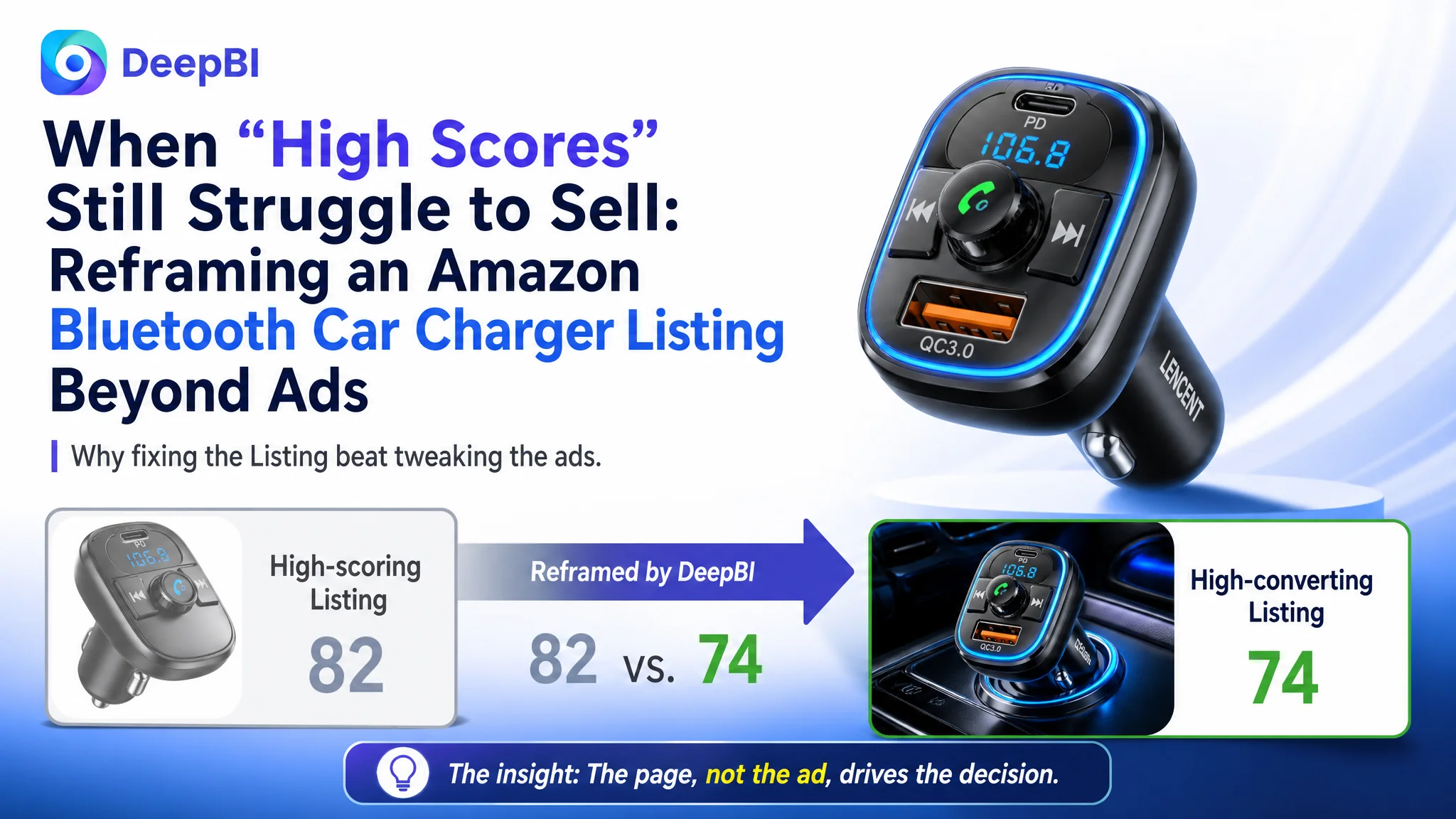
An Amazon seller in the car electronics category came to us with an unusual contradiction: their Bluetooth car charger Listing looked objectively strong. DeepBI’s full-page audit even showed an overall score higher than a key competing Amazon Listing. Yet when they pushed Amazon ads, the return was unstable, acquisition felt expensive, and the product page was not converting traffic as efficiently as expected.
The seller’s first instinct was to blame the ads: they suspected keyword structure, bids, or budget caps were holding orders back. But when we put their Amazon Listing side by side with a benchmark competitor in the same multifunction “retractable car charger + Bluetooth” space, a different picture emerged. The real constraint wasn’t traffic volume or ad mechanics—it was how the page was framing the product at the click and decision stages.
By dissecting title logic, main-image behavior on the search results page (SERP), and the trust sequence inside A+ content, DeepBI identified a gap: this Listing scored well in many internal dimensions, but it was not aligned with how buyers in this sub-category actually decide. Once the optimization focus shifted from “fix the ads” to “tighten the page’s decision logic”—especially title focus, scene-based main images, and a clearer A+ story—ad traffic started to make sense again. This case is a useful reminder for Amazon sellers: a “high-scoring” Listing can still cap your ad performance if it doesn’t match the way your category’s best-converting pages talk, show, and reassure.
Amazon Ads Were Not Failing. The Page Was Consuming the Traffic.
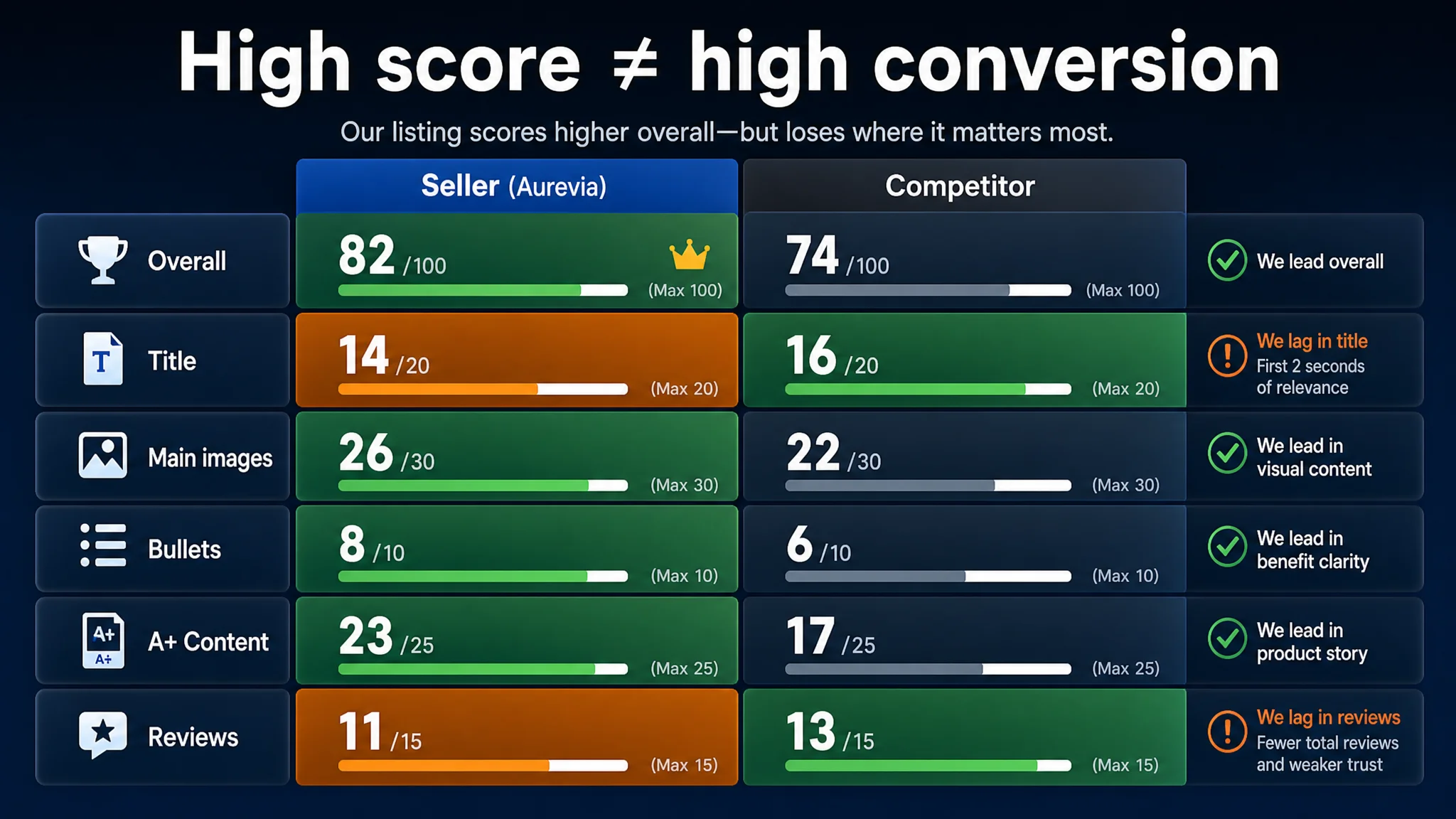
From a pure scoring perspective, this Amazon Listing looked healthy:
- Overall Listing score: 82/100
- Benchmark competitor: 74/100
On paper, the seller’s page even outperformed the competitor in several key areas:
- Main images: +4 points
- Bullet points: +2 points
- A+ detail page: +6 points
Only two dimensions lagged:
- Title: –2 points
- Reviews: –2 points (slightly fewer stars and far fewer total reviews)
The seller’s narrative was: “Our page is already pretty strong. ACOS pressure must be an advertising problem.” They had been iterating keywords, bids, and campaign structure, but couldn’t get a stable, satisfying cost-per-order. Clicks came, but orders were not following the way their ad dashboards suggested they should.
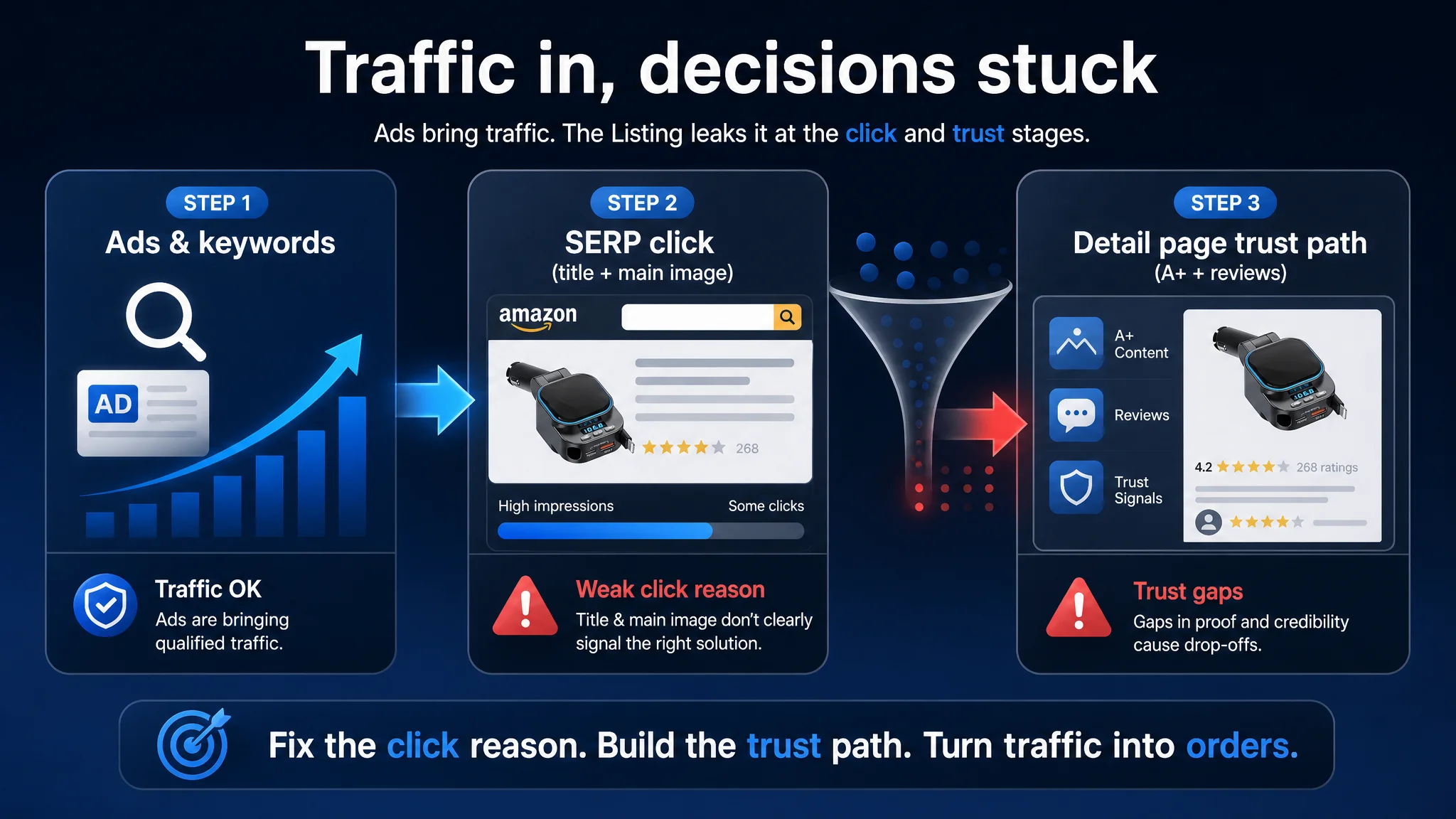
DeepBI’s diagnosis was different: this product did not lack traffic. It lacked a click reason and a trust path that matched buyer psychology for ‘retractable Bluetooth car chargers’.
“The real problem was not that ads failed to bring traffic. It was that the page could not convert the traffic.”
The benchmark competitor made that painfully clear.
The Real Constraint Was Listing Conversion Capacity
When we compared both Amazon Listings in context, one pattern stood out: the competitor was weaker overall, but stronger exactly where the buyer’s decision is made—at the search result and first-glance level.
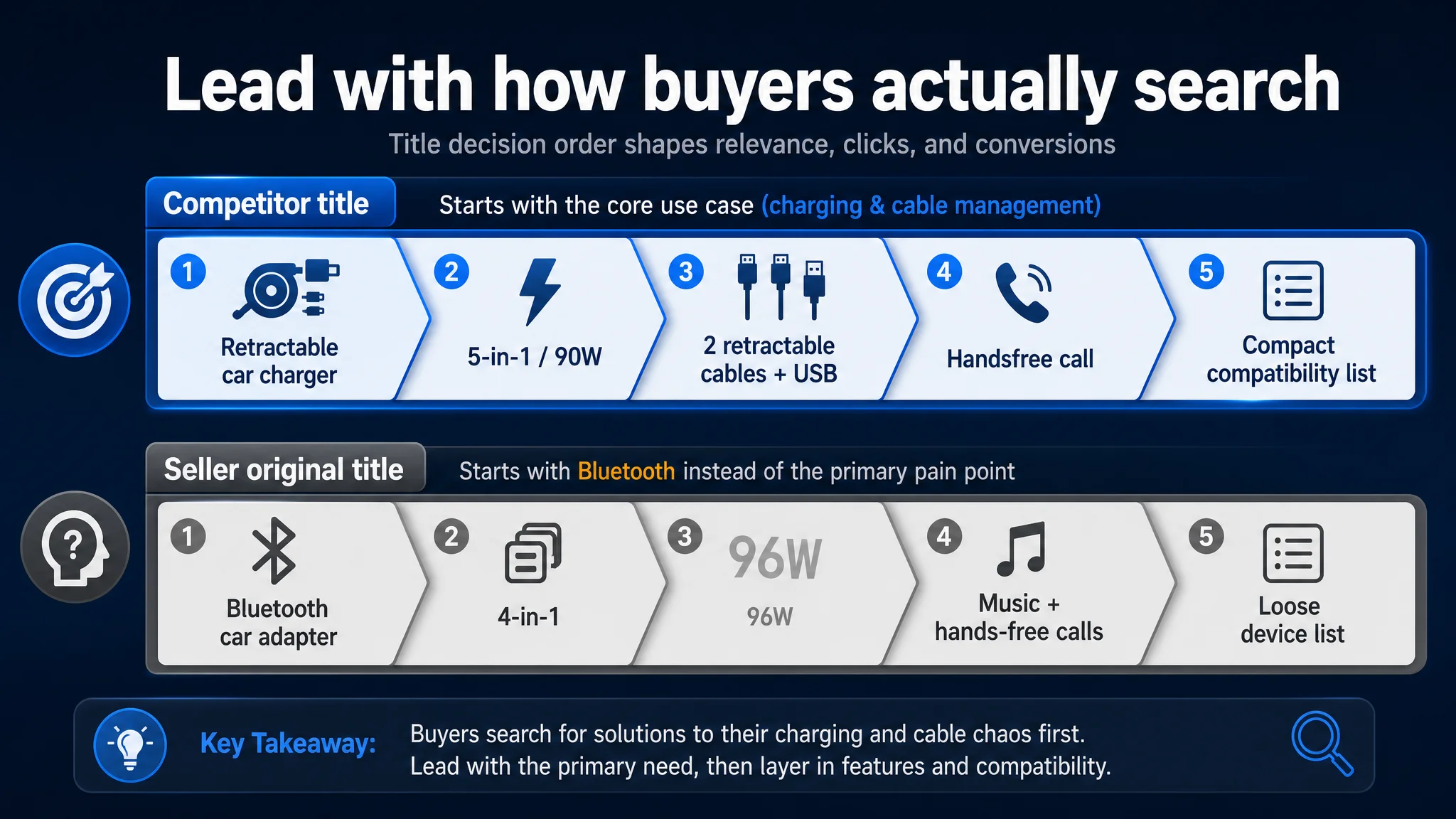
Title: The wrong lead for this category
The seller’s original title leaned into “Bluetooth Car Adapter” as the lead phrase. The competitor did the opposite:
- Competitor: opens with “Retractable Car Charger”
- Seller: opens with “Bluetooth Car Adapter”
In this niche, buyers are usually starting from a very concrete pain point:
- Car interior full of tangled cables
- Need multi-device fast charging from the cigarette lighter
- Bonus: want Bluetooth audio / hands-free calls if it’s part of the package
The competitor’s title logic followed that decision order:
- Lead with the core use case: retractable car charger
- Quantify clearly: “5 in 1”, “90W”
- Spell out cable types and counts: “2 retractable cables and USB chargers”
- Front-load a key differentiator: “Handsfree Call”
- Compact, dense compatibility listing at the end
By contrast, the seller’s title:
- Led with Bluetooth rather than charging
- Mentioned “96W” (actually stronger), but without a comparative frame
- Used “4-in-1” without unpacking what “4” concretely means
- Buried “Hands-Free Calls” behind “Music” and other attributes
- Listed device models with looser spacing, reducing tightness and readability
On an Amazon SERP full of tiny thumbnails and 2–3 visible lines of title, the competitor’s Listing answered “Is this a retractable car charger that solves my mess of cables and charges fast?” faster and more concretely.
In other words, the seller was winning in content depth, but losing the first 2 seconds of relevance.
Main images: Information-rich, but not anchored in real driving scenes
Image scoring favored the seller: 26 vs. 22.
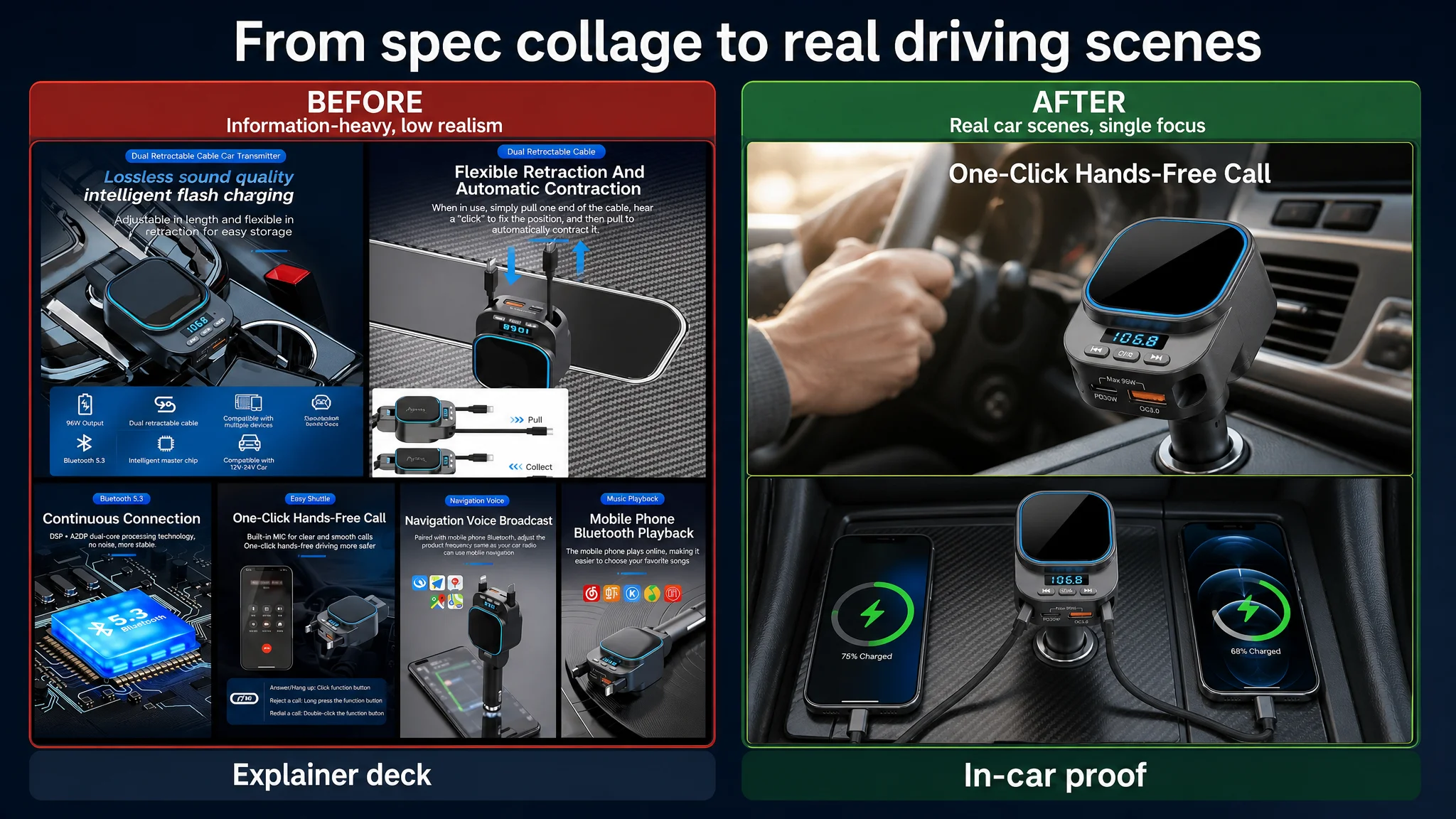
Yet DeepBI’s visual comparison surfaced a subtle problem: the seller’s gallery was technically detailed, but emotionally detached from real driving context.
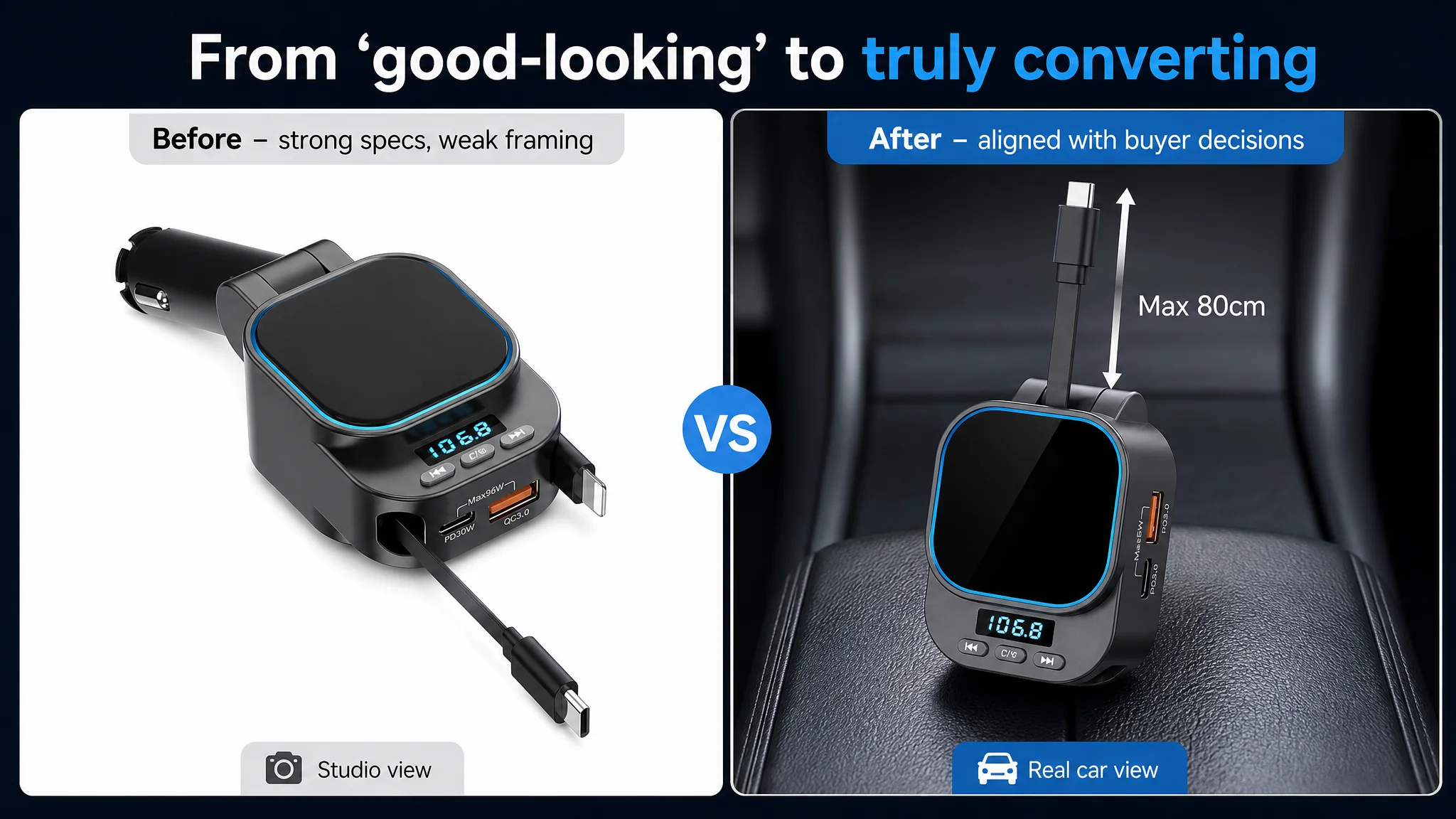
- The primary image lacked an in-car scene; it looked like a product card more than a device living in a car’s console.
- Several images leaned on multi-panel collages and synthetic backgrounds, which increased information but diluted immediacy and realism.
- Some scenes used toy cars or obviously artificial setups, unintentionally lowering perceived professionalism.
The competitor’s main image set had its own problems (e.g., repeated visuals, redundant retractable-cable shots), but crucially, their first image showed the product installed in a real car interior. That immediately lowered mental effort for the shopper: “I can see how this sits in my car.”
So while DeepBI’s scoring recognized the seller’s higher information density, it also flagged a commercial risk: the Listing had become an “explainer deck” more than a “buy this now, it fits your car and your life” page.
Why Traditional Ad Optimization Kept Failing
The seller’s operational logic was straightforward:
1. They saw a relatively solid Listing score.
2. They saw rising ACOS and uneven returns.
3. They concluded: “We need stronger ad optimization—more keywords, cleaner structure, better bids.”
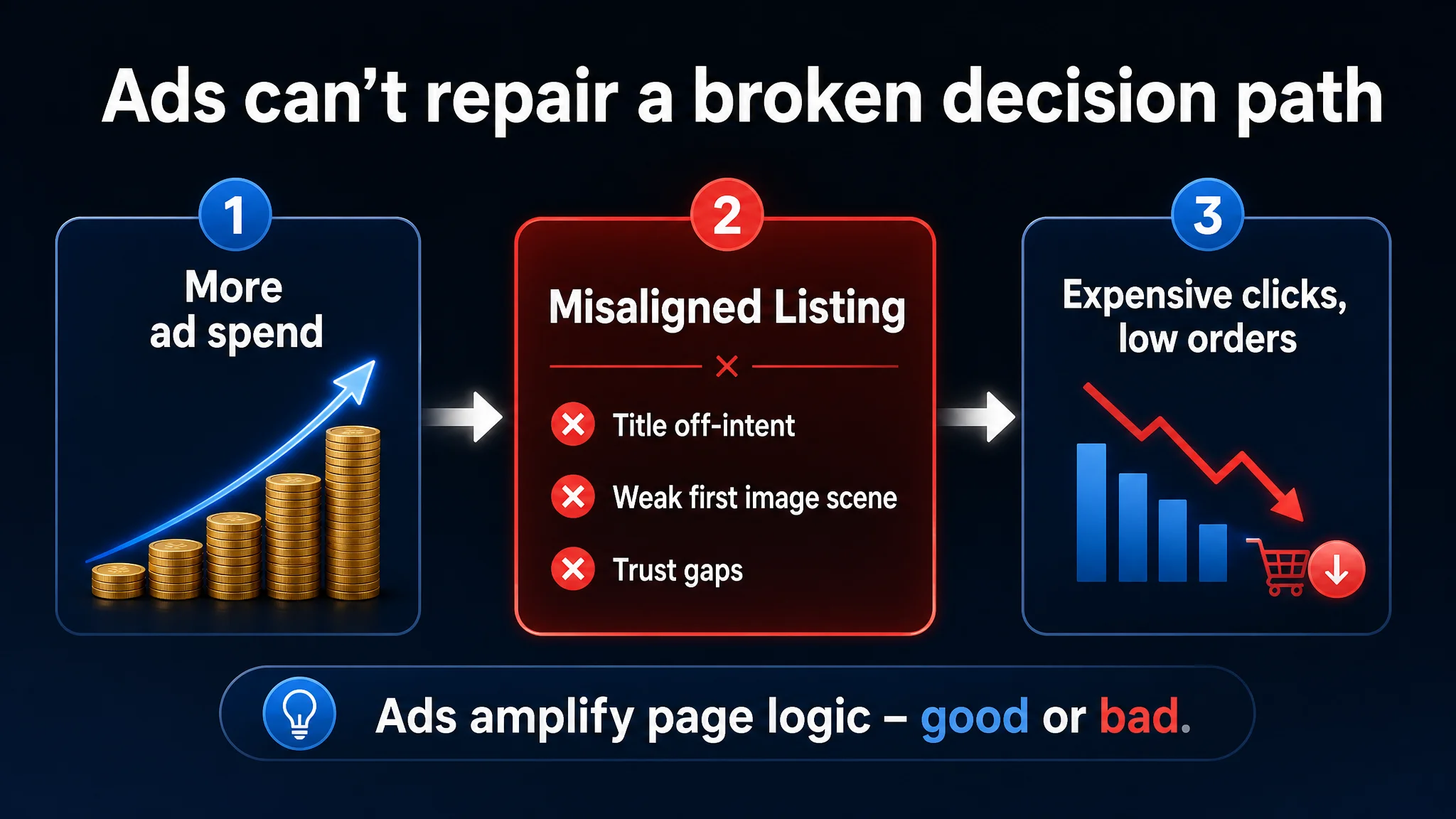
The problem: ads were amplifying a page that didn’t match category decision logic.
- The title didn’t immediately signal “retractable multi-port car charger” to searchers.
- The first image didn’t sell a real driving scenario.
- Reviews, while decent in star rating, lacked the volume and narrative richness that the competitor had.
- One visible 1-star review complained about core functionality (“only charging works”), which hurts trust far more than a competitor’s “manual is unclear” complaint.
So each incremental ad dollar bought impressions and clicks, but many of those clicks landed on a page that:
- Didn’t match the user’s mental starting point (charging + cable management first, Bluetooth second).
- Didn’t visually prove “this will clean up your car and still charge everything fast.”
- Didn’t quickly neutralize safety and compatibility anxieties.
As a result, advertising was not the bottleneck; it was the magnifier of a misaligned page.
What DeepBI Saw in the Listing Data That Changed the Direction
DeepBI’s Listing scoring made the contradiction visible:
- Overall, the seller had higher scores than the competitor.
- But the competitor outscored in title and reviews:
- Title: seller 14 vs. competitor 16
- Reviews: seller 11 vs. competitor 13
- The competitor also had:
- 1762 reviews vs. the seller’s 268
- Richer mention of multiple functions (fast charging, Bluetooth, voltage display) in review text
From a conversion-funnel perspective, this pointed to one core constraint:
The Listing’s conversion capacity at the SERP and trust layers was weaker than its internal content quality suggested.
That’s why DeepBI did not start from “let’s restructure campaigns.” Instead, the priority became:
1. Tighten the title to align with winning search behavior and competitor framing.
2. Rebuild key images around real-car scenes and single-focused messages, not collages.
3. Refine bullets and A+ so they form a clean “pain → solution → proof → safety” story that works with, not against, the images.
Only after that would it make sense to push more ad traffic.
This Product Page Did Not Lack Information. It Lacked a Buying Logic.
The internal content of the seller’s Listing was, in many ways, more sophisticated than the competitor’s.
Bullet points: Strong structure, but missing one strategic angle
DeepBI’s analysis showed:
- The seller’s bullets were scenario- and benefit-driven:
- “tangle-free”, “early warnings”, “crystal-clear”, “guardian”, “safety expert”
- The structure was logical:
- From charging → to calls & audio → to compatibility → to voltage monitoring → to integrated value
- The copy used concrete data:
- “0% to 50% in 30 minutes”
- “180° rotatable plug”
The competitor, by contrast, leaned heavily on parameters:
- PD30W, cable length, port outputs, voltage display, protocol lists.
That’s why the seller’s bullets scored higher. But against this benchmark, DeepBI still saw a gap: the Listing did not fully exploit its own strongest differentiators in a way that closed the loop with the title and images.
The optimization plan therefore:
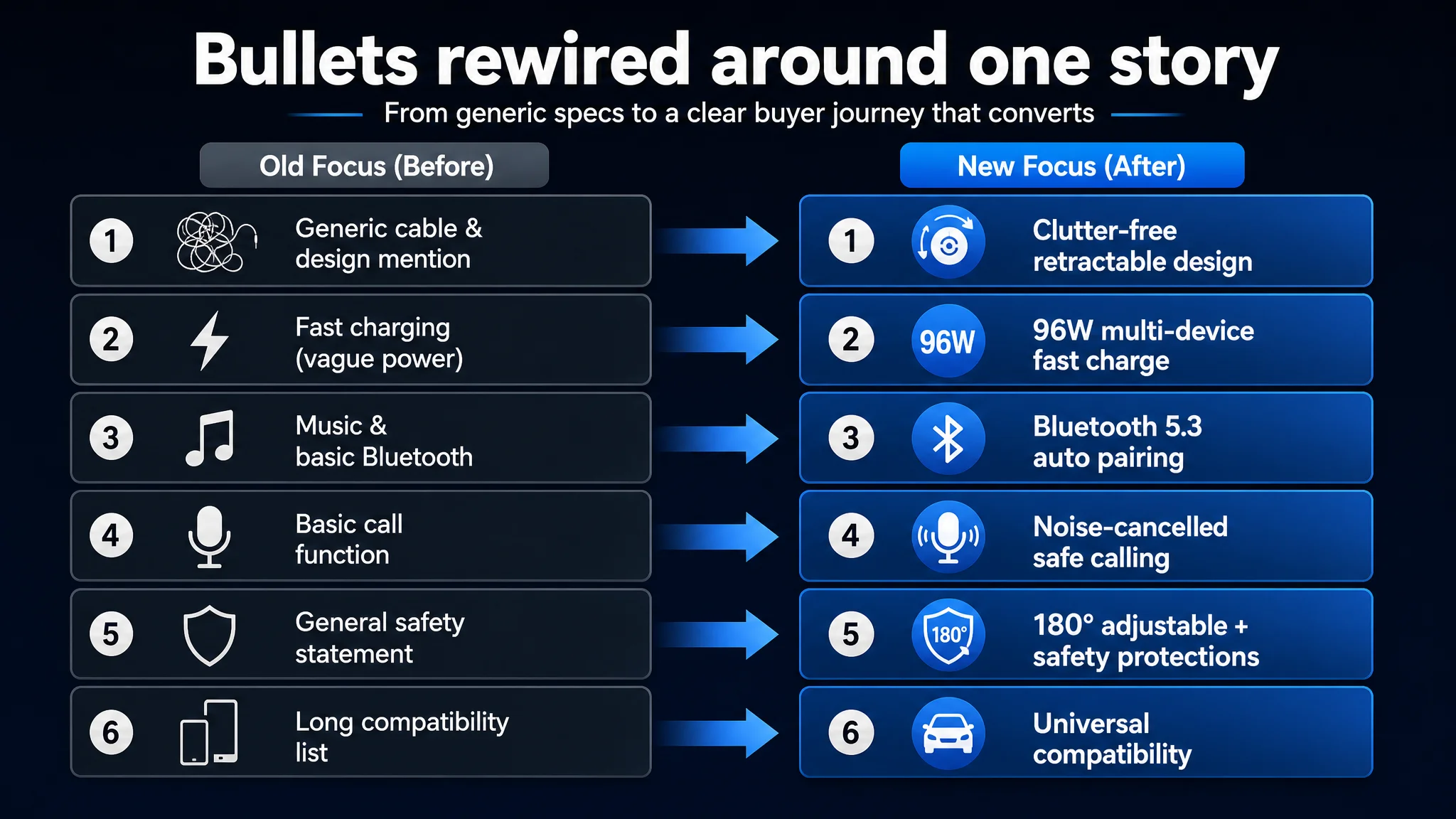
- Re-anchored Bullet #1 on clutter-free retractable design, mirroring how the competitor linked “retractable” to “clean and organized” but tying it back to the seller’s 4-in-1 configuration.
- Strengthened Bullet #2 around 96W high-speed multi-device charging, clarifying “up to four devices at full speed” and reducing the need to “carry multiple chargers.”
- Expanded Bullet #3 to fully own Bluetooth 5.3 as a category differentiator (auto pairing, lower latency, stable streaming).
- Pushed Bullet #4 into noise-cancelled, safe calling (CVC) as a driving-safety benefit, not just an audio feature.
- Combined Bullet #5 with 180° adjustable plug + safety protections into a safety and stability story that feels both mechanical and electronic.
- Added Bullet #6 to address universal compatibility, mirroring the competitor’s rich compatibility list to strengthen search coverage and reduce buyer doubt.
In other words, bullets stopped being just “better than competitor” internally and became aligned with the top-level claim the title would make and the scenes the images would show.
The Detail Page Had Strength—but the Story Needed to Be Grounded
On A+ and detail content, DeepBI’s scoring already favored the seller:
- Seller: 23/25
- Competitor: 17/25
The seller’s A+ used:
- High-end full-width car interior hero scenes.
- Pain-point vs. solution contrasts (cable mess vs. retractable organization).
- Power and chip visuals (96W, Bluetooth 5.3, dual-core chip).
- Step-by-step operation diagrams.
- Multi-layer safety shields.
- Side-by-side “hero vs. standard” comparison.
The competitor’s A+ was more fragmented, mixing:
- Compatibility grids
- Structure/heat dissipation visuals
- Vehicle shots
- Brand logos
- Button close-ups
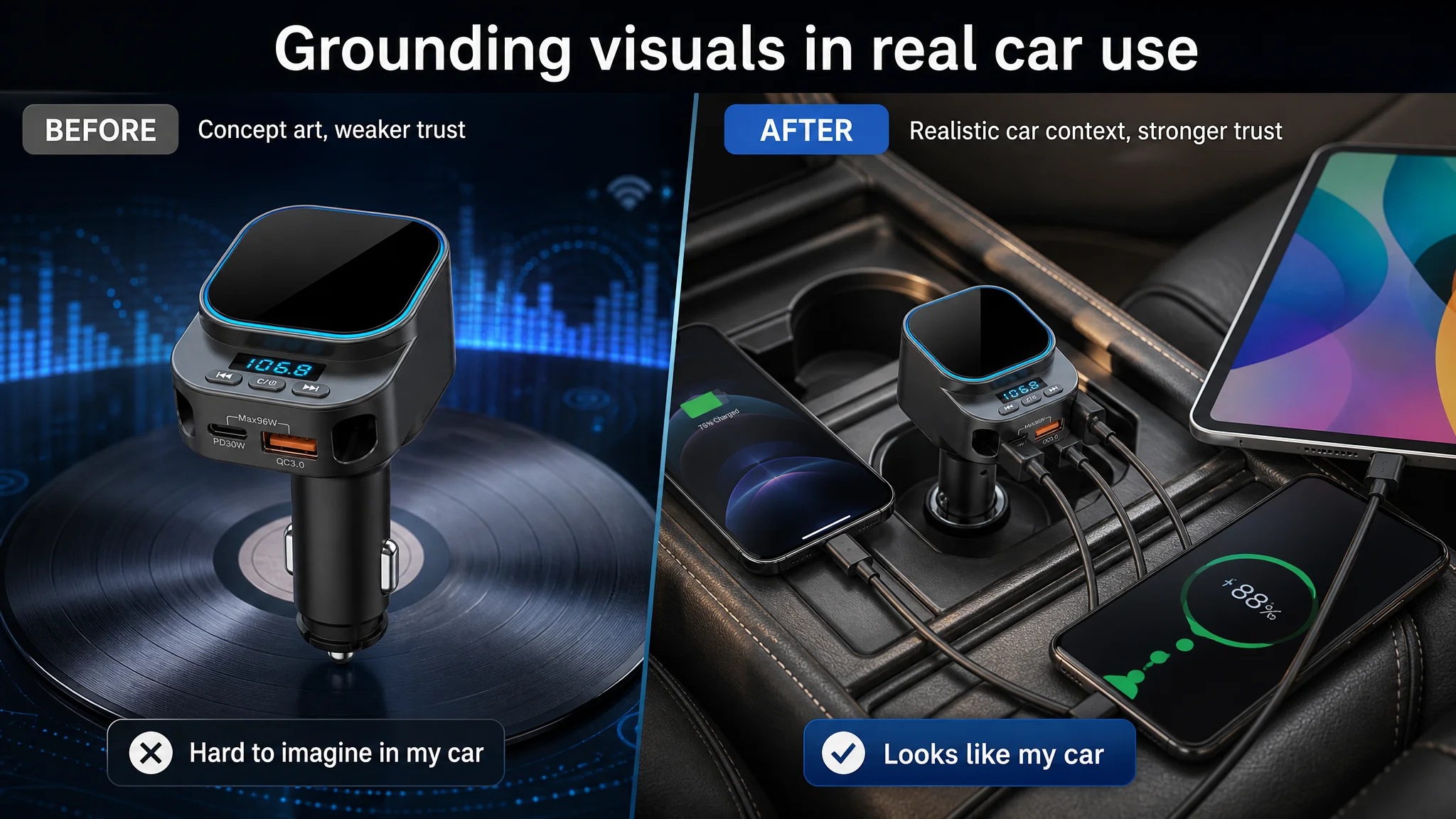
Yet DeepBI flagged one risk: some of the seller’s visuals drifted into “concept art” and away from felt reality.
Examples:
- Using a vinyl record as a base for a car charger felt clever but disconnected from the car environment.
- Ice block visuals to communicate “not hot” felt exaggerated and less credible than down-to-earth, professional safety cues.
The optimization direction focused on keeping the structural strengths but grounding the visuals in realistic car and product contexts:
- For cable management:
- A clear left/right comparison: messy cable-filled console vs. neat, high-end interior with the retractable charger installed.
- For 96W fast charging:
- Macro shot of ports and cables, plus a simple progress/bar chart with real, relatable time/percentage, instead of just a giant “96W” number.
- For Bluetooth music:
- A warm in-car scene: sunlight, leather console, phone near the charger, emphasizing actual usage.
- For safety:
- A professional, geometric product-on-pedestal scene, emphasizing “tested, engineered, protected” rather than visual tricks.
This preserved the original A+ richness but made it more credible and emotionally congruent with car electronics expectations.
Why DeepBI Did Not Keep Tuning the Ads First
From a purely advertising perspective, the seller’s instinct to keep tweaking campaigns was understandable. But the underlying logic was flawed:
- If the SERP presence (title + main image) is misaligned with category search intent, more impressions and clicks will not fix CVR.
- If the product page doesn’t quickly resolve “Does this fit my car?”, “Will it really charge all my devices?”, and “Is it safe?”, then higher ad spend just magnifies that uncertainty.
DeepBI’s judgment:
1. The Listing’s internal quality (bullets, A+) was already above average.
2. The external framing—what shoppers see before they decide to click, and what they feel in the first 5–10 seconds on the page—was the true bottleneck.
3. Ads were therefore not the primary problem, but they were making the bottleneck more expensive.
The decision path:
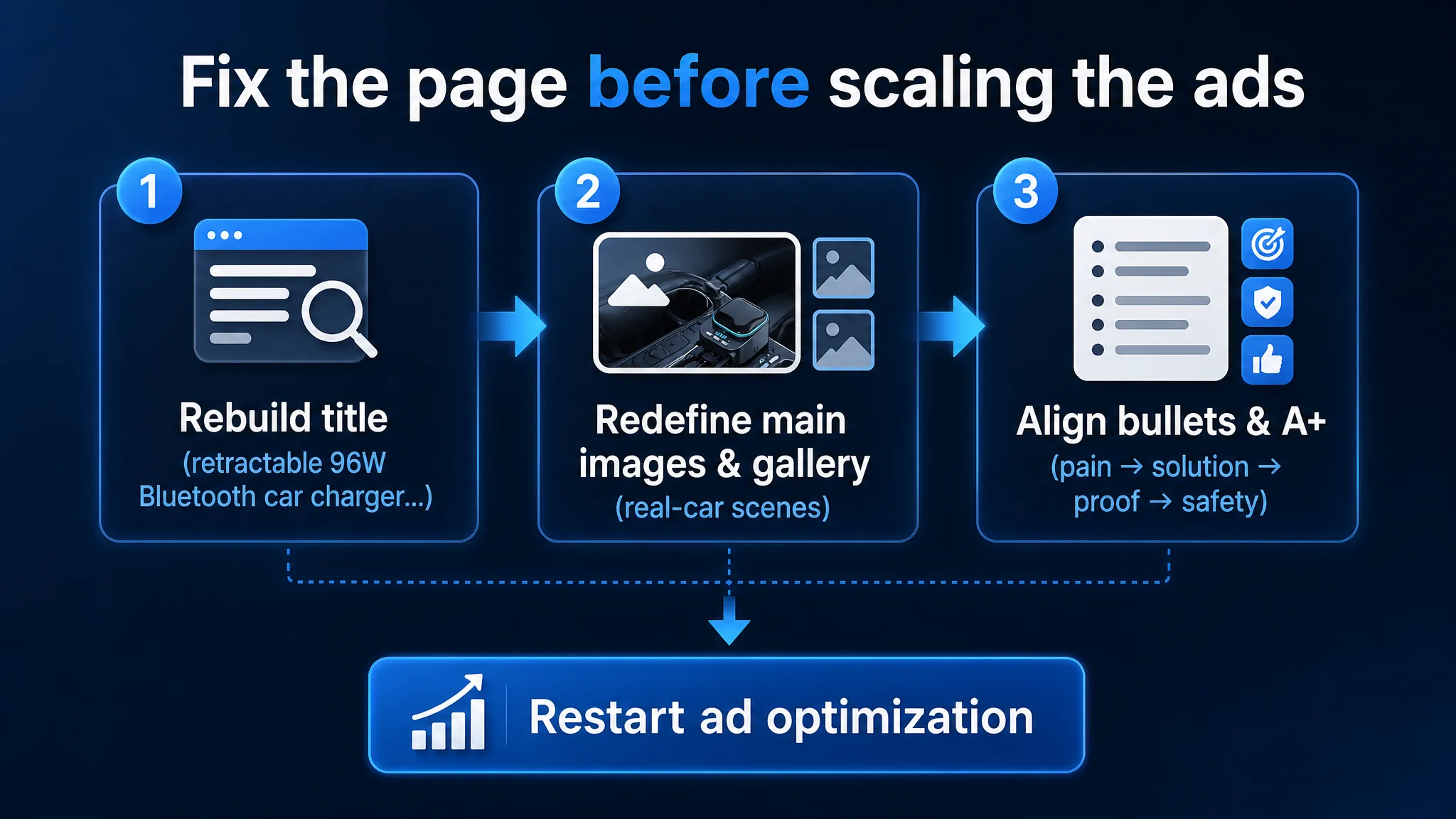
- Step 1: Rebuild the title
Lead with “Retractable 96W Bluetooth Car Charger” and 4-in-1 fast charging, emphasizing Bluetooth 5.3 FM transmitter and hands-free calling, then compact device compatibility lists.
- Step 2: Redefine main images and key gallery slots
Replace collage-heavy and toy-based visuals with single-focus, real-car scenes:
- Clean white-background hero shot with strong three-dimensional lighting.
- In-console “Max 80cm” retractable cable demo shot.
- Driver-hands-on-wheel scene with “One-Click Hands-Free Call.”
- Two-phone charging scene on a carbon-fiber console, no clutter, no effects.
- Multi-device charging near an armrest, annotated “96W High-Power Output.”
- Step 3: Align bullets and A+ with this new external framing
Ensure that each bullet and each A+ module reinforces the same pain → solution → proof → safety sequence that the new title and images promise.
Only after this foundation is in place does it make sense to:
- Re-evaluate keyword coverage in the new title and bullets.
- Restart ad experiments with more confidence that CTR and CVR can realistically move.
“Advertising does not only amplify advantages. It can also amplify a page’s existing defects.”
How the Page’s Sales Logic Started to Recover
Once the optimization focus shifted from “ads” to “Listing decision logic,” several positive operational changes followed, even without inventing any new features or functions:
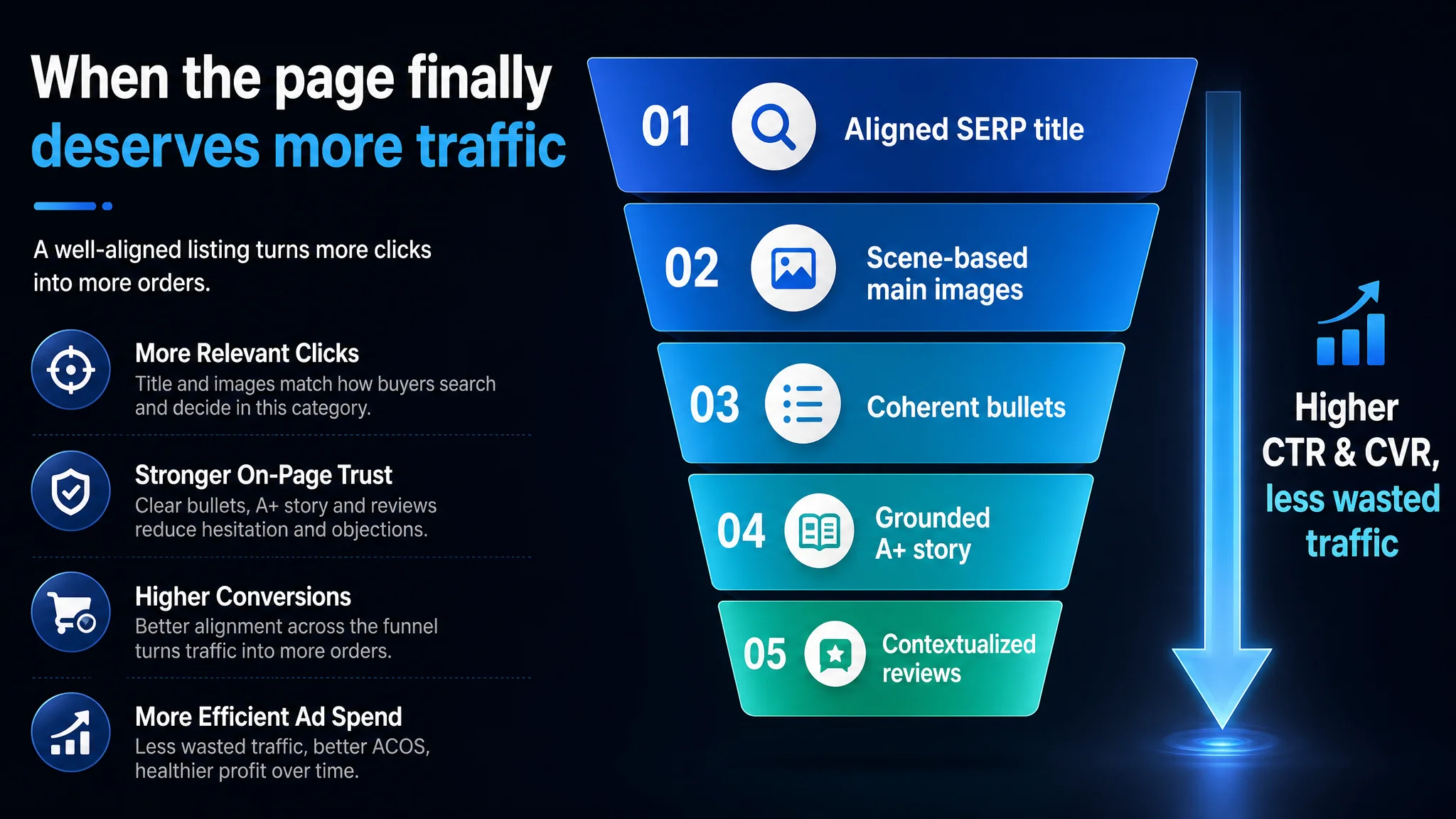
- SERP alignment improved
The title now led with “Retractable 96W Bluetooth Car Charger, 4-in-1 Fast Charging with 5.3 FM Transmitter, Handsfree Calling...” This better matched how high-intent buyers search and what they expect to see when they type those queries on Amazon.
- Click intent became clearer
With a real-car hero image and scene-based mid-gallery visuals, shoppers no longer needed to mentally map a studio product shot to their own console. CTR has a much healthier chance to respond when that mental gap is closed.
- On-page trust regained structure
Bullets and A+ now formed a single narrative:
- This charger cleans your car interior (retractable, clutter-free).
- It actually charges multiple devices fast (96W, four-device support).
- It adds real value vs. a pure charger (Bluetooth 5.3, clear calls).
- It is designed with driving realities in mind (CVC noise canceling, 180° adjustable, stable fit).
- It is broadly compatible and safe (multi-protocol, 12V–24V vehicles, protection circuits).
- Review risk was contextualized
While DeepBI could not change the existing negative review about core functionality, improving the overall professional feel and clarity of the Listing helped reduce the perceived weight of that one comment. Buyers comparing both pages were now more likely to see a coherent, premium-level story instead of a “good-looking but slightly off” page.
As the Listing conversion logic strengthened, ad traffic stopped feeling “wasted.” The page began to have the capacity to absorb both organic and paid traffic more effectively, making future ad optimization meaningful instead of compensatory.
What Changed in the Seller’s Understanding
Before this diagnostic, the seller believed:
- High ACOS and shaky ROAS were mainly an advertising problem.
- Their Listing was already “good enough” because internal content was richer than the competitor’s.
- The natural next step was to keep tuning campaigns.
After working through DeepBI’s analysis and optimization path, their understanding shifted:
- Amazon ads cannot solve a misframed decision path.
If title and main images do not match how the category decides, no campaign structure will fully fix conversion.
- Listing quality is not just about “more content.”
It is about whether title, main image, bullets, A+, and reviews form a coherent funnel that mirrors the best-performing competitor logic.
- CTR and CVR are joined at the Listing.
Ads can bring volume, but the Amazon product page itself—especially for high-competition electronics—determines whether that volume becomes profit or just spend.
- Before scaling ads, the question is: “Does this page deserve more traffic?”
In this case, once the Listing’s click reasoning and trust-building were rebuilt, ad spend finally had a realistic chance to translate into stable orders instead of volatility.
For other Amazon sellers, especially in technical but crowded categories like car chargers, this case underlines a simple but often overlooked lesson: a high-scoring or “beautiful” Listing is not necessarily a high-converting Listing. The core work is not adding more details, but aligning every pixel and every word with the way your category’s buyers actually make decisions—from search term, to click, to purchase.