

An Amazon jewelry seller in the German marketplace came to DeepBI with a familiar frustration: the Listing looked “decent”, ads were already running, but the product page still could not match a key competitor’s conversion. The team’s first instinct was to treat this as a typical Amazon Listing-copy issue—improve the title a bit, polish some bullet points, and then continue tweaking bids and keywords in Amazon ads.
DeepBI’s diagnosis showed something different. The title was indeed suboptimal, but the deeper constraint was the Listing’s conversion capacity as a whole: a misweighted title structure, weak bullet-point buying logic, mismatch between A+ strengths and above-the-fold content, and—critically—a review profile that was quietly eroding trust. Ads were bringing traffic; the page was consuming it.
The optimization therefore shifted from “keep polishing the title and adjusting ads” to “rebuild the sales logic of the Amazon product page, then let Amazon ads amplify a page that actually converts.” The work focused on title restructuring, rewriting bullet points around material trust and emotional value, tightening the main-image narrative, and aligning A+ content with what buyers most care about. This case gives other Amazon sellers a concrete reminder: high ACOS and weak orders are not always an ad problem; often, the real bottleneck is the Listing’s ability to turn clicks into confident purchases.
The Real Constraint Was Not Traffic. It Was Conversion Capacity.
From the seller’s perspective, the situation looked straightforward:
- The product is a clover-themed jewelry set for women on Amazon Germany.
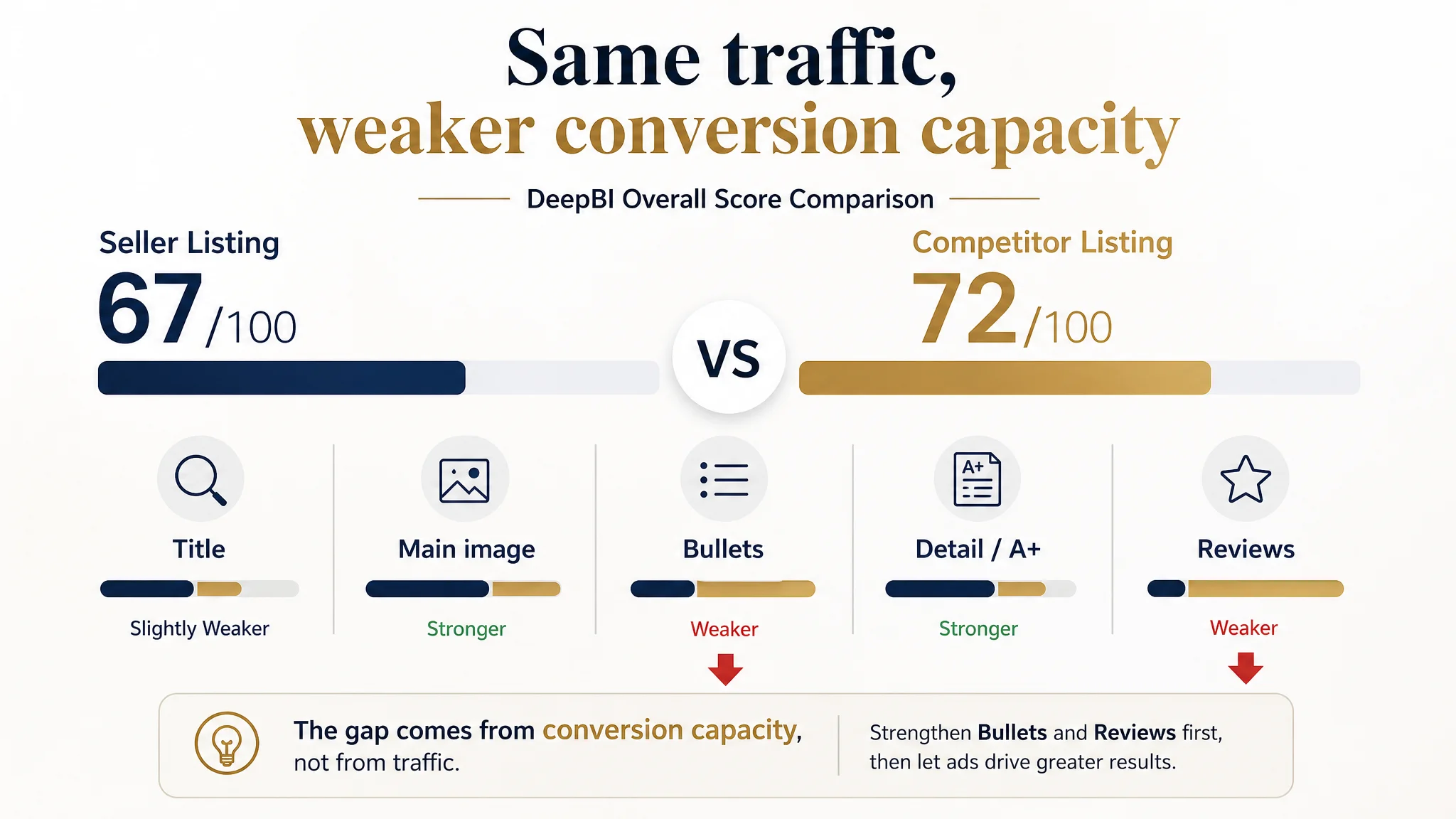
- The Listing had a DeepBI score of 67/100, while a directly comparable competitor scored 72/100.
- Ads were already in play, but results were fragile and hard to scale.
On the surface, a 5-point gap does not look catastrophic. That is exactly why the seller initially treated this as a “light optimization” problem—tune the title, adjust some keywords, and keep pushing ads.
DeepBI’s scoring breakdown, however, exposed an imbalance:
- Title: 10 vs competitor’s 12 (out of 20)
- Main image: 26 vs 24 (out of 30) – the seller actually led
- Bullet points: 5 vs 8 (out of 10)
- Detail/A+: 21 vs 19 (out of 25) – again slightly ahead
- Reviews: 5 vs 9 (out of 15)
On paper, the seller “won” in main images and A+ content, yet still lagged overall. That forced a different question:
If the visuals are not obviously weaker, why is this Amazon Listing still losing conversions?
The answer had two parts: conversion logic above the fold (title + bullets) and trust damage from reviews.
The Customer’s Original Misdiagnosis: “Our Visuals Are Fine. The Title Just Needs a Bit of Work.”
Initially, the seller’s operating logic was:
- The main images and A+ content look polished.
- The brand story is emotional and differentiated.
- The product is a jewelry set—perceived as value-for-money.
So when conversions underperformed, the team defaulted to:
- Blaming the title for not capturing enough search traffic.
- Blaming ads for high ACOS and “inefficient” clicks.
- Assuming that once the title and keywords were slightly improved, the rest of the Listing would take care of itself.
In other words, they misread this as a traffic quality and title problem, not a conversion structure and trust problem.
That misdiagnosis caused two practical issues:
1. They kept tinkering with ads (bids, keywords, match types) while sending traffic to a page that had not yet earned trust.
2. They underestimated how much the review profile and bullet-point logic weighed on Amazon buyers’ final decision.
Why Traditional Amazon Ad Optimization Kept Failing
DeepBI cross-checked Listing scores with competitive benchmarks and what buyers actually see first.
Several contradictions emerged:
- Main image and A+ looked good, but the title and bullets—the first screen—were underpowered.
- The A+ story was emotionally rich, but reviews were signaling hard quality problems (“color fading”, “stones falling off”, “easy to break”), unlike the competitor, whose negatives were softer (e.g., “slightly small size”).
In this context:
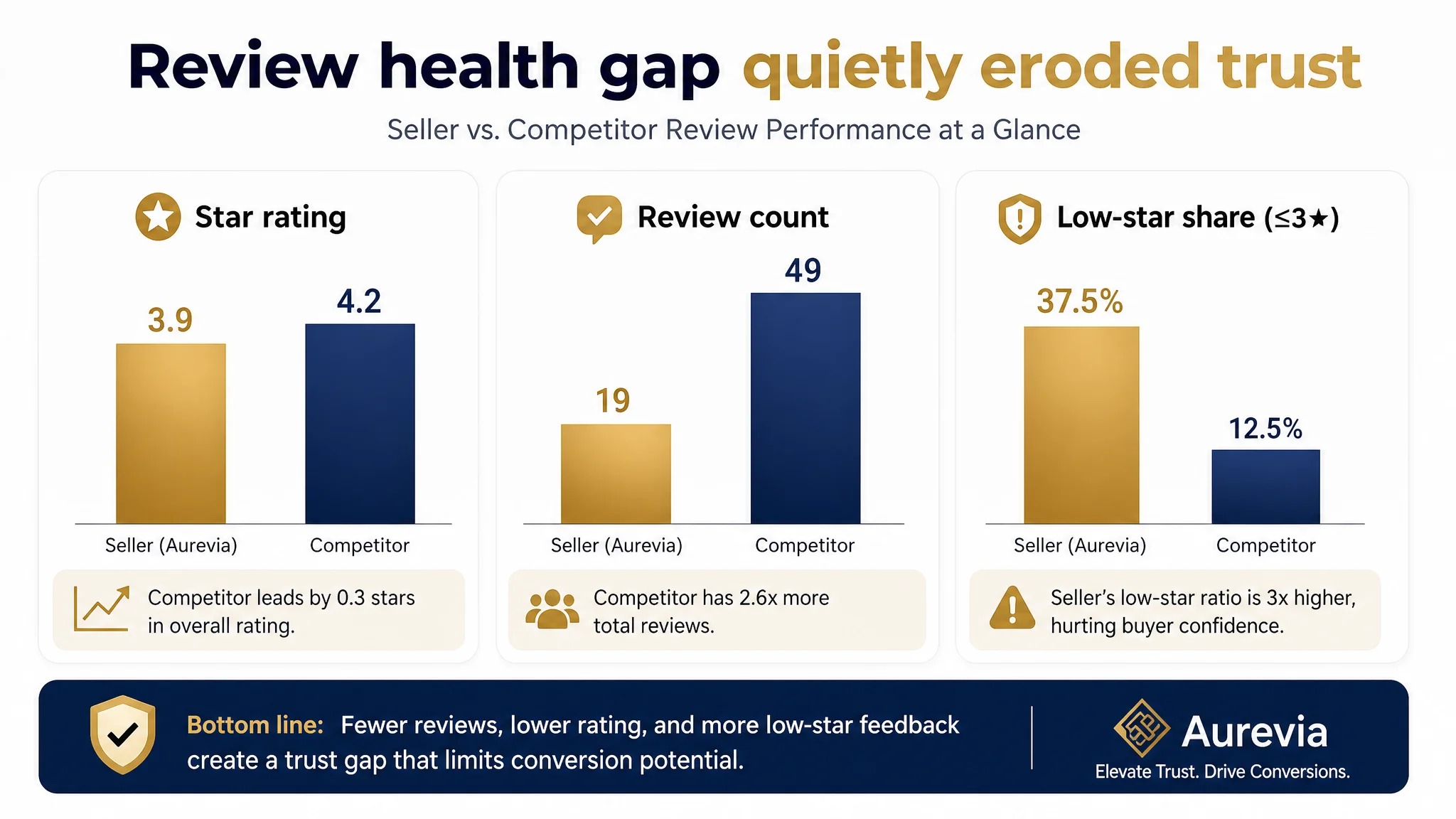
- Even well-targeted Amazon ads could not fix the trust damage caused by 3.9 stars vs competitor’s 4.2.
- The seller had less than 40% of the competitor’s review volume, and 37.5% of homepage reviews were 3 stars or below, three times the competitor’s low-rating ratio.
So every time ad spend increased:
- Clicks came in.
- Buyers saw:
- A title that led with “3 Stück” instead of the clover and material promises they care about.
- Bullets that read like a configuration list, not a jewelry promise.
- Reviews warning about durability and color issues.
Result: ACOS became hard to control not because Amazon ads “underperformed”, but because ads were amplifying a Listing that could not convert the traffic it received.
“Advertising does not only amplify advantages. It can also amplify a page’s existing defects.”
This Product Page Did Not Lack Story. It Lacked Decision Logic Above the Fold.
One of the more interesting findings was that the seller’s A+ detail page was actually stronger than the competitor’s in emotional storytelling:
- A symbolic “five-petal flower” narrative connecting the product to life values.
- Carefully curated gift scenes: birthday, anniversary, party, wedding.
- High-resolution “high-end jewelry” visual style with clean layouts and brand presence.
The competitor’s A+ content stayed closer to purely functional descriptions.
So why was the competitor still converting better?
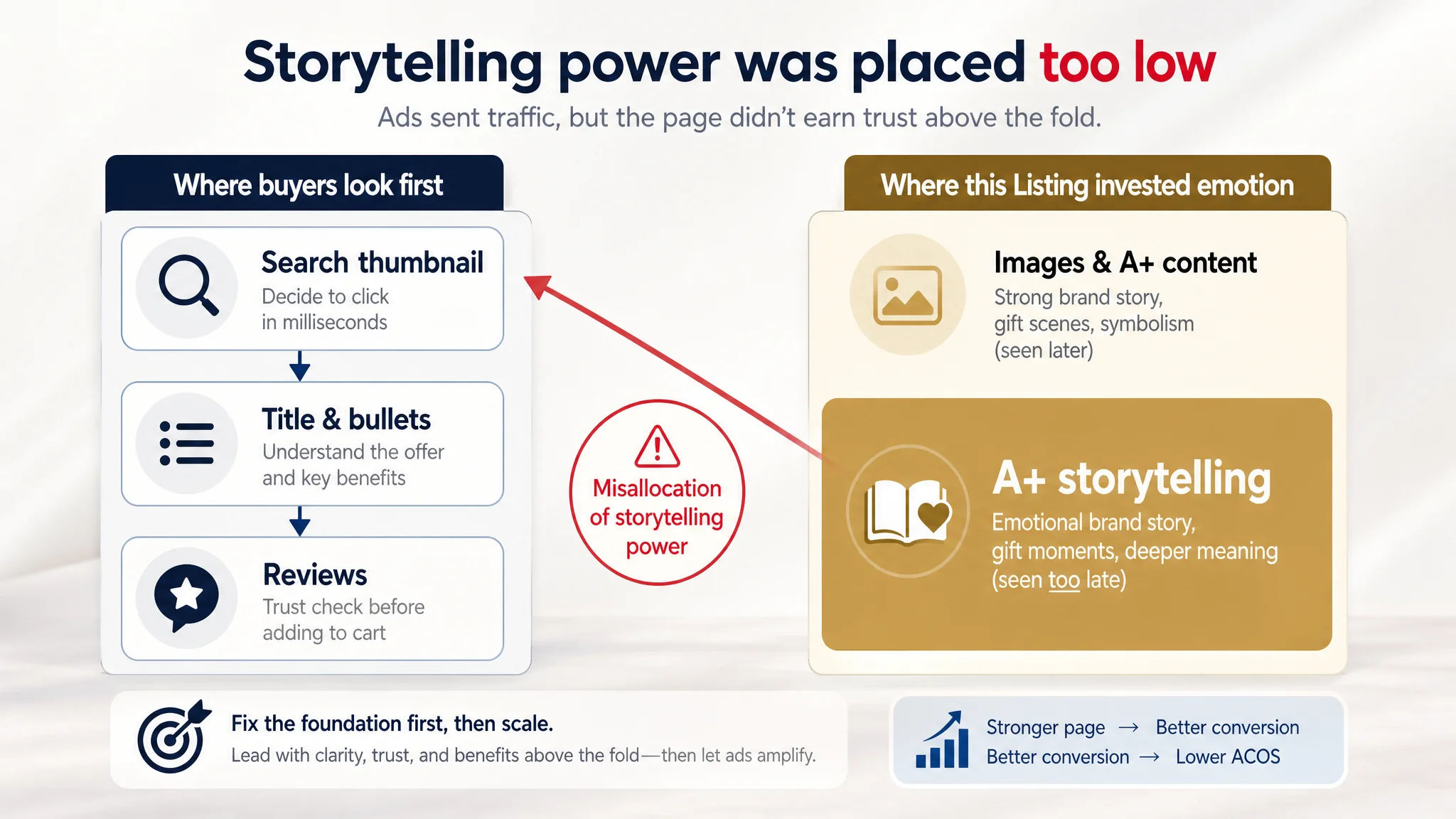
Because Amazon buyers do not start at the A+ section. They start with:
1. Search results (thumbnail + price + review score).
2. Above-the-fold content:
- Title
- Price
- Variants
- Bullets
- Review score
DeepBI’s diagnosis: the storytelling power was misallocated. The seller invested heavily in lower-page emotional content, while the upper funnel (title, main image narrative, bullets, reviews) left too many unanswered questions.
Title: Leading with the Wrong Signal
The title did not respect Amazon’s decision order
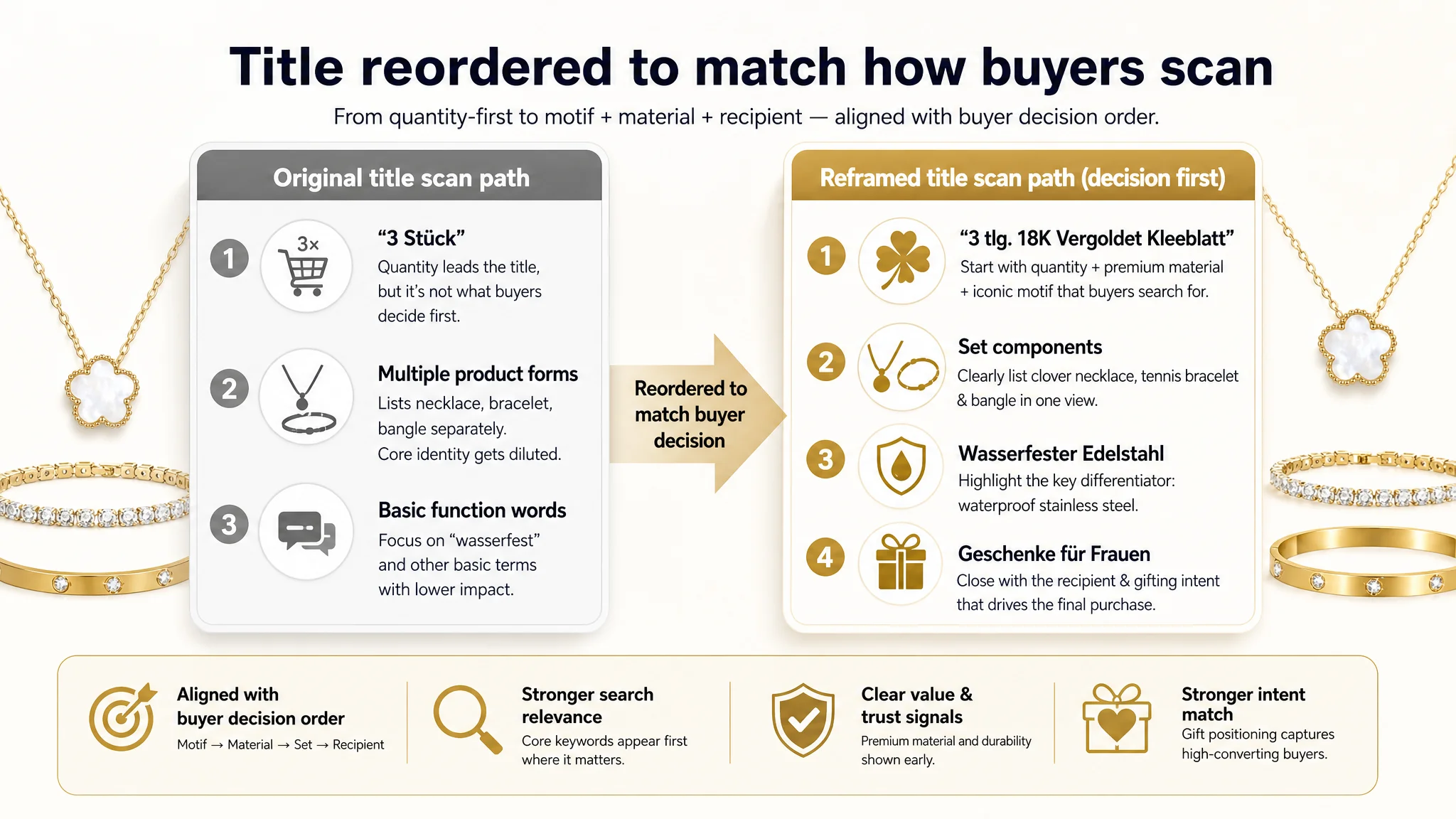
- The original title started with “3 Stück” (3 pieces), pushing the crucial keyword cluster “Vergoldet Kleeblatt” back.
- It then tried to cover multiple product forms: “Kristallen Tennis Armband”, “Zirkonia Armreif”, “Halskette” – which blurred the core identity.
- It leaned on basic functions like “wasserfest” rather than material and value language (“18K Vergoldet”, “Cubic Zirkonia”).
The competitor:
- Front-loaded “18K vergoldet vierblättriges Kleeblatt” as the core search and value phrase.
- Clearly positioned “4PCS Schmuck Set”, then focused on bracelet and necklace.
- Used material descriptors to anchor perceived value.
DeepBI’s revised title direction:
3 tlg. 18K Vergoldet Kleeblatt Schmuck Set für Damen: Vierblättriges Kleeblatt Halskette, Zirkonia Tennis Armband & Armreif, Wasserfester Edelstahl Schmuck, Geschenke für Frauen
Key shifts:
- Front-loads: “3 tlg. 18K Vergoldet Kleeblatt Schmuck Set für Damen”
- Clarifies components: “Kleeblatt Halskette, Zirkonia Tennis Armband & Armreif”
- Keeps the differentiator: “Wasserfester Edelstahl”
- Anchors buyer intent: “Geschenke für Frauen”
This reframing aligns with how Amazon shoppers scan: quantity + material + iconic motif + recipient before they care about every sub-component name.
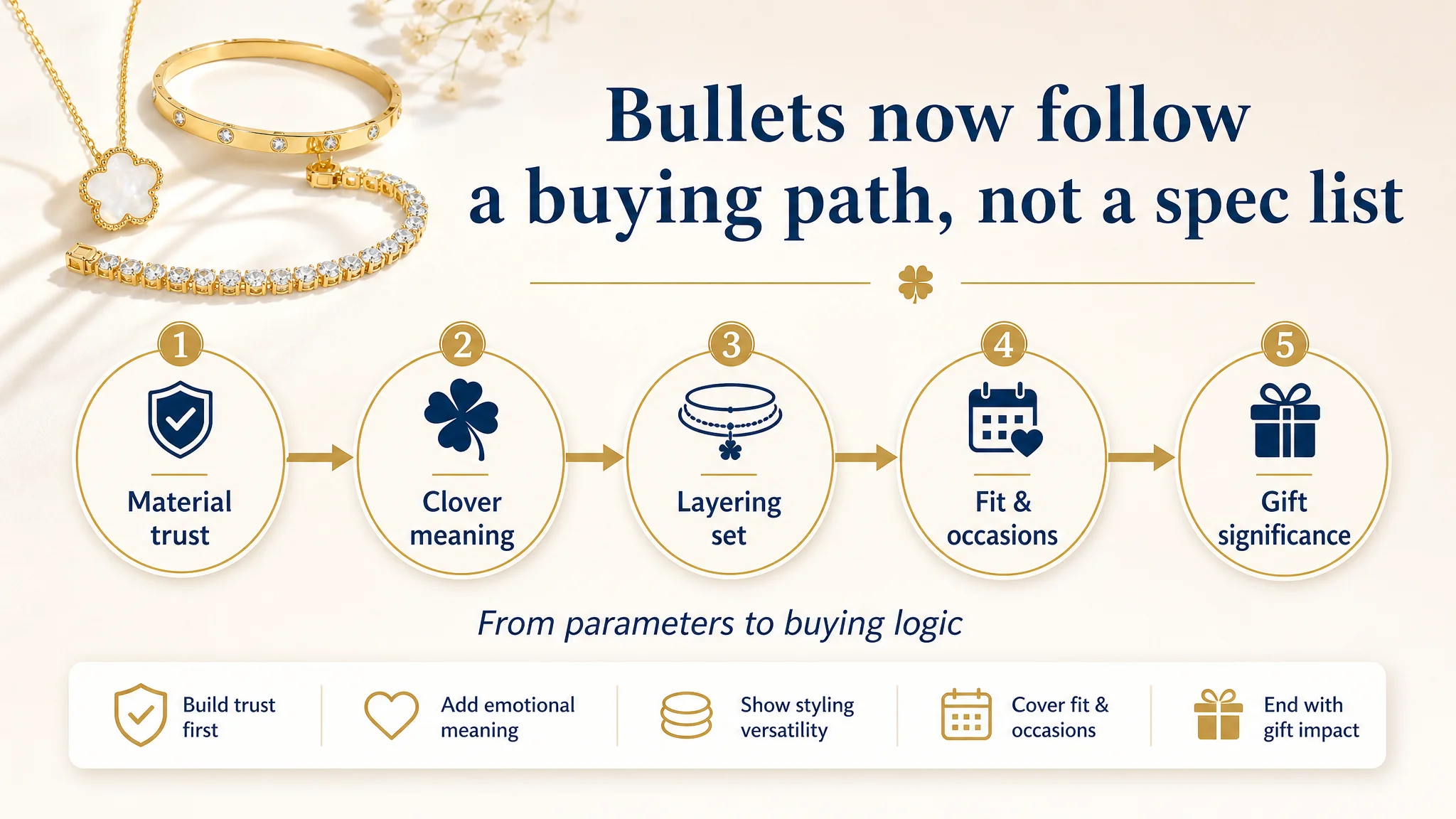
Bullet Points: From Parameter Listing to Buying Logic
DeepBI’s scoring flagged bullet points as a major gap (5 vs competitor’s 8 out of 10). The problem was not lack of information, but lack of buying logic.
How the competitor structured persuasion
The competitor’s bullets followed a clear sequence:
1. Material and durability first (18K gold plating, hypoallergenic 304 stainless steel).
2. Symbolic clover design tied to luck, energy, and positivity.
3. Full-set and layering styles, showing fashion versatility.
4. Multi-occasion usage plus clear gift positioning.
5. Emotional and symbolic closure: more than jewelry, a talisman and reminder.
The seller’s bullets:
- Opened with set composition and configuration—low perceived value.
- Slid into dimensions and parameters, with little emotional connection.
- Scattered mentions of scenes and gifting with weak narrative glue.
- Used more functional language with less imagery and emotional resonance.
DeepBI’s restructuring logic
The optimization did not just “improve wording”; it changed the order of persuasion:
1. Material trust upfront
- Move from vague “high quality” to explicit material and process:
- Hypoallergenic stainless steel and copper, 18K real gold coating, high-polish, oxidation-resistant, skin-friendly.
Example (BP #1):
【Hochwertige 18K Vergoldung & Hautfreundlich】 Gefertigt aus hypoallergenem Edelstahl und Kupfer, veredelt mit einer langlebigen 18K Echtgold-Beschichtung. Dieses Schmuckset ist hochglanzpoliert, oxidationsbeständig und besonders sanft zur Haut – perfekt für den täglichen Glanz ohne Kompromisse.
1. Symbolic design as a genuine “reason to buy”
- Bring the clover symbolism up, tie it to daily emotional value and talisman logic.
Example (BP #2):
【Symbolträchtiges Kleeblatt-Design als Glücksbringer】 Das filigrane Kleeblatt-Motiv symbolisiert Glaube, Hoffnung, Liebe, Glück und Wohlstand. Ein bedeutungsvoller Talisman, der positive Energie schenkt und als tägliche Erinnerung an die Magie kleiner Glücksmomente dient.
1. Set versatility and layering
- Reframe “Set A/B” not as inventory configuration, but as flexible styling options.
Example (BP #3):
【Exklusives 3-Teiliges Set für Perfekte Layering-Looks】 … Alle Teile sind harmonisch aufeinander abgestimmt und ideal für moderne Layering-Styles.
1. Size + scenario combined
- Keep precise dimensions, but embed them into “fit and occasion” logic rather than presenting them as dry data.
Example (BP #4):
【Präzise Passform für Jeden Anlass】 … Ob im Alltag, bei Hochzeiten oder Festen – dieser zeitlose Schmuck passt sich jedem Stil und jeder Bewegung perfekt an.
1. Gift and brand meaning as a closing argument
- Link gift box, recipient, and emotional intent.
Example (BP #5):
【Perfektes Geschenk in Edler Verpackung】 … ein Zeichen der Wertschätzung.
The impact is structural: material → design meaning → styling versatility → fit & occasions → gift significance. That is the kind of path that supports Amazon ad traffic instead of wasting it.
Main Images: Good, but Not Yet Exploiting Their Full Role
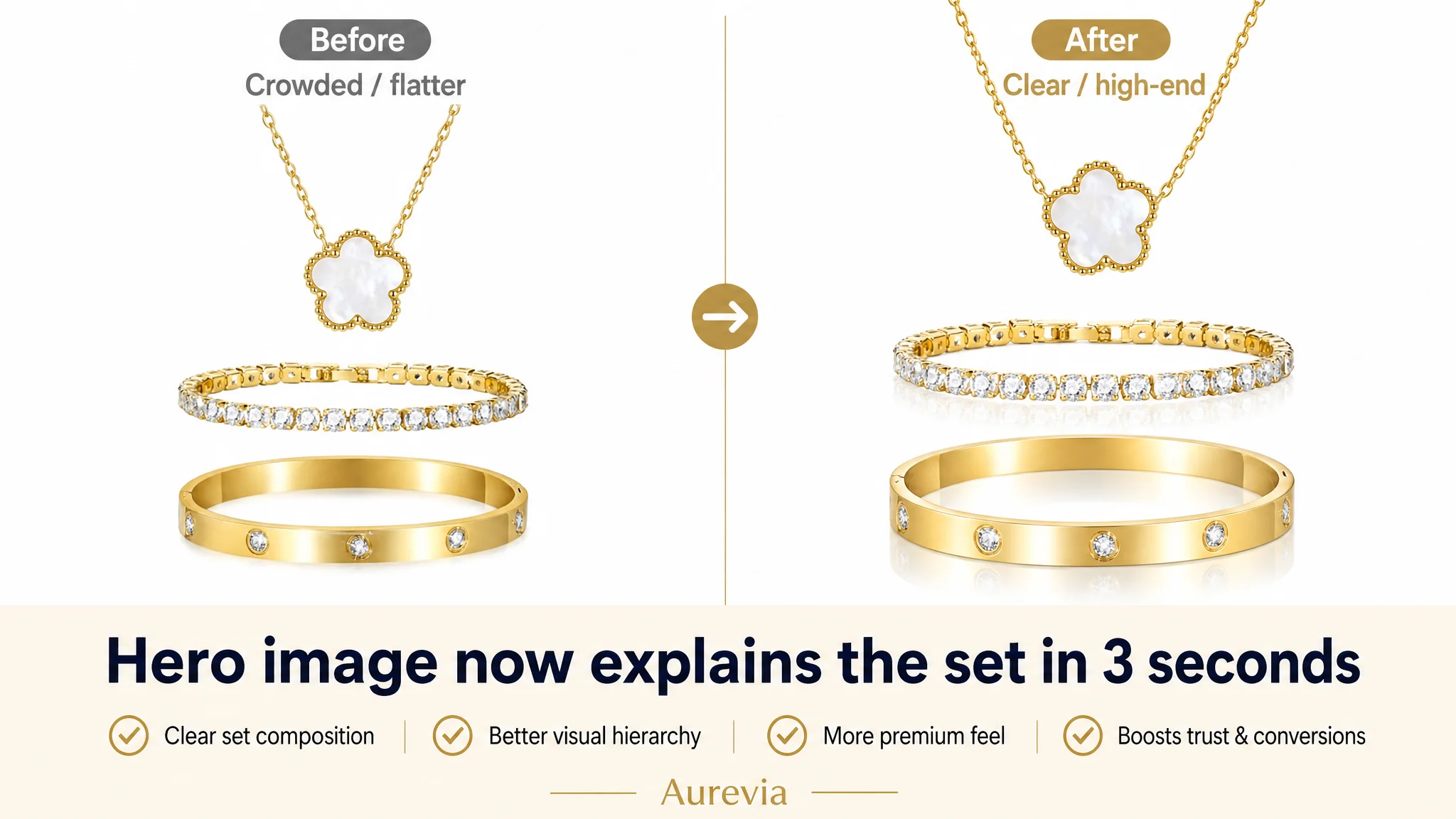
DeepBI’s scoring gave the seller a slight edge on main images (26 vs competitor’s 24 out of 30), but the analysis still identified critical improvement room from a CTR and click-to-detail perspective.
Key issues:
- Some compositions were crowded and under-lit.
- Model shots lacked depth and scenario immersion.
- Technical/parameter visuals were present but not engineered for 3-second information capture.
- Gift scenes overemphasized people and underemphasized the product.
Reframing the main image set
DeepBI’s recommendations were not about “making things prettier”; they were about aligning main-image roles with buyer decision steps:
1. Hero product layout
- Necklace, tennis bracelet, and bangle arranged in a clean inverted triangle.
- 75% of frame, cold white light, subtle reflection on white background.
- Purpose: instant clarity on set composition and a high-end, minimal “German aesthetic”.
1. Neckline-focused model shot
- Close-up, 45° angle, natural sunlight simulation, blurred background, breathing room on one side.
- Purpose: show how the pendant sits at the neckline, highlight geometry and shine.
1. Half-body “full set” shot
- Model pose showing neck and wrist simultaneously.
- Purpose: communicate the logic of wearing the set together; this justifies “set” pricing.
1. Parameter visualization
- Flat-lay on white marble, precise length labels in clean sans-serif type.
- Purpose: reduce returns caused by size expectations and show professional presentation.
1. Gift moment
- Focus on an open deep-blue gift box with jewelry neatly arranged.
- Subtle scene of a hand giving the box, with a warm home/holiday background blurred.
- Purpose: answer the unspoken question: “Is this elegant enough as a gift?”
“The real problem was not that the main images were ugly. It was that they did not fully explain why this set deserved the click and the gift slot.”
A+ Detail Page: Strong Emotion, But Needing Better Alignment
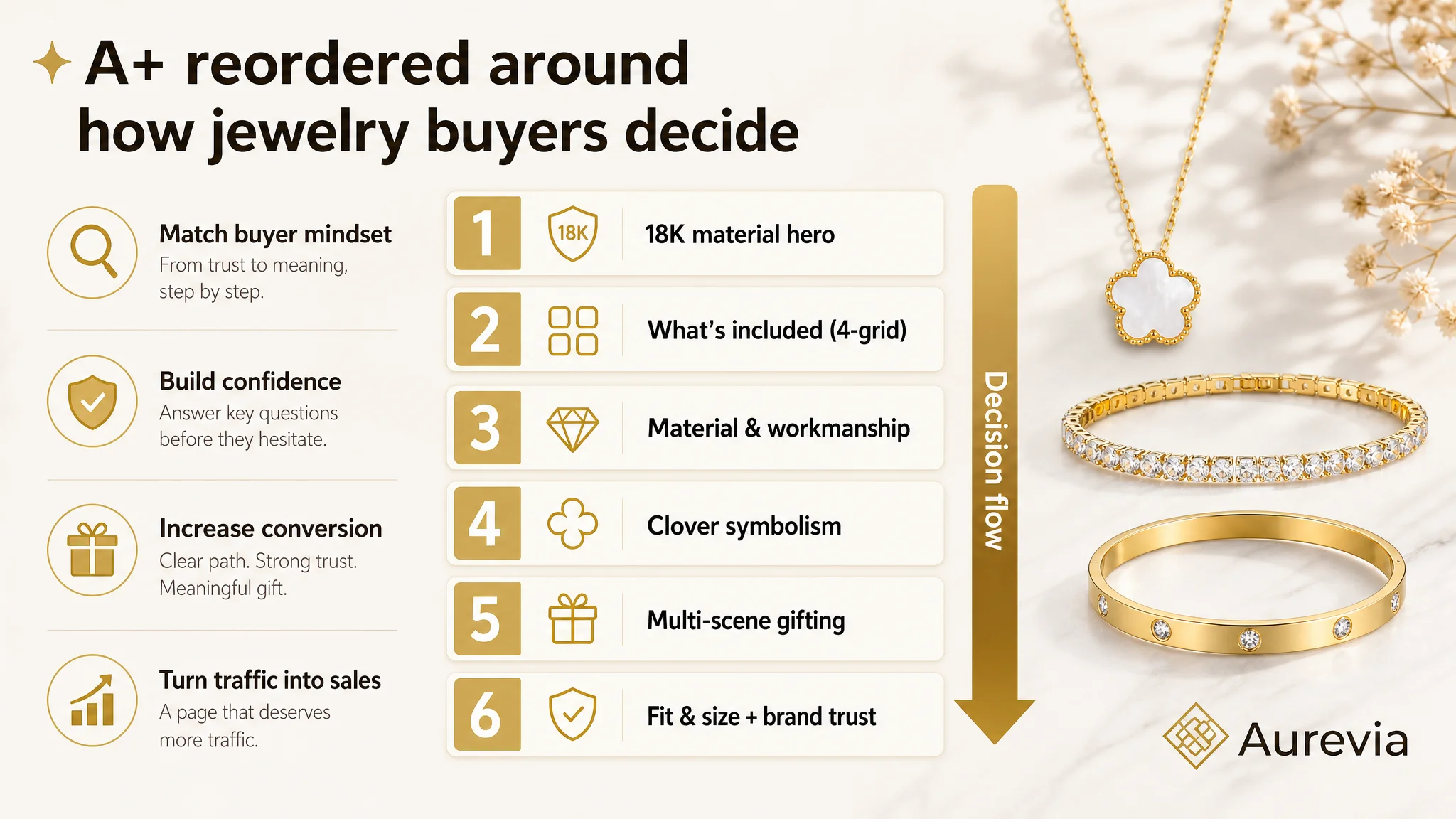
DeepBI’s detail-page analysis actually favored the seller over the competitor:
- Strong symbolic storytelling.
- Four major gift scenarios clearly framed.
- High-end visual structure with large, clean modules.
However, several misalignments reduced the conversion leverage:
- No first-screen material hammer: jewelry buyers care heavily about material and durability. The competitor hammered “18K plating” early; the seller saved that emphasis for later or for text.
- Scattered product composition communication: users had to work to understand exactly what the set included.
- Redundant gift box images: multiple very similar gift scenes consumed valuable A+ real estate that could have been used for materials, sizing, or hypoallergenic reassurance.
- Weak size perception: no clear, labeled wearing-length visuals.
The optimization direction:
- Add a first-screen module with large “18K Vergoldet Kleeblatt Schmuckset” text and a clean outdoor-light image showing material shine.
- Introduce a four-grid component overview (necklace, bracelet, bangle, earrings if applicable), each with a clear label.
- Create a material and workmanship module: macro shots of pendants and clasps with short, bullet-style copy on 18K plating, hypoallergenic properties, hand-finishing.
- Combine symbolism and product in one module: close-up of the clover with the meaning text (faith, hope, love, luck, wealth).
- Replace duplicate gift scenes with a single integrated multi-scene gift module (couple, wedding, birthday).
- Add a length and fit reference using a model with dotted lines and real measurement labels.
- Finish with a warm trust/backstory module, positioning the set as a meaningful gift, not just an accessory.
This realigns the A+ content with buyers’ actual decision steps: material → what’s included → is it safe/comfortable → what does it mean → will it fit → is it a meaningful gift.
Reviews: The Silent Conversion Killer
Among all dimensions, reviews were the harshest constraint:
- Seller: 3.9 stars, 19 total reviews, 8 on the first page.
- Competitor: 4.2 stars, 49 total reviews, 8 on the first page.
- Low-star rate on the first page:
- Seller: 37.5% (3 stars or below).
- Competitor: 12.5%.
And the content of negatives differed sharply:
- Seller: complaints about color fading, stones falling out, easy breakage—direct hits on product reliability.
- Competitor: mostly minor issues like size being smaller than expected or occasional accessory problems.
From a conversion standpoint:
- Even a beautifully optimized page cannot fully neutralize clear, repeated quality complaints.
- Amazon buyers know jewelry is a “gift risk”—if it breaks or fades, the giver is embarrassed. That makes them extremely sensitive to durability feedback.
DeepBI’s role here was not to “hide” these reviews—it cannot and should not. Instead:
- Surface the seriousness of the trust gap to the seller team.
- Emphasize that Listing optimization and ad optimization cannot substitute for basic quality control.
- Recommend prioritizing quality stabilization and possibly controlled review-building efforts (through compliant, policy-safe channels) before aggressively scaling ads.
If there is one key judgment shift here, it is this:
Before scaling Amazon ads, ask: “Does this review profile support more traffic, or will it just convert more people into skeptical readers?”
Why DeepBI Did Not Recommend “Keep Tuning Ads First”
Given the diagnostics:
- Main image and A+ were not catastrophic; they had strengths.
- Title and bullets were misaligned with how Amazon buyers decide.
- Reviews were actively damaging trust.
DeepBI prioritized:
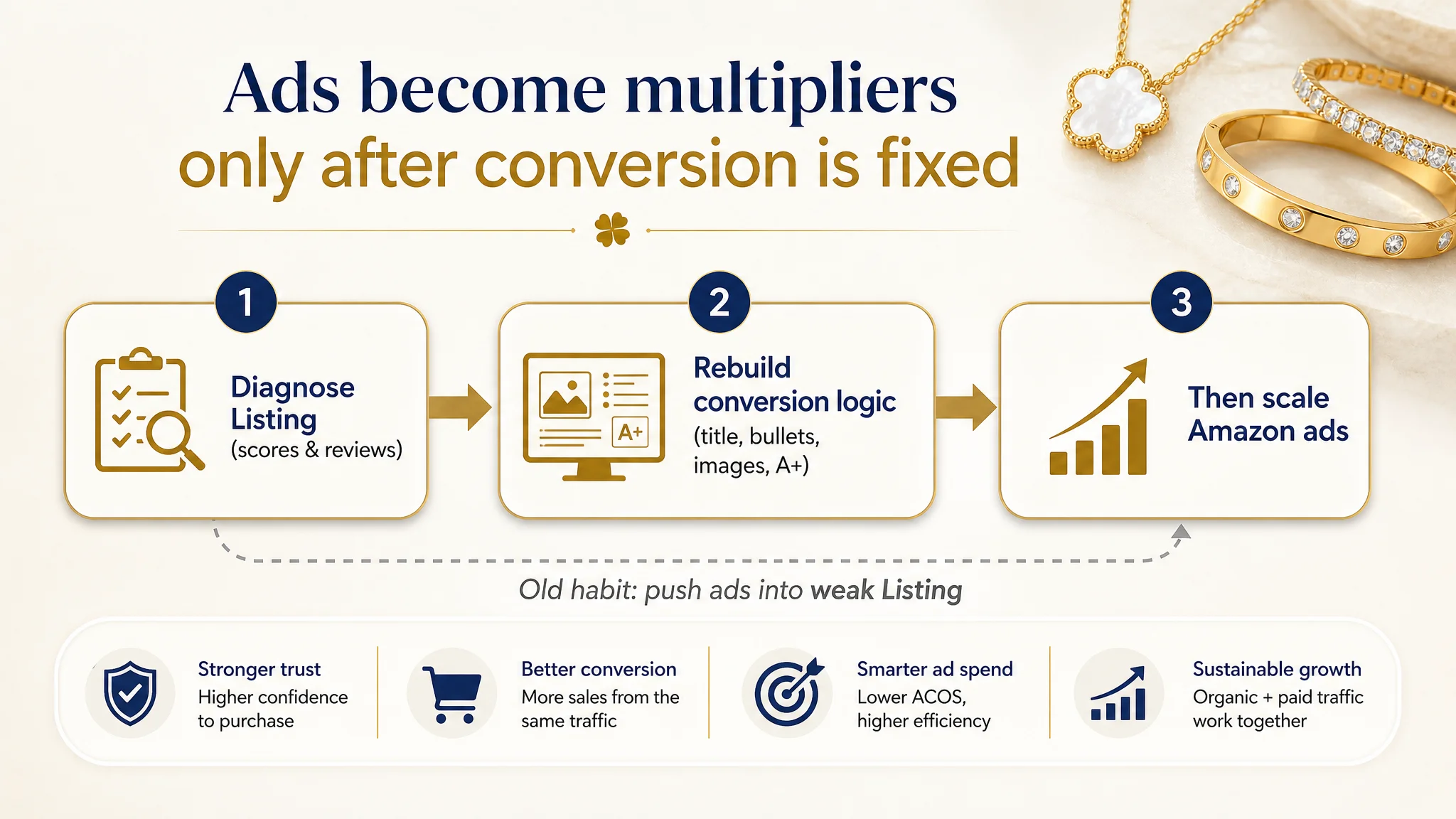
1. Rebuilding Listing conversion logic:
- Restructure the title.
- Rebuild bullet points around material trust and emotional meaning.
- Align main images with set clarity, size clarity, and gifting reassurance.
- Reconfigure A+ to highlight materials and what’s included before deep symbolism.
1. Addressing review risks:
- Acknowledge that some issues stem from real product quality; these are not “copy problems”.
- Encourage stabilizing production and, over time, building healthier review volume.
1. Only then revisiting ad scaling:
- Once the page can credibly convert, Amazon ads regain their role as a growth lever instead of a cost amplifier.
From a risk standpoint, continuing to push ads into the old Listing would have:
- Burned budget on already skeptical audiences.
- Further entrenched low conversion metrics, making future recovery harder.
- Potentially increased negative reviews due to unmet durability expectations.
The chosen decision path instead:
- Secured the base (Listing conversion and trust).
- Then positioned the seller to benefit from future traffic, organic and paid.
After the Rebuild: What Actually Changed
This case is not framed around dramatic “X% uplift” numbers. The seller did not treat this as a short-term A/B test but as a structural correction to their Amazon business logic.
However, several practical changes followed:
- Listing conversion capacity improved:
- Above-the-fold content started presenting a coherent promise:
- Material trust.
- Symbolic value.
- Styling flexibility.
- Fit and occasion coverage.
- Gift significance.
- Ads became more meaningful:
- Traffic sent to the Listing was better matched with what buyers saw on arrival.
- The team had a clearer sense of when a CVR issue was page-related vs. traffic-related.
- Dependence on “more and more ads” decreased:
- As the page’s organic conversion potential strengthened, the store had a more balanced traffic structure.
- The team’s understanding changed:
- They stopped treating Amazon ads as a universal fix.
- They started asking, before any scaling: “Does this Listing deserve more traffic yet?”
What Other Amazon Sellers Can Take Away
Several lessons from this jewelry case generalize across categories:
1. A slight score gap can hide a serious structural problem
A 5-point difference in Listing score (67 vs 72) can be the difference between a page that supports ads and one that silently wastes them. The key is where those points are lost: in this case, title, bullets, and reviews.
1. Title and bullets are not cosmetic; they are your first conversion layer
A sophisticated A+ story cannot compensate for a title that buries the core keyword and a bullet stack that reads like a spreadsheet.
1. Main images must explain, not just decorate
Compositions, lighting, parameter visualization, and gift scenes need to support specific decision questions: “What exactly is included?”, “How does it fit?”, “Is it gift-worthy?”.
1. Reviews can override everything else
A review profile with real, repeated quality complaints cannot be “fixed” by copy and images. Listing optimization must be paired with honest product and quality improvements.
1. Amazon ads are multipliers, not healers
If a Listing cannot convert organic traffic, more paid traffic simply multiplies the loss. DeepBI’s value in this case was not a feature checklist, but a sequence judgment: fix Listing conversion first, then allow ads to work as intended.
For sellers who recognize themselves in this story—traffic is there, ads are running, but orders feel fragile—it may be time to shift the question from “Which keyword should I add?” to “Does my Amazon product page truly deserve the traffic I am buying?”