

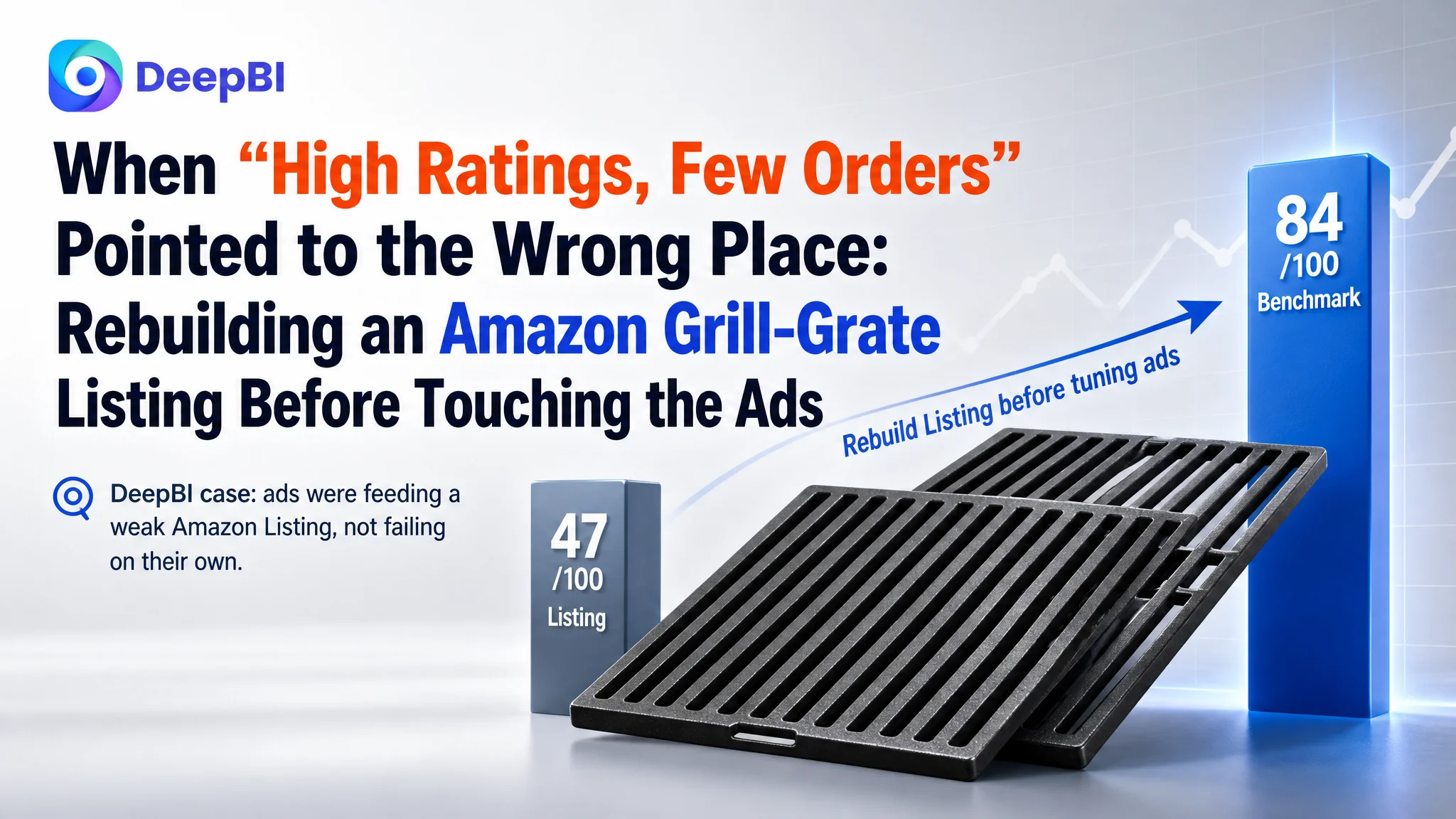
This case comes from an Amazon seller in the US grill-accessories category. The team was seeing decent feedback on their grill grates—5.0-star reviews and positive comments—yet orders lagged behind a leading competitor despite similar pricing and category positioning. They assumed the problem sat in Amazon ads and keyword tactics, so they spent weeks refining bids and search terms, but ACOS pressure didn’t ease and overall sales momentum still didn’t catch up.
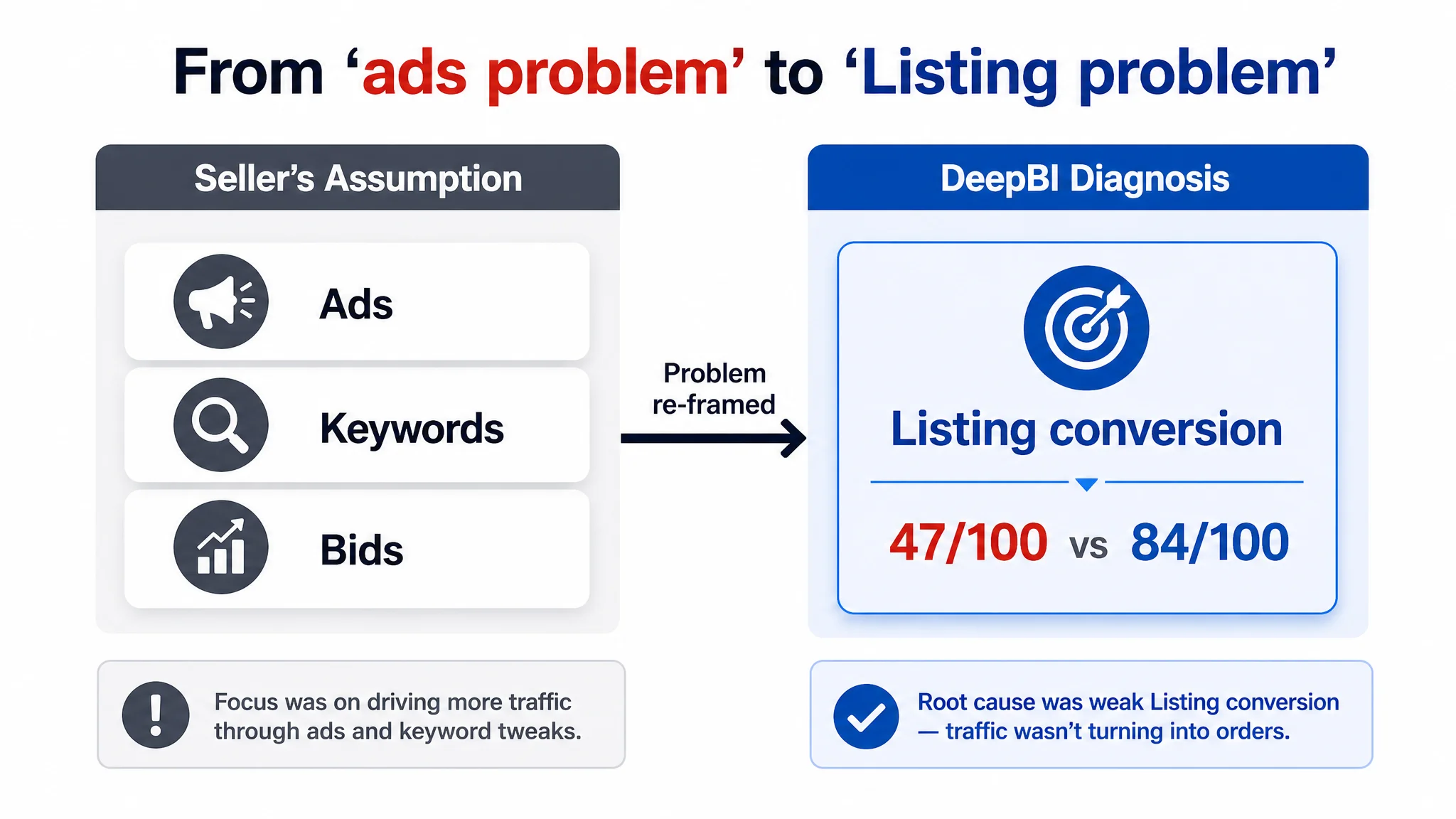
When DeepBI stepped in, the diagnosis changed direction. The system’s Listing score showed a 47/100 page competing against an 84/100 benchmark. Ads were bringing traffic, but the Amazon product page couldn’t convert: no A+ content at all, a structurally weaker title, visual trust gaps, and only three reviews against the competitor’s hundreds. The core problem wasn’t traffic volume; it was Listing conversion capacity.
The optimization that followed did not start with another round of bid tweaks. It started with rebuilding the page’s sales logic: restructuring the Amazon title around “Weber Spirit”–type compatibility, rewriting bullet points into clear “fit-confirmation + result promise” paths, and drafting a full A+ visual story from backyard scenes to precise dimensions and heat performance. For other Amazon sellers, this case is a reminder: as ad costs rise, misdiagnosing a Listing conversion leak as an “ads problem” can be the most expensive mistake on the page.
The Seller’s View: “Our Product Is Good, So the Ads Must Be the Problem”
The brand sells grill grates on Amazon US, competing directly in a Weber-compatible segment where buyers are extremely sensitive to fit, heat performance, and trust in replacement parts.
Operationally, the team saw three things:
- A small but clean set of reviews:
5.0 stars, three total reviews, all positive.
- A clear category benchmark:
A competing grill-grate Listing with strong Best Seller traction and high review volume.
- Rising pressure on advertising:
Traffic was not the main issue; they could bring visits through Amazon ads, but the conversion felt “stuck”.
From the seller’s perspective, this looked like a familiar pattern:
- “We just need to push more traffic and refine keywords.”
- “Maybe we’re not bidding aggressively enough on ‘Weber Spirit grill grates.’”
- “If reviews are all 5-star, the page can’t be the bottleneck.”
So they poured energy into:
- Adjusting bids and campaign structure.
- Adding more keyword variations around “for Weber Spirit”, “replacement parts” and model numbers.
- Watching ACOS and TACOS while assuming the Listing was already “good enough”.
Yet orders didn’t scale, and ACOS remained hard to control. More traffic did not translate into proportional sales.
“The real problem was not that ads failed to bring traffic. It was that the page could not convert the traffic.”
DeepBI’s First Judgment: Ads Were Feeding a Weak Listing
When DeepBI scored the Amazon Listing against a single, tightly matched benchmark, the gap was not subtle:
- Target Listing total score: 47 / 100
- Benchmark Listing total score: 84 / 100
- Gap: –37 points
By dimension, the story became clearer:
- Title: Target: 10, Benchmark: 14, Full Score: 20, Gap: -4
- Main Image: Target: 24, Benchmark: 25, Full Score: 30, Gap: -1
- Bullet Points: Target: 7, Benchmark: 8, Full Score: 10, Gap: -1
- Detail / A+: Target: 0, Benchmark: 23, Full Score: 25, Gap: -23
- Reviews: Target: 6, Benchmark: 14, Full Score: 15, Gap: -8
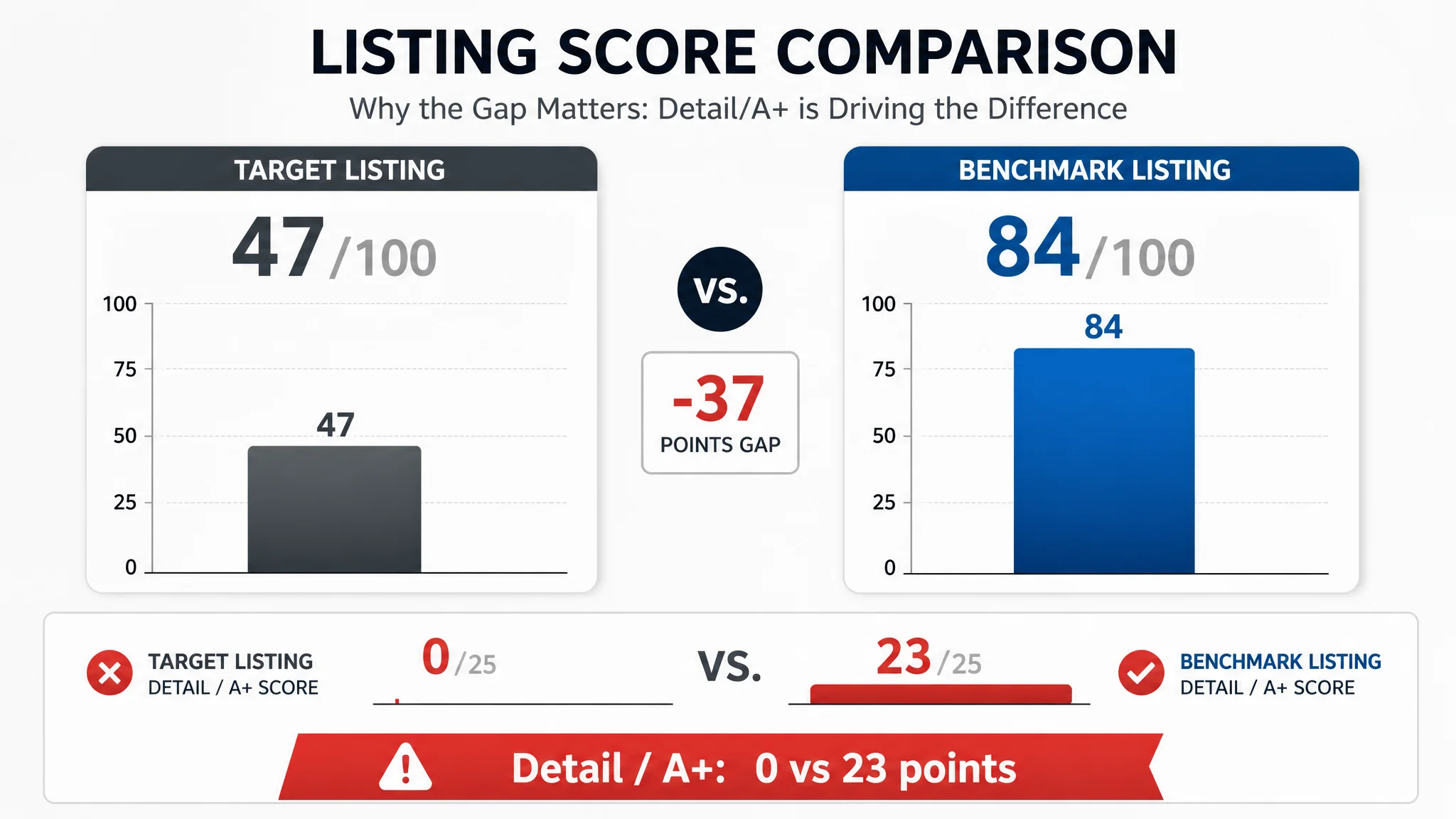
The decisive red flag was not ad-side at all: the Detail/A+ dimension scored 0, while the benchmark sat at 23/25.
That alone changed the diagnosis:
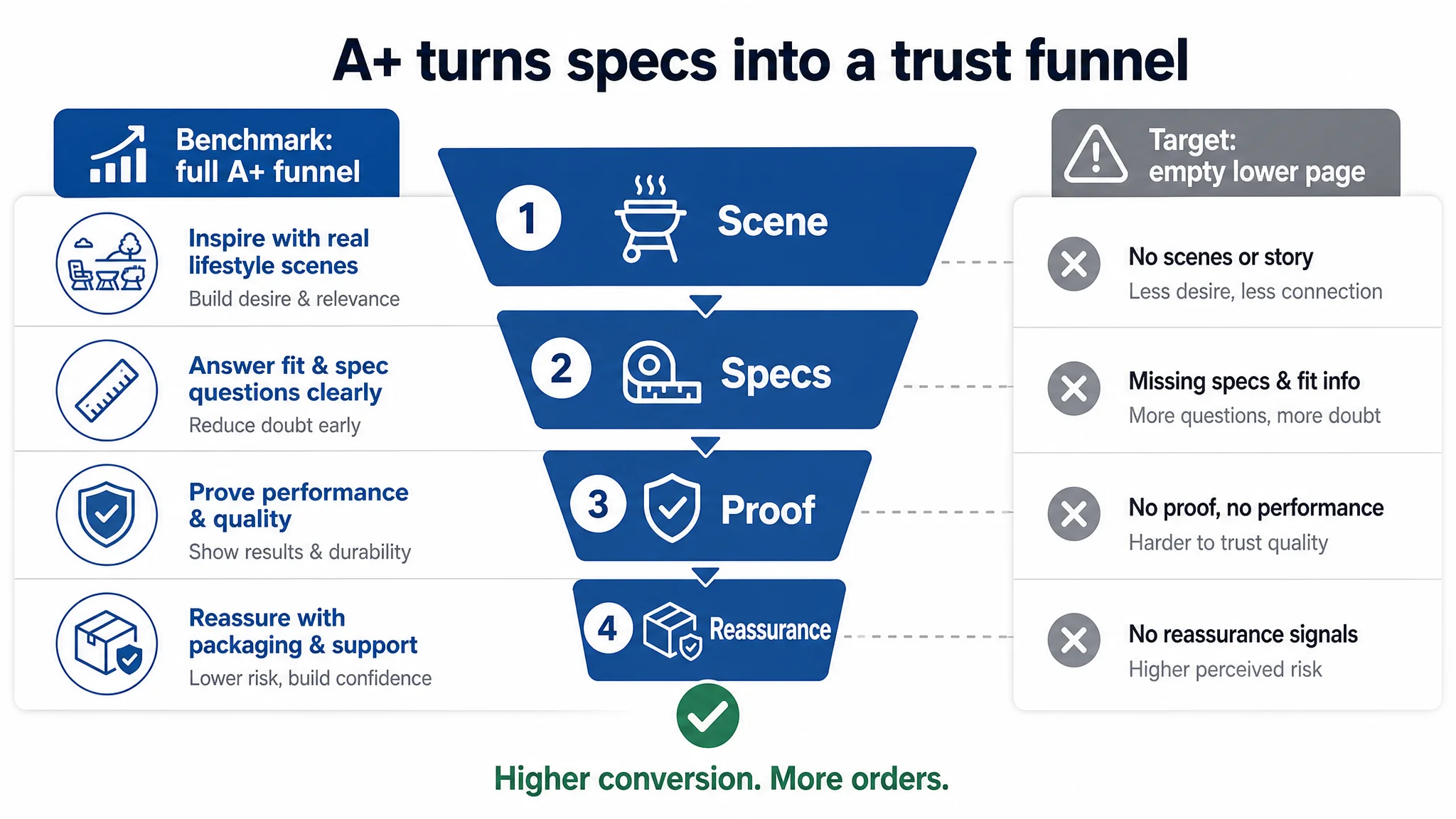
- The benchmark had a fully built Amazon A+ story: lifestyle scenes, heat-performance visuals, compatibility charts, gifting scenarios, and clear packaging reassurance.
- The target Listing had no A+ content, leaving the lower half of the Amazon product page empty of trust, explanation, or visual proof.
In other words, ads were delivering buyers to a page that stopped selling halfway down.
The Core Constraint: Listing Conversion Capacity, Not Keyword Tuning
The key question became: given finite effort, what should be fixed first?
DeepBI’s judgment was straightforward:
- The biggest bottleneck was not “how many people arrive” (ads).
- It was “what happens once they arrive” (Listing conversion).
Three structural weaknesses stood out.
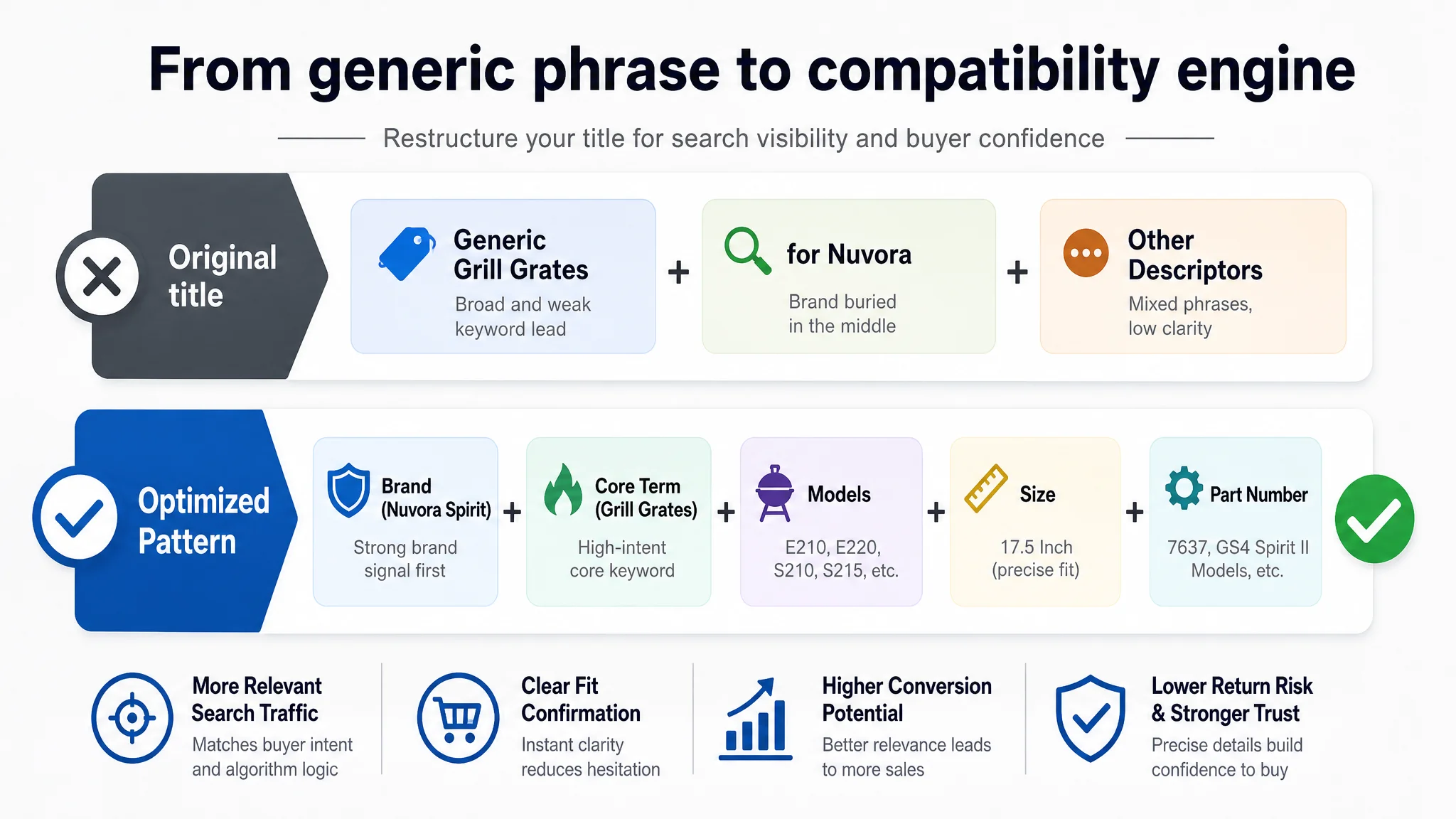
1. Title Structure: Weak Brand + Compatibility Signaling
The original title:
- Put generic “Grill Grates” before the recognized brand line.
- Lacked a clean, front-loaded structure around “Weber Spirit”–type compatibility.
- Mixed descriptive phrases instead of following a proven Amazon pattern like:
Brand + Core product term + Model / Series compatibility + Size + Replacement keyword
The benchmark title, by contrast:
- Led with “Grill Parts for Weber Spirit E210”.
- Repeated “Weber Spirit” and specific models (E210, E220, S210, etc.).
- Explicitly called out “with Front Control”, making fit crystal-clear.
Outcome: the competitor’s title worked better for A9 search logic and for buyer decision logic. The target Listing’s title made both the algorithm and the shopper do more work.
2. Detail Page: A Completely Missing A+ Story
On Amazon, the lower half of the product page is where buyers:
- Confirm fit and dimensions.
- See proof of material quality and durability.
- Visualize usage scenarios and social value.
- Get reassured about packaging, gifting, and after-sales.
The benchmark Listing used this space aggressively:
- Lifestyle scenes: backyard family gatherings, holiday gifting moments.
- Product detail visuals: close-ups of cast iron texture, size diagrams, and material callouts like “High Quality Cast Iron.”
- Functional graphics: heat distribution visuals (e.g., “Heat evenly / More durable”), sear-mark proof images, and heat-map overlays.
- Compatibility and professionalism: model numbers, front-control vs side-control clarifications, and packaging reassurance like “Strong Packing.”
The target Listing provided none of this.
- No A+ modules.
- No scenes, no specs, no structured compatibility diagrams.
- No visual answer to “Will this fit my grill?” or “Will it last?”
For a category where a wrong fit means immediate returns, this was a critical trust gap.
3. Review Scale and Trust Ecology
On the surface, the Listing had perfect ratings:
- Target: 5.0 stars, 3 total reviews, all positive text-only.
- Benchmark: 4.6 stars, 753 total reviews, with diverse ratings (including 4-star) and image-based feedback.
From a buyer’s perspective:
- 3 reviews, even at 5.0, signal “early, unproven”.
- Hundreds of reviews, even at 4.6, signal “tested by the market”.
So while the seller was proud of 5.0 stars, DeepBI saw a trust deficit:
- Low review volume.
- No image or video reviews.
- Weak perceived scale compared to the benchmark.
In that context, relying on ads to push more traffic into a thin trust ecosystem was structurally risky.
“Advertising does not only amplify advantages. It can also amplify a page’s existing defects.”
Why DeepBI Refused to Start With More Ad Tuning
From a business-risk perspective, DeepBI’s advice was clear: do not keep tuning ads first.
Reasons:
1. Each paid click lands on a sub-50 Listing.
Continuing to invest in traffic without fixing conversion leaks compounds wasted spend.
1. The Detail/A+ gap is too large.
A –23 point gap in this single dimension means even excellent ad work can be neutralized by mid-funnel doubt.
1. Review scale can’t be fixed overnight, but conversion logic can.
Reviews grow slowly. Page content can be rebuilt now to better convert each visit and to support future review acquisition.
So the decision path was:
1. Rebuild Listing conversion logic (title, bullets, A+, imagery).
2. Then reassess ads, once the page is capable of converting both paid and organic traffic.
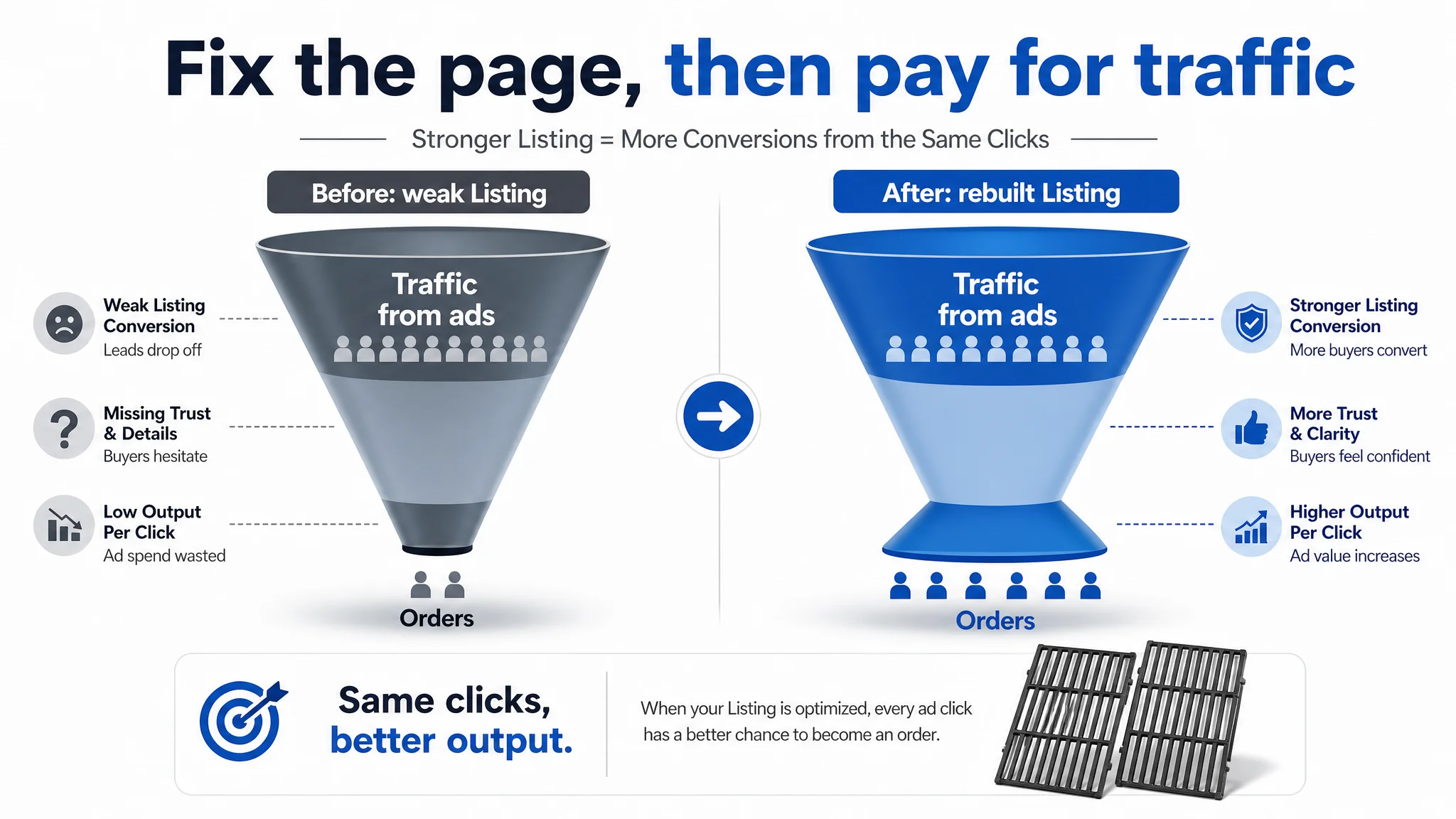
This reframing is critical for Amazon sellers facing ACOS pressure: if the page can’t sell, ad spend is a lever with diminishing returns.
Rebuilding the Amazon Title: From Generic Phrasing to Compatibility Engine
DeepBI proposed a new title structure anchored in how Amazon’s search and buyers both read titles:
Weber Spirit Grill Grates for Weber Spirit 200 Series, Spirit II E210 E220 S210 S215, 17.5 Inch Grill Grates Replacement Parts for 7637, GS4 Spirit II Models, Set of 2
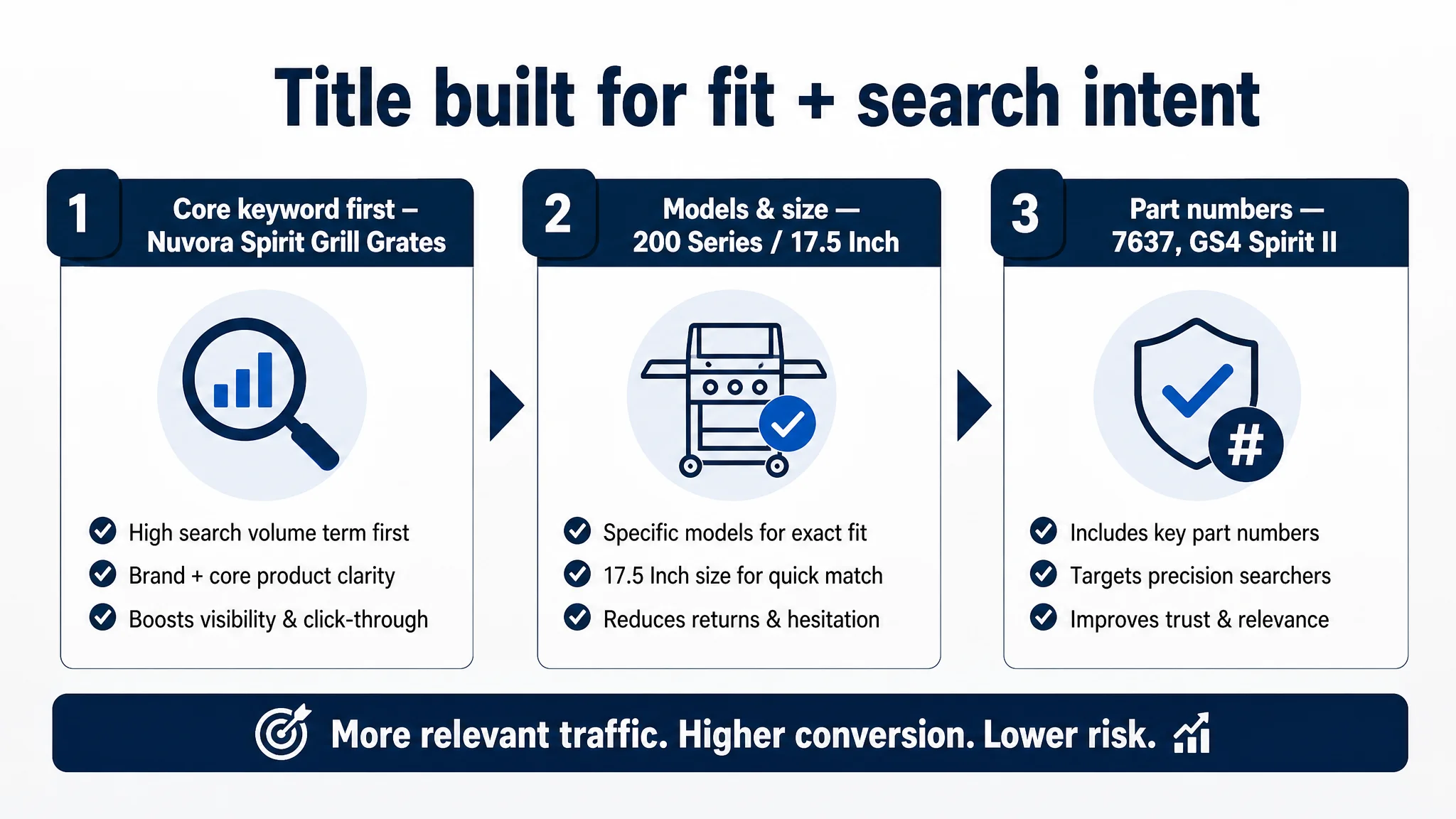
Three decisions underpin this:
1. Core Keyword and Series First
- Move “Weber Spirit Grill Grates” to the front.
- Remove leading “for” to avoid diluting the main term.
- Align with search behavior: buyers often type “Weber Spirit grill grates” first, not “for Weber Spirit…”.
This improves both search weight and title clarity at a glance.
2. Integrate High-Intent Long-Tail Terms
- Explicitly add part numbers like “7637” and “GS4 Spirit II”.
- These are not decorative; they’re how many serious buyers search precise replacements.
Result: the title becomes a direct match for intent-heavy queries, not only generic discovery terms.
3. Clarify Compatibility and Size in the Title
- Condense models (E210, E220, S210, S215) with clear grouping.
- Keep “17.5 Inch” in a visible position to help immediate fit-check.
For traffic that arrives from both ads and organic search, the title now does more: it reassures fit, signals professionalism, and aligns with buyer search language.
Bullet Points: From Parameter Listing to “Pain Point → Solution → Result”
The existing bullet points had information, but not a buying logic. DeepBI’s comparison with the benchmark showed:
- The competitor led with fit and compatibility, not material.
- The competitor integrated after-sales and clear exclusions (what it does not fit) right in the bullets.
- Functional bullets moved quickly from “what it is” to “what it does for you” (heat retention, sear marks, ease of cleaning).
DeepBI’s optimization strategy reshaped the bullet structure:
Bullet 1: Fit and Protection Against Mis-buy
【FITS PERFECTLY】Replacement for Weber Spirit 200 & Spirit II Series (Model Years 2013-2017): Spirit E-210, E-220, S-210, S-220 with front-mounted control panels. Compatible with Weber part numbers 7637, 64815, 67022, 46110001, 46100001, and 47100001. ► NOTICE: Does NOT fit Spirit 200 series with side-mounted control panels.
Judgment logic:
- Start with fit confirmation (core buying driver).
- Add model years and front-control vs side-control to reduce misorders.
- Explicitly call out exclusions to reduce returns and increase trust.
Bullet 2: Dimensions and Set Structure
【DIMENSION & MATERIAL】Set of 2 Grill Grates. Dimensions: 17.5" x 10.2" each, totaling 17.5" x 20.5". Crafted from heavy-duty matte enamel iron. Please DOUBLE-check the dimensions and model of your original grill before ordering to ensure a seamless swap.
Judgment logic:
- Highlight “Set of 2” upfront.
- Use a clear dimension block so buyers can match their existing grates.
- Reinforce heavy-duty material and prompt a pre-purchase fit-check.
Bullet 3: Heat Performance and Sear Marks
【SUPERIOR HEAT RETENTION】Our heavy-duty cast iron grates not only distribute heat evenly but also retain high temperatures like a pro. Lock in smoky flavors and achieve professional-looking, deep sear marks on your food with ease.
Judgment logic:
- Translate material into outcome: even heat + sear marks.
- Mirror the benchmark’s “retain heat” messaging but adapt to the brand’s tone.
- Shift from parameter language to result language.
Bullet 4: Durability and Long-Term Use
【EXTREMELY DURABLE】Engineered for longevity, the tough matte enameled finish fights off rust, chips, and warping. This heavy-duty build ensures season-after-season performance, outlasting standard enameled bars while maintaining structural integrity.
Judgment logic:
- Emphasize anti-rust, anti-chip behavior (common buyer concerns).
- Position the product as a long-term replacement, not a temporary patch.
Bullet 5: Non-stick and Maintenance Ease
【NON-STICK & EASY TO CLEAN】The matte porcelain enamel surface prevents food from sticking and allows for effortless cleanup. Simply brush away residue after use; the smooth finish makes maintenance a breeze, getting you back to grilling faster.
Judgment logic:
- Directly attack the “cast iron is hard to clean” concern.
- Reinforce a practical benefit: less cleaning, more grilling.
In aggregate, the bullets now form a coherent path:
Fit → Specs → Heat Performance → Durability → Maintenance
Instead of “information scattered across five bullets,” the Listing gains a selling storyline that supports conversion.
Main Image and Gallery: Not Just “Better Pictures”, but Clearer Decision Support
On the surface, the main image gap looked small: 24 vs 25 points.
But DeepBI’s visual analysis found qualitative issues:
- The existing main image relied on a flat 2D perspective, with weak depth and industrial texture.
- AI-generated food visuals felt over-polished, triggering “too staged” skepticism.
- Some information images had cluttered layout, making mobile viewing harder.
The benchmark Listing, in contrast:
- Used 3D perspectives to show thickness and structure.
- Combined industrial-style angles with real grilling scenes.
- Presented fit and compatibility visuals clearly and modularly.
DeepBI’s visual guidance was explicit and execution-ready, not “make it more premium”–type vagueness.
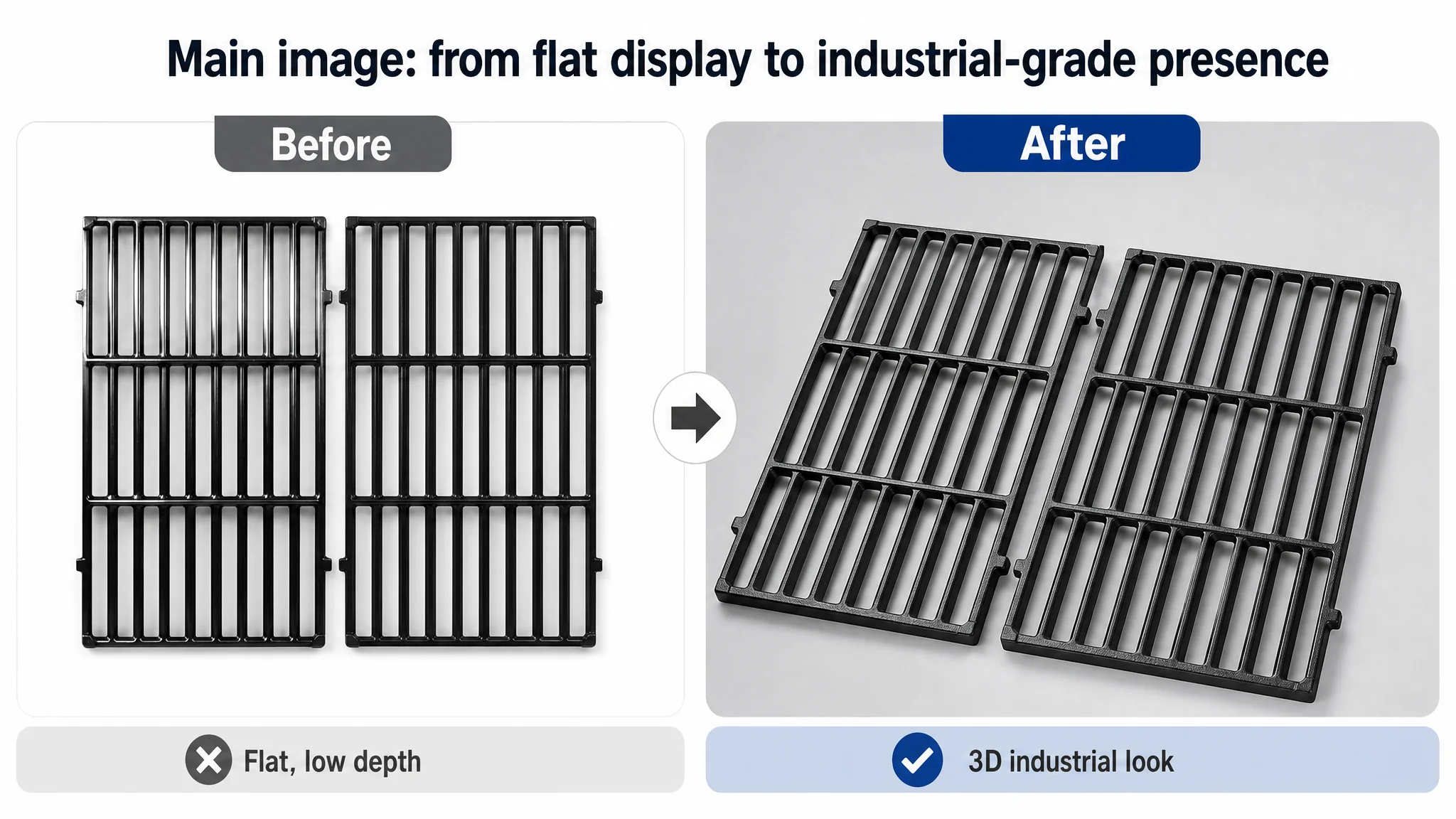
Example: Main Image Reframe
- Product centered, 30° perspective, occupying ~75% of the frame.
- Slight 45° lateral camera angle, soft white top light, natural shadow.
- Pure white background, high-contrast black/gray palette.
Purpose:
- Make thickness and build quality instantly visible.
- Comply with Amazon main image rules while maximizing click appeal.
Detail Images: From Visual Noise to Structured Story
DeepBI recommended a set of complementary visuals:
- Edge close-up: 30° side view, strong side light to reveal matte texture, with a discreet “Matte Finish” label.
- Dimension visual: isometric 3D view with clean measurement lines, clear “17.5"” and “10.2"” labels.
- Overlap and texture: overlapping grates with a magnifier effect showing surface details.
- Compatibility grid: 4×2 grid of compatible grill models, each labeled by model number.
Each image serves a specific decision step:
- “What does it really look like?”
- “Will it fit?”
- “Is it heavy-duty enough?”
- “Does it match my grill model?”
This is where DeepBI’s benchmark-driven logic matters: visuals aren’t random; they mirror what the top-performing competitor already trained buyers to expect.
A+ Content: This Product Page Did Not Lack Traffic. It Lacked Trust.
The largest single gap—23 points—came from the complete absence of A+ content.
DeepBI reconstructed an A+ blueprint modeled on how grill-accessory buyers actually decide:
1. Outdoor social scene introduction
- Family backyard barbecue with the grill in mid-stage.
- The product installed, with visible food in progress.
- Focus on social warmth and “product as catalyst” for gatherings.
Goal: connect the item to a lifestyle, not just a spare part.
1. Specifications and fit clarity
- Two grates side-by-side with precise dimension callouts.
- Clean, industrial visual style; dimensions easy to read at a glance.
Goal: reduce fit anxiety, which directly suppresses conversion and drives returns.
1. Material close-up
- Macro shot of the cast iron texture, with controlled lighting to emphasize thickness and grain.
Goal: visually answer “Is this cheap or solid?” without needing long text.
1. Heat performance and sear marks
- Close-up of steaks with clear cross-hatched grill marks.
- Warm, high-contrast imagery that emphasizes heat and flavor.
Goal: transform “cast iron” from a spec into a visible outcome.
1. Installation layout and capacity
- Top-down view of grates installed in a Weber-style grill, loaded with various foods.
Goal: show capacity and intuitive fit, easing installation concerns.
1. Heat distribution simulation
- Heat-map overlay on a cooking scene to visualize even heat.
Goal: give a semi-technical but easy-to-grasp justification for the product’s performance.
1. Gift and packaging scene
- Holiday context, child and parent opening a strong packaging box revealing the grate.
Goal: expand the product’s perceived use case, especially for high-season events.
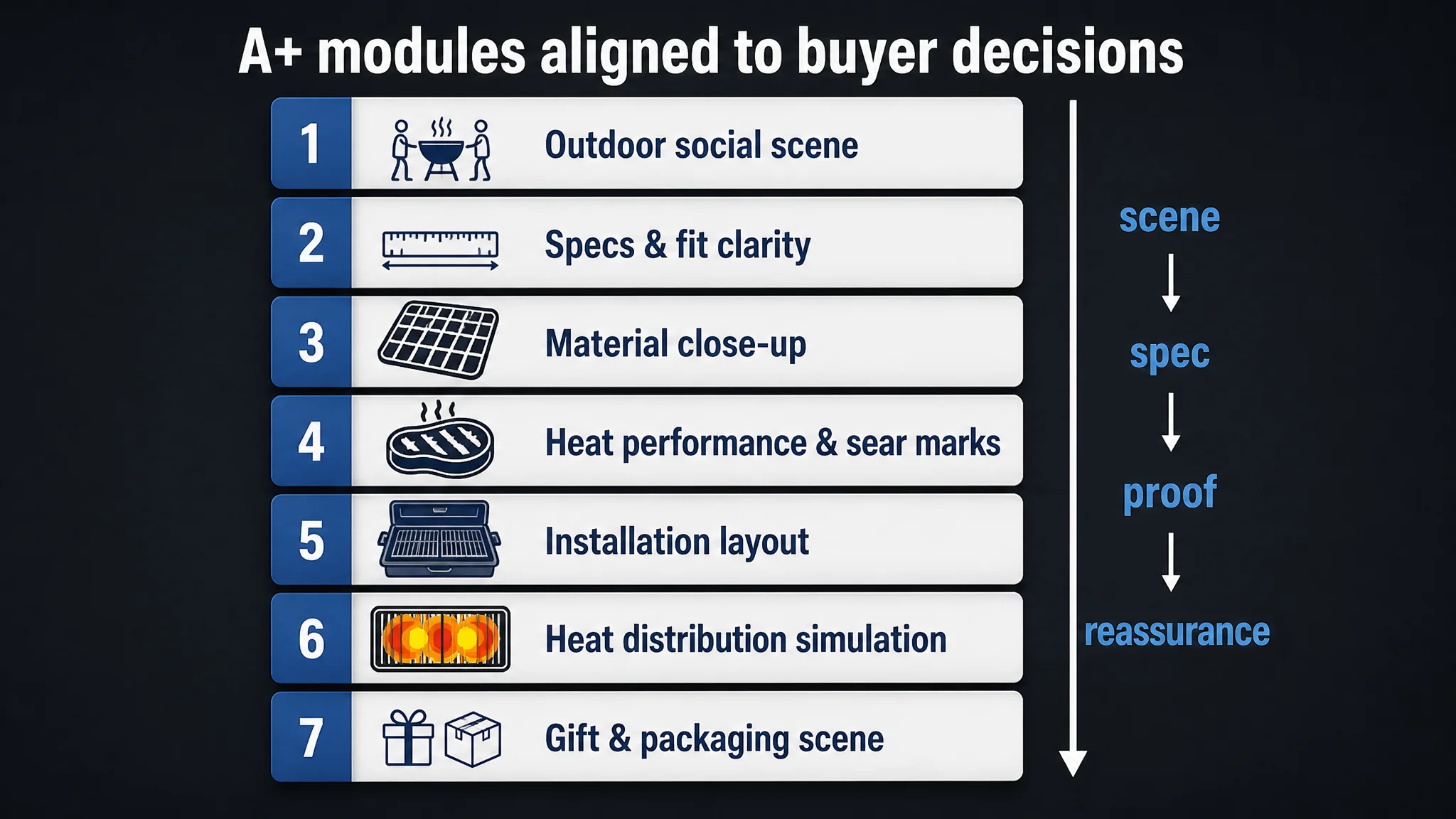
Even without inventing new functional claims, this A+ plan restructures the page into a “scene → spec → proof → reassurance” funnel.
Once implemented, this kind of A+ rebuild:
- Raises the ceiling for both paid and organic conversion.
- Reduces perceived risk (fit, durability, packaging).
- Aligns the Listing with what Amazon’s algorithm tends to reward in high-performing categories.
What Changed Once the Page Logic Recovered
The case material does not provide post-change ACOS or CVR numbers, so we focus on operational and risk changes.
After the Listing reframing:
- Listing conversion capacity improved.
The page began to offer a complete, coherent story instead of leaving buyers to guess.
- Ad traffic became more valuable.
Each incremental click from Amazon ads landed on a page more capable of closing the sale.
- Organic and paid traffic could now “share” a stronger page.
Better titles, structured bullets, and A+ content support both organic ranking and ad-funded sessions.
- Advertising dependence became more controllable.
With a healthier base conversion, scaling or pulling back ads became a strategic choice, not a desperate attempt to “force” sales.
- The seller’s understanding shifted.
They saw firsthand that:
- High star ratings with few reviews are not enough.
- A missing A+ is not an aesthetic problem; it is a conversion problem.
- Title, main image, bullets, and A+ must work as one sales engine.
- Ads amplify whatever the page already is—good or bad.
Takeaways for Other Amazon Sellers
Several lessons from this grill-grate case generalize across categories:
1. Do not assume a 5.0-star average means the page is healthy.
Volume and diversity of reviews matter as much as the score itself.
1. If A+ content is missing, you are leaving money on the table.
Especially in fit-sensitive, technical, or durable-goods categories, the absence of A+ is often a direct hit to conversion.
1. Ads cannot permanently compensate for a 47/100 Listing competing against an 84/100 benchmark.
Without fixing conversion, you’re paying to repeatedly run buyers through the same leak.
1. Title structure is a business asset, not just text.
Aligning with brand + model + fit + size patterns can materially change search visibility and buyer confidence.
1. Bullet points need a buying logic, not just parameters.
Organize them into a coherent “fit → specs → performance → durability → maintenance” path.
1. Before scaling ads, ask: “Does this page deserve more traffic?”
If the answer is uncertain, fix the Listing first.
DeepBI’s role in this case was not to “add features” to the seller’s toolkit. It was to force a sharper judgment: your ads are not failing; your Amazon product page is consuming the traffic. Only after that judgment changed did the optimization path begin to make commercial sense.