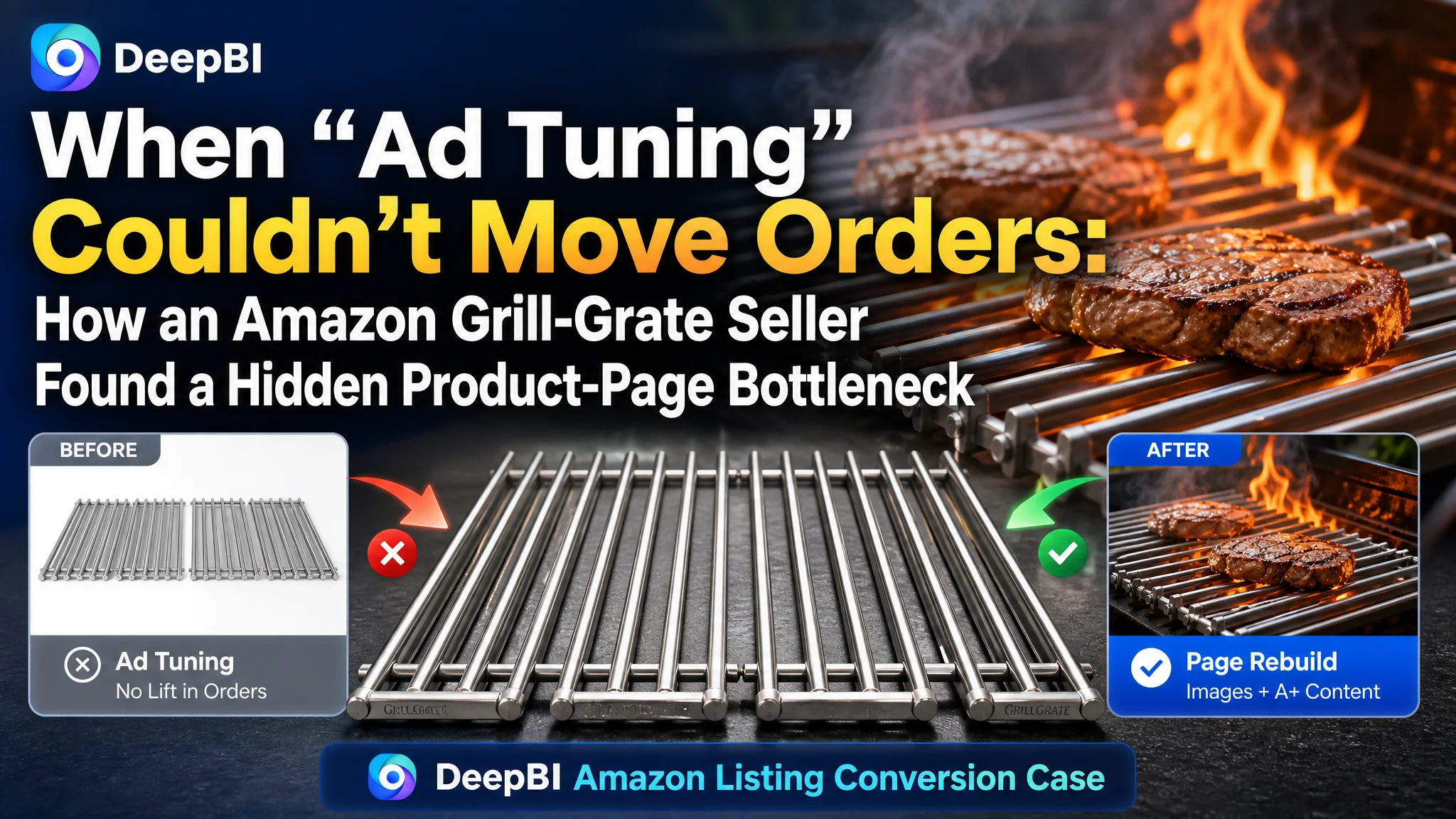
Traffic was not the problem for this Amazon seller in the outdoor grilling accessories category. Ads were running, search exposure was acceptable, and the product itself—a stainless steel replacement grill grate—had solid specs and early 5‑star reviews. Yet orders lagged behind a clear category leader, and every attempt to “fix” the situation focused on bids, keywords, and budget. The team assumed this was a pure Amazon ads efficiency issue.
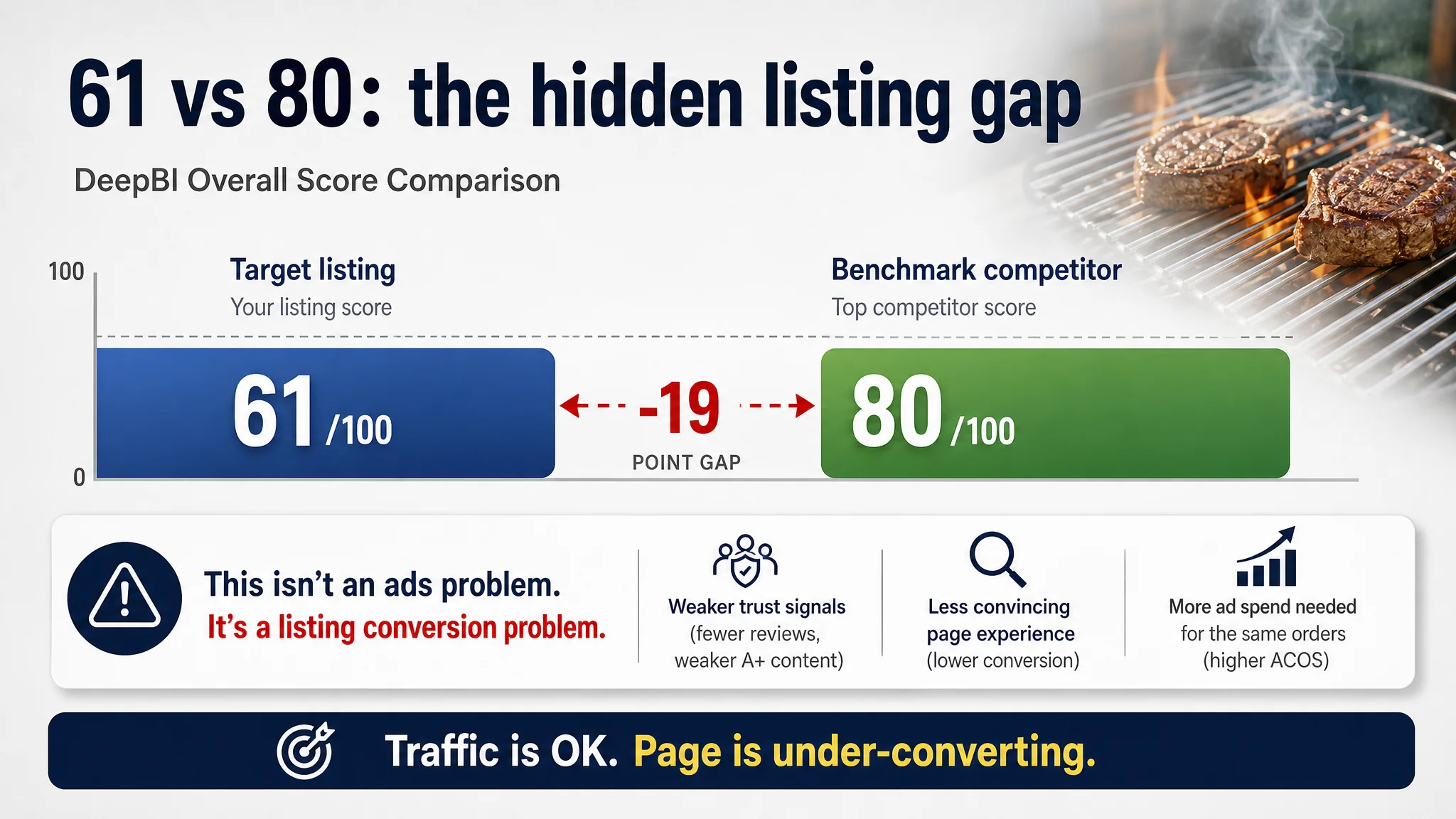
Once we put the listing through DeepBI’s competitive scoring, a different picture emerged. The target Amazon Listing scored 61/100 against a benchmark competitor at 80/100. Ads were feeding traffic into a page that could not fully convert it: missing trust signals in the A+ content, weak visual proof on durability and compatibility, and a thin review base meant the listing was structurally less convincing, even though the product itself was not.
The later optimization work therefore shifted away from more granular ad tweaks and toward rebuilding the Amazon product page: re-framing the title around “replacement” intent and fit, re‑designing main images to tell a “premium, heavy‑duty grilling” story, and restructuring the A+ content into a clear logic from brand trust to “fits my grill” to “lasts longer & cleans easily.” For other Amazon sellers, this case is a reminder that when ACOS feels stuck and ads “won’t optimize,” the real constraint may be your listing’s conversion capacity, not your campaign structure.
What the Seller Saw: “We Just Need Better Ad Performance”
This US Amazon seller offers stainless steel replacement grill grates for high‑end backyard gas grills.
Operationally, the team was under pressure from:
- Rising ad costs on core grill‑grate keywords
- A clear, better‑performing competitor in the same niche
- Early but low‑volume reviews (5.0 rating, only 3 reviews)
From their vantage point:
- The product specs were solid: 7mm heavy-duty rods, SUS 304 stainless steel, strong food support.
- Bullet points already mentioned durability, ease of cleaning, and preventing food from falling.
- A+ images showed the product in use, with some size and material visuals.
So the team assumed:
“If we keep refining keywords and bids, ACOS will come down and sales will catch up.”
In other words, they treated the situation as an Amazon ads optimization problem, not a product-page conversion problem.
But despite adjustments, ad efficiency didn’t meaningfully improve. The competitor kept winning the click and the order.
Amazon Ads Were Not Failing. The Page Was Consuming the Traffic.
When we ran the listing through DeepBI’s listing‑scoring and competitive benchmark process, the gap was quantified:
- Target listing total score: 61 / 100
- Benchmark competitor: 80 / 100
- Gap: –19 points
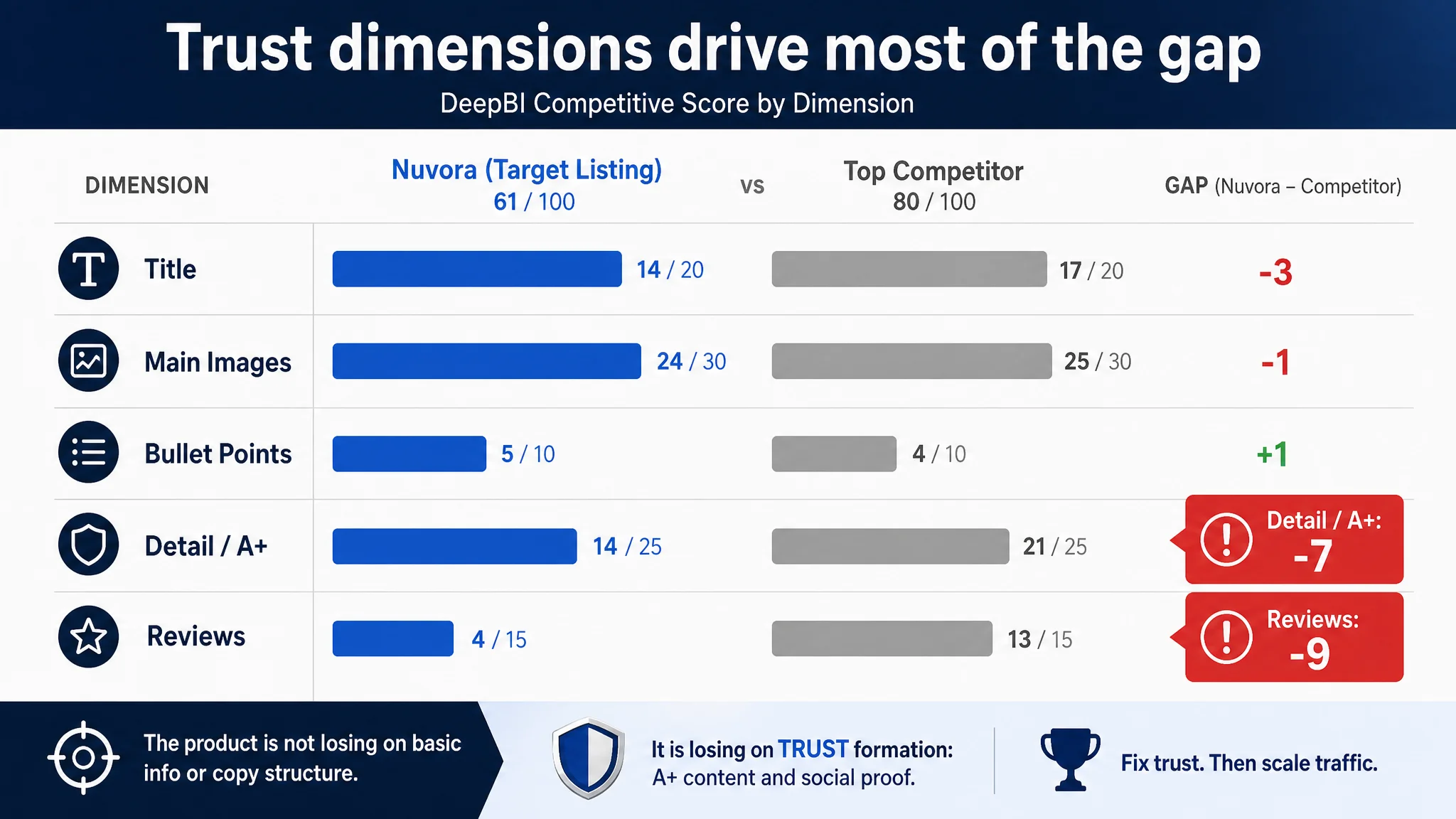
Broken down by dimension:
- Title: –3 vs competitor
- Main images: –1 vs competitor
- Bullet points: slightly better structured than competitor (+1)
- Detail / A+ content: –7 vs competitor
- Reviews: –9 vs competitor
The immediate pattern:
- The product was not losing on basic information or copy structure.
- It was losing on trust formation: A+ visuals and social proof.
“The real problem was not that ads failed to bring traffic. It was that the page could not convert the traffic.”
With low review volume and a weaker detail/A+ structure, every click from ads had to work harder to turn into an order. Ads were amplifying a page‑level weakness.
The Real Constraint: Listing Conversion Capacity, Not Keyword Quality
Title: Good Structure, Wrong Emphasis for Search Intent
The original title:
- Brought the core keyword (“Grill Grate”) forward
- Listed multiple grill models logically
- Included size and material
On paper, that looks fine. But against the benchmark, several strategic gaps appeared:
- The competitor front‑loaded outcome and intent: “9MM Grill Grates Replacement” and “Replacement Parts” are early, clear signals that match high‑intent queries.
- The competitor used “Replacement” and “Fits” language aggressively, aligning directly with buyers searching “replacement for [model / part number].”
- Within limited characters, the competitor managed to encode more search variants and part numbers, capturing long‑tail demand.
So even before clicking through, the competitor looked like:
- The definitive replacement solution
- More likely to fit specific models
- More “engineered” for the job
Our target title, by contrast, looked like a product description, not a replacement solution.
Main Images: From “Spare Part” to “Premium Grilling System”
Image scoring showed a narrower gap (–1), but that small numeric difference masked a big strategic difference in role:
- The benchmark first image aggressively sold appetite and lifestyle: product + flames + multiple foods, creating instant emotional pull on the Amazon search page.
- Subsequent competitor images built a closed loop of usage: product in the grill, food grilling, clear spec visuals, and installation fit.
Our target listing:
- Used one image slot as a video thumbnail, sacrificing a visual slot that could carry a key selling argument (e.g., compatibility or thickness proof).
- Lacked a clear “Fits [X series] / [OEM numbers]” declarative visual on images, forcing compatibility to be inferred from fine print.
- Had an “after grilled” food image that only showed the result, not the product doing the job.
On Amazon, the main-image set is not just photography; it is a visual argument. Here, the argument was incomplete.
Detail / A+ Content: No Trust Path, No Conversion Spine
The deepest gap appeared in the detail / A+ dimension (–7).
The target A+ relied on:
- Repeated atmosphere scenes
- Basic material and size visuals
- Some thickness measurement, but with limited narrative structure
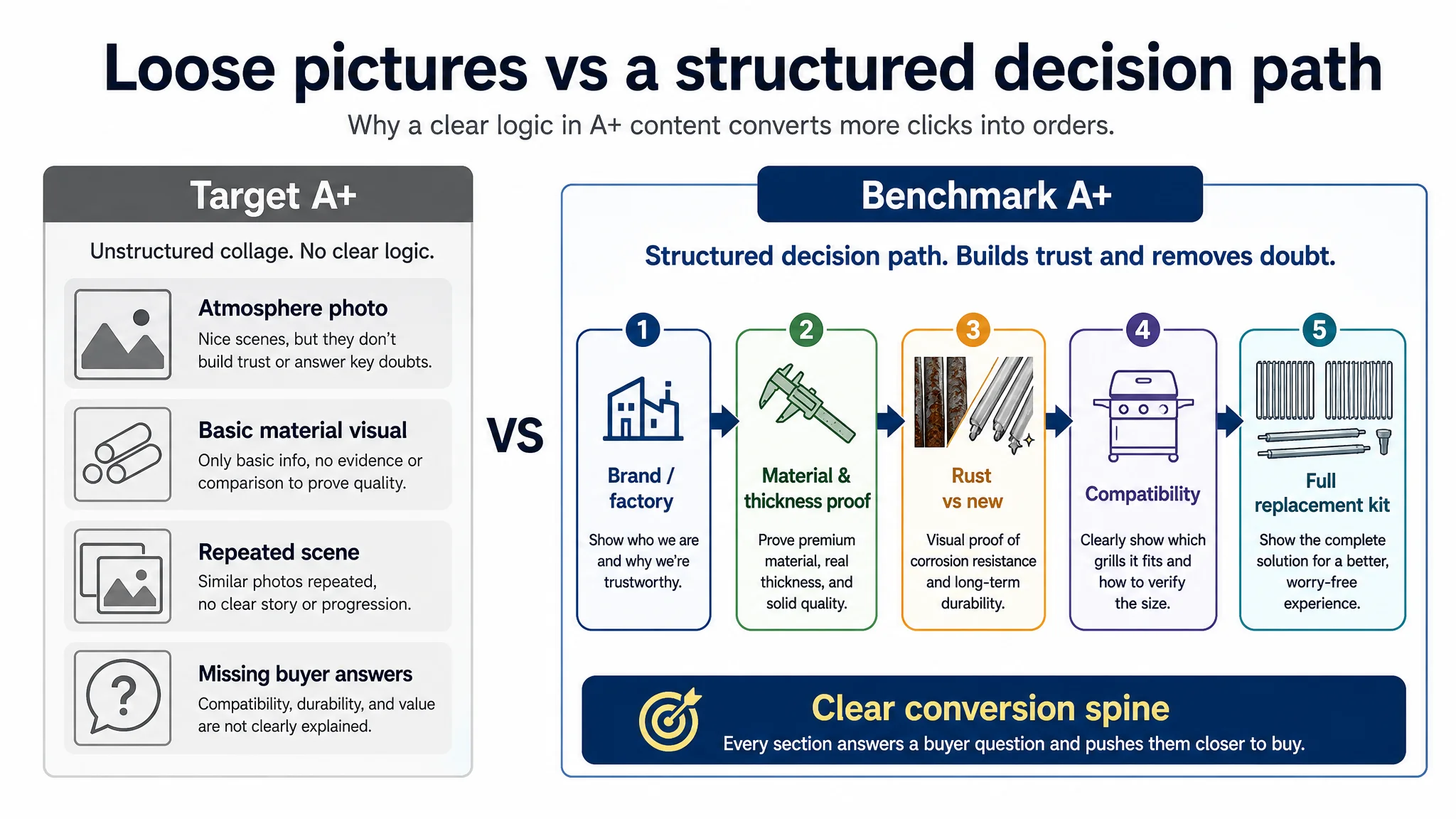
The competitor A+ content followed a far more deliberate logic:
1. Brand / factory backing – images of production and brand identity
2. Core advantage modules – thickness, non‑magnetic, anti‑corrosion, “rusty vs new” comparisons
3. Compatibility and full‑set visuals – multiple grill parts shown together, strong sense of “professional replacement kit”
4. Technical evidence images – calipers on rod thickness, corrosion tests, before/after visual transformations
The result:
- The competitor created a decision path: “Professional brand → thicker & better material → proven rust resistance → clearly fits my model → my old rusty grill looks new.”
- Our target listing showed the product, but did not convincingly answer:
- “Will this really fit my grill?”
- “Will this last longer than cheap alternatives?”
- “Is this actually worth a premium price?”
With very low review volume, this missing A+ story mattered even more.
Why Ad Tuning Alone Couldn’t Solve the Problem
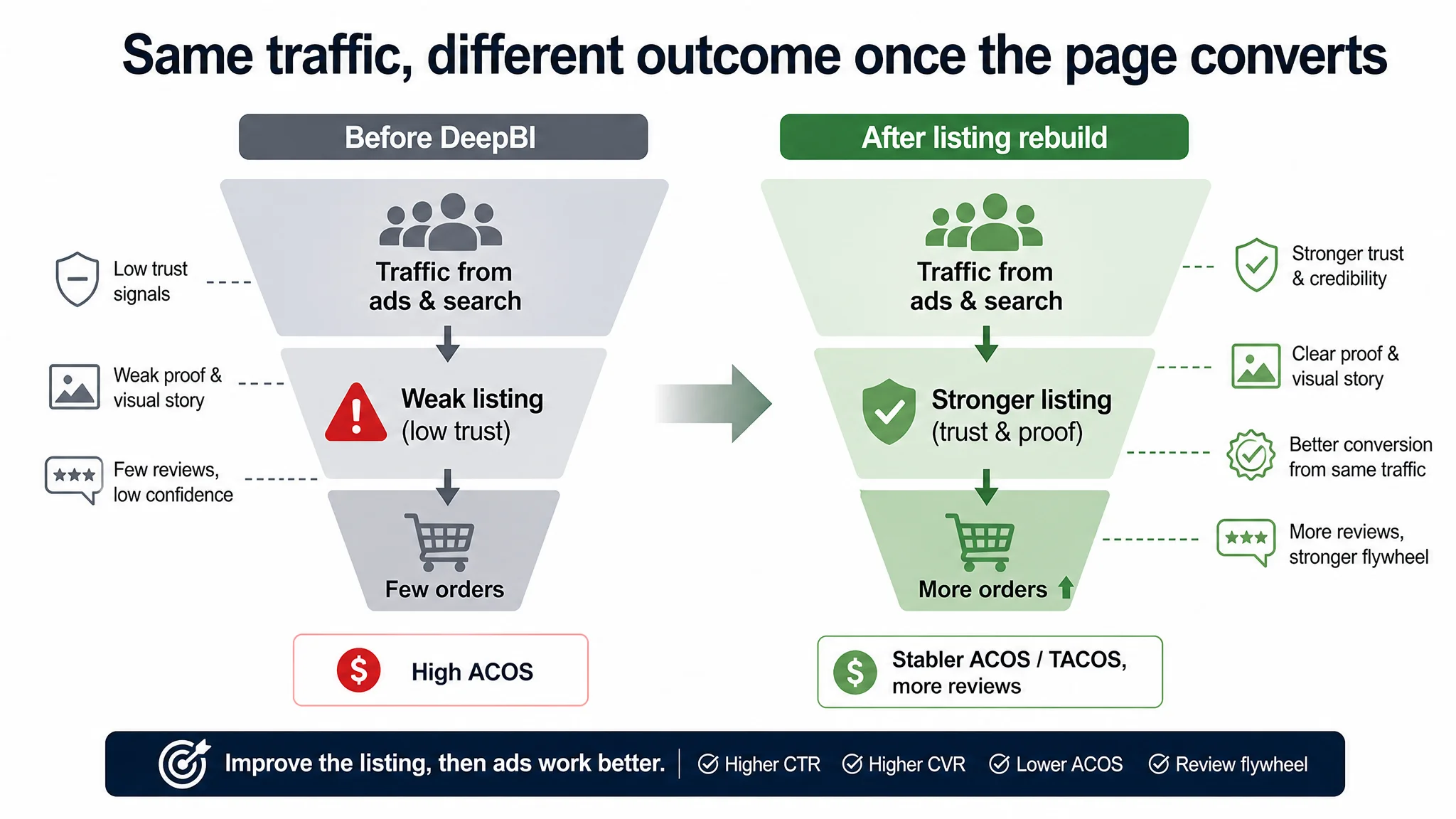
From a funnel perspective, the picture looked like this:
- Traffic: Ads and organic exposure heavy on “grill grate” / “replacement” keywords
- Click stage (CTR): Competing against a visually stronger first image and title that scream “replacement solution”
- Conversion stage (CVR): Landing on a page with:
- Weak social proof (3 reviews vs competitor’s 34)
- Less persuasive A+ content
- Limited visual proof of fit, durability, and long‑term benefit
Under these conditions, continuing to:
- Add keywords
- Split campaigns
- Micro‑adjust bids
…would only push more paid traffic into an under‑optimized page. ACOS pressure would persist because the page itself was the bottleneck.
“Advertising does not only amplify advantages. It can also amplify a page’s existing defects.”
The business risk at this stage:
- More ad spend would not reliably bring down ACOS.
- The listing risked falling into a loop where ads constantly subsidized a weak page, eroding margin without structurally improving conversion.
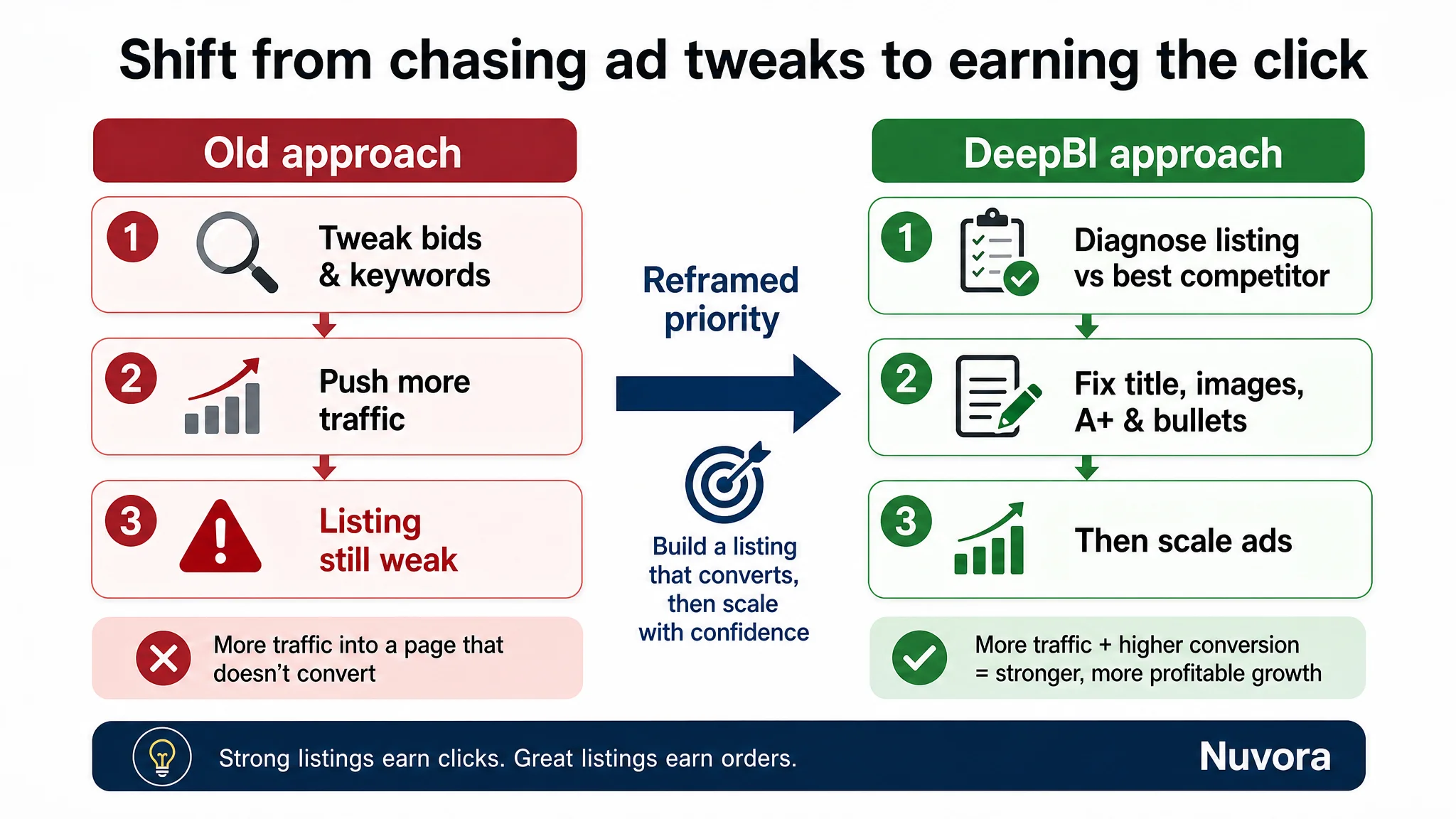
That is why the priority had to shift from campaign surgery to Listing conversion surgery.
How DeepBI Read the Data and Reframed the Problem
DeepBI’s scoring and benchmark logic did three things for the seller:
1. Quantified the competitive gap
- 61 vs 80 total score
- Clear underperformance in detail/A+ and reviews
- Only a marginal gap in visual quality, but a large gap in visual argument
1. Tied Listing weaknesses to funnel behavior
- Low review volume + weak A+ = lower trust
- Less clear “replacement / fits” language = weaker click and conversion on high‑intent searches
- Missing evidence‑style visuals = buyers keep hesitating or bounce to the competitor
1. Reordered the optimization priorities
- Stop thinking first in terms of “new keywords”
- Start by strengthening the product-page story so that each click has a better chance to convert
- Then, refine ads on top of a listing that can actually carry the spend
In short, the real question shifted from:
- “Which keyword or bid is wrong?”
to:
- “Does this Amazon product page deserve more traffic yet?”
What Needed Fixing First: The Page, Not the Campaigns
1. Re‑anchoring the Title Around Replacement Intent and Fit
The proposed title direction:
“4Pcs Stainless Steel BBQ Grill Grate for Bull Angus, Brahma, Outlaw, Steer, Lonestar Select, Lion Premium, 19 1/4 x 7.5 Inch Replacement Grates, 7mm Heavy Duty Rods”
Key shifts:
- “Stainless Steel BBQ Grill Grate” + size moved forward to let buyers confirm fit at a glance.
- “Replacement Grates” is explicit, aligning with high‑value “replacement for…” searches.
- Model names and OEM part numbers (like 16517, 65073) are integrated into bullets to reinforce “this fits my grill” confidence.
- “7mm Heavy Duty Rods” anchors a clear spec advantage, even if the competitor claims 9mm.
This is not just SEO work; it is decision work—making sure the title answers the buyer’s first question in search results: “Is this the right replacement for my grill?”
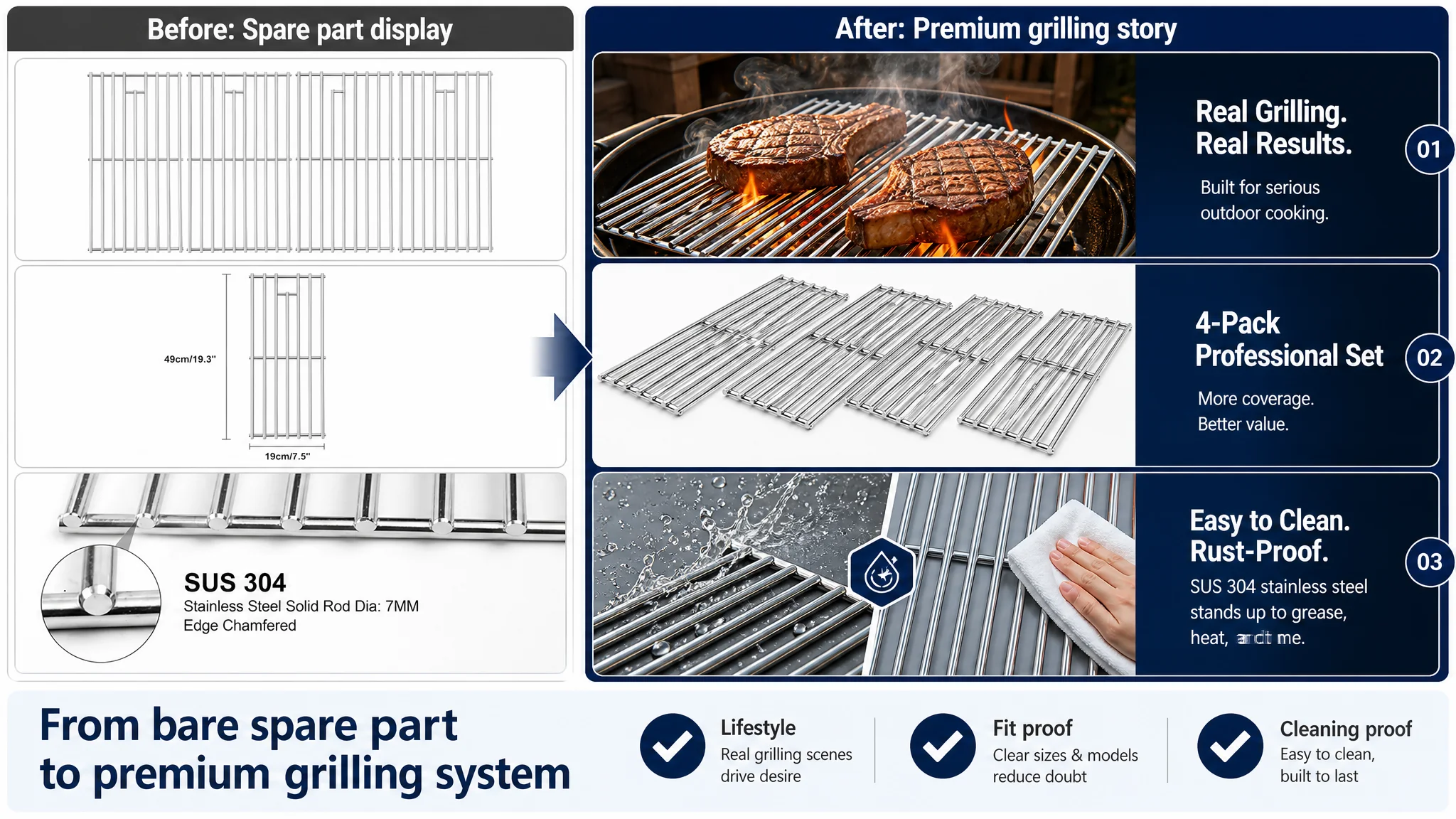
2. Turning Main Images into a Professional Grilling Lifestyle Story
DeepBI’s diagnosis on images led to a revamped visual logic:
- Hero image:
- Product at the bottom third of the frame
- Thick bone‑in steaks grilling on top, visible sear marks, slight flare‑ups, and subtle smoke
- Warm directional light emphasizing stainless steel rods
- Background: blurred outdoor barbecue scene
- Role: upgrade from “bare spare part” to “premium grilling experience.”
- Angle and arrangement shot:
- 4 grates arranged at a 45° angle, evenly spaced, on pure white
- Clean “4‑Pack Professional Set” text
- Role: convey industrial precision and set quantity instantly.
- 7mm thickness proof image:
- Macro of weld joints
- Visual magnification of 7mm solid rod with “Solid 7mm Diameter” tag
- Role: make “heavy duty” a visible fact, not just a phrase.
- Dimension visualization:
- Top‑down view with clean measurement lines (19.3" x 7.5")
- Professional style arrows and sans‑serif labels
- Role: close the loop on fit and reduce “will this match my grill?” anxiety.
- Ease‑of‑cleaning / anti‑rust visual:
- Split scene: water droplets and cleaning cloth, “Easy to Clean & Rust‑Proof”
- Role: bring the SUS 304 anti‑corrosion benefit to life, not just text.
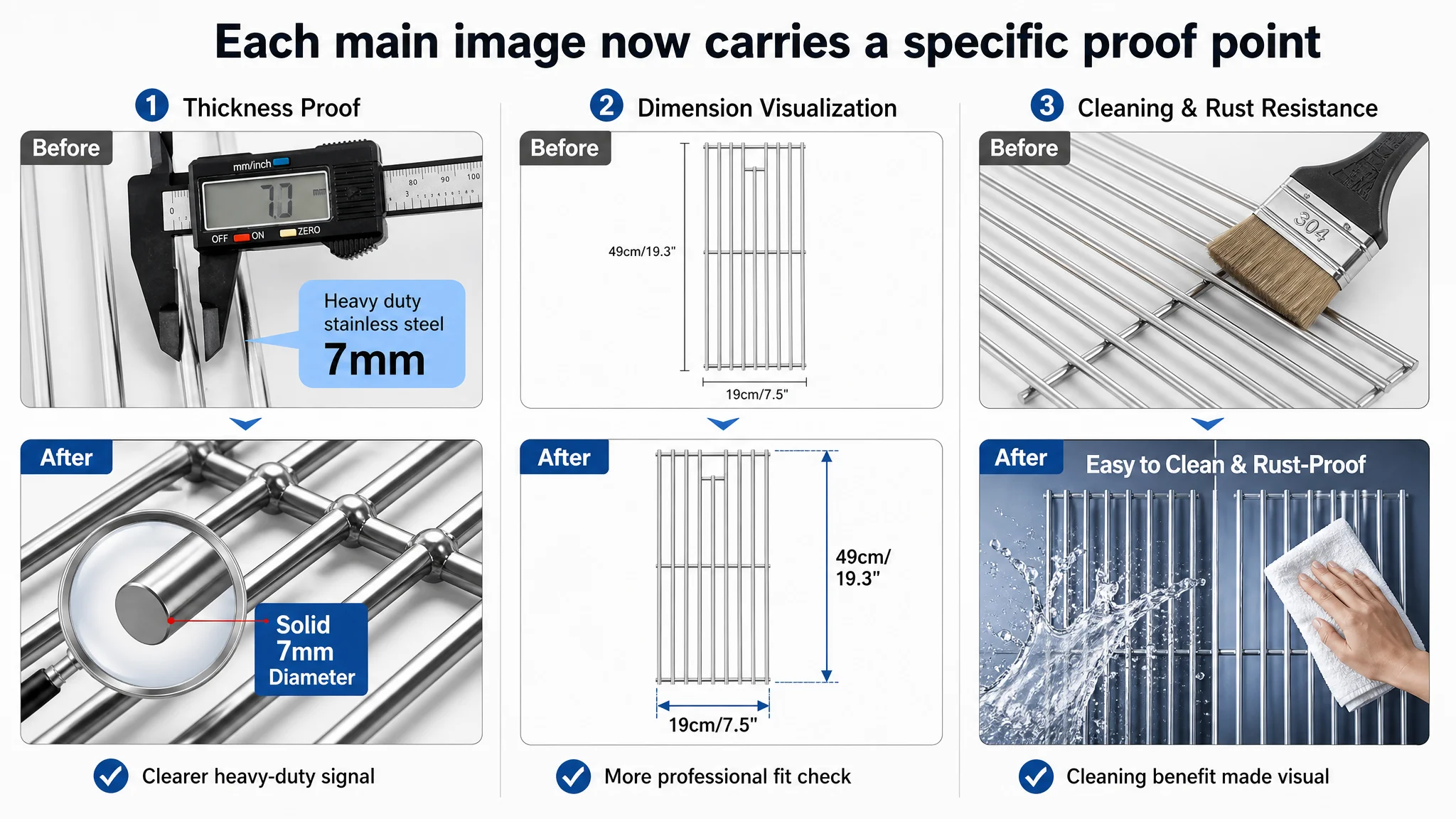
Together, these images push the Listing into a “high‑end professional outdoor grilling” territory while systematically answering core buyer questions: taste, fit, durability, and maintenance.
3. Restructuring A+ Content into a Conversion Path
The new A+ concept is built around three missing pillars: brand trust, pain‑point contrast, and compatibility clarity.
Key modules:
- Brand / factory confidence
- Modern industrial line + installed product in a clean backyard grill
- Role: “We are a serious manufacturer, not a random parts seller.”
- Size + compatibility matrix
- Central product with clear length / width callouts
- Side panel listing compatible Bull and Lion models
- Role: reduce returns and pre‑purchase doubt.
- Rusty vs new visual
- Left: old rusted grate
- Right: new SUS 304 grate with crisp highlights
- Role: make “grill renewal” visceral—why upgrading matters.
- 7mm heavy duty highlighted
- Digital caliper reading “7.0mm” with “7MM HEAVY DUTY” claim
- Role: defend 7mm as strong and sufficient, even against a competitor claiming 9mm.
- 14mm spacing functional scene
- Steak plus small cherry tomatoes on the grate, none falling through
- Role: prove “superior food support” visually, not only in bullet points.
- Smooth edges + safety
- Macro of chamfered edge with “Smooth Edge Chamfered” label
- Role: show engineering care and safety.
- Cleaning scene
- Wire brush cleaning a grate with “before/after” cleanliness difference
- Role: deliver on “easy to clean” in a way that is immediately understood.
Instead of a loose collage of nice pictures, the A+ becomes a structured persuasion sequence:
Professional brand → Fits my grill → Fixes my rust problem → Strong enough for heavy use → Safer & easier to cook → Easy to maintain
4. Aligning Bullet Points with the Visual Story
The existing bullet points already had better logic than the competitor’s, but DeepBI tightened the alignment with the new visual story:
1. Heavy‑duty construction – 7mm solid stainless steel rods, high heat resistance, rust resistance, and heat retention.
2. Perfect fit & compatibility – explicit dimensions, OEM numbers, and supported models.
3. Polished surface & safe edges – non‑sharp, easier handling, and safer cooking.
4. 14mm optimized spacing – prevents small foods from falling, ensures even heating.
5. Easy installation & low maintenance – install in minutes, quick cleaning to extend grill life.
Now, every bullet corresponds to a visual proof point in the images and A+ modules, forming a more coherent buying logic.
How the Page’s Sales Logic Started to Recover
After this reframing, the seller’s optimization sequence changed:
1. Pause aggressive scaling of ads until the Listing could credibly convert the traffic.
2. Rebuild the visual and textual logic of the Amazon product page as above.
3. Then re‑introduce and adjust ads, now using keywords like “replacement,” OEM part numbers, and model‑specific queries, driving traffic into a more convincing page.
The expected operating changes:
- Click‑through rate (CTR):
- Hero image with food and flame + clearer replacement intent in title should attract more relevant, high‑intent clicks.
- Conversion rate (CVR):
- Stronger A+ story, visible proof of fit, durability, and cleaning ease means more visitors finish the purchase instead of bouncing.
- ACOS and TACOS stability over time:
- As the Listing begins to convert a larger share of both ad and organic sessions, ad dependence can be dialed back, and incremental spend becomes more predictable.
- Review flywheel:
- As the Listing converts better, review count can grow from the current “too few to be trusted” level, gradually narrowing the –9 review gap with the competitor and providing additional trust leverage.
What the Seller Learned—and What Other Amazon Sellers Can Take Away
For this Amazon grill‑grate seller, the key realization was:
- They did not have an “ads problem.”
- They had a Listing conversion problem that ads kept revealing and amplifying.
Specifically:
- A reasonably written title, decent bullet points, and a 5.0 rating are not enough if:
- Review volume is low
- A+ content lacks structure and evidence
- Main images don’t work as a story and a proof set
DeepBI’s role was not to provide “prettier pictures” or a generic checklist, but to:
- Quantify how far the Listing lagged a real benchmark
- Identify exactly where that gap mattered most for conversion
- Reorder the optimization priorities so that Listing conversion capacity was fixed before scaling traffic again
For other Amazon sellers, especially in functional categories like parts, accessories, and home hardware, this case underlines three operating principles:
1. Ads cannot solve a trust deficit. If your A+ and review structure are weak, ad spend will mostly highlight that weakness.
2. Listing performance is relative to the best competitor, not to your own expectations. A 5‑star rating with 3 reviews can lose to a 4.8‑star rating with 34 reviews plus superior visuals.
3. Before pushing more traffic, ask: “Does this product page fully earn the click?” If the answer is no, the first place to optimize is the Amazon Listing itself—title, main images, bullet points, and A+ content working together—then the ads.
When ACOS feels stuck and “more adjustments” stop working, it may be time to stop blaming ad campaigns and start treating your Amazon product page as the primary performance lever.