


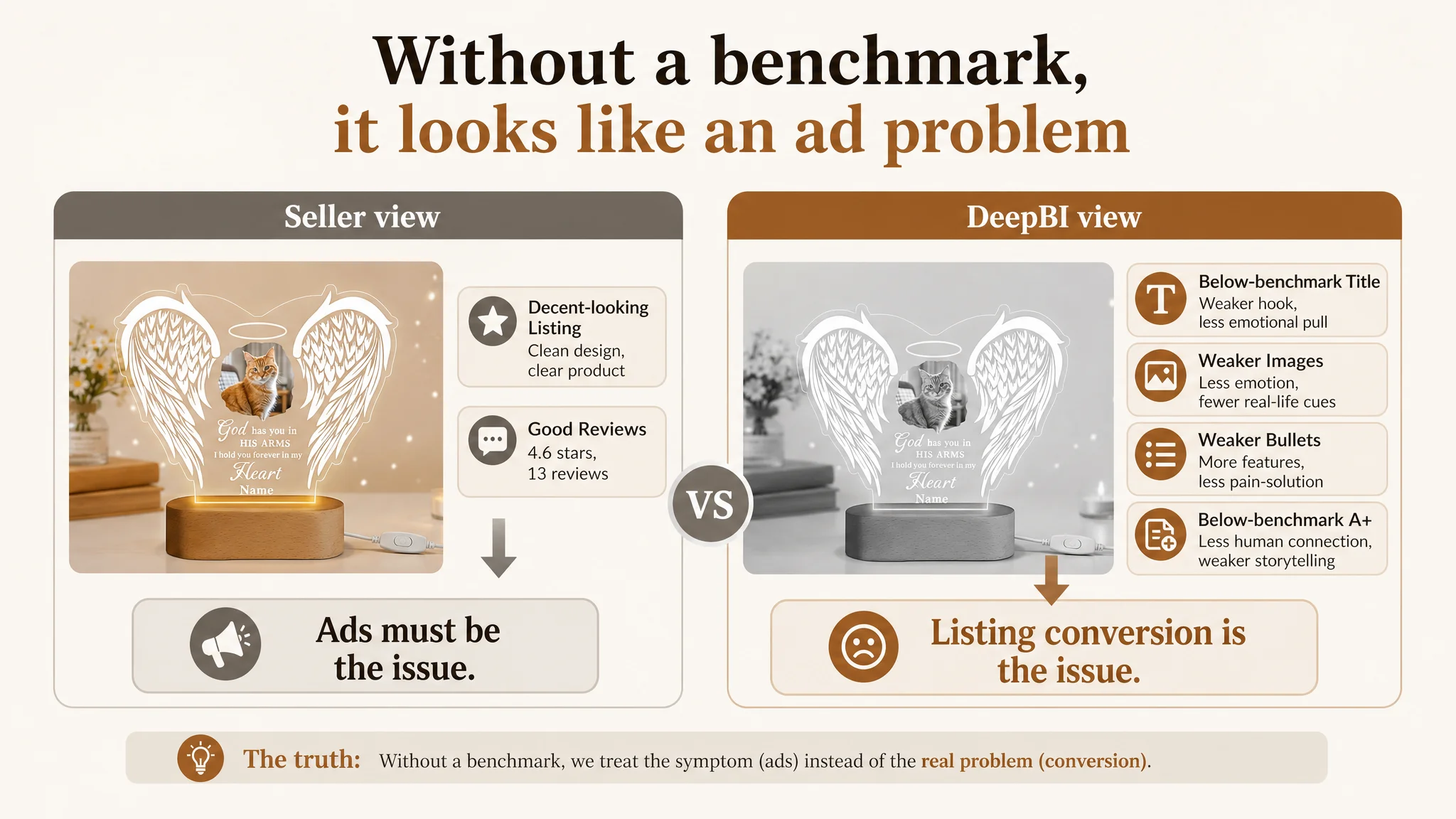
For this Amazon UK seller in the pet memorial niche, the first instinct was familiar: ads were getting harder to control, so the team assumed the problem sat in bidding, keywords, or budgets. The Listing looked “good enough,” reviews were healthy, and the product itself was moving — just not at the pace they needed. But when DeepBI put their Amazon product page side‑by‑side with a category‑leading competitor, a different picture emerged.
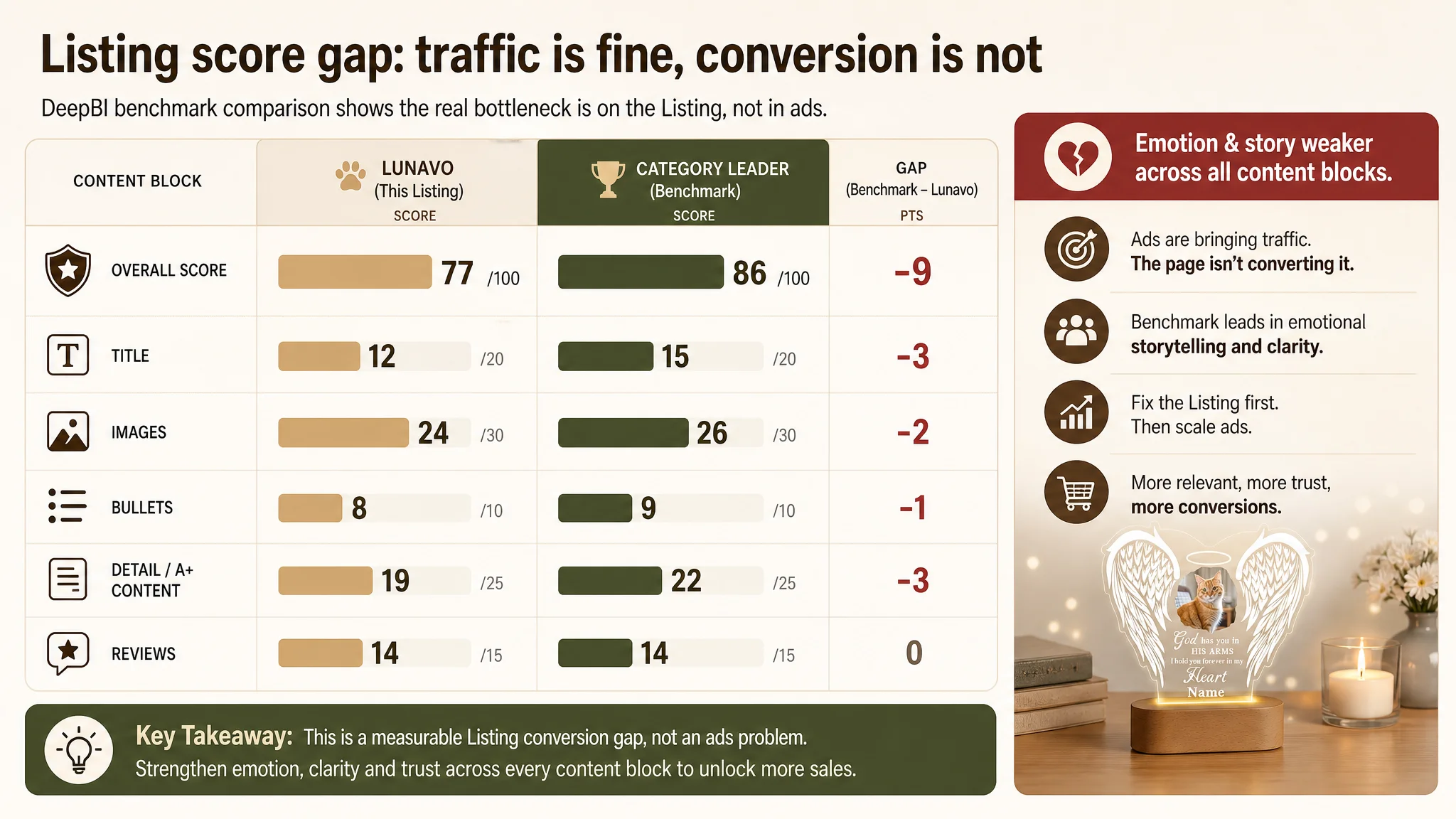
The data showed that this was not an advertising failure but a conversion ceiling on the Listing itself. Title, images, bullet points, and A+ were all slightly weaker than a key competitor, especially in one place that matters most in this category: emotional storytelling. The page looked like a pretty LED ornament; the competitor looked like a way to grieve and remember a pet.
Once the problem was reframed from “fix the ads” to “fix how the page carries grief, comfort, and gifting scenarios,” the optimization priorities changed. DeepBI guided the seller to rebuild the title around high‑intent emotional keywords, restructure bullet points into pain‑solution logic, and redesign images and A+ to show real‑life remembrance scenes instead of just arranged product composites.
For other Amazon sellers, the lesson is direct: when your product page underperforms a clear benchmark, pushing more traffic through ads only amplifies the weakness. In categories where emotion and trust drive decisions, Listing conversion capacity — not campaign tinkering — is often the real constraint.
The Real Bottleneck Was Not Clicks, but Emotional Conversion
On paper, this Amazon pet memorial light Listing did not look “broken”:
- Overall Listing score: 77/100
- Competitor benchmark: 86/100
- Reviews: 4.6 stars, 13 reviews, no visible negative reviews
- Competitor reviews: 5.0 stars, 23 reviews
CTR and CVR were not catastrophic, but the seller could feel the ceiling: ads kept spending, and incremental orders were increasingly expensive. The team instinctively leaned into ad tuning — keywords, bids, budgets — assuming the answer lay in traffic quantity and targeting.
DeepBI’s diagnostic told a different story. The gap to the benchmark wasn’t in reviews or basic credibility; it was embedded in:
- Title (−3 points)
- Main image and image set (−2 points)
- Bullet points (−1 point)
- Detail/A+ content (−3 points)
Each gap was small on its own, but together they formed a consistent pattern: the competitor’s page had clearer emotional positioning, more specific functional detail, and a more complete user journey. That Listing was built to convert traffic; this one was built to “present” the product.
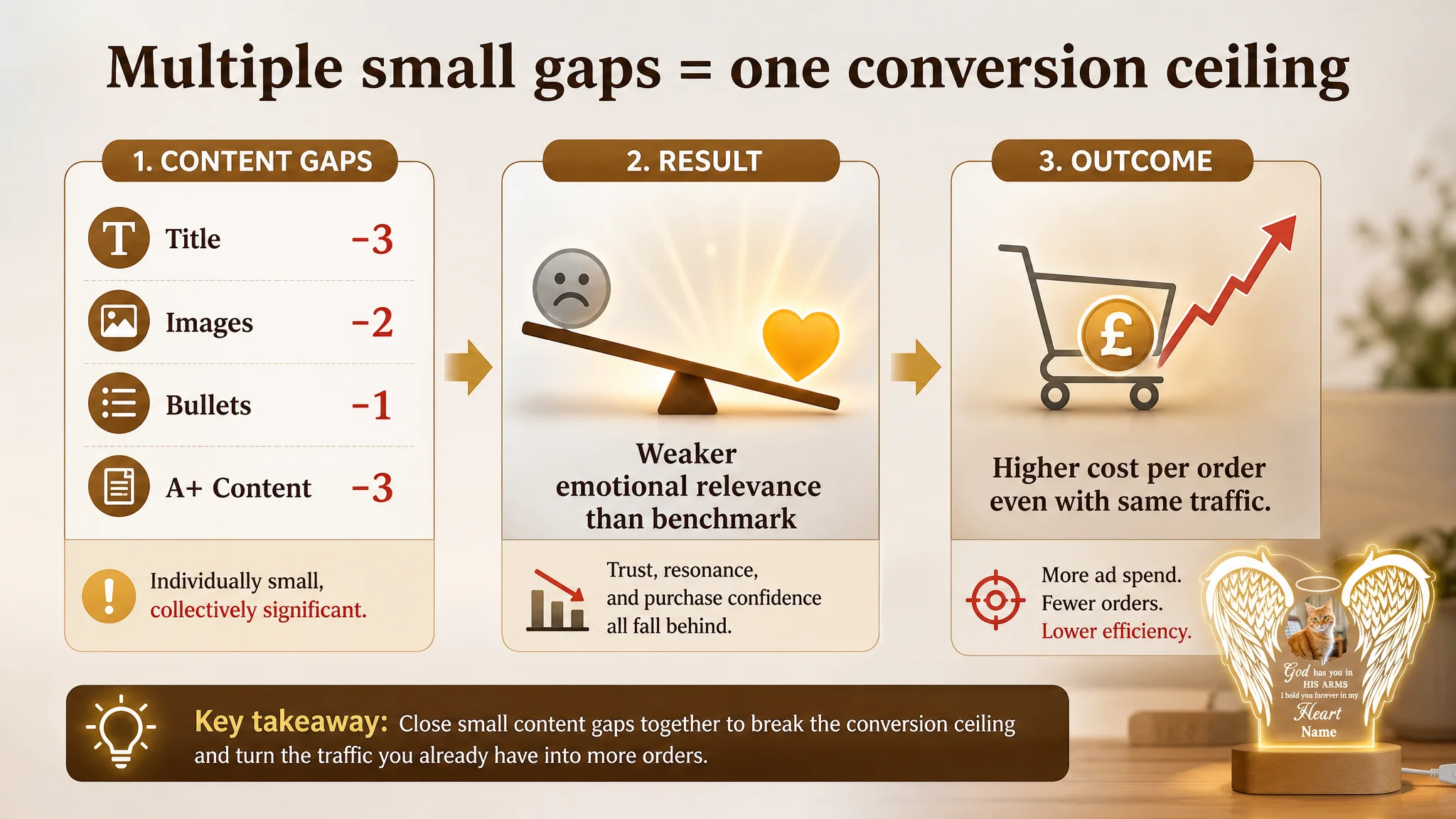
“The real problem was not that ads failed to bring traffic. It was that the page could not fully convert the traffic it already had.”
Once that judgment was clear, there was little point in pouring more spend into campaigns. Every additional click would be hitting a page that converted slightly worse than the benchmark — a structural disadvantage in a niche where intent is high but purchase is emotional.
How the Seller Originally Misread the Problem
From the seller’s perspective, several signals pushed them toward blaming ads:
- The product was visually attractive and differentiated (angel‑wing acrylic with wooden base).
- Personalisation (“Personalised”) and “LED Night Light” were clearly stated in the title.
- Reviews were healthy, with no obvious reputation damage.
- The page already mentioned memorial, remembrance, and decoration.
The internal conclusion: “Our product page is fine; we just need more traffic and better ads.”
This is a common trap:
- A decent‑looking Listing makes people assume the page is not the issue.
- Healthy reviews create a false sense of security about conversion.
- “We already say it’s a memorial gift” sounds sufficient on the surface.
What was missing was a structured comparison against the category’s true ceiling — a direct benchmark that showed how a top‑performing Amazon Listing builds emotion, resolves doubts, and closes the gifting decision from thumbnail to A+.
What DeepBI Saw in the Listing Data That the Seller Could Not
DeepBI’s Listing scoring broke the page down into components and compared it to a single, tightly matched benchmark Listing in the same Amazon UK pet memorial niche.
1. Title: From “What It Is” to “What It Means”
Scores:
- Seller title: 12/20
- Competitor title: 15/20
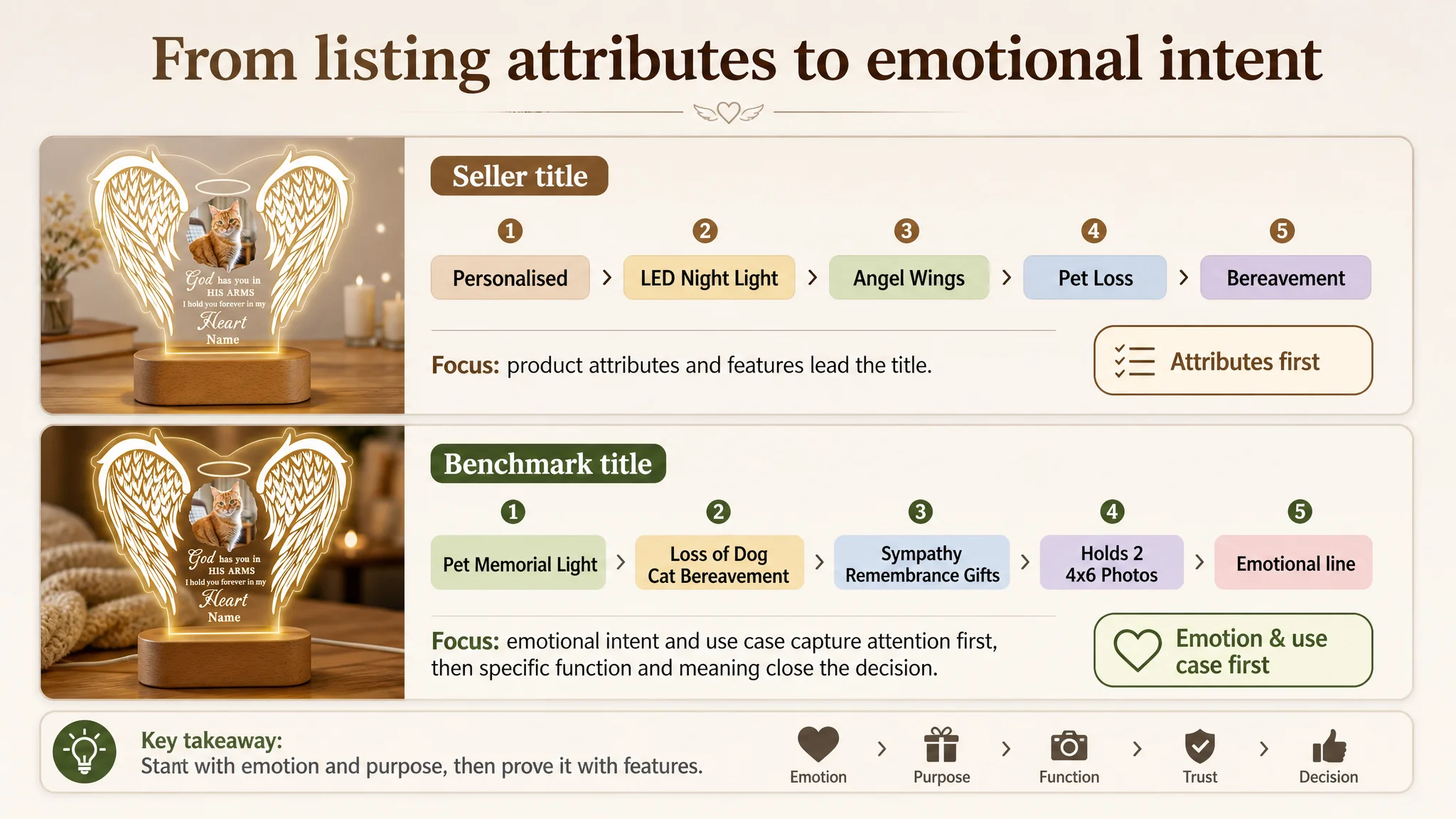
The seller’s title led with:
- “Personalised Cat Memorial Light, LED Night Light with Angel Wings Photo Frame, Pet Loss Sympathy Gift for Bereavement, Remembrance Gifts with Wooden Base”
The problem wasn’t keyword stuffing; the issue was priority and structure:
- The seller front‑loaded “Personalised” and “LED Night Light” — attributes — instead of the core category hook.
- The competitor put “Pet Memorial Light” at the very front, followed by “Loss of Dog Cat Bereavement Sympathy Remembrance Gifts” and then specific functional detail (“Holds 2 4x6 Photos”) and a strong emotional line (“No Longer by Our Side but Forever in Our Hearts”).
DeepBI’s judgment:
- The benchmark title combined broad emotional search terms (“Loss of Dog Cat Bereavement”) with specific functional phrases (“Holds 2 4x6 Photos”) in a clear, staged narrative.
- The seller’s title listed attributes in parallel, but did not build a persuasive arc from pain → use case → outcome.
Why this matters for ads: If your ad brings in “pet loss gift” searchers, a title framed around “Personalised LED Night Light” looks less relevant than “Pet Memorial Light, Loss of Dog Cat Bereavement Sympathy Remembrance Gifts…”. You lose relevance at the very first line of the product page, which hurts both CTR and CVR.
2. Main Images: The Product Was Visible, But the Story Was Missing
Scores:
- Seller main images: 24/30
- Competitor main images: 26/30
The seller’s image set did show the product, multiple views, and some basic contextual usage. The problem was more subtle:
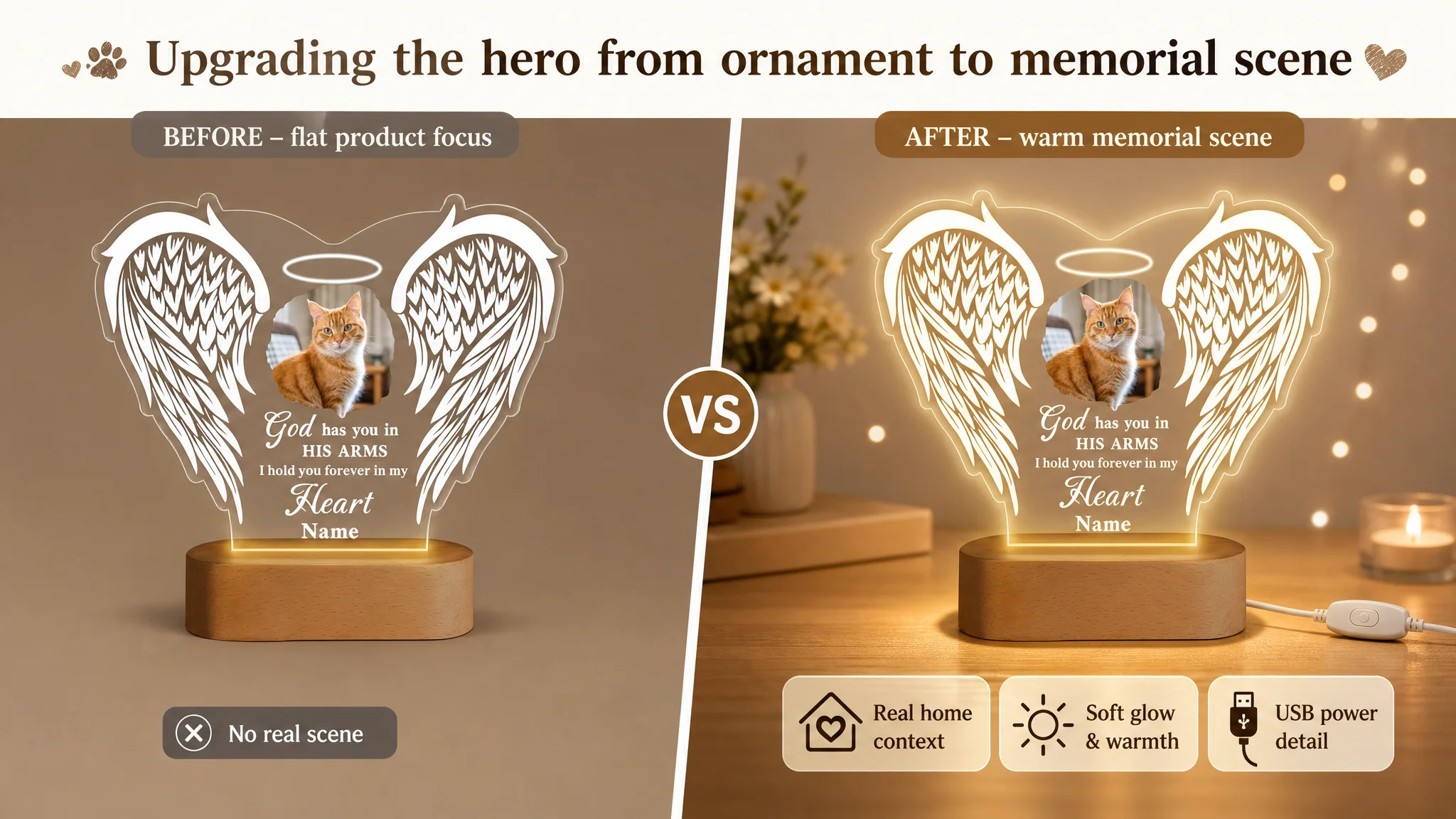
- The main hero image was a static still life — aesthetically fine, but lacking a strong emotional trigger.
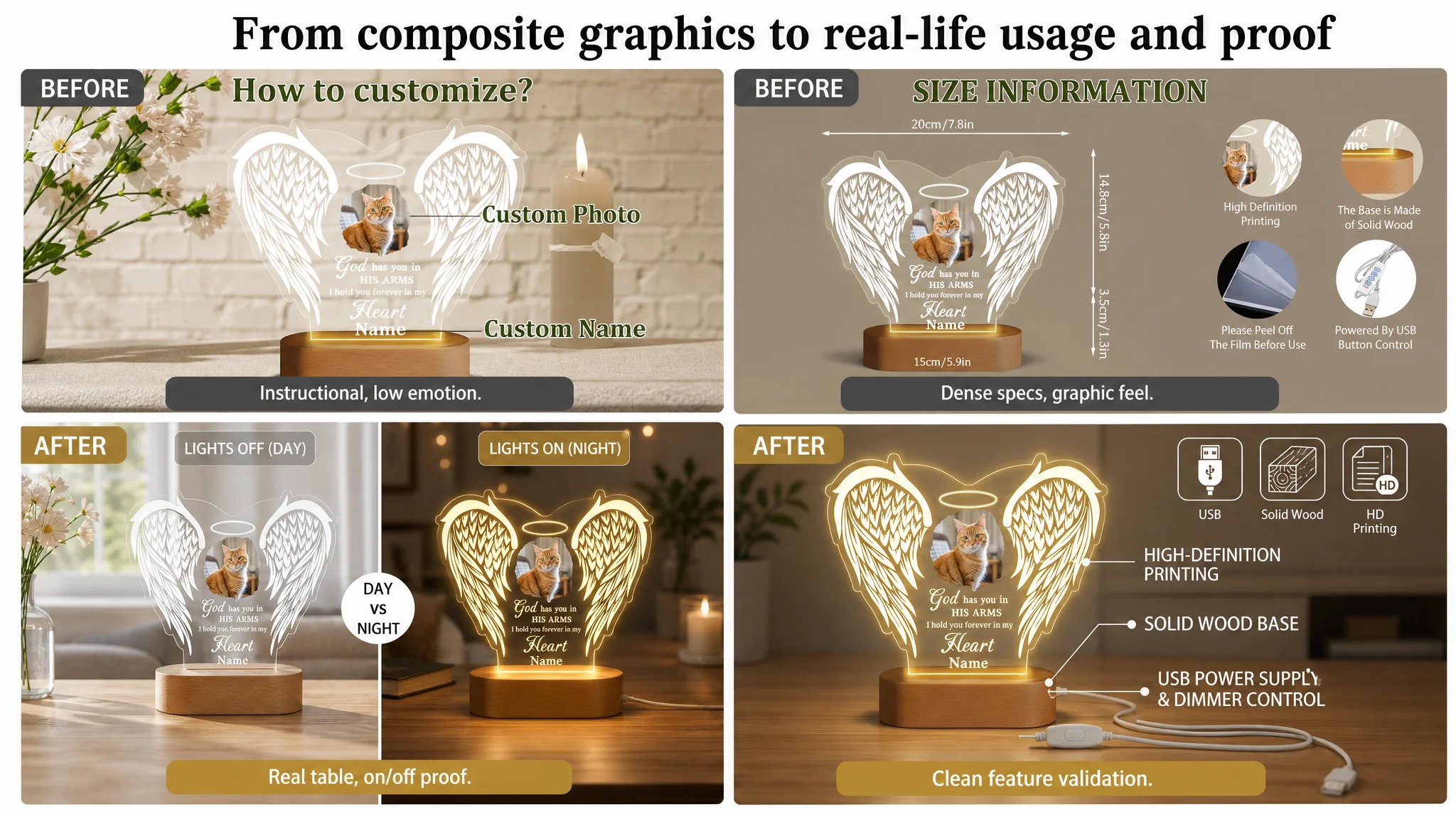
- The “day vs night” comparison felt synthetic, with compositing that weakened trust and realism.
- Parameter and feature images were dense and design‑heavy, but lacked clear visual hierarchy and practical demonstration.
The benchmark’s image set, by contrast, formed a complete conversion sequence:
1. Emotional attraction: warm scene, implied human‑pet relationship, immediate “this is about losing a pet” recognition.
2. Function validation: hinge, frame, power details, real‑world angles.
3. Use scenarios: bedside, living room, memorial table — clear cues where this fits into daily life.
4. Gifting: “ready to gift” feel, packaging indication, implied ceremony.
DeepBI’s conclusion: the seller’s page showed a product; the benchmark showed a ritual. In a bereavement category, that difference converts.
3. Bullet Points: Information Without a Buying Logic
Scores:
- Seller bullets: 8/10
- Competitor bullets: 9/10
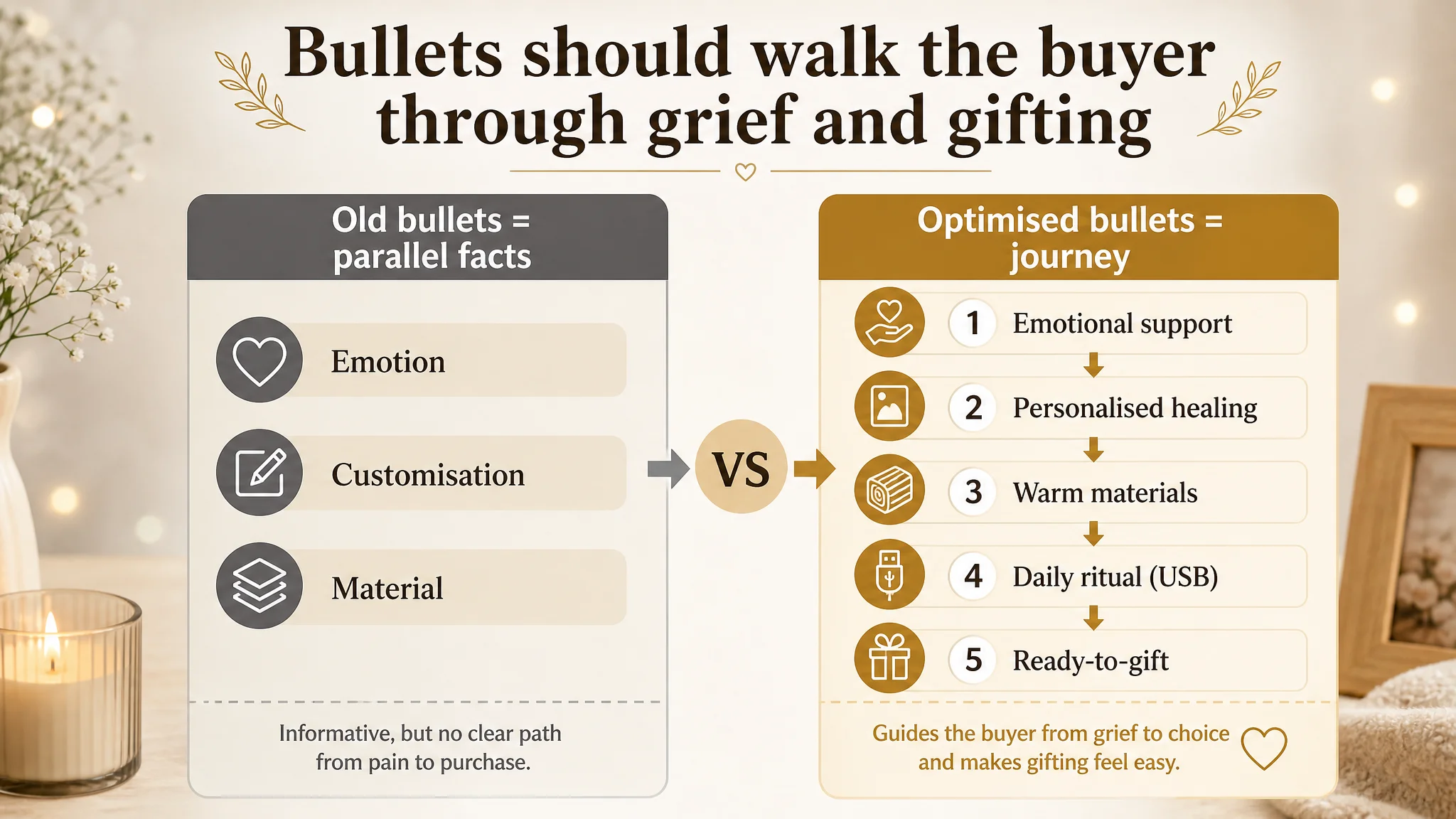
Both Listings covered key elements, but the benchmark had a sharper conversion logic:
- The competitor used strong contrast phrases: “Ideal for… No more…” tying each point to a scenario and a solved pain.
- Every bullet embedded a specific context (“after a loss”, “for bedrooms”, “no more keeping memories hidden away”).
- The bullets formed a user journey: emotional support → functional design → spatial fit → ease of use → gifting readiness.
The seller’s bullets, while covering emotional value, customisation, materials, scenes, and decor/usage, stayed mostly at a descriptive level:
- “What it is” rather than “what problem it solves at each stage of grieving and gifting.”
DeepBI’s analysis: ads were sending high‑intent visitors into a page that informed, but did not walk them through the decision: “Is this the right way to support someone (or myself) through pet loss?”
4. Detail/A+ Content: Credible, But Not Fully Human
Scores:
- Seller detail/A+: 19/25
- Competitor detail/A+: 22/25
The seller’s A+ layout:
- Atmosphere scenes
- Specification visuals
- Three core selling blocks (memorial gift / lighting / decoration)
- Emotional copy block
- Product close‑ups
On a purely design level, this is not “bad.” But relative to the benchmark, several weaknesses emerged:
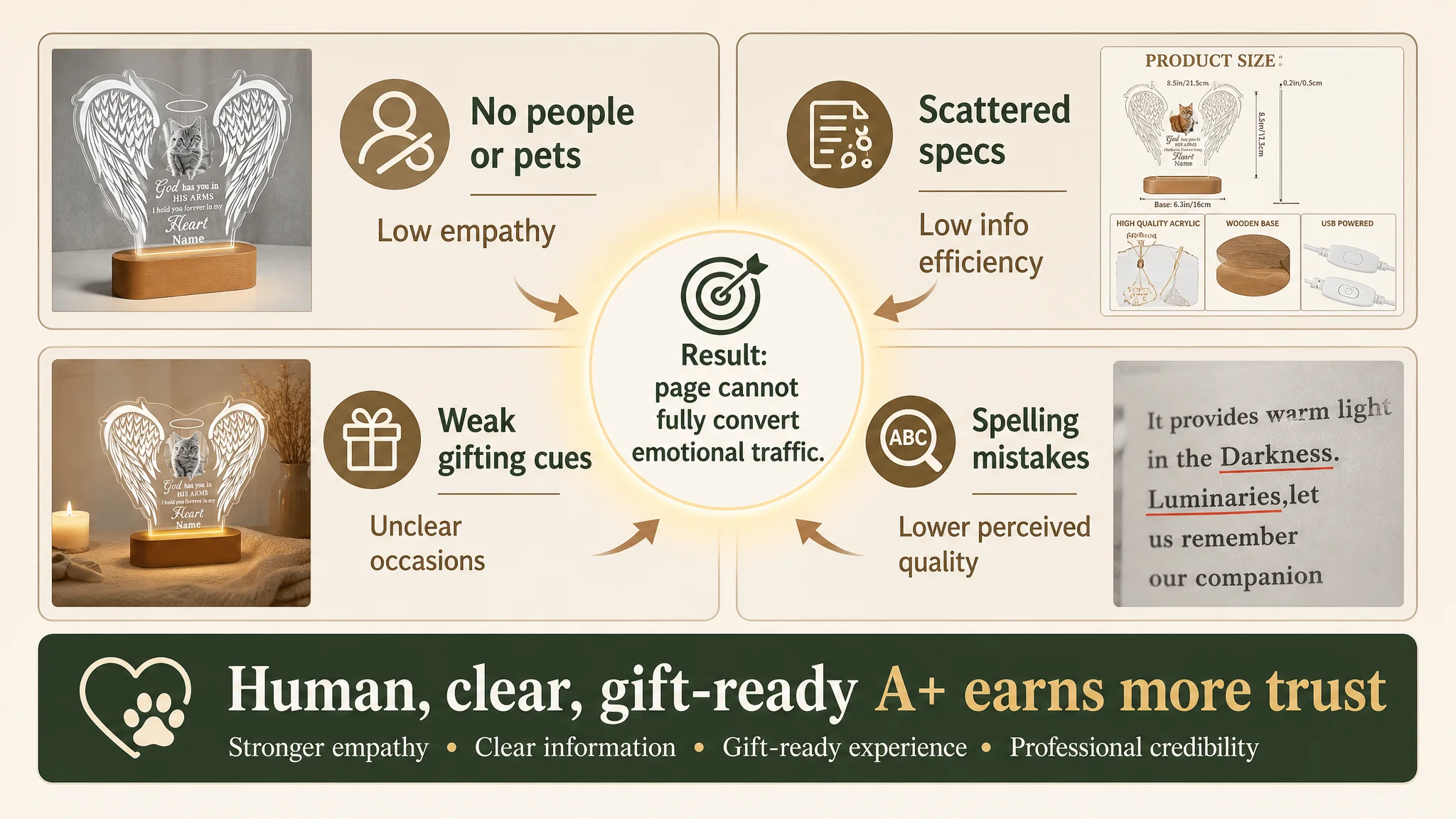
1. Lack of human presence:
The benchmark used “human + pet” imagery — a person with a dog — to anchor empathy. The seller relied on static scenes and product arrangements. In a grief category, who this is for matters more than how neatly it’s displayed.
1. Dispersed technical information:
The benchmark integrated USB power, rotation, and inscriptions into a clear FAQ‑like structure. The seller scattered size and material details inside paragraphs, forcing the shopper to extract critical information manually.
1. Weak gifting anchors:
The competitor clearly signposted festive and occasion gifting (Christmas, birthdays, sympathy), making it easy to justify as a present. The seller only vaguely referenced “decoration” and home placement, missing the emotional stakes of giving this as a memorial gift.
1. Professional errors:
The seller’s existing A+ included obvious spelling mistakes (“Wenorial”, “Decration”, “whocan't”), which quietly undercut trust and perceived quality — especially dangerous at the moment of purchase.
Taken together, this meant the page could not fully exploit the traffic it received. Every click the ads brought in hit a page that did not fully clarify:
- Who is this for?
- When is it appropriate?
- How does it feel in real life?
- Does this brand treat this topic with the care it deserves?
Why DeepBI Chose to Repair the Listing Before Tuning Ads
Given this diagnosis, DeepBI’s operating logic was simple:
- If the Listing underperforms a direct benchmark across title, images, bullets, and A+, then ad optimization alone cannot reset the economics.
- Continuing to scale ads would simply amplify a conversion gap that was already visible in the data.
The key business risks in continuing with ads‑first optimization were:
1. Compounding wasted spend:
Each incremental click would land on a page with a systematically weaker emotional and practical narrative than the benchmark. ACOS would resist improvement because the page wasn’t built to capture full value from traffic.
1. Eroding long‑term ranking:
Amazon’s organic ranking heavily reflects conversion performance. A Listing that always converts worse than a category benchmark will struggle to hold top positions, no matter how much paid traffic it receives.
1. Misleading internal learning:
If the team kept experimenting inside advertising (keywords, bids, placements), they would keep collecting “evidence” that ads were failing — when, in reality, they were feeding the wrong page.
“Advertising does not only amplify advantages. It can also amplify a page’s existing defects.”
DeepBI’s judgment: this seller did not have a traffic problem; they had a Listing conversion problem. Fixing conversion was the prerequisite to any meaningful ad strategy.
How the Page Was Reframed: From Product Ornament to Healing Object
DeepBI’s optimization direction did not revolve around “making things prettier.” It focused on re‑aligning the entire Amazon Listing with how bereaved pet owners and gift‑givers actually decide.
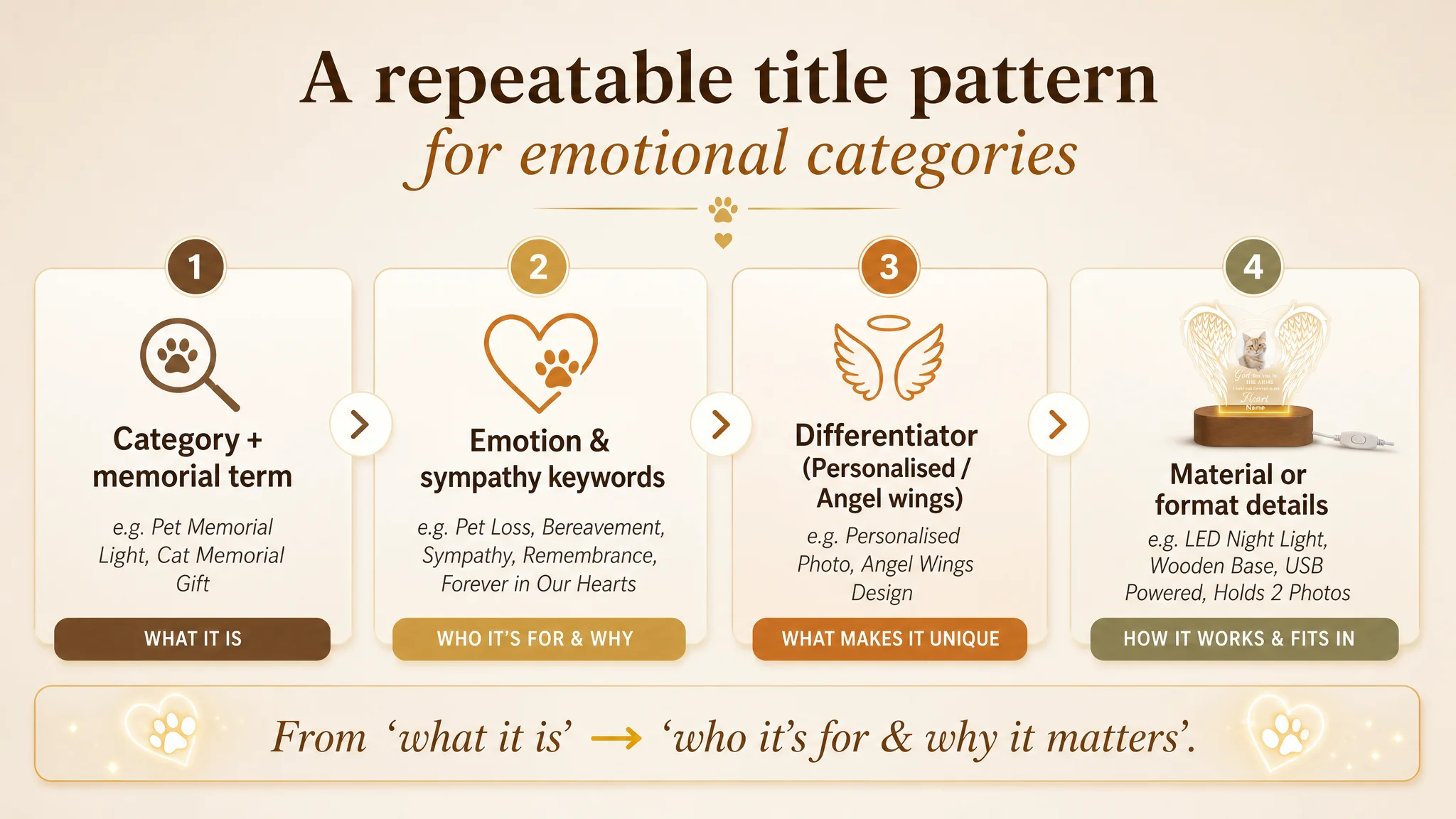
1. Reordering the Title Around Emotional Intent
The revised title logic:
- Bring “Cat Memorial Light” and “Pet Loss Sympathy Gift” forward to align with real search intent and emotional framing.
- Retain and highlight “Personalised” and “Angel Wings” as the key differentiators versus generic frames.
- Embed high‑intent terms like “Bereavement” and “Remembrance” to match the emotional state of searchers and gift‑givers.
This was not just SEO; it was about making the first line of the Listing say:
“This is specifically for lost cats and grieving owners, not just another LED night light.”
2. Turning Bullet Points Into a Grief‑and‑Gifting Journey
Each bullet was reframed into a clear pain → action → outcome structure:
- Bullet 1 — Emotional support, not just light:
“Heartfelt Pet Loss Sympathy Gift… soft LED glow… comforting message… offers quiet emotional support during difficult moments of grieving.”
- Bullet 2 — Personalisation as healing, not decoration:
“Click ‘Customize Now’… upload photo and name… no more keeping memories hidden away — revisit love and companionship through an illuminated display.”
- Bullet 3 — Material as warmth, not just specs:
“Premium acrylic & warm wooden base… avoids cold or clinical feel… fits on bedside table, bookshelf, or memorial space.”
- Bullet 4 — USB as daily ritual enabler:
“Convenient USB powered remembrance… ideal for daily remembrance without battery hassle… consistent soft glow keeps the memory alive in any room.”
- Bullet 5 — Explicit gifting frame:
“Meaningful cat memorial gift & keepsake… specifically for cat lovers mourning a loss… ready to provide a lasting tribute.”
This restructured the bullet area from “facts about the product” into a full journey:
- Why it matters → how to personalise it → how it feels in your home → how easy it is to keep it on → why it is an appropriate gift.
3. Rebuilding the Image Set to Carry a Complete Emotional Story
DeepBI’s visual guidance concentrated on:
- Main hero image:
Single product centered, 70% of the frame, warm light turned on, soft halo on the wooden base, calm beige‑grey gradient background, gentle bokeh. Purpose: “This is calming, dignified, and about remembrance.”
- Day/night real‑scene comparison:
Left: natural daylight, lamp off; right: dimmer home environment, lamp on; same table, real textures. Purpose: prove the lamp is not a synthetic graphic and show how it actually feels in different light conditions.
- Feature + spec image:
Product on the left, clear icons and lines on the right pointing to “USB powered,” “solid wood base,” “high‑clarity printing,” etc. Purpose: answer practical doubts without overwhelming the shopper.
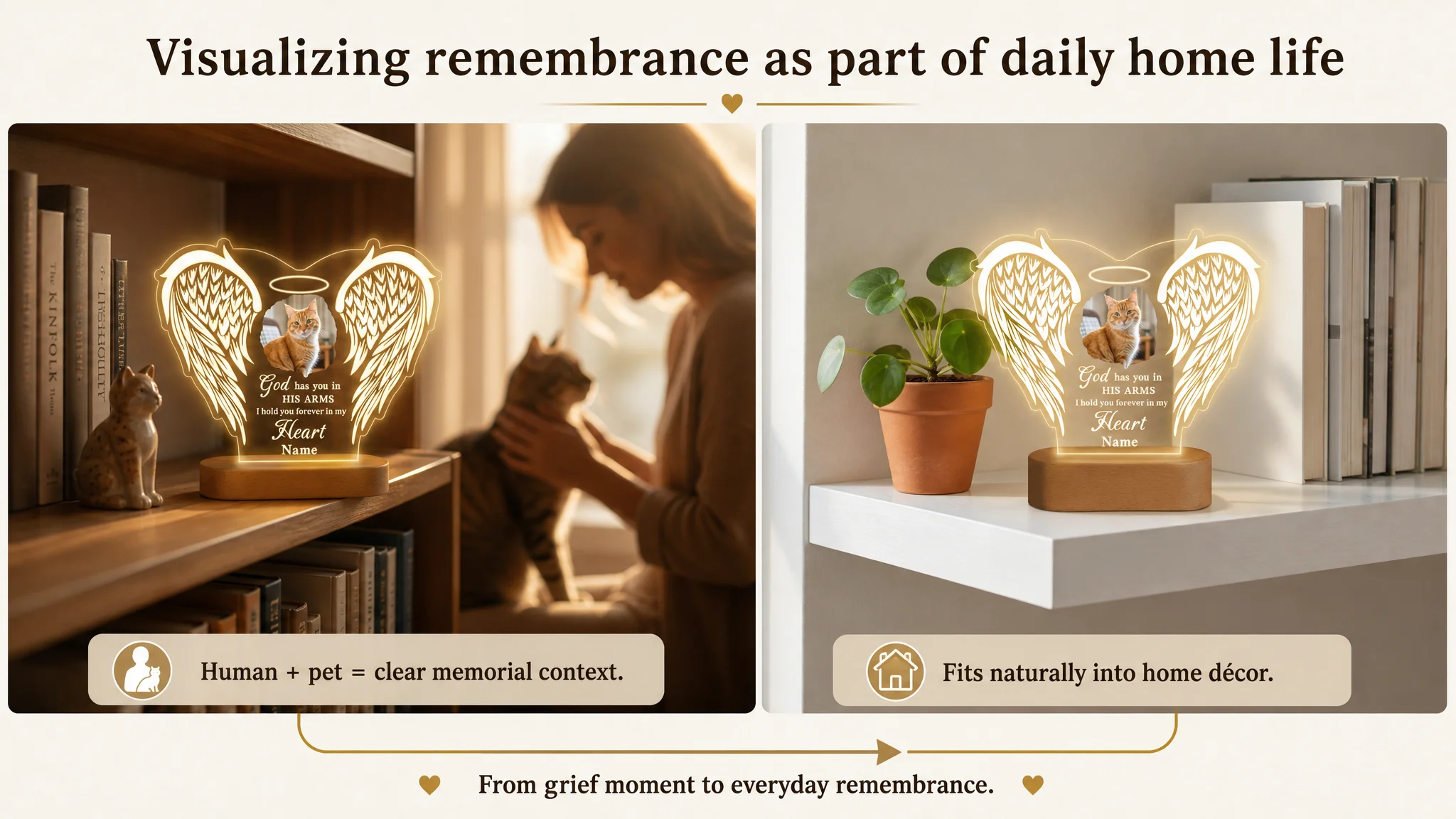
- Human‑pet interaction background:
Product in the foreground; blurred scene of a woman with a cat in the background, warm indoor light. Purpose: anchor the product explicitly to pet loss and companionship, not just decor.
- Home decor placement:
Lamp on a white shelf with a small plant and neatly arranged books, properly proportioned, no AI distortion. Purpose: show it belongs in a lived‑in, tasteful space.
4. A+ Content: From Collage of Products to a Structured Healing Path
The reimagined A+ content followed four clear modules:
1. Opening scene:
A person looking at a pet’s photo, lamp glowing nearby on a sideboard — immediately conveying that this is about grief, memory, and comfort in a normal home environment.
1. Core benefit + material clarity:
Close‑up of acrylic clarity and wood grain, dimension labels, clear USB indication — addressing the “is this real and will it look cheap?” concern.
1. Night‑time usage:
Low‑light bedside scene with lamp casting a warm glow, book and glass nearby — reinforcing night‑light and calming purposes.
1. Gifting ritual:
Hands placing the lamp into a gift box with thoughtful packaging elements — repositioning the product as a considered, ceremony‑worthy sympathy gift; all spelling errors corrected for professional trust.
This was not simply “better design.” It was a deliberate re‑wiring of the emotional and practical narrative: this Listing now speaks to grief, ritual, home, and gifting, not just to light, acrylic, and wood.
What Changed in the Business State (Even Without Inventing Numbers)
Because this case focuses on diagnosis and decision logic, not on fabricated KPIs, the important changes are in operating risk and control:
- Listing conversion capacity improved:
The page now aligns more closely with a proven benchmark in title, emotional content, and visual storytelling. This increases the probability that incoming traffic, paid or organic, will convert instead of bouncing.
- Ads became useful again, not wasteful:
Once the page is aligned with category‑leading conversion logic, each additional click has more value. Ad tuning — targeting, bids, placements — suddenly has leverage instead of fighting against a weak page.
- Traffic structure risk decreased:
A more persuasive Listing can better convert organic visitors and retargeted traffic, reducing over‑dependence on paid traffic to make the numbers work.
- The seller’s understanding of the real constraint changed:
Internally, the team stopped treating ads as a universal answer and began to see:
- Amazon ads expose your Listing’s strengths and weaknesses; they do not fix them.
- Title, main image, bullet points, and A+ must form a shared story, especially in emotional categories.
- Before scaling spend, they must ask: “Does this page truly deserve more traffic than the benchmark?”
Takeaways for Other Amazon Sellers
This pet memorial light case is not unique to its category. The pattern repeats across Amazon:
- A Listing that “looks fine” but underperforms a direct benchmark.
- Healthy reviews that mask structural weaknesses in title, images, and A+.
- Teams that keep trying to solve conversion with more traffic and more ad tweaks.
The core lesson:
- If your Listing scores consistently below a clear benchmark across multiple content dimensions, you do not have an ad problem; you have a conversion problem.
- Ads will magnify whatever your product page already is — persuasive or not.
DeepBI’s value in this case was not in generating assets or features, but in clarifying judgment:
- Identifying that the real bottleneck was Listing conversion in an emotional category, not campaign settings.
- Showing exactly how and where the benchmark was stronger.
- Rebuilding the page so that advertising could finally work with, not against, the product.
For Amazon sellers under pressure from rising ad costs and plateauing orders, this is the shift that matters: stop asking “Which keyword should I bid on next?” and start asking “What about this page makes someone in real grief — or someone buying for them — actually trust and choose us?”