

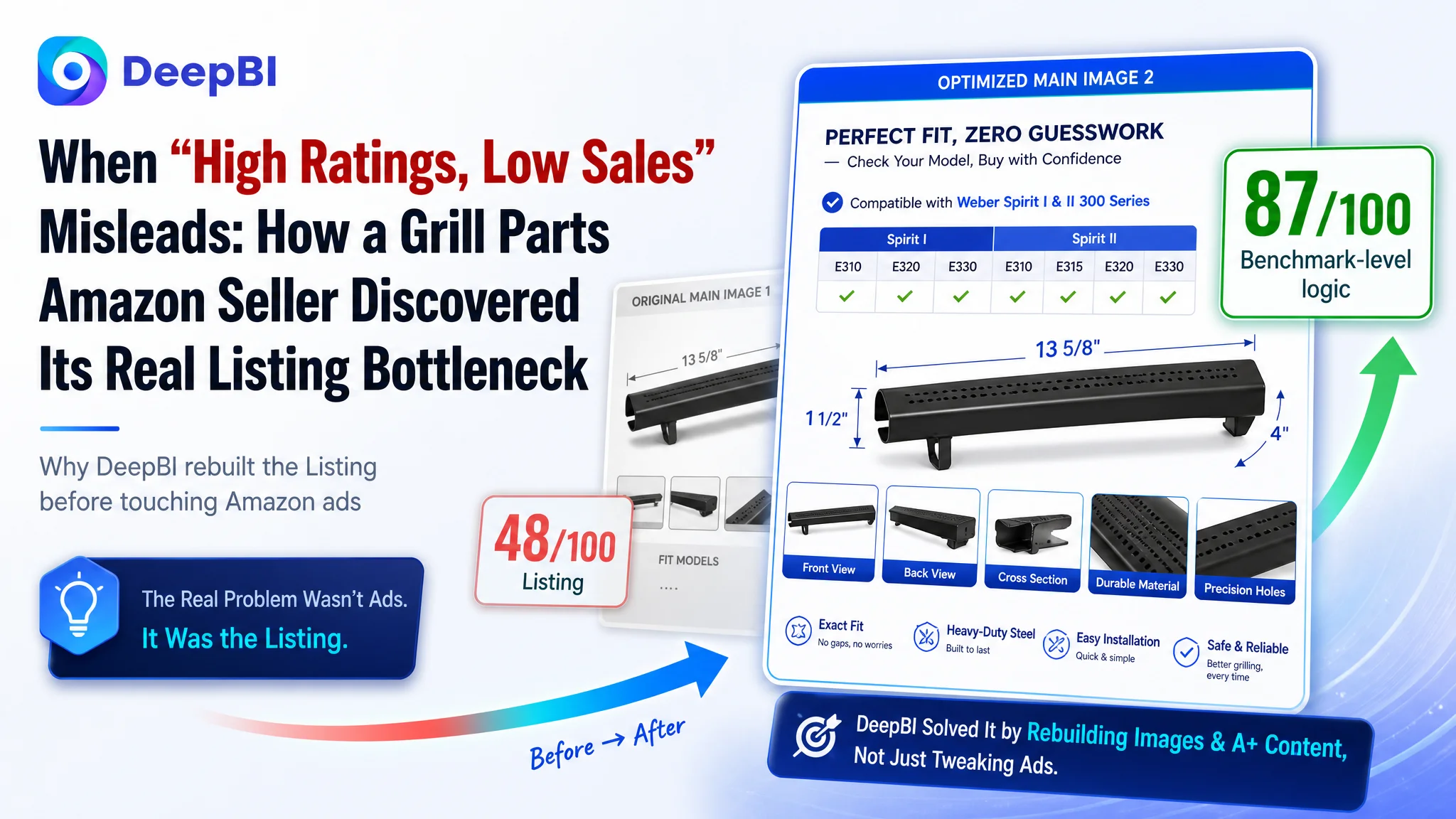
This case comes from an Amazon seller in the grill replacement-parts category. On the surface, everything looked promising: a 5.0 rating, clean text, and a technically sound product. But Amazon ads were hard to scale, and the product page conversion stayed weak. The team kept suspecting bids, keywords, and traffic volume, yet ACOS would not behave the way their past experience suggested it should.
Only when DeepBI benchmarked this Listing against a category-leading Amazon competitor did the real picture emerge. The issue was not that ads were “underperforming”; it was that the Amazon product page itself lacked trust-building content. The title was framed like a generic compatibility note, the main images were visually flat, and the detail section had no A+ content at all—while the benchmark Listing used a full funnel of visual persuasion to turn grill owners’ doubts into confident orders.
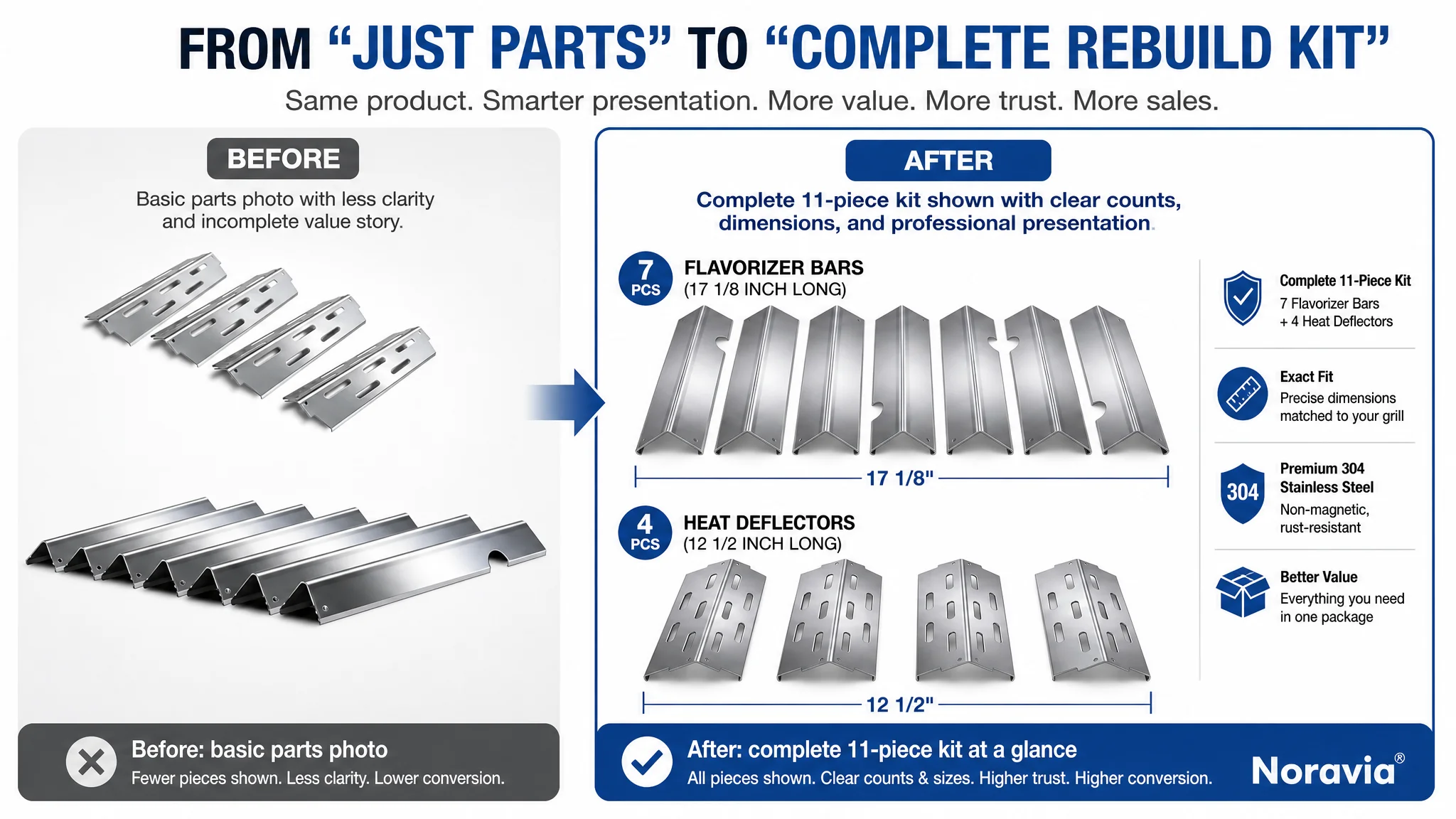
The optimization that followed did not start with more aggressive targeting or new campaign structures. It started with rethinking the Listing: restructuring the title around high-value Amazon search terms, reframing the bullets into a “compatibility → kit value → material → thickness → cooking outcome → maintenance” logic, and redesigning both main images and A+ concepts to visually prove fit, quality, and durability. For Amazon sellers, this case is a reminder: when ads feel “expensive,” the real leak may be on the page, not in the campaign manager.
The Core Conflict: Ads Were Feeding a Page That Couldn’t Sell
DeepBI’s Listing scoring put the situation in hard numbers:
- Target Listing: 48/100
- Benchmark Listing: 87/100
- Total gap: –39 points
Breaking it down by Amazon Listing dimensions:
- Title: 13 vs 16 (–3)
- Main Images: 21 vs 26 (–5)
- Bullets: 7 vs 8 (–1)
- Detail/A+ Content: 0 vs 24 (–24)
- Reviews: 7 vs 13 (–6)
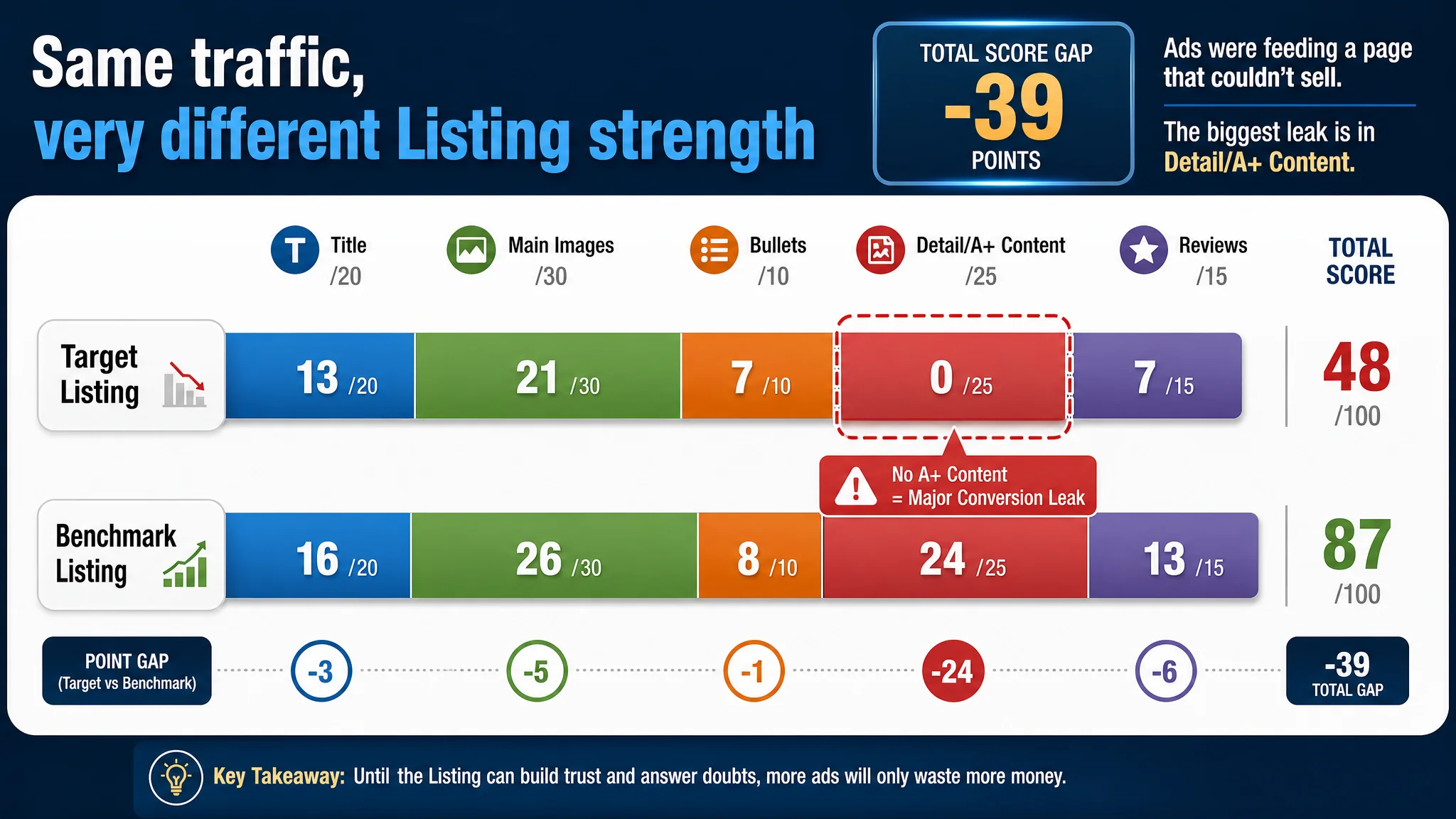
The seller felt the main issue was “not enough traffic and not enough reviews,” and was ready to push ads harder. But the data made one thing clear: the real constraint was Listing conversion capacity, especially in the detail/A+ section. Ads were being asked to do a job that the product page was structurally unable to finish.
“The real problem was not that ads failed to bring traffic. It was that the page could not convert the traffic.”
With a 0/25 score on the detail/A+ dimension against a 24/25 benchmark, any incremental ad spend would simply magnify a conversion leak.
What the Seller Originally Misdiagnosed
From the seller’s perspective, the logic looked straightforward:
- The product is a Weber-compatible flavorizer bars and heat-deflector kit.
- Material and dimensions are correct, price is competitive.
- Star rating is a perfect 5.0, even higher than the benchmark’s 4.7.
- Orders are slow; ads feel expensive; ACOS is hard to bring down.
So the initial hypotheses were familiar:
- “We just need more reviews; ad performance will follow.”
- “We should refine keywords and bids; our listing is already OK.”
- “Maybe the main image isn’t pretty enough; let’s tweak it a bit.”
The team believed the problem was ad-side execution and social proof volume. What they underestimated was how weak the Listing looked when a grill owner actually landed on the Amazon product page and compared it—consciously or not—with the benchmark.
How DeepBI’s Scoring Exposed the Real Bottleneck
DeepBI benchmarked the Listing against a top-performing Amazon competitor in the same grill parts niche. The contrast was not about small cosmetic differences; it was about decision logic and trust-building depth.
Title: Technically Complete, Commercially Passive
The original title functioned like a parts catalog entry:
- It started with “Fits…”, making the entire Amazon title feel like a generic accessory label rather than a strong product promise.
- The benchmark Listing led with a brand name and the core model code, instantly signaling authority and relevance in search results.
- The benchmark also surfaced “GS4 Genesis II” early, aligning itself with how grill owners actually think about their equipment.
DeepBI’s scoring showed that while the title had many model numbers, it lacked a clear, high-weight keyword spine that Amazon’s algorithm and buyers could lock onto.
Main Images: Product Present, Value Missing
On the main-image level, the target Listing wasn’t outright wrong—it was merely insufficient for modern Amazon competition:
- Product photos were simple, with heavy shadows and no strong visual hook.
- Compatibility and dimension info appeared, but the visual hierarchy was messy and slow to read.
- There was almost no visual proof of key concerns for grill parts:
- Is the stainless steel actually high-grade?
- How thick are the bars compared to cheaper options?
- Will it rust?
- Does it really protect burners and improve flavor?
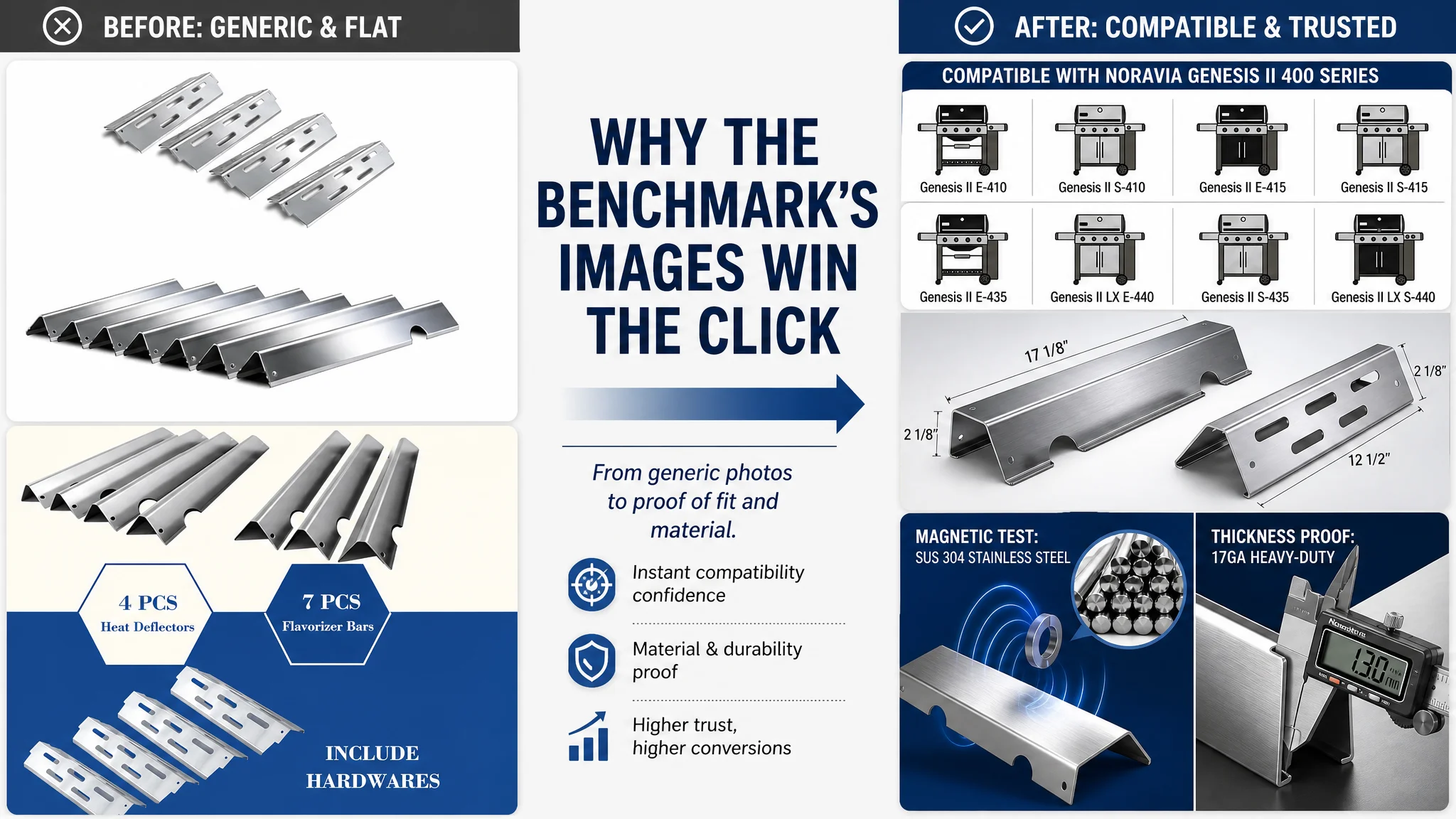
The benchmark Listing addressed these visually:
- Matrix layouts to show all parts clearly.
- Dimension overlays and model icons for instant compatibility confirmation.
- Non-magnetic material demonstrations (magnet hovering, repulsion lines).
- Caliper close-ups showing thickness and gauge.
- Functional illustrations with blue flames and oil drips turning into smoke to make “Flavorizer” a visible mechanism, not just a word.
The result was a 5-point gap in the main-image score that translated directly into weaker CTR and weaker pre-click trust.
Detail/A+ Content: A Complete Void Against a Full Funnel
This was the decisive gap:
- Target Listing: no A+ content at all.
- Benchmark Listing: a carefully staged A+ flow:
- Outdoor family grilling scenes to set emotional context.
- “Fits these models” dominance at the top to kill compatibility anxiety.
- Industrial close-ups and stacked steel rods to signal real stainless and solid construction.
- Detailed size charts and Fits/Not Fit guidance to prevent wrong purchases.
- Visual proof of non-magnetic stainless steel.
- Cleaning demonstrations to lower maintenance concerns.
- Thickness vs cheaper alternatives, with concrete numbers (17GA vs 18–20GA).
- Before/After rust comparisons to trigger replacement urgency.
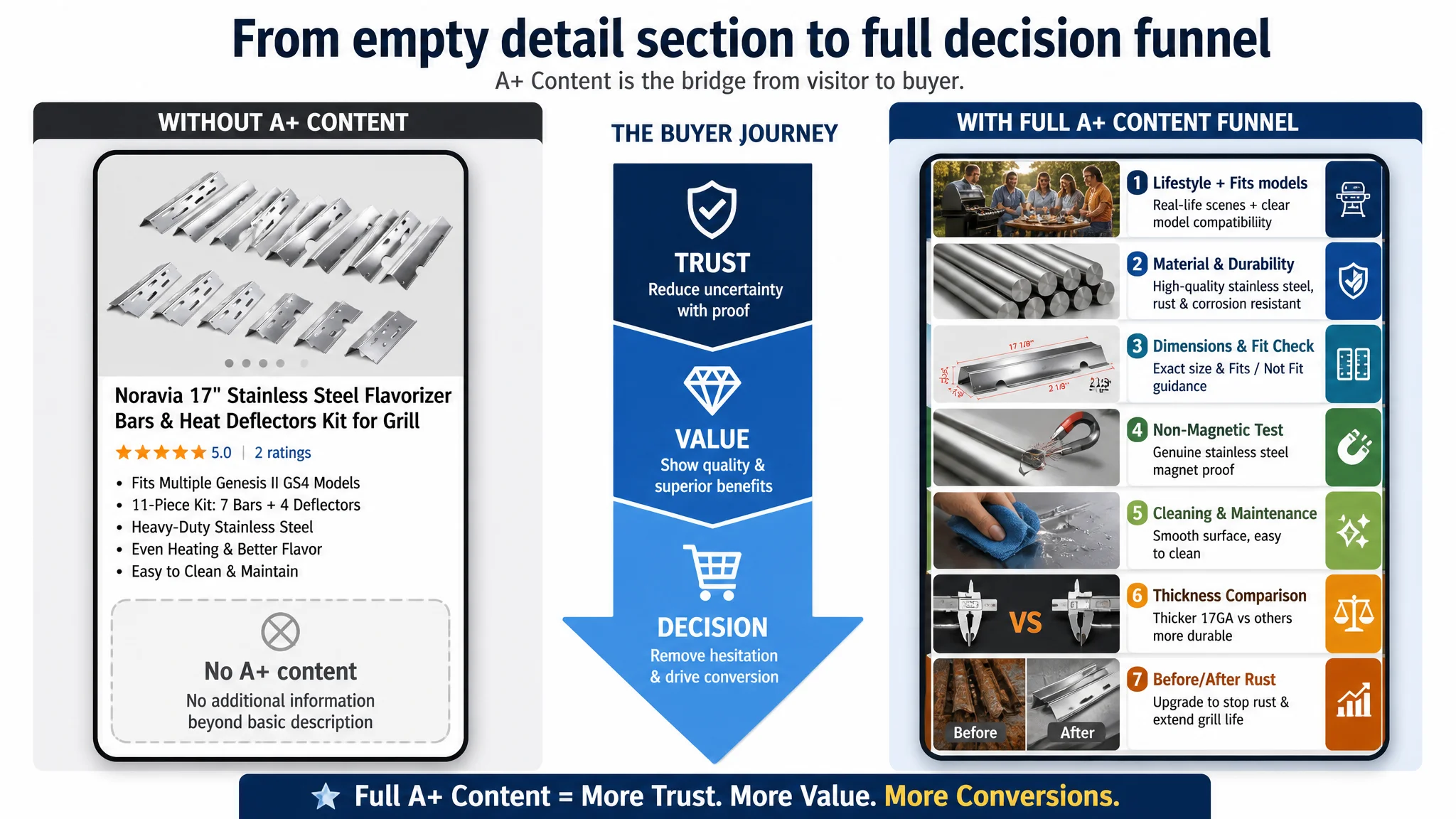
DeepBI’s score: 0/25 vs 24/25 in the detail/A+ dimension.
That 24-point gap meant that once users arrived from Amazon ads, the benchmark Listing kept moving them forward through trust → value → decision. The target Listing simply dropped them into a basic text page with no visual persuasion.
Reviews: Good Rating, Weak Social Proof Base
Reviews weren’t the worst issue, but they reinforced the pattern:
- Target Listing: 5.0 stars, 2 total reviews (1 visible on first page).
- Benchmark Listing: 4.7 stars, 45 reviews, 7 visible on first page, many with photos and length.
The seller focused on the 5.0 rating; DeepBI focused on the scale and richness of social proof. With only 2 reviews, the page lacked the volume needed to create a sense of market validation.
Why DeepBI Refused to Start With Ads
Given this evidence, DeepBI’s judgment was straightforward: do not keep tuning Amazon ads first.
Continuing to push:
- New keywords
- More aggressive bids
- Additional campaign types
would have done one thing: send more paid traffic into a Listing with:
- No A+ structure
- Limited visual proof of material and fit
- Passive pre-click communication in the main image
- Very shallow trust depth vs the benchmark
At this stage, the biggest business risk was not “insufficient traffic”; it was wasting traffic. The Listing was not ready to monetize additional clicks.
“Advertising does not only amplify advantages. It can also amplify a page’s existing defects.”
Until the Amazon product page itself could stand next to the benchmark and hold a buyer’s attention, more traffic would only raise TACOS and intensify the sense that “ads don’t work anymore.”
Reframing the Problem: From “Get More Traffic” to “Deserve More Traffic”
Once the core constraint was clear, the optimization path changed:
- From: “How do we get more people to see this Listing with lower ACOS?”
- To: “How do we make the Listing strong enough that each click actually has a chance to convert?”
The diagnosis pointed to one central objective:
Build a convincing replacement-kit story that visually proves compatibility, quality, and longevity—so that both organic and paid traffic have a fair chance to convert.
That meant reordering priorities:
1. Title: Align with Amazon search logic and how grill owners search.
2. Bullets: Restructure around decision steps, not random attributes.
3. Main Images: Turn abstract claims into visual evidence.
4. A+ Content: Create a trust funnel that catches what the bullets cannot resolve.
Only after this backbone was in place would it make sense to scale Amazon ads and expect sustainable ACOS.
How the Listing Logic Was Rebuilt
1. Title: From Parts List to Search-Driven Promise
DeepBI’s guidance was to move from a “fits X, fits Y” list-style title to a keyword and intent-driven structure:
Proposed direction:
17" Stainless Steel Weber Flavorizer Bars for Genesis II & GS4 E-410/S-410, E-415, E-435, E-440, S-440, LX 440 Series Gas Grills, Replacement Parts for Weber 66041, 66033, 66796, 66797
The logic:
- Surface the core term early: “Weber Flavorizer Bars” and “17" Stainless Steel” in the front half make the product type and key attribute obvious in Amazon search.
- Group series logically: Use slashes (E-410/S-410) and series labels (Genesis II & GS4, LX 440) to convey broad coverage without turning the title into an unreadable wall of codes.
- Reserve space for key OEM part numbers: 66041, 66033, 66796, 66797 sit later in the title to capture technical searches while keeping early words focused on recognition and CTR.
This pushed the title score toward the benchmark and reoriented the Listing around high-weight Amazon keywords and buyer intent, not just fit codes.
2. Bullets: From Attribute Dump to Decision Sequence
DeepBI’s comparison showed that the benchmark Listing used bullets to systematically clear doubts:
- Start with Compatibility
- Then Dimensions and Kit Contents
- Then Material and Durability
- Then Thickness and Heating Behavior
- Then Cooking Outcome
- Finally, Packaging / Gifting / Maintenance
The original Listing was more scattered. DeepBI’s restructuring followed a buyer’s actual journey:
1. “Will this fit my grill?”
Bullet #1: Compatibility & Fit
- “2025 Upgraded version fits for Weber Genesis II & LX 400 Series (2017 and newer)… precise replacement for Weber Part Numbers…”
- Clear call to verify model before ordering.
1. “Do I get everything I need in one go?”
Bullet #2: Comprehensive 11-piece rebuild kit
- Highlights that this set includes 7 flavorizer bars and 4 heat deflectors.
- This is a key differentiator vs the benchmark, which sells only 7 bars.
1. “Is the material actually good?”
Bullet #3: Premium heavy-duty stainless steel
- Non-magnetic stainless (a signal of higher-grade steel).
- Smooth, deburred edges to avoid hand cuts—turning a small detail into a perceived-quality signal.
1. “How durable and heat-stable is it?”
Bullet #4: Superior 17GA thickness
- Explicitly anchors 17GA vs 18–20GA common in cheaper parts.
- Ties thickness to heat retention and component lifespan.
1. “How will my grilling change?”
Bullet #5: Even heating and enhanced smoky flavor
- Explains how the bars protect burners, prevent local overheating, and vaporize drippings for smoke flavor.
1. “Is it easy to maintain and safe to ship?”
Bullet #6: Effortless maintenance & safe packaging
- Easy cleaning and shockproof packaging to reduce returns and shipping damage concerns.
This sequence replaces “parameter listing” with a pain point → proof → outcome logic that matches how Amazon shoppers skim bullets before scrolling further.
3. Main Images: Giving the Product a Visual Argument
DeepBI’s main-image guidance mapped one-to-one against the gaps seen in the benchmark comparison.
Main Image 1 – The Kit as a Professional Set
From: loosely arranged parts with heavy shadows. To: a clean, matrix-style layout:
- All 11 pieces (7 long bars, 4 shorter deflectors) centered and covering ~80% of the frame.
- 45° top-down angle, even white lighting, pure white background.
- No harsh shadows; strong contrast to create a “professional OEM set” feel.
Purpose: Instantly signal completeness and quality, making it clear this is a full rebuild kit, not a random small part.
Main Image 2 – Compatibility and Dimensions at a Glance
From: fragmented overlay text and mixed visual hierarchy. To: a structured, data-visual style:
- Upper half: 4×2 grid of compatible grill model icons.
- Lower portion: product shown at 45° angle, with clean dimension lines and measurements (L, W, H).
- Soft gray-to-white gradient background, top lighting for clarity.
Purpose: Reduce “fit anxiety” by making compatibility and sizing immediately understandable without scrolling.
Main Image 3 – Non-Magnetic Stainless Visual Proof
From: generic product view. To: a focused material-proof concept:
- Single bar horizontally placed; above it, a magnet depicted hovering with clear repulsion lines.
- A round inset showing stacked stainless rods as a material close-up.
- Deep blue background with cool spotlight on metal edges.
Purpose: Visually translate “non-magnetic stainless steel” into something a buyer can see, not just read.
Main Image 4 – Thickness and Industrial Credibility
From: textual claims like “robust” or “thick.” To: quantified proof:
- Close-up of the bar’s cross-section, digital caliper measuring thickness.
- Bold overlay of actual thickness (e.g., 17GA) in large type.
- Dark brushed-metal background with strong side lighting.
Purpose: Turn subjective words (“thicker”) into measurable advantage, matching the benchmark’s gauge-based persuasion.
Main Image 5 – Flavorizer Function Visualized
From: generic product image with vague references to flavor. To: a functional, high-contrast visualization:
- Low-angle shot of bars with blue flames below.
- Golden oil drops hitting the bars and transforming into semi-transparent smoke above.
- Deep black background to highlight heat and vapor effect.
Purpose: Make the core promise—even heat and smoky flavor—instantly understandable and emotionally appealing at thumbnail size.
A+ Content: Building the Trust Funnel That Was Missing
DeepBI’s recommendation was not “add some A+ images.” It was to build a structured A+ flow that mirrors how grill owners make replacement decisions.
The proposed sequence:
1. First Screen: Brand + Compatibility in a Lifestyle Scene
- Outdoor afternoon grilling scene, family around a matching grill.
- The replacement kit laid out neatly across the bottom.
- Large, bold “Fits for [models]” across the center.
Purpose: Make compatibility and lifestyle benefits visible in the first second.
1. Material & Durability Module
- Industrial, dark gradient background.
- Bars at 45°, occupying ~60% of the space.
- Circular inset with brushed metal texture and stacked rods.
- Short copy like “Stainless Steel” and “10+ Years Durability.”
Purpose: Position the product as a premium, long-term replacement, not a disposable cheap part.
1. Dimensions & Fit-Check Module
- Left: grill illustrations with green ticks and red crosses for Fits/Not Fit models.
- Right: product with overlaid dimension lines and numerical values.
- Top-right: number of pieces and weight.
Purpose: Reduce wrong orders and returns by preemptively guiding buyers.
1. Non-Magnetic Test Module
- Action shot of a hand holding a metal block close to the bar, clearly not attracting.
- Deep blue-to-black background, small flame cues below.
Purpose: Turn abstract material claims into visual, believable evidence.
1. Cleaning & Maintenance Module
- Clean, home-style visual: bar across the center, hand wiping with a cloth.
- Part of the bar visibly cleaner where the cloth passes.
Purpose: Address the maintenance pain point and lower psychological effort barrier.
1. Thickness Comparison Module
- Left: “Our product” with caliper showing, e.g., 1.3mm / 17GA.
- Right: “Standard part” with caliper at, e.g., 1.0mm / 20GA.
- “VS” icon in the middle.
Purpose: Anchor perceived value in hard numbers, shifting competition away from pure price.
1. Before/After Rust & Renewal Module
- Left: rusted, cracked old parts in a dull tone.
- Right: new kit installed, bright and clean interior.
Purpose: Trigger replacement motivation by making the cost of inaction visible.
With these modules, the Listing moves from a bare-bones product page to a full decision-support system that mirrors and matches the benchmark’s trust funnel.
What Changed for the Seller
The case does not rely on invented numbers, but the state of the business changed in three fundamental ways.
1. Listing Conversion Became a Real Lever
Before:
- Conversion issues were lumped into “ads are expensive” or “we need more reviews.”
- The team had no clear sense of where the Listing failed a buyer: pre-click, first scroll, or deep scroll.
After DeepBI’s diagnosis and structure:
- The seller understood that:
- The title needed to capture the right Amazon queries.
- The main images had to carry compatibility, kit completeness, and material proof.
- The detail/A+ section needed to handle all the “what if…” doubts that block high-value purchases.
- Conversion became explicitly diagnosable by module, not an amorphous “listing problem.”
2. Ads Became a Secondary, Not Primary, Problem
Before:
- Ad tests continued while the page had 0/25 in detail/A+.
- New traffic simply repeated an unchanged conversion experience, keeping ACOS volatile.
After:
- The seller paused the idea of “more aggressive ads first.”
- Priority shifted to:
- Strengthening Amazon Listing quality until it could stand next to the benchmark.
- Then using ads to amplify a credible offer instead of a weak presentation.
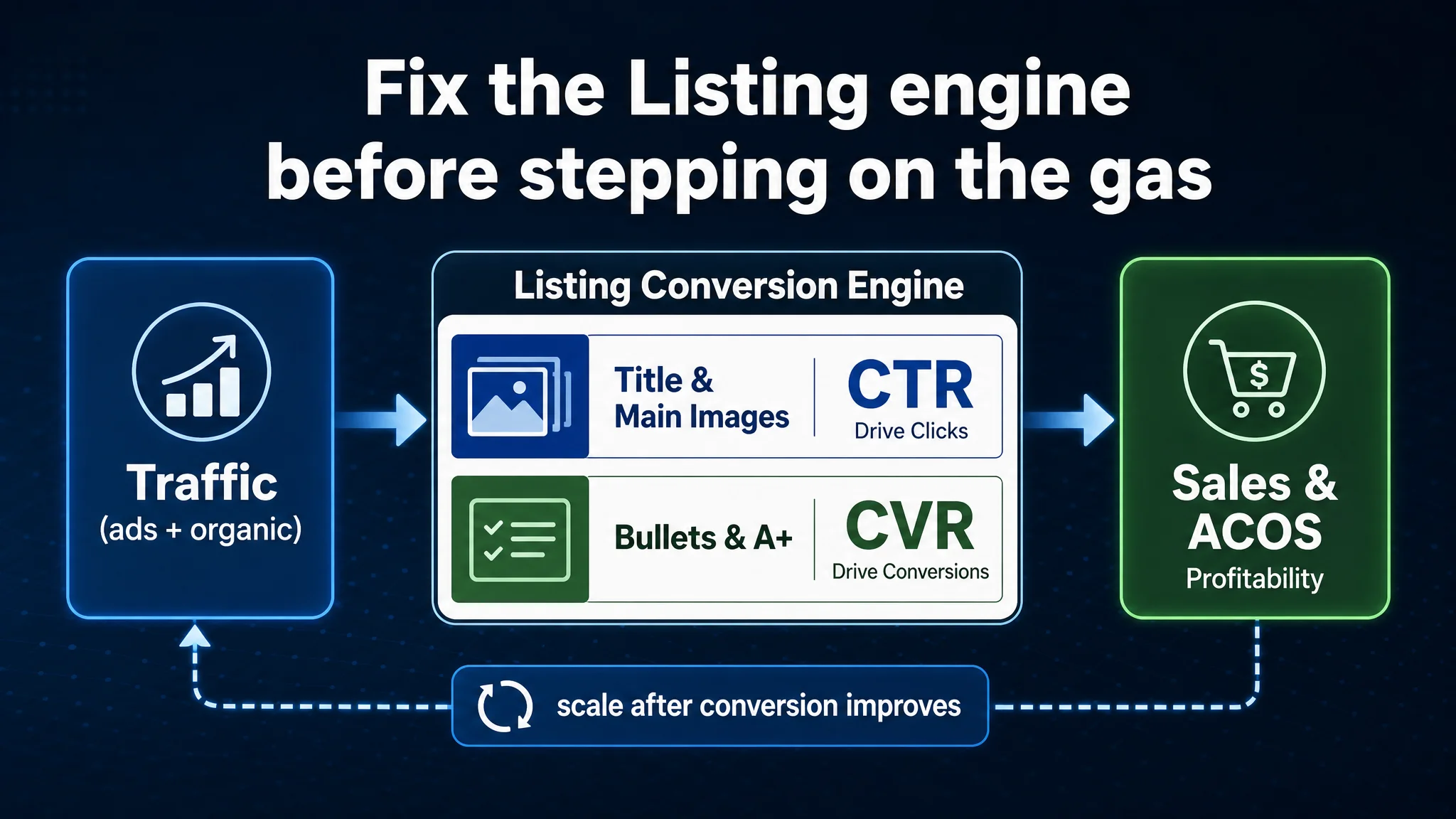
Once the visual structure was rebuilt, ad traffic had a realistic chance to:
- Lift conversion rate (CVR).
- Stabilize ACOS as the page did more of the selling.
- Gradually increase the share of organic sales as the Listing started to perform better in Amazon’s ranking logic.
3. The Seller’s Mental Model of Amazon Changed
Most importantly, the team’s understanding of Amazon operations evolved:
- They stopped seeing Amazon ads as a universal answer to slow sales.
- They internalized that:
- CTR is heavily shaped by main image and title.
- CVR is heavily shaped by bullets, A+, and the trust path.
- Ads can only scale once the Listing’s conversion fundamentals are in place.
They began treating the Amazon product page as a conversion engine to be engineered—title, main image, bullets, and A+ working together—rather than as a static backdrop for advertising.
What Other Amazon Sellers Can Take From This Case
1. A high rating is not enough.
A 5.0 score with 2 reviews does not compete with 4.7 and 45 reviews plus robust A+ content. Volume, depth, and visuals matter.
1. A missing A+ is not a cosmetic defect; it’s a conversion hole.
In this case, the detail/A+ gap alone was 24 points out of 25 compared with the benchmark. That is not optional—it is structural.
1. Ads are not a shortcut around a weak Listing.
When A+ is missing, main images lack proof, and the title doesn’t anchor the core search terms, ad spend mostly delivers expensive bounces.
1. Listing optimization is not “make it prettier.”
It is:
- Rebuilding title logic for Amazon search.
- Aligning bullets with buyer decision steps.
- Turning claims like “non-magnetic stainless”, “17GA thickness”, and “even heating” into visual evidence.
- Designing an A+ funnel that handles fit, quality, maintenance, and replacement anxiety.
1. Before scaling ads, ask a harder question: “Does this page deserve more traffic?”
If the honest answer is no, then the first job is not campaign optimization—it is Listing conversion reconstruction.
This grill parts seller’s experience shows how DeepBI’s approach—scoring against a real benchmark, quantifying Listing gaps, and rebuilding page logic before touching ads—can change the trajectory of an Amazon product. The real gain was not a tweak in ACOS; it was a shift in judgment: understanding that on Amazon, Listing quality is the foundation, and ads are the amplifier—not the other way around.