

This Amazon seller in the home fragrance / incense category came to DeepBI with a familiar problem: ads were bringing traffic, reviews were all five stars, but the Listing still struggled to stand up to a single, dominant competitor. The instinct inside the team was to keep tweaking Amazon ads and search terms to “push harder.” What they had not expected was that the real constraint was not traffic at all—it was the way their Amazon product page built (or failed to build) trust and value.
DeepBI’s Listing scoring showed that, against a benchmark incense Listing, this product was losing systematically across title, images, A+ content, and reviews, despite having perfect star ratings. The page talked a lot about benefits and lifestyle, but did not give enough visual proof of ingredients, craftsmanship, quantity, or brand story. Ads were simply pouring more buyers into a page that could not fully convert them.
Once the focus shifted from “optimize the ads” to “repair the Amazon Listing’s conversion capacity,” the optimization path became very different. Instead of new keywords and bid changes, the work centered on main-image logic, value proof, trust-building A+ modules, and bullet points that matched buyers’ real concerns. The lesson for other Amazon sellers is clear: when ACOS feels stubborn and ads seem “ineffective,” the first place to audit is often the Listing, not the campaign structure.
The Real Constraint: A Listing That Could Not Match Its Benchmark
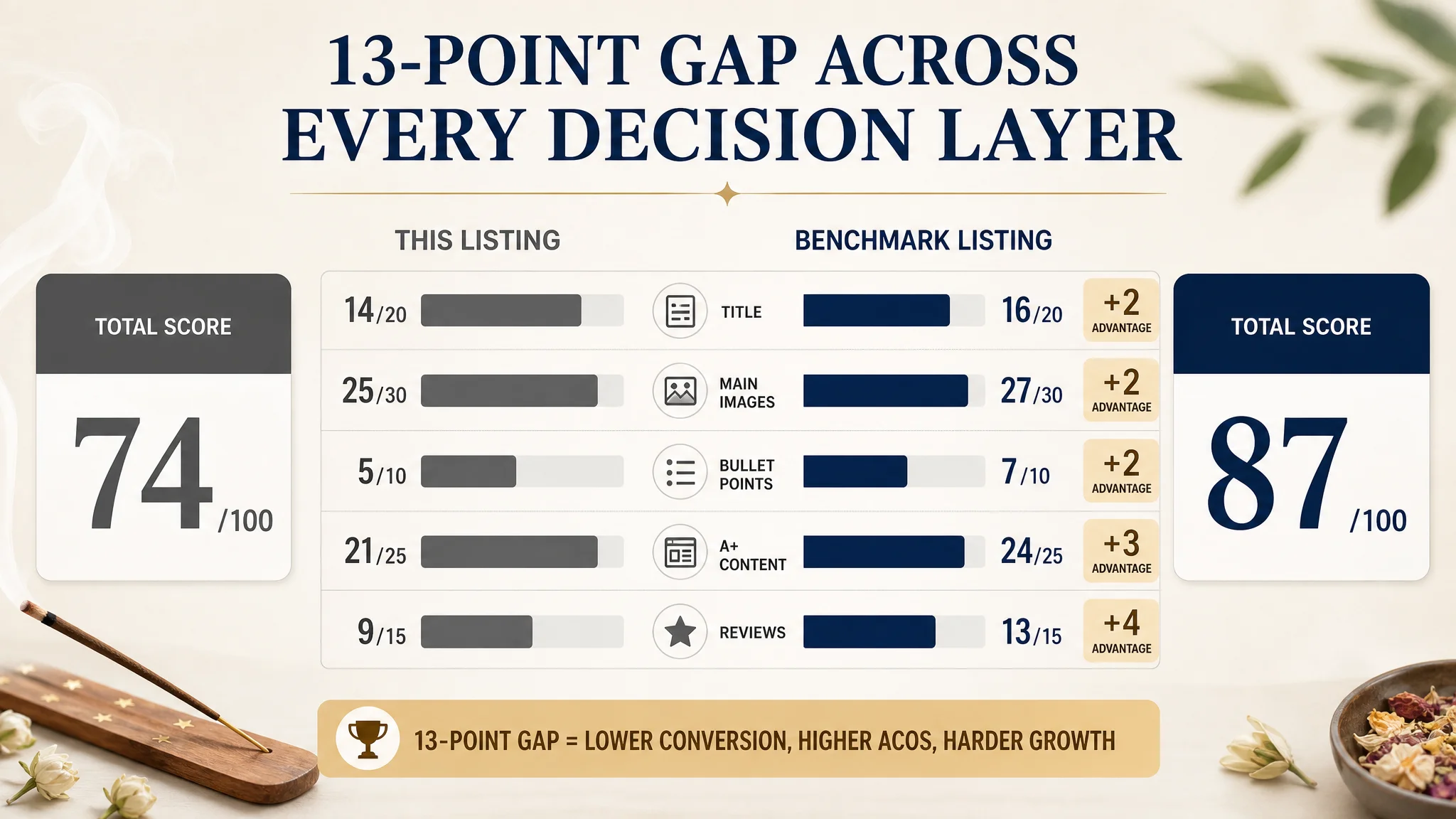
DeepBI’s Listing score put the situation into a single number: 74/100 vs. the competitor’s 87/100, a 13‑point gap on the same Amazon marketplace, same category.
Breaking it down:
- Title: 14 vs. 16
- Main images: 25 vs. 27
- Bullet points: 5 vs. 7
- A+ / detail page: 21 vs. 24
- Reviews: 9 vs. 13
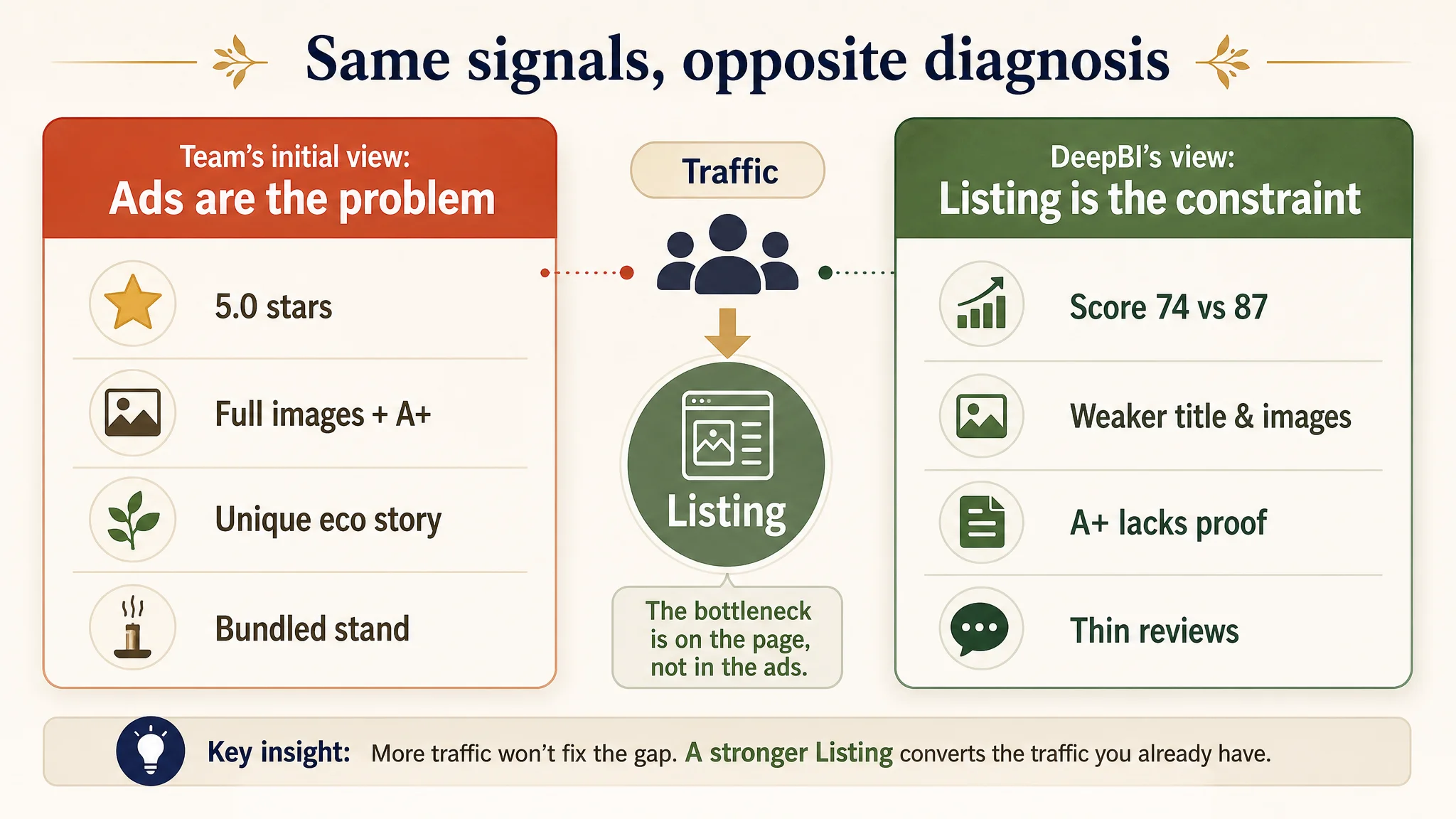
At first glance, nothing looked “broken.” The product had a complete set of images, an A+ page, and five-star ratings (6 reviews, all positive). For the internal team, the natural conclusion was: “Our Listing is fine; ads must be the problem.”
DeepBI read the same Listing very differently. The question was not whether the page was “complete,” but whether it could compete with the category’s best performer for the same search intent and price band.
“The real problem was not that ads failed to bring traffic. It was that the page could not convert the traffic as well as the benchmark Listing.”
From this angle, the core conflict became clear: the seller was trying to fight a benchmark Listing with a page that looked acceptable in isolation but systematically weaker where buyers actually make decisions.
How the Seller Originally Misread the Problem
From the seller’s perspective, several signals pointed away from the Listing:
- Star rating: 5.0 with no negative reviews
- A full image set and A+ content already live
- A unique eco-friendly story (incense crafted from recycled temple flowers)
- A bundled incense burner stand, which the competitor did not offer
They assumed:
- High rating = Listing is strong
- Full modules = no structural page problem
- Unique story + free stand = enough differentiation
- Therefore, the bottleneck must be ads: bids, budgets, targeting, or creative.
This is how many Amazon sellers get trapped:
- They over‑weight rating and completeness, and under‑weight comparative conversion logic.
- They assume any gap in orders or ROAS is an advertising issue.
- They interpret a full set of images as “optimization done,” even if those images are not arranged around the buyer’s real decision path.
DeepBI’s scoring logic is built to break exactly this kind of bias. It does not ask “Is the Listing okay?” It asks “Compared to the best Listing we can legitimately benchmark in this category, where are you losing the sale?”
Where Traditional Ad Optimization Would Have Kept Failing
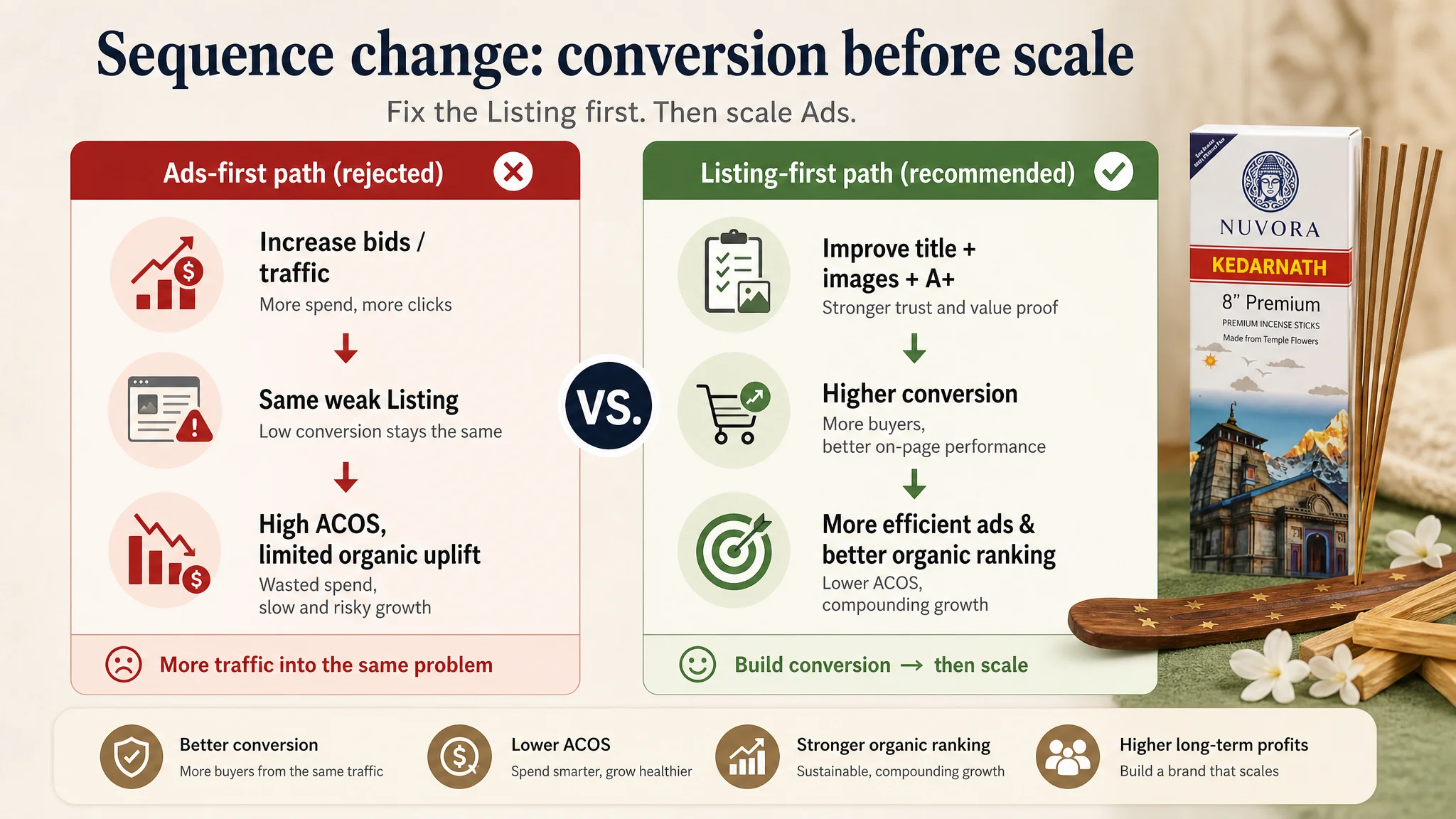
If the seller had continued to treat this as a pure Amazon ads problem, the typical path would have been:
- Adding more incense-related keywords
- Adjusting bids on high‑CTR, low‑CVR terms
- Expanding match types and campaigns
- Repeatedly testing small ad creative tweaks
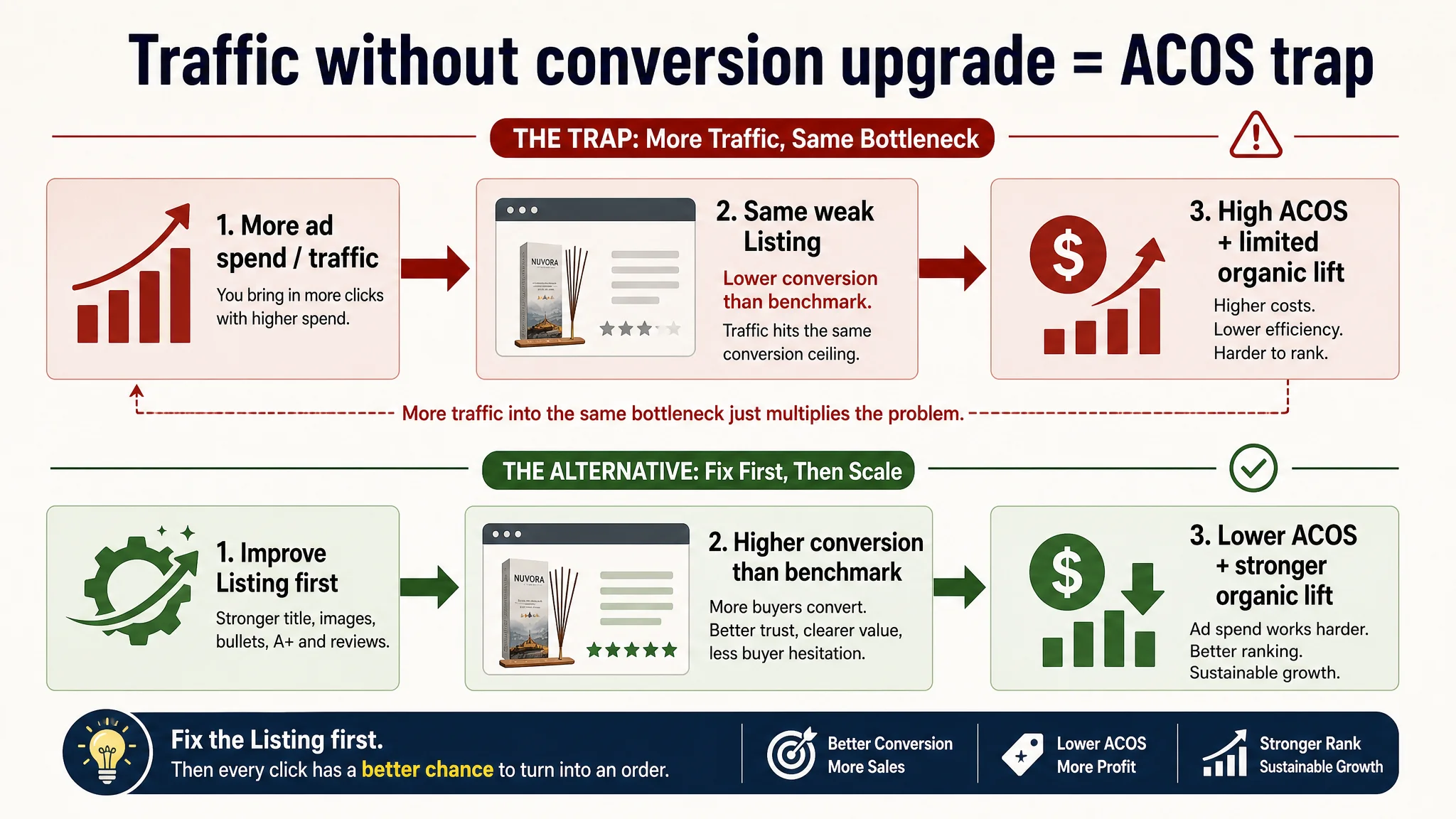
All of this would have had one thing in common: more traffic into the same conversion bottlenecks.
Two structural risks would have intensified:
1. ACOS pressure with no structural fix
As traffic scales onto a weaker Listing, ACOS tends to stabilize at a painful level. The seller reads this as “ads are expensive,” when the deeper reality is “the product page is not convincing enough per click.”
1. Organic ranking capped by conversion
If ad traffic cannot convert as efficiently as the benchmark Listing for the same keywords, Amazon’s system has less reason to reward the product with strong organic positions. The seller then buys even more ads to compensate, further deepening the dependency.
DeepBI’s judgment was that tuning ads first would be a misallocation of effort. Without improving the Listing’s conversion capacity, ad work would only amplify the Listing’s existing weaknesses.
What DeepBI’s Listing Score Actually Revealed
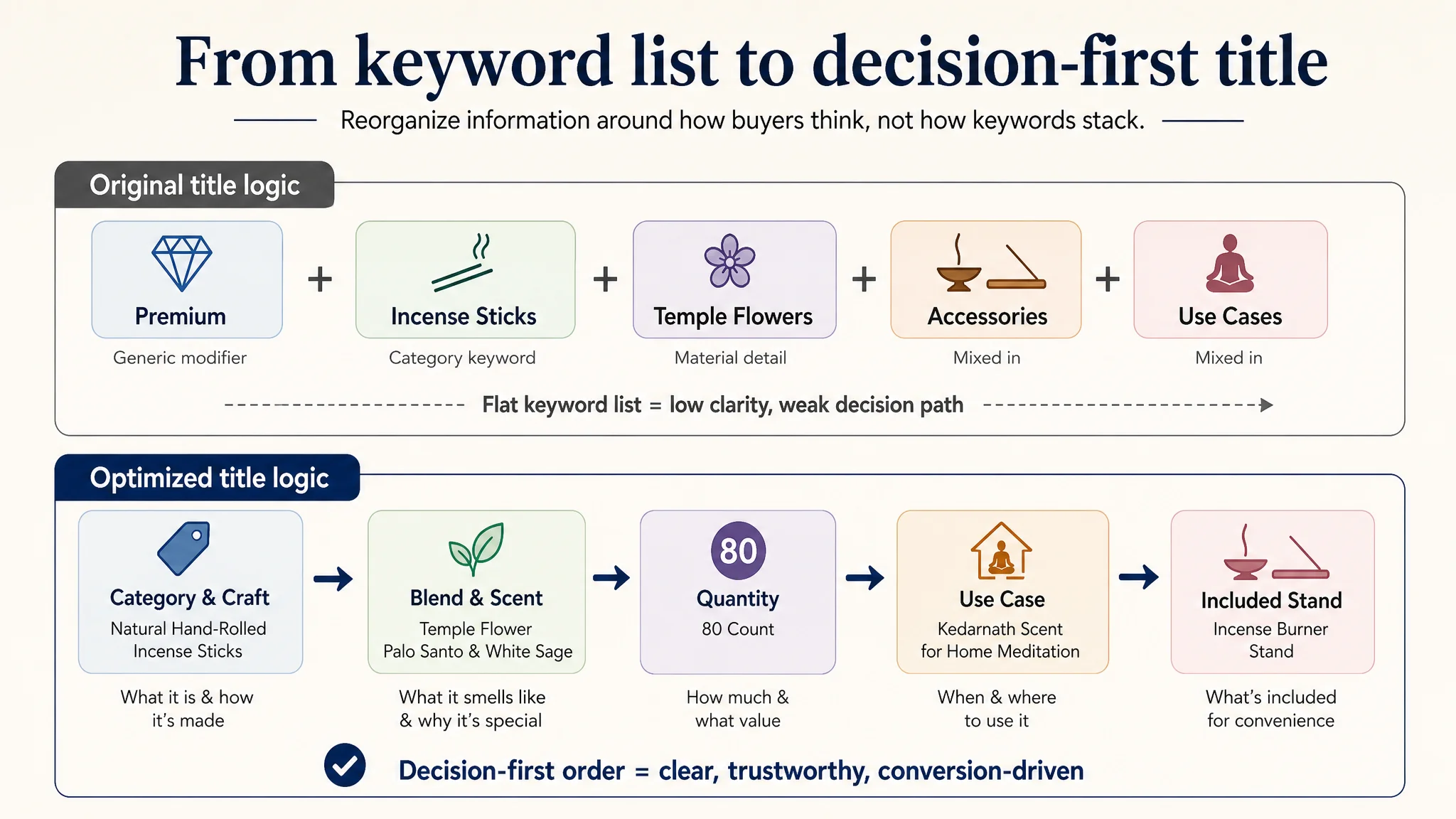
1. Title: Structured Like a Catalog, Not Like a Decision
The original title did some things right:
- Core keyword “Incense Sticks” was front‑loaded.
- It mentioned key attributes: scent, size, count, inclusion of a burner stand.
But against the benchmark, several gaps were visible:
- Brand visibility:
The competitor opened with a strong brand phrase (“Premium [Brand] Golden Bloom …”), building brand recall for future searches. This Listing opened with “Premium Incense Sticks,” without the brand name, sacrificing long‑term brand search accumulation.
- Craft and category language:
The competitor used “Natural Hand-Rolled Masala”—terms that signal traditional incense craft and authenticity. This Listing used “Made from Temple Flowers,” which is distinctive but reads more like a sustainability detail than a recognized incense category descriptor.
- Spec clarity and persuasion:
The competitor clearly stated “100 GMS”, a familiar incense spec. This Listing mentioned “80 Count” but did not translate this into perceptible volume or value. For buyers comparing options quickly, “100 GMS” vs. “80 Count” gives the competitor a clearer mental anchor.
- Logical focus:
The original title scattered multiple elements—scents, size, accessories, use cases—into a list-like structure. The competitor concentrated on “scent + use + spec” in a tighter, more decisive logic.
DeepBI’s recommendation was not simply to “add more keywords,” but to rebuild the title around a clearer buying logic, for example:
Premium Natural Hand-Rolled 8 Inch Incense Sticks, Temple Flower Palo Santo & White Sage Blend, 80 Count, Kedarnath Scent for Home Meditation, Includes Incense Burner Stand
This refocuses on:
- Explicit craft: “Hand-Rolled”
- Clear product form and size: “8 Inch Incense Sticks”
- Distinctive blend: “Palo Santo & White Sage”
- Concrete value: “80 Count”
- Added set value: “Includes Incense Burner Stand”
2. Main Images: No Clear Role Definition Across the Set
At image level, the gap was less about raw aesthetics and more about role clarity:
- The competitor’s gallery formed a connected story:
- First image: premium, cohesive brand feel
- Follow-ups: scenario use, value proof (dense quantity), trust icons, cultural story, safety and usage guidance
- This Listing’s images were present but role‑blurred:
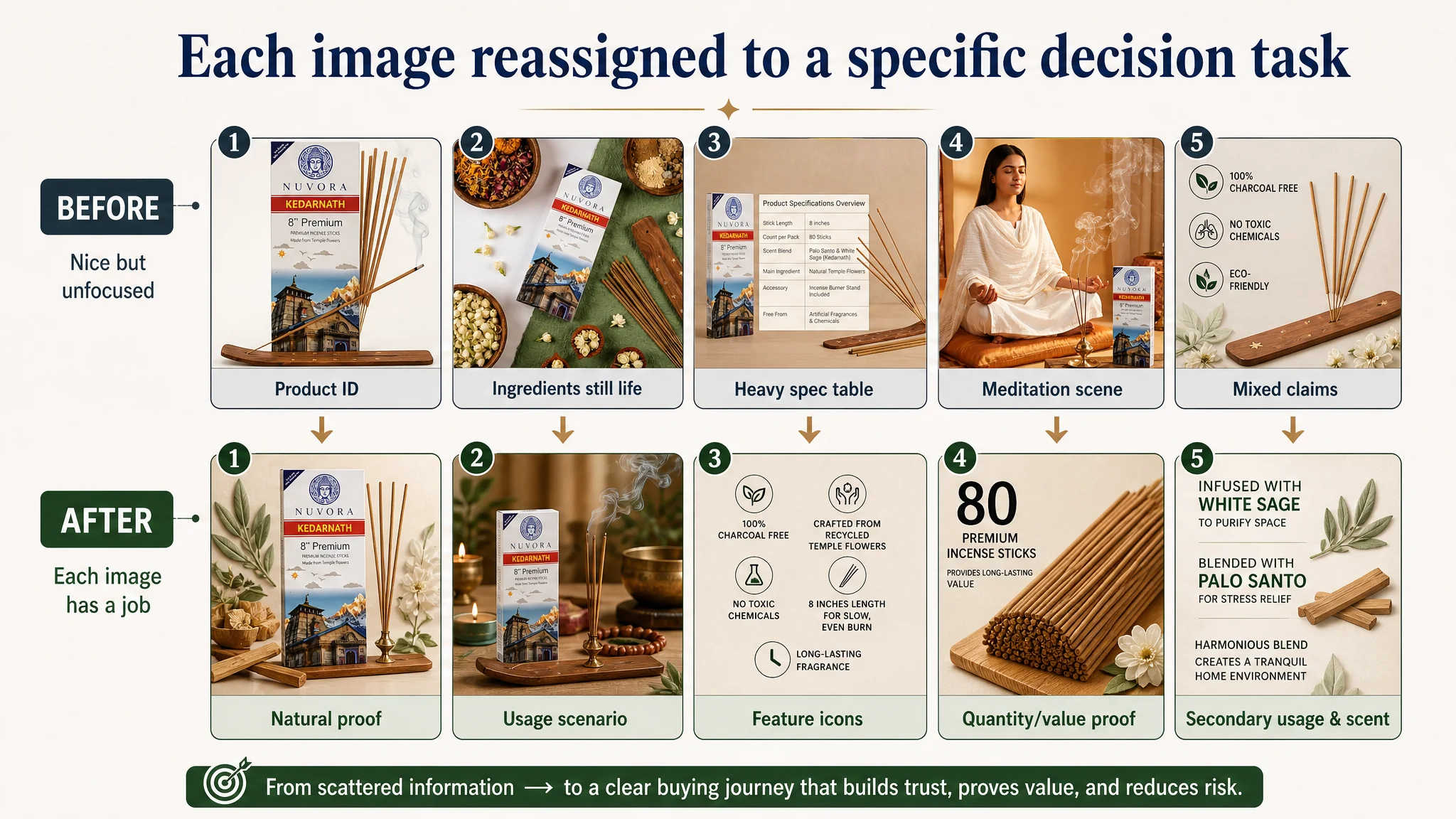
- Image 1 identified the product but did not strongly project scent or natural origin.
- Image 2 laid out ingredients nicely but remained passive; the competitor used that slot for immersive usage scenarios.
- Image 3 tried to reassure with a complex comparative table—an information dump that is hard to process on mobile.
- Image 4 repeated a meditation scenario without adding new decision value.
- Image 5 mixed value, safety, and other points in a way that felt cluttered and repetitive.
The result: buyers got information, but not a decision path.
DeepBI’s diagnosis: the main image set was not structured around critical buyer questions like:
- “Does this look genuinely natural and handcrafted?”
- “Is this enough product for the price?”
- “Will it burn cleanly and safely in my home?”
- “Is this set easy to use if I’m new to incense?”
The optimization focus shifted to:
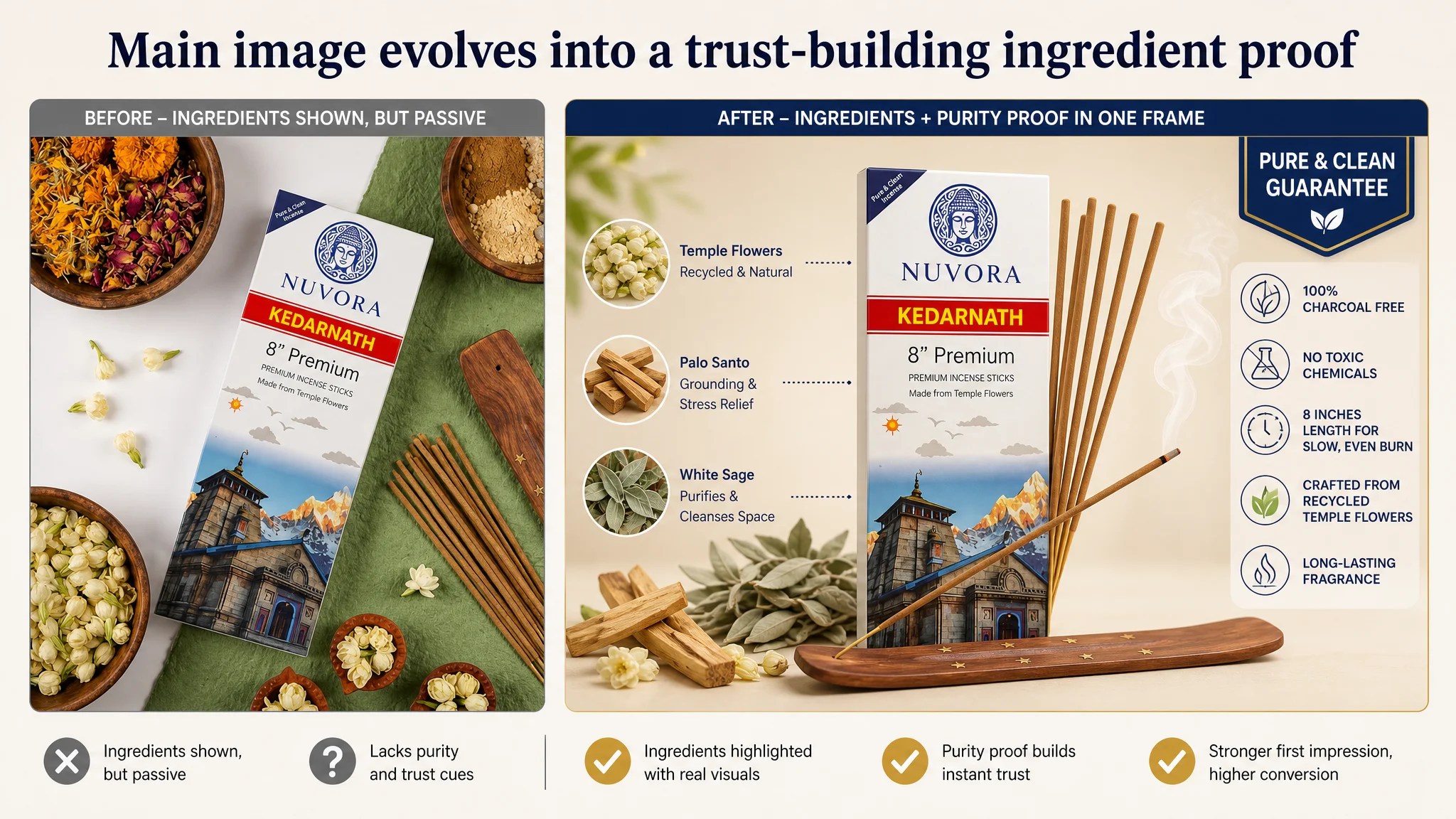
- A first image that visually anchors ingredients and natural quality (Temple flowers, Palo Santo, White Sage) while showing the main set on a clean background.
- A second image that shows real use in aspirational settings (meditation, calm home environment), with the product in action.
- A third image replacing the heavy table with feature icons (charcoal‑free, handcrafted, eco‑friendly, 8‑inch slow burn).
- A fourth image dedicated purely to value and quantity proof: a dense cluster of sticks and bold “80 PREMIUM STICKS” messaging.
- A fifth image showing an alternative use context (home cleansing, stress relief) and clarifying scent effects (purifying, soothing).
This is not “make the images prettier.” It is “assign each image a specific job in the buyer’s decision sequence.”
The A+ Detail Page: From Promising Benefits to Proven Trust
On the A+ detail page, DeepBI saw another pattern: benefits were described, but trust was not fully earned.
The seller’s A+ modules included:
- Product overview visuals
- A comparative module
- Lifestyle and meditation scenes
- Benefit icon summaries
The competitor’s A+ did something different:
- Opened with brand story and product line, suggesting a wider, stable brand behind the product.
- Showed the crafting process and raw ingredients in a visually rich, almost documentary style.
- Used a “time of day” lifestyle framework (Morning Calm, Afternoon Serenity, etc.) to bind the product to everyday rituals.
- Embedded a sense of cultural and spiritual depth—handmade craftsmanship, temple-like scenes, and ritual context.
DeepBI’s judgment:
“This product page did not lack benefits. It lacked evidence.”
Concretely, the weaknesses were:
- Process and origin were stated, not shown.
“Crafted from recycled temple flowers” remained a line of text. There was no visual proof of those flowers, no human hand rolling the sticks, no origin environment.
- Lifestyle scenes were generic.
Clean and nicely shot, but not anchored in specific anxieties: smoke volume, cleanliness, safety, or sustainable sourcing.
- Brand breadth and maturity were invisible.
The Listing focused on a single scent (“Kedarnath”) without offering a sense of a broader collection, making the brand feel more like a one‑off product than a stable incense house.
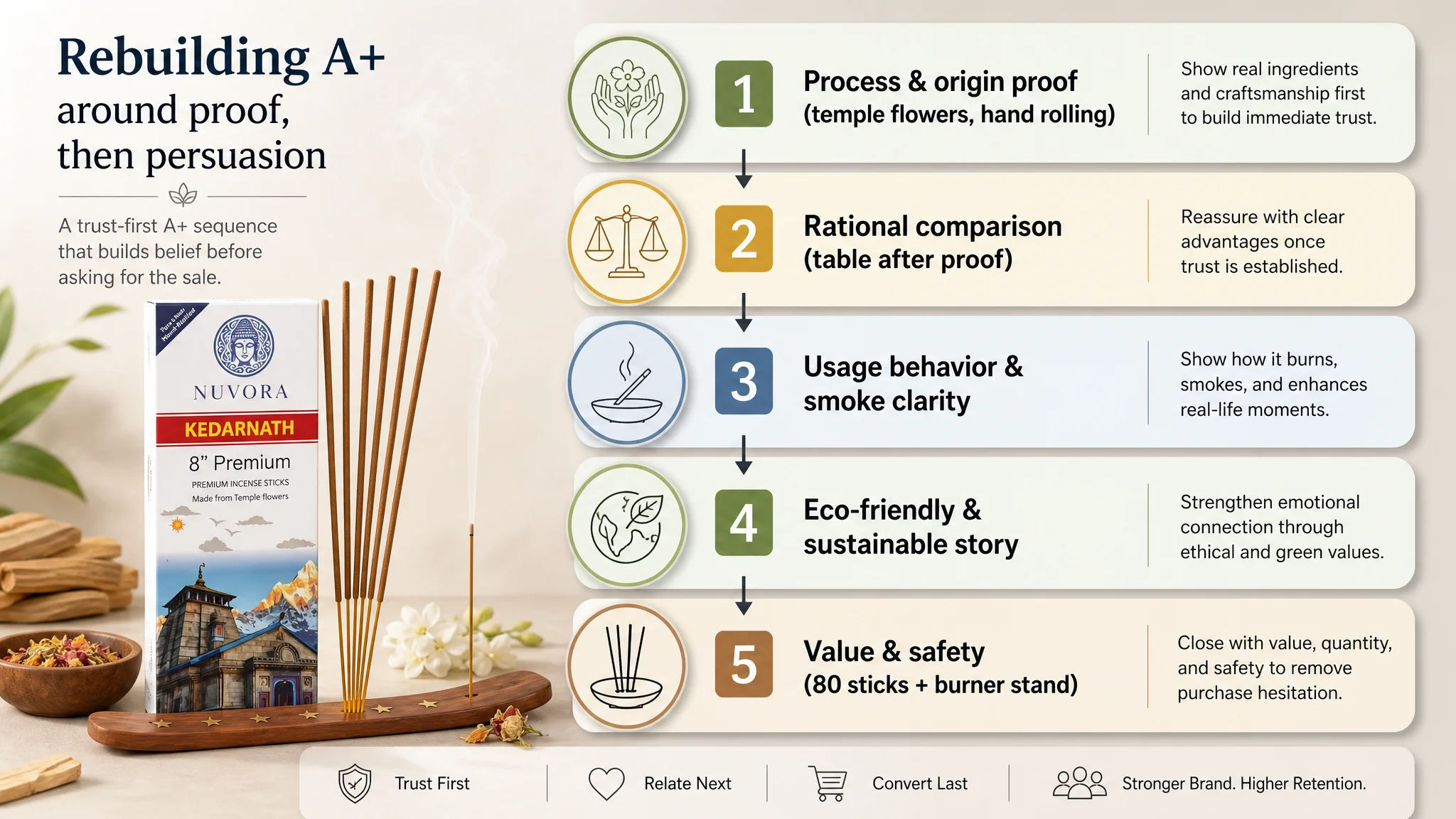
DeepBI prioritized a different A+ logic:
1. Open with process transparency
- Close‑up visuals of temple flowers, Palo Santo, and White Sage
- Hand‑rolling scenes, raw ingredient arrangements
- Clear visual link between “recycled temple flowers” and the final sticks
1. Then present rational comparison
- Keep the comparison table, but place it after visual proof so claims (“handcrafted,” “eco‑friendly,” “charcoal‑free”) feel believable.
1. Add modules designed around usage anxiety and behavior
- Realistic home settings with visible smoke plumes showing clean, gentle burn
- Clear activities: meditation, yoga, stress relief, space cleansing
1. Elevate the eco‑friendly story
- A dedicated module framing the temple‑flower recycling and sustainable practices as a deeper reason to choose this brand.
1. Close with hard value and safety
- Reconfirm 80 sticks, long burn time, and the included burner stand
- Frame the set as a complete, safe, mess‑free starter kit or gift.
This shift is subtle but decisive: from “We say it’s good” to “You can see why it’s good.”
Bullet Points: From Parameter Listing to Pain‑Point Logic
DeepBI’s analysis of the bullet points highlighted a common Amazon problem: more bullets, less clarity.
Original issues:
- The seller used seven bullets, diluting attention and repeating themes (meditation, relaxation).
- Bullets emphasized parameters and components (materials, size, accessories) more than buyer pain points.
- There were no sub‑headings, so scanning on mobile was harder.
- The last bullet was essentially a summary of earlier points—dead space in a high‑value area.
The competitor’s structure was leaner and more focused:
- Five bullets, each with a clear sub‑heading (“RESIN BLEND AROMA,” “SLOW BURNING,” etc.).
- Each bullet addressed a deeper concern: authentic aroma, handcraft, slow burn, daily value, and consistent supply.
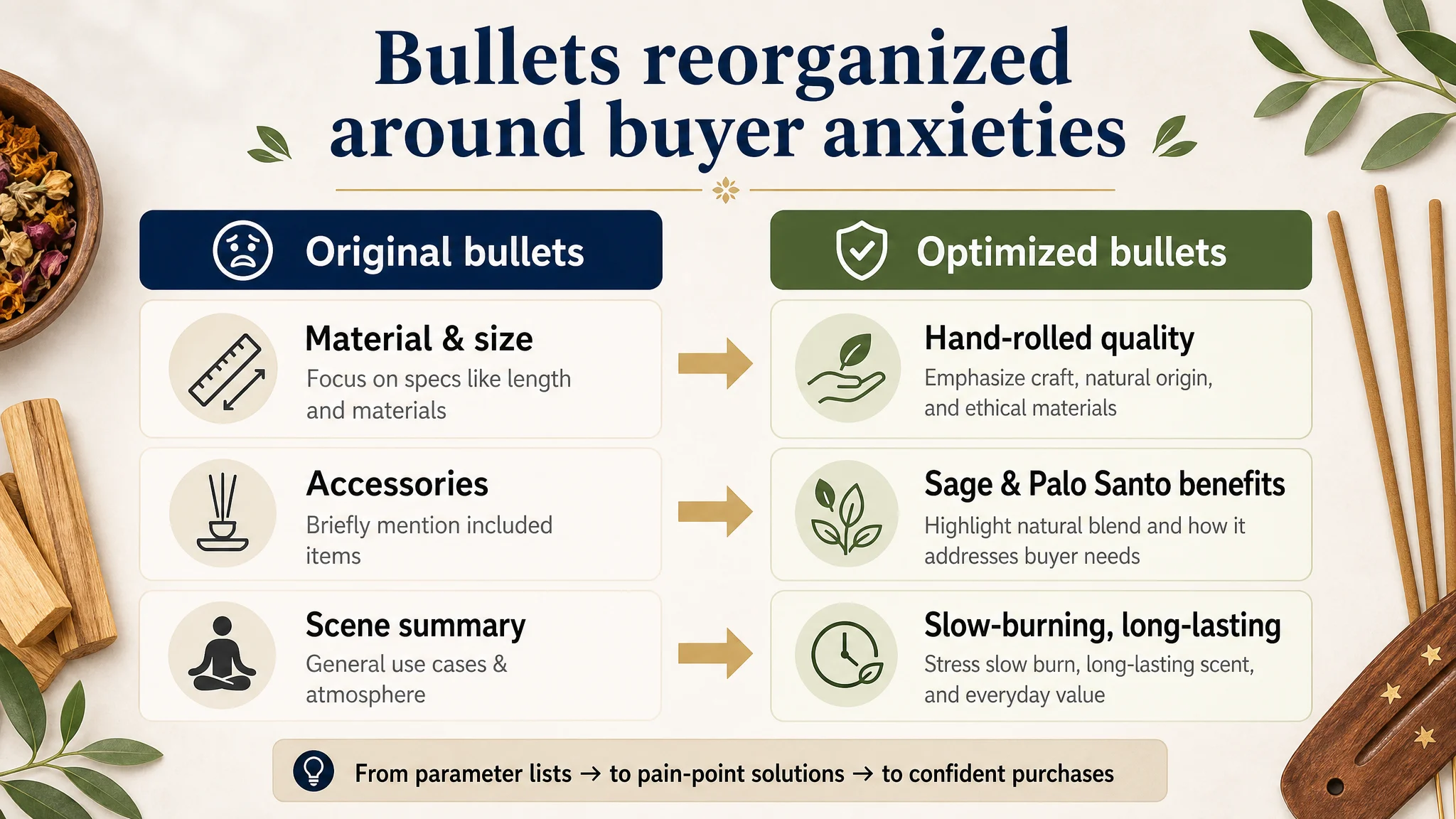
DeepBI restructured the bullets into a tighter logic, for example:
1. TRADITIONAL HAND-ROLLED QUALITY
- Crafted from recycled temple flowers using traditional masala methods.
- Emphasizes authenticity, eco‑friendliness, and craftsmanship in one shot.
1. SOOTHING SAGE & PALO SANTO BLEND
- Describes the scent in professional, sensory terms (“resin-based,” “warm earthy undertones”).
- Directly connects to purification and tranquility—what buyers actually want the incense to do.
1. SLOW-BURNING & LONG-LASTING
- Links 8‑inch length to slow, even burn and long‑lasting fragrance.
- Positions the product as suitable even for longer meditation sessions or evening routines.
1. 80-STICK PREMIUM VALUE PACK
- Reframes quantity into “daily well‑being” and long‑term use, not just “80 pieces.”
- Helps rationalize price as a cost‑effective, ongoing ritual investment.
1. SAFE & CONVENIENT SET
- Leverages the included incense burner stand as a safety and convenience advantage.
- Positions the product as a one‑box solution for both beginners and experienced users.
Here, DeepBI’s judgment was not “add keywords,” but “rebuild bullets as a pain‑point → solution chain.”
Reviews: Perfect Stars, But Not Enough Proof
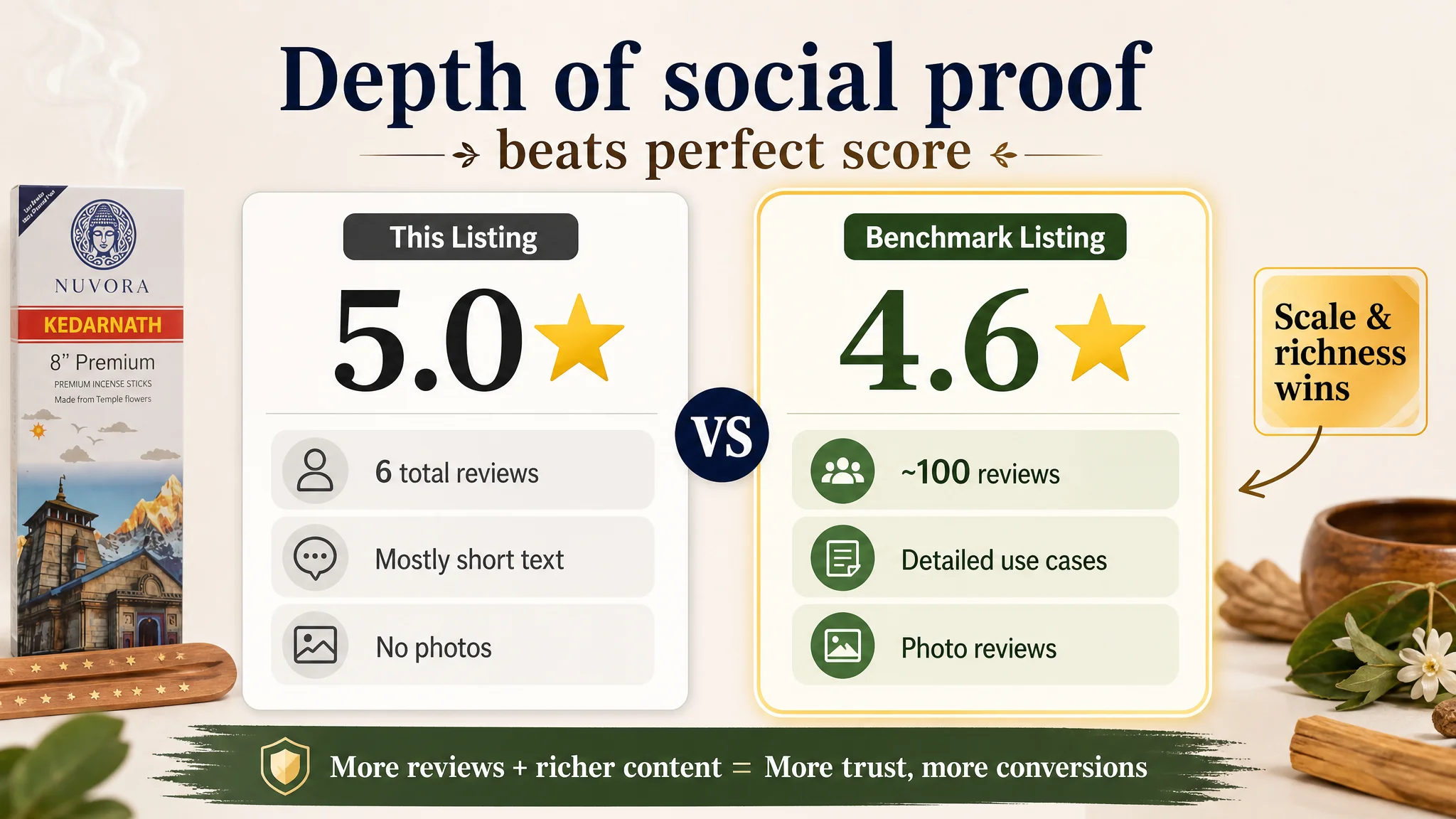
One of the most deceptive signals on the Listing was the 5.0‑star rating with no negative reviews.
DeepBI’s review comparison put it in context:
- This Listing:
- 5.0 stars
- Only 6 total reviews
- 2 reviews on the first page
- Short, text‑only, little detail
- Benchmark competitor:
- 4.6 stars
- Around 100 total reviews
- 8 reviews on the first page
- Multiple detailed use‑case descriptions
- Several photo reviews
For a new visitor, the competitor looked:
- More battle‑tested (“100 people bought and liked this”)
- More transparent (“I can see how it burns, where it’s used, how much smoke there is”)
- More credible (“not perfect, but consistently good”)
DeepBI’s reading: the Listing suffered from a scale and richness deficit, not a rating problem.
Optimizing ads into this structure would likely push more traffic toward a product whose social proof felt thin next to the benchmark. The priority was again to improve every other trust layer—images, A+, bullets—so that when reviews gradually accumulated, each new visitor would not feel the “6 vs. 100” gap as strongly.
Why DeepBI Did Not Recommend “Ads First”
Given all these findings, DeepBI’s judgment was clear:
- The Listing did not lack traffic potential.
- It lacked a coherent, evidence‑based selling narrative compared with its main competitor.
Continuing to prioritize ad optimization would have:
- Exposed more buyers to a structurally weaker page
- Locked ACOS into a stressful range
- Prevented the product from reaching its real organic potential for core keywords
By contrast, prioritizing Listing conversion—title structure, main image logic, A+ trust and narrative, bullet point clarity, and visual proof of value—offered the seller a way to:
- Turn existing traffic (both paid and organic) into more orders
- Make every future ad click more productive
- Allow Amazon’s algorithm to see stronger conversion signals and gradually reward the product with better organic positions
“Advertising does not only amplify advantages. It can also amplify a page’s existing defects.”
In this case, the rational sequence was:
1. Fix the Listing’s ability to convert.
2. Then scale and refine ads on a stronger foundation.
How the Page’s Sales Logic Started to Recover
Because this case focuses on diagnosis rather than numeric outcomes, we will not invent performance numbers. Instead, it’s important to see how the operating state changed:
- Main image set:
Each image was assigned a clear job: natural proof, usage scenario, feature clarity, quantity/value proof, and secondary usage & scent explanation. The image sequence began to guide the buyer through curiosity, trust, value, and use—rather than repeating generic lifestyle shots.
- Title:
The new title balanced search logic (front‑loaded category terms and blend keywords) with human decision logic (craft, quantity, use cases, included stand). This helped both Amazon’s algorithm and mobile shoppers immediately understand what was being offered.
- Bullet points:
From scattered and repetitive, they became a set of headline‑driven, pain‑point based selling blocks. Scannability improved, and each bullet added something new instead of echoing the previous one.
- A+ modules:
The A+ page shifted from broad benefit promotion to trust‑first storytelling: process, ingredients, eco‑credentials, usage behavior, and finally value and safety. Buyers were given more reasons to believe the claims, not just read them.
- Perceived risk:
New visitors, even with limited review volume, now encountered multiple layers of credible proof—visual evidence, process transparency, clear safety cues, and rational quantity/value messaging.
As these elements aligned, ad traffic was no longer being “consumed” by a page that underperformed its benchmark. Each click stood a better chance of turning into an order.
What Changed in the Seller’s Understanding
This case did more than adjust a single incense Listing. It shifted how the seller thought about Amazon operations:
- They stopped equating “5.0 stars” with “Listing is not the problem.”
They learned that a small number of perfect reviews can be less persuasive than a large number of mostly positive ones, and that everything else on the page must work harder when review volume is low.
- They stopped treating ads as a universal fix.
They saw how ads can amplify weaknesses as easily as strengths, and why high ACOS often hides a conversion problem rather than an advertising problem.
- They began to see title, main images, bullet points, and A+ content as one sales logic, not separate tasks.
Each module now had an explicit job in the funnel: catching attention, building trust, resolving anxiety, justifying price, and making use feel easy.
- They realized that Listing quality is the foundation of ad efficiency.
Before putting more dollars into keywords, their new default question became: “Does this Amazon product page deserve more traffic yet?”
Takeaways for Other Amazon Sellers
For other Amazon sellers, especially in categories like home fragrance, craft, or wellness where sensory trust is hard to build online, this case underlines a few practical points:
- If ads feel “expensive” and tweaks don’t move ACOS, check the Listing first, not the bid logic.
- Do not let a few five‑star reviews convince you your page is fine; review depth and richness matter as much as rating.
- A “full” Listing (title, images, A+) is not necessarily an effective Listing. What matters is whether each element plays a defined role in the buyer’s decision sequence.
- Advertising efficiency is a function of Listing conversion. The best media strategy cannot compensate for a page that systematically loses arguments to its benchmark competitor.
DeepBI’s value in this case was not in adding more tools, but in reframing the question: from “How do we make our Amazon ads cheaper?” to “Why would a buyer choose this Listing over the best one in the category, given the same traffic?”
Once that question is answered honestly, the path to healthier ads and more controllable growth becomes much clearer.