

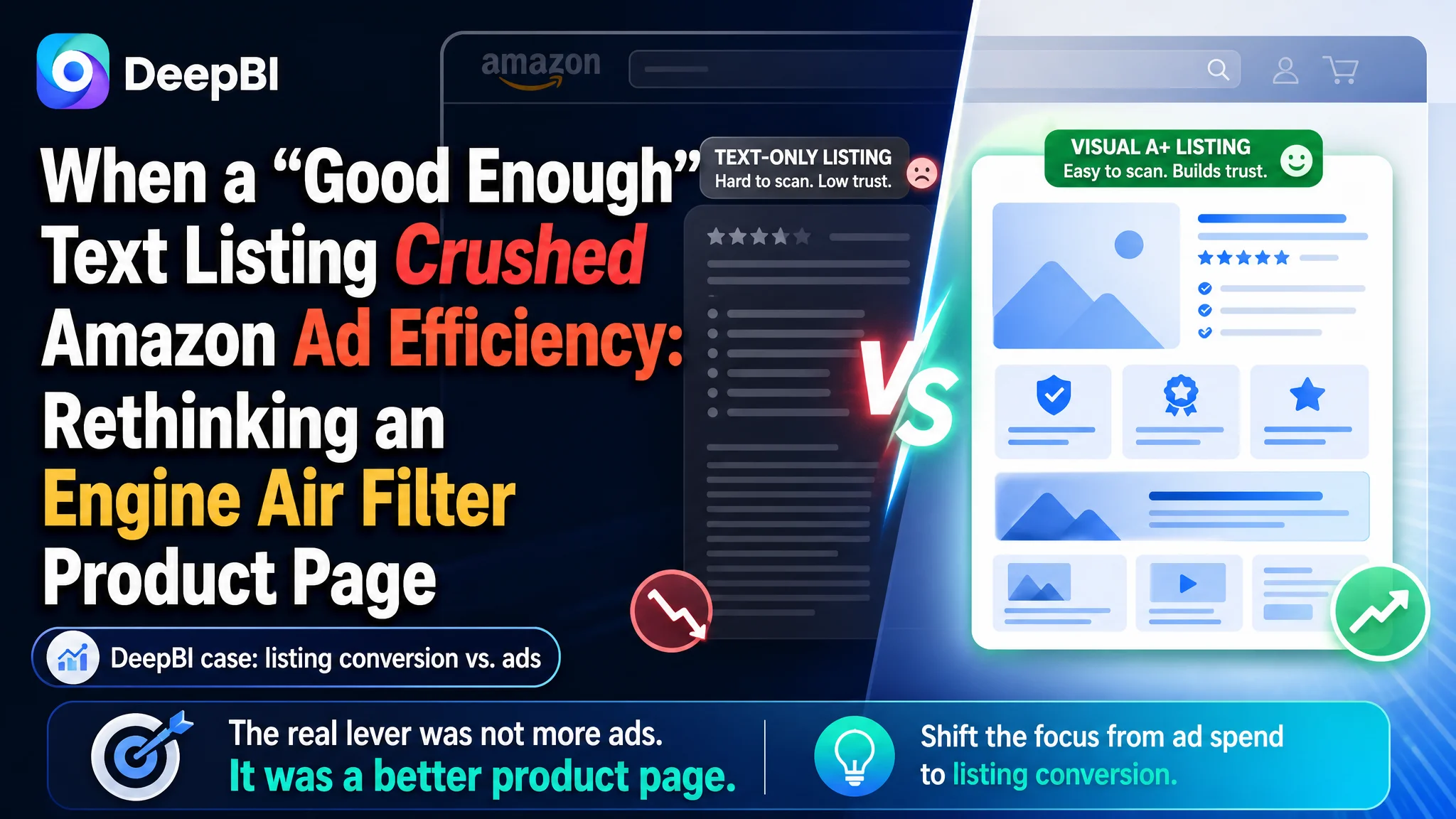
This case comes from an Amazon seller in the automotive parts category, focusing on an engine air filter for diesel pickup trucks in the US marketplace. The team felt their content was already “solid”: keywords were in place, bullet points were detailed, and ads were steadily bringing traffic. Yet ACOS kept feeling hard to control and ad traffic was not turning into proportional orders. Internally, the seller kept asking the same question: “Is our Amazon ads setup the problem?”
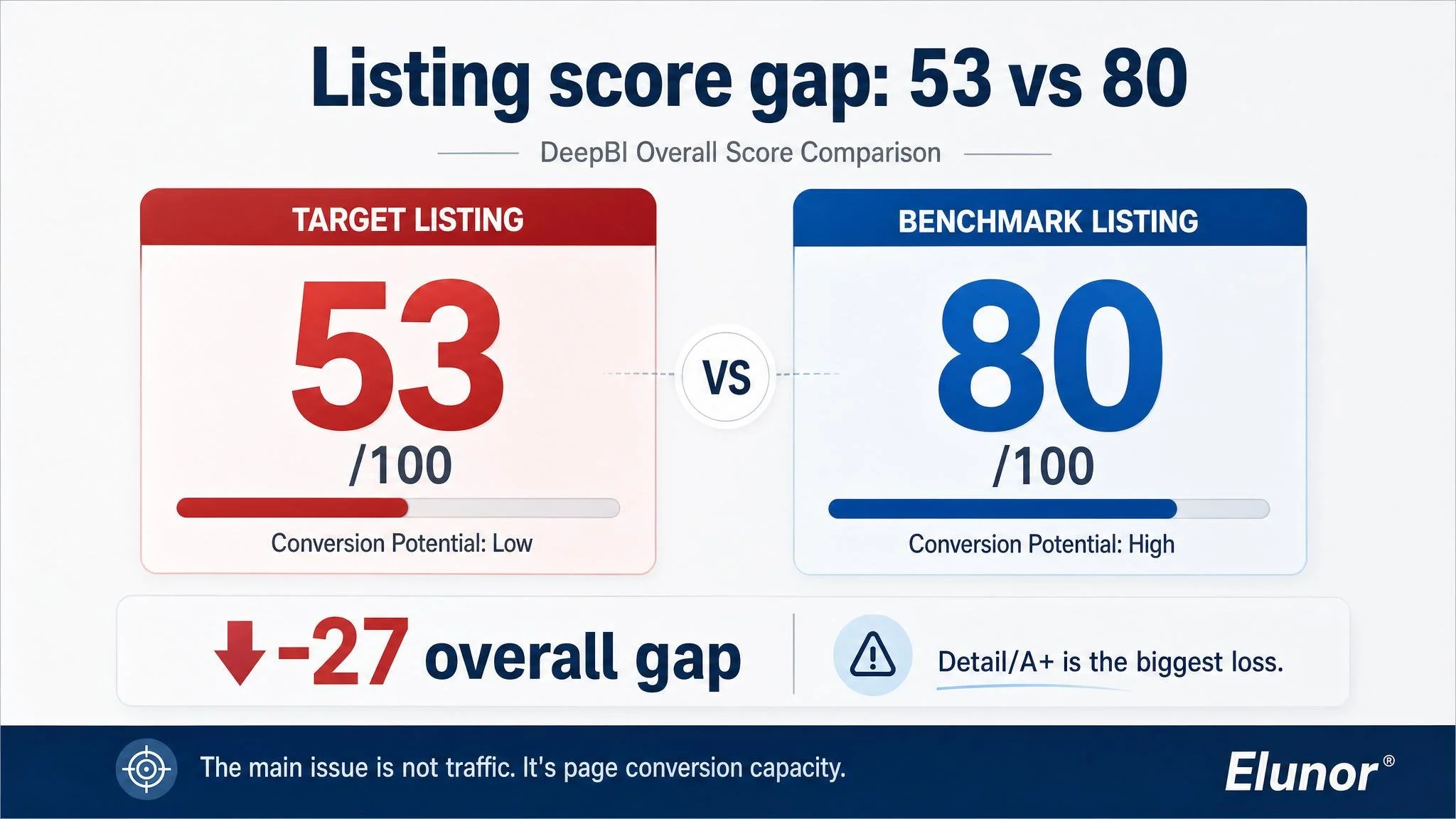
DeepBI’s diagnosis pushed the discussion in a different direction. Against a category-leading competitor, the target Amazon Listing scored 53/100 versus 80/100. The surprise was not that titles or main images lagged slightly—those gaps were relatively small. The real cliff was in the detail/A+ dimension: 3/25 versus the competitor’s 21/25. In other words, ads were driving buyers to a product page that simply did not complete the trust and decision logic.
Once the team accepted that the core issue was Amazon product-page conversion, not just advertising, the optimization focus shifted: instead of endlessly tuning bids and keywords, they worked on building a proper visual detail section and tightening the title for both relevance and trust. What other Amazon sellers can take from this case is straightforward: if your detail area is only text or almost empty while your category’s top listings use full visual A+ modules, then every extra ad dollar is likely being poured into a page that cannot convert at market level.
Amazon Ads Were Not Failing. The Page Was Consuming the Traffic.
From the seller’s perspective, the situation looked like a classic advertising problem.
- Traffic from Amazon ads was there.
- The product was a standard engine air filter, not a niche experiment.
- Reviews were not terrible: 4.4 stars with dozens of ratings.
- Bullet points were carefully written, with technical terms and replacement intervals.
So the natural conclusion was: “Our Amazon ads need more refinement. Better structure, tighter keywords, smarter bidding.”
DeepBI’s scoring, however, framed it differently. When the listing’s five major dimensions—title, main image, bullet points, detail/A+, and reviews—were benchmarked against a top-performing competitor, the picture changed:
- Overall score:
- Target Listing: 53/100
- Benchmark Listing: 80/100
- Gap: –27 points
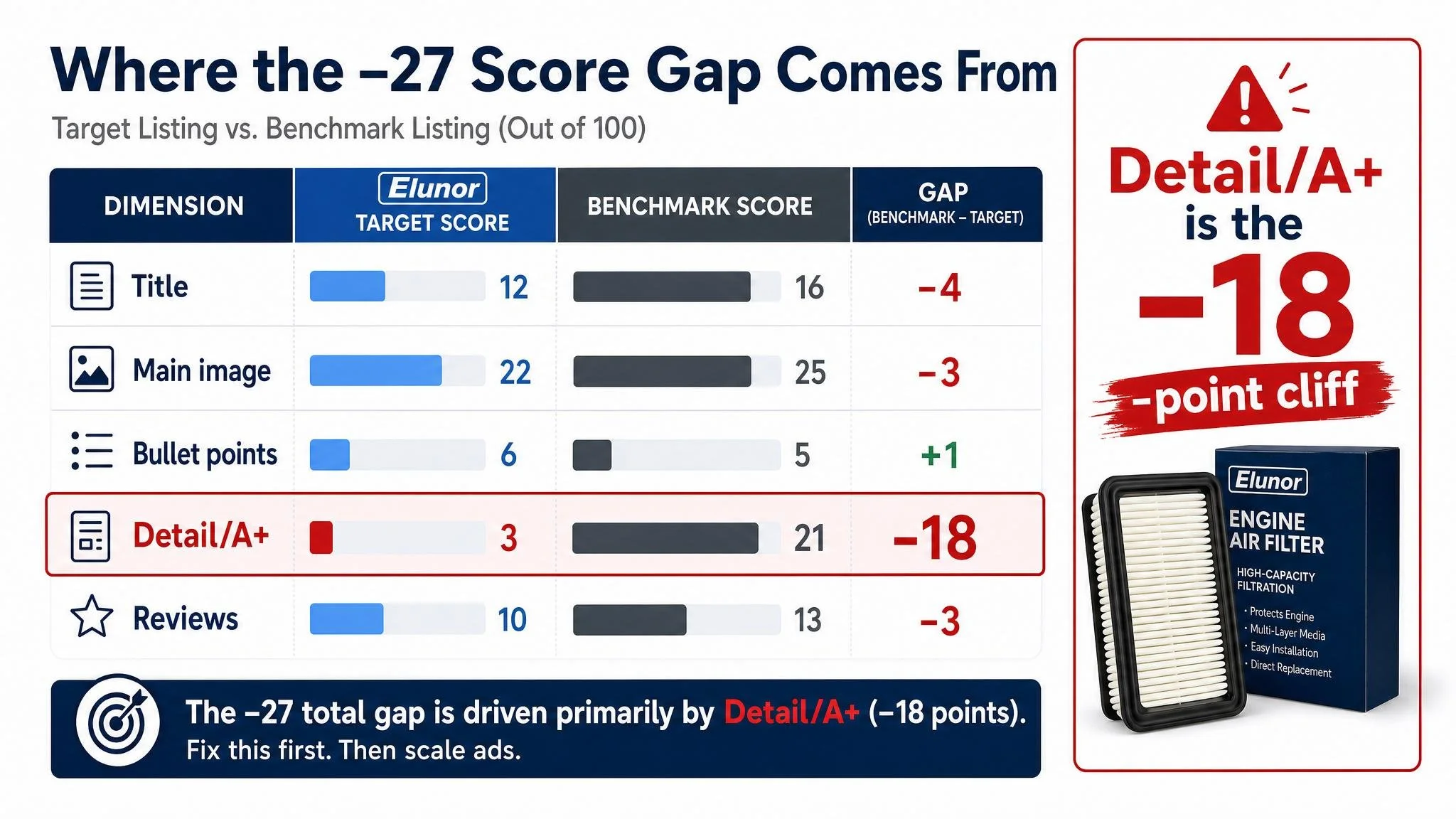
- By dimension:
- Title: 12 vs 16 (–4)
- Main image set: 22 vs 25 (–3)
- Bullet points: 6 vs 5 (+1)
- Detail/A+: 3 vs 21 (–18)
- Reviews: 10 vs 13 (–3)
“The real problem was not that ads failed to bring traffic. It was that the page could not convert the traffic.”
The bullet points were actually slightly stronger than the competitor’s in logic and density—exactly where the seller had invested most of their energy. But the detail/A+ layer was almost non-existent. The page had no visual structure to carry buyers from click to purchase.
In this state, continuing to optimize Amazon ads first would only amplify the Listing’s conversion defect.
The Misdiagnosis: “Our Text Is Strong, So It Must Be the Ads”
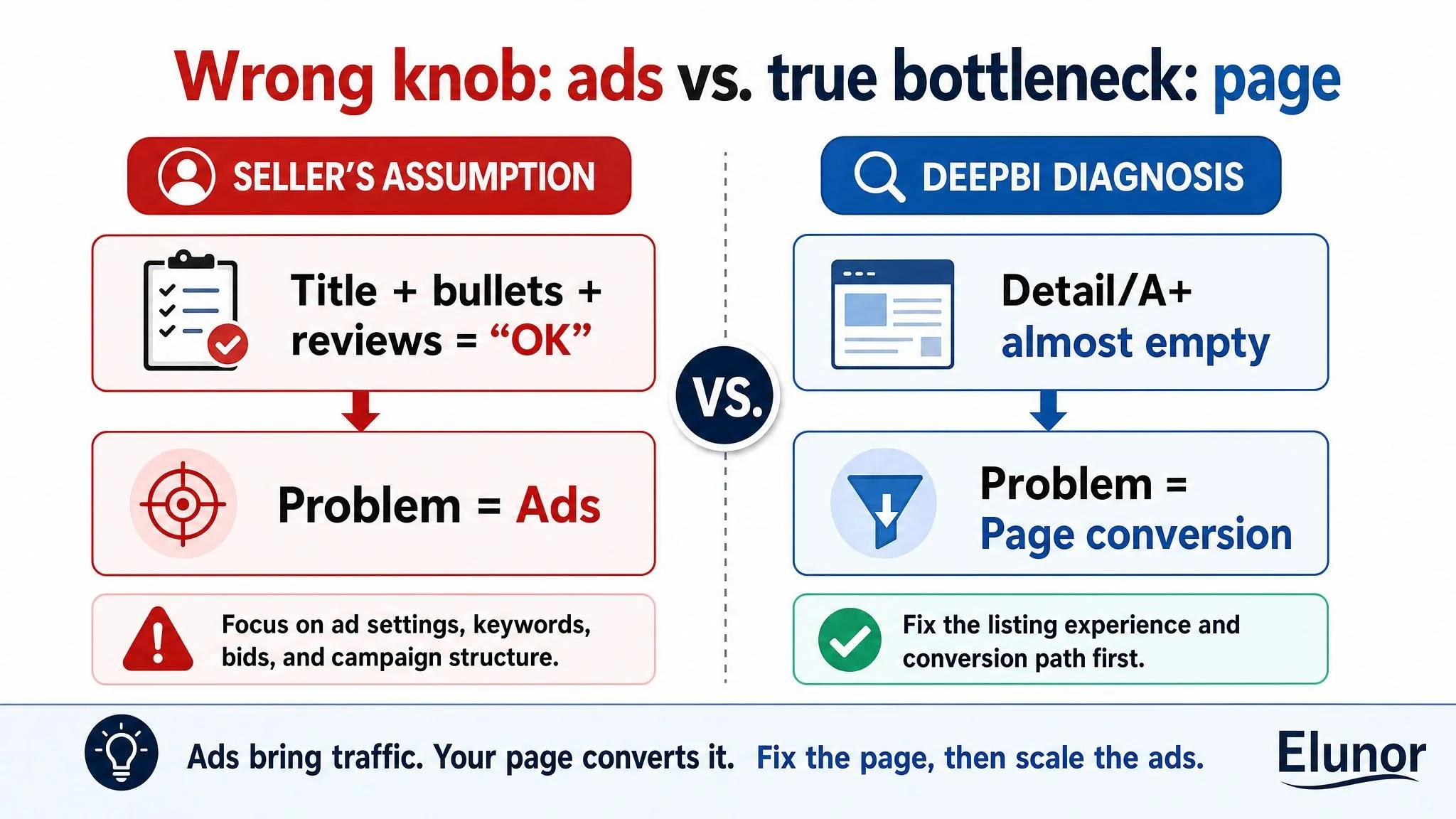
The seller’s original logic went like this:
- Keywords like “Engine Air Filter” were in the title.
- The bullet points included compatibility, technical media (“Advanced synthetic filtration media”), replacement cycles (e.g., mileage intervals), and performance impact.
- Reviews were decent and real.
- So if orders were not following traffic, ads must be the weak link.
This is a common pattern among Amazon sellers:
1. They mainly look at title + bullets + reviews.
2. If those seem “not bad,” they automatically blame:
- Wrong keyword match types,
- Poor negative keyword control,
- Insufficient bid precision,
- Or not enough campaign segmentation.
But in this case, DeepBI’s comparative view made a different issue obvious: the seller was almost blind to how detail content and visual structure influence conversion, especially in a technical automotive category where buyers want proof, not just claims.
The Real Constraint Was Listing Conversion Capacity
DeepBI’s diagnosis highlighted a single core constraint: The Amazon product page did not have enough visual and structural capacity to convert the traffic it was already getting.
Title: Technically Correct, Commercially Underpowered
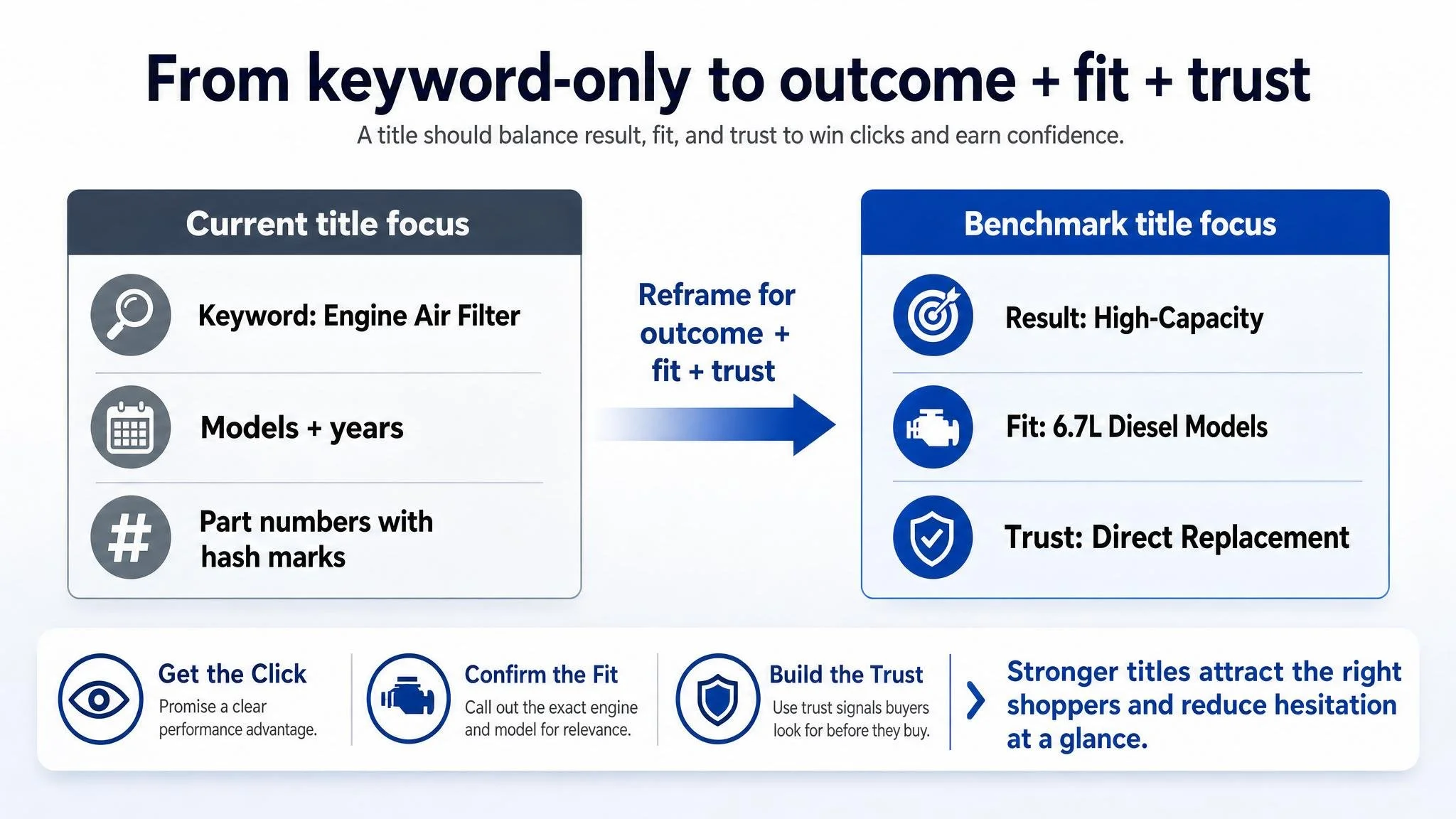
On the surface, the title felt “okay” to the seller:
- The core keyword “Engine Air Filter” was front-loaded.
- Vehicle model and year information were listed.
- Part numbers were included.
However, compared against the benchmark listing:
- The competitor led with “High-Capacity”, immediately signaling performance and differentiation.
- Trust-building phrases like “Direct Replacement” were clearly stated, helping buyers feel safe about fitment.
- The competitor explicitly called out “6.7L Diesel Models”, capturing high-intent long-tail searches.
- The target title carried awkward formatting, such as hash marks and loosely separated part numbers, which hurt readability and perceived professionalism.
The result: a –4 point gap in the title dimension. Not catastrophic, but enough to drag down both CTR and trust at a glance—especially in a crowded search results page.
Main Images: Not Bad, But Not Category-Top Either
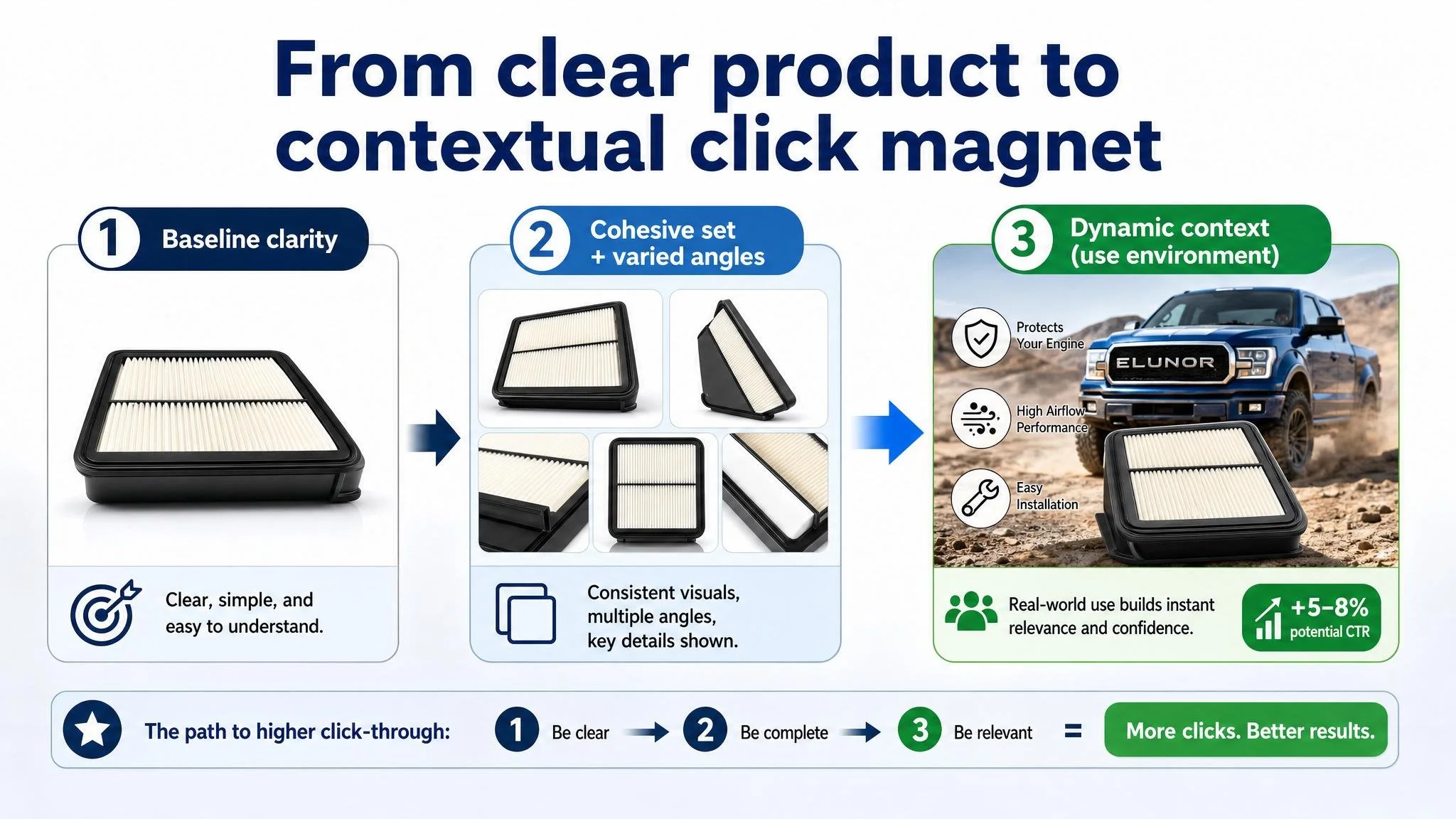
The main image set only lagged by –3 points. This suggests:
- Baseline clarity and professionalism existed.
- But the competitor’s visuals were more cohesive, and their use of varied scenarios and technical callouts likely generated 5–8% better click-through on the search results page.
- One competitor image used dynamic context (e.g., visualizing use or environment), creating a stronger “this is for my truck and this use case” signal.
For mid- to high-intent shoppers, especially those comparing multiple tabs, that difference can decide who gets the click and who gets dismissed.
Bullet Points: The Only Dimension Where the Seller Was Stronger
Ironically, the only clear edge:
- The seller’s bullet points had better structure:
“Protection → Installation → Performance → Technology” — a logical progression that matches how informed buyers think.
- Content density was higher:
- Concrete phrasing like “Advanced synthetic filtration media.”
- Specific replacement intervals (e.g., precise mileage numbers).
- The competitor used less rigorous phrasing:
- “Clean up exhaust” (vague).
- “Attracts dirt like a magnet” (visual but not technical).
But this strength was buried by the rest of the page’s weaknesses.
“When bullets are the only strong element, they become overworked and under-read. Most buyers never slow down long enough to decode dense text without visual anchors.”
Detail/A+ Content: The Fatal –18 Point Gap
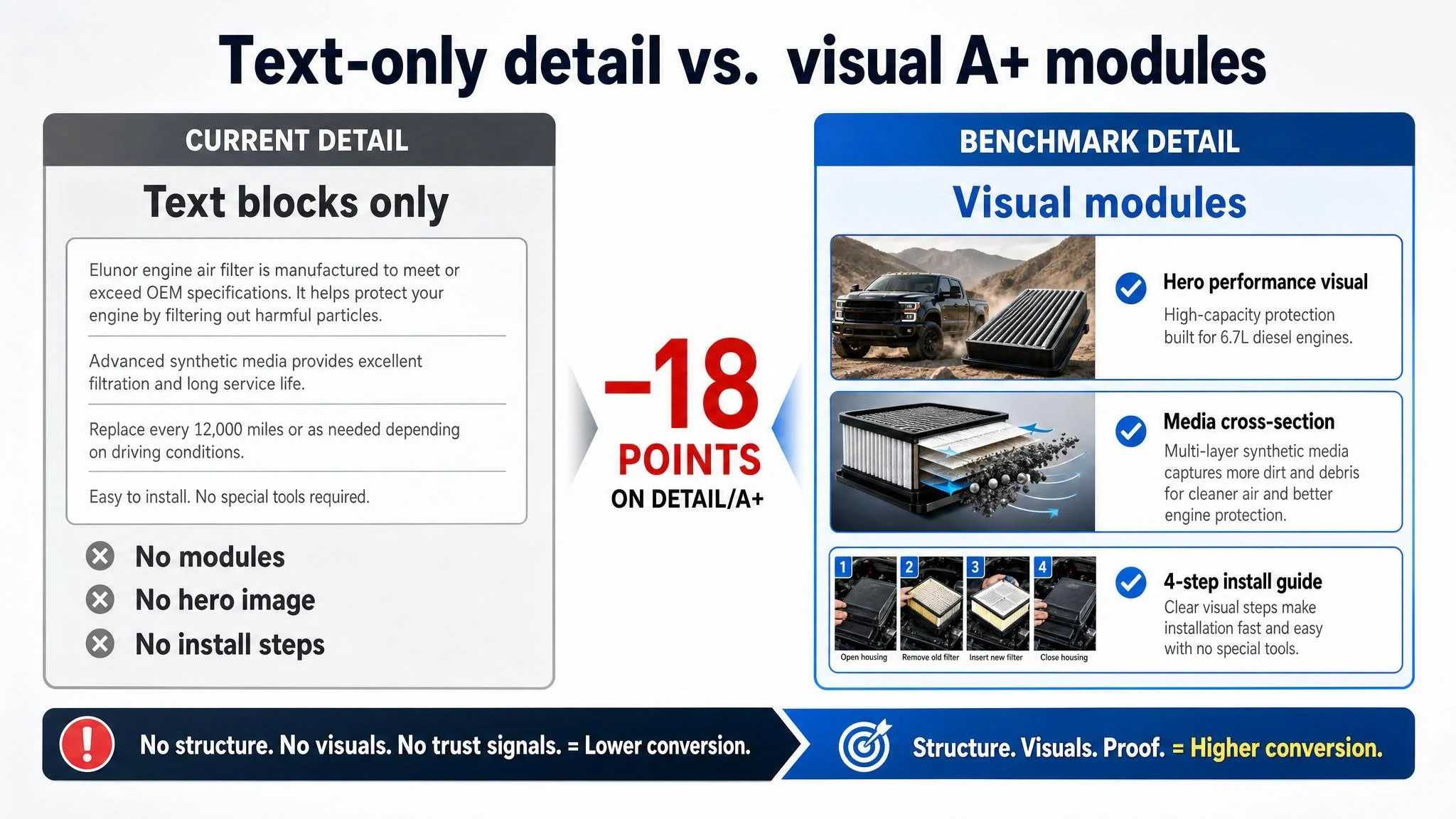
Here was the real bottleneck:
- Seller:
- Pure text, no visual modules.
- Long paragraphs repeating similar information.
- No clear modular structure, no visual entry points.
- Competitor:
- Hero visual with clear performance promise.
- Technical advantage image explaining layers or media.
- A four-step installation guide in images, reducing “fitment and difficulty” anxiety.
The impact on conversion is straightforward:
- No visuals → lower first impression → shorter dwell time.
- No structured modules → buyers cannot quickly find:
- “Will this fit my engine?”
- “How hard is it to install?”
- “What real protection or performance do I get?”
- No installation visualization → increased perceived risk:
- “If it doesn’t fit, I waste time and risk returns.”
- “Is this really OEM-level quality?”
For Amazon’s algorithm and buyers, this is a page that does not finish the purchase argument, even if the product itself is fine.
Why DeepBI Did Not Recommend “Fix Ads First”
From a pure advertising point of view, the seller still had multiple knobs they could adjust. But DeepBI’s view was shaped by one priority question:
“If we send 100 more qualified visitors to this page, how many incremental orders can the page realistically capture compared to the category benchmark?”
Given:
- Detail/A+ score: 3 vs 21 (–18).
- Reviews: weaker in both star rating (4.4 vs 4.7) and volume (75 vs 153).
- Visual trust gap.
The answer was clear: the marginal value of extra traffic was low until the page conversion logic improved.
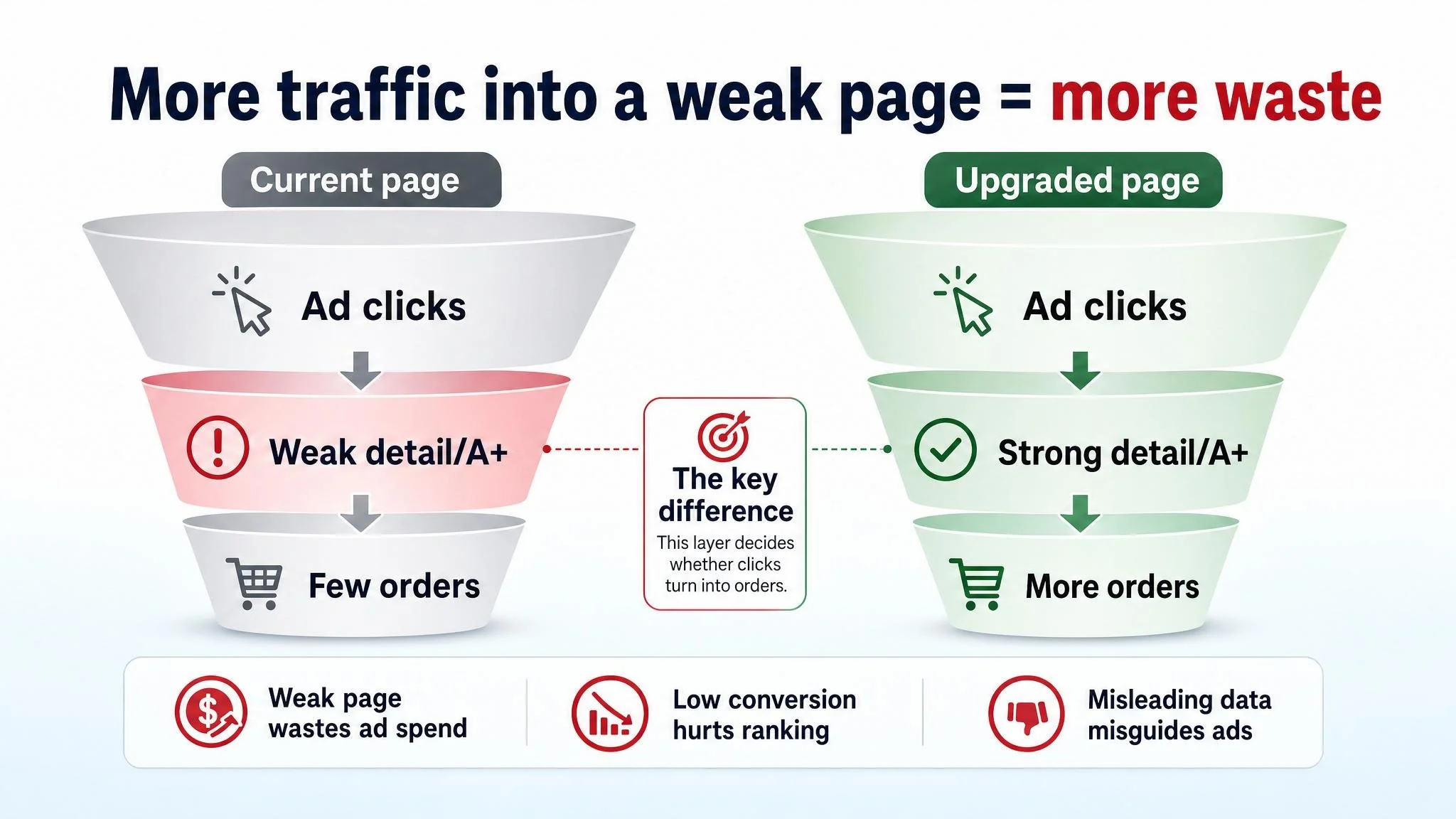
Continuing to adjust ads first would create three risks:
1. Ad spend inflation without proportional CVR gains
Each incremental click had a lower chance of converting than the competitor’s page, simply because the buyer’s risk and uncertainty were not resolved on-page.
1. Organic ranking stagnation
With weaker conversion, the Listing struggled to send strong positive signals back to Amazon (click → dwell → add to cart → purchase), limiting organic rank growth even when ads created exposure.
1. Misleading operational feedback
The team might misinterpret “ads not working” and keep re-structuring campaigns, when the real limit was how the page persuaded people.
So DeepBI’s judgment was: fix the Listing’s conversion infrastructure first, then refine ads.
This Product Page Did Not Lack Traffic. It Lacked Trust.
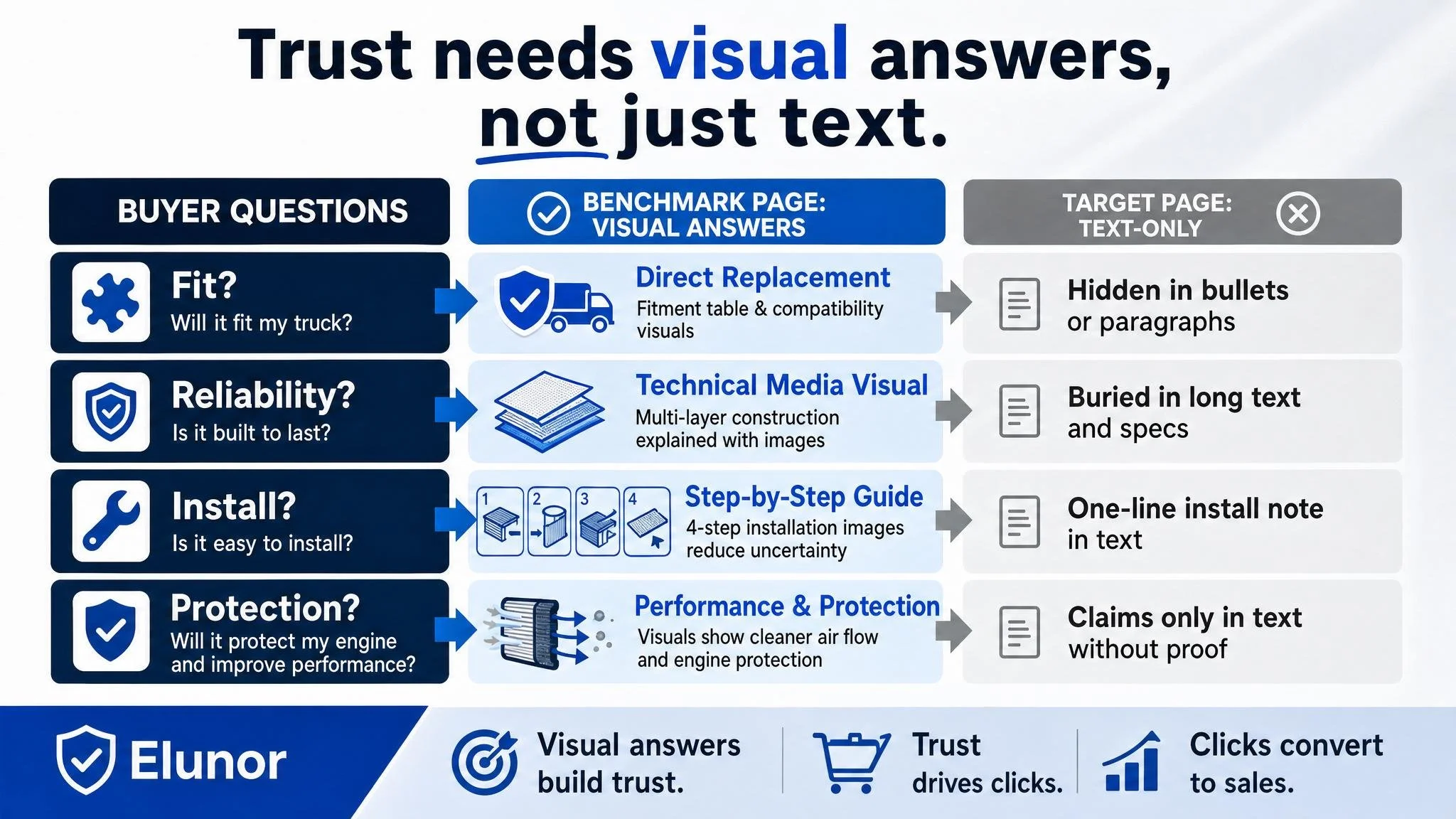
From a buyer’s point of view, especially for a diesel truck engine air filter, trust is built on a few very concrete questions:
- “Is this a direct fit for my engine and model?”
- “Is it as reliable as OEM or trusted brands?”
- “How often do I have to replace it, and is installation realistic for me?”
- “Will this actually protect and maintain performance over time?”
The competitor’s Amazon product page answered these visually:
- Clear “High-Capacity” positioning and outcome-oriented language.
- “Direct Replacement” claims that reduce fit anxiety.
- Installation visuals showing step-by-step process.
- Conceptual technical images that make unseen benefits feel tangible.
The target Listing mostly answered them in text only, and only if the buyer read carefully. Many never did.
“Advertising does not only amplify advantages. It can also amplify a page’s existing defects.”
Without visuals and structured A+ content, the page asked buyers to trust paragraphs. In a competitive category, this is an unrealistic expectation.
How the Page’s Sales Logic Needed to Recover
DeepBI’s diagnosis implied a clear reordering of work, not a long feature checklist.
1. Reframe the Title Around Outcome and Fit
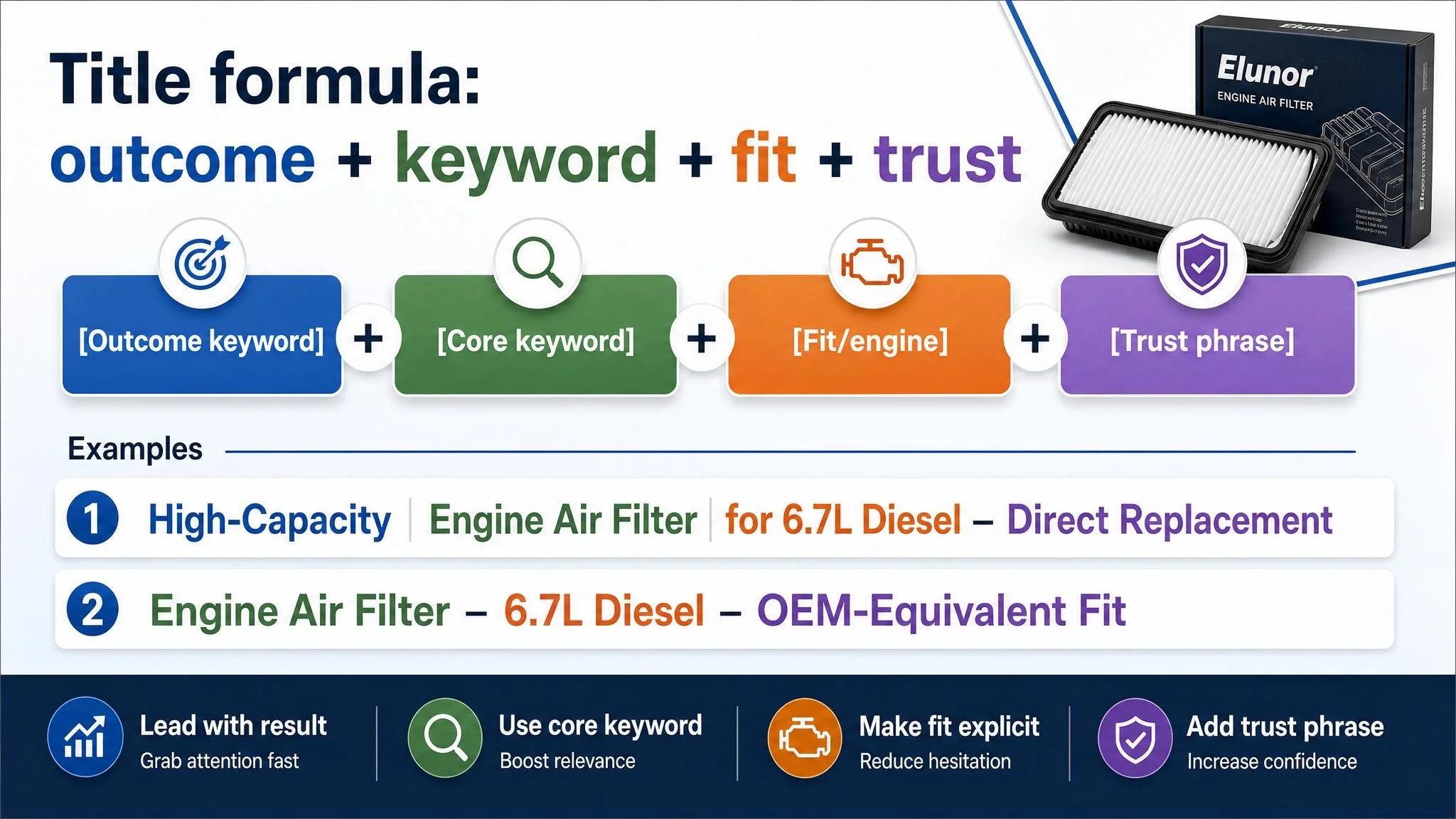
The priority was to make the title serve two jobs at once:
- Capture core and long-tail search intent.
- Reduce doubt on fit and quality at a glance.
That meant:
- Front-loading the result: integrate performance- or capacity-oriented wording (e.g., “High-Capacity” or similar category-credible benefits) alongside “Engine Air Filter.”
- Making fit explicit: go beyond just model years; include engine displacement or variant when that is how users search (e.g., explicitly calling out the diesel engine size).
- Including trust wording: phrases like “Direct Replacement” or equivalent confidence builders for OEM-equivalent fitment.
- Cleaning up formatting: replacing hash-mark chaos and inconsistent separators with a clean, scannable structure that looks like a professional automotive listing.
This is not about stuffing more words. It is about reorganizing the title so search relevance and trust are visible in the first few seconds.
2. Treat the Detail/A+ Area as the Main Conversion Engine
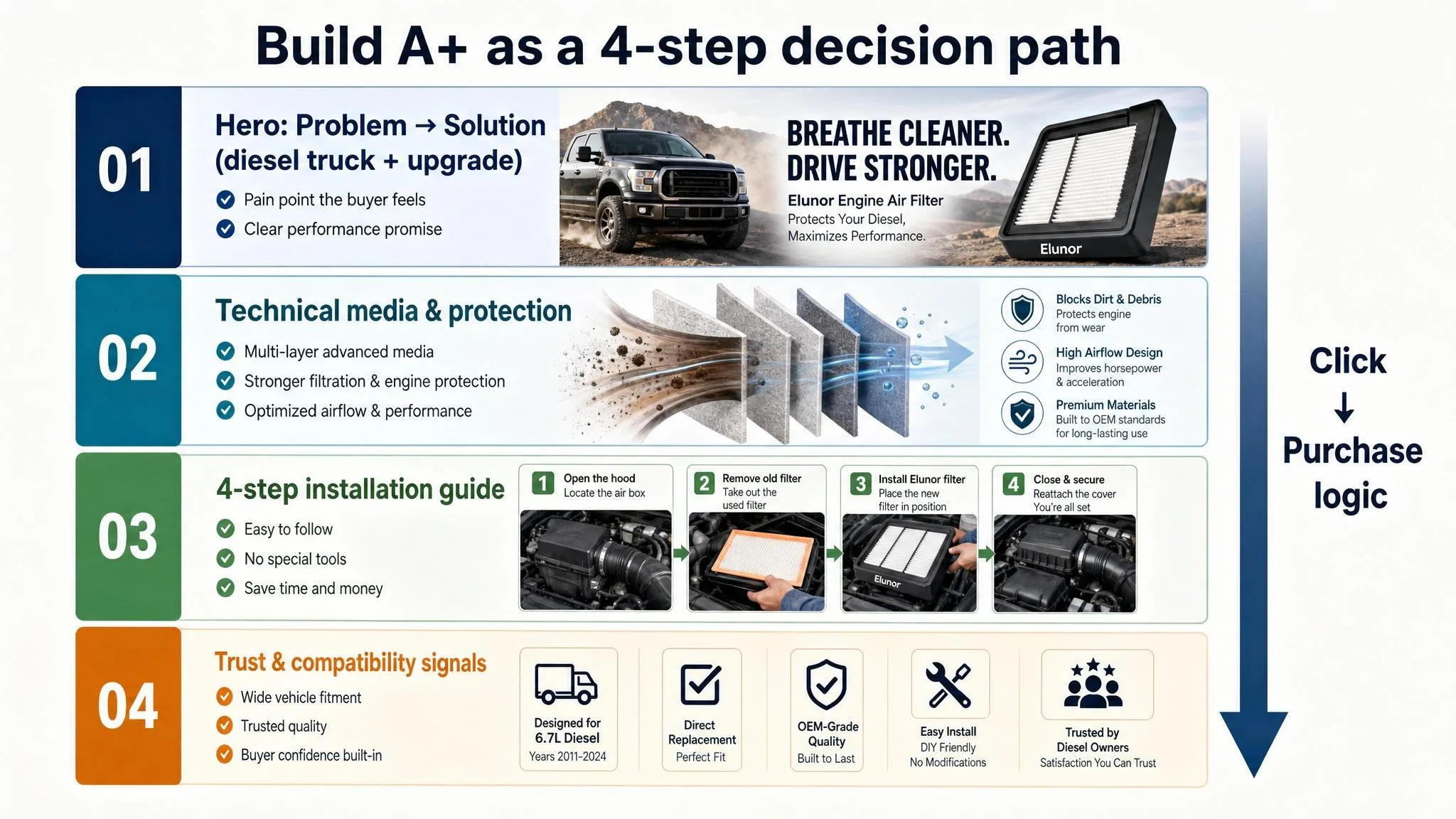
In this category, the detail/A+ section is not a “nice to have”; it is where buyers are convinced.
The logic needed to be:
1. Problem → Solution Intro
- Visual hero that quickly shows:
- Use environment (diesel truck context),
- Protection and performance angle,
- The filter as an obvious “upgrade” from a dirty or clogged one.
1. Technical Advantage in Visual Form
- Image that simplifies the filter media story:
- Layers or media type,
- Protection against dust and debris,
- How this supports engine longevity or efficiency.
1. Installation Assurance
- Visual “4-step” or similar installation walk-through:
- Clear images of each step,
- Reinforcing that a typical owner can handle it,
- Directly attacking “will this be a hassle?” anxiety.
1. Trust and Compatibility
- Fitment matrix or callouts in image form (not only text),
- Signals equivalent to OEM standard or industry norms,
- Possibly leveraging the best review themes in visual snippets.
Instead of expecting buyers to parse dense paragraphs, the page needed modules that map to how people actually make decisions.
Why Listing Conversion Had to Be Fixed Before Scaling Ads
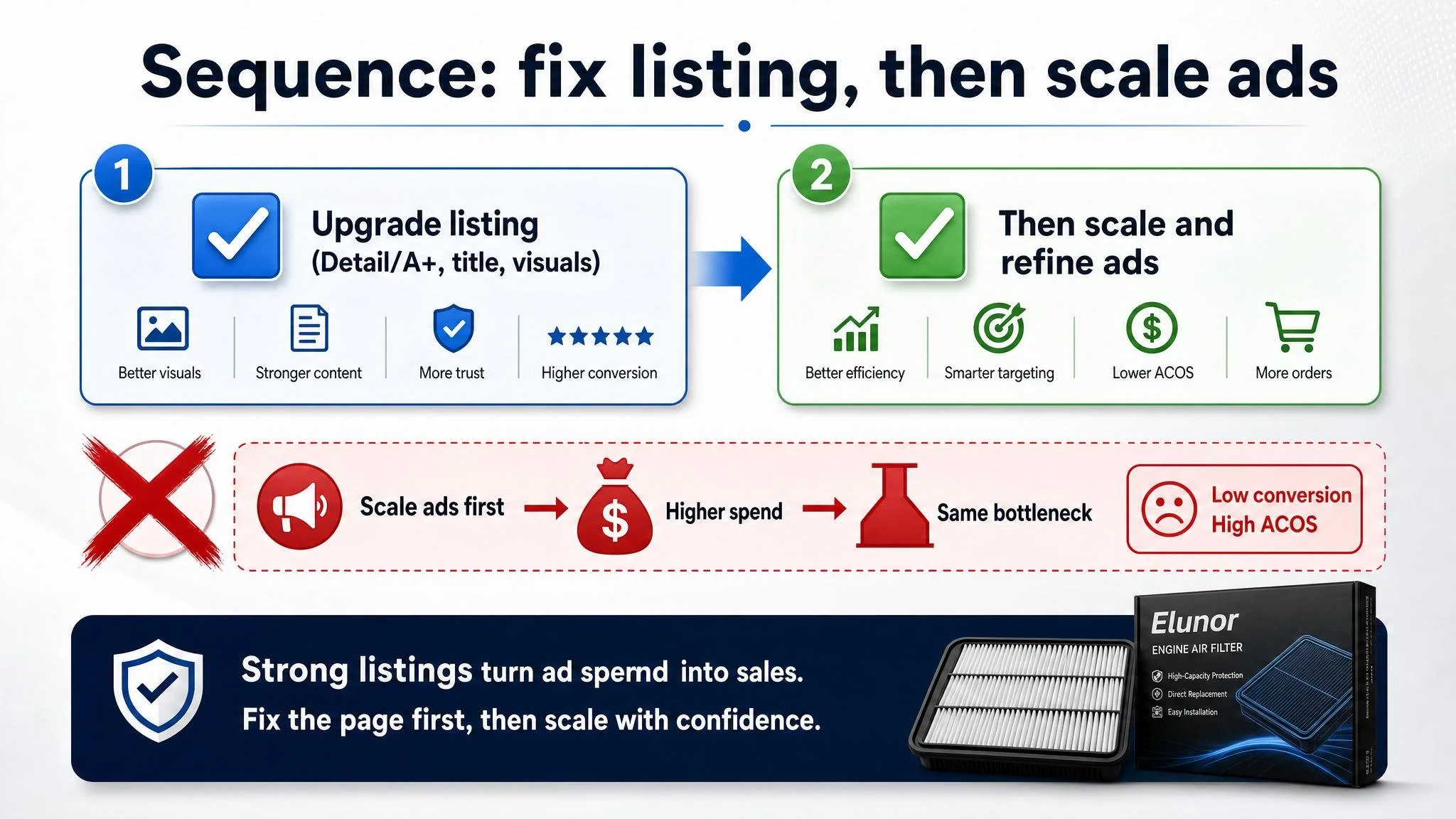
Once DeepBI highlighted the –18 point gap in the detail/A+ dimension, the decision sequence became straightforward:
1. Boosting ads into a weak-conversion page would:
- Increase spend,
- Leave ACOS stubborn,
- Probably raise internal pressure to “optimize ads even more,”
creating a loop with no structural improvement.
1. Strengthening the page first would:
- Make each existing click more valuable,
- Improve conversion signals that support both paid and organic performance,
- Give future ad tests a clean read—performance changes would more accurately reflect ad decisions, not page weaknesses.
From a risk perspective, the question was:
“What is the bigger risk right now: under-optimized ads, or systematically wasting traffic on a page that cannot match the competitor’s conversion capacity?”
Given the scoring gaps, DeepBI treated listing conversion as the primary bottleneck.
How Ad Traffic Became Useful Again (Conceptually)
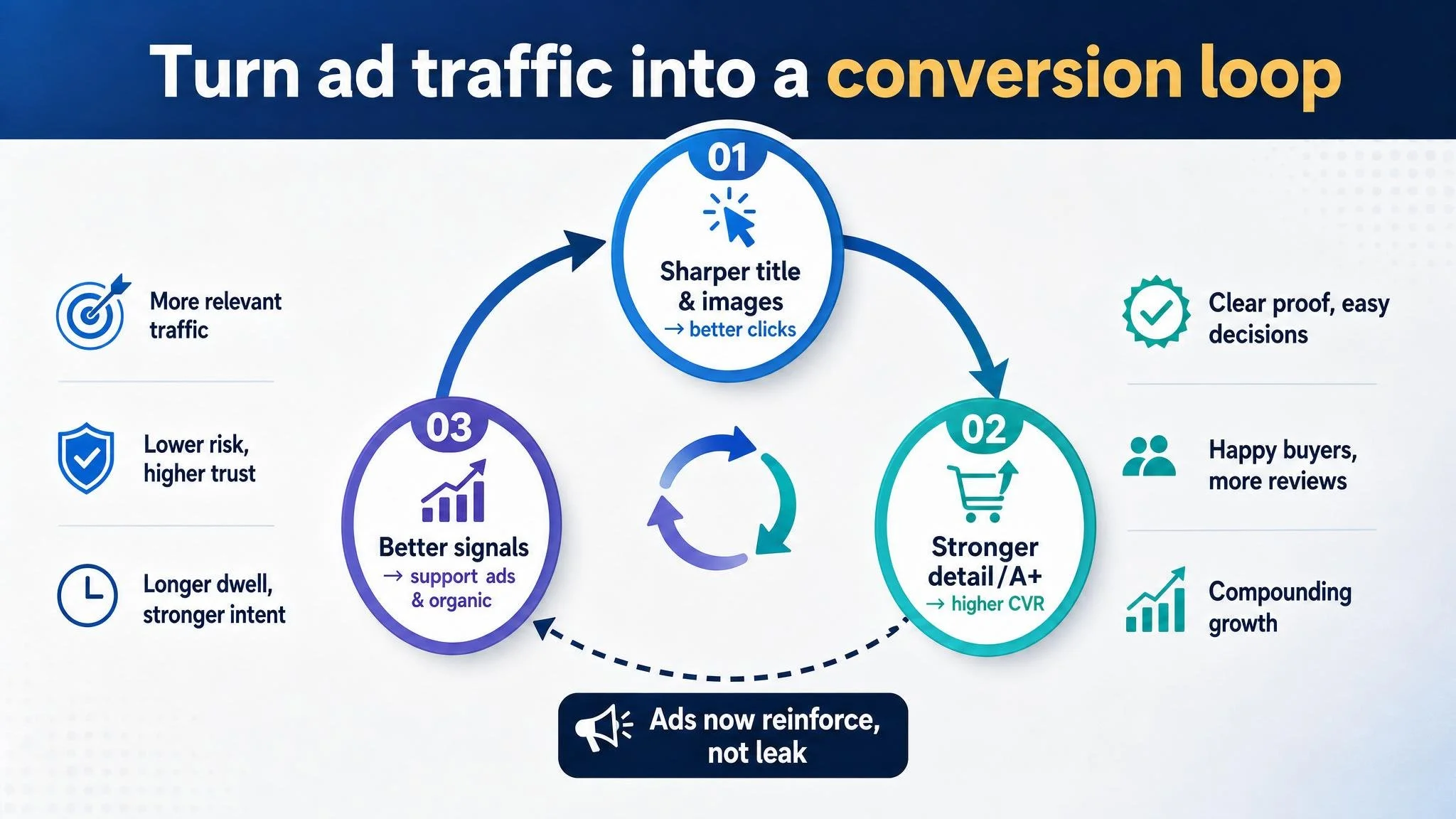
Although we don’t use fabricated numbers, we can describe the expected operating change once the Listing’s structure catches up with the category standard.
After upgrading:
- Click quality increased:
- A sharper title and main-image set pull in visitors who clearly recognize:
- The product matches their engine,
- It promises a specific performance or protection outcome.
- On-page conversion logic improved:
- Buyers quickly find:
- How the filter protects the engine,
- Why the media and construction are credible,
- How to install it,
- That other buyers like them have used it successfully.
- Ads started compounding instead of leaking:
- Existing campaigns suddenly find that each click has a higher chance of turning into a sale,
- CVR on both organic and paid traffic can recover toward, and sometimes above, category norms.
At this point, revisiting Amazon ads—keywords, bids, structures—actually makes sense. The page has become capable of turning incremental traffic into incremental orders.
How the Seller’s Understanding Changed
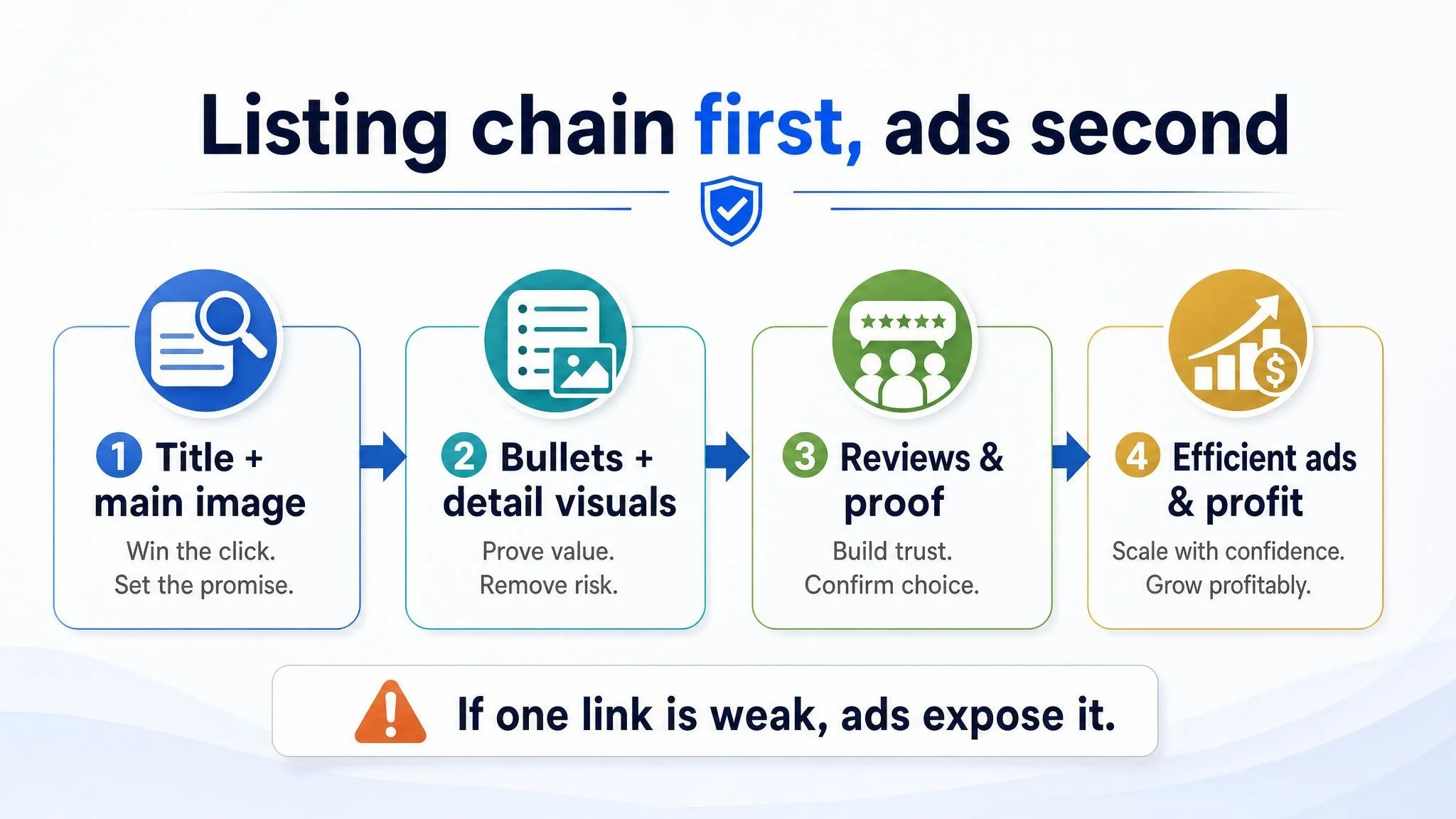
By the end of this diagnosis, the seller’s internal narrative shifted:
- From:
“Our bullets are solid, reviews are okay, so the problem must be ads.”
- To:
“Our bullets are the only strong part; the page as a whole is underbuilt compared with the category’s benchmark. Ads are just exposing that weakness.”
What they learned—and what many Amazon sellers can borrow—is this:
1. Listing quality is the foundation of advertising efficiency.
If the A+ / detail area is weak, ads cannot rescue conversion.
1. Title, main image, bullets, and detail visuals must work as a chain.
- Title and main image win the click and set the promise.
- Bullets and detail visualization prove that promise and remove risk.
- Reviews close the loop by confirming real-world performance.
1. Before scaling ads, ask: “Does my page deserve more traffic?”
If a benchmark listing in your category scores far higher on detail/A+ and visual storytelling, and you’re relying on text-heavy sections only, your Amazon ads are likely subsidizing a conversion gap, not building a profitable flywheel.
In this engine air filter case, DeepBI’s value was not in generating “more creatives” or “more copy”—it was in reframing the problem. The seller stopped over-focusing on Amazon ad knobs and started treating product-page conversion as the true bottleneck. Once that judgment changed, every subsequent optimization step became more commercially sound.