

This case comes from an Amazon seller in the hatchback car-cover category. On the surface, their Listing looked solid: decent visuals, a complete set of images, and a higher review rating than a main competitor. Yet advertising kept feeling “heavy” to run—traffic arrived, but the Amazon product page could not consistently turn that traffic into orders.
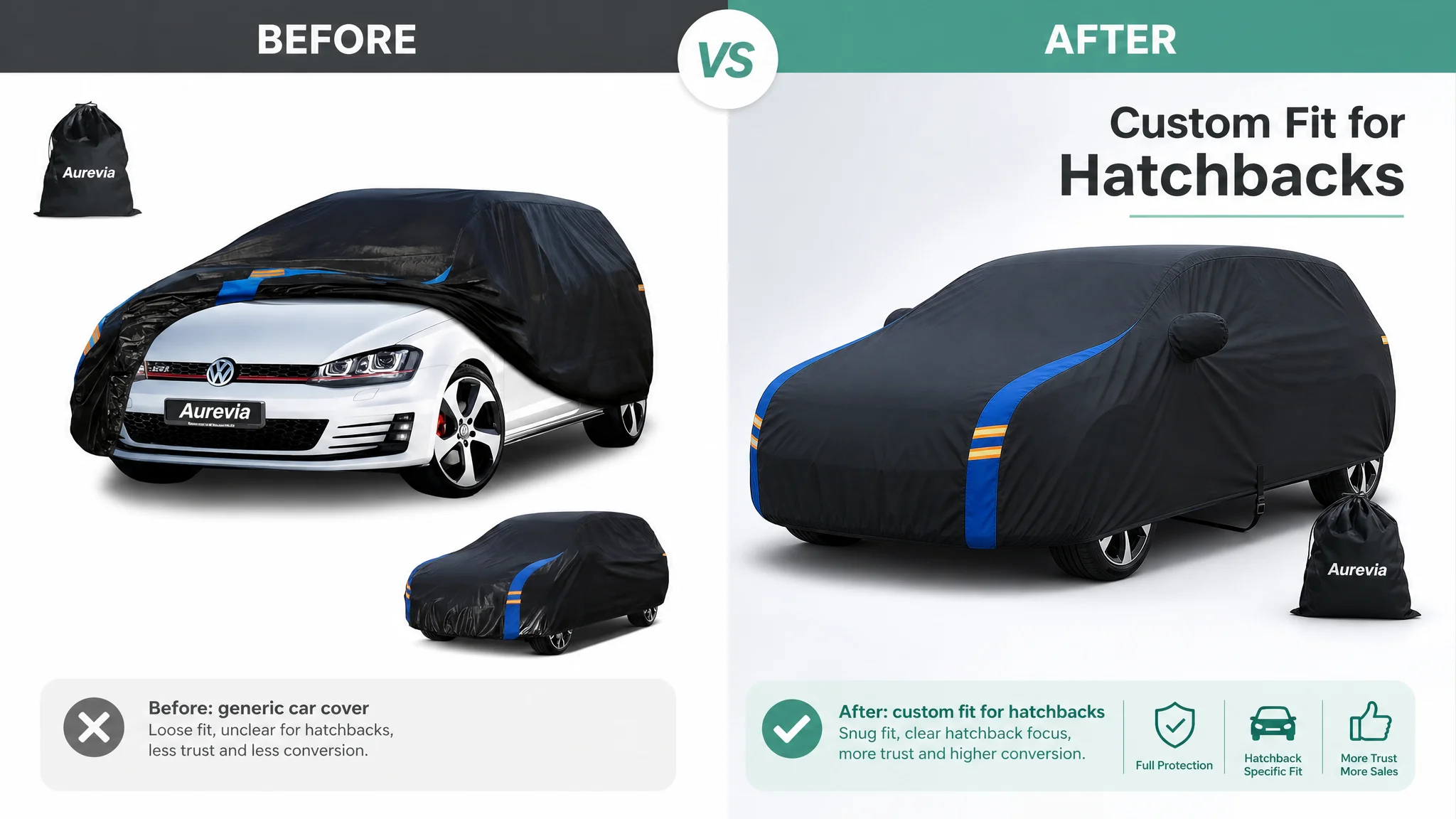
The team’s first instinct was to blame ads and bidding. They tried to refine keywords and adjust budgets, convinced the problem sat in campaign structure and rising CPC. DeepBI’s diagnosis told a different story: the Amazon Listing itself lagged behind a category-leading competitor in one crucial area—conversion logic across the title, main image set, and A+ details.
By scoring the Listing against a benchmark, DeepBI found that title specificity, detail-page trust signals, and review volume were collectively dragging the page’s conversion capacity, even though the star rating was higher. The subsequent optimization did not start with “more ads,” but with rebuilding the product page’s decision path: clarifying hatchback fit in the title, tightening bullet-point logic around sizing, weather protection, and safety details, and using images and A+ content to visualize fit, materials, installation, and scenarios.
For other Amazon sellers, this case is a reminder that a “nice-looking” Listing can still be structurally weaker than a competitor. When ACOS feels stubborn and ads look inefficient, the real constraint may be that the product page cannot convincingly answer fit, protection, and trust questions. Fixing that foundation is often what makes every later advertising dollar truly work.
Amazon Ads Were Not Failing. The Page Was Consuming the Traffic.
The seller operates in the US Amazon marketplace with a hatchback car cover positioned as an all-weather solution.
They were seeing a familiar pattern:
- Ads brought steady traffic.
- CPC was not catastrophic but felt increasingly hard to justify.
- Orders didn’t grow in proportion to impressions and clicks.
Internally, the diagnosis was clear: “ad efficiency problem.” The team kept asking:
- Should we refine keywords further?
- Are bids too high?
- Do we need more long-tail search terms?
What they did not question enough was whether the Amazon Listing itself had the same decision power as their main competitor’s page.
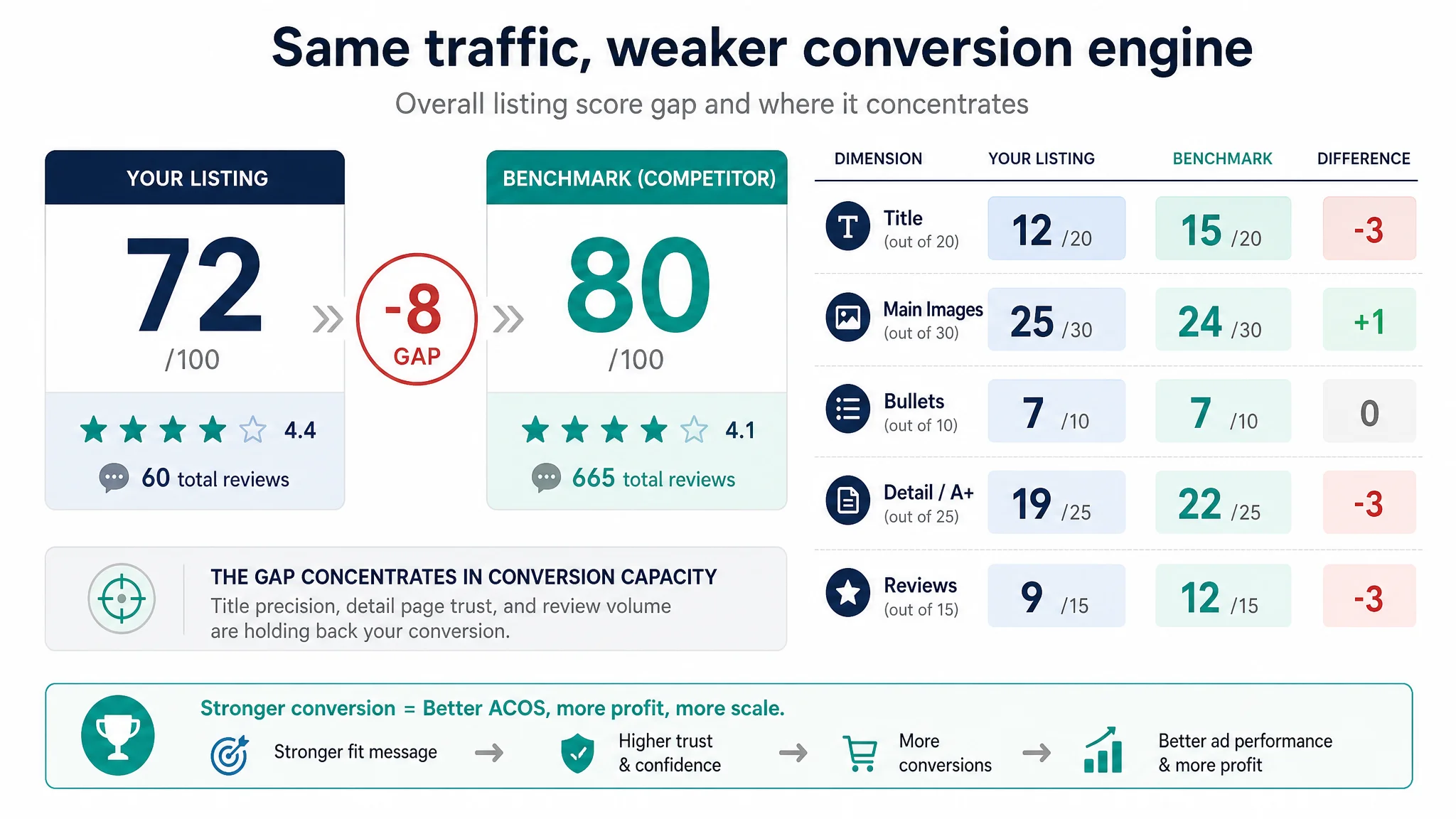
DeepBI’s Listing scoring showed the core conflict very directly:
- Their Listing total score: 72/100
- Benchmark competitor Listing: 80/100
- Gap: -8 points
More importantly, the gap wasn’t random—it concentrated in the parts of the page that directly govern trust and conversion.
“The real problem was not that ads failed to bring traffic. It was that the page could not convert the traffic.”
The Real Constraint Was Listing Conversion Capacity
DeepBI’s analysis broke the Listing into five conversion-critical dimensions:
- Title
- Main image set
- Bullet points
- Detail / A+ content
- Reviews
Here’s how the seller compared to the benchmark:
- Title: 12 vs 15 (out of 20) → -3
- Main images: 25 vs 24 (out of 30) → +1
- Bullet points: 7 vs 7 (out of 10) → 0
- Detail / A+: 19 vs 22 (out of 25) → -3
- Reviews: 9 vs 12 (out of 15) → -3
At first glance, the seller’s team saw a familiar comfort blanket:
- Star rating: 4.4 vs competitor’s 4.1
- But review count: 60 vs competitor’s 665
They leaned on the higher rating as evidence that “customers love the product,” and therefore concluded the issue must be on the ads side.
DeepBI treated the data differently:
- A higher rating with one-tenth the reviews does not yet create the same trust as a heavily validated competitor.
- A weaker title and underpowered detail/A+ modules mean even good traffic is not fully monetized.
In other words, the constraint wasn’t ad exposure. It was the Listing’s ability to:
- Match the right hatchback search intent.
- Build professional trust in the first three seconds.
- Answer “Will this really fit my car?” and “Will it survive my weather?” without friction.
Why Traditional Ad Optimization Kept Failing
The seller’s default playbook was performance marketing–driven:
- Increase coverage on “car cover” and related keywords.
- Adjust bids dynamically.
- Try long-tail terms around weather and fit.
This approach assumes one thing: the product page can convert incremental traffic at a stable rate.
But DeepBI’s scoring linked the Listing score gaps directly to expected behavior:
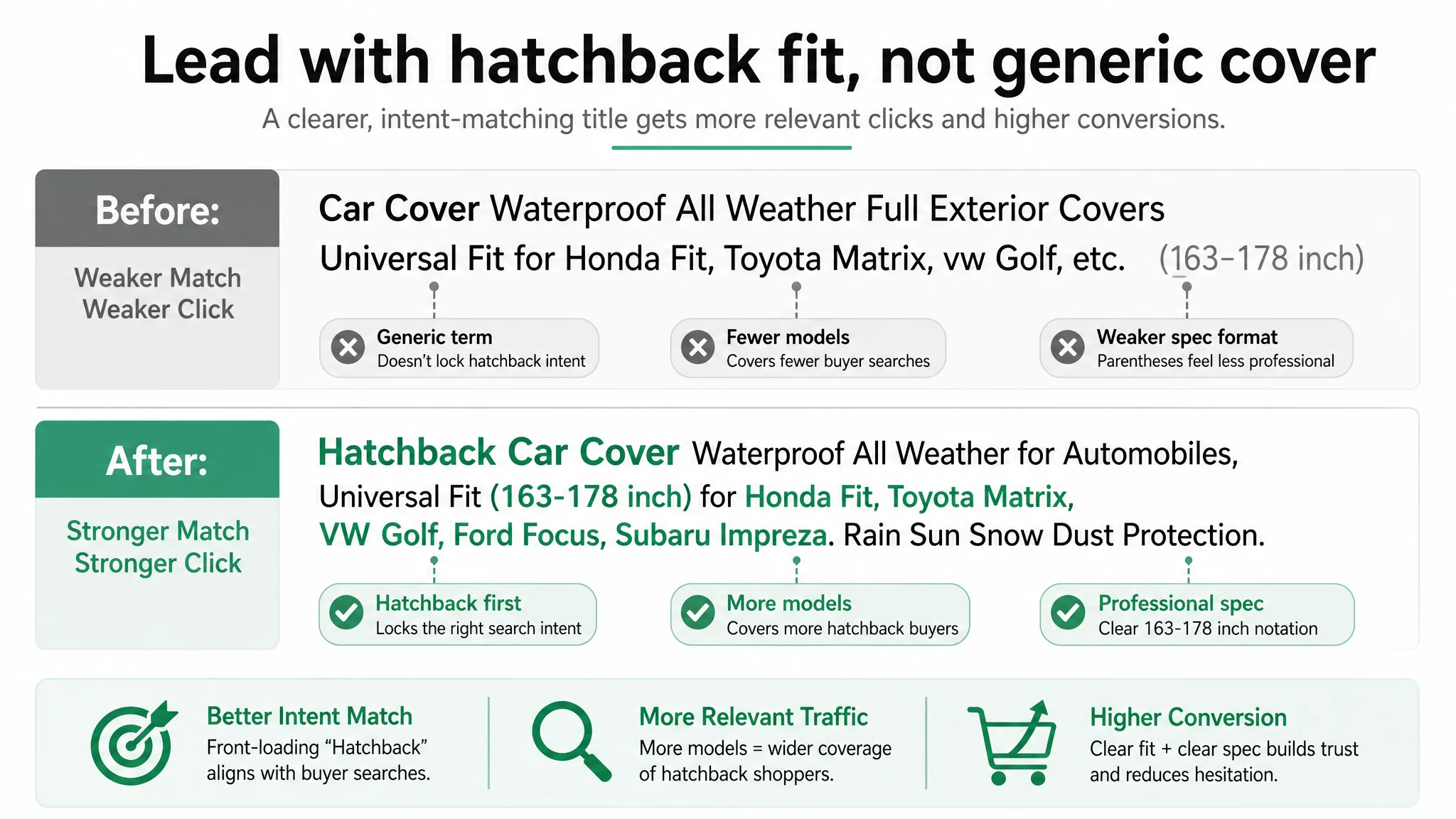
- Title precision gap (-3): Less precise targeting of hatchback models and fit, especially when compared to the competitor’s “Hatchback Car Cover” front-loaded title.
- Detail/A+ trust gap (-3): Fewer, less-structured proof images around materials, seams, reflective strips, and multi-scene use.
- Review volume gap (-3): Lower volume = lower perceived reliability, especially in a category where buyers care about long-term durability and fit accuracy.
This meant every incremental ad click was effectively being pushed through:
- A slightly less trustworthy page.
- A less precise fit message.
- A thinner evidence chain.
Under that structure, ads amplify the Listing’s conversion weaknesses instead of its strengths.
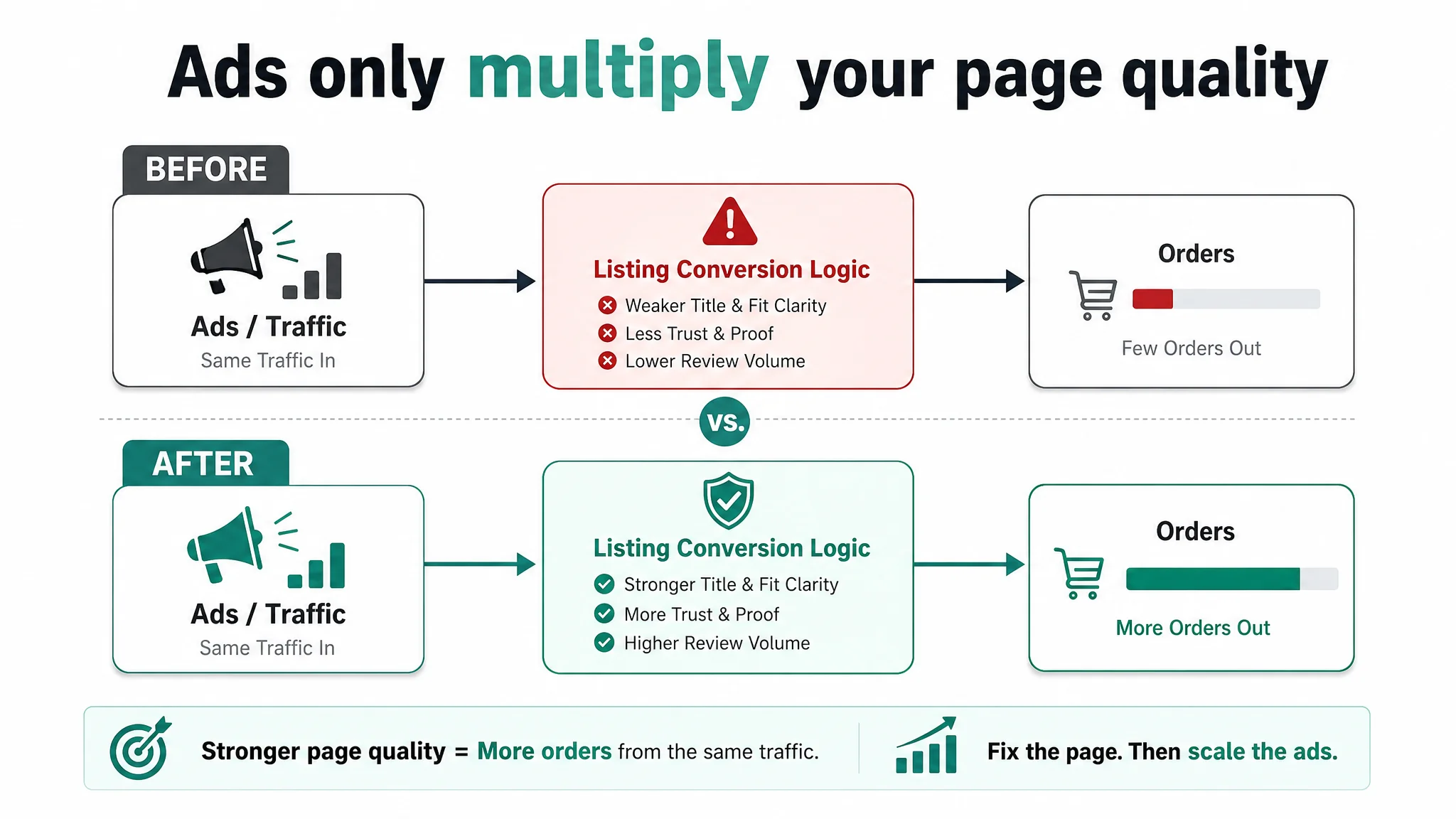
“Advertising does not only amplify advantages. It can also amplify a page’s existing defects.”
That is why bid tuning and keyword expansion never delivered the ACOS relief the seller expected. They were trying to solve a product-page problem with media tactics.
This Product Page Did Not Lack Traffic. It Lacked Trust.
The title did not fully lock the right search intent
The benchmark competitor did one thing very clearly:
- Put “Hatchback Car Cover” at the front.
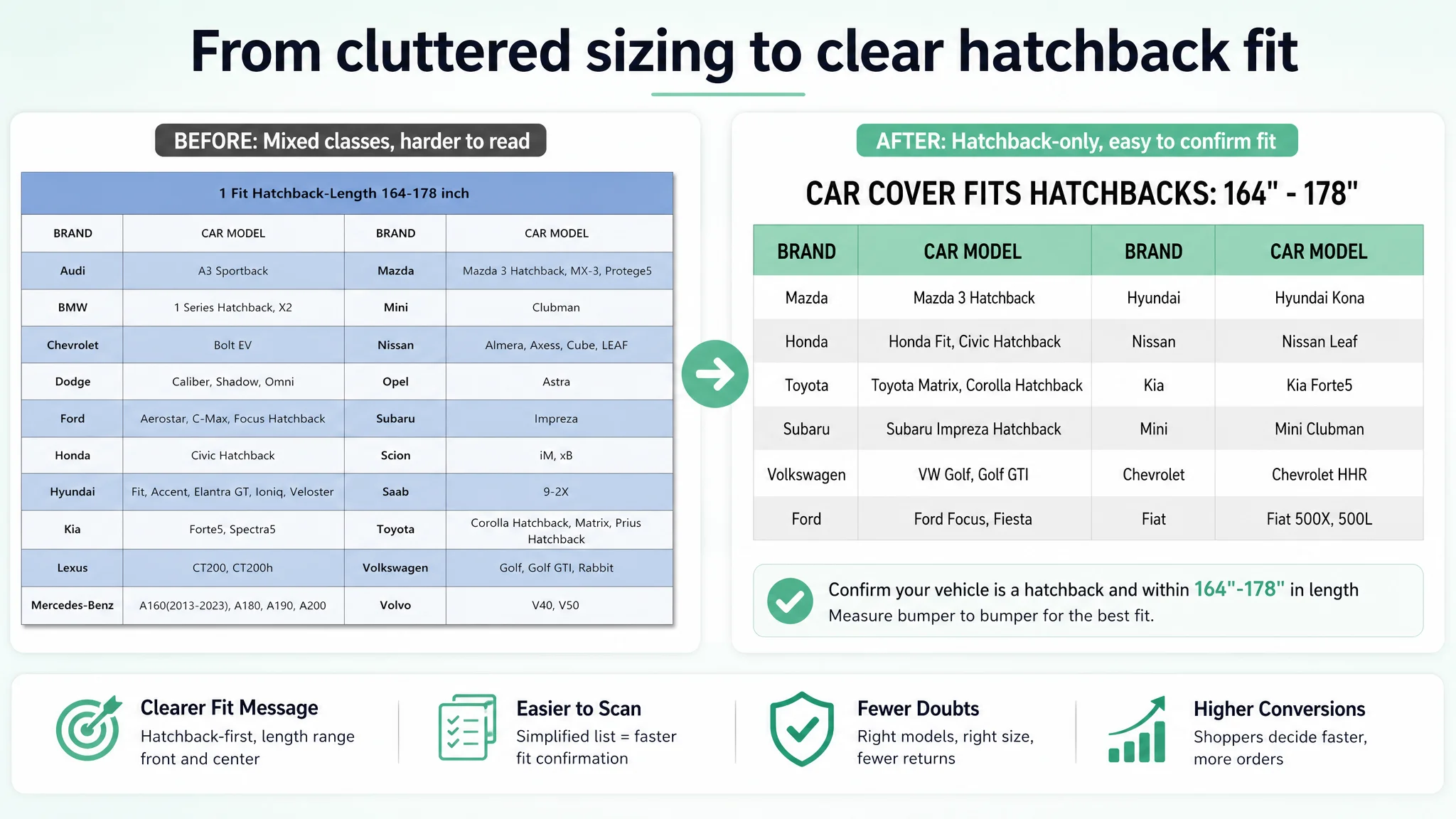
- Clearly list key models: Honda Fit, Ford Focus, Subaru Impreza, Toyota Matrix, VW Golf.
- Standardize dimensions: “Length: 164"-178"” in a professional, spec-like notation.
The seller’s title:
- Led with a more generic “Car Cover”.
- Mentioned the length “(163–178 inch)” in parentheses, which reads less like an engineered spec and more like an aside.
- Covered fewer specific models, limiting immediate recognition for certain shoppers.
So in search results, where buyers scan quickly, the competitor’s title looked:
- More targeted to hatchbacks.
- More precise technically.
- More complete in model coverage.
DeepBI’s recommendation reframed the title as a fit-first, hatchback-first, spec-standardized message:
Hatchback Car Cover Waterproof All Weather for Automobiles, Universal Fit (163-178 inch) for Honda Fit, Toyota Matrix, VW Golf, Ford Focus. Rain Sun Snow Dust Protection.
This adjustment is not about wordsmithing. It’s about:
- Increasing match quality with hatchback intent.
- Signaling professional sizing (not just marketing adjectives).
- Widening recognizable model coverage to win more clicks and relevant traffic.
The main image set lacked a clear decision narrative
On the main image dimension, the seller was not “bad”—they even slightly outscored the competitor numerically. But DeepBI’s visual analysis found structural issues that affect click and conversion:
- Scene images were less cohesive and less powerful than the competitor’s strong outdoor visuals.
- Size/adaptation tables were harder to read, forcing users to zoom and scroll.
- Installation was not visually explained; buyers had to rely on a vague “consult” note.
From an Amazon buyer’s perspective, that means:
- Lower CTR: Weak or generic scene images, especially for “outdoor use” queries, reduce click preference by an estimated 5–8%.
- Higher bounce risk: Poorly formatted tables make fit confirmation harder, which pushes some users away.
- Slower trust build: No clear visual interaction (hands, buckles, elastic hems) to show ease of use.
DeepBI’s image recommendations—like 45-degree car views, structured 2x2 feature grids, and clear installation sequences—were not “design upgrades” for their own sake. They were rebuilding the decision path:
1. “This looks like the right hatchback fit.”
2. “I can see the material and waterproofing logic.”
3. “I understand how it straps, reflects, and fits.”
4. “I know how to choose my size.”
Until that path exists, additional traffic only exposes the weaknesses more frequently.
The Bullet Points Had Information, but Not a Buying Logic
On paper, both the seller and the competitor scored equally on bullet points: 7/10. But the ordering and logic differed in ways that affect conversion.
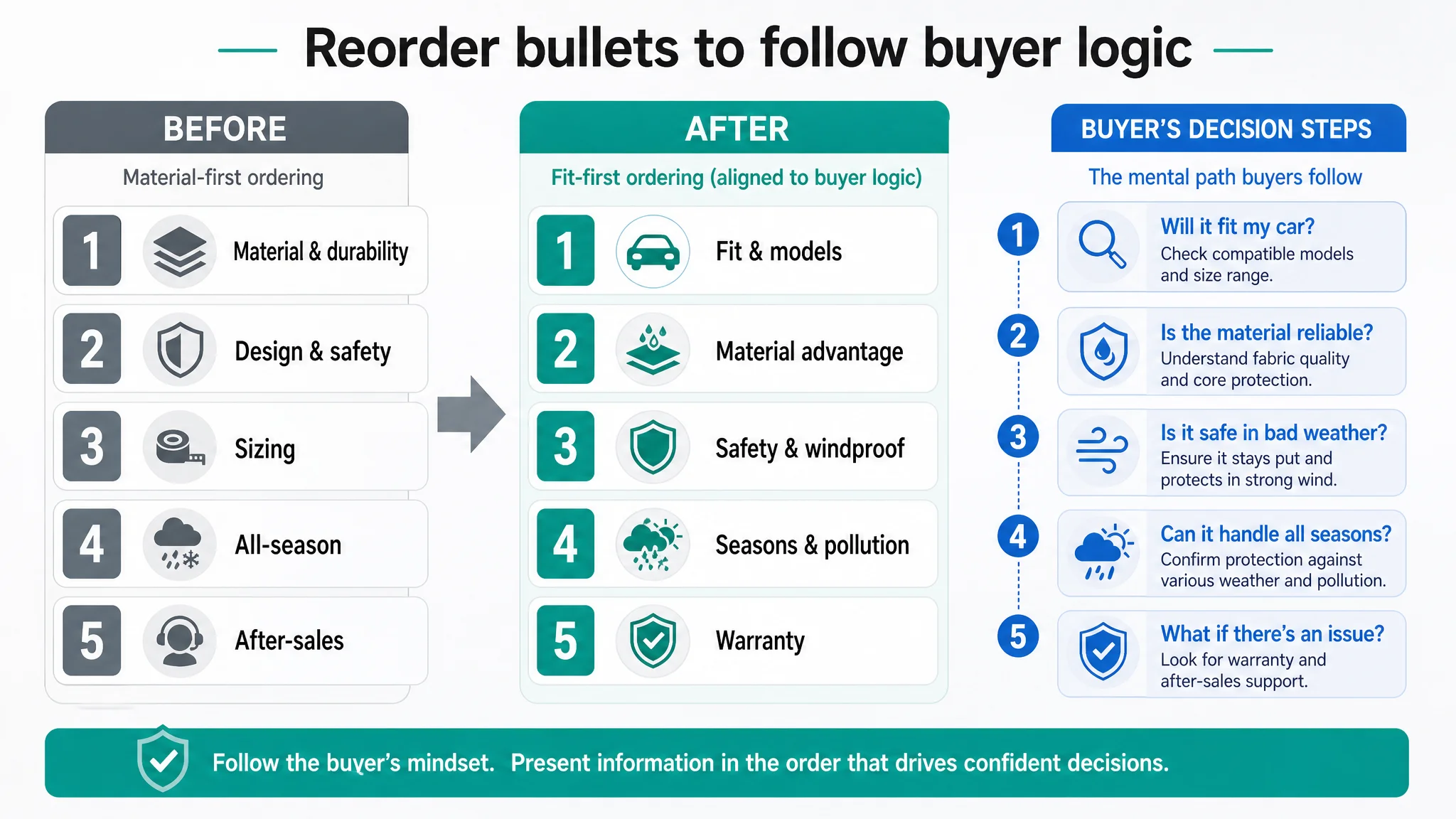
The seller’s sequence:
1. Material & durability
2. Design & safety
3. Sizing
4. All-season protection
5. After-sales & reminders
The competitor’s sequence:
1. Sizing / model fit
2. Material & durability
3. Design & safety
4. All-season protection
5. After-sales guarantee
For car covers, DeepBI’s category logic is simple: fit is the first gate. If the customer is not convinced it fits their hatchback:
- They won’t care about fabric.
- They won’t fully trust any all-weather claims.
- They may never reach the warranty point.
So the competitor’s decision flow:
- Starts with “Choose the right model.”
- Only then talks materials, safety, and seasons.
DeepBI reframed the seller’s bullet points into a fit-first, proof-backed structure, for example:
- BP1: Precision fit (164–178 inch hatchbacks)
Named compatible models and explicitly instructed buyers to confirm length and body type.
- BP2: Material with measurable advantage
Highlighted a 2000mm waterproof rating—superior to the competitor’s 1800mm—turning a hidden advantage into visible proof.
- BP3: Safety & anti-wind details
Reinforced 3 pairs of reinforced straps, reflective strips, and elastic hem.
- BP4: Seasonal and pollution scenarios
Connected weather and pollutants (UV, pollen, industrial pollution, acid rain) into an all-weather story.
- BP5: 12-month warranty
Positioned as practical reassurance, especially around sizing and fit issues.
This didn’t just rewrite copy. It aligned the bullet order with the mental steps buyers naturally take:
1. Does it fit my car?
2. Is the material truly strong and waterproof?
3. Will it stay put and keep me safe?
4. Will it protect in my specific climate and environment?
5. If something goes wrong, do they stand behind it?
Without that order, even strong single bullets underperform.
The A+ Detail Page Was Informative but Not Yet Convincing
DeepBI’s detail/A+ analysis showed:
- The seller’s page wasn’t empty. It had:
- Scene main image.
- Icons for selling points.
- Detail close-ups.
- A size table.
- Four-season visuals.
- The competitor’s page, however, stacked:
- Clear first-screen function tags (WATERPROOF / INSULATION / WINDPROOF / ANTI-UV).
- Multiple high-precision macro shots of seams, reflective strips, elastic hems, and material.
- Distinct indoor + outdoor usage scenes.
- A double-car city background to convey lifestyle and usage context.
Three gaps emerged:
1. First-screen value anchoring:
The competitor makes the protection logic obvious within 3 seconds using bold function tags. The seller required buyers to scroll and interpret.
1. Material transparency and proof:
The competitor visually proves workmanship and material engineering (silver coating, seams, elastic edges). The seller’s four detail images did not fully demonstrate the same “premium material” story, and lacked quantified data in visuals.
1. Scenario completeness:
The competitor explicitly spans garage and city outdoor use. The seller focused largely on weather seasons without fully showing real-life storage, installation, and indoor use.
DeepBI’s A+ recommendations targeted these gaps:
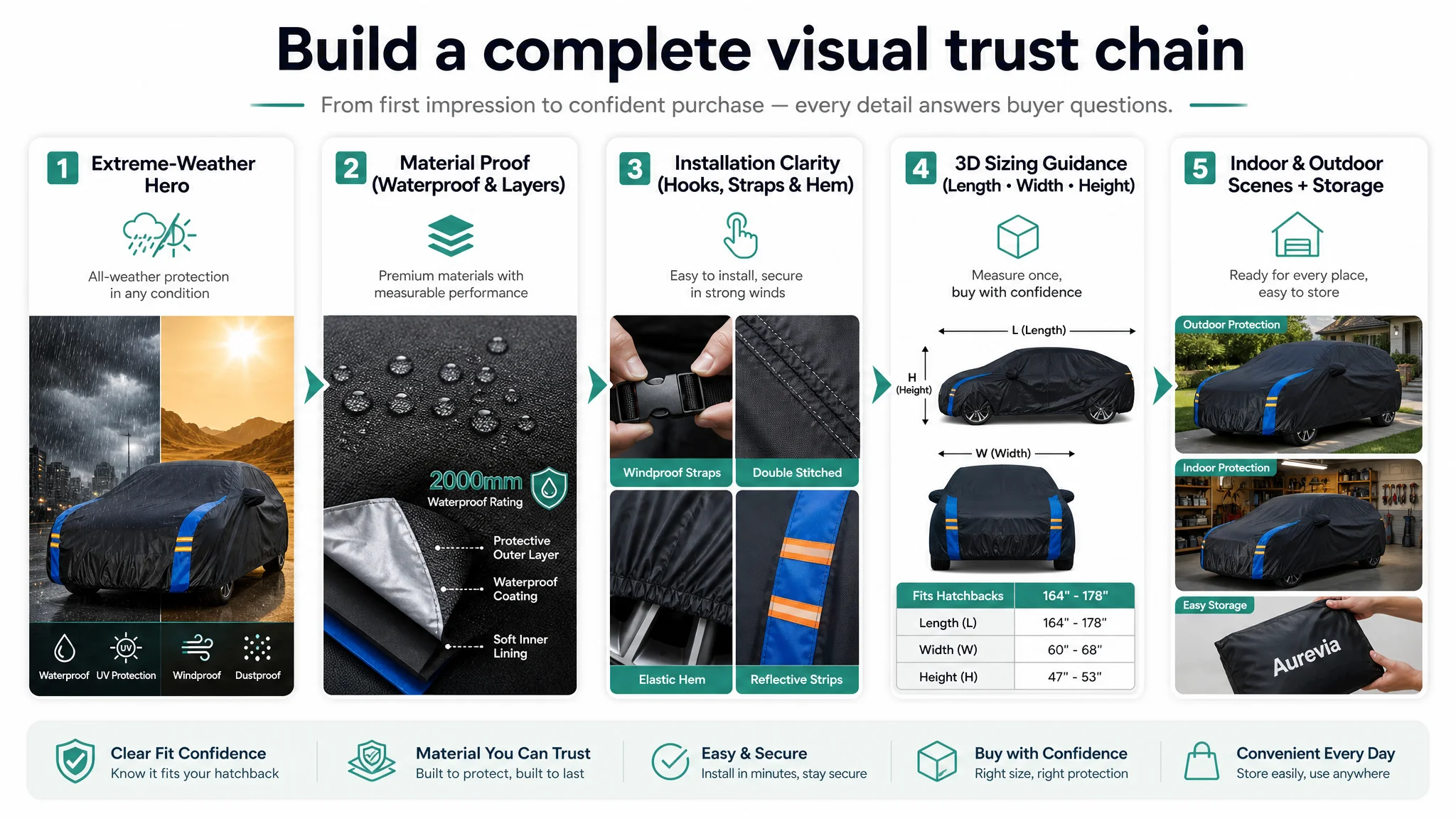
- Extreme-weather contrast visuals: Rain vs blazing sun in a single hero image, with clear icons (waterproof, UV, wind, dust) and a double-car composition to create a “this is built for anything” feeling.
- Layered material close-ups:
Showing outer fabric + inner silver coating + seam detail, with measured waterproof level and UV coating annotated.
- Installation convenience visuals:
Hands fastening buckles, elastic hem gripping wheels, reflective strips at dusk—emphasizing use, not just product.
- 3D sizing logic:
Length, width, and height clearly mapped via diagrams and tables, aligning with the competitor’s more complete sizing guidance.
- Indoor/outdoor dual-scene image:
One car outside in rain, the same car in a clean garage for dust protection.
- Fold and storage module:
Addressing a frequent buyer concern: “Will this be a pain to store?”
These modules are not decorative; they form a trust chain:
- “It’s engineered for real weather.”
- “They understand fit and sizing beyond just length.”
- “They’ve thought about my storage and usage realities.”
Without that chain, buyers may still convert—but at a lower rate, and with higher return risk.
Why DeepBI Did Not Keep Tuning the Ads First
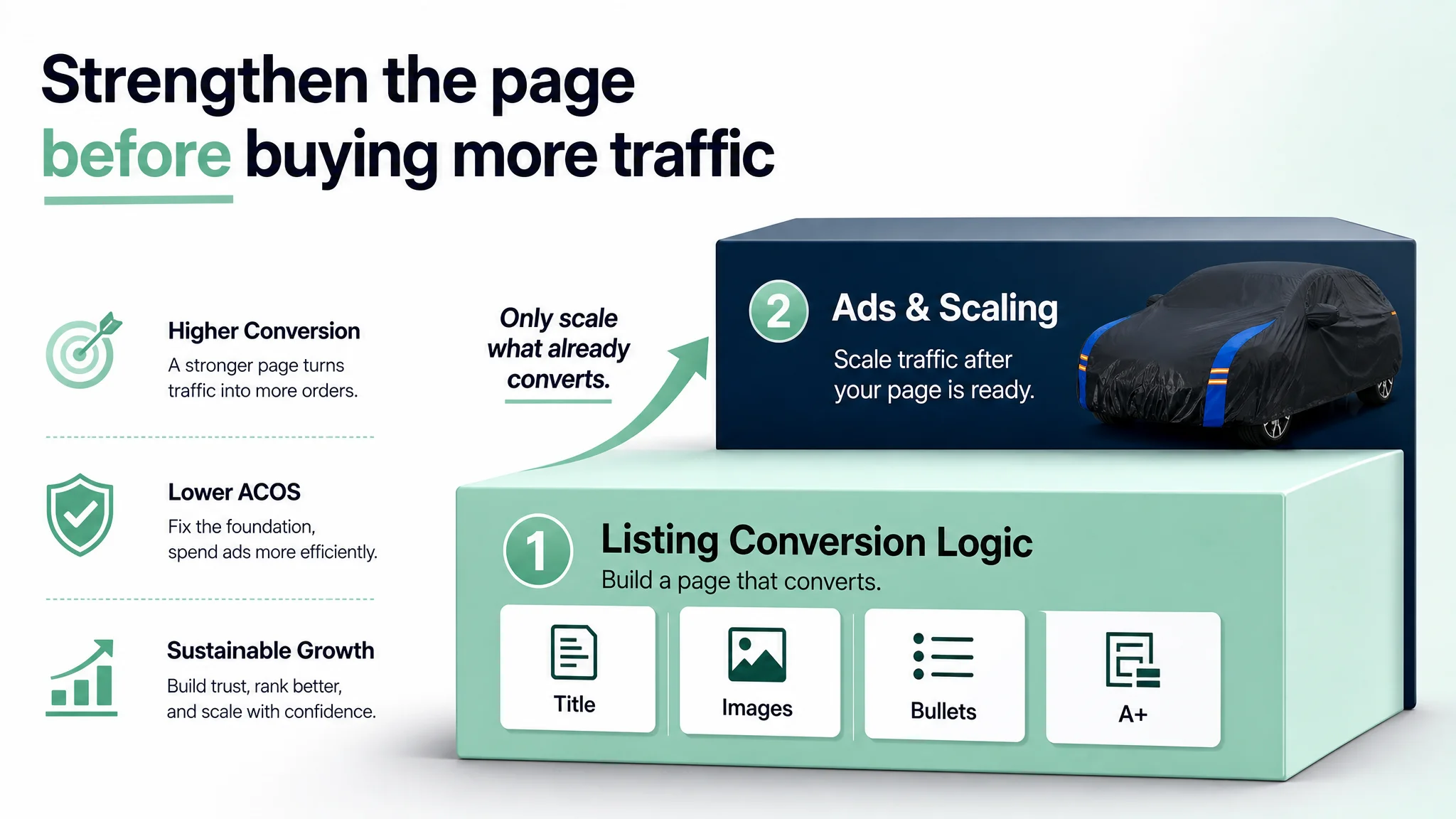
From a business-risk standpoint, DeepBI made a deliberate call: fix Listing conversion before scaling or heavily re-optimizing ads.
The logic was:
- Current Listing score: 72 vs 80
- Gap clustered in title, details, and review volume.
- Main image set: good but structurally improvable.
If the seller kept:
- Pushing more ad traffic.
- Expanding keyword coverage.
- Raising bids.
Then they would:
- Pay more to send traffic to a page that still under-leverages traffic.
- Possibly train Amazon’s algorithm on a mixed signal: decent clicks, weaker-than-necessary conversion.
Instead, DeepBI prioritized:
1. Title restructuring for hatchback specificity and professional spec presentation.
2. Bullet-point reordering to put fit and measurable advantages first.
3. Main image restructuring for clearer fit, material, and installation narratives.
4. Detail/A+ rebuilding to elevate trust, material transparency, installation clarity, and scenario coverage.
The reasoning:
- Ads are a multiplier. If the base conversion logic is weak, the multiplier amplifies waste.
- Listing conversion is the foundation. Without it, any ACOS reduction is fragile and heavily dependent on discounts or low CPC pockets.
How the Page’s Sales Logic Started to Recover
Once the new Listing logic is applied, the expected changes in operating state are:
- Higher CTR on relevant hatchback queries
Thanks to:
- “Hatchback Car Cover” front-loaded.
- Broader model list (Honda Fit, Toyota Matrix, VW Golf, Ford Focus).
- Clear spec notation (163-178 inch).
- Stronger CVR from both organic and ad traffic
Because:
- Buyers can quickly confirm fit (title + BP1 + size diagram).
- They see quantified material strength (2000mm waterproof rating).
- They understand how straps, reflective strips, and elastic hems work.
- They see clear, realistic scenarios (rain, sun, garage).
- Reduced dependence on heavy ad push
As the Listing starts converting better:
- Organic ranking has a stronger chance to recover.
- Ads no longer need to overcompensate for page-level weaknesses.
- More stable traffic structure
With improved conversion:
- Ad traffic becomes more profitable.
- Organic traffic is better monetized.
- The seller can choose when to scale ads, rather than being forced to “buy” every sale.
How the Seller’s Understanding Changed
Before working with DeepBI, the seller’s mental model looked like this:
- ACOS frustrating →
- Ads must be inefficient →
- Solution = adjust bids, change keywords, refine campaigns.
After seeing the Listing score and competitor comparison, their model shifted:
- ACOS frustrating + Listing score weaker than competitor →
- Ads are supplying traffic to a less convincing page →
- Solution = improve Listing conversion logic first, then re-evaluate ads.
Key internal realizations included:
- “More reviews” is not the only lever.
With only 60 reviews vs 665, they cannot rely solely on volume; they must maximize the persuasive power of every visual and line of text.
- Listing quality sets the ceiling for ad performance.
Even the best ad structure cannot permanently compensate for a page that fails to articulate fit, material proof, and usage clearly.
- Title, main image, bullets, and A+ must work as a system.
A good single image or a strong single bullet cannot fix a misaligned overall decision path.
- Before scaling ads, the team must judge whether the page deserves more traffic.
That question is now part of their standard playbook.
What Other Amazon Sellers Can Take from This Case
This hatchback car cover case is not unique to its category. The pattern repeats across many Amazon verticals:
- Sellers see ACOS pressure and assume “ad problem.”
- They keep tweaking campaigns while the Listing quietly drags conversion down.
- Competitors who align title, images, bullets, and A+ around a clear decision path quietly capture more orders from the same traffic pool.
Three practical takeaways:
1. Treat Listing scoring as the first step before large-scale ad changes.
If your Listing is structurally weaker than a benchmark, media optimizations will have a hard ceiling.
1. Judge Listing conversion by logic, not just aesthetics.
Ask:
- Does the title lock the correct intent?
- Does the main image create a reason to click and a reason to stay?
- Do bullets follow the buyer’s mental steps?
- Does A+ visually prove what the copy claims?
1. Use ads to scale, not to compensate for a weak page.
When the product page can convert both organic and paid traffic, every ad dollar has a better chance to return as profit rather than as a band-aid.
DeepBI’s role in this case was not to “decorate” a Listing. It was to expose where the Amazon product page could not yet shoulder the traffic the seller was buying—and to realign the page so that ads could once again become a growth tool, not a permanent cost burden.