

Many Amazon sellers in hardware and replacement parts will recognize this: ad spend goes out, impressions come in, but orders climb much more slowly than expected. This gas grill burner seller on Amazon US was in exactly that position. They believed the issue sat inside Amazon ads—keyword choices, bids, or campaign structure—so they kept tuning campaigns while the core product page stayed nearly unchanged.
Once DeepBI ran a full Listing diagnosis against a strong benchmark in the same grill-burner subcategory, a different picture emerged. The ads were not the real bottleneck. The Amazon Listing itself—title, images, bullets, A+ content, and reviews—was underpowered versus a direct competitor: overall Listing score 67 vs. 82, with deficits across bullets, detail page, and review trust. Paid traffic was being pushed into a page that could not fully convert.
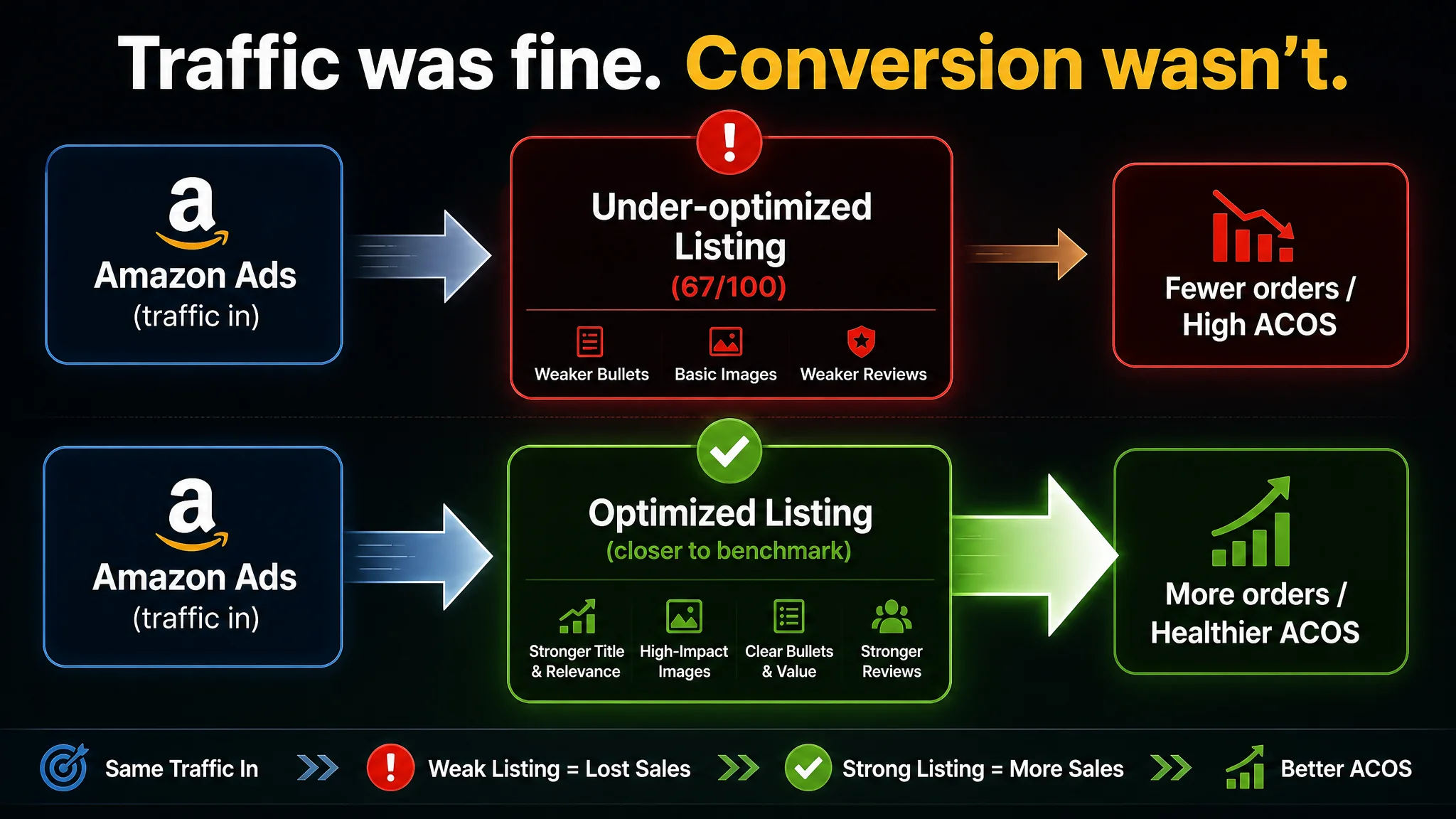
The later optimization did not start with “more traffic” or “cheaper clicks.” It focused on rebuilding the Listing’s decision logic: clarifying compatibility in title and bullets, visually proving 304 stainless steel and “heavy duty” in image stacks, restructuring A+ modules around “why choose us” and compatibility, and addressing the trust gap in reviews. For Amazon sellers, this case is a reminder: when ACOS feels stuck, the real lever is often Listing conversion capacity, not one more round of bid changes.
Amazon Ads Were Not Failing. The Page Was Consuming the Traffic.
The seller is in the Amazon US marketplace, selling a 304 stainless steel gas grill burner replacement part. From an ad perspective, they were “doing the right things”: targeting relevant grill-related keywords, aligning budgets with seasonality, and watching ACOS. Yet orders lagged behind traffic and every attempt to push harder on ads felt less efficient.
Internally, the diagnosis was straightforward:
- “The bids may not be aggressive enough.”
- “We might be missing some high-intent keywords.”
- “We need to squeeze ACOS by tighter campaign structure.”
So the team stayed inside the Amazon ads console—tweaking bids, adding terms, and trying to grind ACOS down—without questioning whether the Amazon product page itself deserved more traffic.
“The real problem was not that ads failed to bring traffic. It was that the page could not convert the traffic.”
When DeepBI stepped in, the first step was not more ad tuning. It was to ask: if we put 100 clicks on this Listing versus 100 clicks on the best-performing competing Listing in the same subcategory, which page has the better chance of turning visits into paid orders?
The Real Constraint Was Listing Conversion Capacity
DeepBI benchmarked the target Listing against a category-leading competitor on Amazon US:
- Target Listing overall score: 67 / 100
- Benchmark Listing overall score: 82 / 100
- Gap: -15 points
Broken down by dimension:
- Title: Target: 12, Benchmark: 13, Full Score: 20, Gap: -1
- Main Images: Target: 24, Benchmark: 26, Full Score: 30, Gap: -2
- Bullet Points: Target: 5, Benchmark: 8, Full Score: 10, Gap: -3
- Detail / A+: Target: 19, Benchmark: 23, Full Score: 25, Gap: -4
- Reviews: Target: 7, Benchmark: 12, Full Score: 15, Gap: -5
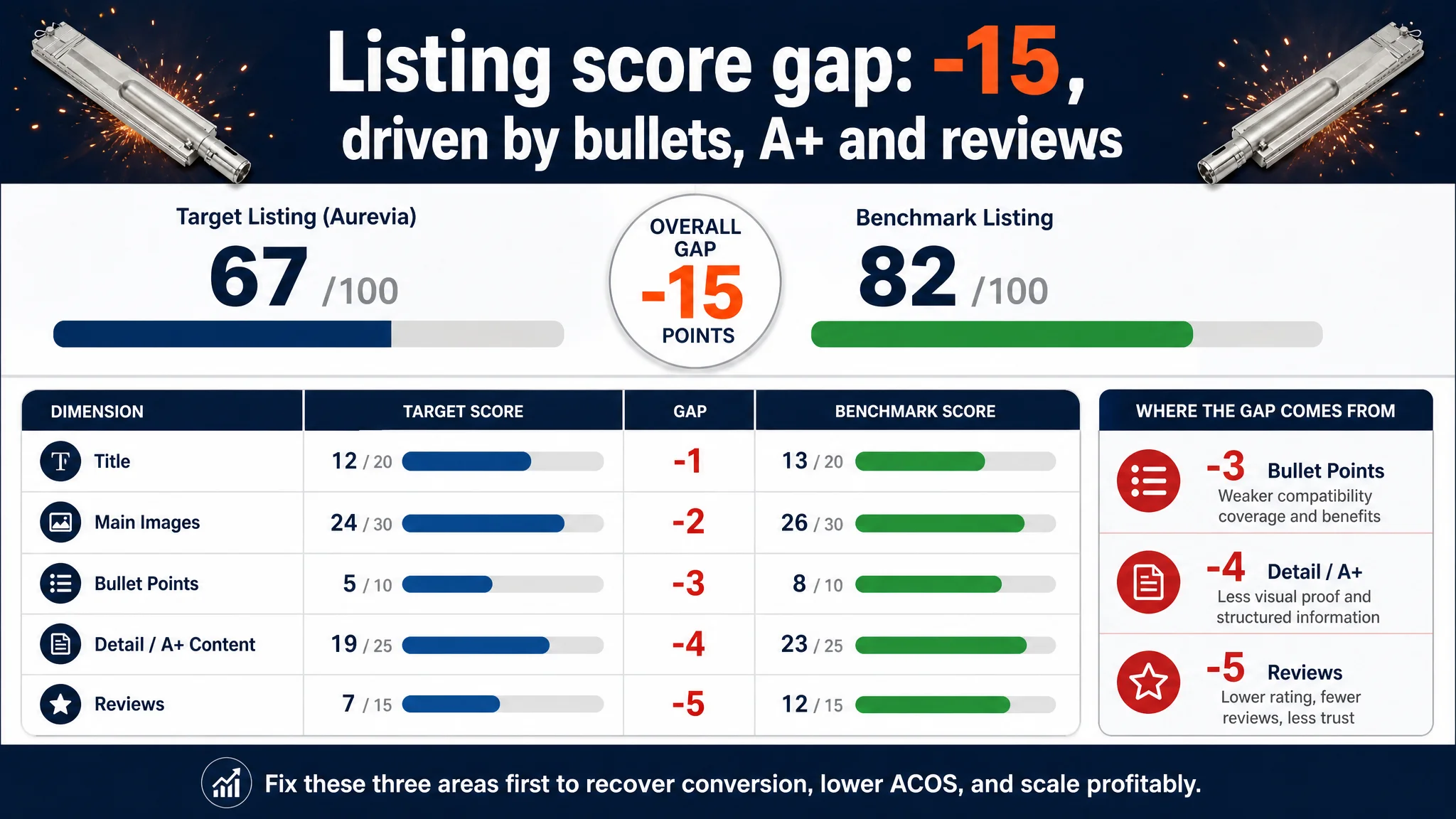
The numbers matter less than the pattern:
- Title and main images were close but still weaker.
- Bullets, A+ detail, and reviews were meaningfully behind.
- In a replacement-part category where buyers are risk-averse (fitment, safety, durability), that trust and clarity gap has a direct cost: lower CVR, higher ACOS.
From a business standpoint, this means: every extra dollar spent on Amazon ads was feeding a page with:
- Less precise compatibility and use-case coverage.
- Less visual proof of “304 heavy duty stainless steel.”
- Less structured, easy-to-scan compatibility and sizing information.
- Fewer, weaker reviews versus a competitor that had crossed the 4.5-star trust threshold.
DeepBI’s judgment: this seller did not have an ad-traffic problem yet. They had a page-conversion problem.
Why “More Ad Optimization” Kept Failing
Before the diagnosis, the team’s logic was:
- ACOS is not where we want it →
- ACOS is an ad metric →
- Therefore the problem is inside ads.
In practice, that led to:
- Adding more keywords to “capture more search volume.”
- Testing different match types.
- Adjusting bids to chase placement.
But the Listing was not constructed to fully absorb that traffic:
- CTR side:
Thumbnails and titles in the search results did not clearly dominate on “heavy duty 304 stainless” or rich compatibility coverage. So even at similar ad positions, the click share could lag.
- CVR side:
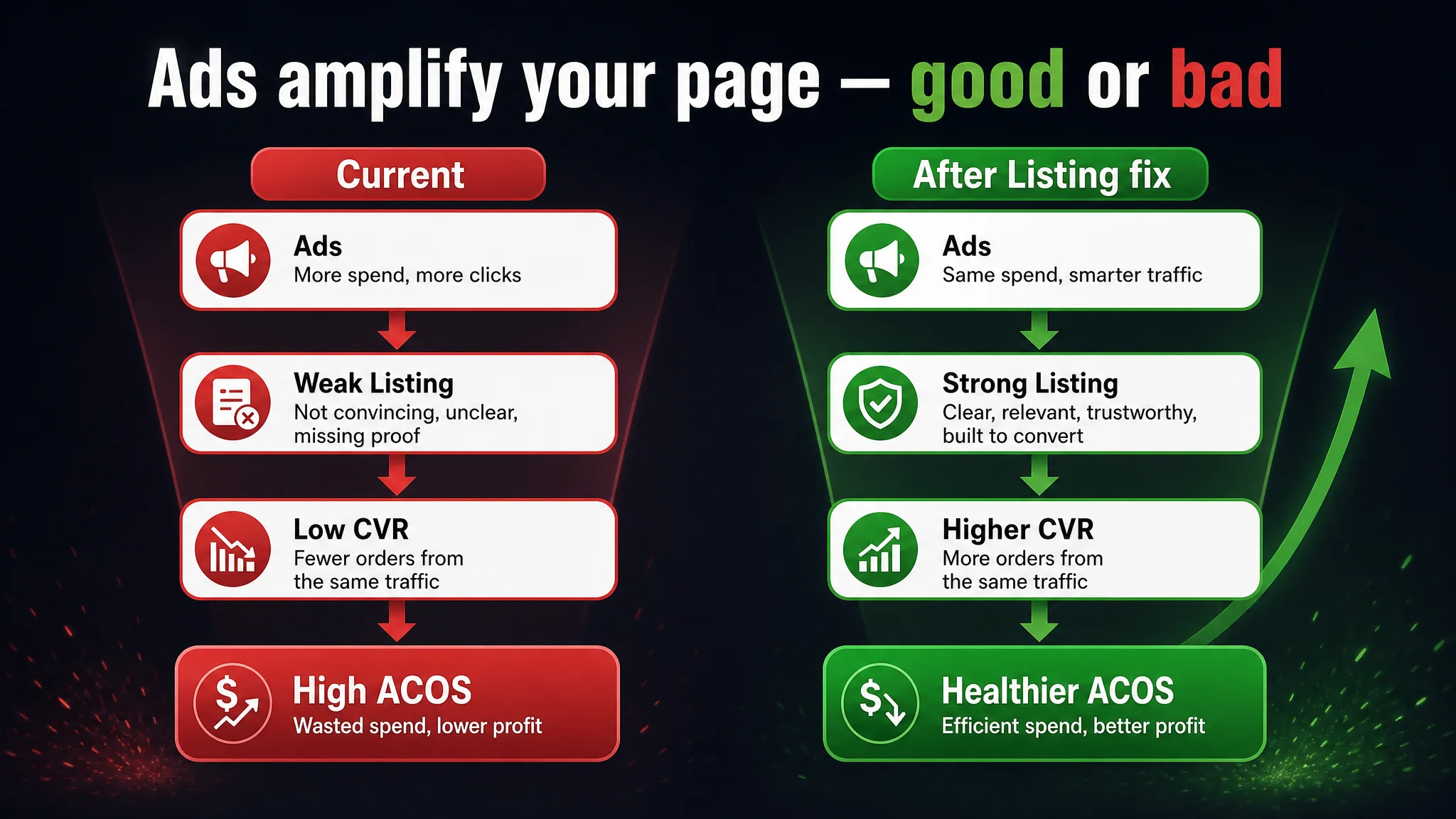
Once buyers clicked into the detail page, they did not get the same level of reassurance as on the benchmark Listing. That is where ACOS silently deteriorates: the ad did its job; the page did not finish the job.
From DeepBI’s perspective, continuing to tweak Amazon ads first would only amplify the weaknesses of the current Listing:
“Advertising does not only amplify advantages. It can also amplify a page’s existing defects.”
The safer sequence was to rebuild the Listing’s conversion logic first, then scale ads into a stronger page.
Title: Compatibility and “Heavy Duty” Were Not Fully Cashed In
The title comparison looked subtle at first glance, but the gaps were commercially important.
- The benchmark title front-loaded the material:
“304 Heavy Duty Cast Stainless Steel BBQ Premium Gas Grill Burner Replacement Part…” This speaks directly to buyers who care about corrosion resistance and long-term durability.
- The target title only said “Stainless Steel Burner”, which is generic and does not fully leverage “304” or “heavy duty” as high-value terms.
- The target title did have a strength: it included a concrete size (“16-1/8””), which is helpful in this category. The benchmark did not capitalize as strongly on specific dimensions.
- However, the benchmark title listed more compatible brands, broadening both search reach and perceived applicability. The target title underlisted compatibility brands.
- Both titles followed the “attribute/selling point + product + compatibility” formula, but neither front-loaded the core functional phrase “Grill Burner Replacement Part.”
DeepBI’s conclusion:
- The title was not broken, but it was not optimized around how Amazon buyers search and decide in this subcategory.
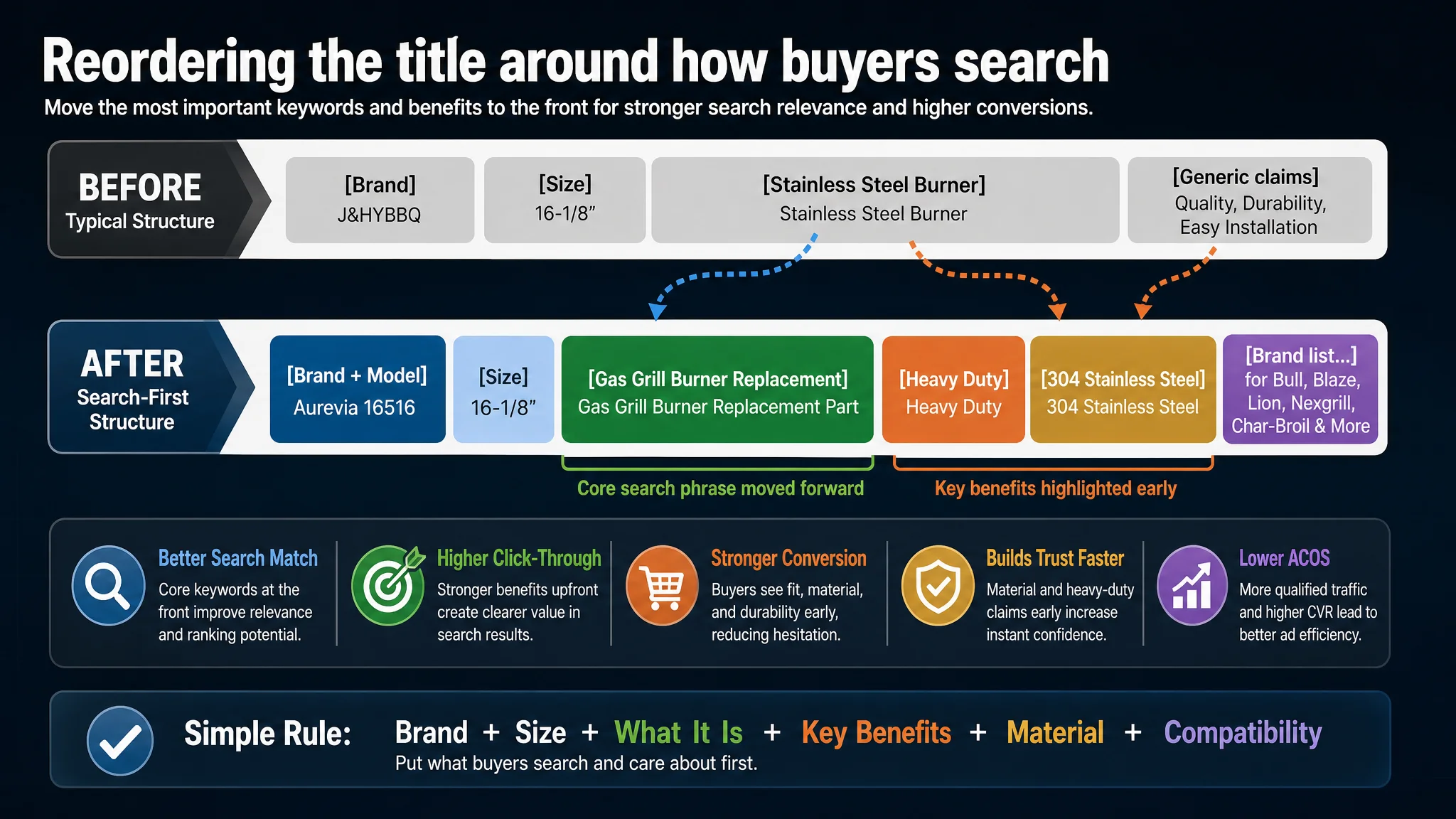
The suggested direction:
“J&HYBBQ 16516 16-1/8” Heavy Duty Gas Grill Burner Replacement Part, 304 Stainless Steel for Bull, Cal Flame, Charbroil, Nexgrill, Beefeater, Blaze, Lion, Jenn Air and More Gas Grills”
This reframed the title to:
- Move “Gas Grill Burner Replacement” into the front half for stronger relevance in Amazon search.
- Explicitly highlight “Heavy Duty” and “304 Stainless Steel.”
- Expand the compatibility brand list with high-weight brands (Bull, Blaze, Lion, etc.) to catch more long-tail search while still staying readable.
The business purpose is not just “wordsmithing.” It is about winning:
- More relevant impressions.
- More qualified clicks.
- Better starting trust in the search results before the page even loads.
Main Images: The Page Did Not Visually Prove Durability and Fit
In replacement parts, images do more than “look good.” They answer three questions:
1. Will this fit my grill?
2. Will this last longer than the part I am replacing?
3. Does this look like a serious, well-made component?
The benchmark Listing answered these visually with:
- A dominant, high-contrast hero image with an industrial feel.
- Clear dimension visuals.
- A multi-detail grid (5-tile style) showing material, pores, joints, etc.
- A visual chain from parameter → compatibility → usage scenario.
The target Listing had several issues:
- One of the images used negative compatibility warning visual design, which could unintentionally create doubts in first-time viewers—especially price-sensitive buyers—before they even look deeper.
- There was no standalone material close-up that convincingly showed 304 stainless steel and heavy-duty construction. Technical buyers who care about “304 vs. cast iron” had to trust text instead of seeing proof.
- Information was fragmented: size, compatibility, and scenario were not arranged as a clear decision path. The benchmark’s “parameters → compatibility → scenario” sequence made it much easier for buyers to confirm fit and value.
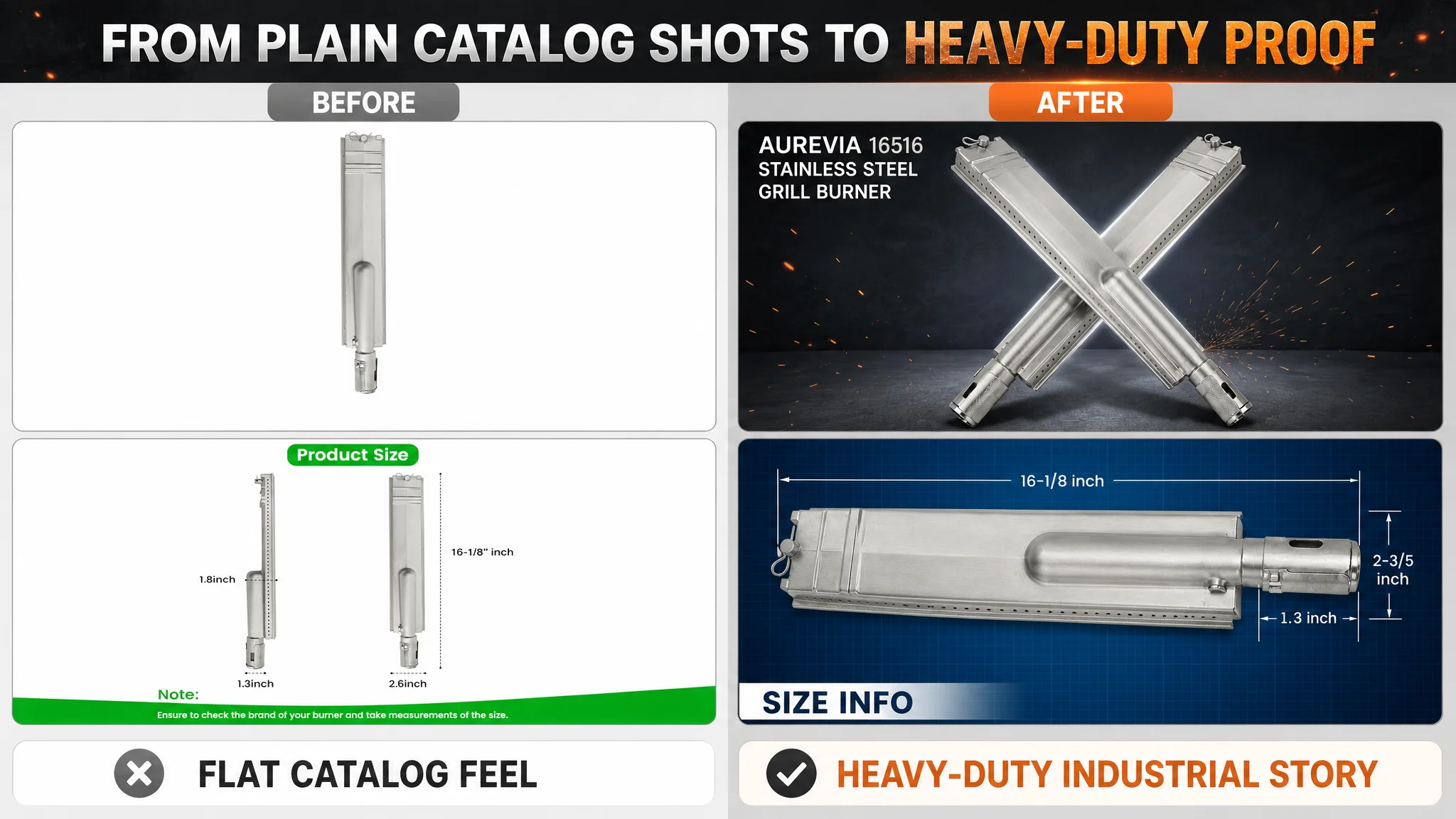
DeepBI’s recommended direction for the main-image stack was not “make it prettier,” but:
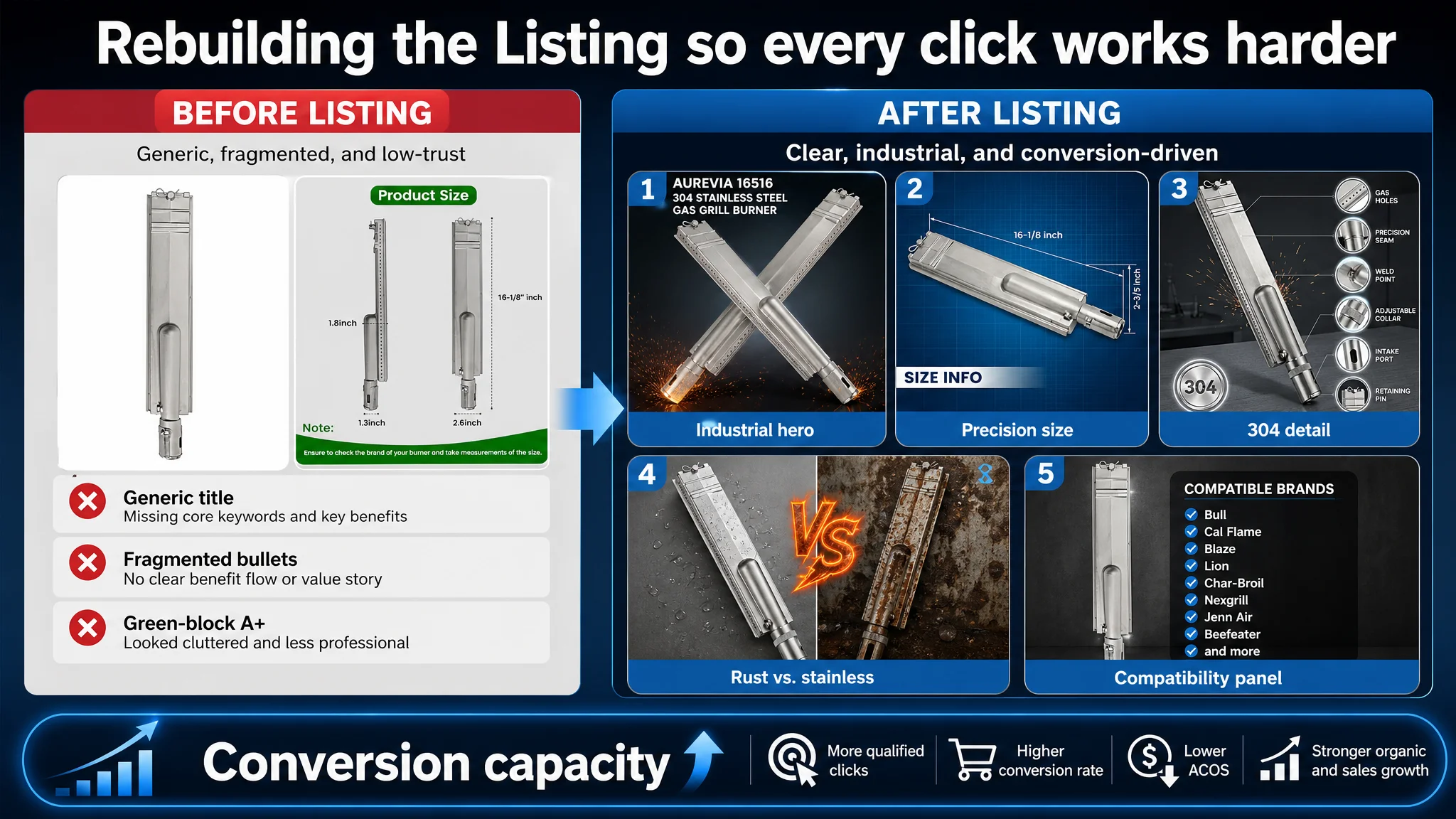
- Use a deep gray/black industrial base, strong side lighting, and fire/spark cues to convey “heavy duty, professional-grade burner” in the very first hero shot.
- Build a separate precision dimension image with deep blue grid backgrounds and clear arrows, so buyers instantly see length and width without reading text.
- Add a detail macro shot: pores, welds, air shutter details—all visible, with a clear “304” icon; this visually supports the “304 stainless steel” claim.
- Use a stainless vs. rusty cast iron split image: new burner with water beads and clean metal vs. heavily rusted, rough old burner, separated by a clear “VS” mark, to tap directly into the replacement pain point.
- Provide a compatibility panel image: product on one side, a clean, high-contrast list of brands on the other, making brand compatibility instant and scannable.
All of this serves a single conversion goal: make a cautious Amazon buyer think, “Yes, this is clearly 304 heavy-duty stainless, and yes, it will fit my grill.”
That confidence reduces “I’ll think about it” exits and supports both ad and organic CVR.
Bullet Points: From Parameter Listing to Decision Logic
On the bullet-point level, the benchmark was not just more detailed—it was more strategic:
- Bullet 1: Clear universal compatibility, listing major brands and part numbers.
- Bullet 2: Dual fuel & air control, with a metal mesh and blue flame description.
- Bullet 3: Heavy-duty 304 stainless with a “3X stronger” comparison.
- Bullet 4: Precision size & full kit, including a “Pro Tip” to measure old burners.
- Bullet 5: Gift use + 12-hour support, closing with an emotional and trust hook.
The target Listing’s bullets stayed at:
- Basic compatibility (covering fewer brands, no part numbers).
- Functional design descriptions.
- General durability claims.
- Dimension notes.
- Fuel adaptability remarks.
What was missing was the complete “pain point → solution → reassurance” arc.
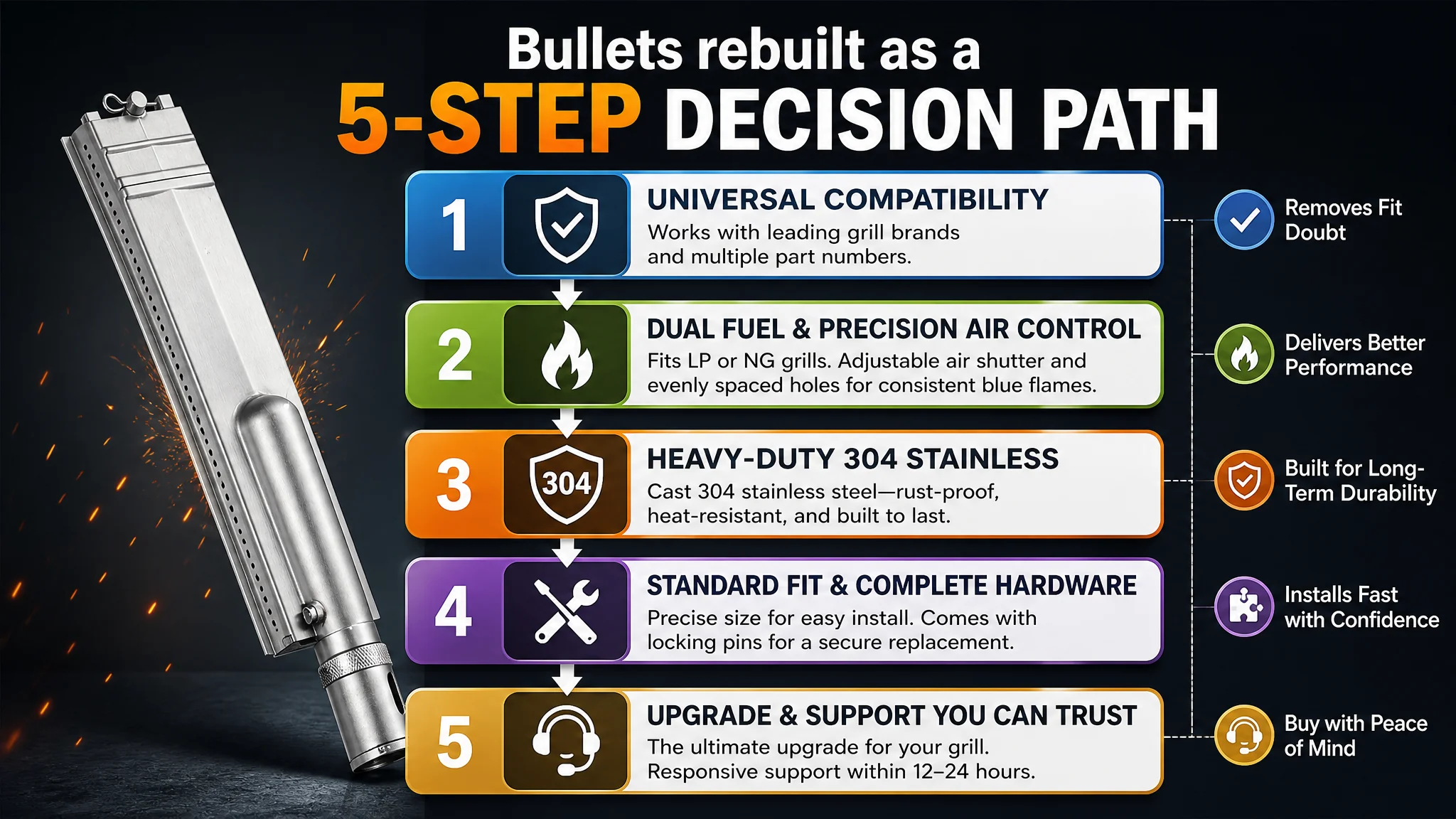
DeepBI’s suggested rewrites aimed to build that arc:
1. Universal Compatibility
- Explicitly list major brands (Bull, Cal Flame, Blaze, Nexgrill, Lion, Char-Broil, Jenn Air, etc.).
- Add part-number compatibility (CIT, CITSS, 23301, 16516, 26106…) to capture part-number searches and lower fitment anxiety.
1. Dual Fuel & Precision Air Control
- Emphasize both Propane (LP) and Natural Gas (NG) usage.
- Highlight the adjustable air shutter and protective mesh.
- Reference blue flames and even heating as a concrete outcome.
1. Heavy-Duty Cast 304 Stainless Steel
- Contrast directly against fragile cast iron burners.
- Anchor on rust-resistance, heat-resistance, and ability to handle extreme temperatures, reinforcing long-term outdoor use.
1. Standard Fit & Complete Hardware
- Give precise dimensions and confirm all necessary hardware is included.
- Add a clear “[Pro Tip] Please measure your original burner…” to reduce size-related returns and build perceived professionalism.
1. Ultimate Grill Upgrade & Support
- Frame it as a serious upgrade for BBQ enthusiasts, tied to occasions like Father’s Day or holiday gifting.
- Promise a concrete support response time (e.g., within 12–24 hours) to strengthen trust.
The key shift: bullets stopped being product-centric descriptions and started functioning as a conversion engine that:
- Solves compatibility doubts.
- Demonstrates functional superiority.
- Reduces install/return risk.
- Adds a support-safety net.
A+ Detail Page: The Page Did Not Build a Complete Trust Story
In A+ content, the target Listing did not lack modules; it lacked coherent logic and visual authority.
The seller’s A+ structure:
- Brand title module
- Compatibility list module
- Replacement-components display
- Stainless vs. cast iron comparison
- Three detail images
- Collage-style usage scene
The benchmark’s A+ structure:
- Brand hero visual
- Specifications and material breakdown
- “Why choose us” four-point value explanation
- Multi-brand compatibility list with numbered visuals
- Gift-positioning visual
Where the target Listing fell short:
- Visual consistency:
Heavy green blocks created a slightly chaotic feel. Information density in some modules was too high, reducing readability. It did not look as “professional” as the benchmark’s deep-blue, high-contrast, unified style.
- Value logic:
The stainless vs. cast iron comparison existed, but the page did not build a full performance–compatibility–experience loop. The benchmark clearly walked the buyer through: “Thicker, more durable, easier to clean, even heating” → “Adaptable models” → “Gifting and long-term use.”
- Information guidance:
The benchmark used icons, numbers, and clear layout to guide the eye across specs, benefits, and compatible models. The seller’s three-detail image module lacked visual anchors; users had to work harder to interpret technical information.
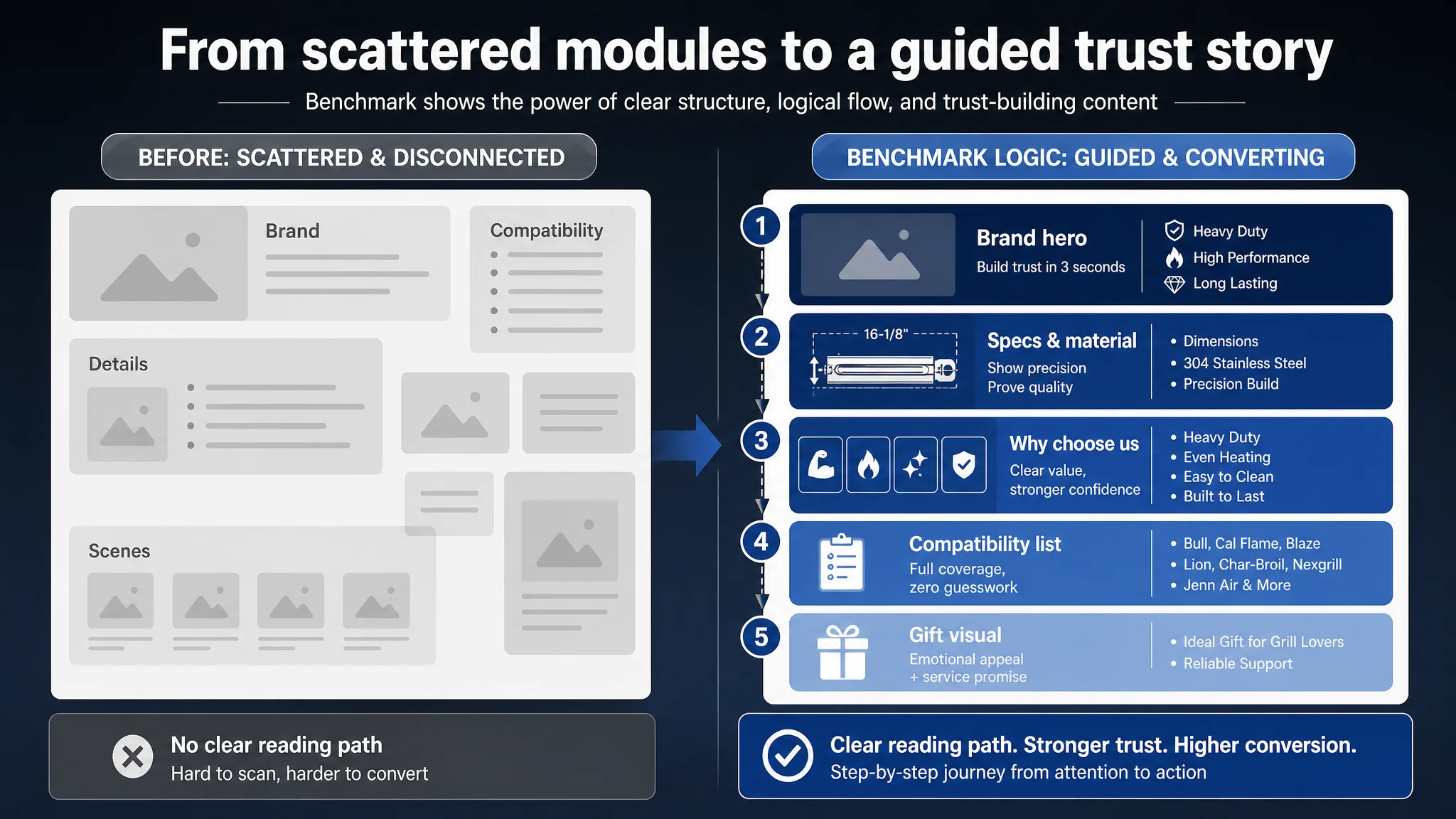
DeepBI’s proposed A+ direction was:
- Replace “cut-out” composite looks with realistic outdoor grilling scenes, showing the burners installed and fired, with realistic flame reflections. This builds first-glance trust and reduces the “Photoshop pasted” feeling.
- Create a macro material module focusing on 304 stainless, with strong lighting on welds, pores, and finish to visually communicate “heavy duty.”
- Redesign the stainless vs. rusted cast iron comparison into a clean left–right split: new, clean 304 burner vs. rusted/broken old burner in a darker mood, connected by a clear “VS” sign.
- Add a core function module zooming in on the adjustable air shutter, with graphic arrows showing airflow direction for NG/LP switching and “upgraded airflow design.”
- Build a spec sheet module with grid background, clear dimension lines, and professional technical drawing style, reducing size-uncertainty and returns.
- Show a multi-grill compatibility scene: 4-piece set displayed alongside an in-use grill in a family backyard scenario, merging quantity and real use.
- Present a compatibility list module with organized brand and model text against a deep blue metallic background, plus small call-outs on the product image, making it very easy to confirm fit.
The objective: turn the A+ section into a confidence machine that:
- Proves material and build quality.
- Eliminates fitment doubts.
- Connects to real-life grilling scenarios.
- Visually supports the decisions that buyers are already making in their heads.
Reviews: A Small Number with Outsized Impact
On the review side, the gap was plain:
- Target Listing:
- 4.3 stars
- 4 total reviews
- Only text reviews
- Mentions of “fitment” issues (even if not low-star) that can seed doubt.
- Benchmark Listing:
- 4.6 stars
- 18 total reviews
- 8 reviews on the first page
- Image/video content that feels more authentic
In buyers’ mental model, 4.5+ stars with enough review volume is a psychological trust threshold. Being below that, with fewer reviews and no media, makes the Listing look less “proven,” especially when placed side-by-side with a stronger competitor.
DeepBI’s judgment was not that reviews could be “fixed” overnight, but:
- The Listing had to compensate for weaker review volume through stronger visual proof and more structured content.
- Over time, as conversion improves and happy buyers accumulate, the review gap can close naturally.
Why DeepBI Did Not Recommend “Keep Tuning Ads First”
Given this total picture, DeepBI’s prioritization was clear:
1. Listing conversion is the constraint.
The 15-point score gap versus the benchmark, especially in bullets, A+, and reviews, signals lower conversion potential.
1. Ads are already feeding the Listing.
Adding more spend would mostly push more traffic into a weaker page, raising ACOS further.
1. The biggest business risk is letting ads amplify a structurally under-optimized Listing. That risk shows up as:
- Wasted clicks.
- Difficulty scaling.
- Over-reliance on paid traffic without building organic strength.
Therefore, DeepBI’s advice was: repair the Listing’s sales logic first. Only once CTR and CVR show signs of recovery should the seller re-accelerate ad spend.
This is the opposite of the intuitive reaction (“ads are expensive, fix ads first”), but commercially sound:
- Fixing the product page increases the value of every click, whether paid or organic.
- Once the Listing converts better, ACOS naturally begins to move down and ad scale becomes safer.
- Organic ranking improves as higher CVR feeds Amazon’s ranking algorithm, reducing long-term dependence on ads.
How the Page’s Sales Logic Started to Recover
After re-framing the problem, the optimization work followed a more coherent path:
- Title: Rebuilt around “Gas Grill Burner Replacement,” “Heavy Duty,” “304 Stainless Steel,” and expanded brand compatibility.
→ Closer match to search intent and stronger thumb-level messaging in Amazon search results.
- Main images: Re-composed into a cohesive industrial, high-trust visual narrative: 3D hero angle, precision size graph, macro details, stainless vs. rust, compatibility panel.
→ More convincing proof of durability and fit, supporting both CTR and CVR.
- Bullets: Rewritten to form a “universal compatibility → dual fuel & airflow → 304 heavy duty → precise fit kit → upgrade & support” chain.
→ Bullets became a direct conversion bridge instead of a technical checklist.
- A+ content: Restructured around core scenes, material proof, performance vs. old parts, airflow mechanics, precise specs, and multi-grill compatibility.
→ The page now walks buyers through the decision rather than leaving them to assemble the story.
- Review strategy: Acknowledged as a medium-term project, but the enhanced Listing is now better equipped to earn and showcase image/video reviews and higher-star experiences.
As these changes begin to take hold, the expected operating changes are:
- CVR starts to recover versus the benchmark, reducing wasted ad clicks.
- ACOS becomes more controllable at similar bid levels.
- The dependency on “constant ad tweaking” drops because the Listing regains its own ability to convert traffic.
- Organic traffic becomes more valuable as the same page converts unpaid visitors more effectively.
How the Seller’s Understanding Changed
Before working with DeepBI, the internal narrative was:
- “We need better ad optimization to fix ACOS.”
- “The Listing is okay; the product is good; keyword work is the main lever.”
After the diagnosis and restructuring, the understanding shifted:
- Amazon ads are not a universal fix for conversion problems.
- Product-page conversion is the base layer; ads sit on top of that, not the other way around.
- Title, main image, bullets, A+ visuals, and reviews must work as a system to carry buyers from search term to order confirmation.
- Before scaling ads, the team now asks, “Does this Listing deserve more traffic?” rather than “How do we get more traffic?”
For other Amazon sellers—especially in technical, compatibility-sensitive categories like replacement parts, automotive accessories, or hardware—the core takeaway is straightforward:
- When you see rising ACOS and lagging orders, do not assume the problem is inside the ads console.
- Step back and ask whether your Amazon Listing is as strong as the true benchmark in your subcategory.
- If your page cannot yet win that one-on-one conversion battle, fixing ads first will only magnify the pain.
DeepBI’s value in this case was not just in suggesting new images or copy. It was in changing the order of decisions: identify Listing conversion as the root constraint, repair the product page’s sales logic, and only then let Amazon ads do what they do best—scale a page that can actually convert.