

An Amazon seller in the Japanese marketplace came to DeepBI with a familiar pressure: ad spend was going up, traffic volume was no longer the problem, but orders on a kitchen sponge Listing were not following. The team’s first instinct was to keep tweaking Amazon ads—more keywords, tighter bids, more campaigns—assuming ACOS issues were purely a traffic problem.
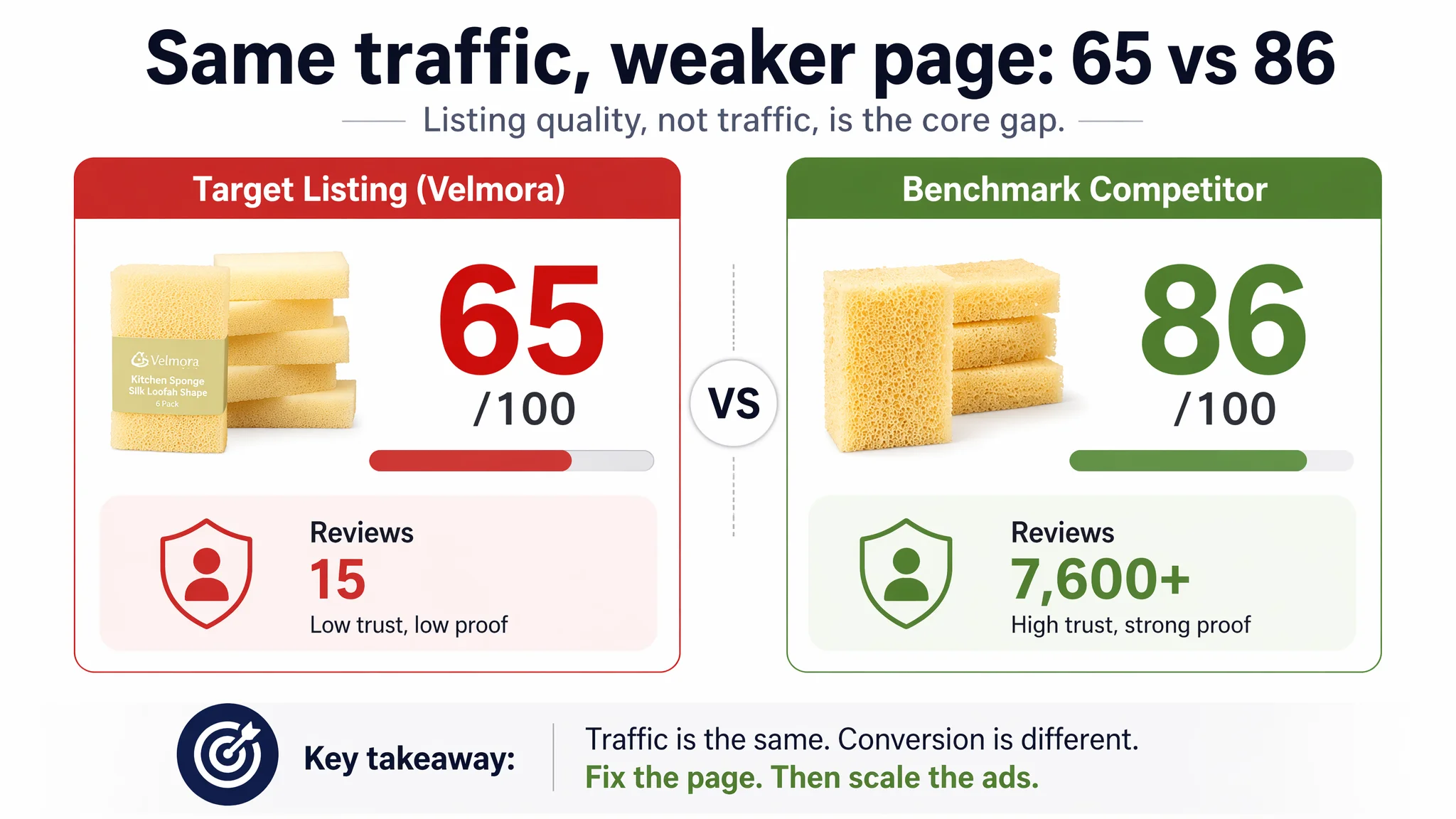
Once DeepBI put the Listing into its scoring and benchmark system, a different story appeared. Against a category‑leading competitor, the product page scored only 65/100 versus 86/100. The biggest gaps were not in “finding traffic,” but in the page’s ability to convert it: weak detail/A+ content, almost no trust signals, and only 15 reviews versus the competitor’s 7,600+. Ads were feeding a page that hadn’t earned the click or the purchase.
From there, the optimization stopped treating ads as the main lever and instead rebuilt the Amazon Listing’s sales logic: refocusing the title around real kitchen sponge decision factors, redesigning main images to show foam, degreasing and fast drying, and restructuring A+ content around trust, safety, and durability. For other Amazon sellers, this case is a reminder that when ad optimizations stop working, the real bottleneck may be the Listing’s conversion capacity, not your bid strategy.
Amazon Ads Were Not Failing. The Page Was Consuming the Traffic.
By the time this seller looked for help, the Amazon Listing already had some traffic and a reasonable star rating.
On the surface, a 4.3‑star score in the kitchen sponge category didn’t look like a crisis. The team saw ACOS pressure and assumed the answer was “better ads”:
- test more keywords
- refine campaign structure
- adjust bids and match types
But once DeepBI ran the Listing through its scoring system and benchmarked it against a top competitor in the same category, the picture changed:
- Target Listing: 65/100
- Benchmark competitor: 86/100
- Gap: –21 points
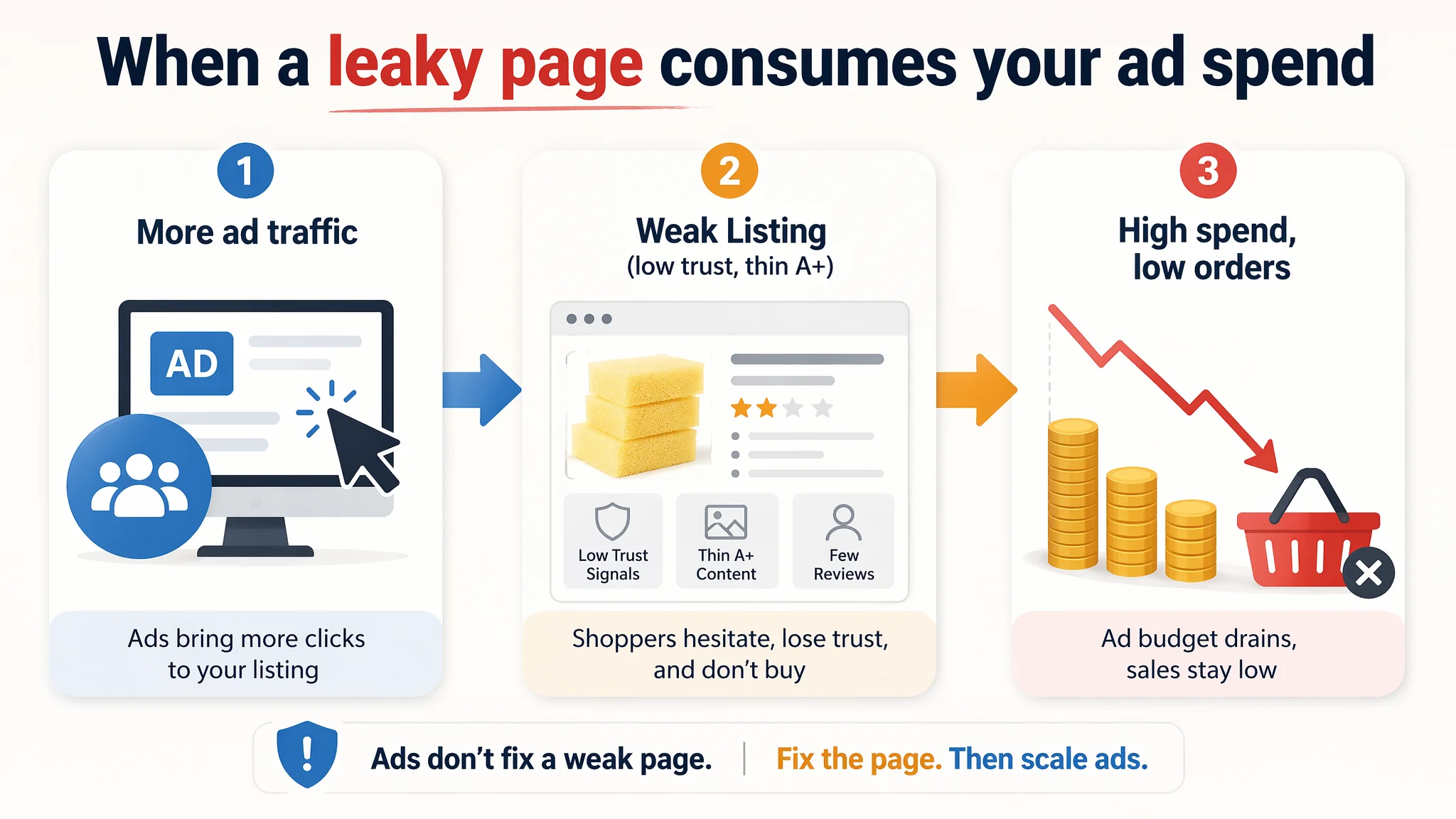
The problem wasn’t that Amazon ads were unable to bring traffic. It was that the page could not efficiently convert the traffic it already had.
“Advertising does not only amplify advantages. It can also amplify a page’s existing defects.”
For a low‑ticket, high‑competition product like a kitchen sponge, every weakness in trust, clarity, and perceived quality gets multiplied by ads. The more they pushed traffic, the more they burned spend through a leaky page.
The Real Constraint Was Listing Conversion Capacity
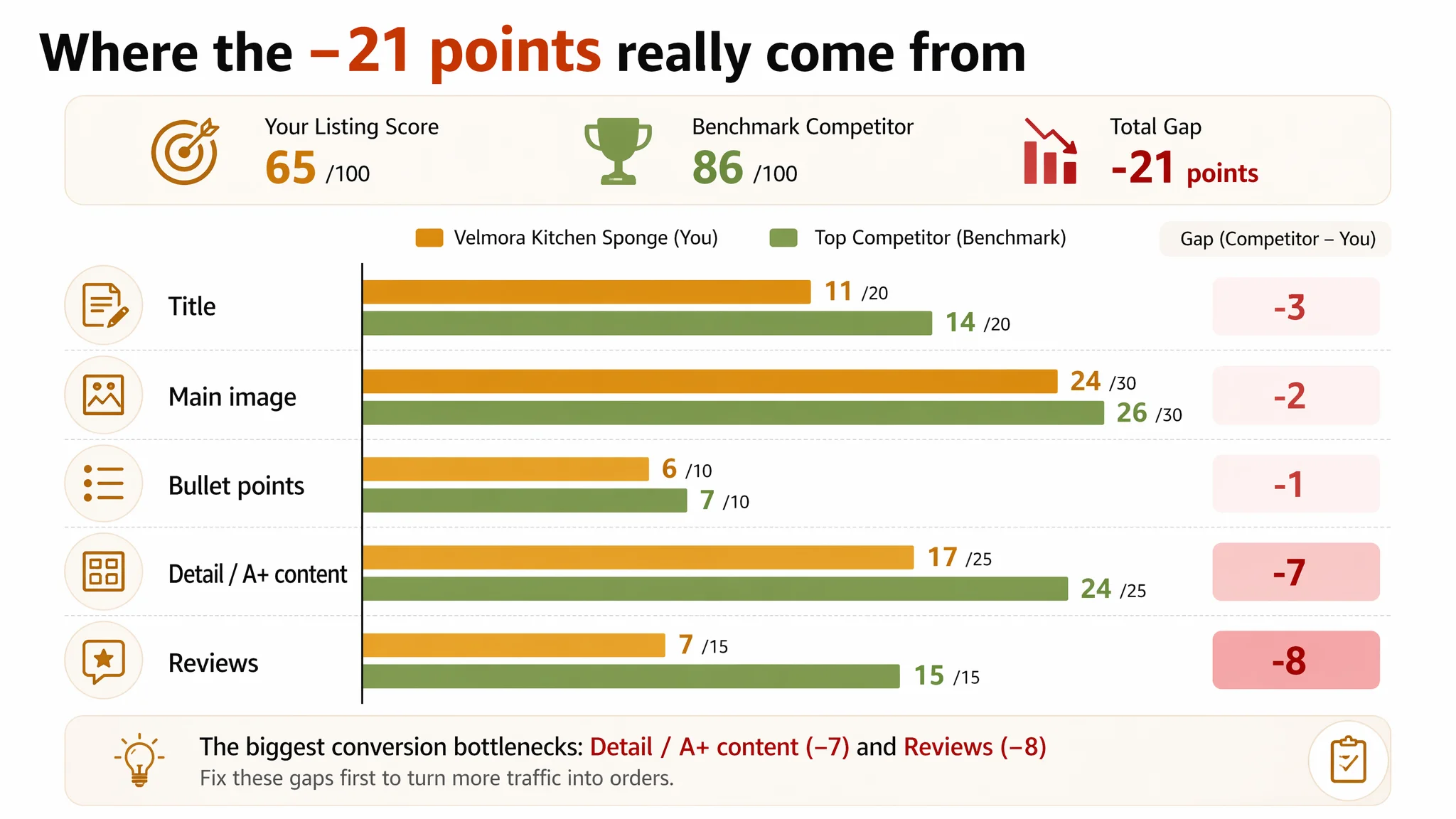
When DeepBI decomposed the 65/100 score, one pattern stood out: the biggest gaps were in exactly the areas that carry trust and persuasion on an Amazon Listing.
Dimension scores vs. competitor:
- Title: 11 vs 14 (–3)
- Main image: 24 vs 26 (–2)
- Bullet points: 6 vs 7 (–1)
- Detail/A+ content: 17 vs 24 (–7)
- Reviews: 7 vs 15 (–8)
The core constraint was not “low exposure” or “weak keyword coverage.” It was a Listing that:
- did not clearly frame the most important purchase outcomes in the title
- failed to build a premium, trustworthy first impression in the main image
- treated bullet points as information listings, not buying logic
- used A+ content only to repeat features, not to build a trust chain
- lacked sufficient review volume to reassure cautious buyers
In practice, this meant:
- Title: overcrowded with generic adjectives (“convenient,” “optimal”) and secondary information like “subscription,” while burying the primary category words. The competitor, by contrast, front‑loaded “kitchen sponge” and “驚きの水切れ&泡立ち (surprisingly quick drainage & rich foam),” tying the product immediately to the biggest consumer outcomes.
- Main images: the seller leaned on white‑background product stacks with a slightly industrial feel. There was little sense of “modern Japanese kitchen” aesthetics, no visualized foam performance, no clear proof of drainage or durability, no cues of origin or quality. The competitor’s images, in contrast, embedded the sponge in daily kitchen scenes, visibly showed foam and quick drying, and hinted at brand history and reliability.
- Bullet points: structured more like feature bulletins (multi‑purpose, economical, eco‑friendly) than a tight sequence of “pain point → solution → reassurance.” The competitor opened with “changing the common sense of kitchen sponges,” then connected technical design, safety (no abrasive), and type selection guidance, leading the reader step by step to a confident choice.
- Detail/A+ content: the seller used a small set of functional images: a few core selling‑point visuals plus one multi‑scene collage. The competitor’s A+ layout built a full narrative: sales volume proof, media exposure, foam performance, degreasing power, material safety, domestic manufacturing, product line segmentation, and even gift scenarios.
- Reviews: while the seller’s rating (4.3) was healthy, total review count was only 15. The competitor had more than 7,600 reviews and 4.5 stars. For buyers, this is not a subtle difference; it is the difference between “new or niche” and “proven standard.”
DeepBI’s judgment: ad optimization could not outrun this gap. Pushing more traffic into the current page was commercially irrational.
Why Traditional Amazon Ad Optimization Kept Failing
From the seller’s point of view, the logic seemed reasonable:
- competition was intensifying
- ads were driving up TACOS
- previous campaign structures that once worked were losing efficiency
So the team kept cycling through familiar playbooks:
- expanding keyword sets
- restructuring campaigns
- isolating exact keywords
- adjusting bids to chase better ACOS
But none of these actions questioned a core assumption: that the Listing itself was not the bottleneck.
DeepBI’s data and visual comparison showed the opposite:
- The benchmark competitor had stronger CTR drivers (more compelling title hooks, more attractive main image) and stronger CVR drivers (trust‑heavy A+ content, massive review bank).
- The seller’s Listing lacked both a sharp reason to click and a complete trust sequence once the shopper landed on the page.
In this context, any marginal gain from slightly better targeting was quickly eaten by conversion losses. Ads were not failing. They were faithfully delivering clicks to a page that had not been engineered to close the sale.
“The real problem was not that ads failed to bring traffic. It was that the page could not convert the traffic.”
This is why DeepBI chose not to start with another round of ad tuning. At this stage, the highest risk was not “too little traffic,” but too much traffic going into a structurally weak Listing.
This Product Page Did Not Lack Traffic. It Lacked Trust.
Once the core constraint was clear, DeepBI treated the Listing as a conversion engine that needed structural repair.
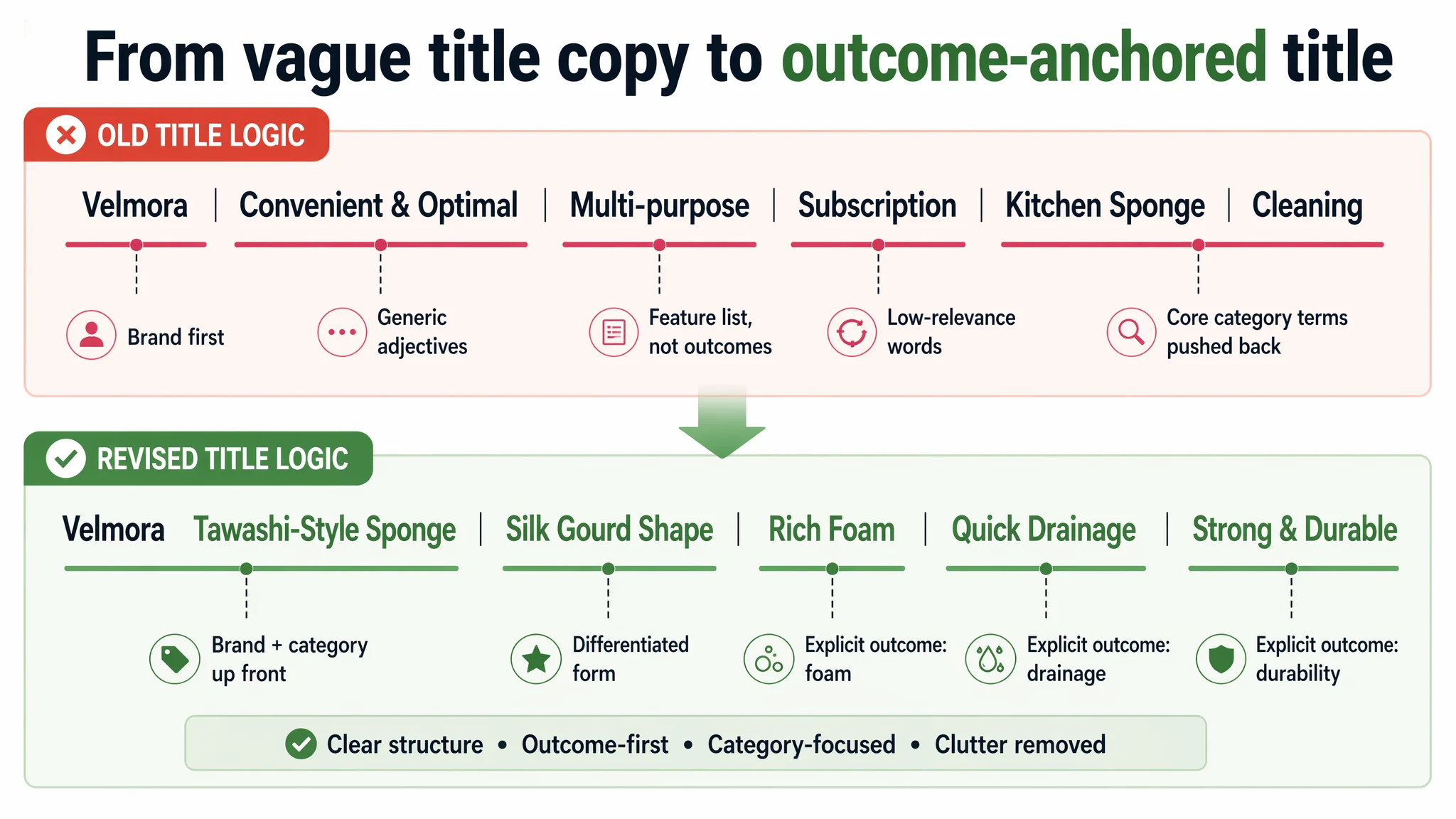
The title was not anchored in outcomes
The original title:
- opened with a low‑recognition brand name
- stacked many functional claims and qualifiers
- included low‑relevance text like “subscription”
- used generic adjectives rather than specific, decision‑driving outcomes
DeepBI’s comparison with the benchmark showed what the market had already validated:
- buyers respond strongly to “water drainage” and “durability” in this category
- explicit outcome phrases (“驚きの水切れ&泡立ち”, “丈夫で長持ち”) perform better than vague “high quality” language
- front‑loading core category terms (“kitchen sponge,” “sponge set”) supports both search relevance and immediate comprehension
The revised title logic:
- kept the brand but immediately followed with the main category phrase (“たわし風スポンジ”)
- added the differentiating form (“シルク瓜型”) to help it stand out in search results
- explicitly emphasized foam, quick drainage, and durability
- removed low‑impact phrases like “定期購入”
- maintained a crisp, scannable structure for mobile users
The objective wasn’t to “sound nicer.” It was to align the title with the real decision logic buyers use when scanning Amazon results in this category.
The main image was not just a visual issue. It failed to create a reason to click.
On Amazon, main image thumbnails carry two tasks:
- earn the click in search results
- pre‑frame the product’s quality tier and trust level
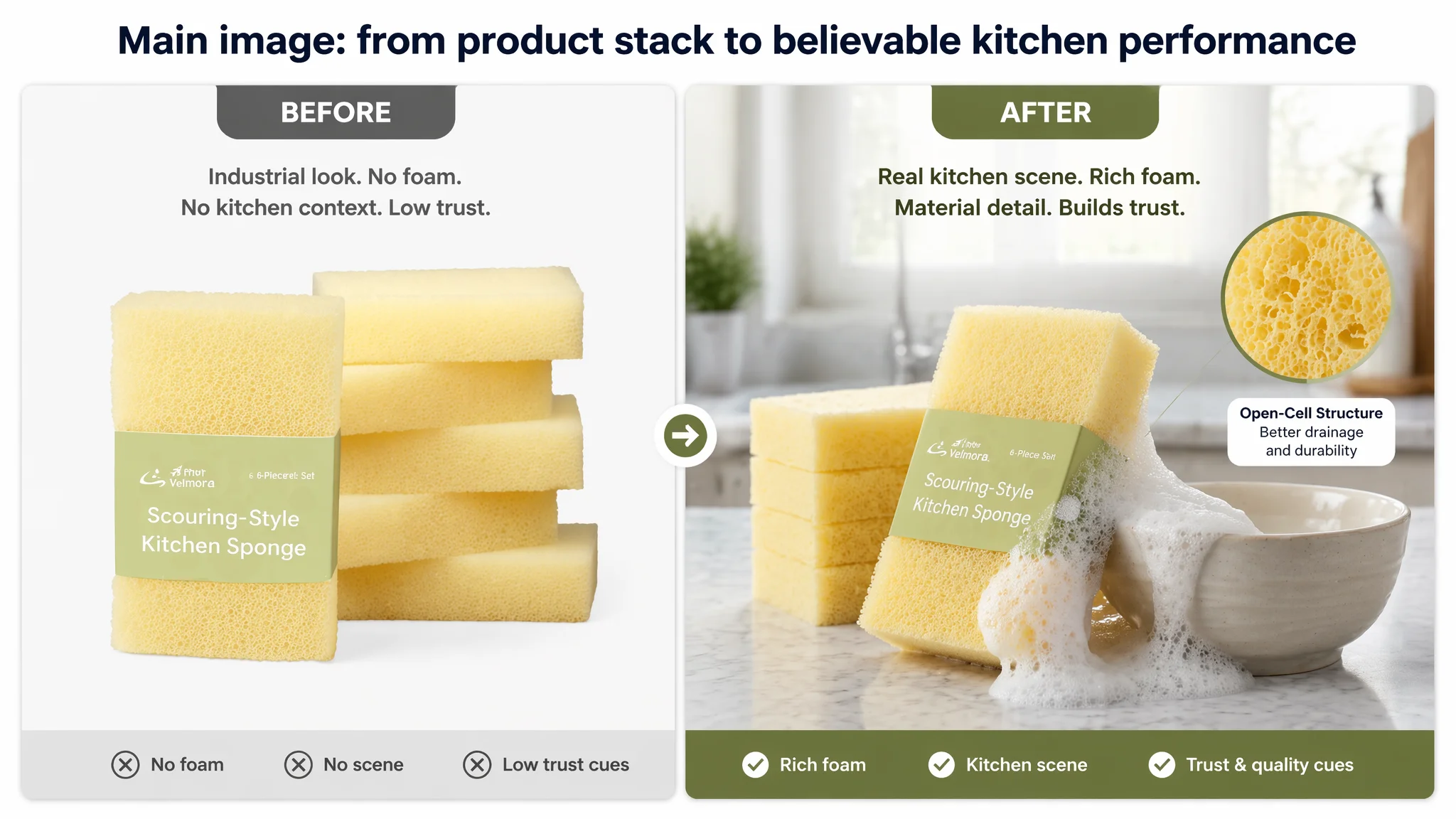
The seller’s main images:
- leaned heavily on white background stacks
- gave off a “low‑priced industrial sponge” impression
- lacked any sense of Japanese lifestyle aesthetics or modern kitchen context
- did not visualise foam density, degreasing power, or quick drying
- did not provide packaging cues, origin cues, or certification cues that reduce perceived risk
DeepBI’s benchmark analysis showed the competitor using:
- marble or wooden surfaces that signal “modern, clean kitchen”
- in‑use shots with visible foam and oil‑removal contrast
- dynamic images of squeezing and water droplets to imply quick drainage and hygiene
- multi‑scene compositions that show versatility without words
- trust badges and rankings embedded in the imagery
Rather than copying, DeepBI re‑anchored the seller’s visual strategy:
- Hero image: sponge set centered on a marble countertop, with a clean Japanese ceramic bowl, natural light, and a close‑up of the mesh structure. The goal: shift perception from “cheap industrial” to “modern Japanese kitchen tool.”
- Usage images: clear before/after oil cleaning contrast, dense foam coverage, and non‑abrasive interaction with non‑stick pans.
- Drainage image: squeezing moment with visible water droplets to directly address the mold/odor concern.
- Multi‑scene grid: glass, stainless steel, ceramic, sink surfaces to visually demonstrate multi‑purpose use.
The goal was not artistic; it was commercial: give Amazon shoppers a visual reason to believe this sponge cleans well, dries fast, and feels safe to buy.
The Bullet Points Had Information, but Not a Buying Logic
The original bullet points covered many angles: multi‑purpose use, environmental friendliness, cost savings. But they lacked a coherent path from buyer worries to reassurance.
DeepBI contrasted this with the competitor’s structure:
1. Start with a strong value promise (“changing the common sense of kitchen sponges”).
2. Deepen with technical explanation + safety reassurance (“膜飛ばし構造,” no abrasive).
3. Offer type selection guidance (normal vs soft) to reduce decision friction.
4. Clarify color options and specs.
5. Introduce cross‑use recommendations or combinations.
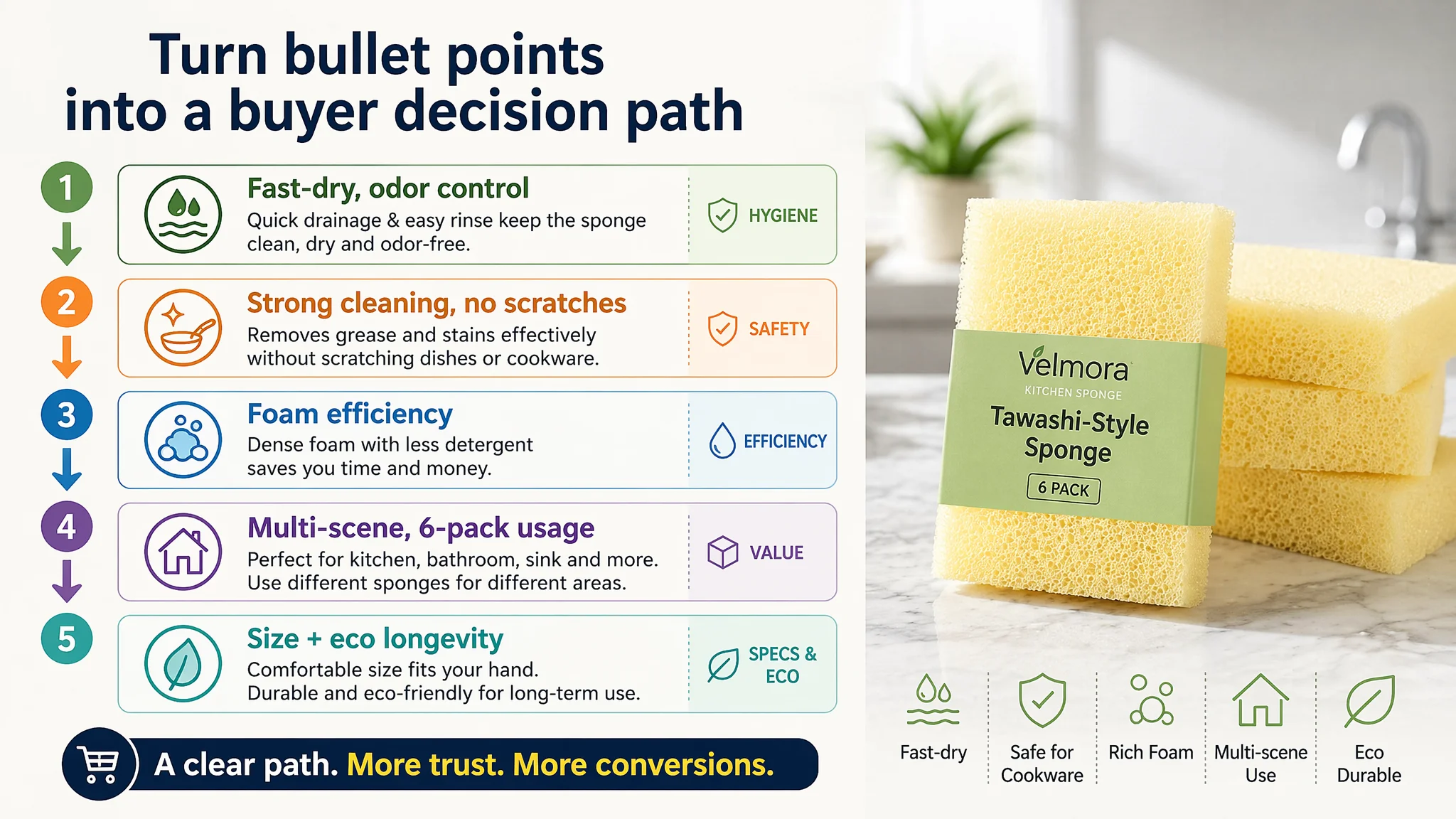
For the seller, DeepBI re‑sequenced the logic around category‑critical topics:
- Bullet 1: durability and drainage as a core promise
Emphasizing the “silk gourd” structure, fast drying, and odor prevention. This directly hits the hygiene anxiety that often stops sponge purchases.
- Bullet 2: cleaning power without damage
Explicitly stating “研磨剤不使用” and clarifying that tough stains can be removed without scratching delicate surfaces (plastic, glass, lacquerware).
- Bullet 3: structural reason for foam efficiency
Explaining how the unique structure pulls in air to maximize foam, positioning the product as both effective and detergent‑saving.
- Bullet 4: multi‑scene, multi‑pack logic
Leveraging the 6‑piece set not only as “more pieces,” but as a way to assign different sponges to different zones (dishes vs bathroom vs car), increasing perceived versatility and value.
- Bullet 5/6: specifications and eco‑economics
Clarifying exact size and reinforcing longevity and eco‑benefit (less frequent replacement, less waste).
The transformation was not about longer text; it was about aligning each bullet with a specific decision hurdle:
- “Will this sponge dry fast, or will it smell?”
- “Will it scratch my pan?”
- “Is it really more efficient than my current sponge?”
- “Do I actually need six of these?”
- “Is this size right for my hand and my dishes?”
The Detail Page Was Thin on Trust and Story
The starkest gap appeared in the detail/A+ dimension: 17 vs 24, a –7‑point difference.
The competitor built a complete trust chain
DeepBI’s benchmark review showed the competitor constructing a layered narrative:
- Sales and history proof: “15 million units sold,” “48 years of history”
- Media exposure: TV, magazines, social media coverage
- Domestic manufacturing: Japanese production and strict quality checks
- Product line clarity: Normal vs Soft hardness, multiple series, clear selection guides
- Emotional and gifting scenes: gift packaging, messages, home‑use warmth
This sequence translates to a clear buyer experience:
1. “Others already trust this.”
2. “Experts and media have validated it.”
3. “It’s made with reliable standards close to me.”
4. “I can find exactly the type I need.”
5. “It can even be part of a gift – this is not a throwaway sponge.”
The seller’s A+ stopped at function
The seller’s A+ content:
- focused mainly on functional images (core selling points, multi‑scene use)
- did not provide any social proof (sales numbers, exposure, long history)
- did not show origin or manufacturing trust cues
- did not clarify product line choices or variation strategy
- did not extend into emotional or social value
In other words, the A+ content stopped at “what it does,” while the competitor went all the way to “why you should feel safe and even happy choosing this brand.”
Reframing the A+ around decision value
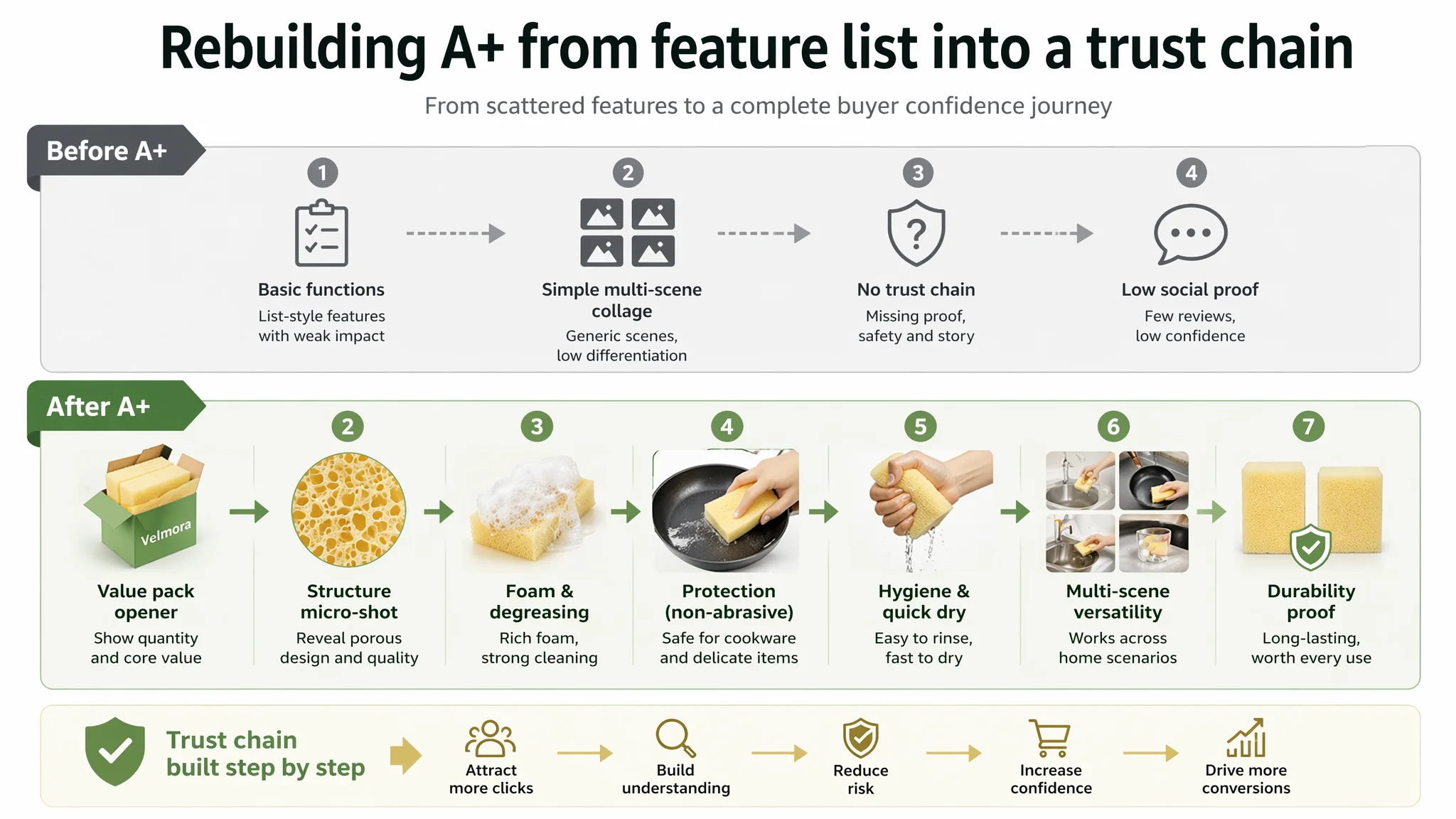
DeepBI’s optimization plan shifted the A+ focus from “loofah‑style gimmick” to “high‑efficiency, hygienic, non‑abrasive, and great value”:
- Opening module: a visual emphasizing “6‑piece value pack” on a bright modern kitchen table, with a subtle badge highlighting the pack advantage. This addresses the category’s strong price‑value sensitivity.
- Structure micro‑shot: macro visual of the mesh, explaining the “scientific hollow structure” that drives drainage and foam — turning a visual pattern into a rational reason.
- Foam and degreasing module: hand cleaning a white ceramic plate, dense foam visually dominating the product, with clear cues that only a small amount of detergent is needed.
- Protection module: sponge interacting with a black non‑stick pan surface, explicitly reinforcing “doesn’t scratch pots, doesn’t hurt hands.”
- Hygiene and quick‑dry module: dynamic squeeze shot with water quickly leaving the sponge, paired with a dry, fluffy comparison. The goal is to make “less mold, less smell” feel visually real.
- Multi‑scene module: baby bottles, range hood filters, glassware — elevating the product from “cheap dish sponge” to a “versatile household cleaning tool.”
- Durability module: before/after visuals showing the sponge after 100 uses, still intact. This directly supports the long‑lasting, eco‑value message.
This was not about adding more images for the sake of it. The sequence was designed to catch and answer the major trust questions that the original page left open.
Why DeepBI Did Not Recommend “Fix Ads First”
Given the scoring and the benchmark differential, DeepBI’s decision path was clear:
1. Listing conversion was the bottleneck, not traffic volume.
2. Pushing additional ad traffic into a weak page would increase wasted spend and delay the real repair.
3. In this category, visual trust and narrative depth directly influence CVR and, indirectly, ad efficiency and organic ranking.
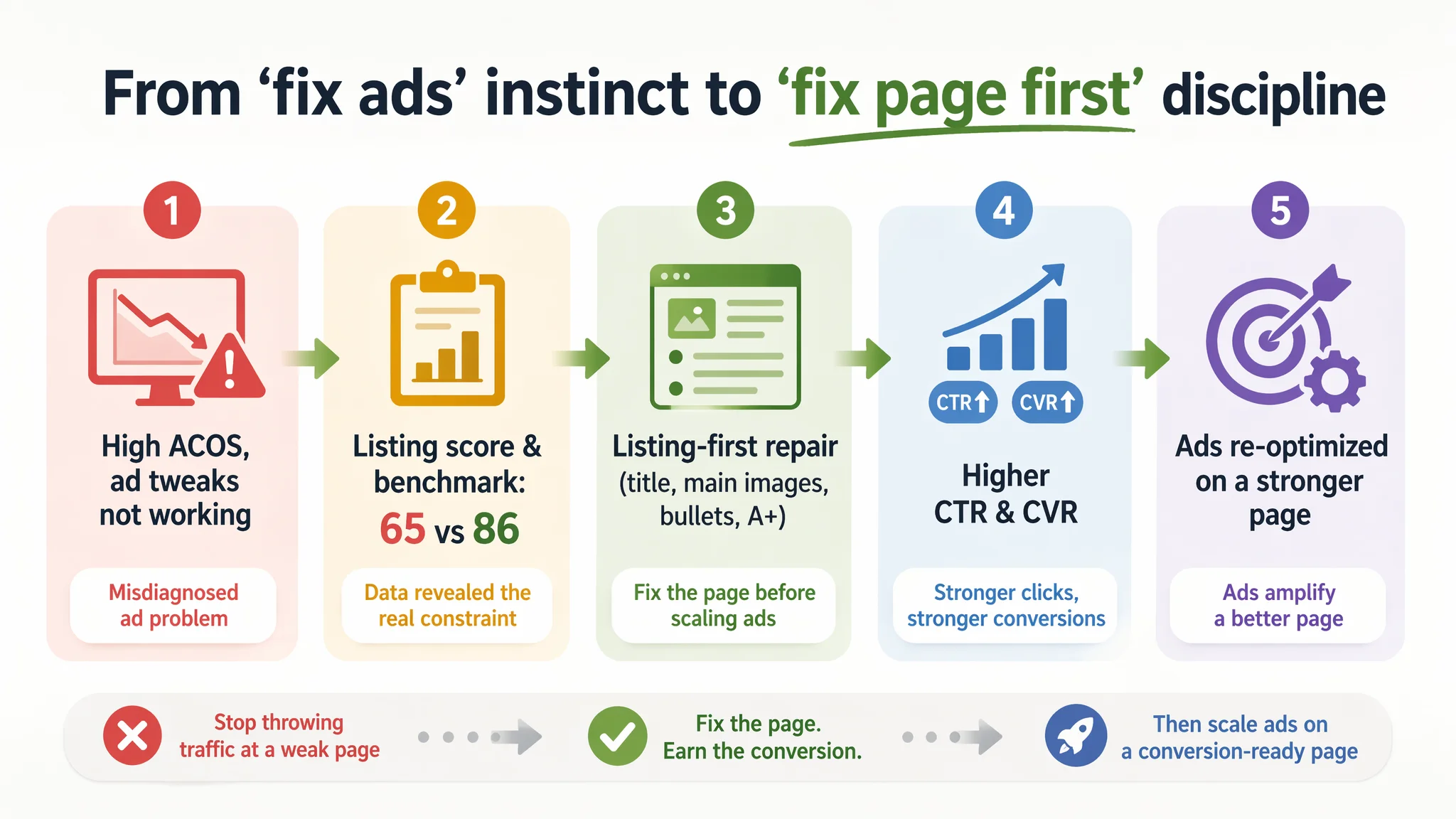
Therefore, DeepBI’s priority order was:
- Step 1: Repair the Listing’s core conversion assets: title, main image stack, bullet logic, A+ trust chain.
- Step 2: Let these changes stabilize and start rebuilding the page’s intrinsic conversion capacity.
- Step 3: Only then, revisit ads — re‑evaluate keyword strategies, budgets, and bid levels now that the page is capable of converting incremental traffic.
This decision logic reflects a core discipline:
“Before scaling ads, judge whether the page deserves more traffic.”
For this seller, the highest business risk was not under‑bidding. It was over‑fueling a page that shoppers didn’t yet trust.
How the Page’s Sales Logic Started to Recover
Although this case does not include specific post‑optimization metrics, we can track the change in operating state rather than invent numbers.
After the Listing‑first rebuild, the business context shifted in several ways:
- CTR basis improved: More persuasive, outcome‑focused titles and visually stronger main images gave the Listing a better chance to win clicks in crowded Amazon search results.
- CVR foundation strengthened: Buyers arriving on the page saw clearer explanations of foam, drainage, and non‑abrasive safety, supported by structured visuals and more precise bullet logic.
- Trust gap narrowed: While review volume didn’t catch up overnight, the A+ content and visual story started compensating for low review count by building perceived reliability and professionalism.
- Ad traffic became more useful: Once the page could better convert, ad spend was no longer primarily funding “learning,” but had a more direct path to orders and organic support.
Operationally, the seller moved from:
- chasing ad tweaks in a fog, to
- seeing Listing scores and competitor differentials, to
- committing to a page‑first repair, then
- coming back to ads with a more stable, conversion‑ready foundation.
What This Amazon Case Means for Other Sellers
This kitchen sponge case is not about sponges. It is about how easily Amazon sellers misdiagnose ad problems as bid problems.
Common patterns this case highlights:
- A healthy star rating does not mean your Listing has enough trust infrastructure (A+, reviews, social proof) to compete with category leaders.
- Ads revealing high ACOS may be symptoms of weak conversion, not poor keyword strategies.
- Titles overloaded with generic adjectives or low‑relevance phrases can quietly erode CTR, even when the product is good.
- Main images that show only the product, not outcomes (foam, degreasing, fast drying), often lose clicks to competitors who do.
- A+ content that restates features without building a trust chain leaves buyers unconvinced and reluctant to commit.
The deeper understanding this seller gained — and that many Amazon sellers can borrow — is:
- Amazon ads cannot fix every conversion problem.
- Listing quality is the foundation of ad efficiency.
- Title, main images, bullet points, and A+ content must work as a single decision path, not as separate decorations.
- Before investing more into ads, it is critical to ask: “If I were the shopper, would this page convince me?”
DeepBI’s real value in this case was not in adding more tools, but in forcing a reframing: stop trying to out‑bid the problem; start fixing the page that every click lands on.