


This Amazon seller in Japan sells vacuum storage bags. On paper, their Amazon Listing looked decent: the title was packed with keywords, the main images were not obviously worse than a leading Amazon Basics–style competitor, and the A+ detail page was actually richer and more persuasive. Yet despite this, ad spend was hard to control and the product page was struggling to convert traffic.
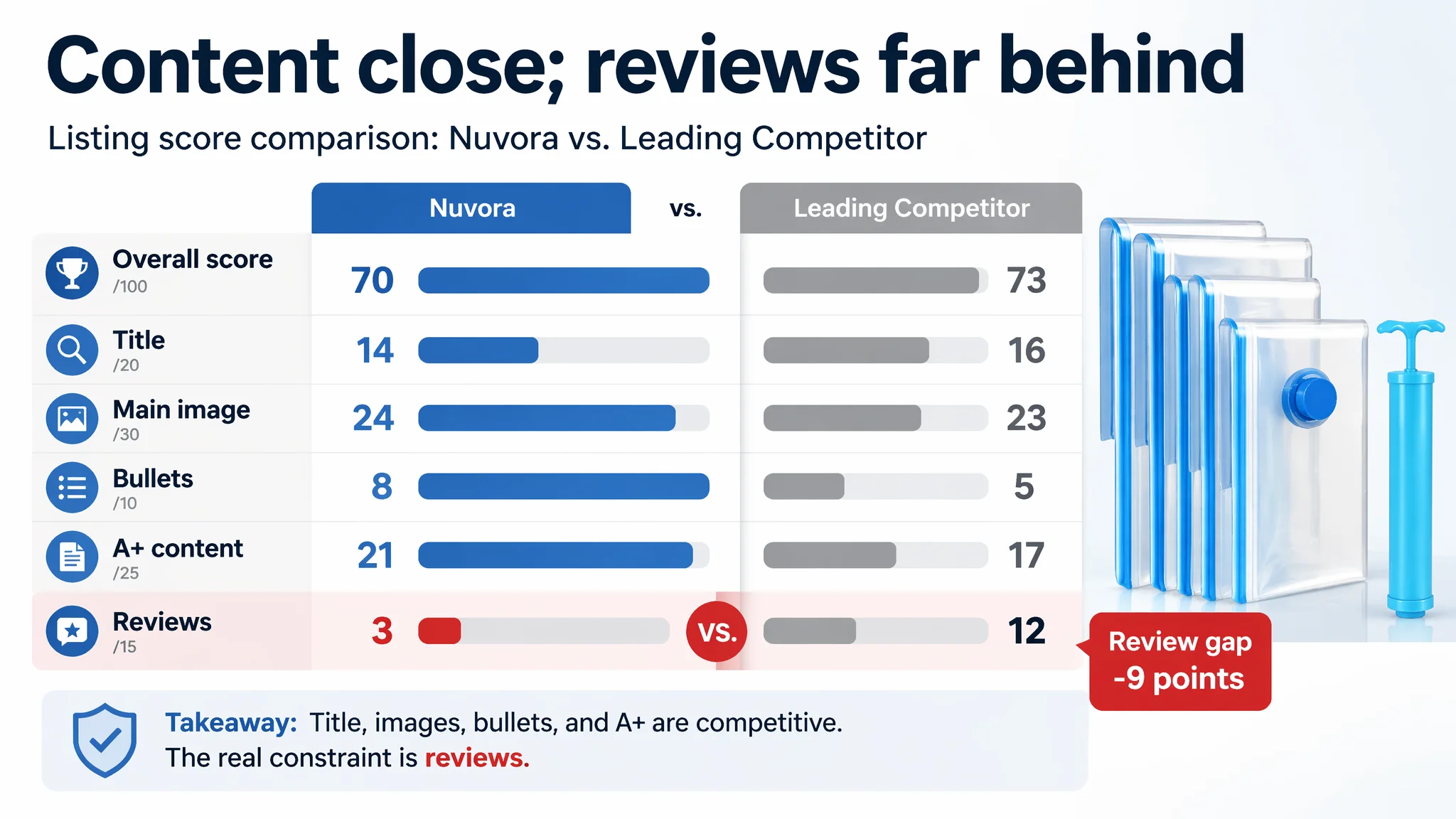
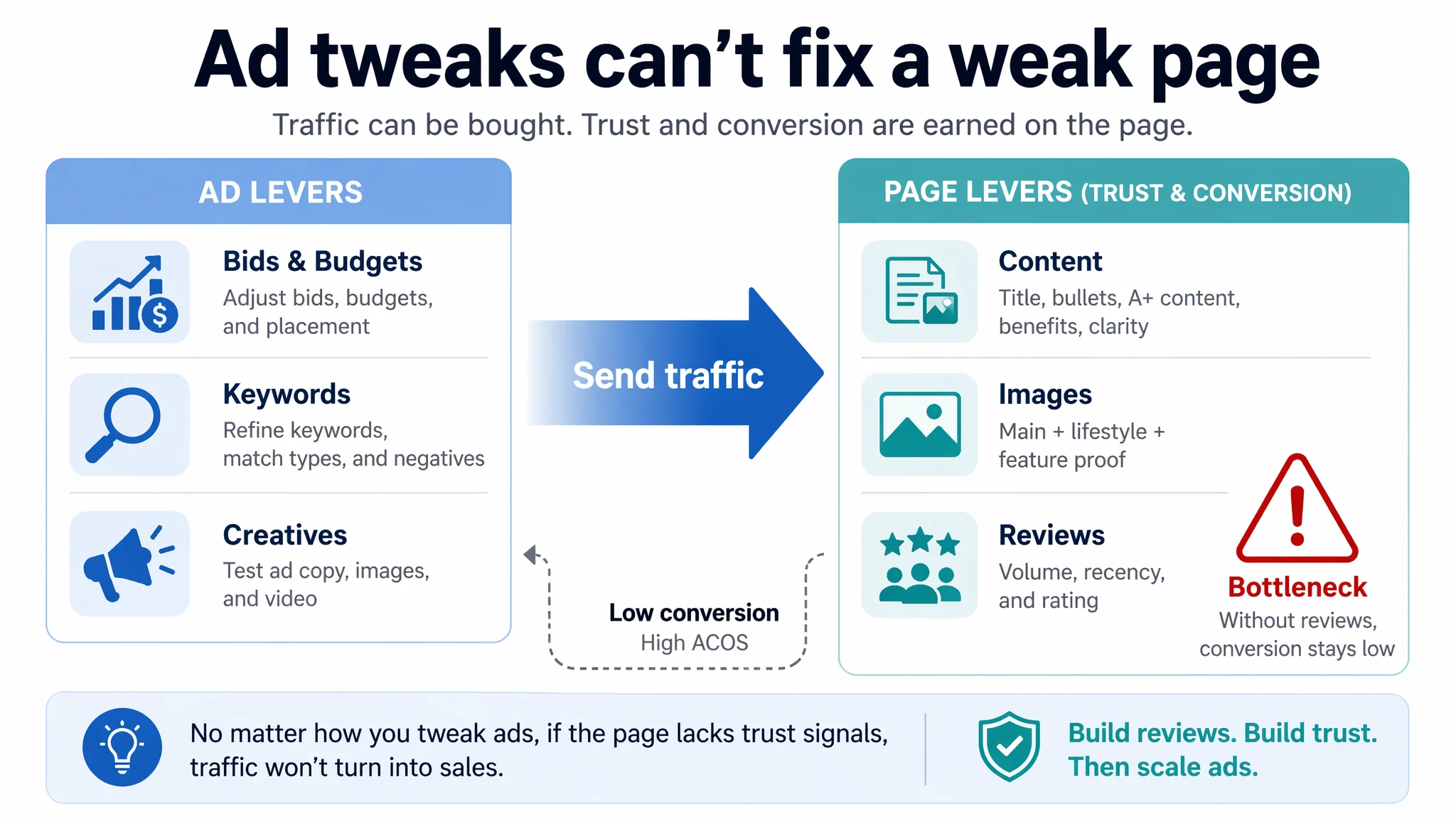
The customer originally believed the problem lay in Listing content and creatives: they suspected their title and images were “not good enough”, and they focused on revising copy, adding scenes, and refining A+ modules—while continuing to push Amazon ads. DeepBI’s diagnosis took a different path. By scoring the Listing across title, main image, bullets, A+, and reviews against a benchmark competitor, the real constraint emerged clearly: not visual assets, but an extreme review-gap and immature social proof system that the page simply could not overcome with ads alone.
After reframing the problem, the optimization focus shifted. Instead of endlessly tuning bids and rewriting the same modules, the team prioritized two things: (1) keeping and sharpening the content strengths that already outperformed the competitor (bullets and A+), and (2) redesigning images to better visualize compression and durability—while accepting that sustained review building and controlled ad scale were prerequisites for stable ACOS, not quick fixes. For other Amazon sellers, this case is a reminder: when ads feel “inefficient”, the bottleneck may not be in campaign structure at all. It may be in whether your Listing, including its review profile, is fundamentally convincing enough to deserve the traffic you are buying.
What the Seller Saw: A Listing That “Should Be Working”
On the surface, this Amazon Japan Listing was not a typical problem child.
- Overall Listing score: 70/100 vs benchmark competitor at 73/100 (a small 3-point gap).
- Title: 14 vs 16 (slightly weaker but acceptable).
- Main image: 24 vs 23 (actually 1 point higher).
- Bullets: 8 vs 5 (clearly stronger).
- A+ / detail content: 21 vs 17 (again stronger).
- Reviews: 3 vs 12 (this is where the cliff appears).
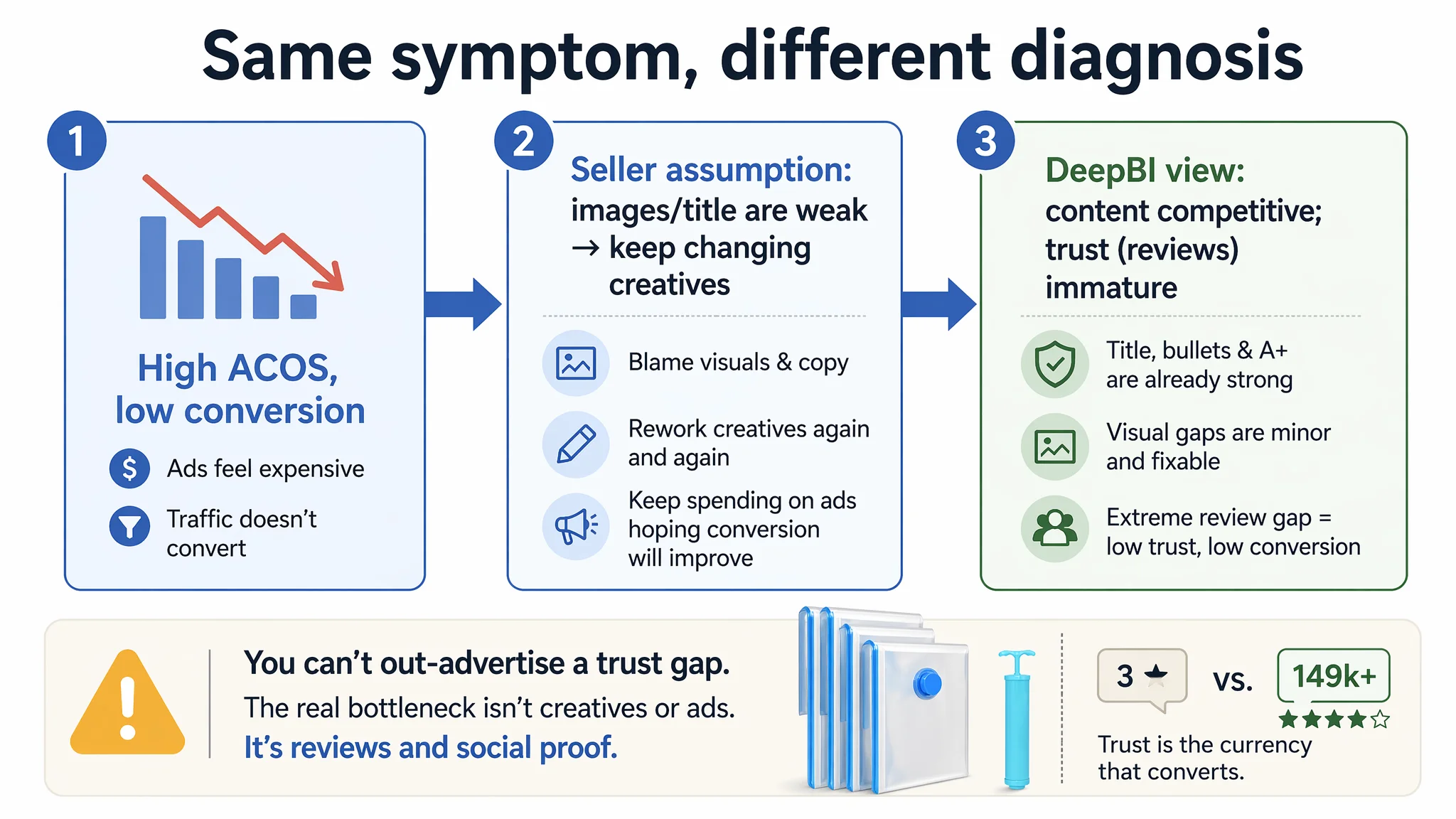
For the seller, the daily experience was simple: Amazon ads were getting expensive, and conversion did not follow traffic. Because they saw the competitor dominating the category, they instinctively blamed:
- “Our pictures are not attractive enough.”
- “Our title is less optimized for search.”
- “Our story is not as clear as theirs.”
So the operational energy went into visual and copy refinement and continued ad traffic, assuming that once the Listing “looked better,” conversion would naturally catch up.
DeepBI’s scoring forced a colder view: if you ignore reviews, this Listing’s content-side conversion capacity was already competitive—even better than the benchmark in several key modules.
The real question became:
If the content is not the weakness, why does traffic still feel wasted?
The Misdiagnosis: Treating a Review Problem as a Creative Problem
The seller’s original judgment was typical:
- ACOS was hard to push down → this must be an ads or creatives problem.
- Benchmark looks more “mature” → we must rework images and copy to match.
- A/B changes on visuals → ACOS did not move enough → try more creative tweaks.
What this misses is the structure of trust on an Amazon product page.
DeepBI’s Listing-level comparison showed a very different pattern:
- Title & SEO logic
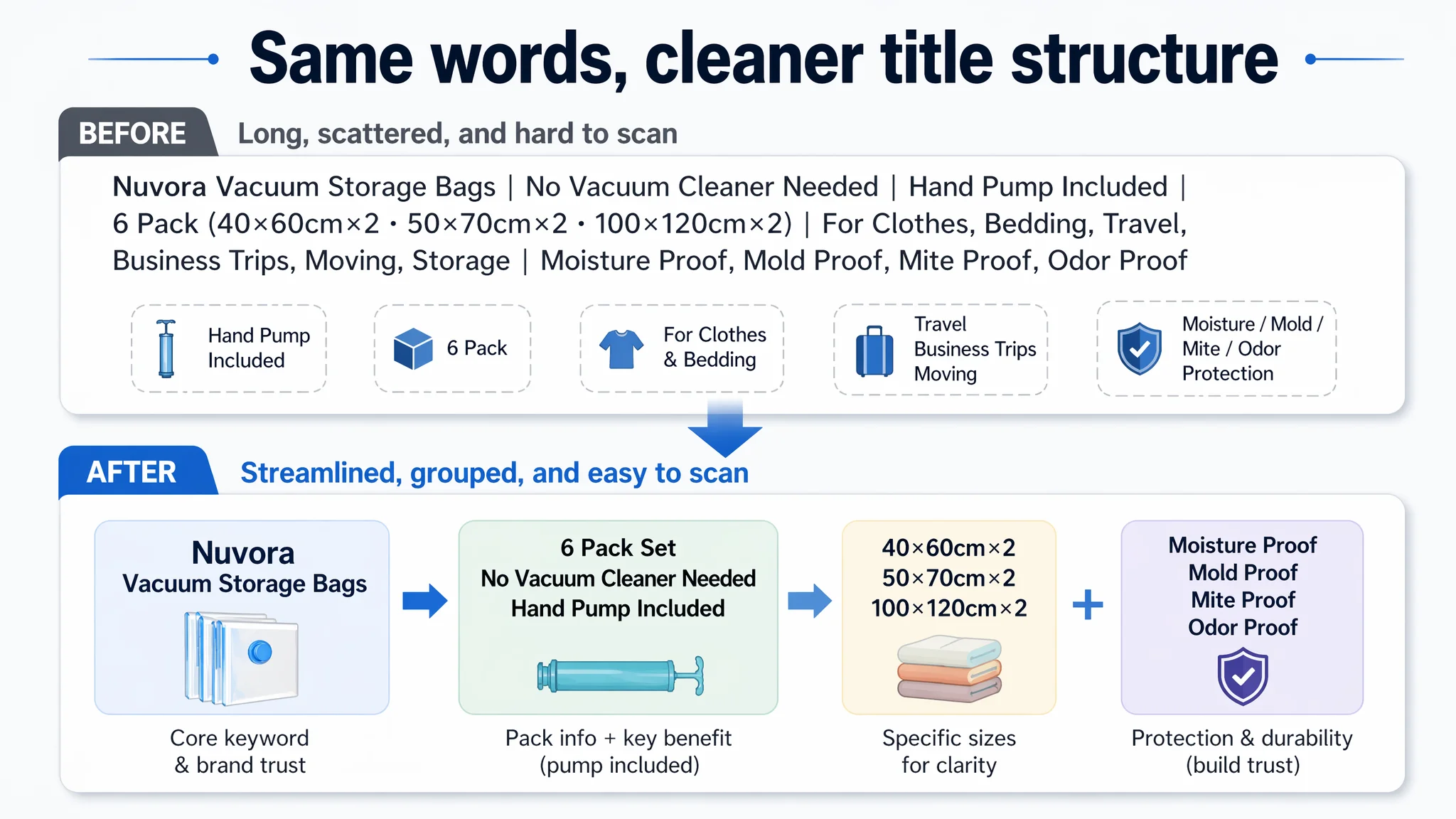
The competitor’s title did a better job front-loading brand trust (“Amazon Basics”-like positioning), with a tight structure and direct mention of vacuum bags, “no vacuum cleaner needed” and size/pack info in one concise chain. The customer’s title, however, was not fundamentally weak:
- It covered the core term “布団圧縮袋” right after brand.
- It included clear set size (6-piece) and “no vacuum cleaner needed” plus hand pump.
- It even added more scenario and benefit terms—travel, business trips, moving, moisture/mold/mite/odor protection.
The problem was not “bad keywords”; it was slightly lower structural maturity and a touch of keyword stacking. This is not enough by itself to explain poor conversion.
- Main images & secondary images
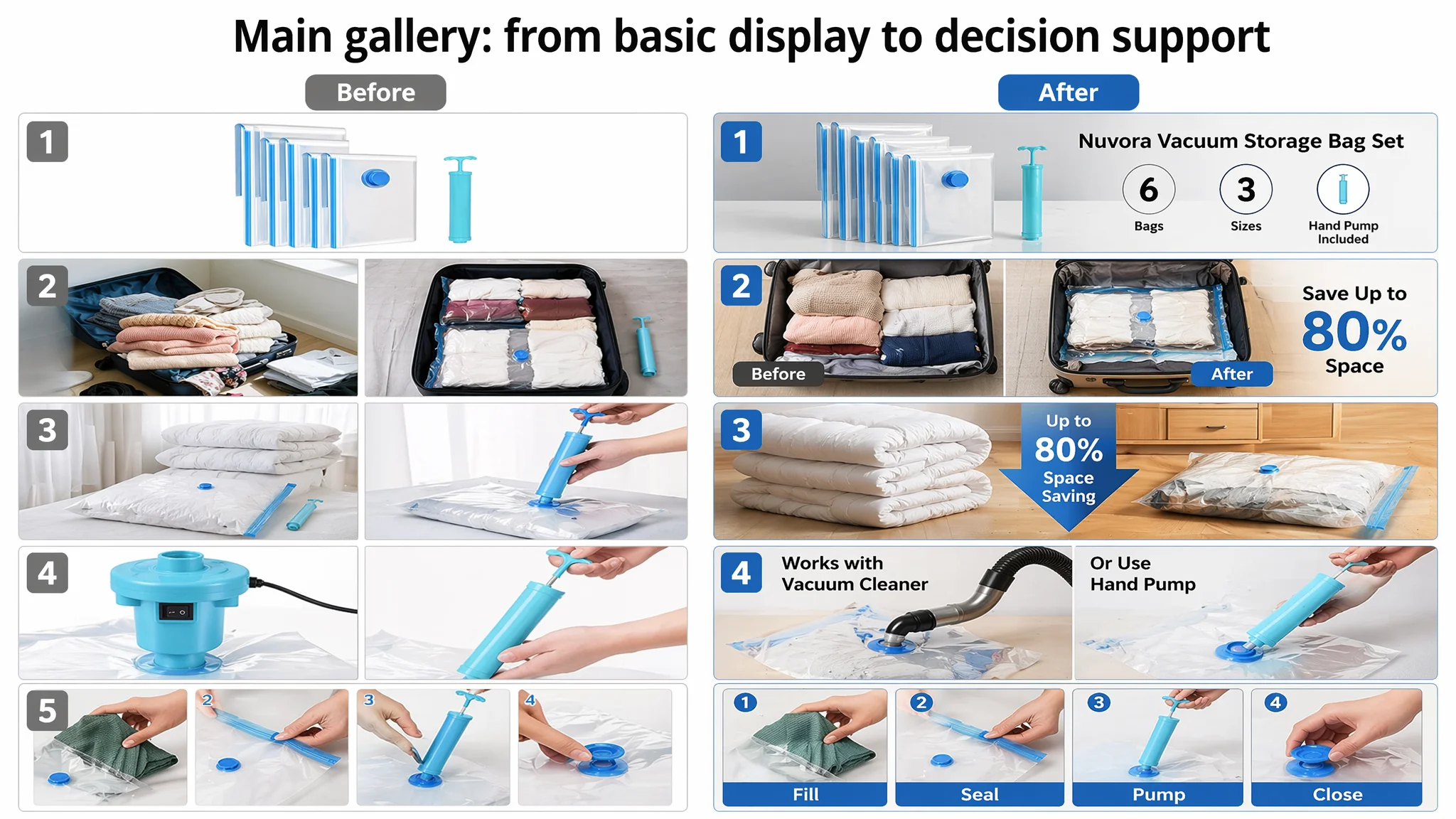
Visually, the customer’s main and gallery images did have weaknesses:
- First image: low information density; product not framed as strongly as it could be.
- Scene images: scattered logic (different scenes diluting the core “vacuum storage” use case).
- Core parameters (sizes, materials, compression rate) spread across multiple images, less consolidated than the competitor’s parameter-focused visuals.
DeepBI estimated that this visual gap could explain a 5–8% weaker CTR and a 3–5% lower CVR vs the benchmark—important, but again, not fatal in isolation, especially given the nice A+.
- Bullets & A+ content
Here, the Listing was actually ahead of the benchmark:
- Bullets started from the core pain point (“no vacuum cleaner needed”) and outcomes (up to 80% space-saving, moisture/odor protection, travel/moving convenience).
- Bullet structure moved logically from ease of use → material & protection → sealing & durability → scenarios → set composition and sizes.
- A+ used real-life scenes (packing suitcases, couple traveling), clearly mapped size options to capacity, and visually integrated “material safety, 80% space saving, protection against bugs/mold/moisture” plus a warranty.
Against this benchmark, the customer’s conversion story architecture was already strong.
Then comes the decisive line in the table:
- Reviews:
- Customer: 5.0 stars, but only 3 total ratings.
- Competitor: 4.1 stars, but 149,154 ratings.
In other words:
The customer tried to solve a social proof vacuum by changing visuals and copy, and then blamed ads when that failed.
DeepBI’s Judgment: The Real Constraint Was Trust, Not Design
When DeepBI lined up all five dimensions, the image changed:
- Title: Slightly behind, but serviceable.
- Main images: Usable, but not sufficiently visualizing compression, parameter clarity, and dual pump modes.
- Bullets: Stronger than benchmark.
- A+: Stronger, more emotional and scenario-driven.
- Reviews: Essentially nonexistent compared to the competitor.
The core conviction became:
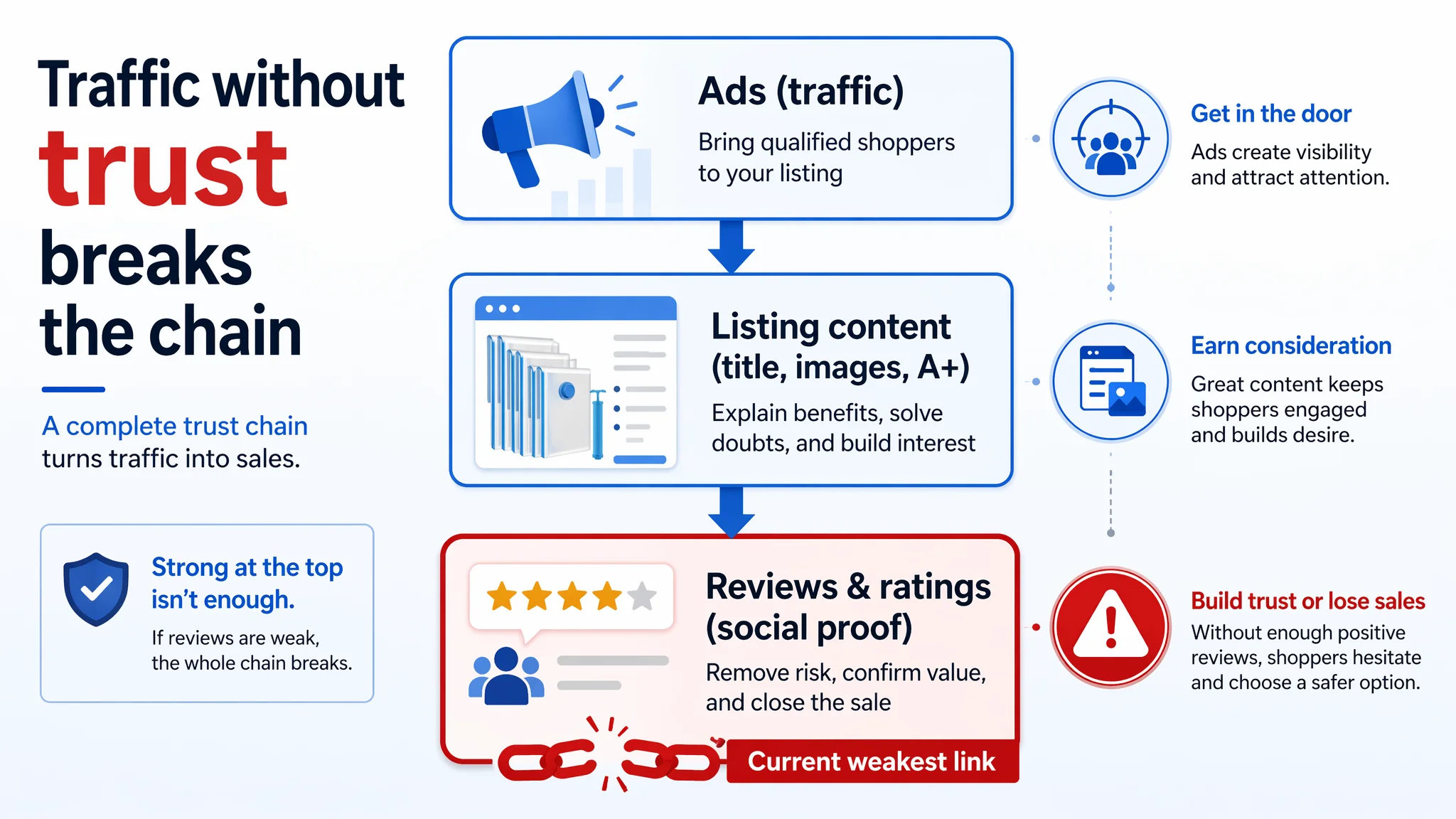
“The real problem was not that ads failed to bring traffic. It was that the page could not convert traffic in the face of an overwhelming review-gap.”
On Amazon, especially in a commoditized category like vacuum storage bags:
- A competitor with 150k+ reviews effectively carries a category-wide trust default.
- A new product with 3 reviews cannot close that trust gap with A+ alone.
- Ads, in this context, don’t “fix” the gap—they amplify the fundamental mismatch between perceived risk (unknown product) and alternatives (well-reviewed category leader).
So DeepBI’s judgment was:
- The Listing does not need a full creative teardown.
- It does need targeted visual corrections where it lags (image structure, compression visualization, valve/durability proof).
- But the business bottleneck is:
- immature review volume,
- near-zero social proof,
- and an ad strategy that assumes the page can already perform like a mature Listing.
Why Traditional Ad Optimization Couldn’t Work Here
In a setup like this, typical Amazon ad optimization playbooks fail for structural reasons:
- Keyword tuning & bid adjustments
You can refine match types and bids, but if shoppers arrive, see 3 reviews versus 149k, and bounce, no bidding trick will fix CVR. You only end up paying more per click for the same outcome.
- Creative testing inside ads
Even if you create better ad creatives, once the user reaches the product page, they still face the same review vacuum. The conversion bottleneck is on the page, not in the ad.
- Scaling spend to “buy data”
Pushing more traffic does not “teach the algorithm” to love a page whose core trust markers are weaker than all visible alternatives. It just burns budget while the competitor’s massive review base keeps absorbing most purchase decisions.
This is why DeepBI did not interpret the 70 vs 73 content score gap as a creative emergency. The issue was a misaligned traffic–trust structure, not a lack of modules or copy.
What the Listing Data Actually Said
DeepBI’s Listing scoring highlighted a few precise, content-side levers that mattered more than another round of generic “make it prettier” work.
1. Title: Focus and Readability, Not Reinvention
The competitor’s title had two key advantages:
- Brand trust signaled early (an Amazon Basics–type brand cue).
- A cleaner chain: product type → unique benefit (“no vacuum cleaner needed” + hand pump) → core use (“clothing storage, travel, mold prevention”) → simple size pack notation.
The proposed title optimization for the customer did not invent new claims; it restructured what was already there:
- Brand + “布団圧縮袋” moved to the front for keyword weight and clarity.
- Pack size “6枚セット” clarified early.
- “掃除機不要 真空圧縮袋 手動ポンプ付” linked tightly to the practical benefit.
- Size info grouped cleanly: “40×60/50×70/100×120cm 各2枚”.
- Protection features (“防湿 防カビ 防ダニ 密封 省スペース”) aligned as a compact tail.
This doesn’t magically beat 150k reviews—but it ensures the title no longer wastes any potential search and scan value.
2. Bullets: Locking in the Conversion Story
Because the bullets were already stronger than the benchmark, DeepBI focused on tightening logic and clarity rather than rewriting from scratch. Each bullet was structured around a clear “pain point → solution → outcome” path:
- BP #1 – Space-saving + protection + scenarios
Compress up to 80%, protect from moisture, dirt, bugs, mold, bad smells; ideal for seasonal wardrobe changes, travel, moving.
- BP #2 – Dual compression modes (hand pump + vacuum cleaner)
Works where there is no vacuum (travel/business trips) and also supports standard household vacuums for fast at-home compression.
- BP #3 – Material & sealing technology
Sturdy 0.08 mm PA+PE material, double zipper, triple-seal valve for long-term airtight storage.
- BP #4 – Space use & visibility
80% space reduction, under-bed/closet/suitcase organization, transparent design to find items quickly.
- BP #5 – Three sizes, six-piece set
Clear mapping of each size to typical use (duvets, sweaters, travel clothes), highlighting multi-purpose value.
These refinements matter because they help the Listing do everything it can once the shopper decides to consider the page seriously. They cannot replace review volume, but they can ensure that as reviews accumulate, the page converts as efficiently as its content allows.
3. Main Image & Gallery: Visualizing the Decision Logic
DeepBI’s image-level analysis was not about aesthetics; it was about decision support:
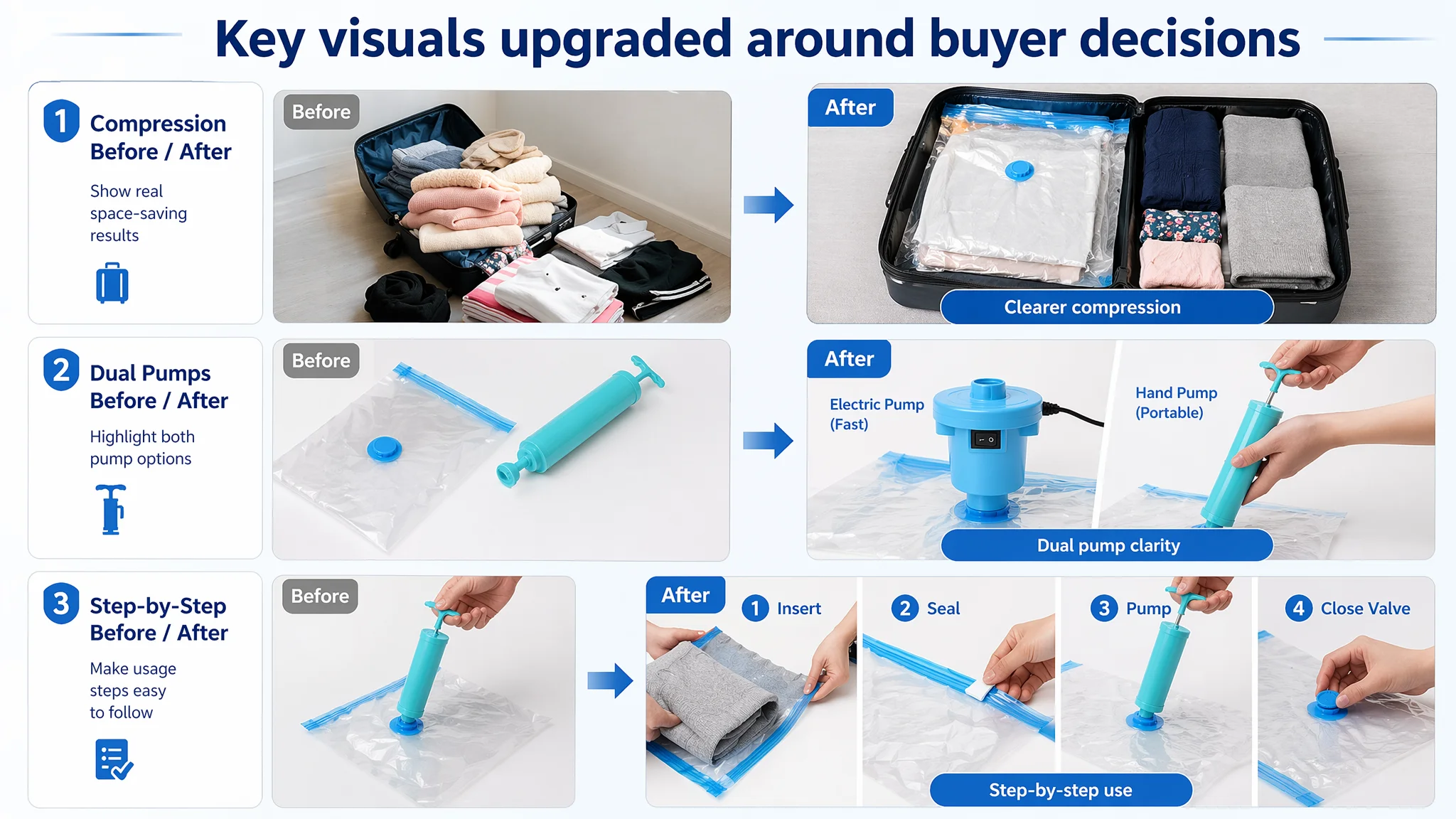
- The first image needed a clear product cluster (bags + pump) occupying about 70% of the frame, with a subtle gradient background and good light to create a distinct silhouette and immediate recognizability.
- Secondary images needed to:
- Show before/after compression in a modern bedroom or suitcase setting, with clear labels “Before / After” and visible space gain.
- Visualize 80% space saving using strong height contrast between stacked clothes before and after compression.
- Show dual pump usage (electric vacuum + hand pump) in a split composition, emphasizing compatibility and ease.
- Break down operational steps (put in, seal, pump, finish) using a four-panel sequence with hand interaction.
- Highlight valve and seal details with macro shots, making airtightness tangible rather than just claimed.
- Clarify size variants in a stepped layout, each bag with representative clothes in front.
- Demonstrate durability with a controlled tensile test image (hands pulling the bag).
These directions were not random creative ideas; they mapped directly to what the benchmark did better (clarity of parameters, compression visualization) while leveraging the customer’s stronger story and scene capabilities.
Why Listing Conversion Had to Be Repaired Before Pushing Ads
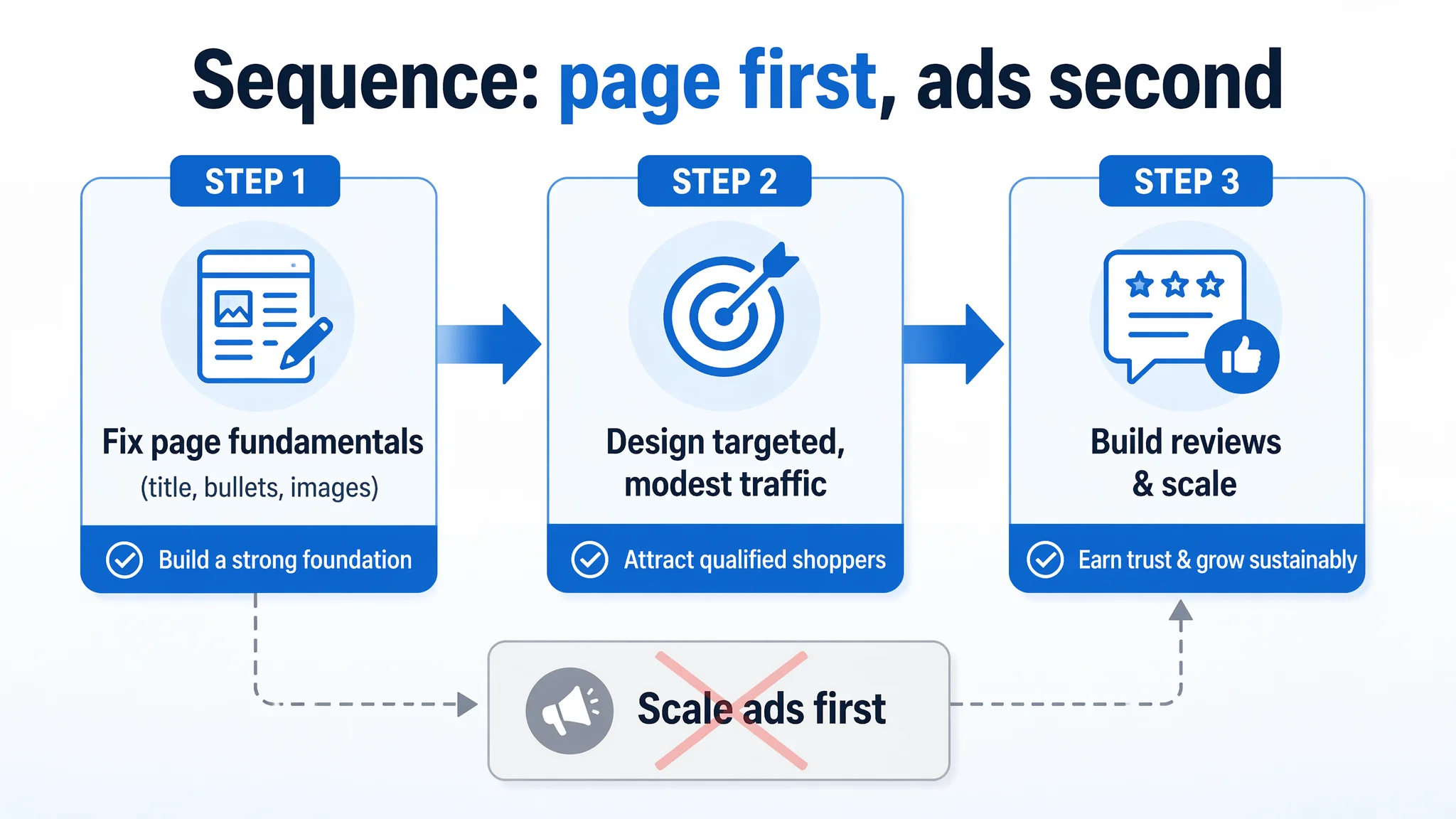
From a business perspective, DeepBI’s central judgment was about sequence.
- In its current state, the Listing’s intrinsic conversion capacity (content, images, structure) was already at or above average—but its review profile was in an extremely immature state.
- If the team continued to scale ads first, they would:
- Pay to send shoppers into a head-to-head comparison where the competitor’s 149k reviews win instantly.
- See ACOS remain stubbornly high.
- Risk drawing the wrong conclusion—“we need more creative changes”—and fall into a loop of visual tweaks that do not address the actual trust gap.
So DeepBI’s priority order was:
1. Lock in solid page fundamentals
- Make sure the title, bullets, and A+ are structurally correct and clearly aligned to pain points, outcomes, and technical reassurance.
- Upgrade images specifically where they fail to support decision-making (not random beautification).
1. Accept the review reality and design traffic accordingly
- Use ads in a measured, targeted way: focus on search terms where the competitor’s dominance is less absolute, or where new product advantages can be noticed.
- Avoid pushing broad, expensive keywords where shoppers will always see the review gap first.
1. Gradually build social proof
- As legitimate reviews accumulate, let the already-optimized content and visuals fully express their conversion potential.
- Only then consider scaling ad spend aggressively.
In other words, the Listing had to regain baseline trust relative to its category before ad traffic could become genuinely “efficient.”
How the Page’s Sales Logic Started to Recover
Once the problem was reframed, the customer team changed how they looked at their own Amazon Listing.
The page did not lack content. It lacked a coherent visual trust narrative.
After implementing the structured changes:
- The title became faster to parse, especially on mobile search results.
- Bullets formed a more obvious “why this product” path.
- A+ images no longer just looked nice; they explicitly visualized:
- Functional icons: dust, bugs, mold, odor, moisture, reusability.
- Valve structure and airtightness via macro imagery.
- Capacity contrast before/after.
- Travel scenarios with overhead suitcase shots.
- Step-by-step usage.
- Size mapping and durability tests.
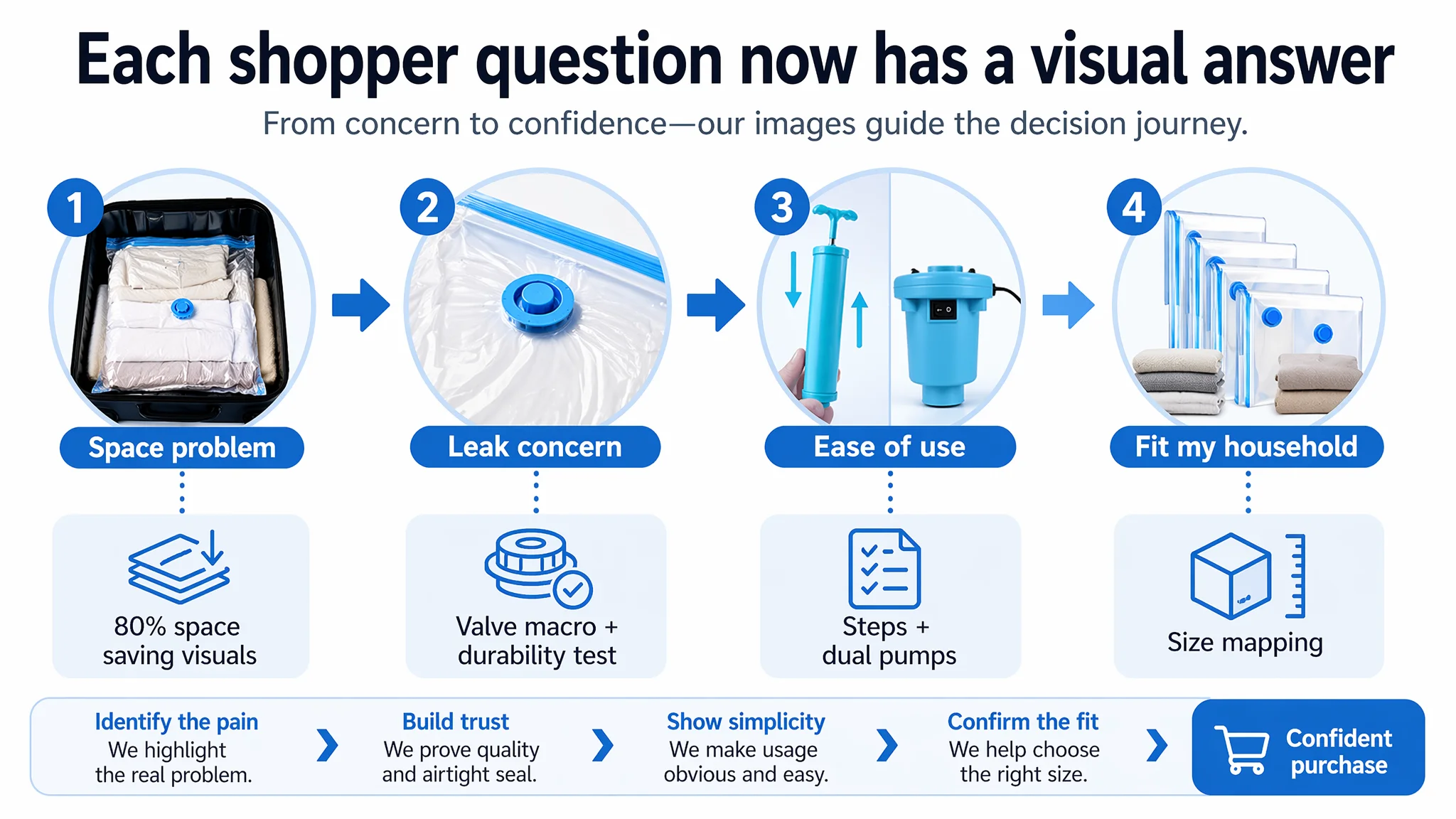
Shoppers who did give the page a chance now encountered a clear, low-friction decision journey:
1. “Will this solve my space problem?” → 80% space-saving visuals and scenarios.
2. “Will it leak after a few weeks?” → Valve macro shots, seal structure, material explanation, durability test.
3. “Is it easy to use at home and when traveling?” → Four-step sequence and dual pump support.
4. “Does the pack size fit my household?” → Size mapping, typical use per size.
Ads stopped being the scapegoat.
With this structure in place, the team could finally separate:
- What ads can influence: volume and type of traffic, discovery, initial attraction.
- What the page must carry: trust, clarity, and reasons to choose this product over a deeply entrenched competitor.
Instead of continuously rewriting creatives and adjusting bids in frustration, they saw that:
- The review gap will not disappear overnight.
- However, every new legitimate review now lands on a page that does not waste its potential.
- As the review count slowly rises, both organic and paid traffic have a much better chance to convert.
What Changed in the Business State (Even Without Invented Numbers)
Because this case does not include post-optimization performance metrics, we won’t fabricate them. What did change, however, was how controllable the business felt:
- The team stopped expecting ads to solve a review-and-trust problem.
- Listing optimization shifted from “make it prettier” to “make each stage of the buying logic visible and credible.”
- The seller learned to treat review accumulation as part of the strategic plan, not an afterthought.
In operational terms, this meant:
- Ad spend could be aligned with the actual maturity of the Listing.
- The Listing’s ability to convert both organic and paid traffic became more structurally sound, even if still constrained by review volume.
- Future ad decisions could be made with clearer expectations: when ACOS is high, the first question is now “Is this a page-level trust issue?”, not “Should we just lower bids more?”
What Other Amazon Sellers Can Take Away
Several lessons from this vacuum storage bag case apply widely across Amazon categories:
1. Don’t automatically blame ads when ACOS is bad.
If your Listing’s title, bullets, and A+ are already competitive, and your visual structure clearly supports decision-making, your problem may be trust maturity, not click-through or content.
1. A strong A+ cannot fully compensate for a massive review deficit.
In mature categories, shoppers expect reviews to de-risk their choice. A 5-star rating with 3 reviews cannot compete with a 4.1-star rating with 149k reviews, no matter how polished your A+ is.
1. Listing quality is the foundation of ad efficiency.
Ads amplify whatever your page already is—good or bad. If the page cannot convert due to missing trust, ads will simply magnify that defect and burn budget.
1. Visuals must do more than look good; they must mirror the buyer’s decision logic.
Show before/after states, core parameters, usage steps, scenes, and proof of durability. This case worked on visualizing “80% space saving,” airtightness, dual pump modes, and size mapping, not on adding random lifestyle images.
1. Before scaling, ask: “Does this page deserve more traffic?”
DeepBI’s value in this case was not a new feature; it was a different question. Instead of “How do we push more ads?” the better question became:
- “Given this review gap and this content state, what is realistically limiting our conversion right now?”
For this seller, the answer was clear: ads were not the main bottleneck; trust was. Only after facing that could Listing optimization and advertising begin to work together, instead of fighting each other.