

An Amazon seller in the barbecue accessories category came to DeepBI with a puzzling situation: their stainless-steel grill grates had solid specs, a technically strong title, and well-structured bullet points, yet the Listing was lagging far behind a benchmark competitor. Ads were hard to scale because the product page couldn’t convert reliably, and every click felt expensive.
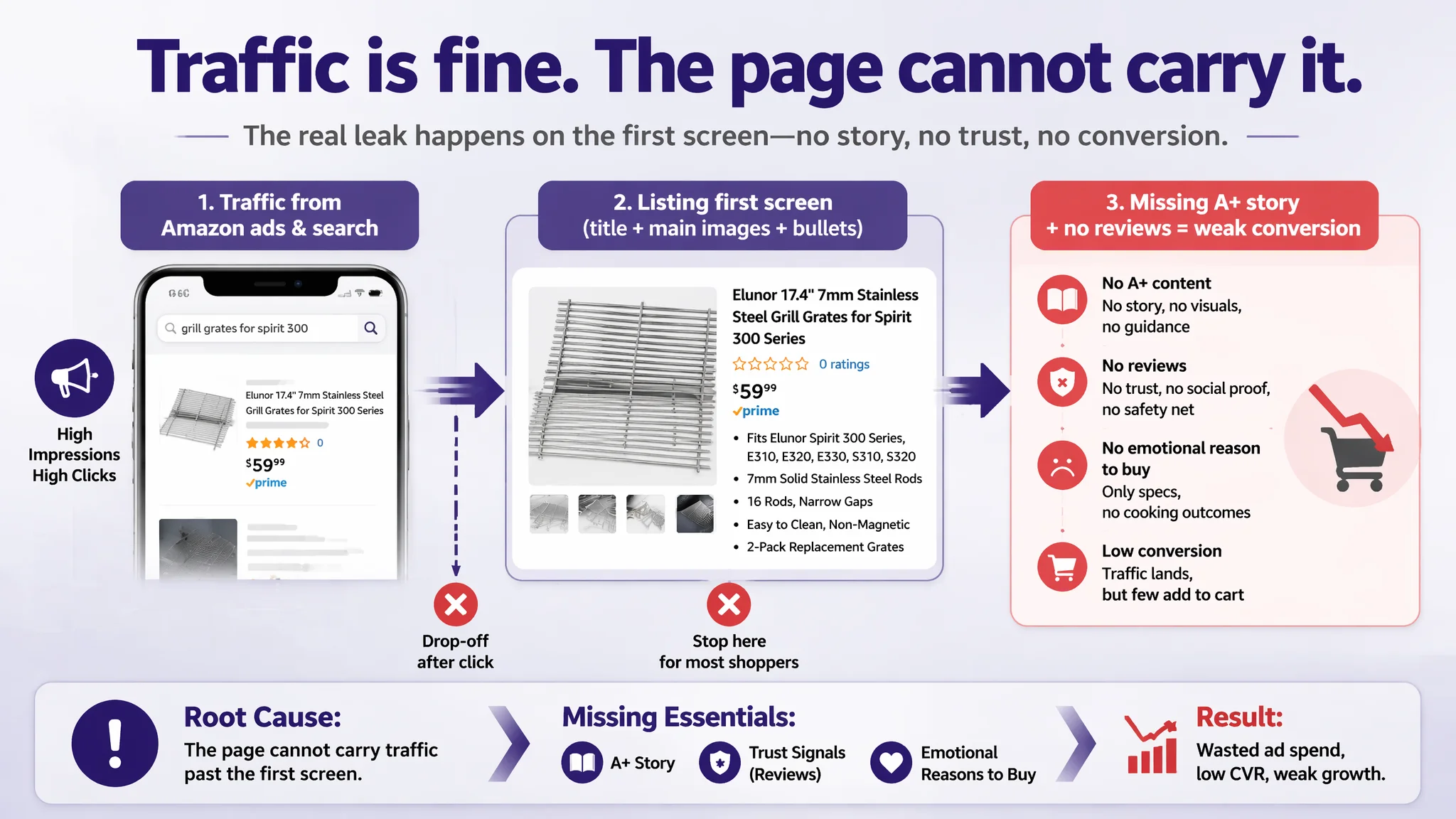
The customer’s internal diagnosis focused on “micro-optimizing” what already looked good: tightening the title, emphasizing 7mm heavy-duty rods, refining technical bullets, and tweaking main images. They believed the challenge was mainly about keyword coverage and visual polish. DeepBI’s Listing scoring, however, exposed a different reality: the core leak wasn’t in the specs or micro-copy—it was the total absence of A+ content and trust infrastructure, amplified by a complete lack of reviews.
Once the problem was reframed as “a Listing that cannot carry traffic past the first screen,” the optimization direction shifted: build a persuasive A+ story, convert technical advantages into visible cooking benefits, and design main/secondary images around food, ease of cleaning, and fit confidence—not only around steel rods and measurements. For other Amazon sellers, this case is a clear reminder: a technically solid product and “good enough” title are not enough if your page offers no emotional reason to buy and no trust backbone. Ads will only magnify that gap.
Amazon Ads Were Not the Issue. The Page Was Consuming the Traffic.
DeepBI’s scoring put hard structure on what the seller was feeling in the ads dashboard.
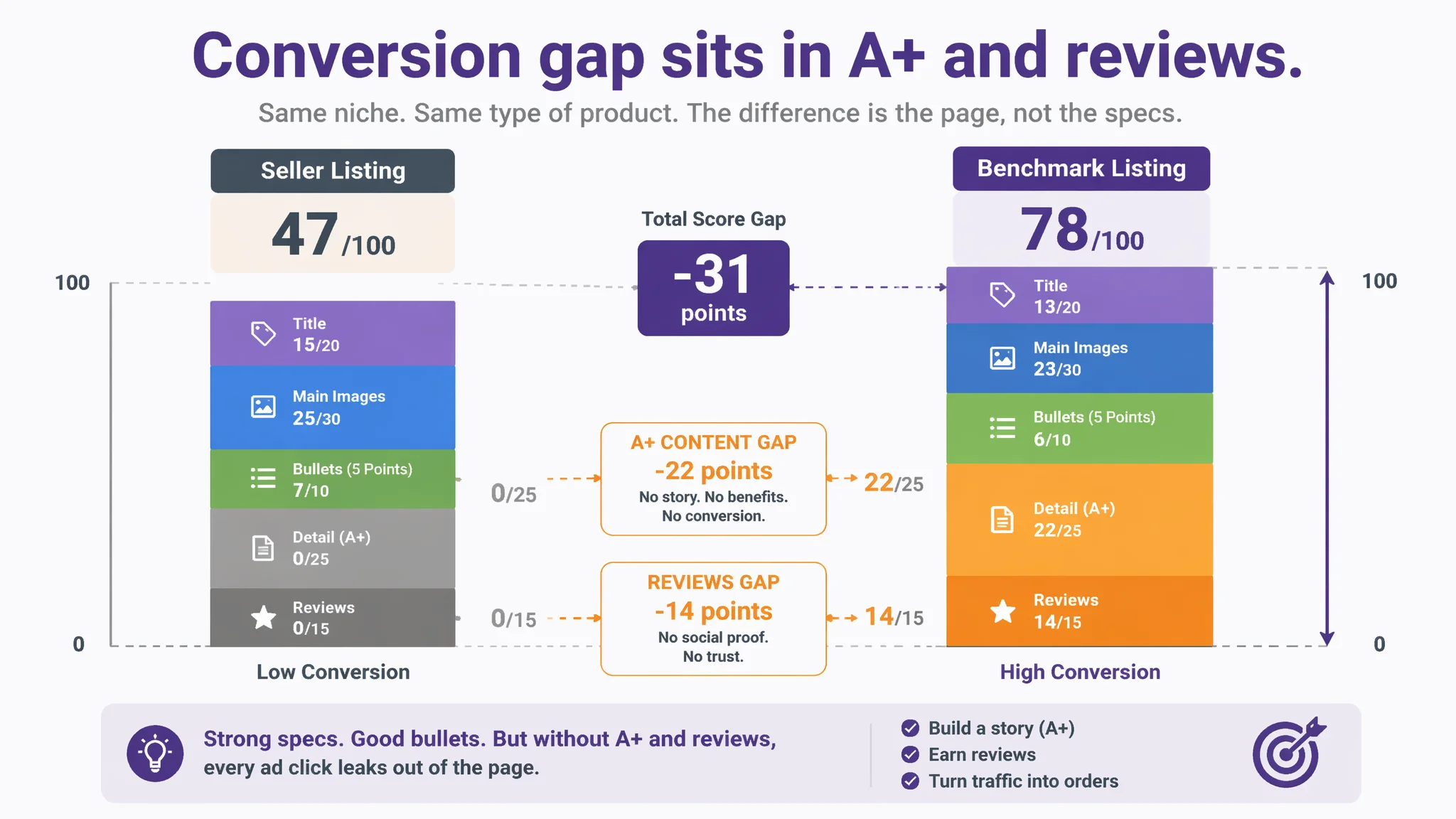
- The customer Listing scored 47/100.
- A directly comparable benchmark Listing in the same Amazon US grill-grate niche scored 78/100.
- The gap was not evenly spread; it clustered in two critical areas: A+ / detail content and reviews.
On paper, the seller’s core modules looked “fine”:
- Title: 15/20 vs competitor’s 13/20 — actually slightly ahead.
- Main image set: 25/30 vs competitor’s 23/30 — again, numerically ahead.
- Bullet points: 7/10 vs competitor’s 6/10 — solid and technically detailed.
The shock came from:
- Detail / A+ content: 0/25 vs competitor’s 22/25.
- Reviews: 0/15 vs competitor’s 14/15 (4.7 stars, 186 reviews).
“The real problem was not that ads failed to bring traffic. It was that the page could not convert the traffic.”
From an ads perspective, this is lethal. Paid clicks land on a page that:
- Has no A+ visuals, no structured story, no compatibility matrix.
- Shows zero reviews and no social proof.
- Speaks in technical language but offers no emotional or outcome‑based reassurance.
Every extra click driven by advertising simply falls into a page that cannot absorb it.
The Seller’s Original Misdiagnosis: “Our Specs Are Strong. We Just Need Better Keywords and Images.”
Before DeepBI, the seller’s internal narrative was centered on product strength:
- 7mm solid stainless rods, versus typical 5mm grates.
- Detailed compatibility lists for Weber Spirit and Genesis series.
- Non-magnetic, food-grade stainless steel, polished surface, ease of cleaning.
They believed the problems were:
- Perhaps the title was not fully leveraging keywords (“Weber Spirit Grill Grates” not front-loaded enough).
- Maybe main images looked “too industrial” and less lifestyle-oriented than competitors.
- Bullet points could be made more persuasive, but overall “the content was already professional.”
So their energy went into:
- Adjusting title structure while keeping brand forward.
- Adding more parameter-heavy images, specs overlays, and technical explanations.
- Fine-tuning bullet points around diameter, rod count, magnetism.
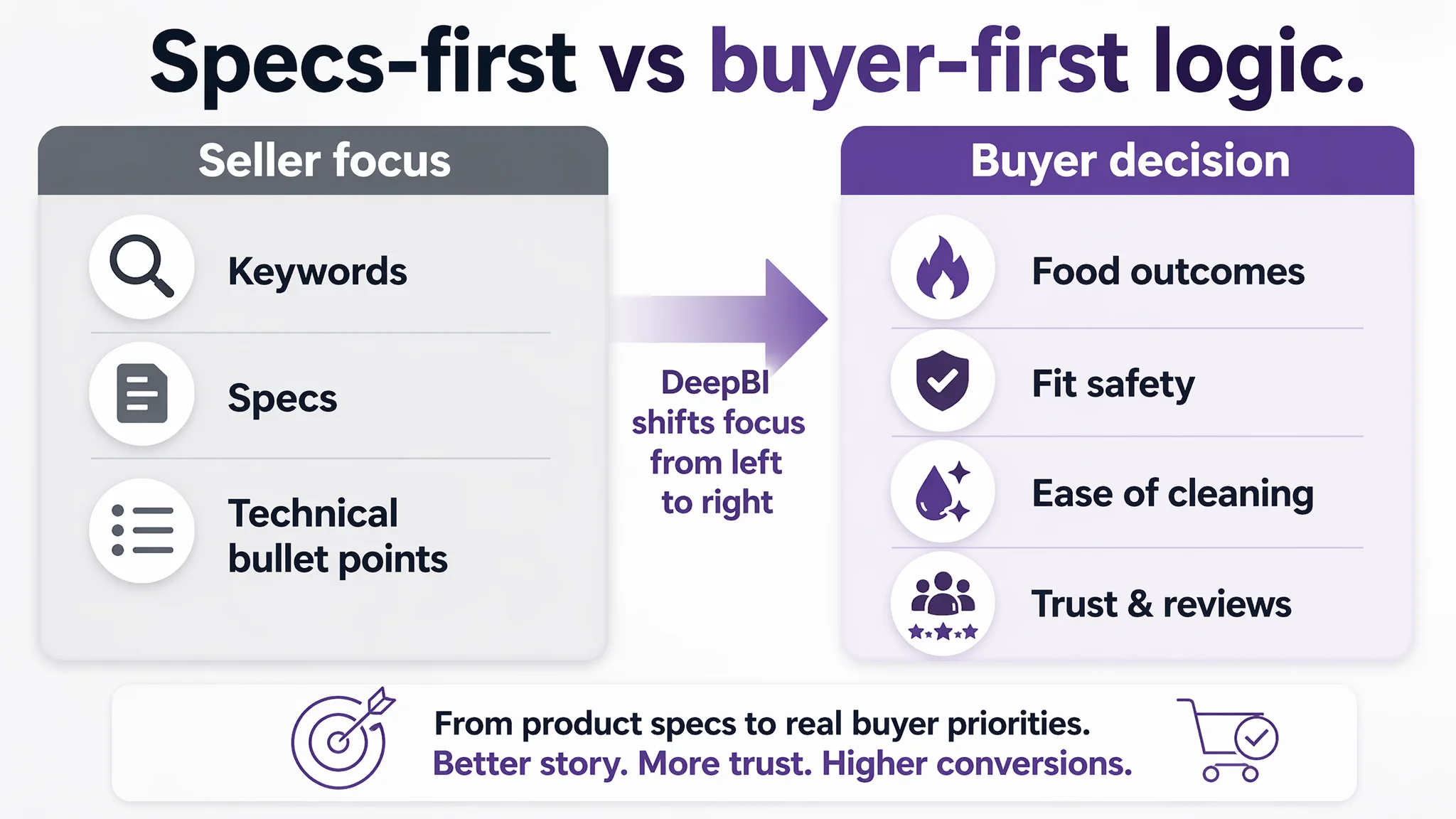
These are reasonable actions for a seller that sees the world through specs and engineering. But in Amazon’s actual buying logic, the main constraint wasn’t the detail of the rods—it was the lack of a page narrative that helped a backyard griller feel safe, hungry, and confident enough to click “Add to Cart.”
What DeepBI’s Scoring Actually Revealed: A Listing with No Story and No Trust
DeepBI’s Listing scoring didn’t just show a low total score; it clarified where the Listing was structurally weak relative to the benchmark.
The Title Was Not the Bottleneck
The seller’s title already:
- Clearly stated size (17.4", 7mm), material (stainless steel), and use (grill grates for specific series).
- Listed multiple compatible models and replacement part numbers (E310/E320/E330, GS4 Spirit II, Genesis Silver B/C, Weber 7638/7639 etc).
The competitor took a broader compatibility approach (“Genesis Silver/Gold/Platinum… Genesis 1000–3500”), improving reach, but title performance was not the main drag—the seller was slightly ahead in the title scoring dimension.
DeepBI still recommended a revised title path: move “Weber Spirit Grill Grates” further forward and fuse some of the competitor’s high-volume compatibility labels to widen search coverage. But even perfect title optimization would not fix the underlying conversion logic.
The Main Images Were Technically Fine but Emotionally Thin
The seller’s image set leaned heavily on:
- Product-only angles on white or dark backgrounds.
- Parameter overlays, rod thickness emphasis, dimension callouts.
- Close-ups of rods and welds.
The competitor’s set, in contrast:
- Showed rusted vs clean grates side by side.
- Used flames, steaks, and multi-food grill scenes to induce appetite.
- Visualized cleaning with a brush in motion, showing “before and after.”
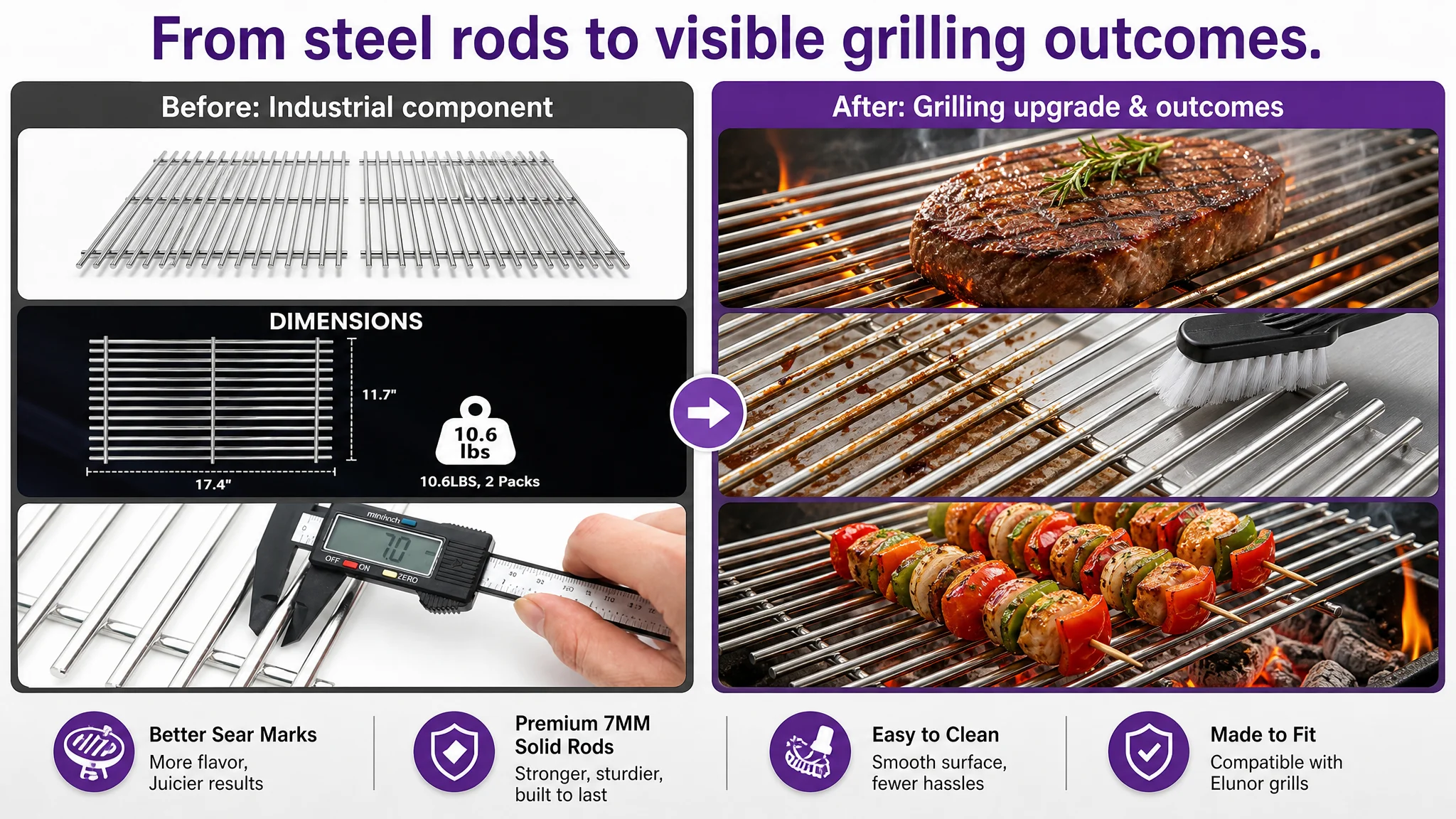
The seller’s main image dimension score was slightly higher than the competitor’s, but the visual function was different:
- Seller: “industrial component” positioning.
- Competitor: “high-end grilling lifestyle” positioning.
The issue was not that the seller had “bad images”, but that images were not anchored to the decisions buyers make: Will my food look better? Will cleaning be easier? Will it fit my grill? Can I trust this upgrade?
The Real Black Hole: A+ Detail and Reviews
The decisive gaps:
- A+ content: Seller 0, competitor 22/25.
- Reviews: Seller 0, competitor 14/15 (4.7 stars, 186 reviews).
DeepBI’s detail-page analysis found the competitor running a full A+ stack:
- Hero scene with steak, flames, herbs — immediate appetite and premium feel.
- Dimension and compatibility graphics, including a matrix covering 10+ models.
- Function–effect–cleaning sequence: heat conduction → browning → easy cleanup.
- Material benefit visualization: rust vs no rust.
- Cleaning demonstration imagery.
The seller, by contrast, had no A+ content at all:
- No scene entry point.
- No compatibility graphics.
- No “function-to-benefit” chain.
- No dedicated cleaning or rust-proofing visual explanation.
Combined with zero reviews, the Listing asked buyers to trust:
- Raw specs,
- A few technical bullet points, and
- Bare product photos.
That’s not enough to carry ad traffic or convert organically in a mature category.
“Advertising does not only amplify advantages. It can also amplify a page’s existing defects.”
Why Listing Conversion Had to Be Fixed Before Any Serious Ad Scaling
With this diagnostic in hand, DeepBI’s core judgment was straightforward: Pushing more traffic at this page would mainly increase wasted spend.
Key reasons:
1. No A+ = No Story.
In a category where the competitor uses seven A+ modules to narrate “better cooking + easier cleaning + no rust + guaranteed fit,” the seller’s blank A+ area is a hard conversion barrier.
1. No Reviews = No Social Proof.
A grill owner replacing grates for a branded BBQ will not treat this as a trivial purchase. Without ratings, they hesitate.
1. Technical Bullets Without Emotional Bridge.
“7mm” and “16 solid rods” matter, but not if buyers cannot see what that means for sear marks, food not falling through, or long-term durability.
1. Industrial Visual Tone Misaligned with Actual Buying Motivations.
Grilling is about food, friends, weekends, and avoiding hassle. A purely industrial tone misses the emotional trigger.
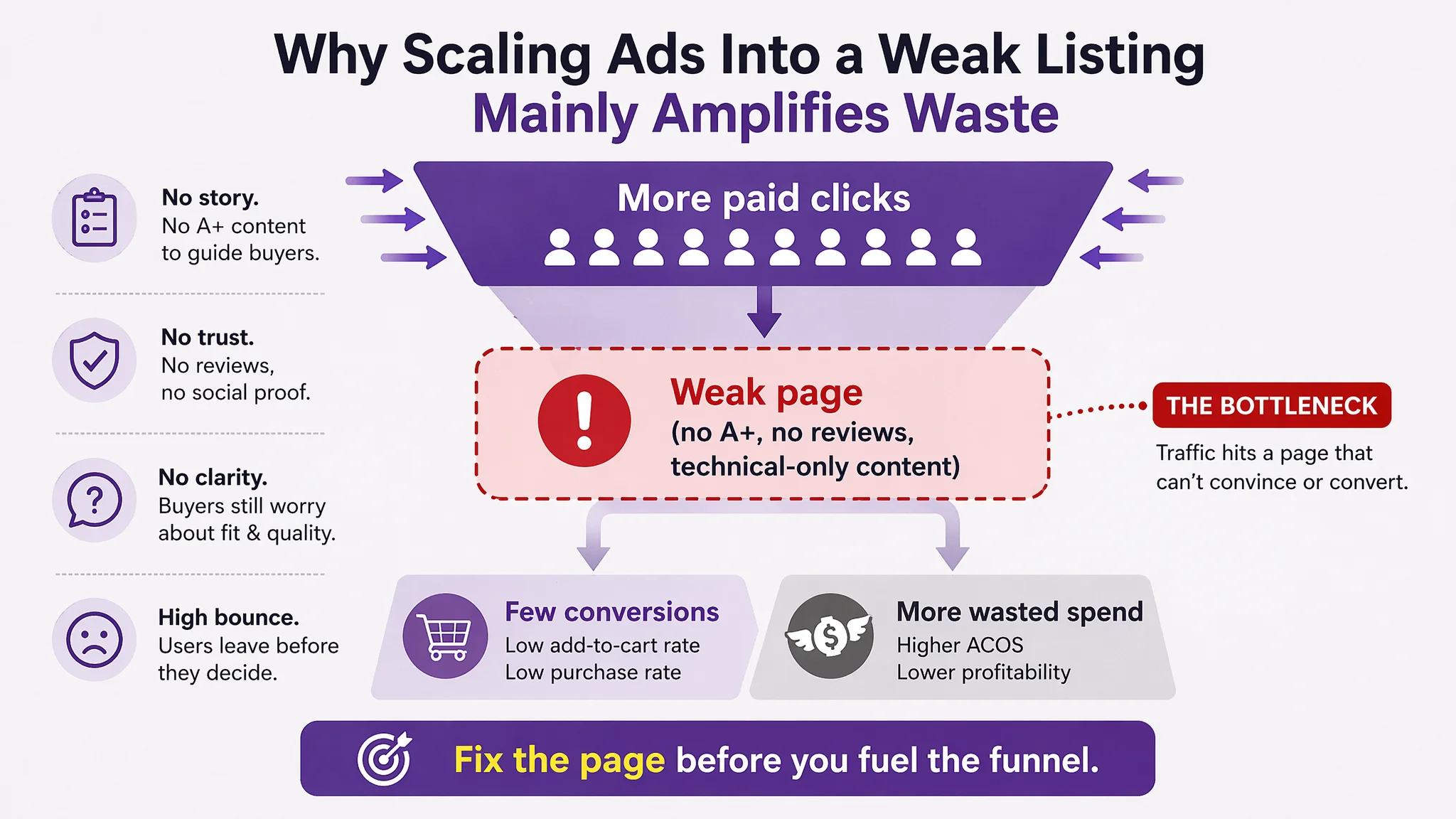
DeepBI’s position: Until the Listing can show cooking outcomes, visualize fit and cleaning, and supply a trust backbone, ad campaigns will simply expose users to a half-built page and deliver underwhelming CVR.
This Product Page Did Not Lack Traffic. It Lacked Trust and Food Outcomes.
DeepBI reframed the optimization not as “make the images prettier” but as rebuild the decision logic of the page.
From “Industrial Part” to “Grilling Upgrade”
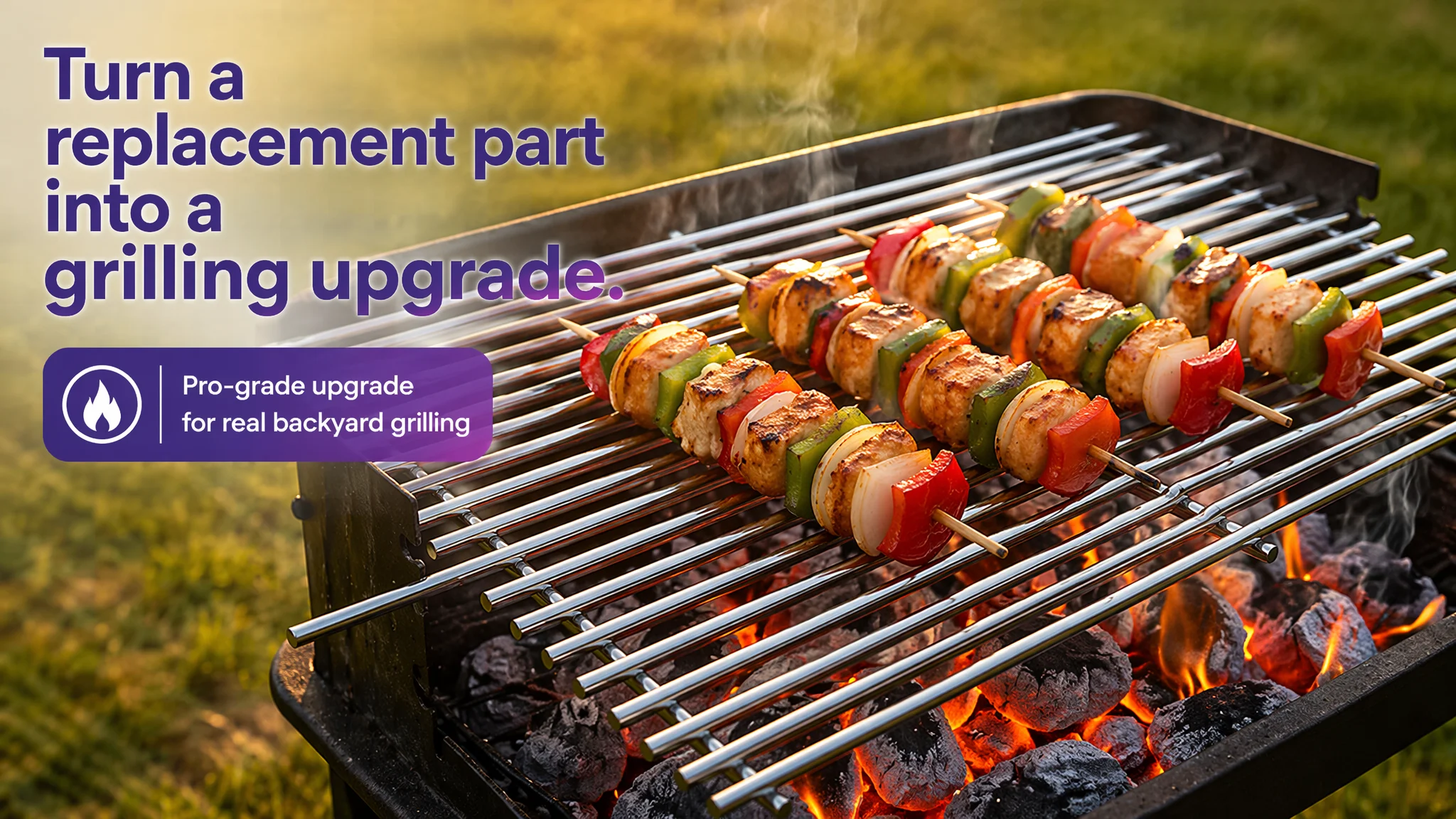
The key shift was conceptual: Stop treating the grates as a replacement part; start framing them as a pro-grade upgrade to the grilling experience.
Visually, that means:
- Hero imagery: steak, skewers, flame, and outdoor garden atmosphere, not just rods against a black background.
- Composition that puts food and the grate in the same frame, so buyers see where their money goes.
From Specs to Benefits
Technical parameters stayed, but they had to be translated:
- 7mm rods → heavier heat retention & better sear marks.
- 16 solid rods → narrow gaps, less food falling, more even cooking.
- Electro-polished surface → non-stick feel, easier cleanup.
- Non-magnetic stainless → long-term rust resistance.
The future content path: Show this visually, not just say it.
How DeepBI Guided the Page Rebuild: From A+ Absence to a Persuasion Structure
Instead of starting with more ad tweaks, DeepBI’s plan focused on rebuilding the Listing itself.
1. Rewrite the Bullet Points Around Buyer Logic
The seller’s bullet points were already technically advanced, but they needed to be repackaged as decision paths, not parameter lists. DeepBI proposed a restructured set:
- BP #1 – Ultimate Compatibility & Risk Reduction
Lead with precise Weber Spirit and Genesis series coverage, list part numbers, and explicitly ask buyers to measure before ordering. This directly tackles the “wrong model” fear that drives returns.
- BP #2 – Heavy-Duty 7mm Value Proposition
Turn “7mm” into a promise: thicker than standard 5mm OEM grates, better heat retention, professional-level searing, rust-proof, warp-resistant.
- BP #3 – Dimensions & Narrow Gaps for Real Cooking Use
Exact measurements plus the “16 solid rods with narrow spacing” angle: no small food falling through, perfect grill marks, safe handling.
- BP #4 – Effortless Cleaning vs Cast Iron Hassle
Explicitly contrast cast iron maintenance with stainless ease: no seasoning required, brush-only cleanup, corrosion-resistant.
- BP #5 – Upgrade Positioning and Support
Frame the grates as a pro-grade upgrade rather than a generic replacement, backed with response promise for compatibility or quality questions.
This doesn’t change what the product is; it changes how the information flows from risk → value → usability → maintenance → assurance.
2. Redesign Main Images as a Conversion Toolkit
DeepBI’s visual recommendations were not “make it prettier”; they were engineering-level instructions for images that align with Amazon buyer behavior.
Examples:
- Primary product shot:
Grates centered, 45° top-side angle, strong directional light creating parallel shadows, clean white background. Purpose: establish premium industrial quality at a glance.
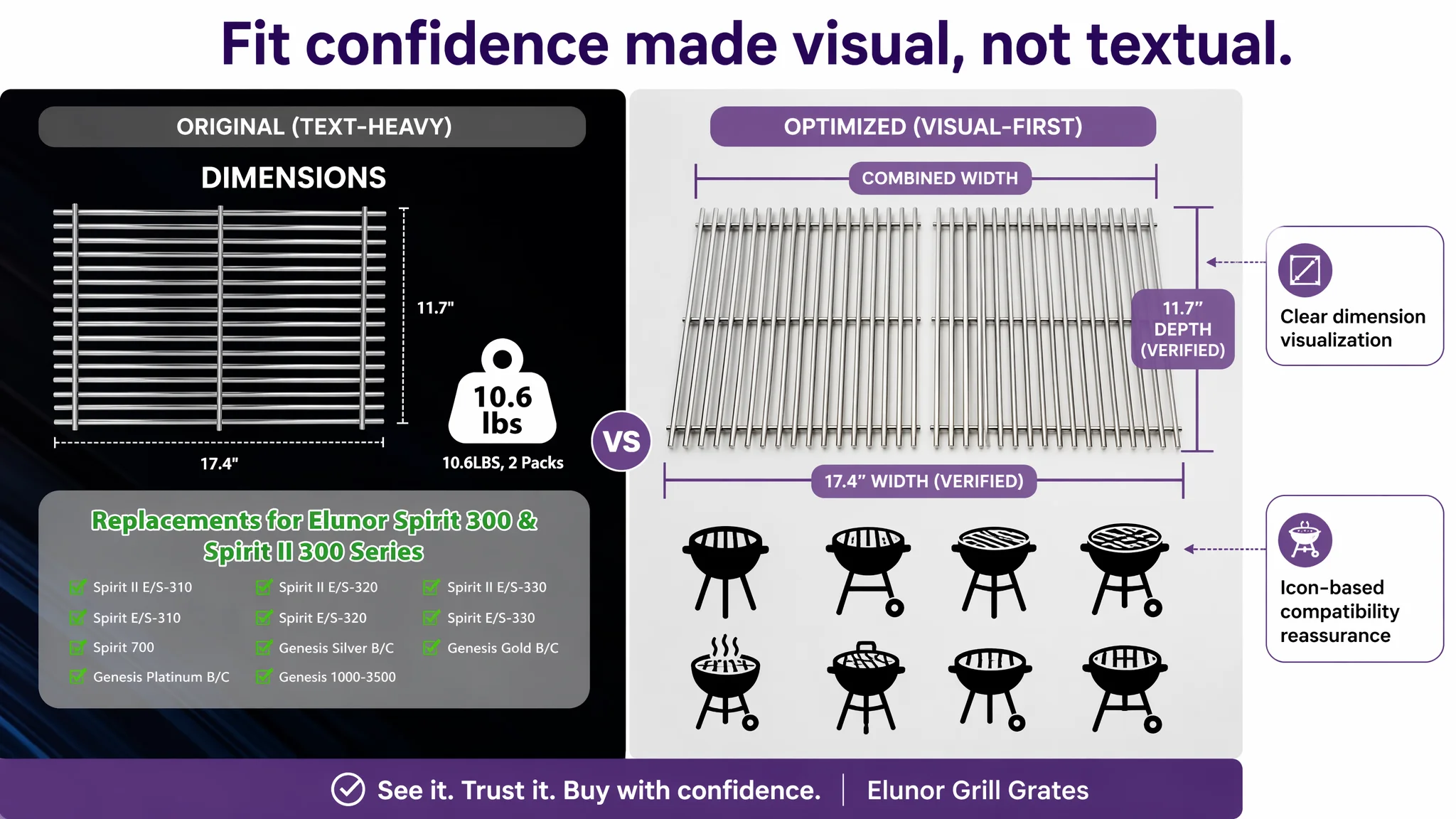
- Compatibility & dimensions image:
Two grates laid out with precise dimension overlays in a purple accent frame, plus a grid of simple grill icons to represent compatible models. Purpose: visual fit confidence.
- Food outcome image:
Split-screen: juicy steak grilling on the rods (70%), circular zoom window showing solid rod cross-section (30%) with text “100% Food Grade Solid Rods”. Purpose: connect material to food impact.
- Cleaning image:
Diagonal composition showing a cleaning brush crossing rods, with a clear “dirty vs clean” path and a headline such as “Clean up is easy and quick”. Purpose: attack the cleaning pain point visually.
- Lifestyle grilling image:
Flame under the grates, skewers with colorful vegetables and meat, outdoor dusk lawn blurred in the background, “Enjoy Delicious Food” tagline. Purpose: shift from component to experience.
Each image is designed to answer a specific buyer question: What does it look like? Will it fit? Will my food be better? Will cleaning be easier?
3. Build an A+ Story Where There Was None
The most dramatic structural change is at the A+ level. The goal: move from 0 to a coherent narrative that rivals the benchmark.
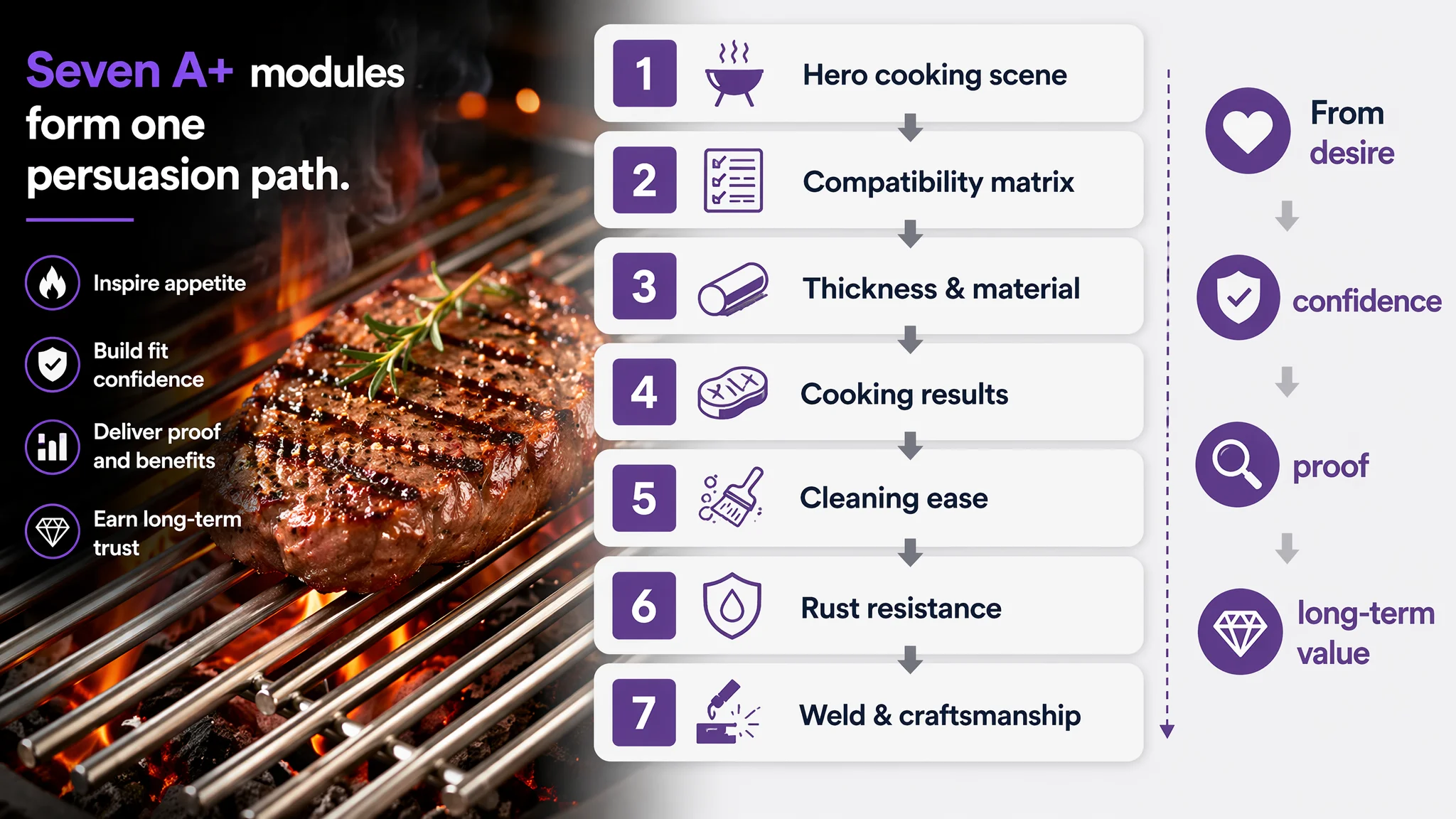
Proposed modules:
1. Hero usage scene
Outdoor BBQ scene with the product in use, flames under the grates, meat cooking. Warm orange tones, high contrast. Purpose: immediate appetite and lifestyle entry.
1. Compatibility module with icons
Visual matrix showing core Weber Spirit and Genesis series models with icons, alongside the grates image. Purpose: demystify fit, lower perceived risk.
1. Thickness & material module
Caliper measuring 7mm rods, with a visual comparison to typical 5mm rods. Cold-toned industrial feel to emphasize authority. Purpose: prove “heavy duty” instead of just claiming it.
1. Cooking-result module
Macro shot of steak with perfect sear marks over tightly spaced rods, blurred coal behind. Purpose: tie “16 rods / narrow gaps” to visibly better grilling.
1. Cleaning module
Brush-in-action image, bright outdoor light, polished rods. Purpose: show “no seasoning, easy cleanup” in motion.
1. Rust-resistance module
Split visual: bright stainless rods versus abstracted rusted grid with icons (check vs cross). Purpose: communicate long-term value.
1. Weld & craftsmanship module
Micro shot of weld points, clean edges, high sharpness. Purpose: signal manufacturing quality and safety (“no sharp burrs”).
The A+ rebuild isn’t about volume; it’s about creating a path: Food desire → fit confidence → technical superiority → cooking benefits → easy maintenance → long-term durability → craftsmanship trust.
How Ad Traffic Becomes Useful Again Once the Page Can Convert
When this type of Listing repair is implemented, several critical business shifts tend to follow, even without inventing specific numbers:
- Conversion rate starts to stabilize
Paid traffic lands on a page that provides visual and textual answers, not just specs. Fewer users bounce on first scroll.
- ACOS becomes more manageable
Because the page converts a higher share of clicks, ad spend stops leaking as badly on non-buyers.
- Organic ranking has a chance to improve
As CVR improves, Amazon’s algorithm is more willing to reward the Listing with better visibility on important keywords.
- Traffic structure becomes less risky
Sellers can rely on a growing base of organic orders; ads are no longer forced to shoulder all volume at poor efficiency.
- The Listing regains its ability to work without constant manual babysitting in ads
Once the page can stand on its own, incremental ad optimization (keywords, bids, match types) finally starts paying off.
The seller’s understanding also changes:
- Ads are not a universal fix; they expose the strengths and weaknesses of the product page.
- Title, main image, bullet points, and A+ content must act together as a conversion system, especially in categories where competitors already do this well.
- Before scaling PPC, the team must ask: “Does this page deserve more traffic?”
What Other Amazon Sellers Can Take from This Grill-Grate Case
This case is not really about grill grates. It’s about the difference between technical completeness and conversion completeness on Amazon.
Key takeaways for other sellers:
- A strong spec, good title, and decent images do not guarantee conversion if your Listing is missing a trust and story layer.
- Zero A+ and zero reviews in a mature category is not a minor gap; it is a structural failure that forces ads to carry a page that cannot perform.
- Bullet points must connect parameters to real user benefits and pain points, not stay at the level of engineering detail.
- Visuals must answer practical concerns (fit, cooking results, cleaning, durability) and emotional drivers (food, lifestyle, safety), not just “show the product.”
DeepBI’s real value in this case was not generating new pictures or rewriting text. It was identifying that the seller was optimizing the wrong layer and showing, with data and competitor comparison, that the Listing’s core constraint was conversion capacity—not advertising settings.
For Amazon sellers under ad pressure, this is the core judgment that often separates “more spend, same outcome” from “smarter spend, better outcomes.”