

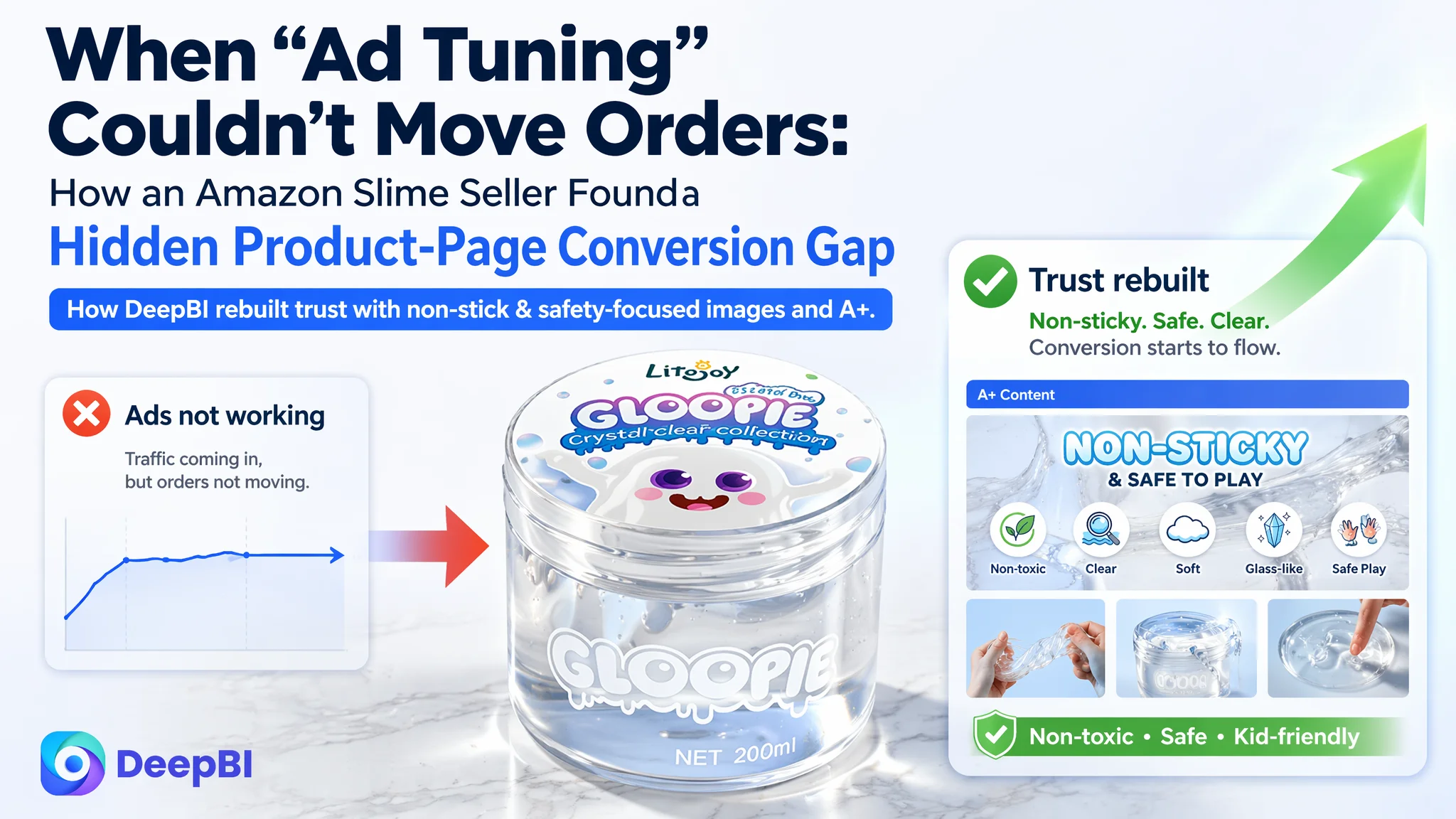
This case comes from an Amazon US seller in the crystal slime niche. On the surface, the Listing “looked fine”: decent title, attractive main image, emotional bullet points. The team believed their main issue was ad performance and keyword bidding, and they spent most of their energy on Amazon ads. Yet orders stagnated while a benchmark clear-slime competitor continued to dominate.
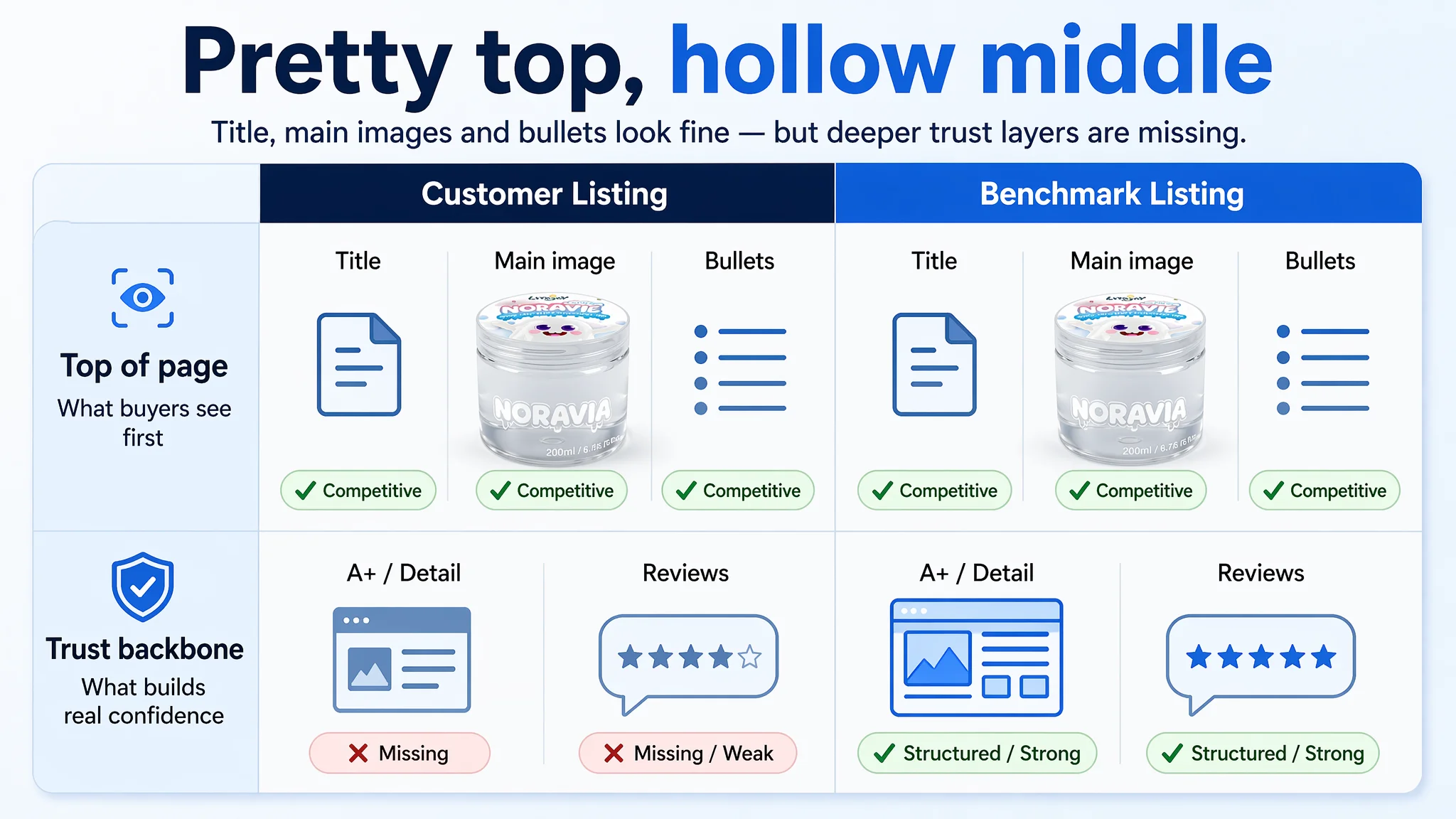
When we put the two Amazon Listings side by side, a different picture appeared. The customer’s title, main image, and bullets actually outscored the competitor in several dimensions. The real collapse was in the A+ / detail section and the review base: almost no A+ content, almost no review volume, and no structured way to address the category’s biggest fears—stickiness and safety. Ads were not the core problem; the product page simply could not convert the traffic it received.
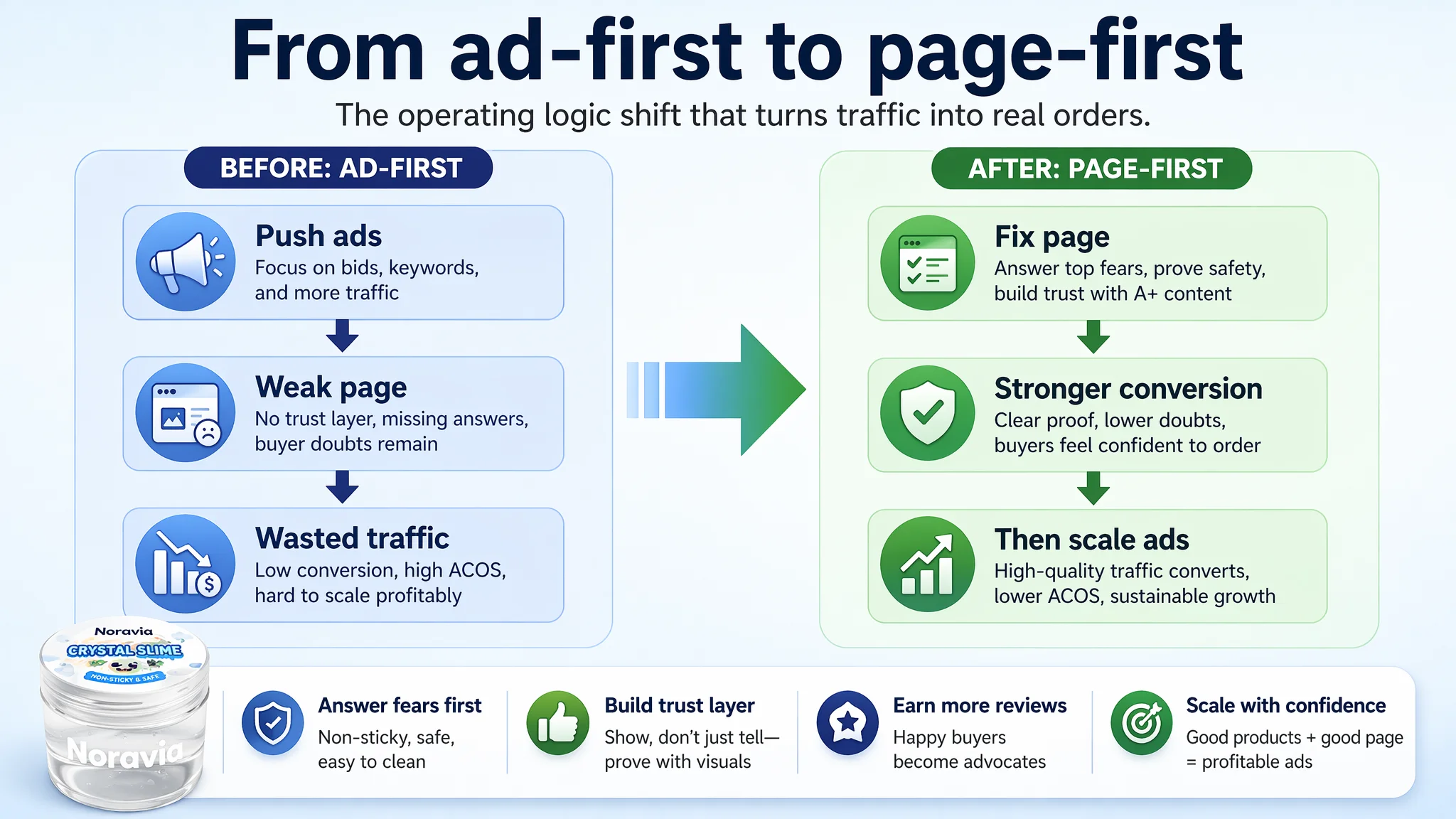
DeepBI advised the seller to stop trying to “win back performance” by pushing ads harder and instead rebuild the page’s sales logic: restructure the main image set around non-stick & safety proof, add an A+ story that leads with “what you get + non-sticky + safe formula”, and make the gift/sensory-tool angle explicit. Once the Listing started to explain and prove the right things, ad traffic could finally work again.
For other Amazon sellers, this case is a reminder: when a page is missing an entire trust layer (especially A+), you can have a nice title and strong images and still fail to monetize traffic. Before raising bids or expanding keywords, you need to ask: does my Amazon product page actually answer the buyer’s top risks in the first few scrolls?
The Core Conflict: Ads Were Carrying a Page With No Trust Backbone
From the seller’s perspective, the situation was simple and frustrating:
- They were running Amazon ads on a clear crystal slime for kids.
- Traffic was not terrible, but orders and CVR lagged far behind a well-known clear-slime competitor.
- ACOS was hard to control; any attempt to push bids quickly looked unprofitable.
- Internally, the team kept circling the same conclusion: “Our main image and title are not strong enough; we need better creatives and keyword tuning.”
On first glance, that diagnosis sounded reasonable. Clear slime is a highly visual, impulse-driven category; if you lose the click, you lose everything. But DeepBI’s Listing scoring told a different story.
What the seller saw vs. what the data showed
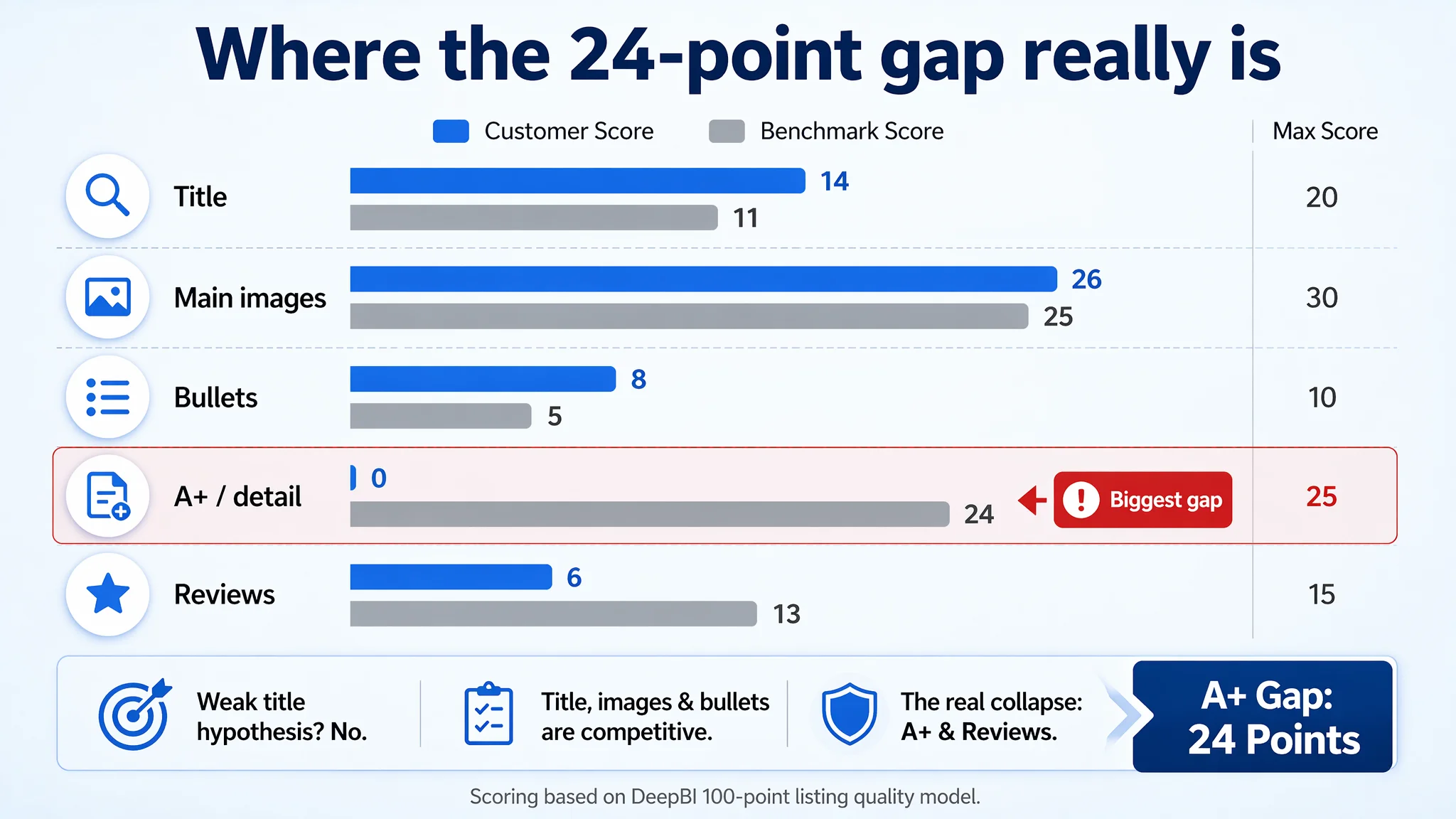
Listing score comparison (100-point system):
- Customer Listing total score: 54/100
- Benchmark Listing total score: 78/100
- Gap: -24 points
Drilling down by dimension:
- Title: Customer: 14, Benchmark: 11, Max: 20, Gap: +3
- Main image set: Customer: 26, Benchmark: 25, Max: 30, Gap: +1
- Bullet points: Customer: 8, Benchmark: 5, Max: 10, Gap: +3
- A+ / detail: Customer: 0, Benchmark: 24, Max: 25, Gap: -24
- Reviews: Customer: 6, Benchmark: 13, Max: 15, Gap: -7
The seller’s “weak title” hypothesis simply didn’t hold. On a pure Listing quality basis, the title, main image, and bullets were not the bottleneck. The absolute collapse was in:
- A+ / detail content: 0 vs. 24
- Review system: 9 reviews vs. nearly 10,000 for the benchmark
The Listing was attractive at the top but hollow underneath.
“The real problem was not that ads failed to bring traffic. It was that the page could not convert the traffic.”
The Original Misdiagnosis: Treating a Trust Problem as an Ads Problem
The customer team’s mental model was linear:
“If CTR and CVR are weak, our images and keywords must be bad. Fix creatives, tune bids, expand keywords.”
So they kept:
- Testing small variations on the main image.
- Adjusting bids and keyword match types.
- Trying to copy some of the benchmark’s keyword patterns.
But two things were missing from their judgment:
1. They did not quantify their content vs. the benchmark across all modules.
They felt their page was “weaker overall,” but could not see that their title and front images were already competitive, while their A+ was literally non-existent.
1. They underestimated the specific fears in this category.
For slime, the first three questions parents ask are:
- Will it stick to hands, clothes, and furniture?
- Is it safe and non-toxic for kids?
- Is it actually fun and worth the mess?
The benchmark Listing answered all three with images, text, and brand signals. The customer Listing answered almost none of them beyond some high-level copy in bullets.
As a result, every incremental ad dollar was driving traffic into a page that did not systematically resolve the top decision risks. Ads were not under-optimized; they were being set up to fail.
What DeepBI’s Scoring Exposed: A Hollow Mid-Funnel
From a DeepBI perspective, the key question was:
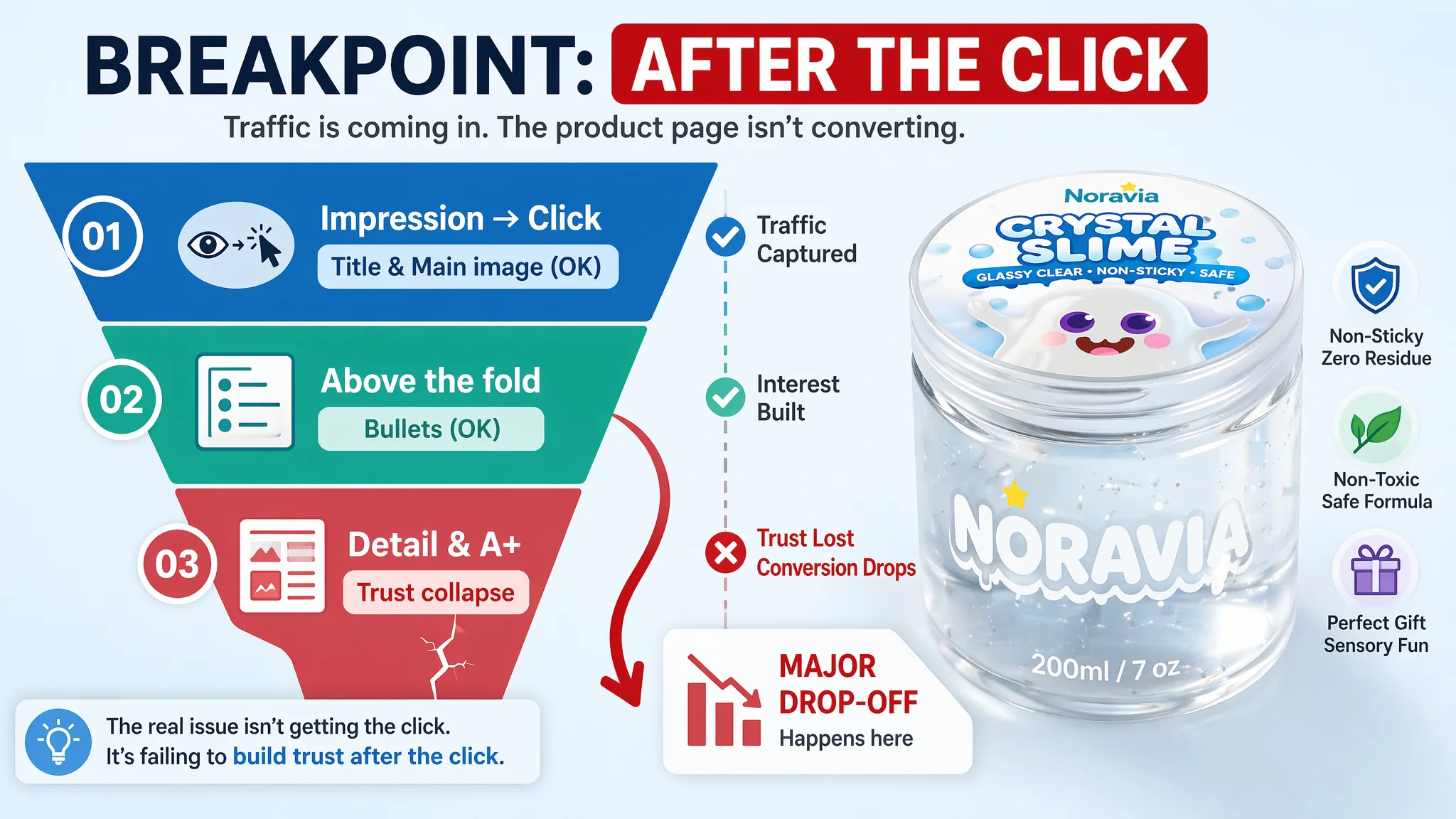
“Where exactly is the conversion funnel breaking: at the click, or after the click?”
The score breakdown provided the evidence chain.
Title: Not the bottleneck
The customer’s title:
- Front-loaded the core term “Crystal Slime”, aligning with Amazon search behavior better than a competitor that led with brand name.
- Included 200ml and a clear value promise: “Ultimate Stress Relief & Sensory Fun for All Ages.”
- Followed a mature structure: product + core attribute + core function + capacity + value proposition + variant.
- Embedded long-tail intent terms: “Stress Relief,” “Sensory Fun,” “All Ages.”
Yes, the title was longer and close to Amazon’s character limit, but in terms of search relevance and conversion-driving language, it was not the weak link. DeepBI’s own optimized suggestion only refined, rather than reinvented, the structure.
Main images: Visually attractive, but with one dangerous cue
The main image set actually scored slightly higher than the benchmark. It highlighted the product’s crystal-clear appearance and capacity. However, a crucial detail mattered in this category:
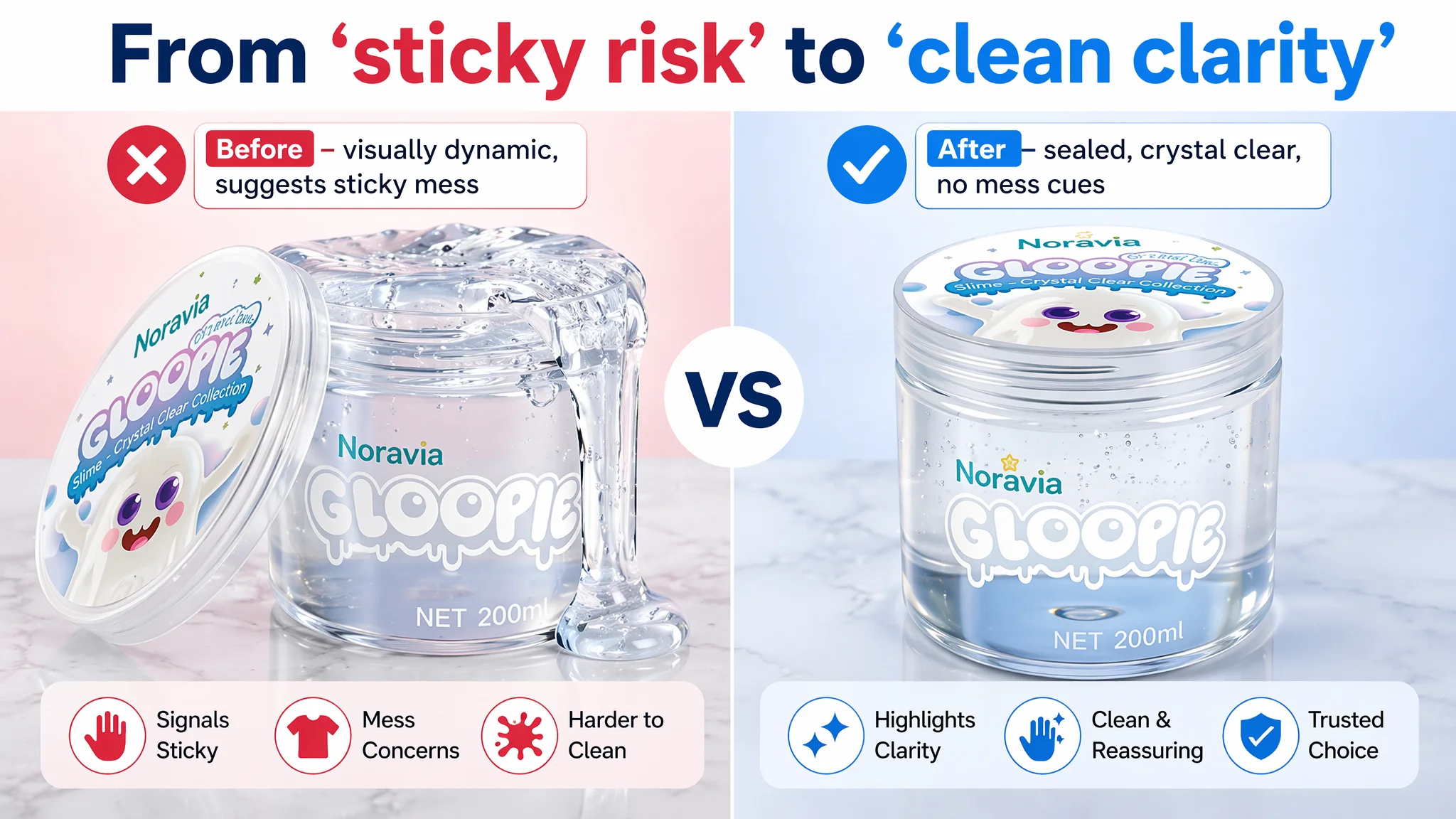
- The leading image showed an open jar with slime flowing over the rim.
- While visually dynamic, that flow strongly suggests “sticky, messy, hard to clean.”
By contrast, the benchmark:
- Used a fully closed container to demonstrate clarity and capacity.
- Avoided any visual that could trigger “sticky nightmare” memories for parents.
For slime, this single cue changes the emotional reading of the product. DeepBI’s judgment:
- Click potential was not the main issue.
- The main issue was the type of emotion triggered: curiosity plus fear, instead of curiosity plus reassurance.
Bullet points: Emotionally rich, structurally sound
DeepBI found that the customer’s bullets:
- Framed benefits around stress relief, creativity, and sensory experience, not just “toy” attributes.
- Used a problem → solution → promise logic: stress/boredom → sensory stimulation/DIY → safe & reusable.
- Positioned the slime as:
- Safe & quality-checked
- Visually satisfying (“crystal-like beauty”)
- Multi-scene (office, gift, kids’ play)
- Easy to store & reuse
In other words, the bullet points were not the worst actor. They were stronger than the benchmark’s more factual, less emotional bullets.
A+ / detail: A total blackout zone
Here was the real structural collapse:
- The customer used no A+ content at all.
- The benchmark built a full A+ funnel, including:
- Brand mark and logo modules
- Children-playing and stretching scenes
- Theme-based product sets (Space, Unicorn, Strawberry Donut)
- Multi-pack and flavor/variant layouts
- Safety and “ready-to-play” messaging
- “Stretchiest” type performance claims
- “70 years” brand history and teacher-trust badges
This is not about decoration. It is about where the conversion actually happens.
On Amazon, especially for kids’ sensory products:
- The first screen of A+ is often where parents decide “yes” or “no.”
- Without A+, buyers have:
- No real-life visual of the texture in action.
- No clear, repeated statement of “non-sticky, no residue.”
- No structured safety reassurance.
- No gift or multi-scene story.
The seller’s Listing had a decent “upper funnel” (title + main images + bullets). But from the A+ layer down, there was no mid-funnel sales logic at all.
Reviews: Not yet a problem you can fix with content alone
Review comparison:
- Both Listings showed 4.2 stars.
- The benchmark had ~9,800+ reviews; the customer had 9.
This is a structural disadvantage that cannot be solved quickly. But DeepBI’s view was:
- You cannot manufacture review count overnight.
- You can make sure every new buyer who lands on the page feels enough trust to convert and become part of your review base.
- That requires fixing the trust and clarity gaps in A+ and the images first, so that ad-driven traffic doesn’t just bounce.
Why DeepBI Did Not Recommend “More Ad Optimization” First
Given the evidence, DeepBI’s priority call was clear:
“Do not keep tuning ads as if this is a bidding problem. Fix the Listing’s conversion logic first, starting with the main image set and A+.”
There were three commercial reasons behind this judgment.
1. Ads were amplifying the wrong page outcome
Every additional click the seller bought had a high probability of running into:
- Fear around stickiness and cleanup.
- Unanswered safety questions.
- Lack of detailed, visual proof of texture and quality.
In that state:
- Higher bids only increase the volume of wasted traffic.
- You train Amazon’s system to associate your ASIN with weak conversion on those keywords, hurting future organic opportunities.
2. The biggest score gap was in a fixable module
The 24-point A+ gap was:
- Completely under the seller’s control.
- Fixable without waiting for external factors (like reviews) to catch up.
- Directly related to the category’s top decision risks.
When you can gain double-digit Listing-score points simply by building core A+ modules, that is a more leverageable move than squeezing another 2–3% efficiency out of ad keywords.
3. Trust and clarity are prerequisites for sustainable ad spend
DeepBI’s overall operating logic is:
“Ads extend what the page can already do. If the page can’t convert, ads will just extend the loss.”
So the sequence became:
1. Diagnose: Recognize A+ and visual trust as the bottleneck, not ad settings.
2. Rebuild: Repair the Listing’s ability to convert both organic and paid traffic.
3. Then scale: Once CVR stabilizes, reconsider expanding ad traffic.
Rebuilding the Page: From “Nice Pictures” to a Structured Sales Story
DeepBI’s optimization direction did not revolve around making things “prettier.” It revolved around reordering and sharpening the sales logic of the Amazon product page.
1. Main image set: From visual novelty to risk removal
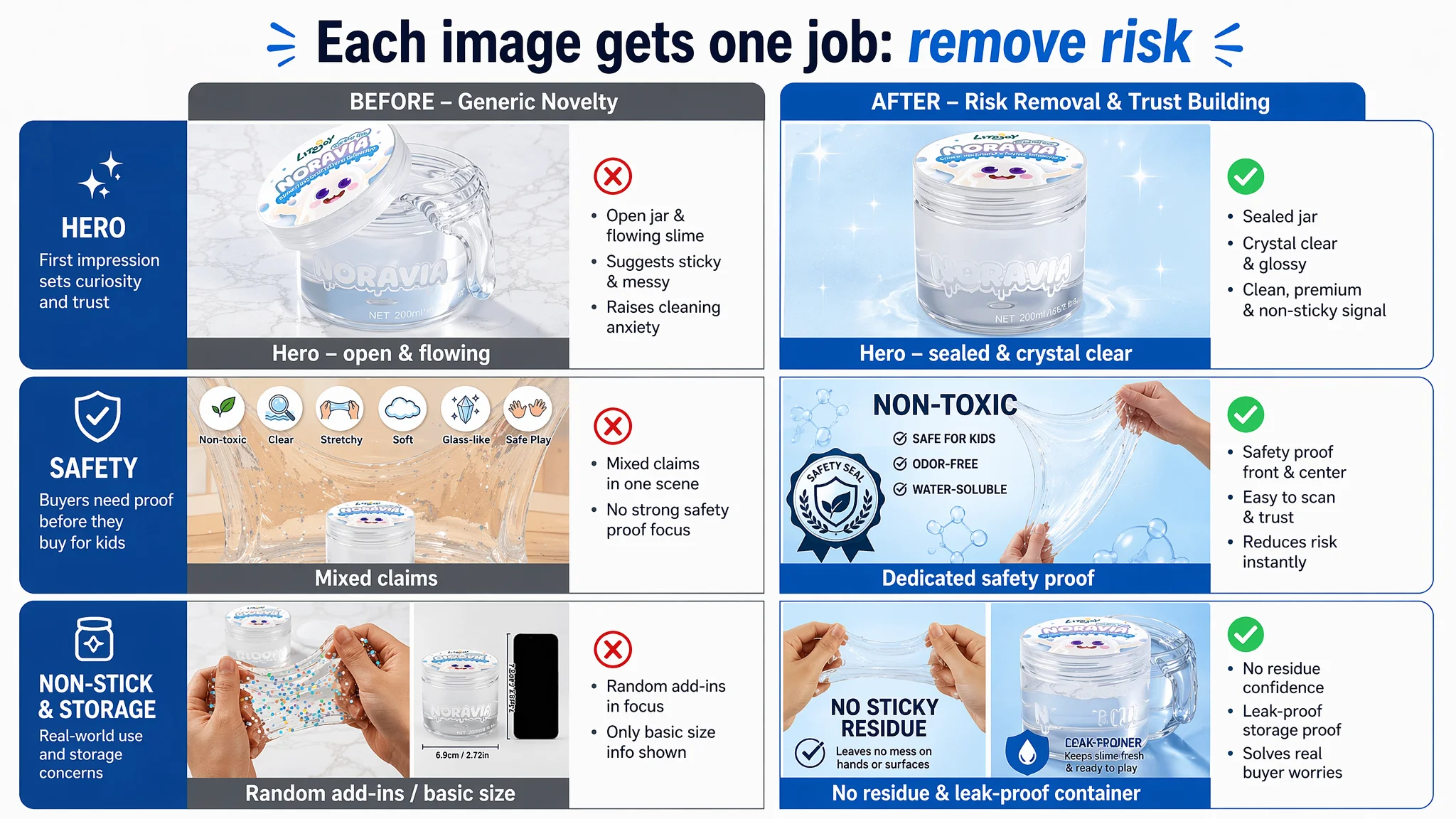
Key shifts:
- Image 1 (hero):
- Change from an open, overflowing jar to a fully closed, crystal-clear jar.
- Emphasize the “glassy clear, jewel-like” aesthetic and clearly show 200ml / 7oz.
- Remove any suggestive “slime dripping everywhere” scenes that cue stickiness.
- Image 2: Safety proof image
- Promote “Non-toxic” and “Odor-free” to the foreground.
- Use clean icons and large text—safety no longer buried among many micro-claims.
- Image 3: Sensory texture proof
- Keep the multi-usage collage, but reframe the focus:
- Highlight Stretchy and Soft as explicit labels.
- Show hands stretching the slime with clarity, not cluttered six-grid noise.
- Image 4: Direct response to the biggest fear—stickiness
- Replace “random glitter add-ins” visuals that may or may not be in the box.
- Show two clean hands stretching the slime with no residue left behind.
- Text focus: “Leaves no sticky residue on hands or surfaces.”
- If add-ins are mentioned at all, add a clear disclaimer like “Charms NOT INCLUDED” and keep visuals generic. DeepBI’s recommendation: stay focused on the non-stick proof.
- Image 5: Storage & reuse
- Use the phone-size comparison to anchor volume.
- Make “Secure leak-proof container” and “Easy storage & reusable” visually explicit.
Underlying logic: Every image now does one job and one job only—safety, non-stick, sensory pleasure, easy storage—rather than trying to say everything at once. This builds a coherent narrative even for buyers who never scroll to A+.
2. Title: Aligning with high-intent terms and compliance
DeepBI’s title optimization focused on three principles:
Before: A long, emotionally rich title with “Ultimate” type language and less structured scene coverage.
After (recommendation):
“Crystal Slime - Glassy Clear Pre-Made Slime, Non-Sticky & Stretchy, 7oz 200ml, DIY Sensory Toy for Mixing Add-ins, Stress Relief Birthday Gifts for Kids 4-12, Party Favors (Crystal Dew)”
Key moves:
- Combine the two most important physical attributes in slime:
“Non-Sticky & Stretchy”—these are the category’s conversion triggers, not just “clear.”
- Explicitly define “Pre-Made Slime” to signal “ready to play, no DIY mixing mess.”
- Add clear scene and audience cues:
- “Stress Relief”
- “Birthday Gifts for Kids 4-12”
- “Party Favors”
- Keep both 7oz and 200ml for US buyers’ unit preference.
- Remove over-claiming adjectives like “Ultimate” for Amazon compliance and Listing stability.
This does not change the Listing’s essence; it aligns the title more tightly with what parents actually search and what they worry about.
3. Bullet points: Turning emotional language into structured buying logic
DeepBI’s recommended bullets kept the emotional tone but tightened the logic:
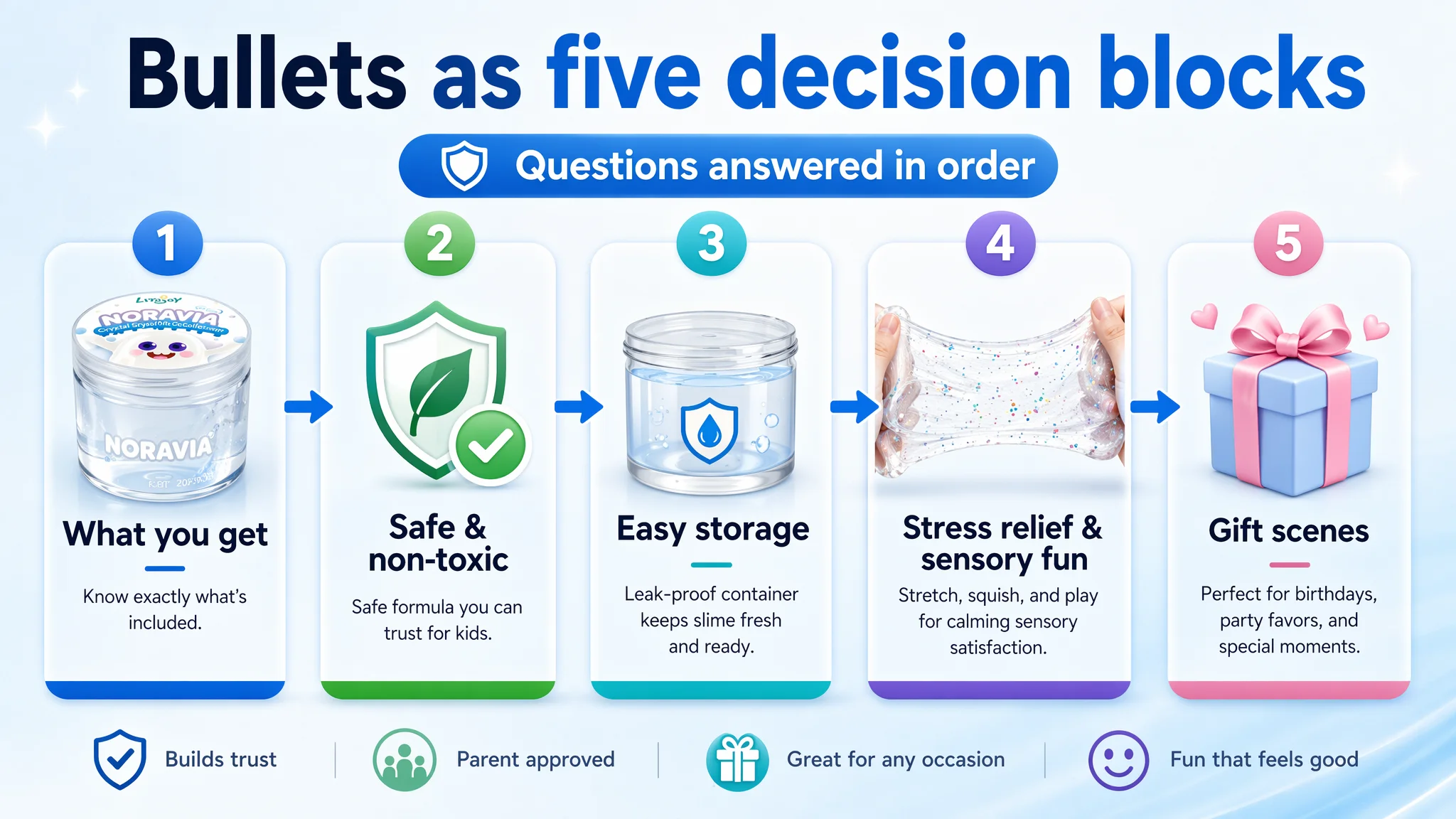
1. [WHAT YOU GET]
- Large-capacity 7oz / 200ml crystal-clear slime.
- Emphasize the “shimmering jewel” visual and potential as a desk ornament or DIY base.
1. [SAFE & NON-TOXIC]
- Spell out premium, odor-free materials and no sticky residue.
- Add clear usage warnings: wash hands after play, not for under 3, do not eat.
1. [EASY STORAGE & REUSABILITY]
- Focus on the secure, leak-proof 200ml container.
- State behavior: must put back in the container, store properly to avoid drying.
1. [STRESS RELIEF & SENSORY FUN]
- Use active verbs: squeezing, twisting, crushing, stretching.
- Link to functional outcomes: reduce stress, improve focus.
1. [GREAT GIFT FOR ALL OCCASIONS]
- Enumerate specific use-cases: birthdays, Easter party favors, classroom rewards, goody bags, holidays.
The change is subtle but important: each bullet becomes a mini decision block addressing “What is it? Is it safe? Can we store it? Does it help my kid? Is it giftable?” rather than being a series of nice-sounding statements.
4. A+ / detail page: Building the missing trust backbone
This was the true transformation. DeepBI’s plan was not to “decorate A+,” but to rebuild the conversion funnel inside the A+ section.
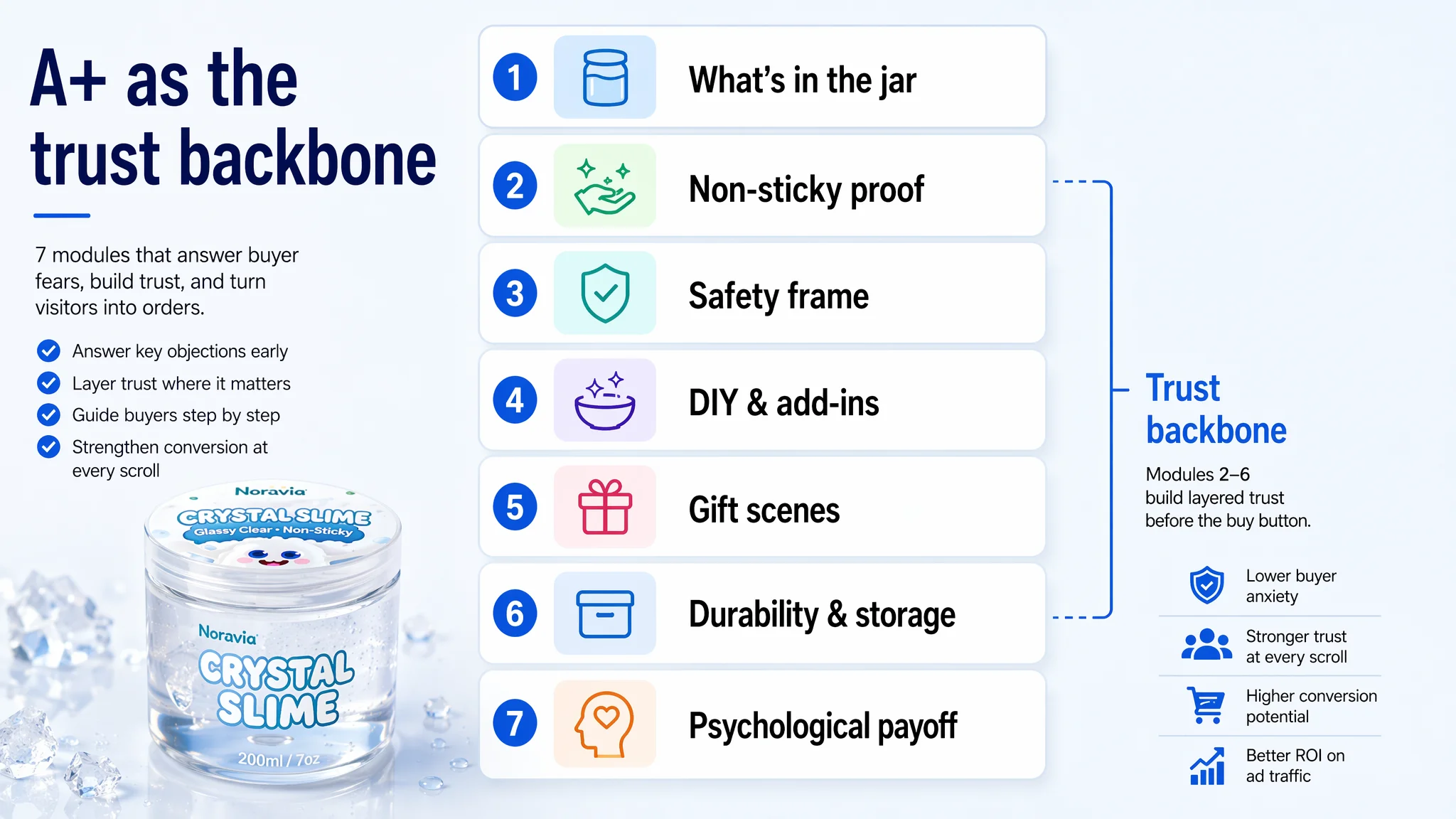
Proposed A+ structure:
1. Module 1 – “What’s in the jar” clarity
- Large hero showing the entire 200ml leak-proof container and the crystal-clear slime.
- Text: pre-made, ready to play, high transparency.
- Purpose: kill fears of murky or different-than-photos product.
1. Module 2 – Non-sticky, no-residue proof
- Close-up of hands stretching and squeezing with zero residue.
- Copy: “Perfect balance of stretchiness and softness,” “Leaves no sticky residue on hands or surfaces.”
- Purpose: directly neutralize the category’s #1 fear.
1. Module 3 – Safety frame
- Dedicated band on “Premium & Safe Formula.”
- Emphasize non-toxic, odor-free, suitable for sensory play across age groups (with appropriate age guidance).
- No need to fake certificates; structured, precise wording is enough to lower risk perception.
1. Module 4 – DIY potential & add-ins
- Visuals of the slime being customized with generic glitter/color/charms.
- Text: “Great for mixing in add-ins,” “Customize your creation,” with explicit disclaimers if add-ins are not included.
- Purpose: make clear it is a perfect base for creativity, not just a static toy.
1. Module 5 – Gift & scene montage
- Children playing, classroom, playdate, office desk stress relief.
- Tie back to bullets: birthdays, party favors, classroom rewards.
- Purpose: push buyer to imagine who they will buy it for.
1. Module 6 – Durability & storage rules
- Show the slime being put back in the container; cabinet or drawer scene.
- Copy: durable, reusable, stays fresh when stored properly.
- Purpose: reduce fear of “one-time play then trash.”
1. Module 7 – Psychological payoff
- Final module summarizing “Ultimate stress relief & sensory fun.”
- Explicitly frame as a sensory tool for stress reduction and focus, not just a throwaway toy.
“This product page did not lack traffic. It lacked trust.”
By layering the A+ this way, the page finally answered, in order, the questions parents were asking themselves subconsciously. That is the missing piece ads could never solve.
After the Shift: How Traffic Became Useful Again
Because we’re not inventing numbers, we’ll focus on state changes, not fabricated metrics.
Once the new logic took shape, the operating state of the ASIN changed in several ways:
- Conversion posture improved.
Instead of relying on a “pretty thumbnail” plus a thin detail section, the Listing now had multiple trust checkpoints: main image non-stick cues, safety-focused secondary images, and a structured A+ story.
- Ad traffic stopped being pure speculation.
When the seller fed traffic into the updated page, they were no longer paying to prove that buyers were afraid; they were paying to show a page that actively answered those fears.
- The path to reviews opened.
It’s still hard to climb from 9 reviews to thousands, but each new buyer landing on the page now had fewer reasons to regret the purchase, and more reasons to leave a positive review. Over time, this is how a small ASIN starts to build a credible review base.
- Operational anxiety shifted from “Why are ads so bad?” to “Does the page deserve more traffic yet?”
The seller began to think in the right order:
1. Diagnose the Listing’s ability to convert.
2. Fix structural deficits (A+, trust, mid-funnel).
3. Then decide on ad budgets.
What Other Amazon Sellers Can Take Away
This case is not just about slime. It’s about how Amazon sellers think about problems.
Key shifts in understanding:
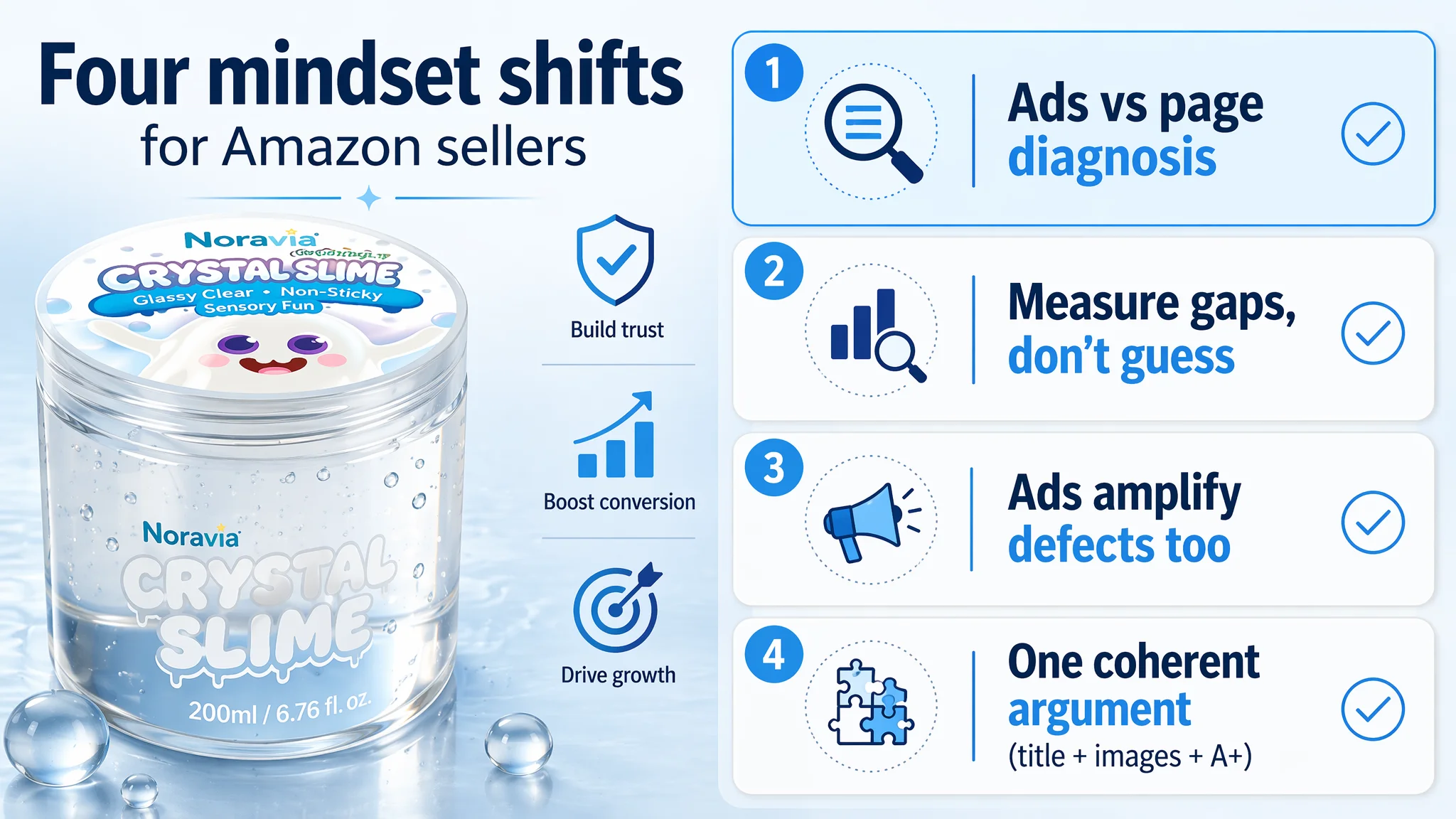
- “Ad problem” vs. “page problem.”
If your title, main image, and bullets are already competitive, but your A+ is empty or generic, you probably don’t have an ad problem; you have a mid-funnel trust problem.
- Listing score gaps matter more than feelings.
The seller felt weak overall, but only when we quantified the gap (0 vs. 24 in A+) did it become clear where to act first.
- Advertising amplifies both strengths and defects.
Pushing more traffic into a page that visually hints at “sticky mess” and never proves safety just amplifies those doubts.
- Title, images, bullets, and A+ must form a single argument.
In this case, once all four aligned around non-stick + safe + sensory + giftable, the page started to act like a coherent sales machine rather than a set of disconnected assets.
Most importantly: before you raise bids or expand keywords, ask yourself the same question DeepBI asked in this case:
“If I were a skeptical buyer landing on this Amazon product page for the first time, has the page really done enough to deserve my order?”
If the honest answer is “not yet,” fix that first. Only then do Amazon ads start to become a growth engine instead of a cost sink.