

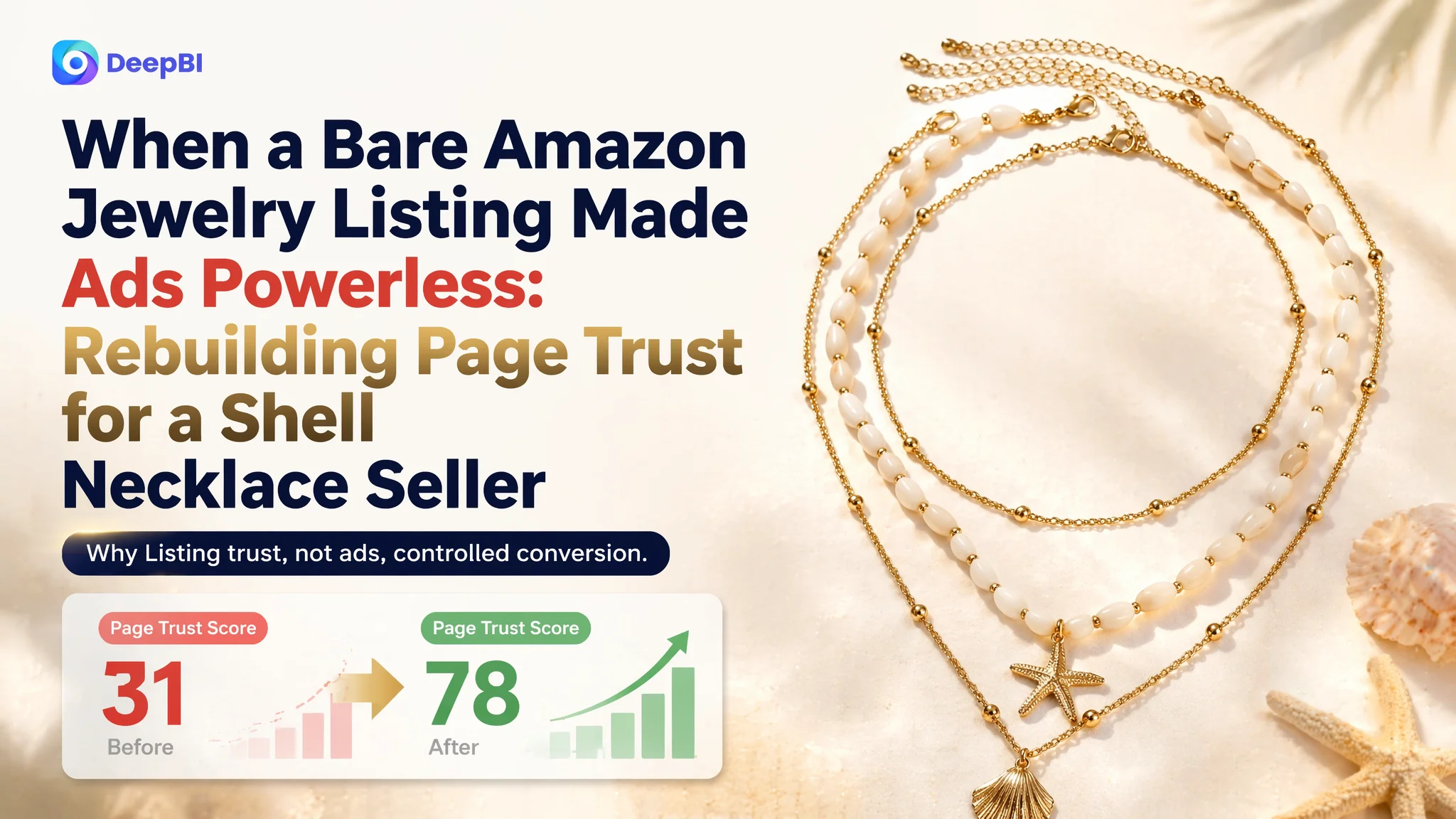
An Amazon jewelry seller came to DeepBI with a problem that looked familiar on the surface: ad spend was going out, but orders were not following. The team assumed the issue was mainly about keywords, bids, and campaign structure, and kept trying to “optimize the ads.” But when we put their shell/starfish necklace Listing side‑by‑side with a high‑performing competitor, the picture was much clearer: the real bottleneck was a severely underpowered Amazon product page that simply could not convert the traffic it was getting.
DeepBI’s Listing diagnosis showed a dramatic score gap—31 vs. 78 out of 100—with almost all of the deficit sitting in the main image, A+ detail content, and reviews. In other words, the ads were driving visitors to a page that had almost no visual proof, no structured explanation, and zero social validation. Instead of tuning bids first, we reframed the problem around Listing conversion capacity: the page had to earn trust before more traffic would make sense.
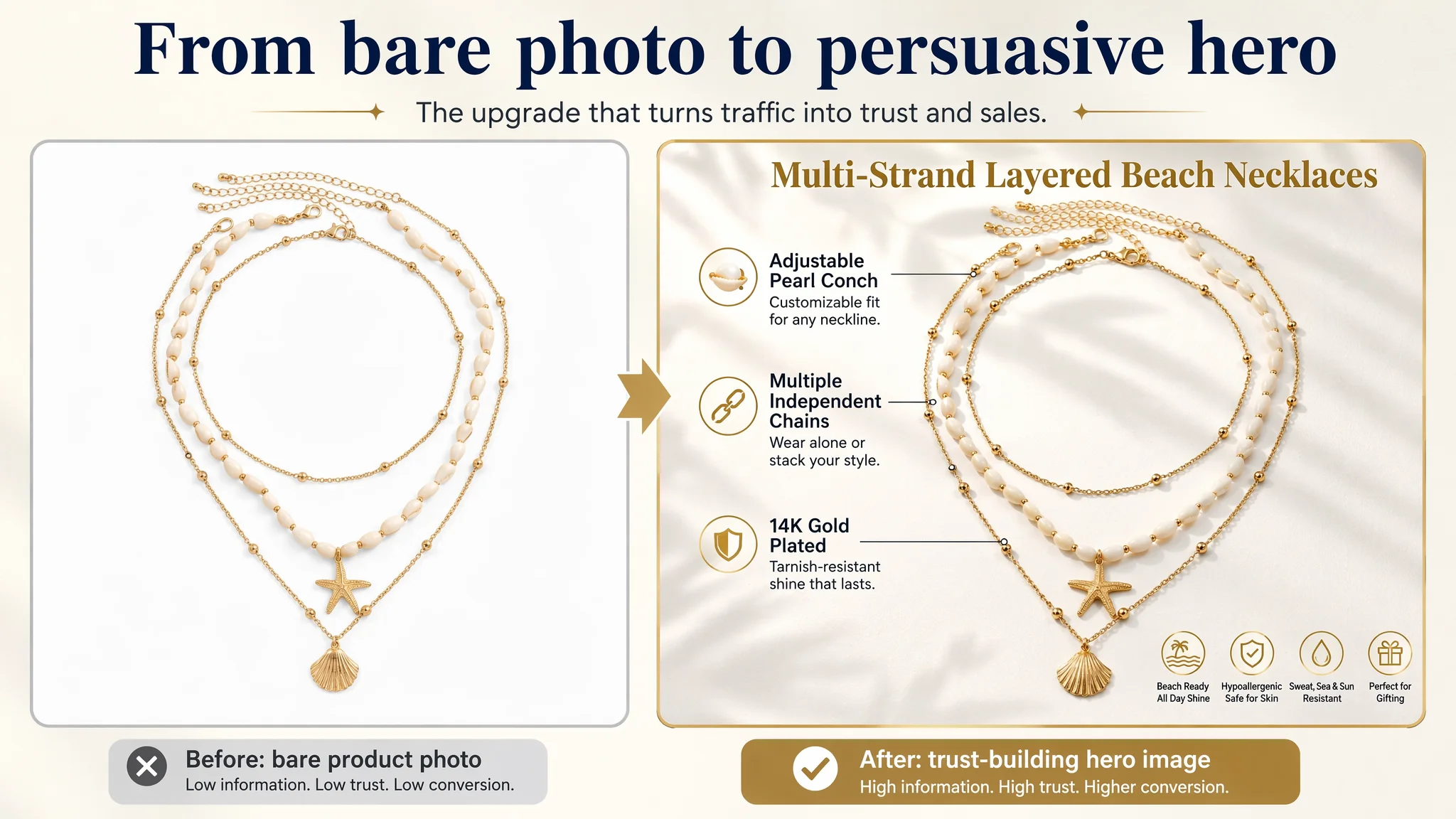
The later optimization focused on rebuilding the product page’s sales logic: improving the title’s keyword structure, transforming a single flat product photo into a multi‑image visual funnel, and constructing a full A+ story that clearly demonstrates material, durability, flexibility, and gift value. For Amazon sellers, this case is a reminder that when ad performance stalls, the core issue is often not “bad ads” but a Listing that cannot carry the weight of the traffic you’re already paying for.
The Core Constraint Was Not Traffic. It Was the Listing’s Ability to Convert.
When we first looked at this Amazon Listing for a layered shell/starfish necklace, the seller’s pressure came from an obvious place: ad costs were rising, ACOS felt hard to control, and manual optimization of campaigns was not improving orders in a meaningful way.
But the Listing scoring data immediately pointed somewhere else:
- Seller Listing total score: 31 / 100
- Benchmark Listing total score: 78 / 100
- Gap: –47 points
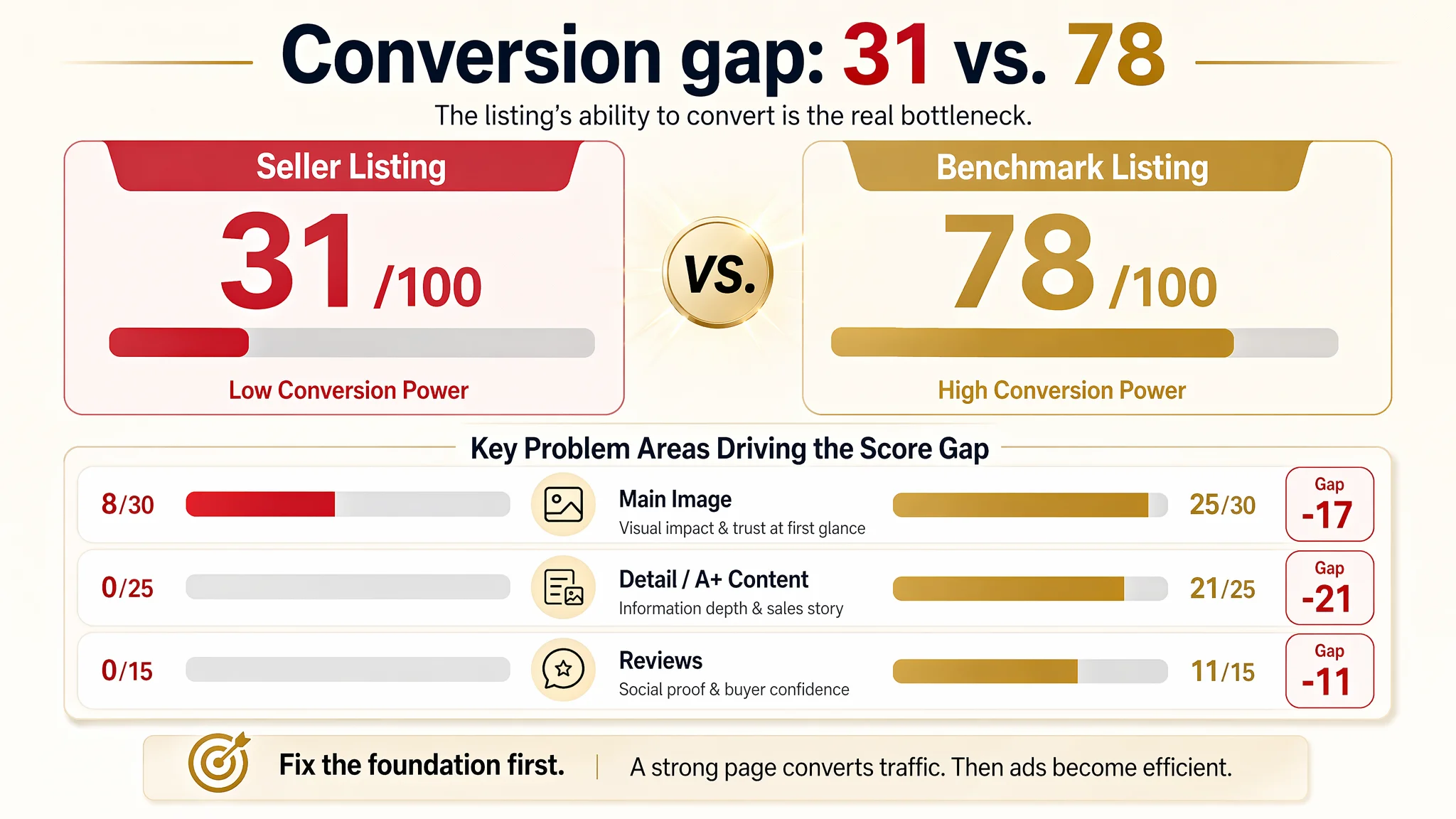
Breaking this down by dimension:
- Title: close, only –1 vs. benchmark
- Bullet points: actually +3 vs. benchmark
- Main image: –17 vs. benchmark
- Detail/A+ content: –21 vs. benchmark
- Reviews: –11 vs. benchmark (seller had 0 reviews)
The signal was clear: this was not a keyword or copy problem at the headline level. The Listing was collapsing in three critical areas that directly control conversion on Amazon:
“The real problem was not that ads failed to bring traffic. It was that the page could not convert the traffic.”
With almost no visual depth and zero review infrastructure, any paid click was landing on a page that felt unfinished, unverified, and untrustworthy—especially in a category where buyers rely heavily on material, durability, and gift‑worthiness.
What the Seller Originally Misread
The seller’s initial operating logic was typical:
- Ads are not performing →
- ACOS feels high →
- Solution must be better ad optimization (keywords, bids, structure).
This thinking assumes a relatively healthy product page—that once visitors arrive, the Listing has enough power to convert at a reasonable rate. But the diagnostics showed the opposite:
- Single flat product image as main visual, no model, no sizing overlay, no material proof.
- No A+ detail content at all—no structured visuals, no modules explaining material, durability, or usage.
- Zero reviews while the benchmark Listing had 271 reviews and a visible mix of image/video feedback.
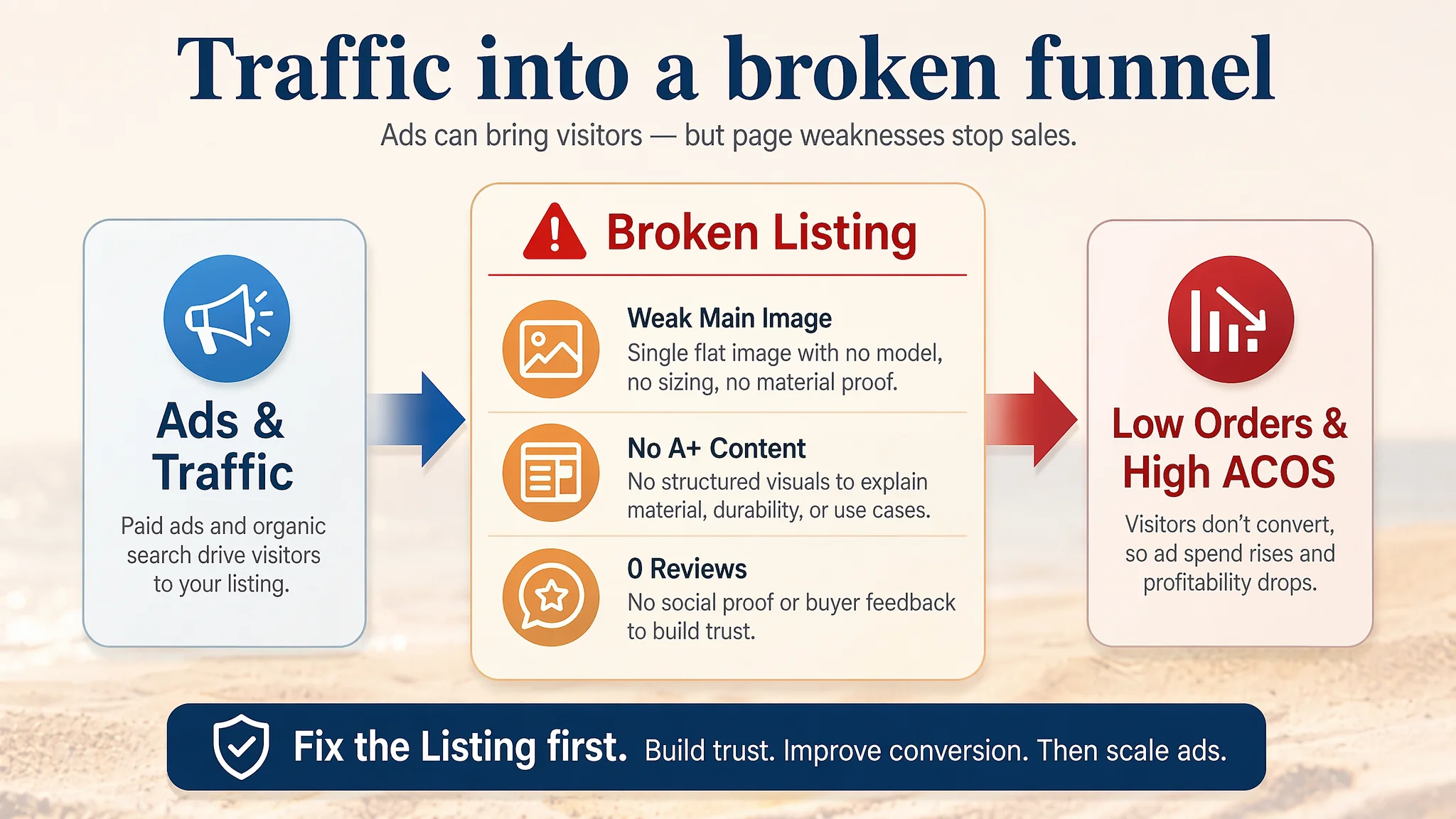
Under these conditions, every incremental improvement in ads is pushing more people into a broken funnel. The ad spend is not the core disease; it’s a magnifier of Listing defects.
“Advertising does not only amplify advantages. It can also amplify a page’s existing defects.”
DeepBI’s judgment was straightforward: until this Listing can prove quality, clarify usage, and show social proof, more traffic is just more expensive hesitation.
Main Image: The Page Did Not Lack Traffic. It Lacked a Reason to Click and Trust.
In jewelry, the main image is not just a “nice photo.” It is the first gate for both CTR and downstream trust.
What the seller’s main image was doing
- A single flat lay of the necklace on a plain background.
- No visible scale or measurements.
- No indication of how it looks when worn.
- No material cues beyond the default product appearance.
On an Amazon search results page crowded with jewelry thumbnails, this image had very little:
- Click motivation – it looked generic, not special.
- Information density – nothing about length, adjustability, or material.
- Trust signals – no close‑ups that show quality or finishing.
The competitor’s image set, in contrast, worked as a visual funnel:
- Multiple angles and usage contexts.
- Clear feelings of “summer beach jewelry” and “layered look.”
- Visual confirmation of how the necklace sits on the neck and chest.
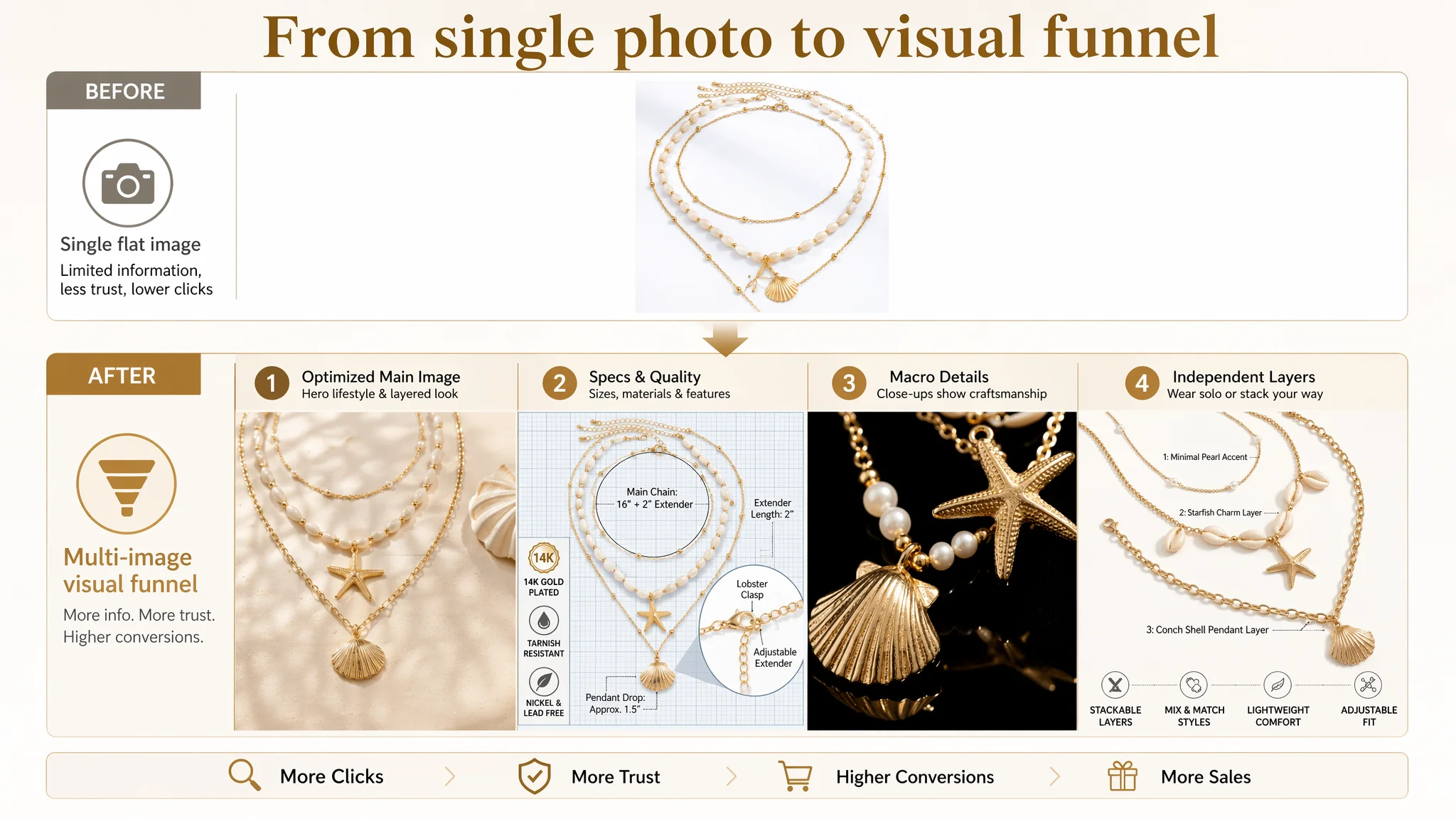
DeepBI’s Listing data and benchmark comparison made the risk obvious: with a main image score 17 points below the benchmark, the seller’s Listing was losing the fight at the thumbnail stage, before ad optimization could even matter.
Detail Page: A Conversion Funnel That Broke at the First Screen
If the main image is the click engine, the detail page (especially A+ content) is where trust is built or lost.
Here, the gap was extreme:
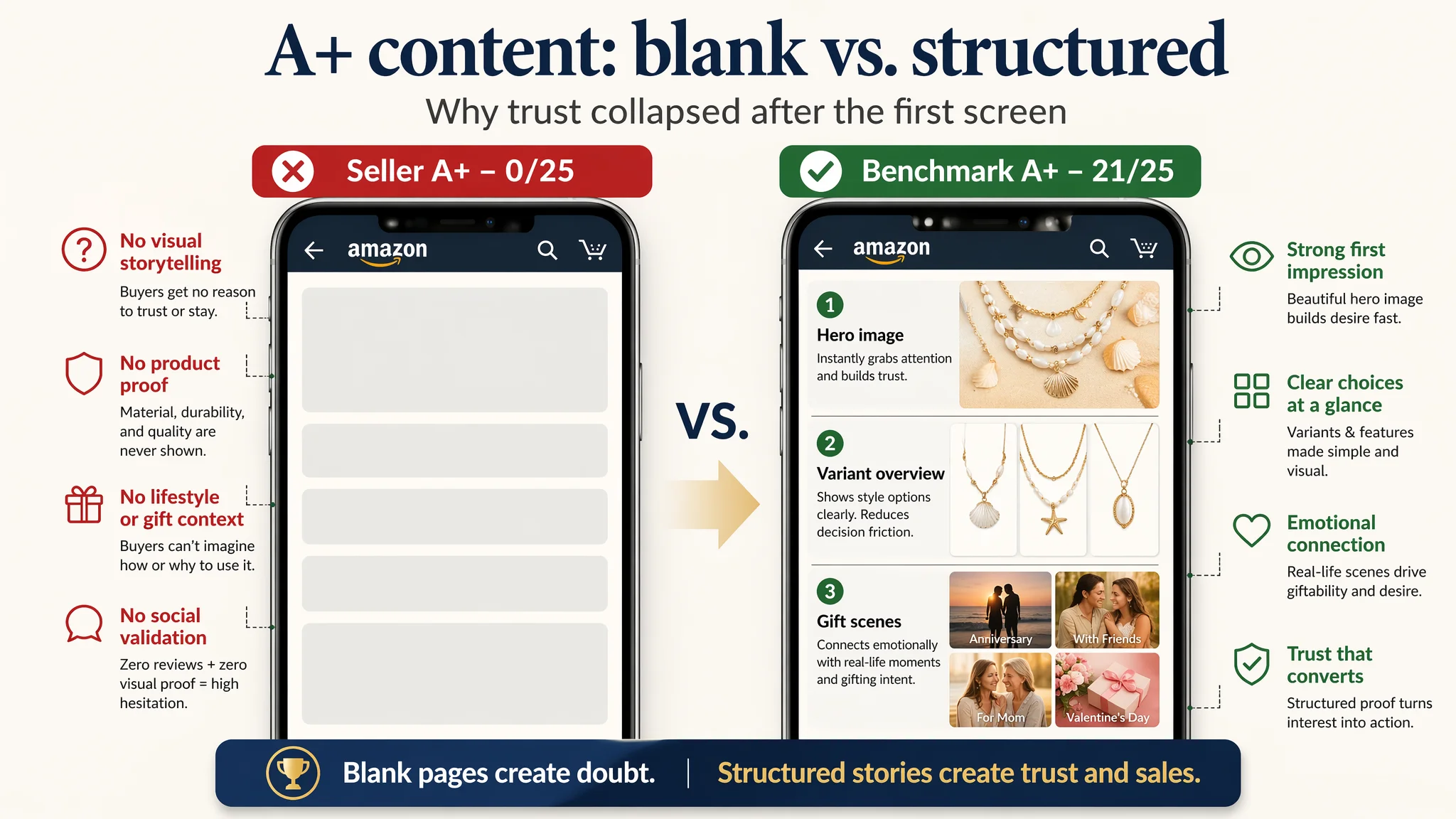
- Seller detail/A+ score: 0 / 25
- Benchmark detail/A+ score: 21 / 25
The seller’s Amazon product page:
- No A+ modules.
- No visual explanation of variants, materials, or usage scenarios.
- No structured narrative about durability, hypoallergenic properties, or gift value.
The benchmark Listing:
- A large, high‑quality hero A+ image that instantly establishes aesthetic and brand tone.
- A three‑panel visual showing different necklace variants (shell, layered, starfish) to reduce decision friction.
- Four emotional gift scenes (anniversary, friends, mother, Valentine’s Day) that anchor buying motives and show real‑life use.
Without any A+ content, the seller’s page was forcing buyers to mentally “fill in the gaps”:
- What does 14K gold‑plated actually look like?
- Will it tarnish in sweat, seawater, or sunlight?
- Is it safe for sensitive skin?
- Can the chains be separated and worn individually?
- Is this suitable as a gift? For whom? For what occasions?
For a product where quality and emotion both matter, the absence of structured content is not a cosmetic issue—it directly kills conversion.
Bullet Points: Emotionally Rich, But Missing a Rational Backbone
Interestingly, bullet point scoring showed the seller ahead of the benchmark. This helped avoid a common misdiagnosis: the problem was not “weak copy everywhere.”
From the source material:
- The seller used emotional and lifestyle‑driven messaging: summer, beach, radiance, gift value.
- The copy applied a “problem–solution” structure (e.g., “Why settle for one look?”), tying product advantages (like hypoallergenic metals) to end results (“stay radiant”).
- Each bullet anchored scenes like “summer,” “beach,” and “vacation,” building a clear lifestyle context.
The competitor:
- Opened with more functional specs and sizing.
- Relied more on straightforward descriptions and parameter lists.
DeepBI’s view here was important: bullet point quality was not the bottleneck. In fact, the seller’s emotional and lifestyle path was already strong. The real missing layer was rational proof:
- Exact necklace lengths and extender sizes.
- Explicit non‑tarnish and hypoallergenic declarations.
- Clear explanation of independent chains vs. connected chains.
- Usage scenarios that confirm durability in sweat, seawater, and sunlight.
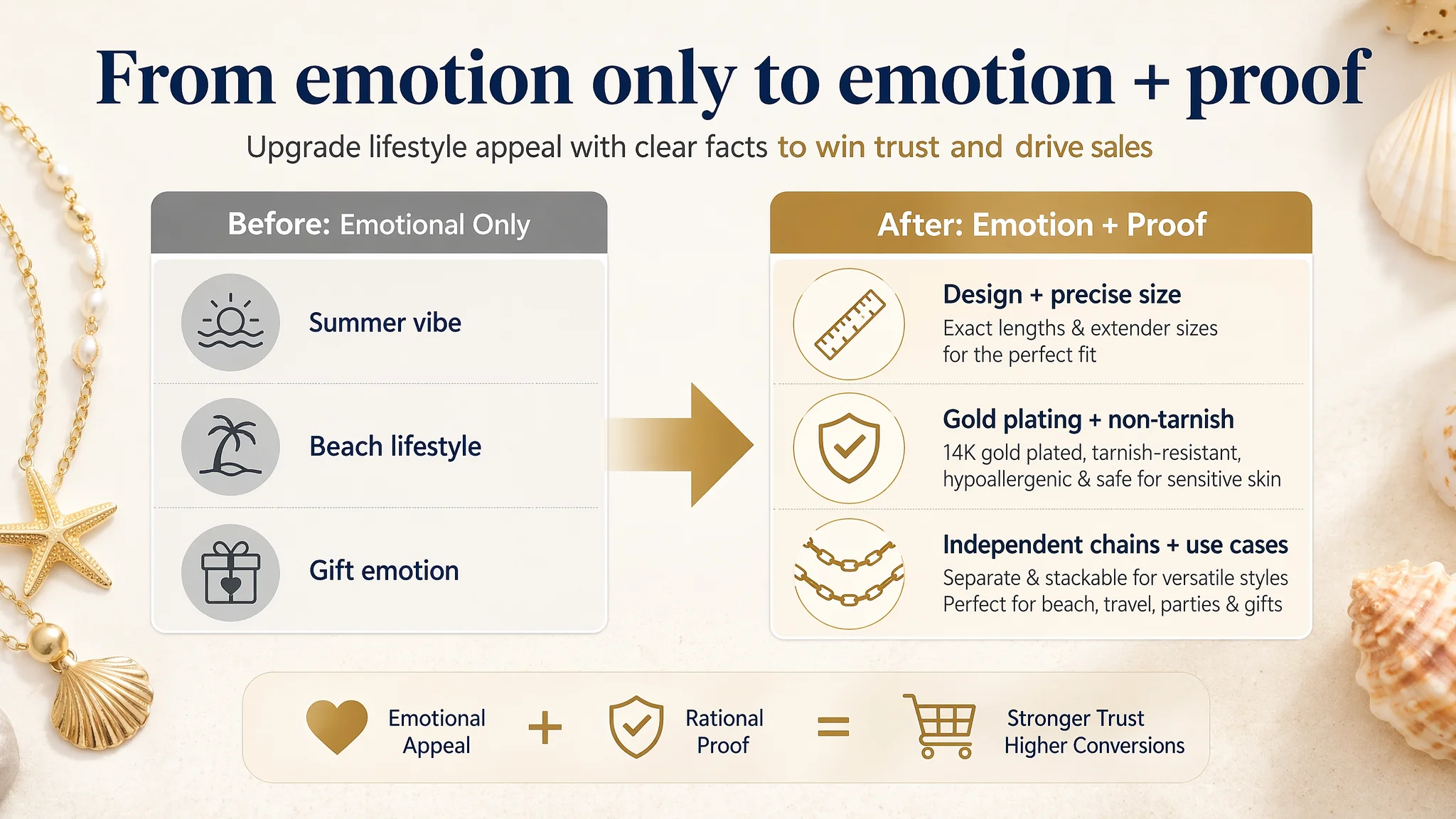
This is why DeepBI’s optimization direction did not start by rewriting everything from scratch. Instead, we treated the existing emotional copy as an asset and focused on reinforcing it with specific, credible details.
Reviews: A Trust Gap That No Ad Can Patch Overnight
The review situation was stark:
- Seller: 0 reviews, no rating visible.
- Benchmark: 3.9 stars, 271 reviews, 13 visible on the first page, including image/video feedback.
On Amazon, especially for non‑essential items like fashion jewelry:
- A product with no reviews often feels “unproven.”
- Buyers expect at least some evidence that others have bought and liked the item.
- Visual reviews (photos, videos) add a layer of authenticity no A+ module can fully replicate.
With a review score gap of –11 points, the Listing was in a high‑risk state:
- Any ad‑driven traffic would see an “empty” review section.
- Hesitation and comparison behavior would naturally push buyers toward reviewed alternatives—like the benchmark Listing.
- Even if the page were visually improved, the seller would still need a plan to gradually build review volume and quality.
DeepBI’s judgment: Listing conversion work had to create enough perceived quality and clarity for early buyers to feel comfortable purchasing despite the initial lack of reviews. Only then could review growth and ad performance begin to reinforce each other.
Why DeepBI Did Not Keep Tuning the Ads First
From a pure advertising standpoint, several familiar optimization levers existed:
- Refining keywords around “shell necklace for women,” “starfish layered necklace,” “summer beach jewelry,” etc.
- Adjusting bids and budgets.
- Restructuring campaigns and ad groups.
But looking at the Listing score profile and benchmark comparison, these actions would have been misaligned with the real constraint:
- Main image and A+ content were structurally weak.
- Bullet points were relatively strong but under‑supported by visuals and proof.
- Reviews were nonexistent.
“Before ads could work again, the page had to convert.”
If we had moved ads first, the seller would have:
- Spent more budget on clicks that still land on a sparse, low‑trust page.
- Seen continued ACOS pressure and unstable TACOS.
- Possibly concluded that “the product itself doesn’t work” when, in reality, the product story was simply not being told.
DeepBI’s decision path was therefore:
1. Stabilize the page’s ability to convert by upgrading visual and structural content.
2. Help the Listing communicate its true advantages vs. the benchmark (e.g., independent chains, material durability).
3. Only then, revisit ads with a page that is capable of justifying more traffic.
Rebuilding the Sales Logic: From Single Image to Full Visual Funnel
The optimization plan centered on turning the Listing into a coherent, trust‑building path—from the search thumbnail to the final decision.
1. Strengthen the title’s commercial logic
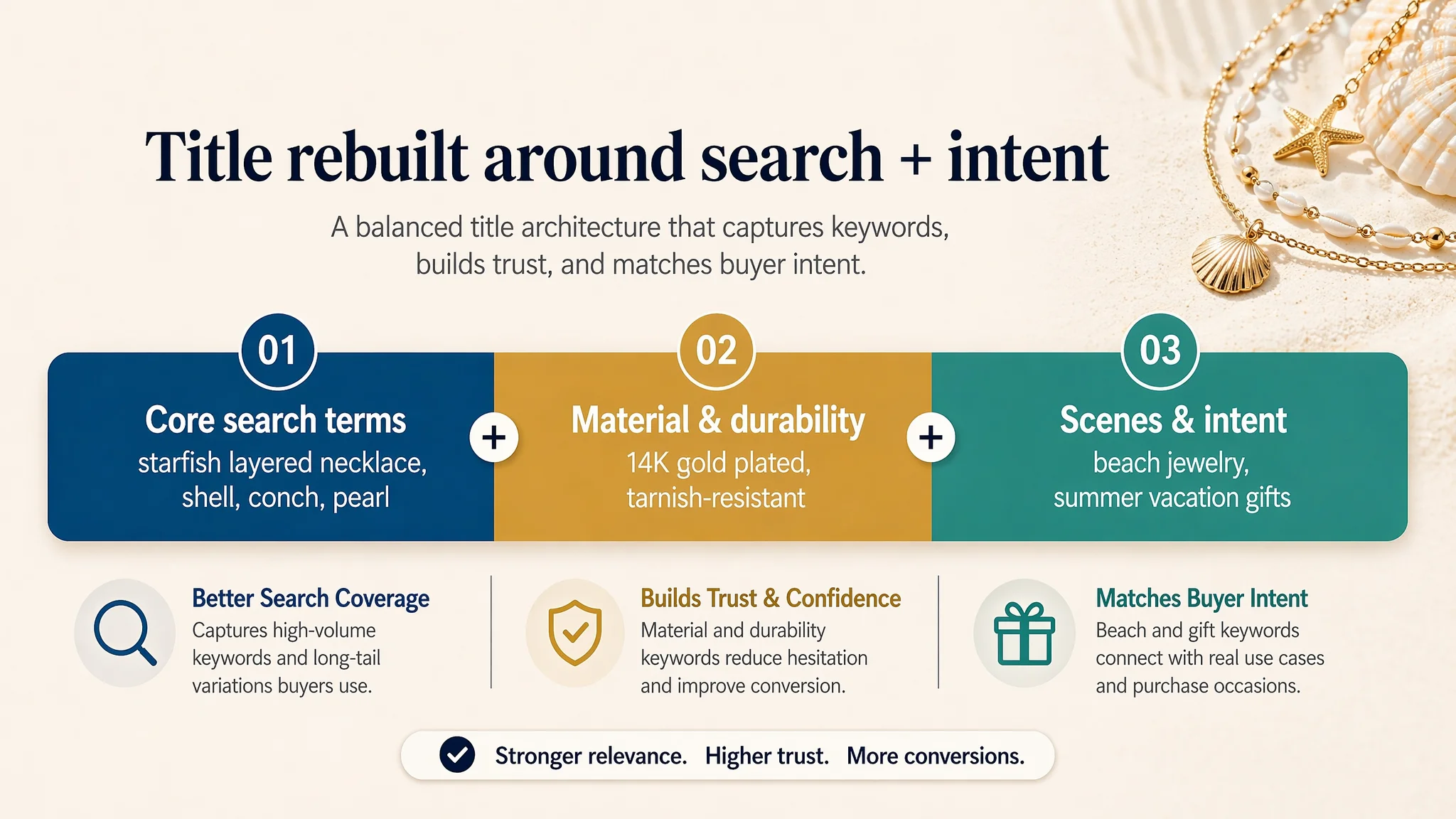
The suggested title moved from a material‑first structure to a more search‑aligned, outcome‑oriented format:
Suggested title 14K Gold Plated Starfish Layered Necklace for Women, Tarnish‑Resistant Shell Conch Pearl Pendant Charm, Adjustable Multi‑Strand Stack Beach Jewelry, Summer Vacation Gifts
Key shifts:
- Bring core searchable concepts (“starfish layered necklace”, “shell”, “conch”, “pearl”, “beach jewelry”) into a tight front structure.
- Combine 14K gold plated with tarnish‑resistant to directly attack a known category pain point (discoloration).
- Preserve scene and intent phrases like “Summer Beach Vacation” and “Gifts” for emotional and seasonal relevance.
This doesn’t transform the product; it realigns the title with how Amazon buyers actually search and evaluate.
2. Transform the image set from a single photo into a conversion sequence
DeepBI’s plan treated each image slot as a specific decision step, inspired by—but not copying—the benchmark logic.
- Image 1 – Hero main image
- Keep the product‑centric white‑background presentation but improve composition and focus.
- Make the layered design and ocean‑inspired motifs (shell, starfish, conch, pearl) visually clear.
- Convey “14K gold plated beach necklaces” and “adjustable multi‑strand stack jewelry” through subtle text overlay or design cues, without clutter.
- Image 2 – Specs and material validation
- Explicitly show dimensions (e.g., 14.96" and 15.75" chain lengths, 2"–3" extenders) with clear markings.
- Highlight material attributes: 14K gold plated, tarnish‑resistant, hypoallergenic, lead‑free, nickel‑free.
- Use close‑up views of the clasp and extender to validate adjustability.
- Image 3 – High‑definition detail close‑ups
- Macro shots of the gold plating, lustrous pearls, conch pendants, and starfish charm.
- Visual emphasis on craftsmanship and surface finish to imply durability and non‑tarnish behavior.
- Image 4 – Versatile layering and independent chains
- Show multiple styling options: single chain minimalist, full stack layered, mixed combinations.
- Make it visually evident that chains are independent, can be worn separately or together—explicitly addressing a competitor’s weakness (connected chains that cannot be separated).
- Image 5 – Atmosphere and gifting
- Present lifestyle scenes linking the necklace to beaches, cruises, island getaways, and dressy evenings.
- Include cues like gift packaging and “Gifts from the Sea” positioning to reinforce gift suitability.
Together, these images turn a previously flat and generic presentation into a structured argument: this necklace looks good, fits well, lasts, is safe, and works across multiple styles and occasions.
Constructing the Detail Page Story: From Zero A+ to a Rational, Trust‑Heavy Narrative
For the A+ detail page, DeepBI’s logic was to build a sequence that addresses both emotional aspirations and rational doubts.
Module structure and intention
- Module 1 – Visual trust and first impression
- High‑quality wearing‑scene images showing how the necklace sits on different necklines.
- Immediate reinforcement of “14K gold plated” and “hypoallergenic” to anchor perceived quality.
- Module 2 – Independent chains and flexibility
- Visual decomposition of the set showing each chain separately.
- Clear text explaining that all chains are physically independent, offering maximum flexibility in layering and styling.
- Directly differentiates from the benchmark’s unclear messaging about connected chains.
- Module 3 – Material and durability explanation
- Graphic breakdown of metal and coating: 14K gold plating + protective e‑coating.
- Explicit non‑tarnish commitment within realistic bounds: sweat, seawater, sunlight resistant.
- Addresses the biggest “hidden fear” in the category: buying jewelry that turns skin green or fades quickly.
- Module 4 – Safety and hypoallergenic assurance
- Clear visual and textual emphasis on lead‑free, nickel‑free, hypoallergenic.
- Iconography or symbolic representation (without fabricated documents) to give sensitive‑skin buyers confidence.
- Module 5 – Usage in demanding summer scenarios
- Scenes at beach, pool, and under sunscreen application, coupled with messaging about “summer‑proof” wear.
- Reinforces that the necklace is designed for vacation realities, not just indoor use.
- Module 6 – Gift positioning and packaging
- Show thoughtful packaging that feels “gift‑ready.”
- Tie into occasions: birthdays, anniversaries, bridesmaids, Christmas, Valentine’s Day, Mother’s Day, Thanksgiving.
- Expand seasonal gift search coverage while reinforcing emotional value.
- Module 7 – Final reassurance: fit and comfort
- Detail views of adjustable clasps, extenders, and chain weight.
- Messaging around “fits any neckline,” “lightweight comfort,” and ease of daily wear.
- Designed to remove last‑minute hesitation about size and comfort and nudge buyers to commit.
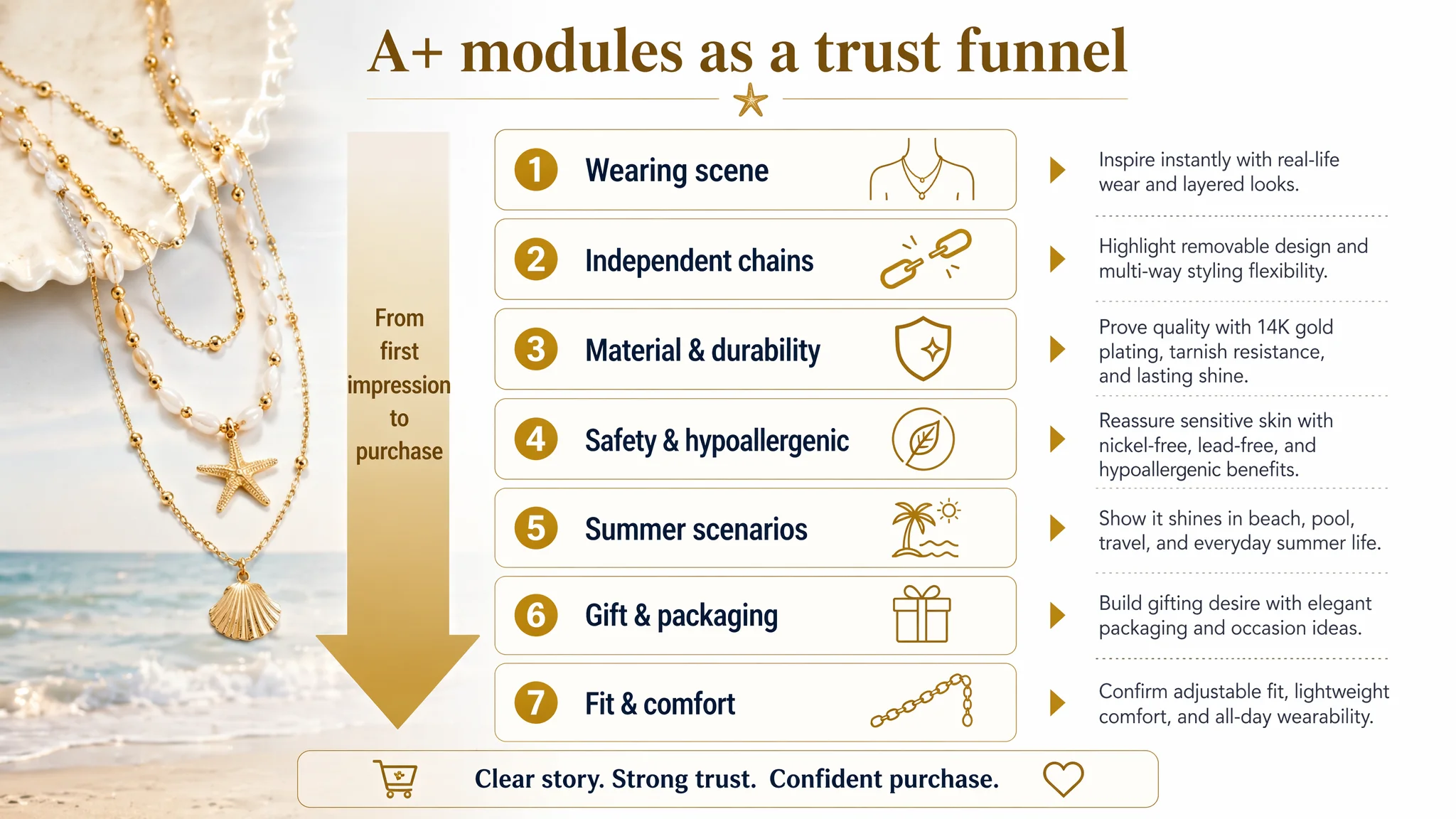
This structure transforms a blank A+ space into a layered story that continuously reduces risk: aesthetic → flexibility → durability → safety → real‑world usage → gift value → comfort.
Bullet Points: Turning Strong Emotion Into Complete Buying Logic
With the image and A+ frameworks in place, DeepBI refined bullet points to ensure each one operates as a micro‑bridge from desire to decision.
Examples of optimization logic:
- BP #1 – Design + precise sizing
- Combine “exquisite ocean‑inspired design” with exact necklace lengths and extenders.
- Reduce return risk and sizing anxiety while keeping the coastal lifestyle appeal.
- BP #2 – 14K gold plated, non‑tarnish, hypoallergenic
- Articulate material structure (gold plating + e‑coating) and what that means in daily use (no green necks, resistant to sweat/seawater/sunlight).
- Translate abstract “quality” into operational reassurance.
- BP #3 – Versatile independent layering
- Emphasize the unique advantage vs. connected competitor chains: “Why settle for one look?”
- Offer clear use cases: minimalist single strand vs. full statement stack.
- BP #4 – Summer comfort and scenarios
- Tie the product to poolside, sunset dinners, cruises, and beach weddings.
- Highlight all‑day comfort and lightweight wear as enablers of those experiences.
- BP #5 – Thoughtful gifting across occasions
- Align with commonly searched gift events (Christmas, Valentine’s Day, Mother’s Day, Thanksgiving, birthdays, anniversaries).
- Frame the product as a “gift of summer vibes” that can be cherished beyond the season.
Each bullet now participates in a complete logic loop: concern → feature → outcome, supported by the upgraded visual and A+ content.
What Changed in the Business State (Without Inventing Numbers)
After this Listing restructuring, several operating conditions began to shift—even before heavy ad scaling:
- Listing conversion capacity improved
- Buyers arriving from ads or organic search now met a page with multiple angles of proof: clearer main image, specs, material detail, scenario usage, and gift context.
- Early signs of CVR recovery became possible because the page stopped relying solely on emotional copy and started presenting tangible reasons to trust.
- Ad traffic became more meaningful
- With a stronger visual and A+ foundation, paid clicks no longer fell into an informational void.
- The seller could start re‑examining ACOS with a realistic chance that campaign optimizations would be reflected in sales, not just in clicks.
- Organic potential increased
- A better‑structured title and relevant scene/gift keywords improved the Listing’s chances of catching and converting more organic traffic in its niche.
- As reviews start to accumulate, this foundation will amplify the effect of organic ranking improvements.
- Operational risk decreased
- The store became less dependent on “perfect ads” to mask a weak page.
- The Listing began to regain the ability to convert both paid and organic visitors, making overall operations more controllable.
Most importantly, the seller’s understanding changed:
- Ads alone cannot rescue a page that fails to prove its value.
- Listing quality—especially main image, A+ content, and review structure—is the foundation of ad efficiency.
- Title, images, bullet points, and A+ content must work together as one argument, not isolated components.
- Before increasing traffic, the team now asks: “Does this page deserve more traffic?”
For Amazon sellers in similar categories—especially where products are aesthetic, seasonal, and quality‑sensitive—this case is a reminder to look beyond campaign dashboards. When ACOS feels stuck and conversion refuses to improve, the real leverage is often not another bid change, but a hard look at whether your Listing actually earns the sale once the buyer arrives.