

An Amazon seller in the sewing and crafts category came to DeepBI with a paradox: their laser-guided sewing scissors had a highly polished Amazon product page and a very strong visual story, yet ads were becoming harder to control and the Listing still could not break through a long-established competitor. The team’s first instinct was to keep tuning Amazon ads and “add more images,” assuming the problem lay in advertising structure and visual volume.
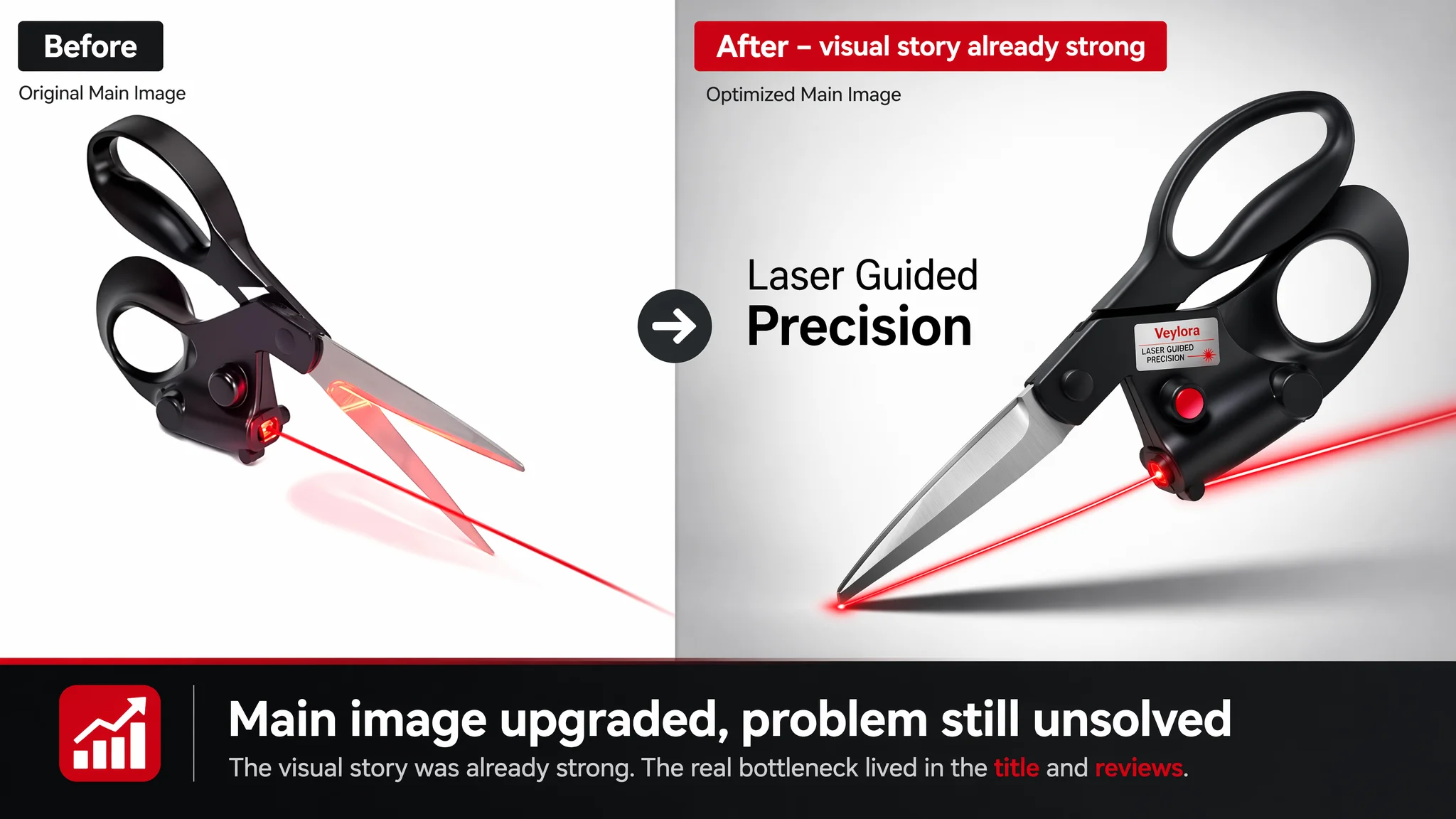
DeepBI’s scoring and competitive analysis told a different story. The Listing already outperformed the benchmark in main images, bullet logic, and A+ detail-page content; the real bottleneck sat in two neglected areas: a structurally weak title and a near-zero review base. Ads were pushing traffic into a page that looked professional but still under-communicated its core promise in the title and lacked basic trust signals from customers.
The later optimization stopped treating this as a “more traffic” or “more images” issue. Instead, the focus shifted to rebuilding the Amazon title around laser precision and professional use, tightening bullet-point logic around pain-point relief, and planning a path to build the first layer of reviews. For other Amazon sellers, this case is a reminder: when A+ looks “better than the competitor” but performance is flat, it’s often a diagnosis problem, not a design problem—and the root may sit in title logic and trust, not in another batch of creatives or bid tweaks.
Amazon Ads Were Not Failing. The Page Was Consuming the Traffic.
The brand sells laser-guided sewing scissors on Amazon US, targeting fabric crafters, quilters, and DIY users.
From the seller’s perspective, the symptoms looked familiar:
- Ad spend rising, ACOS difficult to push down.
- Traffic volumes acceptable, but orders lagging.
- A+ visuals and gallery images clearly more modern than the main competitor.
Internally, the team drew a straightforward conclusion:
“Our Amazon ads and creatives are still not good enough. We need more images, more tests, and better campaign tuning.”
So they kept iterating:
- Adjusting bids and keyword mixes.
- Producing more images with laser effects.
- Expanding scenes and parameters in the gallery.
Yet the gap with the category’s long-established benchmark Listing remained.
DeepBI’s Listing-score diagnosis showed why.
The Real Constraint Was Listing Conversion Capacity, Not Creative Volume
When DeepBI ran the Listing through its Amazon scoring and competitive benchmark system, the result was clear:
- Target Listing: 66 / 100
- Benchmark Listing: 77 / 100
- Gap: –11 points
But the important part was where the gap lived:
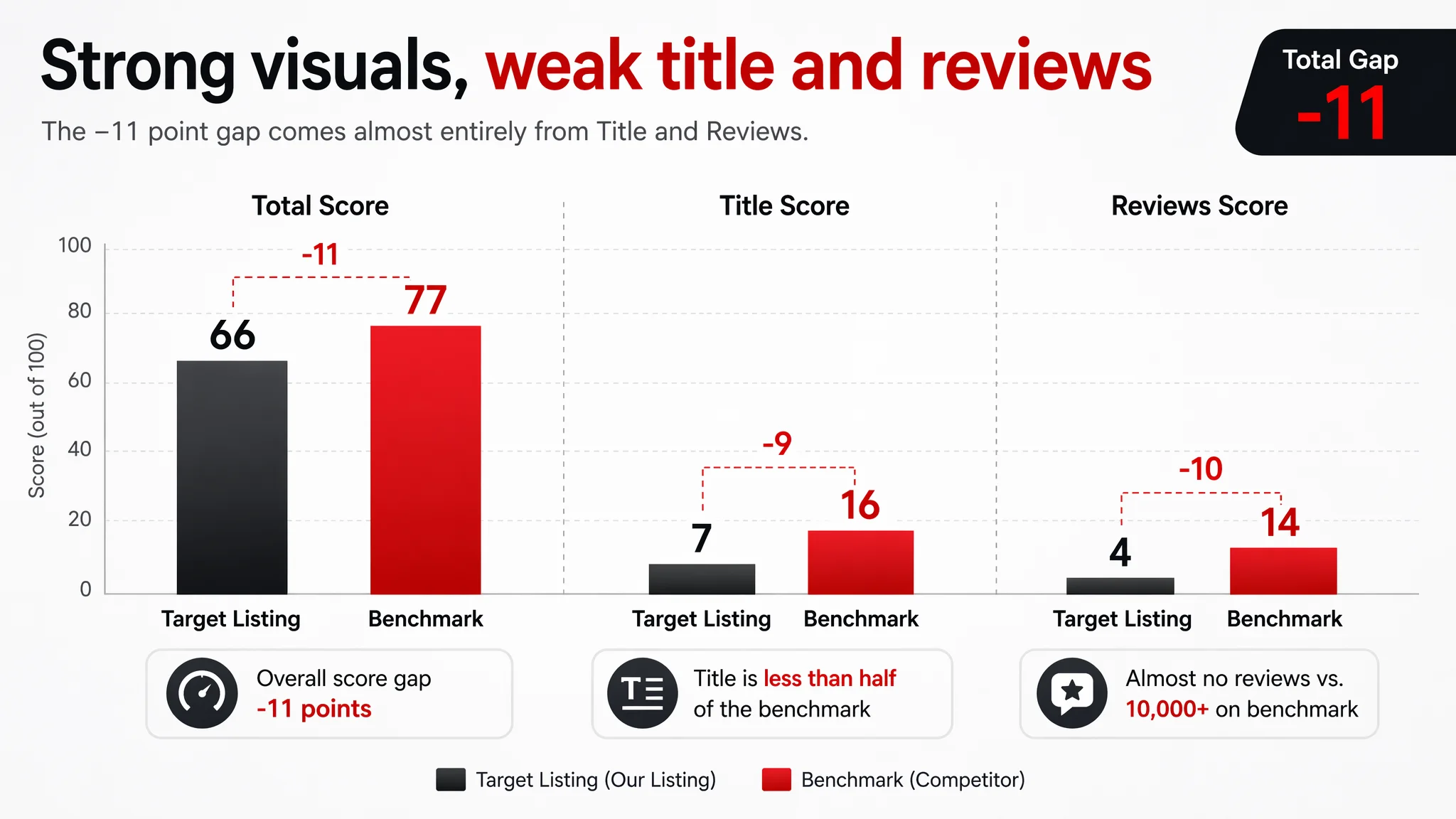
- Title: Target: 7, Benchmark: 16, Full: 20, Gap: -9
- Main Image: Target: 26, Benchmark: 22, Full: 30, Gap: +4
- Bullet Points: Target: 8, Benchmark: 6, Full: 10, Gap: +2
- Detail/A+: Target: 21, Benchmark: 19, Full: 25, Gap: +2
- Reviews: Target: 4, Benchmark: 14, Full: 15, Gap: -10
This was not a classic “weak gallery, weak A+” case.
- The main images already scored higher than the benchmark.
- The bullet points and A+ detail page were structurally better, more technical, and more persuasive.
- The two critical deficits were:
- A title that scored less than half of the benchmark’s.
- An almost empty review base versus a competitor with over ten thousand reviews.
In other words:
The Listing didn’t lack images. It lacked a clear promise in the title and basic social proof.
Continuing to pour budget into ads and additional images would not change these fundamentals. Ads were amplifying a page that still spoke like a generic tool and carried close to zero proof of usage.
This Product Page Did Not Lack Traffic. It Lacked Trust.
The review dimension made the trust gap visible:
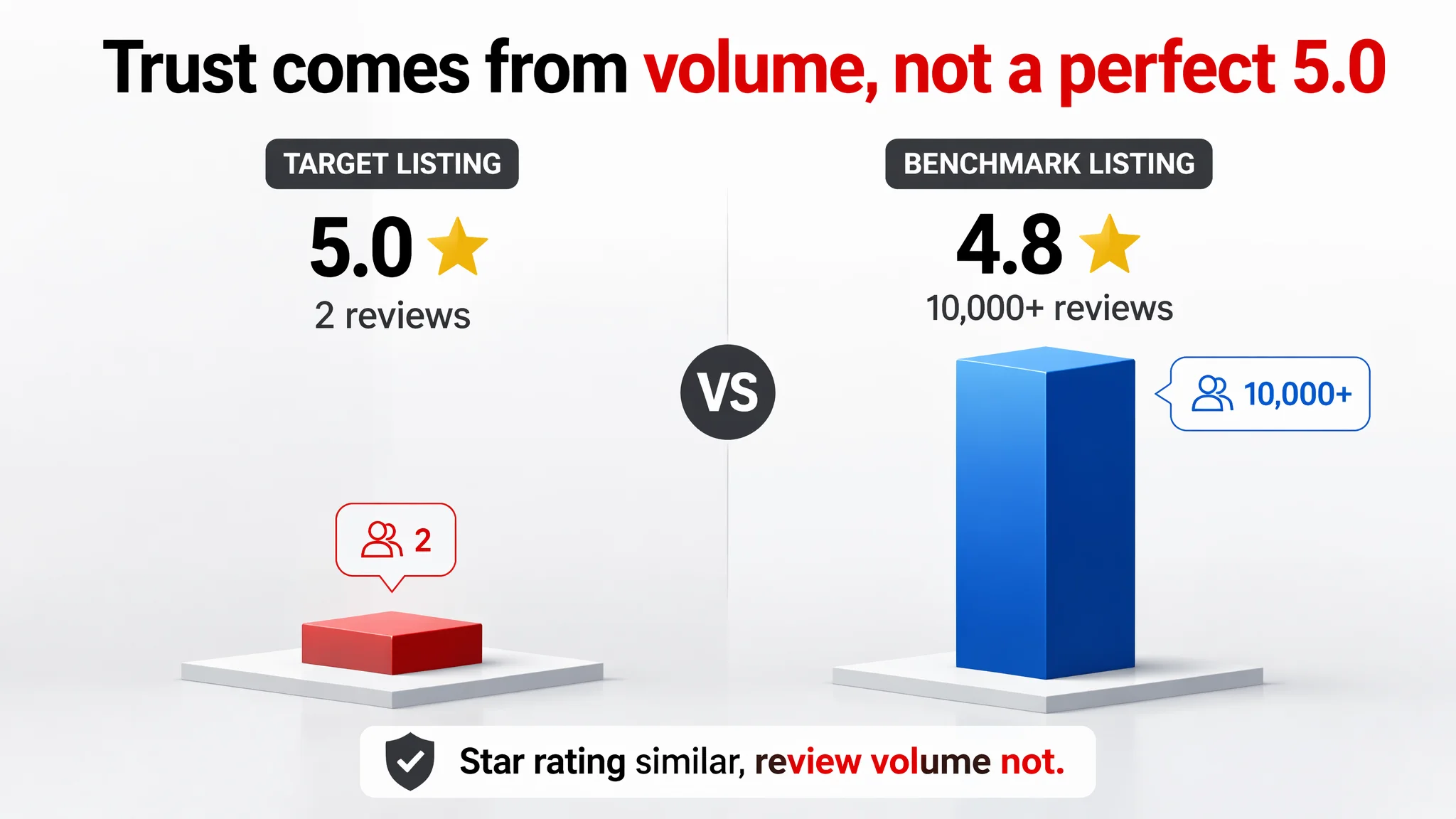
- Target Listing:
- 5.0 stars
- 2 total reviews
- Benchmark Listing:
- 4.8 stars
- 10,000+ reviews
Even though the star rating looked “perfect,” the scale was the real story. Users are used to this category’s benchmark Listing; they see:
- A slightly lower rating (4.8 vs 5.0),
- But thousands of detailed, global reviews, often with photos and stories.
The target Listing presented:
- Strong visuals,
- Almost no reviews,
- A new brand with no historical footprint.
So the conversion funnel looked like this:
- Click level: Main images and laser story were good enough to win clicks.
- Page level: Title did not clearly articulate a tangible outcome.
- Trust layer: Review base was near zero.
Result: traffic arrived, visually liked what it saw, but lacked enough trust and clarity to commit.
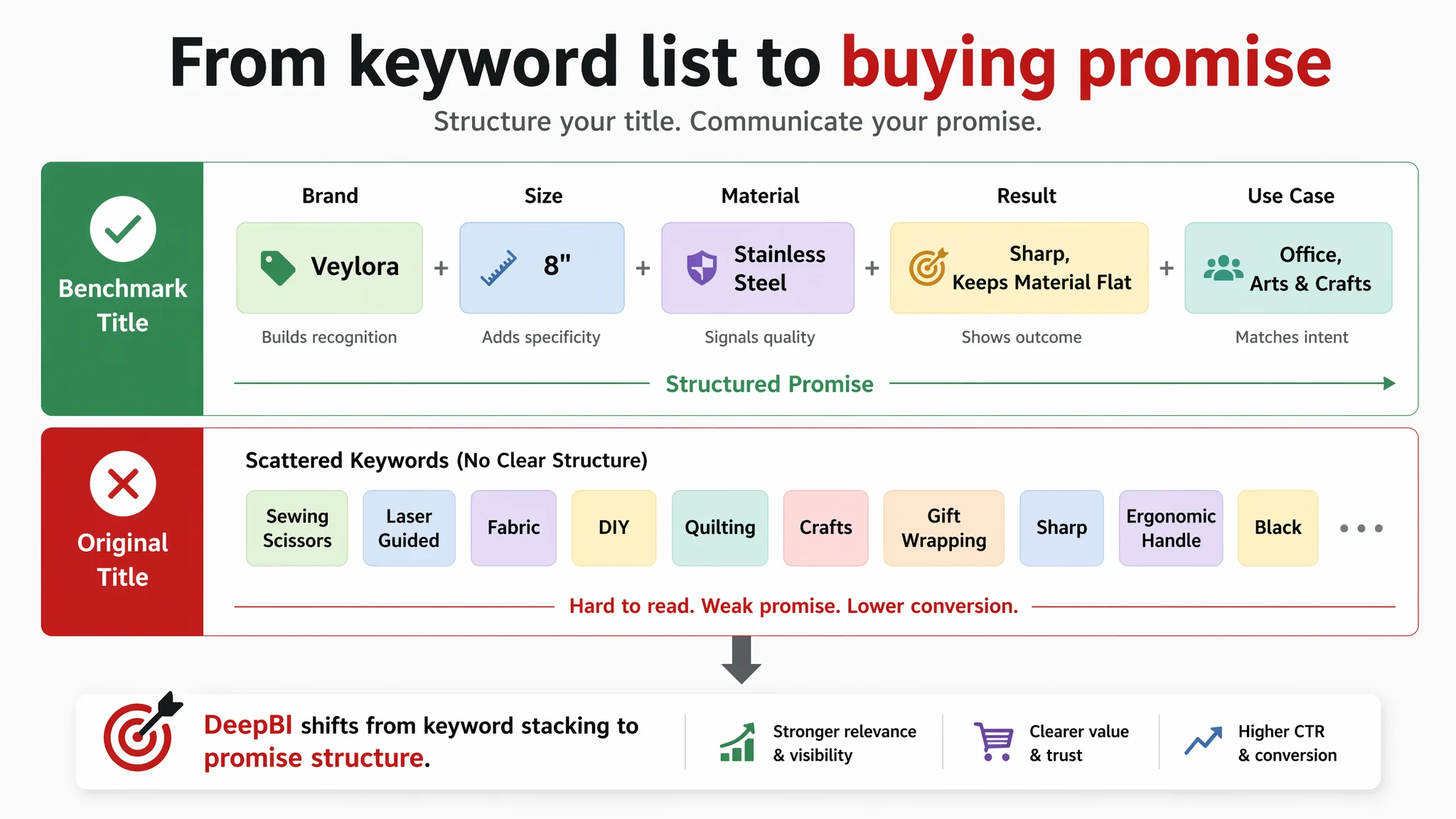
A Title That Read Like a Keyword Dump, Not a Buying Promise
DeepBI’s diagnosis on the title dimension highlighted the core issue.
The benchmark title followed a highly disciplined, outcome-centered structure:
- Brand + size + visible feature + material + result + usage
For example (simplified):
[Brand] 8" Stainless Steel Scissors, Ergonomic and Keeps Material Flat, Sharp All-Purpose Paper and Fabric Scissors for Office, Arts, and Crafts
Key behaviors:
- Brand and size clearly front-loaded.
- Material (“Stainless Steel”) immediately raising perceived quality.
- Concrete result words like “Keeps Material Flat” and “Sharp” signaling outcomes.
- Clear usage scenarios: office, arts, crafts.
By contrast, the target Listing’s title:
- Pushed the core category term “Sewing Scissors” toward the back.
- Stacked multiple keywords without a tight logical order.
- Read more like a feature inventory than a coherent promise.
It technically “covered a lot of keywords,” but:
- Lacked a strong front-loaded hook.
- Did not connect the laser feature to a specific result (e.g., perfectly straight cuts).
- Scattered the message across multiple roles (fabric, DIY, etc.) without hierarchy.
This is where DeepBI’s judgment diverged from the customer’s original diagnosis.
The seller believed “we just need to stuff enough relevant keywords and let ads do the rest.” DeepBI saw “a title that fails to state what the laser does for the buyer.”
As long as the title opened weak, the Listing conversion capacity would stay capped—regardless of A+ quality and image volume.
Why DeepBI Did Not Keep Tuning the Ads First
With scoring pointing to a strong visual backbone and a weak title-trust layer, DeepBI’s recommendation path was straightforward:
1. Do not treat this as an ad-structure problem first.
2. Repair the Listing’s conversion logic before scaling traffic.
There were three reasons.
1. Ads Were Already Bringing “Enough” Traffic
The fundamental problem was not traffic scarcity.
CTR was being supported by:
- Visually differentiated laser storytelling.
- Strong parameter visuals and multi-scene demonstrations.
Yet orders were not moving in step.
Pouring more spend into this structure would:
- Increase sessions,
- But feed them into the same under-optimized title and near-empty review layer.
2. The Biggest Gaps Were at the Top and Bottom of the Page Logic
- Top (title): Failing to deliver a clear, outcome-driven promise.
- Bottom (reviews): Failing to provide any meaningful social proof.
Between those two, the mid-layer (images and A+) was already ahead of the benchmark. Fixing the mid-layer again was not the priority.
3. Advertising Was Amplifying the Wrong Weakness
As DeepBI often sees:
“Advertising does not only amplify advantages. It can also amplify a page’s existing defects.”
In this case, every dollar spent:
- Successfully brought users into a visually convincing environment,
- Then hit them with:
- A generic, keyword-stacked title, and
- A near-empty review section.
This is precisely the sequence that inflates ACOS and keeps CVR stuck.
Rebuilding the Title Around Laser Precision, Not Just “Sewing Scissors”
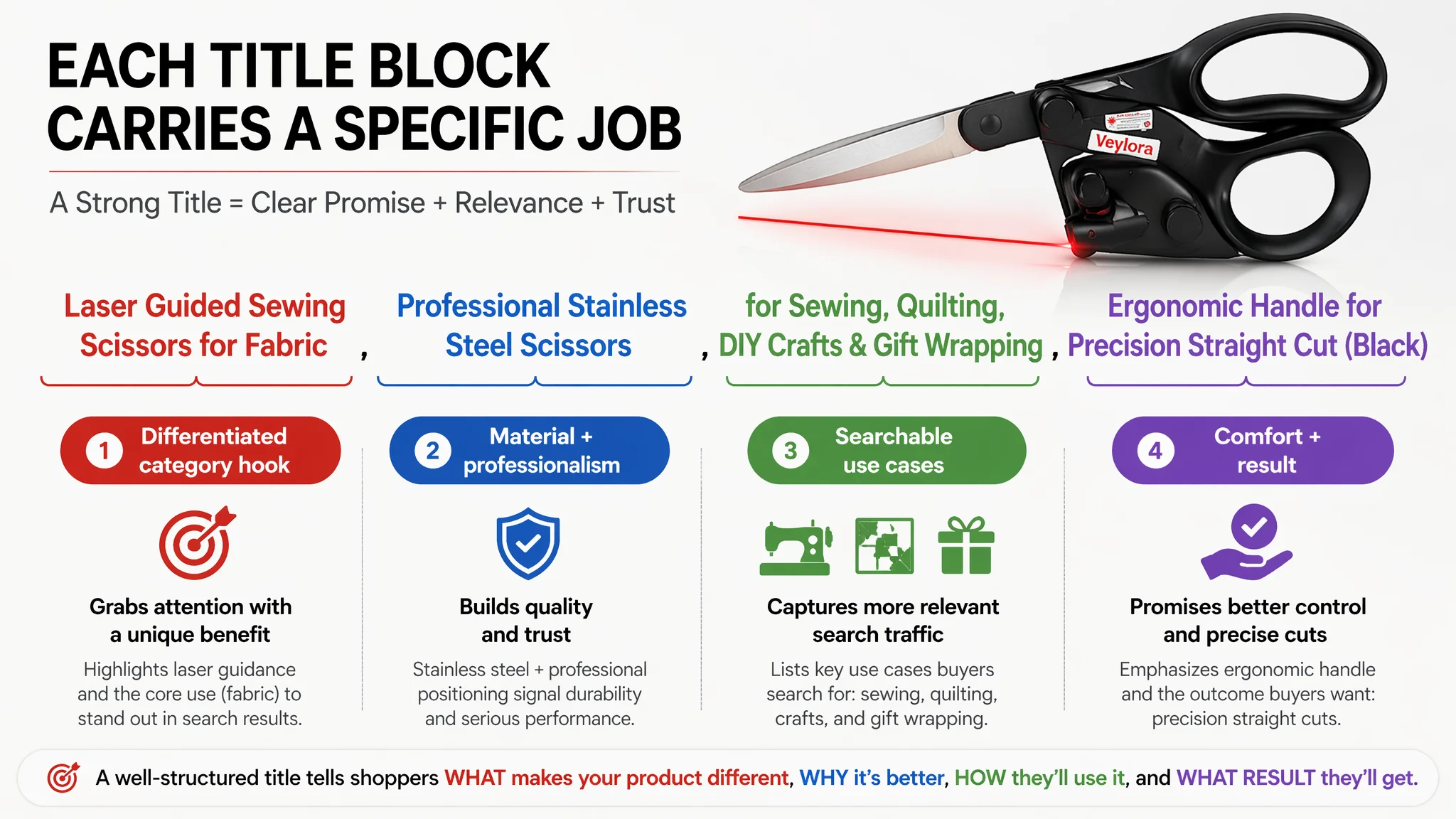
DeepBI reframed the title from “a list of features” to “a structured buying argument.”
The proposed direction:
Laser Guided Sewing Scissors for Fabric, Professional Stainless Steel Scissors for Sewing, Quilting, DIY Crafts & Gift Wrapping, Ergonomic Handle for Precision Straight Cut (Black)
Several deliberate shifts are embedded here.
The unique hook moves to the front
- “Laser Guided Sewing Scissors” becomes the opening.
- It ties the category (sewing scissors) directly to the differentiator (laser guided).
- This tells Amazon search and buyers: this is not just another pair of scissors.
Material and professionalism pull up perceived value
- Adding “Stainless Steel” and “Professional” leverages proven benchmark behavior.
- Material not only helps SEO but also signals durability and serious use.
Use cases become structured, not random
- “Sewing, Quilting, DIY Crafts & Gift Wrapping” are not just keywords.
- They mirror how real buyers describe their projects and search patterns.
- The spread covers core sewing terms without diluting the main promise.
The result is explicitly stated
- “Ergonomic Handle for Precision Straight Cut” connects comfort to outcome:
- Less fatigue,
- Straight cuts—the core pain point this product solves.
This is not decoration; it is a conversion lever.
A user seeing “Laser Guided… Precision Straight Cut” already understands what the product does for them, before reading any A+ module or bullet point.
Bullet Points: From Features to a Structured Decision Path
While the bullet score already exceeded the benchmark, DeepBI still saw room to tighten the path from pain point to solution.
The brand’s existing bullets followed a “technical advantage → scene → experience → components → convenience” progression. The benchmark took a flatter approach.
DeepBI’s suggested rewrites pushed each bullet into a pain point → mechanism → result structure.
Examples:
1. Laser-guided straight cuts as a category anchor
【Laser-Guided Arts & Crafts Staple】Built-in laser guide projects a clear, precise straight line for error-free cutting…
- Names the role (“Staple” in arts and crafts).
- Connects directly to “crooked cuts” as the pain point.
- Positions laser as the solution, not just a “cool feature.”
2. Blade professionalism, not just “sharp”
【Precision Stainless Steel Blades】High-grade, precision-ground stainless steel blades…
- Mirrors benchmark phrases like “precision-ground.”
- Emphasizes full-length sharpness (root to tip).
- Reinforces consistency in performance language.
3. Ergonomics framed as fatigue relief
【Ergonomic Soft-Grip Comfort】… reduces hand fatigue during long-term use…
- Ties comfort directly to long sewing sessions.
- Speaks in the user’s reality (“long-term use,” “intricate cutting tasks”).
4. Expanded multi-use keywords without losing focus
【Multi-Purpose & Professional Utility】A dependable addition to your quilting, scrapbooking, and sewing supplies…
- Adds quilting and scrapbooking, but within a coherent “professional utility” frame.
- Protects relevance while broadening keyword coverage.
5–6. Simplicity, safety, and “ready to work”
- Emphasis on:
- One-button laser operation,
- Pre-installed batteries,
- Immediate usability.
This further reduces friction at the decision stage: no extra purchases, no fiddly setup.
Together, the bullets shift from “many features listed” to “a structured buying story,” which is essential when reviews cannot yet carry the trust load.
This Page Was Already A+ Heavy. The Question Was: Is That Story Used Correctly?
DeepBI’s evaluation confirmed that, on the detail-page side, the brand had already invested heavily:
- 7 structured A+ modules, including:
- Modular precision in real scenes,
- Multi-material capability (silk, leather, paper, cotton),
- Ergonomic emphasis,
- Ready-to-use messaging (batteries, setup),
- Laser alignment and calibration details.
Strategically, the seller had chosen a “technical, high-precision instrument” narrative, while the benchmark leaned on “brand history + emotional familiarity.”
This meant:
- The A+ already had:
- High information density,
- Strong technical storytelling,
- Consistent laser visual motif (red line across multiple images).
For DeepBI, the focus was not “add more modules,” but “align each module’s visual role with the title promise and bullets.”
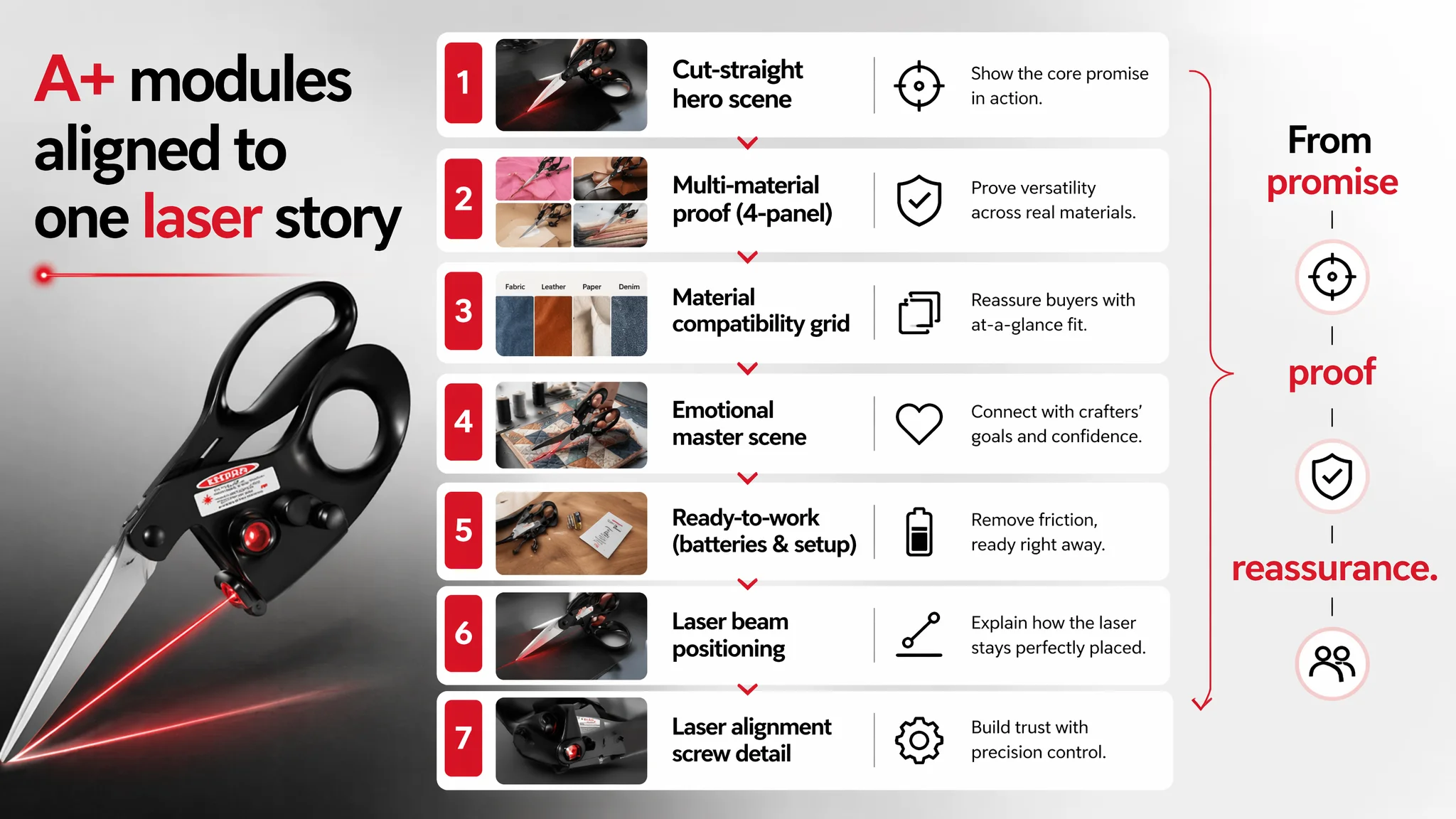
Key refinements included:
- A stronger first module that shows laser guidance clearly solving the “cut straight” problem on a challenging dark fabric.
- A four-panel multi-material visual confirming:
- No “chewing” on fabrics,
- Seamless cuts from silk to leather.
- A micro-level module showing laser calibration screws, addressing a typical objection:
- “Will the laser stay accurate?”
The point: use the existing A+ strength to answer downstream doubts, while the title and bullets take responsibility for upstream promise and clarity.
Before Ads Could Work Again, the Page Had to Convert
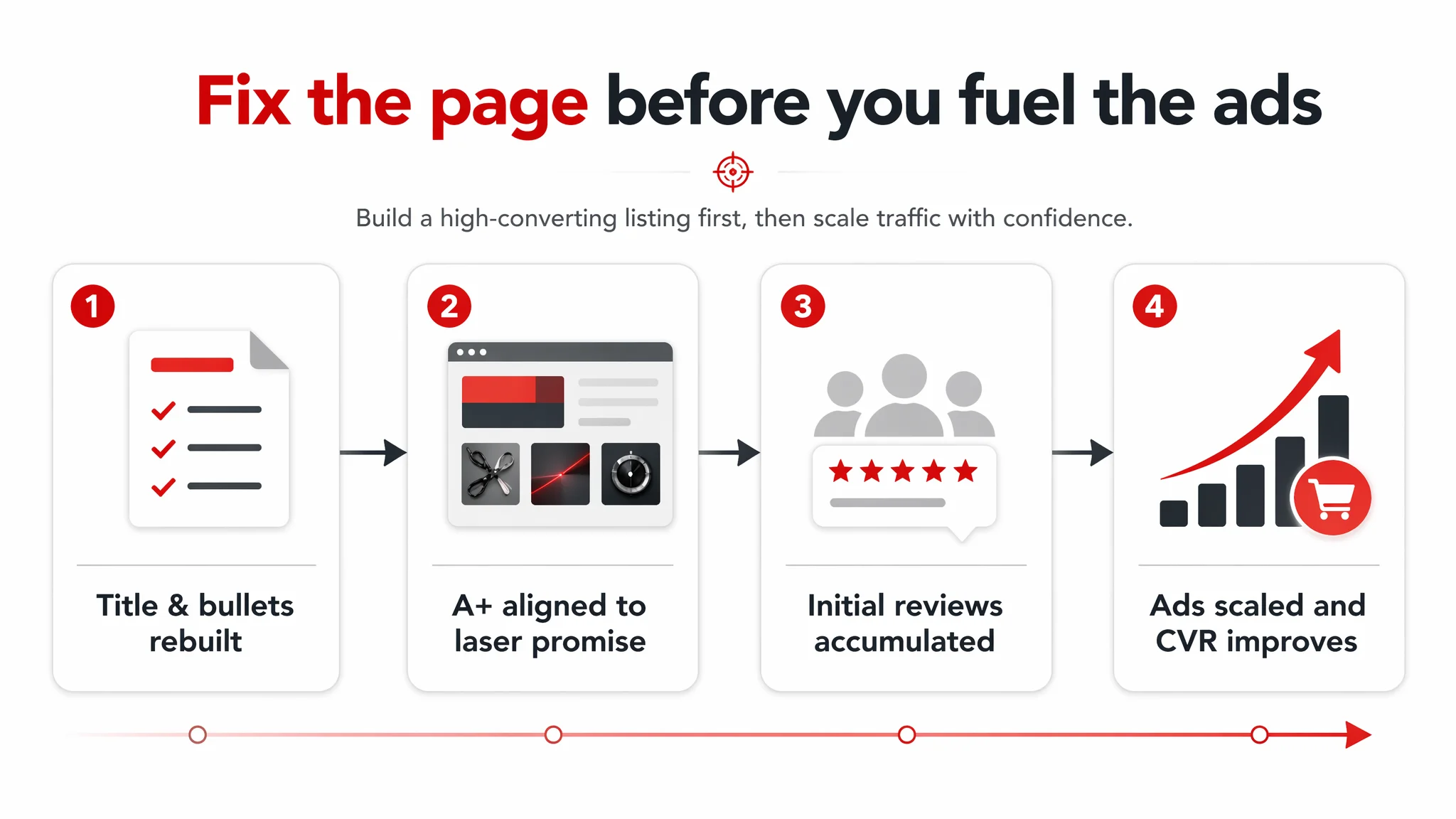
After reframing the problem, the optimization order became:
1. Title: Front-load laser precision and professional outcomes.
2. Bullets: Rewire around a “pain point → mechanism → result” narrative.
3. A+ visuals: Refine and align with the laser promise and technical reassurance.
4. Reviews: Plan and execute a trust-building phase (e.g., early reviewer programs within Amazon’s policies, targeted traffic from relevant audiences, post-purchase follow-ups).
Only once these foundations were in place did it make sense to:
- Scale ad traffic again,
- Reopen aggressive keyword testing,
- Stretch bids on high-intent terms.
The expected evolution in operating state was not “instant dramatic numbers,” but:
- CVR starting to recover as the title and bullets clarified the promise.
- ACOS gradually easing as each click met a clearer value story and fewer users dropped off for trust reasons.
- Organic order share improving, once the Listing began to rank not just on traffic, but on consistent conversion signals.
- Advertising dependence decreasing over time, as the Listing itself carried more of the sales burden.
What Changed in the Customer’s Understanding
By the end of this diagnosis and early optimization phase, the seller’s view of the problem had shifted in several important ways:
- From “Our Amazon ads are underperforming”
→ to “Our Listing’s title and trust layer were underdeveloped.”
- From “We need more images and more ad tests”
→ to “We need a stronger promise in the title and a clearer decision path through bullets and A+.”
- From “Once A+ looks impressive, ads will take care of the rest”
→ to “A+ supports conversion, but the title and reviews decide whether users give the page a chance.”
Most importantly, the seller internalized a core Amazon reality:
Listing quality is the foundation of ad efficiency. Before scaling traffic, you must decide whether the page deserves more traffic.
For other Amazon sellers—especially those in mature categories with entrenched incumbents—this case underlines a simple but often overlooked truth:
- A high-scoring main image and elaborate A+ do not guarantee conversion if:
- The title does not clearly state what the product does for the buyer, and
- The review base is too thin to carry trust.
If your Amazon ads feel “harder to optimize than they used to,” and your Listing visually looks “better than the category average,” it may be time to re-ask the core question DeepBI asked here:
- Are your ads failing,
or is your product page quietly consuming the traffic they bring?