

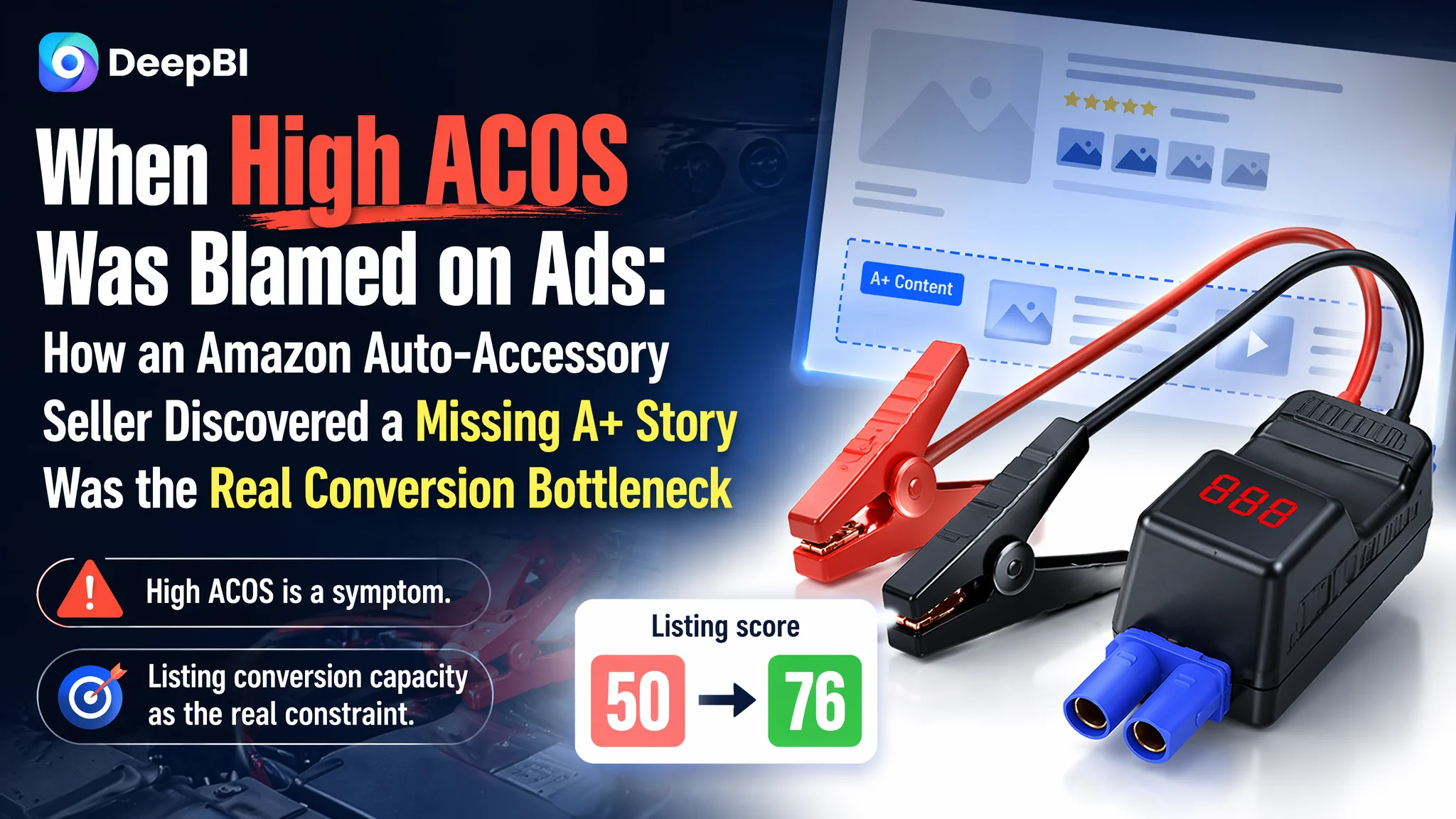
For this Amazon auto-accessory seller, the pressure came from rising ad costs and a stubbornly weak order curve. The product was an EC5 car jump-starter cable with a smart LCD display—objectively a differentiated tool in a crowded automotive accessories category. Yet even with steady Amazon ads traffic, the Listing was not converting like it should. The team’s first reaction was familiar: blame keyword setup, bids, and campaign structure.
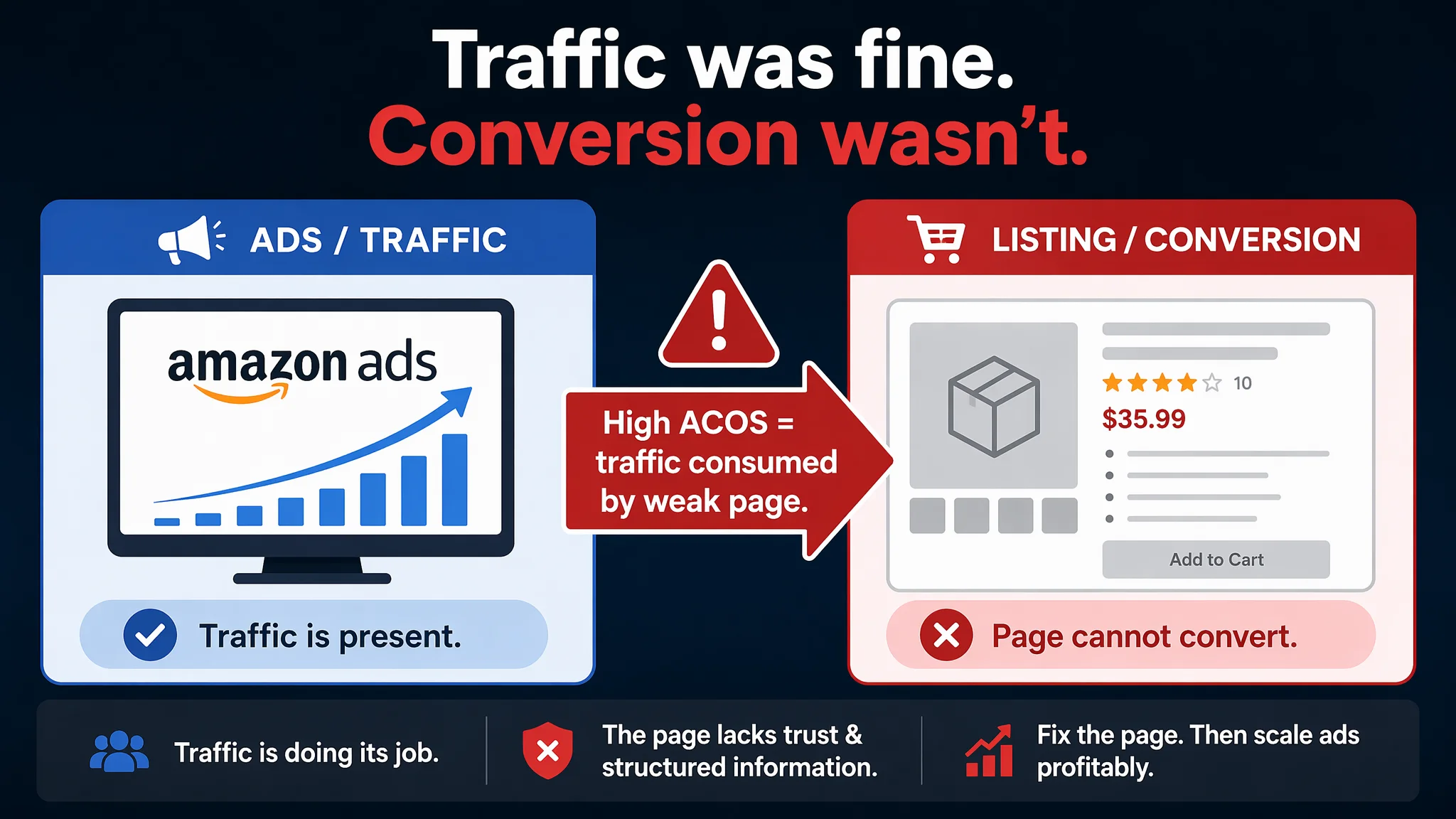
Once DeepBI’s Listing diagnosis went in, the picture changed. The real issue was not a lack of traffic, but a page that was structurally weaker than a benchmark competitor: a total Listing score of 50 versus 76, with a catastrophic 0/25 on the detail (A+) dimension and a 4.0-star, low-volume review profile facing a 4.5-star, high-volume benchmark. Ads were pumping traffic into a page that could not build enough trust, especially below the fold.
The optimization pivoted away from “keep tuning ads” toward rebuilding Amazon Listing conversion capacity: a tighter, more outcome-focused title, bullet points that combined SEO with concrete technical proof, a main-image set that visualized the smart LCD and EC5 specs, and—most critically—a complete A+ story to close the trust gap. The result wasn’t a magic spike overnight, but a Listing that could finally carry its weight: paid clicks were no longer consumed by a thin page, organic conversion capacity began to recover, and the ad funnel became economically usable again.
For other Amazon sellers, this case is a reminder that high ACOS is often a symptom, not the disease. When a benchmark Listing is visibly better at telling a credible, visual story, no amount of bid micromanagement will fix a page that fails to persuade. Before scaling ads, the question is simple: does the Amazon product page deserve more traffic yet?
Amazon Ads Were Not Failing. The Page Was Consuming the Traffic.
The customer is an Amazon seller in the automotive accessories category, operating on the US marketplace.
Their product is an EC5 car jump-starter cable with a built-in intelligent LCD screen—positioned as a smarter replacement cable for 12V portable jump starters.
On the surface, the problem looked like an advertising issue:
- Paid traffic was present.
- ACOS pressure was rising.
- Orders were not following the traffic curve.
Operationally, the team’s instinct was:
- “Our ads might not be targeted enough.”
- “We probably need better keywords and bid tuning.”
- “Maybe our creatives don’t stand out in the search results.”
In other words, they treated the issue as an Amazon ads optimization problem.
“The real problem was not that ads failed to bring traffic. It was that the page could not convert the traffic.”
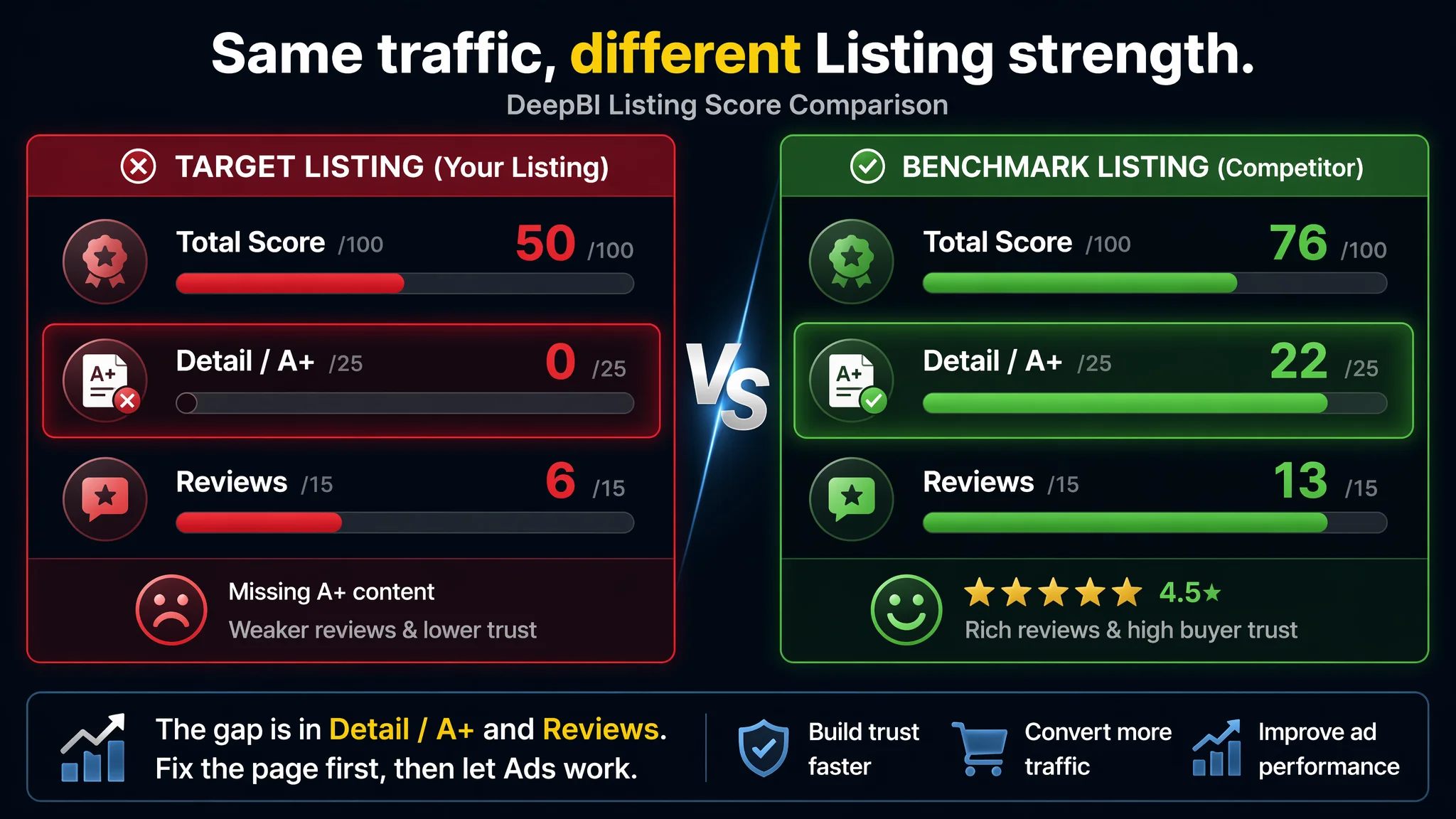
When DeepBI ran the Listing through its scoring and competitive benchmarking, the diagnosis immediately shifted away from pure ad logic and into Listing conversion capacity:
- Total Listing score: 50/100 for the target Listing vs. 76/100 for the benchmark.
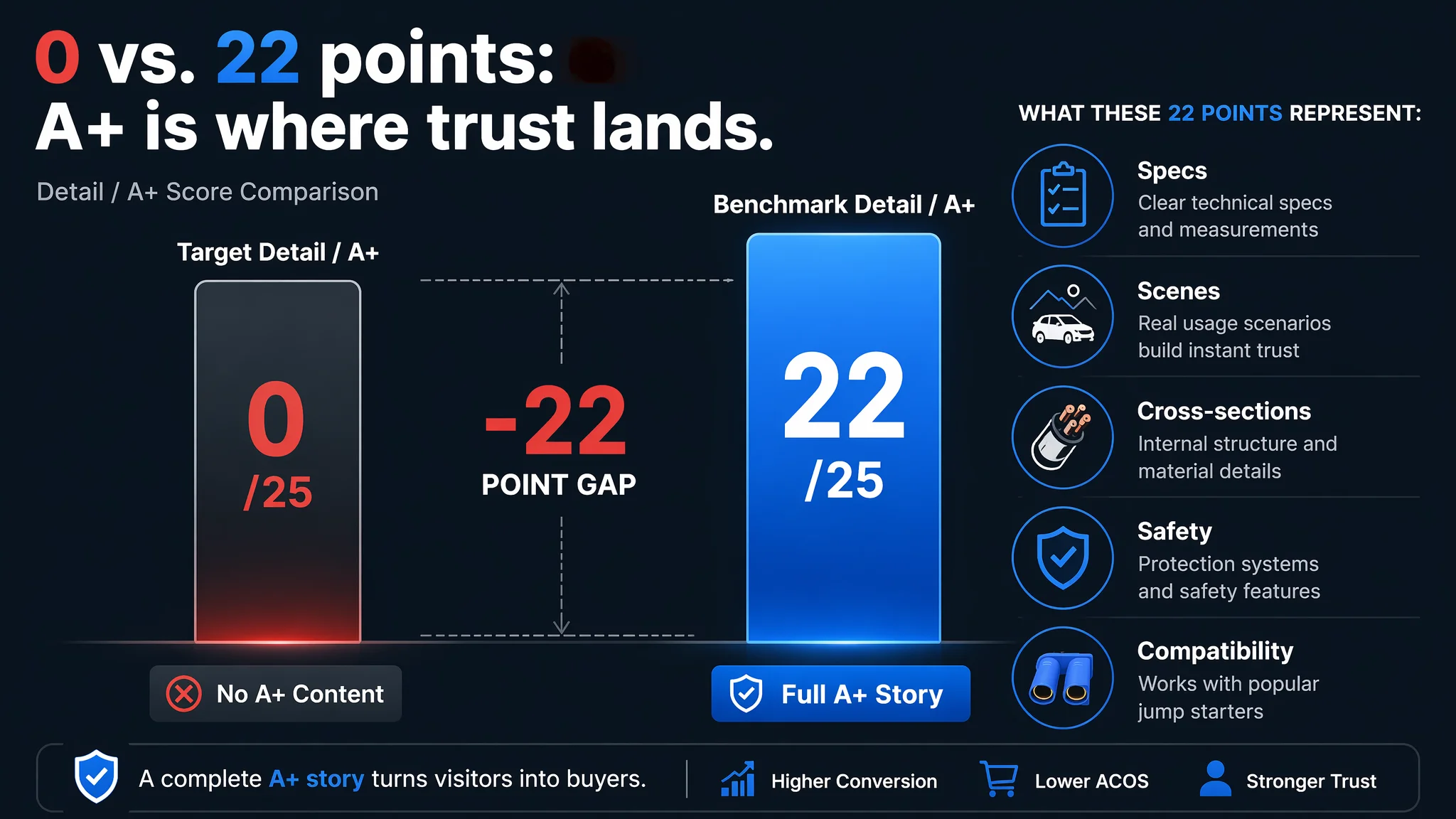
- Detail / A+ score: 0/25 vs. 22/25 — a massive -22 gap.
- Review score: 6/15 vs. 13/15 — a 4.0-star, low-volume profile versus a 4.5-star, high-volume benchmark with rich front-page reviews.
The ads were doing their job: bringing in visitors.
The Amazon product page, however, was not ready to turn those visitors into buyers.
The Real Constraint Was Listing Conversion Capacity
DeepBI’s scoring model breaks the Listing down into five core dimensions:
- Title
- Main images
- Bullet points
- Detail / A+ content
- Reviews
In this case, the single biggest structural gap was obvious:
- Detail / A+ dimension:
- Target Listing: 0 points — effectively no A+ content.
- Benchmark Listing: 22 points — full, structured, and visually rich A+ modules.
Everything below the fold on the target Listing was essentially empty.
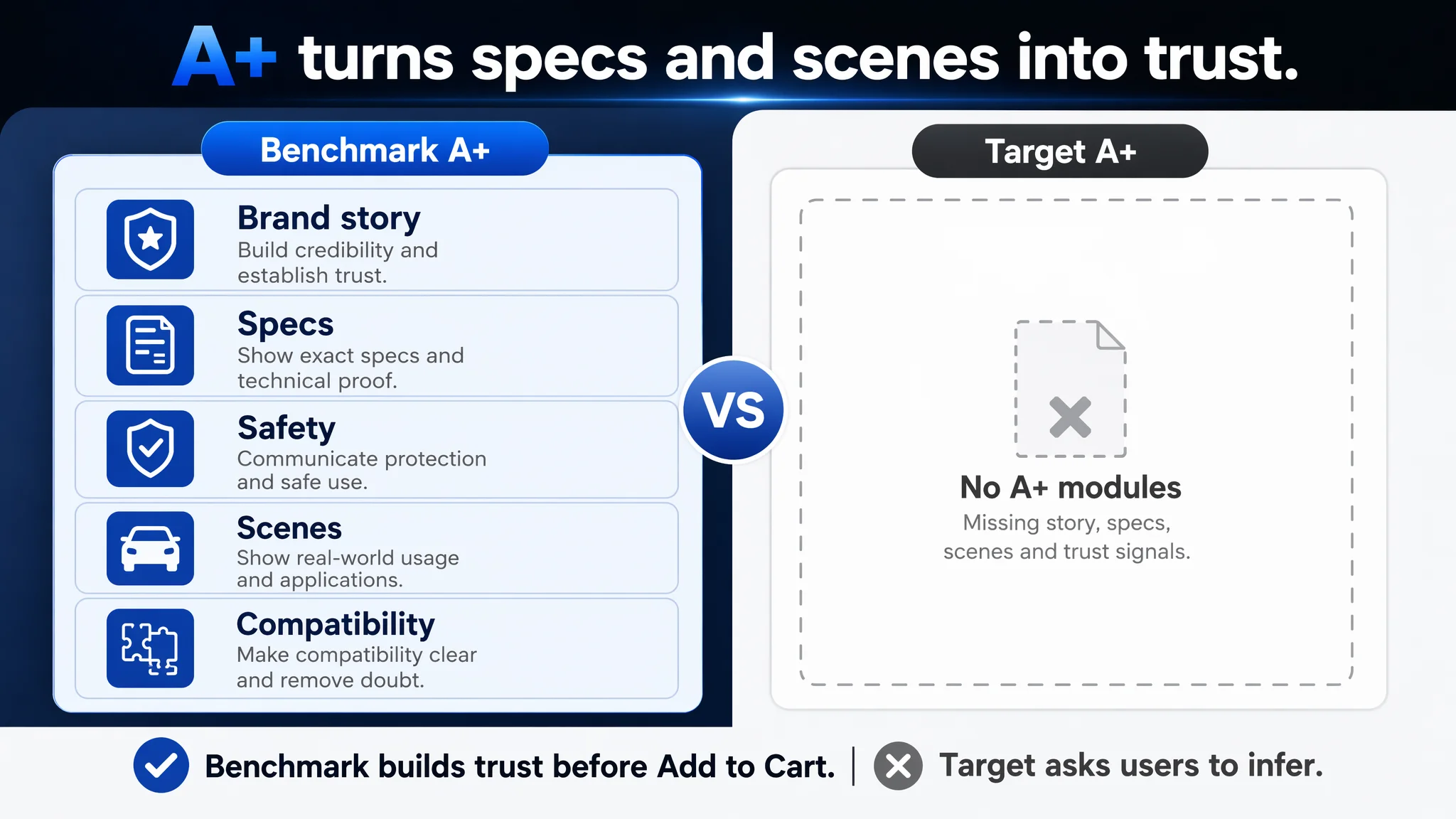
By contrast, the benchmark Amazon product page used its A+ space to build a complete persuasion chain:
- Brand story and credibility.
- Product definition and positioning.
- Visualized core specs (10AWG tinned copper, silicone insulation).
- Technical cross-sections and dimension diagrams.
- Realistic in-car usage scenes.
- Clear compatibility explanations.
From a decision-logic perspective, this meant:
- Benchmark: Trust is built visually and logically before the shopper ever reaches the “Add to Cart” button.
- Target: The shopper has to infer everything from title and bullets, with no visual reinforcement and no A+ story.
DeepBI’s conclusion: this product page did not lack traffic; it lacked trust and structured information.
What the Seller Originally Misdiagnosed
From the seller’s perspective, several observations drove their initial misdiagnosis:
- Ads showed impressions but limited orders.
- The category is highly competitive, with many similar EC5 jump cables.
- Benchmark competitors had very high review counts and solid ratings.
They drew a familiar conclusion: “We need to fix the ads.”
The team focused on:
- Expanding keywords (e.g., more “jump starter” and “booster” variations).
- Adjusting bids, campaign structure, and placements.
- Considering creative refreshes for Sponsored Ads while leaving the core Listing content mostly unchanged.
Why this kept failing:
1. They treated ACOS as purely an advertising control problem.
In reality, ACOS sits at the intersection of traffic and conversion. You can’t diagnose it from the ad console alone.
1. They underestimated the conversion gap vs. the category benchmark.
A competitor with a fully built A+ and almost 1000 reviews plays by different conversion rules than a Listing with none of that.
1. They overestimated how much their existing bullets and images were doing.
While their bullets were logically structured and persuasive, there was no A+ to visually echo and deepen that logic.
DeepBI’s data made the misdiagnosis explicit: you can’t expect ad efficiency if you are feeding ad traffic into a structurally incomplete Amazon product page.
This Product Page Did Not Lack Traffic. It Lacked Trust.
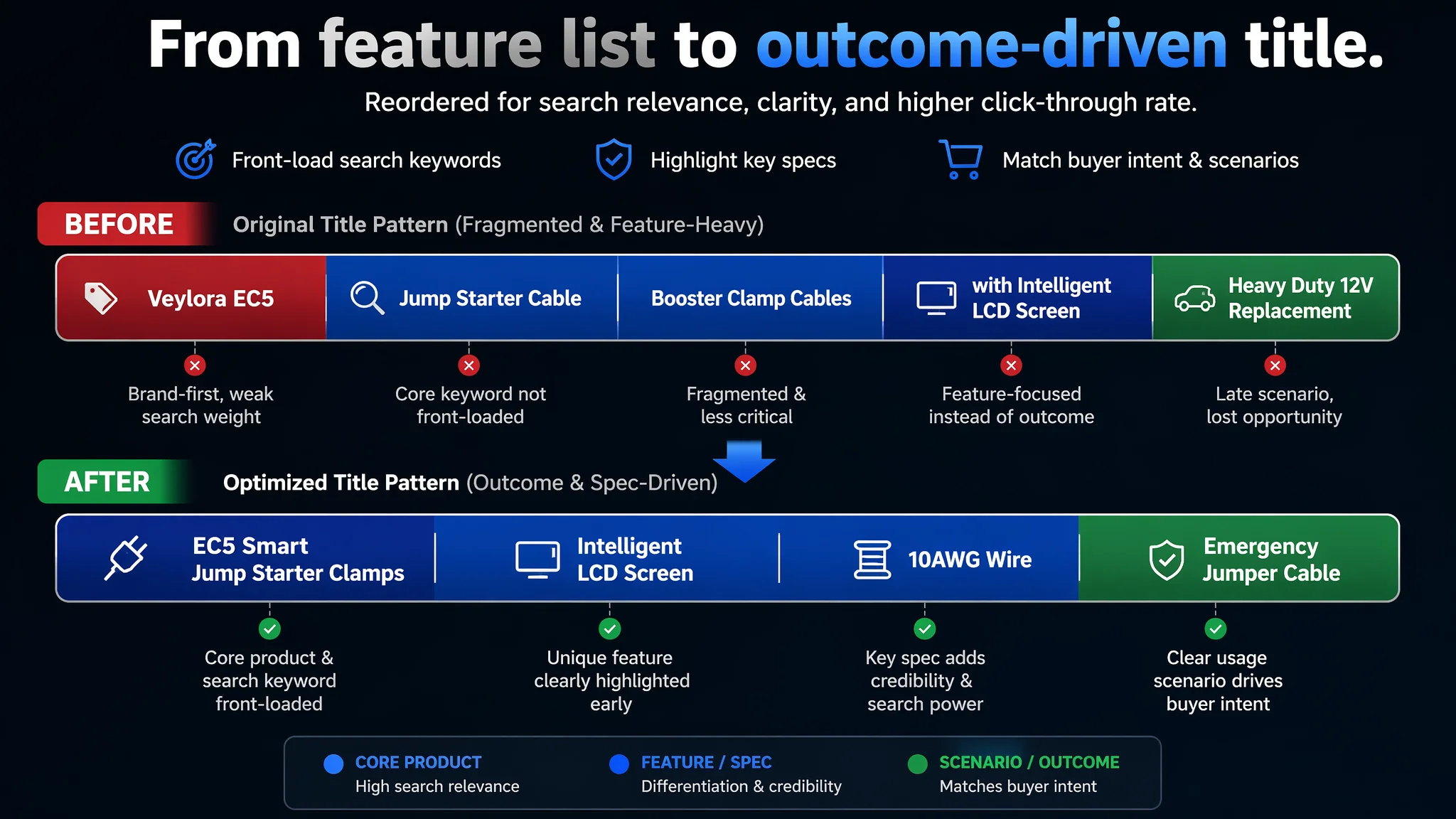
Title: Functionally Correct, But Not Structurally Competitive
Score gap: 11/20 vs. 15/20.
DeepBI’s title analysis contrasted the target Listing with the benchmark:
- Benchmark title pattern:
- Brand + EC5 Jump Starter Cable
- 12V Replacement Alligator Clips to EC5 Female
- Car Jumper Cable for Emergency Portable Jump Starter
- 10AWG Wire (specific spec)
- Target title pattern (before optimization):
- Brand “EC5” pushed to the front.
- “Jump Starter Cable” and “Booster Clamp Cables” fragmented or pushed back.
- Focus shifted to features like “with Intelligent LCD Screen” without a clear outcome anchor.
- Descriptive “Heavy Duty” claim but no quantitative spec (e.g., “10AWG Wire”).
Issues DeepBI highlighted:
- Search-weighted core block (“EC5 Jump Starter Cable”) not clearly front-loaded.
- Overemphasis on functional listing (“with Intelligent LCD Screen”) at the expense of a tight, outcome-driven structure.
- Lack of concrete technical specs (10AWG, wire OD, EC5 connector) that would both:
- Raise perceived professionalism.
- Improve CTR by matching buyer expectations in SERP.
The benchmark title followed a “Brand + core product + key features + usage scenario” formula that both the algorithm and buyers favored.
Main Images: Rich Logic Inside the Page, But Weak First-Image Hook
Interestingly, on the main-image set, the target Listing was not fundamentally weaker:
- Target strengths:
- Visual explanations of usage steps.
- Dimensions and compatibility visuals.
- Material cutaways and chip close-ups.
- A clear “professional tools” vibe.
- Benchmark weaknesses:
- Less robust demonstration of multi-scene usage.
- Fewer functional diagrams and process visuals.
- Heavy focus on EC5 connector comparisons and safety warnings.
DeepBI’s judgment:
- Once users clicked into the page, the target images helped build professional trust and explain functionality.
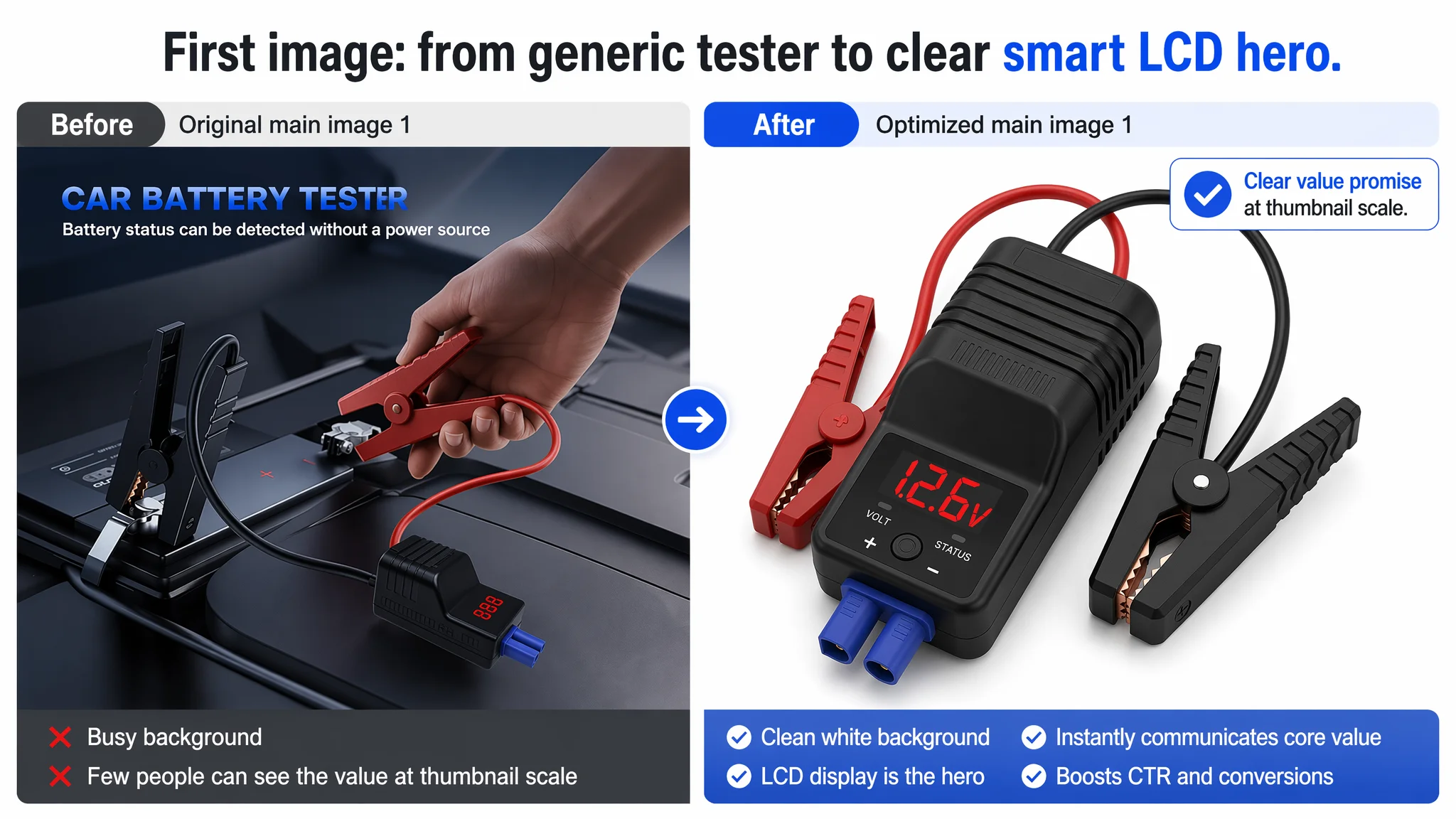
- But the first main image failed to articulate a clear, single value promise at the thumbnail level, such as:
- “Measure battery voltage without external power.”
- “Smart LCD for real-time battery health.”
This meant:
- Inside-page visuals were good.
- But the first image did not maximize CTR or clearly differentiate the product at search-result scale.
Bullet Points Had a Story. But the Page Still Failed to Close the Sale.
Bullet score: 8/10 vs. 4/10 — here the target Listing actually outperformed the benchmark.
The target Listing’s bullet strategy was strong conceptually:
- Started from user pain points (independent battery testing, safety fears).
- Framed copy as “problem → solution,” not just feature lists.
- Emphasized technical advantages and resultant outcomes:
- Stronger, safer sparks.
- More reliable starts.
- Organized logically from:
- Smart features and safety.
- Hardware quality.
- Compatibility coverage.
- Long-term durability and “professional choice” positioning.
By contrast, the benchmark:
- Used a more “instruction manual” tone.
- Focused on:
- Basic product definition.
- Parameters.
- Instructions and warnings.
- Lacked a strong motivational arc.
On paper, the target bullets should have given it an edge.
However, two things undermined their impact:
1. The bullets carried too much alone.
With no A+ to share the burden, they had to do all the explaining without visual reinforcement.
1. The language leaned heavily into marketing adjectives.
Without concrete technical visuals and specs, words like “innovative” and “professional” can feel unsubstantiated, especially versus a benchmark page full of engineering-style imagery.
DeepBI’s conclusion: the problem was not the presence of a story, but the absence of supporting visual and structural proof around that story.
The Missing Layer: A+ Content and the Detail Page
This is where the case becomes decisive.
Detail / A+ score:
- Target Listing: 0/25
- Benchmark Listing: 22/25
The benchmark Amazon A+ content included:
- Brand-backed introduction module.
- Technical spec module with diagrams.
- Structural breakdowns and conductor cross-sections.
- Material close-ups showing tinned copper and silicone insulation.
- Real usage scenes next to cars in real contexts.
- Icon-based safety and feature modules.
- Clear, visual compatibility explanations.
The target Listing had none of this.
“Advertising does not only amplify advantages. It can also amplify a page’s existing defects.”
DeepBI evaluated the impact across three dimensions:
1. Trust-building:
Automotive accessory buyers naturally seek “thickness” and “precision”:
- They want to see wire gauge and length visually confirmed.
- They want to sense material robustness and safety.
Without A+, the target Listing gave them none of that.
1. Differentiation:
The seller’s unique edge—smart LCD voltage display—was text-heavy, not visually dramatized.
- No close-up voltage scenes (e.g., 12.6V display).
- No clear “see the battery status before you crank” visual storyline.
The benchmark, while less advanced functionally, looked more “professional” because it visualized the basics better.
1. Decision-effort:
Benchmark A+ walked users through:
- Brand trust → Product definition → Core specs → Safety → Compatibility.
The target Listing forced users to mentally assemble the story from scattered bullets and images, increasing cognitive load and bounce risk.
DeepBI’s determination: the absence of A+ was the single biggest structural bottleneck—and it had to be fixed before any more serious ad scaling decisions.
Why DeepBI Did Not Keep Tuning the Ads First
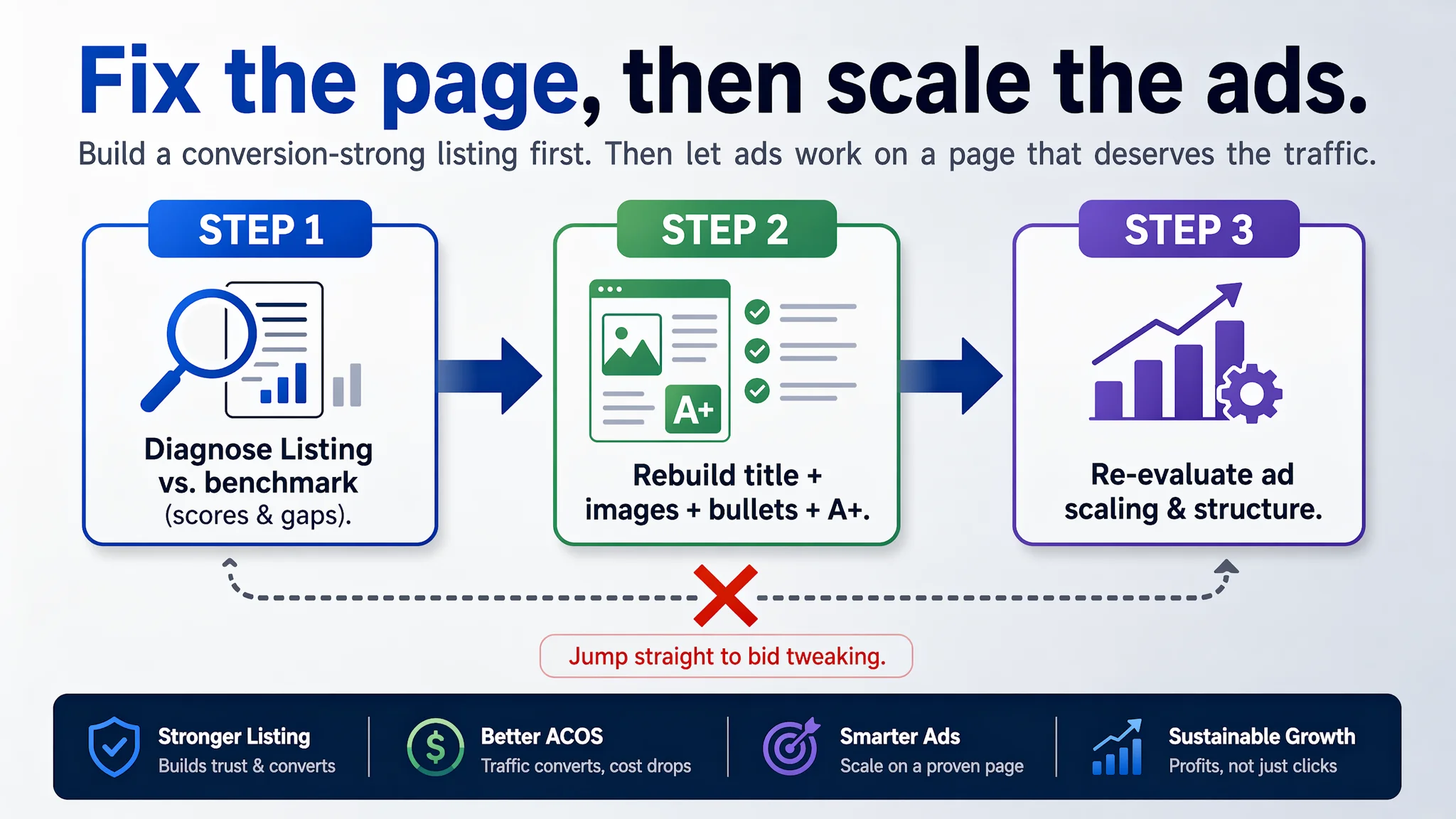
Given the scoring gaps and structural analysis, DeepBI recommended a clear decision order:
1. Stop treating this as primarily an ad-configuration problem.
The ad console couldn’t fix a 0/25 A+ dimension and a -22-point detail gap.
1. Rebuild Listing conversion capacity first:
- Tighten and professionalize the title.
- Reframe bullets for SEO + concrete technical proof.
- Sharpen the main image set for CTR and clarity.
- Build a full A+ that visually anchors the smart LCD and safety story.
1. Only then re-evaluate ad scaling and structure.
The business risk of ignoring this order was clear:
- Continuing to pour ad spend into a structurally weak page would:
- Keep ACOS high.
- Depress CVR.
- Force overreliance on paid traffic to compensate for poor organic conversion.
- Over time, this would erode margin and reduce room for competitive bidding in a category where a high-review benchmark was already entrenched.
DeepBI’s role was not to “optimize everything,” but to prioritize the single constraint that truly governed the outcome: the Listing’s ability to convert both paid and organic traffic.
How the Page’s Sales Logic Was Rebuilt
DeepBI’s guidance did not revolve around abstract “make it better” advice. It translated benchmark gaps into specific, Amazon-executable changes.
1. Reframing the Title Around Outcomes and Specs
Suggested title:
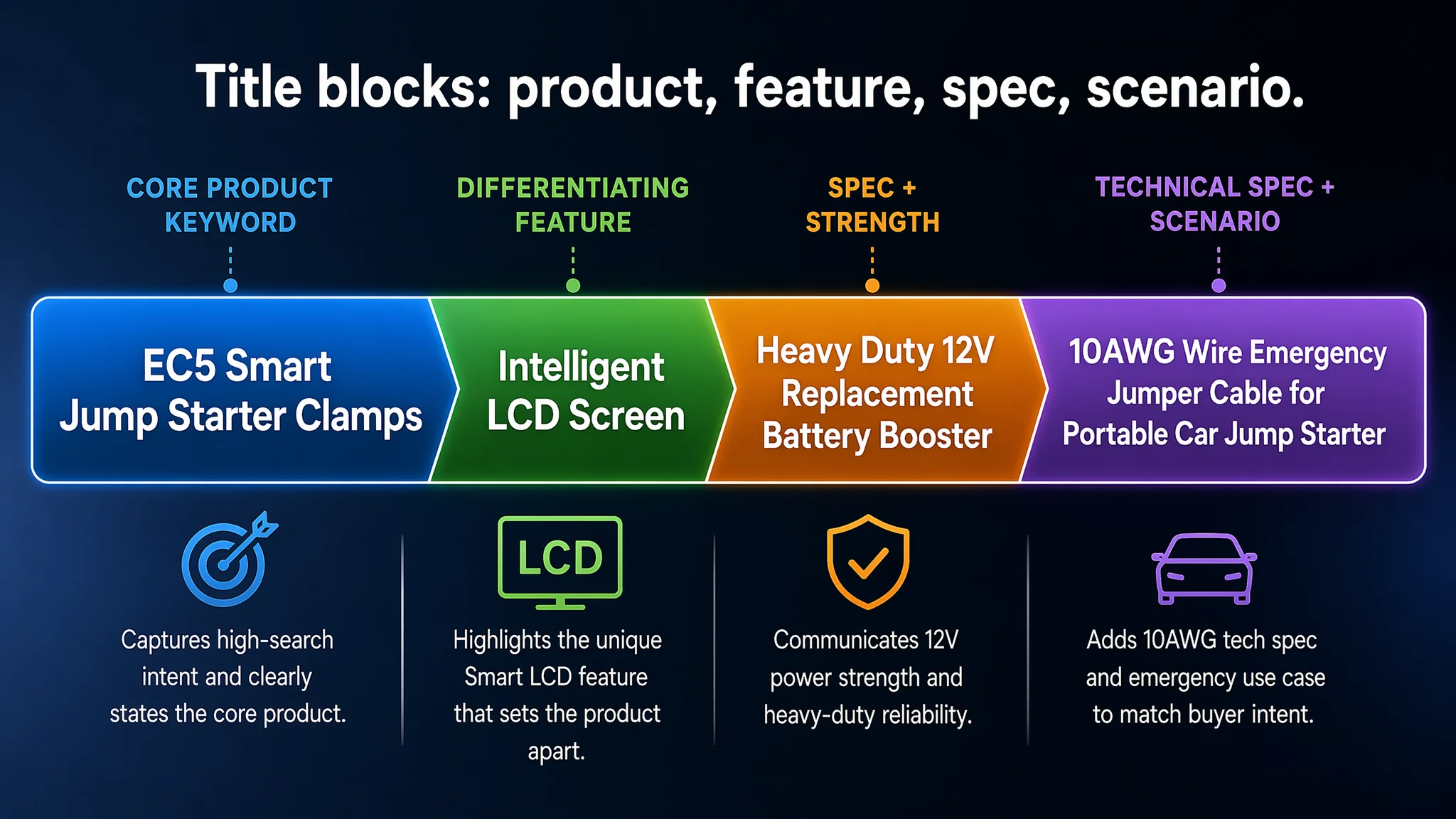
EC5 Smart Jump Starter Clamps with Intelligent LCD Screen, Heavy Duty 12V Replacement Battery Booster Alligator Clips Cable, 10AWG Wire Emergency Jumper Cable for Portable Car Jump Starter
Key shifts:
- Move “Jump Starter Clamps” and “EC5” into a coherent, front-loaded keyword block.
- Introduce “10AWG Wire” to:
- Signal professional-grade specs.
- Match benchmark buyer expectations and search patterns.
- Keep “Intelligent LCD Screen” prominent, but within a structured “product + feature + scenario” pattern.
- Remove redundant wording and fix minor formatting issues to uplift perceived professionalism.
This aligned both SEO logic and buyer readability with what high-performing Amazon Listings in the category were already doing.
2. Turning Bullets into SEO Anchors Plus Evidence
DeepBI proposed bullet revisions that merged:
- Benchmark strengths (clear specs, compatibility, warnings).
- Target strengths (smart LCD, safety layering, cold-weather performance).
Examples:
- Bullet 1:
“Universal Replacement Cable & Smart LCD Display” → Anchors “replacement jump starter cable” while spotlighting the unique standalone battery health check function.
- Bullet 2:
“Standard EC5 Connector & Technical Specs” → Clearly states EC5 compatibility and 10AWG silicone wire, reducing purchase hesitation.
- Bullet 3:
“10-Layer Protection & Superior Tinned Copper” → Combines benchmark’s “tinned copper” durability claim with the seller’s multi-layer safety system.
- Bullet 4:
“Easy 3-Step Operation” → Simplifies usage into three steps, lowering perceived risk of misuse.
- Bullet 5:
“Cold Weather Flexibility & Vital Safety Note” → Marries material advantage (flexible silicone in cold) with responsible safety warnings (e.g., remove clamps within 30 seconds).
This turned the bullets into a structured, evidence-backed buying logic, not just marketing language.
3. Re-architecting the Main Images Around Decision Logic
DeepBI’s suggestions for the image set followed a specific storyline:
- Main image 1:
Minimalist, high-clarity white-background hero:
- Product centered, ~75% of frame.
- 45-degree angle.
- Clean light, no distracting plug-ins.
Goal: maximize CTR and first-glance professionalism.
- Main image 2:
Step-by-step usage four-grid:
- Deep engine-bay background.
- High brightness, real usage scenes.
- Each grid labeled with a step.
Goal: show “easy 3-step operation” visually.
- Main image 3:
Smart LCD close-up:
- Focus on screen showing “12.6V.”
- Engine bay blurred in the background.
- Light focused on the display.
Goal: dramatize the unique “voltage visualization” advantage.
- Main image 4:
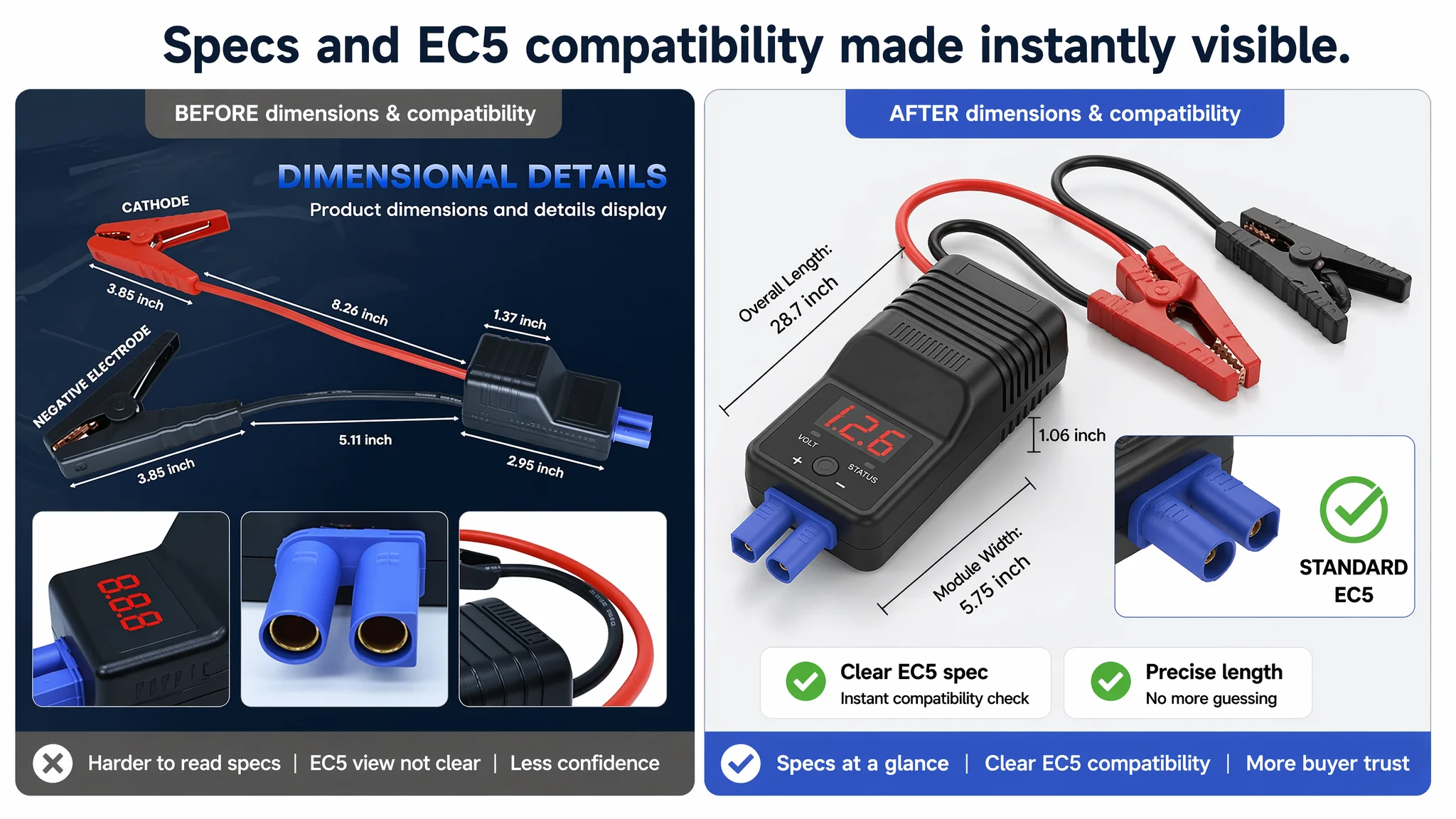
EC5 connector and dimensions:
- Diagonal layout, 80% frame coverage.
- Clear size lines and EC5 close-up.
- “Standard EC5” label.
Goal: reduce compatibility uncertainty.
- Main image 5:
Cable length visualization:
- Overhead shot.
- Cable straightened, length annotated clearly.
Goal: satisfy the buyer’s need for “thickness” and “fit” perception.
In other words, every image was assigned a specific job in the decision funnel, not just an aesthetic improvement.
4. Building the A+ Story the Page Was Missing
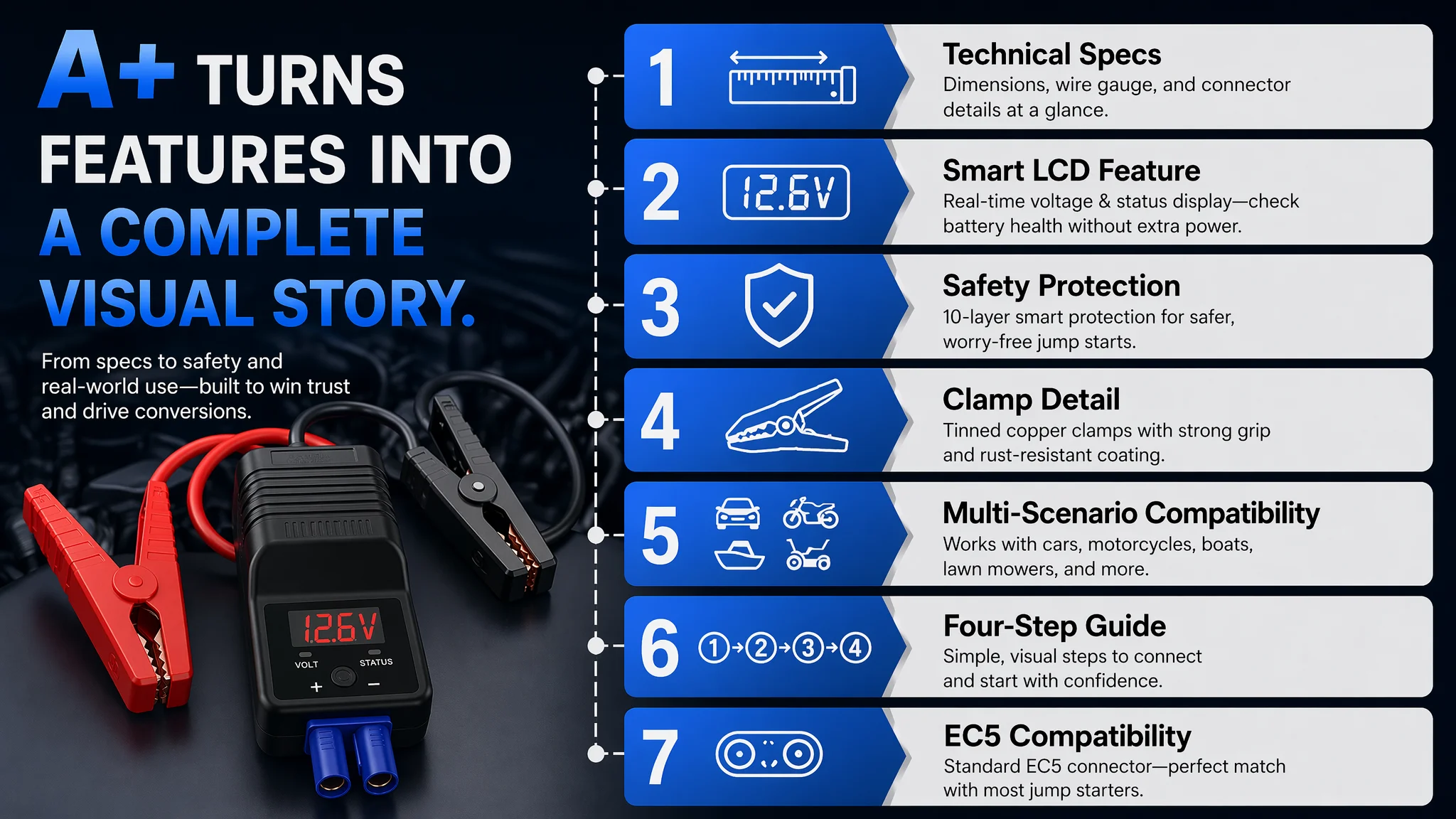
On the A+ / detail page, DeepBI recommended a complete visual architecture:
- Technical specs module:
Industrial-style image with:
- Exact length.
- 10AWG marking.
- Structural details.
Goal: anchor the product in a “professional manufacturer” visual language.
- Smart LCD feature module:
Macroscopic close-up of the voltage display:
- Realistic 12.6V reading.
- Engine bay background.
Goal: show how the LCD reduces uncertainty about battery condition.
- Safety protection module:
Clean, dark-blue layout:
- Product centered.
- 10 safety icons arranged around it.
Goal: create an instant “safety halo” without text overload.
- Clamp-detail module:
Macro shot of the clamp jaws:
- Copper teeth visible.
- Engine bay blurred behind.
Goal: address concerns about grip strength and conductivity.
- Multi-scenario compatibility module:
Grid showing usage on car, motorcycle, lawn mower, ATV:
- Real outdoor light, unified visual style.
Goal: make “broad compatibility” intuitively believable.
- Four-step guide module:
Clear, de-cluttered four-step visuals:
- Hands, EC5 plug, clamps clearly shown.
Goal: reduce anxiety in emergency-use situations.
- EC5 compatibility module:
Front-facing EC5 interface shot:
- Surrounded by representative portable jump starters.
Goal: visually answer “Will this plug fit my device?” without forcing users to read fine print.
With these modules, the detail page could finally carry the trust and explanation load that was previously missing.
How Ad Traffic Became Useful Again
DeepBI’s objective wasn’t to claim dramatic, quantified gains without data, but to stabilize the operating state of this Amazon Listing:
- Listing conversion capacity improved:
- The page moved from “thin and text-heavy” to “visually and structurally complete.”
- Smart LCD became a visible differentiator, not a buried phrase.
- Ads stopped amplifying structural defects:
- Paid clicks now landed on a page with a full A+ story and a tighter title.
- The gap vs. the benchmark’s 22-point detail score narrowed significantly.
- Traffic structure became healthier:
- The Listing regained the ability to convert both paid and organic traffic, reducing the need to brute-force growth via ads alone.
- Operational controllability increased:
- The seller could now interpret ACOS changes as a mix of traffic and conversion factors, not just bid-level noise.
- Future ad experiments could be run on a more reliable Listing, instead of on a broken foundation.
What the Seller Learned—and What Other Amazon Sellers Can Take Away
By the end of this process, the seller’s understanding changed in several fundamental ways:
- Amazon ads cannot solve every conversion problem.
When ACOS is high and a benchmark Listing is structurally superior, no amount of bid tweaking will fix a fundamentally weaker page.
- Listing quality is the foundation of advertising efficiency.
Title, main image, bullet points, and A+ content must work as one continuous sales argument.
- A+ content is not a cosmetic add-on.
In many categories—especially technical or safety-related ones—A+ is where trust, specs, and differentiation actually land.
- Advertising amplifies whatever your page already is.
If your page is strong, ads scale profitably. If your page is weak, ads amplify defects and leak budget.
- Before scaling ads, ask: “Does this page deserve more traffic?”
DeepBI’s scoring and benchmark comparison gave the seller a way to answer that question with data, not just with intuition.
For other Amazon sellers, this case is a signal to reconsider where you place your effort when pressure builds:
- If your ACOS is rising while benchmark Listings clearly show better A+ and trust structures, start with the page.
- Use data-driven Listing diagnostics to identify whether the bottleneck is:
- CTR and main images, or
- CVR and A+ / reviews.
- Fix the core constraint first, then let ads work on top of a Listing that actually deserves to be scaled.
In this automotive accessories case, DeepBI’s value was not in “doing more optimization,” but in redirecting optimization to the one place where it actually mattered: the Amazon product page’s ability to convert the traffic it was already getting.