

An Amazon home-decor seller came to DeepBI with a familiar headache: Amazon ads were getting more expensive, click volume looked “acceptable”, but orders were not growing in the same proportion. The team had already invested time refining keywords, bids, and campaign structure around an artificial hanging pothos plant, yet ACOS remained stubborn and the product page felt like it had hit a ceiling.
Internally, the team believed the problem sat mainly in advertising and creatives. They suspected the main images weren’t “premium enough” and that competitors must be winning purely on visuals. But when DeepBI ran a full Listing diagnosis against a benchmark faux-plant competitor, the real gap appeared somewhere else: the target Amazon Listing had a Detail/A+ score of 0, while the benchmark sat at 23 out of 25. In other words, the ads were pushing traffic into a page that had almost no A+ story, no visual trust chain, and very limited conversion support.
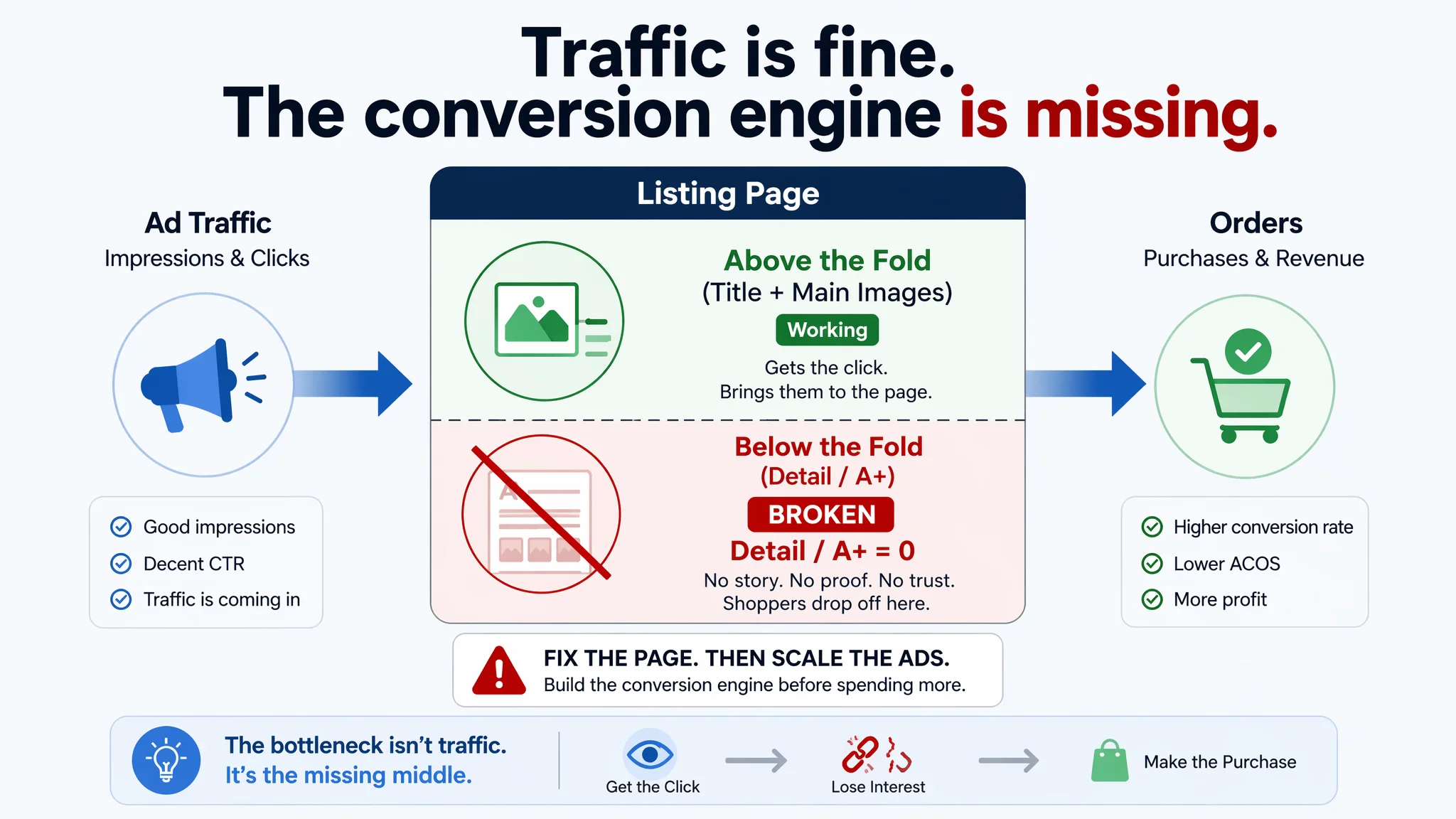
This reframed the problem entirely. Instead of continuing to squeeze more from Amazon ads, DeepBI advised the seller to first rebuild the Listing’s conversion capacity: clarify the title’s keyword and scenario strategy, refine bullet-point logic around value and realism, and, most critically, construct a full A+ detail page that could carry buyers from curiosity to decision. Only after the product page could reliably convert both organic and paid traffic would it make sense to scale ads further.
For other Amazon sellers, this case is a reminder that high ACOS is not always an advertising issue. When Detail/A+ content is missing, every extra click from Amazon ads just magnifies a structural conversion leak. Fixing the page’s trust and storytelling capacity often has a bigger impact on long-term profitability than another round of bid adjustments.
This Listing Did Not Lack Traffic. It Lacked a Conversion Engine.
DeepBI’s scoring showed a clear structural pattern:
- Overall Listing score:
- Target Listing: 60 / 100
- Benchmark Listing: 76 / 100
- Largest single gap: Detail/A+ content
- Target: 0 / 25
- Benchmark: 23 / 25
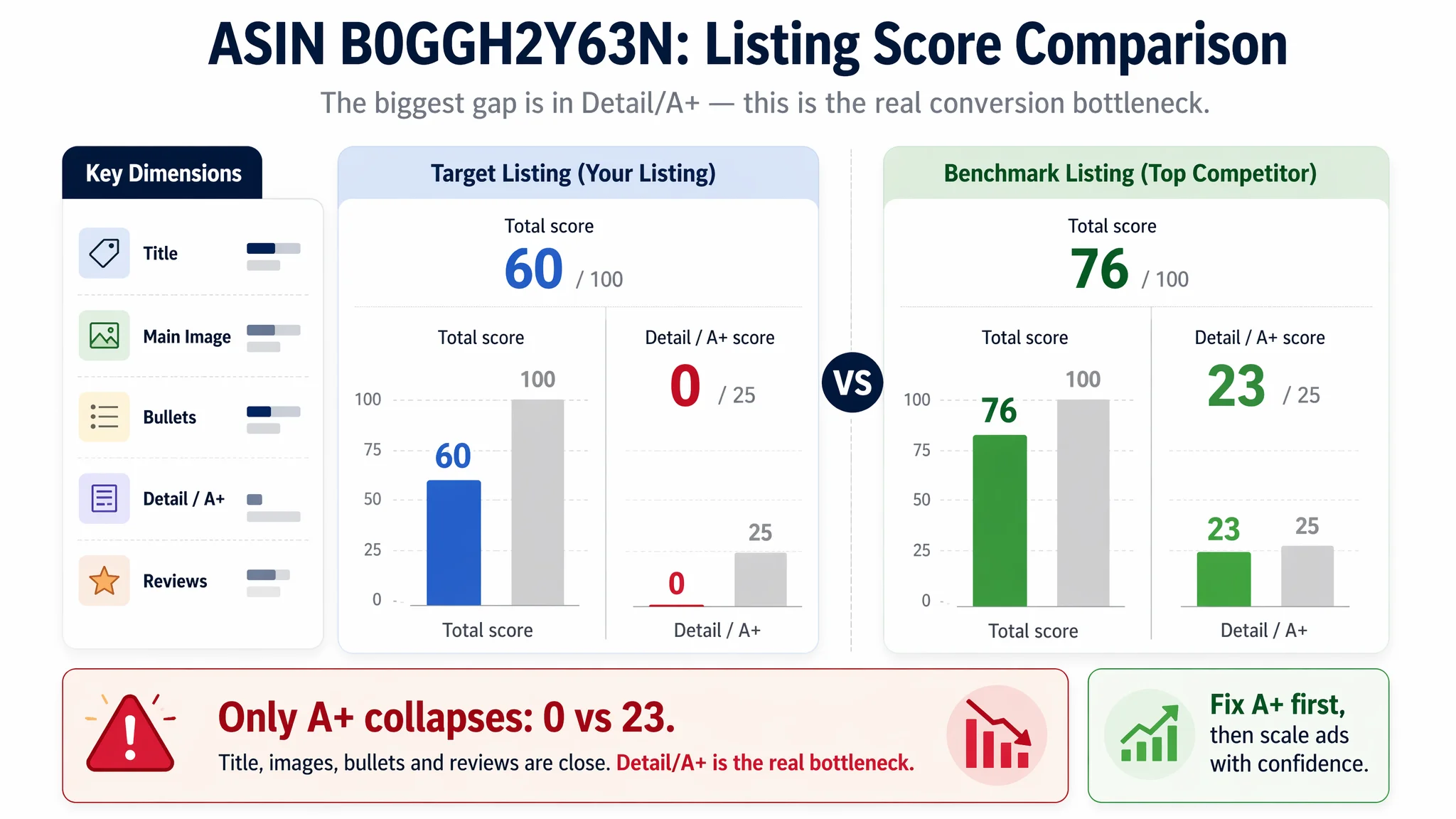
Title, main image, bullets, and reviews were not perfect, but they were not catastrophic. The title actually slightly outperformed the benchmark in structure and keyword logic. Main images and bullets were competitive. Reviews were close: 4.4 vs. 4.5 stars; 251 vs. 304 reviews.
Only one dimension was fundamentally broken: Detail/A+ content was non-existent.
“The real problem was not that ads failed to bring traffic. It was that the page could not convert the traffic.”
From an operational point of view, this meant the seller was paying Amazon to send shoppers into a page that:
- Had no brand story or lifestyle scenes
- Did not visually prove realism or craftsmanship
- Did not explain adjustability or maintenance
- Did not close the trust gap for a “fake plant” category where buyers are extremely sensitive to cheap-looking products
Under these conditions, traditional Amazon ad optimization has extremely limited upside. You can move keywords and bids, but you cannot fix a missing trust chain purely with campaign structure.
What the Seller Originally Misdiagnosed
On the seller’s side, the diagnosis looked like this:
- Amazon ads felt “inefficient”: ACOS too high, conversions too volatile.
- Main suspicion: visual quality and creatives were not attractive enough, especially in a lifestyle category.
- Operational response:
- Keep iterating on images within existing constraints
- Keep adjusting keywords, bids, and budgets
- Expect advertising refinements to lower ACOS
There were several reasons why this misdiagnosis was understandable:
1. The visible part of the funnel was advertising. The team saw impressions and clicks every day in the ad console, but had no structured way to measure Listing conversion strength versus competitors.
1. Most surface metrics looked “OK enough”.
- Title: already brand-led, size and core keywords placed forward, scene descriptors included.
- Main image: not ideal, but not obviously worse than random category peers.
- Reviews: good-enough rating and volume, not an obvious red flag.
1. The invisible hole was the A+ section. Without structured scoring or side-by-side Detail comparison, it was easy to ignore the absence of A+ and assume “we’ll add it later”.
This created a classic trap: the team invested most of its energy into a part of the funnel (ads and top-of-page visuals) that was not the true bottleneck.
The DeepBI Diagnosis: A Page That Stops at the Fold
When DeepBI put the Listing through its Amazon Listing scoring and benchmark comparison, the contradiction was obvious:
- Title:
Target: 16 / 20; Benchmark: 13 / 20 The seller’s title actually outperformed the competitor on structure:
- Brand + size (“32 Inch”) + core keywords (“Artificial Hanging Pothos”) placed early
- Scenario descriptors like “Realistic Hanging Plants”, “Aesthetic Fake Pothos”
- Color variant clarified (“White Pot”), reducing confusion
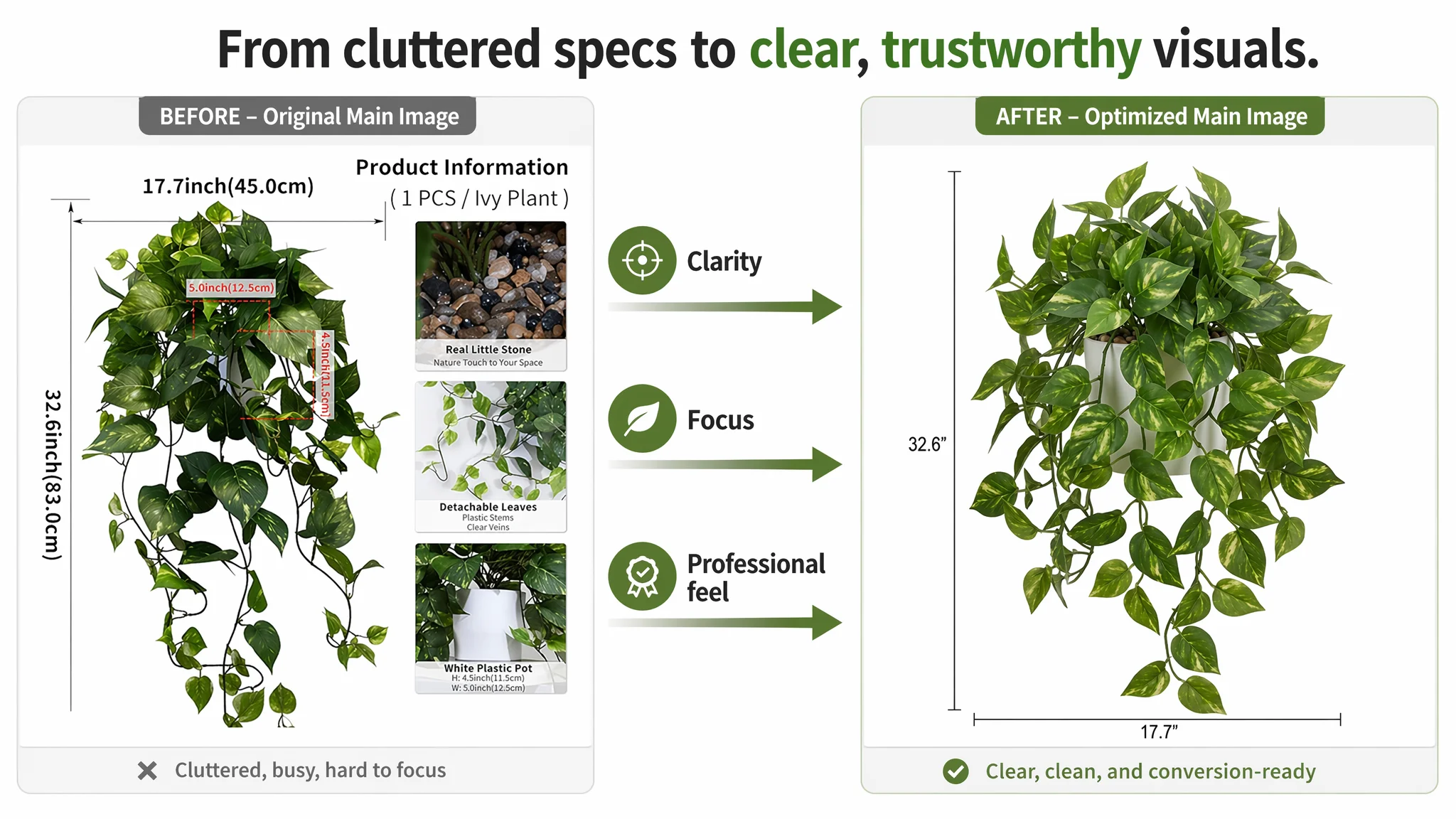
- Main Images:
Target: 25 / 30; Benchmark: 23 / 30 Main visual score gap was small. There were weaknesses—flat lighting, some clutter, inconsistent style—but nothing like a catastrophic failure.
- Bullet Points:
Target: 8 / 10; Benchmark: 5 / 10 The seller’s bullets were already structured and emotionally driven:
- “Ready out of the box” as first message
- Emphasis on realism and atmosphere
- Clear installation and adjustment guidance
- A logical progression from product → usage → effect
- Reviews:
Target: 11 / 15; Benchmark: 12 / 15 Slightly weaker rating and volume, but not enough to explain a major conversion gap alone.
Only one dimension collapsed: the Detail/A+ section.
The benchmark competitor used A+ to build what DeepBI defines as a “trust chain”:
- Brand exposure and positioning module
- High-quality lifestyle scenes (living room, kitchen shelves)
- Clear “problem → solution” framing with Before/After adjustments
- A six-block features module (adjustable stems, realistic leaves, sand fill, easy cleaning, etc.)
- Multi-scene montage showing different shapes and placements
By contrast, the target Listing had no A+ modules at all. Below the fold, there was simply no structured explanation of:
- Why this fake plant looks realistic in real homes
- How it can be adjusted from flat shipping shape to full, drooping greenery
- What materials and construction justify its price
- How it behaves in different décor styles and spaces
- Why it is stable, durable, and easy to maintain
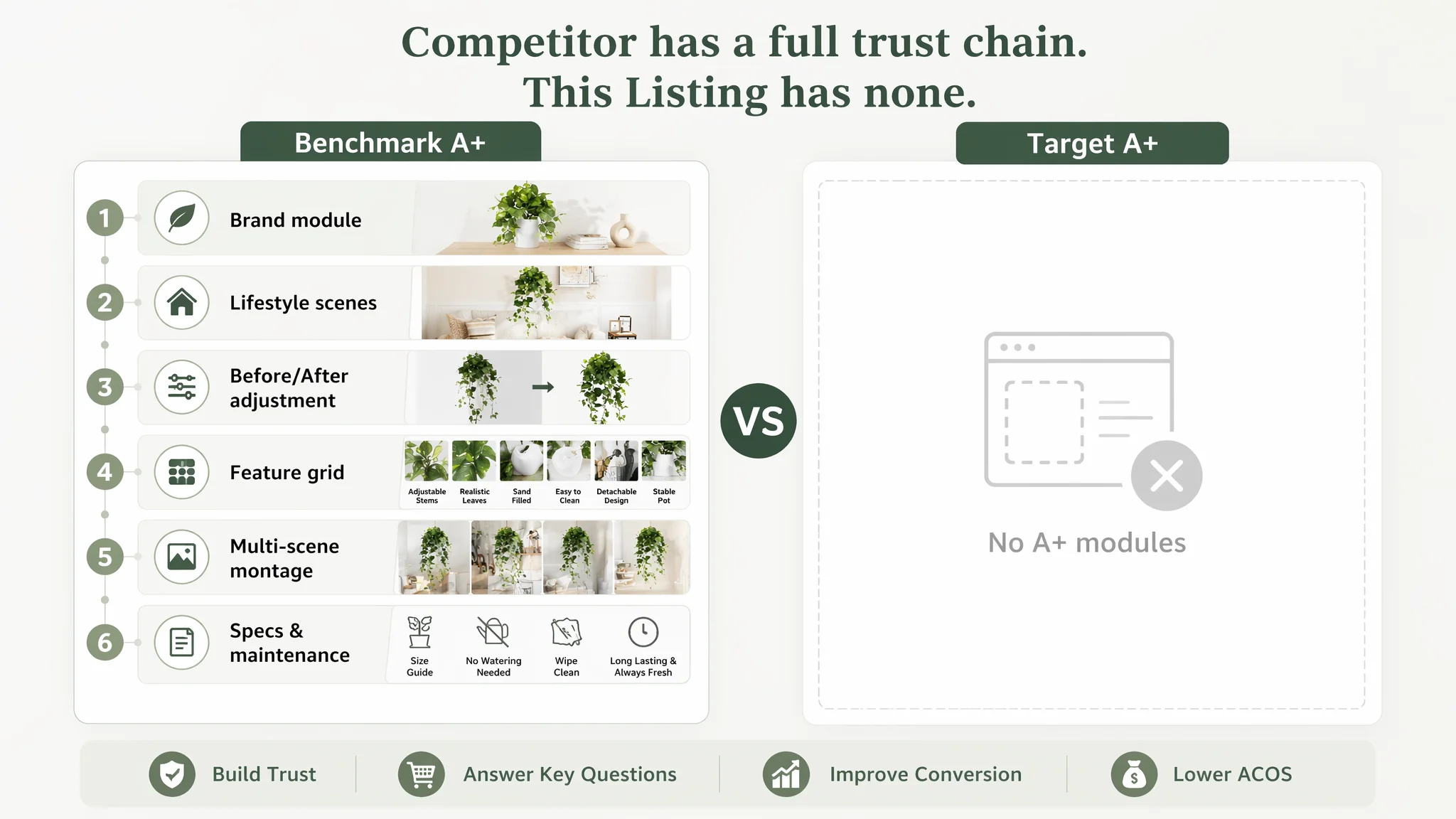
In DeepBI’s framework, this means the Listing had no mid-funnel narrative. The page could attract a click (thanks to reasonably competitive title and images), but it could not walk a buyer through the remaining steps to purchase.
Why Listing Conversion Had to Be Fixed Before More Ad Tuning
Once the structural gap was clear, DeepBI’s judgment was straightforward: do not prioritize more ad tuning while the page cannot convert incrementally better traffic.
There were three key reasons.
1. Ads Were Amplifying a Conversion Defect
With Detail/A+ at zero, every extra ad dollar simply pushed more visitors into an under-explained product experience.
“Advertising does not only amplify advantages. It can also amplify a page’s existing defects.”
In this case, what was being amplified was the perception risk that haunts all fake-plant listings:
- “Will it look cheap in my home?”
- “Is the size really what I imagine?”
- “Can I adjust the leaves so it doesn’t look flat?”
- “Will it tip over easily?”
Without visual proof, many buyers will abandon the page or default to the benchmark that shows everything clearly in A+.
2. The Biggest Score Gap Was Not on the Search Page
Title and main image are crucial for CTR; Detail/A+ and reviews are crucial for CVR.
Here, the largest measured gap against the benchmark was:
- Detail/A+: –23 points
- Everything else: minor gaps or even advantages
This made the priority order obvious:
1. Repair the Detail/A+ conversion engine
2. Then revisit bids, keywords, and campaign scaling
Without this reordering, any short-term ACOS improvement would be fragile and likely to disappear as soon as competition intensified.
3. Organic Conversion Capacity Was at Risk
A Listing with weak A+ is fragile not only for ads, but also for organic traffic. Even if the seller stopped ads tomorrow, the page would still struggle to:
- Convert organic browse traffic within the category
- Maintain stable rankings on key terms
- Defend its position against well-built competitor pages
Strengthening the A+ section was not just an ad efficiency play; it was a Listing survival move.
Rebuilding the Page’s Sales Logic: From “Plastic Pot” to “Home Décor Object”
With the core diagnosis set, DeepBI helped reset the page logic around a single goal: turn the product from a generic “plastic fake plant” into a believable, high-aesthetic home décor object in the buyer’s mind.
This meant aligning title, bullets, main images, and A+ around one coherent path.
The Title: Aligning Search Logic and Reading Logic
DeepBI kept the seller’s structural strengths and tightened the keyword logic:
Proposed title direction:
LOYWREE 32 Inch Artificial Hanging Pothos, Fake Plants Indoor Realistic Scindapsus Aureus, Faux Potted Plants for Home Office Shelves Bedroom Bathroom Decor, White Pot
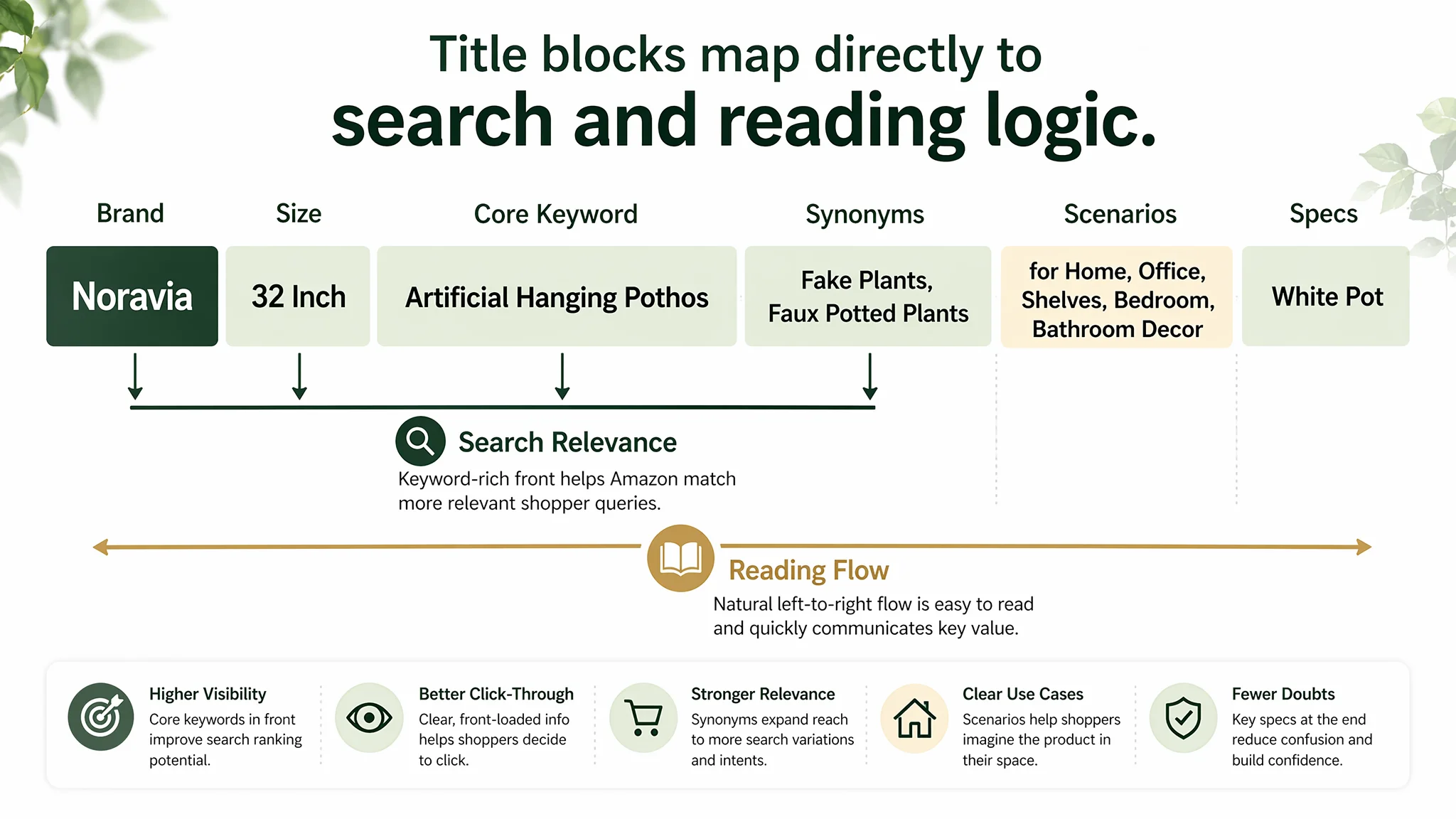
Key shifts in logic:
- Core keyword front-loading: “Artificial Hanging Pothos” positioned directly after brand for stronger Amazon search relevance.
- Synonym coverage: Integrating “Fake Plants”, “Faux Potted Plants”, “Artificial Hanging Pothos” to match how buyers actually search.
- Structured scenario naming: Grouping “Home Office Shelves Bedroom Bathroom Decor” rather than scattered scene listing.
- Specification clarity: Keeping “32 Inch” and “White Pot” for expectation management.
This did not reinvent the title; it aligned it with how Amazon rewards keyword order while preserving readability for shoppers.
The Bullet Points: From Isolated Claims to a Decision Path
The seller’s bullets already leaned into realism, aesthetics, and ease-of-use. DeepBI’s focus was to tie each bullet to a specific decision-stage concern, using the benchmark’s strengths as reference.
Bullet 1: Value and Completeness
- Competitor angle: “Perfect size & value for money”
- DeepBI adjustment: emphasize all-in-one convenience plus size clarity
[All-in-One Package & Superior Value] Everything you need in one go: a 32-inch large artificial pothos, a 5-inch white pot, and decorative pebbles. No extra pot purchase, no assembly confusion—ready to bring greenery to your home right after unboxing.
This directly answers: “Do I need to buy anything else? Is the size worth the price?”
Bullet 2: Durability and Stability
- Competitor angle: “Durable & strong load-bearing”
- DeepBI adjustment: highlight material quality and structural stability
[Durable Quality & Sturdy Construction] Premium materials, a sturdy base, and secured stems ensure the plant stays stable and holds its shape, avoiding the flimsy feeling common in cheaper fake plants.
This answers: “Will it topple? Will it deform?”
Bullet 3: Realism and Texture
- Competitor angle: “Realistic appearance & clear texture”
- DeepBI adjustment: deepen texture and gradient storytelling
[Ultra-Realistic Texture & Lifelike Look] Clear leaf veins, natural color gradients, and varied leaf sizes combine into a realistic hanging foliage effect that avoids the “plastic, flat” look.
This addresses the core emotional concern in the category: “Will it look fake?”
Bullet 4: Maintenance and Adjustability
- Competitor angle: “Easy to maintain & detachable”
- DeepBI adjustment: make zero-maintenance + adjustable design explicit
[Zero Maintenance & Adjustable Design] No watering, no pruning, just occasional wiping. Detachable or adjustable stems allow buyers to spread the leaves, shaping the plant to match their space.
This answers: “Can I shape it? Will it be a hassle?”
Bullet 5: Scene Coverage and Atmosphere
- Competitor angle: “Vibrant & widely used”
- DeepBI adjustment: tie scene list to aesthetic styles
[Versatile Decor for Any Space] The minimalist white pot and hanging design fit modern farmhouse, Nordic, and mid-century styles, working equally well in living rooms, kitchens, bathrooms, offices, or shelves.
This helps buyers mentally place the product in their own rooms.
The A+ Gap: Turning a Blank Area into a Trust Chain
The most critical part of the rebuild was the Detail/A+ section. DeepBI’s analysis of the benchmark showed that their A+ acted as a continuous persuasion path:
1. Brand positioning and aesthetic anchor
2. Lifestyle integration in real rooms
3. Before/After adjustment demonstration
4. Close-ups of material and sand fill
5. Multi-scene adaptability
6. Practical details like size, cleaning, and stability
To catch up, the seller did not need to copy modules one by one; they needed to recreate the decision logic in their own A+.
1. First Screen: Establishing Aesthetic Credibility
DeepBI advised a clean, Nordic-inspired opening module:
- Central composition: plant on a light wood sideboard
- Simple décor around it (books, a minimal ceramic ornament)
- Soft, warm natural light, clean cream wall, controlled shadows
Purpose: make the plant look at home in a modern interior before saying anything. This counters the “cheap plastic” perception in under a second.

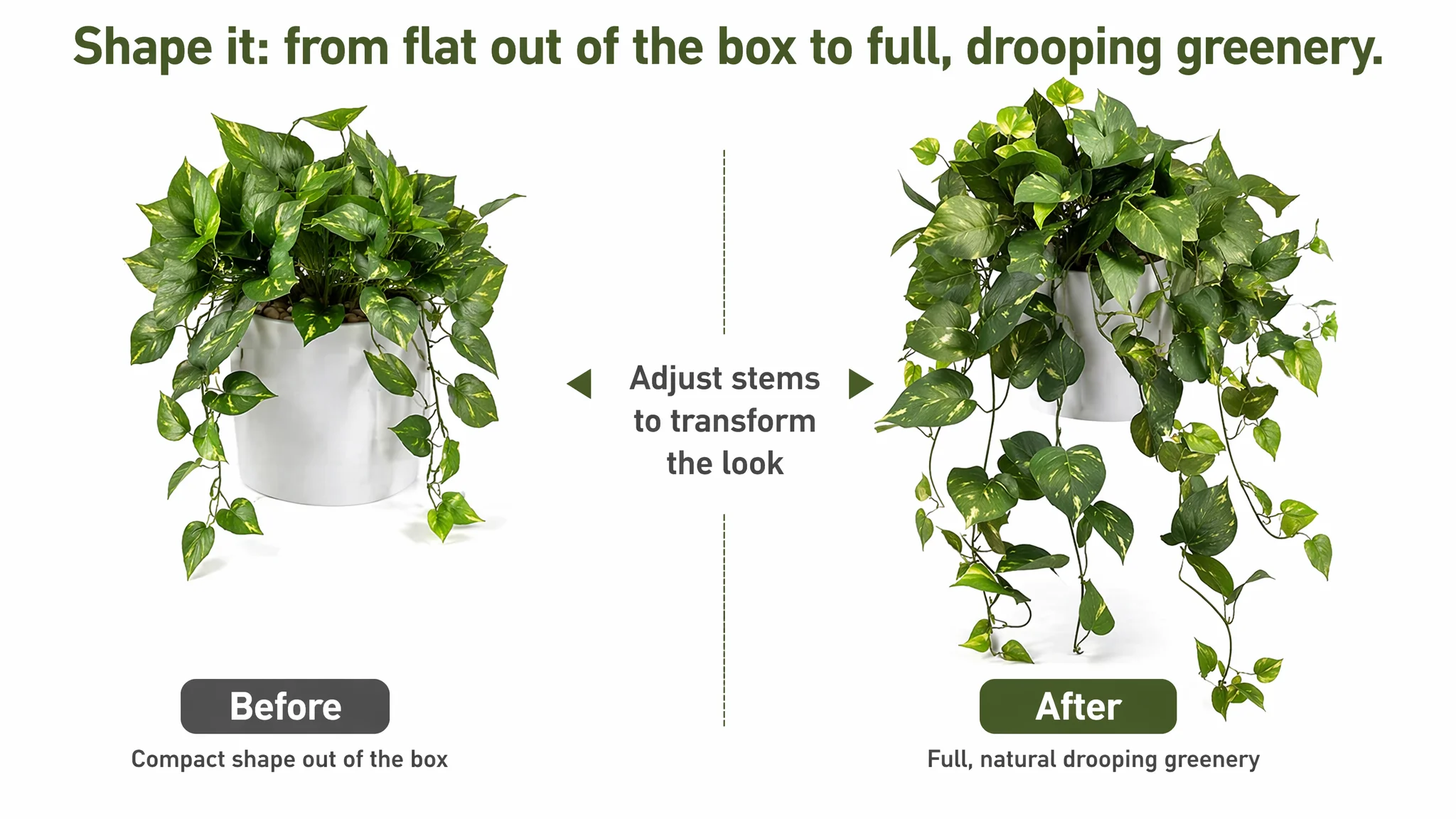
2. Core Feature: Before/After Shape Adjustability
One major buyer fear: “Will it arrive flat and lifeless?”
DeepBI recommended a clear Before/After comparison:
- Left: compact, just-unboxed plant (labeled “Before”)
- Right: fully spread, natural droop (labeled “After”)
- Simple labels and even lighting
Purpose: show that buyers can shape the plant and that its final look depends on a simple adjustment process, not luck.
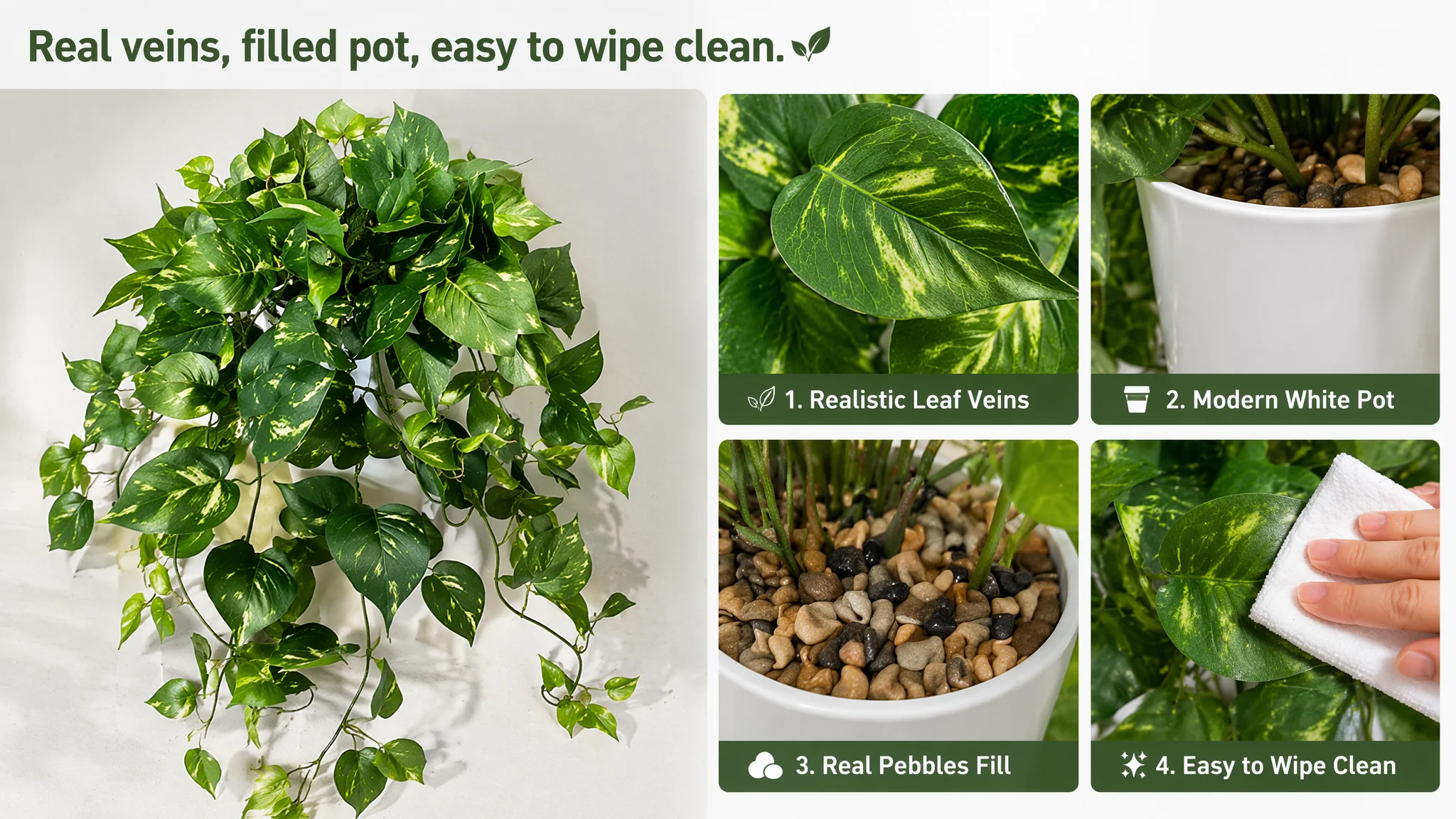
3. Detail Mosaic: Material, Sand Fill, and Cleaning
DeepBI pushed for a multi-tile detail image showing:
- Leaf vein close-up
- Smooth pot rim
- Visible sand fill inside the pot
- A hand wiping the leaves
This approach:
- Visualizes material quality and effort
- Proves stability (sand fill)
- Shows how easy it is to maintain
It turns vague claims like “premium materials” and “easy maintenance” into evidence.
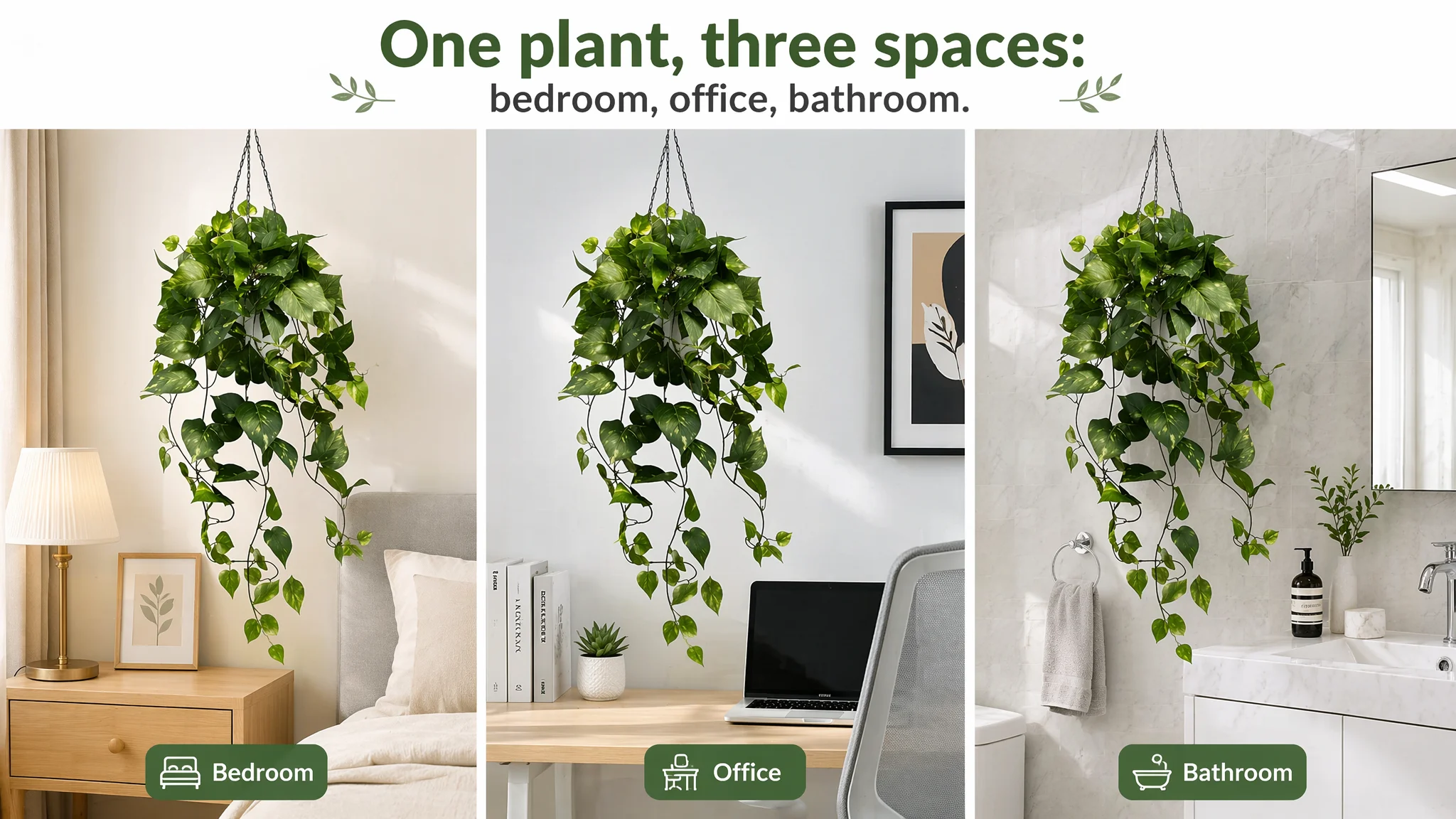
4. Multi-Scene Strip: Bedroom, Office, Bathroom
Rather than repeating one generic shelf, DeepBI suggested:
- A vertical strip of three scenes:
- Bedroom bedside table
- Minimalist office desk
- Fresh, bright bathroom
Each with tailored lighting and styling.
Purpose: expand perceived versatility and let buyers instantly imagine at least one compatible space in their own homes.
5. Size with a Familiar Reference
DeepBI insisted on a size graphic with a common object:
- The plant on a shelf
- A smartphone as a reference
- Clear height/width lines and labels
This reduces “size surprise” returns and shows professionalism in how the brand communicates specs.
6. Cleaning and Low-Maintenance Story
A dedicated image:
- Hand with microfiber cloth cleaning a leaf
- Bright, airy balcony background
- Subtle backlighting to show leaf translucency
This visually hits the fundamental fake-plant motivation: “I want greenery without the work.”
7. Final Call-to-Action Module: Multi-Pot Inspiration
Lastly, a wide image showing 3–5 pots arranged on a shelf with premium lighting:
- Suggests set or multi-item purchase
- Gives a richer décor vision than a single pot could
This closes the trust chain with a visual “reason to buy now”, not just another claim.
How Ad Traffic Became Useful Again
The seller’s short-term goal was not to “double sales overnight,” but to bring order back into the funnel:
- Top of funnel:
- Title and main images already had a competitive base
- Fine-tuning CTR would continue, but not as a first move
- Middle of funnel (previously missing):
- A+ now explained value, realism, size, adjustability, and maintenance
- Buyers’ key questions had visual answers, not just text claims
- Bottom of funnel:
- Reviews continued to provide social proof
- The perceived gap between this Listing and the benchmark narrowed
In operational terms, the changes meant:
- CTR could be interpreted more cleanly.
If CTR remained low after main-image adjustments, it was genuinely an ad/visual issue. If CTR improved but conversion lagged, further A+ refinements could be targeted.
- ACOS became easier to influence.
With a stronger mid-funnel, each click had a higher probability of converting, so the same ad spends could start yielding more orders.
- Organic traffic was better defended.
Even without incremental ads, the Listing now had enough story and visual trust to stand in search results alongside established competitors.
DeepBI did not need to claim a specific percentage increase to justify the work. The core outcome was that traffic—paid or organic—finally had a page that could carry it to purchase.
What This Case Changes in the Seller’s Understanding
For the customer team, the main shift was conceptual, not just cosmetic.
They realized:
- Amazon ads cannot compensate for a missing mid-funnel. You cannot “bid your way out” of a zero-score Detail/A+ dimension.
- Listing conversion is not just about main images and headlines. Title, main images, bullets, and A+ must form one continuous decision path.
- High ACOS with “decent” ads can be a page problem, not a campaign problem. The fact that this Listing’s largest gap was Detail/A+ forced a reprioritization away from pure ad tinkering.
- Before scaling traffic, the key question is: “Does this page deserve more clicks?” In this case, the initial answer was no; after the A+ rebuild, it became yes.
What Other Amazon Sellers Can Take Away
This case is not about artificial plants alone. It describes a pattern many Amazon sellers face when ads begin to feel “inefficient”:
- Ads look like the problem because they are the most visible cost.
- Campaign optimization absorbs most of the team’s time.
- The real bottleneck quietly sits in Listing conversion capacity—especially in Detail/A+.
Three practical questions other sellers can ask themselves:
1. If I compare my Detail/A+ to the best in my subcategory, can my page honestly support a higher CVR?
2. Am I pushing ad traffic into a page that lacks a clear visual trust chain—brand, scene, proof, and action?
3. Is my largest gap versus competitors on the search page (CTR) or below the fold (CVR)?
In this fake-plant Listing, DeepBI’s scoring made the answer unambiguous: the Detail/A+ hole was too large to ignore. Only after closing it did ad traffic have a fair chance to convert.
For Amazon sellers under pressure from rising ad costs, this is a crucial discipline: fix the Listing’s conversion logic first, then scale the ads.