

An Amazon seller in the motorcycle helmet headset category came to DeepBI with a clear frustration: their product looked technically superior, their title was already stronger than a key competitor, and reviews volume was higher—yet the Listing lagged badly in overall competitiveness. Ads were becoming more expensive to run, and each extra click felt harder to turn into an order.
The seller’s internal diagnosis focused on “keep polishing what already looks good”: refine the title, push the Mesh intercom advantage harder, and adjust bullets. They treated the page as a mostly solved problem and assumed that as long as ads kept feeding traffic, sales would eventually catch up. But when DeepBI ran the Listing against a category benchmark, the data showed a different story: the real leak was not keyword coverage or a weak main image—it was that the detail page had almost no A+ content while the competitor’s A+ modules were carrying the entire trust and explanation load.
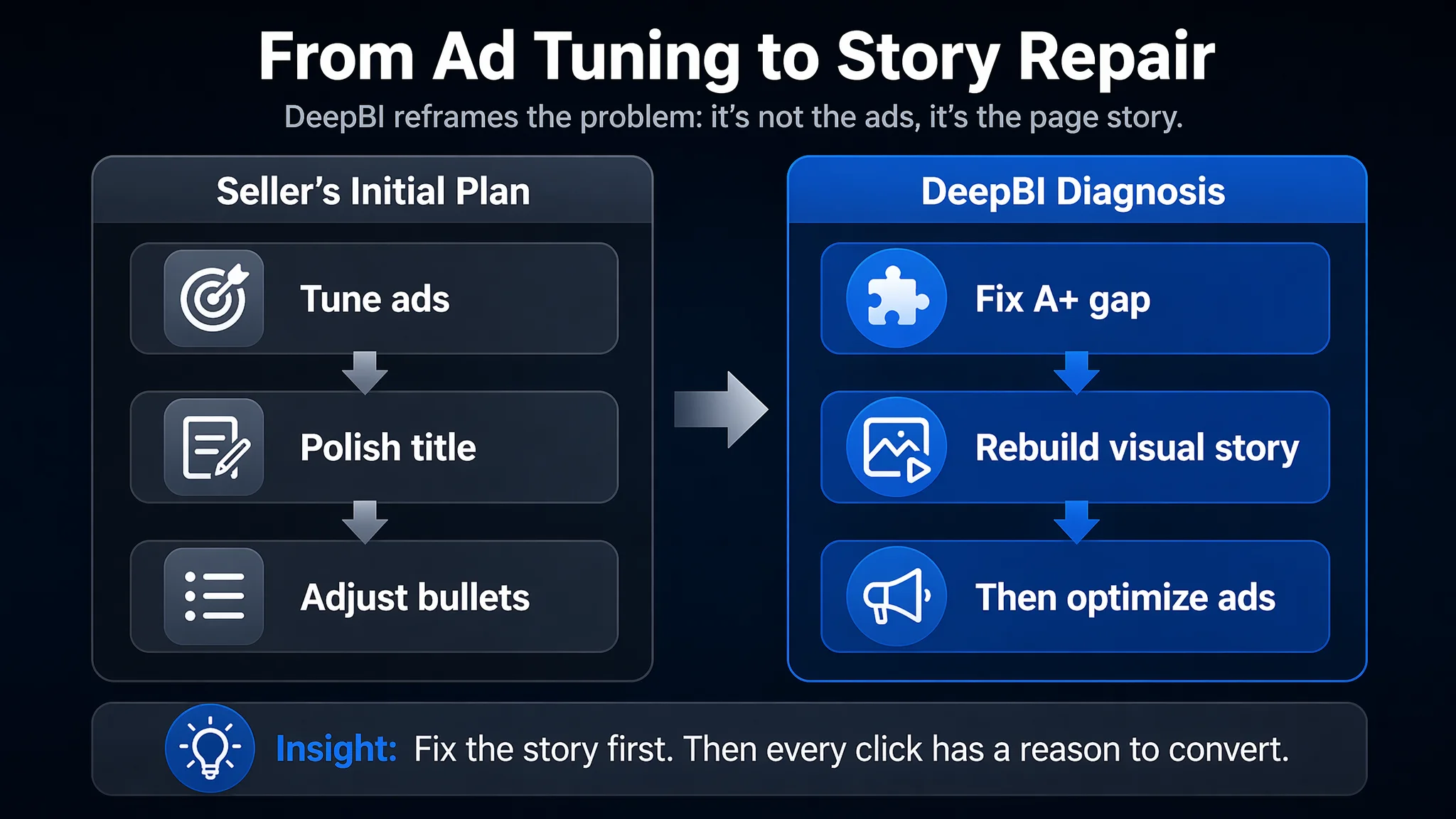
Once the case was reframed from “improve ads and fine‑tune text” to “repair a broken product-page story,” the optimization path changed. DeepBI pushed the team to treat A+ and visual storytelling as the primary bottleneck, and only then use title and bullets to amplify that structure. For other Amazon sellers, this case is a reminder: a technically strong product and a high-scoring title cannot compensate for an empty detail page. If A+ content doesn’t exist—or doesn’t explain your spec advantage—ads will only amplify a conversion defect.
Amazon Ads Were Not Failing. The Page Was Consuming the Traffic.
The product is a motorcycle helmet Mesh intercom on Amazon US, targeting group riders who care about long-range communication, audio quality, and safety. On paper, it beats a key competitor: 24 riders vs. 2, 2000M range vs. 550 yards, BT 5.4 instead of standard Bluetooth, richer noise reduction, and more features.
DeepBI’s Listing score, however, told a harsher story:
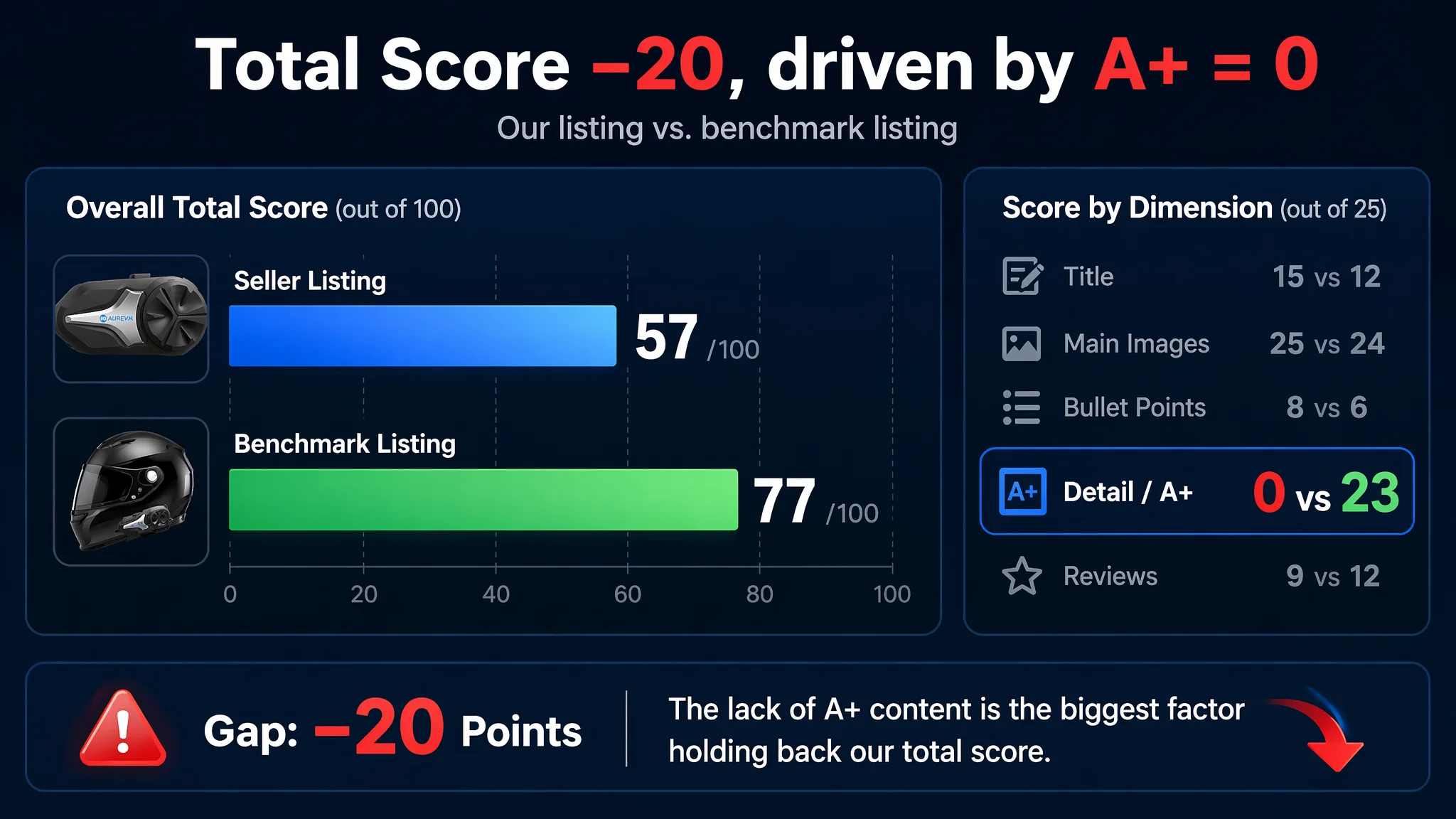
- Seller Listing total: 57 / 100
- Benchmark Listing total: 77 / 100
- Gap: –20 points
At first glance, this was confusing for the seller:
- Title: 15 vs. 12 (seller ahead)
- Main images: 25 vs. 24 (almost tied)
- Bullet points: 8 vs. 6 (seller ahead)
- Reviews: 9 vs. 12 (slight disadvantage, but with more total reviews: 82 vs. 48)
The killer gap sat in one place:
- Detail / A+ content: 0 vs. 23 / 25
- A single dimension wiped out the advantage built elsewhere.
From a traffic perspective, this meant: even if Amazon ads kept driving relevant clicks, most buyers landed on a page that could talk specs but could not visually prove use cases, trust, or compatibility. The benchmark page, by contrast, used its A+ modules to do the heavy lifting on understanding and reassurance, which made each click far more likely to convert.
“The real problem was not that ads failed to bring traffic. It was that the page could not convert the traffic.”
The Seller’s Original Misdiagnosis: “Our Title and Tech Are Already Good Enough”
Internally, the seller saw three things:
- A technically advanced product in a performance-driven category
- A title that already followed Amazon best practices
- Main images that mentioned key parameters
They concluded the problem was incremental:
- Slightly adjust keywords
- Emphasize Mesh and 24 riders more
- Keep pushing ads to the same page
Because their own title scored higher than the competitor’s, they assumed they had already solved “visibility and clarity” and that the remaining issues were around bids, keywords, or minor copy tweaks.
DeepBI’s scoring model broke that assumption:
- Title strength did not explain the 20‑point total score gap.
- The page did not lack traffic or feature claims. It lacked trust-building structure.
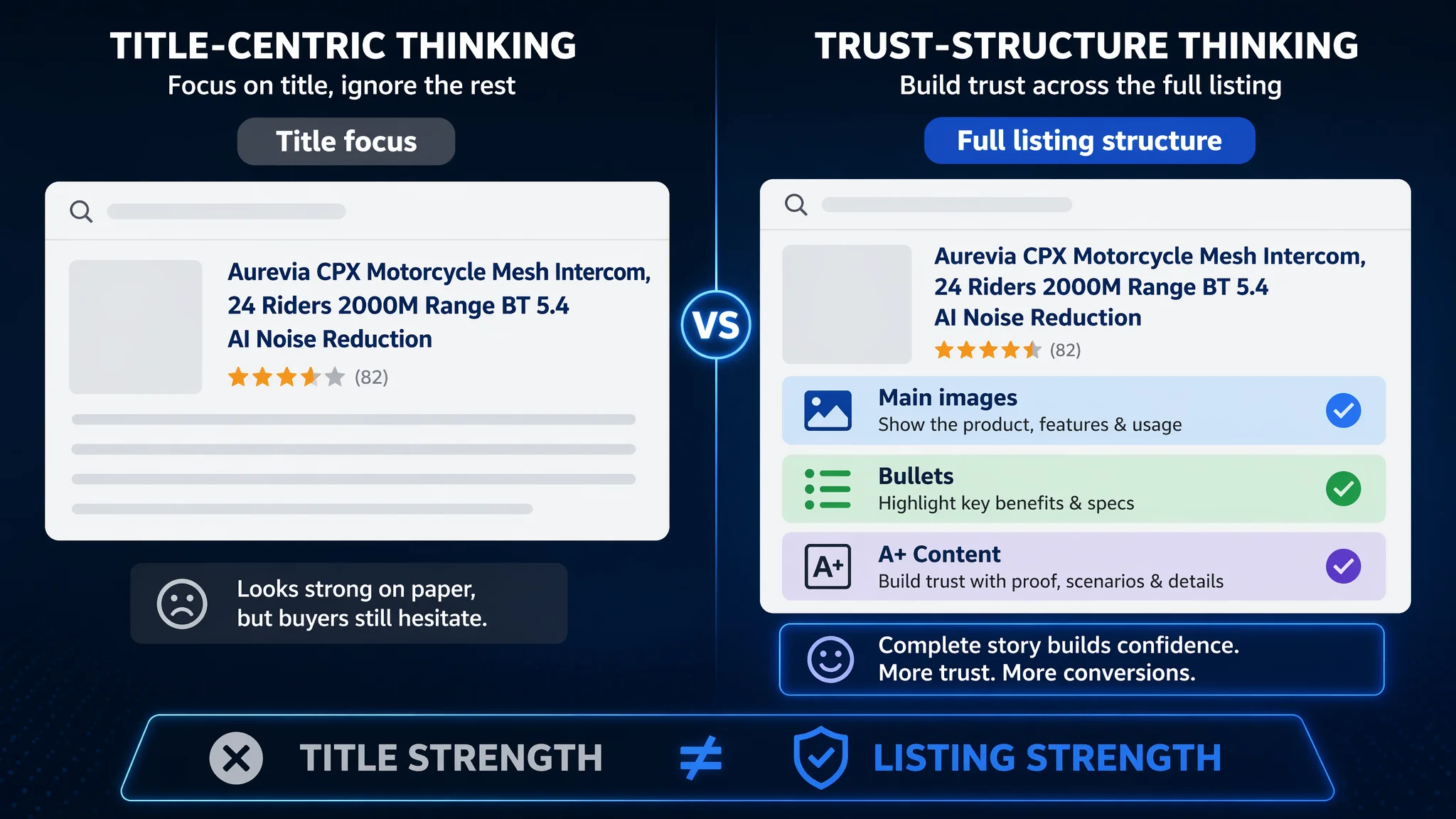
Advertising experience also started to fail them. As ACOS pressure rose, simply re-tuning campaigns could not fix the fact that post-click persuasion was weak. Ads were being asked to solve a problem that lived inside the Listing.
A Strong Title Couldn’t Carry a Weak Story
Title: technically ahead, conversion logic incomplete
DeepBI’s title analysis showed the seller was, in many ways, already doing things right:
- Core keyword “Motorcycle Mesh Intercom” tightly placed near the brand
- Specific specs: “24 Riders”, “2000M”, “BT 5.4”
- A logical structure: brand + core function + key parameters + core selling points
- Long-tail keywords indicating advanced features: “Mesh Communication System”, “Audio Multitasking”, “AI Noise Reduction”
Compared to the benchmark, the seller actually had:
- More advanced specs
- More technically differentiated wording
Where did the competitor win?
- Their title explicitly highlighted use convenience: “Easy to Connect/Use with Gloves”
- They tied technical capability to a concrete pain point: use while wearing gloves, quick pairing
Conversion impact: when riders scan Amazon search results, they’re not only scanning specs—they’re scanning whether they can actually use the product while riding. The seller’s title spoke to the engineer; the competitor’s title spoke to the rider’s hands.
DeepBI recommended maintaining the technical edge while importing user experience language from the benchmark. The suggested title:
“Motorcycle Mesh Intercom, 24 Riders Group Communication System BT 5.4 Helmet Speakers, 2000M Range, AI Noise Reduction, Audio Multitasking, Music Share, Hi-Fi Stereo, Waterproof, 1 Pack”
This retains the high-value tech but keeps room to later echo “glove-friendly” and ease-of-use in images and bullets, where the story has more space to breathe.
The Real Constraint Was Listing Conversion Capacity
The decisive insight came from the detail/A+ score:
- Seller: 0 / 25
- Benchmark: 23 / 25
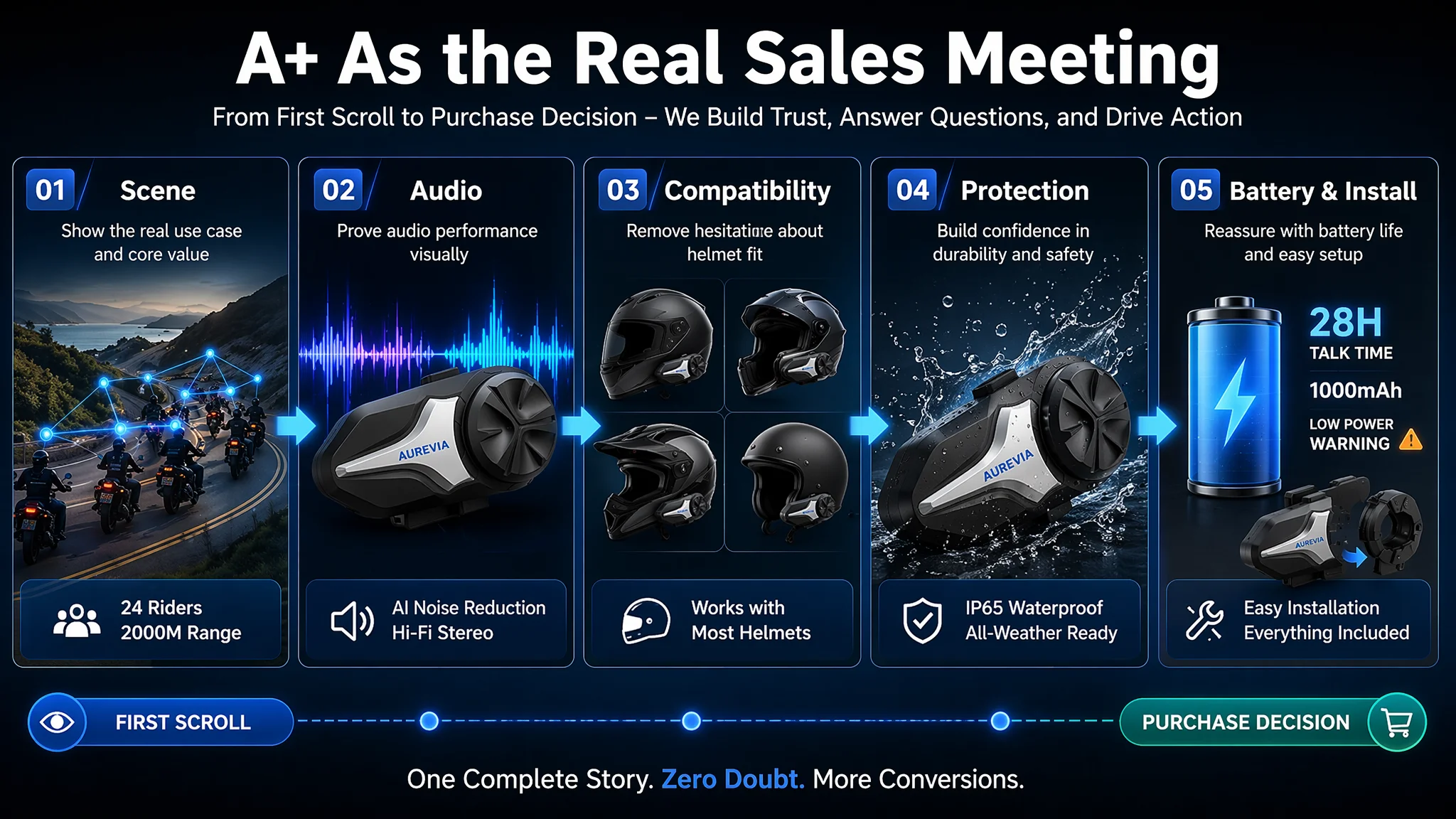
On Amazon, that is not a cosmetic gap; it is a business model gap. The benchmark’s A+ content acted as the true “sales meeting” with the customer:
- Full-bleed core scene (two riders, 550-yard communication)
- Audio performance visuals: sound waves, HIFI representation
- Product close-ups: showing buttons, mic, and installation points
- Compatibility visuals: different helmet types
- AI assistant, waterproof, battery life, installation guide, and unboxing list, all visually presented
The seller’s page had no A+ content:
- No scene images to show group riding
- No visual explanation of Mesh or 24 riders
- No installation reassurance
- No battery, waterproof, or safety story beyond text
In DeepBI’s scoring logic, this effectively meant “trust construction = 0”.
“Advertising does not only amplify advantages. It can also amplify a page’s existing defects.”
If ads pushed more riders to this page, most of them hit a wall after the initial scroll: the product promised a lot but showed almost nothing.
This Product Page Did Not Lack Traffic. It Lacked Trust.
How the benchmark used A+ to translate specs into decisions
DeepBI broke down the benchmark’s A+ structure into functional modules:
1. Opening scene:
- Two riders, clear distance indication, immediate visualization of “intercom at range”
1. Tech and audio:
- HIFI sound represented via visual sound waves, technical parameters like 40mm speakers and dual DSP/CVC explained with imagery
1. Usage scenarios & compatibility:
- Different helmet types, installation steps, and voice assistant visuals
1. Protection & durability:
- Water splashes, IPX6 callouts, outdoor weather cues
1. Battery and convenience:
- 1000mAh, 25 hours, low power warnings shown graphically
The page felt:
- Complete: covering performance, usage, trust, installation, and protection
- Concrete: there was almost no abstract promise without visual proof
- Easy to read: modules clearly separated, each solving one decision question
The seller’s A+ gap: a silent detail page
By contrast, the seller’s detail section was empty of A+ visuals. Buyers could read:
- Some specs in the bullets
- Some tech wording in the title
But there was:
- No Mesh network visualization to justify “24 riders / 2000M”
- No noise reduction demonstration
- No glove-friendly control shown in use
- No helmet compatibility reassurance
- No battery or waterproof stress-test visuals
DeepBI treated this as the core bottleneck: until the page could visually carry these claims, ads and title optimisation would only be marginally effective.
Why DeepBI Did Not Keep Tuning the Ads First
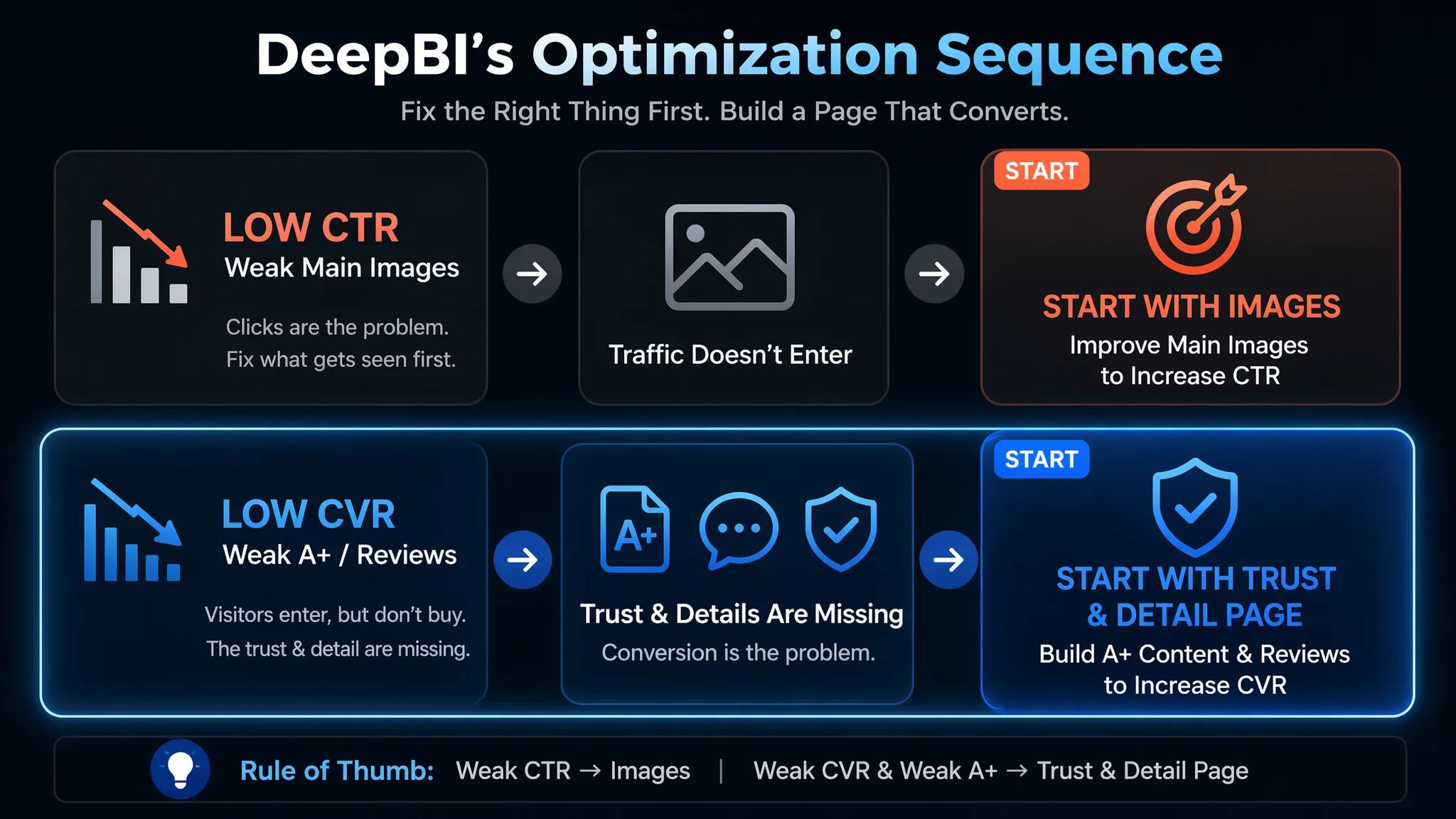
DeepBI’s internal decision logic follows a simple sequence:
- If CTR is weak and main images score low → start with images.
- If CVR is weak and detail/A+ and reviews are weak → start with trust.
Here, the main image score (25 vs. 24) was not the obvious failure point. The page’s problem was deeper:
- It used relatively decent product imagery, but with suboptimal focus (e.g., human face dominating instead of device)
- It had no supporting A+ content to follow through
Continuing ad tuning would have:
- Increased paid traffic into a poorly structured conversion funnel
- Driven up ACOS without fixing the funnel’s weakest point
- Masked the need for structural Listing repair behind campaign adjustments
For DeepBI, the biggest business risk was letting ads amplify a low-conversion page. So the priority became:
1. Repair the Listing’s ability to tell a coherent story.
2. Then allow ads to bring traffic into a funnel that can actually convert.
Rebuilding the Page: From Raw Specs to a Visual Sales Logic
DeepBI’s optimization plan focused on three linked layers:
1. Main image system
2. Bullet points (five-point description) logic
3. A+ visual modules
The goal was not “make it prettier,” but: make every major spec visible and believable.
1. Main images: turning abstract Mesh and audio into visual reasons to click
Key adjustments:
- Decongest the hero image:
- Remove the packaging box, center the device, show 3 interchangeable shells.
- Emphasize 65% product occupancy to make the intercom the undisputed focal point.
- Visualize group Mesh and range:
- Show a 24‑bike convoy on a bridge, with blue Mesh-style grid overlays connecting helmets.
- Place “2000M” in clear typography to ensure the spec moves from abstract to felt.
- Make audio performance tangible:
- Close-up on the button side with expanding sound waves and “Immersive Hi-Fi” text.
- Use strong contrast and cool tones to convey professional audio.
- Show noise reduction as before/after:
- Split-screen: noisy environment with jagged red waves vs. clean blue waves at the helmet.
- Let riders visually experience “AI noise reduction” as a difference, not just a phrase.
- Highlight BT 5.4 and performance:
- Use a tech background (circuit textures, “5.4” glowing, progress bars) to frame Bluetooth as a high-end, measurable spec.
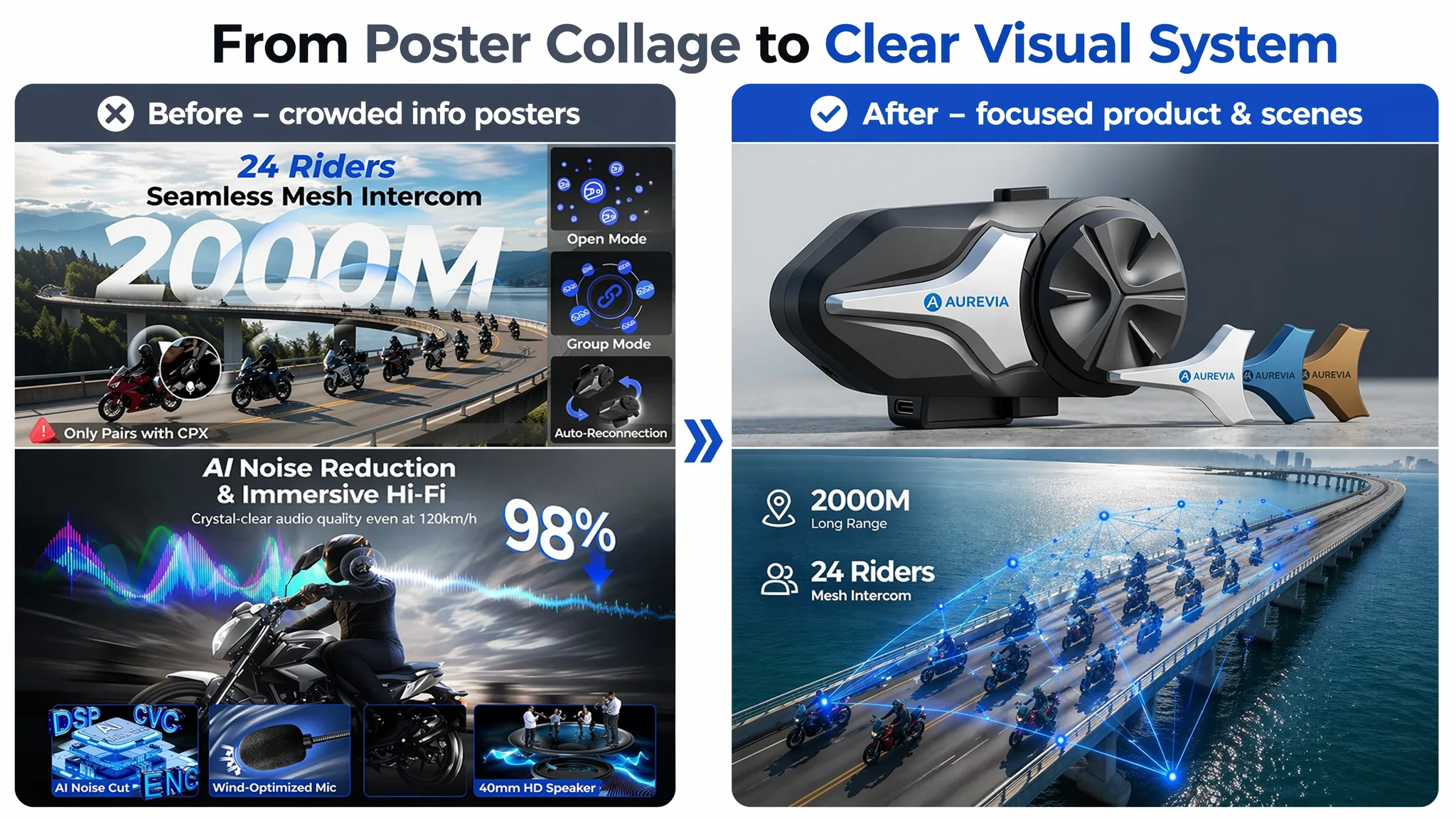
These changes shift the main images from “just showing the product” to “showing what the product actually does for riders.”
2. Bullet points: from parameter listing to a buying path
DeepBI reconstructed bullets around a pain point → solution → proof logic, borrowing context from the benchmark but aligning it to the seller’s superior Mesh tech:
1. Group communication as the central promise
- “24-Riders Dual-Mode Mesh Intercom” with 2KM range and clear notice that Mesh pairs only with specific models.
- Use “Open Mesh” and “Group Mesh” to segment use cases (large group vs. private teams).
1. Audio quality and noise handling as performance proof
- 40mm high-fidelity speakers, quad-layer AI noise handling (DSP, CVC, ENC, wind-proof mic).
- Explicitly naming high-speed use (“up to 120 km/h”) turns noise claims into a scenario.
1. Connectivity and multitasking as convenience
- BT 5.4 for stable pairing.
- “Audio Multitasking”: music, GPS, and intercom simultaneously—something the benchmark hinted at but with older tech.
1. Control and safety
- Glove-friendly oversized knob, 10‑second auto-answer, one-tap voice assistant, intercom-priority volume logic.
- The competitor mentioned “big buttons with gloves”; this Listing now turns that into a distinct control system.
1. Social and multi-device capability
- Music sharing and dual smartphone connection.
- Stronger framing of social riding and “work-life balance on the go” than the benchmark.
1. Battery life
- 1000mAh, 28 hours of continuous use, >300 hours standby, low-power warning, fast charging.
- Explicitly differentiates from the competitor’s 25 hours.
1. Protection and weather reliability
- IP65 dustproof and waterproof for all-weather, off-road conditions.
- Emotional framing: “no fear of wind and weather.”
1. Compatibility and installation reassurance
- A complete kit with boom mics and multiple bases, fit for full-face, modular, motocross, and half helmets.
- Clear mention of Type-C secure connection to avoid sound issues.
1. Personalization and entertainment
- Interchangeable shells as a style statement, built-in FM for news and music.
- Positions the intercom as part of the rider’s identity, not just hardware.
Instead of nine disconnected features, the bullets now guide the rider from “Can I communicate reliably?” to “Will it sound good?,” “Is it easy to use while riding?,” “Will it survive my conditions?,” and “Does it fit my style?”
3. A+ modules: building a visual decision funnel
DeepBI’s A+ plan mirrored the benchmark’s strengths while leveraging the seller’s technical edge:
- Mesh group scene introduction
- A mountain road aerial shot with multiple riders connected by visible Mesh halos.
- “24-Rider Mesh Intercom” text on a dark overlay for immediate value recognition.
- AI noise reduction module
- Left: noisy city, chaotic purple waveforms labeled “Ambient Noise.”
- Right: quiet tunnel exit, smooth blue waveforms labeled “AI-Clear Voice,” with the intercom visible on the helmet.
- Shell customization module (“Snap. Swap. Style.”)
- Gloved hands swapping shells in a dynamic motion shot.
- Reinforces both fashion and glove compatibility.
- Smart volume and multitasking module
- First-person riding view: dashboard, helmet, and a UI ring showing GPS, music, and intercom icons.
- Intercom icon highlighted to express “intercom priority” visually.
- Helmet compatibility module
- Four actual helmets: full-face, modular, motocross, half, each with the product installed.
- Eliminates concerns like “Will this fit my helmet?” without words.
- IP65 protection module
- Dark background, strong water spray hitting the device, with “IP65 Waterproof: Defy Any Weather.”
- Makes the spec feel like survival capability.
- Accessory flat lay module
- Neat top-down layout of all included parts: host, clips, mic types, cable, shells.
- A visual guarantee that buyers are not under-equipped.
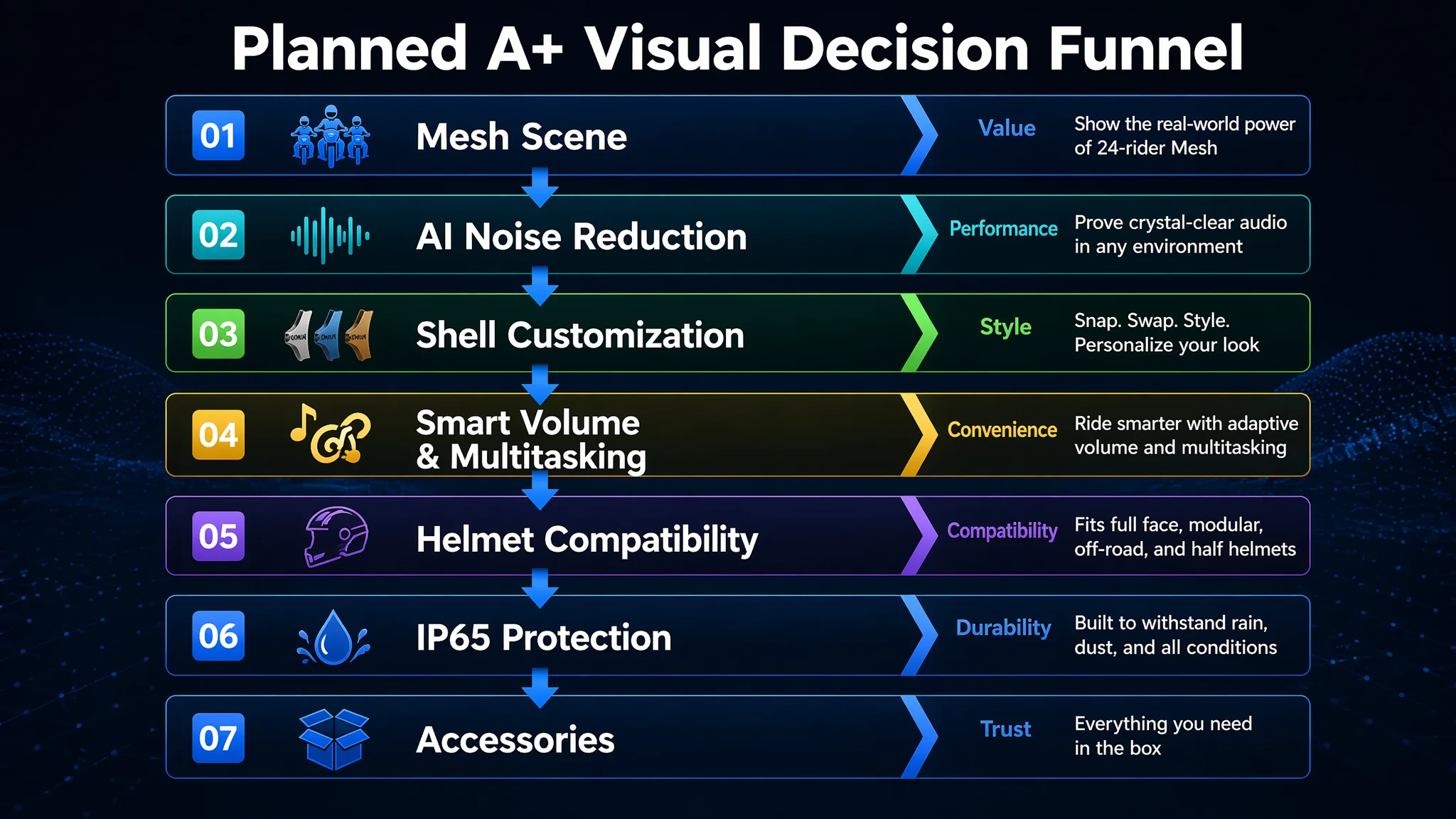
This structure gives the page a clear progression: value → performance → style → usability → compatibility → durability → completeness. It turns what used to be a nearly silent detail page into a persuasive funnel that supports Amazon ads rather than wasting them.
Reviews: Volume Advantage Without Front-Page Leverage
DeepBI also noted a subtle but meaningful difference:
- Seller: 4.2 stars, 82 total reviews, but 0 front-page reviews
- Benchmark: 4.6 stars, 48 total reviews, 9 front-page reviews
Implications:
- The seller had more total feedback, which is an underlying strength.
- But on the first screen, where buyers make fast trust decisions, they saw no reviews, while the benchmark showed 9 detailed, high-quality reviews with images.
In practice, this meant the seller’s stronger data foundation was invisible at the moment of decision. While DeepBI cannot fabricate reviews, strengthening the Listing’s A+ and visual clarity increases the likelihood of:
- More satisfied buyers
- More visual reviews
- Better front-page representation over time
Before Ads Could Work Again, the Page Had to Convert
After DeepBI’s diagnosis, the seller’s understanding shifted:
- They moved from “our problem is ad optimization” to “our problem is product-page conversion.”
- They recognized that the strongest differentiators—Mesh, 24 riders, 2000M, BT 5.4—were not truly visible on the existing page.
- They accepted that ads were amplifying a page that did not yet deserve more traffic.
By restructuring the Listing:
- The conversion capacity of the page began to recover.
- Each click from Amazon ads now landed on a clearer, more complete story.
- Trust was built in layers: title → main images → bullets → A+ modules → reviews.
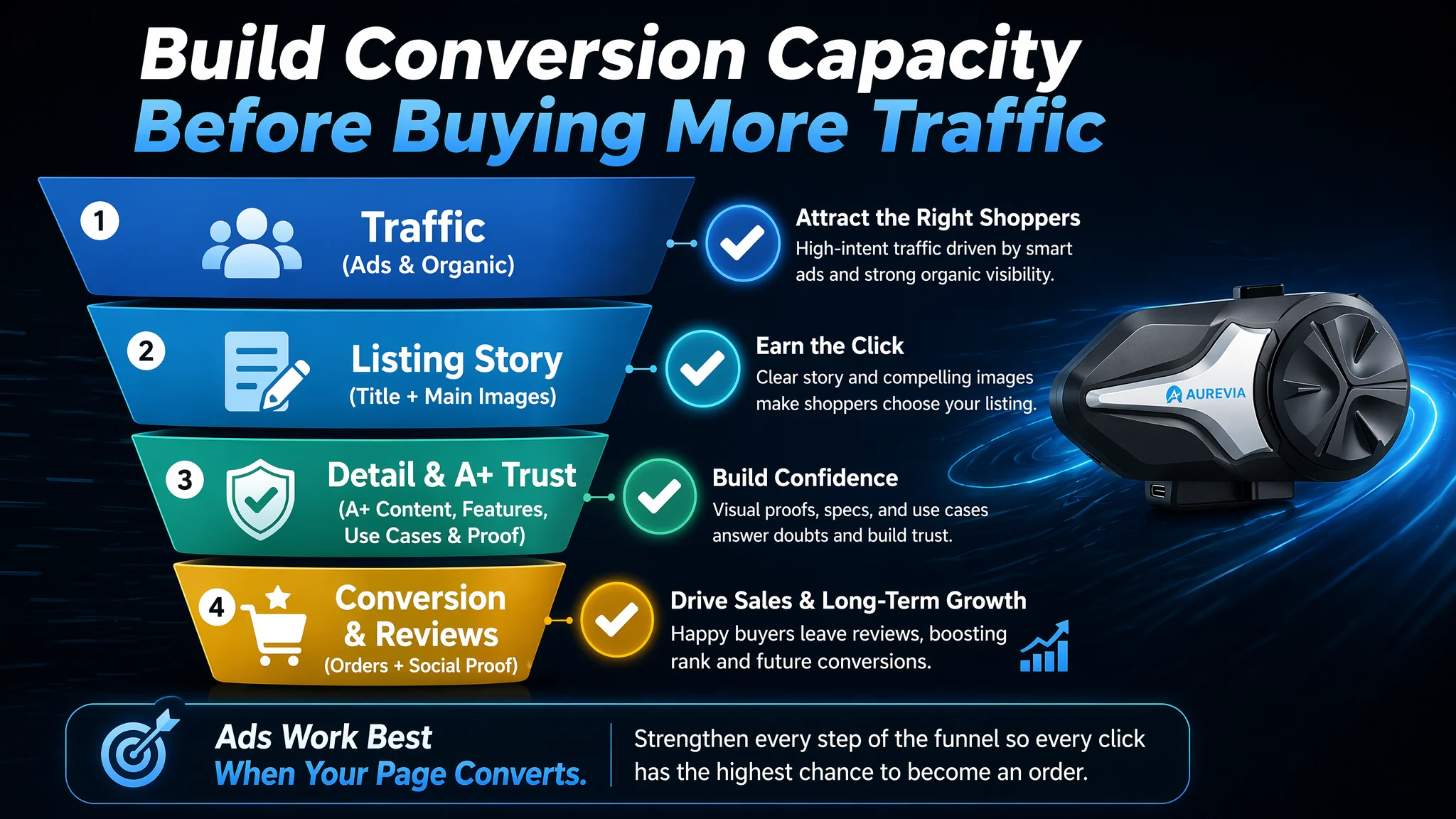
Even without quoting specific post-optimization numbers, the operational state changed in critical ways:
- The Listing no longer relied purely on specs and title to persuade.
- Organic and paid traffic had a more coherent path to follow.
- Ad spend could be evaluated against a page that was genuinely capable of converting.
What Other Amazon Sellers Can Take From This Case
Several lessons extend beyond motorcycle intercoms:
1. A strong title and decent main images do not guarantee a strong Listing.
If your A+ content is missing or thin, your page may be fundamentally untrustworthy, no matter how good your headline looks.
1. Ads cannot repair a broken product-page story.
They can send traffic, but they cannot make your product understandable or believable on their own.
1. Technical superiority must be translated into buyer logic.
Specs like “24 riders, 2000M, BT 5.4, quad AI noise reduction” only become competitive assets when buyers can see them in action and tie them to concrete scenarios.
1. Listing conversion is the foundation of ad efficiency.
Until your Amazon product page can convert the traffic it gets—both paid and organic—optimization of bids and keywords will have diminishing returns.
1. Title, main image, bullets, and A+ must work together.
In this case, the title was already ahead. What changed the business risk profile was aligning images and A+ modules to tell the same story.
For Amazon sellers, the deeper takeaway is judgment: before you invest in “better ads,” ask whether your Listing—especially your A+ content—actually deserves more traffic. DeepBI’s value in this case was not in generating more assets, but in correctly identifying that the real constraint was conversion capacity on the page, not the sophistication of the campaigns.