

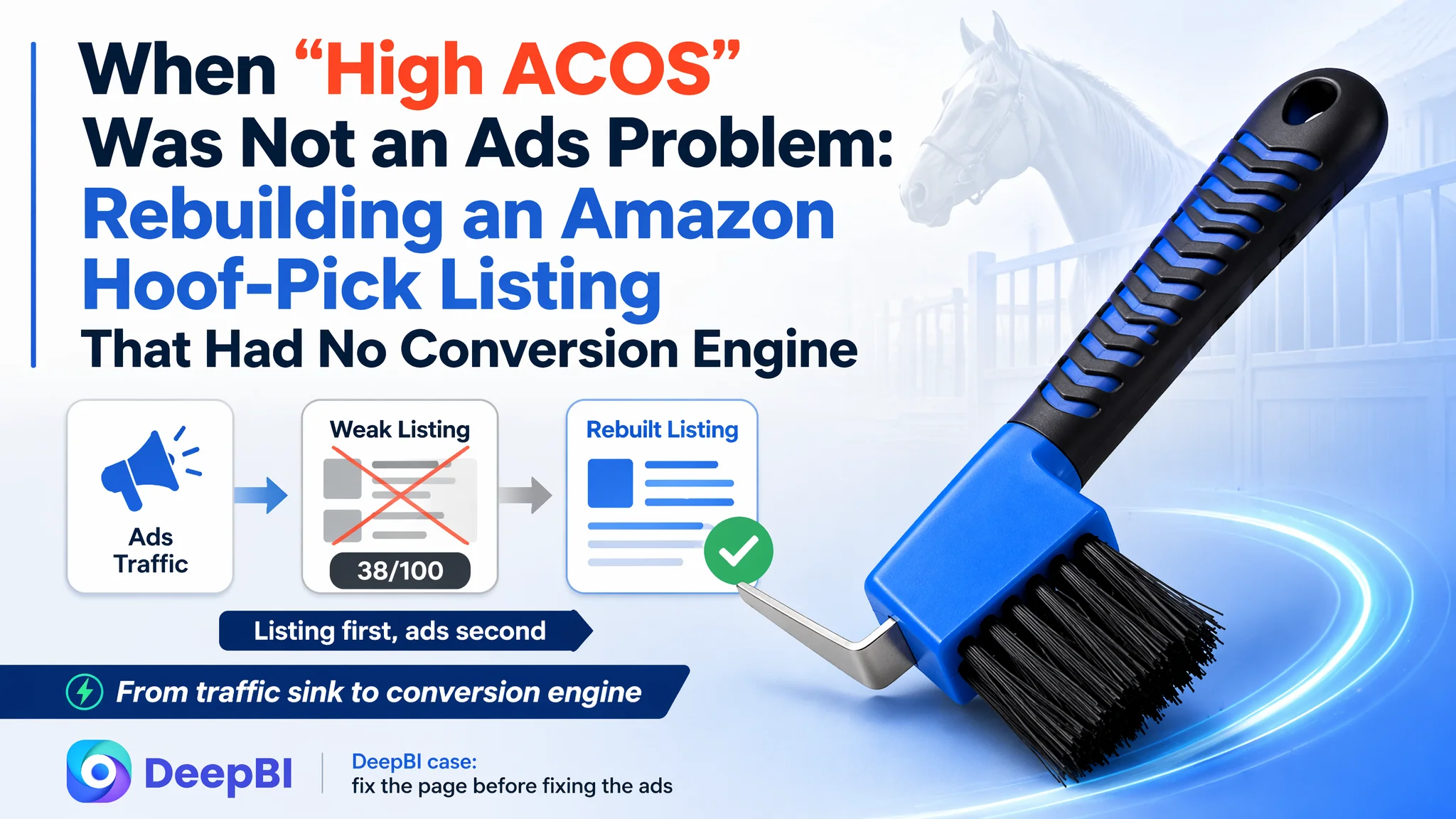
An Amazon seller in the equestrian tools category came to DeepBI with a familiar headache: Amazon ads were getting more expensive, ACOS was hard to control, and yet orders were not growing in step with traffic. On the surface it looked like a pure advertising issue on the UK marketplace—a matter of bids, keywords, or campaign structure.
The seller’s team had been iterating creatives and keywords around a hoof-pick tool, assuming the answer lay in “better ads” and “more traffic.” DeepBI’s diagnosis told a different story. The core listing scored only 38/100 against a benchmark competitor at 77/100, with zero A+ content and zero reviews. The ads weren’t failing; they were sending traffic to a product page that was structurally unable to convert.
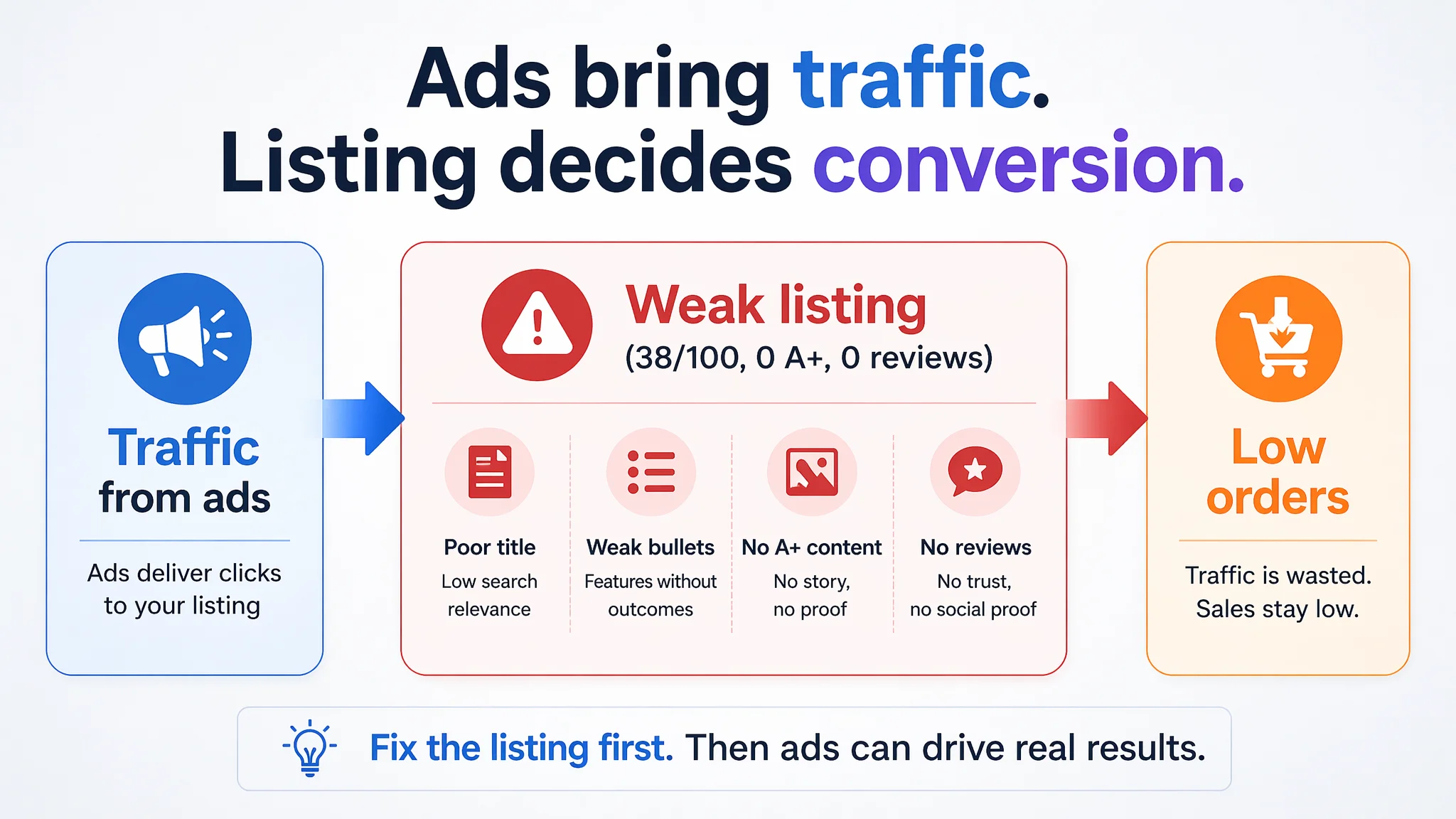
The work that followed did not start with campaign tuning. It started with rebuilding the Amazon Listing itself: reordering the title around buyer search logic, restructuring bullets from component description to user outcome, and designing a complete A+ story using professional, scenario-based visuals. Once the page began to explain, prove, and de-risk the product, ad traffic finally had a chance to convert instead of being consumed.
For other Amazon sellers, this case is a reminder that rising ACOS is not always an advertising problem. When a listing lacks trust signals, usage scenarios, and a clear decision path, ads only amplify the leak. The key shift is to treat listing conversion—titles, main images, bullets, and A+ content—as the foundation of any ads strategy, not an afterthought.
Amazon Ads Were Not Failing. The Page Was Consuming the Traffic.
Before DeepBI stepped in, the seller was focused almost entirely on Amazon ads.
Clicks were coming in, but the cost per order kept edging up. The intuitive response was to:
- Rotate creatives;
- Test more keywords;
- Micro-adjust bids and budgets.
Nothing fundamentally changed.
From their perspective, the story was simple: “Our hoof-pick tool is solid, our images show the product, and ads are driving traffic. If ACOS is high, the ads must be wrong.”
DeepBI’s scoring report exposed a different pattern:
- Total Listing score: 38/100
- Benchmark competitor: 77/100
- Gap: -39 points
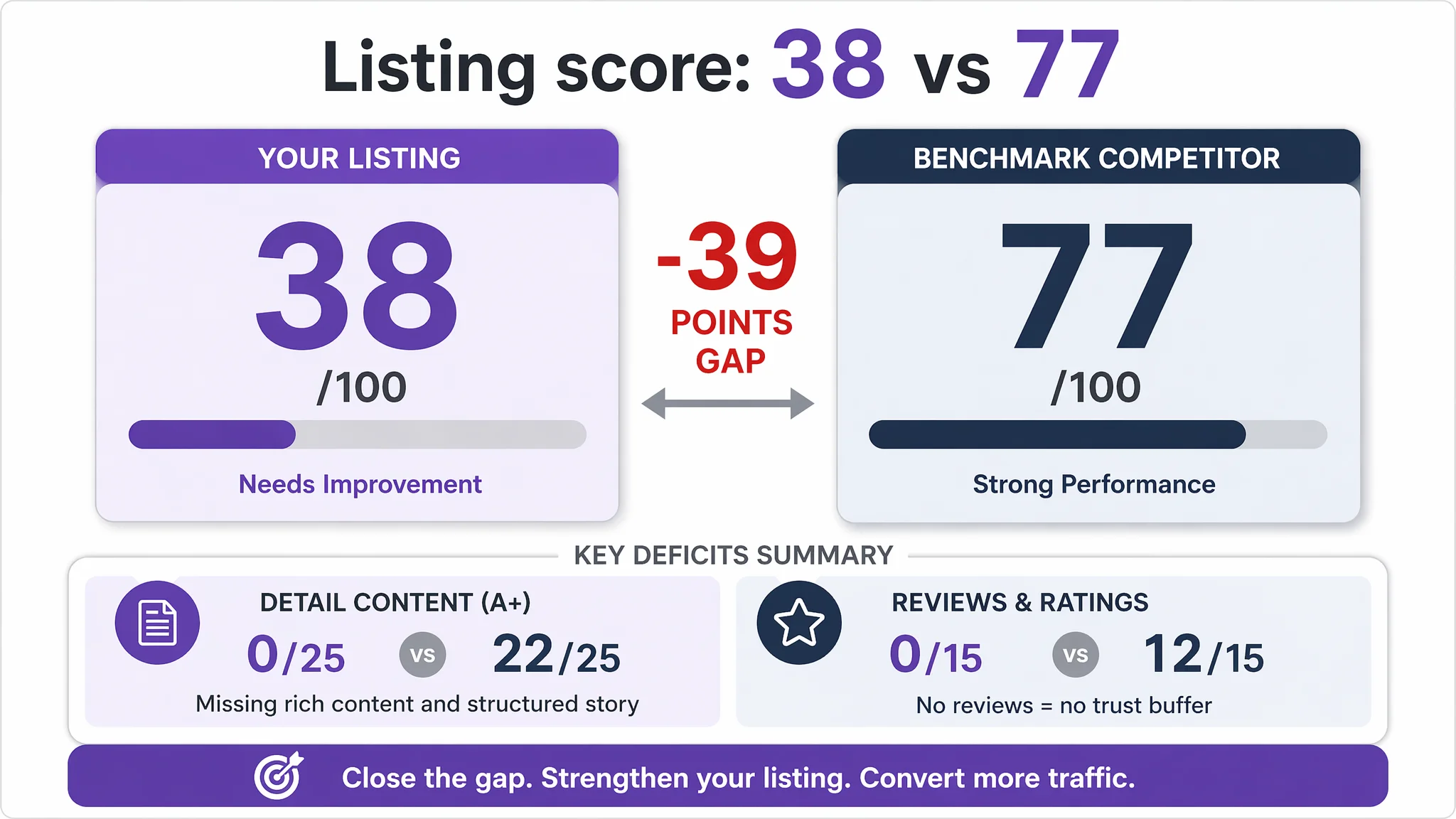
The detailed breakdown made the risk obvious:
- Title: 9 vs 15
- Main images: 24 vs 21 (a relative strength)
- Bullet points: 5 vs 7
- Detail page (A+): 0 vs 22
- Reviews: 0 vs 12
“The real problem was not that ads failed to bring traffic. It was that the page could not convert the traffic.”
The listing was effectively asking ads to carry the entire business, while offering almost no conversion infrastructure on the product page itself.
The Real Constraint Was Listing Conversion Capacity
DeepBI’s judgment in this case was straightforward: the bottleneck was not traffic volume, but the listing’s conversion capacity.
Several red flags made this clear.
The title didn’t align with how buyers search
The original title:
- Led with “1 Pack,” a low-value phrase in Amazon search terms;
- Buried the core product phrase “Hoof Pick” behind quantity and generic attributes;
- Listed materials and applicable animals, but did not anchor on the primary use case.
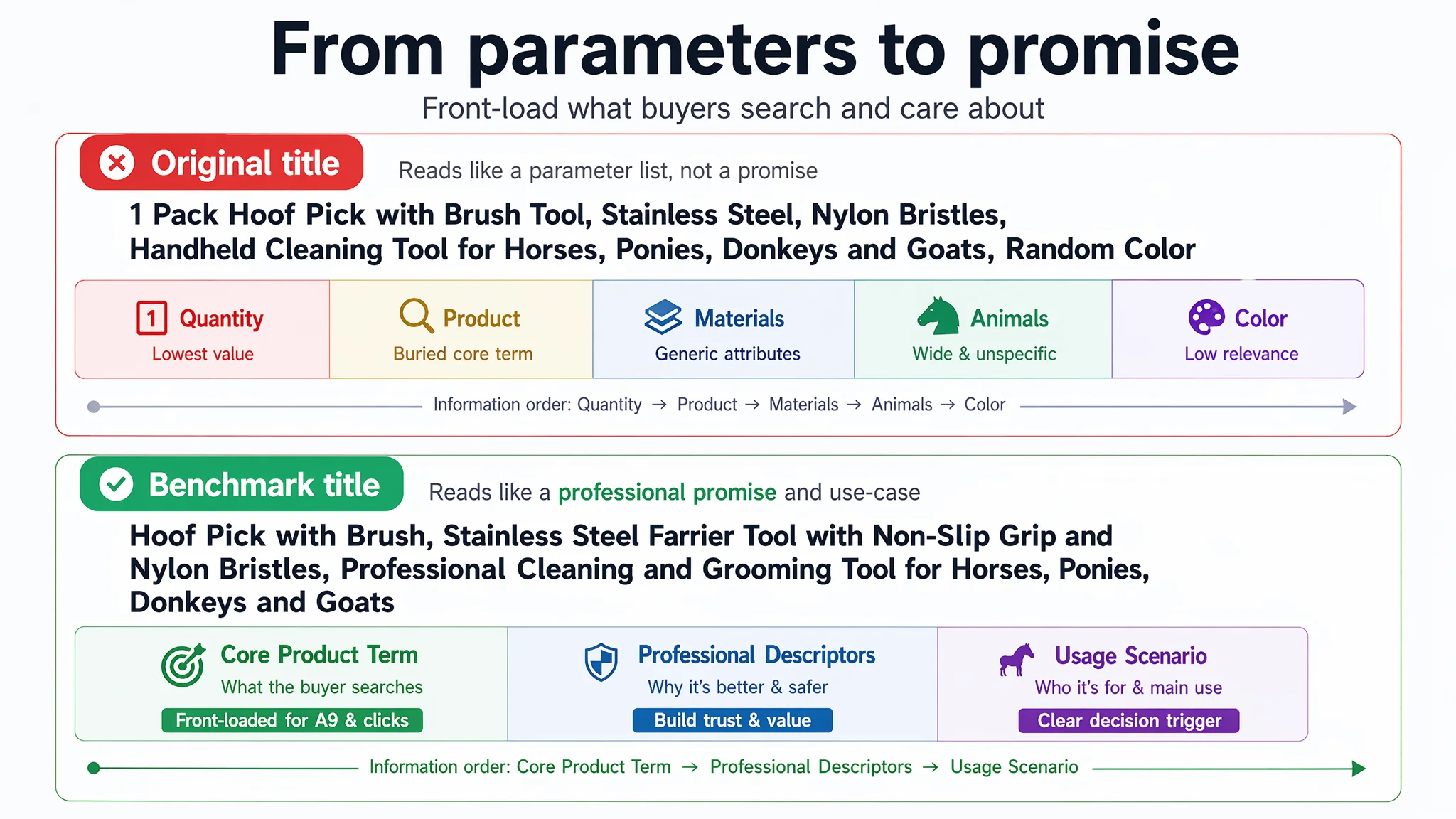
The benchmark, by contrast, did three things very well:
1. Front-loaded the core term “Horse Hoof Pick,” matching buyer queries and A9 expectations.
2. Embedded high-value, professional descriptors like “TPR Non-Slip Grip” and “Farrier Tool,” signaling expertise and seriousness.
3. Explicitly framed the core scenario: “Hoof Cleaning and Grooming.”
The problem was not just SEO; it was decision framing. The seller’s title read like a parameter list, not a promise of a specific outcome.
Bullet points were structured as a manual, not a buying argument
The seller’s bullets walked through:
- Dual-function explanation;
- Metal-end function;
- Brush-end function;
- Portability and look;
- Usage and safety notes.
The competitor’s bullets walked through:
- Core dual-function and resulting cleaning effect;
- Deep-cleaning materials and outcome;
- Non-slip grip solving “wet and slippery” pain points;
- Storage convenience solving “easy to lose” pain points;
- Size and durability for daily use.
The key difference: the competitor always tied a feature to a user outcome. The seller stayed at the level of parts and instructions, and even used the last bullet as a safety reminder, breaking the persuasion flow right when buyers needed reassurance to click “Buy.”
The detail page had no A+ content at all
This was the biggest structural deficit:
- Seller: no A+ modules, no structured visuals, no story.
- Benchmark: a full A+ stack—hero scene, function breakdown, multi-angle usage, real-use scenes, emotional positioning.
DeepBI’s scoring gave the seller 0/25 on detail content vs 22/25 for the benchmark.
This meant:
- No emotional entry point (why this hoof pick matters to horse welfare);
- No visual proof of professional use (such as a farrier in action);
- No modular explanation of structure and function;
- No systematic trust-building from scene to proof.
In practice, the listing had no second layer of persuasion beyond the standard image carousel. Once visitors scanned the top images, there was nothing else to carry them from interest to purchase.
Zero reviews meant no trust buffer
The review gap was equally stark:
- Seller: 0 reviews, no rating;
- Benchmark: 4.6 stars, 14 reviews, several on the first page.
With no social proof:
- Any minor doubt in the content became fatal;
- Ads had to fight both conversion and trust alone;
- The listing could not reassure buyers that other horse owners had used and approved this tool.
For DeepBI, the conclusion was clear: as long as this listing stayed structurally weak and trust-free, any extra ad spend would only magnify waste.
Why Traditional Amazon Ad Optimization Kept Failing
The seller was not inexperienced. They did what most Amazon teams would do when ACOS rises:
- Add negative keywords to filter irrelevant clicks;
- Shift bids toward “better performing” search terms;
- Test different campaigns and creatives.
But these moves all assumed one premise: that the product page was good enough, and the problem was traffic quality or volume.
DeepBI’s data contradicted that premise.
- Main-image scoring (24/30) was not the weak link; the visual set already covered function, steps, and multi-scene usage more thoroughly than the benchmark.
- The largest scoring deficits were in detail content (-22 points) and reviews (-12 points).
In other words, the listing had:
- An “OK to good” image rail;
- A structurally weak title and bullets;
- No A+ content;
- No social proof.
Under these conditions, ad optimization cannot fix the conversion funnel:
- Even highly relevant clicks land on a page with incomplete trust and incomplete explanation;
- Each extra click costs money but fails to reach a stable conversion rate;
- ACOS pressure keeps mounting, not because ads are inherently bad, but because the landing environment for those ads is not commercially ready.
“Advertising does not only amplify advantages. It can also amplify a page’s existing defects.”
DeepBI’s role was to break the team out of the “ads first” reflex and force the question: “Does this page deserve the traffic we’re paying for?”
This Product Page Did Not Lack Traffic. It Lacked Trust and a Buying Logic.
Once DeepBI anchored the problem on listing conversion, the strategy became a question of decision logic, not extra execution.
The diagnosis unfolded along three main axes:
1. Clarity of the offer at the title level;
2. Persuasive flow in the bullet points;
3. Depth and coherence of the A+ story.
Reframing the title: from parameters to a professional promise
DeepBI recommended a new title direction:
Hoof Pick with Brush, Stainless Steel Farrier Tool with Non-Slip Grip and Nylon Bristles, Professional Cleaning and Grooming Tool for Horses, Ponies, Donkeys and Goats
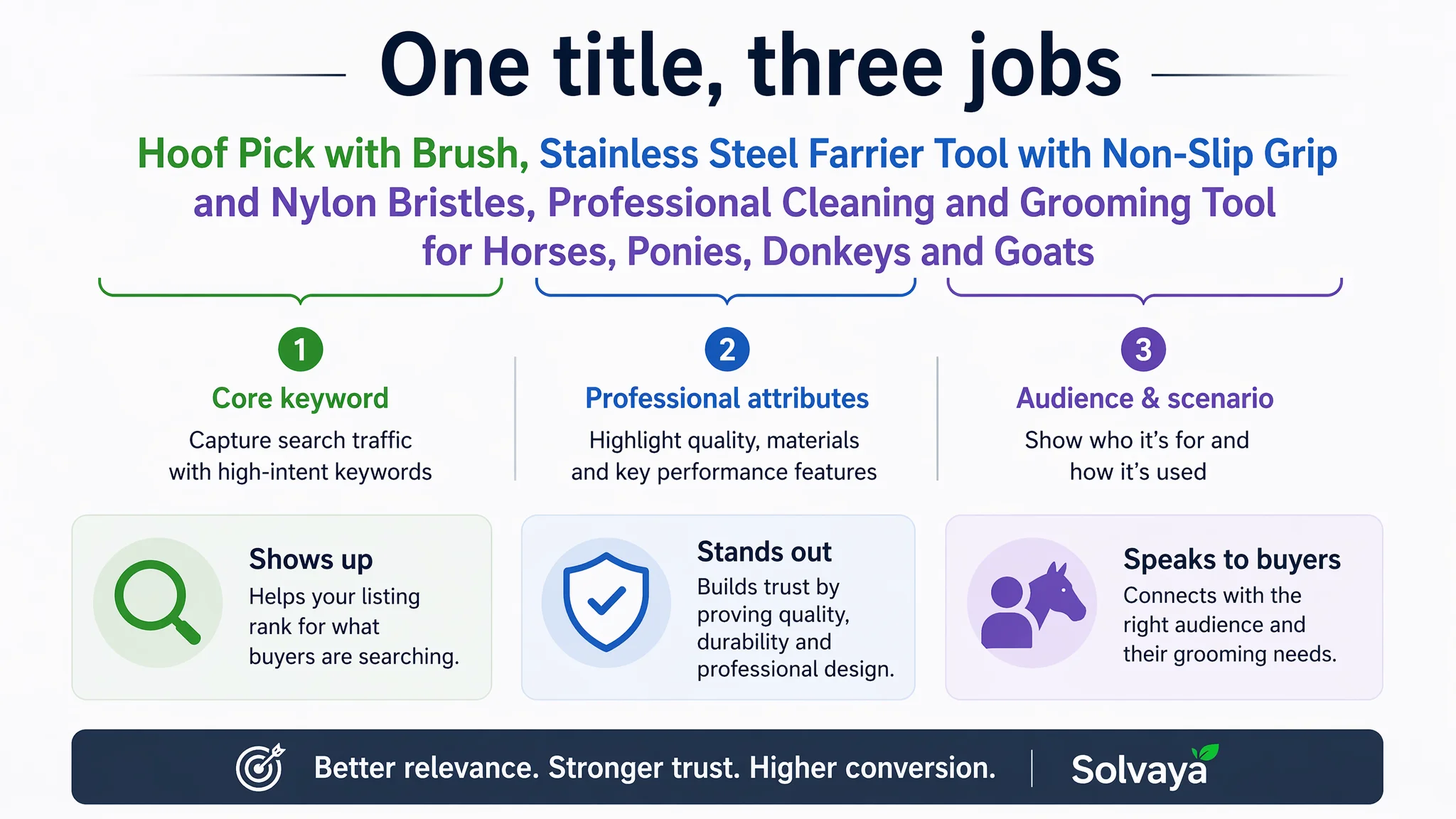
Notice how this reframing deals directly with the earlier gaps:
- Core keyword in front: “Hoof Pick with Brush” leads, aligning with search terms and click intent.
- Professional identity: “Stainless Steel Farrier Tool” signals that this is not a generic plastic gadget.
- Important functional attribute: “Non-Slip Grip” creates a clear safety and control promise.
- Audience and scenario: “Professional Cleaning and Grooming Tool for Horses, Ponies, Donkeys and Goats” ties multi-species versatility back to the grooming use case, not just to a list of animals.
This is not cosmetic wordplay; it’s a re-ordering of what the buyer sees first and what they infer about the product. Titles are not just for algorithms; they frame whether a visitor arrives expecting a serious farrier tool or a cheap brush.
The Bullet Points Had Information, but Not a Buying Logic
DeepBI’s analysis highlighted that the seller’s original bullets were structured “inside-out” (from parts to user), while the benchmark structured them “outside-in” (from user pain to solution).
The optimization path therefore was to rebuild each bullet around a result, then support it with features, not the other way round.
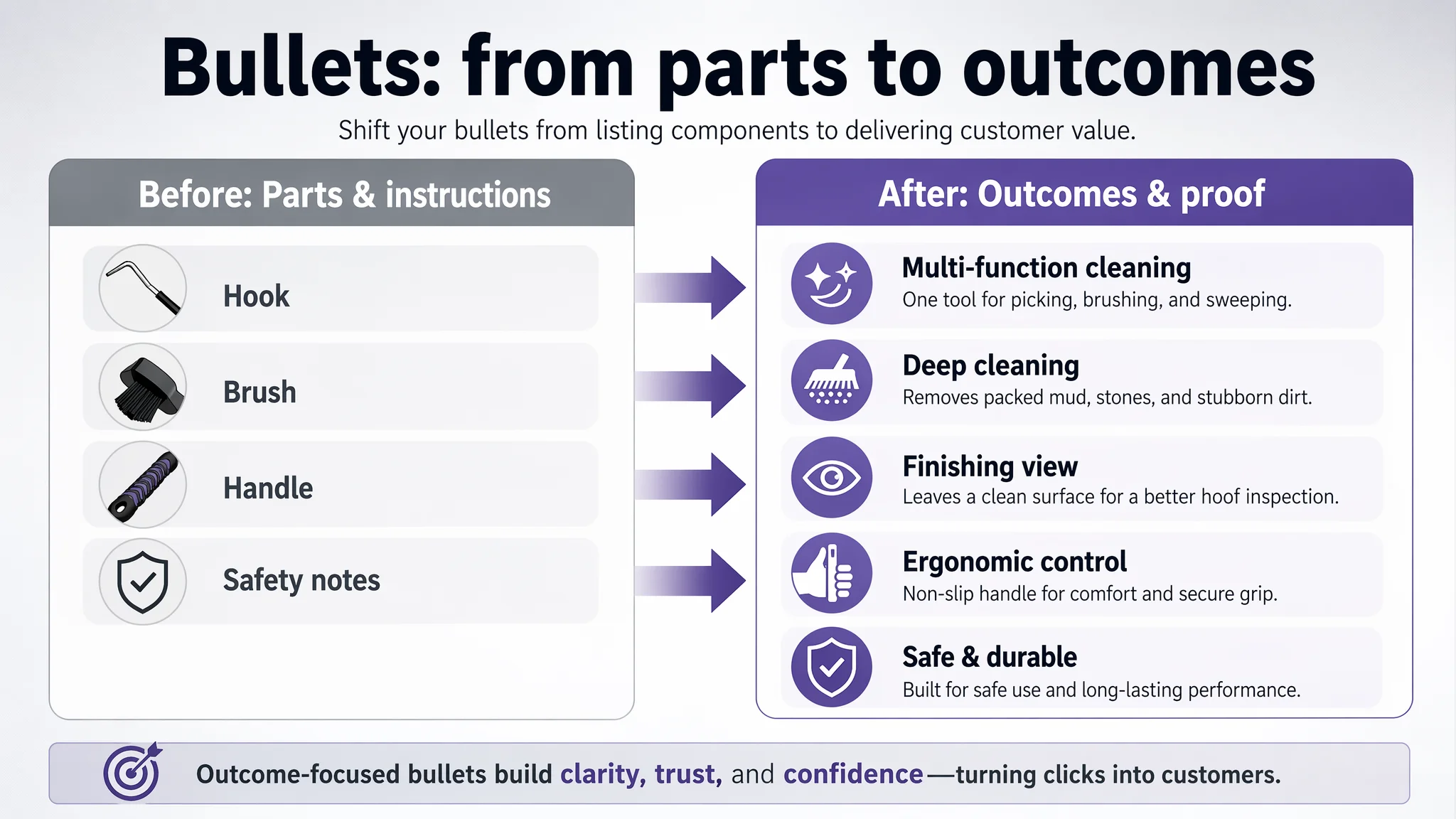
Bullet 1: Define the multi-functional outcome, not just “2-in-1”
Original mindset: explain that the tool has two functions.
Optimized direction:
Multi-Functional 2-in-1 Design: Efficiently combines a heavy-duty hoof pick and a stiff bristle brush in one tool, allowing you to quickly remove packed mud and sweep away loose debris for comprehensive equine hoof maintenance.
Shifts achieved:
- “2-in-1” becomes “multi-functional” and “efficiently combines,” hinting at time and labor savings.
- The sentence ends on “comprehensive equine hoof maintenance,” mirroring how a professional or serious owner thinks about hoof care.
Bullet 2: Anchor the metal pick on durability and deep-clean capability
Instead of a generic mention of material, DeepBI tied the stainless-steel attribute to specific job tasks:
Premium Stainless Steel Pick: The durable metal pick is specifically engineered to lift out small stones, compacted dirt, and stubborn stable bedding from soles and grooves during routine checks and deep cleaning sessions.
This explicitly connects:
- The material (stainless steel);
- With the tasks (stones, compacted dirt, bedding);
- Within the routine (checks and deep cleaning).
The buyer no longer has to guess whether the tool can handle what they see in their horse’s hooves.
Bullet 3: Use the brush to secure a “finishing” outcome
Brushes are often undersold as generic “bristles.” DeepBI repositioned them as the finishing step:
High-Density Nylon Bristles for Finishing: Features stiff nylon bristles that excel at brushing away remaining dust and fine debris after picking, ensuring a perfectly clean surface for a better view of the hoof’s condition.
This does two important things:
- It assigns the brush a precise role in the sequence (“after picking”);
- It links that role to a diagnostic outcome (“better view of the hoof’s condition”), which is critical for owners and farriers monitoring hoof health.
Bullet 4: Turn handle description into control and portability
Rather than “handheld plastic handle,” the revised logic is:
Ergonomic & Portable Handle: Designed for comfort and control, this compact handheld tool fits perfectly in grooming kits, tack boxes, or trailers; its lightweight yet sturdy construction ensures easy portability and daily reliability.
Now the handle:
- Solves the comfort problem;
- Fits the typical storage environments buyers actually use;
- Ties portability to reliability, which supports the farrier-tool positioning.
Bullet 5: Replace safety disclaimers with safety-design plus longevity
The last original bullet being a pure “safety reminder” was a conversion break. DeepBI’s recommendation:
Safety-First & Easy Maintenance: Built for safe operation with controlled strokes, the angled pick design keeps points away from the body. Simply rinse or wipe clean after use for a long-lasting, hygienic addition to your grooming routine.
The bullets now read like a coherent buying logic from function to trust, instead of a scattered technical breakdown interrupted by warnings.
The Detail Page Had to Become a Story, Not Just a Placeholder
The most serious gap remained: 0 points for detail/A+ vs 22 points for the benchmark.
DeepBI’s judgment was that no amount of ad work was going to compensate for this. For an equestrian tool, the decision often depends on:
- Perceived care for the animal;
- Perceived professional endorsement;
- Clarity about how the product behaves in real use.
The recommended A+ redesign followed a deliberate sequence.
1. Start with emotional context: horses, health, and care
The opening A+ module was designed around a high-aesthetic pastoral scene:
- Horses in a natural environment at sunset;
- Warm, golden lighting;
- Softly blurred barns and fences in the background.
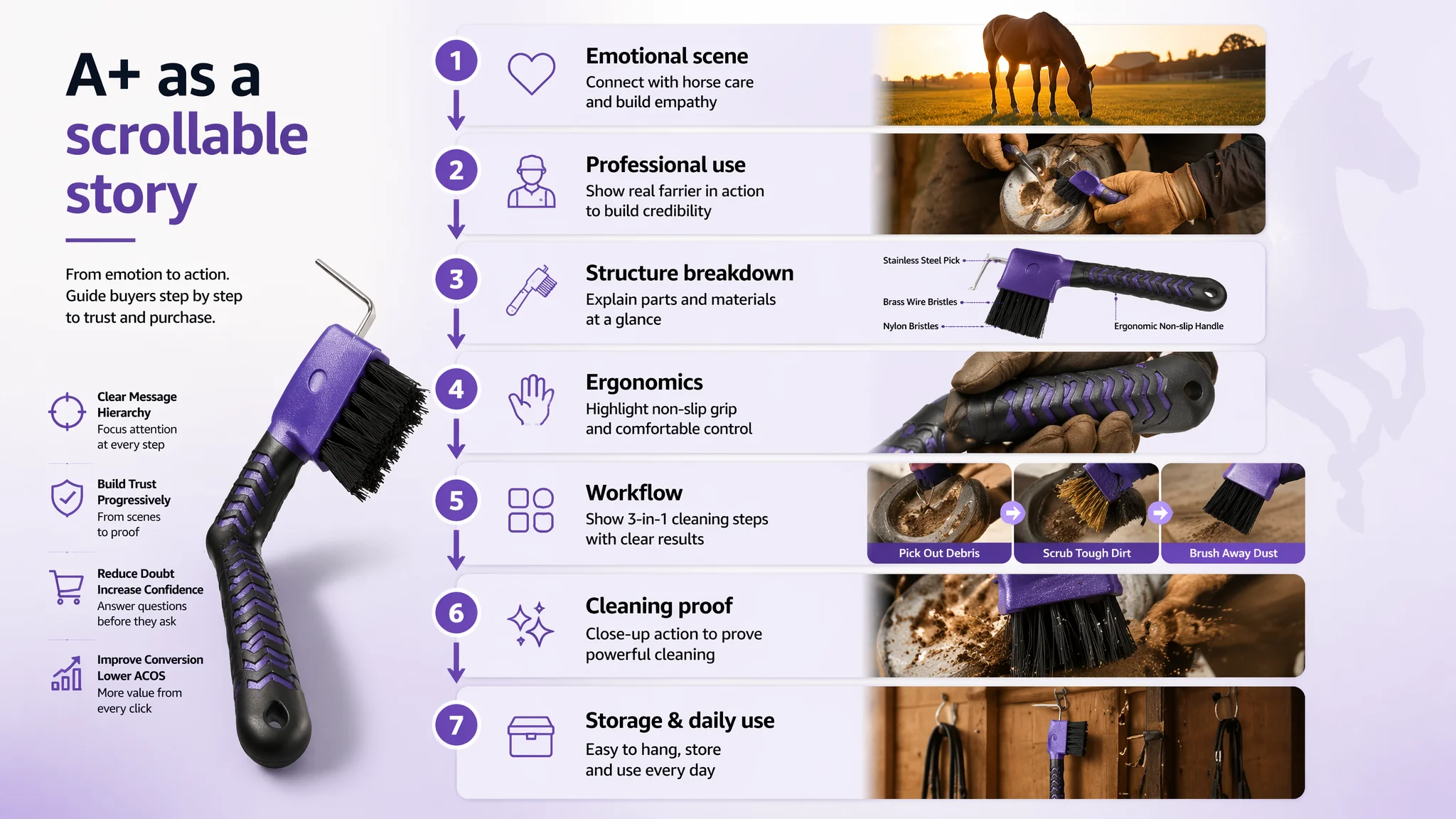
Business logic:
- Equestrian buyers are highly sensitive to animal welfare;
- Positioning the brand as a caretaker of horse health, not just a tool seller, increases willingness to pay and patience to read;
- It sets up the hoof pick as part of a broader “care ritual,” not a disposable gadget.
2. Show professional use by a farrier
Next, DeepBI introduced a module with a farrier in action:
- A professional in a leather apron;
- Cleaning a hoof with the tool clearly visible;
- Sharp lighting to show dirt and hoof detail.
Why this matters:
- A farrier using the tool functions as implied expert endorsement;
- It reduces doubt about whether the product meets “real-world” standards;
- For owners, it answers: “Is this something a professional would actually use?”
3. Deconstruct the product: structure and purpose in one glance
The third module was pure function breakdown:
- White background;
- Product at a 45° angle occupying most of the image;
- Callouts for metal hook, brass bristles, nylon bristles, and non-slip handle.
This addresses:
- The need to understand each part quickly;
- The cognitive load of reading text-only explanations;
- The desire to see how the tool is engineered without technical overload.
4. Focus on ergonomics and pain points: grip and fatigue
Another module zoomed in on the handle:
- Gloved hand gripping the purple non-slip handle;
- Grain and texture clearly visible;
- Stable, professional stable background, softly blurred.
Business reasoning:
- “Slippery when wet” and “hand fatigue” are known pain points;
- Showing a secure, gloved grip visually answers those objections;
- This is more persuasive than simply writing “non-slip ergonomic handle.”
5. Visualize the full cleaning workflow: hook, brush, sweep
DeepBI emphasized a three-step visual narrative:
- Hook removing stones and packed dirt;
- Hard brush working the edges;
- Nylon brush sweeping away dust.
The buyer sees:
- The complete “hook–brush–sweep” flow;
- How the product compresses multiple tasks into one tool;
- Why this represents value and time savings vs separate tools.
6. Prove cleaning power with dynamic close-up
To address the “stubborn dirt” concern, a macro shot shows:
- Bristles actively scraping hardened dirt from a hoof;
- Small dirt particles flying, adding motion and intensity.
This image functions as evidence, not illustration:
- It demonstrates bristle stiffness;
- It “proves” cleaning strength in a split second;
- It reduces the gap between expectation and reality by grounding the product in a realistic scenario.
7. Close the loop with storage and daily integration
Finally, a module shows:
- The tool hanging on a stable wall via its built-in hole;
- Other equestrian tools around, in order, in a real stable environment.
The experience loop is complete: from emotion and professionalism, through function and proof, to storage and ongoing use.
Why DeepBI Did Not Recommend “Keep Tuning Ads First”
Given this diagnostic picture, DeepBI’s decision path was to repair the listing’s conversion logic before any new ad scaling.
The reasons:
1. The largest gap vs the benchmark lay in A+ and reviews, not in traffic or even main images.
2. Ad spend on a weak conversion asset is not just inefficient; it’s risky. It can:
- Mask listing weaknesses behind temporary traffic;
- Inflate TACOS and depress ROI;
- Encourage the wrong conclusion that “Amazon ads don’t work.”
1. Listing conversion is the foundation for ad efficiency. Without:
- A title that captures the right searches;
- Bullets that articulate outcomes;
- A detail page that builds trust;
ads are effectively “pushing” customers into a weak pitch.
DeepBI’s judgment was that, at this stage:
- Every pound invested in listing structure had more leverage than another pound in ad experiments;
- Only after a stable conversion baseline was established would it make sense to re-evaluate bids, creatives, and keyword expansion.
How the Page’s Sales Logic Started to Recover
This case did not hinge on a single “magic graphic” or a “killer phrase.” It was about rebuilding a coherent sales logic across the page.
Key changes in the operating state once the new logic was implemented:
- Title clarity improved: “Hoof Pick with Brush” and “Farrier Tool” moved into the lead, aligning both organic and paid search traffic with the actual product positioning.
- Bullet points formed a persuasion sequence: From multi-functional design and deep cleaning, through ergonomic grip and portability, to safety and maintenance as a final reassurance.
- A+ content created a full funnel: Emotional connection, professional usage proof, structural explanation, pain-point resolution, dynamic evidence, and storage integration formed a clear “scroll narrative.”
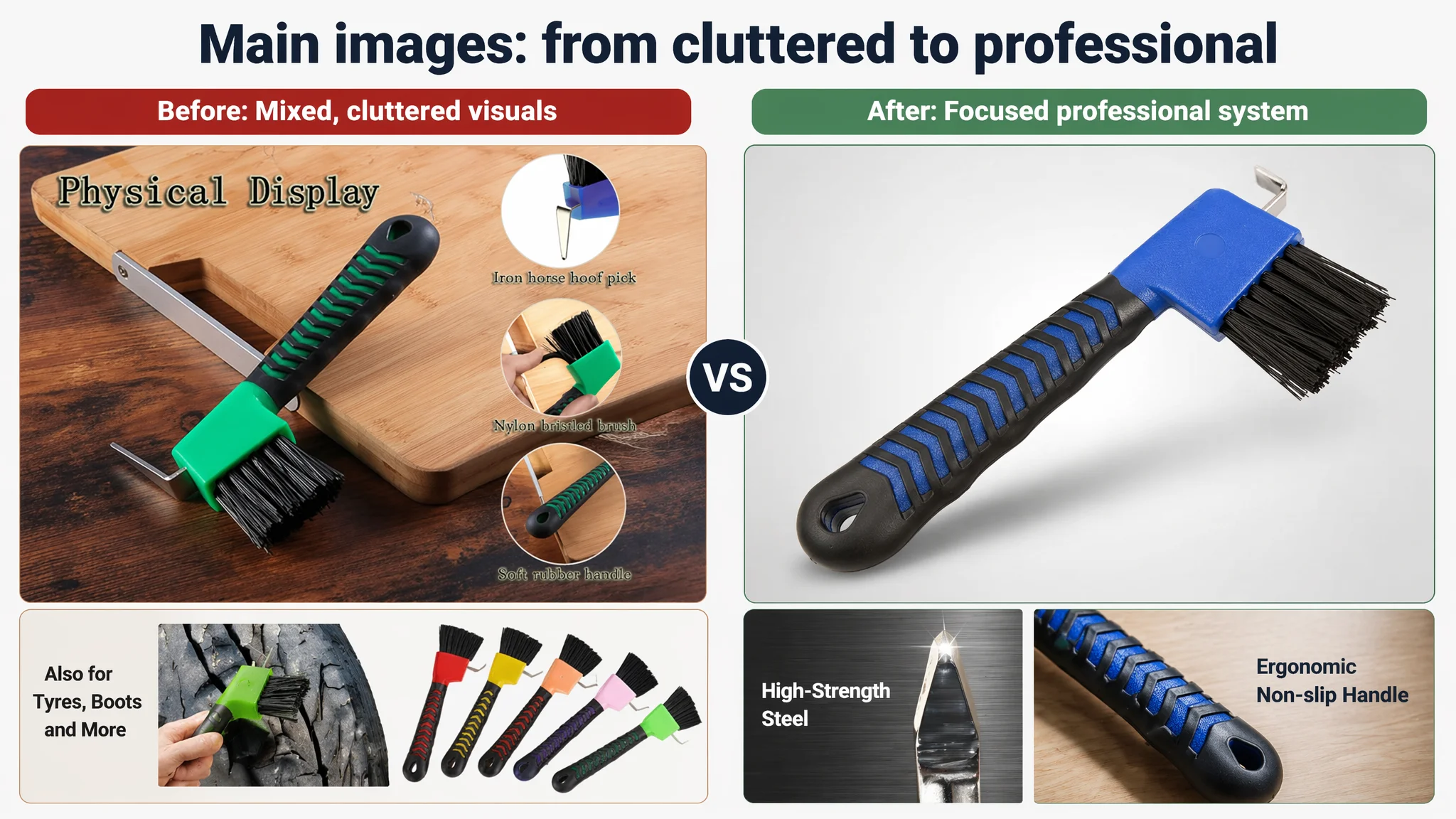
- Main images were refocused for professional impact:
- Centered, high-contrast hero presentation;
- Metal hook macro shot with “High-Strength Steel” callout;
- Non-slip handle texture close-up;
- Bristle density proof and parametric dimension visuals.
The result: ad traffic finally had meaningful support once visitors landed. The page began to:
- Explain what the tool does and for whom;
- Show how it works in real, believable contexts;
- Address functional and emotional risks that previously went unspoken.
Even before any dramatic review build-up, the listing was no longer asking ads to do all the work alone.
How Ad Traffic Became Useful Again
DeepBI’s approach does not treat Amazon ads and listings as separate silos.
In this case, the shift looked like this:
1. Before:
- Ads sent traffic into a page with weak title, thin bullets, zero A+, and no reviews.
- Visitors had to mentally assemble a justification for purchase from scattered information.
- Many left, leaving the seller paying for clicks that had little chance to convert.
1. After listing restructuring:
- The page started catching and guiding attention from the first screen down.
- The conversion funnel (click → understanding → trust → purchase) became continuous instead of fragmented.
- Even with the same level of ad spend, the probability that each click would convert increased.
Although this narrative does not attach specific CVR or ACOS numbers, the risk profile changed:
- The listing was no longer a clear underperformer vs a 77/100 benchmark;
- Advertising dependence became more rational, as the page itself had the capacity to bear more of the selling work;
- The seller gained a more controllable traffic structure, where organic and paid traffic were feeding into a page with a consistent, professional story.
What This Amazon Seller Learned—and What Other Sellers Can Take Away
By the end of the process, the seller’s understanding of their Amazon business had shifted in several important ways.
1. High ACOS is not always an ad problem
- Ads can look “expensive” because the page fails to convert what they bring.
- Without a solid title, bullets, A+, and social proof, even highly optimized campaigns will underperform.
2. Listing quality is the primary lever for ad efficiency
- Main images can be relatively strong yet still be dragged down by weak titles and absent A+ content.
- A full-funnel listing—top images plus a structured A+—is what allows ad traffic to convert consistently.
3. Title, main image, bullets, and A+ must work together
- Title: sets search alignment and a professional promise.
- Main images: create click reasons and immediate clarity.
- Bullets: translate features into outcomes and sequential logic.
- A+: builds trust, proves performance, and shows real scenarios.
Missing any one layer forces the others to overcompensate. In this case, the image set was doing far more than its share of the work—until A+ and text were brought up to standard.
4. Before scaling ads, ask: “Does this page deserve more traffic?”
DeepBI’s biggest contribution here was not a single optimization tactic, but a change in decision order:
- Diagnose listing conversion capacity first;
- Fix structural weaknesses in title, bullets, visuals, and A+;
- Only then re-approach ad scaling, knowing that the page can support the investment.
For Amazon sellers, especially in categories where trust and usage skill matter—like equestrian tools—this case demonstrates a simple but often overlooked truth:
Traffic alone does not build a business. A page that can consistently convert that traffic does.
DeepBI’s value in this case lay in seeing that distinction clearly, quantifying the listing gap against the benchmark, and insisting that the listing be rebuilt as a conversion engine before any further ads “optimization” took place.