

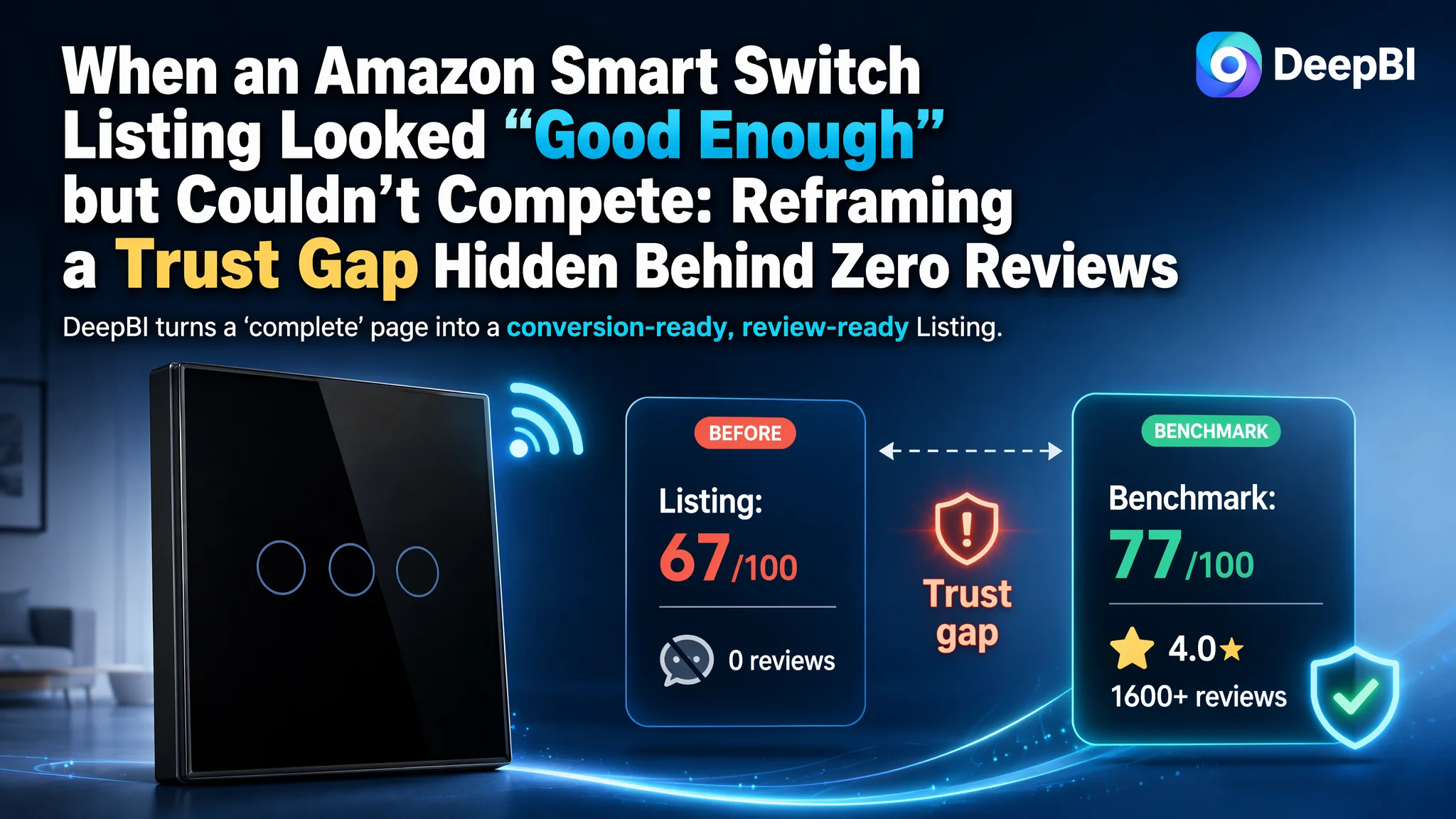
For this Amazon seller in the smart light switch category, the Listing didn’t look like a typical “problem page.” The title was packed with keywords, the main images were decent, the bullet points and A+ content were actually more systematic than a leading competitor. On paper, most of the content was already in place. Yet in real Amazon traffic, the Listing couldn’t stand up to a benchmark product that had thousands of reviews and stable sales.
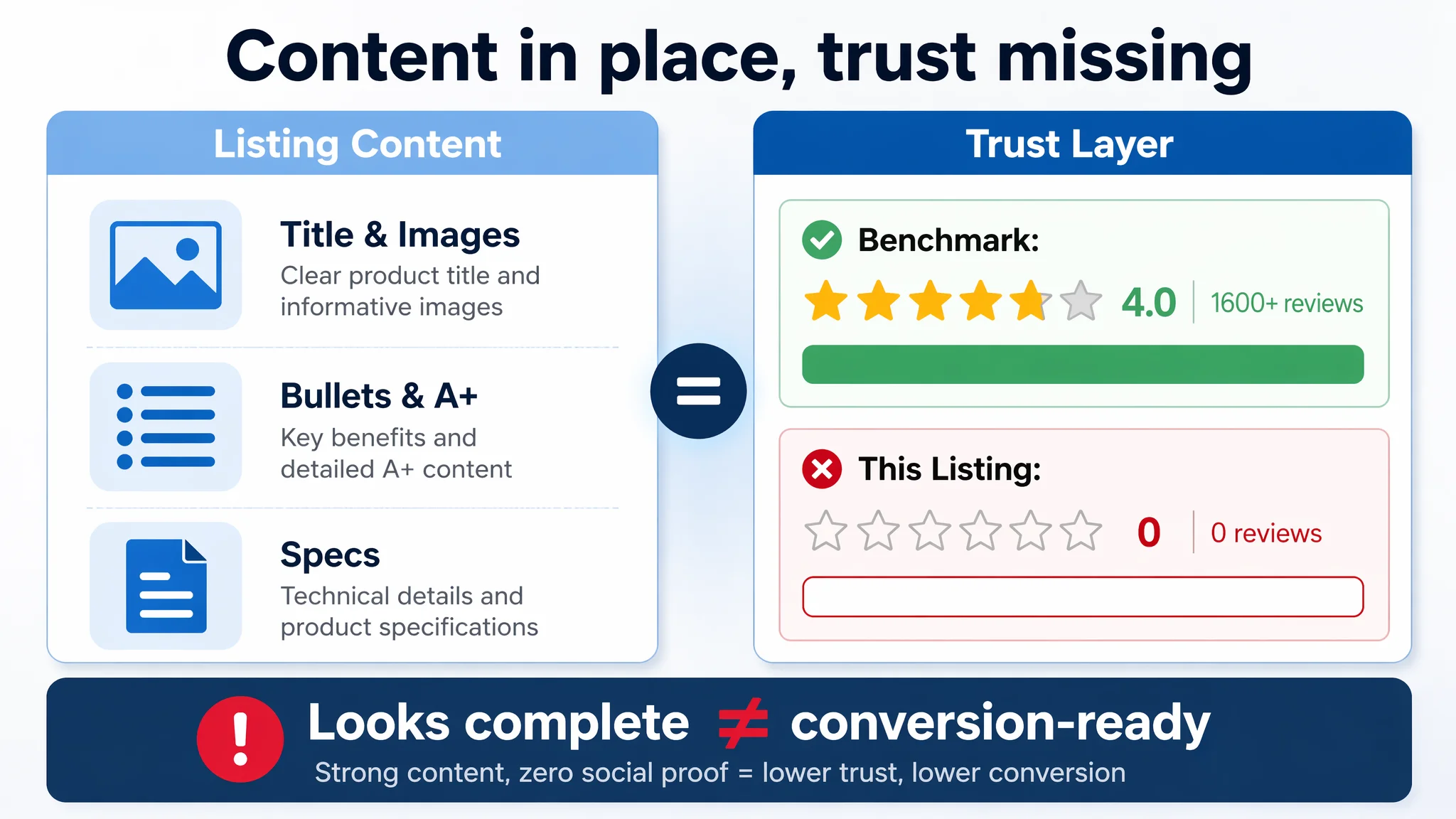
The seller’s first instinct was familiar: treat this as a text-and-image polishing problem. They tried to adjust titles, refine bullet points, and plan better main images—assuming that if they could match or surpass the competitor on visible content, Amazon ads would start performing and conversion would follow. But DeepBI’s diagnosis made one thing clear: the biggest bottleneck was not the wording or the visuals. It was the Listing’s total lack of social proof and how that changed the way every other module was perceived.
By comparing Listing scores against a benchmark Amazon smart switch and dissecting title, main image, bullet points, A+ layout, and review reality, DeepBI surfaced a counter‑intuitive judgment: this Listing already had stronger structural logic in many areas, but without any ratings or reviews, the page was operating under an invisible handicap. Optimization had to focus on building a conversion‑capable foundation—clarifying installation risk, sharpening key purchase signals, and preparing the page to actually deserve and convert early traffic—before any serious ad scaling would make sense.
For other Amazon sellers, this case is a reminder that a “complete” Listing can still be commercially weak. When ads feel hard to optimize and a page looks fine at first glance, it may not be the ad structure that’s failing, but a trust gap and misaligned selling logic on the product page. Fixing that judgment first is what allows Amazon ads and organic traffic to become useful again.
Amazon Ads Were Not Failing. The Page Was Consuming the Traffic.
When the seller came to DeepBI, the core pressure was simple: they needed this smart light switch Listing to start converting so that ad spend could be justified. The product sat in a competitive Amazon US subcategory with clear benchmarks: a comparable, category‑leading smart switch Listing with:
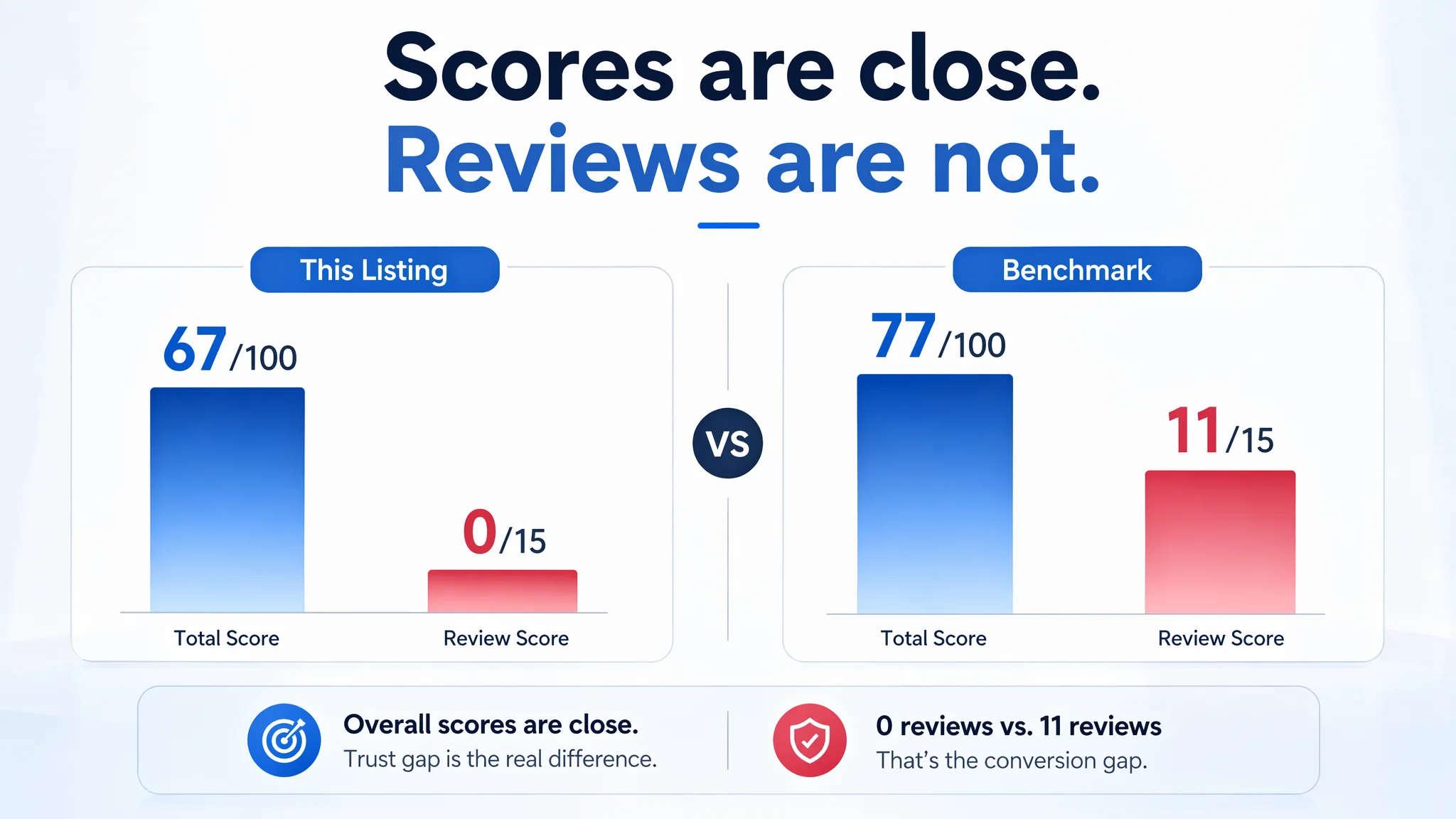
- A total Listing score of 77/100
- A large review base and 4.0 stars
- Visible traction in search and ads
By contrast, the target Listing:
- Scored 67/100 overall
- Looked relatively solid in title, main image, bullet points, and detail page
- Had 0 reviews and no rating—a review score of 0/15
On the operations side, the seller was feeling the usual pressures:
- Amazon ad costs were edging higher
- It was hard to push bids aggressively without seeing stable conversion
- Scaling traffic felt risky because the page wasn’t yet proven
The team’s assumption was straightforward: “Our Listing is probably weaker than the competitor in visuals and copy. If we fix that, ads should start to work.”
DeepBI’s scoring and comparison brought a different picture into focus.
“The real problem was not that ads failed to bring traffic. It was that the page could not convert the traffic.”
The Real Constraint Was Listing Conversion Capacity, Not Visual Completeness
The DeepBI Listing score split the problem into concrete parts:
- Title: 15 vs 17 (out of 20)
- Main Image: 25 vs 24 (out of 30)
- Bullet Points: 6 vs 6 (out of 10)
- Detail/A+: 21 vs 19 (out of 25)
- Reviews: 0 vs 11 (out of 15)
This breakdown surfaced one core conflict:
- In structural content (title, main image, bullets, A+), the seller’s Listing was not dramatically weaker than the benchmark. In some areas, it was more logically built.
- The decisive gap sat almost entirely in review and rating trust, which dramatically affected the way buyers processed all other information.
From a pure content perspective, DeepBI saw:
Title: Functional, but Missing the Core Decision Anchor
The competitor’s title led with:
- Brand and generation (“2nd Generation”)
- A clear installation promise: “No Neutral Wire Needed”
- Simple, consolidated connectivity: “WiFi RF433”
- Familiar ecosystem terms: “Smart Life/Tuya App” and “Works with Alexa and Google Home”
The target Listing’s original title:
- Packed in “3 Gang Smart Light Switch”, “Tri‑Mode WiFi BT 433MHz”, and multiple technical tokens (WiFi, BT, RF433)
- Mentioned Tuya/Smart Life and voice assistant compatibility
- Felt keyword‑dense, but lacked a crisp, prominent statement about installation risk and requirements—the true make‑or‑break decision factor in this category
DeepBI’s judgment: the title was not garbage; it was misaligned. It chased keyword coverage, but didn’t lead with the pain point that determines installation feasibility and return risk.
Main Images: Adequate, But Not Decision‑Driving
Compared against the benchmark, the seller’s main image set:
- Showed the product clearly
- Included some scenes and UI hints
- Was missing strong decision hooks:
- Direct visual proof of waterproof and durability
- Clear visual connection between switch, smartphone, and voice assistant
- A “direct replacement” story that lowers installation anxiety
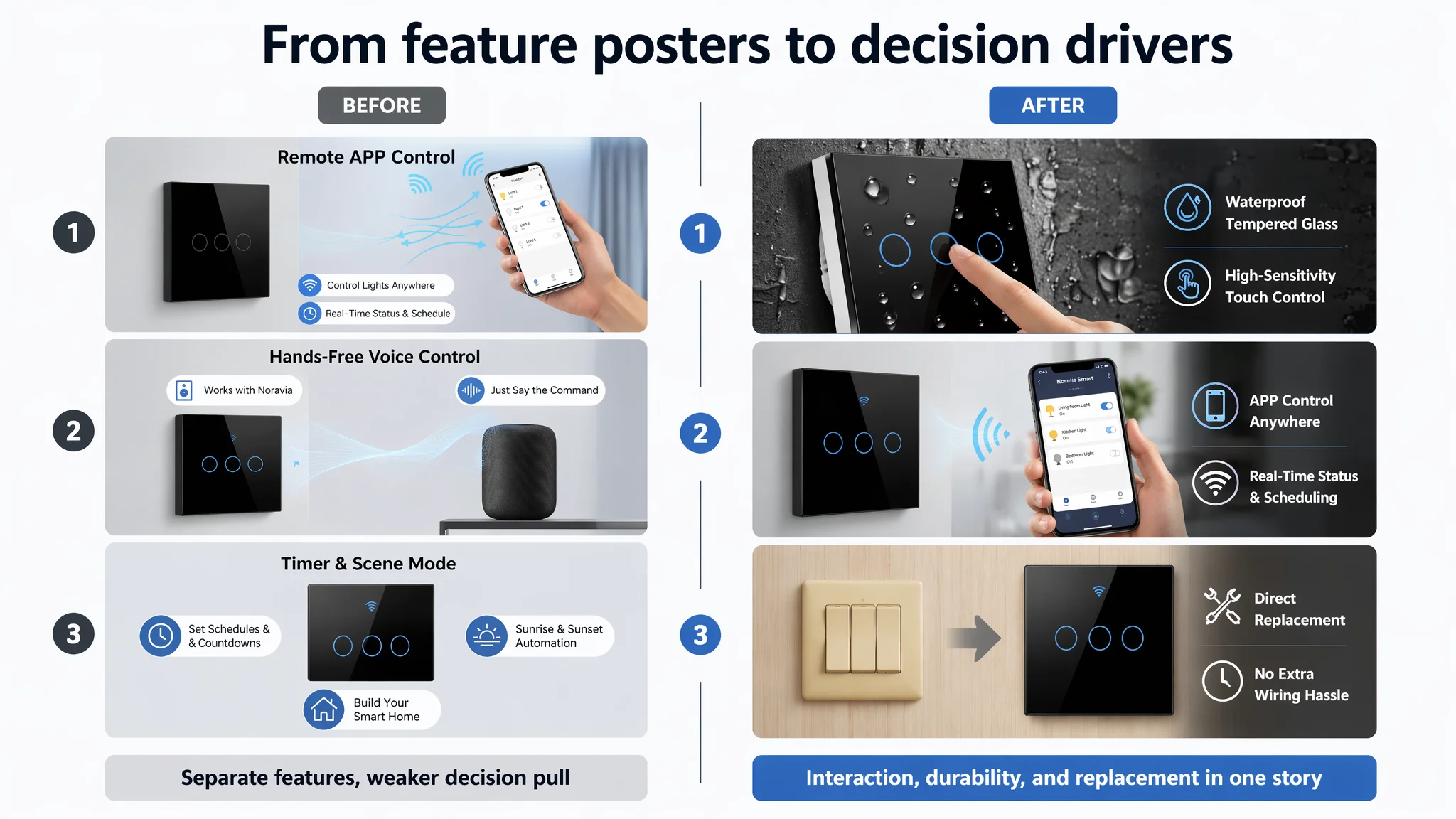
The competitor’s main image sequence used:
- A finger touching the panel + water drops to signal touch + waterproof
- A phone showing the app, visually linked to the switch
- An Alexa/Google speaker with “Voice Control” call‑outs
- Scene compositions that made remote control, scheduling, and replacement feel intuitively easy
DeepBI’s view: the seller’s main images looked “ok”, but they were behaving more like illustrations than conversion drivers. They didn’t quickly answer: “Can I safely install this in my home? Will it work with my setup? Is it worth switching?”
Bullet Points and A+: Surprisingly Strong Logic
DeepBI found that the seller’s bullet points and A+ detail content:
- Covered all key functional pillars: control modes, installation, safety, compatibility, scenes
- Used step‑by‑step installation explanations, such as “10‑minute install” and wiring guidance
- Implemented a clear decision path in A+:
- Installation → functionality → multi‑scene use → technical details
- Visualized single‑fire vs neutral wiring, load capacity, and multi‑scene applicability (old house retrofit, new house, app, voice, timers)
In fact, DeepBI judged:
- The seller’s A+ structure was more systematic than the benchmark
- The competitor used more images, but with lower information density and a less coherent narrative
- The seller’s detail page already had enough depth and professionalism to support conversion—if buyers stayed long enough to read it
This is where the misdiagnosis appeared.
“The Listing did not lack information. It lacked a credible frame within which that information could be trusted.”
With 0 reviews, all this logical content was sitting on a foundation that buyers instinctively discounted.
Why DeepBI Did Not Recommend “Just Keep Tuning Ads” First
Given this diagnostic, DeepBI faced a key judgment call:
- Should the seller push ad bids and try to buy more traffic immediately?
- Or should they re‑engineer the Listing’s selling logic and trust cues first, so that early traffic is not wasted?
DeepBI’s decision path:
1. Review reality changes the value of every other module.
When a Listing has 0 reviews, buyers treat:
- Titles as “claims”
- Bullet points as “marketing”
- A+ as “the brand’s own story, not yet validated”
The page’s conversion capacity is fundamentally lower, regardless of how polished the wording is.
1. Ads would be amplifying a low‑trust page.
Pushing more traffic to a Listing that:
- Does not clearly set expectations around installation (neutral wire vs single live wire)
- Does not visibly de‑risk DIY installation and load capacity
- Has no social proof
…would primarily amplify risk: low CVR, unstable ACOS, and a higher chance of early negative reviews driven by mis‑expectations.
1. Listing conversion had to be made “review‑ready” first.
Before scaling traffic, the page needed to:
- Clarify installation requirements in the title and bullets (e.g., “Neutral wire required”)
- Use visuals and text to reduce mis‑purchase risk (single‑fire vs zero‑fire, 10A limits, 2.4GHz WiFi only)
- Make the multi‑mode connectivity (WiFi + BT + RF433) a clear, simple advantage rather than a confusing spec list
1. Ad dollars are a scarce resource; they must hit a trustworthy surface.
Until the Listing could reliably convert first waves of traffic, DeepBI judged that aggressive ad experimentation would mainly consume budget without building a sustainable order base.
So instead of treating this as a pure ad optimization problem, DeepBI reframed it as a conversion foundation problem:
Before ads could be scaled, the product page had to learn how to sell.
This Product Page Did Not Lack Traffic. It Lacked Trust.
Trust in this category comes from three sources on Amazon:
1. Installation clarity (Can I safely wire this in my home?)
2. Ecosystem compatibility (Will it work with my existing smart home environment?)
3. Social proof (Have enough others used this and survived it?)
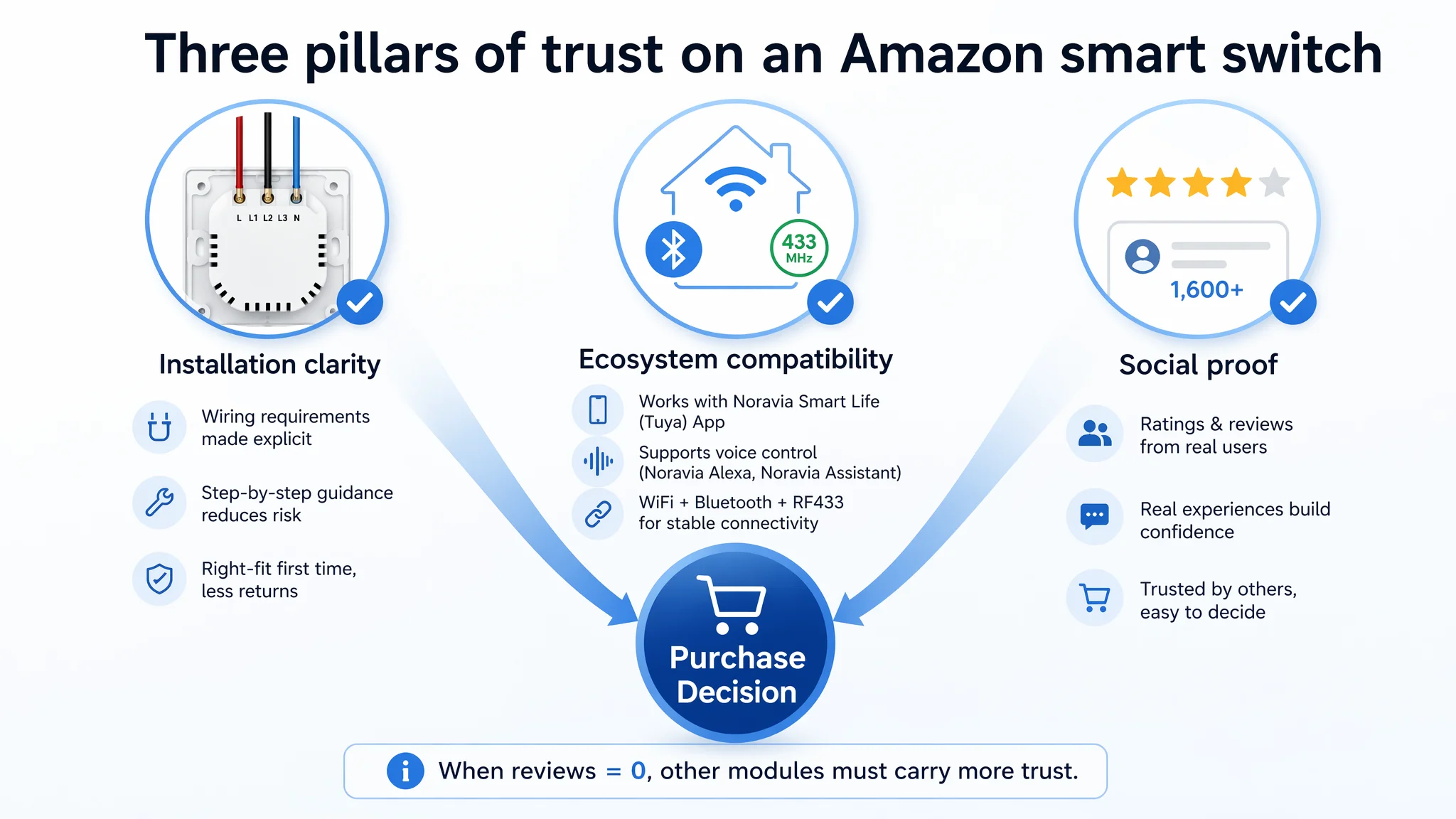
The competitor Listing, with its 4.0 stars and 1600+ reviews, could afford to be somewhat chaotic in A+ layout because buyers were anchored by:
- “Many others bought this.”
- “The risk of failure feels lower.”
The seller’s Listing had to compensate for the absence of that anchor by:
- Being more explicit about non‑negotiables (neutral wire requirement, 2.4GHz WiFi only, minimum wattage, 10A load limits)
- Turning visuals and bullets into substitutes for early trust until ratings and reviews catch up
DeepBI’s listing‑level diagnosis led to a complete rethink of how each module should work together.
Rebuilding the Title: From Keyword Stack to Decision Signal
DeepBI’s title recommendation aimed to:
- Keep high‑value search terms
- Remove redundancy
- Push critical decision points forward
Recommended structure:
3 Gang Smart Light Switch, Tri‑Mode WiFi BT 433MHz Smart Touch Wall Switch, Tuya Smart Life App Control, Compatible with Alexa and Google Assistant, No Hub Required, 10A Triple Switch, Black
Key shifts:
- Core product term first: “3 Gang Smart Light Switch” anchors the Listing in Amazon’s algorithm and buyer expectation.
- Tri‑mode connectivity as an advantage, not a clutter: WiFi + BT + 433MHz are combined into “Tri‑Mode” and explained once, reducing cognitive load.
- Ecosystem clarity: “Tuya Smart Life App Control” and “Compatible with Alexa and Google Assistant” match common search and trust patterns.
- Technical framing without inflation: “No Hub Required” and “10A Triple Switch” convey practical value without overpromising.
At this stage, DeepBI deliberately did not add “No Neutral Wire Needed” since the product actually requires a neutral wire. The judgment here was about avoiding false comfort that would temporarily boost clicks but cause returns and negative reviews later.
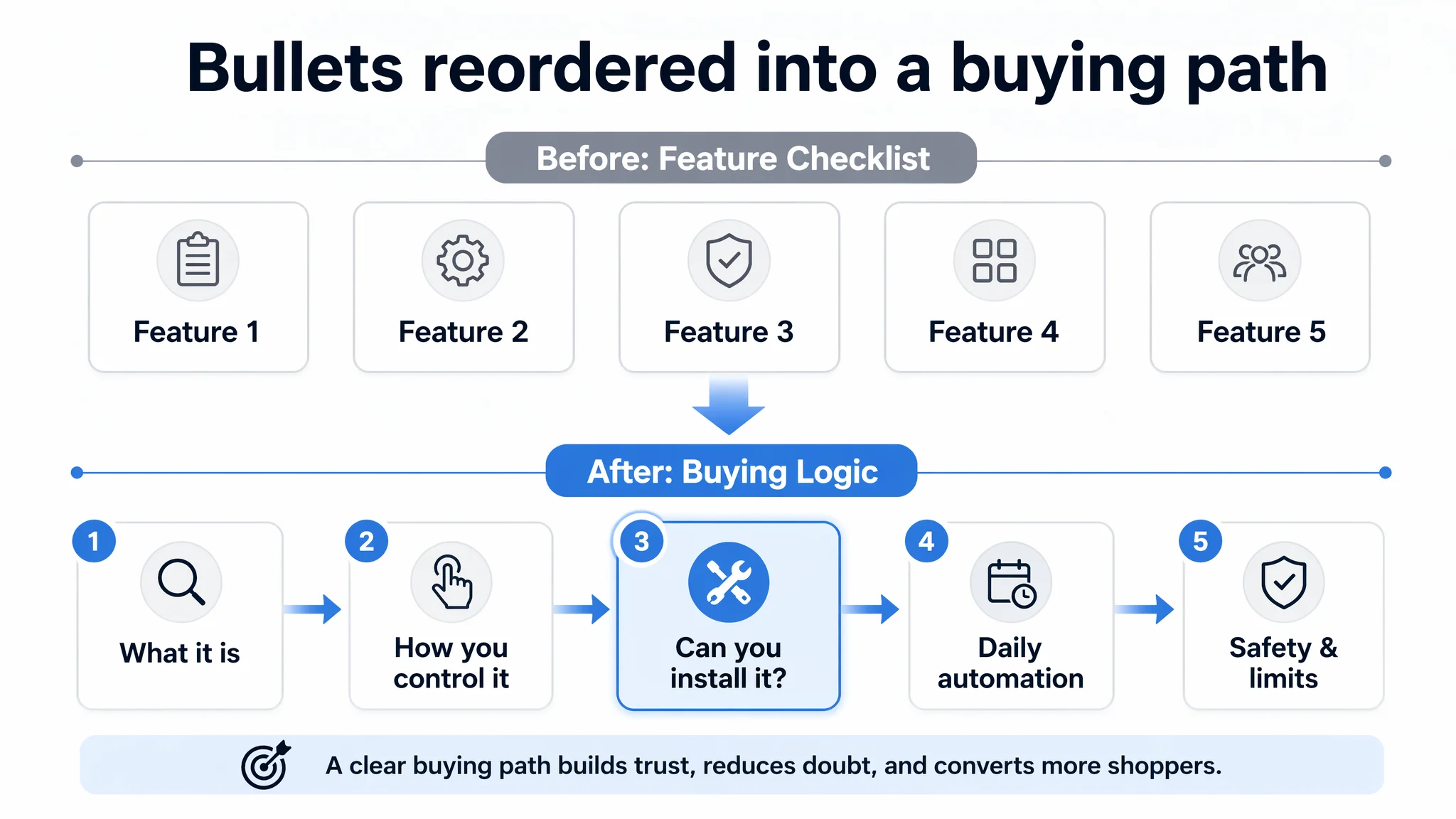
Re‑Ordering Bullet Points: From Feature List to Buying Logic
The original bullet points behaved like a checklist: feature → feature → feature. DeepBI’s logic was to convert them into a decision sequence that:
1. Defines what the product actually is and how it is controlled
2. Shows how it fits into daily life
3. Clarifies installation conditions upfront
4. Highlights automation value
5. Closes with safety and network constraints
Bullet Point #1 – Define the Physical Control Advantage
【3‑Gang Smart Touch Control】 This 3‑gang smart light switch features a high‑sensitivity touch panel, allowing you to independently control 3 separate light fixtures with a single tap. The sleek, tempered glass design blends perfectly with any room decor while offering a responsive manual control experience.
Judgment:
- First bullet focuses on what you’re physically installing and why it’s better than a traditional switch.
- “3‑gang” is not just a spec; it becomes the core reason to replace an existing wall plate.
Bullet Point #2 – Connect to Voice and App Ecosystem
【Voice & Remote APP Control】 Fully compatible with Amazon Alexa and Google Assistant for hands‑free voice control (e.g., “Alexa, turn off the kitchen lights”). Manage your home lighting from anywhere via the Tuya Smart or Smart Life App, ensuring you never leave lights on when away.
Judgment:
- This bullet ties the switch into existing smart home habits.
- Explicit voice command examples lower psychological distance to usage.
Bullet Point #3 – Clarify Installation Reality, Not Hide It
【Easy Installation & Neutral Wire Required】 No hub or extra wiring required. Directly replaces your traditional wall switches with a standard size. Please note: A Neutral Wire is required for installation. Follow our step‑by‑step guide to finish the setup within 10 minutes.
This is a critical reversal.
DeepBI insisted on:
- Making “Neutral Wire Required” visible early in bullet logic
- Accepting that some potential buyers would drop off here
- Protecting long‑term ACOS and review quality by avoiding mis‑expectations
In this category, installation mismatch is one of the biggest causes of returns and negative reviews. The Listing’s job is not to maximize short‑term clicks; it’s to filter customers correctly before they buy.
Bullet Point #4 – Elevate Scheduling as Its Own Value Pillar
【Smart Scheduling & Scenes】 Use the timer or countdown schedules to set your smart switch to automatically turn on and off at specific times. Create customized smart scenes for home automation, making your daily routines more convenient and energy‑efficient.
Judgment:
- Scheduling is not a minor feature; it’s a primary lifestyle outcome.
- Giving it a dedicated bullet point matches how buyers imagine smart home behavior (wake‑up routines, night lights, absence simulation).
Bullet Point #5 – Close on Safety and Network Constraints
【10A Safe Design & 2.4G WiFi Only】 Built with high‑quality fire‑retardant materials and overload protection, this switch supports a maximum 10A load for most lighting and small appliances. Note: Only supports 2.4GHz WiFi networks (Not 5G) and features Bluetooth for faster, stable pairing.
Judgment:
- Safety, load capacity, and network constraints are risk factors.
- Stating them clearly keeps the Listing honest, decreasing the chance that early buyers feel misled.
“Advertising does not only amplify advantages. It can also amplify a page’s existing defects.” For this Listing, defects were not in the product itself, but in how expectations were framed.
Re‑Designing Main Images: Turning Visuals into Conversion Logic
DeepBI’s main image guidance followed a simple rule: each image must answer a specific buyer question in under three seconds.
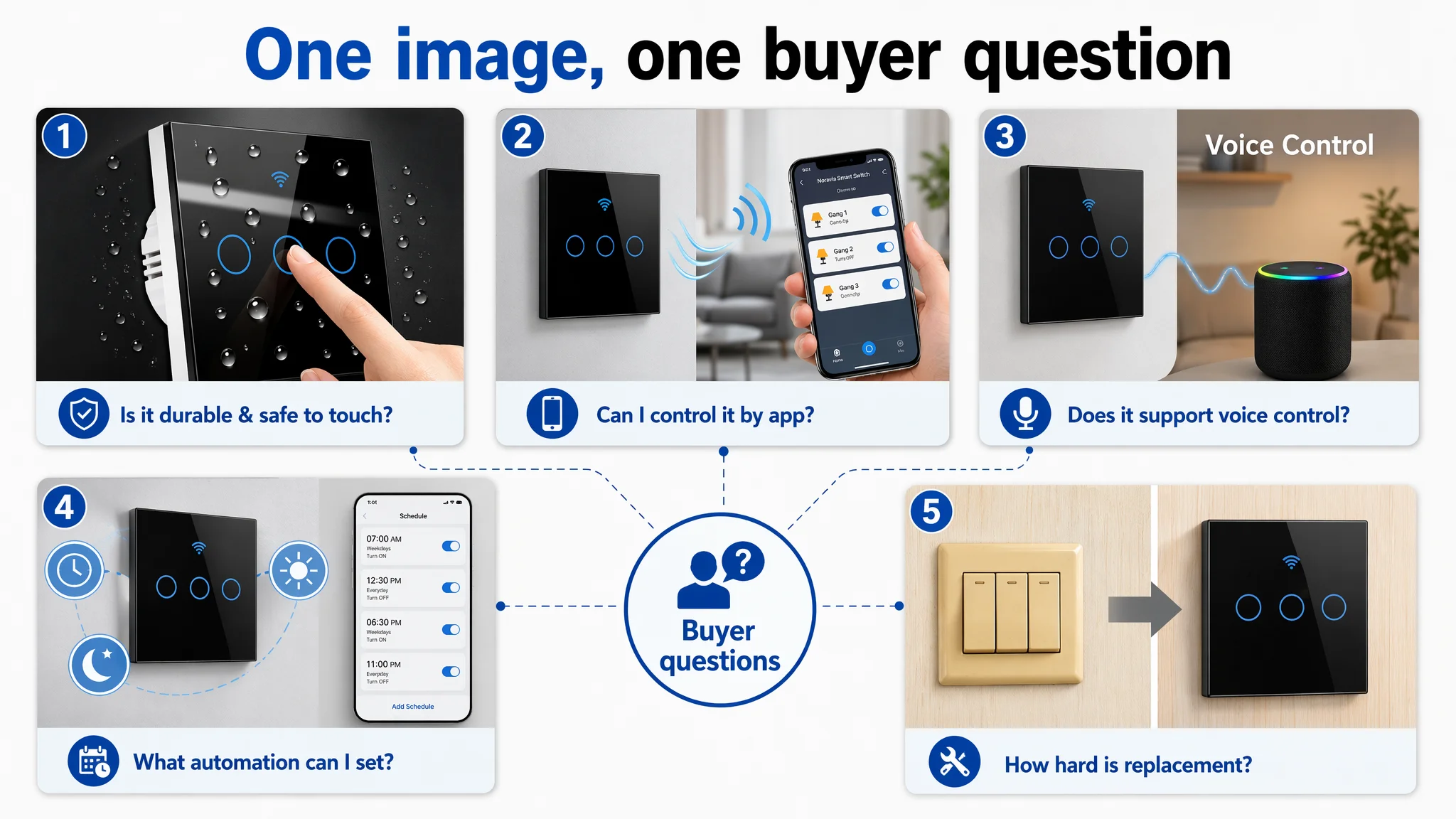
Main Image 1 – Product + Waterproof + Interaction
- Product centered, ~70% of the frame
- 45° side angle, tempered glass surface highlighted
- A finger touching the central ring
- Transparent water droplets on the panel to intuitively signal water‑resistant touch
- Dark gradient background with soft strip lighting on the glass
Purpose: combine design, touch interaction, and durability in one glance.
Main Image 2 – App Control Linked Visually to the Switch
- Switch installed on a modern, light‑grey wall (left)
- Hand holding a smartphone with the app UI (right)
- Soft blue WiFi ripple between phone and switch
Purpose: make remote app control feel real, not conceptual.
Main Image 3 – Voice Control Visualized
- Switch on the wall (left)
- Smart speaker in the foreground (right)
- Blue sound wave line between them
- “Voice Control” text in clean sans‑serif font in the corner
Purpose: depict voice control as a tangible interaction, not just a word.
Main Image 4 – Scheduling and Scenes
- Switch with three icons around it: clock, sun, moon
- Smartphone UI showing timer and schedule list on the right
- Bright, tech‑blue accents, white background
Purpose: compress automation logic into a visual story—day/night, schedules, scenes.
Main Image 5 – Direct Replacement Story
- Split screen:
- Left: old yellowing mechanical switch
- Right: the new smart touch panel
- Arrow pointing from old to new
- “Direct Replacement” text below
Purpose: lower installation anxiety by framing this as a one‑for‑one upgrade, not a complicated remodel.
Across these images, DeepBI was not chasing “beauty” for its own sake. The aim was to create a visual sales script that:
1. Shows what you’re really buying (a 3‑gang tempered glass smart switch)
2. Proves how you control it (touch, app, voice)
3. Clarifies core functions (scheduling, scenes)
4. Signals that installing it is a reasonable step up from a traditional switch
Strengthening A+: This Page Did Not Lack Modules. It Needed a Sharper Story.
DeepBI judged that the seller’s existing A+ was already structurally strong. The optimization focus was less about adding content and more about sharpening how each module contributes to the buying path.
Key A+ refinements:
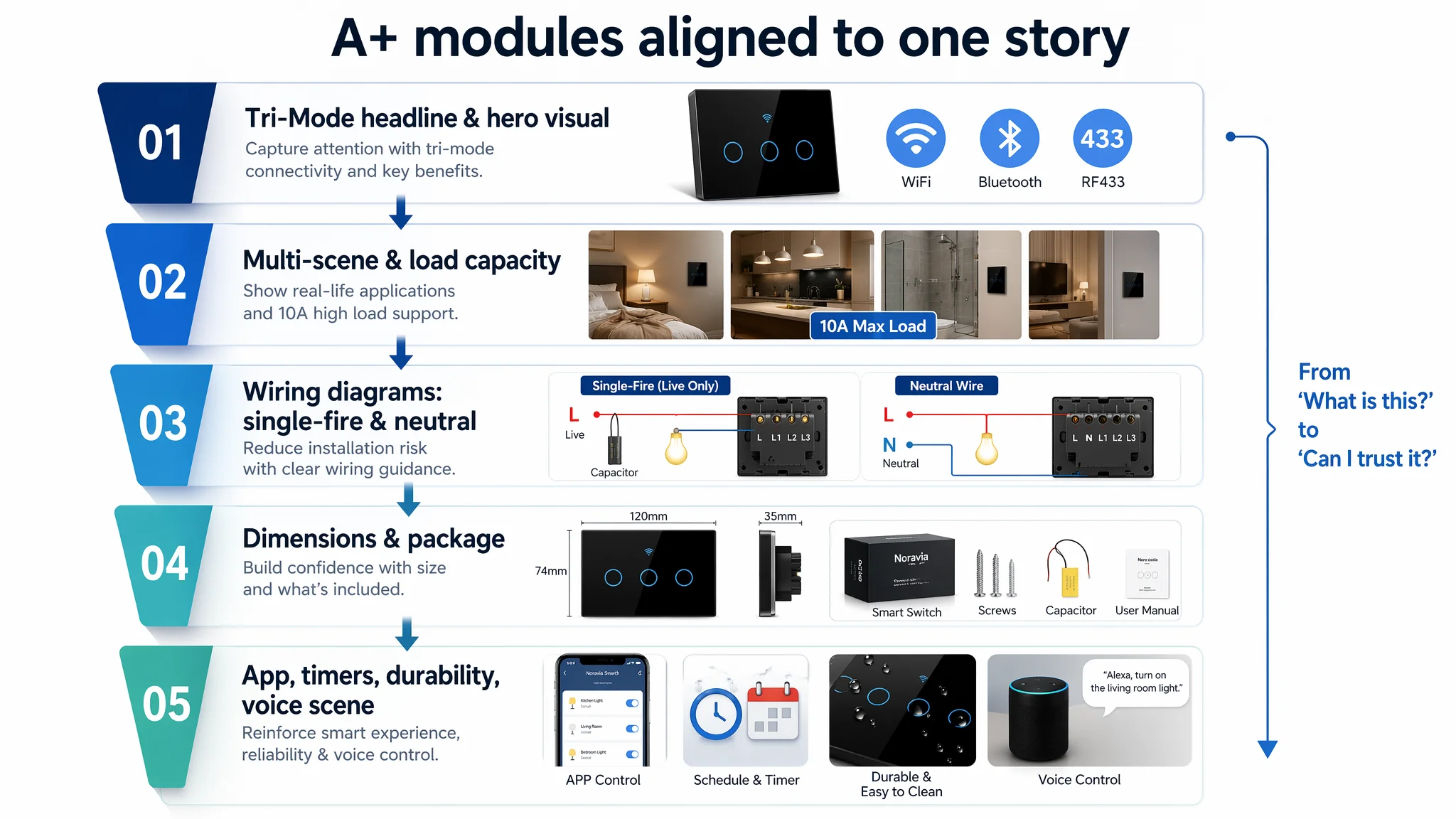
1. Opening Visual: Tri‑Mode Connectivity as the Signature Advantage
- Switch in the center, surrounded by icons for 433MHz, WiFi, and Bluetooth
- Background: minimalistic living room, soft side lighting
- Clear headline: “Three‑Mode Connection, No Hub Required”
Purpose: make the product’s tri‑mode connection a differentiator right at the top.
2. Multi‑Scene Load Confidence
- Four‑panel collage: bedroom, kitchen, bathroom, living room
- Each scene shows the switch controlling specific appliances (lights, fan, etc.)
- Labeling: “Up to 10A High Power Support”
Purpose: address the load‑capacity worry for users planning multi‑device setups.
3. Single‑Fire vs Neutral Wiring Visualization
- Left: single‑fire wiring schematic with capacitor marked
- Right: neutral wiring schematic
- Color‑coded wires (red for live, blue for neutral) on a clean white background
Purpose: directly tackle installation and compatibility anxiety for old vs new houses.
4. Technical Parameters and Package Contents
- Perspective view of switch with precise dimensions (e.g., 120mm x 74mm) drawn
- List of included items: switch body, screws, manual, capacitor
Purpose: give professional buyers and installers concrete data to verify box compatibility and contents.
5. App + Timer Scene
- Wall‑mounted switch in background
- Foreground: hand holding phone with Tuya app open, showing a timer screen
- Warm, evening lighting to suggest energy savings and convenience
Purpose: link remote control and scheduling into a single, emotionally resonant use case.
6. Durability: Glass, Waterproof, Easy Clean
- Close‑up of tempered glass panel with water droplets and a cloth wiping the surface
- Kitchen background to signal real‑world use
Purpose: convert the glass material into a premium + practical story (durable, waterproof, easy to clean).
7. Voice Assistant Scene
- Switch on the wall, Alexa speaker on table
- Speech bubble: “Alexa, turn off kitchen light.”
Purpose: anchor voice control in concrete phrasing buyers already use.
Together, these modules turn the detail page into a technical and lifestyle assurance system—exactly what a zero‑review Listing needs to convince early adopters to take the first risk.
How the Page’s Sales Logic Started to Recover
Once DeepBI’s recommendations were implemented (or at least used to guide the seller’s own adjustments), three operating shifts began to occur—even before review volume grew:
1. Fewer mismatched purchases
By clearly stating “Neutral Wire Required”, 2.4GHz‑only, and 10A limits, the Listing started filtering out unsuitable buyers earlier. This reduces installation frustration, returns, and negative early reviews, which is critical for a new Listing’s survival.
1. More coherent buyer path
Buyers landing on the page can now follow a simpler mental flow:
- “What is this?” → 3‑gang tempered glass smart switch
- “Will it work with my ecosystem?” → Tuya/Smart Life, Alexa, Google
- “Can I install it?” → neutral wire requirement, wiring diagrams, direct replacement
- “What does it change in my day?” → scheduling, scenes, remote control
- “Is it safe?” → fire‑retardant materials, overload protection, 10A
1. Traffic begins to have meaning
With a more honest and sharper sales story, fewer clicks are wasted on buyers who were never a fit. That makes each ad test more informative: you’re measuring against a Listing that is actually telling the truth about installation and usage.
DeepBI’s perspective was that Listing conversion capacity is the foundation of advertising efficiency. For this seller, the immediate outcome was not a dramatic CVR spike or a sudden review surge, but something more fundamental: the page stopped sabotaging its own traffic.
How Ad Traffic Became Useful Again
Once the Listing:
- Stops mis‑leading users about wiring and network requirements
- Shows a clear visual and textual path for installation and use
- Communicates its tri‑mode connectivity and 10A capacity in a buyer‑friendly way
…then ad traffic starts to behave differently:
- Early orders are more likely to be successful installs, not frustrated returns.
- Initial reviewers are more likely to be neutral‑to‑positive, shaping the future trust curve.
- ACOS becomes observable, not chaotic, because conversion behavior is tied to a clear sales story.
From DeepBI’s viewpoint, this is when it makes sense to revisit advertising structure: campaigns, keywords, bids. Not because the ads themselves changed, but because the surface they land on has changed.
What Other Amazon Sellers Can Learn from This Case
This smart switch Listing case is not about a dramatic creative overhaul or a magical ad trick. It’s about judgment.
Several lessons translate directly to other Amazon categories:
1. A structurally “complete” Listing can still be commercially weak.
Having a title, main images, bullet points, and A+ modules does not mean your page is conversion‑ready. The order and clarity of decisions matter more than content volume.
1. Trust gaps and mis‑framed expectations are more dangerous than visual flaws.
In technical categories (electronics, installation products), hiding or soft‑pedaling requirements (neutral wire, voltage, WiFi type, wattage) will damage long‑term performance more than any keyword omission.
1. Ads cannot fix a page that confuses or mis‑filters buyers.
If installation constraints and usage realities are not transparently communicated, pushing more traffic will increase returns and negative reviews, not sustainable sales.
1. Title, main image, bullet points, and A+ must act as a single sales script.
This case shows how each module can be tuned to a shared logic: define the product, anchor ecosystem compatibility, clarify installation, show usage outcomes, close with safety and constraints.
1. Before scaling ads, ask if your Listing deserves more traffic.
DeepBI’s core judgment here was not “how do we get more impressions?” but “does this page convert the traffic it already gets, in a way that builds long‑term viability?”
For Amazon sellers under pressure from rising ad costs and flat orders, this kind of reframing is often the difference between endlessly tweaking campaigns and actually solving the underlying business problem.