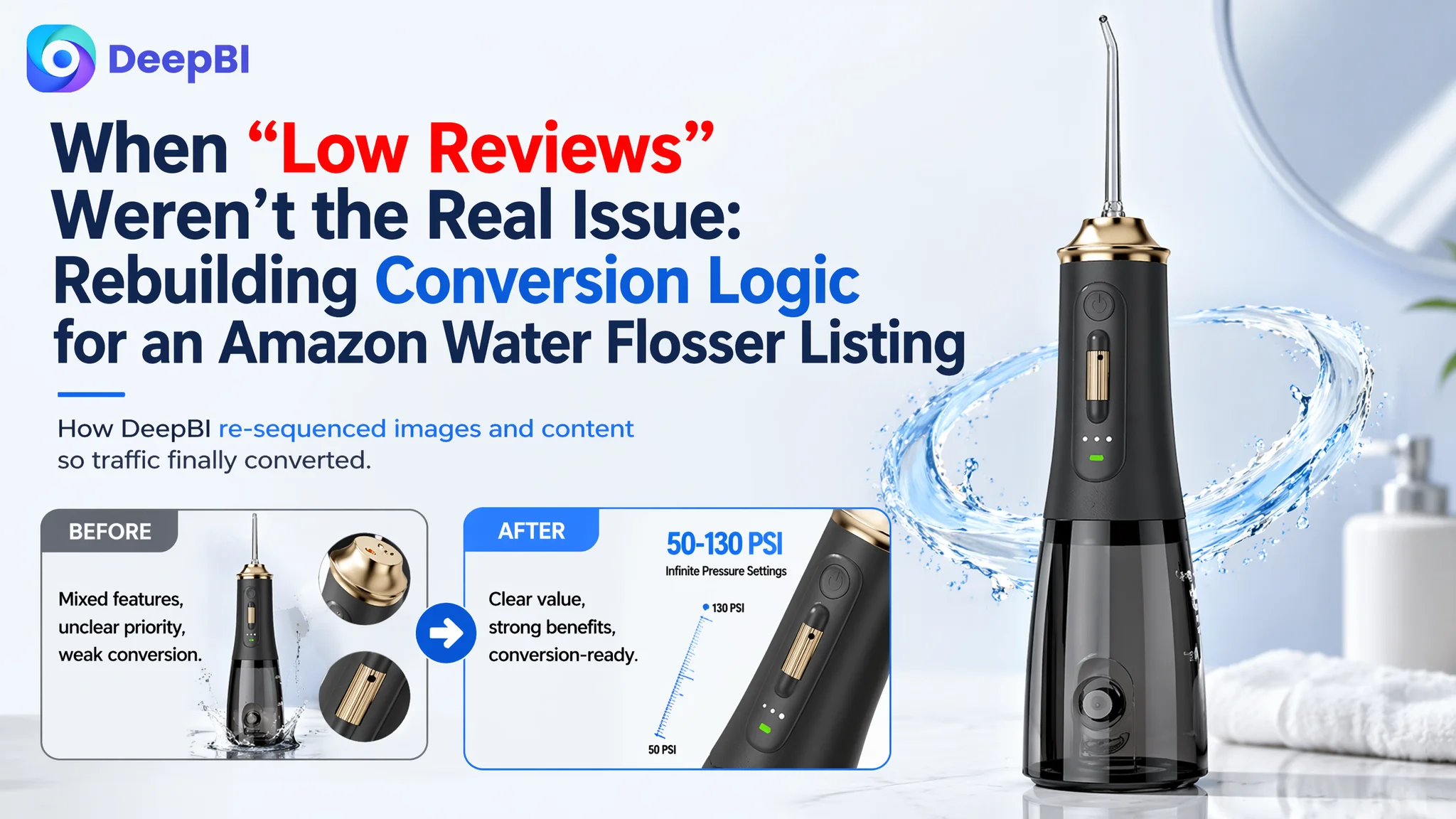
This case comes from an Amazon seller in the oral‑care category who felt they were “stuck” on a key water flosser ASIN. Traffic was not the main problem—ads could bring people in—but the Listing was not turning views into stable orders. Internally, the team blamed “too few reviews” and “not enough Vine volume,” and kept trying to solve trust issues only through review growth and ad tweaking.
Once DeepBI benchmarked the Listing against a leading Amazon competitor, a different picture emerged. The core gap was not exposure or even ratings. It was that the product page itself—title, main image sequence, bullet logic, and A+—failed to convert the traffic it already had. Authority, differentiation, and pain‑point reassurance were all weaker than the benchmark, so every click was landing on a page that struggled to close.
The later optimization therefore did not start with more ad complexity. It started with the Amazon Listing itself: repositioning the main image story around a unique stepless roller pressure control, front‑loading multi‑country certifications as authority, restructuring bullets into problem‑solution‑result logic, and rebuilding A+ modules into a trust‑first, comparison‑driven narrative. For other Amazon sellers, the lesson is blunt: if the page cannot answer the buyer’s core risks and show clear, relative advantage, no amount of additional traffic or reviews will fix conversion or ACOS in a sustainable way.
The Core Conflict: A Page That Couldn’t Carry the Traffic
On paper, this water flosser Listing did not look “bad”:
- Overall Listing score: 72/100
- Benchmark competitor: 87/100
The seller saw:
- Decent star rating (4.2)
- A small but clean review base (25 reviews, mostly Vine)
- Functional images and detailed A+
From the team’s perspective, the main issues were:
- “We just need more reviews to catch up.”
- “Ads are expensive because we don’t have enough social proof yet.”
So they focused on:
- Pushing Vine and hoping for more early reviews
- Iterating ad bids and keyword coverage to push more traffic
But DeepBI’s score breakdown made the real bottleneck visible:
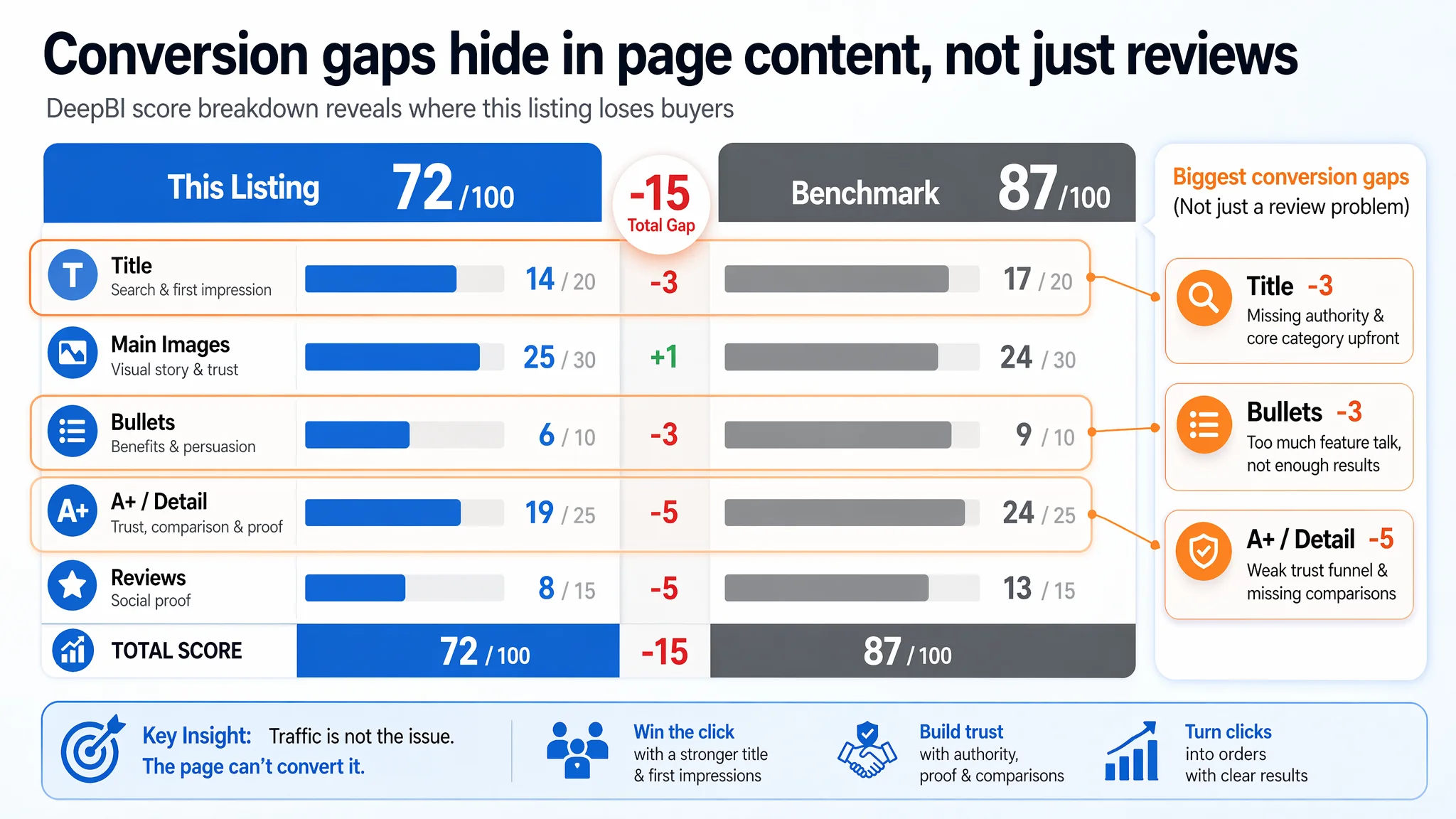
- Title: This Listing: 14, Benchmark: 17, Gap: -3
- Main Images: This Listing: 25, Benchmark: 24, Gap: +1
- Bullets: This Listing: 6, Benchmark: 9, Gap: -3
- A+ / Detail: This Listing: 19, Benchmark: 24, Gap: -5
- Reviews: This Listing: 8, Benchmark: 13, Gap: -5
- Total: This Listing: 72, Benchmark: 87, Gap: -15
The most damaging gaps were not where the seller was putting their attention (only on review count). The bigger structural deficits were:
- A+ trust and explanation (-5)
- Bullet persuasion logic (-3)
- Title structure and authority signals (-3)
“The real problem was not that ads failed to bring traffic. It was that the page could not convert the traffic.”
In other words, this Listing did not lack visits. It lacked a conversion story strong enough for an expensive, trust‑sensitive oral‑care device.
How the Misdiagnosis Formed: “It’s Just a Review Problem”
Looking at the benchmark, the review gap was intimidating:
- This Listing: 4.2 stars, 25 reviews, 2/8 front‑page reviews at 3 stars or below, all Vine
- Benchmark: 4.4 stars, 47,000+ reviews, 0/13 front‑page reviews at 3 stars or below, mostly verified purchase
It is easy operationally to see such a gulf and conclude:
- “We lose because we don’t have 10,000+ reviews.”
- “We should push reviews first; we can’t compete on page content anyway.”
This drove a behavior pattern familiar to many Amazon sellers:
- Continue feeding ads to keep rank and visibility
- Hope rating and review volume slowly catch up
- Avoid heavy Listing restructuring because “the page is already detailed”
But review count is not something you can fix in the short term, and trying to “buy time” with ads while the page is weak only amplifies wasted spend. DeepBI’s diagnosis was that the Listing itself was not using the limited trust and differentiation it did have—and this was fixable now.
DeepBI’s Judgment: The Real Constraint Was Listing Conversion Capacity
Against the benchmark, several structural weaknesses appeared immediately.
1. Title: Function‑First, Authority‑Last
The benchmark’s title follows a mature Amazon pattern:
- Brand + core category (“Water Dental Flosser Teeth Pick”)
- Authority (“ADA Accepted”)
- Key comfort and usage cues (“Portable Cordless”, “Travel”)
- Strong functional language (“Electric Flossing Machine”, “IPX7 Waterproof”)
This Listing:
- Leads with “300ML” and battery life instead of clear category identity
- Pushes brand and core category wording to the back
- Focuses on generic functions (“Adjustable Pressure”, “Implants/Braces”) without anchor authority
For buyers scanning Amazon search results, this means:
- The Listing feels like “another flosser with specs”, not a professional medical‑adjacent device
- No early “reason to trust” (such as ADA or visible certification in the title)
Title’s job in Amazon ads is not just indexing; it is also a micro‑promise. Here, the promise was weak.
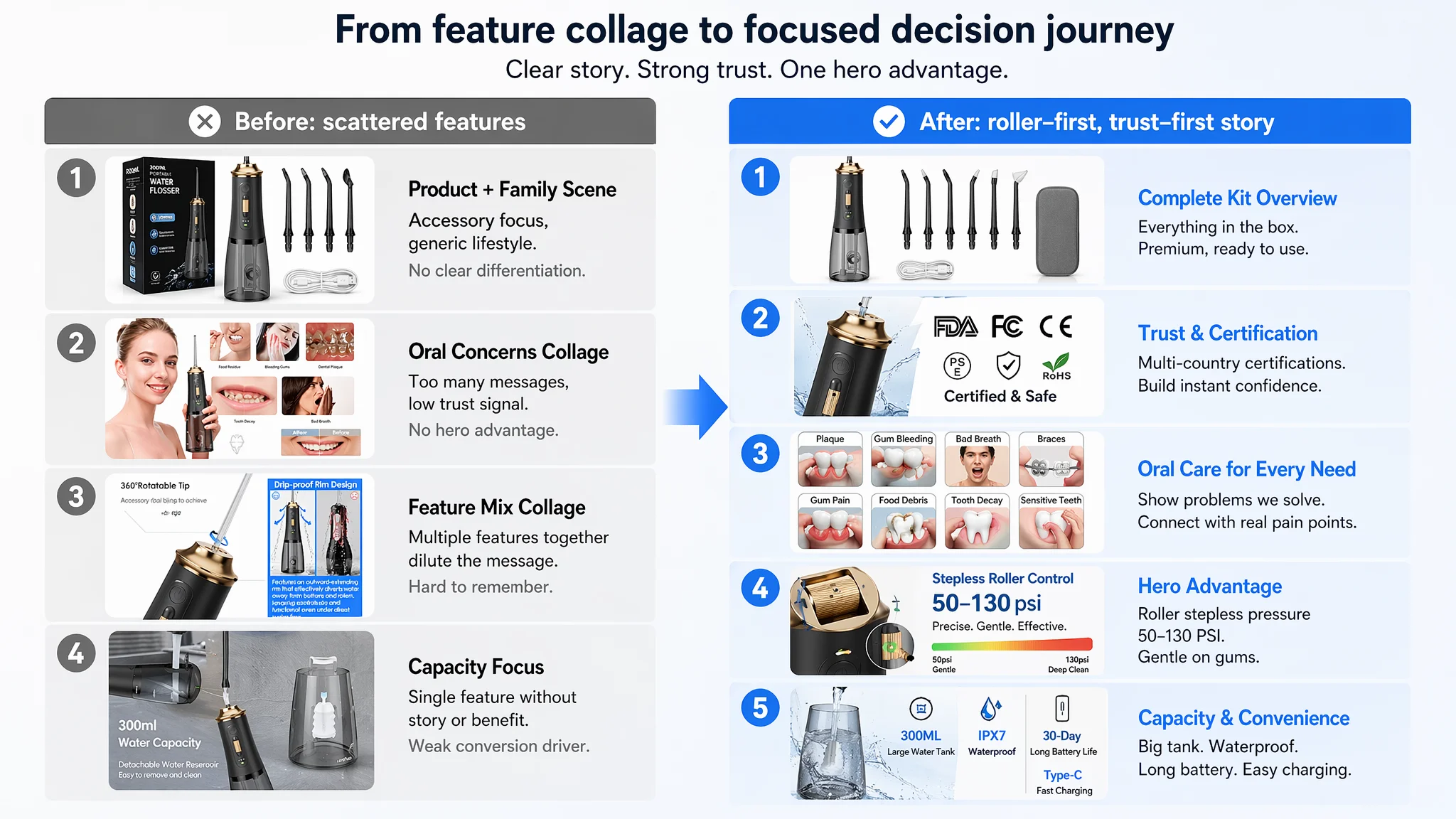
2. Main Images: Features Listed, Story Missing
Visually, this Listing was not ugly. It even outscored the benchmark slightly on the raw main‑image metric. But the role of each image in the buyer’s decision journey was unclear.
What DeepBI saw:
- Image 1: Product, accessories, and a general “professional” feel
→ Same as every other flosser. No front‑loaded differentiation.
- Image 2: Nozzle breakdown again
→ Repeats information, instead of inserting trust or authority here.
- Image 3–5: Scattered mix of before/after, capacity, multiple features together
→ Overloaded collages dilute the one thing that’s truly unique.
The real gem—a stepless roller pressure adjustment—was not being given center stage. In a niche where “water pressure too strong hurts my gums” is a primary fear, this should have been the hero.
“Advertising does not only amplify advantages. It can also amplify a page’s existing defects.”
The more traffic they drove, the more buyers landed on a page where the key anxiety (pressure too strong) was not visibly solved in the first couple of images.
3. Bullets: Parameters Without a Buying Logic
The bullet‑point comparison was even more telling.
Benchmark bullets consistently follow a problem → solution → result structure, backed by:
- Authority: “ADA… Healthier gums in 15 days”
- Specifics: “0.3mm dual‑thread water pulse”, “1400–1800 pulses per minute”
- Outcomes: “Helps prevent and reduce gingivitis and bleeding gums”
This Listing’s bullets:
- Start from accessories and feature specs
- Emphasize technical aspects and materials
- Rarely convert those attributes into health outcomes, comfort reassurance, or clear “why it matters”
So even when the product has real advantages—innovative micro‑waterfall tech, 300ml tank, unique roller adjustment—buyers are forced to map functions to outcomes by themselves. Most will not.
4. A+ Detail Page: The Trust Funnel Was Thin
DeepBI’s A+ comparison was stark:
- Benchmark builds a four‑layer funnel:
Trust (ADA, 10M users, “#1 in sales”) → Technology explanation → Comparative visuals → Social proof (testimonials)
- This Listing’s A+:
Primarily self‑described parameters, structure diagrams, and usage steps, plus a generic gift‑scene.
Concrete gaps:
- External authority: No credible third‑party‑style framing of its many certifications (FDA, FCC, CE, PSE, ROHS)
- Comparison: No “us vs others” capacity, battery, or comfort visuals to make the 300ml tank or durability feel superior, not just present
- Social proof: No integration of real review quotes into visuals, despite existing praise like “powerful clean” and “pretty in purple”
Net result: trust was built slowly and mostly through self‑claims, not proofs.
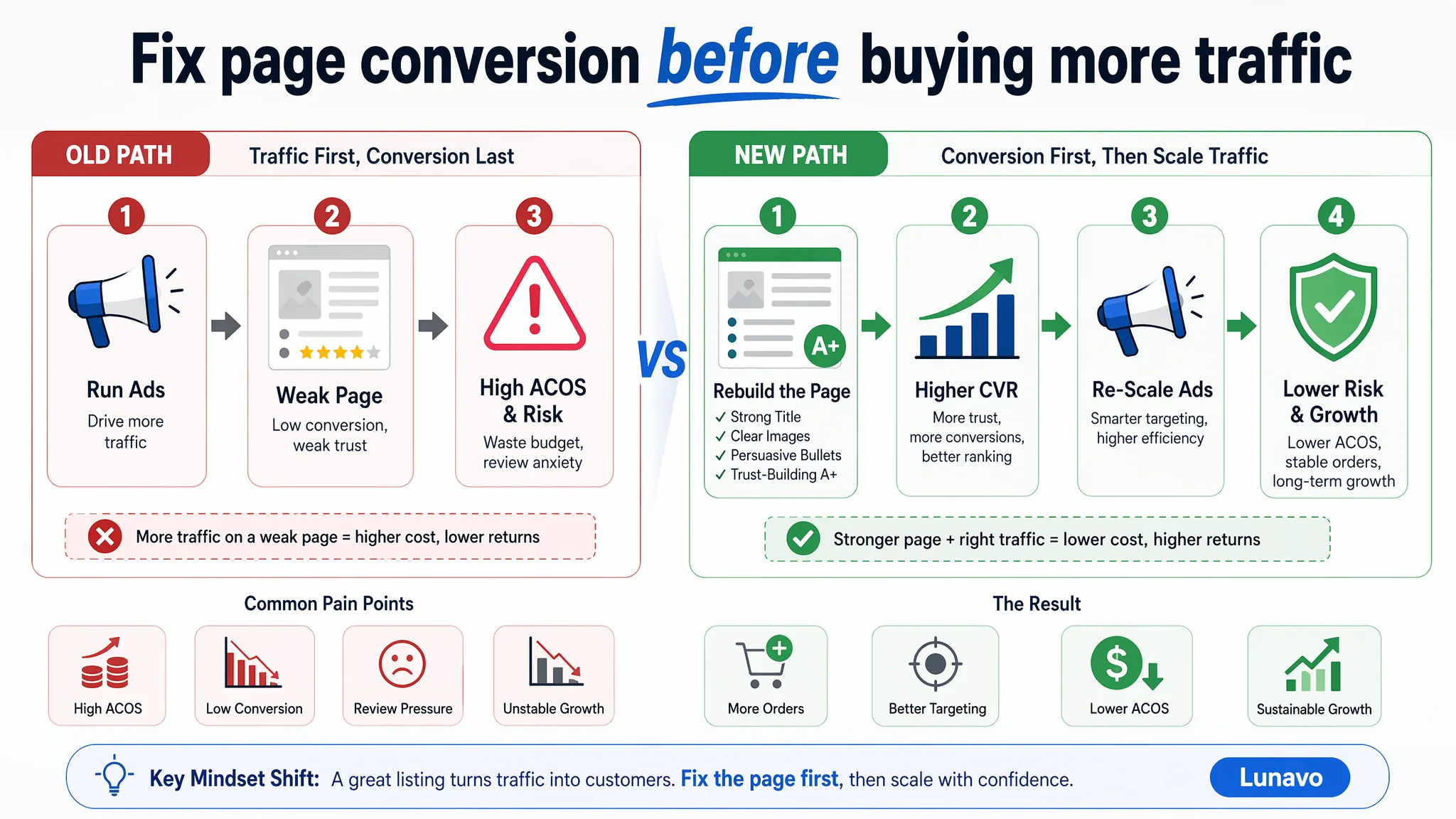
Why Listing Conversion Had to Be Fixed Before More Ad Tuning
From a business perspective, DeepBI’s judgment was:
- The Listing did not lack traffic channels (ads and search could already drive visits)
- The biggest immediate risk was ads funding a weak conversion funnel
Continuing to optimize ads—bids, keywords, structure—without fixing the page would:
- Keep ACOS under pressure because each click had to work harder to convert
- Force higher dependence on discounts and promotions to compensate for trust gaps
- Delay the point at which organic conversion and rank could stabilize
So the decision order was reversed:
1. Rebuild the Listing’s sales logic so that each paid visit has a higher chance of turning into an order.
2. Only then re‑scale ads and test CPS/ACOS from a stronger conversion baseline.
Reframing the Page: From Specs to Risk‑Free, Gentle Power
DeepBI’s optimization path did not start with random cosmetic changes. It started by asking:
- What does this product do better than the benchmark?
- What is the biggest buyer fear in this category?
- Where in the current page is that fear not addressed?
Two core answers emerged:
1. The stepless roller pressure adjustment is a real, rare advantage for sensitive gums and first‑time users.
2. The page barely used this advantage to directly confront the “too strong, hurts gums” fear.
Main Image: Making the Roller the Hero
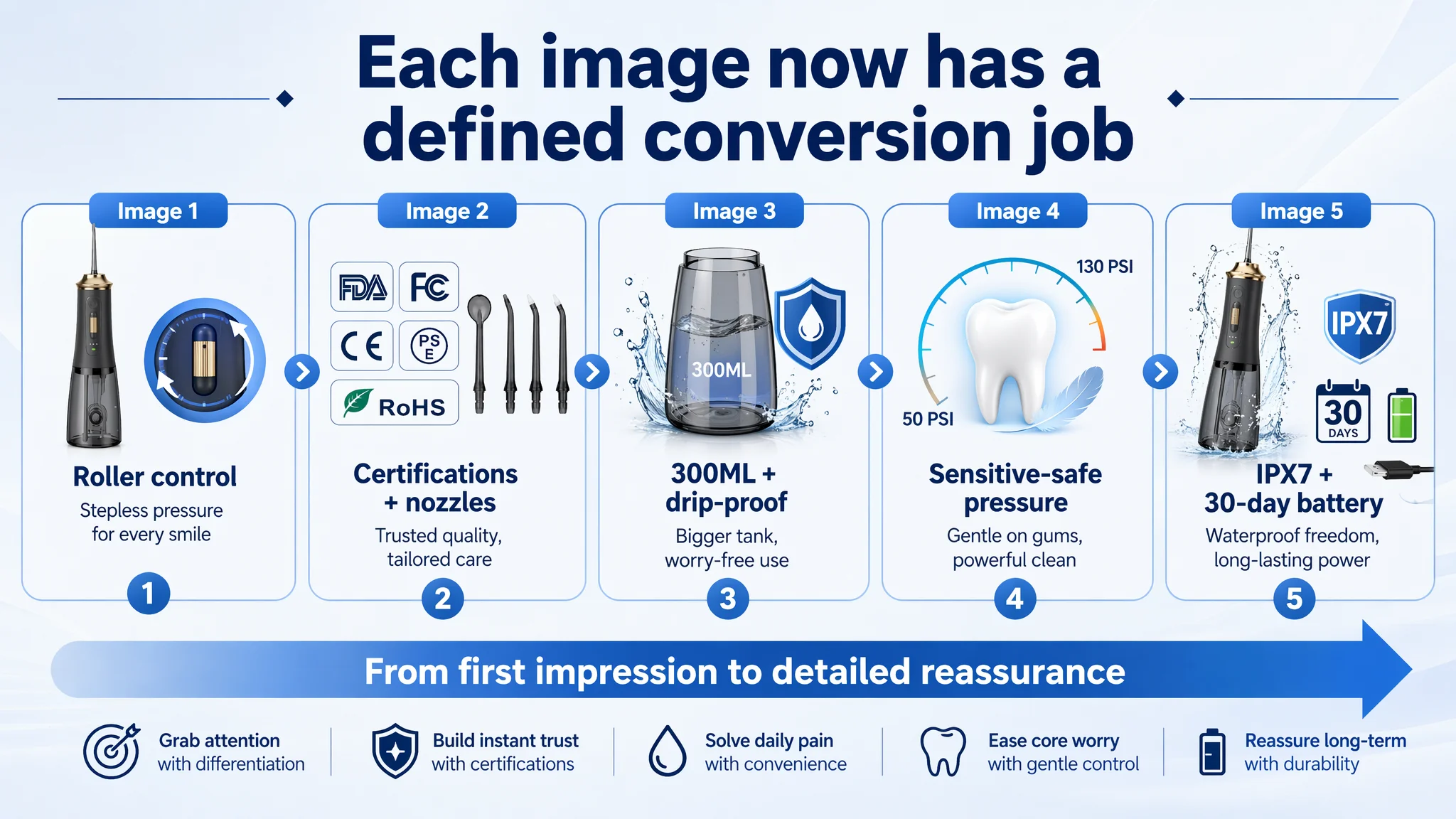
The main‑image sequence was re‑planned around decision logic:
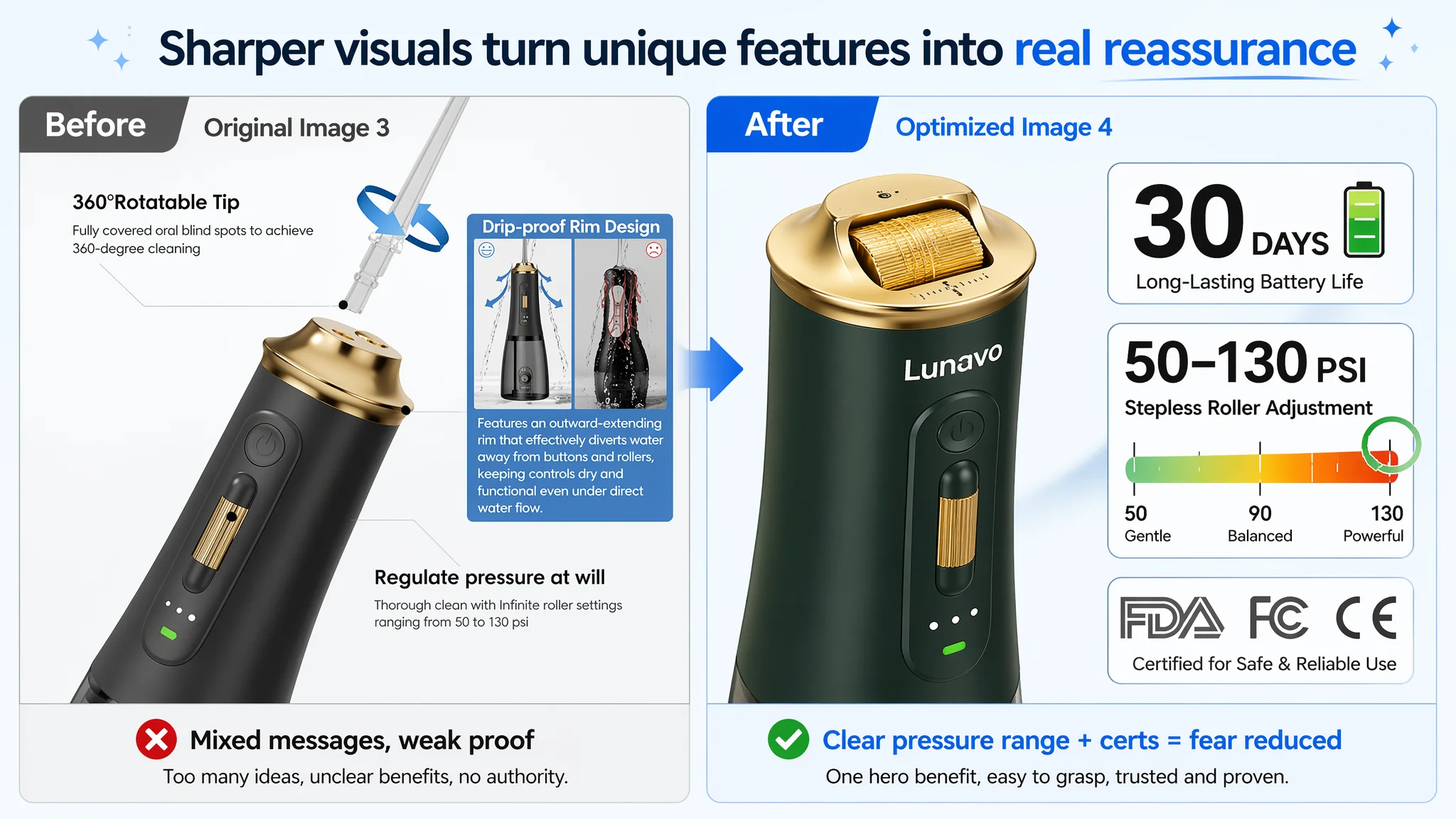
1. Image 1: Roller‑first differentiation
- A dedicated shot zooming the roller, clearly labeled as “Stepless Roller Pressure Control (50–130 psi)”
- Visual gradient from soft to strong water flow to signal a wide comfort range
- Copy explicitly addressing sensitive gums and beginners
1. Image 2: Trust and professionalism, not just nozzles
- Keep the multi‑nozzle breakdown
- Add visible certification icons (FDA, FCC, CE, PSE, ROHS) at the top
- Tie each nozzle to scenarios (braces, implants, periodontal pockets)
1. Image 3: Capacity + drip‑proof design as a combined advantage
- Emphasize 300ml tank: “Clean once without refilling”
- Integrate the unique drip‑proof rim so water doesn’t flood buttons and roller, with copy like “Keeps controls dry, prevents malfunctions”
1. Image 4: Directly answering the pressure fear
- Another roller‑centric image, this time focusing on nervous users and sensitive gums
- Clear copy: “From ultra‑soft to strong – safe for beginners and receding gums”
- Keep 360° rotating nozzle as a secondary support element (full coverage in hard‑to‑reach areas)
1. Image 5: Shower‑safe + endurance in one frame
- Device half submerged to visualize IPX7 waterproofing
- Overlay: “30‑Day Battery Life” and “Type‑C Fast Charging”
- Implied travel and home scenes to make endurance feel like a life benefit, not just a number
With this restructuring, the first three images now do what the Listing previously failed to do:
- Claim a unique benefit (stepless roller)
- Answer a core fear (too much pressure)
- Build trust (multi‑country certifications)
- Visualize convenience and durability (drip‑proof, IPX7, 30‑day battery)
Clicks from Amazon ads now land on a page where the first visual seconds work hard to keep the buyer.
Text: Turning Features into Outcomes and Assurance
Title: Clarifying Category and Core Promises
The suggested title pivoted from “spec‑heavy” to “role + outcome”:
Water Dental Flosser Cordless for Teeth, 300ML Portable Oral Irrigator with 4 Tips, IPX7 Waterproof Rechargeable Electric Water Flosser for Braces, Implants & Receding Gums, Black & Gold
Key shifts:
- Early category clarity: “Water Dental Flosser Cordless”
- Strong modifiers that matter in search and decisions: “300ML”, “Portable”, “IPX7 Waterproof”, “Rechargeable”
- Clear audience targeting: “Braces, Implants & Receding Gums”
This aligns with how both Amazon’s algorithm and buyers scan titles: what is it, what does it solve, and for whom.
Bullets: From Parameter Lists to Buying Logic
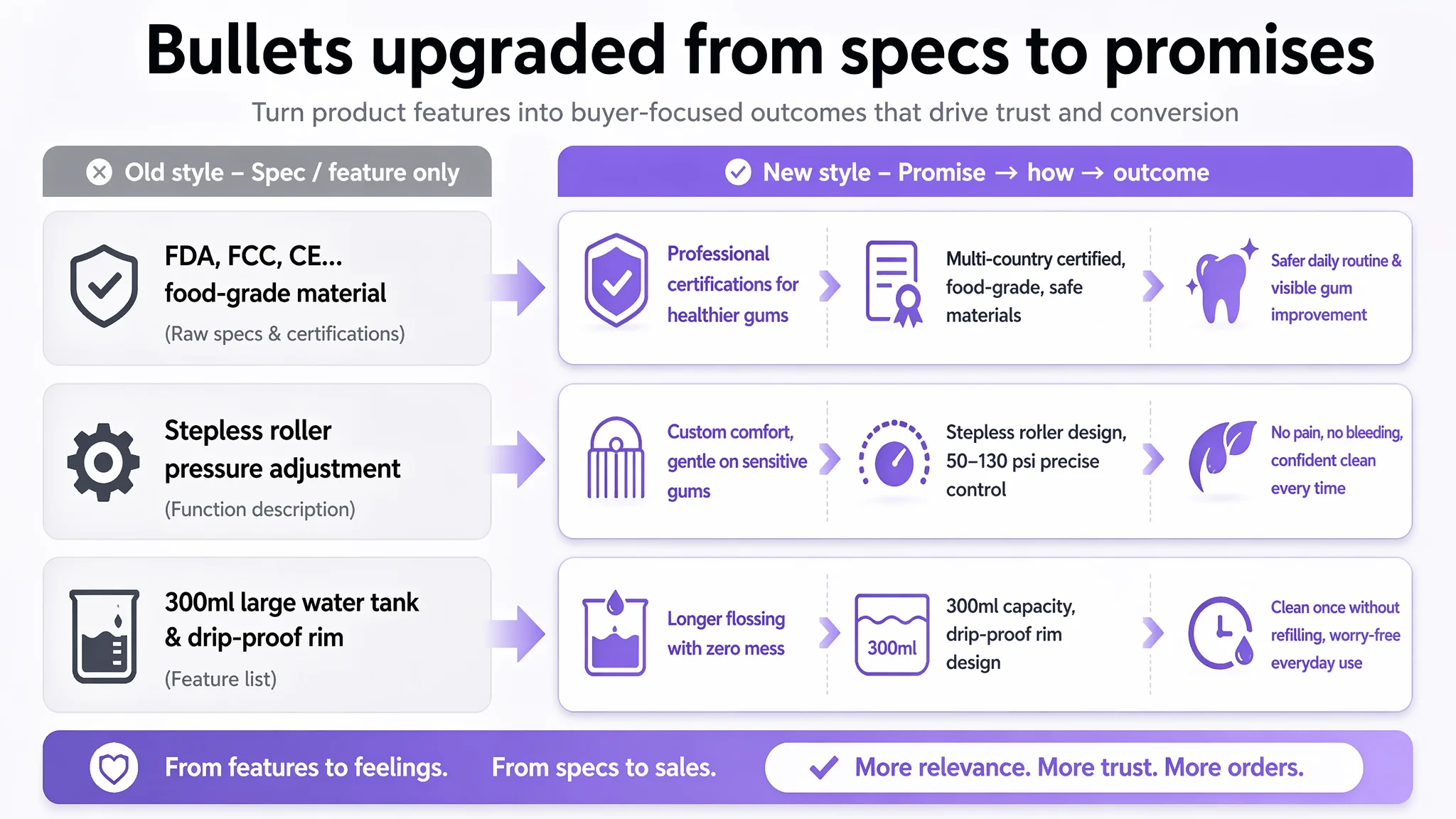
DeepBI reorganized bullets into distinct promises:
1. Professional Certifications for Healthier Gums
- Combine FDA, FCC, CE, PSE, ROHS and food‑grade materials
- Explicitly tie them to “visible gum health improvement” and “safe, eco‑friendly routine”
1. Scientific Cleaning with Micro‑Waterfall Tech
- Explain the micro‑waterfall system as “deep cleans between teeth and below the gumline”
- Emphasize “thorough clean without pain or bleeding” for sensitive gums
1. Unique Drip‑Proof Rim & Ergonomic Design
- Make the drip‑proof rim a stand‑alone promise around device longevity and button safety
1. 30‑Day Long Battery Life & Travel Ready
- Tie battery life directly to travel convenience and freedom from charging anxiety
1. 4 Specialized 360° Rotating Nozzles
- Move from a list of nozzle types to a “whole‑family coverage” story, plus deep cleaning in hard‑to‑reach areas
1. Stepless Roller to Adjust Force Freely
- Call out the roller as the key differentiator versus “standard fixed modes”
- Position it as a personalization and comfort tool for all oral conditions
1. Usage Note for Best Results
- Add a straightforward “start soft, mouth slightly closed” tip
- Suggest standard 5V adapter for battery health
Now each bullet has a shape: promise name → explanation → result/assurance, not just “component + spec”.
A+: Rebuilding the Trust Funnel
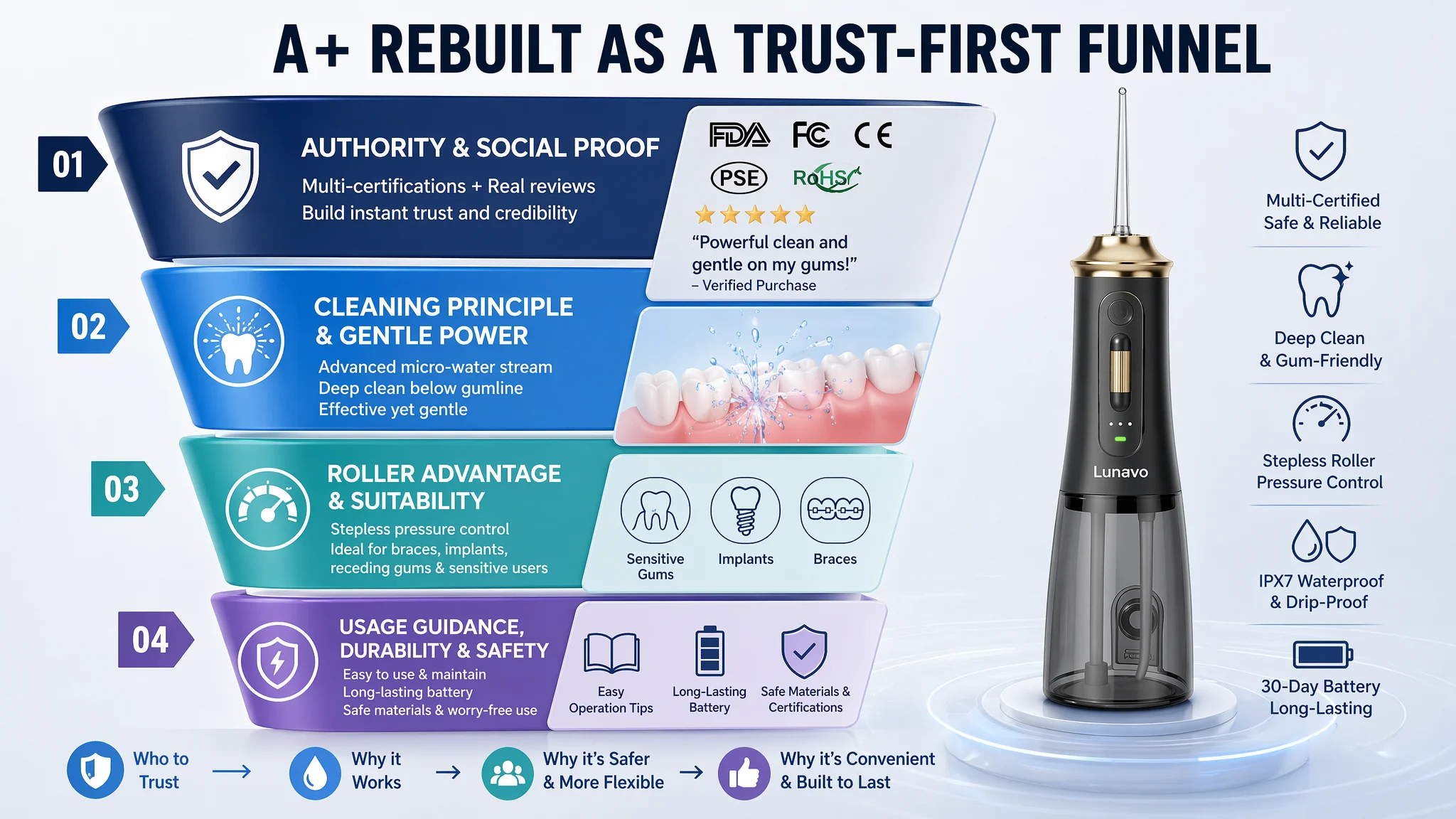
DeepBI’s A+ recommendations followed the same logic: move from scattered information to a structured persuasion path.
1. Module 1 – First Trust Node
- Lead with certifications (FDA, FCC, CE, PSE, ROHS) visually, not buried in text
- Add one or two review quotes (“powerful clean”, “pretty in purple”) as social proof
- De‑emphasize IPX7 and battery here; those come later
1. Module 2 – Cleaning Principle + Gentle Power
- Keep cleaning principle and before/after visuals
- Add a direct “gums protection” statement, e.g., “scientific dental cleaning that does not hurt gums”
- Integrate a real review line confirming powerful yet comfortable cleaning
1. Module 3 – Stepless Roller as the Core Advantage
- Convert this into a dedicated “roller system” module
- Directly confront “water pressure too strong” with visual roller close‑up and range explanation
- Use language like “freely adjust from sensitive to strong”
1. Module 4 – Capacity as a Real Pain‑Reliever
- Make “300ML large water tank” the headline
- Show a one‑session cleaning scenario without refilling
1. Module 5 – Suitability for Braces, Implants, Receding Gums
- Visualize different user types: braces, implants, gum recession, family use
- Reduce the perceived risk of “this may not be for my condition”
1. Module 6 – Operation, Nozzle Guide, and Misuse Prevention
- Keep the step‑by‑step guide but add “insert tip in mouth before turning on” as a visual tip
- Highlight drip‑proof rim here again in relation to device safety
- Include a clear visual guide of the 4 nozzle types and their use
1. Module 7 – Long Battery & Material Safety as the Final Gate
- Use “30‑Day Long Battery Life” as the heading
- Show travel/business scenes with USB charging versatility
- Turn technical material text into a visual “food‑grade PC” and “environmentally certified” promise
With this structure, the buyer is led from who to trust → why it works → why it’s safer and more flexible → why it’s convenient long‑term, instead of being left to piece together disparate technical panels.
What Changed for the Business (Even Without New Numbers)
The case material does not include post‑optimization CVR or ACOS numbers, so we will not fabricate them. But the operational state and risk profile clearly shifted:
- Listing conversion capacity improved
The page now systematically addresses core fears (pressure, gums, misuse), shows relative advantages (300ml, drip‑proof, stepless roller), and builds multi‑layer trust (certifications, review snippets, visual scenarios).
- Ad traffic became useful again
Instead of feeding clicks into a function‑heavy but emotionally weak page, every ad visit now has a clearer path to purchase. This stabilizes the relationship between ad spend and orders.
- Dependence on “massive reviews” as the only defense decreased
Even with far fewer reviews than the category leader, the Listing no longer relies solely on volume. It uses what it already has—unique design, certifications, and some positive feedback—to build a credible story.
- Operational understanding matured
The seller’s internal narrative shifted from “we lose because we lack reviews and ads are too expensive” to:
- “Our Listing must first be able to convert the traffic we already pay for.”
- “Title, main images, bullets, and A+ must collectively solve buyer risks.”
- “Ads amplify page quality—good or bad—so we must fix the page before scaling ads.”
Takeaways for Other Amazon Sellers
Several lessons from this water flosser case apply broadly across Amazon categories:
- High ACOS and slow orders are not always ad problems
If your Listing scores lag on bullets and A+ versus benchmark, you likely have a conversion issue, not a bid or keyword issue.
- Unique advantages must be visually and textually front‑loaded
A stepless roller adjustment is only valuable if it is the first thing buyers understand and see as an answer to their fear.
- Authority and social proof should not be buried
Certifications, key review quotes, and comparative visuals are trust multipliers. If they sit in secondary modules or text blocks, they do not work.
- Listing structure is a decision funnel, not an asset collection
Every image and module should have a defined job: attract, reassure, explain, compare, or instruct.
Most importantly, this case shows why DeepBI focuses on business judgment before execution. The turning point was not another optimization sprint in Amazon ads; it was the realization that the product page itself was the real bottleneck. Once that judgment changed, the entire optimization direction—and the usefulness of every future ad dollar—changed with it.