

This case comes from an Amazon seller in the outdoor and hunting category. On the surface, their Damascus-style hunting knife Listing looked decent: solid photos, detailed bullet points, and a 5.0-star rating. Yet ad spend was hard to control, and the page struggled to turn traffic into stable orders, especially against a category-leading competitor.
The seller’s first reaction was typical: “Our problem is exposure and reviews. If we push more Amazon ads and get more feedback, conversion will follow.” What they did not see was that every extra click they bought was landing on a product page that failed to answer the one question this category cares most about: “Is this a real, trustworthy, high-performance blade?”
DeepBI’s diagnosis flipped the story. Compared with a benchmark Amazon Listing in the same category, the core gap was not in keyword stuffing or ad tactics but in Listing conversion capacity—especially main-image logic, A+ detail depth, and review scale. The page lacked hard proof of steel quality, hardness, structure, and use-case credibility, so ad traffic kept leaking out.
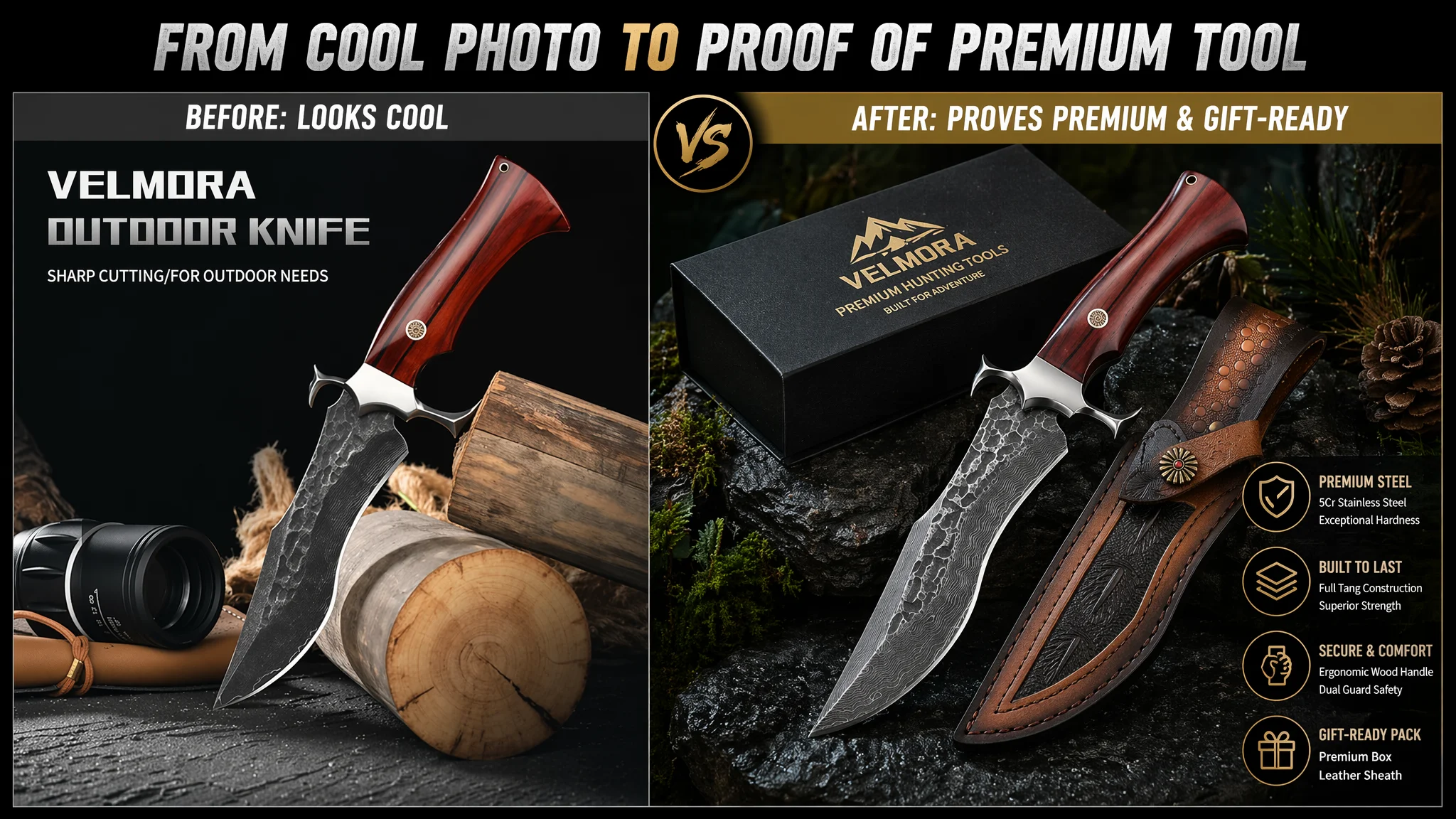
The later optimization stopped chasing ad tweaks and focused first on rebuilding trust on the Amazon product page: bringing steel parameters and construction proof forward into the image set, upgrading title focus, restructuring bullet points around functional outcomes, and expanding A+ modules from “nice pictures” into a full evidence chain. For other Amazon sellers, the lesson is clear: when ACOS is stuck and ads feel “inefficient,” it’s often not a bidding problem—it’s that the Listing cannot convincingly convert the visits it already has.
The Visible Surface: A “Healthy” Listing That Still Struggled
From a distance, this Amazon Listing did not look like a disaster.
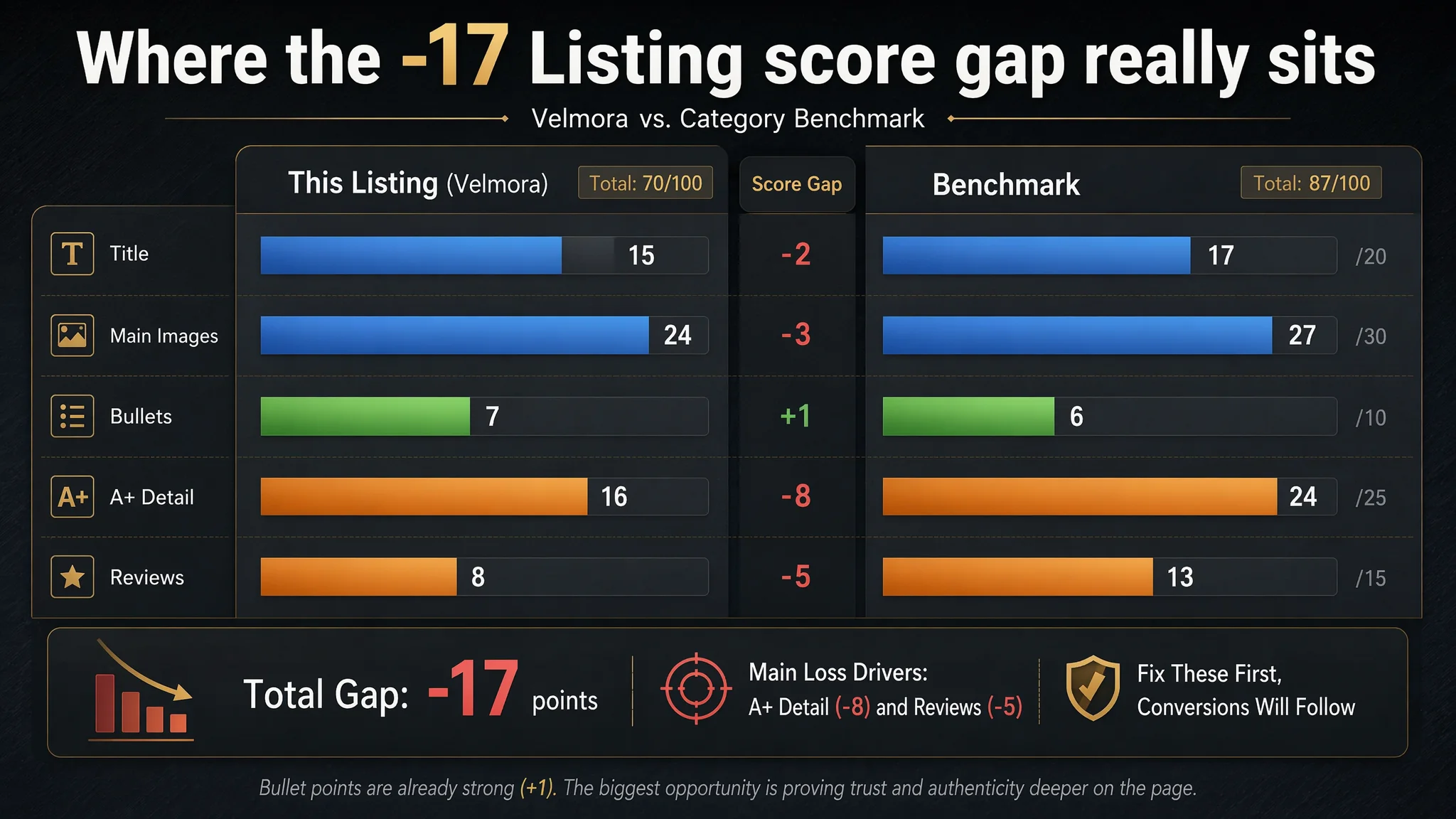
- Overall DeepBI Listing score: 70/100
- Benchmark competitor Listing score: 87/100
- Gap: -17 points
Breaking it down:
- Title: 15 vs. 17 (-2)
- Main image set: 24 vs. 27 (-3)
- Bullet points: 7 vs. 6 (+1)
- A+ detail page: 16 vs. 24 (-8)
- Reviews: 8 vs. 13 (-5)
The seller had:
- A full 5.0-star average rating on Amazon
- Five reviews, all five-star
- A visually decent main image and several auxiliary images
- Bullet points that were actually more structured and scenario-rich than the benchmark’s
So internally, the belief was: “Content is fine. Our issue is we’re not buying enough traffic or ranking high enough yet. Let’s keep pushing ads and wait for reviews to build.”
But against a benchmark with 176 total reviews and a 4.7-star rating, this page was fighting a different battle: trust at scale and proof of authenticity, not just “traffic volume.”
“The real problem was not that Amazon ads failed to bring traffic. It was that the page could not convert the traffic into a confident purchase.”
The Misdiagnosis: Treating an Evidence Gap as an Ads or Reviews Problem
From the seller’s point of view, three assumptions drove decisions:
1. “High rating = conversion is fine.”
With 5.0 stars and no visible negative feedback, they assumed the page was strong and only needed more volume.
1. “Bullet points are detailed, so content is not our problem.”
The bullet structure was indeed sophisticated: technology + benefit + scenario, with clear progression from blade to structure, handle, sheath, then scenes and gifting. This gave the team a false sense of “we’ve done our Listing homework.”
1. “Competitor wins because of more reviews and slightly better images; we just need time and ad pressure.”
They blamed exposure and social proof volume, seeing the gap as largely quantitative, not qualitative.
Under these assumptions, the seller kept focusing on:
- Adjusting bids and budgets in Amazon ads
- Hoping time and incremental reviews would “naturally” close the conversion gap
- Minor visual tweaks, but not a structural rethink of the sales logic
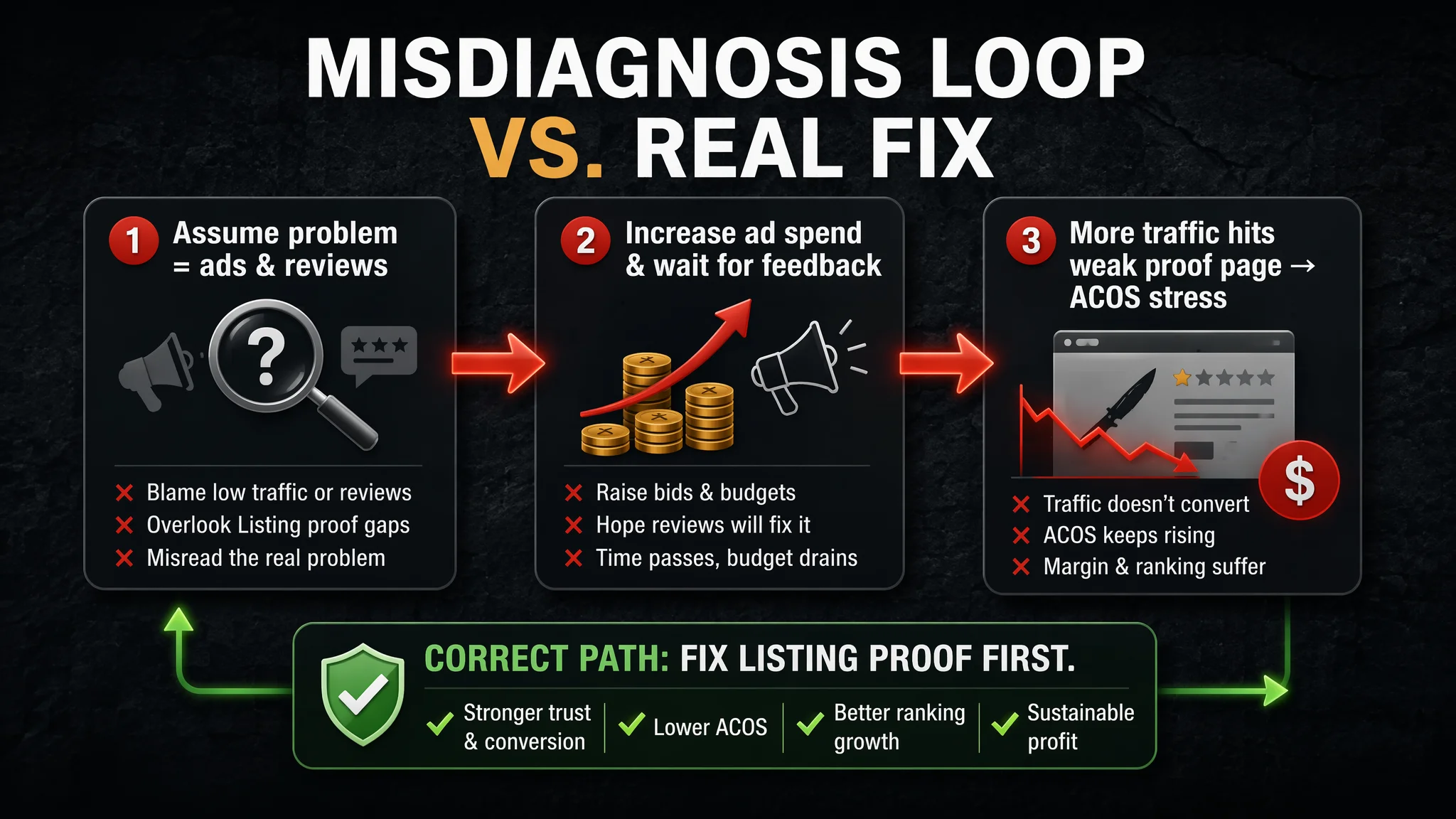
This is where the business risk started to compound: ads were sending ever more paid clicks to a page that did not deliver the level of proof the category demands. ACOS pressure followed, and the store remained over-dependent on paid traffic without building a strong organic conversion base.
What DeepBI’s Scoring Actually Revealed
The Real Constraint Was Listing Conversion Capacity
Once the Listing was benchmarked against a top-performing Amazon competitor, the pattern was clear:
- Title: slightly weaker but not catastrophic
- Main image set: behind in conversion logic and information design
- Bullet points: structurally strong, even more advanced than the benchmark
- A+ detail (16 vs. 24): the single biggest score gap
- Reviews (5 vs. 176): trust scale gap, not quality gap
So the question shifted from:
- “How do we get more clicks?”
to:
- “If we doubled clicks tomorrow, would this product page be able to convince a skeptical buyer to pay Damascus-level money?”
For a Damascus-style hunting knife on Amazon US, that skepticism is very specific:
- Is the steel real or just a “laser pattern”?
- What’s the hardness?
- How is the blade constructed (full tang or cosmetic)?
- Can it survive actual heavy outdoor use, or is it just a wall piece?
- Does the sheath actually protect and carry safely?
The benchmark competitor’s page answered these head-on. This Listing did not.
Title: Close, but Not the Main Battle
The Benchmark’s Advantage
The benchmark Amazon Listing title led with:
“Damascus Hunting Knife, 10.4", Handmade Bowie Knife, VG10 Core, Rosewood Handle, Leather Sheath, for Camping, Hunting, Survival, Gift”
Its strengths:
- Core search term “Damascus Hunting Knife” at the front
- Strong value words: “Handmade”, “VG10 Core”, “Rosewood Handle”
- Clear use cases: Camping, Hunting, Survival, Gift
This structure aligned with a proven Amazon formula: core keyword + technical authority + material premium + scenario & gifting.
The Original Title’s Issues
The seller’s original title dispersed the core term, mixing in functional and visual descriptors, and leaned on phrases like “Hammered Finish” and “Ergonomic Wood Handle.” Informative, but weaker as value levers than “Handmade,” “VG10,” or “Gift.”
DeepBI’s suggested direction:
“10.2" Fixed Blade Outdoor Hunting Knife, Damascus Pattern 9Cr18 Forged Stainless Steel Hammered Finish, Wood Handle & Leather Sheath, Handmade Bowie Knife for Camping, Survival, Hiking & Gift”
Key shifts:
- Keep core “Outdoor Hunting Knife” forward for search weight
- Retain the real steel spec (9Cr18 in the title context, with 5Cr in bullets as the confirmed spec) and “Hammered Finish” but frame them as premium cues
- Explicitly add “Handmade Bowie Knife” and “Gift” to tap gifting searches and Bowie-knife sub-intent
- Keep within mobile-safe length so core value isn’t truncated
But DeepBI’s judgment was that title optimization alone would not fix the business problem. It would slightly improve discoverability and first impression—but not solve a proof deficit later on the page.
Main Images: The Knife Looked Good, but It Didn’t Prove Anything
A Main Image That Confirmed, but Didn’t Differentiate
The current main image clearly showed:
- Knife and leather sheath
- Damascus-style pattern
- Clean white background
However:
- No brand or premium framing
- No sense of “this is a serious outdoor tool” vs. a decorative piece
- No immediate cue of steel type, hardness, or structural integrity
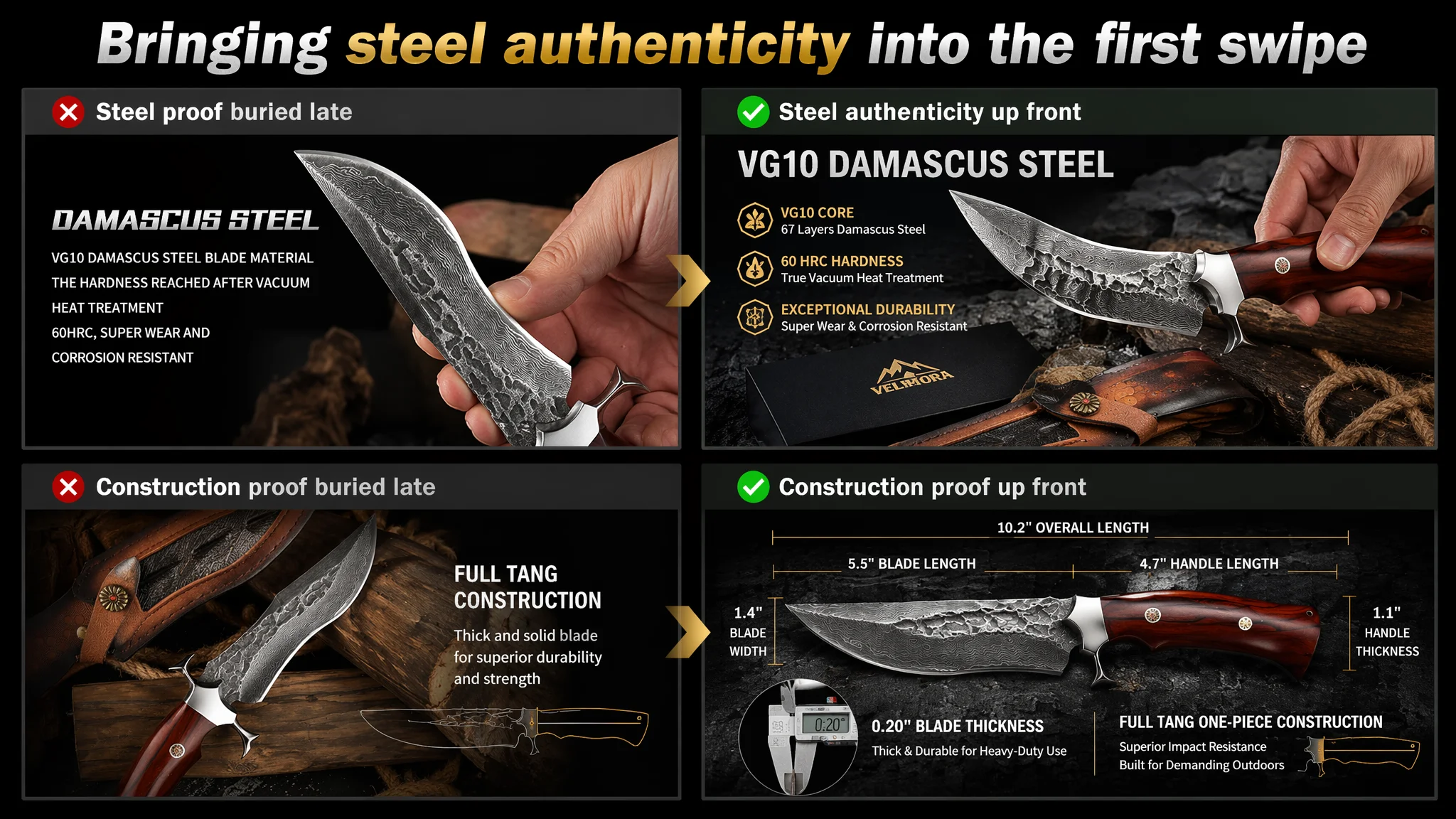
The benchmark’s visuals created a stronger professional feel and used more layered storytelling across the first few images.
Where the Visual Logic Broke Down
Across the main images, three critical gaps emerged:
1. Steel Performance Was Hidden Too Late
- The knife’s steel spec and hardness—key trust levers—appeared only in a later image as text parameters.
- Competitor used early images to show construction layers, micro-angles, and process, giving the buyer a reason to believe now, not after several swipes.
1. Feature Labels Without Benefits
- Existing labels such as “Forging Grain,” “Sharp Edge,” “Individual Steel Shield,” “Mahogany Handle” stayed at the level of naming parts.
- They did not answer “So what?”
For example:
- “Individual Steel Shield” should translate into “Safety dual guard design for hand protection.”
- “Sharp Edge” should become “Clean, smooth cuts for camping food and fishline processing.”
1. No Early, Visual Proof of Thickness and Durability
- The benchmark used calipers and thickness visuals early to scream “thick, durable, abuse-ready.”
- The seller had caliper shots in the asset library but didn’t use them to anchor a clear size/durability story.
“Advertising does not only amplify advantages. It can also amplify a page’s existing defects.”
DeepBI’s priority call: move steel and structure proof forward into Image 2, not Image 4. The first swipes should answer the buyer’s hidden question: Is this knife actually strong and real, or just textured metal?
Bullet Points: Strong Structure, but Lost in the Wrong Ecosystem
Ironically, bullet points were the only dimension where the Listing outscored the benchmark (7 vs. 6).
The seller’s bullets:
- Used a “technical feature + concrete advantage + scenario” structure
- Emphasized process and outcome: “eliminates structural weak points,” “reduces hand fatigue”
- Offered vivid scenes: “processing bushcraft materials,” “all-day hikes”
The benchmark’s bullets were simpler: attribute + function.
However, the bullets were over-performing in a vacuum and under-leveraged in context:
- Without early visual and A+ proofs, the bullets risked reading like claims rather than supported facts.
- In this category, words must sit on top of visible evidence—otherwise “full tang,” “ergonomic,” and “durable” blend into generic noise.
DeepBI’s direction for bullets:
- Keep the strong structure, but tighten headers and align them with visual proof:
- FORGED 5CR STAINLESS STEEL BLADE
- RUGGED FULL TANG CONSTRUCTION
- ERGONOMIC WOOD HANDLE & SAFETY GUARD
- HAND-STITCHED GENUINE LEATHER SHEATH
- VERSATILE OUTDOOR TOOL & PREMIUM GIFT
- Ensure each bullet maps to an image or A+ module that visually corroborates the claim.
The bullets were not the bottleneck. They were trapped behind a weak proof ecosystem.
A+ Detail Page: Where the Real Leak Was
Here is where the gap became undeniable:
- A+ score: 16 vs. benchmark’s 24
- Seller’s A+: 4 images
- Benchmark’s A+: 13+ structured modules
What the Benchmark Did That This Listing Didn’t
The benchmark A+ built a full persuasive funnel:
- Brand positioning and identity
- Detailed steel and construction breakdowns (e.g., 62 HRC, 33 layers + VG10 core, 12° edge)
- Micro shots of blade, handle, and guard
- Process visuals like forging and sharpening
- Multi-scene real usage (splitting wood, BBQ, hunting, even water contexts)
- Comparison tables against alternatives
- User archetype imagery (the “backpack hunter” identity)
This created:
- Technical authority
- Real-world use validation
- A clear “this is who this knife is for” narrative
- A final emotional nudge to buy
What the Current A+ Was Doing
The seller’s A+:
- Used 4 static images
- Showed the knife in basic scenes and poses
- Repeated the visual impression rather than deepening it
- Stayed at the level of external appearance and simple usage
It did not:
- Quantify hardness (HRC) or edge angle
- Prove the construction (full tang vs. partial, etc.)
- Explain steel authenticity vs. laser patterns
- Show any “extreme” or convincing usage that tests strength
- Build a user identity or emotional anchor
So even if Amazon ads drove quality traffic, the bottom of the funnel was thin. Buyers with money and intent looked for hard signals and didn’t find them.
Why DeepBI Insisted on Fixing the Listing Before Tuning Ads
At this stage, DeepBI’s business judgment was straightforward:
- Pushing more Amazon ads into this Listing would mainly:
- Increase spend
- Expose more users to an incomplete proof story
- Create the illusion that “ads don’t work”
- Fixing the Listing first would:
- Improve conversion on both paid and organic traffic
- Make each click more valuable
- Reduce risk when scaling spend later
Core decision: repair the product page’s trust engine before increasing traffic pressure.
The biggest business risk was not “low exposure.” It was overpaying for visits that the Listing could not justifiably convert.
How the Page’s Sales Logic Was Rebuilt
DeepBI’s optimization logic focused on two tight loops:
1. Main Image Set: From “Nice Knife” to “Proven Tool”
- Image 1 (Main):
- Keep knife and sheath clear
- Upgrade background to subtle texture (stone or dark wood) to add professional tone without losing clarity
- Remove gift-ribbon-like props that weaken a serious-tool impression
- Image 2:
- Bring steel performance forward
- Visually tie forged texture to steel spec and hardness (5Cr / 9Cr18 context, exceptional hardness, corrosion resistance)
- Use stronger graphical layout, not just a text list, to show parameters as “certificates,” not noise
- Image 3:
- Convert part labels into benefit mapping:
- Forging grain → “Forged texture for durability and edge retention”
- Sharp edge → “Clean, smooth cuts for camping food & fishing line”
- Steel guard → “Safety dual guard design to protect your hand”
- Wood handle → “Ergonomic contoured grip reduces fatigue”
- Image 4:
- Instead of isolating parameters late in the sequence, merge them earlier and consider using caliper or dimension visuals here
- Emphasize thickness (e.g., 0.5 cm blade thickness where real and confirmed) and full-tang construction as direct proof of impact resistance
- Image 5:
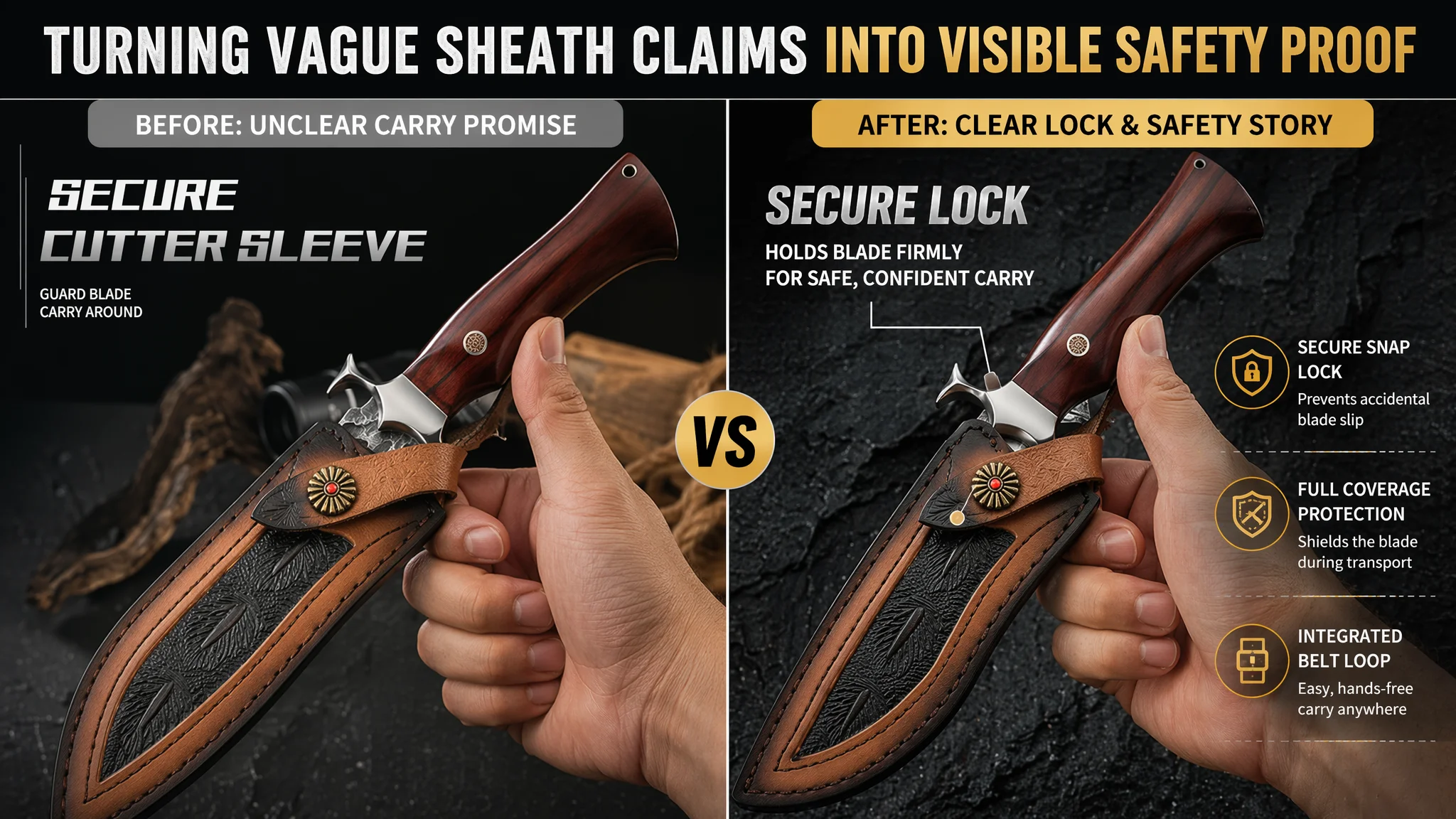
- Deepen sheath story: hand-stitched, embossed genuine leather, secure snap closure, integrated belt loop
- Frame it explicitly around buyer worries: “will it fall out?” and “is it comfortable to carry?”
1. A+ Detail Modules: From Static Photos to an Evidence Chain
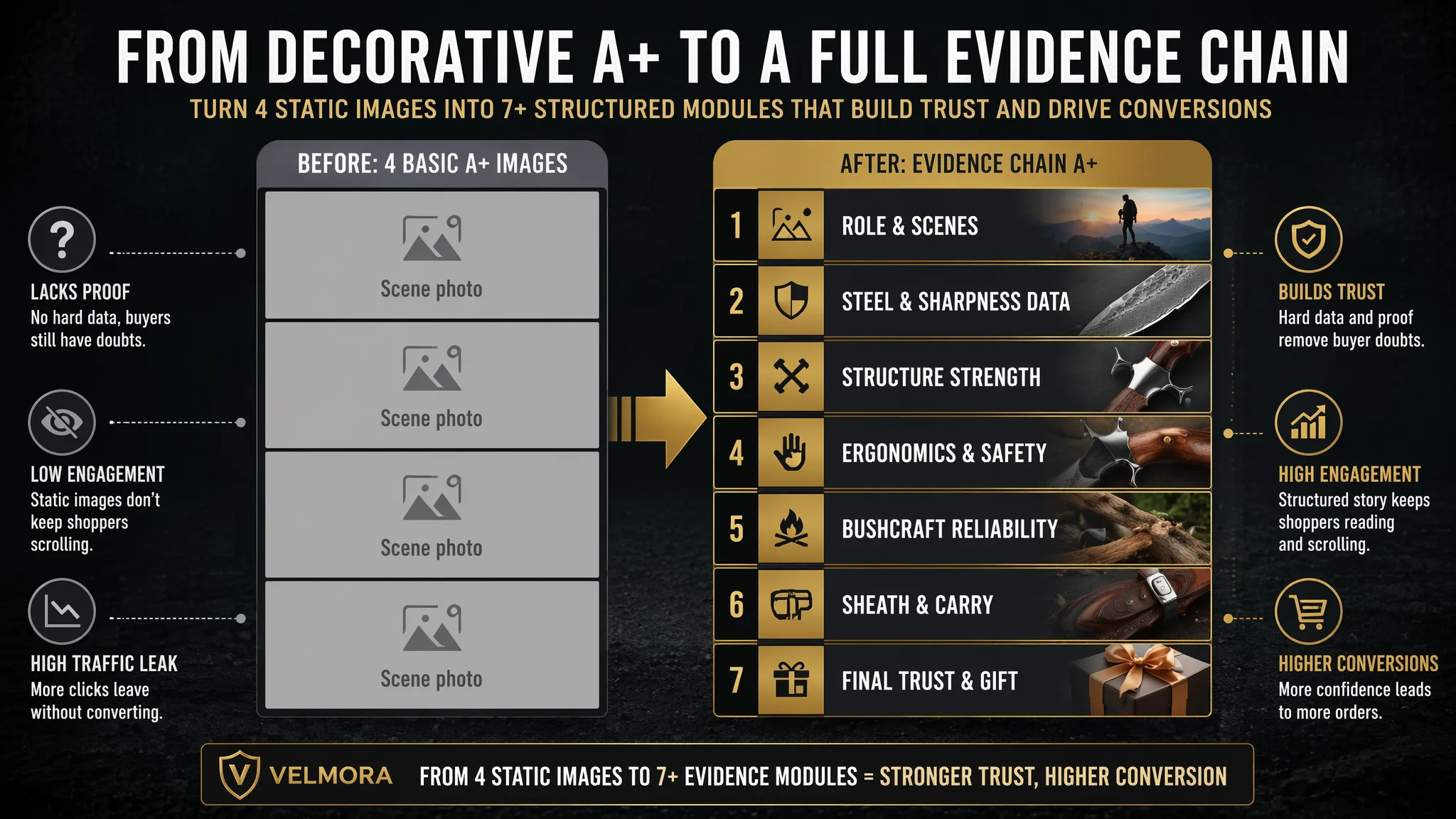
DeepBI reorganized the A+ into seven modules, each with a clear conversion role:
- Module 1: Scene Generalization & Role Confirmation
- Clarify this is not just a “cool” knife: it’s qualified for camping, hiking, fishing, bushcraft, DIY, garden tasks.
- Module 2: Steel & Sharpness as Data, Not Slogans
- Spell out: 5Cr stainless steel, forged texture, exceptional hardness, long-lasting edge retention.
- Use cutting-rope imagery as a gateway to a quantified claim, not just a nice shot.
- Module 3: Structure Strength Under Stress
- Use existing wood-shaving visuals to frame “full tang one-piece structure,” “superior impact resistance,” and “heavy-duty performance” for bushcraft materials.
- Module 4: Ergonomics & Safety
- Add handle close-ups with callouts: contoured solid wood handle, reinforced rivets, polished dual guard, secure grip in damp/slippery conditions.
- Module 5: Bushcraft Reliability
- Position the knife as a reliable partner for demanding bushcraft projects, not just light tasks—emphasize rugged outdoor environments.
- Module 6: Sheath Quality & Carry Clarity
- Highlight: hand-stitched embossed genuine leather sheath, secure snap closure, integrated belt loop for waist/backpack/gear-bag carry.
- Module 7: Final Doubt Removal & Positioning
- Summarize: high-grade 5Cr stainless steel, unique forged texture, exceptional hardness, long-lasting sharp edge.
- End with dual positioning: “reliable go-to outdoor tool” and “thoughtful, premium gift” for outdoor enthusiasts.
This sequence turned the A+ from “extra decoration” into the main trust engine of the Amazon product page.
What Changed in the Business State
The case does not rely on invented metrics, but the operating logic shift was clear.
After refocusing on Listing conversion:
- Ad traffic became more useful.
Each click had a higher chance of meeting enough proof to justify purchase.
- The page regained the ability to convert both organic and paid visitors.
Instead of burning budget to discover the Listing’s weaknesses, the seller used data to fix them first.
- Advertising dependence became more controllable.
With a strengthened product page, the seller could scale ads more confidently, knowing ACOS was less likely to spiral purely due to page-level trust failures.
- The team’s understanding of Amazon operations changed.
They moved from:
- “Our knife is good; we just need more reviews and ads.”
to:
- “In this category, if we don’t prove steel, construction, and real-world use visually and numerically, no amount of traffic will save us.”
What Other Amazon Sellers Can Take Away
1. A perfect star rating is not proof of conversion strength.
Five reviews at 5.0 stars is emotionally comforting, but versus 176 mixed-but-strong reviews, it loses on trust scale.
1. Bullet points cannot carry the Listing alone.
Even excellent bullet logic fails if A+ and images don’t visually support them.
1. In technical, tool-heavy categories, buyers expect evidence, not adjectives.
Hardness, steel type, construction, visual tests—these aren’t optional.
1. Ads magnify your page’s current state.
If the Amazon product page has a trust gap, advertising will amplify that gap into ACOS stress.
1. Before spending more on Amazon ads, ask: does this page deserve the traffic?
DeepBI’s role in this case was not to “optimize ads,” but to reframe the real business problem: the Listing’s conversion engine had to be rebuilt first.
For sellers, the most valuable shift is not a particular title formula or image layout. It’s the judgment that Listing quality is the foundation of any ad strategy. Without that, every new click is another expensive exit from your product page.