An Amazon seller in the construction tools category came to DeepBI because their new green laser level was burning through Amazon ads without bringing back stable orders. On the surface, the team believed this was an advertising issue: keyword bids, campaign structure, and daily budgets were all being tweaked in cycles, yet ACOS would not come down and conversion stayed weak.
Once we ran the Listing through DeepBI’s diagnostic model and benchmarked it against a category‑leading Amazon competitor, a different picture emerged. The ads were delivering traffic, but the product page itself had almost no ability to convert that traffic. Title relevance was low, bullets were essentially missing, there was no A+ content at all, and reviews were almost non‑existent. Against this backdrop, every extra advertising dollar was simply feeding a page that could not build trust or explain the product.
The later optimization work therefore shifted away from “tuning ads harder” and focused first on Amazon Listing fundamentals: reconstructing the title around real search terms and technical outcomes, rebuilding the bullet points into a pain‑point/solution path, and designing a full A+ story that mirrored how professionals actually decide on a laser level. For other Amazon sellers, this case is a reminder: when ads feel “inefficient”, the core leak is often Listing conversion capacity, not bid strategy.
The Store’s Reality: Traffic Was Paid, but the Page Was Empty
When the seller approached DeepBI, the business pressure was straightforward:
- Amazon ads were already turned on.
- Spend was climbing.
- Orders were unstable, and ACOS looked increasingly uncomfortable.
Internally, the explanation was simple: “The product is new, reviews are low, so we must push harder on advertising and maybe adjust some images.” Most of the discussion stayed inside the ads console—keywords, match types, negative terms—while the product page was treated as “good enough for now”.
DeepBI’s Listing scoring quickly showed this was not the real bottleneck.
- Total Listing score: 38/100
- Benchmark competitor: 87/100
- Gap: -49 points
Across every conversion‑relevant dimension—title, main images, bullet points, A+ content, and reviews—the Listing was far below the category’s working standard. This meant the store was paying Amazon for exposure without having a page capable of defending that spend.
“The problem was not that ads failed to bring traffic. It was that the page could not convert the traffic.”
At that point, continuing to optimize ads first would have meant amplifying a structurally weak page.
What the Seller Originally Misdiagnosed
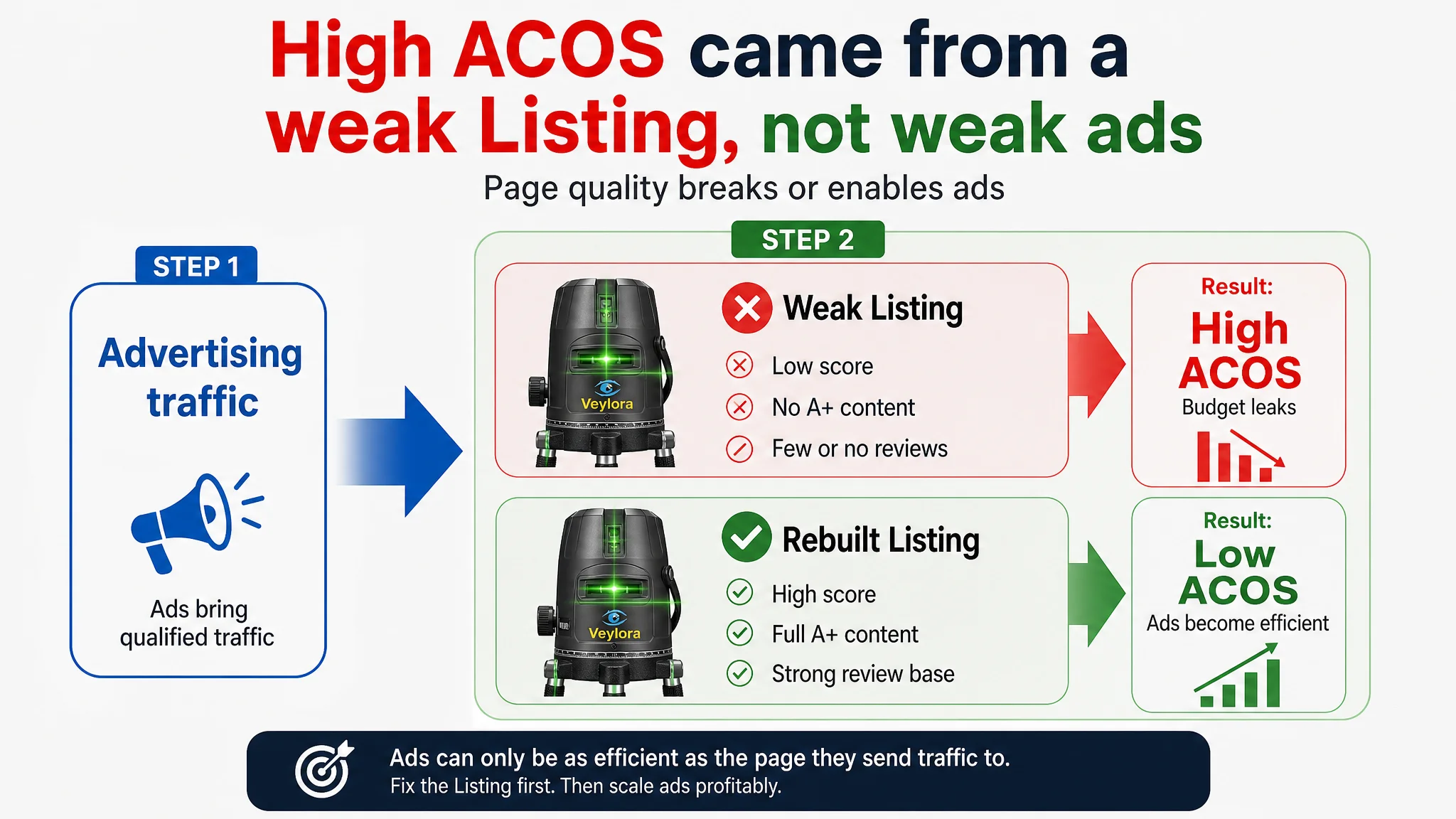
From the seller’s perspective, the logic chain looked like this:
- Ads on → impressions okay, clicks not ideal → ACOS high.
- Therefore, “ad optimization” is the primary problem.
This led to typical responses:
- Rebalancing keyword sets.
- Trimming inefficient terms.
- Adjusting bids to chase a lower ACOS.
- Experimenting with budgets and placements.
What was missing was a hard look at the Amazon Listing itself. In a competitive, high‑ticket category like laser levels, professionals do not convert on a thumbnail and a single line of copy. They convert when a product page answers three questions convincingly:
1. Can this tool handle my real‑world use cases?
2. Is it technically reliable enough for job sites, not just for hanging a picture?
3. Does the page feel as professional as the competitors I already trust?
On this page, those answers simply did not exist.
DeepBI’s Diagnosis: A Listing With Zero Story Against a Fully Built Benchmark
The core constraint: Listing conversion capacity, not traffic volume
DeepBI’s scoring against a proven benchmark laser level Listing made the constraint obvious:
- Title: Target Listing: 7, Benchmark Listing: 15, Max: 20, Gap: -8
- Main images: Target Listing: 23, Benchmark Listing: 27, Max: 30, Gap: -4
- Bullet points: Target Listing: 4, Benchmark Listing: 8, Max: 10, Gap: -4
- A+ / Detail page: Target Listing: 0, Benchmark Listing: 24, Max: 25, Gap: -24
- Reviews: Target Listing: 4, Benchmark Listing: 13, Max: 15, Gap: -9
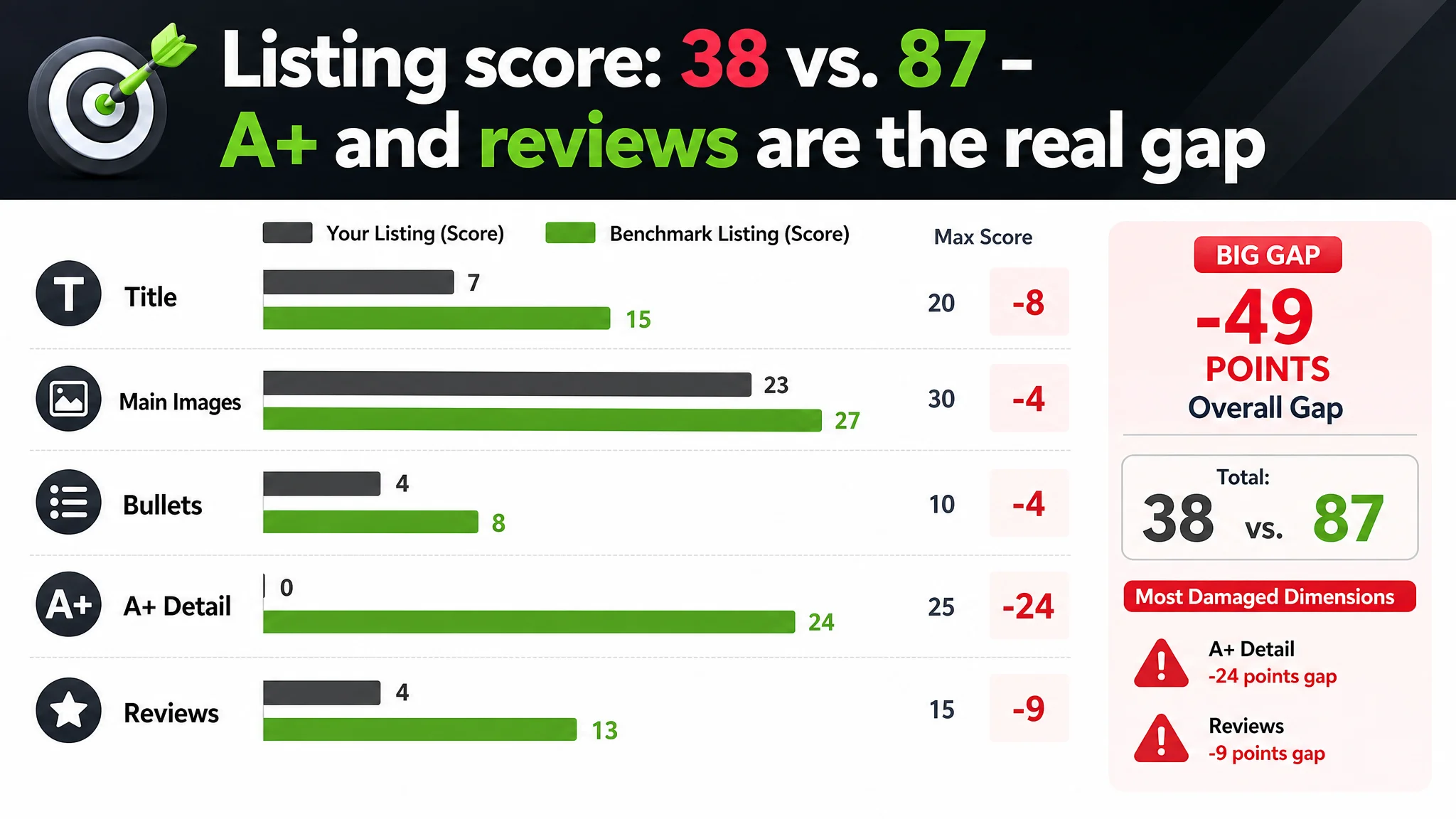
Two red flags stand out immediately:
- A+ / detail score: 0 vs. 24
- Reviews: 1 total review vs. 2,295 for the benchmark
In other words, the seller was trying to compete in Amazon search results against a fully developed, trust‑rich Listing with:
- A complete A+ structure: professional hero banners, icons, multi‑scene application shots, detailed operating modes (self‑leveling, manual, pulse), battery and runtime visuals, IP54 durability, and clear accessory explanations.
- A massive, credible review base: thousands of reviews, with strong front‑page photo/video content.
By contrast, the target Listing:
- Had no A+ content at all.
- Had only one review, with a 5.0 rating that looked more “unproven” than “strong”.
- Relied almost entirely on a basic title and scattered images.
From a business perspective, this is not an ad problem. This is a product‑page trust deficit.
Why Traditional Ad Optimization Kept Failing
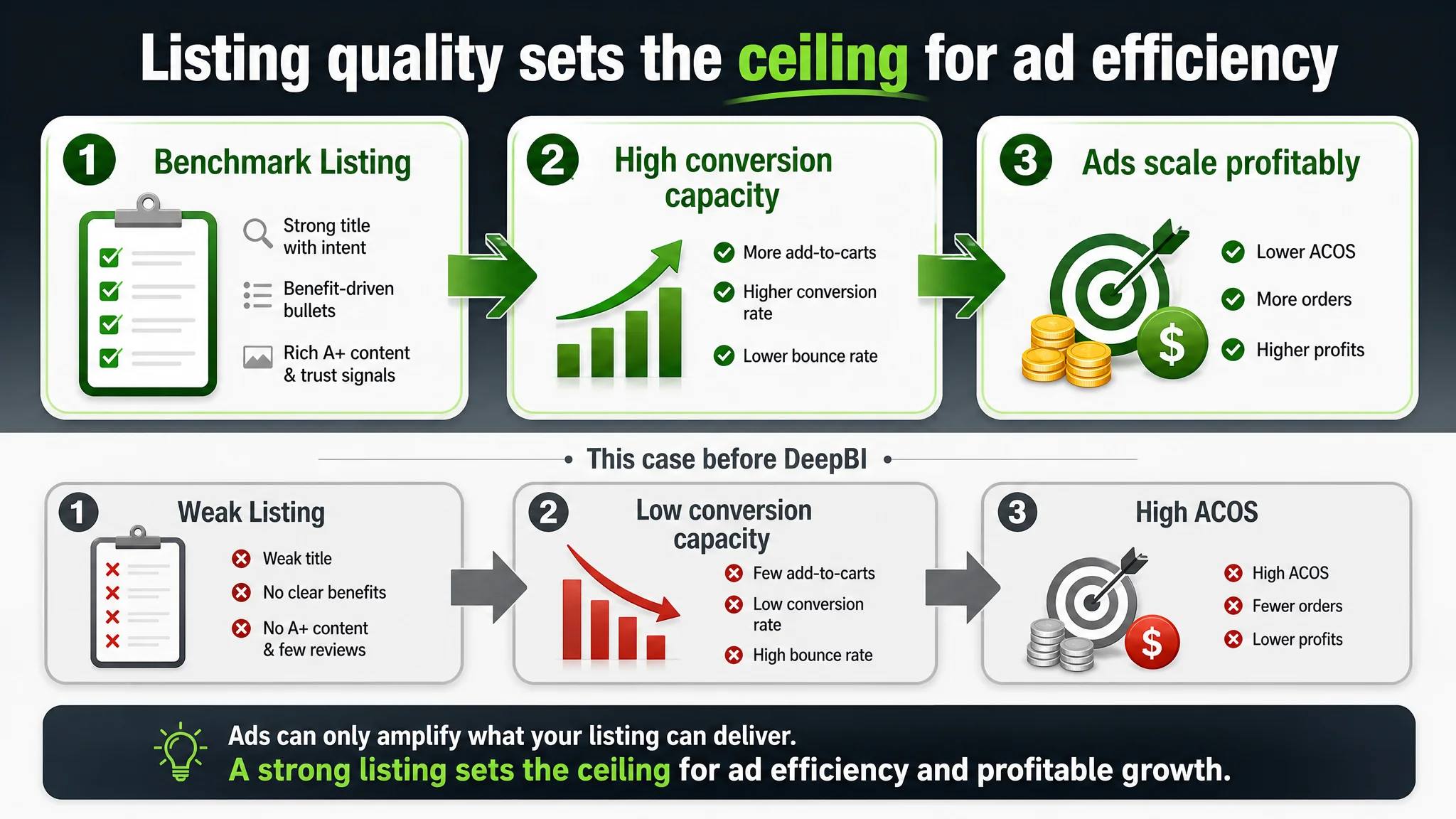
Advertising on Amazon has a simple, unforgiving relationship with product‑page quality:
- Good pages convert both organic and paid traffic and can scale ads profitably.
- Weak pages leak traffic, inflate ACOS, and make ad “optimization” look impossible.
Here’s how that played out for this seller.
1. Title could not carry search intent or outcomes
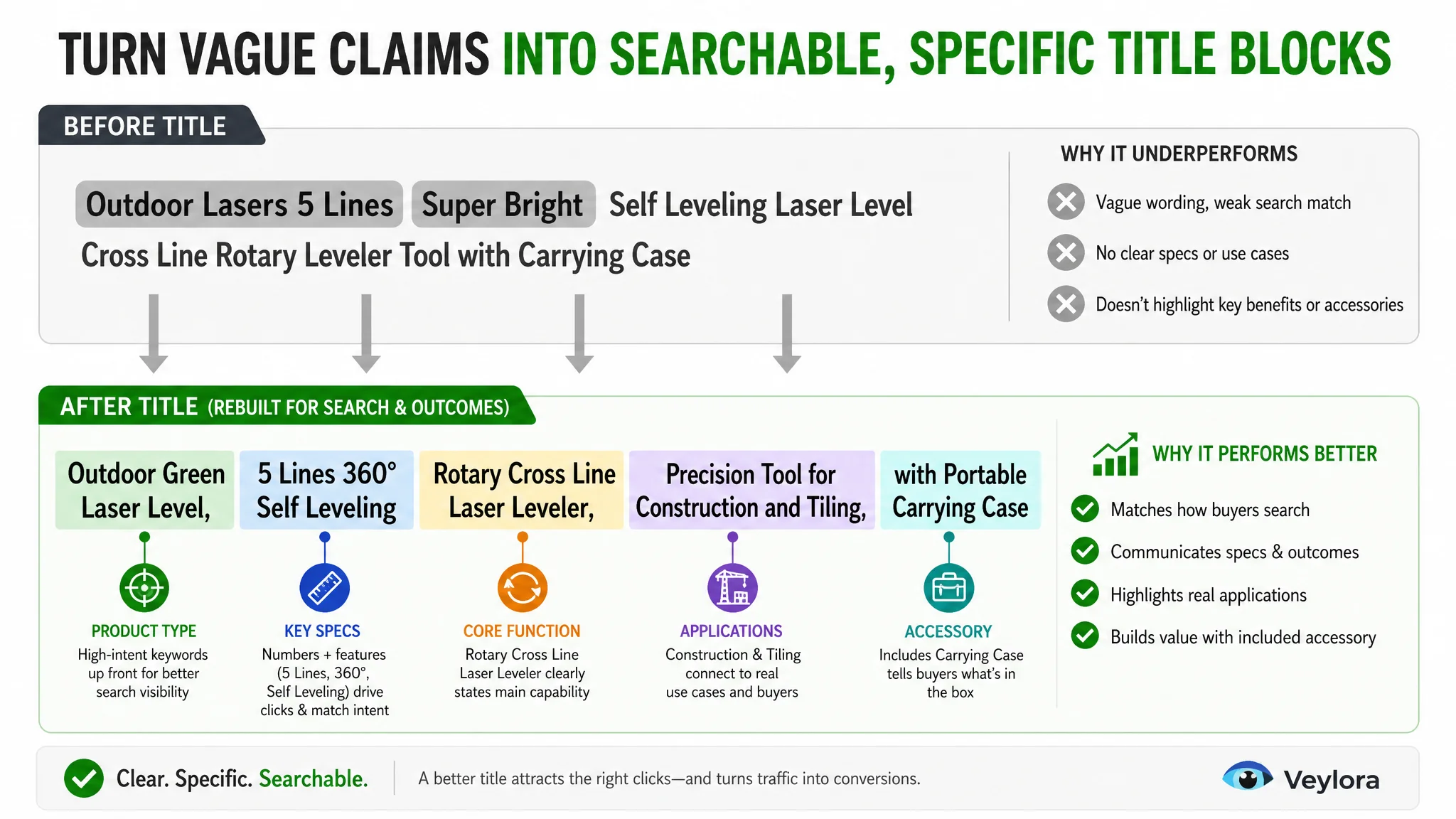
The original title leaned on vague phrases like “Outdoor Lasers 5 Lines” and “Super Bright”, while the benchmark competitor followed a hardened formula:
- Brand + product type (Laser Level)
- Concrete technical spec (3x360°, green laser, self‑leveling)
- Application scenes (Construction, Picture Hanging)
- Practical accessories (magnetic bracket, hard case)
That structure improves both visibility (A9 keyword weighting) and click motivation (“this is clearly the 3D, job‑site‑ready laser I’m looking for”).
The DeepBI recommendation pushed the seller toward a more aligned version:
“Outdoor Green Laser Level, 5 Lines 360° Self Leveling Rotary Cross Line Laser Leveler, Precision Tool for Construction and Tiling, with Portable Carrying Case”
This keeps the product’s actual attributes but reallocates title real estate to high‑intent search terms and real outcomes. Until the title met that standard, every ad impression had a lower chance to turn into a click.
2. Bullet points were missing a decision path
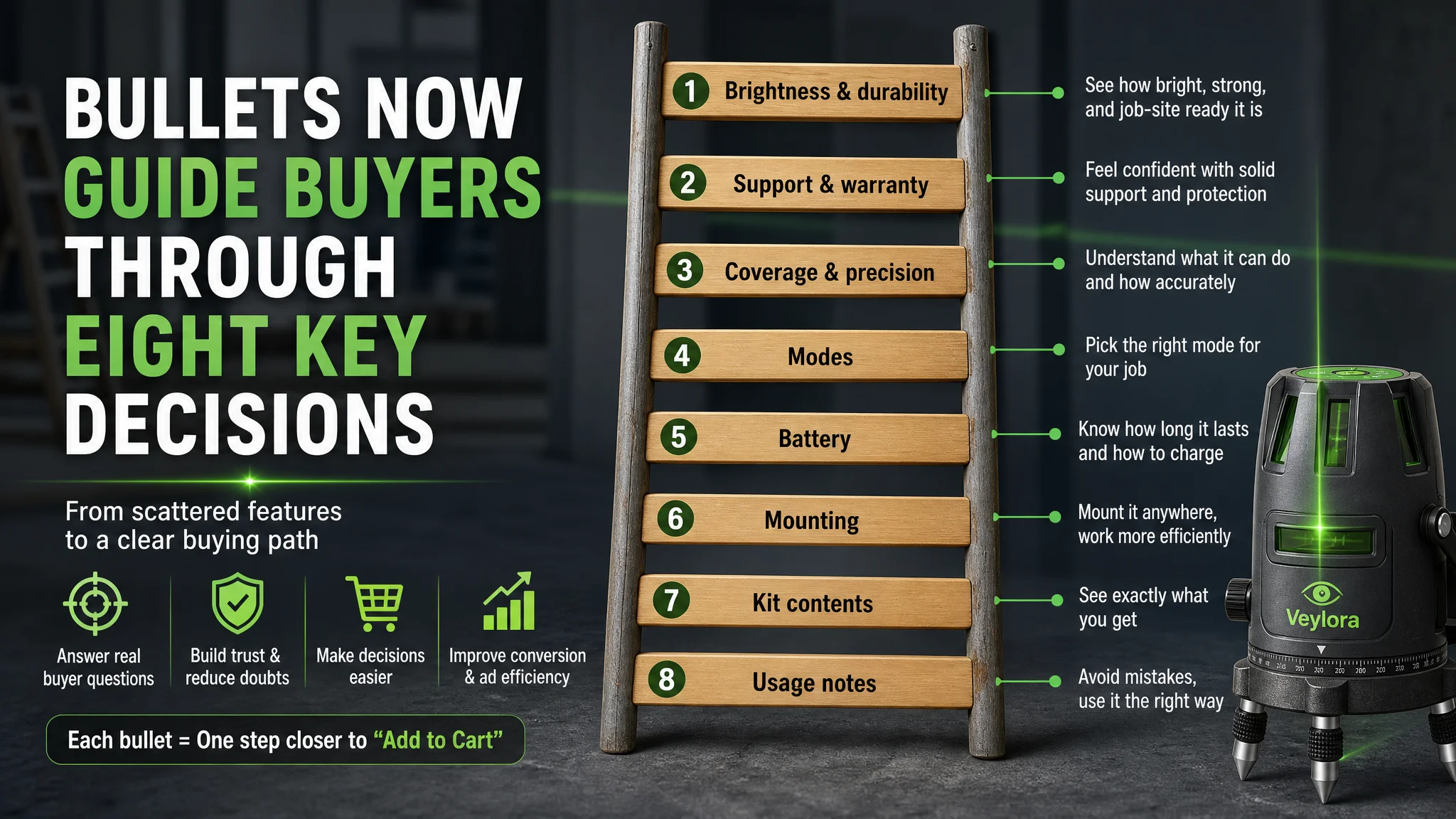
The benchmark bullets were not just data lists; they were a structured buying guide:
- Brighter green laser & durable housing
- Warranty and lifetime technical support
- 3x360 coverage & pulse mode range
- Self‑leveling vs. manual mode logic
- Battery capacity & charging details
- Mounting flexibility
- Clear kit contents
- Important usage notes
By comparison, the target Listing effectively had no coherent bullet framework. There was no “problem → solution” pattern, no explicit after‑sales promise, and no structured explanation of modes, coverage, or mounting scenarios.
With that gap, ad traffic from professionals looking for “360 green laser level for construction” hit a page that felt under‑explained and amateur compared to the benchmark. Many of those visitors would click, scan briefly, then bounce.
3. Detail page: complete absence of A+ content
This was the single biggest structural weakness.
The benchmark A+ did three critical jobs the target page did not:
- Immediate professional framing: A hero section showing 3x360° green lines in real construction environments, establishing that this is a serious tool for job sites, not just home DIY.
- Mode and scenario mapping: Clear visual modules for self‑leveling, manual tilt, and pulse mode, each tied to specific use cases (ceilings, stairs, outdoor foundations).
- Durability, power, and accessories: IP54 water/dust scenarios, battery runtime visualizations, Type‑C charging, magnetic bracket mounting options, and transparent kit contents.
Without any A+, the target page asked visitors to buy “blind”, based on limited text and non‑systematic images. In a category where buyers depend on visual proof and technical clarity, this is fatal to conversion.
4. Reviews: quantity and structure, not just star rating
The target Listing technically had a 5.0 rating, but from only one review.
By contrast, the benchmark’s:
- 4.6 rating sat in the healthy, believable range.
- 2,295 reviews created scale trust.
- Front page showed rich photo and video content that reinforced real‑world usability.
From a visitor’s perspective, 5.0 with one review feels like “untested”. Amazon ads can send traffic, but they cannot manufacture proof. With such a thin review base, the page needed even stronger Listing content to compensate. It had the opposite.
“Advertising does not only amplify advantages. It can also amplify a page’s existing defects.”
Why DeepBI Refused to Keep “Fixing Ads” First
Given this diagnostic picture, continuing to iterate ad settings would have:
- Raised spend on a structurally weak Listing.
- Generated noisy data where ad experiments were blurred with page‑level problems.
- Risked forcing the seller into deeper discounting just to make the page feel “acceptable” vs. competitors.
DeepBI’s judgment was straightforward: before ads could work again, the page had to convert.
Three principles guided the decision path:
1. Fix the funnel from the bottom up.
A Listing that converts well on organic traffic is the only stable foundation for scaling ads. If the page cannot sell people who arrive with strong intent, paying for more of that traffic is irrational.
1. Stop interpreting conversion failures as bid failures.
When every major content module (title, bullets, A+, reviews) is weaker than a benchmark, conversion problems are page‑driven until proven otherwise.
1. Let ads test a repaired page, not mask a broken one.
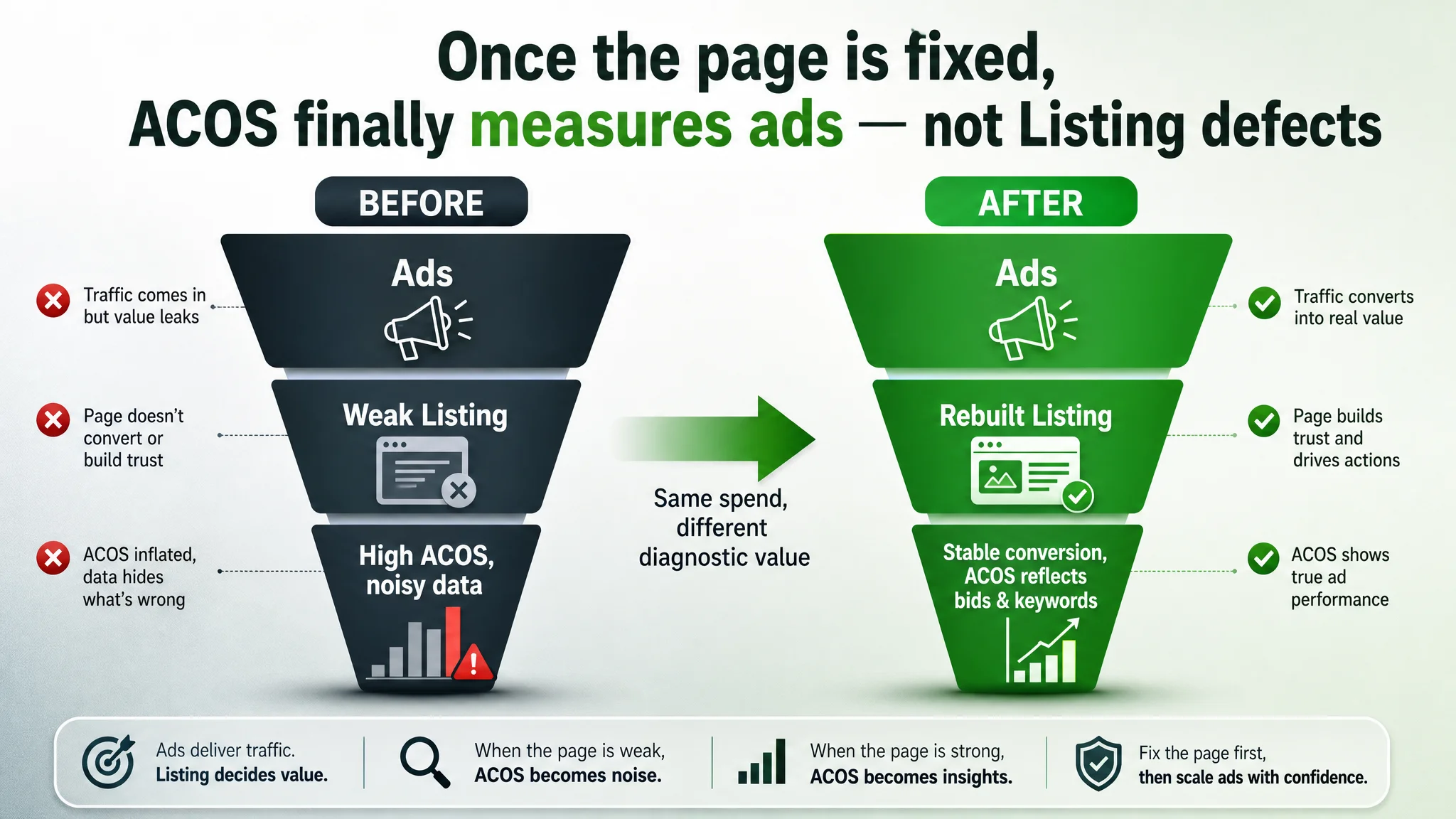
Once the Listing is rebuilt, ad data can meaningfully reflect keyword fit, creative strength, and audience targeting. Before that, ACOS mostly measures “how expensive it is to send visitors to a weak pitch.”
How the Listing Was Reframed: From Scattered Information to a Buying Story
The optimization work centered on one goal: give the Amazon product page the same decision logic the benchmark was already using, but grounded in this product’s real attributes.
1. Repositioning the title around how buyers search
The title optimization moved from:
- Vague adjectives, brandless phrasing, and “Super Bright”–type claims
toward:
- Clear product type: “Green Laser Level”, “5 Lines”, “360° Self Leveling”
- Core applications: “Construction”, “Tiling”
- Tangible add‑ons: “Portable Carrying Case”
This did two things at once:
- Helped the Listing compete for the right high‑intent search phrases.
- Gave ad impressions a better chance to turn into clicks by signaling “this is exactly the type of 5‑line, 360° tool you were looking for”.
2. Rebuilding bullet points into a structured persuasion chain
DeepBI mapped the benchmark bullets and rebuilt the seller’s bullets not as generic descriptions, but as modules in a decision path:
- BP #1 – Brighter green laser + durability
Linked outdoor visibility (real pain point) with robust ABS housing and IP54 protection. This is about performance under real job‑site conditions.
- BP #2 – After‑sales and support
Explicitly called out 24/7 responses, warranty, and lifetime technical support to mirror the competitor’s trust anchor.
- BP #3 – Coverage and precision
Structured the 5‑line layout in terms of actual work coverage—horizontal and vertical lines for floors, walls, ceilings—with explicit accuracy data.
- BP #4 – Self‑leveling vs. manual tilt
Clarified operating logic and mode switching, emphasizing both ease of use and flexibility for stairs or slopes.
- BP #5 – Battery and runtime
Framed capacity and power management in terms buyers care about: continuous work hours, smarter line activation to conserve power.
- BP #6 – Mounting and base advantages
Highlighted the integrated 360° swivel base and bubble level as a real differentiator for uneven ground, rather than burying this feature.
- BP #7 – Professional kit contents
Listed each accessory clearly and positioned the carry bag as protective and organized, not just “extra stuff”.
- BP #8 – Usage notes to prevent mis‑expectation
Proactively warned about reflective surfaces and stability requirements, both signaling professionalism and reducing return risk.
This moved the page from “some specs on a screen” to a guided, low‑friction explanation of how the tool actually solves the buyer’s problems.
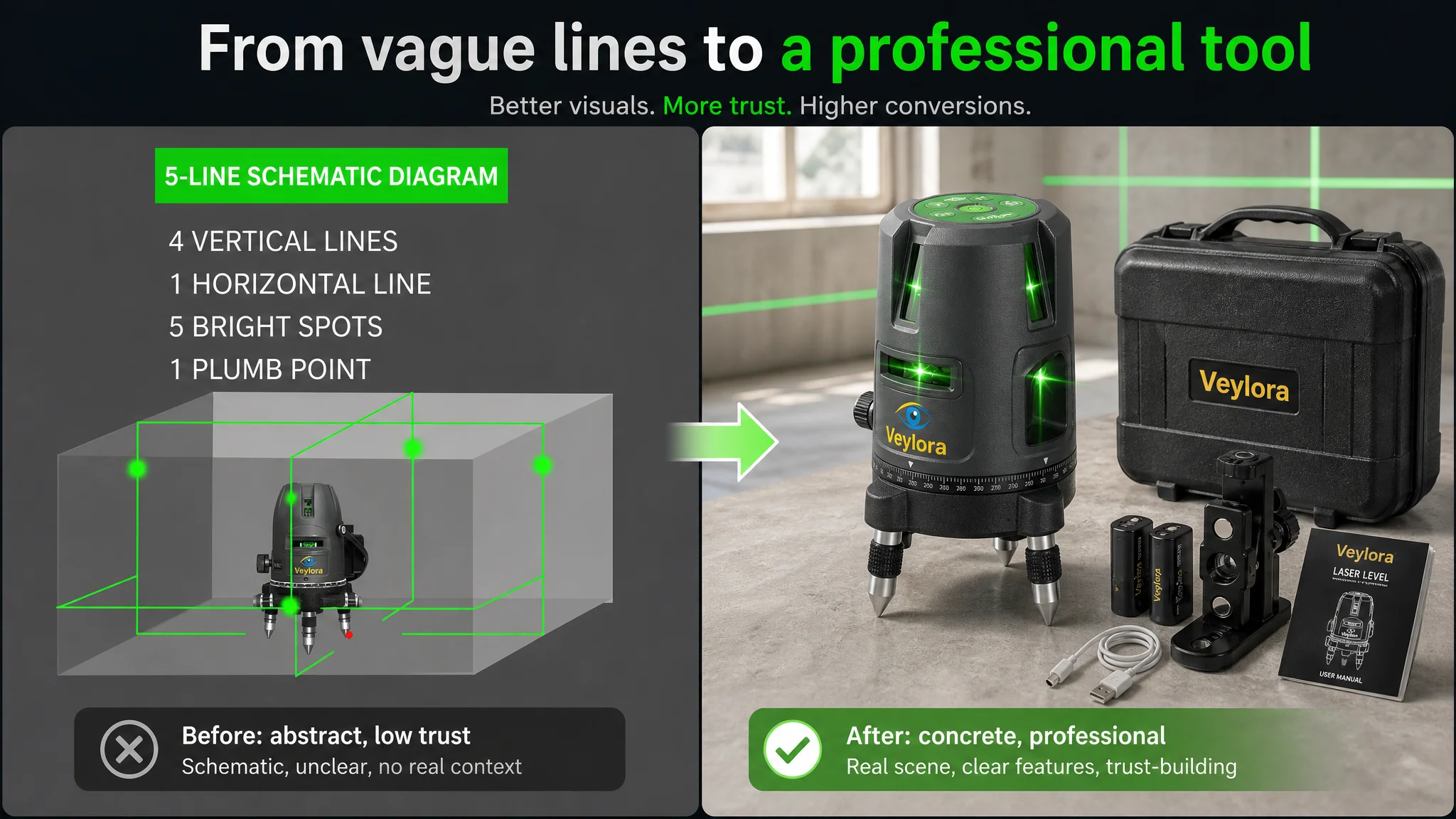
3. Designing main images that show outcomes, not just objects
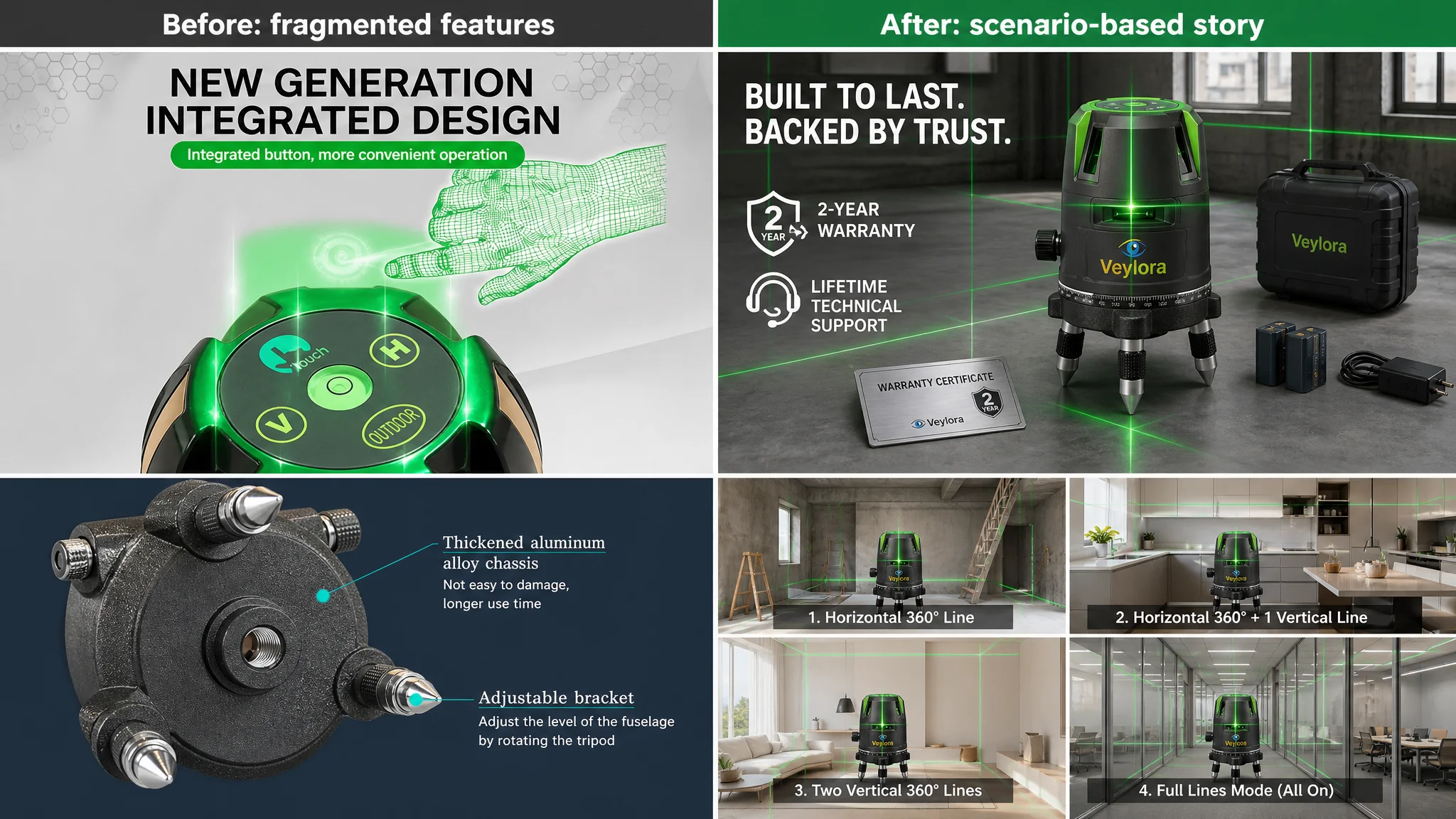
The diagnostic comparison with the benchmark revealed three visual issues:
- Lack of spatial sense: product cut‑outs on flat backgrounds rather than 3D, job‑site‑like depth.
- Missing trust visuals: no visible mention of warranty, no scenario that conveys “professional equipment”.
- Weak function storytelling: 3D line drawings instead of believable scenes where lines interact with real walls, floors, ceilings, and stairs.
DeepBI’s guidance reorganized the main image set around specific roles:
- Primary image:
Industrial, professional styling with strong contrast, 45° perspective, and accessories clearly subordinate to the main unit. Quick text tag like “Professional 5‑Line Laser” to anchor category at a glance.
- Support images:
- Warranty / assurance frame with bold “2‑Year Quality Assurance” and serious visual tone.
- Multi‑scene grid (tiling, hanging pictures, ceilings, vanity installation) showing the laser lines in real spaces.
- Close‑up on battery and Type‑C charging to make power and modern convenience tangible.
- Clear split between self‑leveling and manual/tilt use on stairs and irregular surfaces.
Instead of “more images”, the Listing moved toward images that each carry a distinct piece of the conversion story.
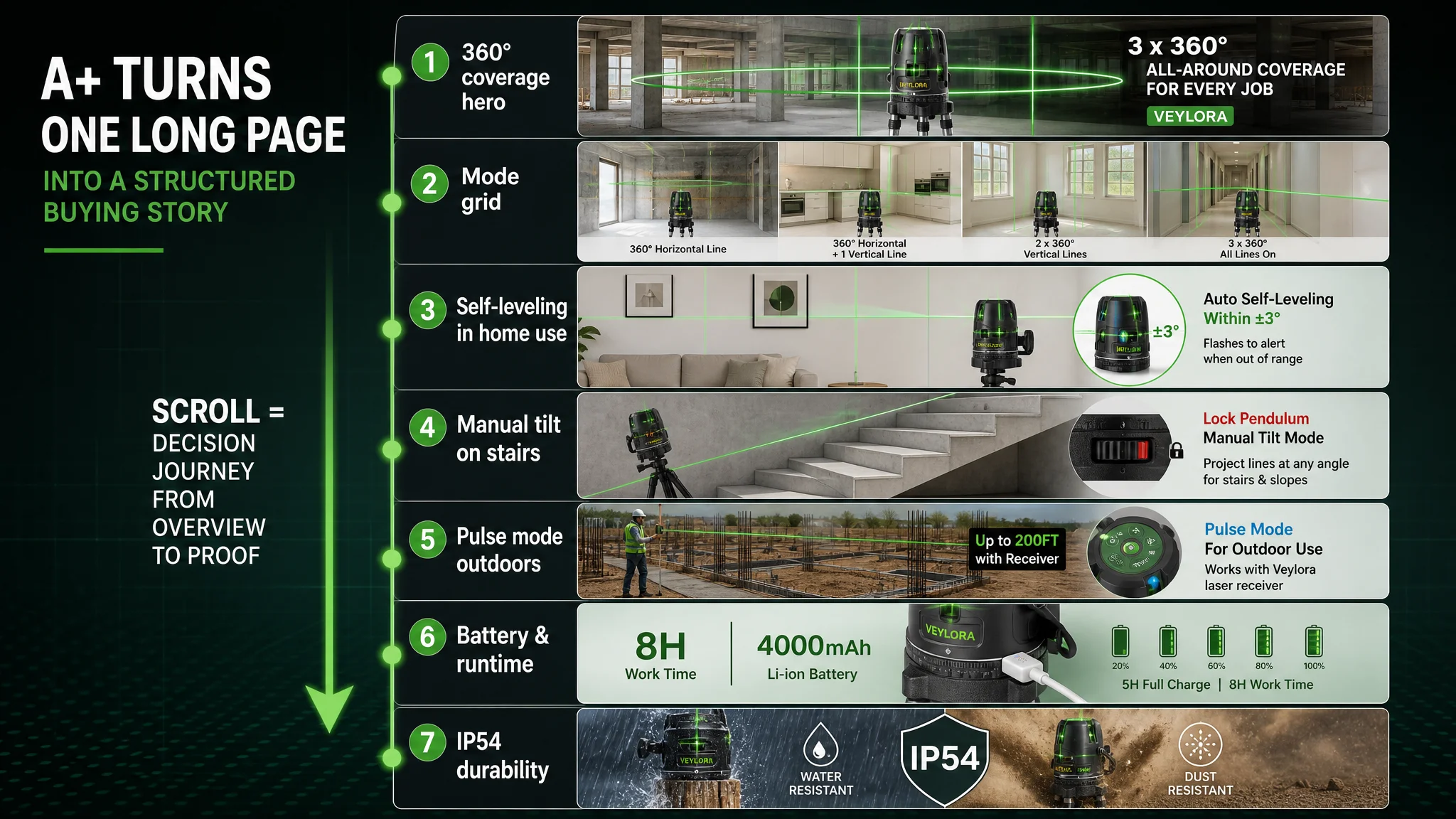
4. Building an A+ detail page that mirrors how professionals think
Here, the gap was absolute: 0 vs. 24 points in the A+ / detail dimension.
DeepBI’s optimization blueprint essentially rebuilt the A+ structure from nothing, inspired by the benchmark’s logic but tailored to this product:
1. Hero: 3x360° coverage visual
Tool on tripod, full 360° lines slicing across a concrete background, with high‑contrast green lines. This immediately answers “can it cover my full room?”
1. Mode grid: where each mode is used
Four panels: horizontal only, horizontal + one vertical, double vertical, full mode. Each set in a different real environment: rough construction, kitchen, empty living room, office corridor.
1. Self‑leveling in a home scenario
A living‑room scene aligning picture frames with a clear magnified bubble showing automatic correction within ±3°. This turns abstract “3° self‑leveling” into visible behavior.
1. Manual tilt on stairs
A stairway under construction, with the tool projecting a line parallel to the handrail, paired with a clear “locked” indicator. This locks the idea: “this is the tool that finally solves sloped work reliably”.
1. Pulse mode on an outdoor site
A foundation pour with a worker holding a receiver 20m away, a visible pulse‑mode line, and an indicator light. This scene sells the tool’s right to claim “outdoor, long‑range, professional”.
1. Battery and runtime visualization
Close‑up on Type‑C port, capacity callouts (e.g., 4000mAh / 8h working time, if accurate), and graphic battery bars. Buyers can now picture a full workday with this tool.
1. Durability and IP54 proof
Split scene: water on one side, dust on the other, with a bold “IP54” mark. This answers the quiet but critical fear: “Will this survive my actual work environment?”
This structure doesn’t just “look better”. It restores the missing conversion modules that the benchmark was already using to win.
What Changed: From Ad Waste to a Page That Deserves Traffic
The case materials do not provide post‑optimization numbers, so we will not invent performance metrics. But operationally, several key changes are clear:
1. The Listing regained the ability to explain and persuade
Before, the page was effectively asking visitors to trust:
- A thin title.
- A handful of untargeted images.
- One solitary review.
After the optimization path:
- The title speaks Amazon’s search language and the buyer’s outcome language at the same time.
- Bullets walk buyers through brightness, durability, coverage, modes, power, mounting, kit, and safe use in a coherent story.
- The A+ content visually proves the tool’s relevance in home renovation and job‑site environments.
- Visuals and copy finally move in the same direction instead of working as disconnected fragments.
In DeepBI’s terms, Listing conversion capacity became structurally higher, regardless of traffic source.
2. Ad traffic became diagnostically useful again
Once the product page was rebuilt:
- A given level of impressions could be expected to drive a more stable baseline of clicks (thanks to the reworked title and hero image).
- Conversion data started reflecting questions like “are we buying the right queries?” instead of “does our page look unfinished versus competitors?”
- ACOS movements could be attributed more cleanly to keyword and bid changes because the major page‑level leak had been patched.
The store no longer had to guess whether ad tweaks failed because of bids, competition, or a weak Listing; the Listing was no longer the obvious constraint.
3. The team’s mental model of “ad problems” changed
Perhaps the most important shift was conceptual:
- Previously: “High ACOS = ads not optimized enough.”
- Afterwards: “High ACOS with a weak Listing means ads are exposing a page‑level weakness. Fix the page first.”
That understanding changes how future launches are handled:
- New SKUs won’t be pushed with ads before their Amazon Listing content is benchmarked and structurally competitive.
- A review‑light product will be given stronger A+ storytelling and clearer bullets to compensate, instead of just “more budget”.
- Ads and Listings are now seen as a joint system: Listing quality sets the ceiling for ad efficiency.
What Other Amazon Sellers Can Take Away
For Amazon sellers—especially in technical, mid‑ to high‑price categories—this case is a common trap in extreme form:
- Ads feel inefficient, so the team doubles down on optimization inside the console.
- Listing quality is assumed to be “fine” because the product itself is good.
- Competitors with fully built A+ content, clearer titles, structured bullets, and thousands of reviews quietly capture conversion that feels “mysteriously” out of reach.
Three practical questions from this case are worth applying to your own catalog:
1. If your ads stopped tomorrow, would your Listing still convert organic traffic at a healthy rate?
If not, the page—not the ads—is the first problem.
1. Can a stranger understand your product’s modes, coverage, durability, and real scenarios just by scrolling your Amazon product page once?
If they have to guess or leave to check a competitor, you’re paying to educate for someone else.
1. Is your A+ content doing at least as much work as the top competitor’s?
If they use their A+ to prove professional fit and you have no A+ at all, any discussion of “ACOS optimization” is premature.
In this laser level case, DeepBI’s value was not in generating prettier imagery. It was in judging that ads were not the core constraint, proving through data that the Amazon Listing lagged far behind the benchmark, and forcing a reordering of priorities.
Once the Listing started to tell a credible, technically grounded story, Amazon ads stopped being an expensive experiment and became a lever the business could actually control.