

This case comes from an Amazon seller in the garden tools category whose product page was quietly “refusing” to convert traffic. On the surface, the team saw a familiar problem: ads were getting expensive and orders were not following. They believed the issue was keyword tuning and bid strategy, so they tried to push harder on Amazon ads. But no matter how they adjusted campaigns, the pressure on ACOS did not ease.
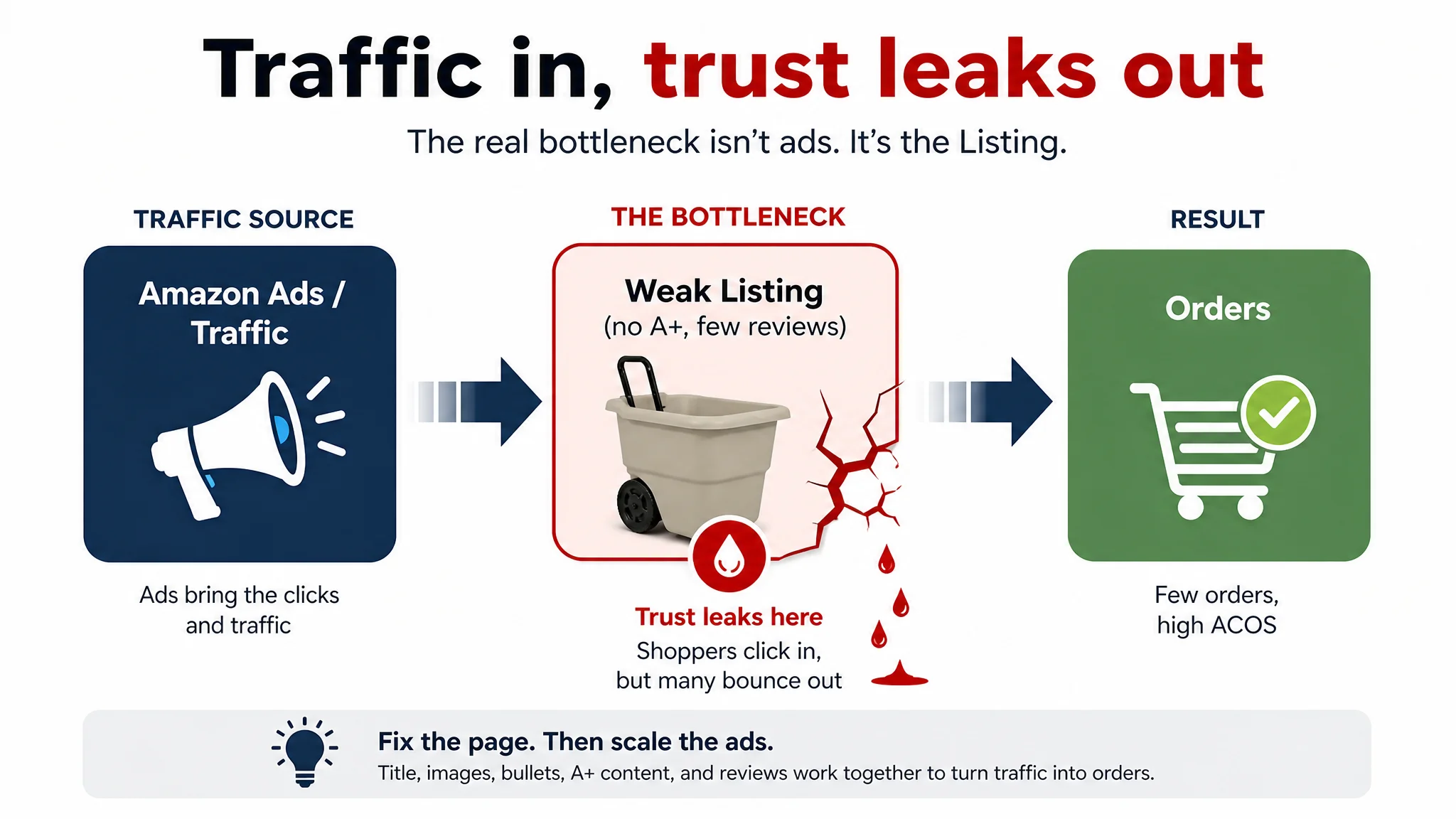
When we put the Listing into DeepBI’s scoring and benchmark system, a different picture emerged. Against a category-leading Amazon competitor, this garden cart Listing scored 44/100 while the benchmark was at 87/100. The biggest gaps were not in keywords or bids, but in A+ content (0 vs 22 points) and reviews (1 vs 14 points). In other words, the Listing itself had very limited conversion capacity: there was almost no storytelling underneath the fold, no trust layer, and almost no social proof. Ads were simply feeding more buyers into a page that could not persuade them.
The later optimization therefore did not start from “more traffic” but from rebuilding the product page: restructuring the title around outcome-oriented benefits and specific use scenarios, reframing the bullet points from feature lists into buying logic, and planning a full A+ module set that would visually prove durability, versatility, and lifestyle fit. Only once the page could carry a credible garden-cart story did ad traffic become useful again.
For other Amazon sellers, the core lesson is straightforward but uncomfortable: when your Listing’s conversion foundation is this weak, Amazon ads cannot “optimize” you out of the problem. Until the title, main images, bullets, A+ content, and review layer work together, each extra dollar of traffic is mostly an extra dollar of leakage.
The seller’s view: “We just need to push keywords harder”
This Amazon seller operates a garden cart on wheels (15‑gallon resin utility cart) in the US marketplace.
From their perspective, the symptoms looked like a classic advertising issue:
- Spending on Amazon ads was under pressure.
- Traffic volume was not the main bottleneck.
- Orders and revenue did not keep pace with the exposure they were paying for.
The team’s working assumption was:
“Our product is fine. Competitors are just bidding more aggressively and winning the clicks. If we improve keywords and bids, ACOS will come down.”
So they focused on:
- Expanding keyword coverage around “garden cart on wheels”, “yard cart”, etc.
- Adjusting bids and campaign structure to improve impression share.
- Trying to push more traffic into the same product page.
But the business state didn’t fundamentally change. They were pushing traffic into a page whose real problem they had never measured.
What DeepBI saw first: the Listing was not in the same league
Once the ASIN entered DeepBI’s Listing scoring and benchmark system, the gap to a directly comparable, high-performing Amazon competitor became very clear.
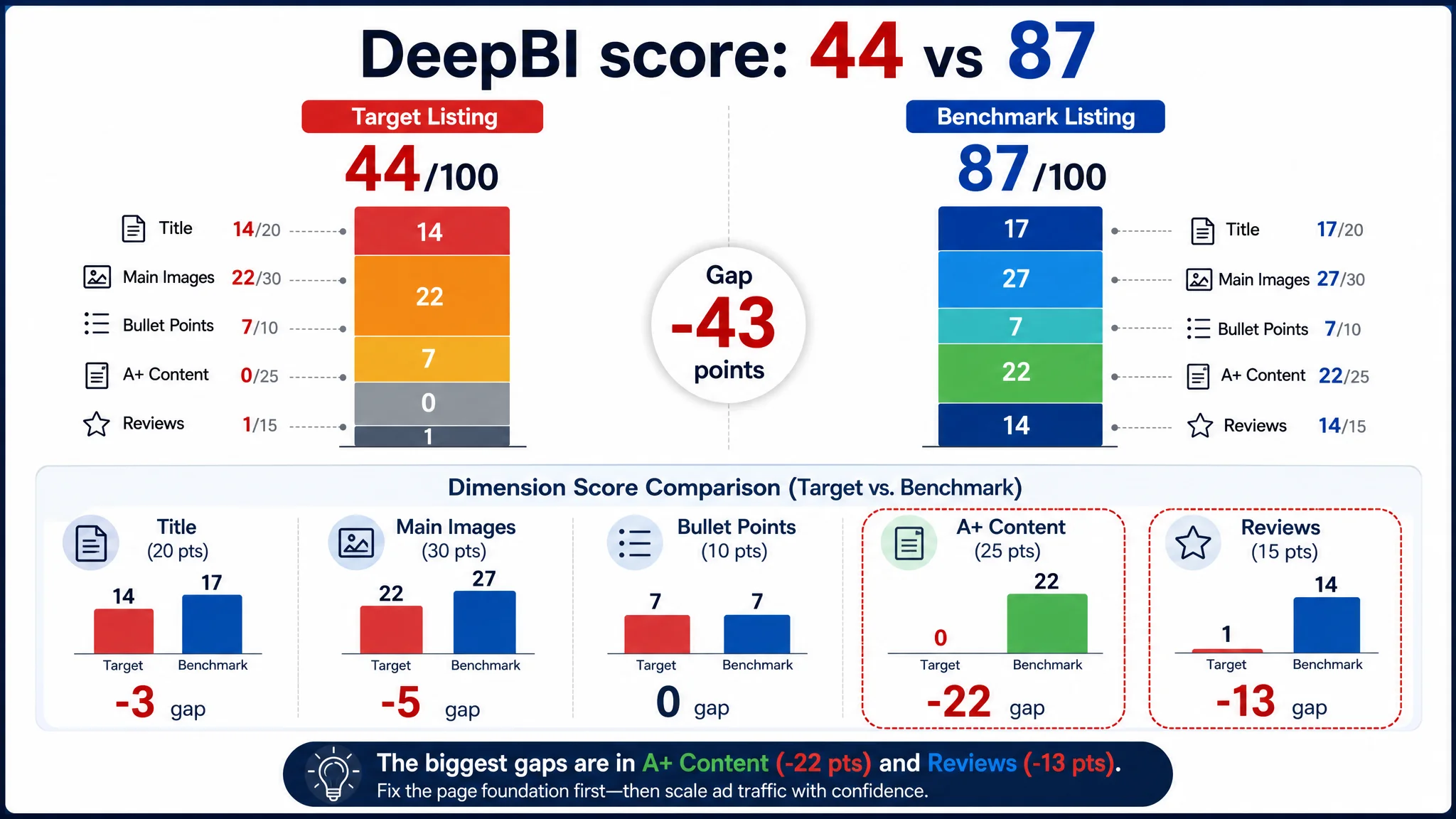
Overall score vs. benchmark:
- Target Listing: 44/100
- Benchmark Listing: 87/100
- Gap: –43 points
Breaking this down by core Amazon Listing dimensions:
- Title: Target: 14, Benchmark: 17, Full Score: 20, Gap: –3
- Main images: Target: 22, Benchmark: 27, Full Score: 30, Gap: –5
- Bullet points: Target: 7, Benchmark: 7, Full Score: 10, Gap: 0
- A+ / Detail page: Target: 0, Benchmark: 22, Full Score: 25, Gap: –22
- Reviews / Rating: Target: 1, Benchmark: 14, Full Score: 15, Gap: –13
Two things stand out immediately:
- The page has no A+ content at all (0/25) while the benchmark is strong at 22/25.
- Social proof is almost non‑existent (1/15) compared with a deeply established competitor.
Those two gaps alone explain why ad traffic was failing to convert: shoppers arrive, but there is no depth, no trust, and almost no proof that this cart will really solve their everyday hauling problems.
“The real problem was not that ads failed to bring traffic. It was that the page could not convert the traffic.”
Reviews: a trust gap that ads cannot compensate for
On Amazon, reviews and rating form a trust layer that directly influences conversion and also indirectly affects click behavior on the search results page.
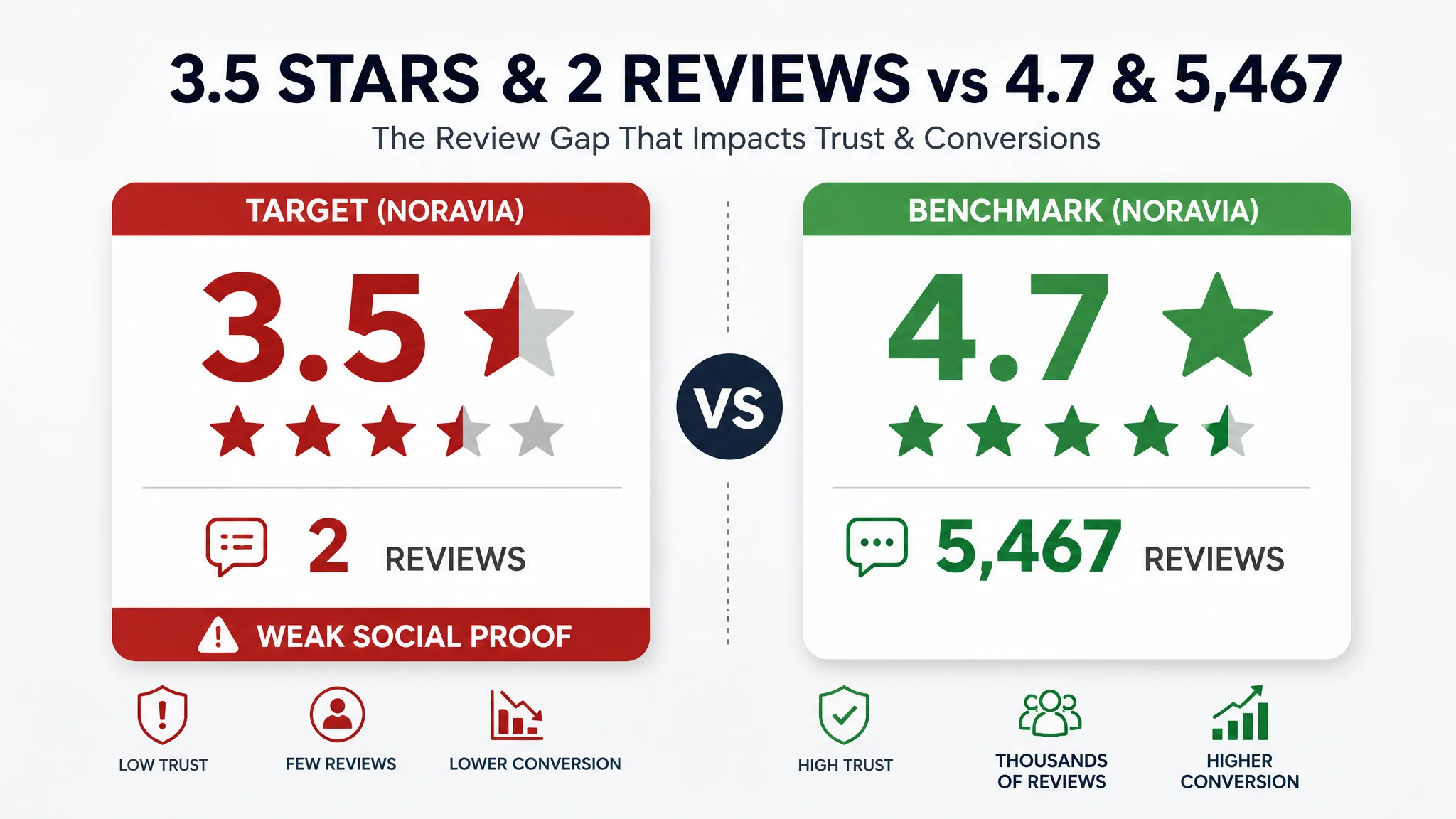
Review snapshot:
- Target Listing:
- Rating: 3.5 stars
- Total reviews: 2
- First page reviews: 2, with 50% of them at 3 stars (no strong social proof at all).
- Benchmark Listing:
- Rating: 4.7 stars
- Total reviews: 5,467
- First page reviews: 12, with no 3‑star or below comments visible.
From a buyer’s perspective:
- The competitor looks “proven” and safe: thousands of other customers have validated the product.
- The target Listing looks untested at best and risky at worst.
In such a context, pushing additional cold traffic through ads mostly amplifies the trust gap:
- ACOS becomes hard to control because many buyers exit at the review layer.
- Even if title and main image attract some clicks, the social proof layer blocks final conversion.
DeepBI’s conclusion at this stage: this product page does not deserve significant ad scale until its basic trust signals and narrative depth are repaired.
Title: function-heavy, buyer-outcome-light
At first glance, the target title did not score terribly (14/20 vs. 17/20), but the qualitative difference mattered.
The competitor leveraged a mature Amazon title structure:
- Brand + core term front-loaded: reinforces authority and search weight.
- Clear target user: “for Seniors” – immediately signaling fit for an important demographic.
- Outcome‑oriented benefits: “Lightweight”, “Easy Mobility”.
- Trust signals: “Made in the USA”.
- Concrete, life‑specific scenarios: “Firewood & Laundry”.
By contrast, the target title:
- Front-loaded the core term “Garden Cart on Wheels” correctly.
- Listed functional attributes: “Durable Resin”, “Adjustable Handle”.
- Used broader, less concrete scenes: “Gardening, Lawn and Home Hauling”.
- Lacked any country-of-origin or similar trust badges.
- Did not speak directly to a specific user group (e.g., seniors, family use), so it felt generic.
The result: the title was descriptive, but not decisive. It would appear in relevant searches but did less work to:
- Differentiate the cart.
- Promise an outcome.
- Signal that it is easier, lighter, and safer to use than other options.
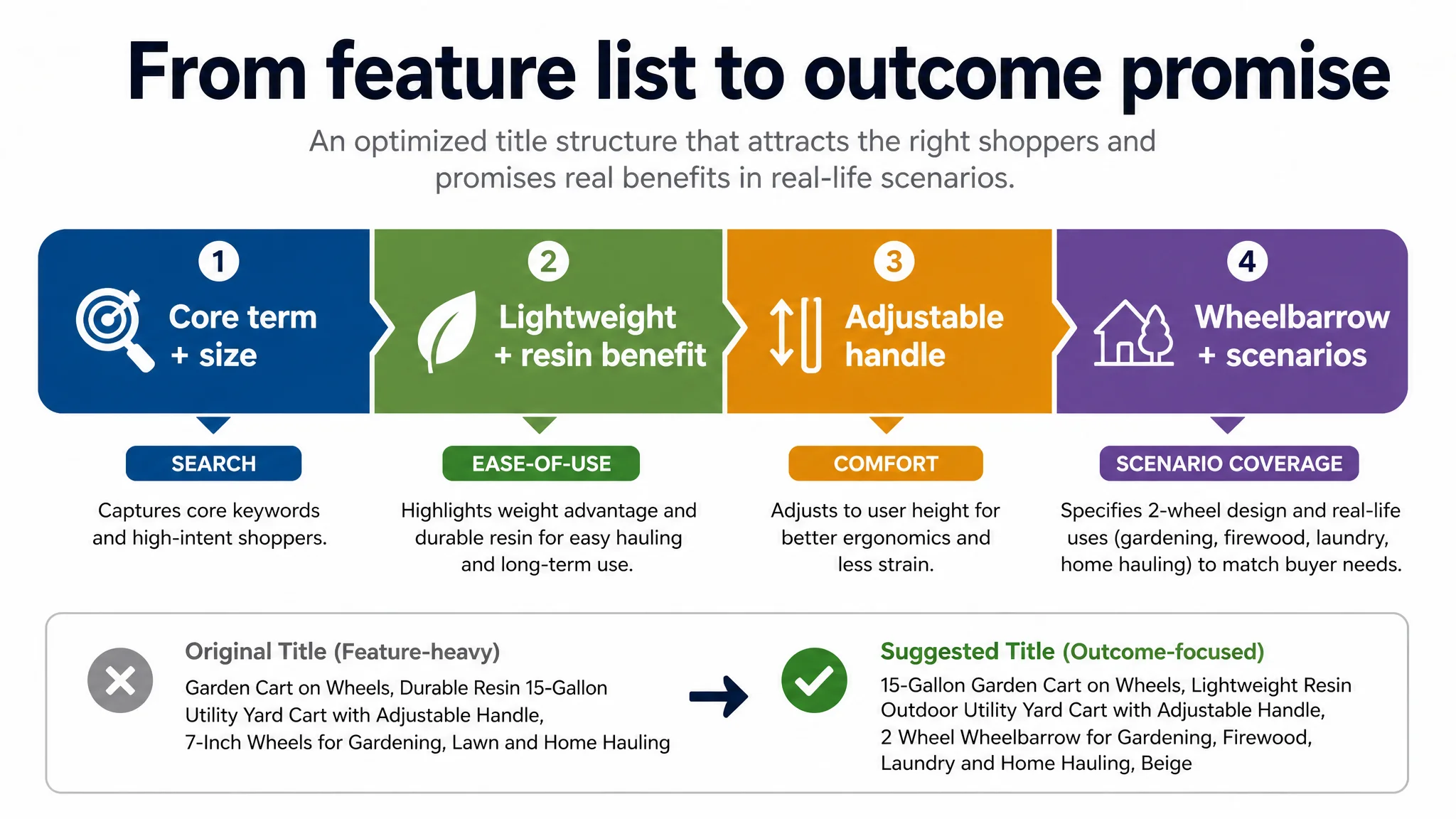
DeepBI’s recommended title direction kept the core product facts but reframed the logic:
15-Gallon Garden Cart on Wheels, Lightweight Resin Outdoor Utility Yard Cart with Adjustable Handle, 2 Wheel Wheelbarrow for Gardening, Firewood, Laundry and Home Hauling, Beige
Key shifts in judgment behind this proposal:
- Reinforce search relevance and scenario coverage:
Add “Wheelbarrow” and concrete scenes like “Firewood” and “Laundry” to capture more mid‑tail search intent and match what the benchmark was already converting on.
- Move from pure features to benefit-linked features:
“Lightweight” combined with “Adjustable Handle” positions the cart as easy and comfortable for seniors and adults to maneuver.
- Respect Amazon’s title constraints:
Keep essential attributes while staying within length limits and ensuring that key selling points appear early on mobile.
Main images: enough product, not enough story
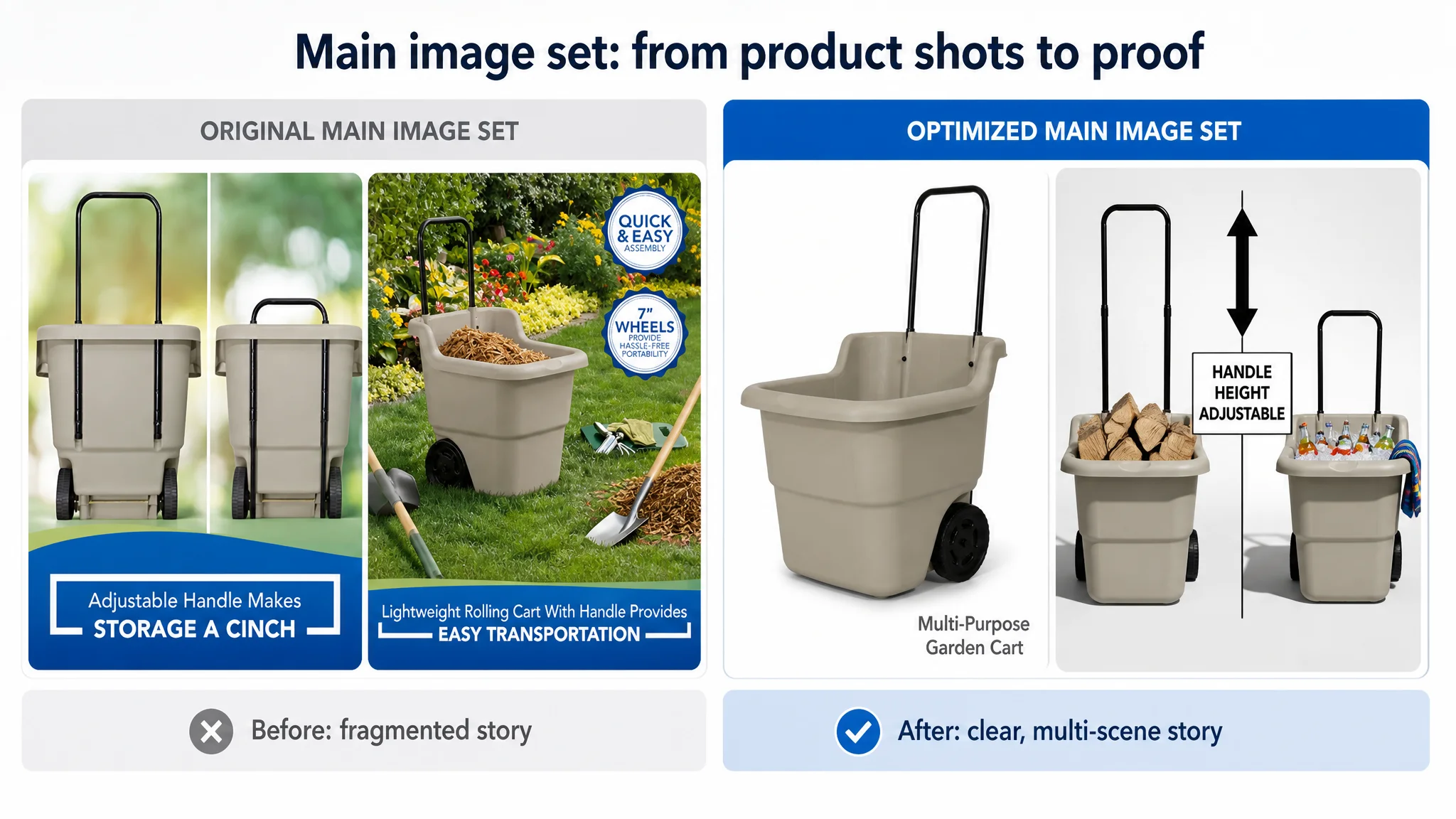
On the main-image set, the score gap (22 vs. 27) looks modest, but the qualitative impact on CTR and CVR is large.
The competitor’s gallery worked like a visual funnel:
- Person-in-scene images to show scale and ease of movement.
- Technical graphics to clarify assembly, durability, and material.
- Multiple lifestyle scenes: hauling firewood, laundry, washing the car, etc.
- “Made in USA” and quality cues embedded visually.
The target Listing’s images:
- Lacked dynamic human presence and lifestyle context.
- Did not visually prove “tool‑free assembly” or long‑term durability.
- Didn’t fully exploit the cart’s multiple-use potential (firewood, laundry, car‑washing).
- Provided limited support for a higher perceived value or “professional” impression.
So while the product was shown, the story was not:
“The main image set did not lack pixels. It lacked reasons to click and reasons to trust.”
DeepBI’s image-level recommendations (summarized):
- Main hero image:
Center the product at a 45° side view, 75% frame coverage, strong white background, controlled shadow – to maximize clarity and click appeal on search results.
- Adjustable-handle image:
Use split-screen composition showing extended vs. folded handle with arrows and “Handle Height Adjustable” text to make ergonomics immediately understandable.
- Loaded garden scene:
Outdoor grass background, cart visibly filled with mulch and surrounded by tools – to prove real loading capacity and professional use.
- Firewood scene:
Warm, evening patio setting with the cart full of neatly stacked logs and an overlay “High Load Capacity” – connecting durability to an emotionally appealing life scene.
- Car-wash / cleaning scene:
Cart filled with foam, sponge in foreground, bright and clean environment – to visually expand use cases beyond gardening.
Underlying logic:
- Bring in humans and realistic load to communicate scale and ease of use.
- Turn abstract claims (“durable”, “multi‑purpose”) into specific visual proof.
- Align with what the benchmark already does well, but without copying: same types of scenes, different execution, same decision logic.
Bullet points: information existed, buying logic did not
On paper, both the target Listing and the benchmark scored 7/10 on bullet points. The word count and basic structure were not the issue. The structure and psychological path were.
The competitor’s approach:
- Opens from user profiles (adults, seniors, kids) – human-centered.
- Repeats “lightweight” and “compact” as core themes.
- Anchors trust with “Made in the USA” as an independent bullet.
- Uses each bullet as part of a progression: ease of use → versatility → storage → durability → trust.
The target Listing:
- Focused on capacity, movement, ergonomics, durability, and scenarios.
- Treated each bullet as an independent feature statement.
- Did not fully connect features to buyer pain points or outcomes.
- Did not carve out a dedicated trust bullet (origin, quality stance, etc.).
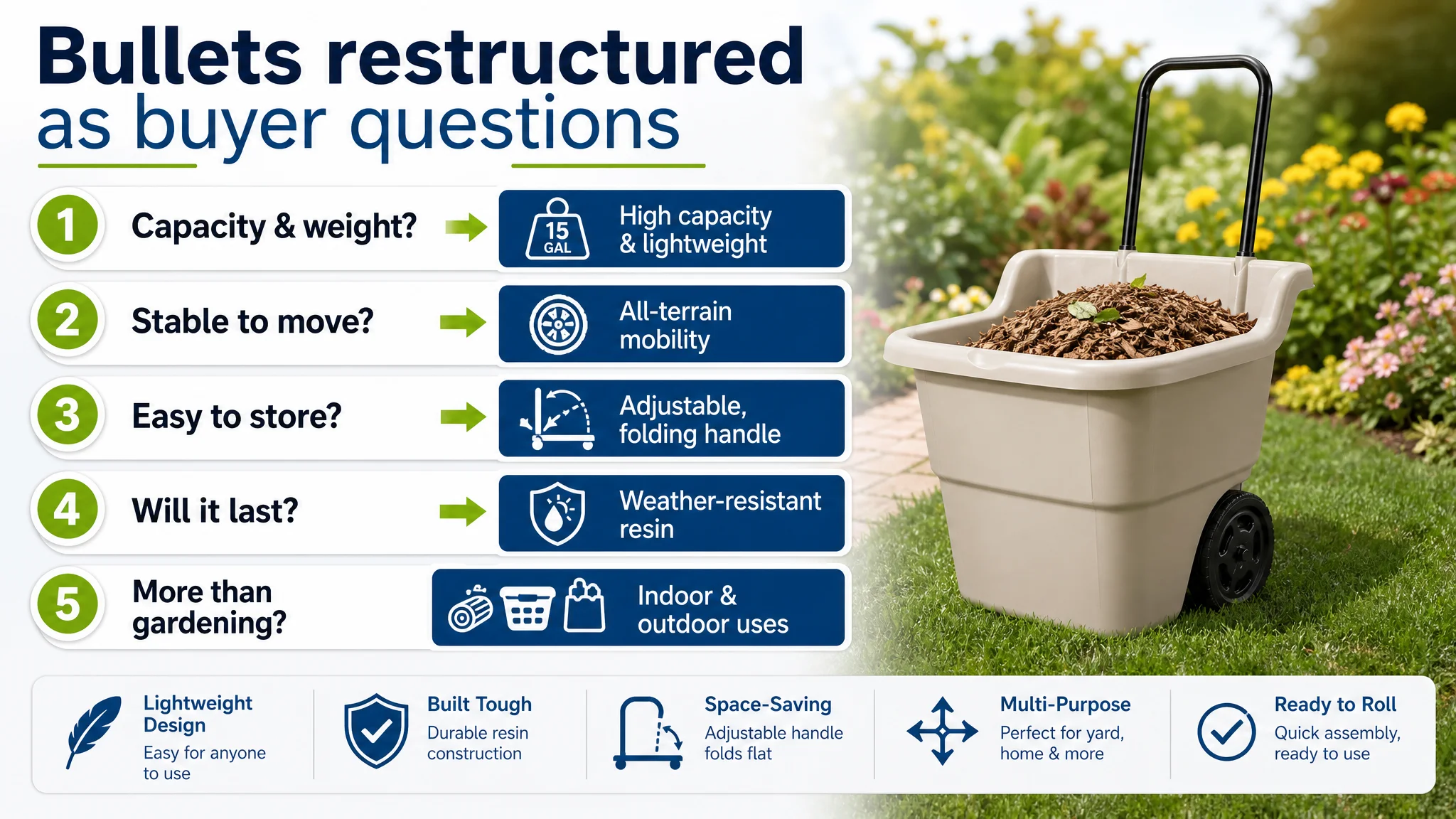
DeepBI’s optimization reframed the bullets into named, benefit-first blocks that mirrored real purchase questions:
1. Can this cart really handle my yard work without being too heavy for me?
→ “HIGH CAPACITY & LIGHTWEIGHT HAULER” with explicit 15‑gallon / ~250 lbs framing, connecting high load with ease of maneuver for seniors and adults.
1. Will it feel stable and manageable on uneven ground?
→ “SUPERIOR MOBILITY ON ALL TERRAINS” emphasizing the two 7‑inch wheels, low center of gravity, and reduced tipping risk.
1. Can I store it easily when the yard work is done?
→ “SPACE-SAVING ADJUSTABLE HANDLE” explaining how the folding handle fits into tight garages/sheds/closets.
1. Will it survive outdoor conditions over time?
→ “WEATHER-RESISTANT & LOW MAINTENANCE” detailing rust‑proof resin and easy cleaning vs. metal alternatives.
1. Is it worth buying for more than just gardening?
→ “VERSATILE INDOOR & OUTDOOR PARTNER” listing firewood, groceries, laundry, party supplies, etc.
That shift turns bullet points from a feature checklist into a short, structured persuasion path that supports both ad traffic and organic traffic.
The real constraint: a page with zero A+ depth
In DeepBI’s scoring, the most decisive weakness was the detail-page dimension:
- Target Listing: 0/25
- Benchmark Listing: 22/25
The competitor’s A+ content included:
- Brand scene hero image in a landscaped yard.
- Product family comparison to position the cart inside a broader lineup.
- Functional graphic modules with icons like “Built To Last” and “Sustainability”.
- Lifestyle scenes (family, backyard relaxation) to attach the product to a desirable way of living.
- Clear “Made in USA” badges and a “We Stand for Quality” statement.
The target Listing:
- Had no A+ modules at all.
- Presented no structured visual explanation of:
- How it solves “backyard clutter” or “junk in the yard” problems.
- How durable the resin is over sun, rain, and seasons.
- How this cart fits into family life beyond moving soil.
So once a visitor scrolled past the bullets, the page simply ran out of persuasion.
“This product page did not lack traffic. It lacked a second and third layer of trust.”
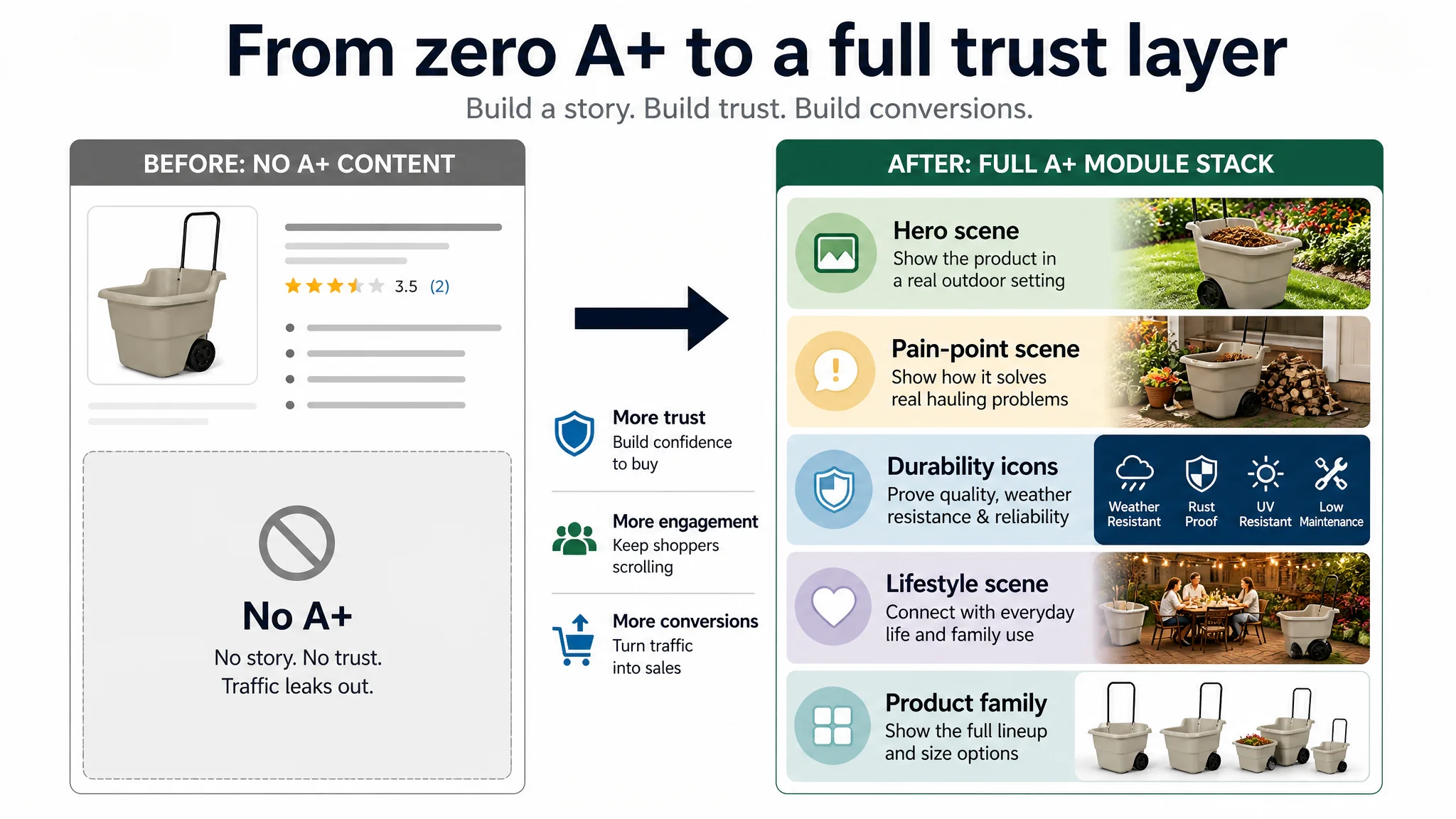
DeepBI’s A+ redesign logic focused on five modules:
1. Outdoor hero introduction
- Cart at 45° top-down angle on a freshly trimmed lawn.
- Large left-side space for brand logo and concise category positioning.
- Clean natural light to immediately anchor the product in a tidy yard context.
1. Pain-point scene: hiding clutter
- Show the cart in a role similar to “organizing outdoor mess”: hiding tools, covering up HVAC units or messy corners.
- Real wall + flowers background to prove it beautifies rather than adds plastic clutter.
1. Durability icon strip
- Deep blue panel with four white line icons: “All‑Weather Use”, “Corrosion Resistant”, “UV Resistant”, “Low Maintenance”.
- Each icon labeled clearly for fast scanning during quick scrolls.
1. Lifestyle scene
- Family on a wooden deck in a modern backyard, cart visible in mid‑background as part of the environment.
- Warm dusk light to connect the cart to relaxed, quality outdoor time, not just work.
1. Product family / cross-sell matrix
- White background lineup of related garden products (various sizes of carts / garden accessories).
- Consistent lighting and spacing to communicate a professional, coherent product system.
This is not “decoration.” It’s a deliberate attempt to:
- Rebuild the missing trust layer the benchmark already had.
- Answer unspoken objections (durability, aesthetics, storage, versatility) with visual logic.
- Increase page dwell time and depth, signals that Amazon’s algorithm does correlate with conversion quality.
Why DeepBI did not recommend “fix ads first”
From a business-risk perspective, continuing to iterate ads on top of a 44/100 Listing would have meant:
- Paying to send buyers into an unfinished funnel.
- Training the algorithm on a weak conversion page, which can depress ad relevance and effective CPC over time.
- Mistaking media efficiency issues (ACOS) for creative/keyword issues when the real constraint is page persuasion.
DeepBI’s judgment was:
1. The core bottleneck was page conversion capacity, not traffic volume.
The data supported this: 0/25 A+ depth, 1/15 review strength, visual and textual gaps vs. an 87/100 benchmark Listing.
1. Ads would only start working again when the page started doing its job.
Fixing title, bullets, image set, and A+ content would give both organic and paid clicks a real chance to convert.
1. Listing optimization had to come before aggressive ad scaling.
Otherwise, every incremental ad dollar would just inflate leakage.
So the operating sequence became:
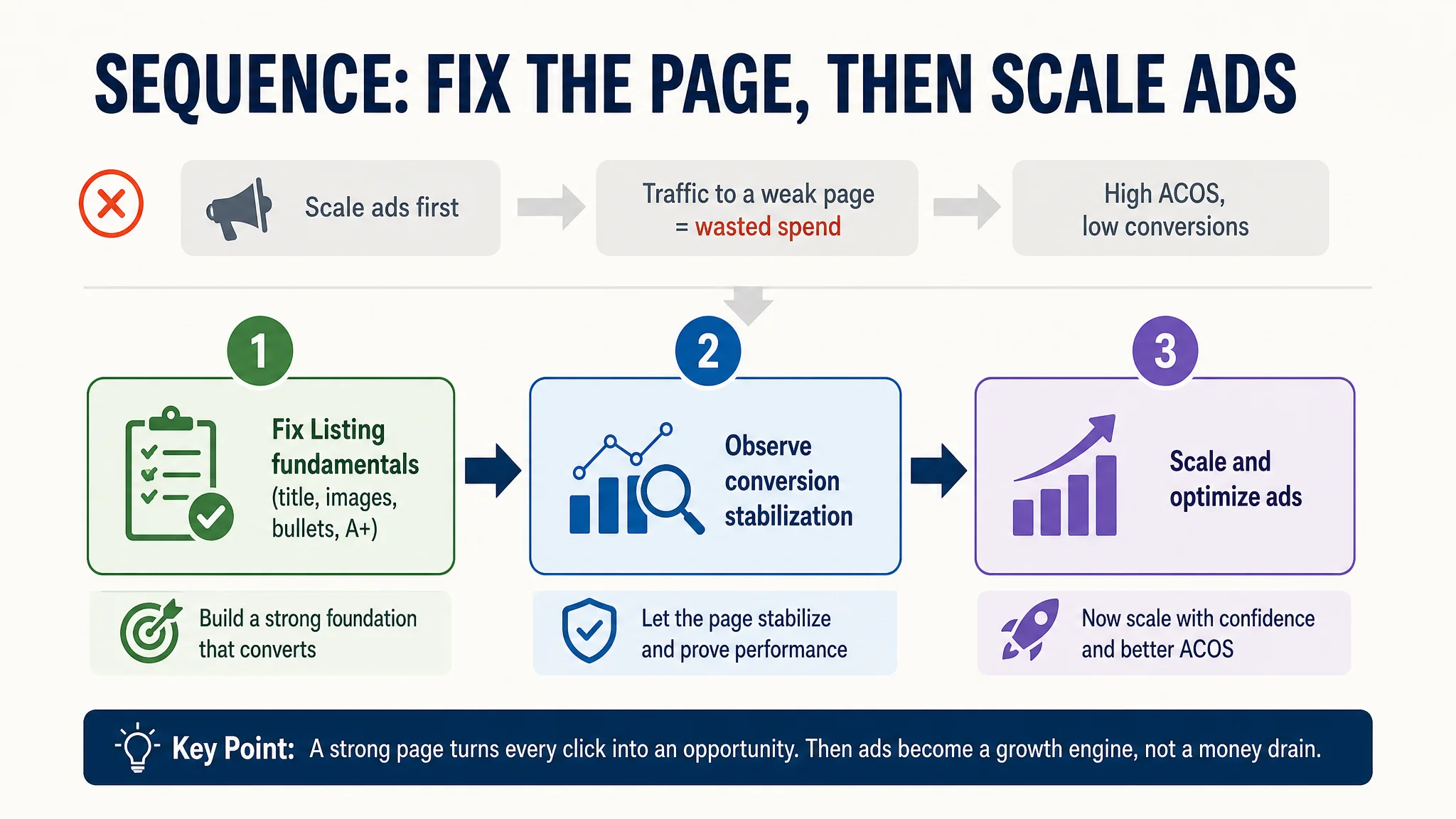
- Phase 1: Rebuild Listing fundamentals (title, bullets, main-image set, A+ modules) against the benchmark.
- Phase 2: Let the updated page stabilize organic and paid conversion.
- Phase 3: Re‑evaluate ad structure and scaling now that the funnel is not fundamentally broken.
What changed for the seller – even before new numbers
Even without inventing post‑optimization performance numbers, we can describe the shifts in business state and understanding:
- Listing conversion capacity improved
The page moved from “no A+ and almost no trust” to a structured story about capacity, ease of use, durability, and lifestyle value.
- Ad traffic became meaningful again
Once the title, images, bullets, and A+ were coherent and persuasive, each paid click had a better chance to turn into an order instead of a bounce.
- Organic and paid traffic were no longer fighting each other
Previously, any organic ranking gains were not fully monetized due to low trust and thin content. After optimization, both traffic types now fed into a page with real persuasion depth.
- Operational risk decreased
The seller was less exposed to volatility from small bid changes because the underlying page conversion no longer sat at such a fragile level.
- The team’s mental model shifted
They stopped treating high ACOS as primarily a bidding problem and started seeing it as a signal that the Listing itself was under‑qualified relative to the benchmark.
Takeaways for other Amazon sellers
Several lessons from this garden cart case generalize beyond the category:
1. Ads cannot repair a structurally weak Listing
When A+ is missing, reviews are thin, and images do not tell a complete story, every extra click is mostly amplified leakage.
1. Benchmarking matters more than internal opinion
This Listing did not look “broken” to the seller – until they saw an 87/100 competitor and a –43 gap across title, images, A+, and reviews.
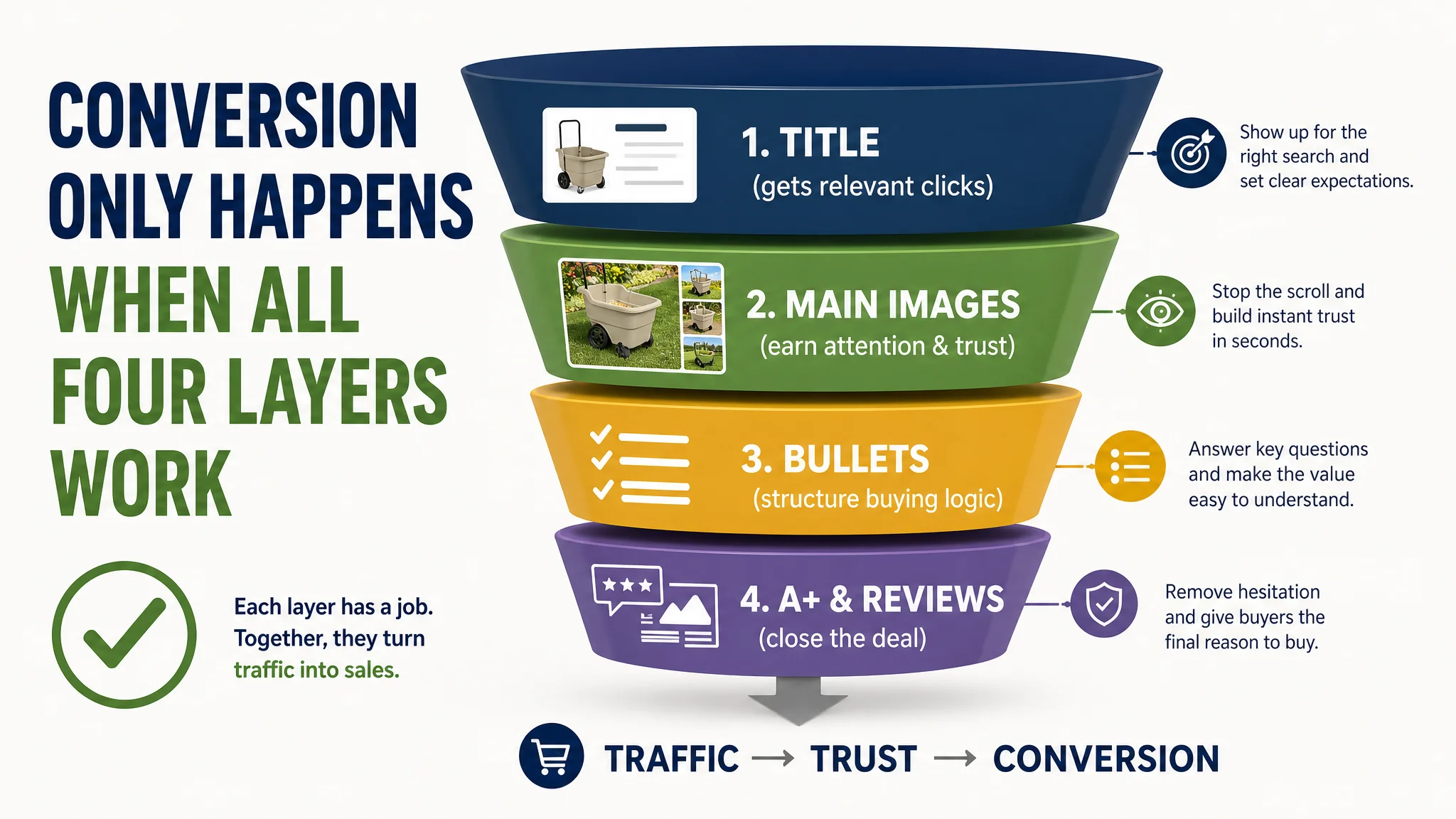
1. Title, images, bullets, and A+ must support one another
- Title attracts the right searchers and sets expectations.
- Main images get the click and visually prove core claims.
- Bullets organize buying logic around real questions.
- A+ content and reviews provide the final persuasion and risk reduction.
1. Before scaling ads, ask if the page deserves more traffic
DeepBI’s approach is to treat Listing scoring as a precondition for ad scaling: if the page’s conversion foundation is far below benchmark, fix that first.
1. Business judgment is the real edge
What made a difference here was not just the ability to generate better copy or images, but the decision to reframe the problem from “ads are failing” to “the product page is consuming the traffic.”
For Amazon sellers facing rising ACOS and stagnant orders, this case is a reminder: the first lever is often not in the campaign console, but in the product page itself.