

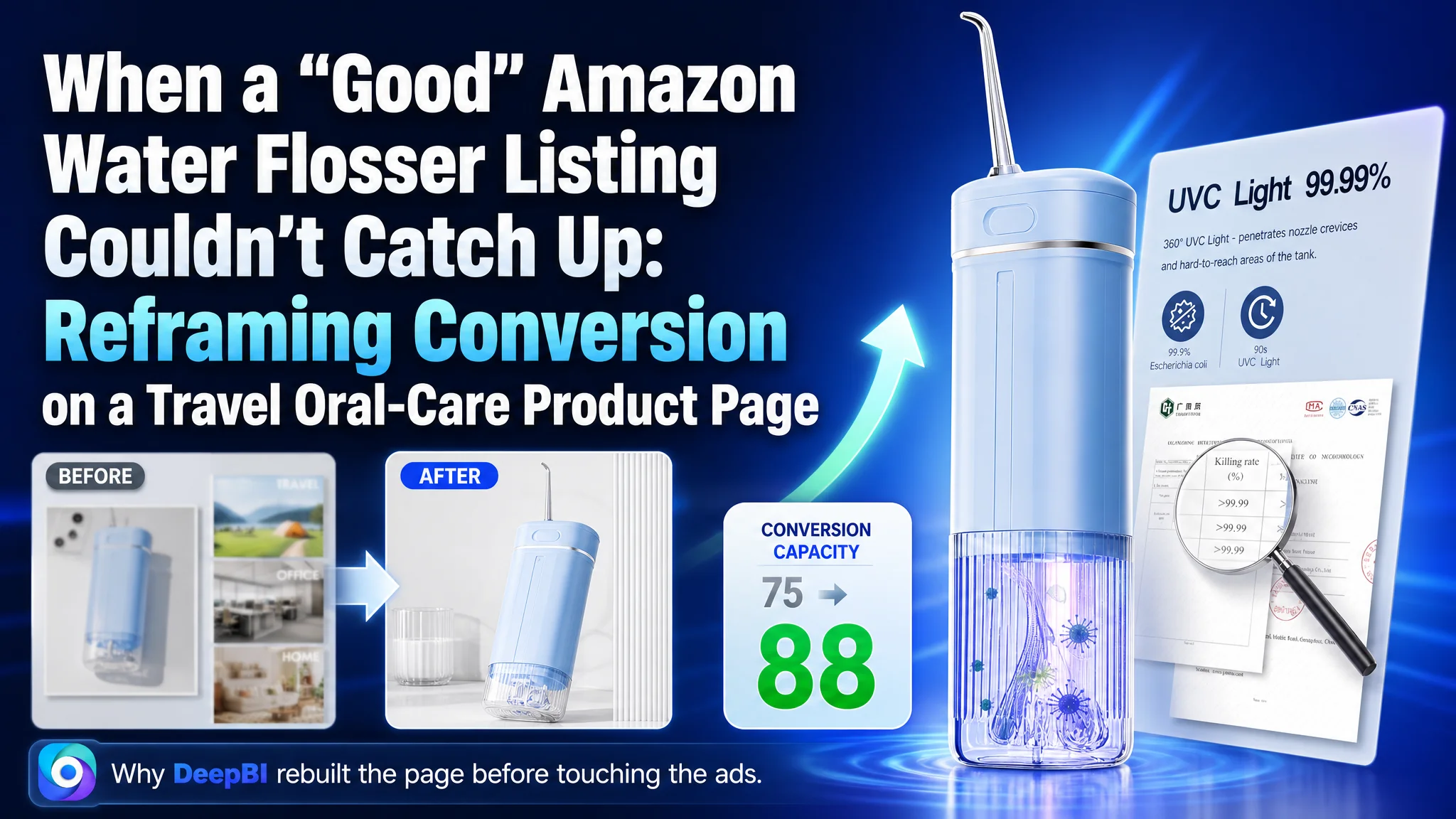
This case comes from an Amazon US seller in the portable oral-care category (mini cordless water flosser). On paper, the product looked competitive: a 225ML tank, sterilization mode, 8 tips, decent ratings. The team believed the main problem was traffic and reviews, so they kept trying to “push harder” with ads and accumulate more social proof.
DeepBI’s Listing diagnosis showed a different picture. Against a leading benchmark water flosser, this Amazon Listing was not losing because of product capability, but because the page could not tell a coherent, credible story. The title underused the core “water flosser” keyword, the bullets were parameter-heavy but user-light, A+ content lacked real user validation and lifestyle immersion, and the visual modules failed to express the one thing that truly differentiated the product: “portable yet bigger tank with sterilization”.
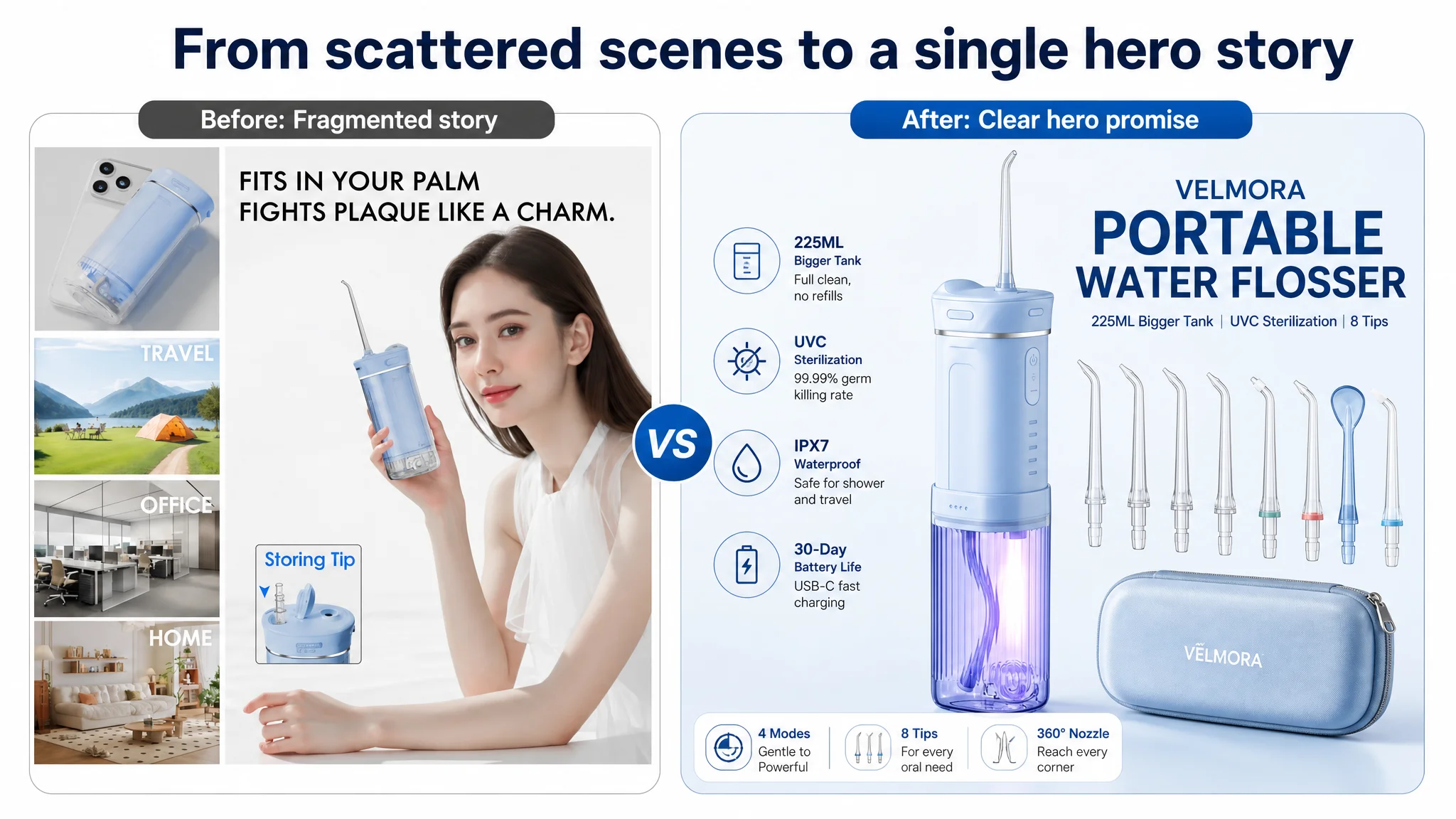
The later optimization therefore did not start with more campaigns or bid logic. It started by restructuring the Amazon product page itself: repositioning the title, rebuilding main images around “portable + 225ML + sterilization”, rewriting bullets with user scenarios and outcomes, and upgrading A+ into a full decision path rather than a set of technical posters. The lesson for other Amazon sellers: when a product is objectively strong yet struggles to out-convert a benchmark, the constraint is often not “bad ads” but a Listing that doesn’t turn traffic into trust.
The Real Problem Was Not Traffic. It Was How the Listing Used It.
Looking at the category from the outside, the seller’s portable water flosser should have been a strong player:
- 225ML water tank (larger than many compact competitors at ~180ML)
- Unique sterilization mode and UVC disinfection capability
- 8 nozzles covering more oral scenarios than common 6-nozzle sets
- 4.5-star rating, all front-page reviews at 4 stars and above
Yet when DeepBI benchmarked this Amazon Listing against a category-leading competitor, the total Listing score told a clear story:
- Target Listing: 75 / 100
- Benchmark Listing: 88 / 100
- Gap: -13 points
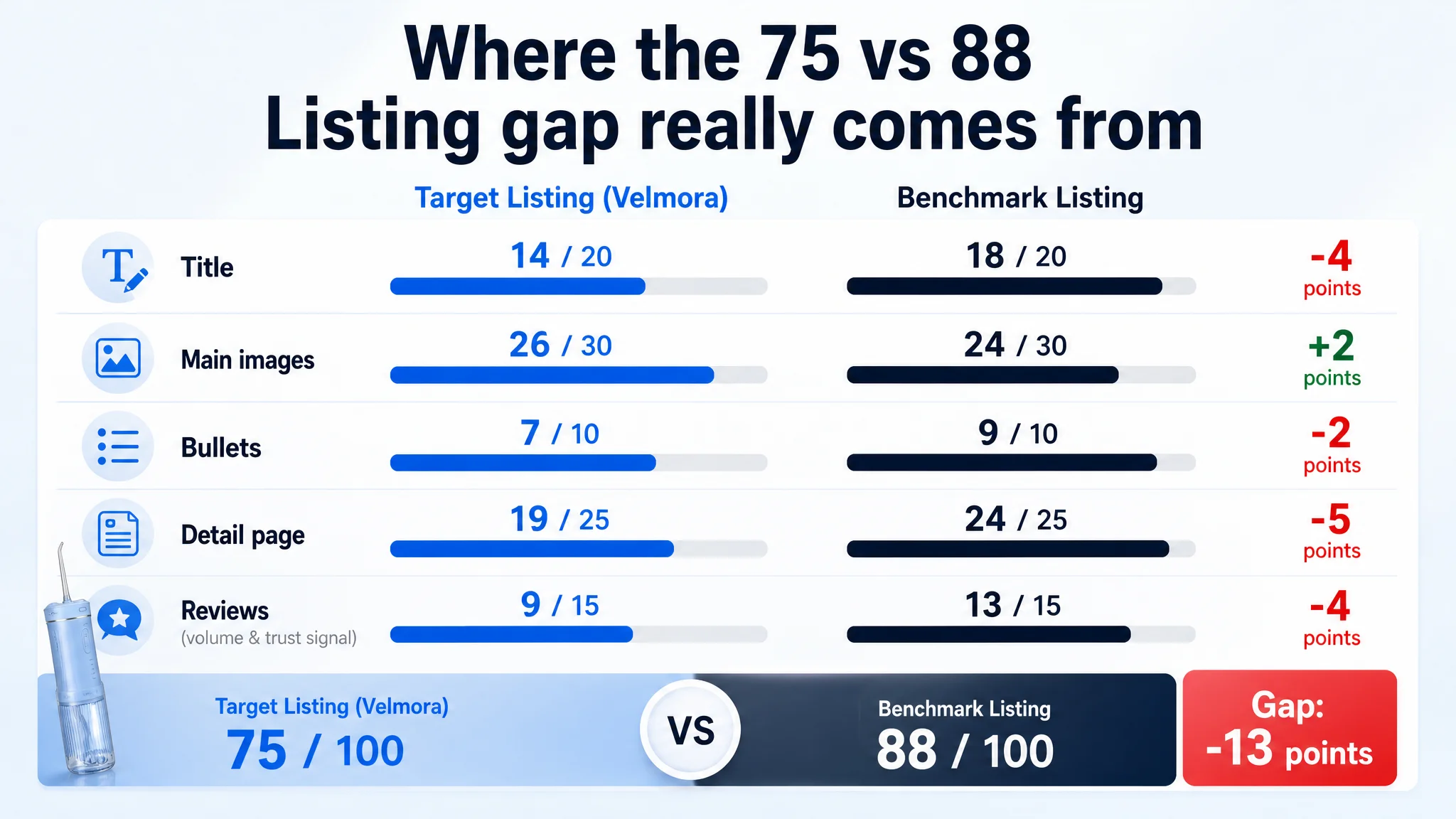
The gap was not evenly distributed:
- Title: -4
- Main image set: +2 (slightly better but misallocated)
- Bullet points: -2
- Detail page (A+): -5
- Reviews (volume & trust signal): -4
So while the product itself had several objective strengths, the Amazon product page was not generating enough trust and purchase logic compared with the benchmark that dominated the category.
“The real problem was not that ads failed to bring traffic. It was that the page could not convert the traffic.”
From a business perspective, this is dangerous: every incremental dollar of Amazon ads would be poured into a Listing that is structurally weaker than the benchmark at converting undecided shoppers.
How the Seller Originally Misdiagnosed the Problem
From the seller’s side, the surface data was easy to misread:
- Rating 4.5 vs competitor 4.4
- Zero visible negative reviews on the first page
- Feature set at least as rich as the benchmark (and in some dimensions better)
The internal narrative was roughly:
- “Our product spec is strong; our rating is slightly better.”
- “The competitor wins because they have way more reviews and a longer sales history.”
- “To compete, we need more traffic and more reviews; we’ll rely on ads + Vine to catch up.”
So the operating focus became:
- More ad exposure on core keywords
- Increasing review volume over time
- Occasional visual tweaks, but no structural rethink of the Listing’s sales logic
This is the classic pattern: treating a conversion problem as a volume problem. As ad costs rise, such a diagnosis traps the team in ever-growing ad spend, while the underlying page remains suboptimal at turning visits into orders.
Why Traditional Optimization Was Not Moving the Needle
Even without full ad-report data in this case, the structural risk is obvious to any Amazon operator:
- Benchmark Listing converts better at the same keyword position
- Benchmark accumulates more verified reviews faster
- Benchmark sends stronger trust signals in A+ and images
In that environment, “add more ads” produces three side effects:
1. Weak ROAS / high ACOS
You are paying to compete head-on for the same search intent while sending shoppers to a page with weaker persuasion.
1. Slower organic growth
Because the page converts less efficiently than the benchmark, it struggles to defend or gain front-page organic positions, no matter how much paid traffic it receives.
1. Review gap persists
The benchmark’s higher conversion rate means every unit of traffic yields more orders and thus more potential reviews. The review gap remains or even widens despite your efforts.
DeepBI’s perspective: until the Listing’s conversion capacity is repaired, optimizing bids and keyword trees cannot fundamentally change the competitive position of the ASIN.
What the Listing Score Exposed: A Conversion-Capacity Problem
DeepBI’s Listing scoring and benchmark comparison made the constraint clear:
The Amazon Listing did not lack product strengths. It lacked a clear, credible buying logic that matched the benchmark’s sophistication.
1. Title: The Core Keyword Was Sacrificed
On Amazon, the title must work for both the algorithm and human scanning.
- Benchmark:
- Structure: Brand + “Water Flosser” + “Mini Cordless Portable” + 5 Modes + Telescopic Water Tank + IPX7 Waterproof + Use Cases (Orthodontic, Braces, Gums)
- “Water Flosser” appears early, locking core search intent.
- Clear enumeration of modes, tank design, and waterproof capability.
- Target Listing:
- Led with “225ML” and “Long-Lasting Endurance”, pushing the core keyword “Water Flosser” back.
- This diluted the weight on the main product term and made the title less search- and scan-friendly.
Although capacity and endurance are strong selling points, the structure made them compete with — rather than support — the core “portable water flosser” identity.
DeepBI’s revised direction:
- Front-load “Portable Water Flosser Mini Cordless Oral Irrigator”
- Integrate 225ML, 8 Tips, IPX7 Waterproof, Long Battery Life as structured secondary information
- Clean symbol usage to improve readability
This reframing doesn’t invent new features; it reorders them to align with how Amazon’s algorithm and shoppers both read titles.
2. Main Images: Strong Assets, Weak Focus
Surprisingly, the target Listing slightly outscored the benchmark on the main image dimension, but this was misleading. The problem was not image quality; it was what those images chose to emphasize, and in what order.
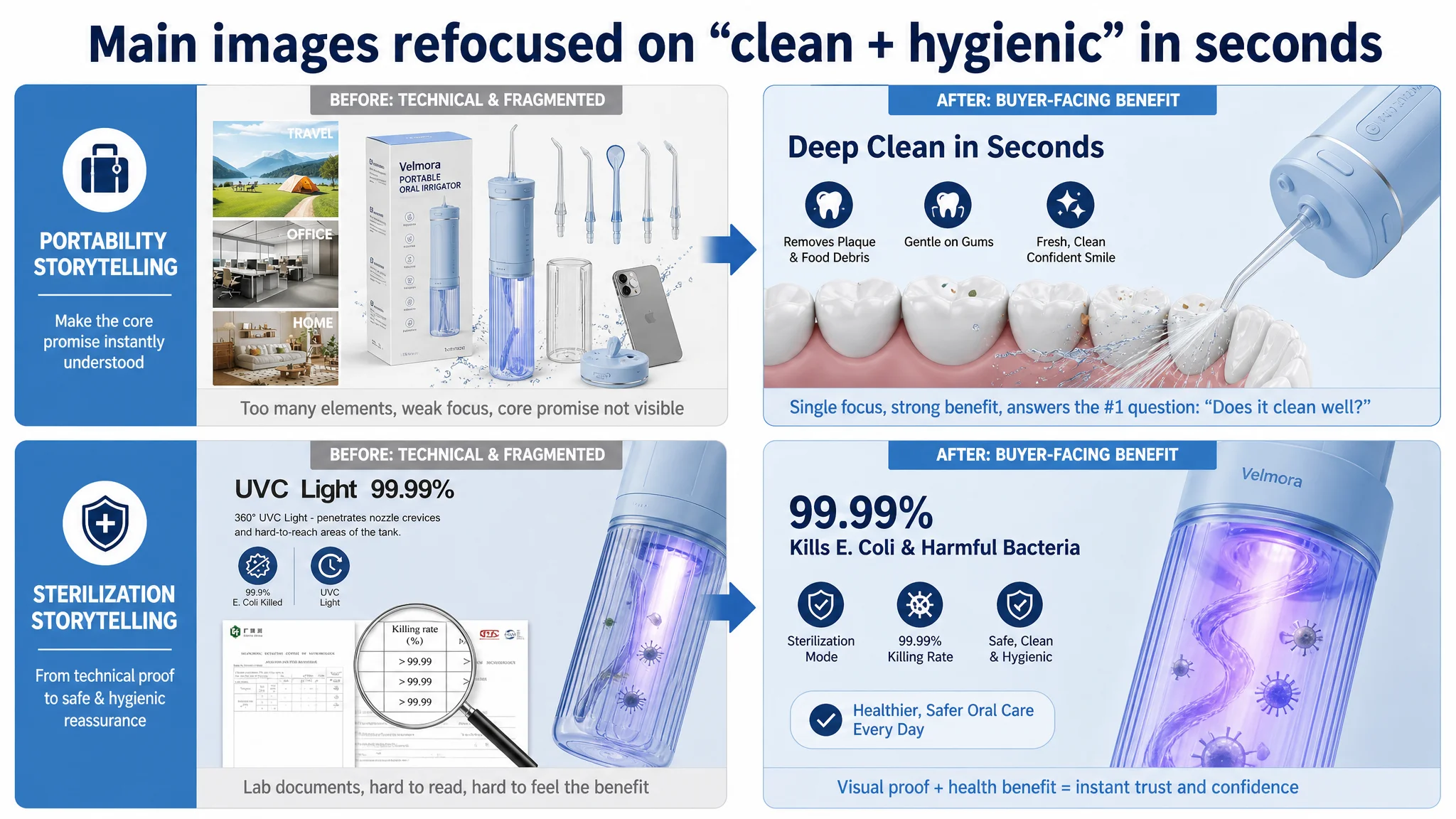
Key issues:
- No clear hero message in image 1
- Too many elements: box, toothbrush, multiple nozzle cases, splashes, main device.
- No dominant visual anchor or core promise.
- The one decisive differentiator — “portable yet 225ML” — was invisible.
- Image 2 overloaded with fragmented scenes
- Six mini-scenes (travel, office, at home, phone comparison, nozzle storage, hand-holding).
- Each too small to create impact or a clear takeaway like “perfect for travel” or “fits in any bag”.
- Sterilization mode visually framed as technical, not reassuring
- The UVC disinfection image leaned academic: “360° UVC” + lab-like report.
- It spoke in technical proof rather than buyer outcomes like “no secondary contamination” or “healthier, safer oral care on the go”.
- Gravity-ball structural explanation pushed into a prime slot
- Explaining why it can spray at any angle is valuable, but it competes with more urgent decision questions:
- Does it clean well for my specific use (braces, sensitive gums)?
- Is it really portable yet has enough water for one full-use?
- Is it durable and waterproof enough for daily use and travel?
In contrast, the benchmark used each of its 6 images to carry one clear promise: ultra-portable design, water modes by user type, tank + storage, waterproofing and durability, staying organized while traveling, etc.
“Advertising does not only amplify advantages. It can also amplify a page’s existing defects.”
If ad traffic lands on a visually fragmented story, shoppers leave with “many details, no clarity.”
3. Bullet Points: Parameters Without a Buying Path
On Amazon, bullets often decide whether a reader scrolls further or bounces.
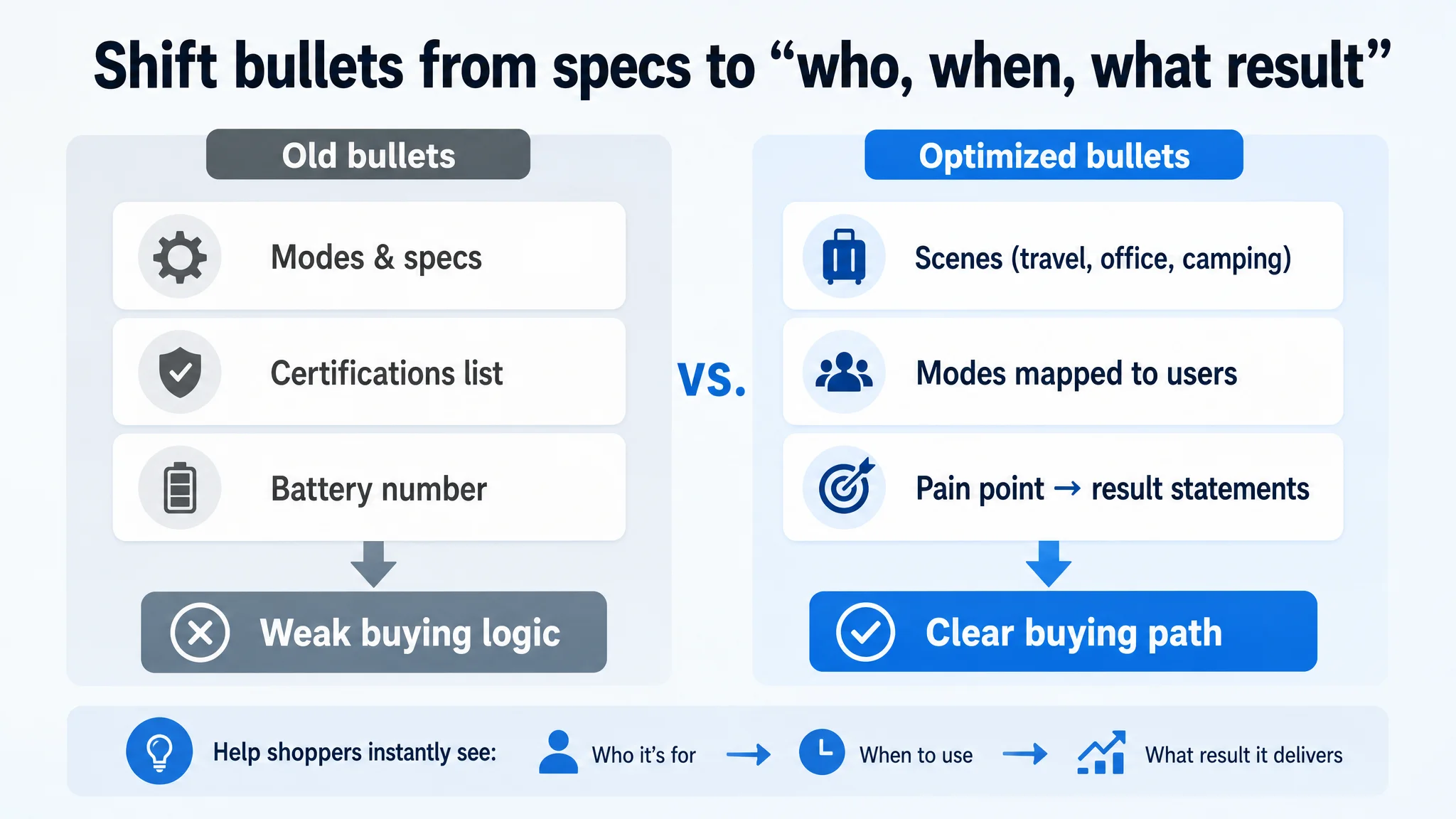
- Benchmark bullets start from user scenarios:
- Ultra-portable for travel, commuting, home, camping
- Different pressure modes tied to specific user groups: children, sensitive gums, orthodontic care
- Battery life explicitly framed for “30 days of trips and business travel”
- Water tank design and storage bag solving concrete annoyances (finding the right cable, losing nozzles)
- Target bullets start from functions and parameters:
- Mode functions and safety certifications
- Technical description of micro-waterfall system
- Battery life and portability explained, but not tied strongly to specific people or moments
- Pain points (frequent refilling, cleaning difficulty, lost nozzles) barely surfaced
So instead of:
“If you travel often and hate recharging or refilling, this is the compact flosser that actually lasts 30 days and cleans your whole mouth on one fill.”
readers see:
“4 modes, micro-waterfall technology, long battery life, IPX7 waterproof.”
Technically correct, commercially underpowered.
4. A+ Detail Page: Dense Function, Thin Trust
In the detail section, the benchmark Listing built a complete persuasion structure:
- Brand-first intro with consistent color and high-end visuals
- Real human usage scenes across contexts
- Explicit modes, nozzles, and design details tied to outcomes
- Data and user testimony: global user numbers, “97% users agree…”, named user quotes
- FAQ and lifestyle imagery: how to use, where it fits in life, what people actually say
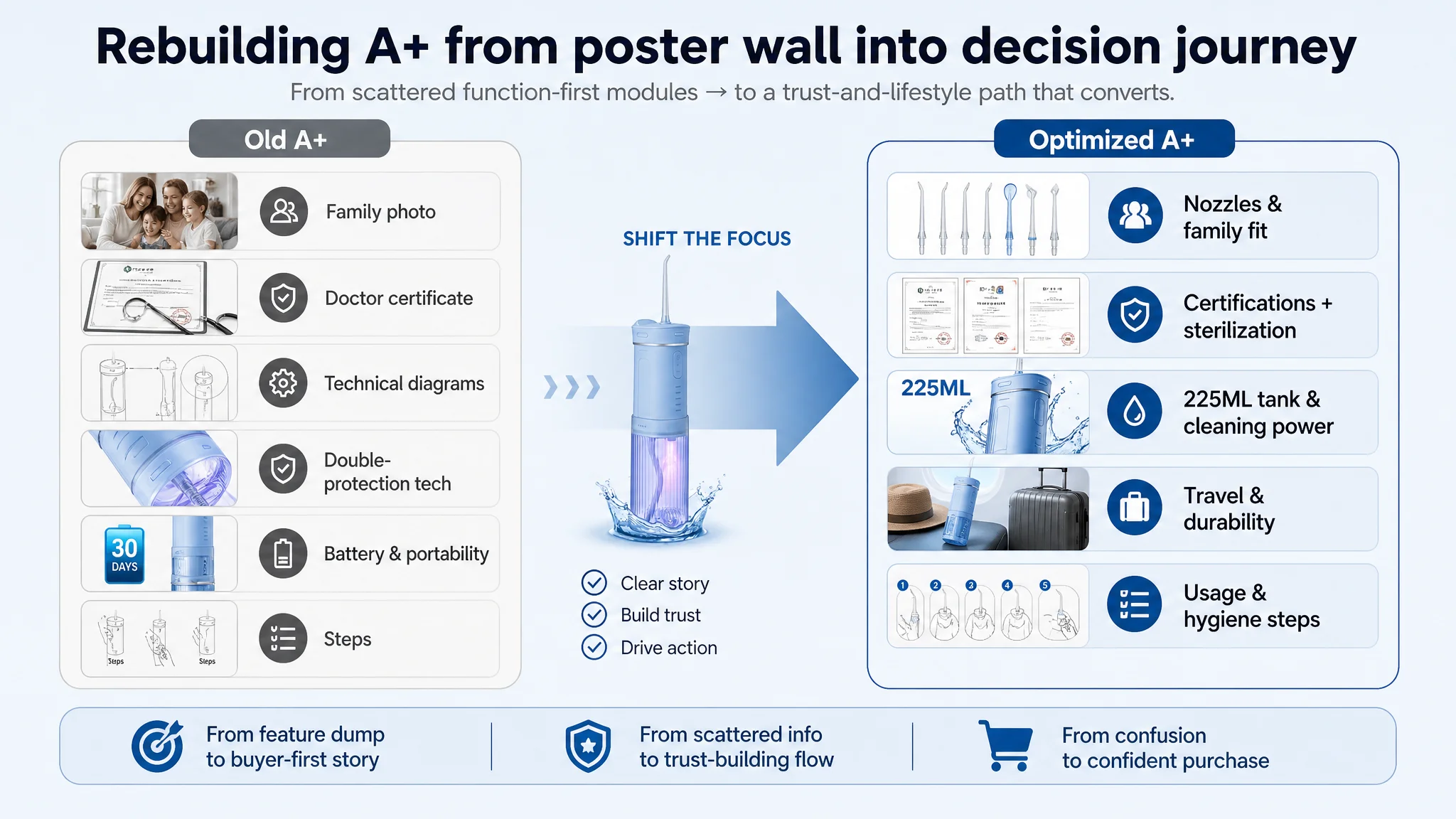
The target Listing’s A+ modules were:
- Home-family scene
- Certification visual (doctor & certificates)
- Core function diagrams (plaque, pulse, pressure)
- Double-protection tech graphic
- Battery life and portability
- Usage steps
Gaps:
- Visual style felt like collaged information, not a unified brand story.
- Trust relied mostly on a doctor certificate and family photo, with no real customer voices or quantified validation.
- Lifestyle scenarios (travel, commuting, bathroom counter reality) were limited; the product remained stuck at functional explanation level.
- High-perception differentiators like “225ML vs 180ML” and “8 nozzles vs 6” were not elevated into clear, visual, side-by-side advantages.
From a conversion standpoint, this meant the rival Listing answered more of the buyer’s unconscious questions: “Do people like me use this?” “Is it proven?” “Will it fit in my life, not just in my suitcase?”
How DeepBI Reframed the Problem
DeepBI’s judgment was:
This product did not lack features. It lacked a structured Amazon sales argument.
So instead of recommending more ad experiments, DeepBI focused on one core decision: Rebuild the Listing’s conversion capacity before scaling traffic.
The diagnosis decomposed into several key judgments.
Judgment 1: The Hero Story Is “Portable + Big-Tank + Sterilization”
Given category norms and buyer pain points, DeepBI prioritized three differentiators:
1. 225ML large tank in a compact travel format
- Directly hits the “I hate refilling mid-use” pain point, especially for travel devices.
1. Sterilization mode / UVC disinfection
- Addresses a deep category concern: “Is my flosser itself hygienic?”
1. 8 nozzles covering entire family & multiple oral conditions
- Converts a raw spec into a family-level value proposition.
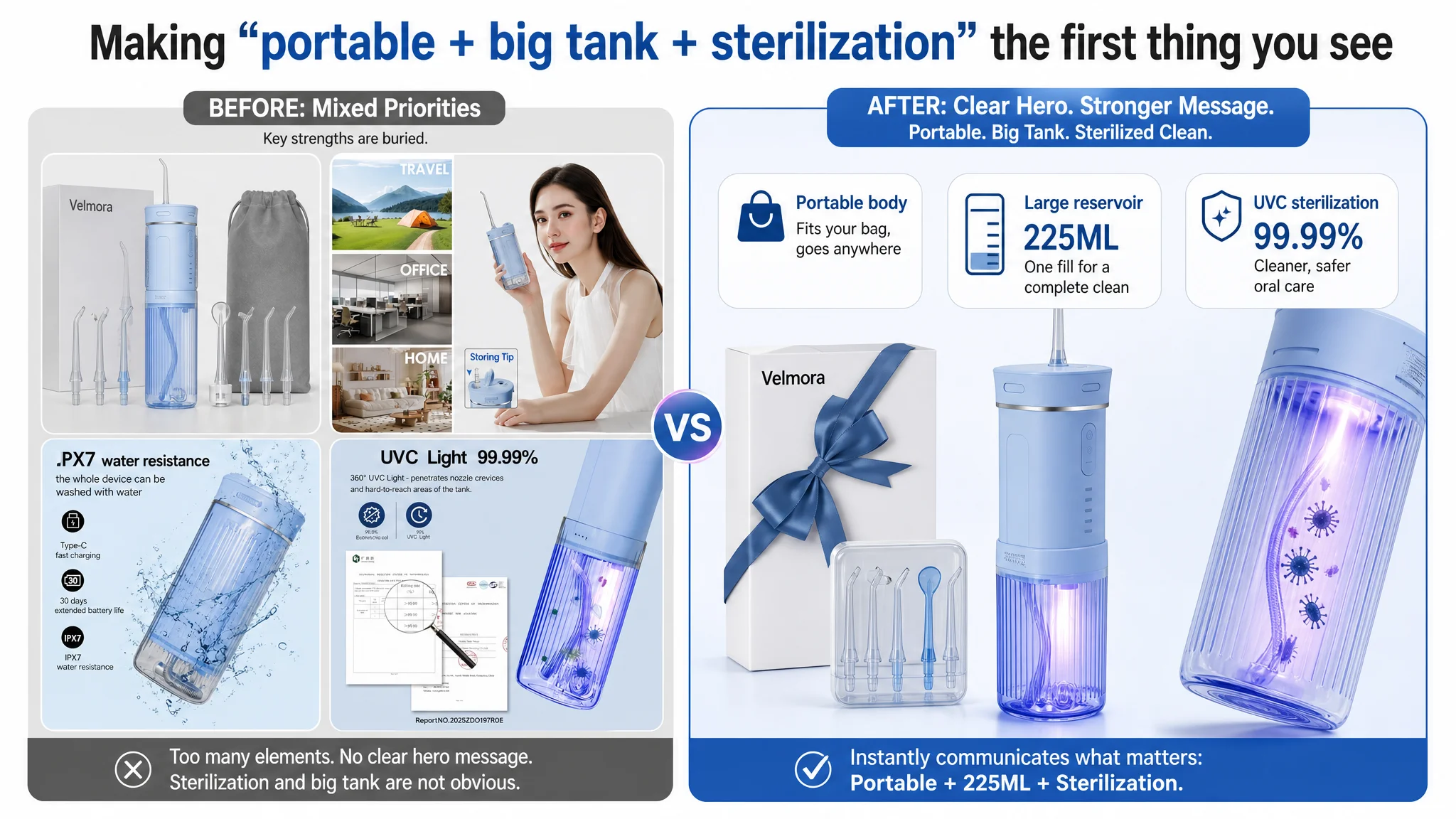
The Listing’s existing layout barely surfaced this as a coherent message. DeepBI’s optimization direction:
- Main image 1:
- Center the device.
- Cleanly arrange all accessories around it.
- Big, readable claims:
- “225ML Large Water Tank”
- “Portable & Travel-Ready”
- Subsequent images:
- Combine “portable” and “225ML” in a human-centered travel scene (held in hand, dropped into a stylish toiletry bag).
- Bring Sterilization mode into the front image set as a hallmark of “professional hygiene”, not a side-tech story.
This turns the first seconds of exposure into a meaningful differentiation instead of a generic accessories showcase.
Judgment 2: Rebuild Bullets Around People, Not Parameters
DeepBI’s bullet suggestions deliberately mirrored the competitor’s user-driven logic, but anchored in the target product’s strengths:
- BP #1 – Ultra-Portable & Scene-Based
Position the product as “mini, travel-ready, fits into handbags or backpacks”, and explicitly name scenes: business trips, office, camping, commutes.
- BP #2 – 4 Modes + Sterilization Technology
Not just listing “4 modes”, but mapping each to user groups:
- Soft: sensitive gums
- Standard: daily use
- Power: deep cleaning
- Sterilization: hygienic maintenance, particularly relevant to shared or family use.
- BP #3 – Scientific Dental Care & Certified Safety
Explain the micro-waterfall system in consumer terms: deep but gentle cleaning, no gum damage. Combine this with FDA/FCC/CE/PSE certification and food-grade PC material.
- BP #4 – 30-Day Battery as a Travel Enabler
Present battery life not as a number but as “no more searching for outlets on long trips”.
- BP #5 – IPX7 Waterproof & Easy Cleaning
Allow shower use, emphasize detachable tank = easy to clean, no residue buildup.
- BP #6 – 4 Specialized 360° Nozzles
Tie each nozzle to a problem: tongue coating → bad breath; periodontal pocket → gum issues; orthodontic → braces; normal → daily cleaning.
The key shift: every bullet must complete the loop “pain point → feature → result.”
Judgment 3: Re-Architect A+ Around Trust and Daily Life
Rather than just “more images”, DeepBI recommended a new A+ narrative order:
1. Accessory & Family Fit First, But With a Specific Edge
- Show the 8 nozzles clearly (vs benchmark’s 6).
- Map them to family roles and needs: kids with braces, adults with sensitivity, tongue cleaning, etc.
- This isn’t just “more pieces”; it’s “one device for the whole family’s different mouths.”
1. Brand Trust Brought Forward
- Move doctor & certification imagery to the front.
- Integrate logos of FDA/FCC/CE/PSE/ROHS with the product, not as a detached badge wall.
- Introduce Sterilization mode as a natural extension of this “certified-level hygiene”.
1. 225ML as the Core Differentiator Module
- Visually amplify “225ML vs 180ML”.
- Use an explicit message such as “Single-Fill, Full-Mouth Clean” to anchor the benefit: no mid-session refills.
- Combine this with 4 modes and micro-waterfall system into a single “cleaning capacity” module.
1. Merge Redundant Technical Modules
- Fold “gum-bleeding prevention” and high-frequency pulse into the core cleaning module.
- Emphasize “deep but gentle cleaning” and electronic stability instead of repeating numbers.
1. Strengthen Travel & Durability Module
- Use a travel-calendar visual to embody “30 days on one charge”.
- Integrate IPX7 waterproofing and Type-C charging as part of a unified “travel-safety and convenience” narrative.
- Add real buyer quotes about battery performance to reduce rational doubts.
1. Reframe Portability: Compact Yet Large-Capacity
- Keep the portable pouch or carry case visuals.
- Explicitly name the tension solved: “Compact body, 225ML tank.”
- Reconnect with 8 nozzles as “one kit, all scenarios”.
1. Simplify Steps & Highlight Ease and Hygiene
- Shorten the steps diagram.
- Emphasize wide-mouth detachable tank for easier filling and cleaning.
- Present Sterilization as “one-button” rather than a complicated ritual.
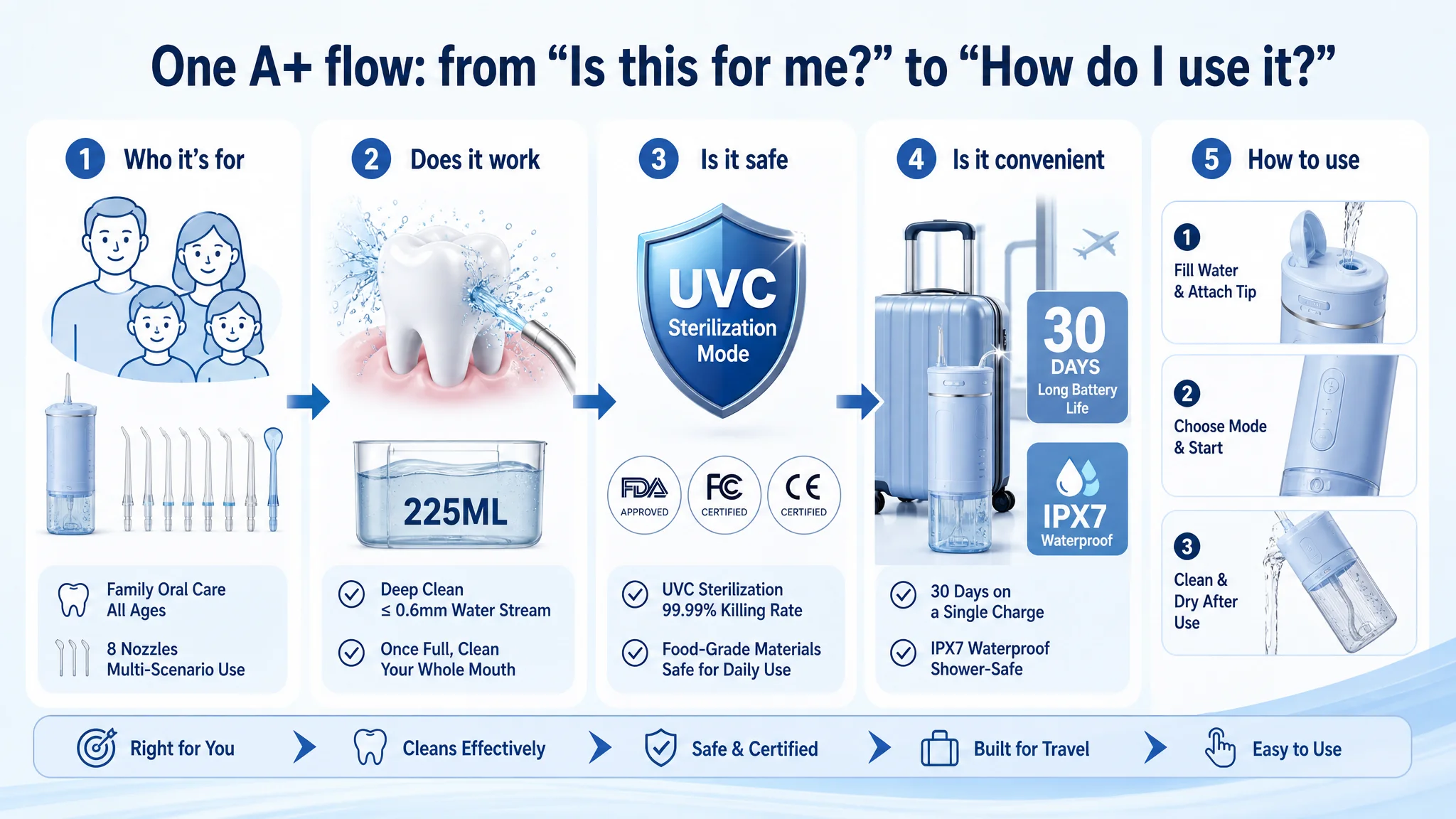
Overall, A+ shifts from a scattered tech poster wall to a predictable decision journey: Who is this for → Does it work → Is it safe → Is it convenient to own → How do I use and maintain it.
Why Listing Conversion Had to Be Fixed Before Ads
From DeepBI’s perspective, the business risk was clear:
- Scaling Amazon ads on a Listing that scores 75 vs a benchmark at 88 means:
- Paying to lose side-by-side on the same SERP.
- Letting a weaker page fight a stronger page for the same decision.
- Turning ads into a magnifier for your own conversion defects.
So the decision sequence had to be:
1. Listing first, ads second
- Rebuild title, main images, bullets, and A+ to fully express product strengths in the same decision language used by the benchmark.
1. Then let ads test the new narrative
- When the page can finally claim:
- “Bigger tank for travel,”
- “Sterilization for hygiene,”
- “More nozzles for the whole family,”
- “Certified and shower-safe,”
its paid traffic has something to work with.
1. Only afterwards consider scaling budgets and adding new keyword sets
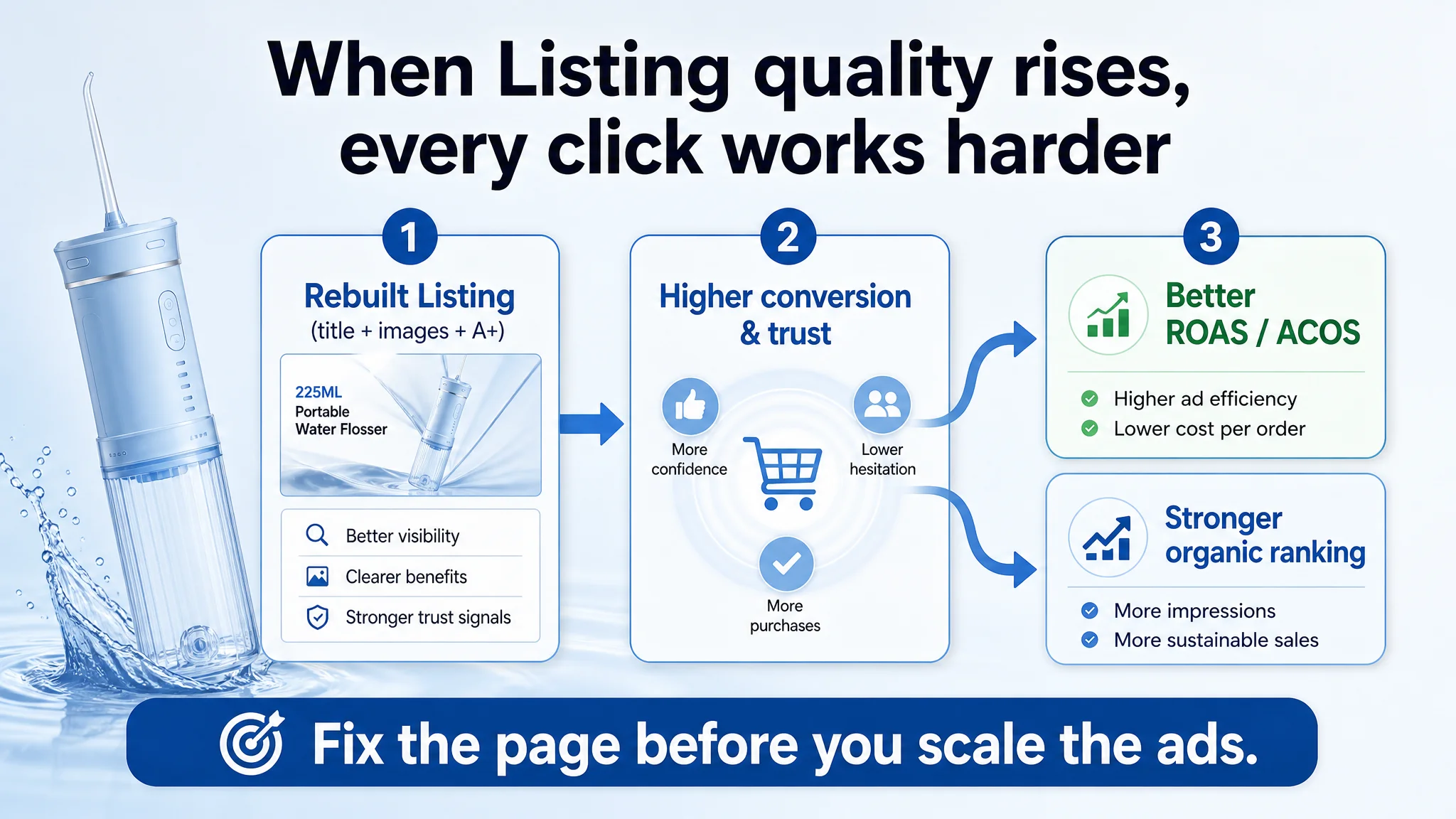
- With improved page conversion, ACOS has a real chance to fall and organic share to climb.
In other words, before asking “How can we get more clicks?”, the question must be “Does this page deserve more clicks?”
How the Page’s Sales Logic Started to Recover
After the Listing was reframed around real buyer logic rather than isolated features, several positive changes became structurally likely (even without exact post-optimization numbers):
- Click-through behavior becomes more favorable
- A clearer hero image and sharper title message (“Portable Water Flosser…225ML…IPX7…Long Battery Life”) improves perceived relevance on the search results page.
- Conversion rate has room to recover
- Bullets that actually talk to travelers, parents with kids in braces, and sensitive-gum users reduce hesitation.
- A+ that shows real scenarios, certifications, and family fit makes the product feel “de-risked”.
- Organic traffic gets a fairer fight
- When shoppers do not bounce as quickly and more of them buy, Amazon’s ranking algorithm receives better signals, supporting keyword stability.
- Review acquisition becomes more efficient
- Better conversion at the same traffic level means more units sold, which means more opportunities for reviews without increasing ad spend.
Most importantly, the seller’s understanding moved from:
- “We need more ads and more reviews to catch the benchmark”
to:
- “Our Amazon Listing architecture was not yet at the level where ads could perform efficiently.”
What Other Amazon Sellers Can Take Away
Several practical conclusions apply far beyond this one water flosser:
1. Good products can underperform because of Listing logic, not product quality.
A 4.5-star rating and strong spec sheet do not guarantee a competitive Amazon page.
1. Benchmarking is about sales narratives, not just parameters.
The leading Listing was not magically better; it simply tied every mode, design detail, and spec to a user and a result.
1. Main images and A+ are not decoration. They are the conversion engine.
If each image does not carry one clear idea, you are burning shopper attention.
1. Ads will not fix a trust gap.
Without a competitive Listing, added traffic amplifies the gap between you and the benchmark.
1. Decision order matters.
Listing conversion capacity first, advertising volume second. Only when the page can convincingly answer “why this product?” should you pay to bring more people there.
DeepBI’s role in this case was not to “beautify” the Listing, but to insist on a more fundamental judgment: the Amazon product page had to be rebuilt as a high-conversion, benchmark-level sales narrative before any further advertising strategy would truly pay off.