


This case comes from an Amazon seller in the craft-supplies category, selling white air-dry foam clay in a large bucket format. On the surface, the product was in good shape: 4.9 stars, solid reviews, and bullet points that were even stronger than a leading competitor. Yet the team felt constant pressure on Amazon ads. Despite ongoing bid and keyword tweaks, they struggled to push traffic with confidence, because each extra click did not translate into equally reliable orders.
The seller’s first judgment was that any underperformance must be an advertising problem: the campaign structure, bids, or keyword coverage. In their minds, the Listing was “already good enough”—after all, reviews were strong and content looked rich. DeepBI’s diagnosis reached a different conclusion. Once we benchmarked their Amazon Listing against a high-performing foam-clay competitor, the real constraint emerged: the page’s conversion logic, especially the title, main image sequence, and A+ story, could not systematically convert the traffic they were paying for.
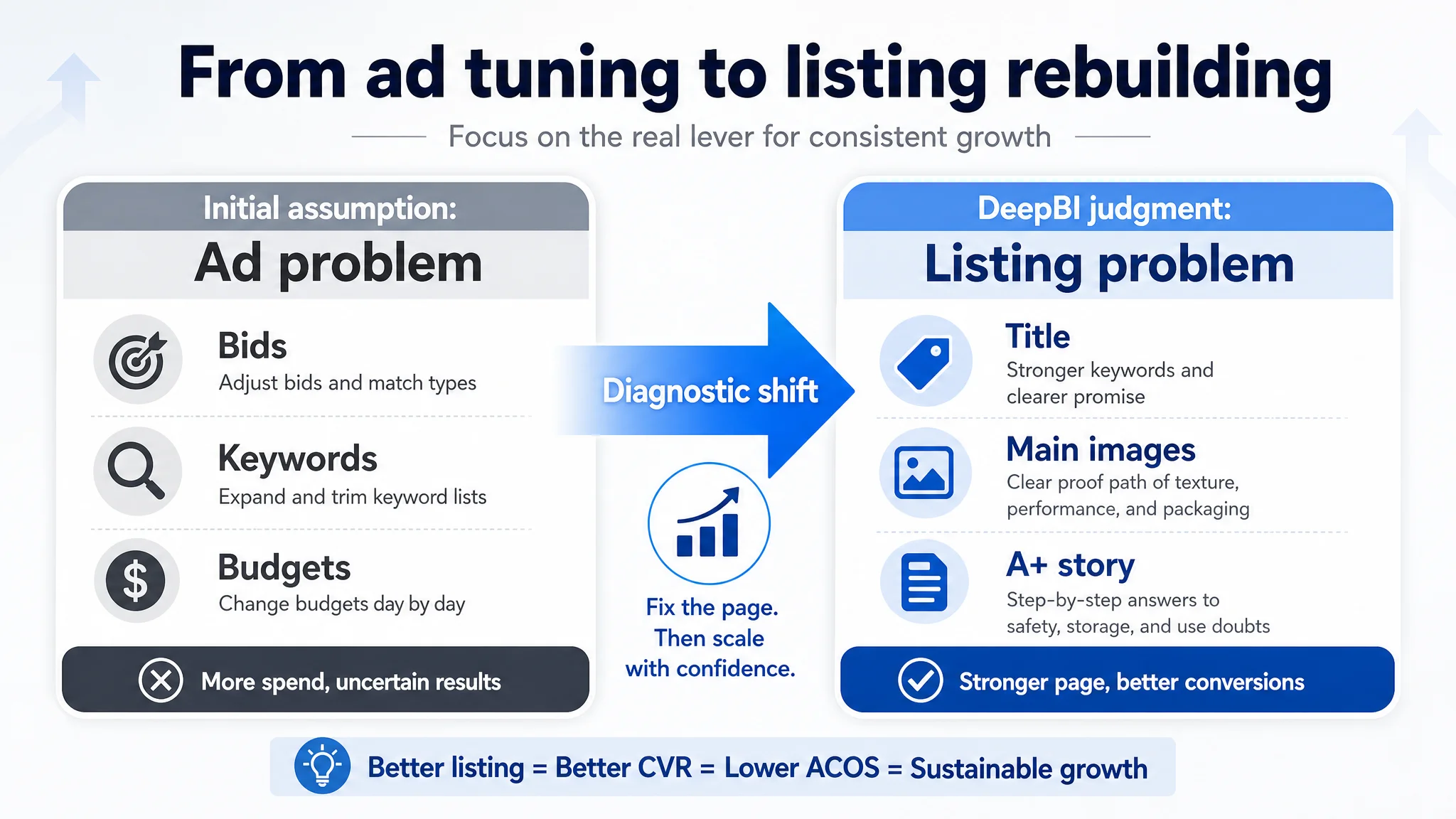
The optimization direction therefore shifted away from “keep tuning ads” toward “rebuild the Amazon product page to deserve more traffic.” We focused on: refocusing the title around core search terms instead of scattered scenarios; turning the main-image gallery into a clear proof path of texture, performance, and packaging; and restructuring the A+ content into a step-by-step persuasion journey that answered storage, safety, and professional-use doubts. This is a case many Amazon sellers will recognize: when ads seem to stall, the real lever is often not another bid change but the way your page explains why your product is worth the click.
The Problem Was Not Traffic. It Was How the Page Consumed the Traffic.
From the seller’s perspective, the situation looked paradoxical.
- Rating: 4.9 stars, higher than a key competitor’s 4.7.
- Review quality: front-page reviews were clean and positive for both products.
- Category: foam clay, where demand is stable and seasonal spikes are predictable.
What made the team anxious was not an obvious collapse in performance, but a creeping sense that every increase in Amazon ad spend brought less and less predictable return. Traffic was coming in; the difficulty was trusting that additional traffic would convert.
Because the campaigns were already running and there were no glaring account-level issues, the seller’s default assumption was: “Our ads aren’t optimized enough.” That led to repeated cycles of:
- Tweaking bids and match types
- Expanding and trimming keyword lists
- Adjusting budgets day by day
Yet the fundamental feeling did not change: ACOS remained hard to push down sustainably, and scaling spend always felt risky.
“The real problem was not that ads failed to bring traffic. It was that the page could not convert the traffic with enough certainty.”
DeepBI’s role was not to “tune ads better” at this point, but to ask a prior question: is this Amazon Listing actually at the level where extra traffic is worth paying for?
The Core Constraint: Listing Conversion Capacity, Not Ad Settings
DeepBI’s listing-scoring benchmark against a category-leading foam-clay product revealed a simple but decisive picture:
- Total Listing score:
- Target Listing: 75/100
- Benchmark Listing: 86/100
- Gap: -11 points
Broken down by dimension:
- Title: -4 (12 vs. 16 / 20)
- Main images: -1 (25 vs. 26 / 30)
- Bullet points: +1 (9 vs. 8 / 10)
- A+ / detail content: -7 (16 vs. 23 / 25)
- Reviews: equal (13 vs. 13 / 15)
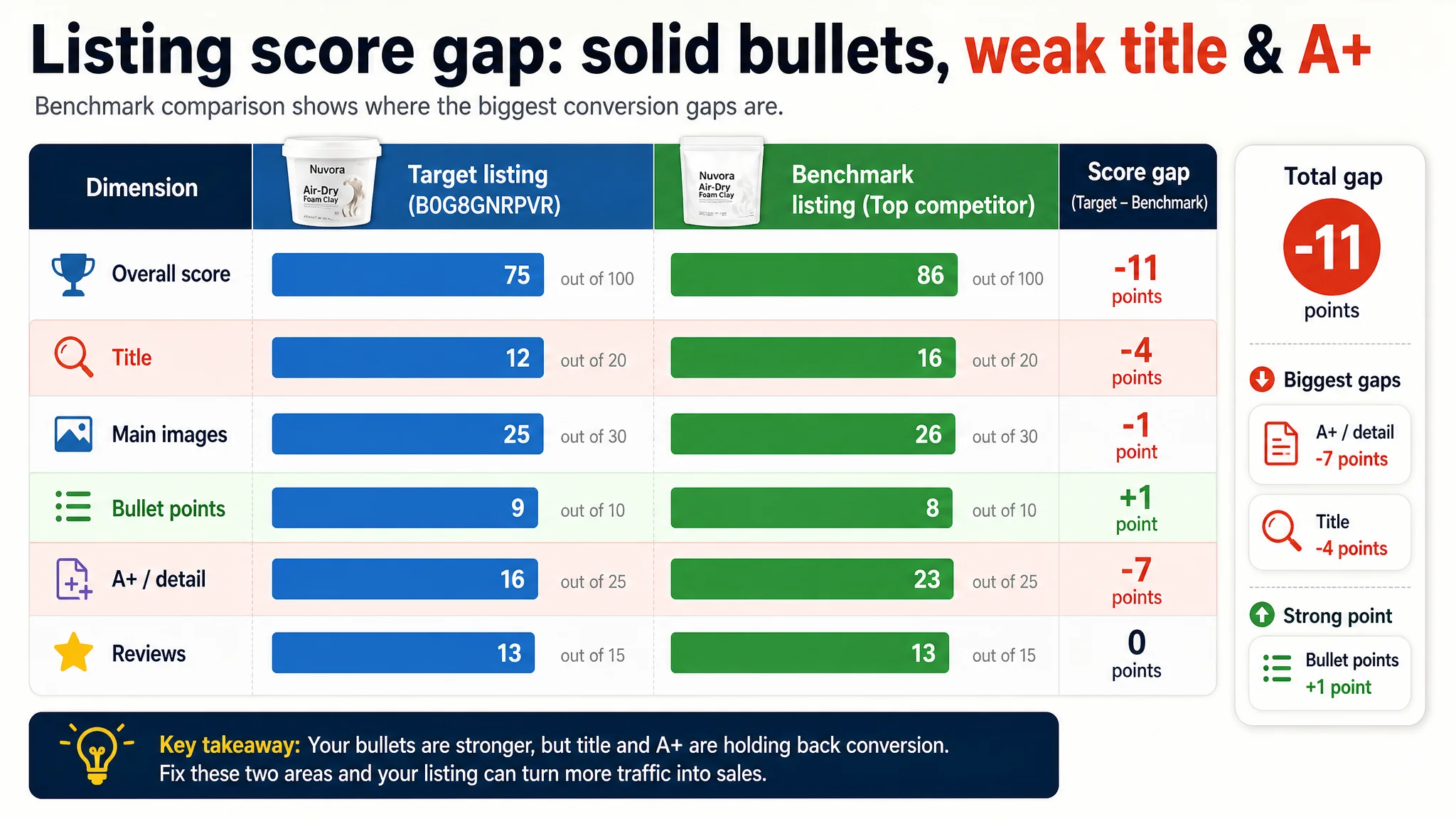
This was the turning point. The one place where the seller actually beat the competitor was the bullet points—exactly the area they had invested effort in. But two far more critical conversion levers were behind:
- Title: weaker search and click-driving logic
- Detail / A+ content: a significantly weaker story
In other words:
- The seller had overestimated:
- “Our content is already solid; just keep polishing ads.”
- DeepBI’s judgment was:
- “Your bullets are solid. But your title and A+ are underpowered versus the benchmark. You don’t have a conversion engine strong enough to justify aggressive traffic.”
At this stage, continuing to prioritize ad tinkering would have meant paying to pour more water into a bucket with weak walls.
How the Title Diluted Both Search Power and First-Impression Logic
On Amazon, the title is not only about SEO; it is a compressed piece of decision logic that must:
- Anchor the core product query
- Clarify the main outcome or use
- Add just enough qualifiers to attract the right click
The competitor’s title did this cleanly:
“Green Air Dry Foam Clay 1.1lbs/500g - Soft Modeling Clay for Art Projects, Cosplay Props, DIY Crafts (Light Weight & Easy to Use)”
The target Listing’s original title, in contrast:
- Put the weight parameter first, not the core product term.
- Scattered application scenarios (school supplies, Halloween decor, flower mirrors, etc.) into a long chain.
- Diluted the emphasis on the core phrase “Air Dry Foam Clay.”
- Mentioned key benefits like “Soft, Light Weight” but buried them inside the sentence instead of highlighting them.
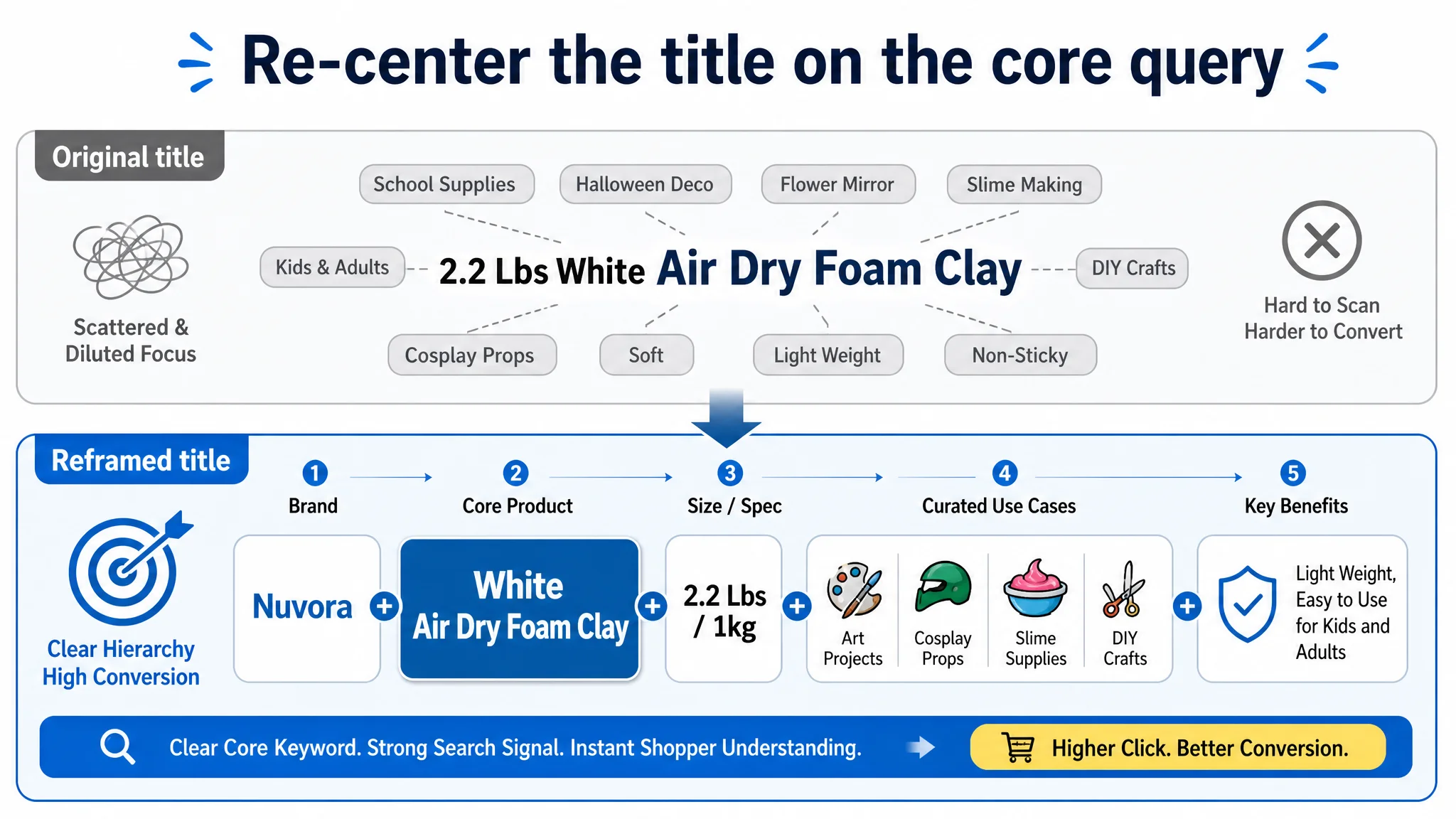
The result:
- For Amazon’s search logic, the core term had less weight and clarity than it should.
- For shoppers scanning results, the title required more effort to parse, without a clear hook.
DeepBI’s adjusted title logic was not about stuffing more words; it was about restructuring the hierarchy:
- Lead with brand + core keyword: “Brand + White Air Dry Foam Clay”
- Keep the weight but as a clear spec: “2.2 Lbs / 1kg”
- Concentrate high-value use cases: art projects, cosplay props, slime supplies, DIY crafts, Halloween decor
- End with plain-language user benefits: “Light Weight, Easy to Use for Kids and Adults”
The purpose was twofold:
- Give Amazon a clearer, stronger core keyword signal
- Give shoppers a quicker “yes, this is the right foam clay for these jobs” judgment in the search results
Without this, even well-targeted ads would suffer: clicks would be more expensive to earn, and some of the most relevant searches would underperform.
The Main Images Looked Busy, but Did Not Resolve Key Doubts
Both the target and benchmark Listings had multiple images. The question was not “how many” but “what each image actually did for the decision.”
Key issues DeepBI found in the main-image gallery:
1. First image: no clear functional promise.
- The bucket and a stretching gesture were visible, but texture looked a bit dry and stiff compared to the competitor’s wetter, more elastic visual.
- Only the brand and product name appeared; crucial triggers like “non-sticky,” “soft,” “elastic,” and “air-dry foam clay” were not clearly tagged in the image itself.
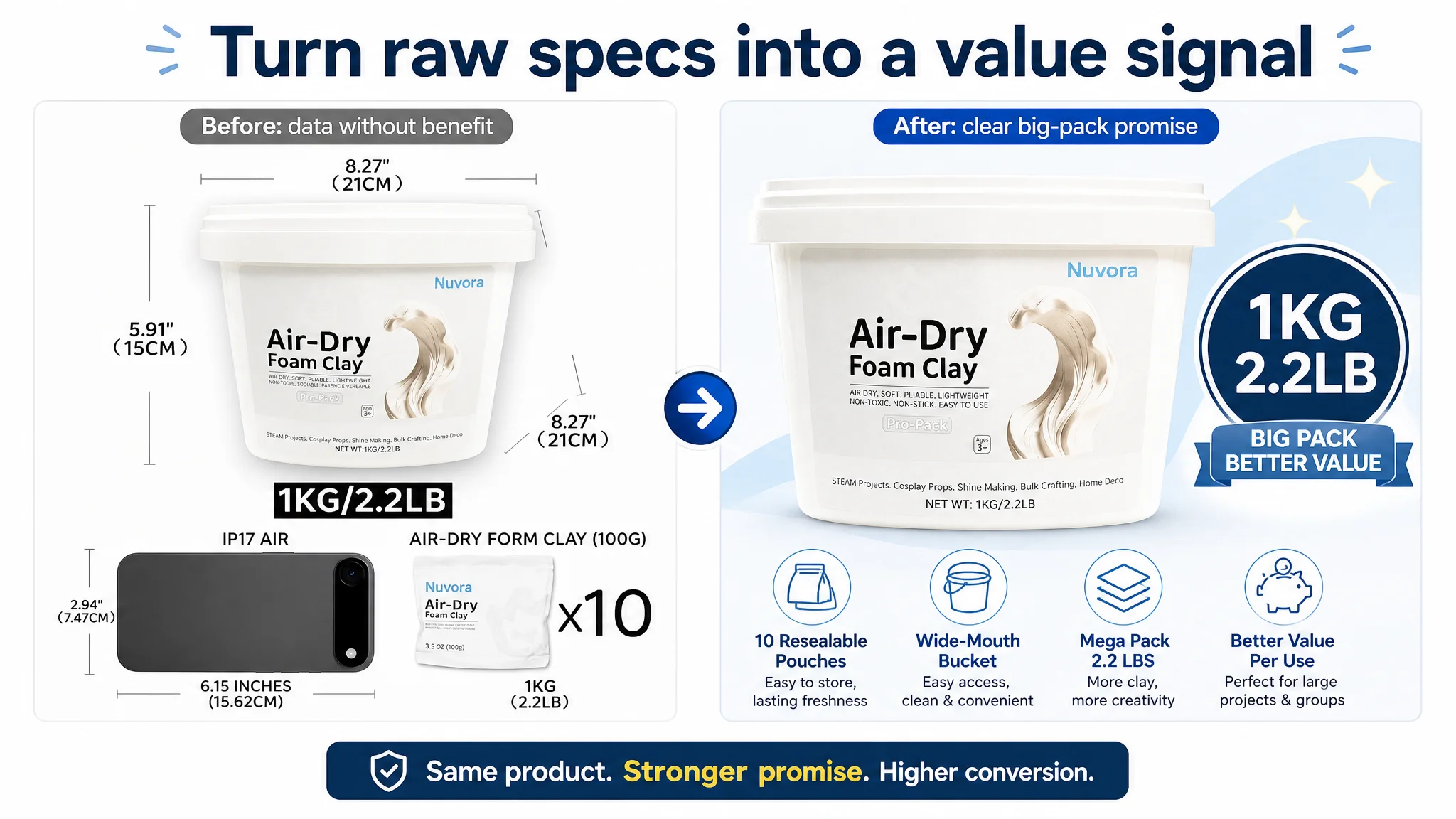
2. Second image: data without conversion logic.
- It focused on dimensions and “10 small bags” inside, but did not translate these into real-life benefits like “easy to store,” “lasting freshness,” or “use a little without drying the rest.”
- At this stage in the gallery, the benchmark Listing was already showing finished creations to set an outcome expectation.
3. Third image: four ideas fighting for attention.
- Finished model, kneading, “lightweight” (feather scale), safety icon, kid playing—too much in one frame.
- No single doubt was fully resolved. “Lightweight” and “no cracking” were not visually proven strongly enough.
4. Fourth image: creative scenes without functional clarity.
- Cosplay wings, coasters, mirror decor, painting—all mixed under a vague header (“Clayful Moments”).
- The crucial capabilities—adhesion to styrofoam/glass/metal and “paintable after dry”—were not sharply demonstrated.
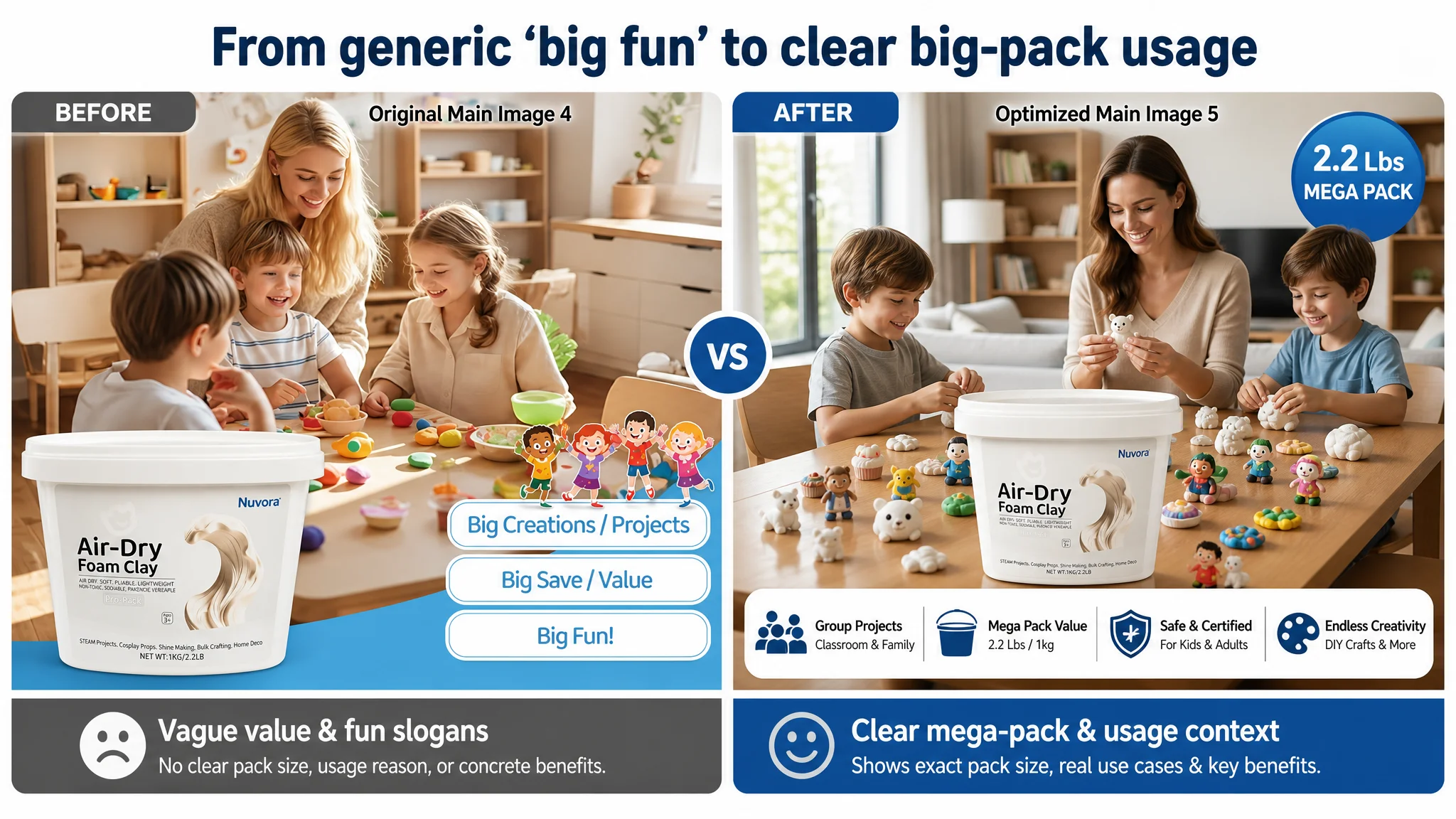
5. Fifth image: family fun without specific reasons.
- A family scene hinted at safety and suitability for kids, but the value claims (“Big Creations,” “Big Fun”) were abstract.
- The “big value pack” advantage was not quantified or tied to group projects, classrooms, or cost-per-use logic.
“Advertising does not only amplify advantages. It can also amplify a page’s existing defects.”
In this case, ads were amplifying images that felt busy but did not carry a structured decision path. Traffic was being spent on a page that made the shopper work too hard to understand:
- What exactly this foam clay can do better
- Why the large bucket format is not a storage risk
- Why it is safe and professional enough for both kids and cosplayers
Where the Benchmark Pulled Ahead: A+ as a Conversion Engine, Not Decoration
The biggest numeric gap was in the detail/A+ dimension: 16 vs. 23 out of 25.
The competitor’s A+ content was not just “more modules.” It followed a deliberate sequence:
1. Confirm basic performance (texture, air-dry, non-sticky)
2. Show professional-level applications (Cosplay, classroom projects)
3. Provide concrete how-to guidance (e.g., step-by-step slime instructions)
4. Resolve long-term-use doubts (packaging, resealability, ease of access, storage)
The target Listing, by contrast, had:
- Scattered scenes: toy car, texture twist, cosplay, kids, flower mirror, slime, colored lumps.
- But no explicit packaging story, no clear “problem–solution–evidence–extended value” progression, and no step-by-step guide to help hesitant buyers imagine success.
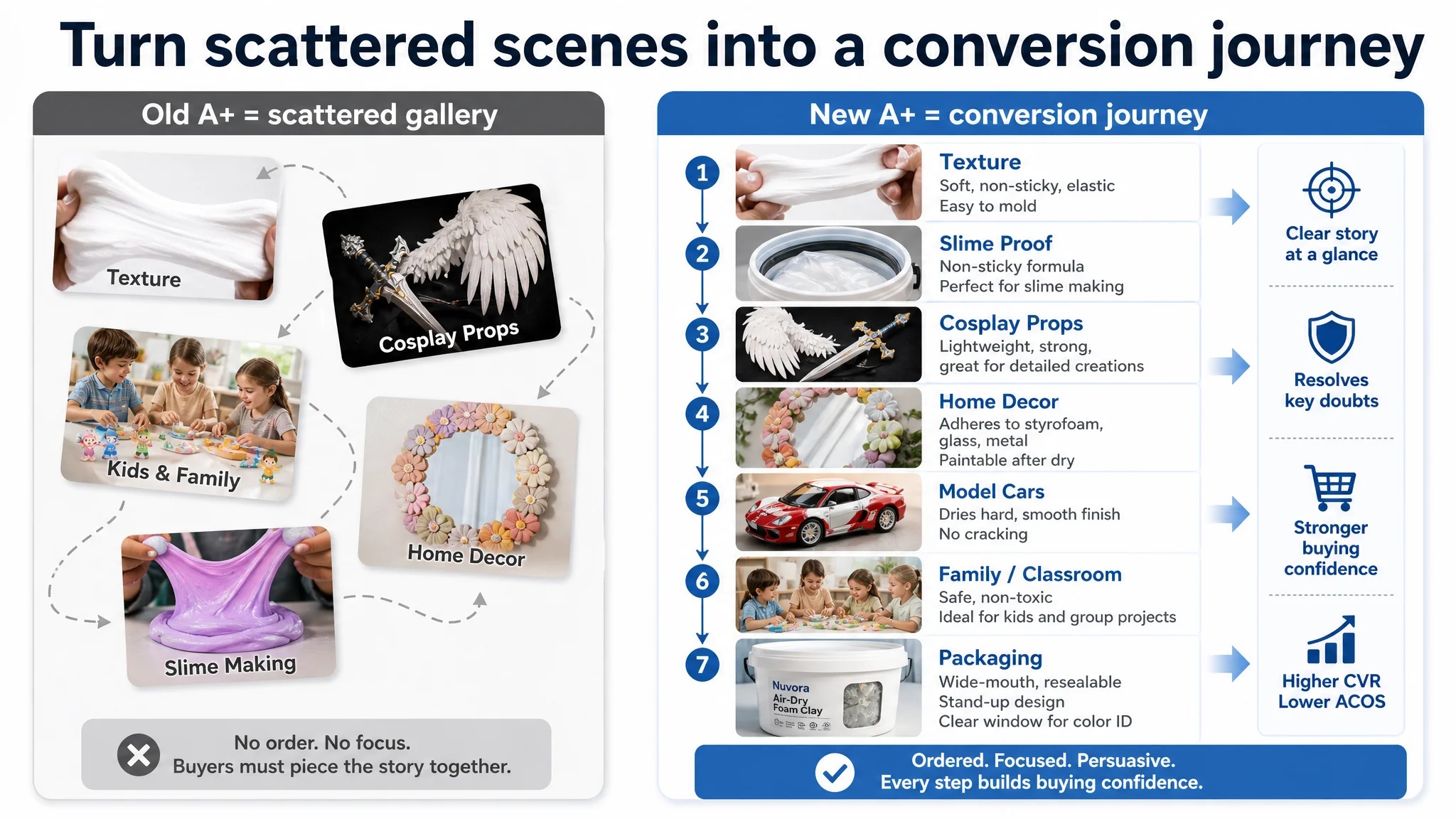
DeepBI’s judgment: this Listing did not lack material; it lacked narrative structure.
The A+ modules were re-thought as a deliberate path:
1. Module 1 – Texture proof:
- Large white foam-clay stretch close-up; emphasize soft, non-sticky, elastic texture.
- Convert “is this dry, crumbly, or sticky?” into a clear “this looks workable and pleasant” answer.
2. Module 2 – Slime as a proof of stretch and safety:
- Use existing slime visuals but anchor them with safety icons and clear “non-toxic, meets US/EU standards, non-sticky” messaging.
- Make slime a functional proof, not just a pretty picture.
3. Module 3 – Cosplay props as professional evidence:
- Position wings, swords, and large props as proof of strength, lightweight feel, and fine detail capability.
- Speak directly to adults and serious crafters: this is not just for kids’ toys.
4. Module 4 – Flower mirrors and home decor:
- Turn mirror decor into a test of adhesion to glass/metal and 3D decorative potential.
- Show that the clay adheres prior to drying and stays put after.
5. Module 5 – Model cars and smooth finishes:
- Use the toy-car models to prove “no cracking,” smooth surfaces, clean color boundaries, and blendability.
- This validates the “professional results” promise.
6. Module 6 – Family and classroom scenes:
- Only after rational doubts are answered, bring in emotional scenes: parents and kids, school projects.
- Connect safety and creativity to daily life.
7. Module 7 – Packaging as the final rational unlock:
- Close-up shots of the bucket: wide-mouth opening, resealable lid, stable upright storage, visual window (if applicable).
- Address the “1kg bucket = will it dry out?” concern directly.
The point was straightforward: paid traffic will not compensate for a missing story. Until the A+ content systematically removed doubts in sequence, every additional click remained fragile.
Why DeepBI Did Not Recommend “Keep Optimizing Ads First”
From a pure advertising standpoint, the seller could have:
- Added more long-tail keywords around cosplay and Halloween
- Tested different match types and negative lists
- Shifted budgets between defensive and offensive campaigns
But each of these assumed that once a visitor landed on the page, the product was presented in a way that:
- Quickly clarified what it is
- Built trust in how it performs
- Answered storage and safety concerns
- Showed aspirational but believable use cases
The reality, surfaced by DeepBI’s listing score, was the opposite:
- Title: not yet optimized for core search logic and clarity
- Main images: packed with content, but not aligned to a stepwise decision flow
- A+: full of material, but under-structured versus the benchmark’s conversion narrative
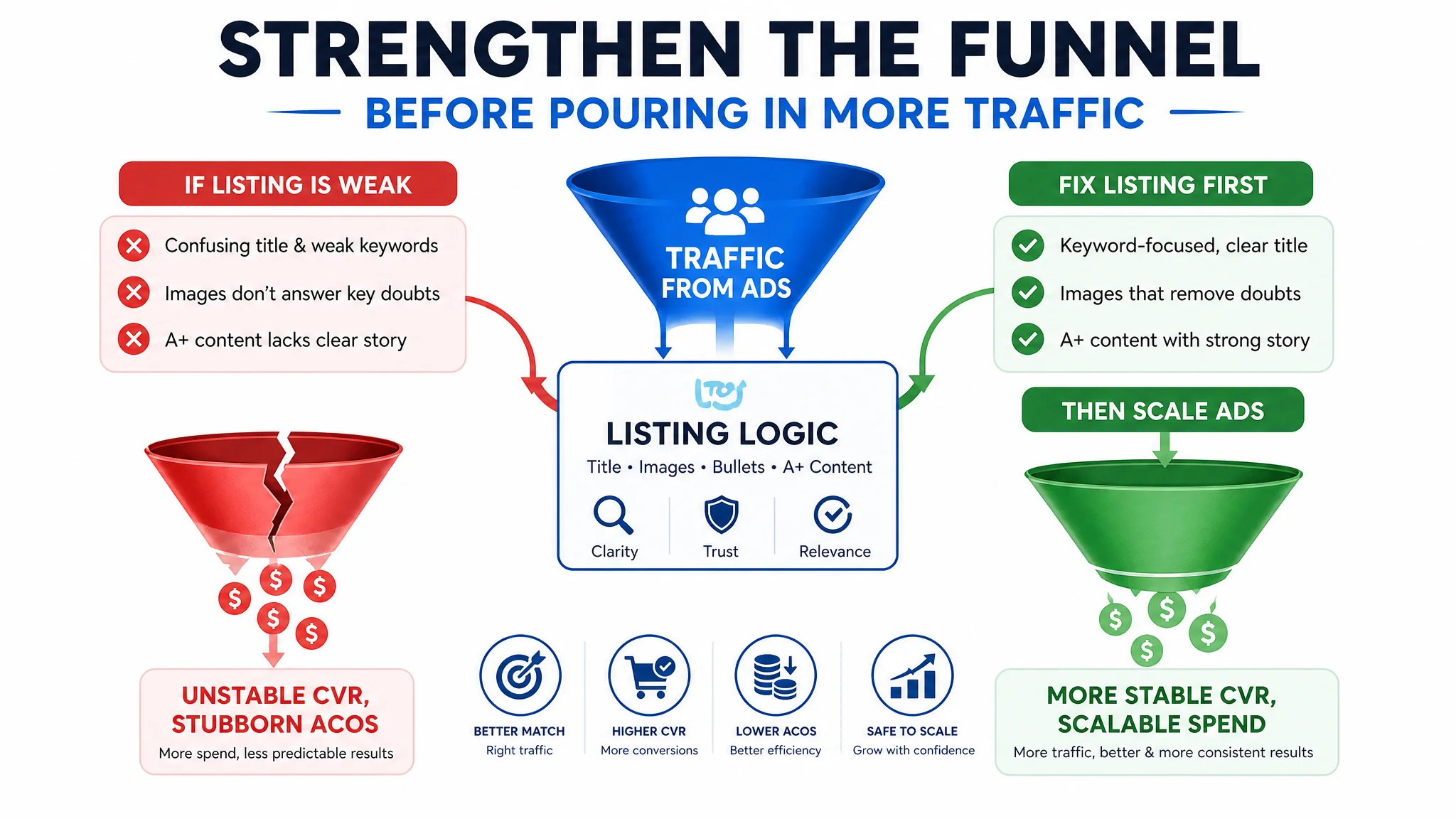
Fixing ads first would have produced more data but not more clarity. There was a real risk of interpreting ad underperformance as “bad keywords” instead of “weak mid-funnel persuasion.”
For this stage of the product:
- Primary business risk: paying to amplify a Listing that underperforms relative to category best practice
- Priority: repair the Listing’s conversion capacity so that both organic and paid traffic become more productive
- Ad optimization: should follow once the page has been re-armed to convert
How the Page’s Sales Logic Began to Recover
Once the team accepted that the constraint was on the Listing side, not the ad side, several shifts happened in how they operated:
1. Title became a traffic and positioning asset, not a dumping ground for scenarios.
- Core key phrase and brand moved to the front.
- High-value use cases were curated, not over-listed.
- User-facing benefits were made explicit, improving both search relevance and scan-ability on the results page.
2. Main images turned into dedicated “nodes” in a buyer’s decision.
- Image 1: texture & softness + explicit “non-sticky, soft, elastic, 2.2 lbs / 1kg” overlays.
- Image 2: “big bucket + small packs” reframed as storage and freshness benefits.
- Image 3: refocused on physical properties—no cracking after dry, feather-light weight, mixable colors.
- Image 4: clear proof of adhesion to foam, glass, metal and “paintable after dry,” tailored to cosplayers and DIYers.
- Image 5: clarified as a “2.2 Lbs Mega Pack – Best Value for Group Projects and Classrooms,” tying pack size to real usage.
3. Bullet points stopped working alone.
- The bullets were already stronger than the competitor’s; DeepBI kept them but ensured that each bullet’s claim had a visual counterpart in either main images or A+.
- For example:
- “Safe & Certified – gluten-, wheat-, and latex-free” anchored to a visual module.
- “User-Friendly Packaging – wide-mouth, resealable bucket” backed by A+ Module 7.
- “Versatile Decoration & DIY – sticks to styrofoam, glass, metal; paintable after dry” proven in the images.
4. A+ content shifted from “gallery” to “argument.”
- The page started to reflect a clear journey: see texture → see what people can build → see it’s safe and multi-surface → see it stores well.
- This reduced the cognitive load for shoppers and increased the odds that each click from Amazon ads became a serious buyer.
As this logic took root, ad traffic finally had something substantial to land on. The seller could begin to scale campaigns with more confidence that:
- CVR would not collapse with incremental traffic
- Organic and paid traffic would share the same improved conversion baseline
- ACOS would have room to move downward as the Listing started to “carry its weight”
What Changed in the Seller’s Understanding
By the end of this process, the seller’s internal narrative about their Amazon business had shifted in several important ways:
- From “ads are the problem” to “ads are revealing a Listing problem.”
They saw that strong reviews and detailed bullets did not automatically mean a strong product page. Title, images, and A+ structure had to work together.
- From “we already optimized content” to “our bullets were good, but the rest was under-leveraged.”
The bullet points had depth, yet they were undercut by a title that diluted core keywords and visuals that did not clearly prove what the bullets promised.
- From “more traffic will fix growth” to “only a higher-conversion Listing deserves more traffic.”
They began to view ad spend as an amplifier of page logic, not a bandage for it.
- From “our product is good; that should be enough” to “our page must show that goodness in the way Amazon shoppers actually decide.”
This meant accepting that A+ and main images were not decoration, but the core of the conversion engine.
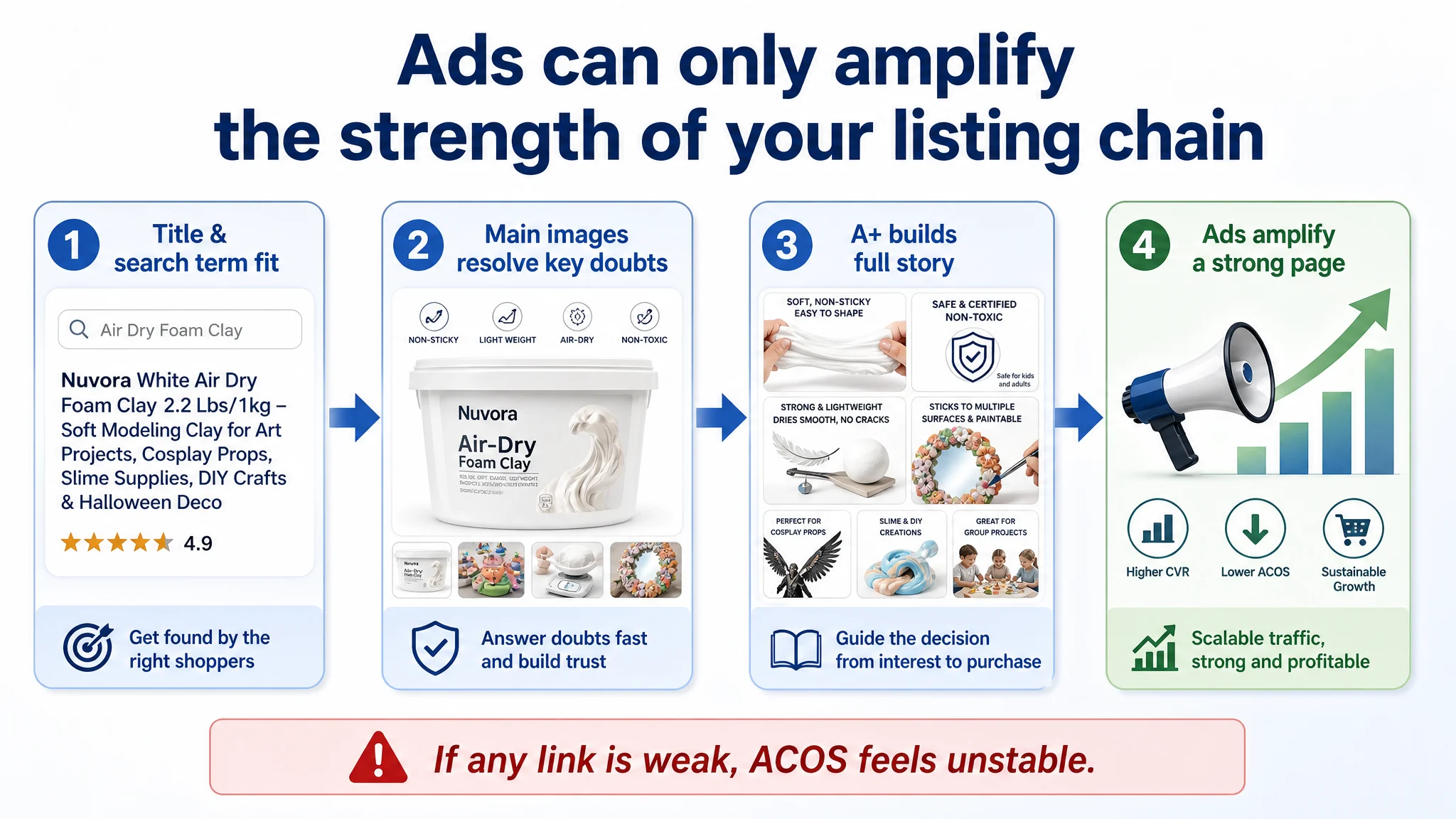
For other Amazon sellers, the lesson is clear:
- If your ACOS feels stubborn and your intuition is to keep reworking campaigns, first ask: Is my title sharpening or blurring my core query?
- Does each main image resolve a specific doubt, or are they just a collage of scenes?
- Does my A+ read like a guided argument, or just a collection of nice pictures?
DeepBI’s value in this case was not in “adding more assets,” but in forcing a more accurate judgment: advertising efficiency was capped not by keyword tactics, but by an under-structured Amazon Listing. Once that was addressed, advertising became a growth lever again instead of a source of anxiety.