

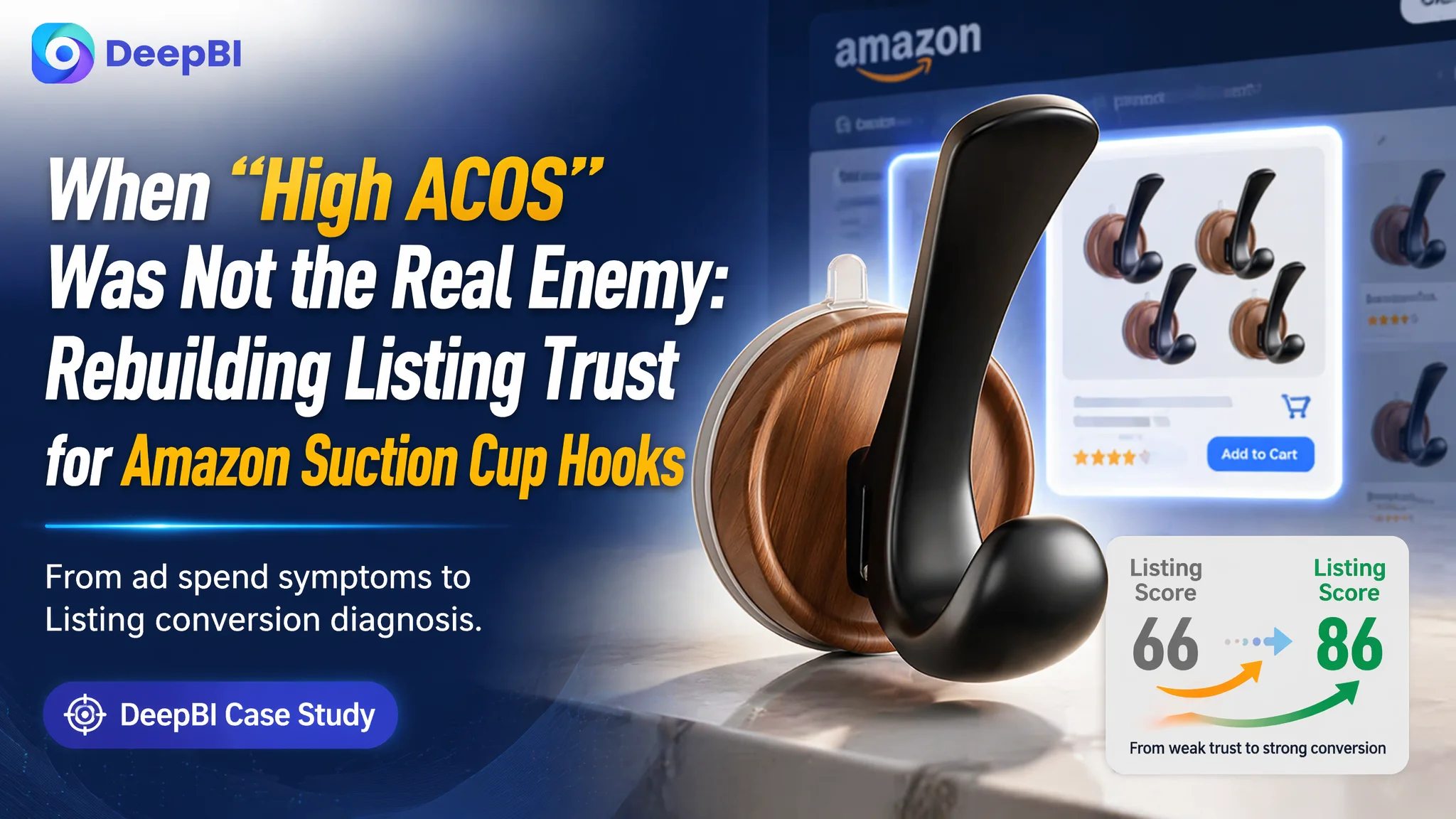
Many Amazon sellers first feel this kind of pressure through the ads dashboard: ACOS is stubbornly high, clicks are expensive, and campaigns look inefficient. That was the situation for an Amazon seller in the suction cup hooks category. They believed the problem was mainly in the ads—bids, keywords, and campaign structure—and tried to tune advertising to “fix” performance.
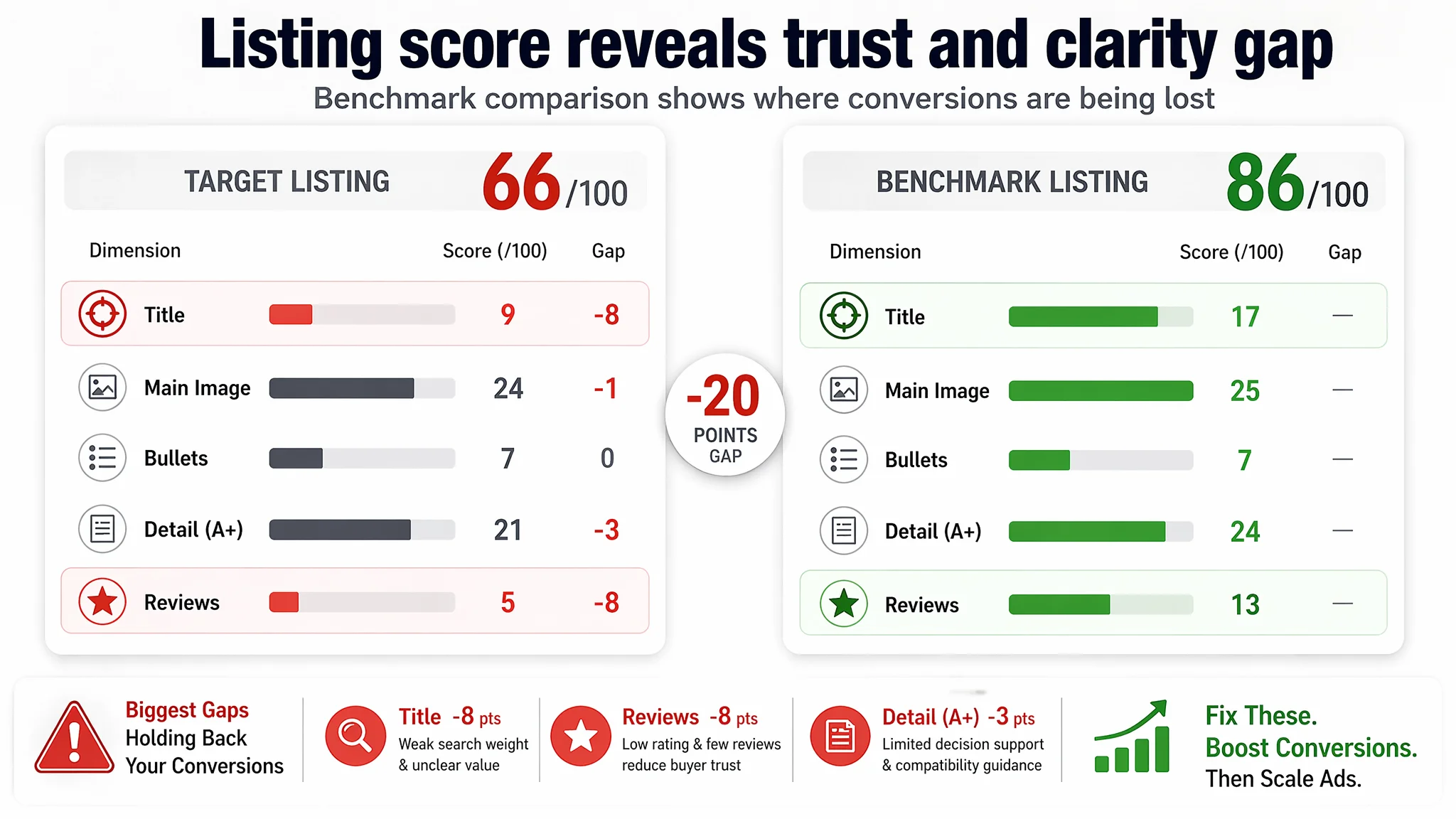
DeepBI’s diagnosis showed a different picture. Against a benchmark suction cup hooks listing in the US marketplace, this product page scored 66/100 versus the competitor’s 86/100. The largest gaps were not in ad settings at all, but in the Amazon Listing itself: title clarity, product-page trust, and review strength. Ads were doing their job bringing traffic; the page could not reliably convert it.
Once the problem was reframed as “weak Listing conversion capacity” rather than “bad ads,” the optimization direction changed: focus first on title logic, visual proof of performance, scenario breadth, and A+ decision support before further scaling ads. For other Amazon sellers, this case is a reminder that before pushing more budget, it’s essential to ask whether your Listing deserves more traffic—and whether your product page is capable of turning that traffic into orders.
The Core Constraint: The Listing Could Not Carry the Traffic
From a data standpoint, the gap was clear:
- The target listing: 66/100
- Benchmark listing: 86/100
- Core deltas:
- Title: 9 vs 17 (–8)
- Detail/A+: 21 vs 24 (–3)
- Reviews: 5 vs 13 (–8)
- Main image and bullets: closer, but still slightly behind
On Amazon, this kind of pattern usually reveals a single dominant bottleneck:
The page did not lack traffic. It lacked trust and decision support.
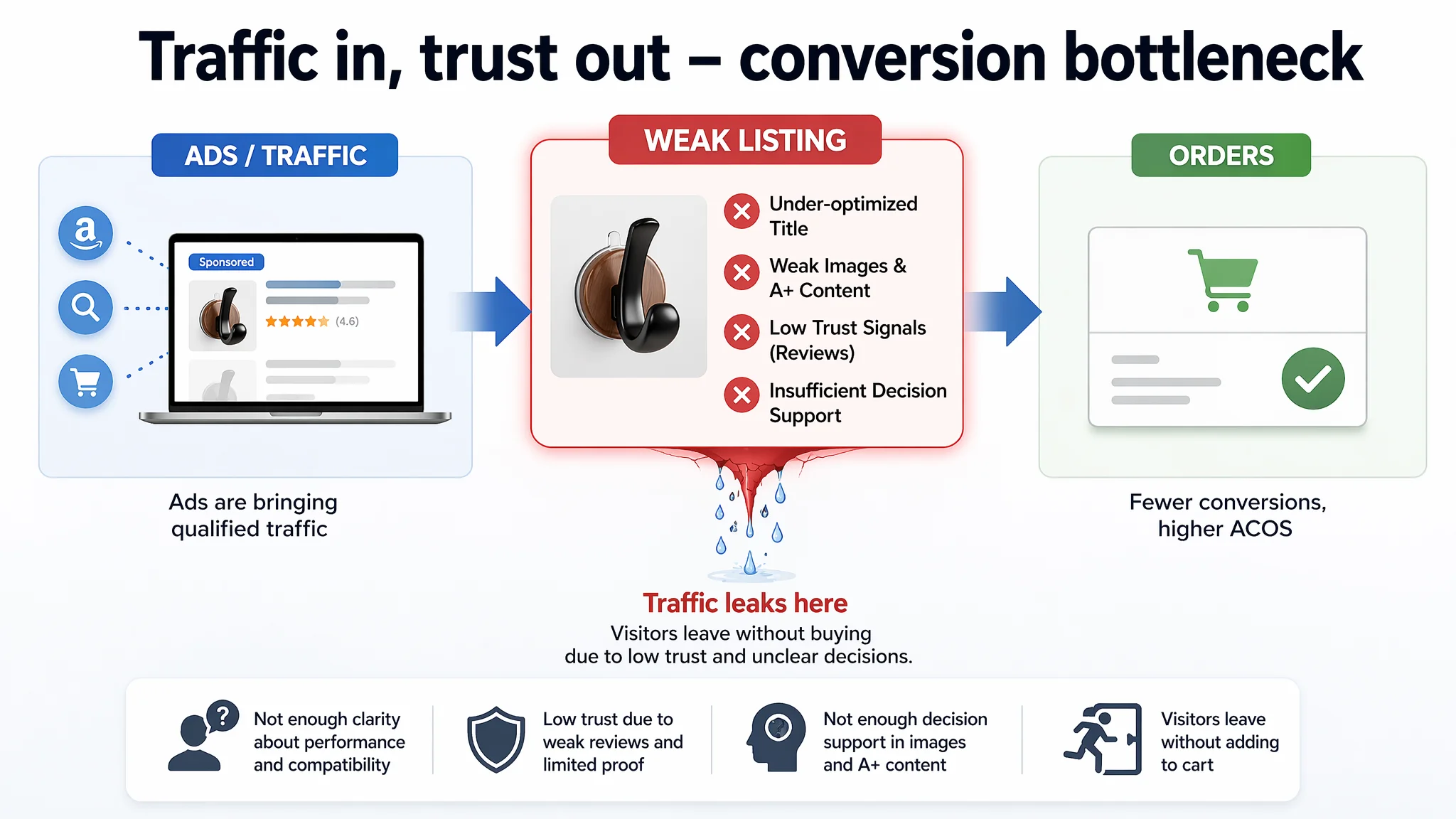
Clicks driven by Amazon ads fell into a product page that had:
- An under-optimized title that did not fully align with Amazon’s search logic or user decision logic
- Visuals that talked about performance but did not show performance in a decisive way
- A+ content that listed functions but did not help users quickly judge compatibility and risk
- A very weak review base (3.8 stars, only 8 reviews) versus a competitor with 4.6 stars and 3521 reviews
Under these conditions, pumping more ad spend mostly amplifies the Listing’s weaknesses. ACOS becomes a symptom of a deeper conversion problem.
The Seller’s Original Misdiagnosis: “We Need Better Ads”
From the seller’s perspective, the situation looked like a standard advertising issue:
- Ad costs in the category were rising
- Benchmark competitors seemed to maintain attractive ACOS
- Their own campaigns felt “expensive” and “underperforming”
It was natural to assume:
- Keywords were not tuned enough
- Bids were misplaced
- Campaign structures needed more granularity
So the team kept iterating bids and search terms while leaving the Listing logic largely unchanged. But return did not improve. The reason is straightforward:
- Clicks were being bought at market prices
- The product page was not communicating enough value, clarity, or safety to convert those clicks
Without a strong Listing, ad optimization becomes marginal at best. DeepBI had to redirect the focus before more budget was burned.
What the Listing Score Revealed
DeepBI’s Listing scoring and benchmark comparison surfaced three decisive gaps.
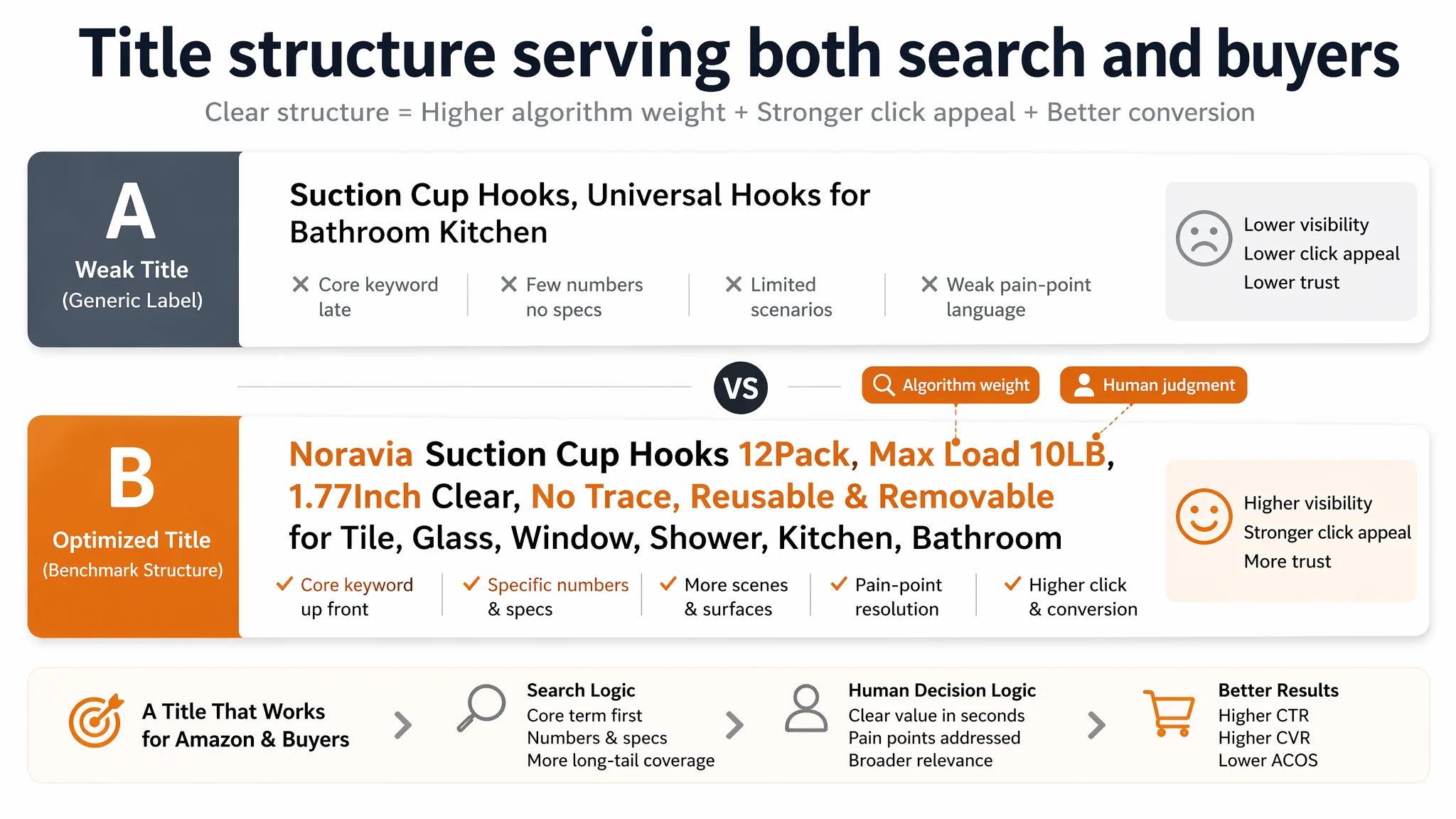
1. Title: Weak Search Weight and Unclear Value
The target title underperformed on several fronts:
- Keyword position and structure
- Core term “Suction Cup Hooks” was not placed with maximum weight; the competitor combined brand + core keyword right at the front.
- The competitor followed a mature Amazon formula: brand + core term + key performance specs + material + scenarios.
- Lack of concrete, confidence-building numbers
- The target title used vague phrases like “Universal.”
- The benchmark title used specific numbers: “12Pack,” “Max Load 10LB,” “1.77Inch,” which:
- Increase click appeal
- Signal seriousness and engineering
- Create immediate expectations about performance
- Limited scenario and surface coverage
- Target: “Bathroom Kitchen”
- Benchmark: “Tile, Glass, Window, Shower, Kitchen, Bathroom”
- This widened the long-tail keyword net and made the product relevant to more concrete use cases.
- Pain-point language
- Benchmark title included “No Trace, Reusable & Removable” directly in the line—precise answers to common user anxieties (damage, reusability).
So in search results, the benchmark listing was not just better optimized for Amazon’s algorithm; it was also better optimized for human judgment in a split-second click decision.
2. Detail Page: Function Was There, But Decision Logic Was Thin
Both pages had A+ content, but they played different roles in the buying decision.
The target listing focused on:
- Core selling-point graphics
- Structure breakdown
- Stability verification
- Washing instructions
- Multi-scene usage images
The benchmark listing added layers that mattered more to the user’s risk calculus:
- Brand main visual for trust and identity
- Three-step installation visuals
- Measured load-bearing (10LB) with a concrete object (kettlebell)
- Material breakdown
- Applicable vs non-applicable surfaces in a clear visual contrast
- Multiple high-emotion lifestyle scenes (holiday décor, kitchen, family interaction)
This difference is crucial.
The benchmark page wasn’t only “prettier”; it reduced uncertainty at every step: “Will it hold?”, “Will it damage my wall?”, “Will it work on my surface?”, “Can I use it in more than one room?”, “Is this brand serious?”
The target page stayed at a functional level and relied heavily on text to explain critical constraints, which slows users down and leaves room for doubt.
3. Reviews: Trust Gap That Ads Could Not Bridge
Review metrics were stark:
- Target listing:
- 3.8 stars
- 8 total reviews
- A noticeable share of 3-star-and-below feedback
- Benchmark listing:
- 4.6 stars
- 3521 total reviews
- First page dominated by 4–5-star reviews
This meant:
- The benchmark had a mature trust engine backing each ad click.
- The target listing had almost no social proof and visible risk signals for potential buyers.
Ads can bring visitors, but they cannot fully override a weak review foundation. In this context, the product page needed to work harder on everything under its control (clarity, visual trust, decision structure) to compensate as much as possible.
Why DeepBI Did Not Recommend “More Ad Tuning” First
With this diagnosis, DeepBI’s judgment was:
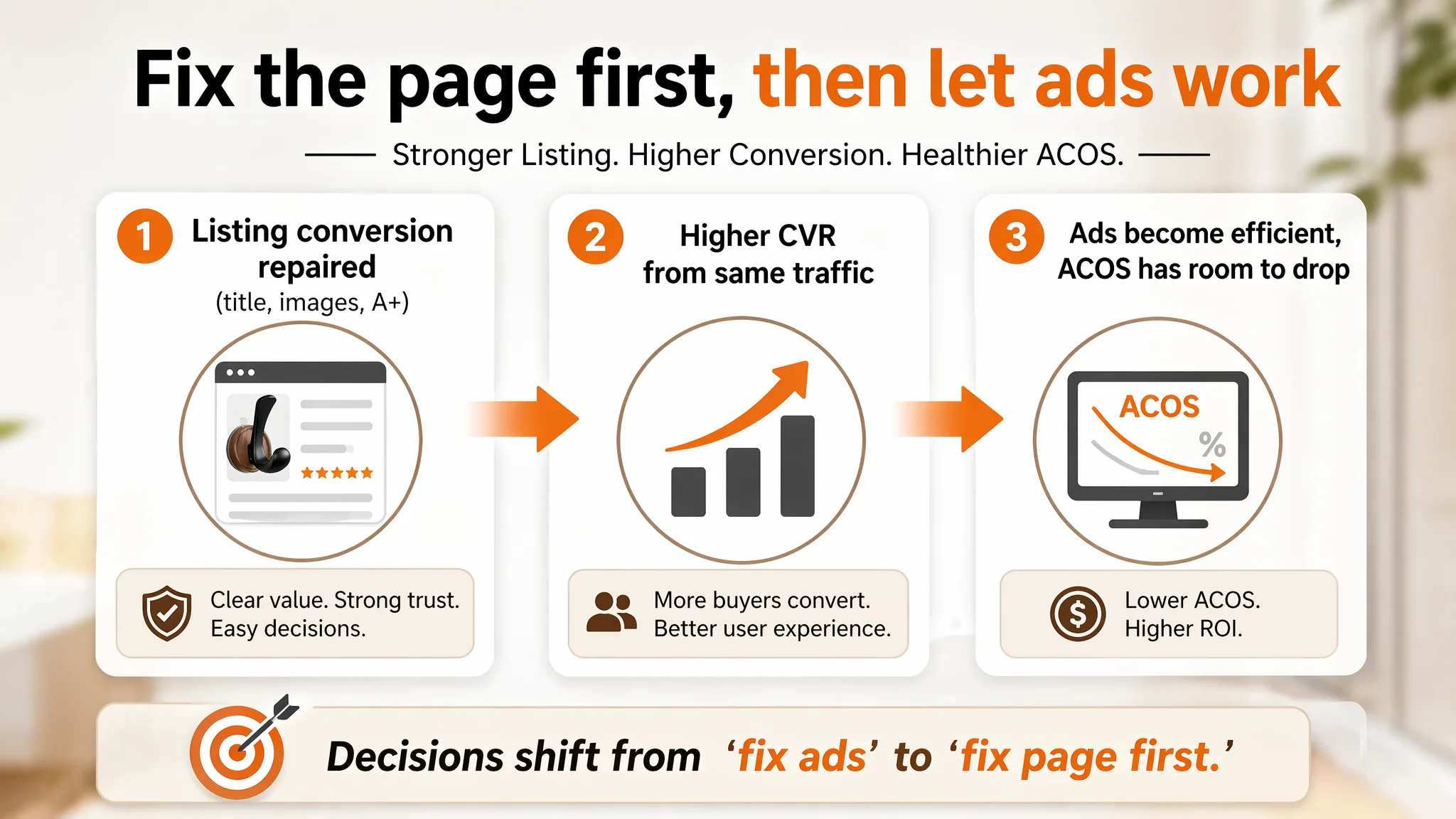
1. The real constraint was Listing conversion, not traffic volume.
2. Further ad optimization, without fixing the page, would mainly amplify inefficiencies.
3. The highest-leverage move was to repair the Listing so that existing and future traffic had a better chance of converting.
The decision order for this seller became:
1. Rebuild title logic around Amazon search and human decision signals.
2. Reconstruct image and A+ content to:
- Visually prove performance
- Reduce compatibility risk
- Expand scenarios and emotional relevance
3. Sustain and then scale ads once the page showed improved conversion behavior.
Advertising does not only amplify advantages. It can also amplify a page’s existing defects.
In a competitive Amazon category, this is not a theoretical concern; it is a direct driver of wasted ad spend.
How the Page’s Sales Logic Was Rebuilt
The optimization focus was not “make it prettier,” but “make it easier to trust and decide.” That included several connected layers.
1. Title: From Generic Product Label to Conversion-Oriented Statement
DeepBI steered a title direction along these lines:
Plastic Suction Cup Hooks 3 Pack, Heavy Duty Max Load 10LB, Clear Removable & Reusable No Drill Hooks for Tile, Glass, Window, Shower, Bathroom, Kitchen, Waterproof & No Trace Wall Hooks
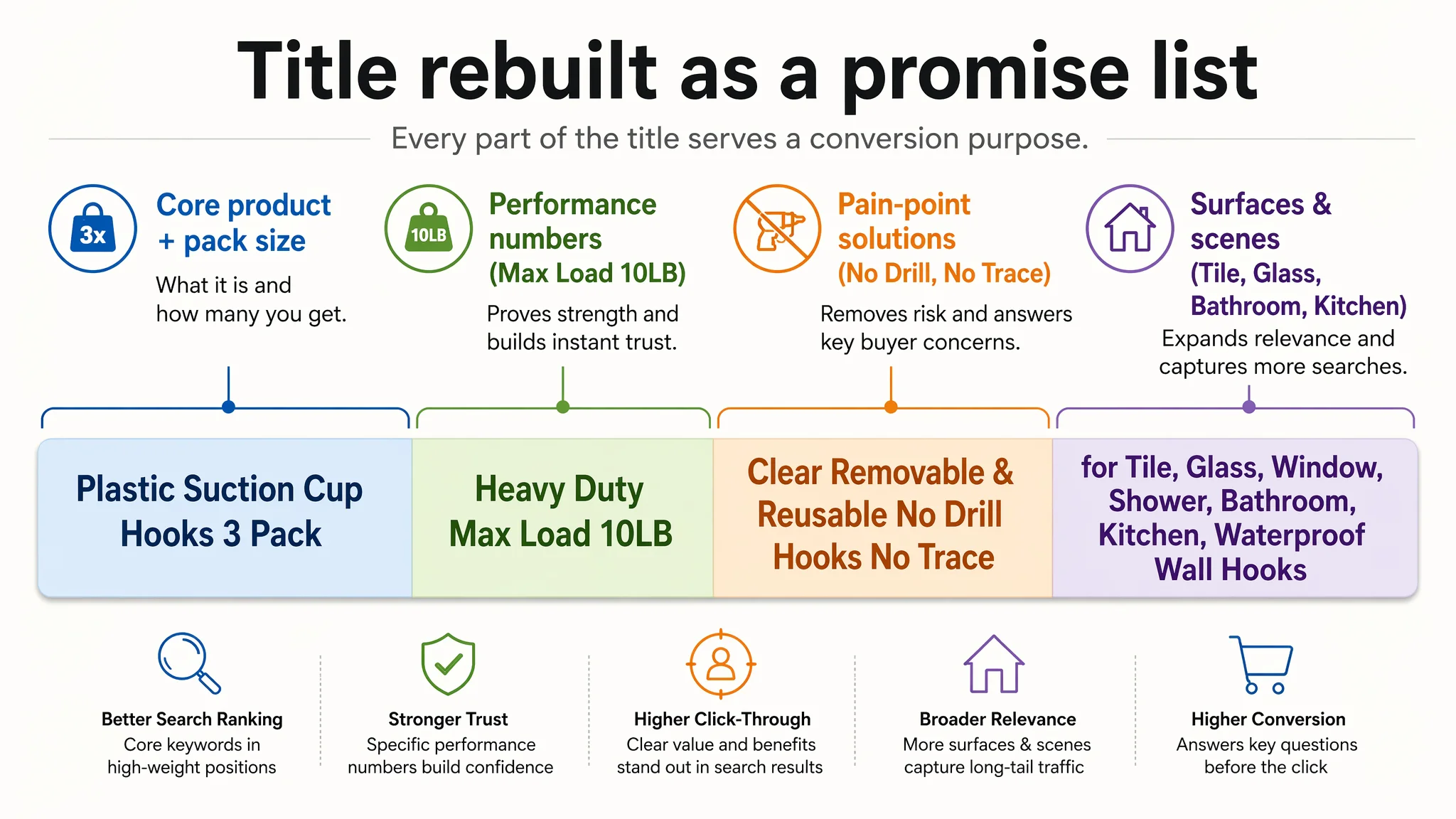
Key changes in logic:
- “Suction Cup Hooks” and core attributes moved into prominent positions.
- Performance parameters brought forward (“Heavy Duty,” “Max Load 10LB”).
- Function words were conversion-oriented: “Removable & Reusable,” “No Drill,” “Waterproof,” “No Trace.”
- Surfaces and scenarios expanded: tile, glass, window, shower, bathroom, kitchen.
Result: the title started behaving both as a search engine signal and as a concise promise list to the buyer in the search result grid.
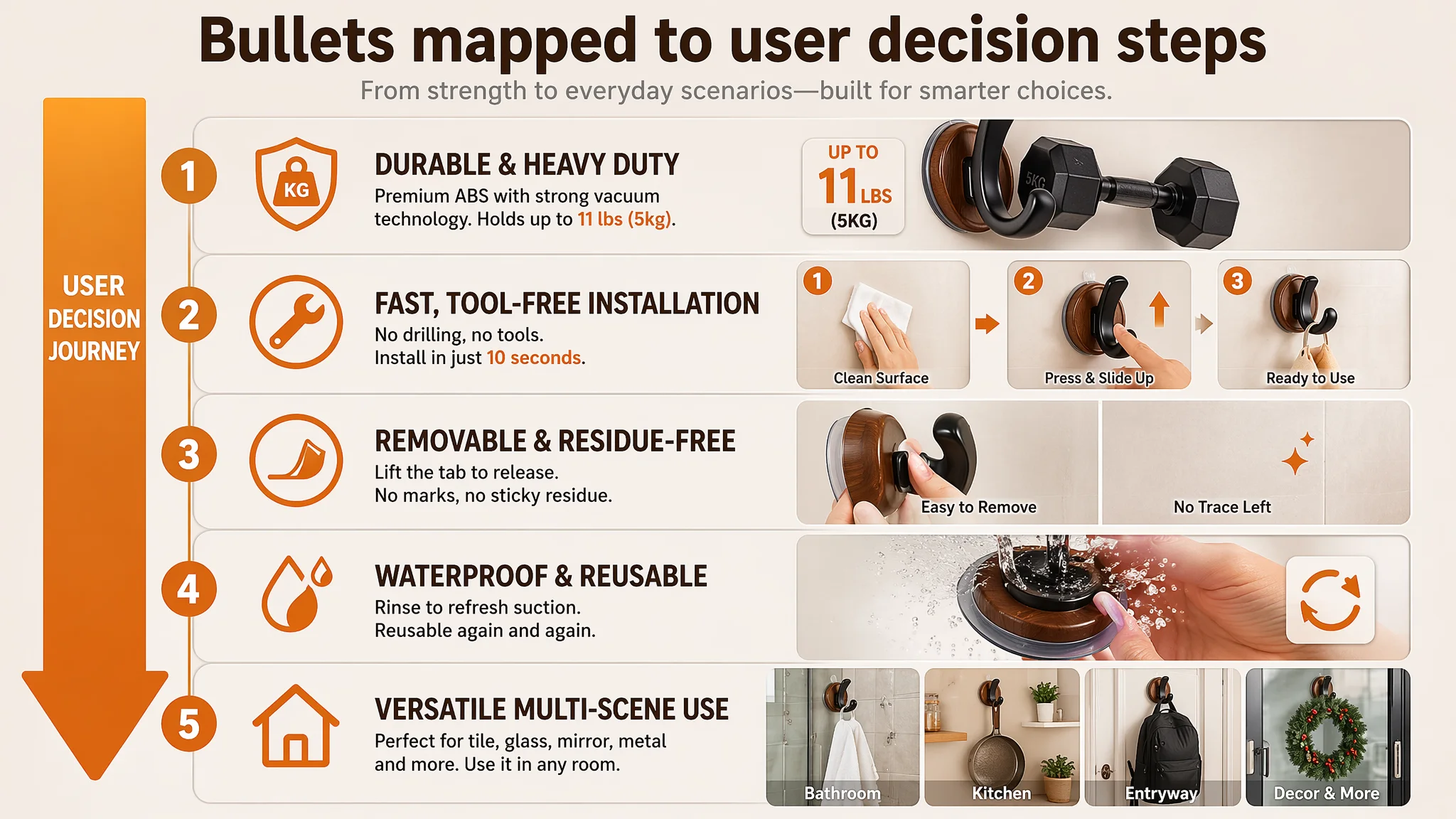
2. Bullet Points: From Technical Listing to Life-Cycle Experience
The original bullets leaned toward technical description. The benchmark listing leaned toward user experience across the product’s life cycle (install, use, remove, reuse).
DeepBI’s suggested bullet logic focused on:
- BP #1 – Durable & Heavy Duty
- Tie material (ABS) to performance and load-bearing (e.g., up to ~11 lbs/5kg).
- Use a clear heading to anchor the reader’s eye.
- BP #2 – Fast, Tool-Free Installation
- Keep the “10 seconds install” advantage.
- Emphasize “no nails, no drilling, no tools” and wall safety.
- BP #3 – Removable & Residue-Free
- Highlight that removal does not damage the wall or leave sticky marks.
- Speak directly to renters, students, and frequent reorganizers.
- BP #4 – Waterproof & Reusable
- Connect moisture resistance with bathrooms and kitchens.
- Make reusability concrete (“rinse and dry to restore suction”).
- BP #5 – Versatile Multi-Scene Use
- Expand beyond bathroom and kitchen to RVs, campers, dorms, etc.
- Name real objects (towels, pans, bags) to increase user imagination.
This reframed the bullets as a logical path:
- Is it strong and durable?
- Is it easy and safe to install?
- Can I remove it without damage?
- Will it last and work in my environment?
- Where else in my life can I use it?
3. Main Images: Making Performance and Scenarios Visually Obvious
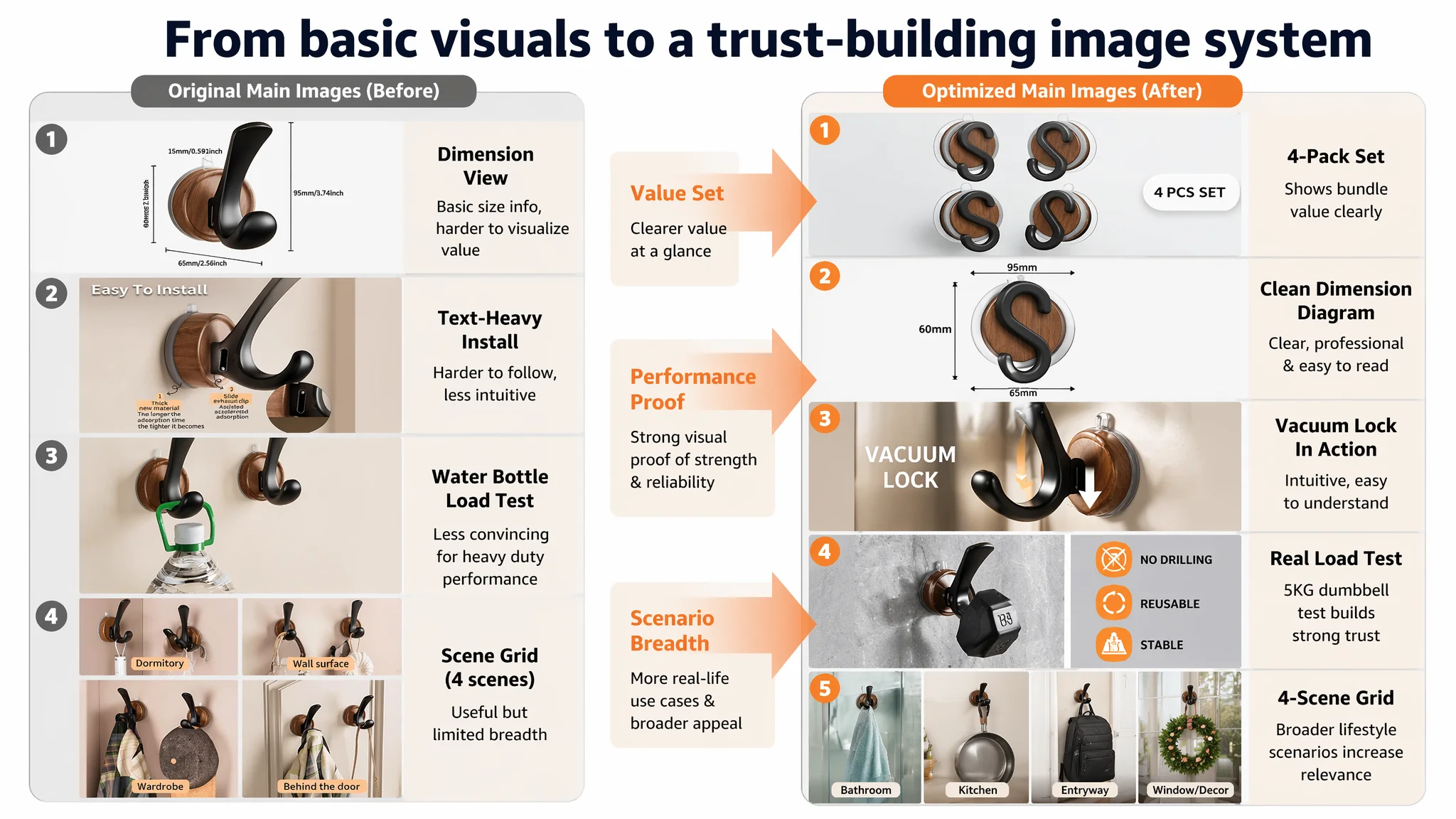
The main image set needed to demonstrate, not merely describe. The benchmark used:
- Clear multi-pack representation
- Clean, high-contrast dimension visuals
- Strong load-bearing proof imagery
- Scenario variety and compatibility guidance
DeepBI’s direction for the seller’s main images included:
- Pack/value perception
- Show all hooks in a balanced composition (e.g., 4 pieces in a diamond layout).
- Add a subtle overlay like “4 PCS SET” to strengthen perceived value.
- Dimension clarity
- Use minimalist, technical layout with clear measurement lines and readable font.
- Make size comprehension instant, not a scavenger hunt in text.
- Vacuum lock mechanism
- Show the hook in a realistic bathroom scene, emphasizing the vacuum lever.
- Use a directional arrow and simple text label like “VACUUM LOCK” to tell the functional story at a glance.
- Load-bearing proof
- Replace low-impact props (water bottle) with higher visual weight (e.g., 5kg dumbbell).
- Combine object + numeric callout (“MAX LOAD 10LB”) to anchor trust.
- Scenario grid
- Four quadrants showing specific uses:
- Bath towel on glass
- Pan on kitchen tile
- Backpack on entry wall
- Holiday wreath on glass door
These changes don’t alter the product itself, but they change what the buyer can see and how quickly they believe the claims.
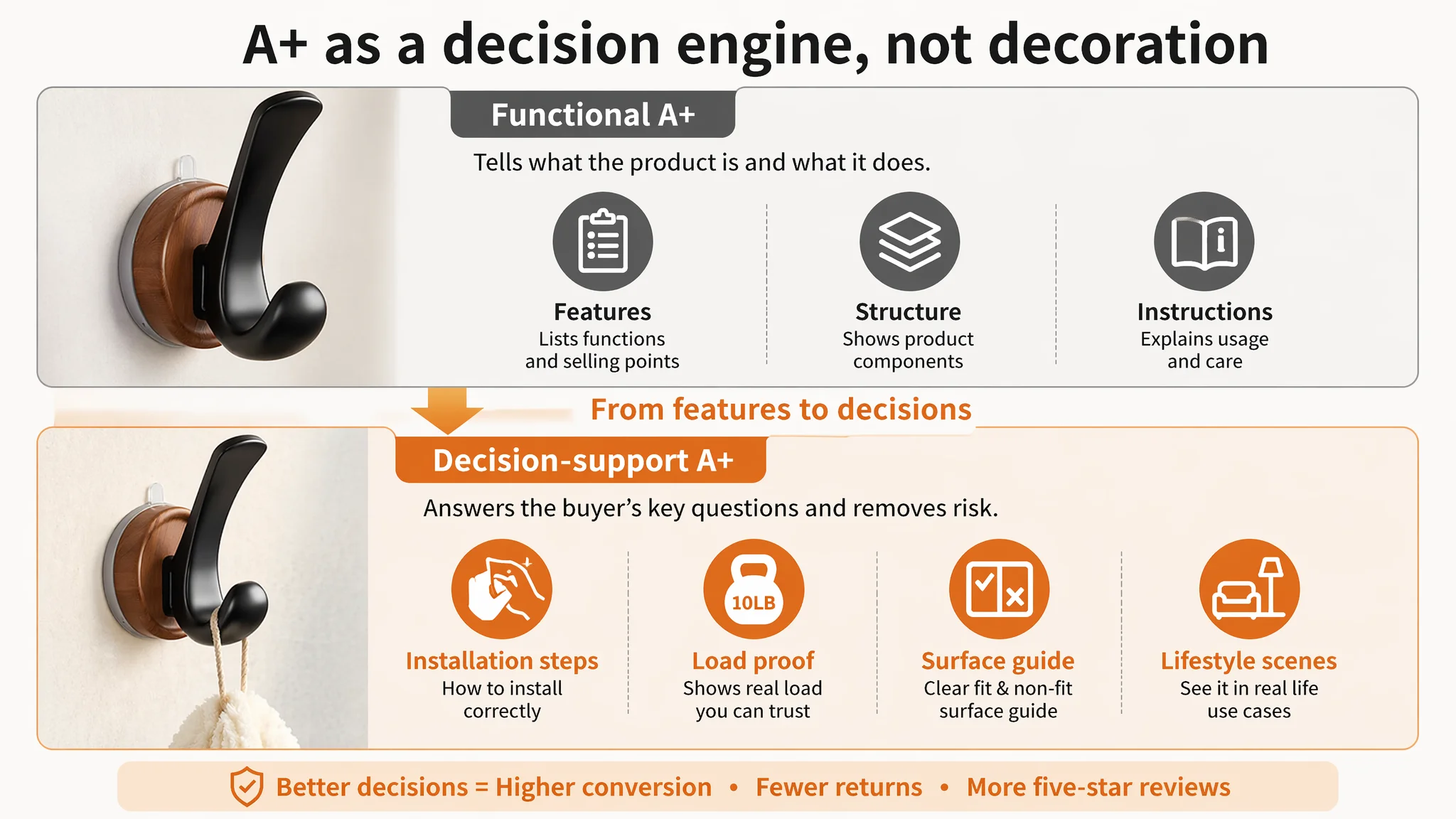
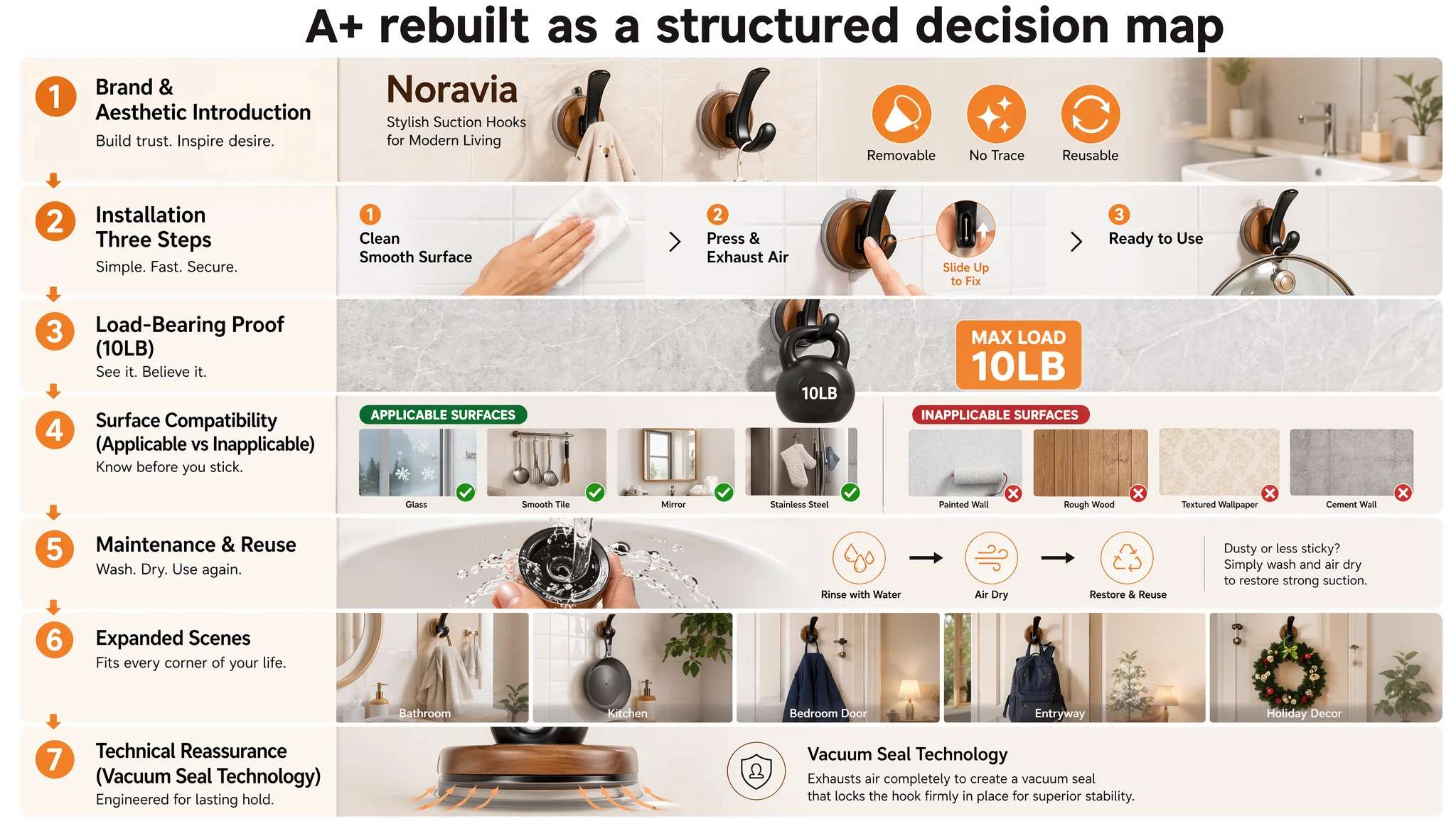
4. A+ Content: From Function Listing to Decision Support Engine
On the detail page, DeepBI’s logic emphasized:
1. Brand and aesthetic introduction
- Use the wood-pattern base as a visual advantage in a category full of transparent, utilitarian designs.
- Position the product as a “modern home solution,” not just a hook.
2. Installation clarity
- Turn scattered detail images into a three-step process:
- Clean surface
- Press and slide the vacuum clamp
- Hang items
- Make the “slide up to fix” motion visually explicit and labeled.
3. Quantified load-bearing
- Show the hook supporting a kettlebell labeled “10LB.”
- Add an overlay callout so the number and real object connect instantly.
4. Surface compatibility and risk reduction
- Create an “Applicable vs Inapplicable” visual module:
- Left: glass, smooth tile, mirror, stainless steel with green check marks.
- Right: painted wall, rough wood, textured wallpaper, cement with red X marks.
- This lowers the risk of misuse and reduces future negative reviews.
5. Maintenance and reuse
- Visualize the hook being rinsed under clear running water.
- Reinforce “Washable & Reusable” so long-term value is felt, not just stated.
6. Expanded scenes
- Show the hook in new contexts like bedroom door with a coat.
- Extend the product’s mental footprint from “bathroom accessory” to “whole-home organization.”
7. Technical reassurance
- Use a close-up visual to explain “Vacuum Seal Technology.”
- This supports a rational understanding of why this hook should be more stable than generic suction cups.
Collectively, these modules transform the A+ from a feature gallery into a structured decision engine: reassuring aesthetics, clear how-to, concrete performance, defined boundaries, care instructions, and extended use cases.
What Changed in the Business State
The case did not revolve around one instant metric jump; it revolved around a shift in how the seller understood their Amazon business.
After the Listing-centered optimization:
- Conversion capacity improved
- The page became more capable of turning both organic and paid traffic into orders.
- Buyers could understand performance, compatibility, and use cases faster.
- Ads started to become useful again
- Ad clicks were less likely to be wasted on undecided visitors.
- ACOS had room to move downward as CVR recovered.
- Traffic structure risk decreased
- The Listing regained the ability to carry more organic traffic without relying purely on ad pressure.
- The store became less exposed to rising ad costs because each click had a higher chance of converting.
- Operational decisions became clearer
- The team stopped treating every performance problem as an “ads problem.”
- They began judging whether a product page deserved more traffic before scaling campaigns.
“The real problem was not that ads failed to bring traffic. It was that the page could not convert the traffic.”
This shift in judgment is the core value. DeepBI’s role was not only to suggest better copy or images; it was to clarify where the bottleneck truly was and why ads should not be the first lever in this situation.
What Other Amazon Sellers Can Take Away
Several lessons from this suction cup hooks case apply across categories:
1. High ACOS is often a Listing issue in disguise.
If your title, images, A+ content, and reviews lag behind a category benchmark, ad tuning alone will rarely fix your economics.
2. Title structure is both an algorithm and a human problem.
Position core keywords correctly, but also embed numbers, scenarios, and pain-point resolution. Amazon search and buyers both respond to clarity.
3. Visual trust beats textual claims.
Load-bearing, installation steps, surface compatibility, and reuse are all more persuasive when seen, not just read.
4. A+ is not decoration; it’s a decision map.
Use it to reduce risk (surface guidance), explain mechanisms (vacuum lock), and expand use cases (rooms, occasions), not just to repeat specs.
5. Before scaling ads, ask a simple question: “Does this page deserve more traffic?”
If the Listing score and benchmark comparison say “no,” fix the page first. Ads should amplify strengths, not weaknesses.
DeepBI’s strength in this case was not listing features, but helping the seller reframe the problem: from fighting the ads manager to rebuilding the product page as a trustworthy endpoint for the traffic they were already paying for.