

This case comes from an Amazon seller in the pet-supplies category, selling rope dog leashes on the US marketplace. The team had begun to feel real pressure: ad traffic was not the core issue yet, but they were already worrying about future ACOS once they scaled Amazon ads. Their instinctive judgment was, “The product is solid, the main images look fine, we just need more reviews and then ads will work.” DeepBI’s Listing diagnosis showed a very different story.
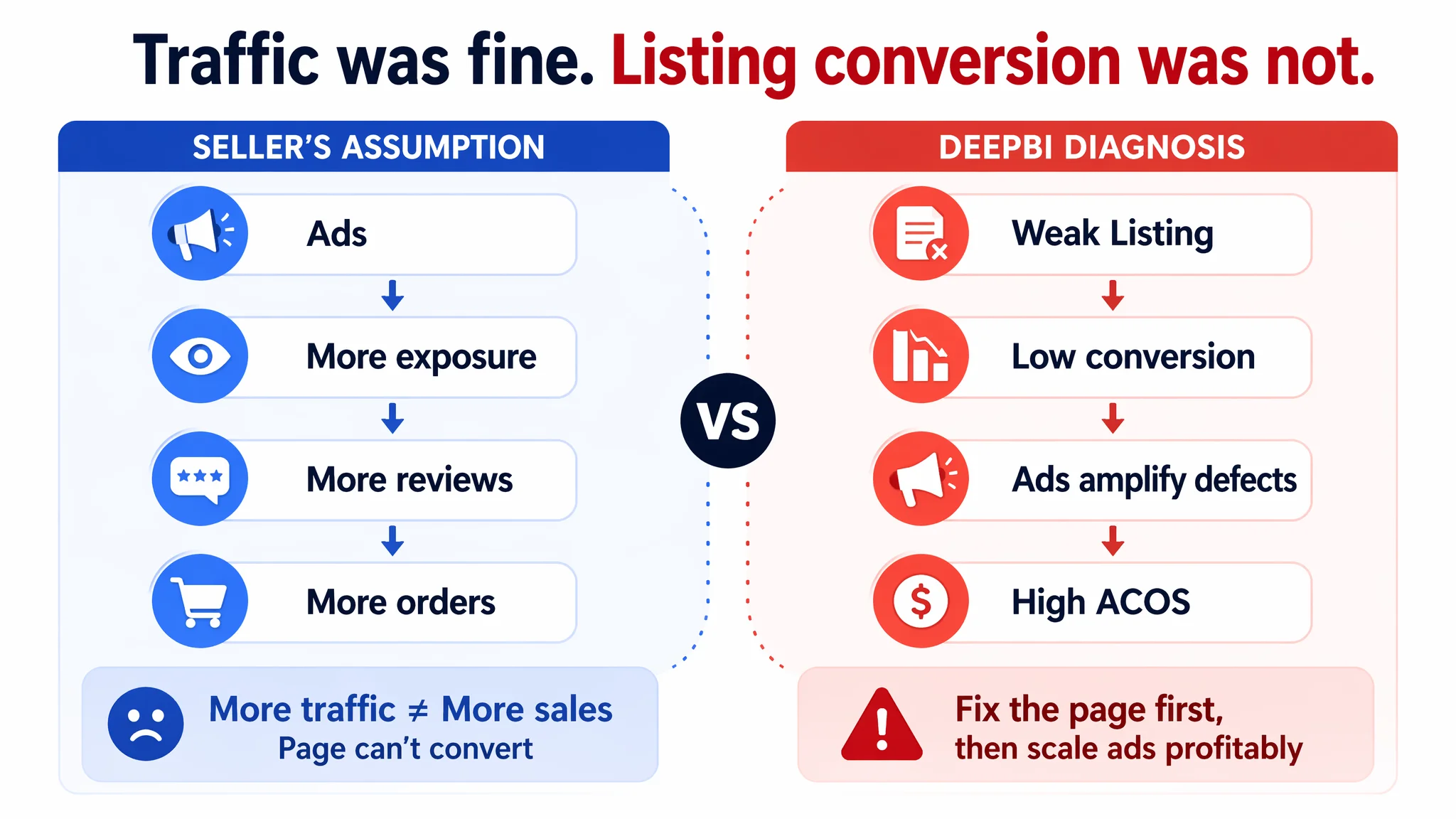
Against a leading Amazon competitor in dog leashes, the customer’s Listing scored only 49/100 versus 86/100. Title, bullet points, A+ content, and review foundation were all significantly weaker, while only the main image looked “not obviously worse” at first glance. DeepBI’s reading was clear: this Listing did not lack traffic; it lacked a conversion engine. Pushing more Amazon ads into this page would simply accelerate spend into a weak product page that could not build trust or communicate value.
The later optimization did not start with bids, keywords, or campaign structure. It started with Amazon Listing fundamentals: restructuring the title around real decision drivers, rebuilding bullet points around safety, strength, and night visibility, and designing a complete A+ story with real outdoor scenarios and technical close-ups. Only once the page could meaningfully convert both organic and paid visitors did it make sense to think about scaling ads. For other Amazon sellers, this case is a reminder: before blaming Amazon ads for high ACOS, make sure the product page itself is capable of earning the conversion.
Amazon Ads Were Not Failing. The Page Was Consuming the Traffic.
From a distance, this rope dog leash Listing looked “acceptable”:
- White background main image
- Multiple auxiliary images
- Basic bullet points
- A 5.0-star rating
The seller’s internal conclusion was typical: “Visuals are okay. Our big gap is review count. Once reviews grow and ads push more exposure, orders will follow.”
DeepBI’s Listing scoring completely broke that assumption.
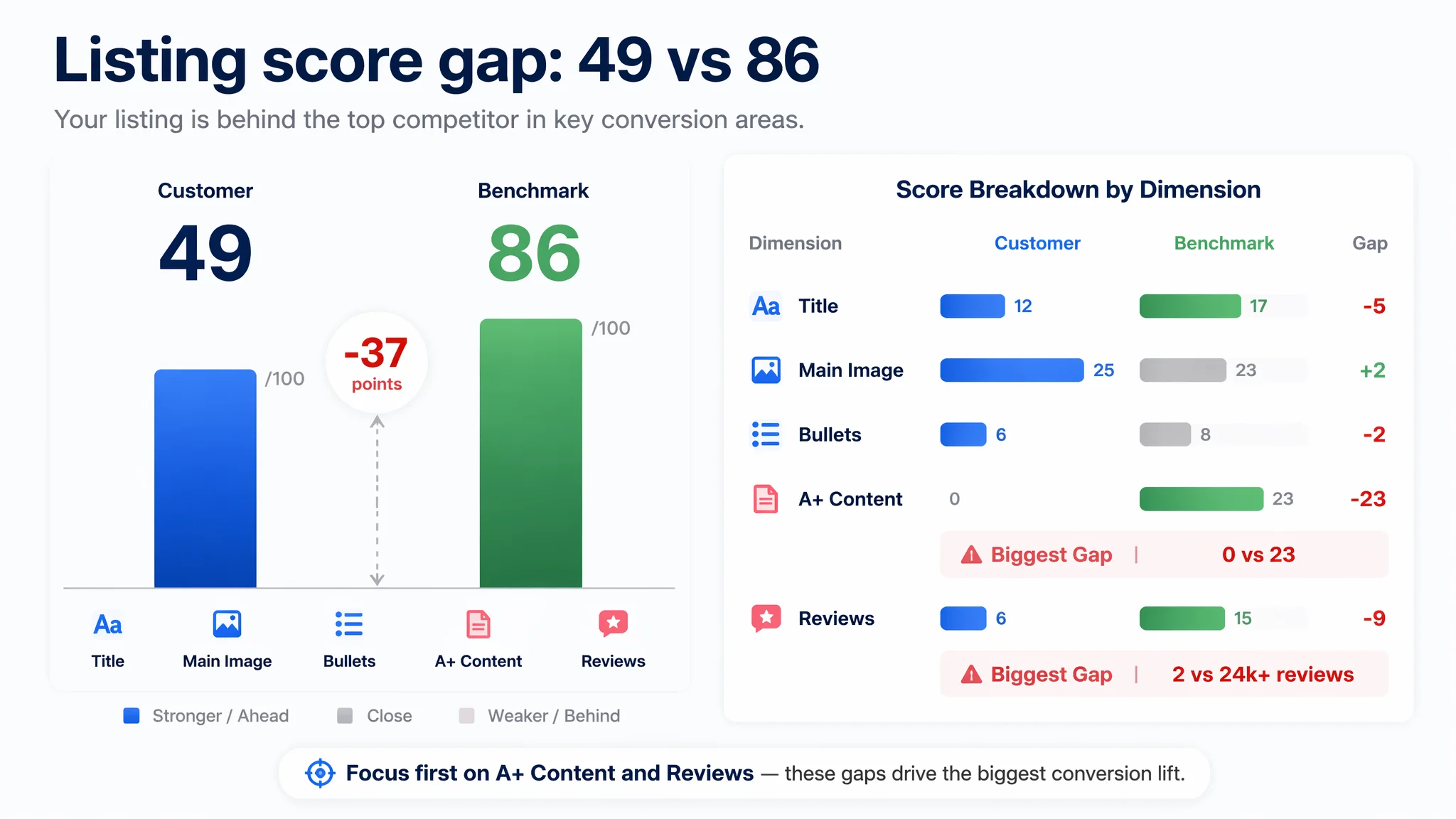
- Target Listing score: 49/100
- Comparable high-performing Listing: 86/100
- Gap: –37 points
By dimension:
- Title: 12 vs 17 (–5)
- Main image: 25 vs 23 (+2)
- Bullet points: 6 vs 8 (–2)
- A+ / detail content: 0 vs 23 (–23)
- Reviews: 6 vs 15 (–9)
“The real problem was not that ads failed to bring traffic. It was that the page could not convert the traffic.”
Main image was not the core bottleneck in this case. The real structural weaknesses were:
- No A+ content at all (0 vs 23)
- Minimal social proof (2 reviews vs ~24k+)
- A title and bullets that did not align with how buyers actually decide
If this seller had immediately scaled Amazon ads, the only certain outcome would have been higher spend, not proportionally higher orders.
The Original Misdiagnosis: “Our Images Are Fine, We Just Need Social Proof”
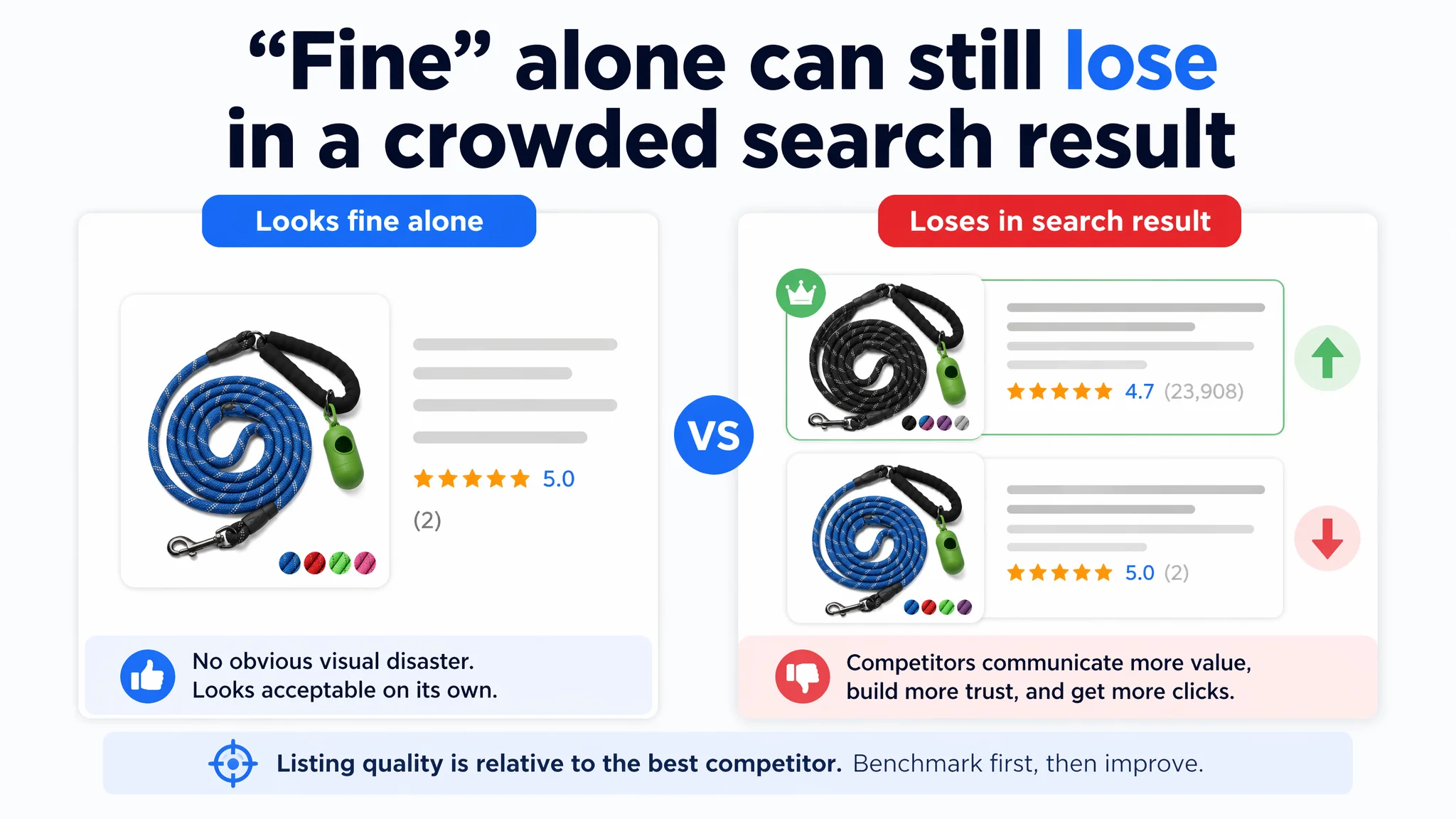
From the seller’s perspective, the logic felt reasonable:
1. Main image is clean, product clearly shown.
2. Bullet points mention durability, comfort, reflective features.
3. Star rating is 5.0, even though reviews are few.
4. Competitors look stronger mainly because they are older and have more reviews.
So they formed a mental model:
- Core problem = “review volume”
- Secondary problem = “maybe add a couple more images”
- Ad strategy = once reviews increase, push more ads
Why this judgment was dangerous:
- It treated the Amazon product page as “good enough” and put the burden of growth on ads + reviews.
- It ignored how deeply the leading competitor’s Listing was engineered to guide decisions, not just display the product.
- It conflated “no obvious visual disaster” with “actually competitive in a crowded search result.”
In a scenario like this, traditional ad optimization—bids, match types, campaign structures—would keep failing, because the downstream page was fundamentally weaker than the benchmark in almost every conversion dimension.
The Real Constraint Was Listing Conversion Capacity
DeepBI’s scoring did not just say “low score.” It showed where the Listing was structurally unable to convert:
1. Title: Words on the Page, But Not a Decision Driver
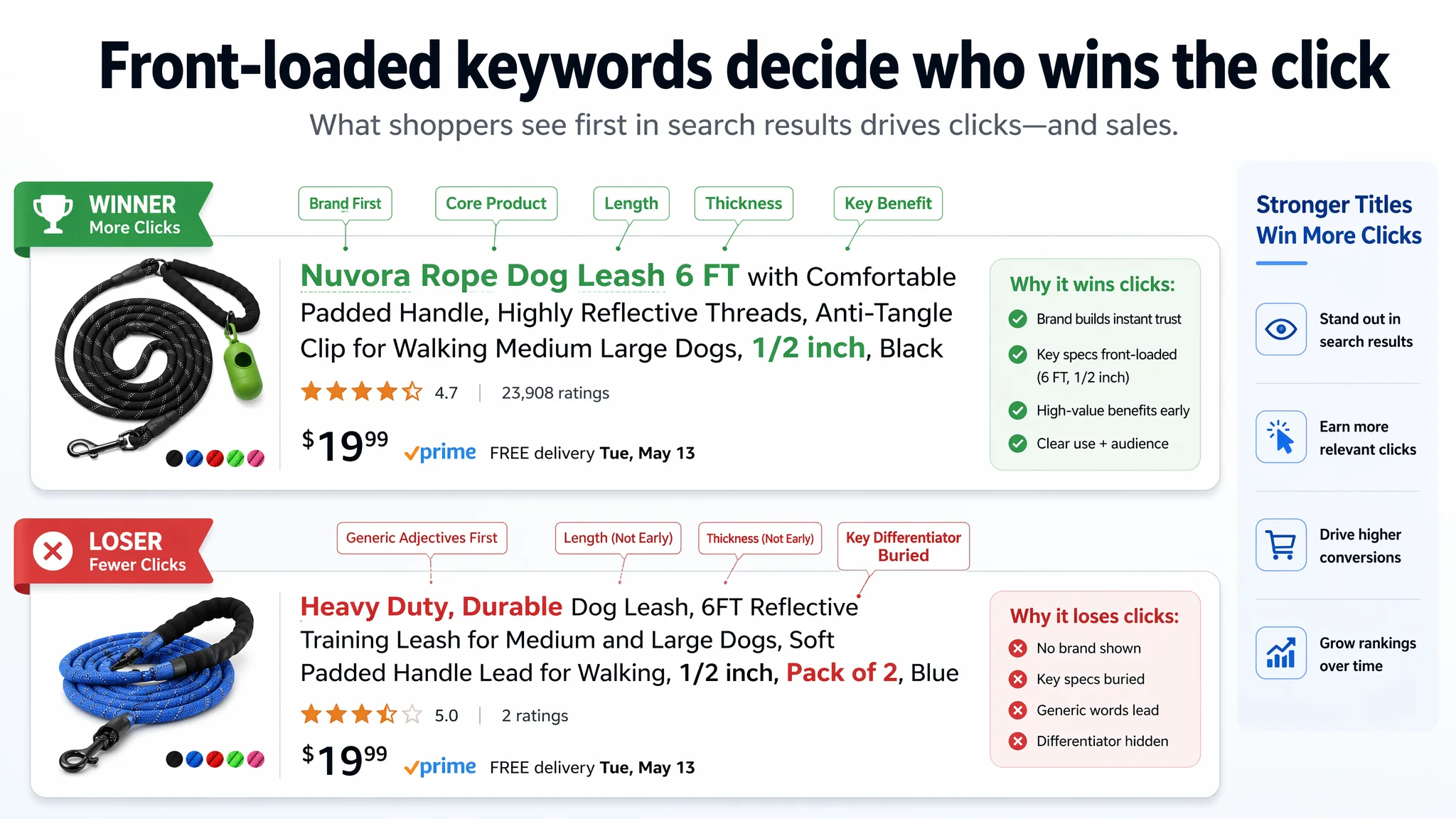
The customer’s title:
- Omitted the brand name entirely.
- Led with generic adjectives like “Heavy Duty, Durable.”
- Buried a crucial differentiator—“2 pack”—in the middle.
- Listed keywords and parameters in a loose sequence instead of telling a clear value story.
The benchmark Listing:
- Led with the brand name, building instant recognition and trust.
- Highlighted high-perceived-value features:
“Comfortable Padded Handle”, “Highly Reflective Threads”.
- Front-loaded the exact parameters buyers use to screen options:
“6 FT”, “1/2 inch”.
This matters on Amazon because:
- Search-results thumbnails show only part of the title. Early words heavily influence CTR.
- Buyers scan quickly for length, thickness, and core use case.
The competitor title surfaces these immediately; the customer’s does not.
DeepBI’s judgment: even before talking about images, the title was already wasting opportunities to earn clicks and frame expectations.
2. Bullet Points: Information Present, Buying Logic Missing
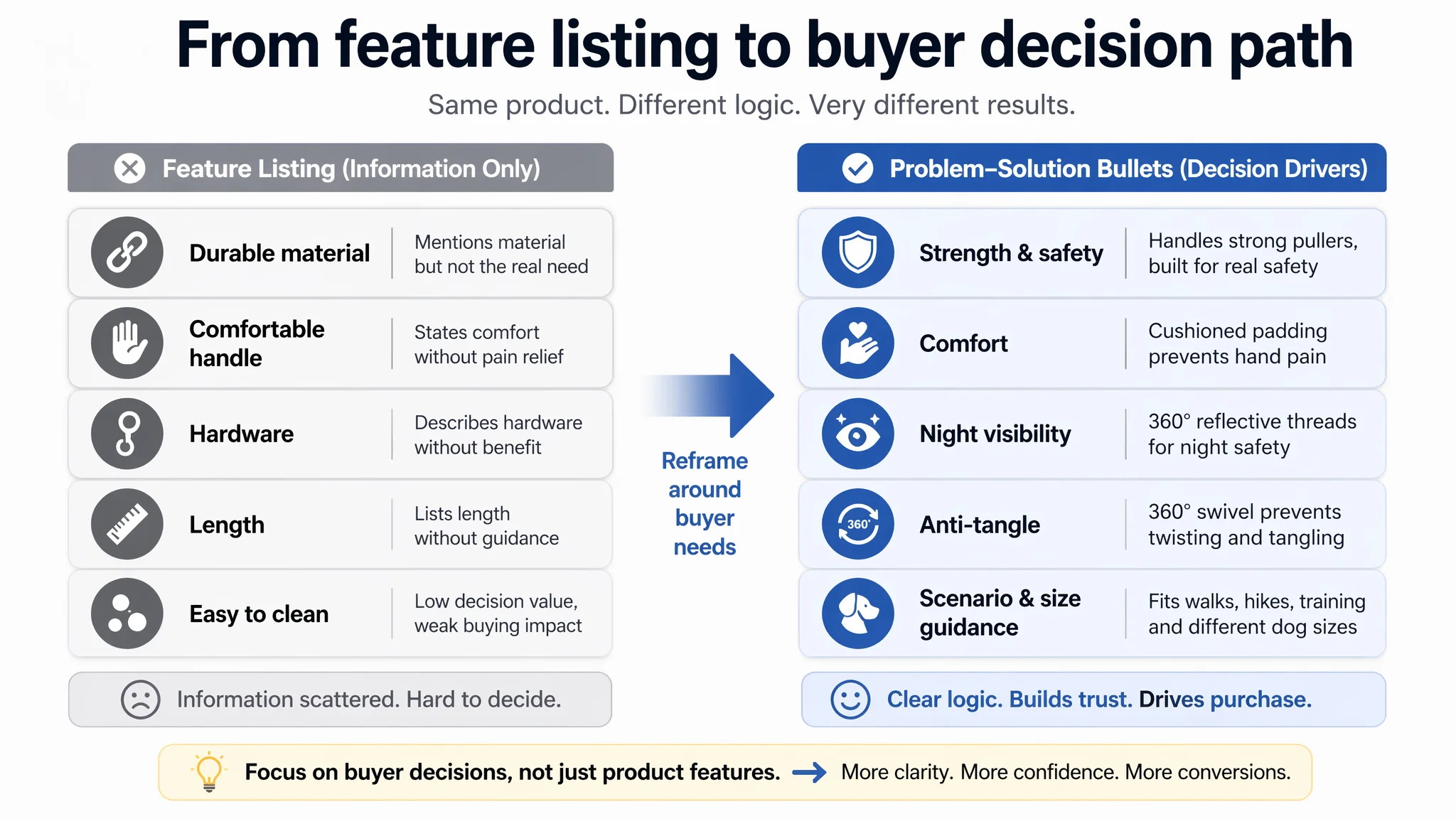
On paper, the customer’s bullet points covered:
- Durability
- Comfortable handle
- Hardware
- Length and control
- Easy to clean
The competitor’s bullets followed a much sharper persuasion path:
1. Ultimate strength with specific data (“1/2 inch rock climbing rope”).
2. Comfort that solves a clear pain point (“say goodbye to rope burn”).
3. Night visibility as a standalone safety promise, with woven reflective threads.
4. Tangle-free 360° swivel that explicitly solves tangling.
5. Use scenarios + size guidance (walks, hikes, lengths, diameter for different dog sizes).
In contrast, the customer:
- Folded “reflective” into generic material description instead of elevating it as a safety feature.
- Used the fifth bullet for “easy to clean & durable,” which is low decision value compared to scenario and size guidance.
- Did not clearly connect bullets to typical pet-owner concerns: strength for pullers, night safety, comfort, and managing different dog sizes.
The bullets were “correct,” but they did not operate as a conversion engine.
3. A+ Content: A Complete Vacuum vs. a Full Narrative
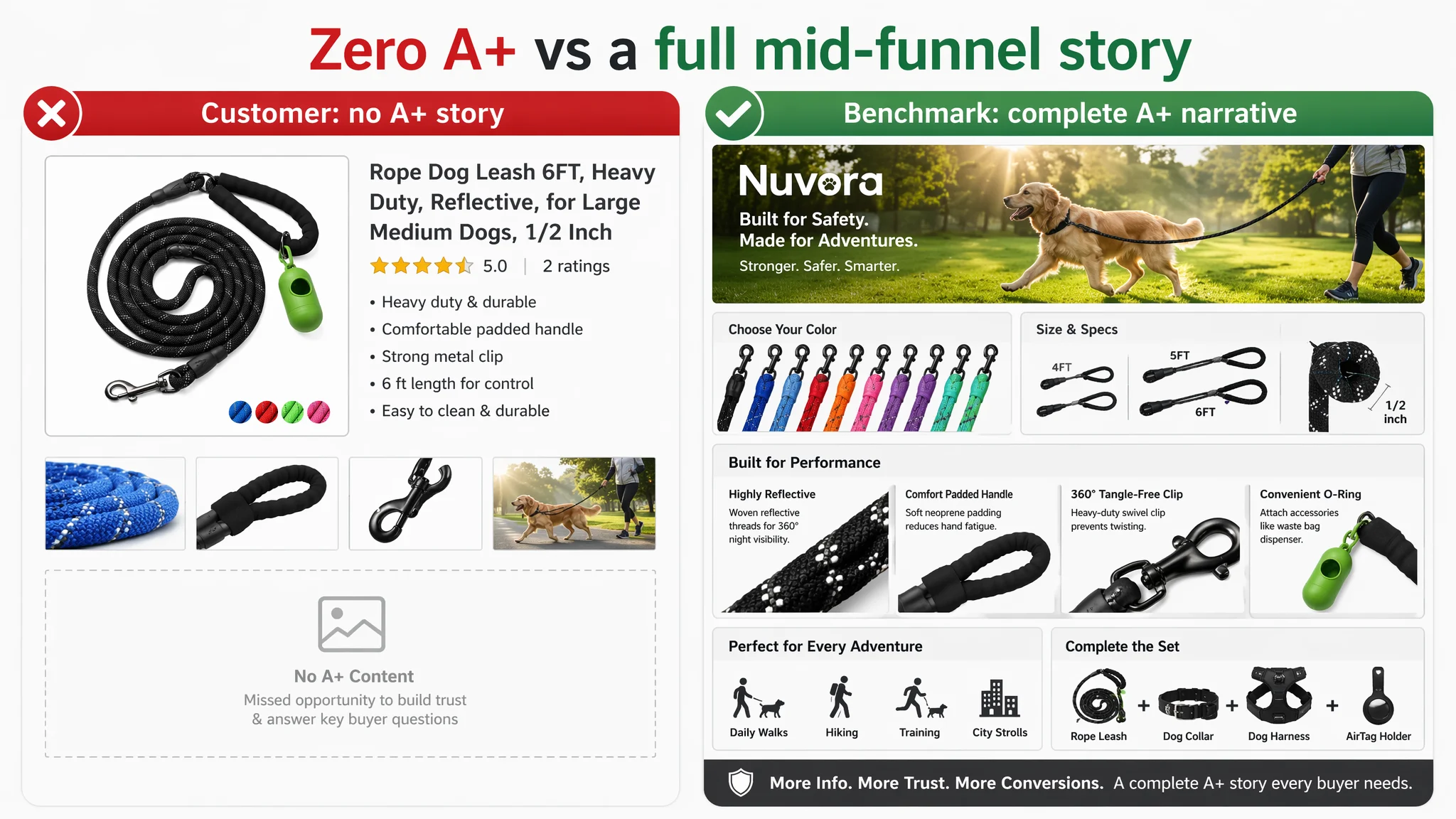
This was the most fatal gap.
Customer Listing:
- No A+ content at all.
Benchmark Listing’s A+:
- Real outdoor scenes (dogs + owners) creating emotional connection and usage context.
- Color range, size and structure diagrams, clearly labeled specs.
- Close-ups of specific features: reflective threads, LED options, personalization, AirTag holder.
- A complete product matrix (collar, harness, AirTag holder) that supports cross-sell and brand depth.
Without A+:
- The customer’s page forces buyers to decide only from title, bullets, a few standard images, and two reviews.
- There is no place to tell the safety story, show leash behavior in motion, or visually answer “Will this work for my dog, at night, in real life?”
DeepBI’s reading: this Listing has almost no mid-funnel or bottom-funnel persuasion structure. It’s a top-of-page shell.
4. Reviews: Perfect Score, but Zero Scale
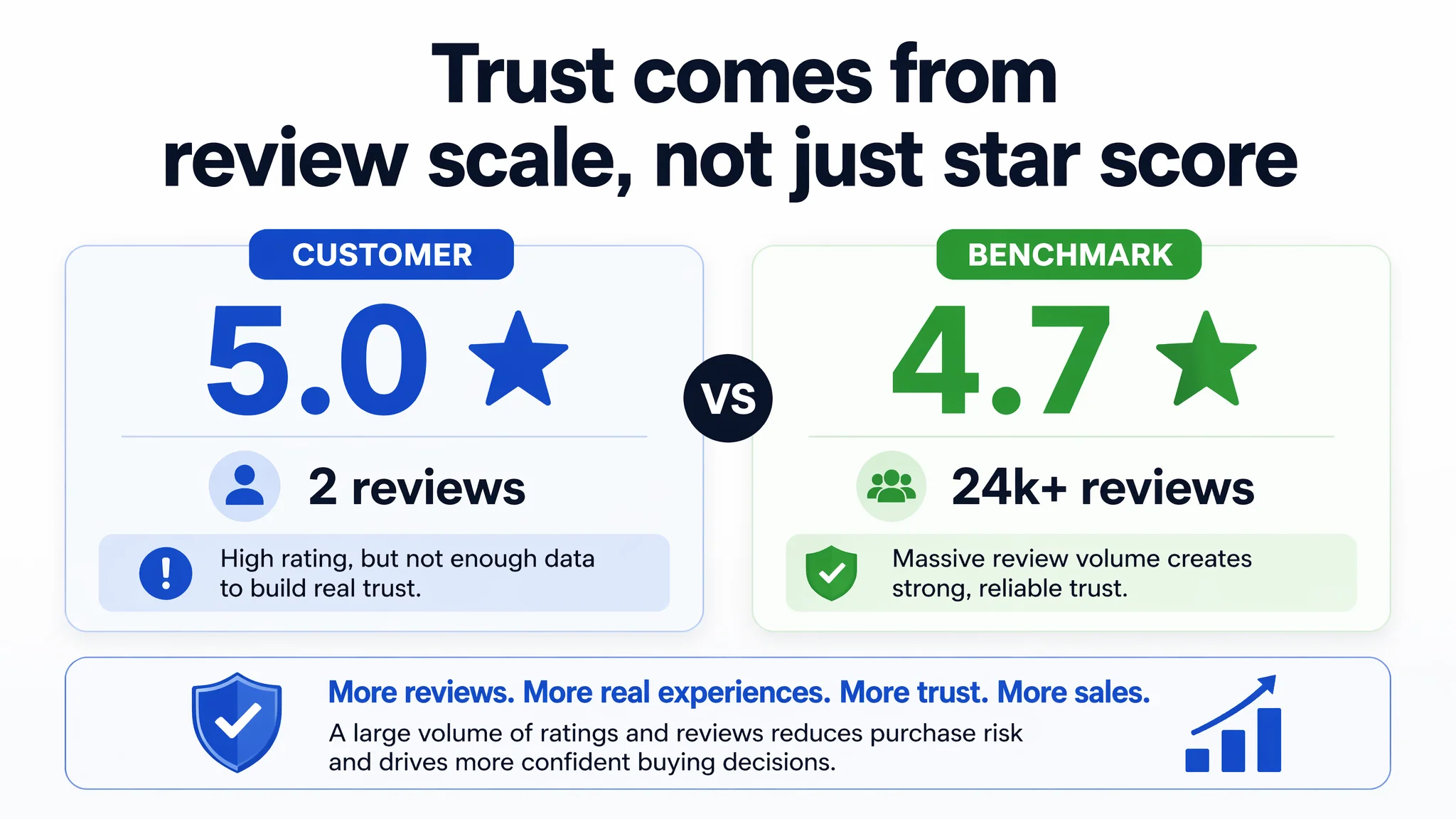
Customer:
- 5.0 stars
- 2 reviews
Benchmark:
- 4.7 stars
- ~24k+ reviews
- A mix of positive and negative reviews visible, which ironically increases perceived authenticity.
A 5.0 rating with 2 reviews is a trust placeholder, not a trust engine. It cannot substitute for:
- A structured page that answers questions visually
- A+ modules that show real-world use and detail
- Consistent language around safety, strength, comfort, and suitability
So while the seller kept saying “we just need more reviews,” the deeper issue was: even if reviews grew, the page still wouldn’t match the competitor’s conversion logic.
Why DeepBI Did Not Recommend “Tuning Ads” First
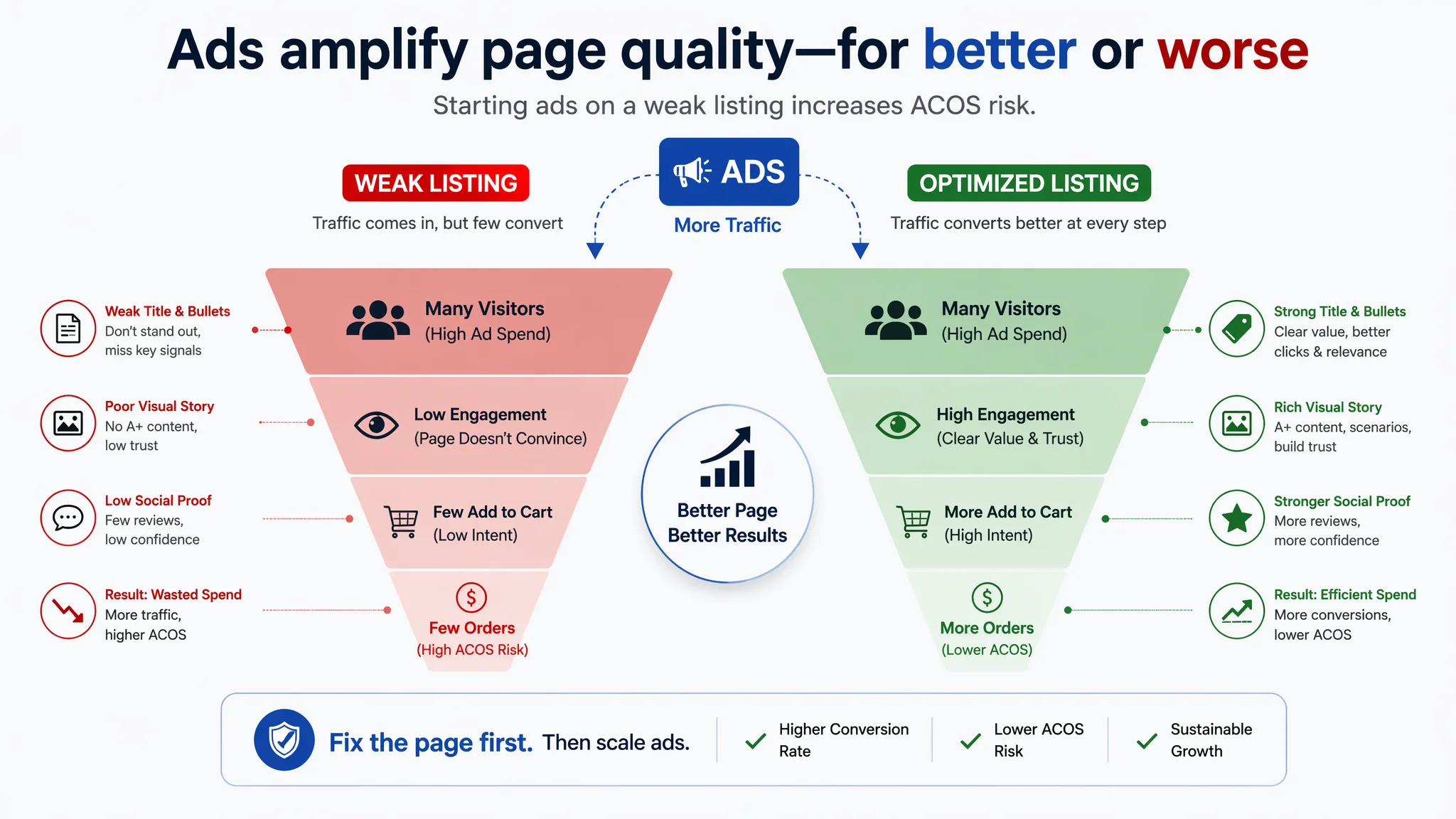
Given these gaps, DeepBI’s decision path was straightforward:
- Do not start with ad-side optimization.
- Do treat this as a page-conversion problem first.
Key reasoning:
1. A 0/25 A+ score is a red flag.
Any spend poured into this Listing would be constrained by the page’s inability to build trust once visitors scroll.
2. Title and bullets were not aligned with top competitor logic.
Even organic impressions were being “wasted” because the page did not communicate strength, safety, or decision guidance as clearly as the benchmark.
3. Ads amplify whatever exists.
In this state, ads would only amplify:
- Generic positioning
- Weak mid-page persuasion
- Minimal social proof
“Advertising does not only amplify advantages. It can also amplify a page’s existing defects.”
From a risk perspective, the biggest immediate danger was:
- Scaling spend on a Listing that structurally underperforms the benchmark, locking the seller into high ACOS and low CVR, and then mistakenly blaming “keywords” or “competition” instead of the page.
Therefore, DeepBI’s call was:
- Repair Listing conversion capacity first.
- Only after core page logic is competitive, then think about systematically scaling Amazon ads.
Rebuilding the Page: From Static Display to Conversion Story
DeepBI’s optimization direction focused on four pillars:
1. Title restructuring
2. Bullet-point reframe
3. Main-image system refinement
4. A+ content construction
The goal was not “make it prettier,” but “make it capable of converting the traffic ads will later bring.”
1. Title: From Keyword List to Clear Value Proposition
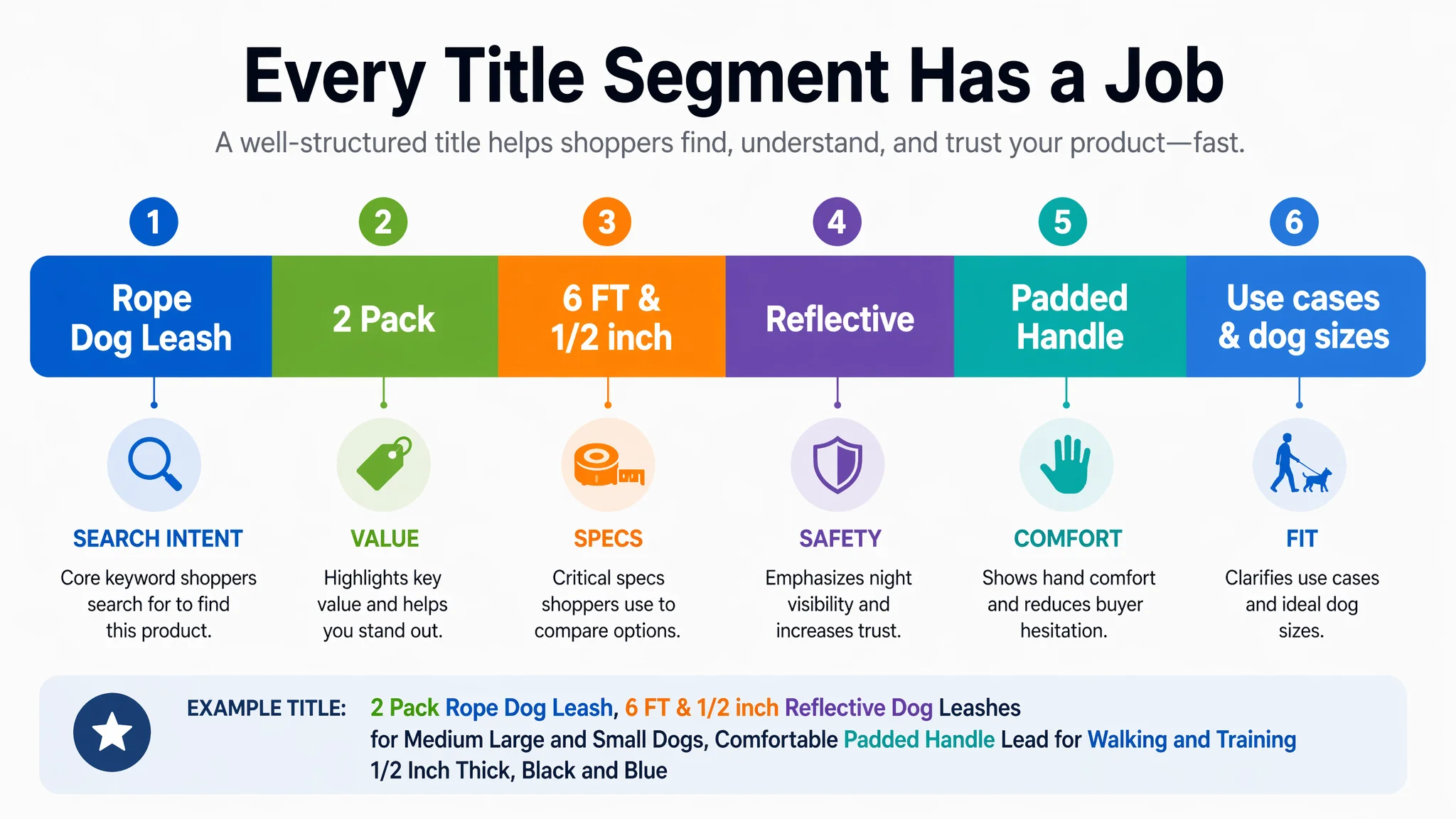
Proposed title direction:
2 Pack Rope Dog Leash, 6 FT Heavy Duty Reflective Dog Leashes for Medium Large and Small Dogs, Comfortable Padded Handle Lead for Walking and Training, 1/2 Inch Thick, Black and Blue
Logic behind this shift:
- Front-load “Rope Dog Leash” to align with core search intent.
- Surface the differentiation “2 Pack” early as a value trigger.
- Keep “Reflective” and “Padded Handle” visible within the truncated title area to highlight safety and comfort.
- Make length (6 FT) and thickness (1/2 inch) easy to spot in scanning.
Instead of generic “heavy duty, durable,” the title now:
- Speaks the language of Amazon search queries.
- Surfaces what actually differentiates this SKU (2-pack, reflective, padded handle).
- Reduces friction for buyers scanning dozens of similar Listings on the results page.
2. Bullet Points: From Product Features to Problem–Solution Logic
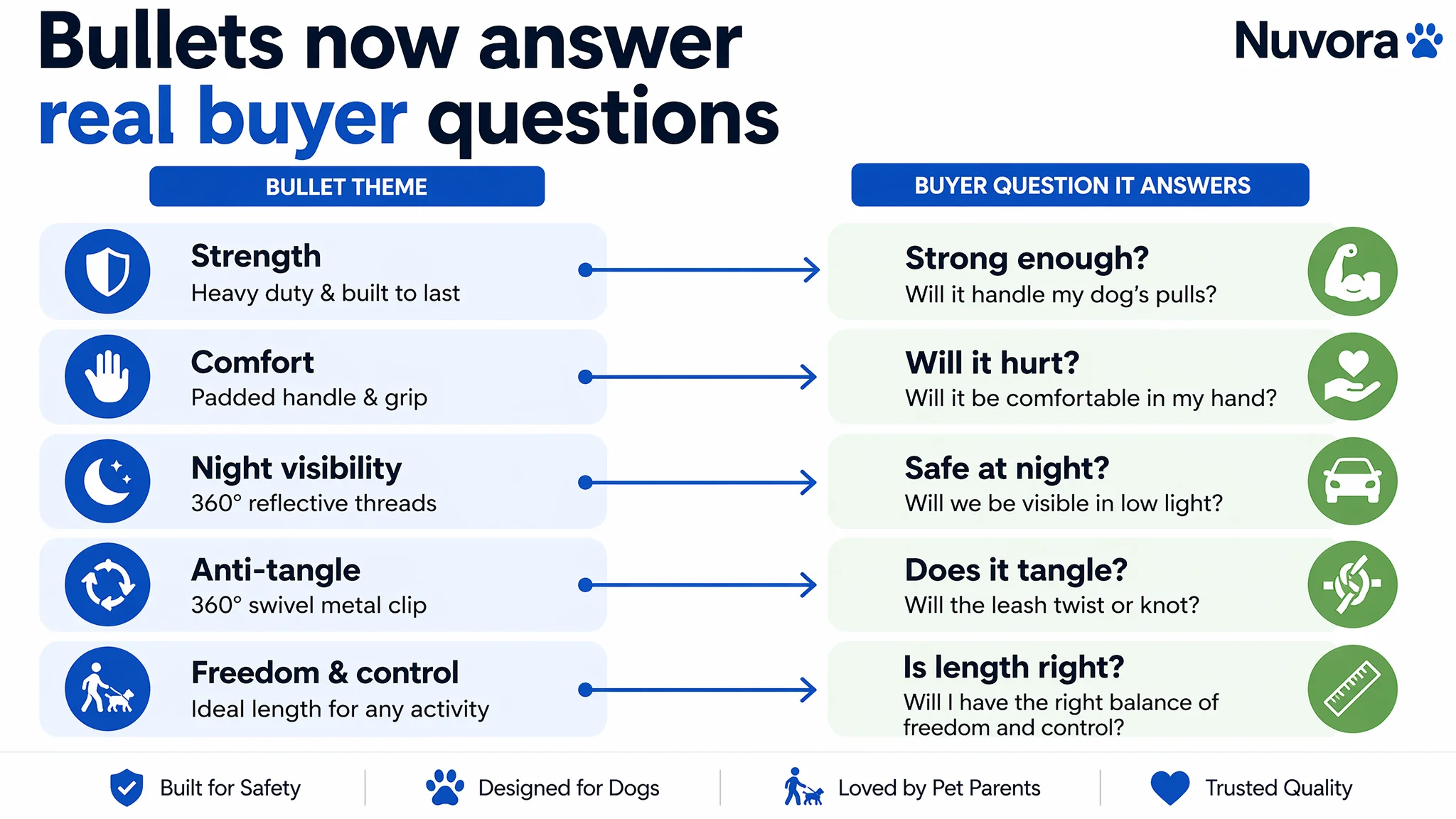
DeepBI’s recommended rewrites followed a consistent structure:
- Name the core concern.
- Anchor it in a tangible spec or design choice.
- Connect it to the buyer’s emotional need (safety, comfort, control).
Examples of the reframed bullets:
Strength & Safety
Heavy Duty & Built to Last: Crafted from 1/2-inch high-strength braided nylon rope, inspired by rock-climbing gear. This durable dog leash is engineered to withstand the most powerful pulls from large, energetic dogs, providing you with maximum safety and peace of mind.
Comfort
Ultimate Comfort Padded Handle: Featuring a soft, non-slip neoprene grip, our handle protects your hands from sudden tugs and eliminates “rope burn.” Enjoy extended walks and training sessions with total comfort and superior control, even with strong pullers.
Night Visibility
360° Enhanced Night Visibility: Highly reflective threads are woven through the entire length of the rope to ensure you and your dog remain visible to cars and cyclists. Perfect for safe early morning jogs or late-night strolls in low-light urban environments.
Anti-Tangle Hardware
Tangle-Free 360° Swivel Hook: Equipped with a heavy-duty, rust-resistant metal clasp that rotates 360 degrees to prevent the leash from twisting or tangling. The secure, zinc-alloy connection ensures a quick and reliable attachment to any collar or harness.
Use Scenarios & Control
Perfect Balance of Freedom & Control: The 6-foot length provides the ideal maneuverability for city walks, park hikes, or obedience training. Designed for daily durability and active outdoor adventures, it is the versatile choice for medium to large breeds.
These bullets do more than describe; they guide the decision:
- “Is it strong enough?” → Yes, and here is why.
- “Will it hurt my hand?” → No, and here is how it solves that.
- “Is it safe at night?” → Reflective threads woven through the entire rope.
- “Does it tangle?” → 360° swivel hardware.
- “Is 6 ft right for me?” → Clear position as the balance between freedom and control.
This is the buying logic the original Listing lacked.
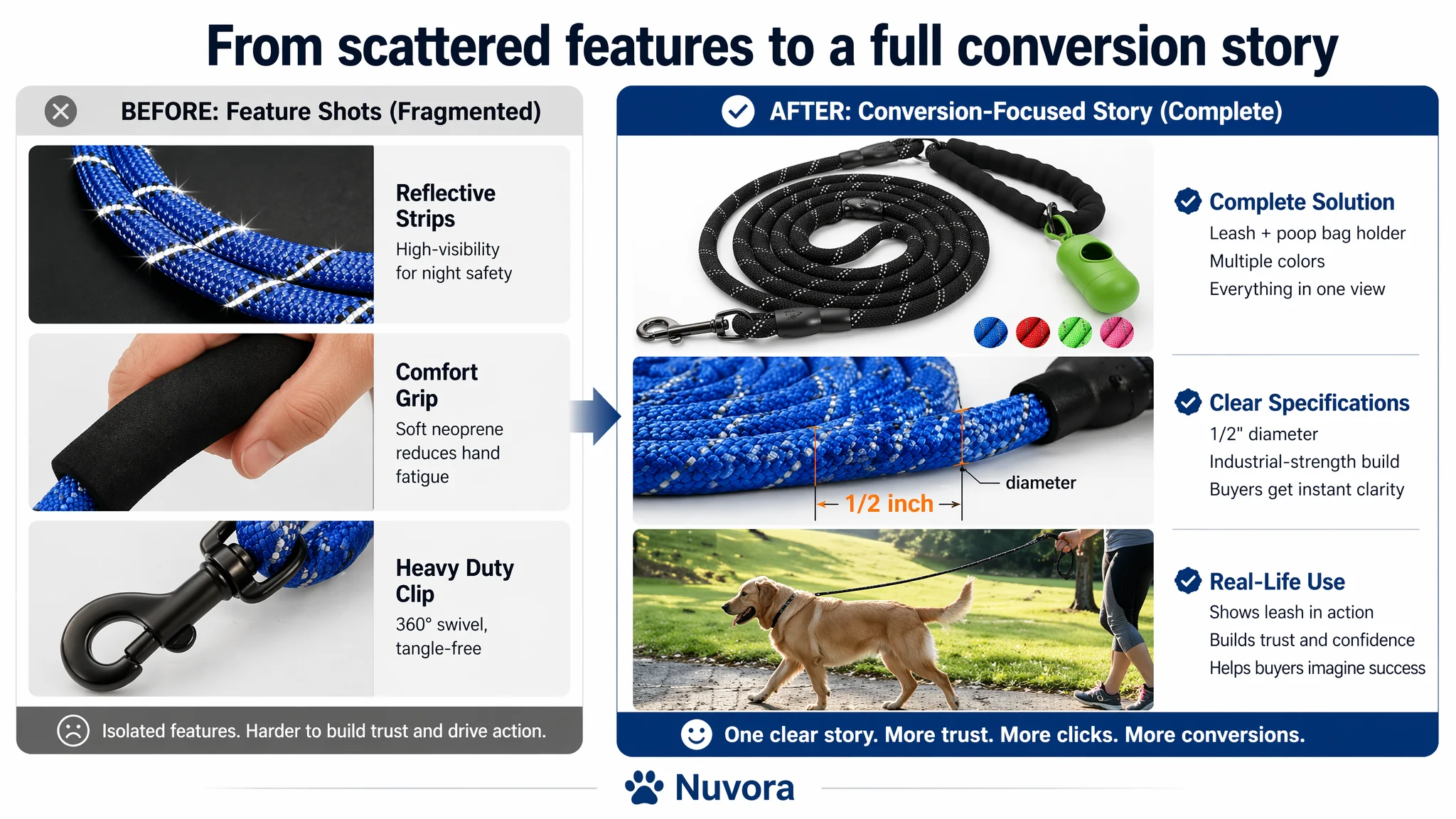
3. Main Images: Not Just “Nice” — Aligned With Conversion Roles
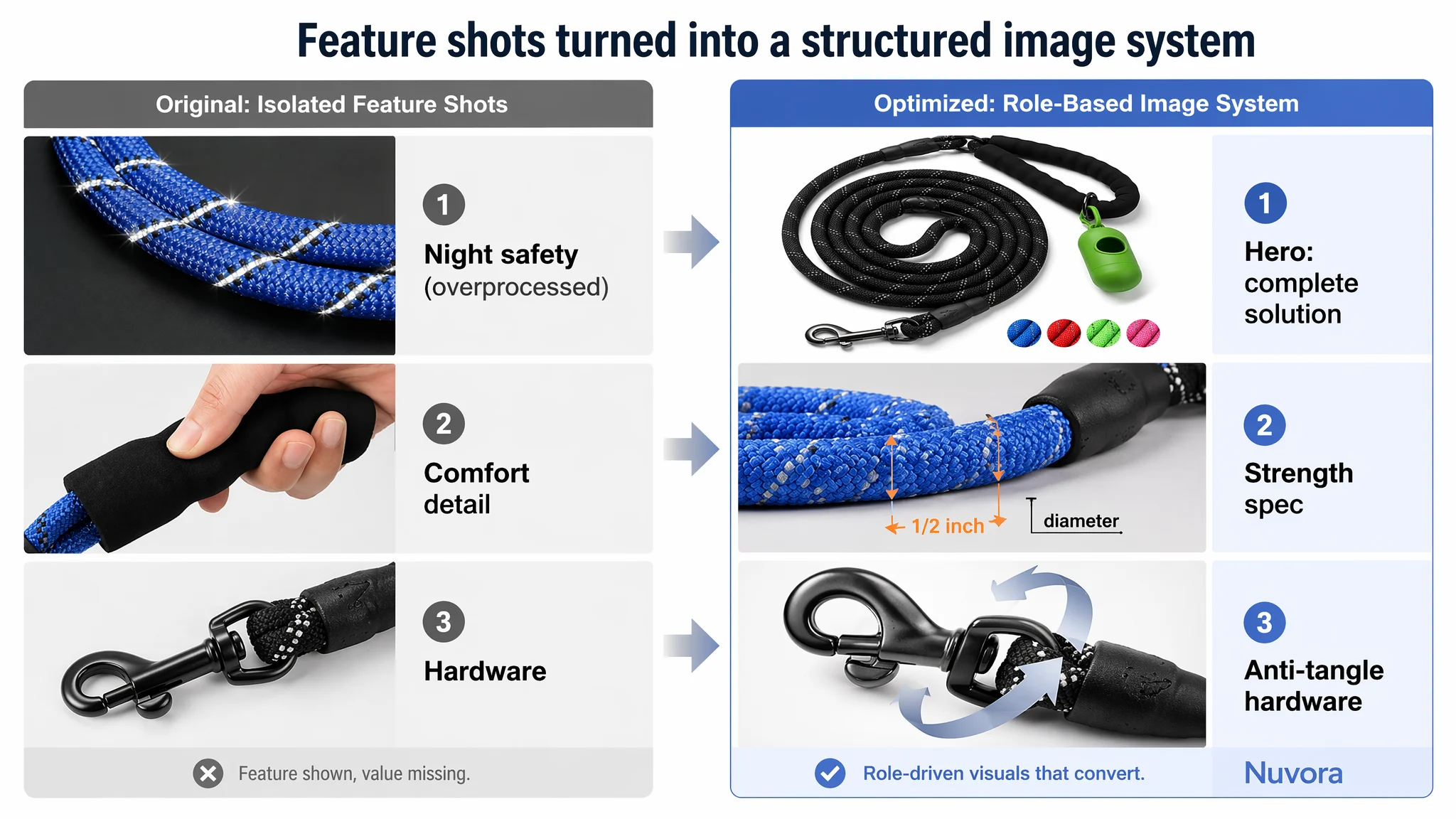
DeepBI did not conclude that the main images were worse than the competitor’s; in fact, the score was slightly higher. But there were several hidden issues:
- Overloaded color combinations lowered perceived value.
- No “first-glance trust anchor” such as brand presence or meaningful accessory bundle.
- Technical details (e.g., 1/2-inch diameter) were not visualized.
- O-ring functionality and 360° swivel behavior were not clearly shown.
- Night-reflective capability looked heavily post-processed and not fully believable.
Recommended changes were role-based, not purely aesthetic:
- Hero image: Single primary color coiled neatly, 45° top view, clean shadows, and a visible poop-bag holder to signal a “complete solution,” plus small color circles for other variants.
- Specification close-up: Macro shot of rope section with a clear “1/2 inch” label, using industrial visual style to communicate strength.
- Handle detail: Clean close-up of padded handle with simple text callouts (“Comfort Padded Handle”, “Convenient O-Ring”).
- Swivel hook focus: Dramatic lighting on metal hardware with a “360° Swivel Tangle-Free” callout to visually encode the anti-tangle promise.
- Lifestyle scene: Realistic morning park walk composition showing the leash in use, visually expressing “Control & Freedom”.
Each image gets a defined job:
- Search-result click (main hero)
- Strength & quality signal
- Comfort & ergonomics
- Anti-tangle clarity
- Real-world usage, emotional connection
4. A+ Content: From Zero to a Structured Conversion Story
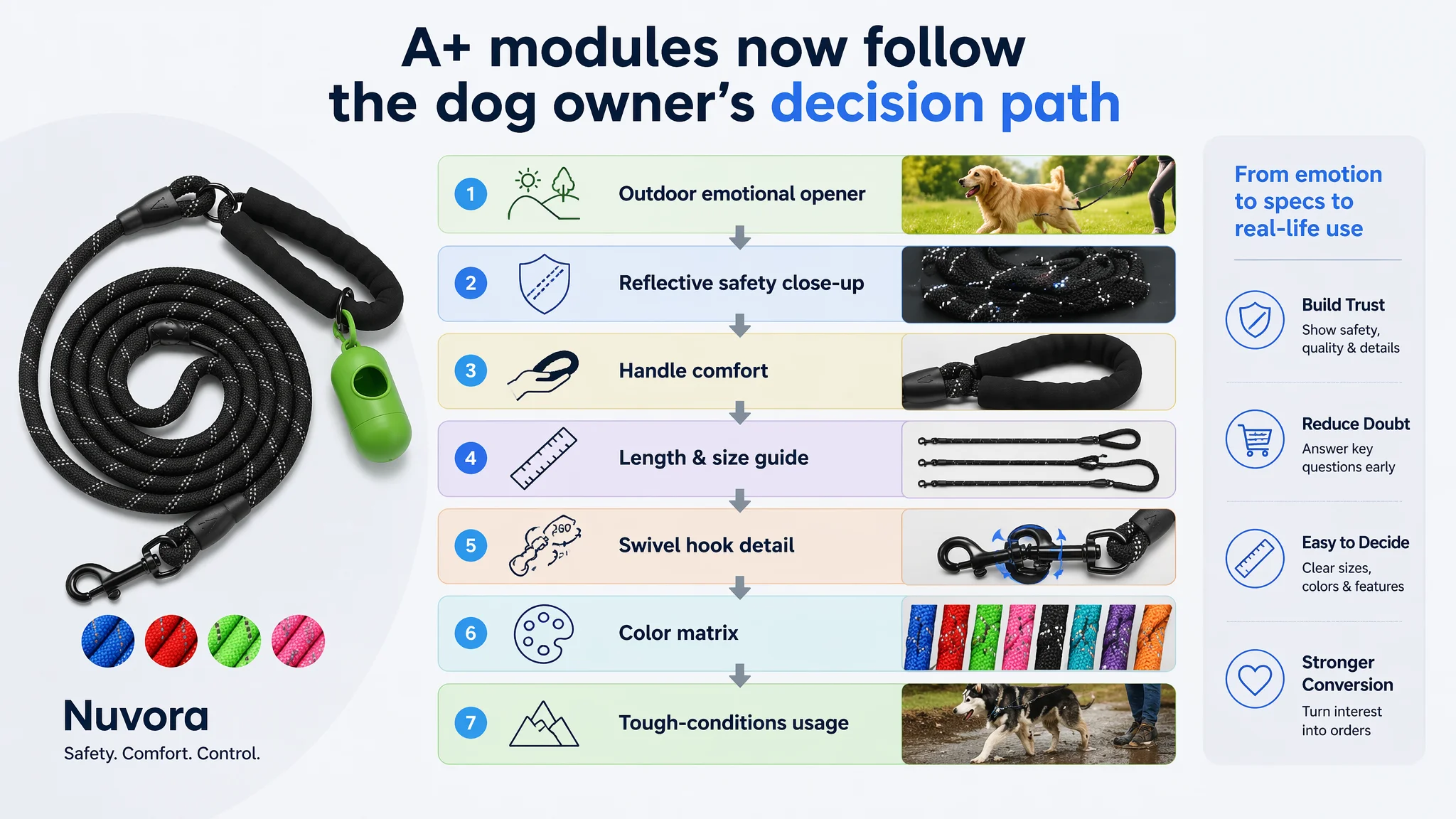
The biggest shift was to build an A+ architecture that mirrors how dog owners actually make decisions.
Module examples:
1. Outdoor emotional opener
- A golden retriever mid-run in a park, leash clearly visible, owner holding handle.
- Bright, natural light, warm tone: communicates freedom + control + happiness.
2. Reflective safety close-up
- “S”-shaped rope under controlled lighting that makes reflective threads visibly “pop.”
- Visual proof of night safety instead of just text claims.
3. Handle comfort demonstration
- Hand gripping padded handle; soft light showing foam compression at pressure points.
- Addresses the “rope burn” and hand pain concern visually.
4. Length and size guide
- Simple layout showing 4ft, 5ft, 6ft options side by side (if applicable), with clear labels.
- Helps buyers choose confidently and reduces returns.
5. Swivel hook detail
- Close-up shot with bold lighting emphasizing metal strength and 360° rotational capability.
6. Color matrix
- Clean display of multiple color variants in a structured grid or fan layout, labeled as “12 COLORS” or similar if relevant.
- Gives a sense of assortment and brand scale.
7. Usage scenario in tougher conditions
- Rainy day or wet surface, leash plus poop-bag holder, hinting at real-life complexity and durability.
This is not “just more pictures.” It is the missing narrative that turns:
- “A rope leash that looks okay” → into
- “A proven, strong, comfortable, safe, versatile leash I can trust for my dog.”
How the Page’s Sales Logic Started to Recover
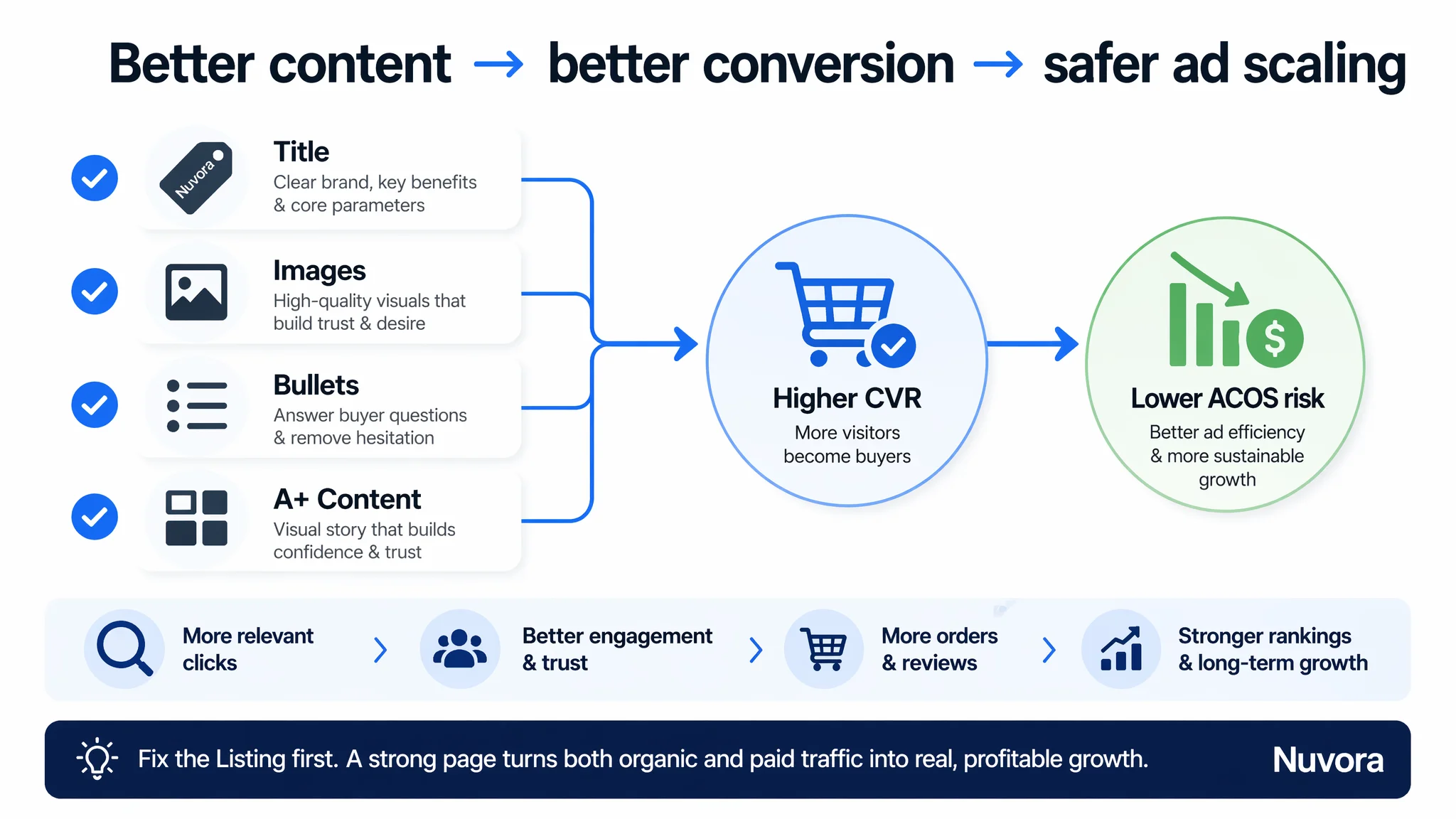
Once these changes are implemented, several structural improvements occur—even before heavy ad spend:
- Title starts winning more relevant clicks on the search-result page.
- Main images create a clearer first impression of quality and completeness.
- Bullet points answer core fears and questions in the language of buyers, not only in the language of manufacturing.
- A+ content gives mid-funnel visitors enough confidence to move from “maybe” to “add to cart,” despite low review volume.
Business effects (without inventing numbers):
- Conversion rate (CVR) has room to move up instead of being artificially capped by missing content.
- Organic traffic becomes more productive, which is essential for long-term ranking.
- When ads are later scaled, each paid click has a higher probability of becoming an order, lowering ACOS pressure.
- The Listing begins to build a more robust base for future reviews, because more buyers actually complete purchases.
At that point, revisiting Amazon ads—keywords, bids, campaign design—starts to make sense. The traffic is no longer being dumped into a fundamentally incomplete page.
How the Seller’s Understanding Changed
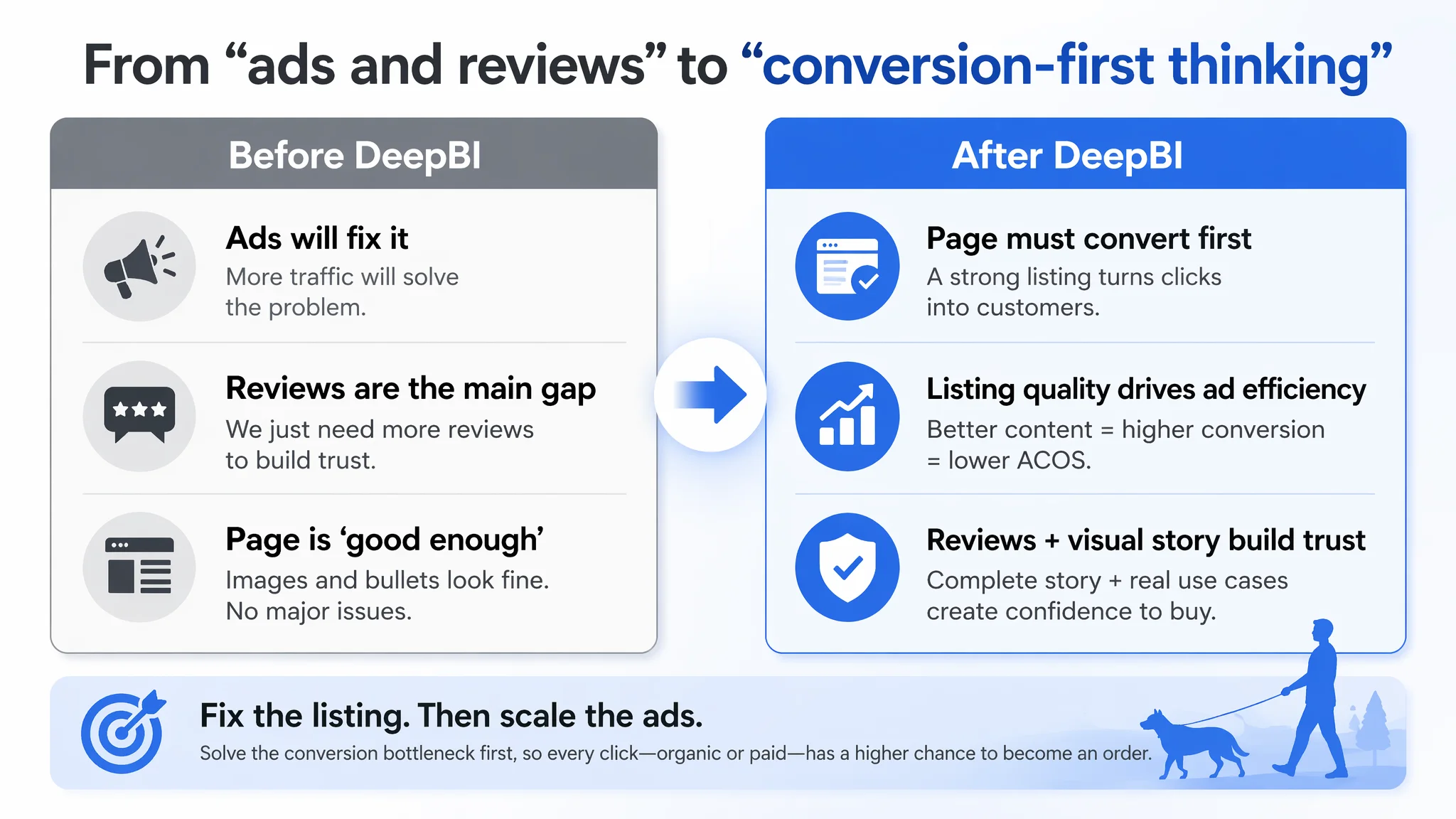
Before the diagnosis, the seller’s operating logic was:
- “Our main images are okay.”
- “Reviews are the only real gap.”
- “Once reviews grow, we’ll push more ads and the product will take off.”
After working through DeepBI’s Listing analysis and optimization path, their perspective shifted:
1. Ads are not a cure for weak product-page conversion.
If the Listing cannot convert, more traffic just magnifies the weakness.
2. Listing quality is a prerequisite for ad efficiency.
Title, main image, bullets, and A+ must form a coherent decision path before scaling spend.
3. Review volume is only one layer of trust.
Visual story, technical clarity, and scenario fit are equally important, especially for a younger Listing that cannot compete on review count yet.
4. Fixing the Listing first reduces business risk.
It lowers the chance of running into unsustainably high ACOS once ads are scaled.
For other Amazon sellers—especially in crowded categories like pet supplies—the key takeaway is clear:
- When traffic exists but orders lag, do not automatically blame Amazon ads.
- Use data-driven Listing diagnostics to ask:
- Is my title really competitive against the benchmark?
- Do my images each have a clear conversion job?
- Do my bullets address real buyer fears, or just list materials?
- Does my A+ content exist, and if so, does it actually tell a story?
Only when the Amazon product page itself is structurally capable of converting both organic and paid visitors does it make sense to push harder on ads. In this dog-leash case, the main win was not a flashy creative makeover; it was a sharper judgment of where the real bottleneck was—and the discipline to fix the Listing before turning up the ad spend.