

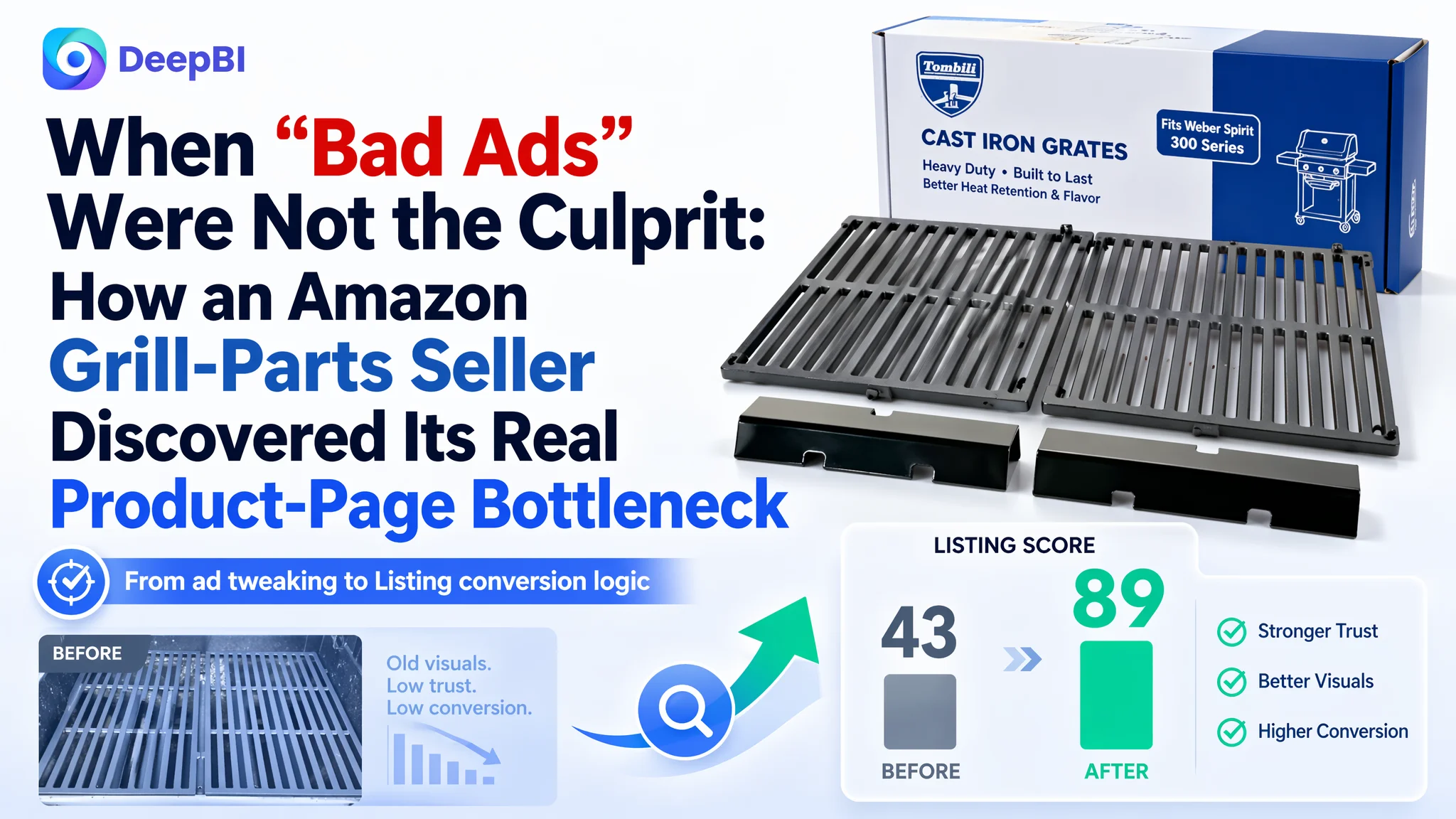
This case comes from an Amazon seller in the grill parts category. The team was preparing to push traffic for a new Weber-compatible grate-and-flavorizer set on the US marketplace. Advertising costs were already a concern, so when early tests showed weak traction, the team’s first reaction was to blame “immature ads” and “not enough bids”.
DeepBI’s diagnosis went in a different direction. Before touching campaign structures or keyword bids, we compared the target Amazon Listing against a high-performing benchmark in the same grill-parts niche. The gap was not in traffic volume at all. The gap was in the page’s ability to convert that traffic: a near-empty product page, no A+ content, zero reviews, and a main image that looked like low-value spare parts rather than a professional upgrade kit.
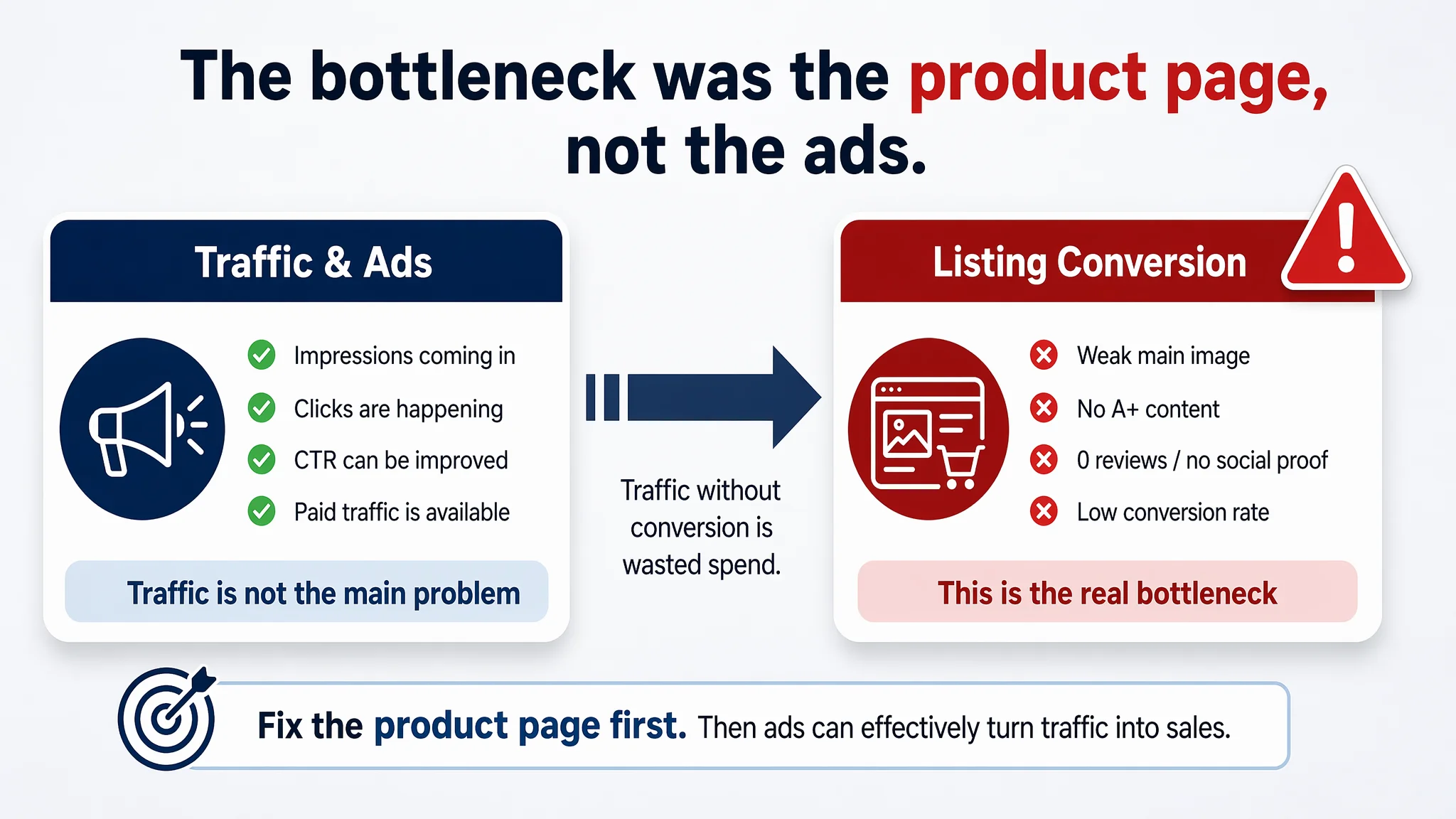
Once the problem was reframed as a Listing conversion issue instead of a pure advertising issue, the entire optimization path changed. Rather than pouring more budget into underperforming campaigns, the focus shifted to rebuilding the Amazon product page: a more strategic title, compatibility-focused bullet points, professional main-image logic, and a full A+ story that could actually carry the decision process. For other Amazon sellers, this case is a reminder that when ACOS feels unmanageable, the real constraint is often that the page does not deserve the traffic it’s paying for.
Amazon Ads Were Not Failing. The Page Was Consuming the Traffic.
From the seller’s point of view, the initial situation was simple and stressful: a new grill grate and flavorizer-bar set compatible with popular Weber Spirit models had been launched, traffic tests had started, but orders were not forming the expected curve. The intuitive conclusion inside the team was:
- Bids might be too conservative
- Keywords might not be broad enough
- The budget might be limiting impressions
In other words: “Our Amazon ads are not strong enough yet.”
The team’s mental model was that this was an ad-optimization stage. Tweak bids, add more keywords, get more clicks, and orders should start to follow. Listing content was seen as “basically OK” — a functional title, a few bullet points, white-background images of the parts. Not perfect, but “good enough to test ads.”
DeepBI’s scoring system, however, put hard numbers on what the team had been treating as a secondary issue:
- Target Listing overall score: 43/100
- Benchmark Listing overall score: 89/100
- A 46-point gap in total competitiveness
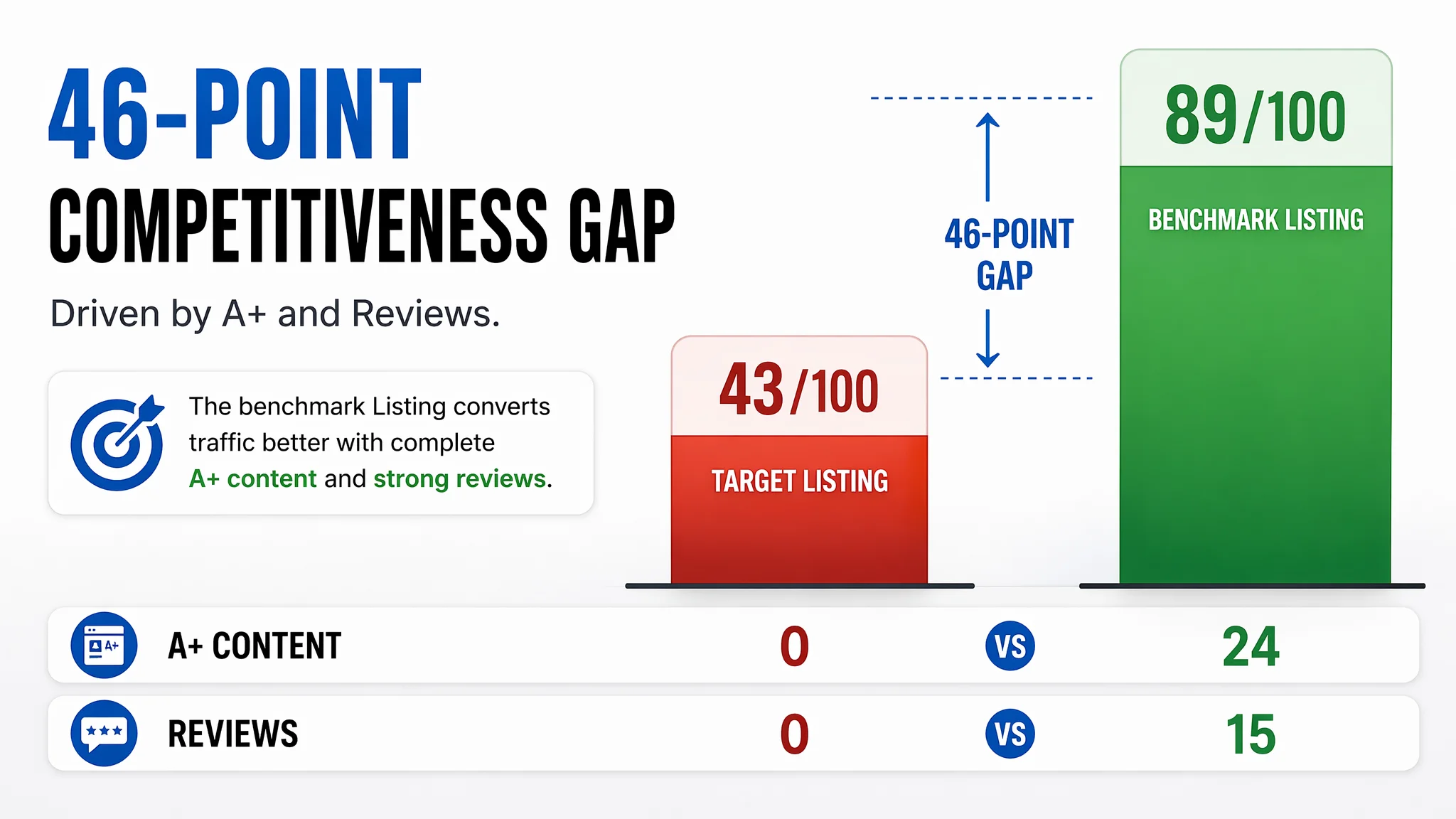
The real red flags were not in the title or bullet points. They were in the conversion infrastructure of the page:
- Detail (A+) score: 0/25 for the target vs 24/25 for the benchmark
- Review score: 0/15 for the target vs 15/15 for the benchmark
“The real problem was not that ads failed to bring traffic. It was that the page could not convert the traffic.”
At this point, continuing to “fix ads” first would have only amplified a structurally weak product page.
The Real Constraint Was Listing Conversion Capacity
Looking at the multi-dimensional score breakdown clarified where the bottleneck really sat.
Title: Functional, but Not Commercially Anchored
Title scores were 12/20 for the target vs 15/20 for the benchmark — not perfect, but not catastrophic either.
The benchmark title followed a classic and proven Amazon pattern:
- Brand + high-trust material + broad compatibility
By contrast, the target title leaned into:
- “Fits …” functional opening + detailed dimensions + replacement part numbers
This meant:
- The benchmark front-loaded brand and material (“SUS304”) to create an immediate quality perception.
- The target front-loaded “Fits”, signalling function, but building almost no brand or quality anchor.
- The benchmark consolidated a wide range of compatible Weber models (including the full Genesis family), unlocking larger search coverage.
- The target restricted itself mainly to Spirit series and packed in raw numbers (17.5", 15.3", part numbers 7638, 7636), making the structure heavy and less efficient at keyword stacking.
In isolation, this would be a moderate issue. But in combination with other weaknesses, it contributed to a page that felt more like a generic spare-part listing than a premium upgrade.
Main Image: Parts on a White Background vs “Professional Upgrade Kit”
On main images, the score gap was again 3 points (24/30 vs 27/30), but the qualitative difference was much larger.
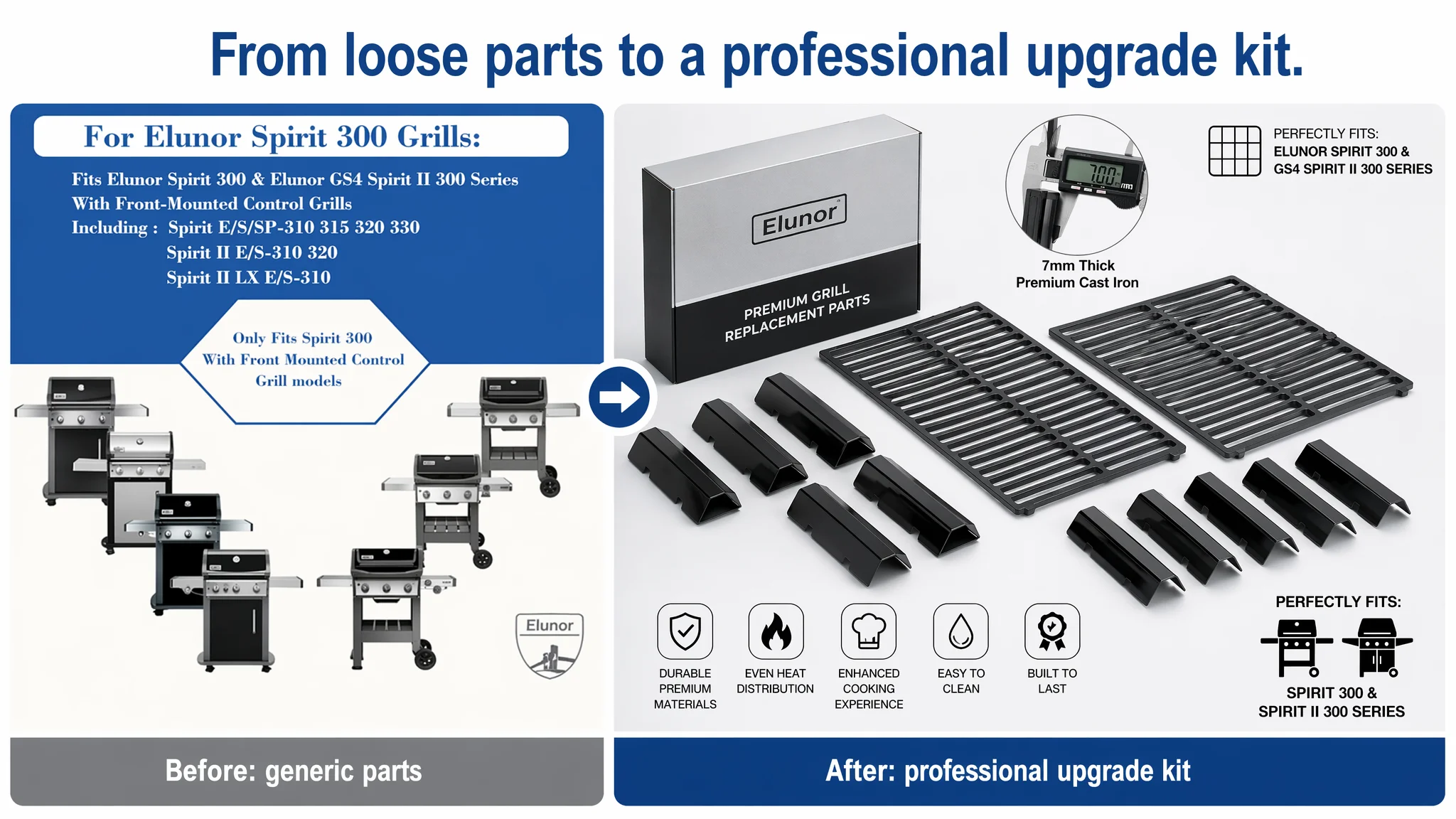
The benchmark’s main image logic:
- Product arranged cleanly with packaging box and visible brand mark
- A professional, retail-like composition that instantly suggests “brand-backed, reliable parts”
- Supporting gallery images showing thickness measurements, material tests, and comparison visuals
The target’s main image logic:
- Bare parts loosely stacked on white, no packaging, no brand visual
- No visual hint that this is a high-precision, durable upgrade rather than the cheapest possible replacement
- No data visualized — only descriptive text elsewhere on the page
Impact on business metrics:
- CTR likely underperforms because the thumbnail looks like a commodity spare-part kit, not a carefully engineered solution.
- CVR is under pressure because the gallery never closes the trust gap with visual proof (thickness, durability, corrosion resistance).
- The seller’s “1/3 price” positioning, without any visual trust counterweight, risks triggering “cheap = low quality” concerns.
In other words, even if ads could bring more impressions, thumbnails were not giving enough reasons to click, and the gallery was not supplying enough evidence to justify a confident purchase.
Bullet Points: Information Present, Buying Logic Weak
Bullet-point scores were close (7/10 vs 8/10), but again, the logic path diverged.
The benchmark’s bullet structure:
1. Compatibility broken into separate points
2. Clear OEM part numbers to reinforce both search relevance and trust
3. Material described with specific, verifiable parameters (“SUS304”, “non-magnetic”)
4. Performance expressed as design upgrade → solution to concrete problems (“16 parallel bars” → “even heat”, “prevents food from slipping”)
5. Cleaning and maintenance addressed with clear usage guidance
The target’s bullet structure:
- Mixed material, compatibility, size, and benefits in a more linear way.
- Used generic terms like “premium material” rather than specific, confidence-building parameters.
- Focused on result statements (better cooking, healthier, easier cleaning) without clearly linking them to how the design achieves these outcomes.
The result: users get information, but not a compelling decision path. There is no tight loop of “your pain point → this feature → this measurable outcome”.
A+ Content: A Complete Void vs a Full Trust Engine
This was the decisive bottleneck.
- Target product page: no A+ content at all → 0/25
- Benchmark Listing: complete A+ system → 24/25
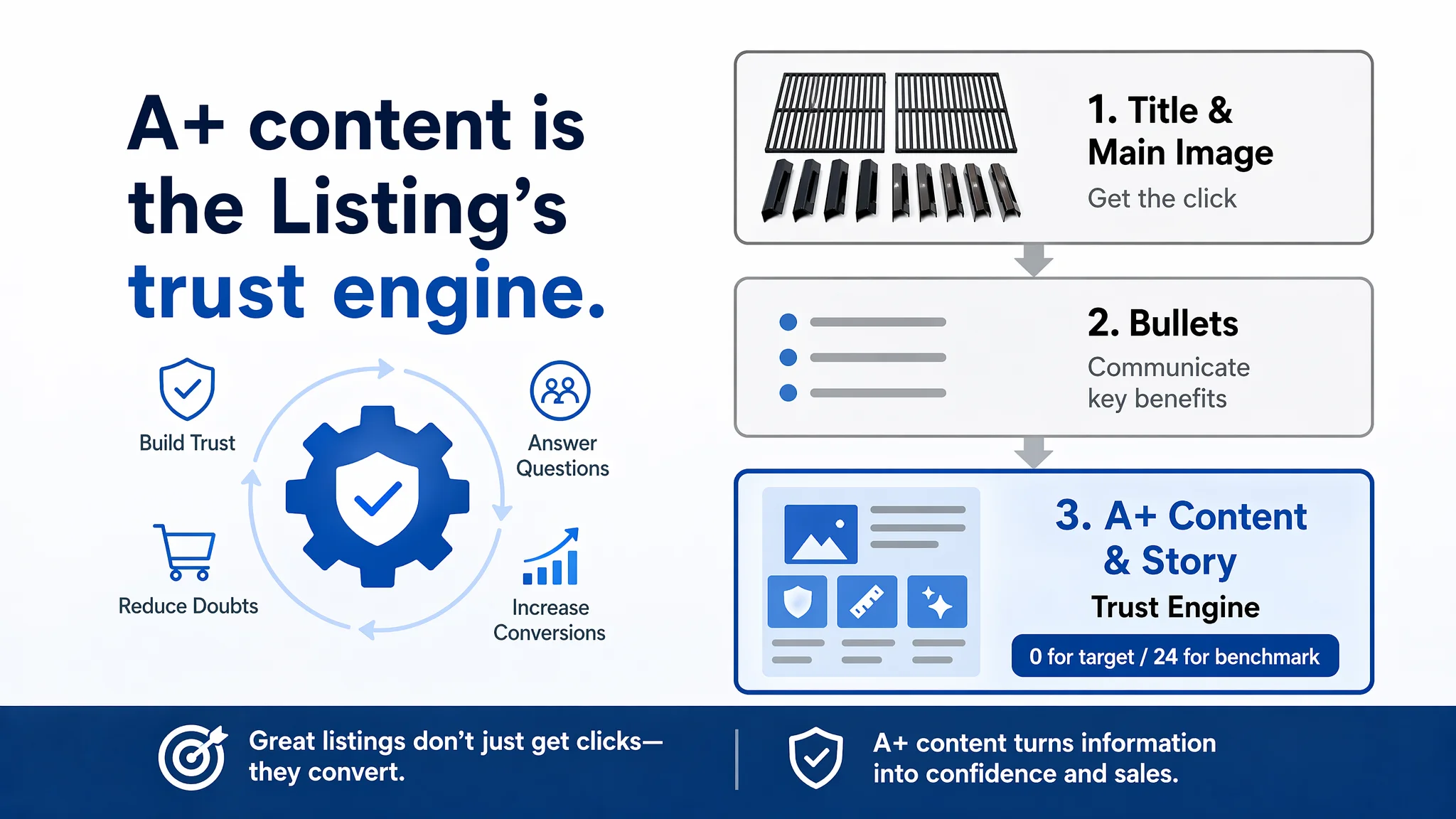
The benchmark’s A+ stack included:
- Full-screen outdoor grilling scenes (lake, backyard BBQ) for emotional resonance
- Visual modules for:
- Compatibility and size
- Material comparisons
- Thickness tests (e.g., 7mm vs 4–6mm rods)
- Cleaning demonstrations
- Icons and phrases like “FDA-grade”, “rust-proof”, “non-magnetic”, “10-year maintenance-free”, and a short brand story (“Passionate Pursuit of Quality & Longevity”)
The target page had none of these. Text existed, but the most powerful trust-building real estate on an Amazon Listing — the A+ detail section — was completely empty.
“Advertising does not only amplify advantages. It can also amplify a page’s existing defects.”
Reviews: No Social Proof Against 1,200+ High-Quality Reviews
Finally, the review dimension:
- Target: 0 reviews, no star rating visible → 0/15
- Benchmark: 4.8 stars, 1,232+ reviews, front page filled with 4–5 star comments → 15/15
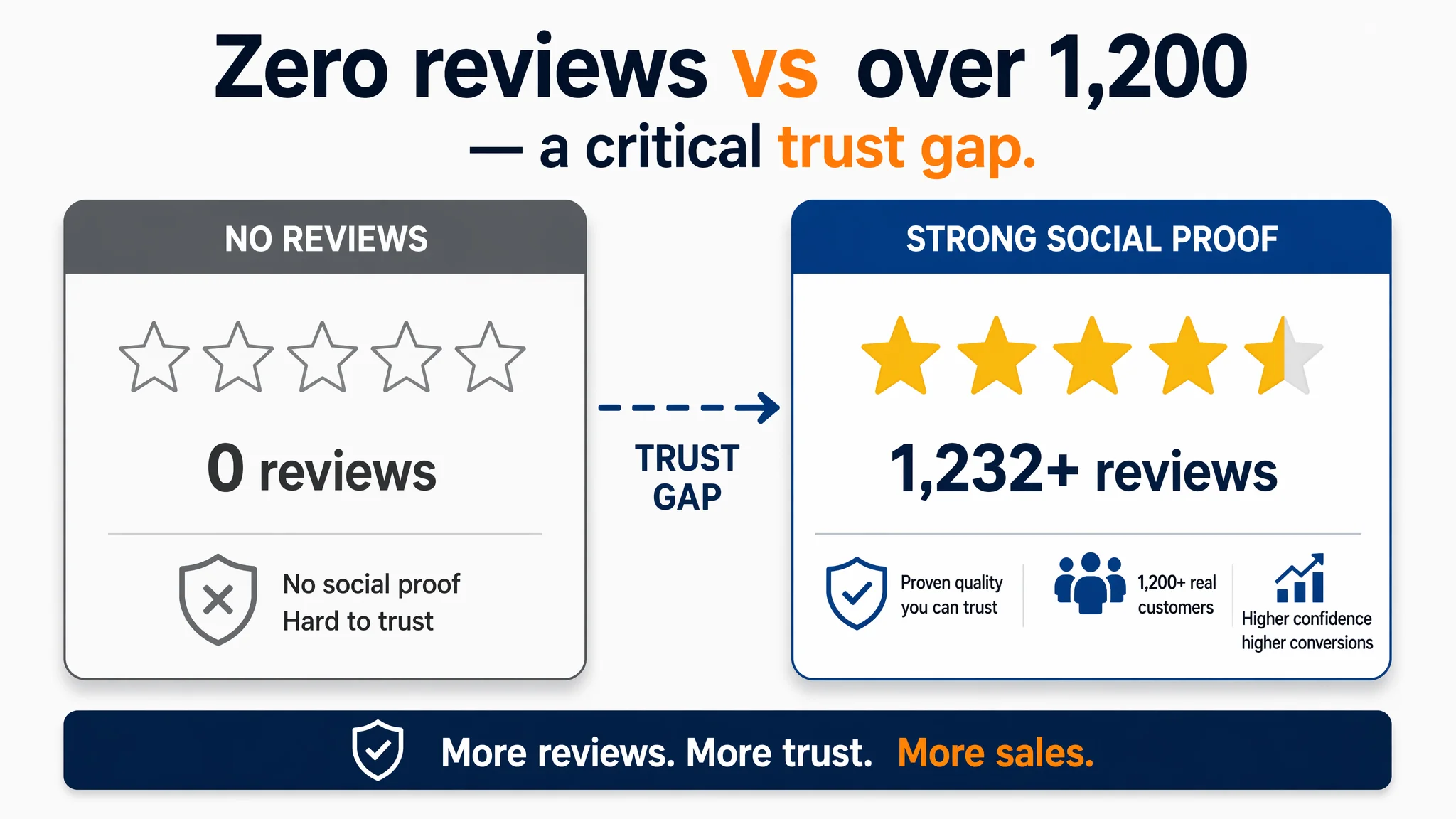
From a buyer’s point of view:
- One Listing looks like a well-loved, proven upgrade trusted by thousands.
- The other feels like an untested spare part from an unknown seller.
With this context, it became clear: the Amazon product page was structurally unable to carry the decision burden that ad traffic would create.
Why DeepBI Did Not Recommend “Keep Tuning Ads” First
Given the 46-point total score gap and the near-zero performance in A+ and reviews, DeepBI’s judgment was straightforward: fixing Amazon ads first would not be commercially rational.
At this stage, the main risks were:
- Wasting ad spend on clicks that had almost no chance to convert
- Teaching Amazon’s algorithm that this ASIN has weak conversion, which would hurt organic ranking
- Locking the seller into a mindset that “ads don’t work for this product”, when in reality the Listing was not conversion-ready
Instead, DeepBI’s decision order was:
1. Rebuild the Amazon product page’s sales logic (title, bullets, main image, A+).
2. Use visual and textual structure to close the trust gap against the benchmark.
3. Only after the Listing could reasonably convert, re-evaluate ad performance and scaling potential.
The reasoning: if every additional 100 paid visits are likely to bounce because the buyer still doubts material, compatibility, or durability, no bid adjustment can fix that. The foundational asset — the Listing — must first be capable of turning paid traffic into a stable base of initial reviews and repeatable orders.
This Product Page Did Not Lack Traffic. It Lacked Trust.
DeepBI’s optimization path focused on one central goal: raise the Listing’s conversion capacity to a level where ad spending becomes productive instead of destructive.
Reframing the Title Around Search Intent and Risk Control
Suggested title direction:
“Weber Spirit E310 Grill Parts: 17.5" Grill Grates & 15.3" Flavorizer Bars for Weber Spirit 300 & GS4 Spirit II 300, Spirit E-310 E-315 with Front Control Knobs, Replaces 7638 7636”
Key shifts in logic:
- Front-load the core search phrase (“Weber Spirit E310 Grill Parts”) to lock in the main traffic entry.
- Cluster compatibility around Spirit 300 and GS4 Spirit II 300 series, keeping the critical “front control knobs” constraint to reduce returns.
- Normalize dimensions and part numbers to make them scannable in the search results and reinforce “direct replacement” value.
The goal was not just more keywords — it was clearer risk reduction at the SERP level: buyers can quickly see “this fits my exact Spirit 300 / Spirit II 300 front-control model”.
Turning Bullet Points into a Conversion Path
Each bullet was re-architected to solve a specific decision question.
BP 1 & BP 2 – Compatibility as the First Trust Barrier
- Separate bullets for Spirit 300 Series and Spirit II (GS4) 300 Series, each listing specific model names.
- Explicit replacement OEM part numbers (7638, 7525, 7527, 65619, 65906).
- Clear exclusion of side-control models to avoid mis-orders.
This turns compatibility from a vague statement into a precise checklist buyers can verify against their grill.
BP 3 – “Complete Replacement Set” Instead of Loose Parts
- Emphasize a complete overhaul set (2 grates + 5 flavorizer bars).
- Provide exact per-piece and combined dimensions.
- Position as a direct heavy-duty replacement.
This reframes the product from “some parts” into a total solution, matching the benchmark’s confidence around “direct replacement” and “full upgrade”.
BP 4 – Material as a Long-Term Investment, Not a Commodity
The product’s material differs from the benchmark (matte enamel cast iron plus porcelain steel instead of stainless steel), so the messaging had to lean into its own strengths:
- Upgraded heavy-duty matte enamel cast iron and high-grade porcelain steel
- Emphasis on heat retention, even distribution, and resistance to rust, corrosion, and chipping
This recognizes that buyers in this category are not just buying a part — they are buying lifespan and performance stability.
BP 5 – Cooking Performance and Flare-Up Control
- Highlight a flatter top design and optimized gaps to prevent food from falling through.
- Use flavorizer bars as the narrative anchor for even heat, smoky flavor, and flare-up reduction.
This makes the bullets feel less like raw specs and more like a direct answer to grilling frustrations.
BP 6 – Maintenance and Health
- Stress the non-porous, glossy surface for easy cleaning.
- Convey how reduced sticking and simple cleaning support healthier grilling.
- Add concrete care guidance to reassure users and extend product life.
Overall, bullets move from “telling features” to walking the buyer through each worry: fit, completeness, longevity, performance, cleaning.
The Main Image Was Not Just a Visual Issue. It Failed to Create a Reason to Click.
DeepBI’s main-image recommendations were driven by one question: What does a high-conversion grill-parts thumbnail need to signal in half a second?
From Loose Parts to “Professional Upgrade Kit”
Suggested changes:
- Arrange 5 flavorizer bars and 2 grates at a 45° top-down angle, neatly occupying ~70% of the frame.
- Add a simple, clean packaging box with brand mark to visually signal professionalism and reliability.
- Use a light grey-to-white gradient background with soft light and subtle shadows to evoke a high-end, industrial-retail feel.
This shifts the visual impression from “pile of parts” to “engineered kit from a serious brand.”
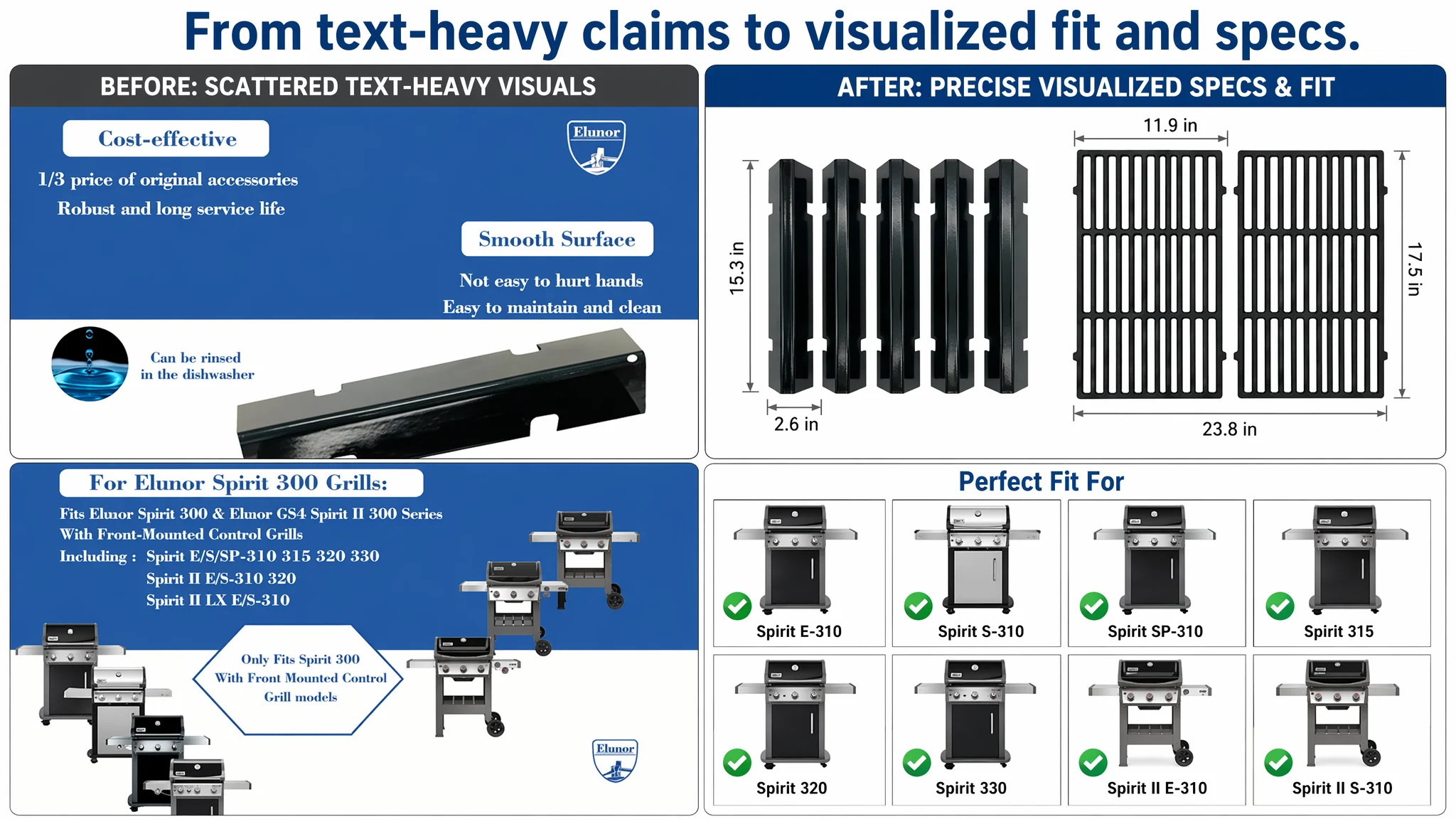
Visualizing Size and Compatibility Instead of Leaving It to Text
- Replace the existing blue background and rough lines with pure white background and precise dimension callouts.
- Use fine dark-grey annotation lines and clean sans-serif text for each key measurement (grate and bar dimensions, combined width).
This helps users understand fit directly from images, not just from text.
Turning Compatibility from a List into a Grid
- Build a 2×4 grid of Weber grill icons, each labeled with its model (e.g., Spirit E-310).
- Add green checkmarks and a clear “Perfect Fit For” heading.
Instead of reading a long compatibility list, buyers visually spot their model in seconds.
Quantifying Quality: Thickness and Durability
- Show a macro close-up of the grate edge with a digital caliper reading the real thickness.
- Add a label like “Premium Cast Iron” and highlight the exact mm value.
- Use a before/after comparison image: the product vs a rusty, worn-out competitor part, with green check and red cross markers.
Now, “durable” is no longer a claim — it becomes a visual, measured fact.
Before Ads Could Work Again, the Page Had to Convert
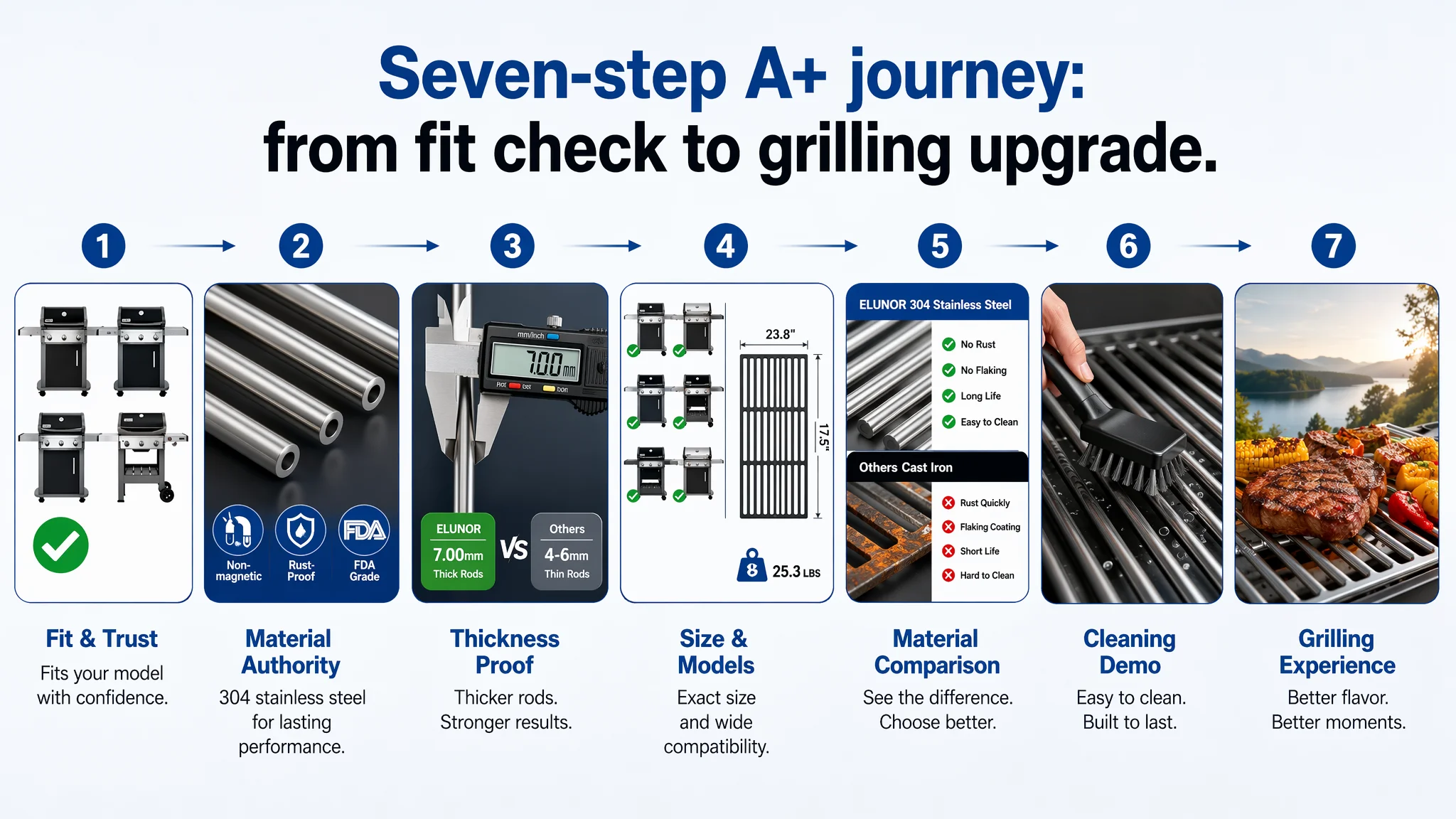
The last missing piece was the A+ story. DeepBI’s logic for the detail section was to rebuild the full decision journey in seven visual steps.
1. First Screen: “Can I Trust This, and Does It Fit My Grill?”
- A hero banner showing the product installed in a Weber grill in a bright backyard scene.
- Family grilling in the background, lightly blurred to keep focus on the grate.
- Compatibility models clearly listed in a visible text area.
In the first three seconds, the buyer should feel: “This looks solid, and it clearly fits my type of grill.”
2. Material and Authority: Why This Is Worth More Than the Cheapest Option
- Dark, industrial-themed close-up of the rods with cold white side lighting.
- Icon badges for “Non-magnetic”, “Rust-Proof”, and “Food-Grade”.
This mirrors the benchmark’s use of material as a justification for price and durability, but aligned with the actual materials of the target product.
3. Thickness and Performance: From “Thick” to “7.0 mm vs 5.0 mm”
- Side-by-side image: left, this product measured at “7.00 mm” with green tick; right, a thinner rod at “5.00 mm” with red cross.
- Clear, legible caliper readings.
Now, value is quantified; buyers can rationalize paying more for tangible thickness.
4. Compatibility + Dimensions: Reducing Returns and Friction
- Left side: grid of compatible grill thumbnails with model names.
- Right side: top-down view of the grate with white arrows and dimension labels (length, width), plus a weight indicator.
This forces a pre-purchase size check, protecting both buyer and seller from misorders.
5. Material Comparison: Turning Rust Fear into Upgrade Motivation
- Left: clean, bright image of the product with green ticks and benefits (no rust, easy to clean).
- Right: rusty, dark grate with red crosses and pain points (rust quickly, food sticks).
This taps into a powerful emotional trigger: fear of rust and wasted money — and positions the product as the solution.
6. Cleaning and Maintenance: Showing Ease, Not Just Telling It
- Action shot of a hand using a grill brush on the rods.
- Focused lighting on the contact area to show resistance to wear and smooth cleaning.
- Clear heading such as “Maintenance-Free, Easy Cleaning”.
Users see exactly how they’ll maintain the product, making the “long-term ownership” picture clearer.
7. Emotional Close: From “Parts” to “Better Grilling Life”
- High-quality food shot with steaks, corn, and vegetables on the grate, outdoor background, warm side light.
- No extra text — just a powerful image of what the upgrade enables.
This completes the journey from rational parameters to emotional desire, turning the Listing from “replacement parts” into an upgrade to the grilling experience.
How the Seller’s Understanding Changed
After going through this diagnosis, the seller’s perception of the problem shifted fundamentally.
Initially:
- They believed the main issue was weak ads and insufficient traffic.
- They were ready to add more campaigns, keywords, and budget to “fix” a performance problem.
After DeepBI’s analysis:
- They saw an objective 43/100 vs 89/100 Listing gap.
- They recognized that 0 A+ content and 0 reviews left the page almost defenseless in a high-competition space.
- They understood that their main image and bullets were functional but not persuasive, lacking the trust and decision logic buyers needed.
The new operating principle became:
- First, ensure the Amazon Listing can actually convert traffic — through a clear title, structured bullets, professional images, and a complete A+ narrative.
- Then, let ads resume their role as a traffic amplifier, not as a bandage for conversion problems.
The more strategic takeaway for other Amazon sellers is straightforward:
- When ad costs feel too high and ACOS refuses to move, do not assume it is purely a bidding or keyword issue.
- Ask whether your product page, in its current state, would convince you to buy if you arrived there from an ad.
- Recognize that Listing conversion is the foundation of advertising efficiency. Without it, every extra dollar of traffic is simply exposing — and paying for — your page’s weaknesses.
In this grill-parts case, DeepBI’s value was not in tweaking one more ad parameter. It was in reframing the core business question: Is this Amazon Listing ready for the traffic you want to buy?