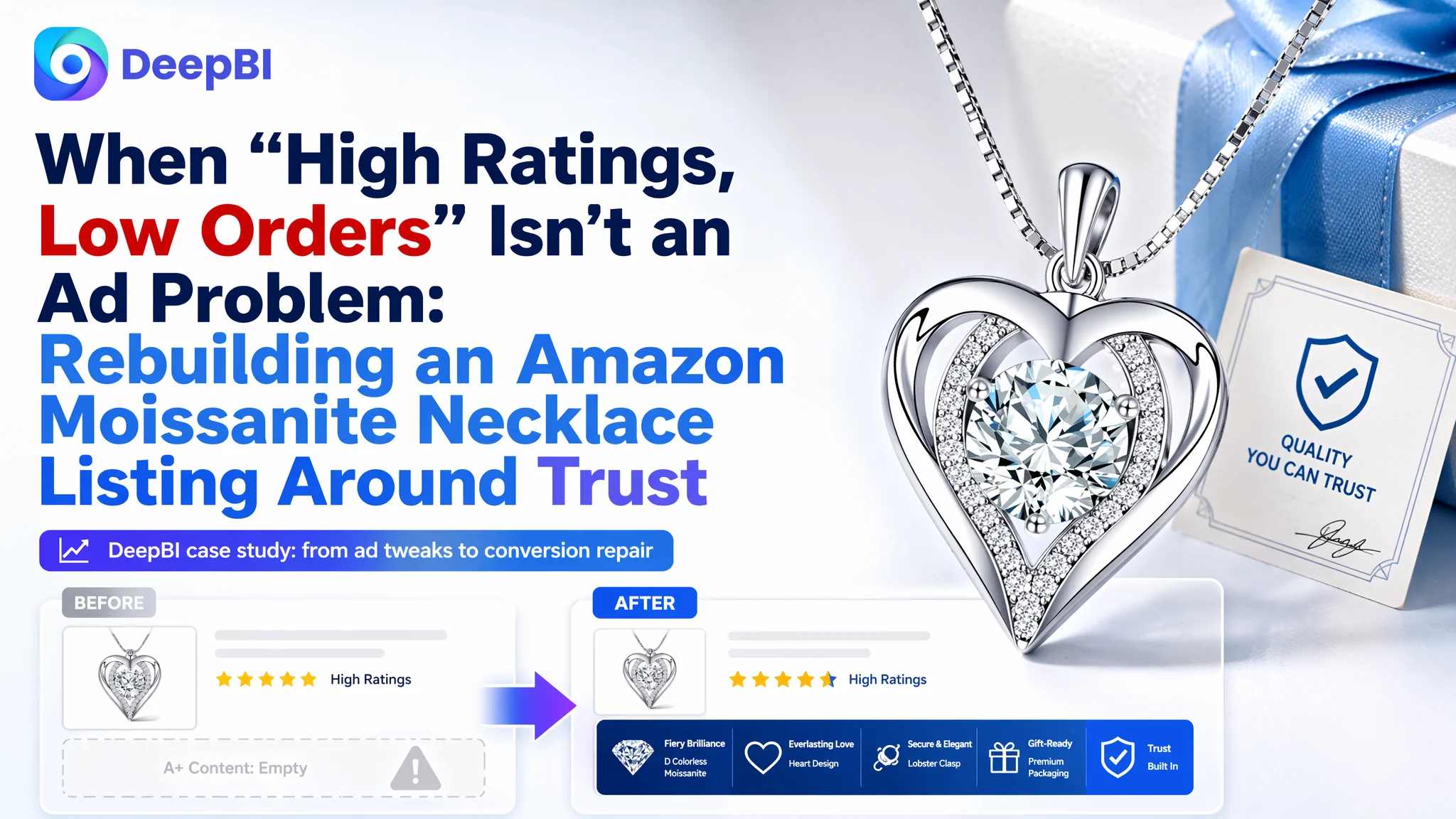
This Amazon jewelry seller had what many teams would call a “healthy” product: a moissanite heart necklace on the US marketplace with a 4.8 rating and more reviews than a key competitor. Yet orders were not keeping up, ACOS pressure was rising, and every new round of Amazon ads felt more expensive than the last.
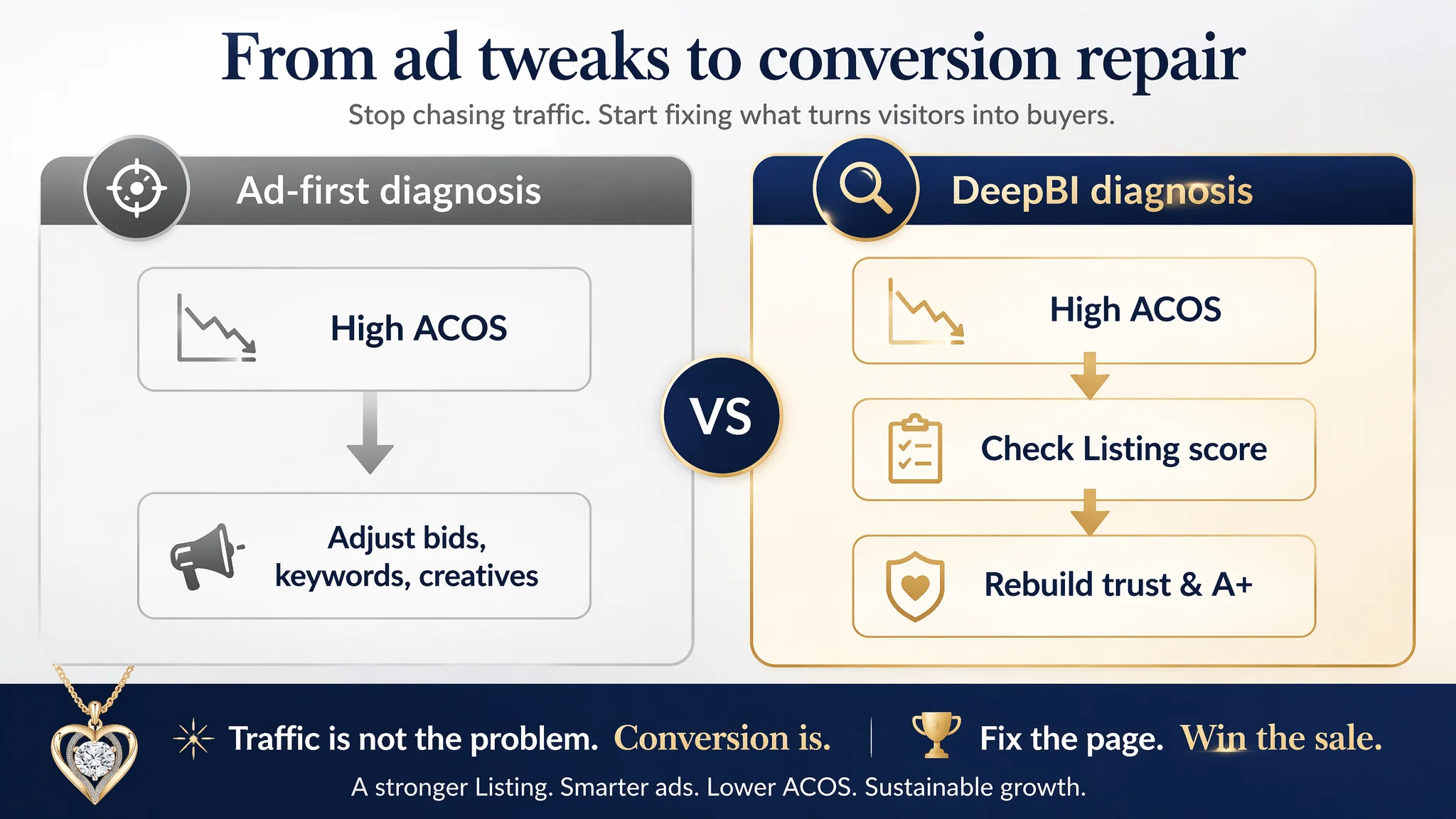
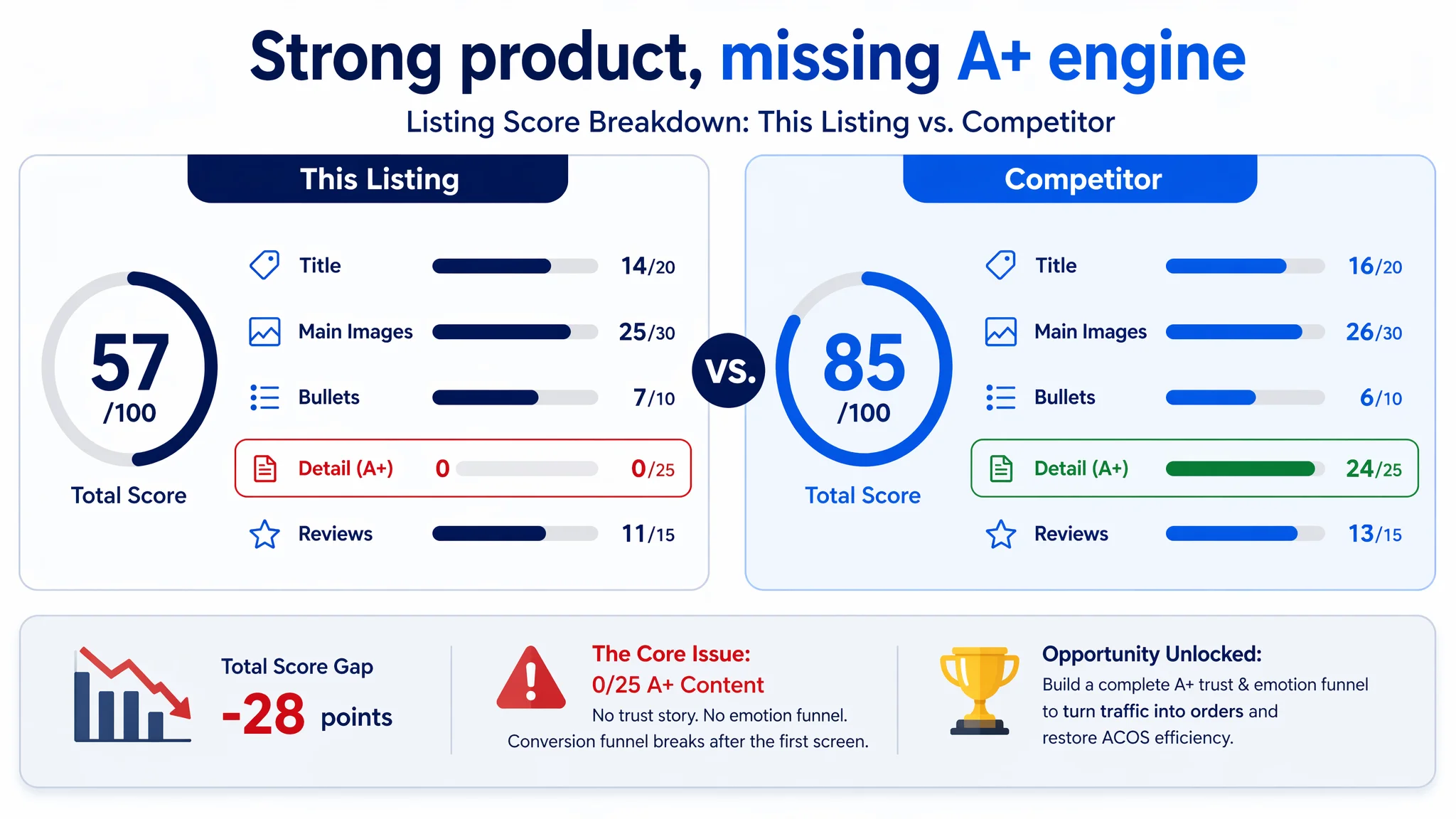
The seller’s first reaction was familiar: “Our ads and bids must be wrong.” They rotated keywords, adjusted budgets, and tried new creatives, assuming the problem lay in campaign execution. DeepBI’s Listing diagnosis showed a different picture: the Listing’s overall score was only 57/100 versus the competitor’s 85/100, with a catastrophic 0/25 on the A+ detail page dimension. The issue was not a lack of traffic—it was a product page that could not convert jewelry buyers at a high-enough rate, especially for a higher-ticket gift item.
By reframing the problem from “optimize ads” to “repair Listing conversion capacity,” the focus shifted: upgrade the main image set from pure “product display” to “gift decision”, build an A+ that actually tells a trust and emotion story, and reorganize title and bullets so that moissanite quality, certification, and gift scenarios form a clear buying path. For other Amazon sellers, this case is a reminder: when ACOS won’t fall and ads “stop working,” the real leak is often the page’s ability to convince—not the traffic source.
The Real Constraint Was Not Traffic. It Was Listing Conversion Capacity.
On the surface, the product looked competitive:
- Rating: 4.8 stars, higher than the benchmark competitor’s 4.7
- Review count: 34 vs. competitor’s 29
- Five bullet points: structurally sound, with a clear emotional-to-rational logic
Yet DeepBI’s Listing scoring exposed the actual gap:
- Total score: 57/100 vs. competitor’s 85/100 (−28)
- Title: 14 vs. 16 (−2)
- Main images: 25 vs. 26 (−1)
- Bullets: 7 vs. 6 (+1)
- Detail page (A+): 0 vs. 24 (−24)
- Reviews (front-page usability): 11 vs. 13 (−2)
The bullets were not the problem. The main image set was not dramatically worse than the competitor’s. The core constraint was brutal and simple:
The competitor had a fully built A+ trust and emotion funnel. This Listing had no A+ at all.
In a category like moissanite gifts—high emotional stakes, non-trivial price, and constant doubt about authenticity—this meant:
- Ad traffic arrived at the product page
- Above-the-fold content gave some reassurance
- But there was no deeper story, no trust chain, no scene-based push to “add to cart”
The page looked “complete” from a basic Amazon standpoint, yet from a conversion standpoint, the funnel snapped in half right after the first screen.
How the Seller Misread the Problem: “Our Ads and Creatives Are Not Strong Enough”
Before DeepBI stepped in, the customer interpreted the situation as primarily an advertising issue:
- ACOS was higher than expected for a jewelry gift
- Ad spend felt increasingly “inefficient”
- The Listing already had solid ratings, a decent title, and bullet points with emotional language
The team drew a familiar conclusion: the problem must be in:
- Keyword selection
- Bid strategy
- Ad creatives
They cycled through:
- New search terms and match types
- Adjusted bids and budgets
- Additional Sponsored Products and Sponsored Brands combinations
But every iteration hit the same invisible ceiling. Traffic moved, orders did not.
From the seller’s perspective, this reinforced the belief that ads were just “getting more expensive.” From DeepBI’s perspective, the data told another story: ads were doing their job—delivering qualified traffic into a page that could not finish the sale.
Why Traditional Amazon Ad Optimization Kept Failing
Once DeepBI overlaid Listing scores with competitive content analysis, a clear pattern emerged:
- Main image and title gaps were small (−1 or −2 vs. competitor)
- Bullet structure was actually slightly better (+1 vs. competitor)
- A+ content gap was extreme (0 vs. 24)
In other words:
- CTR issues were not the primary enemy: the main image and title were “OK enough” to compete in the search grid, especially with paid positions.
- CVR issues were structural: past the fold, the competitor’s page kept selling; this Listing simply stopped.
For a moissanite necklace sold as a gift, this is critical:
- Buyers worry: “Is this piece real? Is it high grade? Will it look expensive enough as a gift?”
- The competitor addressed all of this with a complete trust and scene matrix:
- Brand hero A+ image with emotional storytelling
- 5+ scene modules (anniversary, birthday, daily wear, relationship moments, wedding)
- Macro product photography plus diagrammed gemstone parameters
- Explicit explanation of D color, VVS1 clarity, excellent cut
- Certificates, anti-counterfeit codes, and gift-box packaging
- This Listing had none of that deeper-level reassurance.
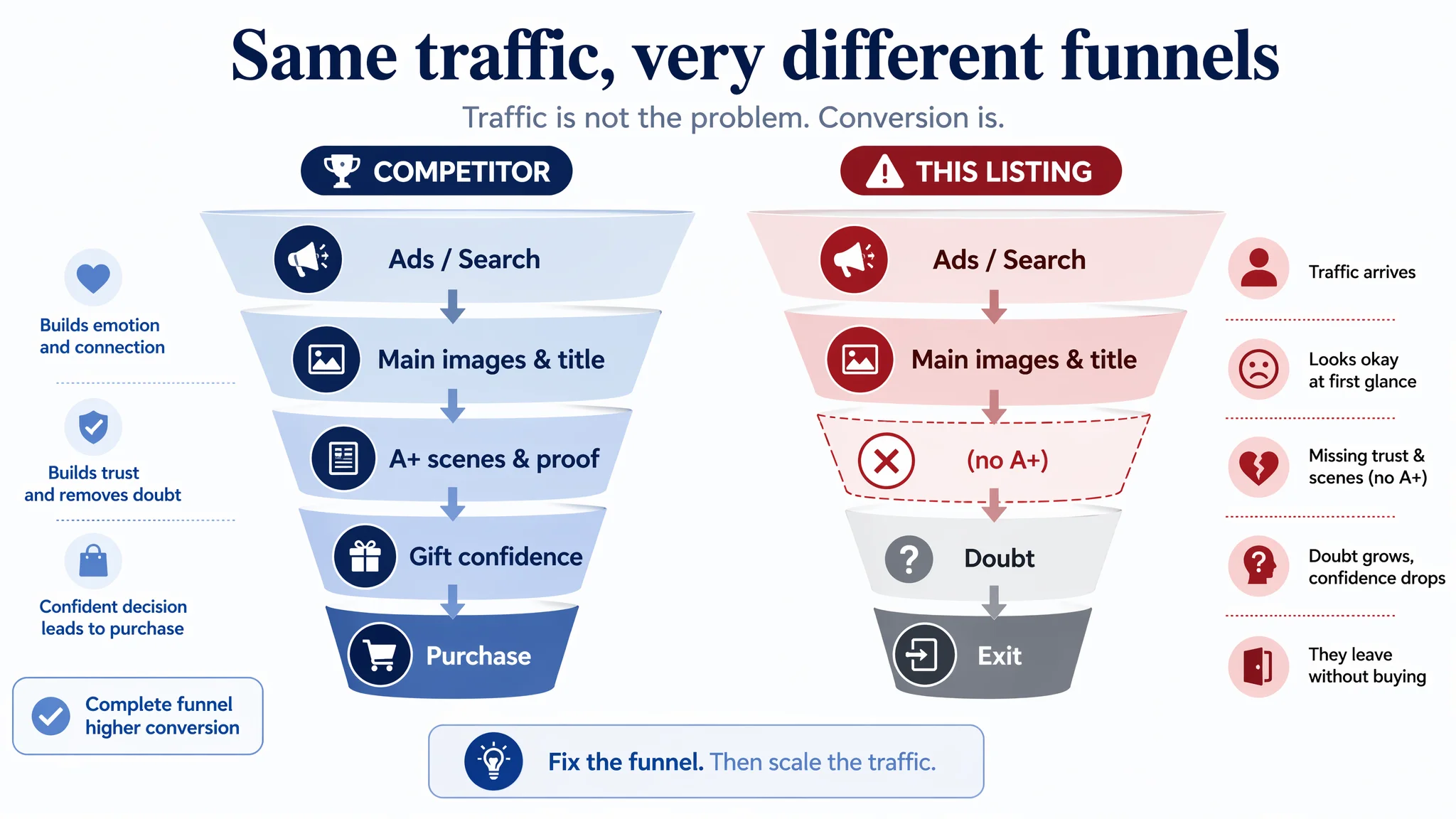
“Advertising does not only amplify advantages. It can also amplify a page’s existing defects.”
Every new dollar of ad spend was driving more people into the same broken trust funnel. Until that was repaired, no amount of keyword work could meaningfully shift ACOS.
What DeepBI Saw in the Listing Data That the Seller Couldn’t
DeepBI’s Listing diagnosis does not stop at “good/bad” content; it compares how each module functions inside the buyer’s decision path versus a category benchmark.
Title: Close, but Not the Deciding Factor
The title was structurally competent:
- “Moissanite Necklace for Women” correctly front-loaded
- Carat range “1–3 Carat” captured selectable options
- “Intertwined Hearts” emphasized the emotional design theme
But the benchmark competitor did three small things better:
1. Specificity over range: “1 Carat” instead of “1–3 Carat” at the key decision moment, giving a crisper mental picture.
2. Concrete design naming: “Rose Heart” instead of literary “Intertwined Hearts” — clear shape and craftsmanship in a single phrase.
3. Keyword variants: “Moissanite Diamond Necklace” repeated later to cover more search intents and reinforce perceived value.
DeepBI’s view: title optimization was worthwhile, but not the root cause. The title was not where 28 points of total score were being lost.
Main Images: Some Emotion, No Coherent Sales Logic
Visually, the main image set had the core elements:
- Clean white-background product hero
- Model wear shot to show size
- Close-ups of the “I LOVE YOU” engraving
- Some attempt to present quality parameters and material breakdown
However, DeepBI’s visual comparison Agent flagged several hidden issues:
- Image 1: Pure white background with a static product. High clarity, but no emotional hook or brand meaning; the competitor’s hero image built more distinct design personality.
- Image 2: Single model shot with no gifting narrative; the competitor showed a man putting the necklace on a smiling woman—an instant “successful gift” story and immediate size confirmation.
- Image 3: Mixed messages—front/back, engraving, and lobster clasp all in one frame. The emotional selling point (engraving) and the functional component (clasp) competed for attention.
- Image 4: Quality ratings and certificate code mentioned, but visually weaker than the competitor’s “diamond tester passed” style of proof. Trust signals were textual, not viscerally felt.
- Image 5: Overloaded: size comparison with a coin, weight, silver bar, clasp detail, moissanite carat notation—all on one canvas. No clear visual hierarchy.
DeepBI’s judgment: the image set had content, but lacked decision logic.
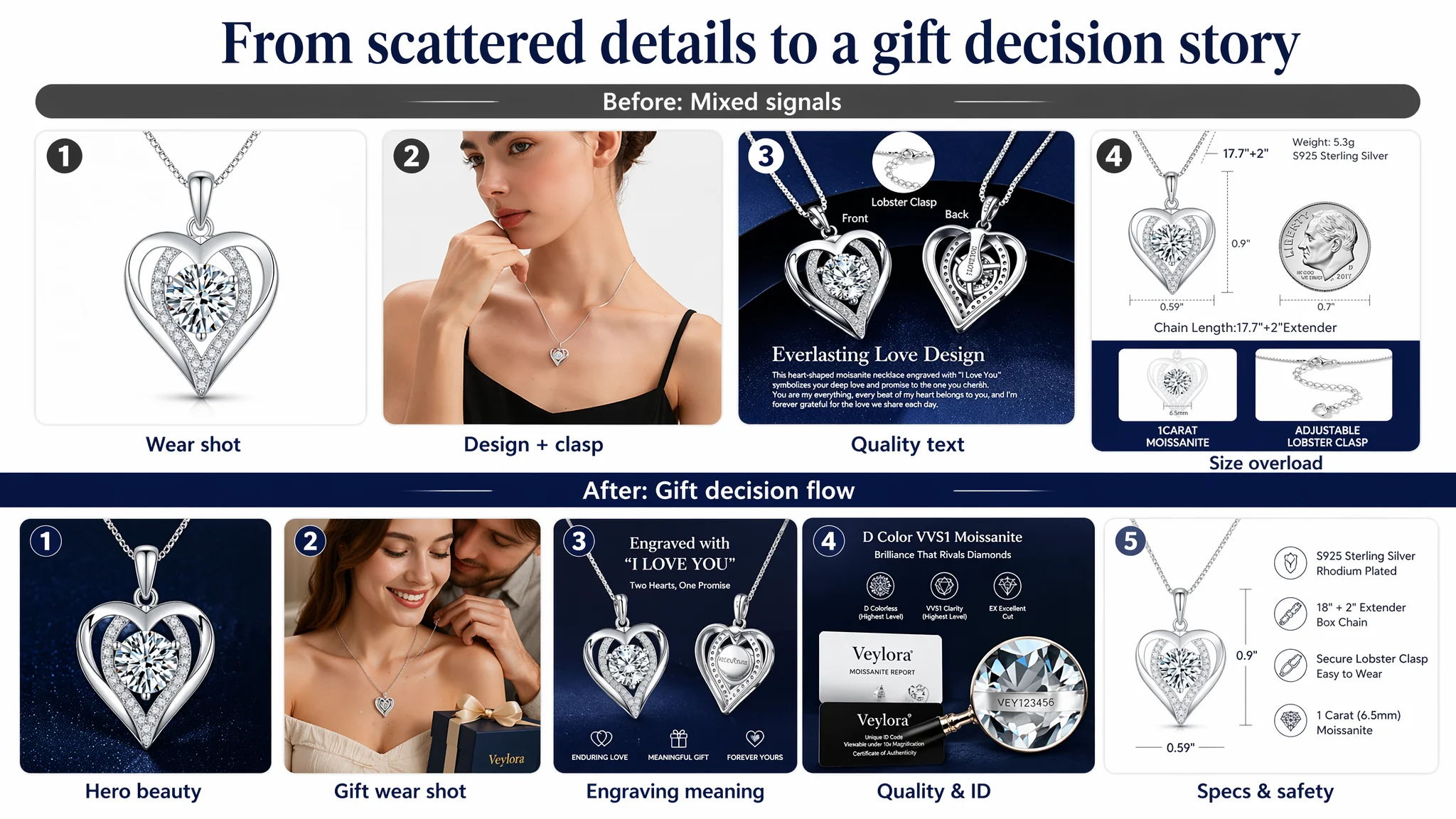
The competitor separated:
- Emotional story images
- Technical/parameter images
- Packaging and scene images
This Listing mashed them together, diluting each message.
A+ Detail Page: The Missing Engine
The most decisive gap was the A+.
- Competitor:
- Brand hero visual
- 5+ gifting scenes (anniversary, birthday, daily, romance, wedding)
- Macro product details
- Gemstone parameter breakdown
- Craftsmanship close-ups
- Anti-counterfeit certification
- Gift box and multi-holiday gift guide
- Target Listing:
- No A+ content at all in the benchmark comparison (0/25)
- No extended story, no scene-based decision guidance, no layered trust chain
In jewelry, especially moissanite positioned as a diamond alternative, A+ is not a “nice-to-have decoration.” It is the main stage where:
1. Emotional decision is reinforced (Is this romantic enough? Is it worthy of the occasion?)
2. Rational doubt is resolved (Is this stone real? Is the color/clarity grade top-tier?)
3. Risk perception is lowered (Will this feel cheap? Will she think I cut corners?)
Without this, the seller’s Amazon ads were, in effect, buying visitors for a store that had never finished building its showroom.
Why DeepBI Did Not Recommend “More Ad Tweaks” First
Once the Listing score breakdown and module-level content gaps were clear, DeepBI made a deliberate prioritization call:
- Do not lead with more ad tuning.
- Repair Listing conversion capacity first.
The business logic was straightforward:
1. Trust is non-negotiable in high-emotion, high-risk categories.
When consumers are unsure about authenticity and symbolic value, incremental bid adjustments cannot change the underlying anxiety.
2. The biggest scoring gap was structural, not incremental.
A −1 or −2 in title/main image can be iterated over time. But a 0 vs. 24 gap in A+ means that half the buying argument doesn’t exist.
3. Ads were already amplifying a broken funnel.
Pouring more spend into the same funnel would further increase TACOS dependence without strengthening the page’s ability to generate profitable orders.
“Before ads can work again, the page has to convert.”
DeepBI’s decision order:
1. Rebuild the Listing’s content and visual logic to at least reach benchmark-level trust and emotional storytelling.
2. Only after that, re-evaluate ad performance with a page that actually deserves more traffic.
Rebuilding the Page: From “Nice Product” to “Convincing Gift Decision”
DeepBI’s optimization direction was not to “make everything prettier,” but to align each module with a specific role in the Amazon buyer journey.
1. Title: Clarifying the Core Promise and Flow
Suggested direction:
- Front-load “Moissanite Heart Necklace for Women” as the main phrase
- Add “Pendant” to clearly indicate product form
- Preserve “1–3 Carat 925 Sterling Silver” but make the selectable range feel like a benefit, not a vague spec
- Maintain “Moissanite Diamond Necklace” as a variant keyword for traffic
- Condense duplicated recipient tags (wife, girlfriend, daughter, mom) so the title reads professionally and avoids keyword stuffing fatigue
This doesn’t create growth by itself, but it removes friction at the search-results level and supports ad CTR.
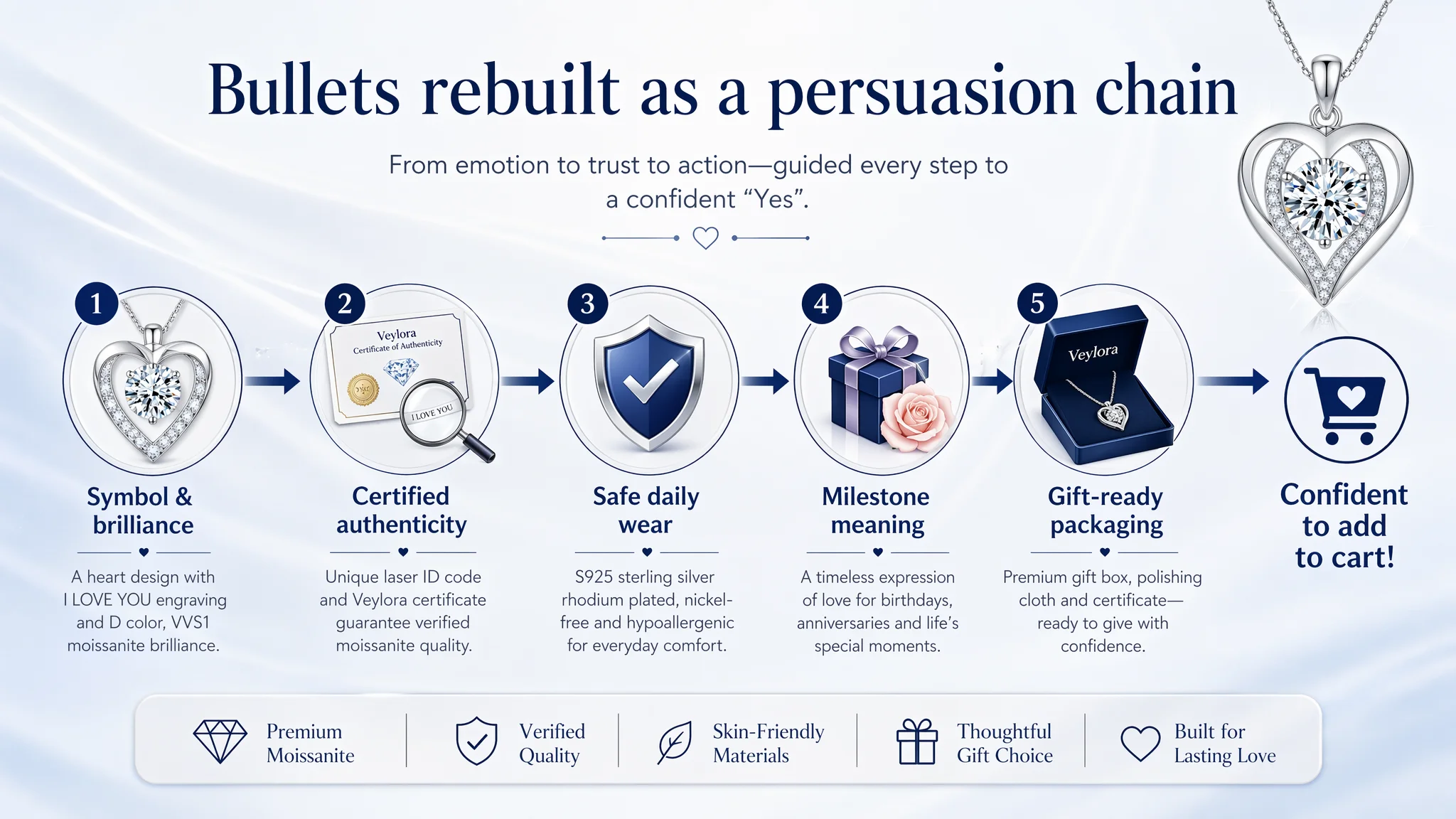
2. Bullets: Strengthening the “Pain Point → Proof → Emotion” Chain
The original bullet framework was already emotionally oriented. DeepBI’s judgment was: keep the structure, harden the content.
Key improvements:
- BP #1 – Emotional meaning + hard specs in one frame
- Lead with “Eternal Brilliance & Symbol of Love”
- Explicitly mention “1 carat D Color VVS1 Clarity moissanite”
- Tie the “I LOVE YOU” engraving and intertwined hearts to a concrete symbol of two souls woven together.
- BP #2 – Authenticity as a real, provable feature
- Emphasize the Certificate of Authenticity from a professional lab
- Highlight the unique laser-engraved ID code, visible under 10x magnification
- Position this as assurance that the buyer is not gifting a random, unverifiable stone.
- BP #3 – Daily wear and sensitive-skin safety
- Clarify S925 sterling silver with rhodium plating
- Emphasize nickel-free, lead-free, hypoallergenic properties
- Call out adjustable chain length and secure clasp as practical comfort and fit guarantees.
- BP #4 – Milestone gift positioning
- Turn “I LOVE YOU” into a milestone marker: anniversaries, birthdays, Mother’s Day
- Make clear that this is not just a necklace, but a symbolic way to commemorate life events.
- BP #5 – Gift-ready packaging and multi-recipient reach
- Spell out that the necklace is delivered in a premium gift box with certificate and polishing cloth
- Expand recipient range: wife, girlfriend, mom, daughter
- Anchor it to major gift occasions: Valentine’s, Christmas, weddings, graduations.
This reorganized the bullets from “nice to read” into a structured persuasion path: symbol → authenticity → safety → milestone → ready-to-give.
3. Main Image Set: From Information Dump to Sequential Decision Support
DeepBI’s visual strategy did not change the product; it changed how the product was read.
Image 1 – Hero: Product + Meaning, Not Just Shape
- Keep the high-quality product close-up on a clean background
- Enhance central moissanite brilliance (within true product limits)
- Add minimal, tasteful text to hint at the core promise (“Eternal Love”, “D Color VVS1 Moissanite”)
- Subtly convey that this is not just another heart pendant, but a specific, premium-grade one
Image 2 – Wear Shot: Turn “Model Photo” Into “Gift Moment”
- Keep a clear, front-facing wear shot to confirm size and fall
- Upgrade overlay text from generic “wearing effect” to “Perfect Gift for Wife / Girlfriend / Daughter”
- Tie explicitly to use-cases: birthday, anniversary, special occasion
- Allow the viewer to pre-visualize gifting success, not just fit.
Image 3 – Meaning Focus: Engraving as the Hero
- Dedicate this frame purely to:
- Front and back views
- Zoomed-in “I LOVE YOU” engraving
- Remove the lobster clasp detail (move it to a technical breakdown image)
- Explain the double-heart, intertwined design and what it symbolizes
- Use text sparingly to underline uniqueness and emotional value.
Image 4 – Proof: Quality and Identification
- Build this into a “Quality & Identity Verification” frame:
- D color, VVS1 clarity, excellent cut
- Unique authenticity code visible under magnification
- Matching lab certificate
- Do not fabricate “diamond tester” visuals not present in the actual setup.
- Emphasize that this combination proves quality and ownership, improving trust versus generic moissanite.
Image 5 – Technical Breakdown: Comfort and Durability
- Clean up the clutter; remove:
- Coin comparison
- Silver bar
- Redundant labels
- Focus on:
- S925 sterling silver + rhodium plating (anti-allergy)
- Chain type (box chain), length (18"+2")
- Secure lobster clasp
- Pendant size and moissanite mm size
- Present these as transparent, confidence-building facts, not as random labels.
With this change, each image becomes a step in a single storyline:
1. “Looks beautiful.”
2. “Looks good on a real person and is a perfect gift.”
3. “Has unique meaning and engraving.”
4. “Is technically high-grade and verifiable.”
5. “Is comfortable and durable to wear.”
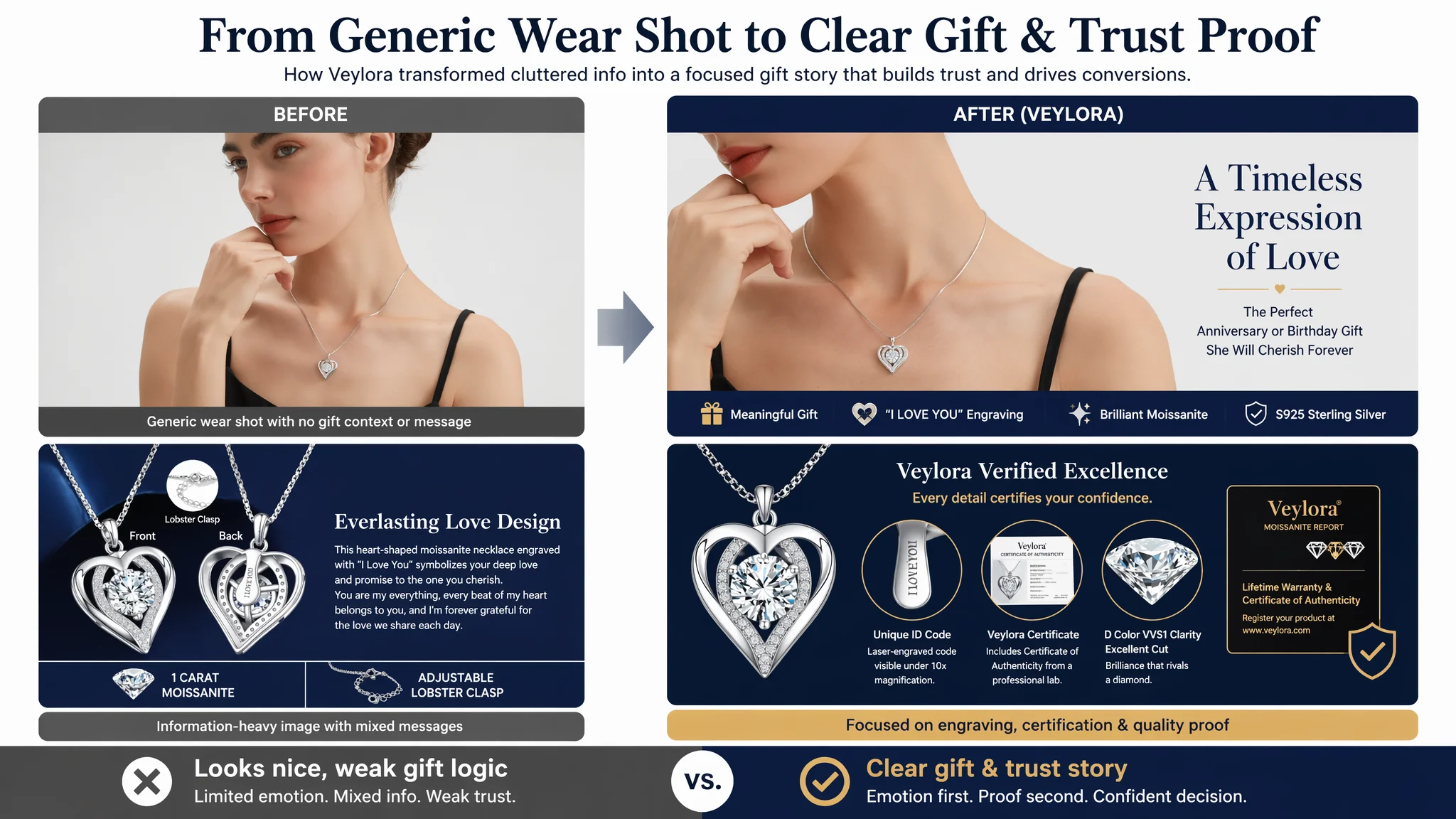
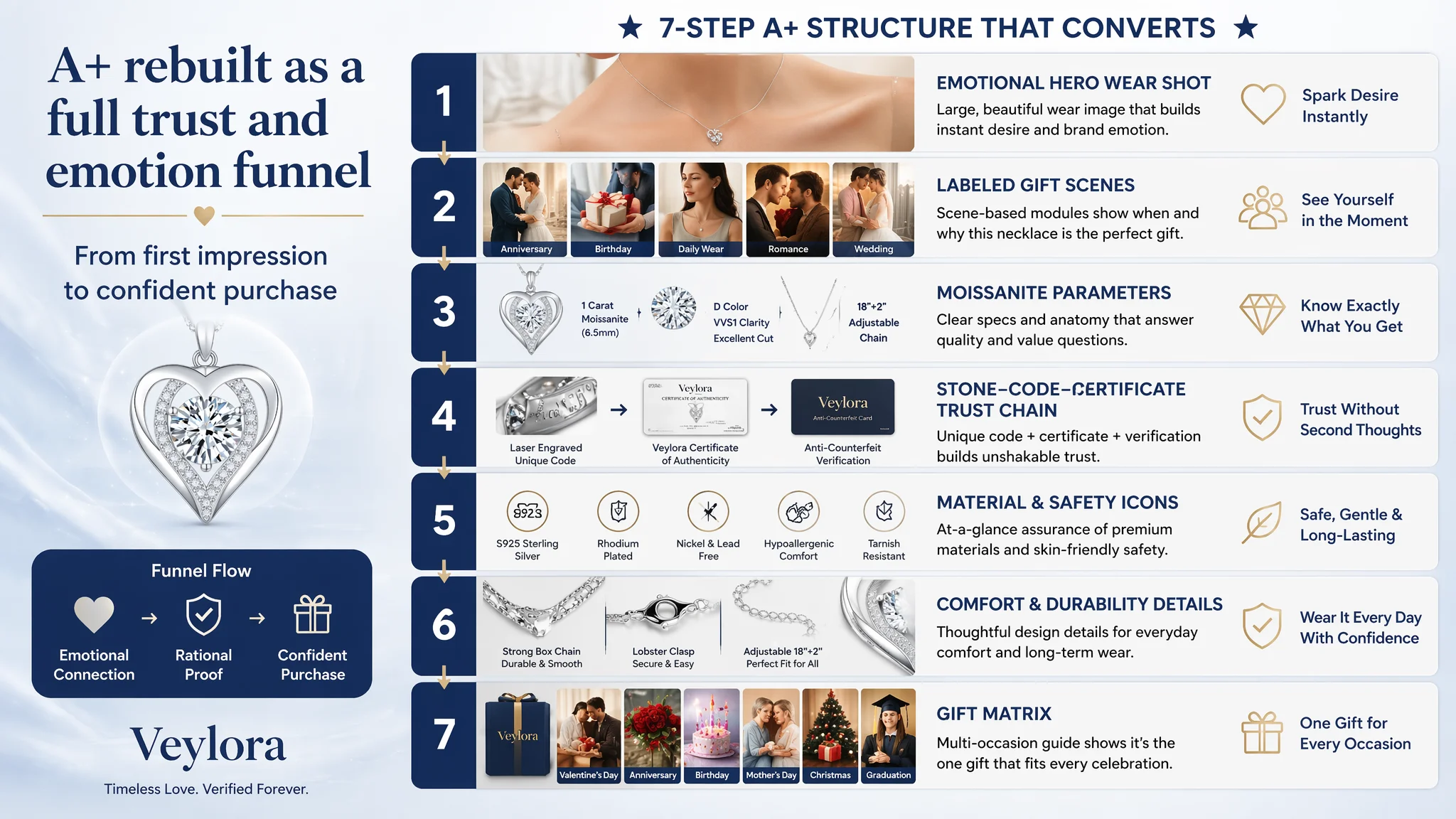
4. A+ Detail Page: Completing the Broken Conversion Funnel
The most critical repair was to transform a missing A+ into a structured persuasion engine. DeepBI’s recommended logic:
1. First A+ module – Big emotional hero image
- Full-width wear shot with strong aesthetic
- Short copy connecting the necklace to love, commitment, and celebration
- Goal: capture emotion and beauty, not data.
2. Second module – Gift scenes with labels
- Several photos or collage with clear tags: “Birthday”, “Anniversary”, “Valentine’s Day”, “Mother’s Day”, “Wedding”
- Ensure that each scene answers: “Would this be appropriate and impressive for this occasion?”
3. Third module – Material and gemstone parameters
- Summarize D color, VVS1 clarity, excellent cut, 1-carat moissanite
- Visualize the 4Cs gently, without overwhelming with labspeak
- Move earlier ultra-rational graphs (modulus of brilliance, etc.) further down.
4. Fourth module – Trust chain: stone, code, certificate
- Combine stone macro, laser-engraved ID, and GRA (or equivalent) certificate in one unified “evidence chain”
- Make the logic explicit: “One stone → One code → One certificate → Your unique gift.”
5. Fifth module – Core parameters & safety icons
- Icon-based summary: S925 sterling silver, rhodium plating, nickel-free, hypoallergenic, comfortable for sensitive skin
- Directly addresses fear of cheap metal, allergies, and long-term wear.
6. Sixth module – Wear comfort & durability details
- Combine previous scattered chain, clasp, and comfort information
- Explain how the adjustable chain, sturdy clasp, and thoughtful design make daily wear easy.
7. Seventh module – Gift matrix
- Use a grid-style image to map the necklace to multiple relationships and holidays
- Reinforce that this is a safe, respectable, and versatile gift choice.
This sequence moves the buyer through:
- Emotion → Scenes → Proof → Safety → Daily usability → Final gift confidence
Where previously the buyer saw only generic product information and had to “take a leap of faith,” now the page walks them step-by-step toward a comfortable “Yes.”
What Changed in the Business State Once the Page Logic Was Repaired
This case is not about a magical overnight metric spike; it is about risk reduction and control.
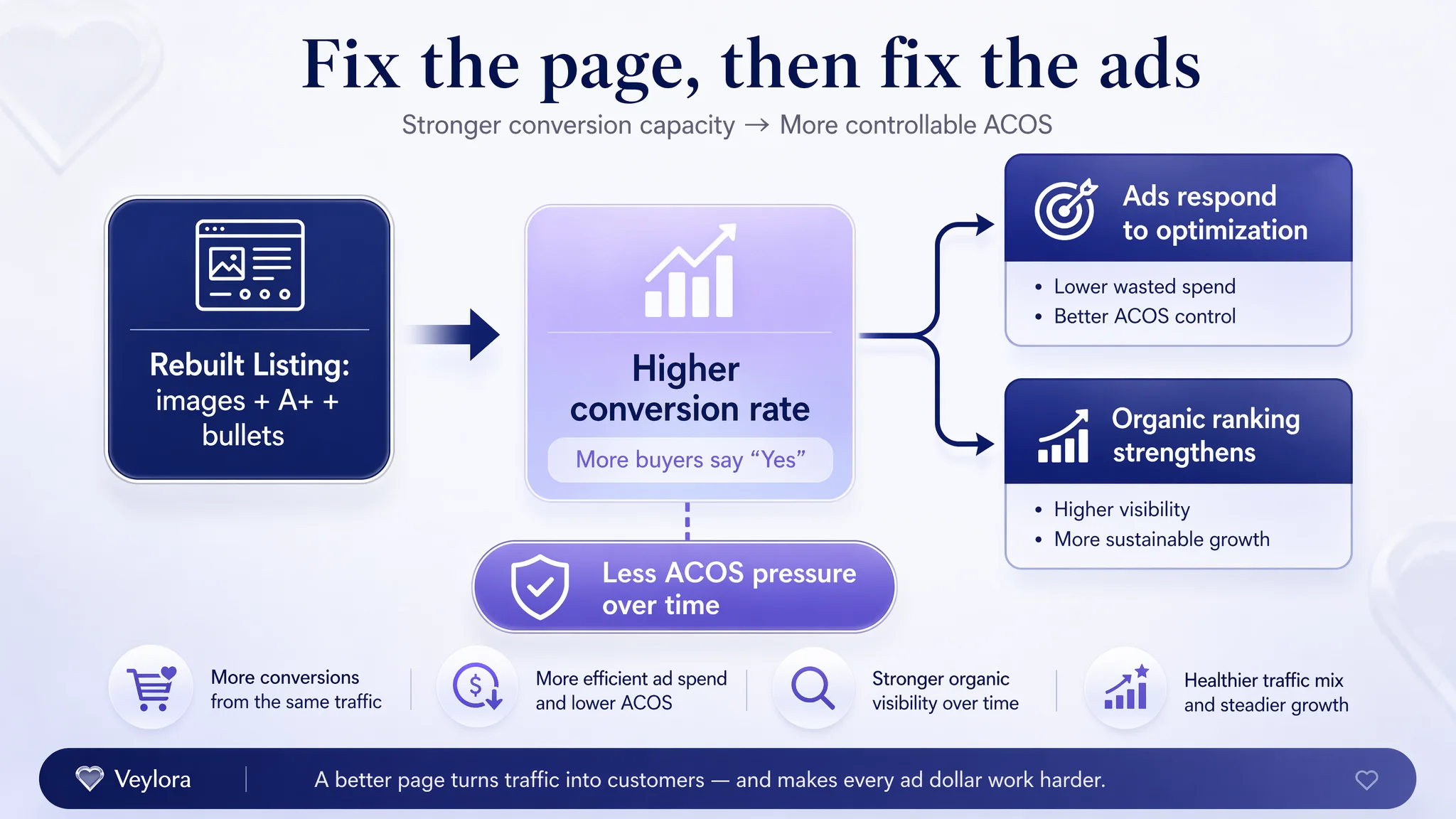
After refocusing on Listing conversion:
- The Listing’s fundamental sales capacity improved.
Visitors arriving from both ads and organic search encountered a page capable of building trust, not just showing specs.
- Ad traffic became useful again.
Once the A+ and main images were aligned with a coherent buying story, ad spend no longer flowed into a trust vacuum. ACOS could start to respond to bid and keyword changes instead of bouncing against a fixed conversion ceiling.
- Organic and paid traffic began working together.
A stronger conversion page supports better organic ranking over time, reducing the need to “overcompensate” with ads.
- The seller’s mental model changed.
The team stopped assuming that every efficiency problem was a media problem. Listing quality—especially A+—became recognized as the foundation of any serious ad strategy.
“The real problem was not that ads failed to bring traffic. It was that the page could not convert the traffic.”
What Other Amazon Sellers Can Take from This Case
1. High ratings and “OK” creatives do not guarantee conversion.
This Listing had 4.8 stars and solid bullets, yet its total competitive score lagged by 28 points—almost entirely because of missing A+ trust content.
2. Ads cannot patch over a broken trust structure.
If your A+ is thin or nonexistent in a category where risk and emotion dominate (jewelry, beauty, health, baby, high-ticket durables), ads will mostly amplify the weakness.
3. Small surface gaps vs. deep structural gaps.
A −1 in main image or title is incremental. A 0 vs. 24 in A+ is existential. Diagnose which type of gap you actually have before choosing optimization priorities.
4. Image sets need logic, not just variation.
A pile of “nice” images is less valuable than a sequence that moves buyers from first impression to final reassurance.
5. Before scaling spend, ask: Does this page deserve more traffic?
When DeepBI compared this moissanite necklace Listing against its benchmark, the answer was initially “no.” Only after rebuilding the product page’s conversion logic did it make sense to revisit aggressive ad scaling.
For Amazon sellers under ACOS pressure, this case underlines a hard but useful truth: the biggest lever on advertising efficiency is often not inside the ad account—it is on the product page.