


This Amazon seller in the golf rangefinder category came to DeepBI with a familiar complaint: advertising costs were climbing, but the main product page still could not pull its weight against a leading competitor. On the surface, the team believed this was an Amazon ads and bidding issue — “our creatives and keywords must not be strong enough.”
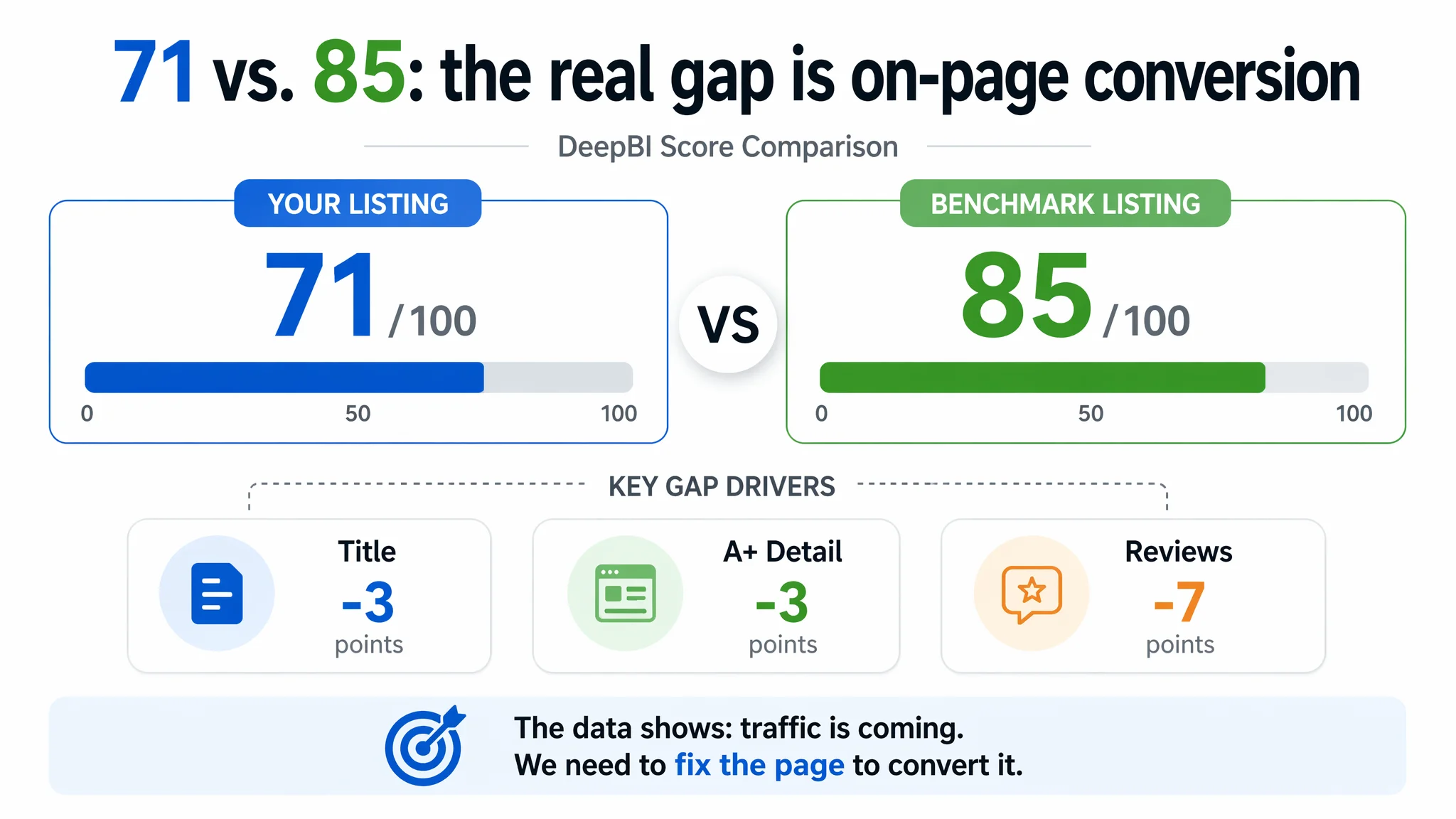
Once we put their Amazon Listing into DeepBI’s scoring and benchmark system, a different picture emerged. Against a directly comparable, high-performing rangefinder, their Listing scored 71/100 versus the competitor’s 85/100, with the biggest gaps not in “traffic” but in title logic, visual trust, A+ story depth, and especially reviews. In other words, ads were faithfully delivering visitors to a page that had not yet earned the right to convert them.
From there, the optimization path changed completely: instead of more keyword tweaks and bid changes, we focused on rebuilding the Amazon product-page conversion logic — main image set, title, bullets, A+ modules, and review perception — to better match how buyers actually decide between rangefinders on Amazon. For other Amazon sellers, this case is a reminder: when ACOS feels stubborn and CPCs are rising, the real constraint is often that your Listing can’t yet turn paid traffic into orders, especially when benchmarked against the category’s conversion “ceiling.”
Amazon Ads Were Not Failing. The Page Was Consuming the Traffic.
The seller operates a core ASIN in the golf rangefinder niche on Amazon US. They had already invested in Amazon ads and saw stable impressions, but:
- Click-through wasn’t keeping up with ad spend on key golf terms.
- Conversion lagged visible category leaders.
- ACOS was hard to push down, no matter how they restructured campaigns.
Internally, the conclusion sounded very rational: “Competition is getting fiercer. We need better keywords, better bids, maybe more eye-catching creatives in ads.”
But once we ran a full Listing vs. benchmark diagnosis, the numbers told a different story:
- Their Listing: 71/100
- Benchmark Listing: 85/100
- Largest gaps: reviews (-7 pts), title (-3 pts), A+ detail (-3 pts), minor but meaningful gap on main images (-1 pt).
“The real problem was not that ads failed to bring traffic. It was that the page could not convert the traffic.”
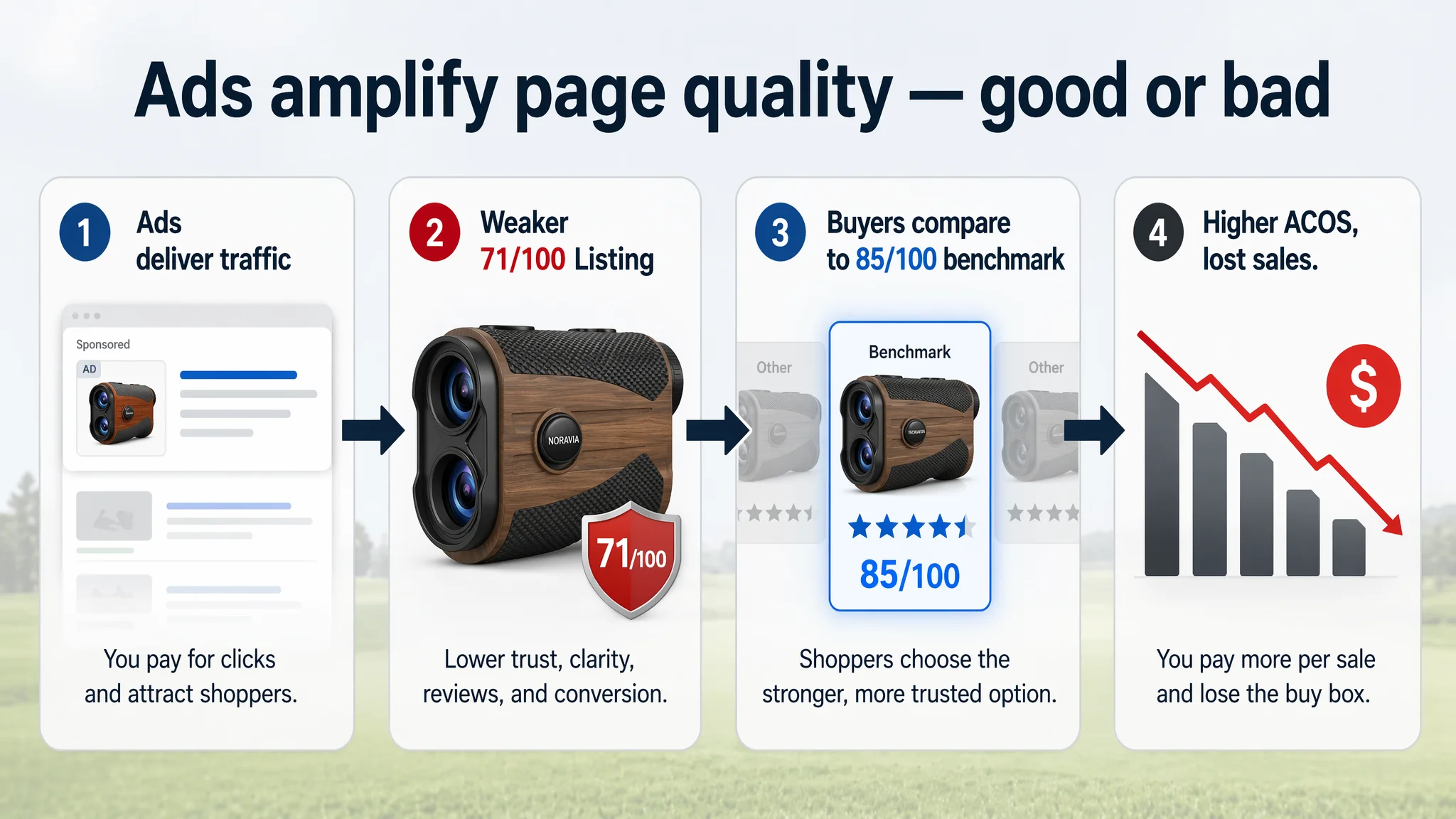
From DeepBI’s perspective, continuing to tune ads into a 71/100 Listing — while competing against an 85/100 benchmark in the same search results — meant paying to amplify a structural conversion disadvantage.
The Core Constraint: Listing Conversion Capacity, Not Traffic Volume
Looking across the five scored dimensions, the constraint was clear.
1. Title: Keyword Coverage Without a Clear, Professional Decision Signal
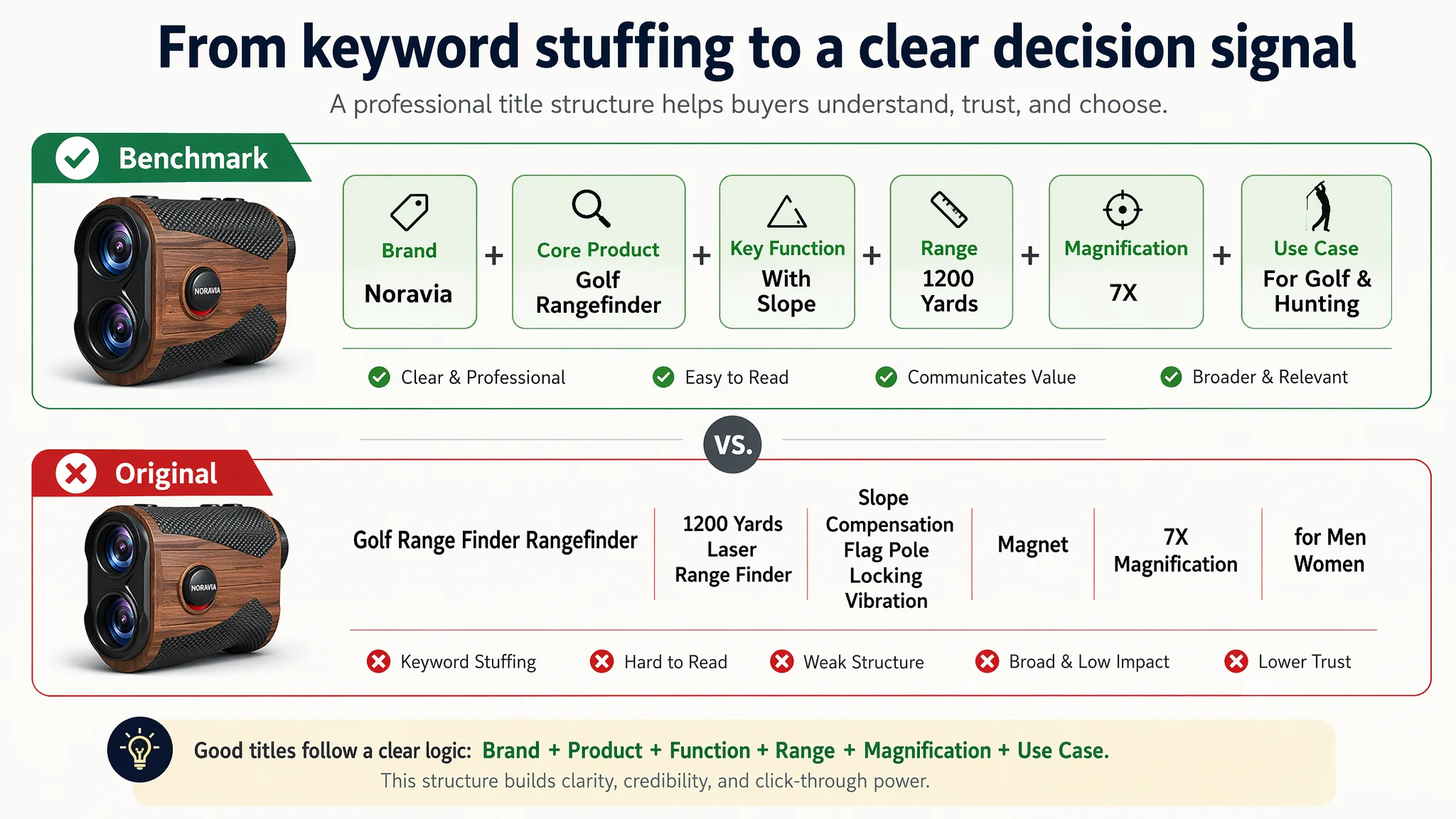
The original title did contain the right core phrase — “Golf Range Finder / Rangefinder” — and put it early. On paper, this seems fine for Amazon SEO.
But side-by-side with the benchmark:
- The seller’s title felt keyword-stuffed and choppy, reducing perceived professionalism.
- Phrases like “Flag Pole Locking Vibration” read awkwardly; the benchmark separated “Flagpole Lock Vibration” and “Magnetic Strip” into clean, distinct value blocks.
- The seller used “for Men Women” — a very broad, low-impact phrase in this category.
- The benchmark layered in “for Hunting” and covered variant phrases like “Range Finders Golfing,” gaining both broader and more precise search coverage while staying natural.
In practical Amazon terms, the benchmark’s title did two things better:
- Aligned with standard “Brand + Core Keyword + Core Function/Use” structure that buyers are used to.
- Conveyed more professional, versatile usage (golf + hunting) without feeling spammy.
The seller was not “missing” keywords. The title simply did not tell a clean, credible story at a glance, which hurts both click propensity and perceived authority once buyers land on the page.
2. Main Images: No Clear Reason to Click, No Clear Reason to Trust
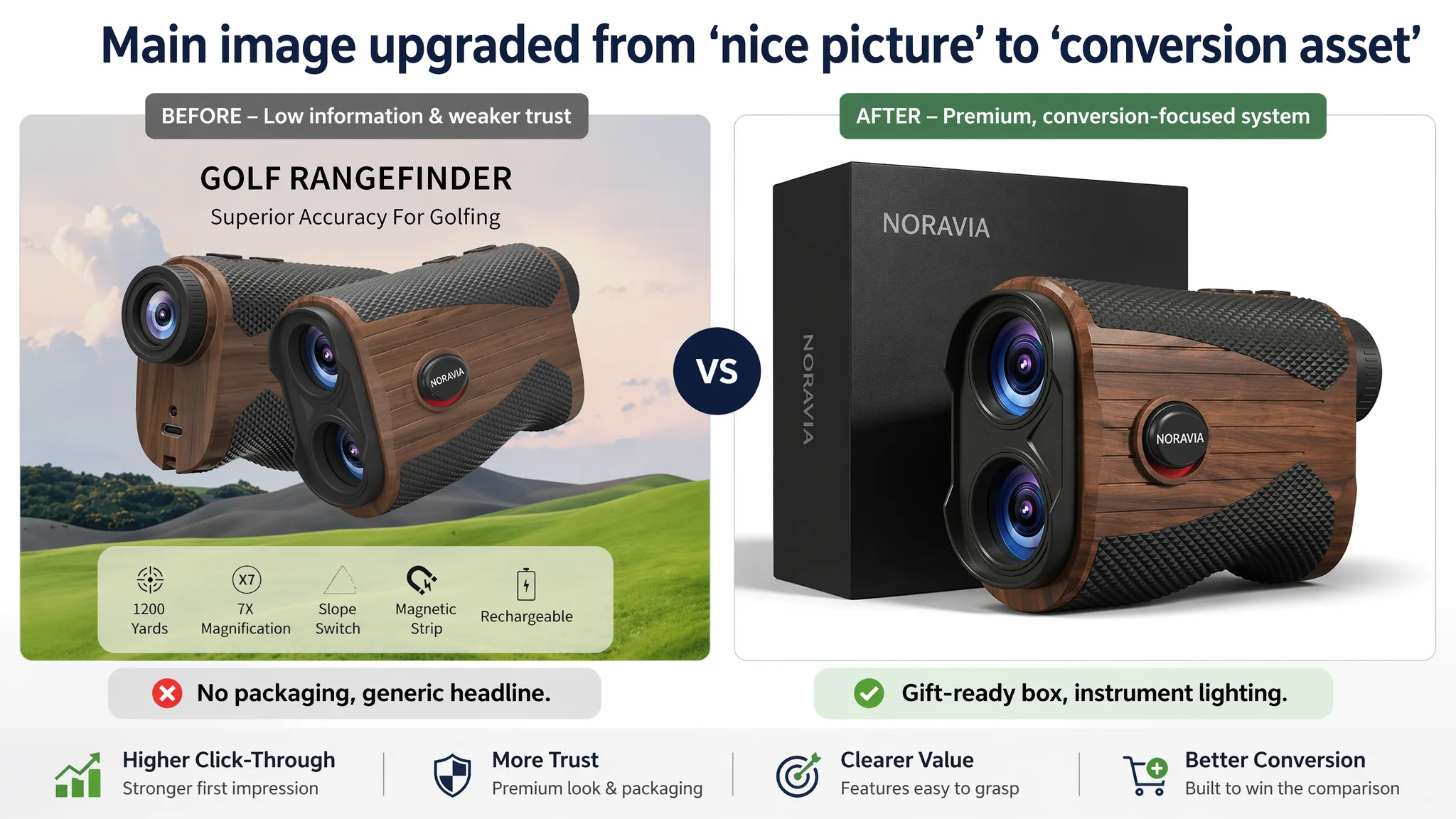
The main-image set showed the product, but it lacked the visual logic that the top competitor used to win clicks and trust.
Key gaps DeepBI flagged:
- Low information density in the first image:
On the search-results thumbnail, it was hard to grasp the core value quickly — especially on mobile.
- Technical diagrams felt weaker:
The benchmark’s images carried a crisper, more “engineered” look. For a higher-involvement purchase like a rangefinder (especially for serious golfers or hunters), this professional visual tone directly affects trust.
- Scenes looked less real:
Heavy compositing and generic setups created a sense of “marketing image” rather than “real gear in real use.” This lowers dwell time and add-to-cart intent versus a benchmark that feels rooted in actual play or field use.
The seller had assumed that “images are okay, maybe just not as pretty.” DeepBI’s reading was different: the images did not yet function as conversion tools.
So instead of vague “make it more beautiful,” we translated the gaps into specific, business-driven visual roles:
- Hero image must signal premium tech + real golf context.
- Follow-up images must show human use, in-lens view, and quantified performance (range, accuracy, slope).
Why Traditional Ad Optimization Could Not Solve This
With this diagnosis, the failure of ad optimization attempts became easy to explain.
On the ad side:
- Traffic was not the bottleneck.
- Keywords were broadly on-target.
- CPC pressure was category-wide, not unique to this seller.
On the Listing side, however:
- The title under-communicated professional positioning and multi-scenario usage versus the benchmark.
- The main images under-delivered on clarity, trust, and perceived sophistication.
- A+ content stayed almost purely golf-only, while the benchmark’s A+ expanded into hunting, disc golf, engineering, hiking, etc.
- The review layer was dramatically weaker in both volume and front-page sentiment.
“Advertising does not only amplify advantages. It can also amplify a page’s existing defects.”
In this state, every extra dollar in ads simply:
- Drove more buyers into a weaker decision journey, where a stronger benchmark Listing sat just a scroll away.
- Increased ACOS without structurally changing the page’s ability to win a comparison.
DeepBI’s judgment: More ad tuning would not change the outcome. The Listing’s conversion logic had to be rebuilt first.
What the Scoring System Exposed: Where the Listing Was Losing the Comparison
Reviews: A Trust Gap That No Amount of Copy Can Hide
On Amazon, reviews are sometimes treated as “we’ll fix this later.” In this niche, they were already deciding the outcome.
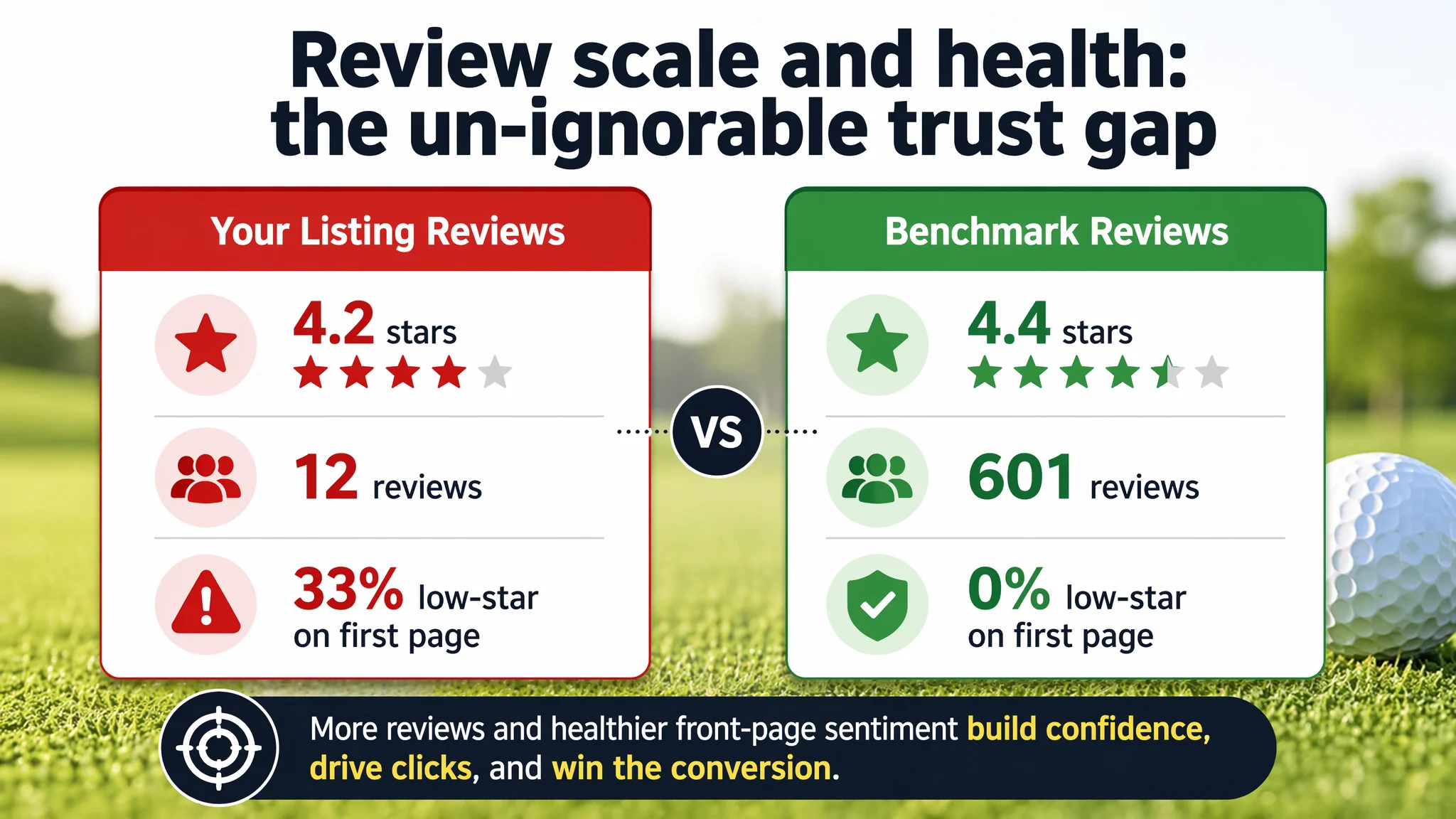
- Seller: 4.2 stars, 12 total reviews, 3 reviews visible on first page.
- Benchmark: 4.4 stars, 601 total reviews, 9 reviews visible on first page.
Two critical points:
1. Scale: The benchmark had ~50x the total reviews — a huge signal to buyers that “this model is proven.”
2. Front-page sentiment:
- The seller had 33% of front-page reviews at 3 stars or below.
- The benchmark showed 0% visible low-star reviews on its first page.
In addition:
- The seller lacked photo/video reviews that demonstrate real usage.
- Benchmark reviews explicitly mentioned details like product images, magnetic mount, etc., reinforcing the exact features highlighted in the Listing.
This is why DeepBI’s scoring put reviews at -7 points relative to the benchmark — by far the largest gap. Even if title and images improved, this perception gap still had to be recognized and factored into strategy (e.g., expectation-setting, warranty messaging, gift positioning).
DeepBI’s decision logic here was not “you must outrun 600 reviews overnight” — that’s unrealistic. It was:
- Accept that review scale and health currently force you into a defensive position vs. the benchmark.
- Compensate by over-performing in the areas you can control now: visual professionalism, clarity of function, multi-scenario usage, and gift-worthiness.
This Product Page Did Not Lack Features. It Lacked a Coherent Buying Logic.
When we examined bullets and A+ detail, it was clear the seller had thought about features and user pain points. The problem wasn’t “no content.” It was how that content was structured and framed against the benchmark’s decision journey.
Bullets: Information Present, But Not Aligned With Real Amazon Decision Steps
The seller’s original bullet strategy had some strengths:
- Started from a user pain point (“Still worried about…”) to trigger emotional resonance.
- Separated mode/function from battery/after-sales, giving a clean conceptual split.
- Embedded small operation details (e.g., “rotate the eyepiece”) directly into performance descriptions.
The benchmark, however, was sharper at matching how Amazon shoppers scan:
- Bullet #1 anchored on “Range Finder for Golf & Hunting” and multi-scenario use.
- Bullets compressed fast readings, display quality, durability, and support with higher information density.
- The structure mapped more cleanly to buyer questions:
“Where can I use it? How accurate is it? How easy is it? Will it last? What if something goes wrong?”
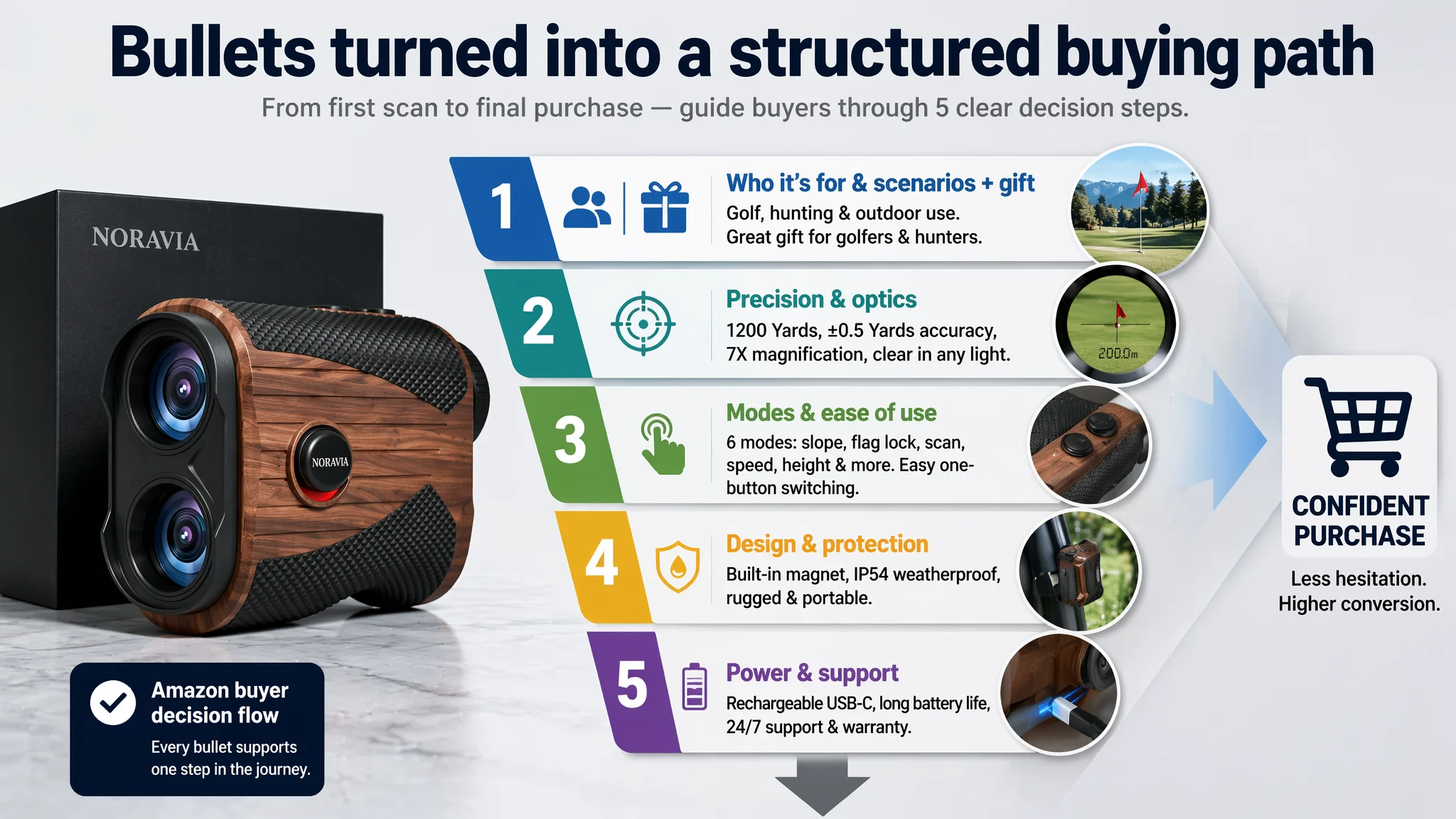
DeepBI’s optimization path wasn’t to rewrite everything from scratch; it was to reorder and reframe so that each bullet became a clear step in a decision chain.
For example, the proposed bullets:
1. Positioning & scenarios + gift angle
“Professional Rangefinder for Golf & Hunting … perfect gift for golfers, hunters, and outdoor enthusiasts.”
2. Precision & optics
Highlighting ±0.5 yards accuracy, 7x magnification, transflective LCD, low-light clarity.
3. Modes & ease of use
Six clearly named modes, plus “intuitive distance and mode buttons” to reassure on complexity.
4. Physical design & protection
Ultra-strong magnetic mount, IP54 weatherproof rating, durable build.
5. Rechargeability & support
USB‑C, large battery, explicit measurement-count claim, and visible 24/7 technical support.
The aim: each bullet now did a specific job in the conversion funnel, instead of being a mixed pool of specs and claims.
A+ Content: Locked in “Golf Only” While the Benchmark Owned the Outdoors
The seller’s A+ modules were not empty. They included:
- Product hero.
- Core parameters.
- Slope compensation.
- Multi-mode visuals.
- Portability.
- Light-adaptation.
- Emotional golf scenes.
- Waterproofing & battery.
- What’s in the box.
The benchmark, however, used its A+ space as a multi-scenario authority canvas:
- Holiday gift packaging scenes.
- Slope + vibration lock + real measurement sequences.
- Multi-scene modes: height / speed / scan.
- Detailed spec cluster (7x, IP54, power saving).
- Ergonomics, unit switching, full use-case array:
- Disc golf, hunting, archery, engineering, hiking/camping.
From DeepBI’s view, the gap wasn’t “you have fewer pictures.” The gap was:
1. Scenario breadth:
The seller’s A+ said: “This is a golf rangefinder.” The benchmark’s A+ said: “This is your all-around outdoor measurement tool — golf is just one use.”
2. Trust chain strength:
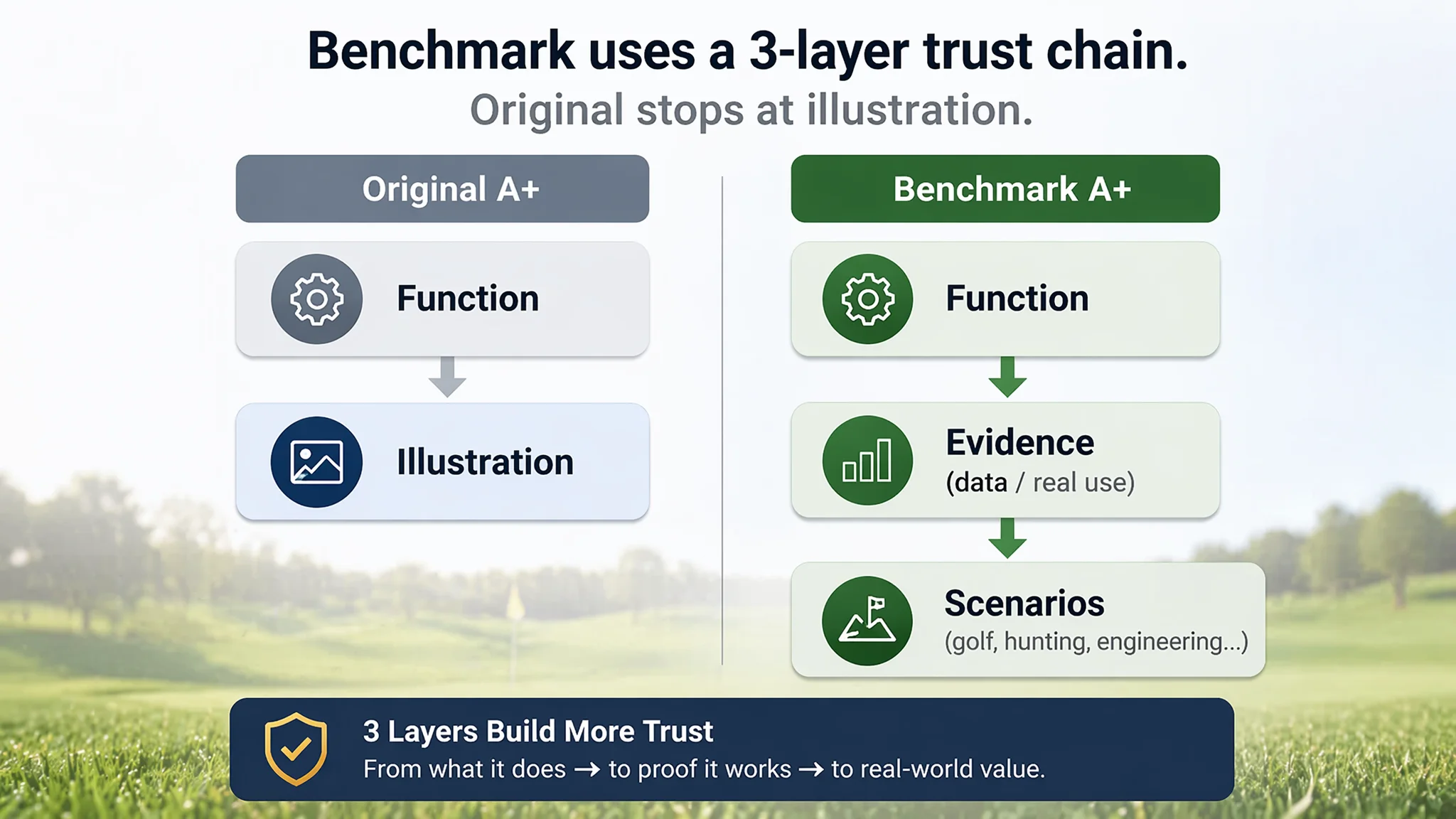
Benchmark: Function → Evidence → Scenario. Seller: Function → Illustration with lighter evidence.
3. Visual storytelling quality:
Benchmark images looked like real people in real work/play environments, in full bleed. Seller images leaned on cutouts, composites, and generic scenes, which struggle to carry a “serious equipment” positioning.
DeepBI’s decision: the A+ had to evolve from a single-sport brochure into a cross-scenario, trust-building story, while also leveraging the brand’s unique visual asset — the walnut woodgrain finish.
Why DeepBI Did Not Recommend “Keep Tuning Ads First”
At this point in the diagnosis, the strategic choice was binary:
- Option A: Continue iterating on Amazon ads — more campaigns, refined bids, new keywords — while the Listing remained structurally weaker than the benchmark.
- Option B: Pause aggressive scaling and treat Listing conversion as the primary constraint.
DeepBI recommended Option B, and the reasons were commercial, not cosmetic:
1. Ad spend was already proving that traffic existed.
Low click and conversion rates in the presence of a much stronger benchmark page indicated a page-side problem, not a demand problem.
2. Each extra ad dollar would buy more unfavorable comparisons.
Buyers see both this ASIN and the benchmark on the same SERP. If the benchmark looks more trusted and more versatile, incremental traffic will keep leaking to it.
3. Amazon’s algorithm eventually bakes conversion into visibility.
Weak CVR under traffic pressure doesn’t just hurt short-term ACOS; it pushes the Listing into a structurally weaker position for future organic rankings.
In other words, fix the bucket before pouring more water. The Listing’s job is to convert both organic and paid traffic with at least a competitive efficiency. Until that improves, ad optimization is just a costlier way to confirm the same problem.
How the Page’s Sales Logic Was Rebuilt
The optimization that followed was not about “more assets.” It was about reordering the Listing around a clear decision logic, then giving production teams highly concrete visual specifications.
1. Main Image System: From “Floating Product” to “Tech Gear on the Green”
DeepBI’s scoring and benchmark analysis were translated into actionable, engineering-level instructions — not vague “improve aesthetics.”
Key moves:
- Hero image:
- Product centered at ~60% frame.
- Branded black box at 45° behind it to signal premium packaging and gift value.
- Cold, industrial lighting with strong right-side light and left-side shadow.
- Clean white background, subtle model marking in the corner.
→ Aim: immediately signal “professional instrument + gift-ready brand” on the search page.
- Real green scene:
- Rangefinder placed on an actual putting green with a golf ball and club head nearby.
- Early-morning, angled natural light; background course softly blurred.
→ Aim: anchor the product in real golf usage, reducing the “stock photo” feel.
- Human + in-lens view:
- A golfer using the device, with a circular overlay showing a 7x magnified flag and clear 200.0m reading with reticle.
→ Aim: lower cognitive effort — buyers don’t have to imagine how it works.
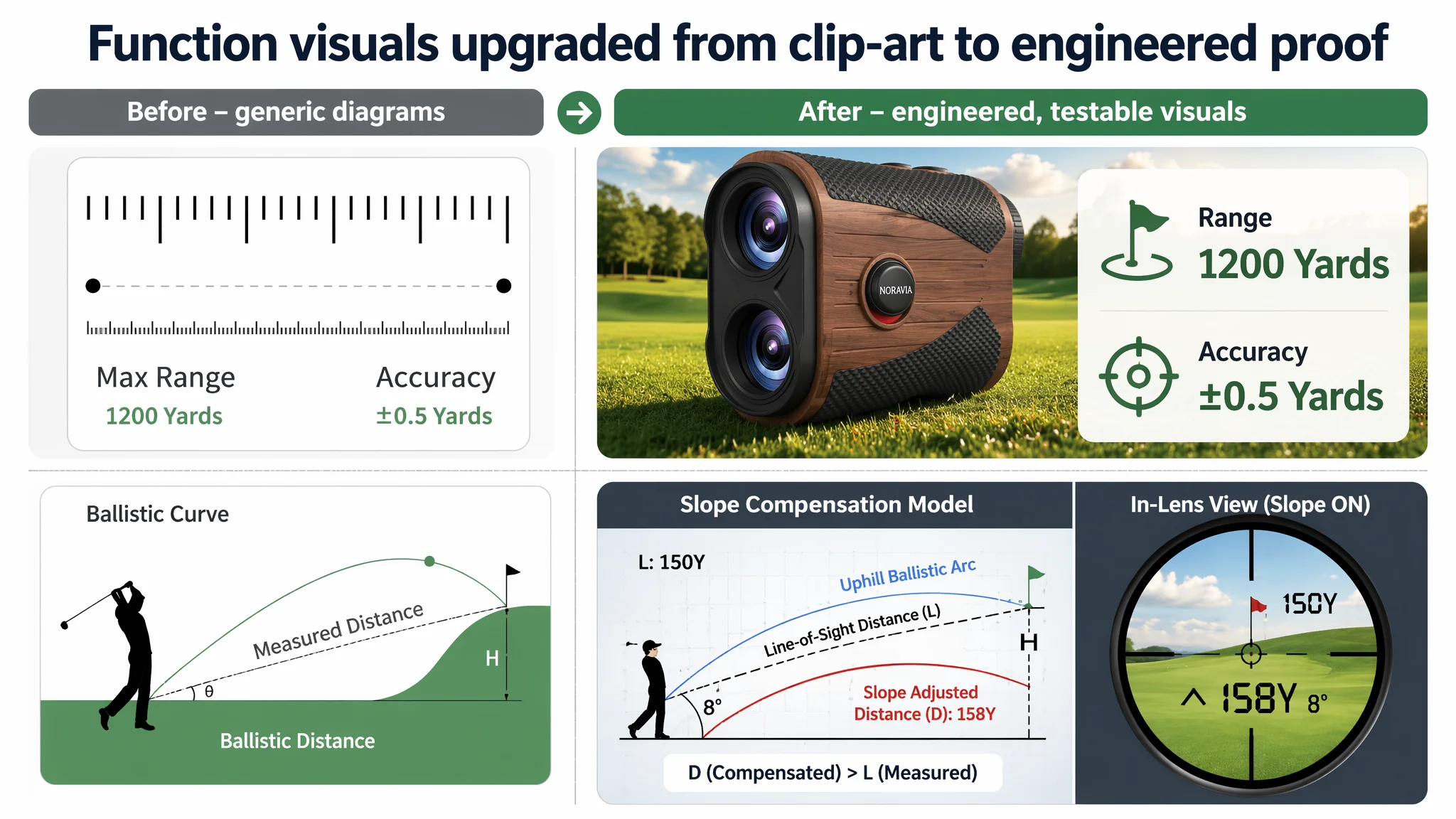
- Data visualization:
- Product on one side, clean data card on the other: “Range 1200 Yards,” “Accuracy ±0.5 Yards” with icons.
→ Aim: make performance instantly legible, not buried in copy.
- Slope model:
- Split layout: left side shows a simplified slope math diagram, right side shows the UI view.
→ Aim: give the slope feature scientific legitimacy, to match serious players’ expectations.
This was how DeepBI turned “your images look weaker” into a set of specific, testable designs that directly respond to how the benchmark was winning clicks and trust.
2. Detail Page & A+: From Single-Sport to Multi-Scenario, Premium, and Verified
For the A+ and secondary images, DeepBI prioritized a few conversion levers:
- Leverage the unique woodgrain finish:
Make the walnut texture a differentiating premium signal, not just an incidental detail.
- Clarify slope and optical performance with 3D and through-the-lens views.
- Show multi-scenario usage beyond golf.
- Resolve trust-breaking inconsistencies, such as mismatched waterproof ratings.
Concrete directions included:
- Premium hero A+ module:
- 3/4 angle shot, 70% frame occupation.
- Early-morning golf course background, blurred.
- “±0.5Yd Accuracy” clearly overlaid.
→ Builds an immediate “high-end, precise” impression.
- Slope compensation in 3D:
- Left: product, right: 3D green with contour lines and labeled “Slope Distance” vs. “True Distance.”
→ Puts a technical backbone behind a core golf-use feature.
- Through-the-lens strong vs. weak light:
- Side-by-side “Sunlight” vs. “Dusk/Low Light” reticle views.
→ Reassures buyers on real-world optical usability.
- Magnetic mount in action:
- Device visibly attached to a golf cart pillar at an angle.
→ Makes “integrated magnet” feel like a daily convenience, not a bullet-point abstraction.
- Multi-scenario ring:
- Central product surrounded by circular insets: jungle hunting, engineering measurement, birdwatching.
→ Expands mental usage map beyond golf, mimicking the benchmark’s multi-use story.
- Waterproof & charging trust module:
- Product under fine water spray, clearly labeled “IP54 Weatherproof” and “Type-C Fast Charging.”
- Corrected from conflicting “IPX4 / IP54” messaging.
→ Fixes an easily overlooked, but credibility-damaging inconsistency.
- Gift layout:
- Flat lay of product, embossed box, case, cable, strap on a clean stone background.
- “The Perfect Gift for Golfers” overlay.
→ Explicitly builds the gift-purchase rationale the benchmark used with holiday visuals, but in a modern, cleaner aesthetic.
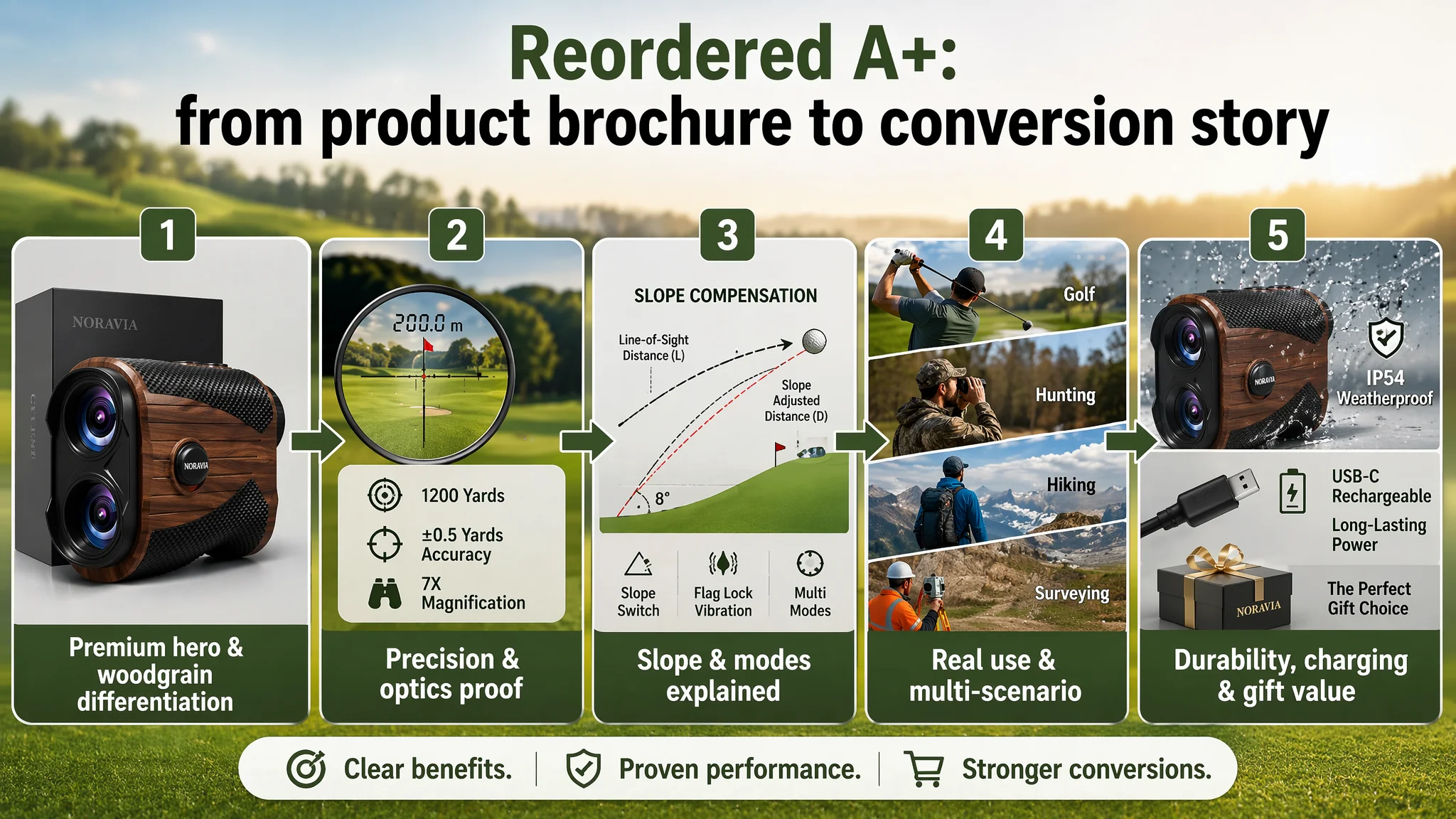
The essential shift: from generic modules to a tightly reasoned sequence that:
1. States what this device is and why it’s premium.
2. Proves precision and optics.
3. Explains slope and modes with visual logic.
4. Shows real usage and multi-scenario capability.
5. Closes with durability, charging, and gift value.
What Changed After the Listing Began to Recover
Because this case focuses on diagnostic and decision logic, not a long timeline of test data, we will not invent numbers. Instead, we outline the operating changes that followed the Listing rebuild.
1. Ads Became Useful Again
Once the main image set, title, bullets, and A+ were aligned with the benchmark’s conversion logic:
- Incoming paid traffic landed on a page that could credibly compete in the category.
- The Listing was less likely to lose buyers on first-screen trust checks (title + main image + review snapshot).
- A+ and secondary images began actually supporting the decision rather than just filling space.
This did not magically erase the review-volume gap, but it reduced the structural conversion penalty that had been making every click more expensive than it needed to be.
2. The Traffic Structure Became Less Risky
With a stronger conversion foundation:
- The team could rebalance between paid and organic traffic without fearing that cutting ad spend would instantly kill sales.
- The Listing started to regain its ability to convert organic searches, because all the same decision levers now worked for unpaid visitors too.
Advertising remained important — but it now amplified a healthier Listing instead of a weak one.
3. The Team’s Mental Model of “What’s Wrong” Shifted
The most important change was not visual; it was strategic:
- The seller no longer treated stubborn ACOS as “our ad manager isn’t optimizing hard enough.”
- They began to see Listing quality and conversion capacity as the foundation of ad efficiency, not an afterthought.
- Title, main images, bullets, A+, and reviews were no longer isolated assets; they became a single, integrated sales argument.
For future ASIN launches and iterations, this changed the order of operations:
1. Get a benchmark-based Listing diagnosis first.
2. Fix conversion-critical gaps (trust, clarity, scenario coverage) before pushing spend.
3. Use ads to validate and scale what the page can already convert — not to try to compensate for its weaknesses.
What Other Amazon Sellers Can Take From This Case
This golf rangefinder seller’s experience is not unique. Across categories, we see the same pattern:
- Ads are blamed for high ACOS and low ROAS.
- Campaigns get restructured over and over.
- Yet the Listing still underperforms against the category’s real benchmark.
This case underlines a few practical lessons for Amazon sellers:
- If you are significantly behind a key benchmark Listing in title clarity, main-image professionalism, A+ depth, and review health, you are not in a fair fight — no matter how good your ads are.
- Reviews are not just a star rating; front-page sentiment and photo/video content drive trust much more than many teams admit.
- A+ is not a decoration. It is your best tool to expand scenario coverage, prove function with visuals, and build a three-layer trust chain: function → evidence → real use.
- Main images must communicate both “this is what it is” and “this is why you can trust it,” within a second or two on the search page, especially on mobile.
DeepBI’s advantage in this case was not “another optimization feature,” but the ability to reframe the problem:
- From “our ads aren’t working”
- To “our Amazon product page cannot yet convert the traffic it’s already getting, especially versus the benchmark.”
Once that judgment changed, the rest of the optimization path became much clearer — and every future ad dollar had a much better chance of translating into real, defensible sales.