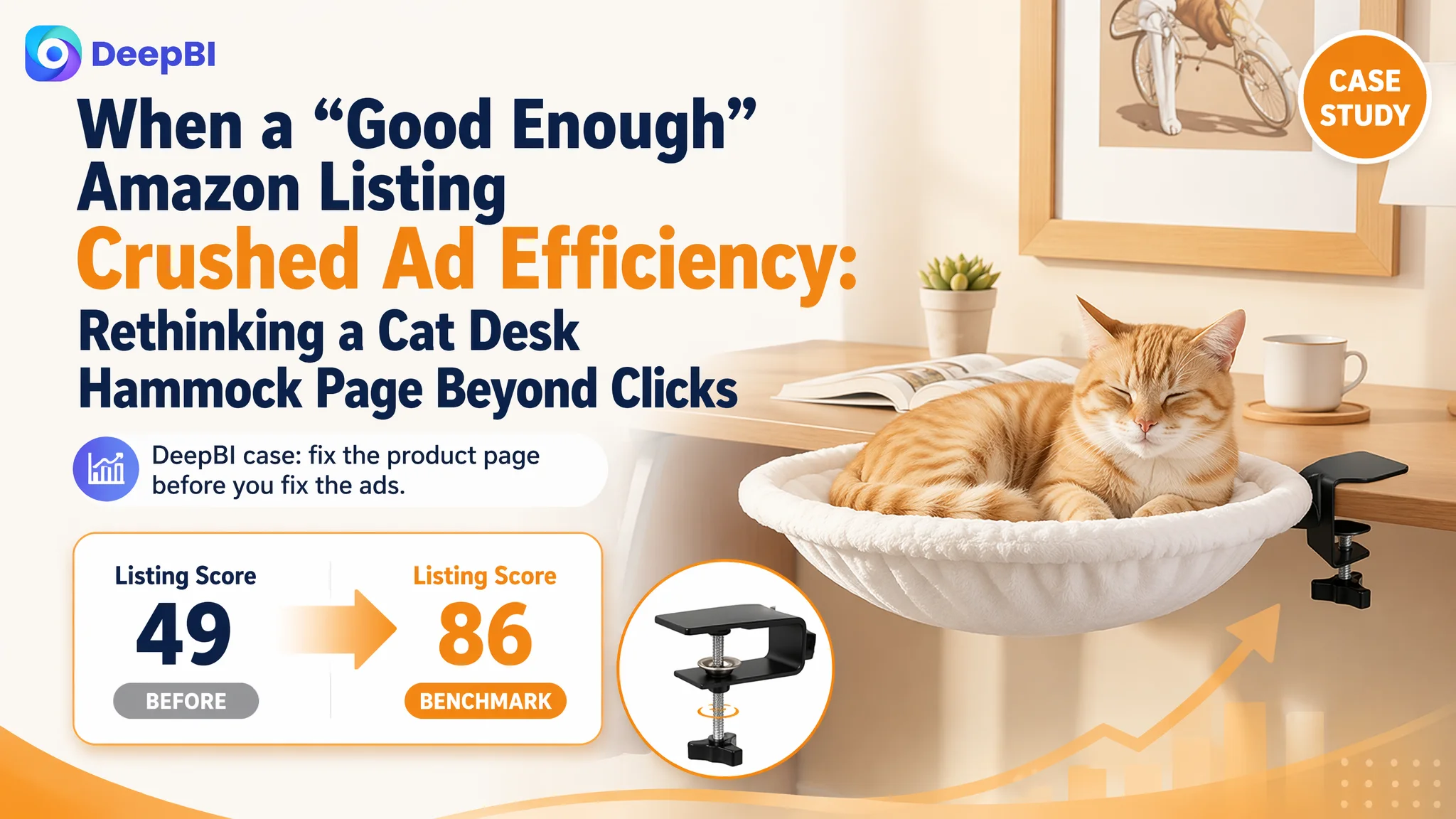
This Amazon seller runs a clamp-on cat desk hammock in the US marketplace. Traffic was not the main problem: ads could bring visitors in, the category wasn’t new, and benchmarking showed clear demand. But conversion lagged behind a directly comparable competitor. The team’s first instinct was to push harder on Amazon ads and tweak bids, hoping ACOS would fall as data accumulated.
DeepBI’s Listing diagnosis told a different story. The issue was not a lack of traffic or a “bad product.” The real bottleneck was that the Amazon product page could not carry the same decision-making weight as the benchmark: no A+ content, weaker title logic, underpowered bullets, and visuals that did not tell a “no-distraction work + safe for big cats” story. Ads were amplifying these weaknesses instead of turning clicks into orders.
Once the problem was reframed as a page-conversion issue, the optimization focus shifted: rebuild the title around desk-cat usage and decision keywords, redesign main images to show “before/after” workspace relief and 50 lb stability, structure bullets around pain point → solution → proof, and design A+ modules that walk a work-from-home buyer from “cat on keyboard” pain to “stable, washable, year-round perch” trust. For other Amazon sellers, this case is a reminder: if a benchmark listing outperforms you with similar traffic, do not keep blaming keywords and bids. First ask whether your page actually deserves the traffic you’re buying.
The Core Conflict: Ads Were Feeding a Weak Page
Looking at this cat desk hammock ASIN in isolation, the surface story was simple:
- Newer listing
- Fewer reviews
- ACOS hard to control
The seller assumed the main levers were:
- “We just need more reviews and time”
- “We need better keyword coverage and campaign structure”
- “Maybe our images are not pretty enough; let’s retouch a bit”
Under that assumption, they kept iterating ads and waiting for social proof to accumulate.
DeepBI’s listing scoring put a number on the gap:
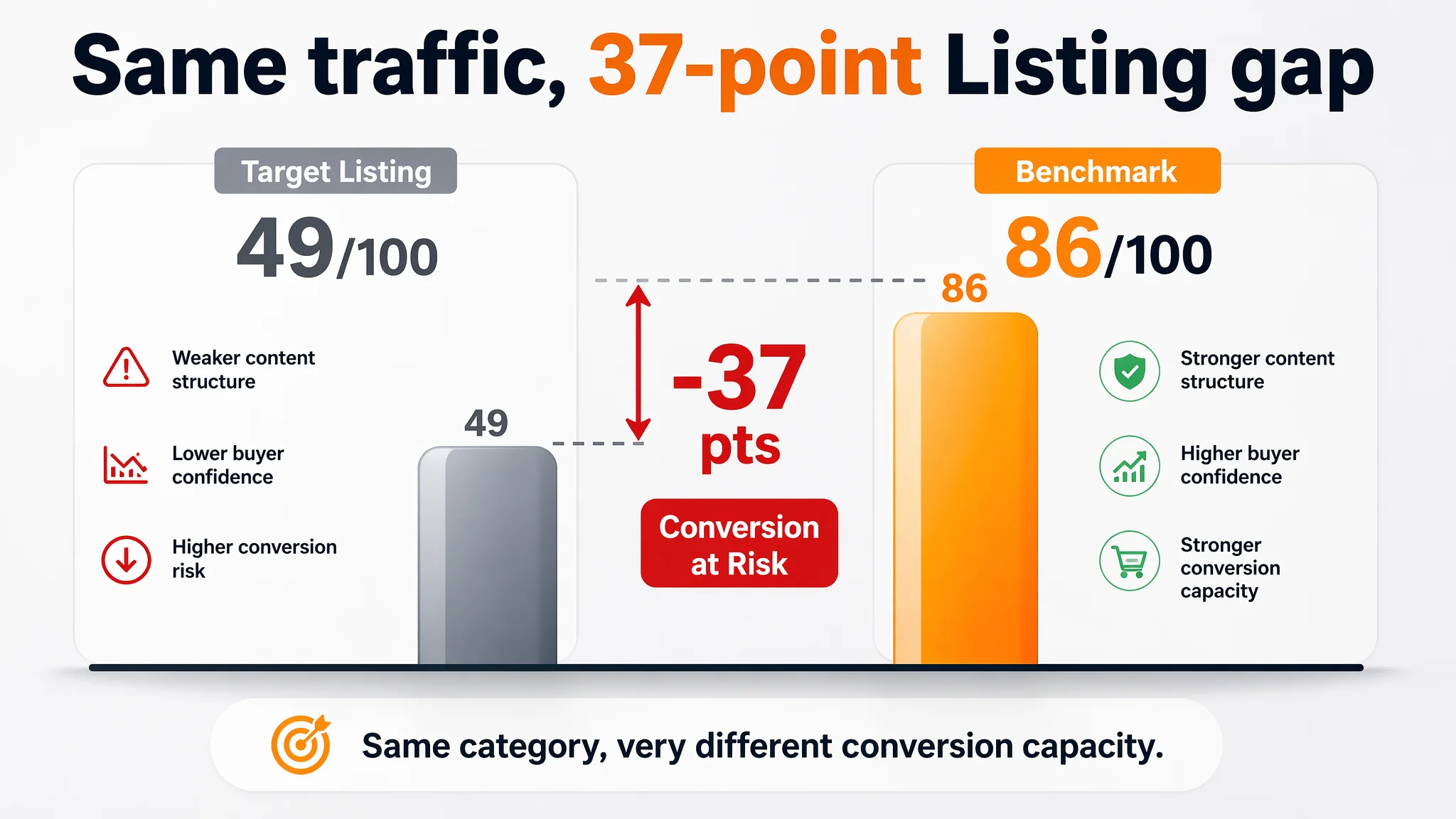
- Target listing score: 49 / 100
- Benchmark competitor: 86 / 100
- Gap: –37 points
That is not a “small polish” difference; it’s a structural conversion problem. More traffic into a 49-point page will not behave like traffic into an 86-point page.
“The real problem was not that ads failed to bring traffic. It was that the page could not convert the traffic.”
At this stage, continuing to optimize ads first would only deepen the loss curve: higher spend, unstable ACOS, and the algorithm slowly learning that your ASIN underperforms when given impressions.
What the Seller Originally Misdiagnosed
From the seller’s perspective, the logic chain sounded reasonable:
- CTR is not disastrous: people do click
- Reviews are still low: that must be the main trust issue
- Competitor is older and has more reviews: “we can’t compare yet”
- Ads must be refined: “once we find the right bids and keywords, conversion will follow”
That diagnosis hides several pitfalls:
1. Overweighting review count as the only trust factor
The team accepted the competitor’s lead as “inevitable” because of review scale (29 vs. 2). They underweighted how much page content, structure, and A+ storytelling drive conversion even with modest review numbers.
2. Treating listing content as “basically okay”
The existing title mentioned the core keyword and some functions. Images showed the product. Bullets mentioned comfort and easy cleaning. On the surface, nothing was “obviously broken,” so ads received most of the attention.
3. Believing ad optimization can offset page-level logic gaps
When ACOS doesn’t improve, the first reflex is usually to adjust keywords, bids, match types, or negative terms. But if the page itself is structurally less persuasive than the best competitor, no amount of segmentation will change the fact that each click is landing on a weaker offer.
DeepBI’s role was not to add “more actions” on top of this. It was to ask whether this entire optimization direction was addressing the wrong constraint.
Listing Scoring Exposed a Single Dominant Bottleneck
When the Listing was benchmarked against a directly comparable “on/under” cat desk bed in the same Amazon category, the pattern was clear.
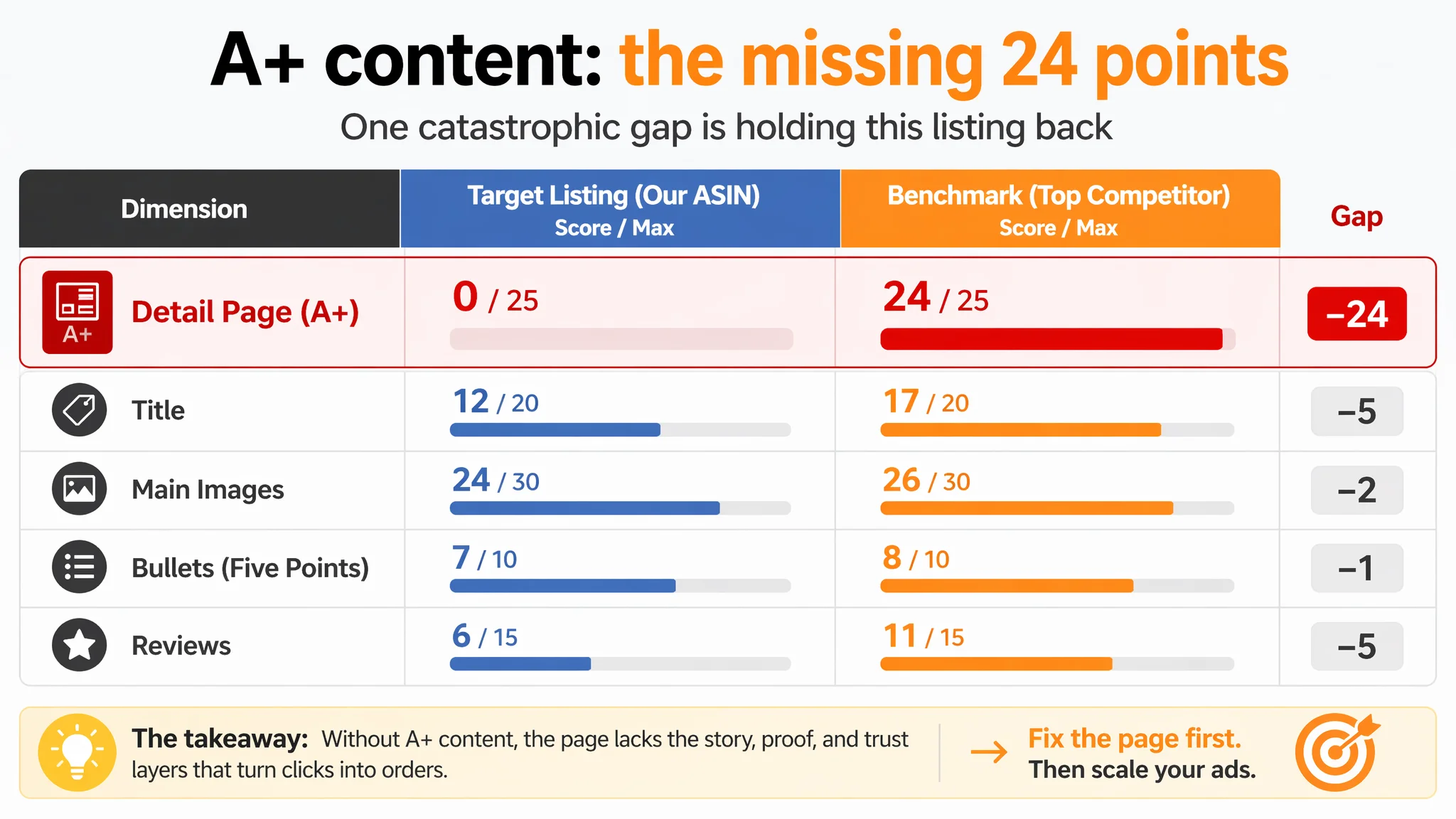
One Dimension Was Catastrophically Weak: A+ / Detail Page
- Detail page (A+) score
- Target listing: 0 / 25
- Benchmark: 24 / 25
- Gap: –24 points
There was no A+ content:
- No pain-point story
- No stability proof
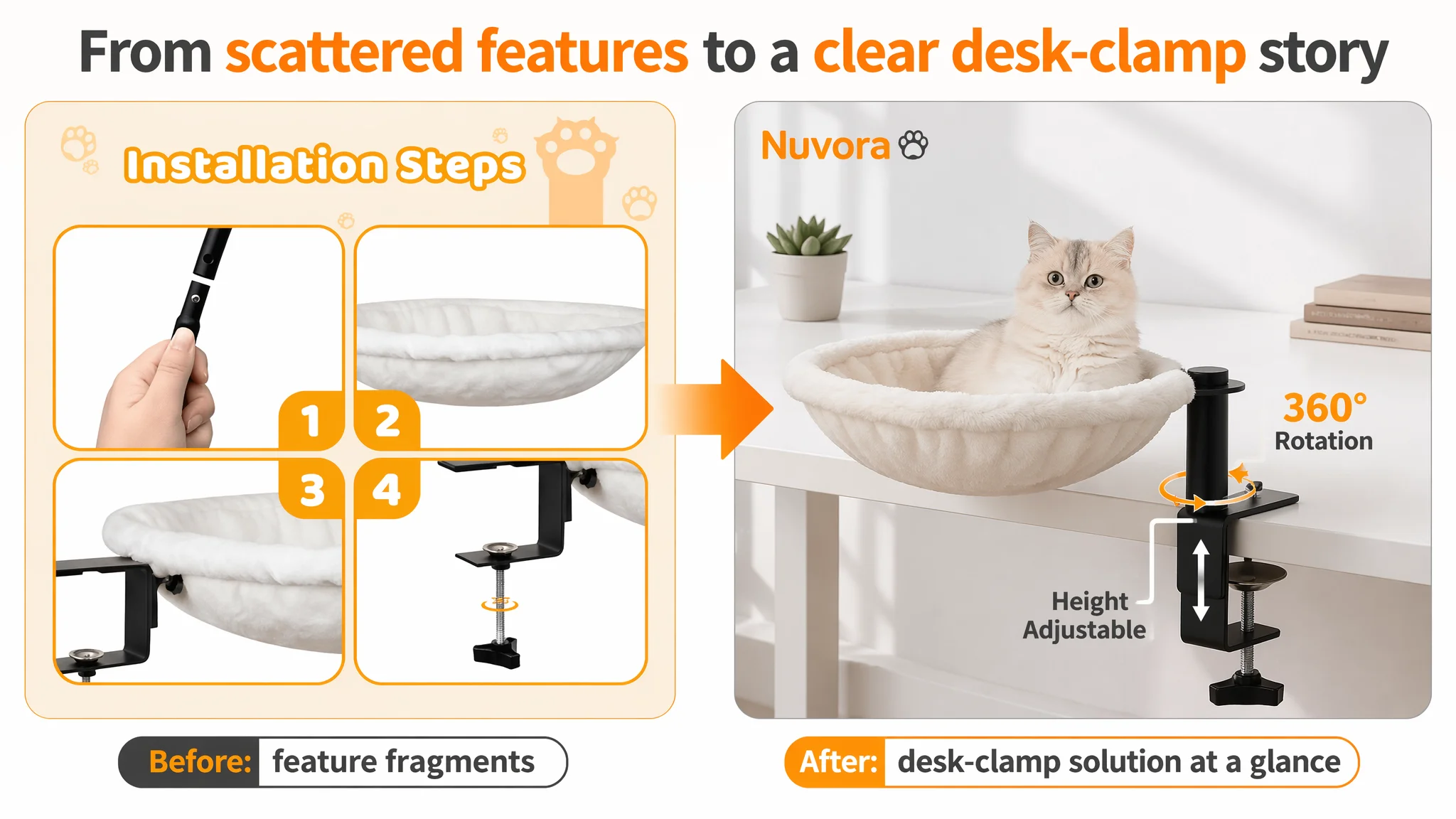
- No visual explanation of installation or desk compatibility
- No illustration of cleaning ease or year-round comfort
The competitor, in contrast, used A+ to build a full conversion funnel:
- Before/After module: cat on keyboard vs. cat calmly perched off to the side
- Visualized 360° rotation and height adjustment with arrows and callouts
- 50 lb load-bearing proof with structure diagrams
- Material details and seasonality (dual-sided reversible mats)
- Multi-scenario panels: gaming, working, studying
If two pages receive the same ad traffic, one gives a full narrative from problem to trust; the other gives nothing beyond the default sections. That will inevitably show up in CVR and ACOS.
Other Gaps Were Noticeable but Secondary
Title
- Target: 12 / 20
- Benchmark: 17 / 20
- Gap: –5 points
The target title:
- Used “Cat Hammock Bed” and “Desk-Mounted”, but skipped more intuitive, search-aligned phrases like “Desk Cat Bed” / “Desk Cat Hammock”
- Scattered functional claims (“No-Drill Install”, “Washable Pad”) rather than front-loading a sharp differentiator
- Lacked numeric and scenario anchors like “On/Under”, “Up to 50 lbs”, “for Office Desks and Game Tables”
- Read more like a list of attributes than a structured value message
Main Images
- Target: 24 / 30
- Benchmark: 26 / 30
- Gap: –2 points
The difference here was not “image quality” but what the images were doing for the decision:
- Competitor used clear 360° and height-adjustment arrows, before/after workspace comparison, compatibility and exclusion diagrams, and load-bearing visualization
- Target images were more generic: product on a desk, detail shots, but little explicit communication of rotation, space saving, or 50 lb safety
Bullets
- Target: 7 / 10
- Benchmark: 8 / 10
- Gap: –1 point
The bullets on the target page:
- Focused on physical features (space saving, ease of cleaning, comfort)
- Lacked an emotional or productivity hook (“distraction-free bonding while you work”)
- Used fewer concrete numbers and conditions (desk thickness, max weight, size)
Reviews
- Target: 5.0 stars, 2 reviews
- Benchmark: 4.6 stars, 29 reviews
The small review base limited social proof, but that was not something DeepBI could or should “fix” directly. The controllable lever was: does the page, independent of review volume, give enough reasons to buy?
“Advertising does not only amplify advantages. It can also amplify a page’s existing defects.”
With this scoring, DeepBI’s judgment was direct: the true bottleneck at this stage was Listing conversion capacity, not traffic volume. Ads had to be deprioritized until the page could reasonably compete.
Why DeepBI Did Not Recommend “Fix Ads First”
For Amazon sellers under ACOS pressure, the temptation is always to start where spending feels most visible: campaigns.
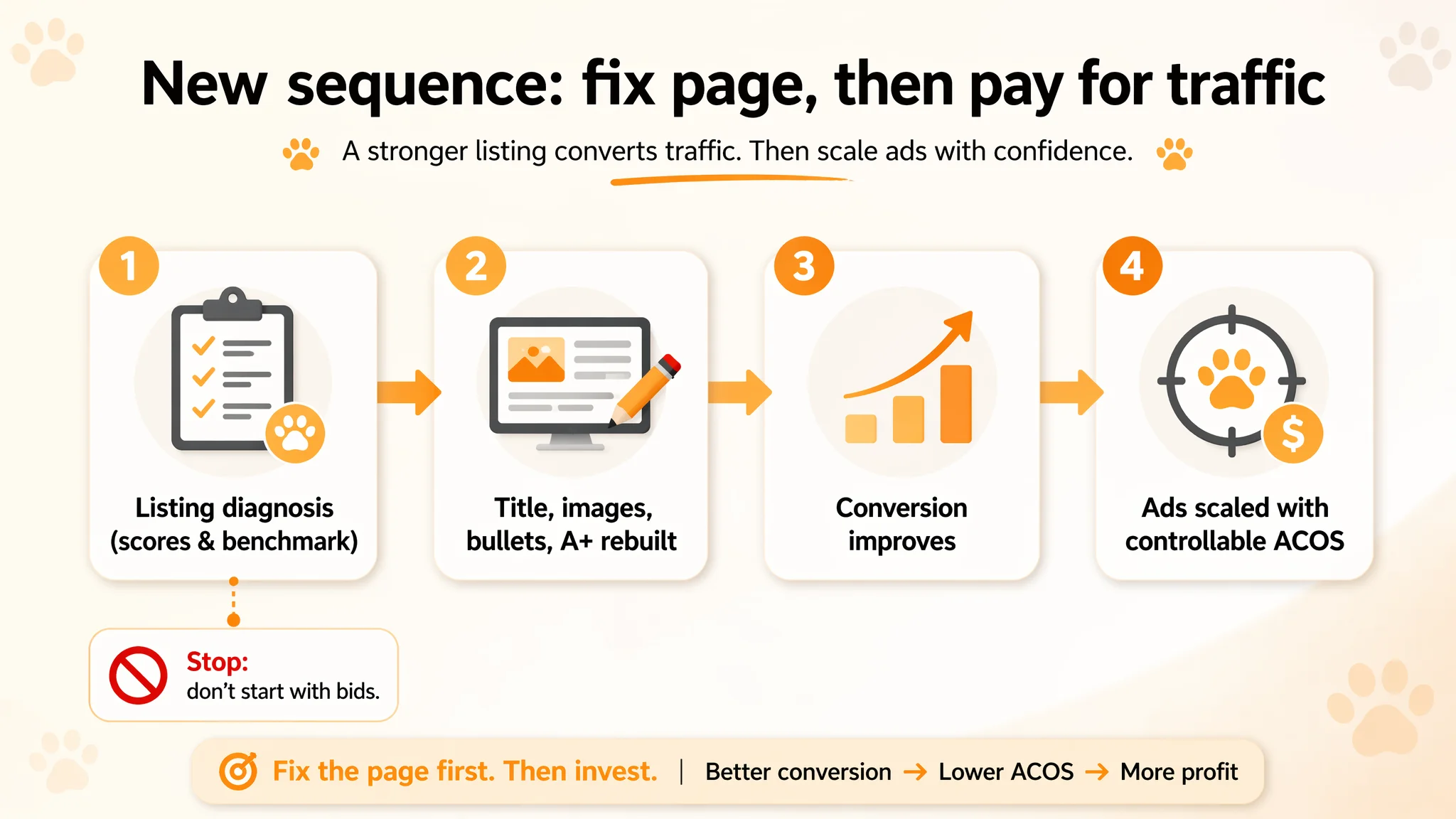
In this case, DeepBI recommended the opposite sequence:
1. Repair the page’s sales logic and trust structure first
2. Then let ads test and scale a page that can actually convert
The reasons:
1. Zero A+ means zero visual story
With no A+ while the benchmark had a fully built funnel, every paid click landed in a structurally weaker environment. Turning more knobs in ads would only send more buyers into a page that wasn’t answering their real questions.
2. Benchmark gap was too large to be solved by incremental ad tweaks
A 37-point listing-score gap (49 vs. 86) is not about “slightly worse creatives.” It reflects incomplete information, missing trust layers, and unstructured messaging. Paid traffic on such a page will almost inevitably be more expensive.
3. Risk of teaching the algorithm the wrong lesson
Continuing to push budget into this Listing before fixing the content risks:
- Lower CVR vs. category average
- Lower contribution to ad-attributed sales per impression
- Amazon’s system gradually deprioritizing your ASIN in auctions and organic rankings
4. Page-level improvements benefit both paid and organic
A stronger title, better images, and robust A+ raise conversion for every visitor, not just ad-driven ones. That stabilizes the entire traffic structure, which in turn makes advertising far more predictable.
DeepBI’s decision logic: do not let ads compensate for a page that is structurally weaker than the benchmark. Fix the foundation, then buy more traffic.
This Product Page Did Not Lack Traffic. It Lacked a Buying Logic.
Based on the diagnosis, DeepBI reframed the key question:
- Not: “How do we bid more cleverly on ‘cat hammock’?”
- But: “If I were a work-from-home cat owner landing here, what exact mental path would I follow from doubt to ‘Add to Cart’—and where does this page drop me?”
Four missing or underdeveloped strands emerged.
1. The Title Did Not Set the Right Mental Frame
The existing title covered:
- Cat hammock bed
- Desk-mounting concept
- Some convenience attributes (“No-Drill”, washable)
But it did not:
- Clearly declare “Desk Cat Hammock Bed” as the core identity
- Indicate clamp-on installation in a way that matches buyer queries
- Assert the critical 50 lb safety and 16.5" size
- Anchor to concrete office/gaming desk scenarios
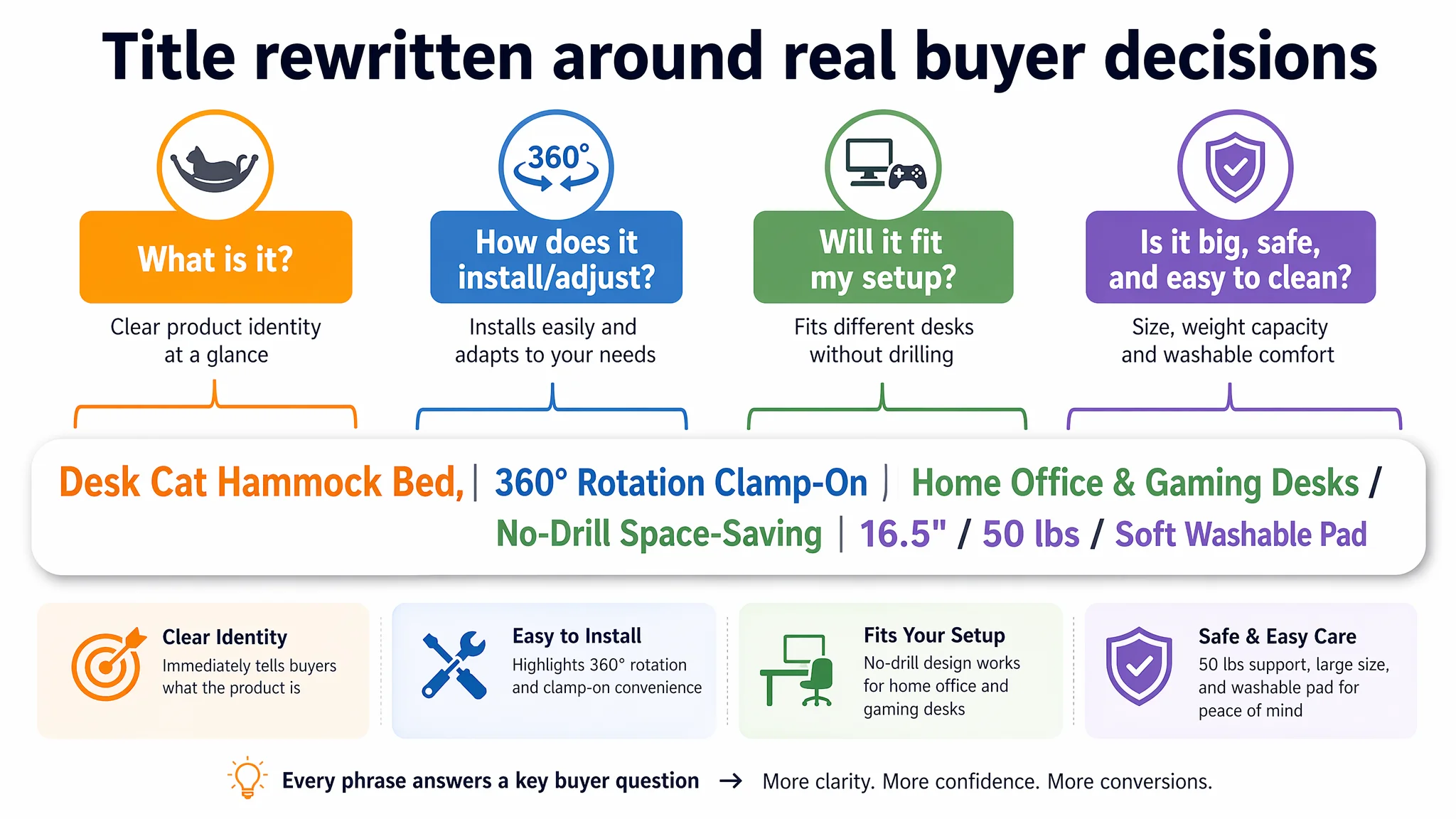
DeepBI’s recommended direction:
Desk Cat Hammock Bed, 360° Rotation Clamp-On Pet Perch for Home Office & Gaming Desks, No-Drill Space-Saving Cat Bed, 16.5" Round Supports 50 lbs, Includes Soft Washable Pad
The logic:
- Lead with “Desk Cat Hammock Bed” to mirror how buyers actually express the intent
- Introduce “Clamp-On” and “No-Drill” early to reassure about desk safety
- Quantify key decisions: 16.5" size, supports 50 lbs
- Tie explicitly to “Home Office & Gaming Desks” for contextual relevance
- Integrate “360° Rotation” where accurate, to match category expectations (assuming the product indeed supports it)
2. The Main Images Showed the Product, Not the Outcome
The competitor’s image sequence was built around a clear storyline:
- Cat on keyboard vs. cat calmly perched: Before/After
- 360° and height arrows: Adjustability
- Structural close-ups with callouts: Stability and 50 lb load
- Compatibility diagrams with “X” marks: Which desks are safe
The target Listing’s images were more static and less explicit. DeepBI’s image-direction logic was:
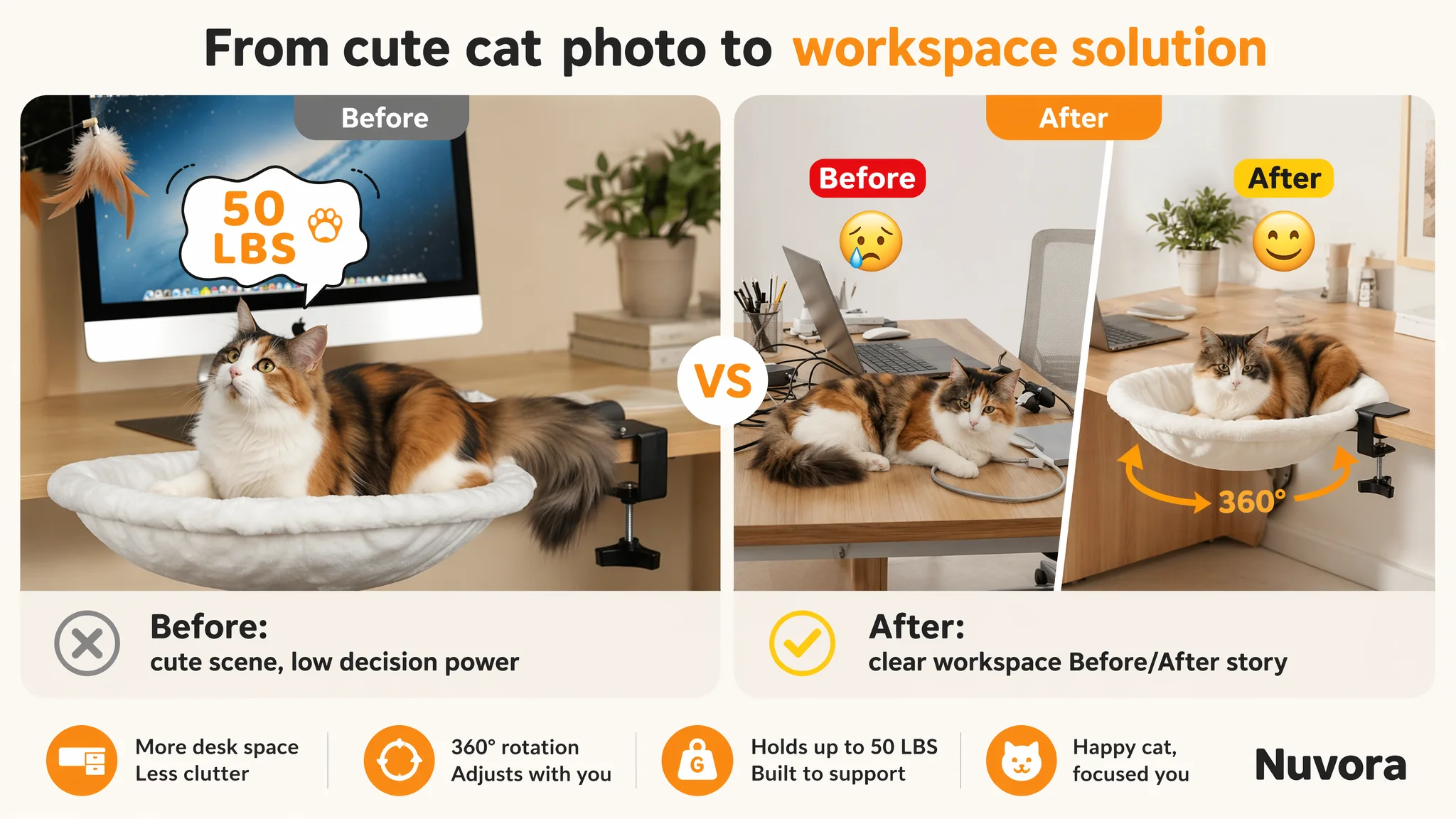
Turn the main image set into a decision toolkit
- Primary image
Show the hammock on a dark wood desk at a 45° angle, with clean white wall background. Overlay subtle orange arrows: circular arrow for “360° Rotation”, vertical arrows for height adjustment (if supported), reinforcing the engineering capability at thumbnail level.
- Before/After image
Split screen: left side a messy desk with cat on keyboard (“Before” in red), right side a clean desk with cat relaxing in the side hammock (“After” in yellow). This doesn’t just show the product; it visually answers, “How will this change my workday?”
- Engineering image
Center the hardware, 45° side view with industrial lighting. Use magnified callouts to highlight the clamp, rubber pads, and adjustment knobs, with clear text like “Secure C-Clamp” and “Anti-Slip Pads”.
- Load-bearing image
Pure white background, weight icon “Max: 50 lb” and silhouettes of cats from small to large. Mark structural stress points with bubbles (“Reinforced Clamp”, “High-Strength Frame”).
- Compatibility image
Side-mounted on a desk with overlay: dimensions, compatible desk-thickness range (e.g., 0.45–2.3 in), and red Xs indicating curved or round edges as “Not Compatible”.
This shifts the image role from “aesthetic decoration” to conversion tools that answer typical pre-purchase doubts in seconds.
3. Bullets Contained Features, but Not a Persuasion Path
The original bullet structure:
- Space saving
- Installation convenience
- Durability and easy cleaning
- Comfort
- Scenes of use
The competitor’s structure:
- Pain point & solution (distractions at work)
- Functions with specific parameters
- Added value (two-season cushions)
- Safety & load-bearing
- Installation details & limits
DeepBI restructured bullets to follow a pain → solution → proof pattern:
1. Distraction-free bonding & workspace efficiency
Lead with: “Stop your cat from walking across your keyboard.” Combine emotional benefit (cat companionship) with productivity outcome (focus, clutter-free).
2. Customizable angle & secure C-clamp grip
Emphasize adjustability (hex key for angle) and non-drilling clamps that protect expensive desks, directly answering “Will it wobble? Will it damage my furniture?”
3. Rock-solid stability for cats up to 50 lbs
Translate the 50 lb capacity into peace of mind, anchoring on “reinforced steel frame” and “jump-proof stability” rather than only the number.
4. Premium comfort & effortless maintenance
Describe the 16.5" plush faux-fur bed, stress “fully removable, machine washable” to tackle hygiene concerns.
5. Quick no-drill setup & universal fit
Spell out the installation conditions (flat edges, thickness notes) and “no tools, no damage” promise to reduce returns from incompatible desks.
The point was not just better English; it was a full reordering of what the bullets are for: to guide the buyer through each core concern until nothing major remains unresolved.
4. The Completely Missing A+ Left a Hole in the Trust Funnel
On Amazon, many sellers still treat A+ as “nice to have.” In this category, it is the decision engine.
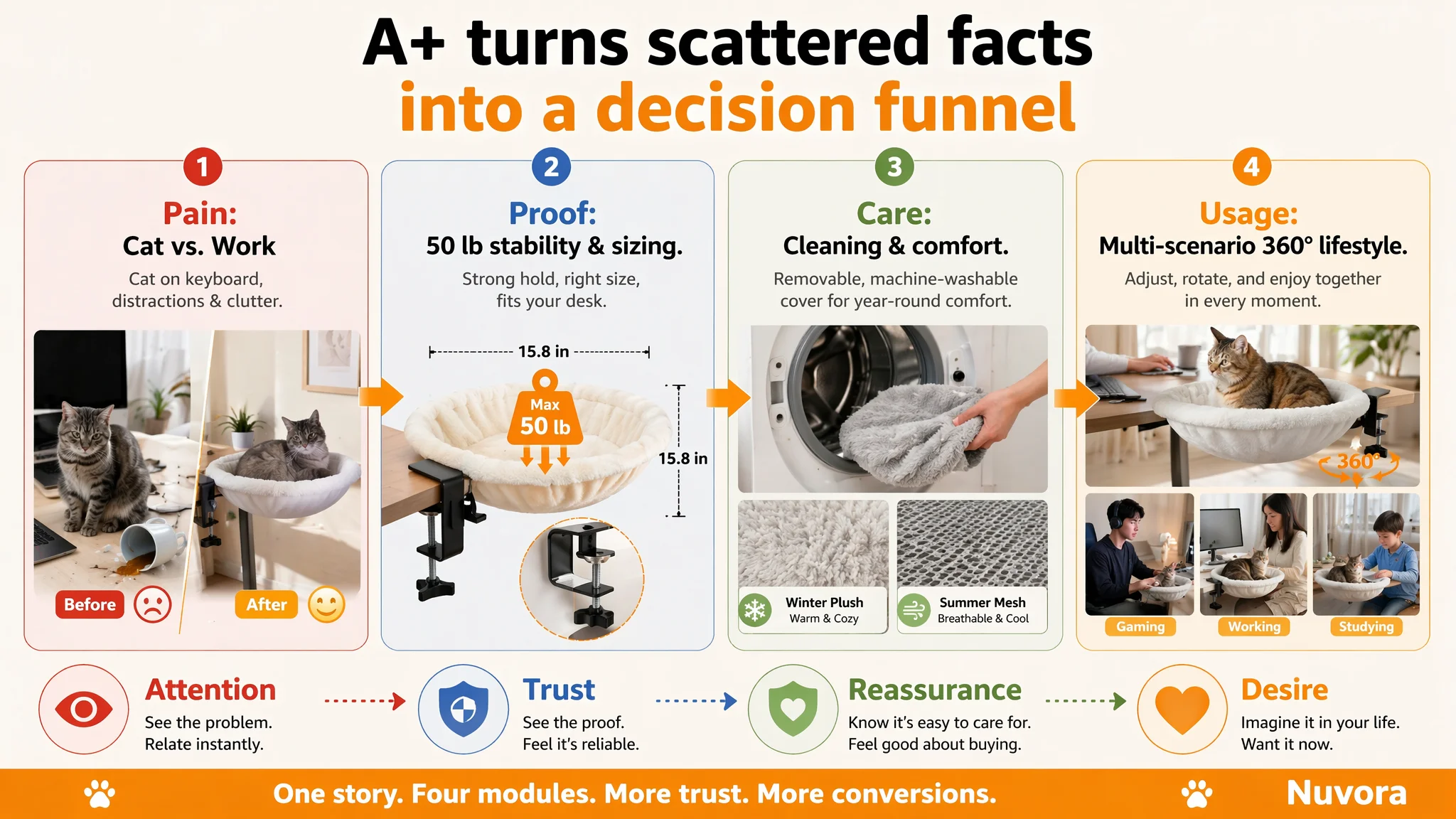
DeepBI identified four must-have modules for this specific product:
1. Pain-point contrast: “Cat vs. Work”
- Left side: cat on keyboard, spilled coffee, stressed user
- Right side: cat in hammock, clear desk, user focused
- Warm tones and home-office background to mirror real life
Purpose: Make the buyer feel, “This is exactly my situation, and this is what it could look like instead.”
2. Stability & safety proof
- 3/4 close-up of clamps and frame
- Overlay “50 lb” icon pressing down, with arrows highlighting reinforced joints
- Dimension labels (e.g., 16" diameter) to show proportions
Purpose: Address the fear of the cat falling and damaging desk or pet.
3. All-season & cleaning module
- Image of the cover going into a washing machine
- Material close-ups (faux fur pile, breathable backing) with tags like “Winter Plush” and “Breathable Comfort”
Purpose: Remove objections about fur, odor, and seasonal comfort. Even without reversible pads like the competitor, the story becomes “always comfortable, always cleanable”.
4. Multi-scenario, 360° lifestyle usage
- Collage of office work, gaming, reading with family, each with the cat visible but not intrusive
- Subtle rotation arrows to imply flexibility in different desk layouts
Purpose: Position the product not as “just a cat bed,” but as a tool for peaceful coexistence between work and pet.
Without this, buyers have to extrapolate everything from generic product shots. With it, the Listing becomes a guided journey from problem recognition to solution confidence.
How the Page’s Sales Logic Started to Recover
Once the team accepted that the binding constraint was on-page conversion—not ad mechanics—the optimization path became straightforward:
1. Rebuild the title and bullets for desk-cat decision logic
The page now mirrors how buyers think: “desk cat hammock”, “no drill”, “50 lb safety”, “fits my type of desk”, “won’t distract me while working.”
2. Turn main images into decision aids, not just visuals
Each image answers a different high-risk question: Will it free desk space? Will it wobble? Will it fit my desk? Is it really 50 lb safe? Is it easy to clean?
3. Add an A+ funnel that tells a complete story
From “cat on keyboard” pain to “stable, clean, flexible” solution, the A+ now does the job that text alone could never do—especially important with a still-small review base.
4. Reserve ad scaling for after page improvements go live
With the Listing strengthened, further ad investment can be used to:
- Test new keywords (e.g., “desk cat bed”, “cat desk perch”)
- See whether CVR improves on the same traffic
- Gradually stabilize ACOS as the page does more of the heavy lifting
Even without publishing specific numbers, the expected operational changes are clear:
- CVR has room to recover as the page approaches benchmark-level storytelling
- ACOS becomes more controllable because each click has a better chance of converting
- Organic orders gain share once Amazon’s algorithm sees improved conversion on both paid and organic traffic
- Dependence on “just more ads” decreases because the Listing itself starts doing its job
What Changed in the Seller’s Understanding
The most important outcome of this case was not a new title or prettier images. It was a shift in how the seller thinks about Amazon growth:
- Amazon ads cannot fix a structurally weak Listing.
If your A+ is absent and your images don’t answer core doubts, traffic is just fuel for a leaky engine.
- Listing conversion is the foundation of ad efficiency.
Before pushing budget, ask: “If I were my ideal buyer, would this page give me enough proof, clarity, and reassurance to buy now?”
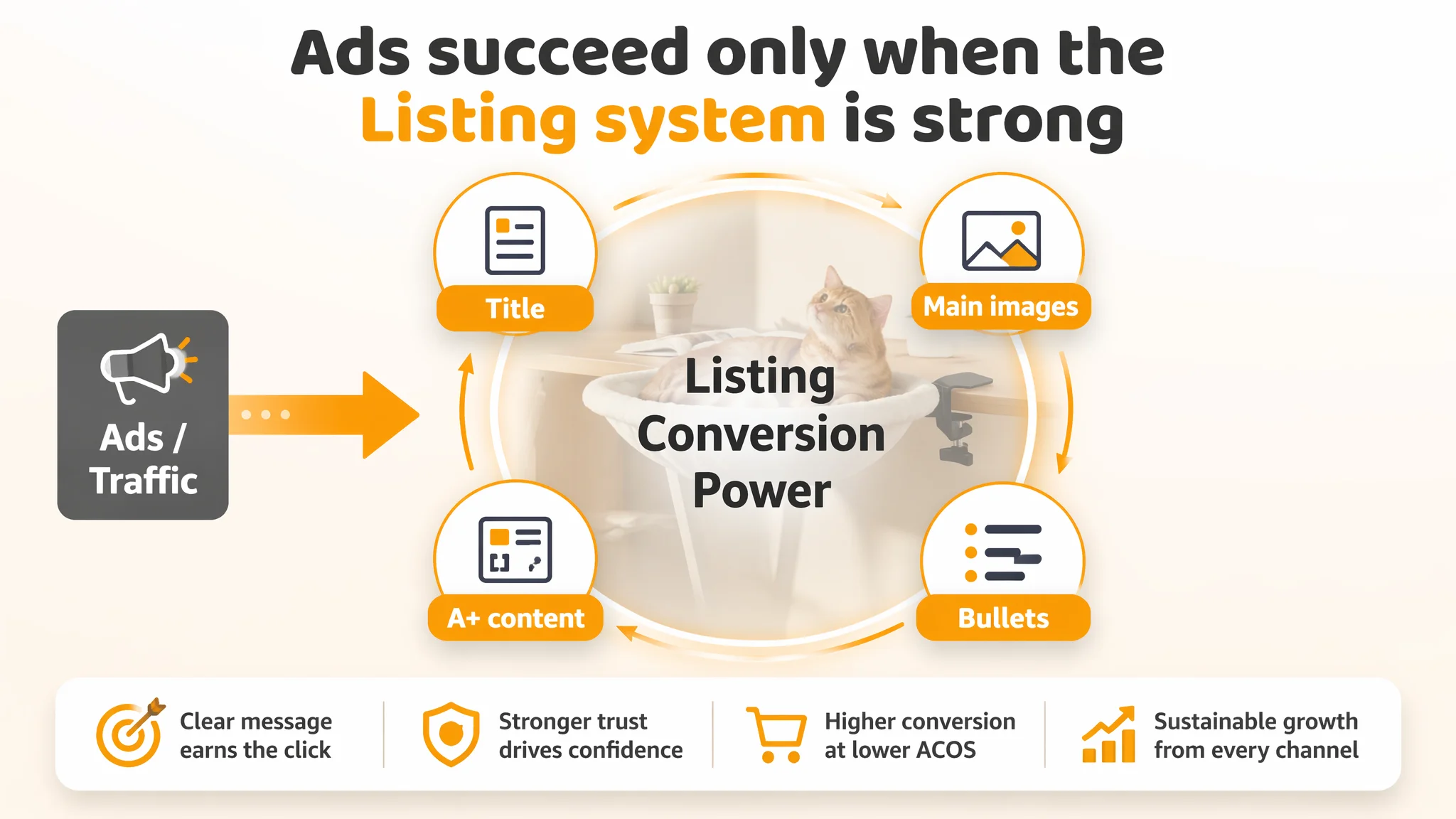
- Title, main image, bullets, and A+ must work as one system.
The title sets expectations, the main image earns the click, bullets and gallery remove doubts, and A+ seals trust. If any of these is missing or misaligned, ACOS will tell you.
- Benchmarking is about logic, not imitation.
DeepBI did not say “copy the competitor.” It showed which roles the competitor’s content was playing that the target Listing simply didn’t cover yet.
For Amazon sellers reading this, the takeaway is direct:
- If your ACOS doesn’t improve despite constant ad tweaking…
- If a clear benchmark in your category keeps out-converting you…
- If your A+ is thin or non-existent while theirs is a full narrative…
Then the real question is not “Which keyword do I bid next?” but “What exactly does my Amazon product page fail to explain, prove, or reassure, that theirs already does?”
DeepBI’s value in this case was not a list of optimizations. It was the judgment to say: stop blaming ads, fix the Listing first, and only then let traffic become an actual growth lever rather than an expensive mirror of page-level weaknesses.