

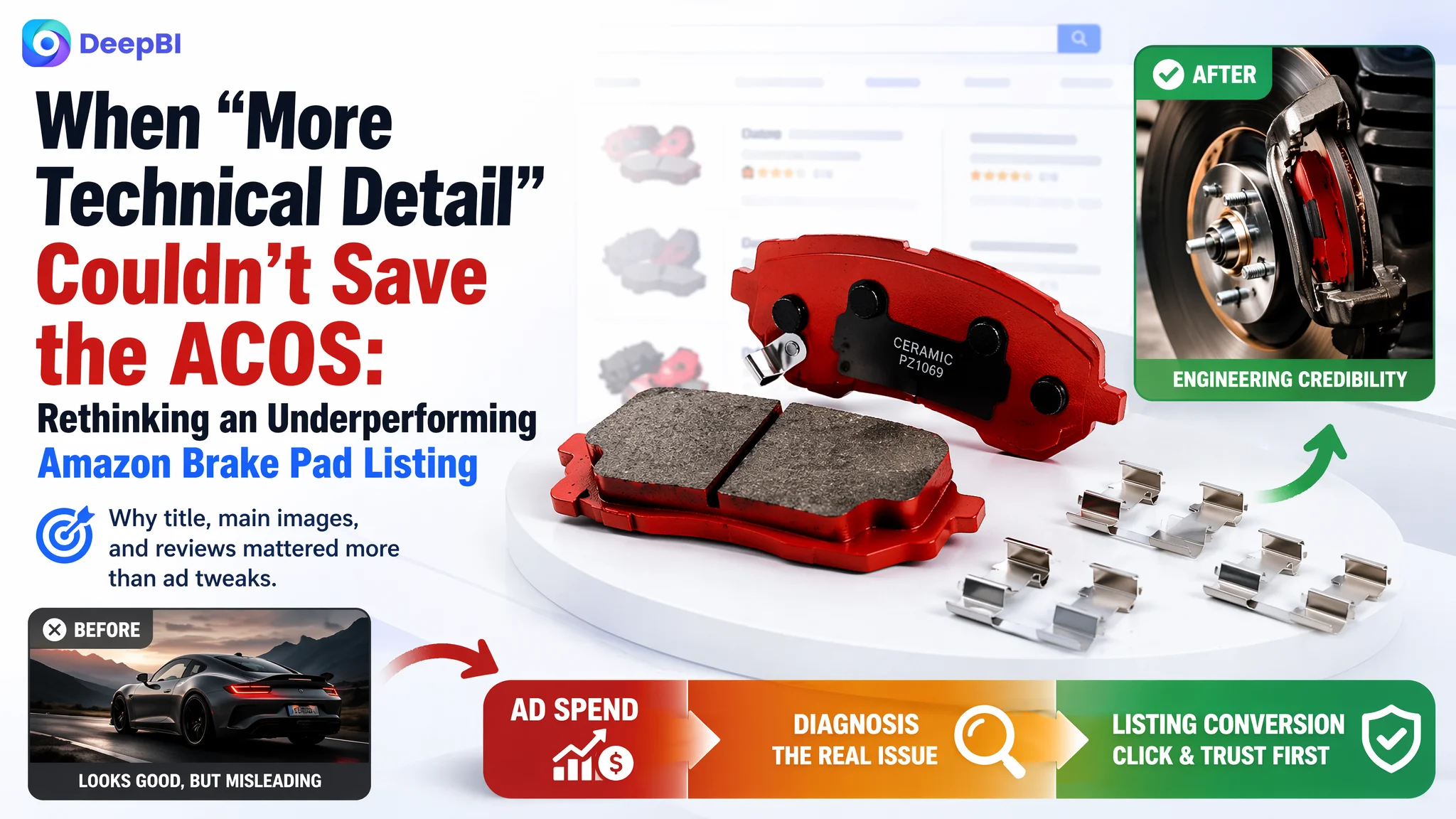
This case comes from an Amazon automotive-parts seller whose ceramic rear brake pads were already getting traffic, but ad efficiency was stuck. On paper, the Listing looked “very professional”: dense technical bullets, dramatic A+ visuals, clear module layout. The team’s judgment was that they just needed to “optimize ads harder” and keep emphasizing advanced technology to win more high-value buyers.
DeepBI’s Listing diagnosis drew a very different picture. Compared with a benchmark competitor on Amazon, the product page was not losing because of weak technical storytelling; it was losing at the basics of click and trust: title search logic, main-image click appeal, and—most critically—review volume. Ads were being sent to a page that looked complex but did not yet feel reliable enough for first-time buyers in this category.
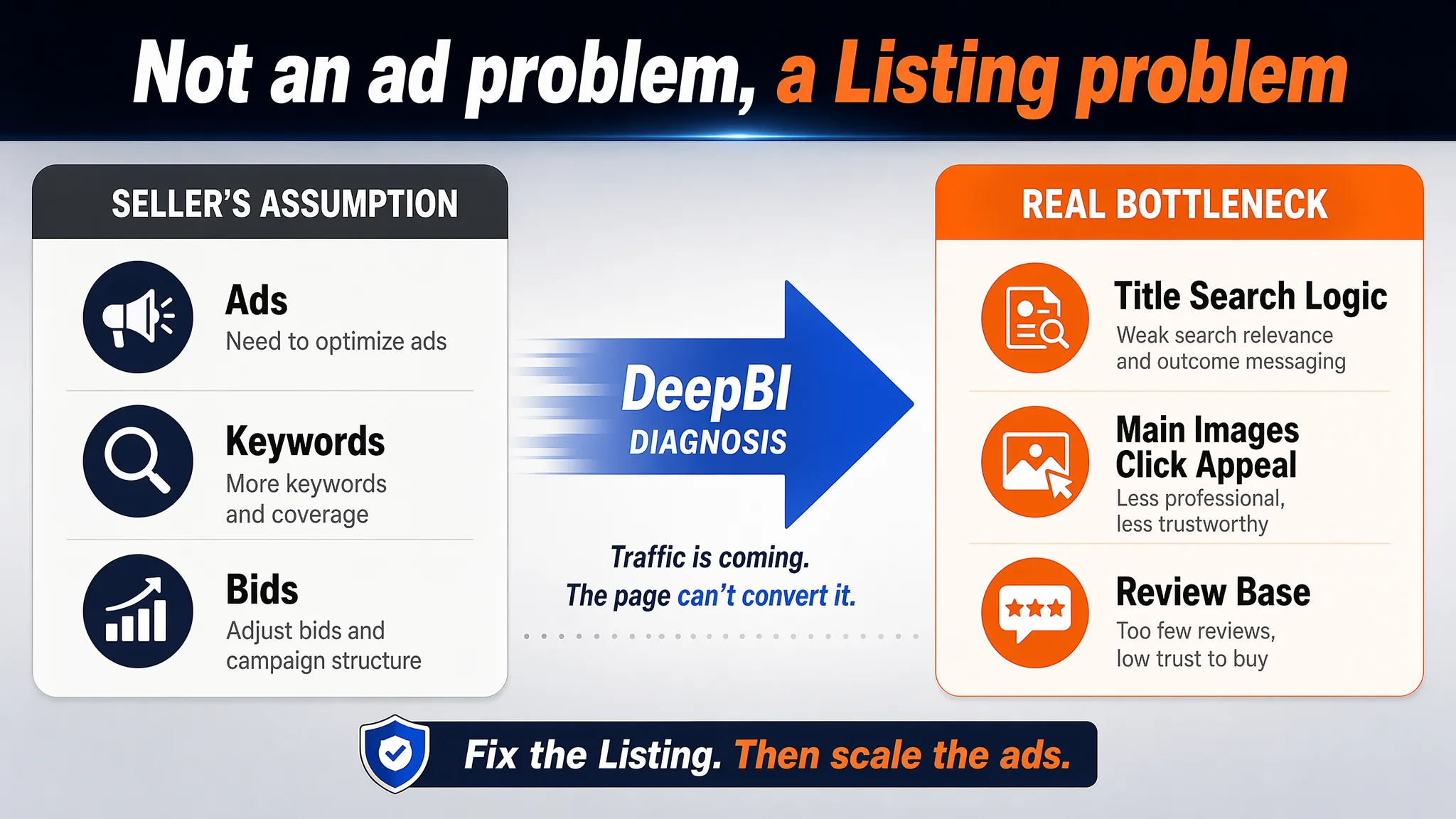
Once the problem was reframed from “ad structure and bidding” to “Listing conversion capacity,” the optimization focus shifted: rebuild the title around buyer search logic and core outcomes, upgrade the main-image set to an automotive engineering style, align A+ visuals with real SUV use scenarios, and plan for early review accumulation. For Amazon sellers, this case is a reminder that in high-decision categories like auto parts, more specs and more “tech talk” cannot compensate for a weak click trigger and a thin trust base—especially when Amazon ads are amplifying every weakness on the product page.
Amazon Ads Were Not Failing. The Page Was Consuming the Traffic.
From the seller’s perspective, the situation felt familiar:
- Ads were running on Amazon US in a competitive brake pad niche.
- Impressions were acceptable, but ACOS was hard to push down.
- The team believed the Listing was already “highly engineered” and differentiated.
Their immediate assumption: this was mainly an advertising problem—keyword coverage, bids, campaign structure—and the answer was better media buying and more granular tuning.
However, when DeepBI benchmarked this Listing against a leading Amazon competitor in the same rear ceramic brake pad segment, a different pattern emerged:
- Overall Listing score:
- Target Listing: 63 / 100
- Benchmark: 77 / 100
- Gap: -14 points
- By dimension:
- Title: -6 vs benchmark
- Main image set: -2
- Bullets: +4 (actually stronger than competitor)
- A+ / detail page: +2
- Reviews: -12 (the biggest single gap)
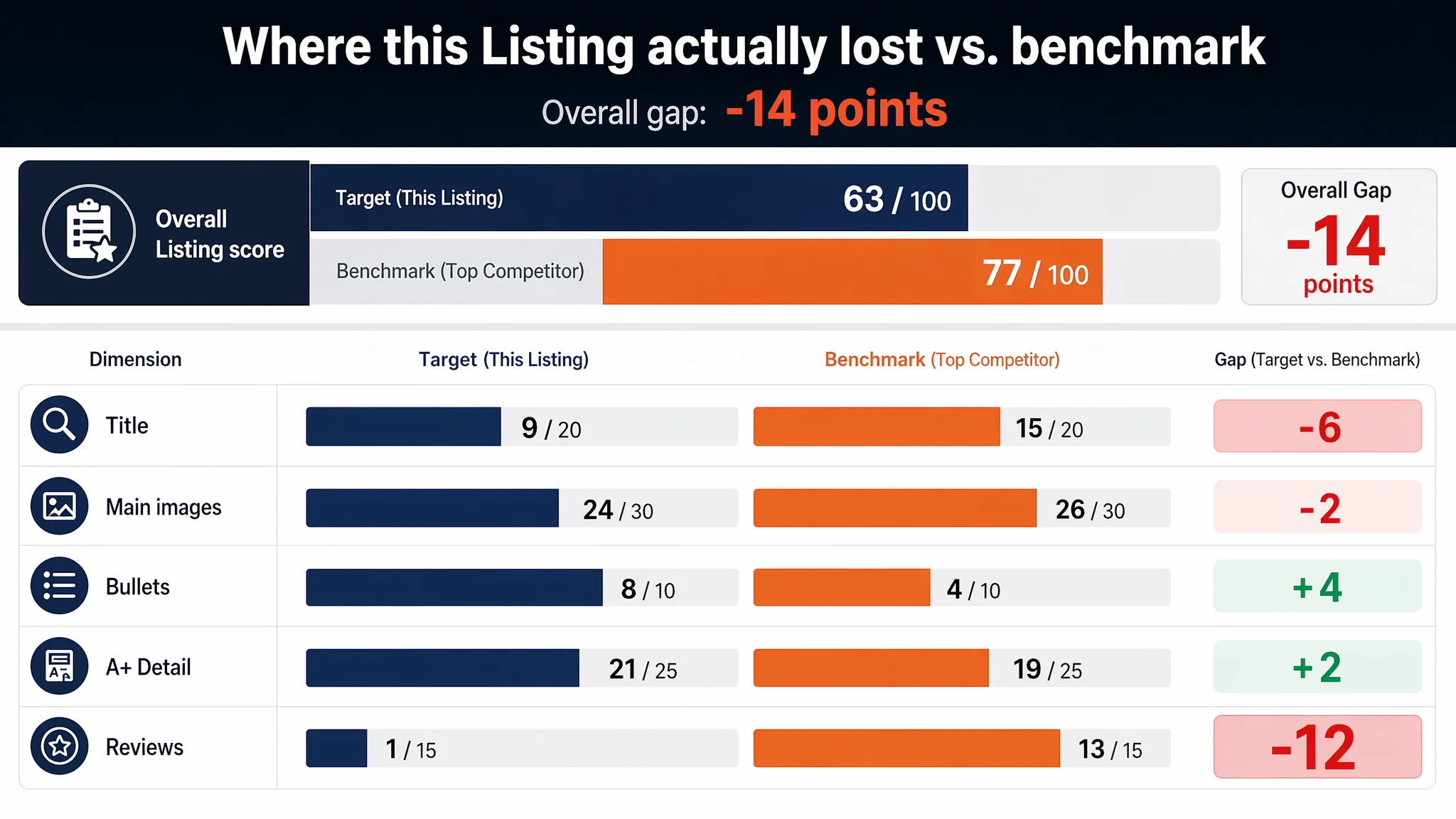
In other words, the places the seller had invested the most energy—technical bullets and rich A+ modules—were actually ahead of the competitor. The real drag on conversion was happening before that content ever had a chance to work.
“The real problem was not that ads failed to bring traffic. It was that the page could not convert the traffic.”
For an Amazon ad funnel, this matters brutally: if the first contact points (search result thumbnail, title, review block) do not build enough trust to win a click and a basic comfort level, the underlying technical story is almost irrelevant.
What the Seller Originally Misdiagnosed
The internal narrative in the brand’s team was clear:
- “We are selling a safety-critical, high-spec product. Buyers who care will read technical details.”
- “Our bullets talk about infrared scorching, low dust, thermal resistance, OEM-level noise control. That should convince serious SUV owners.”
- “If orders are lagging, ads must be under-optimized. We probably just haven’t hit the right keywords and bid levels.”
This led to a classic misallocation of effort:
- Time went into campaign tweaks, search-term expansion, and bid adjustments.
- The Listing itself was seen as “basically finished” except for occasional text polishing.
- No one questioned whether the page’s decision path matched how Amazon brake pad buyers actually choose in the search results environment.
DeepBI’s analysis flipped that storyline: the Listing was not too simple; it was over-indexed on engineering depth at the expense of search logic, quick trust signals, and perceived fit.
The Real Constraint Was Listing Conversion Capacity
DeepBI’s Listing score breakdown made the bottleneck obvious: this page did not lack content; it lacked conversion structure at the moment of choice.
1. Title: Complete Compatibility, Weak Search Logic
On Amazon, rear brake pad buyers almost always start with:
- Vehicle brand / series (Lexus, Toyota, GX, 4Runner, etc.)
- Component type (ceramic rear brake pads)
- Outcome-level concerns (noise, dust, longevity, easy replacement)
The benchmark competitor’s title followed this buyer logic exactly:
- Opened with the product type: “Ceramic Rear Brake Pads”
- Immediately anchored compatibility: Lexus GX / LX + Toyota 4Runner / FJ / Land Cruiser / Sequoia
- Closed with core outcomes: “Easy to Replace, No squeaking, Long-Lasting”
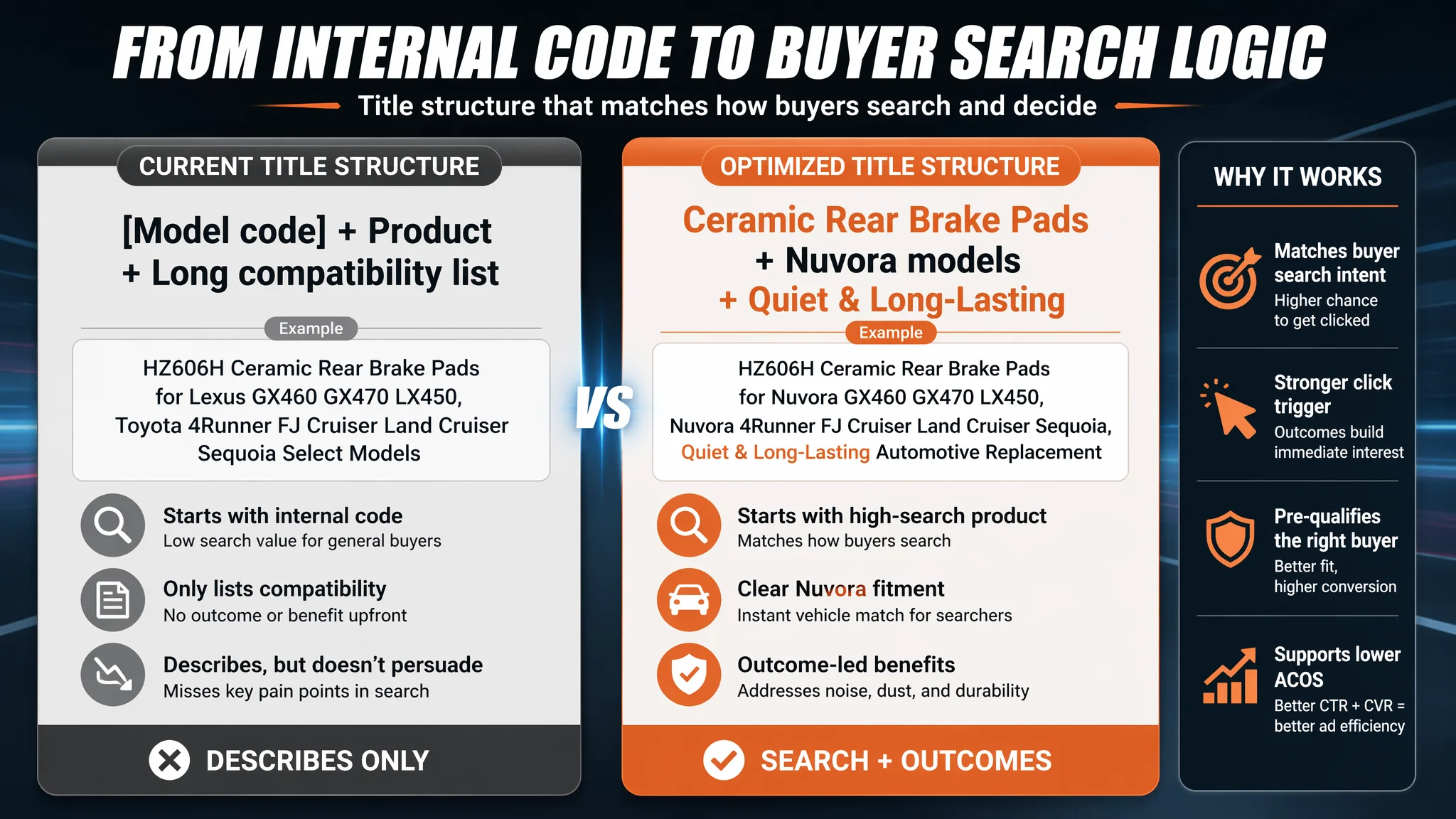
By contrast, the target Listing’s title:
- Opened with an internal model code (“HZ606H”) that has low search value for general buyers.
- Spent most of the visible space listing compatible vehicles.
- Almost entirely skipped explicit outcomes (quiet, long-lasting, easy to install) in the title itself.
So while the content existed elsewhere on the page, the title—the strongest text lever on the search results page—was not doing any conversion work. It described, but it did not persuade.
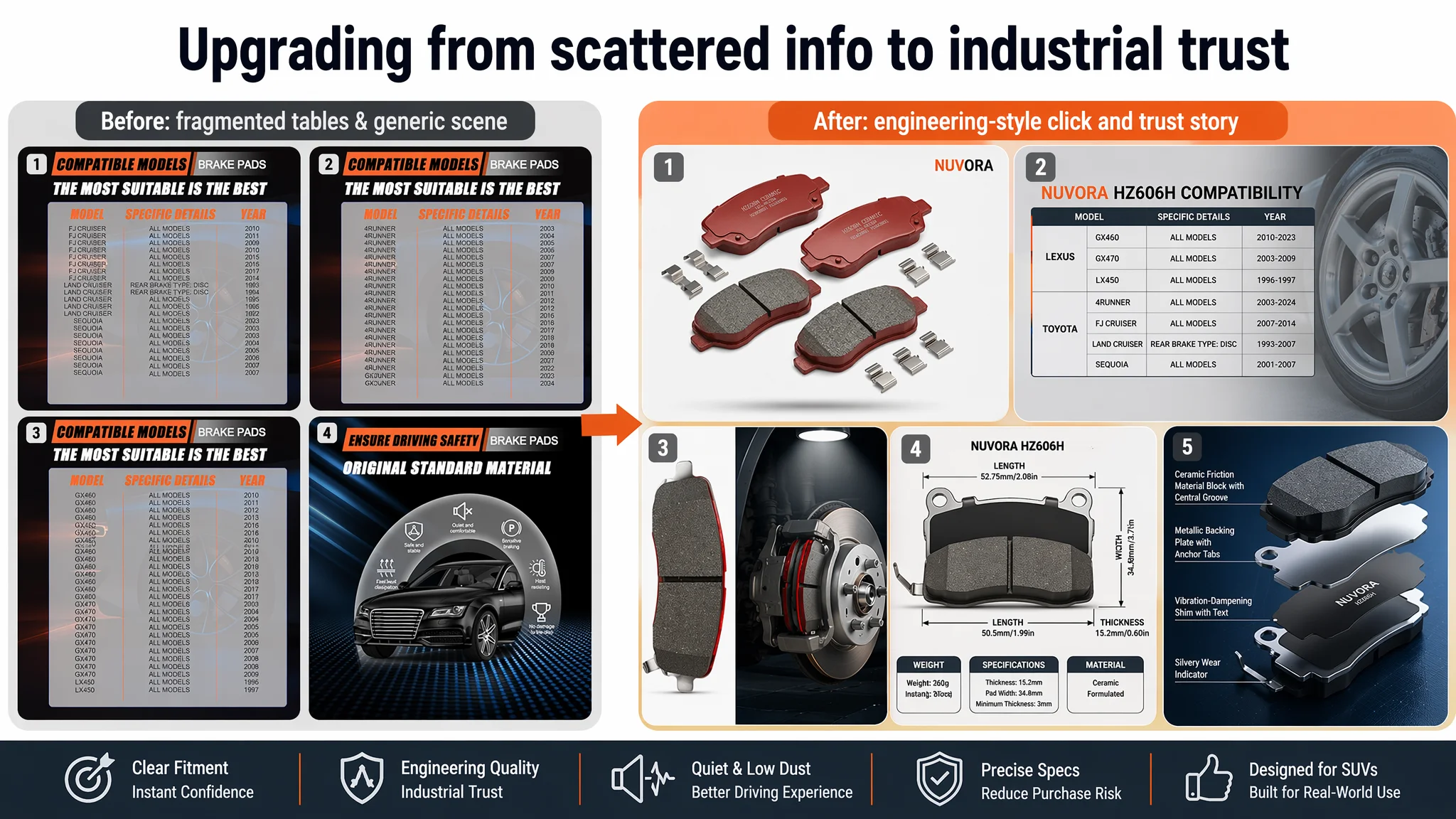
2. Main Image Set: Technically Correct, Emotionally Thin
Visual analysis against the benchmark showed:
- The seller’s images did include product-only shots, compatibility tables, some usage scenes, and structural diagrams.
- But key frames suffered from:
- Scattered composition and low visual hierarchy
- Repetitive compatibility tables spread across several images
- Synthetic or “composited” automotive scenes that felt less authentic
The competitor, on the other hand, leaned into:
- Clean, compact product shots with strong industrial lighting
- Clear installation and on-vehicle context, visually connecting pad to brake disc
- Precise dimension diagrams and structured layout for compatibility
DeepBI’s judgment: this Listing had information, but not a strong reason to click. Even a 5–8% CTR drag in a category like this can make ACOS look “unfixable” from an ad-only perspective.
3. A+ Detail Page: Strong Tech Story, Misaligned Scenarios
Paradoxically, when buyers actually reached the A+ section, the target Listing was competitive or better:
- A structured sequence: hero scene, icons for core benefits, structure breakdown, four-feature grid, thermal protection highlight.
- Technical credibility: terms like “Electrostatic adsorption coating” and “Nitrile polymer rubber layer” tied to reduced noise and dust.
- A clear four-pillar logic: heat dissipation, structure, braking performance, noise.
But two subtle misalignments undermined that strength:
- Scene mismatch:
- The A+ hero visual used a racing / sports car style, while the actual compatibility list was dominated by SUVs (Lexus GX, Toyota 4Runner, Land Cruiser, Sequoia).
- For an SUV owner, that disconnect quietly signals: “Maybe this is not really built for my use case.”
- Underrepresented core pain point:
- The real quantified edge was “68% less dust,” which directly ties to wheel cleanliness—a very concrete benefit.
- The visual story, however, focused more on high-temperature performance than on dust reduction, leaving the most intuitive benefit under-leveraged.
4. Reviews: The Hardest Commercial Gap
The most brutal data point:
- Target Listing: 5.0 stars, 1 total rating, 0 visible front-page reviews
- Benchmark: 4.4 stars, 244 ratings, 11 front-page reviews
For Amazon auto parts, this is a trust cliff.
A buyer comparing two rear brake pad options in search results or on the product page sees:
- One product with hundreds of ratings, a realistic 4+ star score, and rich review content.
- Another with a single rating, no visible reviews, and heavy technical claims.
No matter how strong the A+ or bullets are, ad-spent traffic landing on a page with one review is structurally disadvantaged. The Listing is not yet in a conversion-ready state for scaled advertising.
Why DeepBI Did Not Recommend “Keep Tuning Ads First”
Given this evidence, DeepBI’s business judgment was straightforward:
“Advertising does not only amplify advantages. It can also amplify a page’s existing defects.”
Scaling or endlessly optimizing Amazon ads on top of:
- A title that underutilizes buyer search language and outcomes
- A main-image set that feels less professional and less authentic than the benchmark
- A review block with almost no proof
…would mainly accelerate spend, not profitable orders.
The core risk at this stage was not “insufficient ad experimentation.” It was feeding expensive traffic into a Listing that had not yet built enough click appeal and trust to monetize that traffic.
So the decision order DeepBI proposed was:
1. Repair Listing conversion capacity first:
- Adjust title and main-image logic so that every impression has a higher baseline chance to click and convert.
- Align A+ visuals with the real vehicle types and use cases.
- Support early review accumulation to create at least a basic trust floor.
2. Then re-evaluate ad efficiency:
- Once the page can hold its own against benchmark conversion patterns, ad optimization will finally return the gains the team expected.
This Product Page Did Not Lack Traffic. It Lacked Trust.
DeepBI’s recommendations did not ask the seller to become “more technical.” They asked the seller to become more readable and more believable in Amazon’s real buying context.
Reframing the Title Around Buyer Logic
The proposed title refactor looked like this:
“HZ606H Ceramic Rear Brake Pads for Lexus GX460 GX470 LX450, Toyota 4Runner FJ Cruiser Land Cruiser Sequoia, Quiet & Long-Lasting Automotive Replacement”
Key shifts in decision logic:
- Keep the core keyword “Ceramic Rear Brake Pads” near the front for search relevance.
- Group Lexus and Toyota compatibility more cleanly with punctuation, improving mobile readability.
- Explicitly add outcome phrases—“Quiet & Long-Lasting”—to answer the two biggest emotional questions:
- “Will this squeak?”
- “Will I have to replace it again soon?”
This is not cosmetic: it turns the title from an internal compatibility memo into a frontline sales argument on the search results page.
Turning the Main Images into an Engineering-Style Trust Story
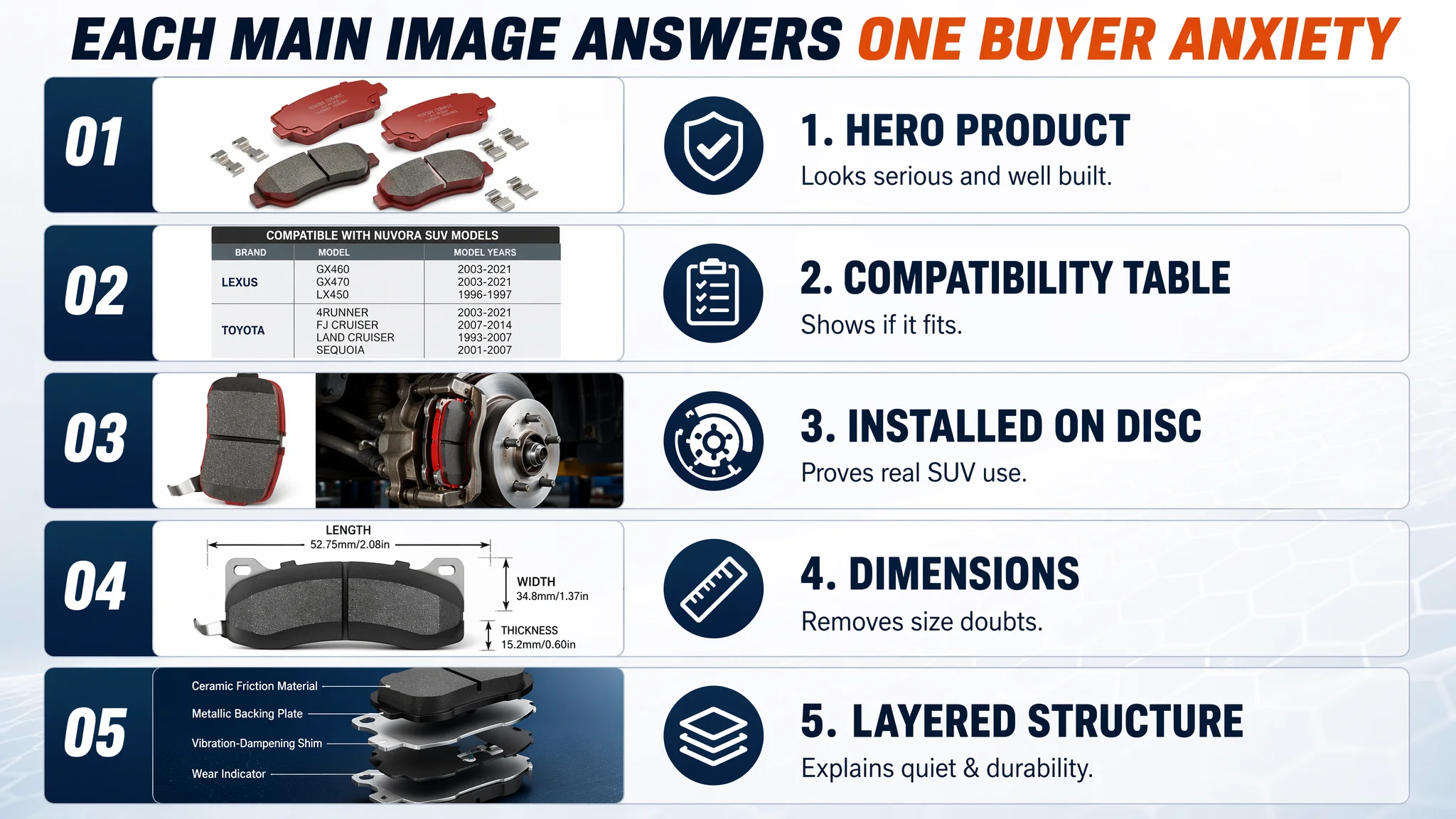
The main-image upgrade strategy aimed for a “professional automotive industrial tech” tone, not flashy marketing:
1. Primary product hero
- Pads centered, occupying ~75% of the frame.
- Clean 45° angle, with the red backing plates and clips laid out precisely.
- High-contrast white background, soft shadow, industrial lighting.
- Model annotation in a discreet corner.
→ Signal: “serious component, clearly built.”
2. Integrated compatibility table
- Consolidate fragmented compatibility charts into a single, legible infographic.
- Neutral gray-to-white gradient background, consistent typography.
→ Signal: “it’s easy to see if this fits my vehicle.”
3. On-vehicle install context
- Split layout: product close-up + installed view on a real brake disc of an SUV wheel.
- Dark workshop background, high contrast on the red backing plate.
→ Signal: “this really goes on your SUV, not a generic illustration.”
4. Precise dimensions and specs
- Single pad centered with measured length/width/thickness callouts.
- Clear, engineering-style type.
→ Signal: “no surprises on fit; we take measurements seriously.”
5. Layered structure visualization (only external layers)
- Exploded view showing visible layers: backing plate, shim, friction material.
- Labeled with benefits like noise damping and durability.
→ Signal: “we know our own engineering, and we can explain it without gimmicks.”
Every image is designed to answer one of the three key pre-purchase anxieties in Amazon auto parts:
1. “Will it fit?”
2. “Is it safe and properly engineered?”
3. “Is this seller serious and professional enough for a safety component?”
Realigning A+ Content with SUV Use and Core Pain Points
On the A+ detail page, the optimization did not mean adding more modules. It meant fixing the narrative alignment:
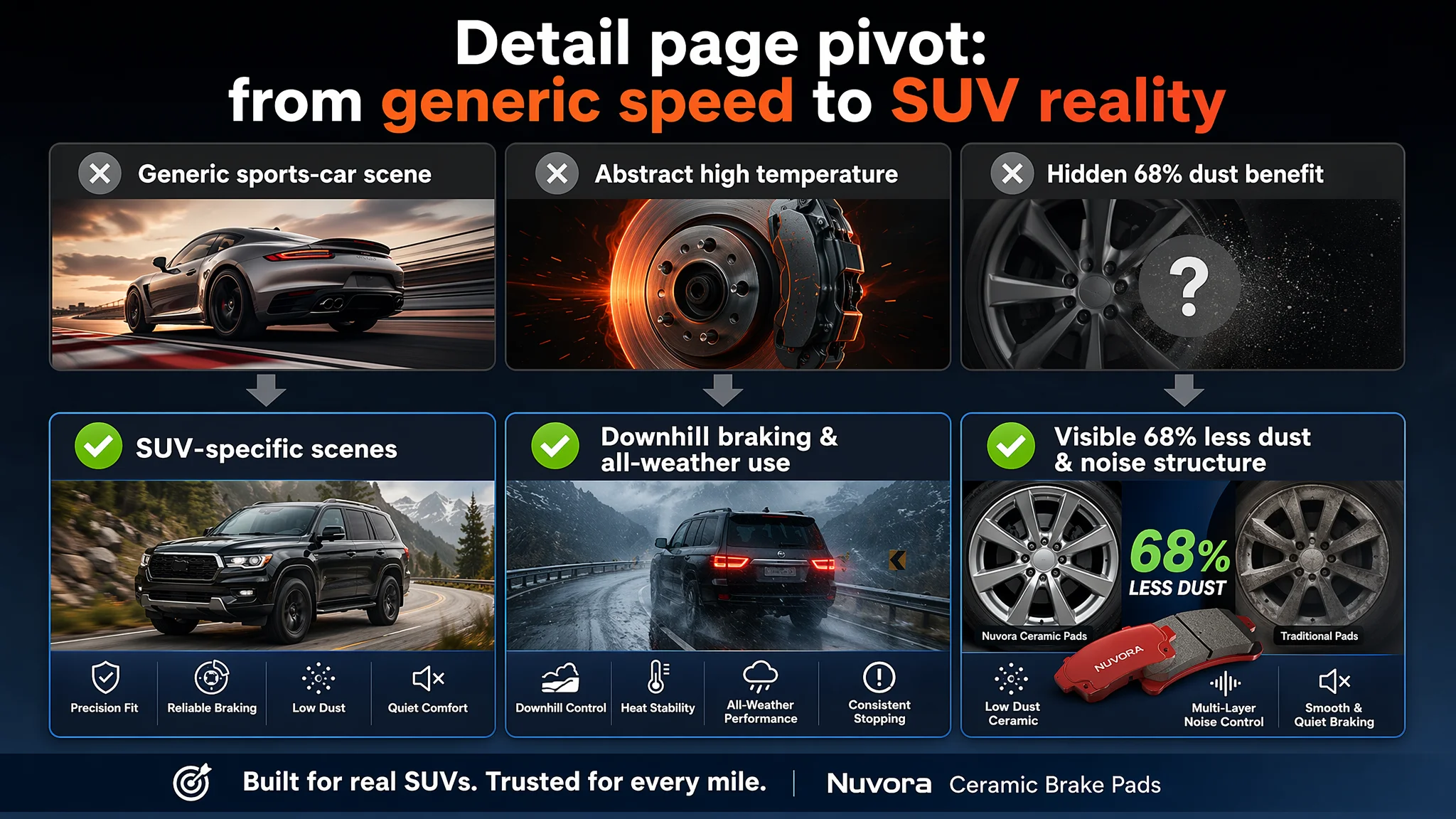
1. Correct audience vehicle and spelling
- Replace sports car visuals with black SUVs aligned to Lexus GX / Toyota Land Cruiser type.
- Clean up typos (“brandinE”, misaligned labels) that erode perceived expertise.
→ Outcome: from “generic aftermarket” to “OEM-grade, SUV-specific replacement.”
2. Visualizing “68% less dust”
- Side-by-side wheel comparison: clean vs dust-covered, with a clear “68% LESS DUST” callout.
→ Outcome: instantly legible benefit—no need to interpret engineering jargon.
3. SUV downhill braking scenario for high temperature
- SUV on a mountain descent, subtle glow on brake disc (not exaggerated).
→ Outcome: “this is built for your heavy vehicle in real-world conditions.”
4. Noise-elimination structure callout
- High-contrast detail shot of the pad’s backing and chamfers, with lines pointing to:
- Nitrile polymer rubber layer
- Laser-cut chamfers / slots
→ Outcome: tangible proof for “whisper-quiet” instead of vague promises.
5. Thermal-scorched break-in technology
- Industrial process visual showing the friction surface under infrared treatment.
→ Outcome: a believable explanation for “60% faster break-in,” not just a number.
6. Compatibility and model-table clarity
- Clean listing of Lexus and Toyota models next to product front/side/back views.
→ Outcome: shorter decision path—“I can see my model; I can see the part; I can decide.”
7. All-weather scenario montage
- Four quadrants: heavy rain, snow, desert, mountain road, all with relevant SUV scenes and a central product anchor.
→ Outcome: broad safety coverage, aligned to the outdoor / off-road identity of GX / 4Runner / Land Cruiser drivers.
The net effect: the A+ stops being a generic “high performance” story and becomes a tightly targeted SUV-use blueprint—which is exactly what Amazon buyers subconsciously test for when they scroll.
How Page Logic Recovery Makes Ad Traffic Useful Again
DeepBI did not promise instant metric jumps, but the operational logic is clear:
- Once the title communicates both fit and outcomes, searchers who see the ad or organic snippet can already pre-qualify: “this might be my pad, and it might solve my noise/dust worries.”
- Once the main-image set reads as industrial, precise, and SUV-relevant, more clicks become intentful, not just curious.
- Once A+ visuals align with real vehicles and show the 68% dust reduction and noise design clearly, traffic that lands is less likely to bounce purely from doubt.
- Once the review base is deliberately built up, the page starts to cross the minimum trust threshold where Amazon auto-parts buyers are willing to try a new brand.
In that state, the same Amazon ad spend that previously felt “wasteful” now has a structurally higher chance of returning:
- Better CTR from search (title + thumbnail trust).
- Higher CVR on-page (better fit storytelling + tangible proof).
- Less wasted spend on mis-fit or low-trust visitors.
Only then does classic ad optimization—bid tuning, keyword pruning, campaign structure—start producing the ACOS improvements the seller wanted.
How the Seller’s Understanding Changed
Before this diagnosis, the team equated:
- High ACOS → ad problem
- “Professional, technical” Listing → conversion should be fine
After working through the DeepBI analysis, their internal model shifted:
- Amazon ads are not a universal fix. If the product page scares off or confuses buyers, no bidding strategy can override that.
- Listing quality is not just content volume. Title search logic, main-image trust signals, and review base can outweigh how many engineering terms appear in bullets.
- In automotive, perceived fit and reliability beat raw tech talk. Buyers want to see that the pad belongs on their SUV and that others have already trusted it.
- Before scaling ads, the team must ask: “Does this page deserve more traffic?” If the answer is “not yet,” Listing conversion has to be repaired before turning up the ad spend.
For other Amazon sellers—especially in technical categories like automotive accessories, tools, or industrial components—the lesson is direct:
- If you keep pushing ads and the ACOS refuses to improve, do not assume the problem is campaign setup.
- Benchmark your Amazon Listing against the real category leaders on:
- Title search logic and outcome communication
- Main-image click appeal and engineering credibility
- A+ alignment to actual use cases and buyer anxieties
- Review volume and star rating realism
- Then decide whether your core bottleneck is traffic, or whether your page is quietly consuming that traffic before it can convert.
DeepBI’s value in this case was not in adding more features to the Listing, but in reframing the question: from “How do we squeeze more from ads?” to “Why doesn’t this Amazon product page deserve more traffic yet—and what must change so that it does?”