

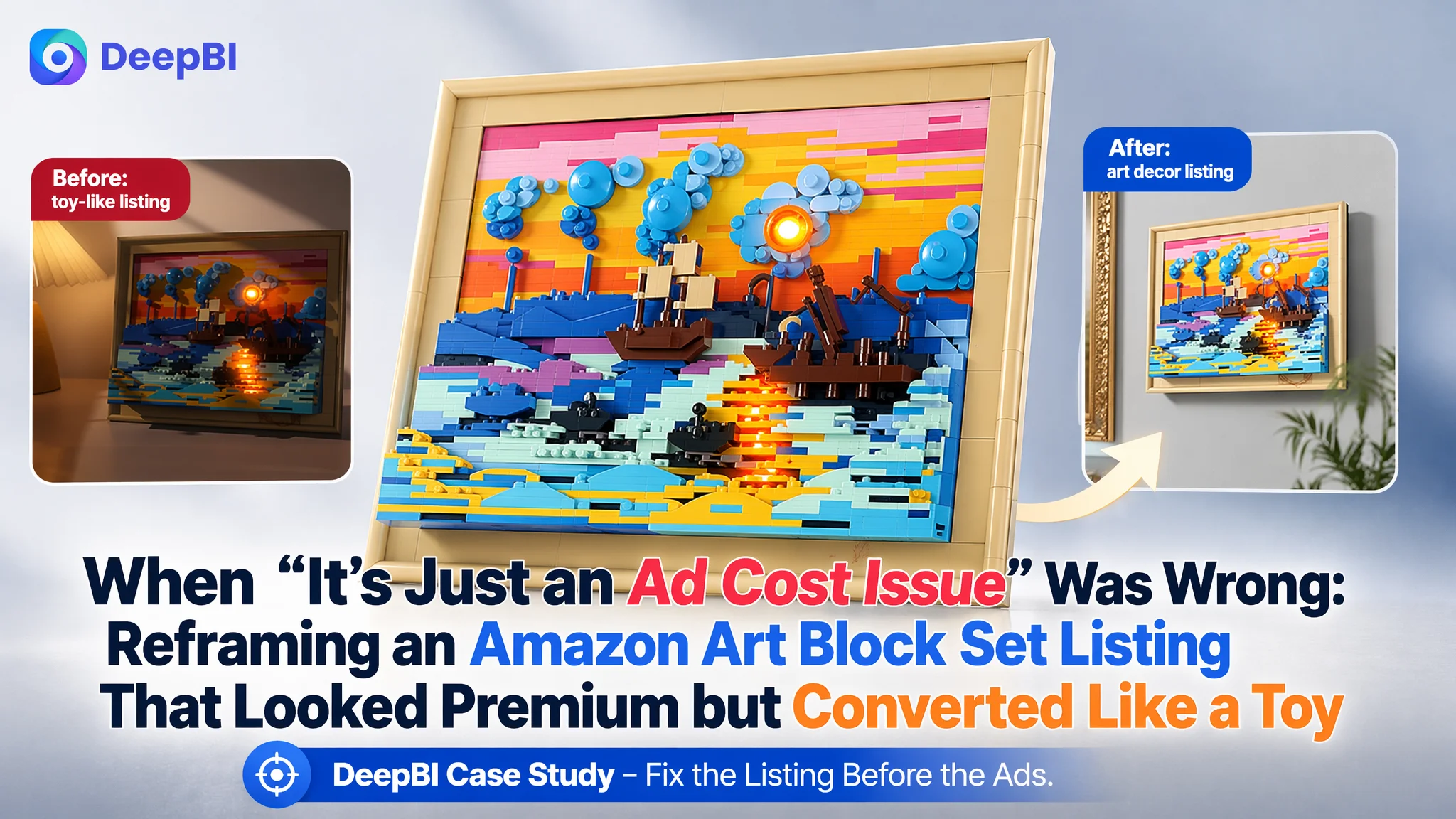
For this Amazon seller in the adult building-set / art-blocks category, the pressure started with rising ad spend that simply refused to translate into stable orders. On paper, the product looked strong: an “Impression Sunrise” micro-block art set with LED, solid review count, and clear differentiation from children’s toys. The team’s first reaction was familiar: “We need to tune Amazon ads harder. Better bids, better keywords, maybe more budget before peak season.”
Once DeepBI stepped in and benchmarked the Amazon Listing against a top-performing “Starry Night” LED building set, the picture changed. Ads weren’t the core problem. The Listing itself—title weighting, main image logic, bullet-point structure, A+ story, and review profile—was underperforming in almost every conversion-critical dimension. Traffic was being poured into a page that still framed itself as a “toy-like model” instead of a high-end art decor piece.
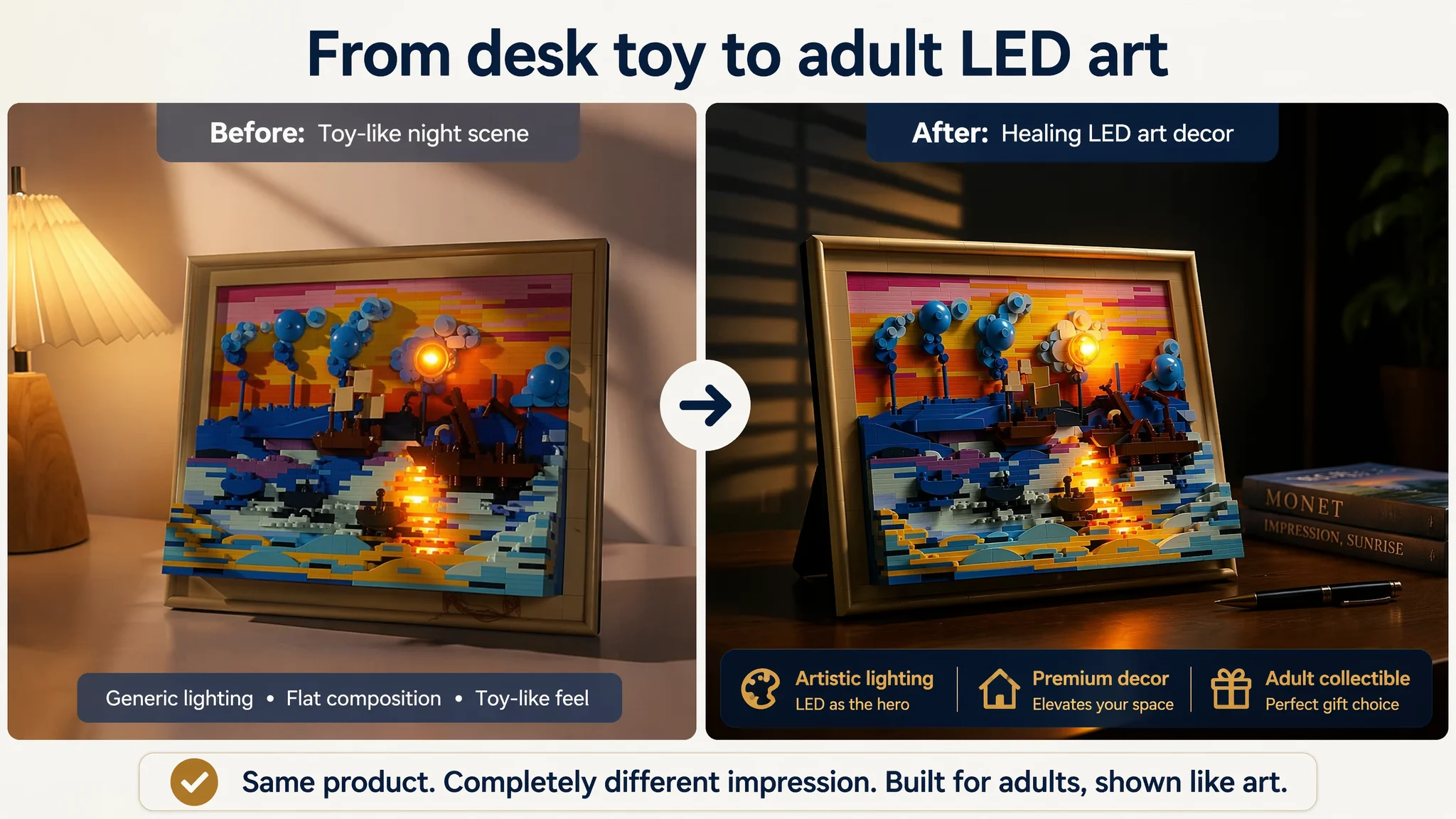
This reframing shifted the optimization order entirely. Instead of pushing more spend through the same funnel, work focused on repositioning the Amazon product page: title and bullets rebuilt around “art + architecture” and home decor outcomes, main images re-shot toward “adult art gift” rather than “generic toy,” and A+ restructured to show build journey, LED contrast, and real home scenarios. Other Amazon sellers can read this case as a warning: if your product-page logic is still stuck at “kids’ toy” while your price and audience have already moved to “adult collectible art,” no amount of ad tweaking will save your ACOS.
The Real Constraint Was Not Traffic, but Listing Conversion Capacity
From a surface view, this Listing did not look “broken”:
- Attractive product concept (famous-painting-inspired art blocks with LED)
- Micro-block complexity (1,500+ pieces) suitable for adult builders
- International review base and a non-trivial total review count
Yet, when DeepBI ran a direct benchmark against a leading Amazon competitor in the same micro-block art-painting niche, the cold numbers were clear:
- Overall Listing score:
- Target Listing: 72/100
- Benchmark competitor: 85/100
- Gap: –13 points
Across all core dimensions—title, main image set, bullet points, A+ details, and reviews—the target Listing lagged:
- Title: –3 points
- Main images: –2 points
- Bullets: –3 points
- A+ / detail page: –2 points
- Reviews: –3 points
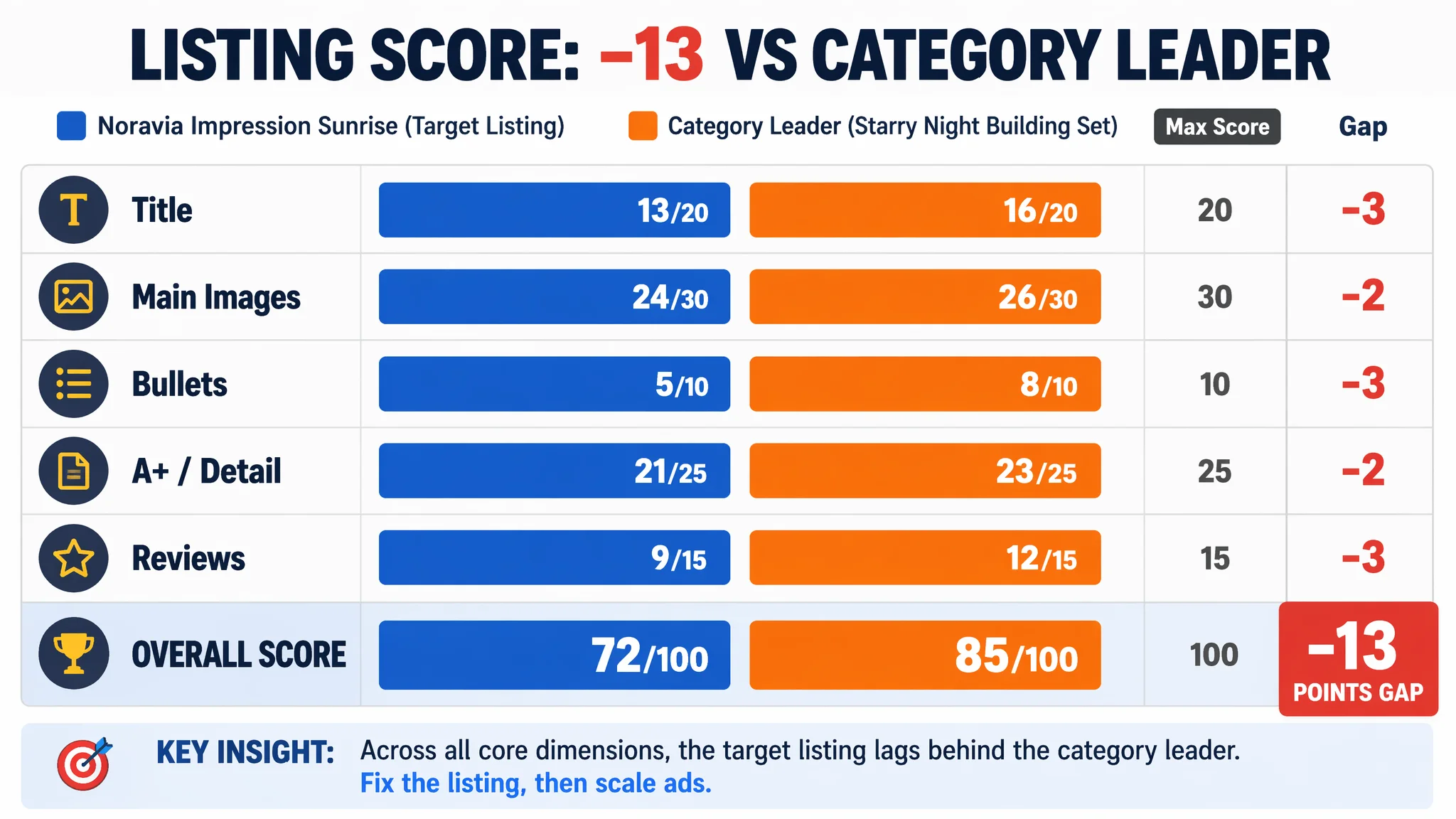
This is not a “cosmetic” gap. It points to a Listing that cannot fully support its own price point or justify heavy Amazon ad investment.
“The real problem was not that ads failed to bring traffic. It was that the page could not convert the traffic.”
In this situation, continuing to optimize ads first would simply magnify the Listing’s weaknesses: every extra dollar funnels more shoppers into a page that still speaks “product features” where the category leader is already selling “art, emotion, and decor”.
How the Seller Originally Misread the Problem
From the seller’s side, the symptoms were typical of Amazon ad fatigue:
- Rising competition in “building set,” “art blocks,” “LED building kit” keywords
- ACOS hard to control at desired levels
- Visible traffic, but order growth not keeping pace
Past experience pushed them toward familiar tools:
- More granular campaign structure
- Tighter keyword selection
- Bid tuning and budget shifts into peak search terms
The implicit assumption: “Our product is good enough; the bottleneck is ad operations.”
What this approach missed:
1. The Listing was not aligned with the real purchase logic of adult art-block buyers.
The page visually and structurally sat between a toy and a decor object. For a high-ticket, LED-enhanced art piece, that ambiguity is lethal.
2. Benchmark competitors had already moved the category narrative.
The leading Starry Night set wasn’t selling “blocks + LED” alone; it was selling:
- World-famous art IP
- Emotional value (“time and tranquility,” “cozy glow”)
- Clear home-decor outcomes
3. Trust and relevance gaps were hiding under “we just need more reviews / more ad spend.”
While the target Listing had more total reviews, its star rating was lower and negative reviews were more prominent on the first page. For a premium adult purchase, a 0.6-star gap and visible negatives will quietly erode conversion.
In other words, the Amazon Listing’s conversion capacity was the constraint, not the volume of ad traffic.
Listing Diagnostics: Where the Conversion Logic Actually Broke
DeepBI’s scoring made the Amazon context brutally clear: for this micro-block “Impression Sunrise” LED set, the page was under-leveraging its biggest strengths and over-emphasizing information that creates friction.
1. Title: Brand First, Category Second – the Wrong Priority
The benchmark “Starry Night” title was built like a conversion engine:
- Leading with “The Starry Night Building Set with LED Lights”
- Explicit piece count (1501PCS) and block size (3.6MM Mini Blocks) up front
- Clear audience and occasions: “for Men Women”, “Easter Gift”, “Home Art Decor”
This does four things at once:
- Maximizes search weight on category + LED + building set
- Quickly quantifies complexity and seriousness (micro-block, high piece count)
- Broadens target audience beyond “for adults” to real gift decision-makers
- Binds the product to a famous painting IP and home decor scenario
By contrast, the target Listing:
- Put the brand name up front, consuming the highest-weight position in Amazon search
- Left the core value term “building set” and “LED” later in the string
- Used a narrower audience tag (“for Adults”) and more generic descriptors
- Did not fully foreground the unique “framed wall art display” angle early enough
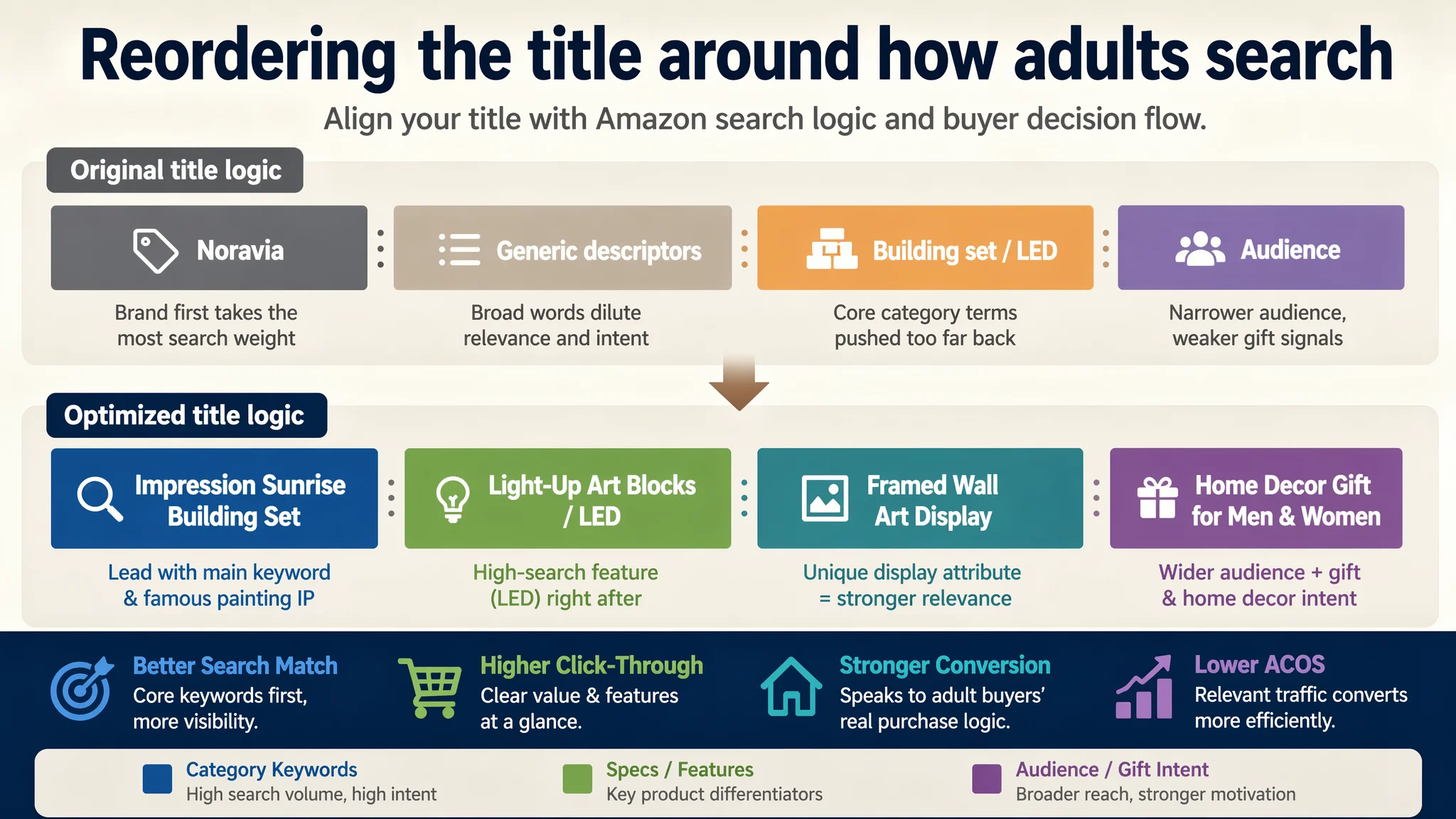
The result: search exposure and click intent were both diluted. For Amazon ads, this means even well-structured campaigns will fight an uphill battle on CTR and relevancy.
2. Main Images: Still Talking Like a Toy, Not a High-End Art Decor Piece
In this price band and category, shoppers are not just asking:
- “What does it look like?”
They are asking:
- “Does it feel like art or a toy?”
- “Will it elevate my home?”
- “Will this LED effect actually look elegant at night?”
The competitor’s main image sequence systematically answers those questions:
- Angled hero with depth and soft shadows → premium adult object
- Night scene with product as primary light source → “deep-night calming LED art”
- Human interaction and wall-mount use → real decor usage
- Size and block-scale visuals with a coin → spec clarity and professionalism
- Micro-detail close-ups → industrial-quality reassurance
DeepBI’s diagnosis for the target Listing:
- Flat, toy-like visual tone. Too little depth, few angles that visually separate it from normal building sets.
- Overly busy night environment. External lighting competes with the product’s LED, weakening the “healing night art” message.
- Human + product scale off. Hanging scenes do not convincingly answer, “How will this look on my wall?”
- Technical info visually under-served. No clean size/comparison visual to translate piece count into tangible scale.
- Lack of assembly / interaction frames. Potential adult buyers cannot judge building difficulty or the “process experience.”
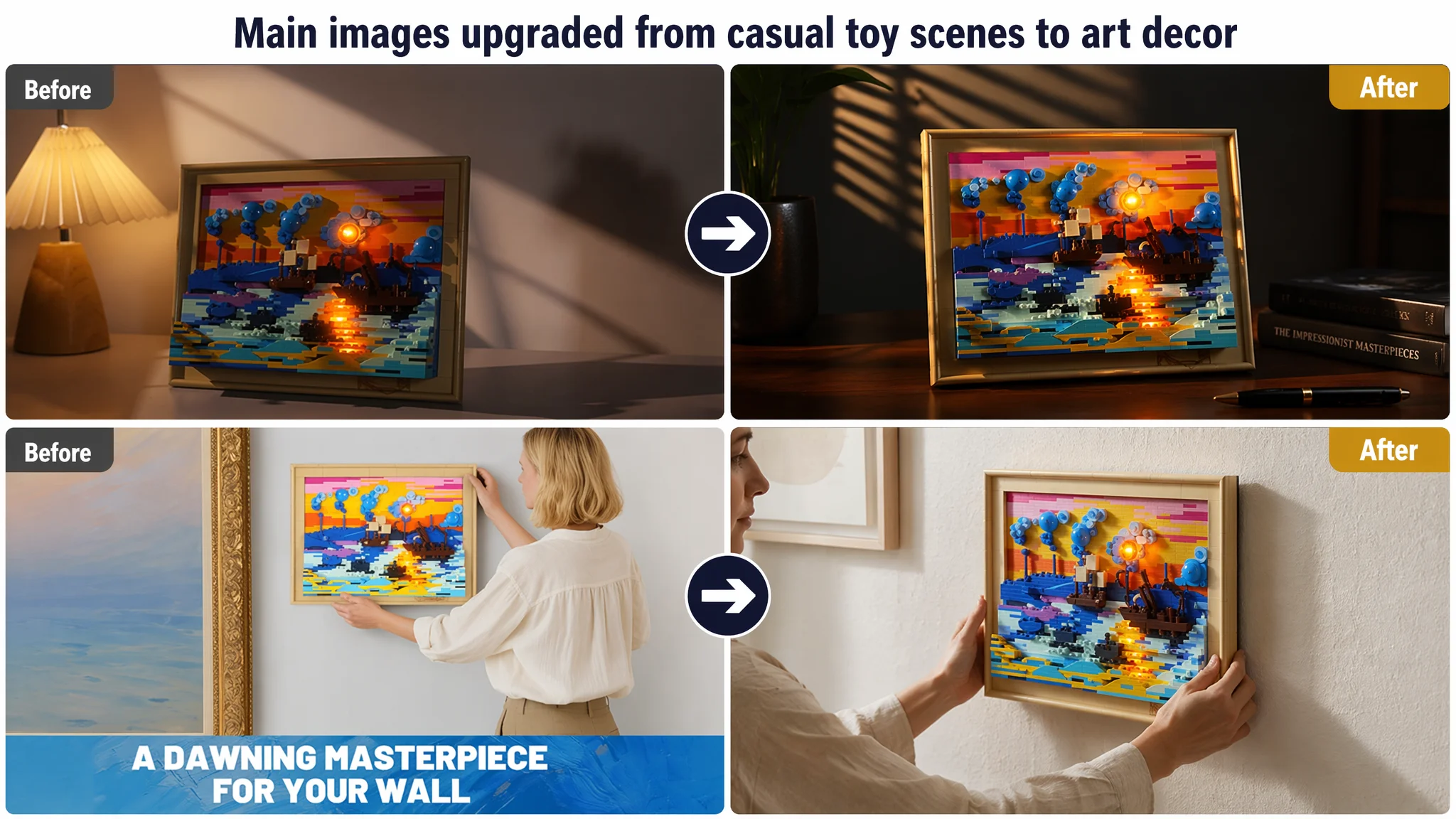
“Advertising does not only amplify advantages. It can also amplify a page’s existing defects.”
With main images like this, boosting ad budgets simply amplifies the impression of a slightly elevated toy, not a collectible-level art piece.
3. Bullet Points: Information Without a Buying Path
The gap in bullet strategy is particularly telling.
Competitor bullet logic:
- Starts with a disclaimer / technical spec → manages expectations (mini 3.6mm bricks, compatibility) and reduces return risk
- Moves into “Where art meets architecture” → concept and art IP
- Then into creative experience / screen-free immersion
- Then home aesthetics (how it fits decor styles)
- Then LED magic (how it transforms at night)
- Ends with gift positioning (holidays, creative adults, screen-free experience)
This creates a decision sequence:
1. “Is this the right block type & size for me?”
2. “What exactly is the art and build concept?”
3. “What will I feel while building this?”
4. “Where will I put it?”
5. “How will the LED change my space?”
6. “Is this a safe bet as a gift?”
By contrast, the target Listing’s bullets:
- Lead with technical design instead of expectation-setting
- Arrange bullets in a parallel list (design, aesthetics, art background, gift, immersion) without clear progression
- Describe the light system with a technical label (“light-sensitive design”) instead of an emotional benefit story
- Underdevelop the home decor and gifting scenarios, especially in the order in which buyers make decisions
DeepBI’s conclusion: the bullets had content but lacked a persuasive path—especially at a price where adults need emotional and functional reassurance before buying for themselves or as gifts.
4. A+ / Detail Page: No Full Journey from “Curious” to “Convinced”
On the A+ level, the divergence widens further.
The competitor’s A+ structure:
- Very clean hero module with the famous painting IP front and center
- LIGHT OFF / LIGHT ON split image showing LED impact at a glance
- Build journey (hands, partial builds, instructions visible)
- User-generated or “real use” style photos
- Multiple home scenarios (bookshelf, console table, bedroom)
- Multiscene gift imagery (holidays, partners, family)
The target Listing’s A+:
- Uses a mix of visual motifs and copy but leans heavily on static, decorative graphics
- Includes “light-sensing” mention, but only via single state imagery—no direct visual contrast
- Shows some scenarios, but lacks a coherent journey: curiosity → build → completion → decor → gifting
- Has no strong multi-angle build-process depiction, depriving adult builders of difficulty and satisfaction cues
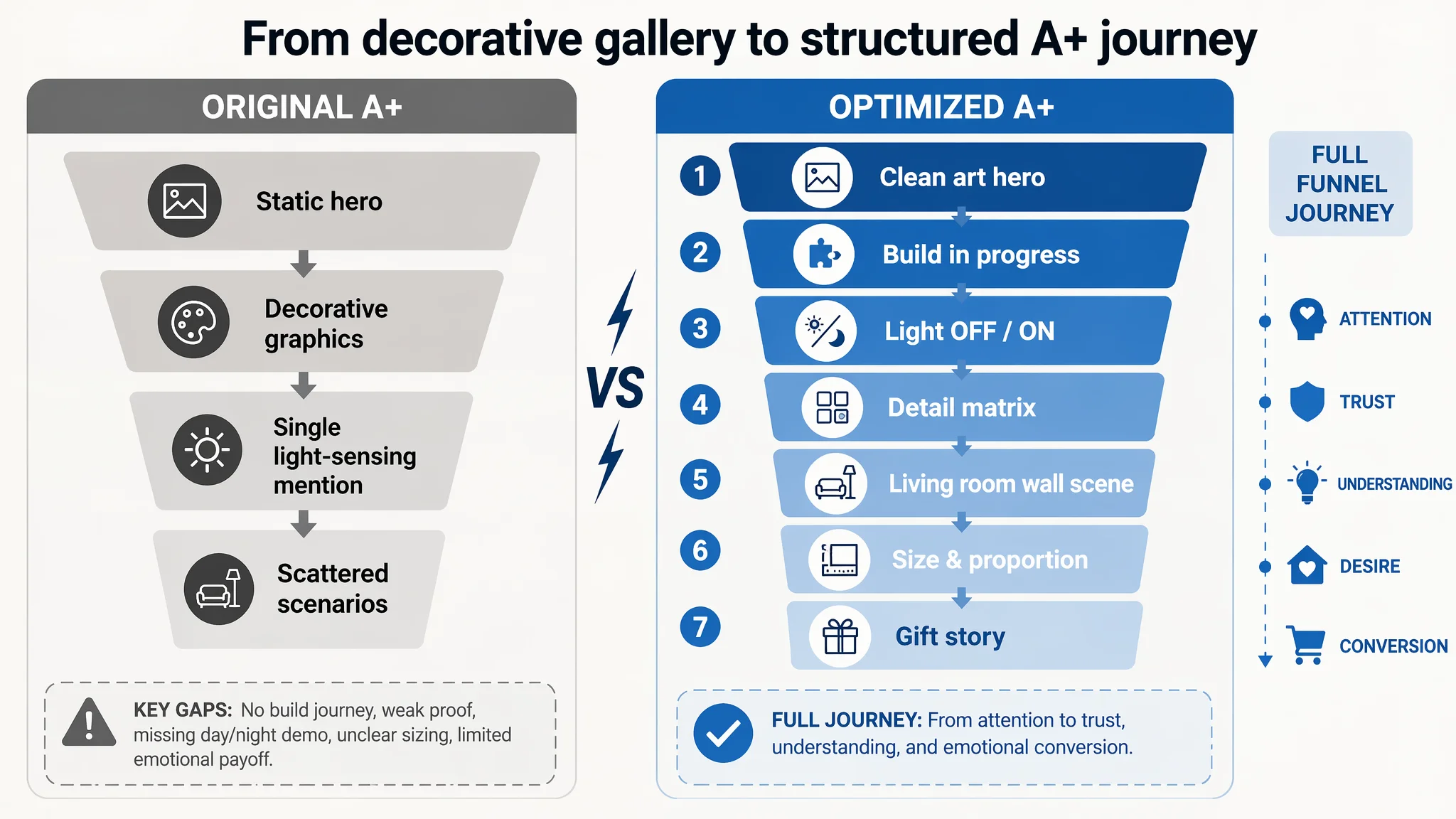
DeepBI’s diagnosis:
- The category’s main conversion driver—art aesthetic + LED transformation + build experience—is not visually proved. It’s mostly claimed in text.
- The A+ behaves more like a generic lifestyle gallery than a structured persuasion pipeline tuned to how Amazon shoppers scan and decide.
5. Reviews: Volume Without Star-Level Trust
On reviews, the numbers superficially look decent but hide a conversion drag:
- Target Listing:
- 4.0 stars, 112 reviews, higher absolute count
- Higher proportion of visible ≤3-star reviews on first page
- Competitor:
- 4.6 stars, 86 reviews, fewer total but higher rating
- First-page reviews are uniformly positive, forming a simple “safe choice” impression
For a discretionary, gift-able art product, a 0.6-star gap and more prominent negatives is enough to push undecided traffic toward the competitor—even if ads and on-page assets are otherwise solid.
Why DeepBI Did Not Recommend “Keep Tweaking Ads” First
Given this diagnosis, DeepBI’s judgment was straightforward but counterintuitive for the seller:
- Do not prioritize ad scaling or fine-grained bid tuning yet.
- Repair and reposition the Amazon Listing first.
The key operational risks of “ads-first” in this state:
1. You pay to expose a half-toy, half-art narrative to a refined adult audience.
Adult buyers looking for art decor with LED and micro-block challenge land on a page that visually undersells those exact attributes.
2. Your traffic mix becomes distortive.
If the title and images skew “toy”, ad algorithms may also favor audiences and search terms more oriented to cheaper toy-like products, which worsens conversion and ACOS.
3. Negative reviews become more visible impact points.
More ad-driven traffic means more people noticing the 4.0-star rating and highlighted critical feedback, further suppressing conversion and increasing return risk.
4. Organic growth is starved.
When the page fails to convert paid traffic efficiently, it struggles to build a strong sales and review trajectory. Organic rankings stagnate, increasing dependency on ads.
From a business-logic standpoint, fixing Listing conversion capacity is the only rational first move. Until the page can efficiently monetize each visit, buying more traffic is financially reckless.
How the Optimization Direction Changed: From Toy-Like Model to Art Decor Object
Once the problem was reframed, the entire optimization direction shifted.
Reframing the Product in the Title
DeepBI recommended a title built to win in Amazon’s search and decision logic:
Impression Sunrise Building Set, Light-Up Art Blocks for Adults with LED Lights, Framed Wall Art Display Kit, Famous Painting Home Decor Collectible Gift for Men and Women
Core changes:
- Core keyword cluster moved forward: “Light-Up Art Blocks for Adults” and “LED Lights” no longer buried.
- “Framed Wall Art Display” explicitly surfaced: repositioning from “just a building set” to wall art decor.
- Audience broadened and made gift-aware: “for Men and Women,” “Home Decor Collectible Gift” → more relevant to givers, not just hobbyists.
- Subjective fluff reduced: Swapping vague “premium, elegant” terms for concrete search and decision drivers (LED, framed display, collectible, home decor).
This is not wordsmithing for its own sake; it realigns the Listing with how adult buyers and Amazon’s algorithm both think about the category.
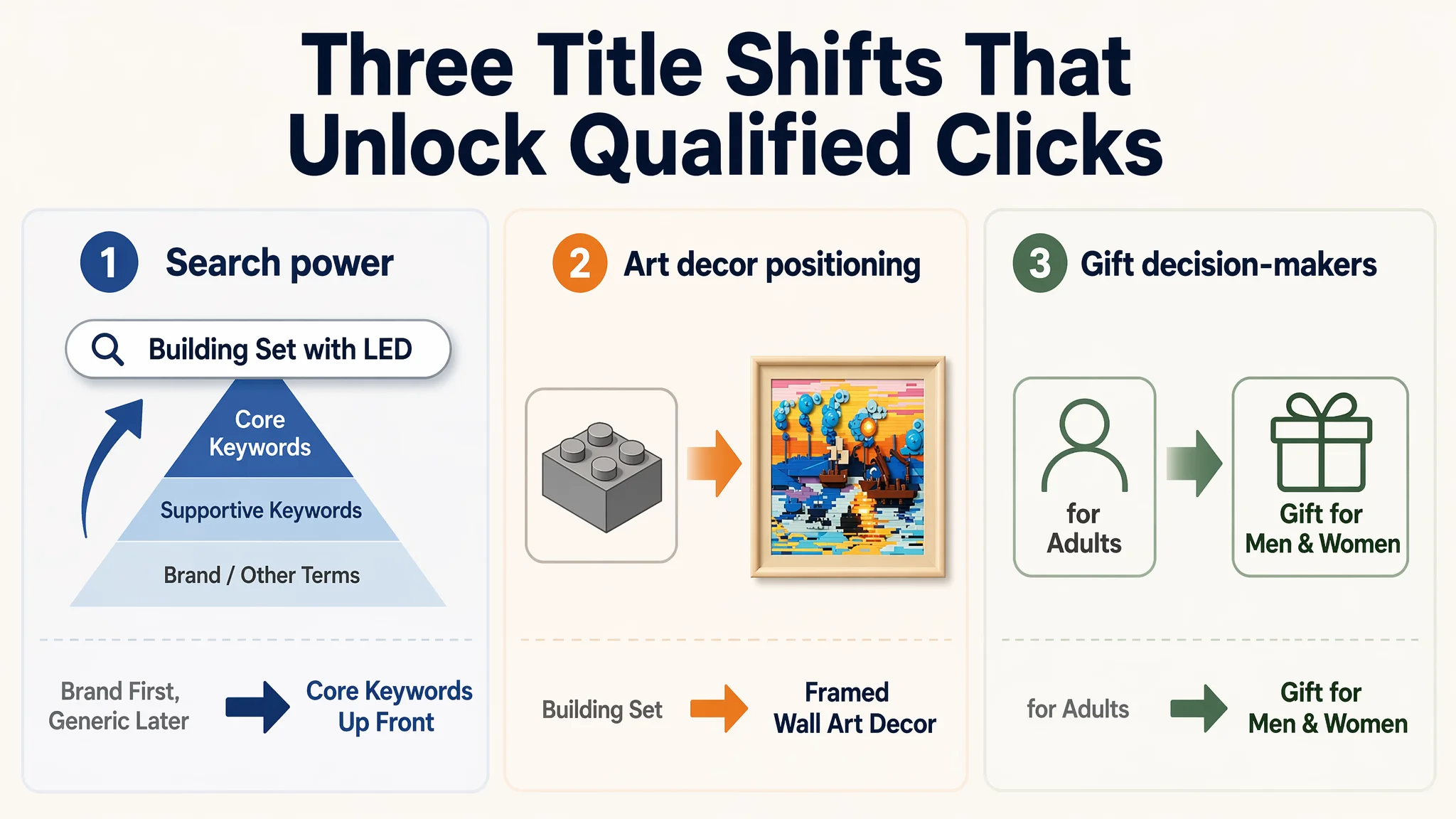
Restructuring Bullet Points into a Convincing Path
Rather than incremental edits, DeepBI’s bullet recommendations rebuilt the persuasion flow:
1. Technical Specifications & Compatibility
- Clarifies 3.6mm micro block size and non-compatibility with major brands
- Sets piece count (1,514) expectations
- Reframes micro scale as an advantage (“high-definition precision,” “nuances of Monet”)
2. Where Art Meets 3D Architecture
- Connects directly to Monet’s “Impression, Sunrise”
- Emphasizes 3D transformation of a historic canvas through block layering and impasto-like texture
3. Unleash Your Inner Artist
- Positions the build as a screen-free, mindful journey
- Highlights the immersive experience: “walk through the foggy harbor,” multi-angle art appreciation
4. Elevate Your Home Aesthetics
- Expands decor usage beyond wall-only: wall, bookshelf, console table, study
- Positions the piece as a conversation starter, not just a finished model
5. Innovative Light-Sensitive Magic
- Explicitly differentiates from standard LED strings
- Highlights the automatic, environment-responsive sensor and day/night dual personality
6. A Memorable Gift for Adults
- Names specific gift moments: birthdays, anniversaries, Christmas
- Targets art enthusiasts, collectors, design lovers, and people seeking screen-free tactile experiences
The net effect:
- Lower decision risk at the top (specs, compatibility)
- Stronger artistic and experiential appeal in the middle
- Clear decor and gift payoff at the end
Now, each ad-driven click lands on a bullet stack that guides a mature buyer through rational and emotional checkpoints rather than leaving them to piece it together.
Rebuilding the Main Image Set Around Adult Art & Decor
DeepBI’s visual recommendations treated the main image carousel as a structured narrative rather than a random gallery:
1. Primary Hero – High-End Gift Object
- Product centered, ~70% frame, 15° upward angle
- Cool–warm soft top lighting, light gray gradient background
- Box floating subtly in a corner for gift cue
- Product shown with lights off to emphasize form and framing
- Clean reflection for premium, gallery-like feel
2. Night Atmosphere – “Deep-Night Healing LED Art”
- Product on dark walnut table, internal warm LED as main light
- Minimal, dark home background with blind shadows
- A pen and art booklet on the side to cue adult, creative usage
3. Wall-Mount Interaction – Real Home Scale
- Close-up of an adult hand hanging the product
- Clean, textured off-white wall, minimalist decor around it
- Bright, gallery-style lighting
4. Size & Scale – Professional Spec Visualization
- Product at 45° angle on pure white background
- Length/height dimensions clearly labeled
- 1:1 micro-block vs coin comparison to make piece scale tangible
5. Micro-Detail Triptych – Industrial Precision
- Three-grid macro shots: sun, boat, wave textures
- Strong side lighting emphasizing block layering
- Small detail captions (e.g., “Detail Aesthetics”) to reinforce craft
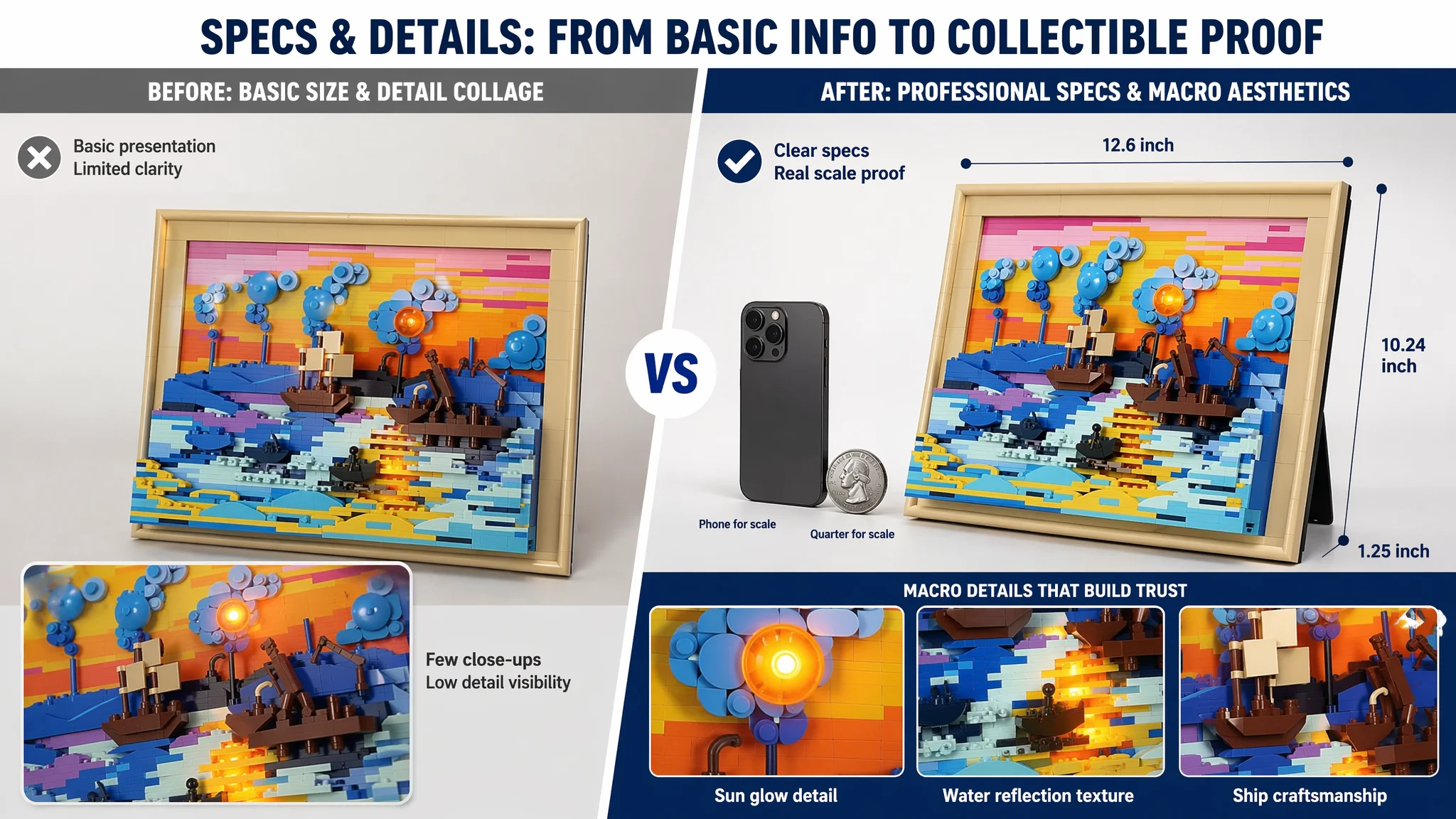
Collectively, these images reposition the product from “nice-looking building set” to museum-influenced art decor with serious build depth and premium LED presence. Only after such a transformation does it make financial sense to re-scale ads aggressively.
Turning A+ into a Real Conversion Story, Not Just Decoration
For the A+ / detail section, DeepBI’s logic was to mirror the mental journey of a careful adult buyer:
1. Clean Art-Focused Opening
- Central, front-facing product shot on an understated wall
- Minimal decor (a single plant), soft side lighting
- “IMPRESSION SUNRISE” as restrained gallery-style text
- Blue decorative borders and clutter removed to restore art dignity
2. Build Process in Progress
- 45° overhead view of a half-built piece
- Pieces scattered, instruction manual in frame
- Adult hands mid-placement
- Warm wooden table, highlighting both complexity and tactile creativity
3. LIGHT OFF / LIGHT ON Split Image
- Same scene, left bright daytime, right moody night
- Clear text: “LIGHT OFF” vs “LIGHT ON”
- LED-illuminated sun and water reflection demonstrated, not just claimed
- Explicitly communicates “daytime art, nighttime ambiance light”
4. Detail Matrix – Four-Quadrant Close-Up
- Sun cluster, water texture, base structure, battery box/switch
- All shot in unified macro style, neutral background
- Reassures on quality, stability, and LED implementation
5. Wall-Mount Living Room Scenario
- Product centered over a modern sofa in a warm, evening-lit living room
- Soft side sunlight echoing the sun in the artwork
- Answers, “If I buy this, what will my living room become?”
6. Size & Proportion with Everyday Reference
- Product on white desk, smartphone next to it
- Clear dimension lines and numbers
- Satisfies practical concerns about space and scale
7. Gift Story Triptych
- Young couple opening the box by a Christmas tree
- Adult woman receiving the finished piece at a birthday
- Parent and teen admiring the glowing piece together in a study
- Captures emotional payoff across different gift-giving contexts
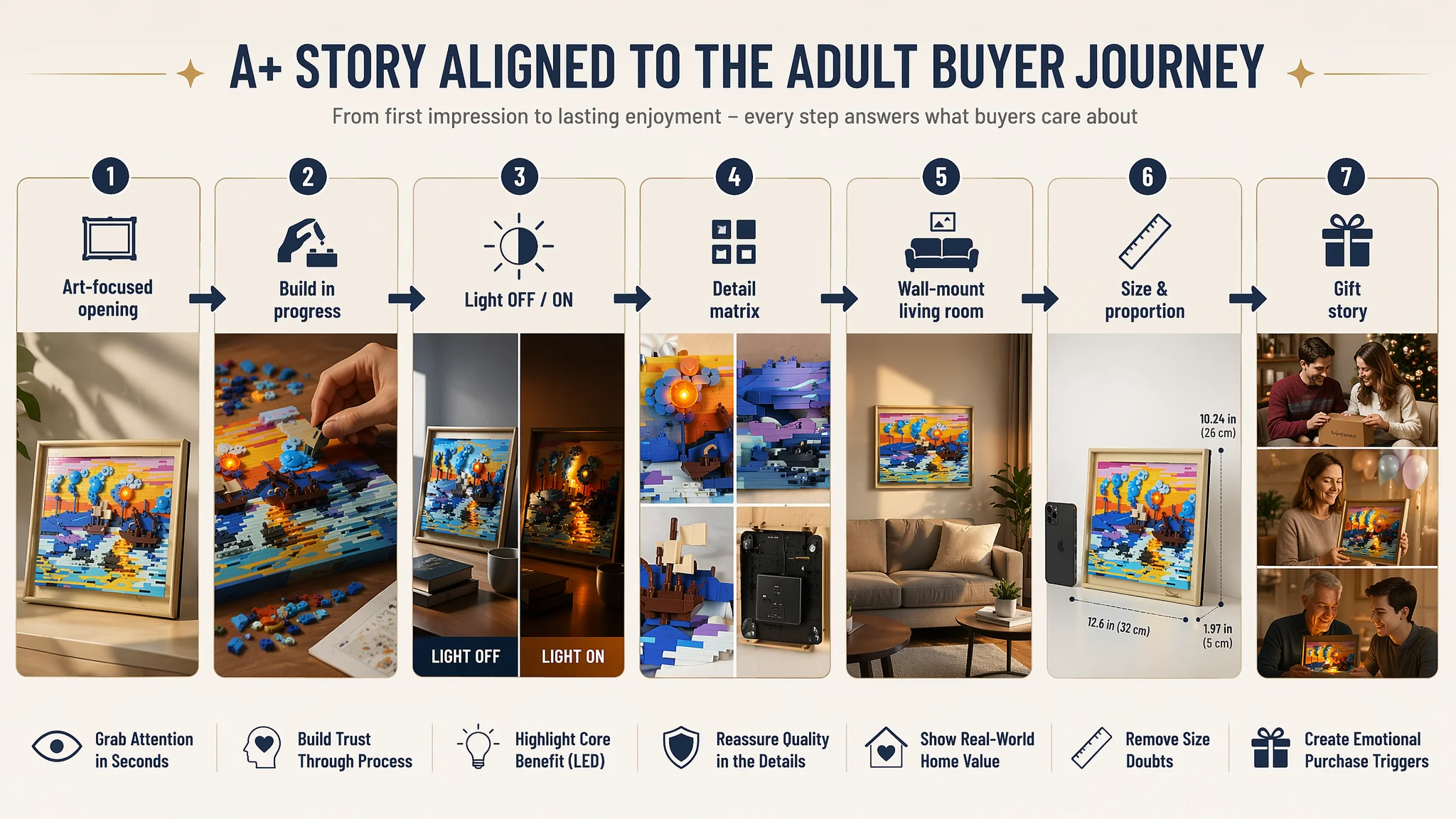
With this shape, the A+ stops being “nice graphics under the fold” and becomes a structured response to the real questions blocking adult buyers from completing the order.
How the Store’s Economics and Understanding Shifted
Even without inventing specific numbers, we can see the operational implications.
Traffic Became Useful Again
Once the title, images, bullets, and A+ were realigned:
- The Listing could handle and monetize the traffic that ads brought in.
- Each incremental click had higher probability of converting, flattening ACOS pressure.
- The product began to look consistent with its own price, complexity, and LED sophistication.
This opened the door for Amazon ads to do what they do best: scale a functioning funnel, not prop up a misaligned one.
Dependence on “More Spend” Reduced
With Listing conversion improved:
- The seller could stabilize ad spend instead of feeling compelled to overspend to maintain rank.
- Organic visibility had a fairer chance to recover once conversion rates aligned better with category norms.
- The traffic mix became more balanced: paid traffic built real momentum for organic search and recommendation systems.
Internal Judgment Upgraded
Perhaps the most important change was not visual but cognitive:
- The team stopped treating high ACOS as purely an ads problem.
- They recognized that title position, main image logic, bullet sequence, A+ story, and review profile are all parts of a single conversion mechanism.
- Going forward, they had a clearer decision order:
1. Check if the Listing deserves more traffic.
2. If not, repair Listing conversion capacity first.
3. Only then, scale and refine ads.
For other Amazon sellers, this case is a concrete reminder: if your product page is still visually and structurally telling an outdated story about what you sell—“toy-like kit” instead of “art decor object,” “technical feature” instead of “room transformation”—your ad dashboards will keep showing symptoms you can’t fix with bids alone. The fastest way to heal your ACOS might be to rebuild the way your Amazon Listing speaks to the human on the other side of the click.