

This Amazon seller in the body-care accessories category came to DeepBI with a familiar problem: traffic on their electric body brush and back scrubber Listing was acceptable, but ad efficiency and conversion on Amazon were weak compared with a category-leading competitor. The team’s instinct was to keep rewriting copy—especially bullet points—around cellulite, lymphatic drainage, and “strawberry legs” pain points, assuming that stronger wording would unlock sales.
DeepBI’s Listing diagnostics told a different story. Against a directly comparable Amazon competitor, the customer’s page was not losing on promise; it was losing on visual proof, trust signals, and decision completeness. The bullets were actually more advanced than the benchmark, but the title positioning, main-image storyboard, A+ detail logic, and review scale all lagged. In other words, Amazon ads were sending traffic into a page that talked aggressively about results, without showing enough that those results were real or that the device was technically sound.
The optimization path shifted from “keep emphasizing pain points in copy” to “rebuild the Listing’s visual and structural logic so the page deserves the traffic it already receives.” That meant reframing the title around broader shower use, restructuring the image set around scenes, proof, and parameters, and making the core 5-in-1 and dual-handle advantages easy to grasp at a glance. For other Amazon sellers, the lesson is clear: when you’re already promising strong outcomes, the next conversion step is rarely more adjectives—it is visual evidence and trust architecture that let your ads finally work as intended.
The Real Constraint Was Not Ads or Copy. It Was Listing Conversion Capacity.
Looking only at text, this Amazon Listing did not look weak.
- Title had niche, high-intent concepts like “Dry Brushing” and “Lymphatic Drainage.”
- Bullet points followed a clear “problem–solution–result” logic.
- A+ content covered brand claims, technology, handle features, and brush-head comparisons.
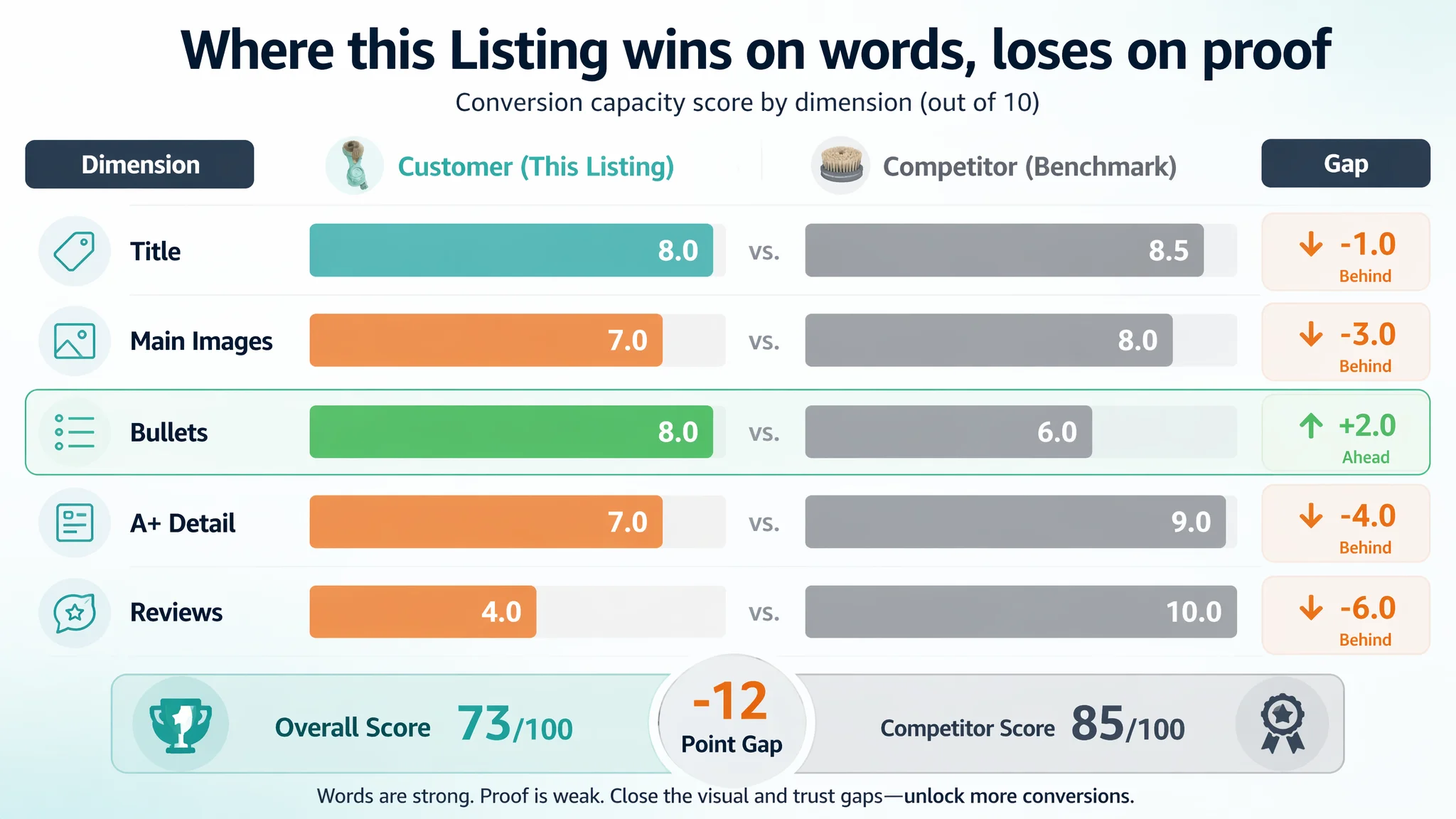
Yet in DeepBI’s Listing score comparison against a category benchmark on Amazon US:
- Overall: customer 73/100 vs. competitor 85/100 (–12)
- Title: –1
- Main images: –3
- A+ detail: –4
- Reviews: –6
- Bullets: +2 (the only dimension where the customer outperformed)
So the weakest links were not what the seller said but how it was visually and socially proven.
 At the same time, the trust gap was stark:
- Customer review volume: 2 reviews, 4.5 stars
- Competitor review volume: 321 reviews, 4.2 stars
The Listing was trying to sell a more professional, result-driven story (cellulite reduction, lymphatic drainage, deep exfoliation) with almost no scale trust, little visual evidence, and incomplete technical reassurance. Under this structure, pouring more Amazon ads into the funnel would mostly amplify doubt.
“The real problem was not that ads failed to bring traffic. It was that the page could not convert the traffic into confident orders.”
DeepBI’s judgment: this was fundamentally a product-page conversion and trust-construction problem, not an ad bid or keyword problem. Before any meaningful ad optimization, the Listing’s ability to carry that promise had to be rebuilt.
What the Seller Originally Misdiagnosed
From the customer team’s perspective, the situation looked like this:
- Competing product in the same Amazon category was selling strongly.
- Their own device actually had stronger functional differentiation:
- Dry brushing, natural boar bristles
- 5 brush heads instead of 3
- Dual-handle flexibility
- Differentiated “home spa” positioning
- Listing copy already spoke to deeper pain points: cellulite, “strawberry legs”, back acne, lymphatic drainage.
The working assumption became:
- “If shoppers understand that this brush solves more problems and has more heads, they will switch.”
- “We should double down on pain-point descriptions and contrast with manual brushes or cheap heads.”
So optimization energy went into:
- More aggressive claims about cellulite and lymphatic drainage.
- Stronger technical-upgrade language (improved bristles, better ergonomics vs. generic brushes).
- Layered bullet logic from functions to result promises.
But Amazon shoppers were not reacting like a long-form sales-page audience. From the search results and first scroll, they saw:
- A competing Listing with clear ‘shower body brush’ framing, waterproof and handle-length clarity upfront.
- A full visual narrative: model-in-shower shots, water-proofing visuals, charging clarity, comfort, before/after proof, packaging, sizes, colors.
- Hundreds of reviews plus videos providing social proof.
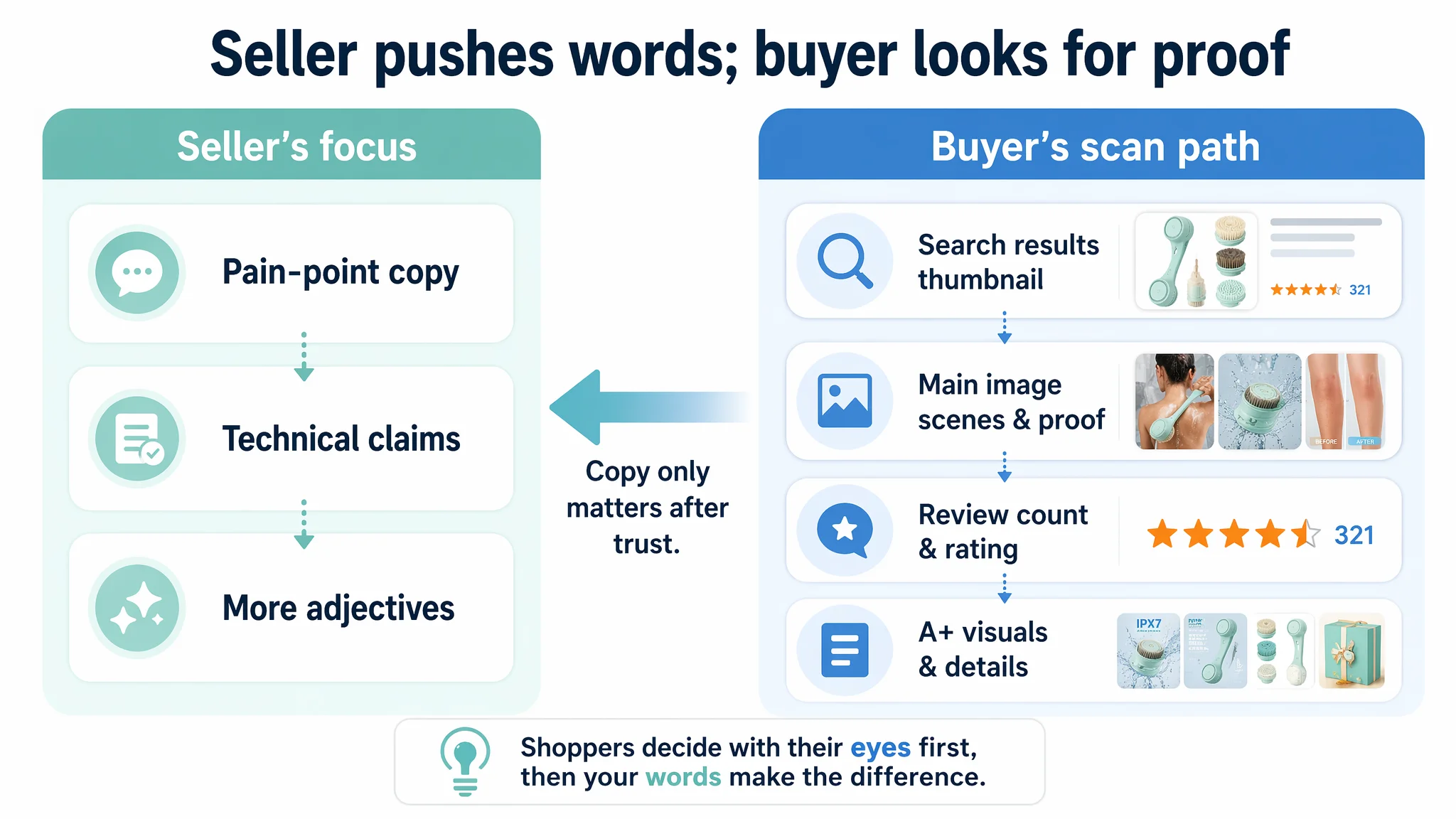 DeepBI’s assessment: the seller’s diagnosis overestimated the role of copy nuance and underestimated the buyer’s need for fast, low-risk evidence at image and A+ level.
Where Traditional Optimization Hit a Wall
Once we mapped the score gaps to decision behavior, the pattern was clear.
1. Title framed the product too narrowly
The competitor’s Amazon title:
- Immediately anchors to “Electric Body Brush Back Scrubber for Shower”.
- Emphasizes “Waterproof” and “Long Dual Handle” early.
- Quantifies functionality: “3 Heads, 2 Speeds”.
- Ends with broad, high-frequency skincare use: “Cleansing, Exfoliating and Massaging Skin.”
The target Listing’s original title leaned heavily on:
- “Dry Brushing”
- “Lymphatic Drainage”
- Repeated niche terms, less emphasis on everyday shower use and waterproof safety.
This created two issues:
- Search-intent mismatch: broader buyers looking for a shower body scrubber for daily cleansing and exfoliating saw a niche “lymphatic drainage” device.
- Missed high-volume terms: cleansing and massaging, very common Amazon search intent in this subcategory, were underplayed.
Text-wise it wasn’t “wrong,” but for Amazon search behavior, it narrowed the funnel too early.
2. Main-image set lacked a click-worthy story
The competitor’s image stack on Amazon:
- Strong model-in-shower scenes right in the carousel.
- Clear visual of dual-handle reach to the back.
- Combined water-proofing and charging scene.
- Before/after skin state.
- Packaging and color options, strong lifestyle feel.
The target Listing’s image stack:
- More static product displays.
- Brush-head close-ups without strong function linkage.
- Text overlays that “state” benefits but don’t show them.
- No before/after proof, no emotionally compelling shower scene at the top.
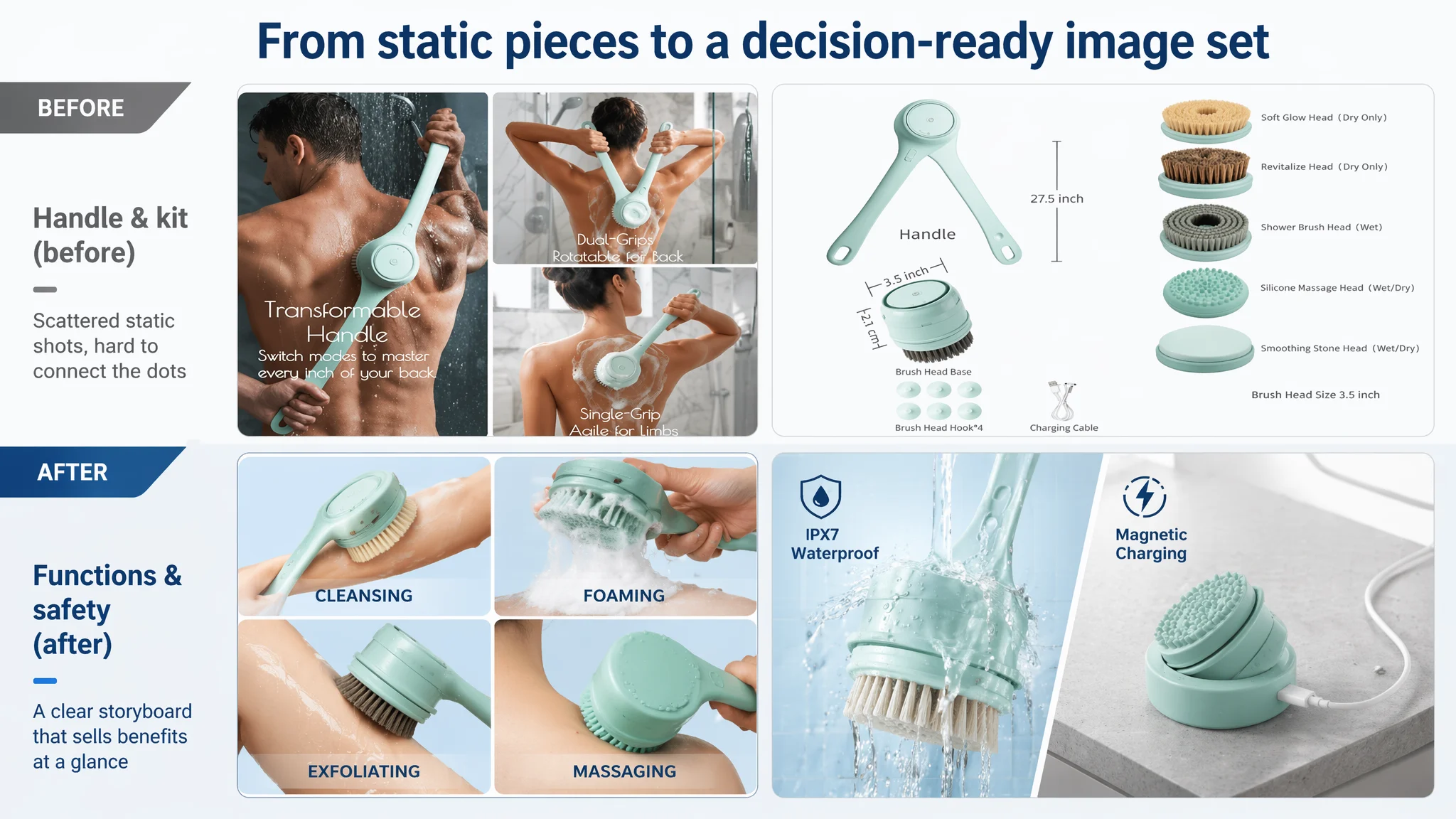 DeepBI’s visual judgment: CTR and dwell-time were capped not by the existence of benefits but by how hard the buyer had to imagine them.
“Advertising does not only amplify advantages. It can also amplify a page’s existing defects.”
3. A+ content listed functions but did not close the trust loop
On the A+ layer:
- The customer used:
- Brand statement visuals
- Technology callouts
- Brush-head comparison
- Handle-function illustration
- Icon-based scene summary
The competitor used:
- Hero shower scenes
- Waterproof shooting
- Charging and battery graphics
- Material and mode explanation
- Ergonomic diagrams
- Accessory pack & dimensions
- Safety protections
- Multi-color packaging
- Before/after comparison
Structurally, the competitor A+ followed a “problem → solution → result verification” loop. The target A+ stayed at “function listing without result verification”.
So while the bullets promised:
- Reduced cellulite
- Smoother skin
- Cleaner pores
…the A+ never visually demonstrated any of it. For Amazon shoppers, this is where strong promises start to feel risky.
What DeepBI’s Listing Data Actually Showed
DeepBI’s comparative Listing scoring made it possible to separate perception from reality:
- Bullets: customer 8 vs. competitor 6 (out of 10)
The copy logic, pain-point coverage, and differentiation narrative were already stronger.
- Title: –1 vs competitor
The gap wasn’t huge, but the direction was. The competitor was aligned with broader search behavior; the customer was more niche.
- Main images: –3 vs competitor
This is critical at the CTR stage. Lack of emotive scenarios and proof meant fewer clicks per impression.
- A+ detail: –4 vs competitor
Missing:
- Parameter clarity (battery mAh, RPM)
- Safety and waterproof reassurance
- Packaging and accessory clarity
- Result visualization
- Reviews: –6 vs competitor
Only 2 reviews vs. 321 created a structural trust disadvantage.
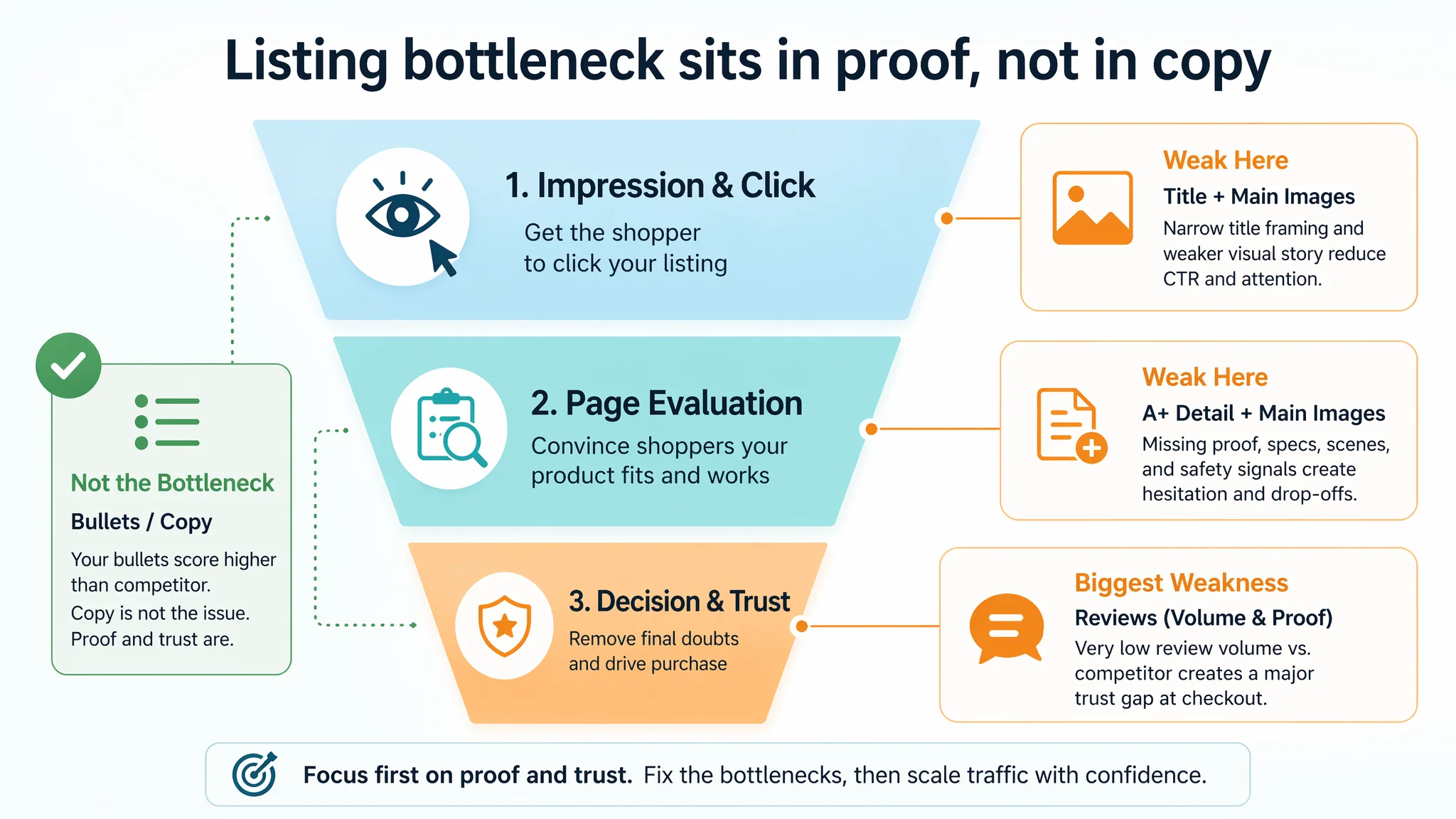 From a funnel perspective:
- Traffic could be driven with Amazon ads.
- Bullet copy could promise strong outcomes.
- But:
- Title made the funnel narrower than needed.
- Images and A+ did not carry the promise to proof.
- Review volume made the promise feel untested.
DeepBI’s conclusion: the core bottleneck was Listing conversion capacity, not ad settings or lack of functional description.
Why DeepBI Did Not Recommend “Keep Tuning Ads First”
When DeepBI sees a page that:
- Scores relatively well on bullets;
- Lags notably on main images and A+ proof;
- Carries high-commitment promises (cellulite reduction, lymphatic drainage) without visual evidence;
- Has nearly no review base;
…the priority is not to push more traffic at it.
If the team had focused on Amazon ads first:
- Higher impressions would likely not reduce ACOS sustainably.
- More clicks would still run into the same trust gap and incomplete story.
- TACoS risk would increase as organic lift failed to follow.
From a risk standpoint, the biggest concern was:
- Amplifying a fragile Listing instead of stabilizing it.
- Paying to test a page that had not yet earned the right to scale.
For this product in this category, DeepBI’s judgment was:
1. Repair title targeting so the product competes properly in broader “shower body brush” and “exfoliating body scrubber” intent, not only niche lymphatic drainage.
2. Rebuild main images and A+ modules into a conversion-focused visual funnel.
3. Then let ads re-test the improved page to validate CVR and ACOS movement.
How DeepBI Reframed the Listing: From “Words First” to “Proof First”
1. Title: from niche terminology to complete value framing
DeepBI’s suggested title direction:
Electric Dry Brush for Lymphatic Drainage, 5-in-1 Natural Bristle Body Brush and Back Scrubber for Shower, Waterproof Power Scrubber for Exfoliating, Cellulite & Massaging, Men and Women
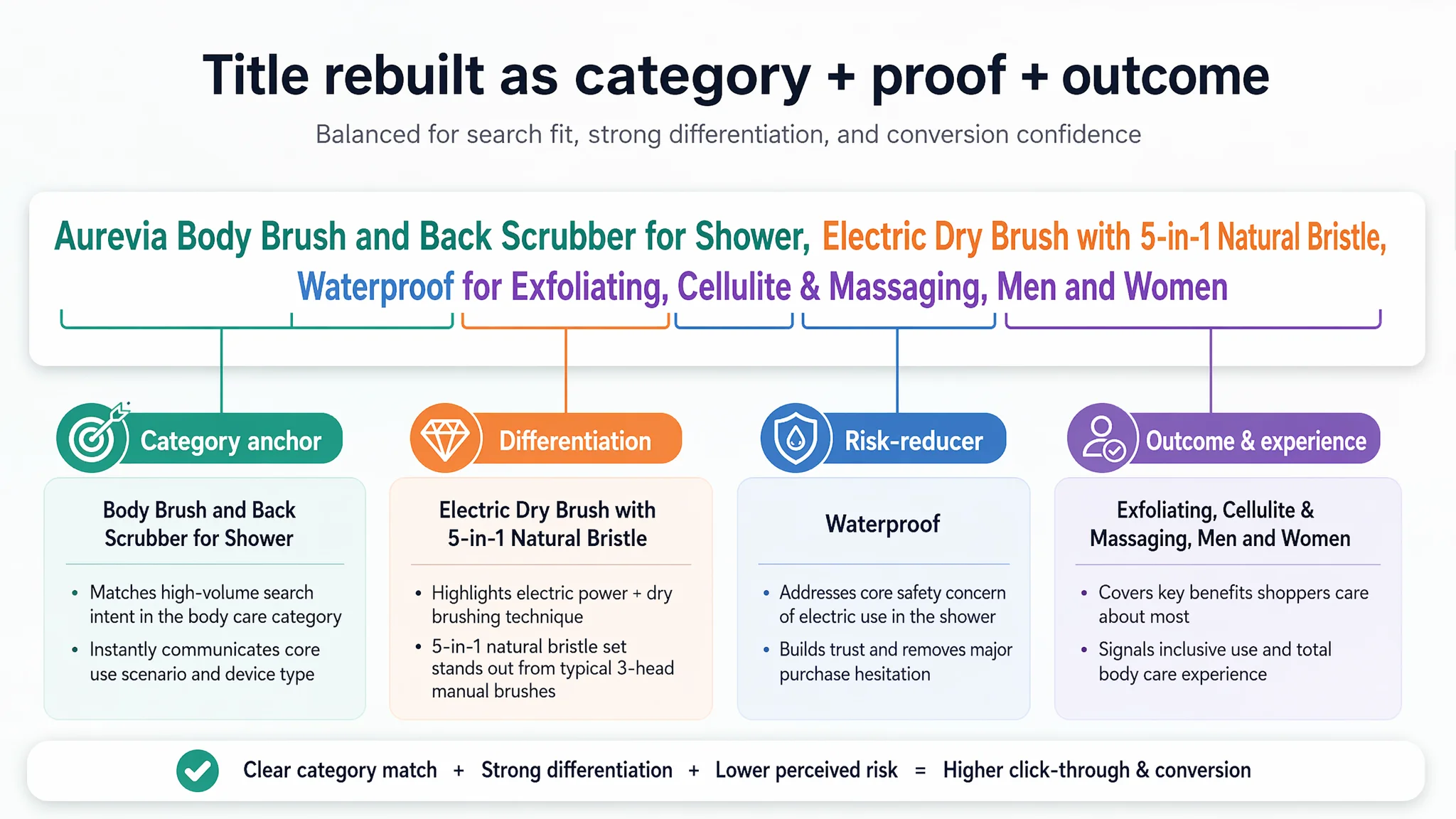 Key shifts:
- Remove repetitive “Lymphatic Drainage” to free character space.
- Keep dry brushing and natural bristles as differentiators, but anchor in “Body Brush and Back Scrubber for Shower.”
- Add “Waterproof” and “Massaging” as must-have category attributes.
- Explicitly position “5-in-1” to signal more value than standard 3-head kits.
- Cover “Exfoliating” and “Cellulite” at a phrase level, not as the entire framing.
This reframing lets Amazon’s algorithm and shoppers both quickly see:
- Category: electric body/back scrubber for shower.
- Differentiation: 5-in-1, natural bristles, cellulite and lymphatic benefits.
- Safety & usability: waterproof.
- Experience: massage, for men and women.
2. Bullet points: keep the logic, sharpen the angle
Because bullets were already structurally stronger than the competitor’s, DeepBI’s focus was not to change their core logic, but to:
- Make each bullet own a singular, differentiated role.
- Align bullets with what would be visually proven in images and A+.
Examples of the optimized direction:
- BP #1 – Professional dry brushing & boar bristles
Anchor around lymphatic drainage and blood circulation but ground it in boar bristle texture and long-term skin-firming benefits.
- BP #2 – Detachable ergonomic handle
Turn “reach your back” into a central ergonomic story: dual-form (long-reach + handheld) for total coverage.
- BP #3 – 5-in-1 head system
Explicitly list all five heads and their roles (sensitive, deep exfoliation, massage, heels, lather), and contrast against “standard 3-head sets.”
- BP #4 – Power, speeds, waterproof & charging
Merge motor consistency, IPX7 waterproof, and magnetic charging into one trust-building bullet.
- BP #5 – Speed modes & gifting
Tie gentle/power modes to experience, then position the eco-friendly gift box for gifting and self-care.
This preserved the seller’s advantage (pain-point logic) while making each bullet easier to support visually.
3. Main images: from product collage to decision storyboard
DeepBI’s judgment: the image set must walk the buyer through how this device solves real shower problems, not just what it looks like.
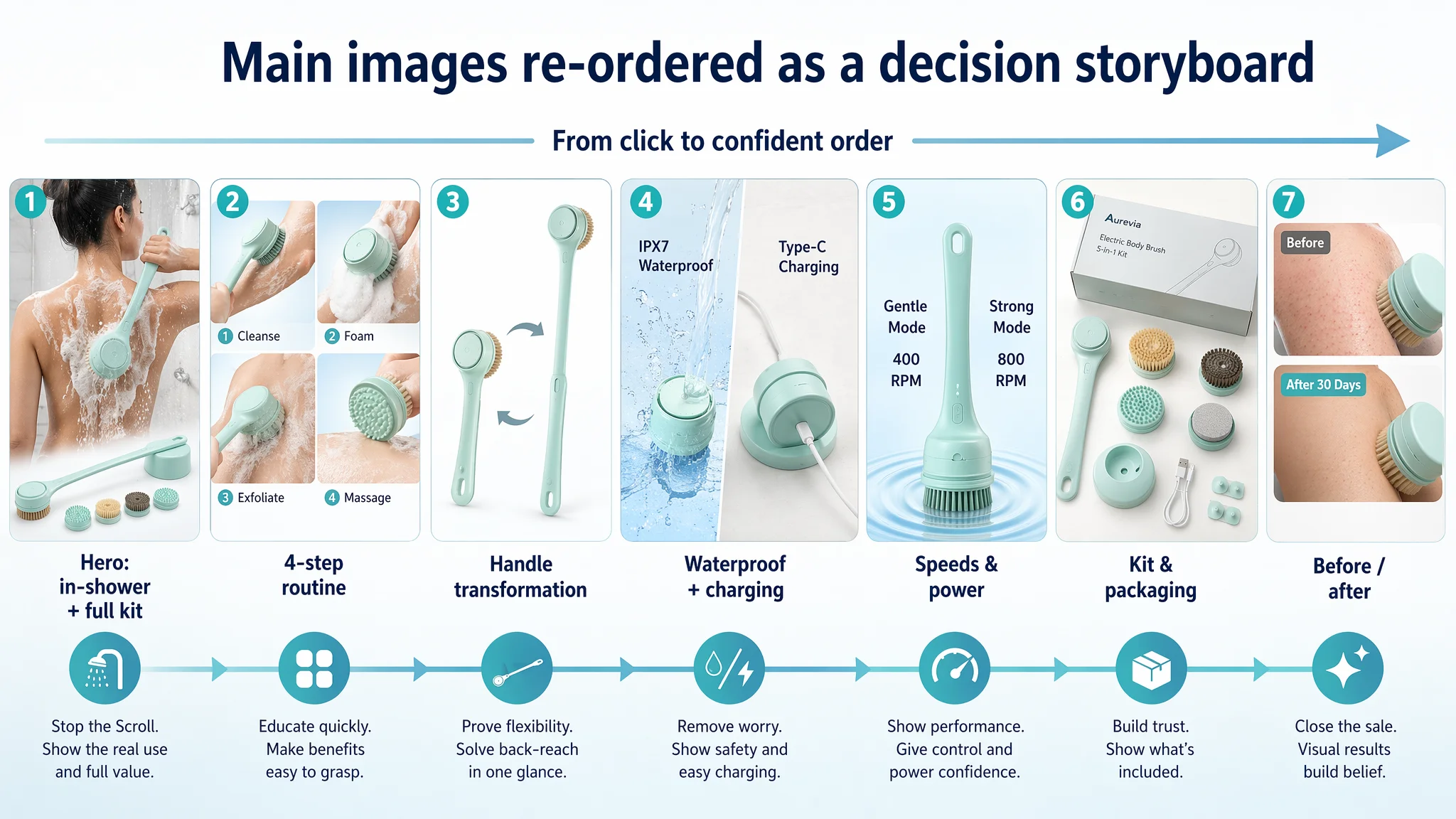 Key structural changes recommended:
1. Primary image: model + full accessory clarity
- Left: model’s back, in-shower use, brush in motion.
- Right: device + four visible heads (with a fifth in secondary image), clear handle length.
- Clean white background, natural light, droplets on skin, subtle brand logo.
Outcome: from first glance, Amazon shoppers see “real shower use + full kit” instead of an isolated gadget.
2. Function storyboard: four-step grid
- Grid showing cleansing, lathering, exfoliating, massage.
- Cropped body parts (arms, legs, back) in action.
- Short, bold captions.
Outcome: transforms abstract functions into tangible routines; reduces cognitive load.
3. Handle transformation visual
- Emphasis on detachable/extendable design.
- Mid-motion, short-to-long handle transformation.
Outcome: visually answers “Can I really reach my back comfortably?” without reading.
4. Waterproof + charging combined
- Device under running water with “IPX7” callout.
- Device on charging base with USB Type-C.
Outcome: condenses safety and convenience into one decisive image.
5. Speed & power visualization
- Centered product with radiating water/wave effects.
- Clear labels for “Gentle Mode” and “Strong Mode” with indicative RPM.
Outcome: makes “power” and “two speeds” feel concrete and controllable.
6. Kit contents & packaging
- Flat lay: long-handle device, 5 heads, cable, gift box.
- Size markers for total length.
Outcome: solves “what exactly do I get?” and reinforces gift positioning.
7. Before/after effect proof
- Side-by-side skin results after 30 days of use for strawberry legs/back oiliness.
- Consistent lighting to avoid “fake” perception.
Outcome: closes the gap between promise and proof at the image level.
8. Lifestyle final image
- High-aesthetic bathroom scene with product placed as part of a calm self-care ritual.
Outcome: upgrades perceived brand tier beyond “gadget” into “self-care tool.”
A+ Detail Page: Turning Features into a Conversion Funnel
For A+ specifically, DeepBI pushed a shift from “nice-looking brand visuals” to “conversion-driven modules” aligned with Amazon scanning behavior.
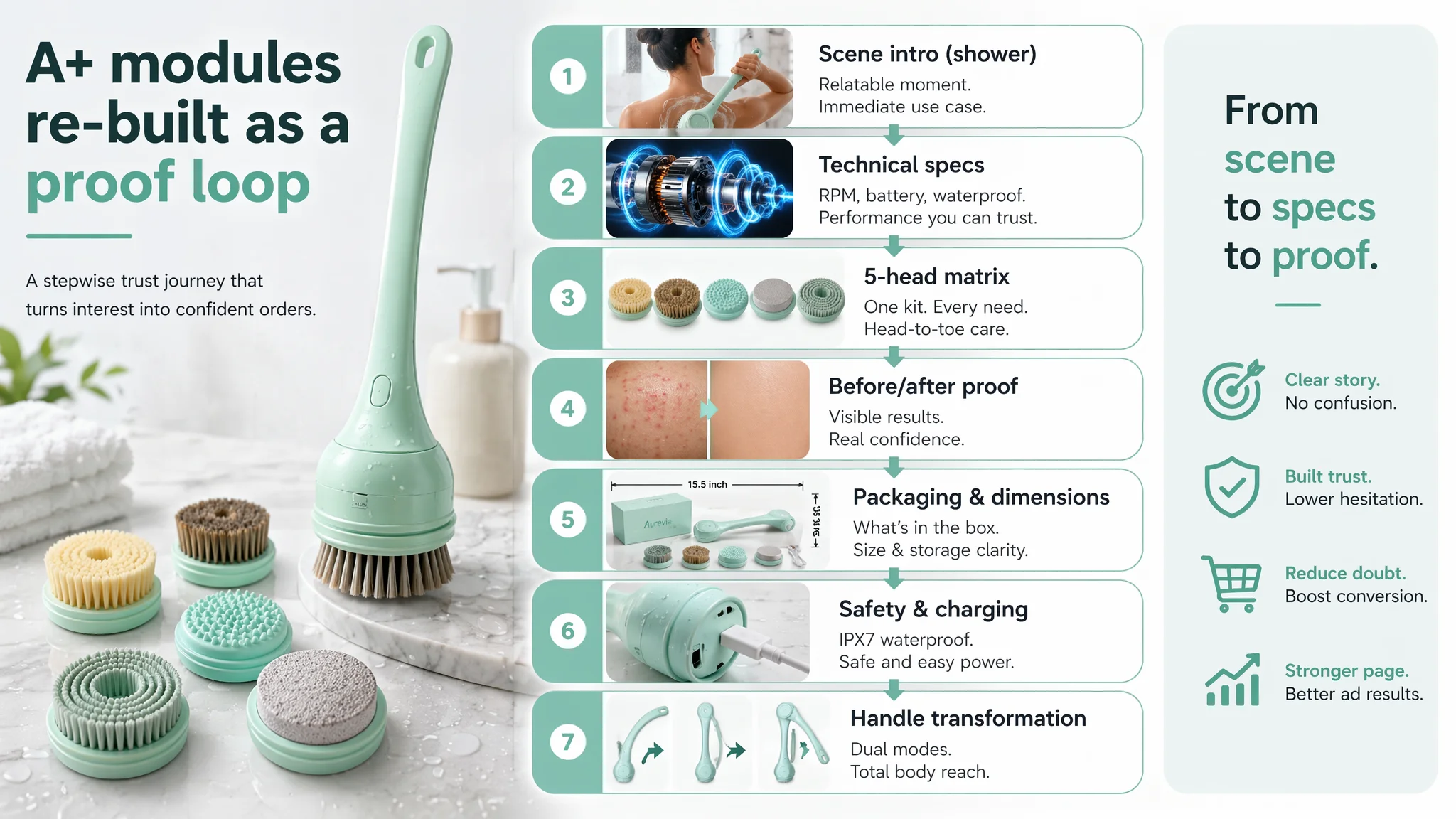 Key module logic:
1. Scene introduction
- Real shower scene, center composition, model washing back.
- Light, water droplets, marble wall backdrop.
Role: anchor the product in realistic shower use and avoid “catalog-only” feel.
2. Technical parameters & performance
- Motor 3D diagram + textual spec panel.
- Highlight battery capacity (e.g., 2000 mAh if accurate), rotation performance.
Role: reassure buyers with concrete numbers in a category where “power” often feels vague.
3. 5-head matrix
- Radiating layout around main device.
- Each head with close texture and “Deep Cleansing / Callus Remover / Massage” style tags.
Role: visually justify “5-in-1 value” in one glance instead of scattered mentions.
4. Before/after proof panel
- Left “before” (dull, clogged pores); right “after” (smoother skin).
- Product in use on the “after” side.
Role: create a clear mental bridge between usage and desired outcome.
5. Packaging, accessories, and dimensions
- Flat lay with box, all contents, and dimension lines.
Role: resolve purchase hesitation around fit, storage, and perceived value.
6. Safety and charging close-up
- Macro shot of Type-C port and waterproof sealing.
Role: neutralize “electric device in shower” anxiety.
7. Handle transformation logic
- Step-wise image showing how to change handle modes with arrows.
Role: ensure the dual-handle advantage is fully understood without reading dense text.
Taken together, this A+ structure moves from “we have many features” to “here is how it works, why it is safe, what you get, and what results you can expect.”
What Changed for the Business (Even Without Inventing Numbers)
Because this case is focused on the Listing-diagnosis stage, we will not invent specific post-optimization metrics. What clearly changed, however, was:
Operating risk
- The Listing went from “promise-heavy, proof-light” to a more balanced narrative.
- Visual and structural gaps vs. the Amazon benchmark were explicitly mapped and addressed.
- The risk of scaling Amazon ads into a low-conversion page was reduced.
Conversion foundation
- Title alignment with everyday shower/body-brush intent expanded the addressable search space.
- Main-image sequence started to:
- Justify clicks,
- Build trust,
- Pre-answer core doubts (reach, waterproof, charging, kit contents).
- A+ modules turned from aesthetic showcases into a stepwise conversion funnel: scene → spec → differentiation → results → safety → completeness.
Usefulness of ad traffic
- Once the Listing’s visual and trust architecture were rebuilt, each paid click had a higher chance of turning into a confident order.
- Ads could now test a fundamentally stronger page, allowing ACOS and TACoS to reflect true product-market fit instead of Listing weaknesses.
The seller’s understanding
Perhaps the most important shift was conceptual:
- They stopped assuming that “more intense pain-point copy” would fix weak sales.
- They saw plainly that being more advanced in text (bullets) than the benchmark does not matter if your images and A+ underperform on proof and reassurance.
- They internalized that, on Amazon:
- Listing quality is the foundation of ad efficiency.
- Title, main image, bullets, A+, and reviews have to work as a single conversion system.
- Before scaling ads, the team must ask: “Does this page visually and structurally deserve more traffic?”
For other Amazon sellers in similar categories—beauty devices, shower accessories, personal care—the takeaway is direct: if you are already promising strong results but ads remain hard to optimize, the issue is often not in the bids or in “insufficiently sharp” copy. It is in whether your Amazon product page makes those promises feel low-risk, visually proven, and technically solid within a few seconds of scanning. That is where DeepBI chose to intervene first in this case, and that is where traffic finally had a chance to become business.