

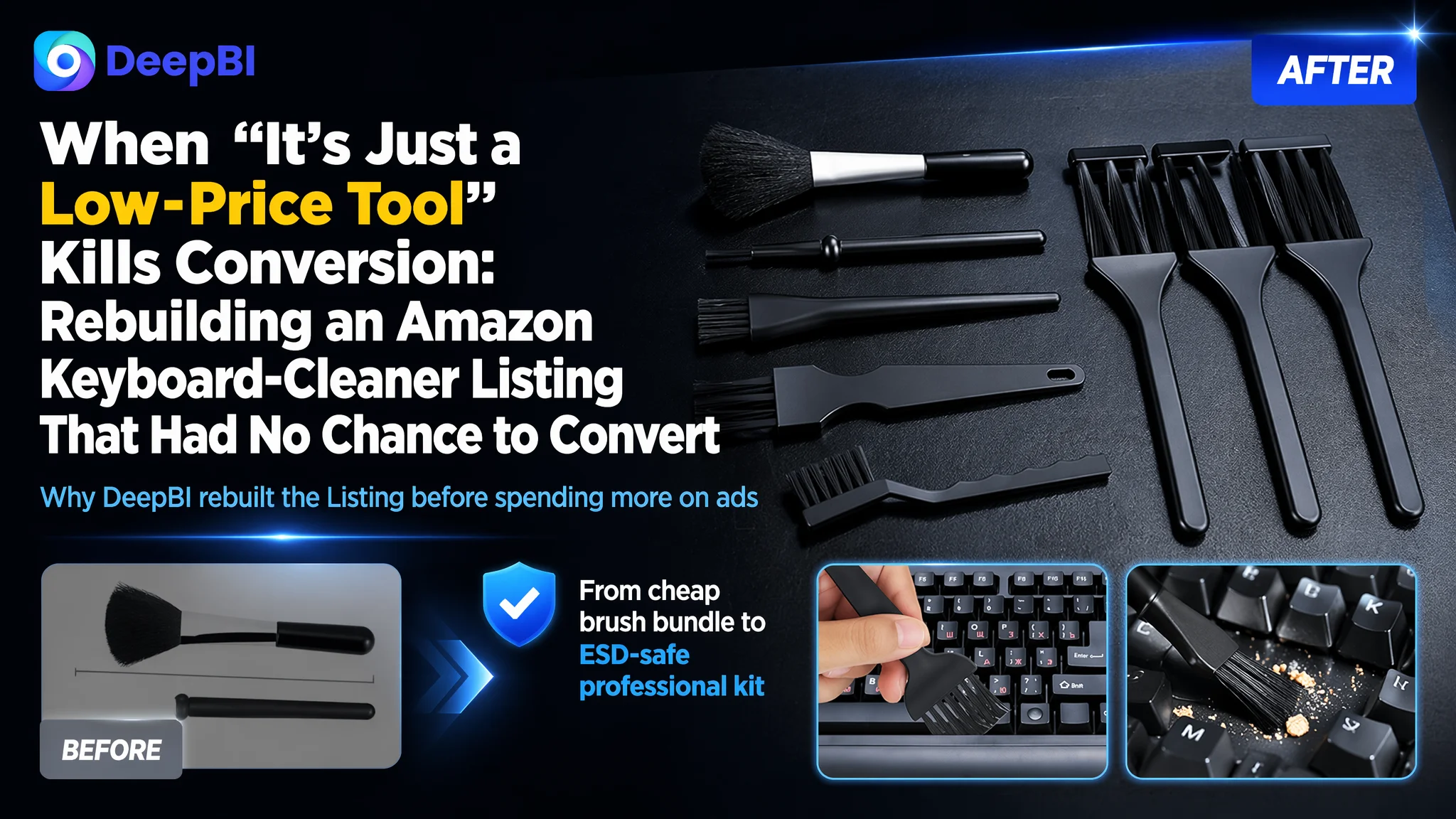
An Amazon seller in the UK electronic-accessory category launched a 9-piece anti-static brush kit for cleaning keyboards and delicate electronics. Ads were planned, but before any meaningful Amazon ads scale-up, one hard fact appeared: the Listing itself had almost no conversion foundation. Against a mature benchmark keyboard-cleaner kit, the product page scored 41/100 versus 85/100 — and had zero reviews.
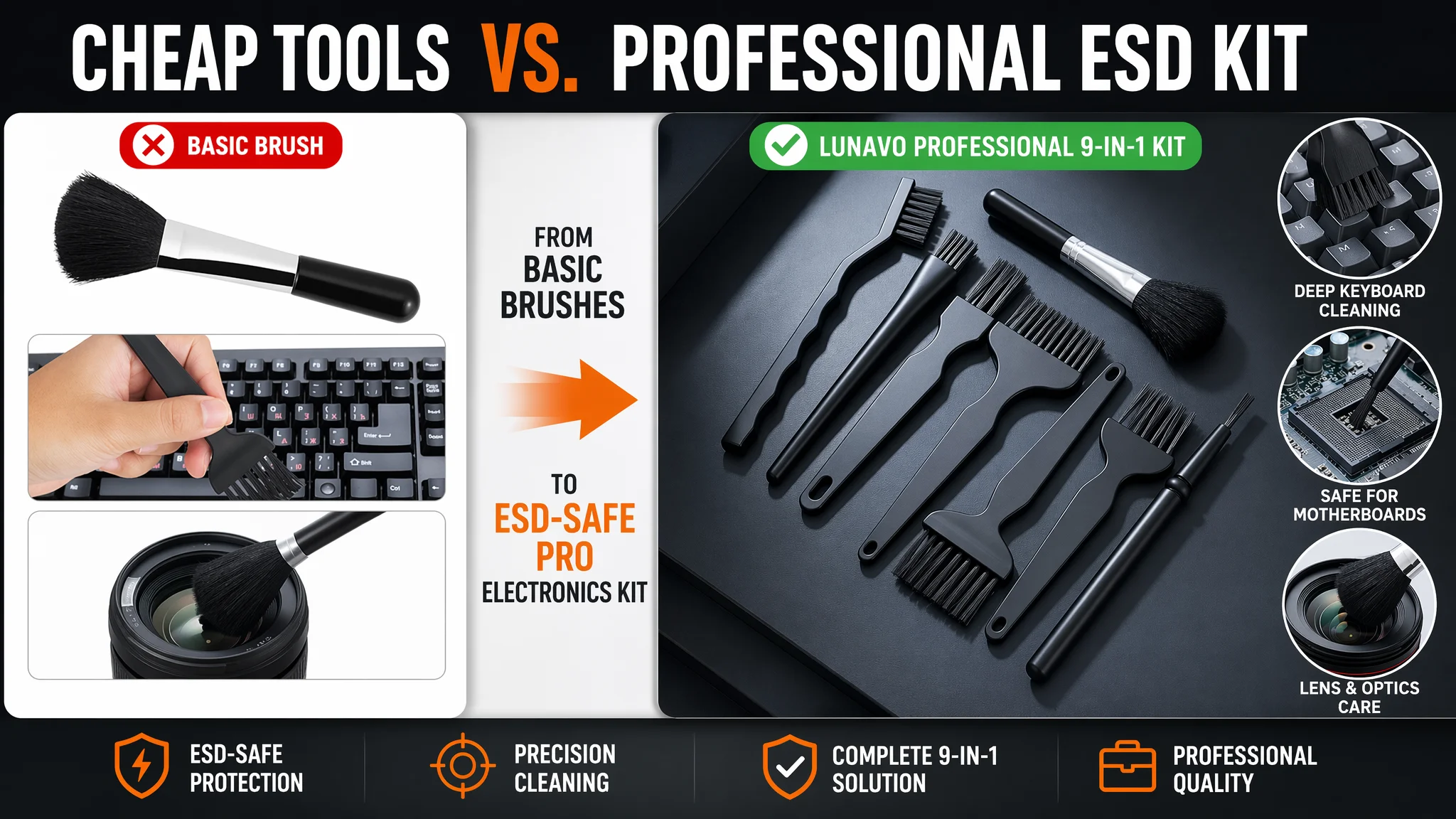
The seller’s first instinct was predictable: “Let’s tweak keywords, maybe change a photo, then push more traffic.” In their view, the problem was insufficient exposure and not enough search reach on Amazon. DeepBI’s Listing scoring quickly showed a different story: the largest gap was not in the title or bullets, but in the complete absence of A+ content, weak visual storytelling, and no social proof. This was not a traffic problem; it was a conversion and trust problem.
Once the issue was reframed, the optimization strategy shifted. Instead of squeezing Amazon ads and keywords harder, the focus moved to rebuilding the entire Amazon product-page logic: repositioning the main-image set from “cheap brushes” to “ESD-safe precision electronics kit”, restructuring bullets around deep-cleaning outcomes, and planning a full A+ visual chain that mirrors the benchmark’s before/after, multi-device, and precision-cleaning story. For other Amazon sellers, this case is a reminder: when a Listing’s core conversion assets are missing, ad optimization doesn’t just fail — it amplifies the loss.
This Amazon Listing Did Not Lack Traffic. It Lacked a Conversion Engine.
Seen purely from the surface, this keyboard/electronics-cleaner kit looked “workable”:
- A 9-piece anti-static ESD brush set
- Professional-sounding keywords in the title
- Some basic product images
The seller’s concern was whether Amazon ads and keyword setup would be enough to gain exposure against a strong competitor in the UK marketplace.
DeepBI’s Listing scoring, however, placed the page in a very different light:
- Total score: 41/100 vs benchmark 85/100 (–44 points)
- Title: 13/20 vs 15/20 (gap –2)
- Main images: 21/30 vs 27/30 (gap –6)
- Bullet points: 6/10 vs 8/10 (gap –2)
- Detail / A+ content: 0/25 vs 23/25 (gap –23)
- Reviews: 1/15 vs 12/15 (gap –11)
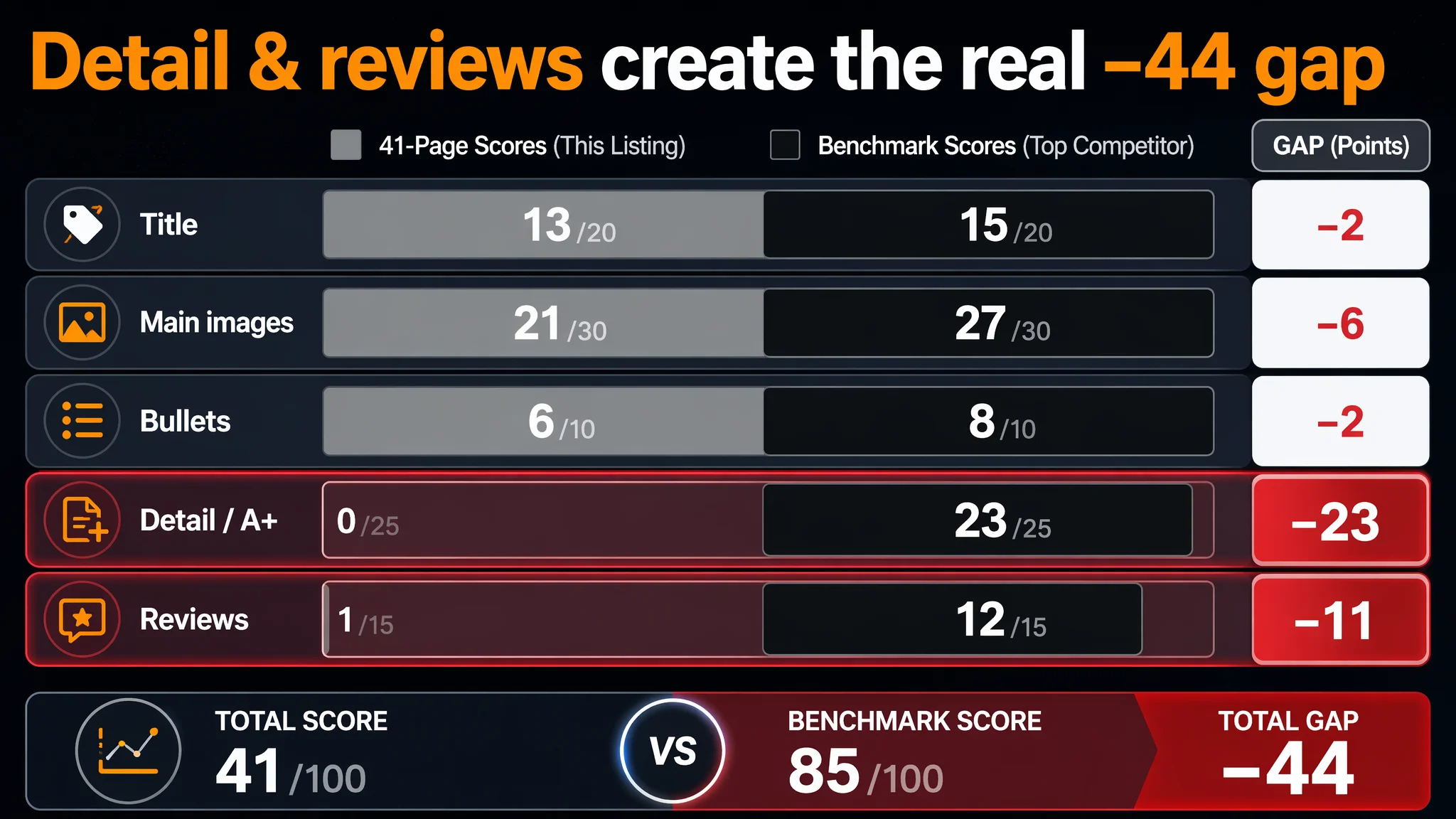
“The real problem was not that ads failed to bring traffic. It was that the page could not convert the traffic.”
With no A+ content at all and zero reviews, this Amazon Listing was structurally incapable of carrying ad traffic, especially in a category where the benchmark product already had 4.4 stars and 6,700+ reviews plus a full A+ visual story.
The Original Misdiagnosis: “We Just Need Better Keywords and Cheaper Clicks”
From the seller’s perspective, the situation looked like a classic advertising challenge:
- The product is professional (anti-static, ESD-safe).
- The title includes technical terms and multiple device keywords.
- The category isn’t hyper-saturated like phone cases.
The working assumption was:
- Low visibility → Not enough clicks → Let’s improve title keywords and adjust bids.
That led to a familiar optimization loop many Amazon sellers will recognize:
- Experiment with more search terms.
- Watch ACOS and clicks.
- Consider minor visual tweaks, but still treat ads as the main lever.
This approach missed one decisive fact: the benchmark Listing was not winning because of slightly better keywords. It was winning because its entire product page — title, imagery, A+, reviews — worked as one integrated conversion system.
When DeepBI compared the two Listings side by side, it became obvious that even if ads delivered qualified traffic, this product page had very little chance of converting at scale.
Where the Real Constraint Was: Listing Conversion Capacity, Not Ad Settings
DeepBI’s scoring and competitor comparison exposed a single core bottleneck:
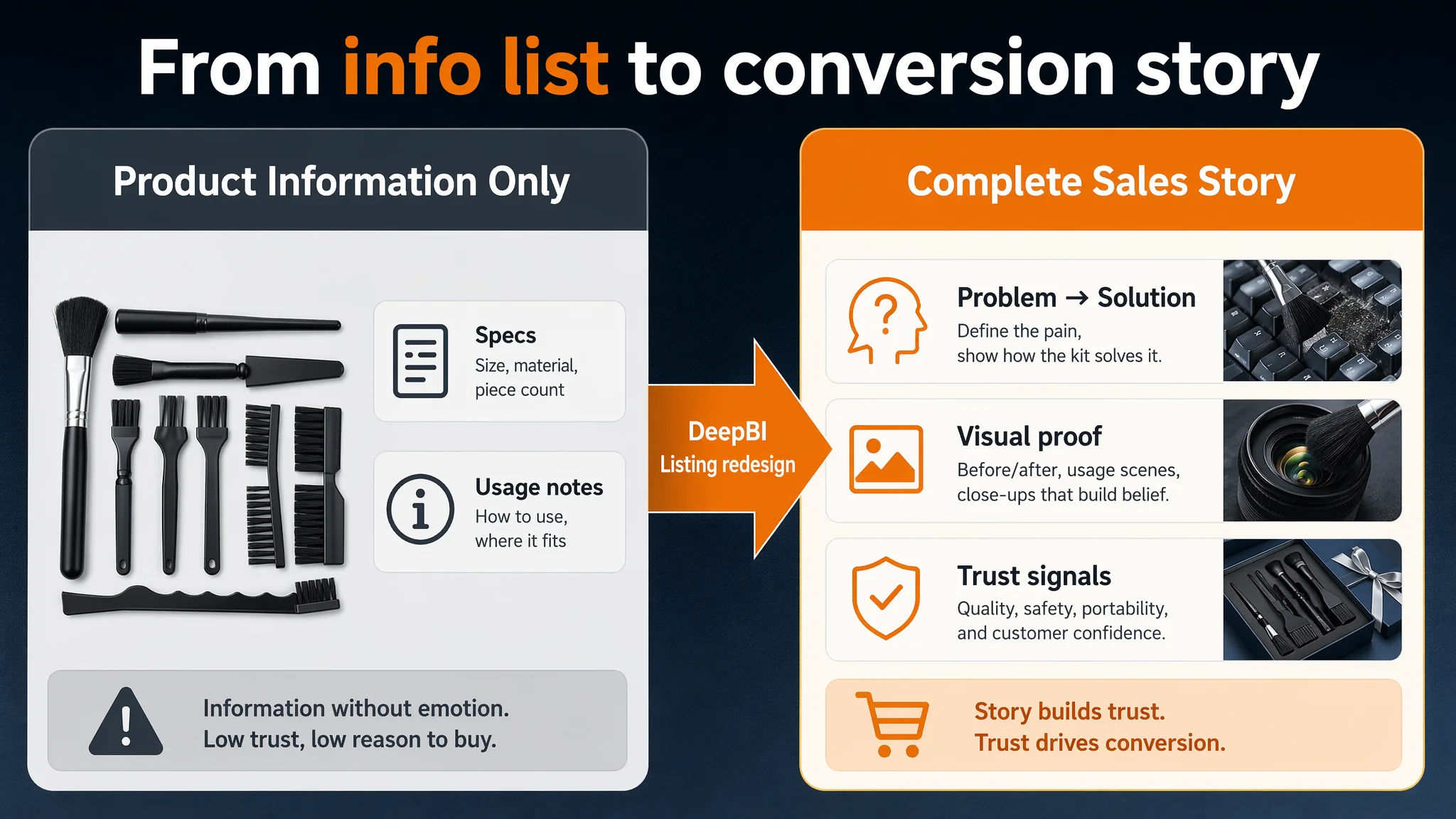
The Listing did not have a complete, trustworthy sales story. It only had product information.
1. Title: Technically Correct, But Not Decision-Orientated
- The seller led with “9-Piece Anti-Static ESD Detail Brushes Kit”, emphasizing specs and technical attributes.
- The benchmark led with “Keyboard Cleaner Laptop Cleaning Kit” and repeated “Keyboard Cleaning Kit / Cleaner / Tool” — aligning strongly with how Amazon buyers actually search.
Key gaps:
- The seller’s title front-loaded technical jargon (“Anti-Static Nylon”, “ESD Detail Brushes”) that normal Amazon shoppers do not search for directly.
- Critical high-intent search terms like “keyboard cleaner”, “cleaning kit”, “laptop cleaner” were less central or fragmented.
- The benchmark title stacked everyday use cases and device names (“MacBook, iPad, iPhone, Computer”), making it crystal clear: “This solves your device-cleaning problem.”
So while the seller had some professional credibility, the title did not “hook” mainstream search behavior or make an immediate outcome promise.
2. Main Image Set: “Basic Brushes” vs. “Professional Kit That Solves Problems”
The main-image dimension showed a –6 point gap that went beyond aesthetics:
- Seller images: felt like a basic brush assortment on plain backgrounds, minimal story.
- Benchmark images: transparent case + modular layout + orange/white color accents, plus:
- Clear multi-tool “10-in-1” story
- Usage scenes (keyboards, screens, ports, lenses)
- Before/after impact and quality proof
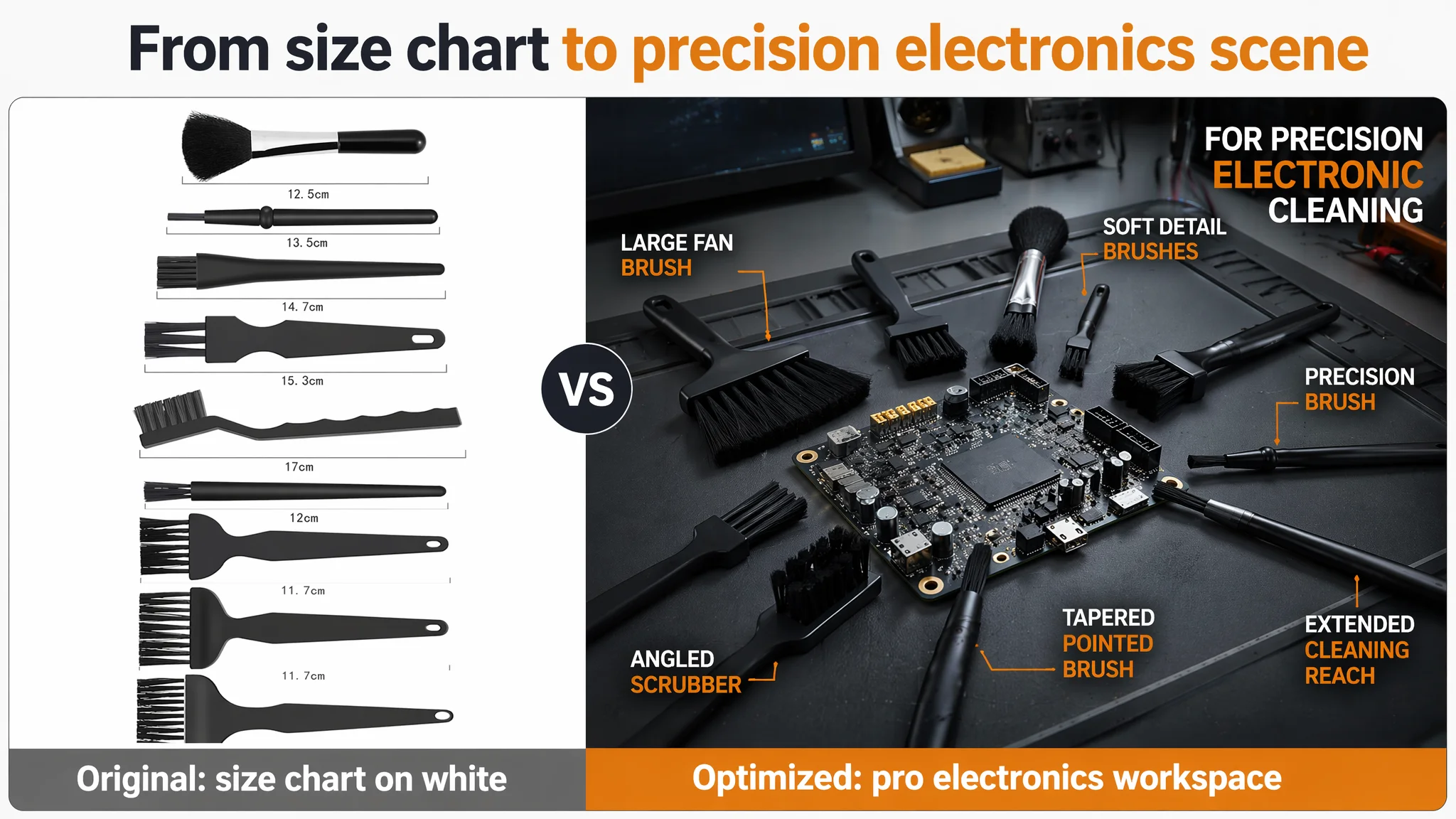
Impact on Amazon behavior:
- Lower CTR (click-through rate) risk: scroll-stopping power was weak. The benchmark immediately looked like a specialized electronics-cleaning solution; the seller’s thumbnails looked like generic brushes.
- Weaker price anchoring: the benchmark framed itself as a professional integrated kit, supporting a stronger price-perceived-value equation. The seller’s visual impression stayed at “cheap bundle of tools”.
3. Bullet Points: Information Without a Persuasive Path
DeepBI’s evaluation of bullets identified a structural difference in how the two Listings talked to the buyer.
Benchmark bullets:
- Headings built on core value: “DEEP CLEAN YOUR DEVICE”, “PROFESSIONAL KEYBOARD CLEANING KIT”.
- Clear problem → solution → result logic (deep cleaning between keys, zero scratches, no fiber shedding).
- Strong outcome promises: clean screens, no streaks, safe for delicate surfaces.
Seller bullets:
- Headings focused on specs and features, not outcomes.
- Content read like a mini user manual: specs, how to use, where it can be used.
- Almost no explicit “what you get after using this” wording.
In practice, this meant:
- The seller was communicating, but not really selling.
- Bullets did not reduce anxiety about scratching screens or damaging expensive devices.
- There was no strong sense of “this kit solves all your device-cleaning problems in one go.”
The Biggest Hole: A Completely Missing A+ Story
The most damaging gap was in the detail page / A+ content:
- Seller: 0/25 — no A+ modules at all.
- Benchmark: 23/25 — a mature A+ layout with multiple high-impact modules.
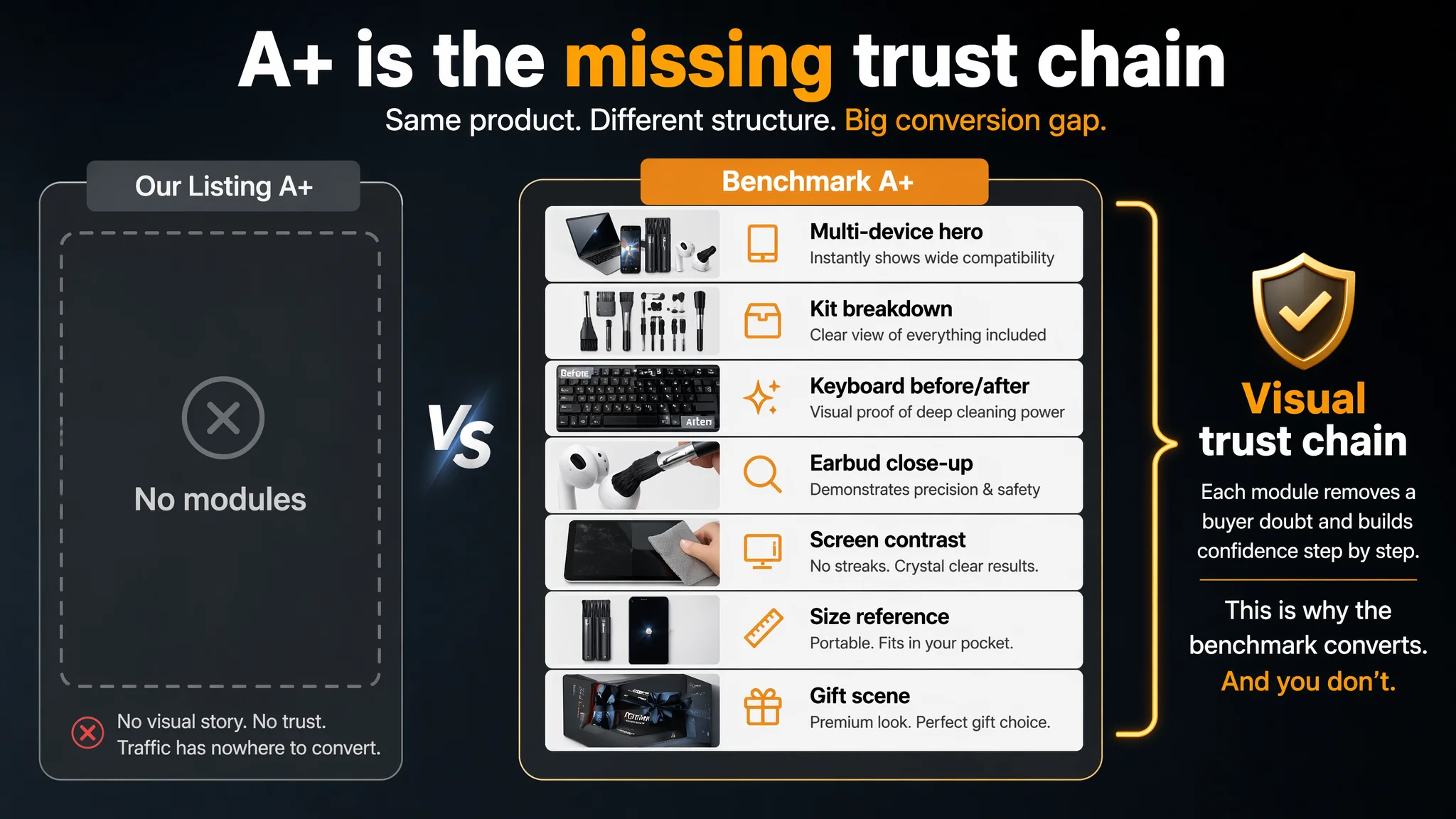
The benchmark’s A+ structure did several things simultaneously:
- Introduced the kit alongside laptops, phones, earbuds — instantly answering “Is this for all my devices?”
- Used exploded views and full breakdowns of all tools, clarifying value and what’s in the box.
- Showed before/after keyboard shots, directly attacking the “dust in keys” pain point.
- Used micro close-ups of earbud cleaning, underlining precision and safety.
- Visualized screen cleaning with fingerprint vs. crystal-clear sides.
- Demonstrated portable size with a phone comparison.
- Positioned the kit as a giftable electronics accessory with a proper box scene.
The seller’s Listing had none of these trust-building, problem-solving visuals.
“Advertising does not only amplify advantages. It can also amplify a page’s existing defects.”
In this state, pushing more Amazon ads would just expose more buyers to a page that lacked:
- A clear all-device story
- Visual proof of cleaning effectiveness
- A feeling of precision and ESD safety
- A reason to trust a brand-new, unrated product
Reviews: Facing a Trust Wall With Zero Social Proof
Finally, the review dimension made the page nearly uncompetitive in cold traffic:
- Seller: 0 reviews, 0 rating.
- Benchmark: 4.4 stars, 6,764 reviews, 13 rich front-page reviews (including video and multiple languages).
For an Amazon buyer choosing between:
- A zero-review brush kit with minimal visuals
- A full-kit “Keyboard Cleaning” solution with thousands of reviews and detailed A+ content
…the decision is almost predetermined, especially when both are in a similar price territory.
No amount of early ad tweaking can compensate for this trust gap. What can be done, however, is raising the Listing’s perceived professionalism and clarity so that early organic or small-scale paid traffic has a realistic chance of converting — and starting to build the first layer of reviews.
Why DeepBI Did Not Recommend “Tune Ads First”
Given the data, DeepBI’s judgment was straightforward:
- Core bottleneck: Listing conversion capacity (especially A+ and visual trust), not keyword density or bid settings.
- Biggest risk: Allowing Amazon ads to push traffic into a structurally weak page would waste budget and delay review accumulation.
So instead of “optimize campaigns and hope conversion catches up,” the decision path was:
1. Stabilize the Listing’s sales logic first.
2. Only then consider ramping Amazon ads, once each click lands on a page capable of persuasion.
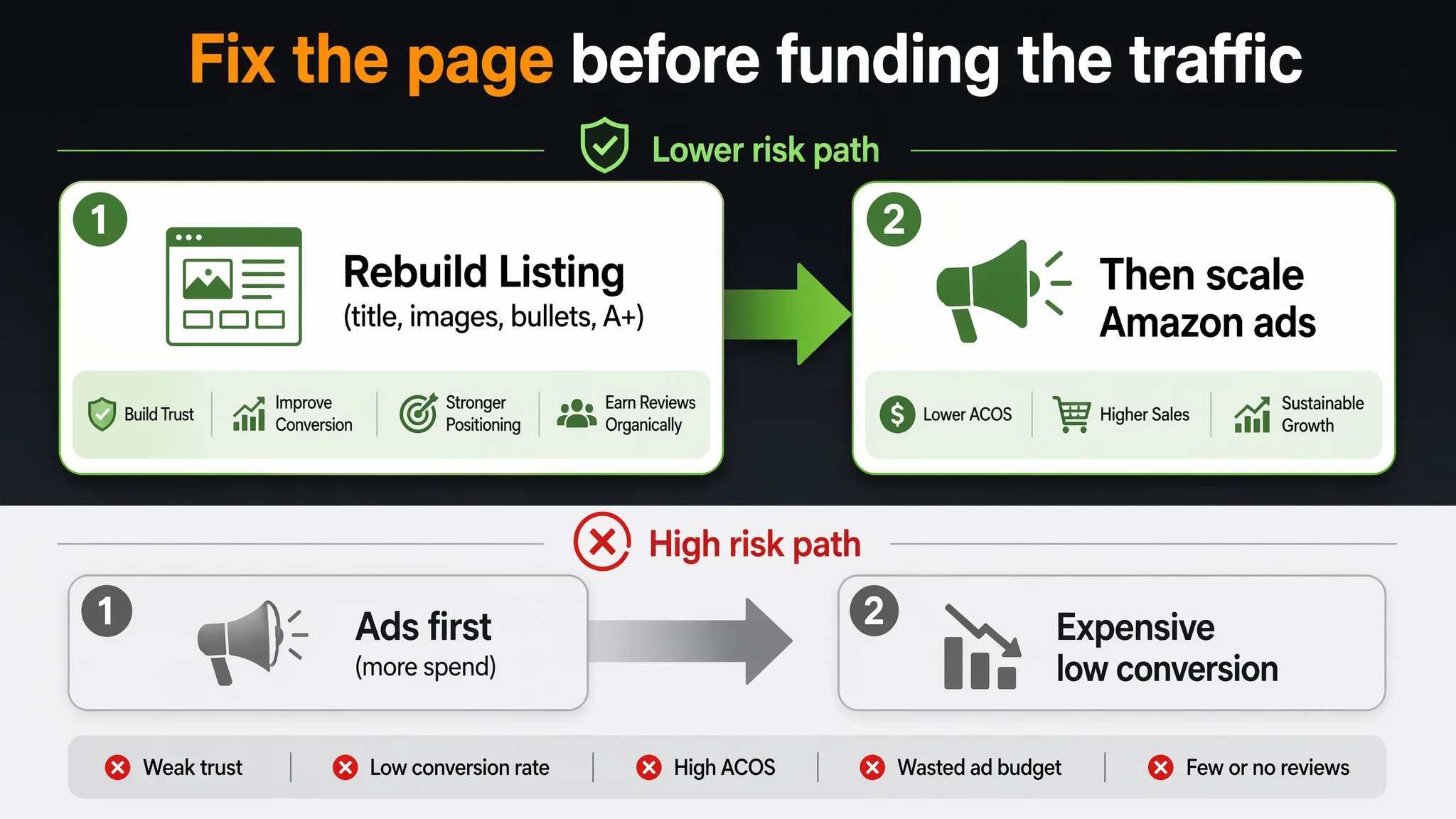
This order of operations matters because:
- With 0/25 detail score and 1/15 review score, every extra click is high-risk spend.
- A strong A+ story can raise CVR enough to make initial ads viable, even before a large review base accumulates.
- Once early conversions and reviews begin to appear, ads are no longer compensating for a fundamentally incomplete page — they are amplifying an already-competent Listing.
How the Optimization Focus Shifted: From “Brushes” to “Professional ESD Kit”
Instead of chasing abstract “better visuals”, the optimization was anchored on specific gaps identified vs. the benchmark.
1. Reframing the Title Around Search and Use Cases
Original logic: lead with technical kit description.
Reframed logic:
- Maintain technical differentiation (Anti-Static, ESD-safe), but not as the only front element.
- Integrate everyday device keywords that match Amazon search behavior.
Suggested structure:
9-Piece Anti-Static ESD Detail Brushes Kit, Professional Electronics Cleaning Tool for Keyboard, MacBook, Laptop, PC, PCB Motherboard, CPU, Camera Lens, Computer Dust Removal Cleaning Brush Set
Key adjustments:
- “Kit” + “Electronics Cleaning Tool” strengthen the perception of an integrated solution.
- “Keyboard, MacBook, Laptop, PC” widen search alignment beyond “PCB motherboard”.
- Technical strength (“Anti-Static”, “ESD Detail Brushes”) is preserved as a differentiator, but no longer isolates the listing to niche professional language.
2. Turning Bullets Into a Conversion Path, Not a Spec Sheet
DeepBI’s suggestions for bullets followed the benchmark’s “value → proof → outcome” posture:
- Bullet 1 – COMPLETE 9-PIECE DEEP CLEANING SET
- From “9 tools exist” → to “this is your all-in-one solution for deep cleaning multiple electronics.”
- Bullet 2 – PROFESSIONAL ANTI-STATIC KEYBOARD KIT
- From generic function → to positioning around ESD safety for keyboards, PCBs, CPUs, internal components.
- Bullet 3 – VERSATILE SOFT-TO-FIRM OPTIONS
- From tool description → to specific guidance by surface type (screens vs vents, lenses vs vents/grilles), addressing both safety and power.
- Bullet 4 – MULTIFUNCTIONAL GADGET FOR ALL TECH
- From device list → to high-value electronics maintenance (cameras, game devices, ports, hinges) that justifies buying a “kit”, not a single brush.
- Bullet 5 – SAFE & EASY MAINTENANCE GUIDELINES
- From basic safety disclaimer → to clear, confidence-building guidance that reduces misuse and post-sale friction.
The bullets stop reading like a manual and start reading like a guided promise: deep clean, professional-grade, safe, multi-device, and easy to maintain.
Main Image Direction: From “Cheap Tool” to “Precision Industrial Feel”
DeepBI’s visual judgment was that the current Amazon main-image set signaled:
- Low-cost tool bundle
- Generic use
- Weak sense of electronics precision and ESD safety
To shift perception, the recommendations followed a coherent “precision industrial / tech” aesthetic:
- Dark grey or black backgrounds
- Cool, directional lighting
- Macro shots on PCBs, sensors, and delicate devices
- Contrasting accent typography (orange/white) stressing “ESD Safe Professional Kit”
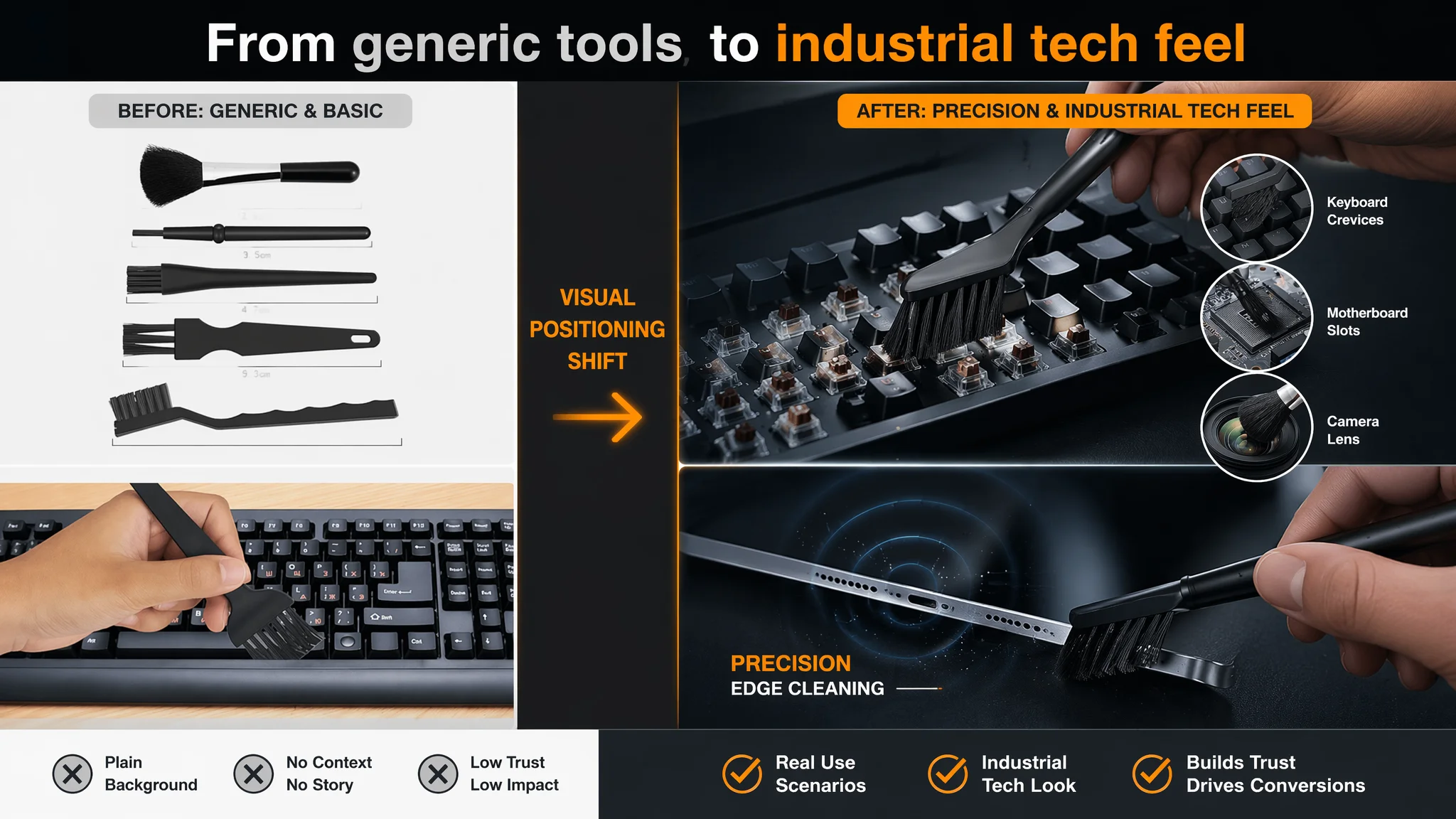
Specific storyboard ideas included:
1. Hero Image:
- Product group centered (≈60% frame), 45° top-down angle.
- Insets showing close-ups: cleaning keyboard gaps, motherboard slots, camera lens edges.
- Overlay text: “ESD Safe Professional Kit”.
2. Quality Comparison Image:
- Left: blurred generic brush.
- Right: this product’s bristles and handle details, full clarity.
- Vertical text callouts: “High-Density Bristles”, “Anti-Static Handle”, “Industrial-Grade Durability”.
3. Deep Cleaning Scene:
- Hand holding brush at 45°, cleaning an opened mechanical keyboard.
- Dark workspace, side lighting, bold “Deep Cleaning” label, subtext “Safe for Sensitive Electronics”.
4. Precision Edge Cleaning:
- Brush cleaning tablet frame edges.
- Dark, textured background, with subtle static-discharge ripple effect; label “Precision Edge Cleaning”.
5. PCB Professional Scene:
- Brushes arranged in a fan layout around a PCB.
- Cool grey tones, workshop atmosphere, slight rim light around brushes.
The point is not artistic flair. It is to make Amazon buyers instantly recognize:
- This kit is designed for electronics, not random household dusting.
- It is professional, precise, and ESD-aware, which helps justify price and encourage trust.
A+ Content: Rebuilding the Entire Trust and Use-Case Story
On the A+ level, DeepBI’s logic was to mirror the proven structure used by the benchmark while keeping the product’s unique ESD position intact.
Planned modules:
1. Opening Multi-Device Hero
- Product in the center, surrounded by a laptop, smartphone, and wireless earbuds on a dark, textured background.
- Purpose: instantly signal “works on all your devices” and establish a clean, tech-forward tone.
2. Full Kit Exploded View
- Opened kit or full brush set laid out with each tool clearly visible.
- Neutral white background, even lighting.
- Purpose: answer “Exactly what do I get?” and make the “multi-piece kit” claim visually credible.
3. Keyboard Before/After Pain-Point Module
- Left: dirty mechanical keyboard with dust and crumbs.
- Right: clean, high-gloss keys after using the large brush.
- Purpose: hit the primary use case most buyers care about immediately.
4. Micro-Precision Earbud Cleaning Close-Up
- Macro shot of the metal tip cleaning an earbud sound port.
- Purpose: prove precision and reassure buyers about cleaning high-value devices safely.
5. Screen Cleaning Contrast
- Tablet or monitor, half with fingerprints, half crystal clear after cleaning.
- Purpose: visualize “no scratches, no streaks, no residue” far more convincingly than text alone.
6. Portability & Size Comparison
- Product alongside a smartphone with clear dimensions.
- Purpose: quantify “compact and easy to carry” in a way buyers understand instantly.
7. Gift-Ready Presentation
- Kit in a refined gift box scene on a textured blue/dark background with ribbon accents.
- Purpose: open an additional gift-use scenario, supporting better positioning and price resilience.
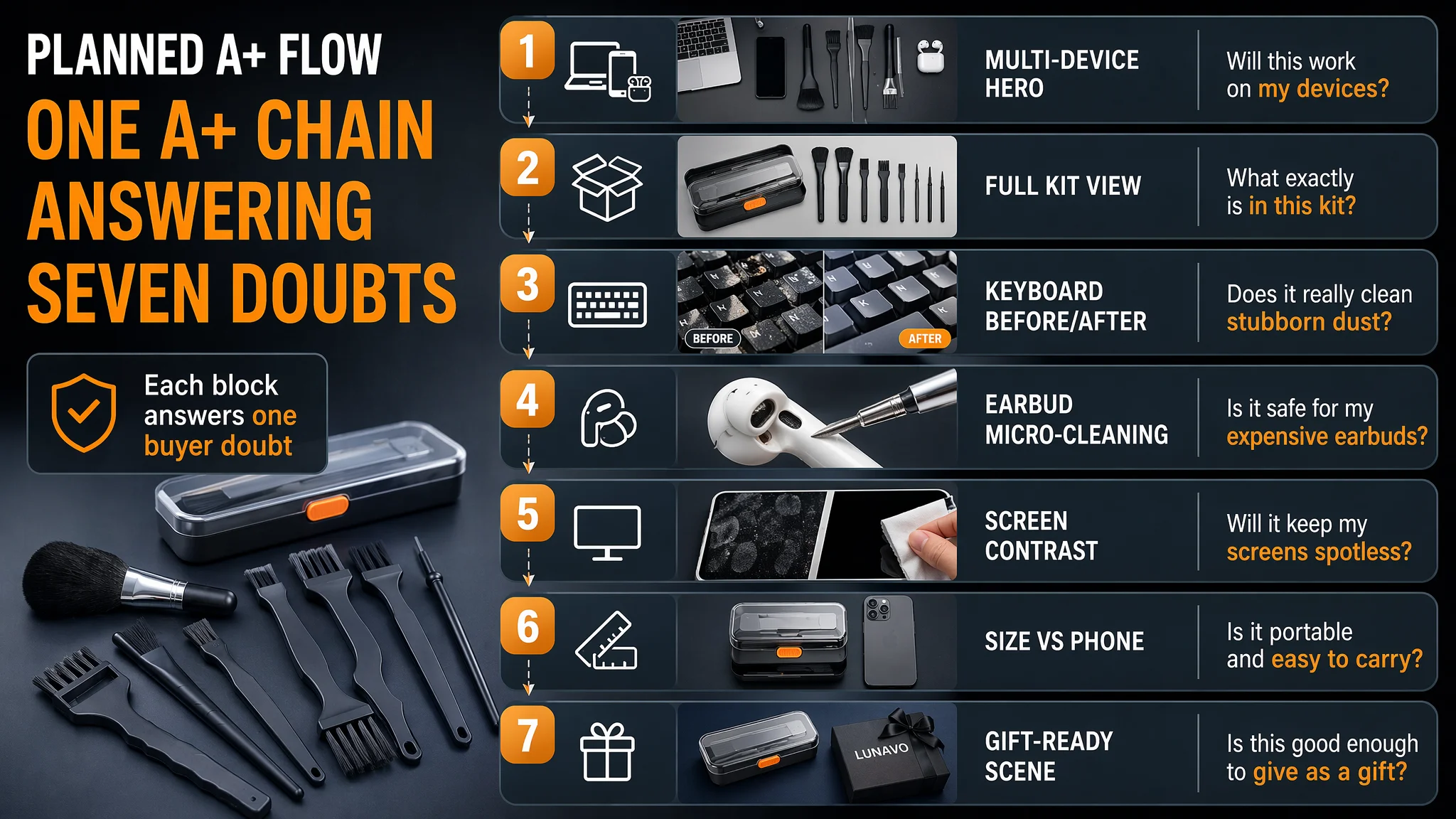
Each module answers a specific buyer doubt:
- “Will this work on my devices?”
- “What exactly is in this kit?”
- “Does it really clean stubborn dust?”
- “Is it safe for my expensive earbuds and screens?”
- “Is it portable?”
- “Is this good enough to give as a gift?”
Once these are addressed visually, the product page can convert a meaningful share of ad and organic traffic, even before thousands of reviews accumulate.
What Changed in the Business State — Even Before Hard Numbers
This case did not center on a massive post-optimization dataset; it centered on a change of operating risk and decision logic:
- The seller stopped assuming that ads alone would solve slow sales.
- They accepted that, with a 41/100 vs 85/100 Listing gap, ad spend would be risky unless the page was rebuilt.
- The focus shifted to:
- Upgrading Listing structure (title, bullets, main images).
- Planning a complete A+ trust and usage story.
- Creating a more coherent, professional Amazon presence that deserves traffic.
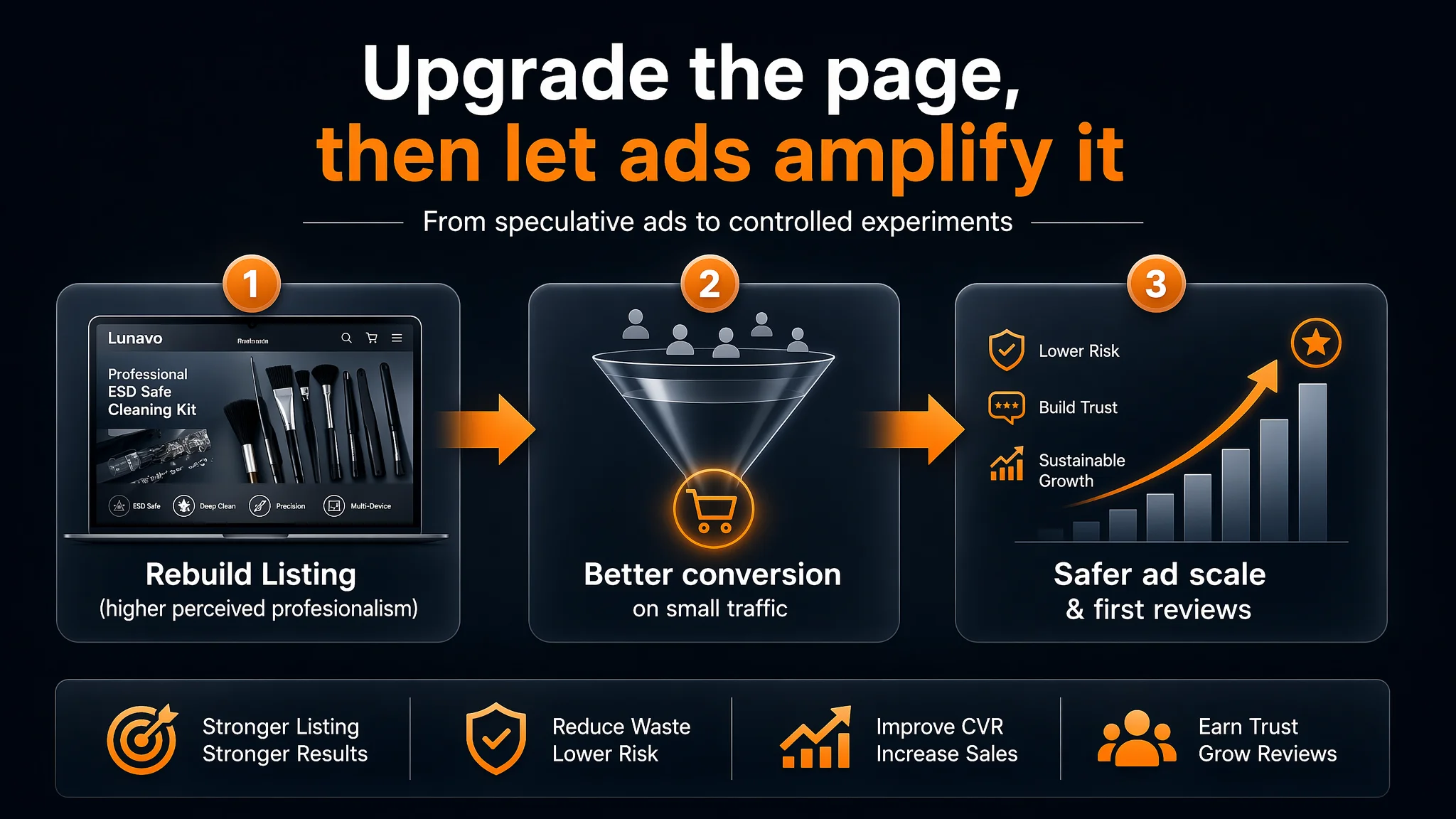
As these changes are implemented, the expected trajectory is:
- CVR begins to recover from a structurally low base.
- Ad traffic becomes useful again — clicks reach a page that can justify purchase.
- Early orders help start building the first layer of review trust, which further stabilizes conversion.
- Dependence on “cheap clicks” declines; Listing quality, not ad aggression, carries more of the revenue.
What Other Amazon Sellers Can Take From This Case
Three key points emerge for Amazon operators:
1. High ACOS or low sales are not always ad problems.
If your Listing has:
- No A+ content,
- Weak, generic images,
- Zero or minimal reviews,
then even the best ad structure will underperform. Diagnose page conversion capacity before touching bids.
2. Listing elements must work as one sales logic, not as isolated parts.
Title, main image, bullets, and A+ are not separate tasks. They must collectively answer:
- What is this?
- Who is it for?
- What problems does it solve?
- Why trust this particular product?
3. Advertising amplifies whatever is already true on your page.
- If the page is incomplete and unconvincing, ads amplify wasted spend.
- If the page clearly demonstrates value, safety, and outcomes, ads amplify profitable growth.
In this keyboard-cleaner case, DeepBI’s value was not in producing “nicer” images or “better” copy in the abstract. It was in identifying that the real bottleneck was Listing conversion capacity, not advertising mechanics — and forcing a strategic reset before more money went into an Amazon page that could not yet sell.