

For this Amazon seller in the outdoor garden-fencing category, the pressure started where most sellers feel it first: on the advertising side. Clicks were not cheap, ACOS was hard to push down, and the team’s first reaction was to keep polishing Amazon ads—bids, keywords, campaign structure—hoping to “optimize their way out” of the problem. But traffic was not turning into stable orders, and every extra dollar of spend felt more like a gamble than an investment.
Once DeepBI put their Amazon Listing under the microscope against a strong benchmark in the same “vinyl coated welded wire fence” niche, the story changed. The page scored only 68/100 versus the competitor’s 85/100, and the real gap was not in traffic volume, but in the Listing’s ability to convert that traffic. Title structure, main-image logic, A+ content depth, and above all the almost non-existent review base meant the product page simply could not carry the weight of paid clicks.
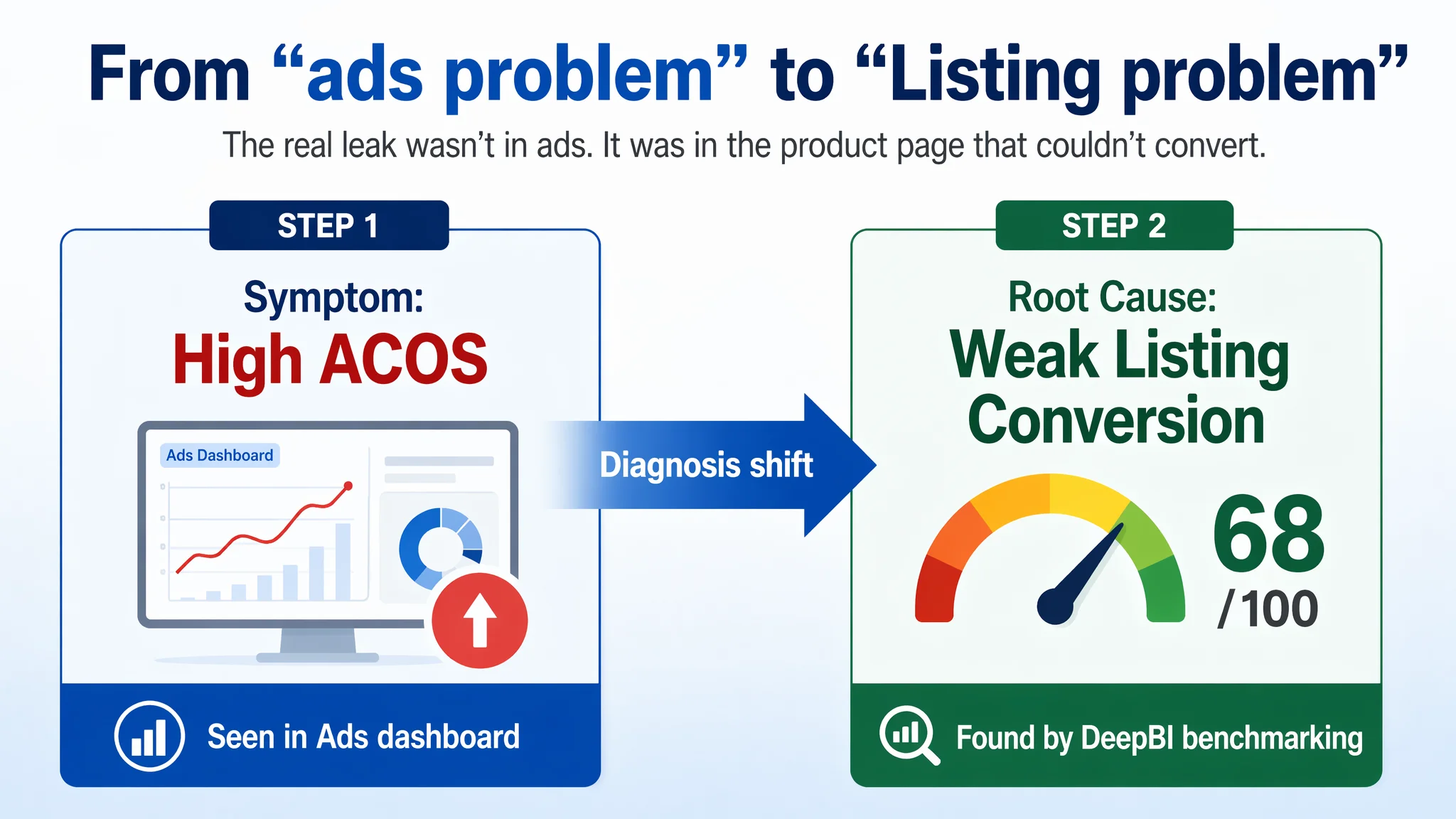
The later optimization path therefore shifted away from “keep tuning ads” toward “rebuild the product page’s sales logic”: refocusing the title around the right Amazon keywords, reshaping main images into a professional outdoor/industrial style with clear use cases, and restructuring bullets and A+ content to answer real buying questions and visualize durability and protection. For other Amazon sellers, this case is a reminder: when ads feel “inefficient,” the real bottleneck may be that your Listing has never been truly equipped to convert the traffic you are already paying for.
The Symptom: Ads Felt Expensive, but the Listing Was the Real Leak
From the seller’s perspective, the situation looked familiar:
- Paid traffic was there.
- Orders were inconsistent.
- ACOS was stubborn.
- Experience-based ad tweaks were producing weaker and weaker improvements.
Because the pressure was showing up inside the Amazon ads dashboard, the initial assumption was straightforward: this was an “advertising optimization problem.” The team spent energy on:
- Adjusting bids and budgets.
- Expanding and refining keyword lists around “wire fence,” “garden fence,” “dog fence,” and related terms.
- Tweaking campaign structure to separate branded vs. non-branded, generic vs. long-tail.
But none of these moves addressed a simple fact: the Listing itself was significantly weaker than a comparable high-performing competitor in the same subcategory.
“The real problem was not that ads failed to bring traffic. It was that the page could not convert the traffic.”
Until that point, the seller had never had a quantified picture of where, exactly, their Listing lost the sale.
What the Data Actually Showed: A 68 vs. 85 Listing Gap
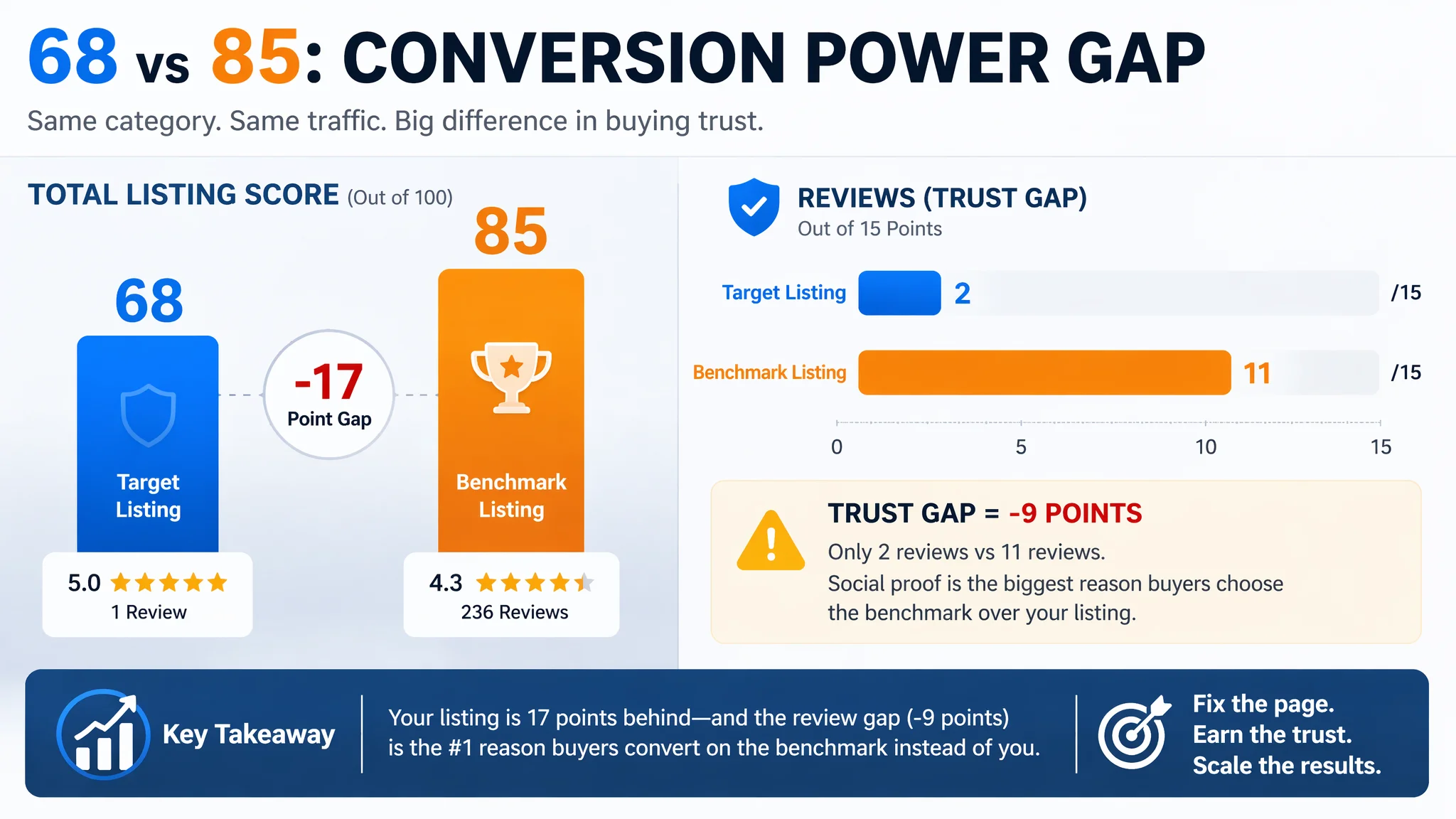
When DeepBI benchmarked the target Amazon product page—a black vinyl-coated welded wire fence roll—against a strong competitor in the US marketplace, the total Listing score was:
- Target Listing: 68 / 100
- Benchmark Listing: 85 / 100
- Gap: -17 points
Broken down by dimension:
- Title: Target: 15, Benchmark: 17, Max: 20, Gap: -2
- Main Image: Target: 25, Benchmark: 26, Max: 30, Gap: -1
- Bullet Points: Target: 7, Benchmark: 8, Max: 10, Gap: -1
- Detail / A+: Target: 19, Benchmark: 23, Max: 25, Gap: -4
- Reviews: Target: 2, Benchmark: 11, Max: 15, Gap: -9
Two things stand out:
1. No dimension was decisively superior to the benchmark. Everywhere that mattered—title, main image, bullets, A+—the seller was slightly behind.
2. Reviews and social proof were almost non-existent. The product had a 5.0 rating, but just 1 review. The benchmark had 4.3 stars with 236 reviews. That is a trust gap you cannot “bid away” with ads.
So while advertising spend was very visible, the underlying conversion engine—the product page—was underbuilt relative to category standards.
The Original Misdiagnosis: “We Just Need Better Ads”
The customer team’s early thinking followed a common pattern:
- ACOS feels high → ads must be inefficient.
- Ads are inefficient → we must tune keywords, bids, and campaign structure more aggressively.
- If we push harder on targeting and budgets, volume will eventually make up for it.
This mindset hides two risks:
1. Ads were being asked to solve a trust problem. A page with thin social proof and incomplete decision content can only do so much, no matter how accurate your targeting is.
2. Each new click was compounding waste. Additional traffic was simply reinforcing a weak Listing, pulling more spend through a funnel that leaked at the product-page stage.
The customer was operating as if ads were an isolated system. DeepBI treated ads and Listing conversion as one connected engine—and the diagnosis shifted.
Why Traditional Ad Optimization Could Not Move the Needle
Looking at the Listing in isolation, it was clear why ad-side tweaks could not unlock performance.
1. Search Intent Was Not Fully Captured in the Title
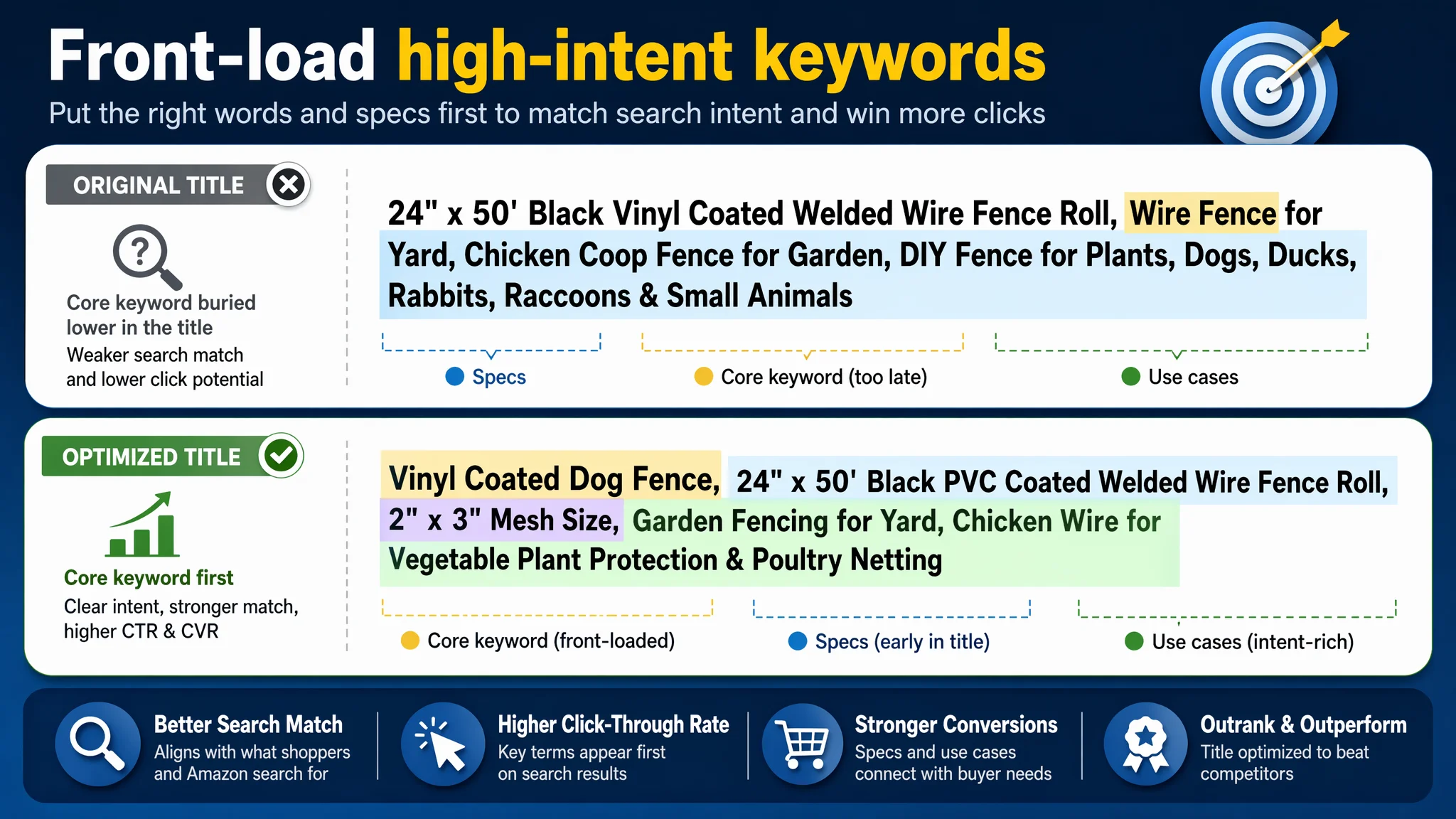
The original title:
- Placed the core keyword “Wire Fence” in the second half, rather than in a front-loaded position that Amazon search and shoppers quickly interpret.
- Used less standard phrasing like “Weatherproof Vinyl” instead of the more commonly searched “Vinyl Coating” / “PVC Coated” language found on the benchmark Listing.
- Packed in terms, but did not structure them for reading speed or search-weight priority.
The benchmark’s title strategy was more disciplined:
- Core product term first (e.g., “Wire Fence 24in x 50ft, 2X 3 16GA”).
- Key specs immediately following (dimensions, gauge).
- A dense, but organized, mix of use cases (“Garden Fence,” “Garden Border Fencing,” “Poultry Netting”) that map cleanly to buyer search intent.
On a crowded Amazon results page, that difference shows up not only in A9/A10 relevance, but also in a shopper’s instant recognition of “this is exactly what I need.”
2. Main Images Looked Like “Asset Piles,” Not a Professional Solution
The target Listing’s main-image set had several issues:
- Too many animals, too much compositing. Stacked dogs, ducks, raccoons, and other elements created a “concept collage” rather than a realistic use scene. For a functional category like welded wire fence, buyers want proof-of-use, not illustration.
- Weak technical visualization. While the copy mentioned galvanization, there was no believable, visual explanation of coating layers or protection mechanism. The benchmark Listing used clear “triple layer” style diagrams and hot-dip galvanization illustrations to convey industrial-grade quality.
- Underdeveloped scenario breadth. The seller’s “wide usage” visuals only showed two scenes and, worse, reused the same dog, making the overall application range feel narrower and more staged. The benchmark systematically displayed multi-scene usage—chicken coops, dog runs, garden borders, window protection—which helped buyers mentally test their own use cases.
Result: the main-image set did not justify clicking at a premium CPC, and those who did click did not get a strong enough signal that this product was clearly better than cheaper alternatives.
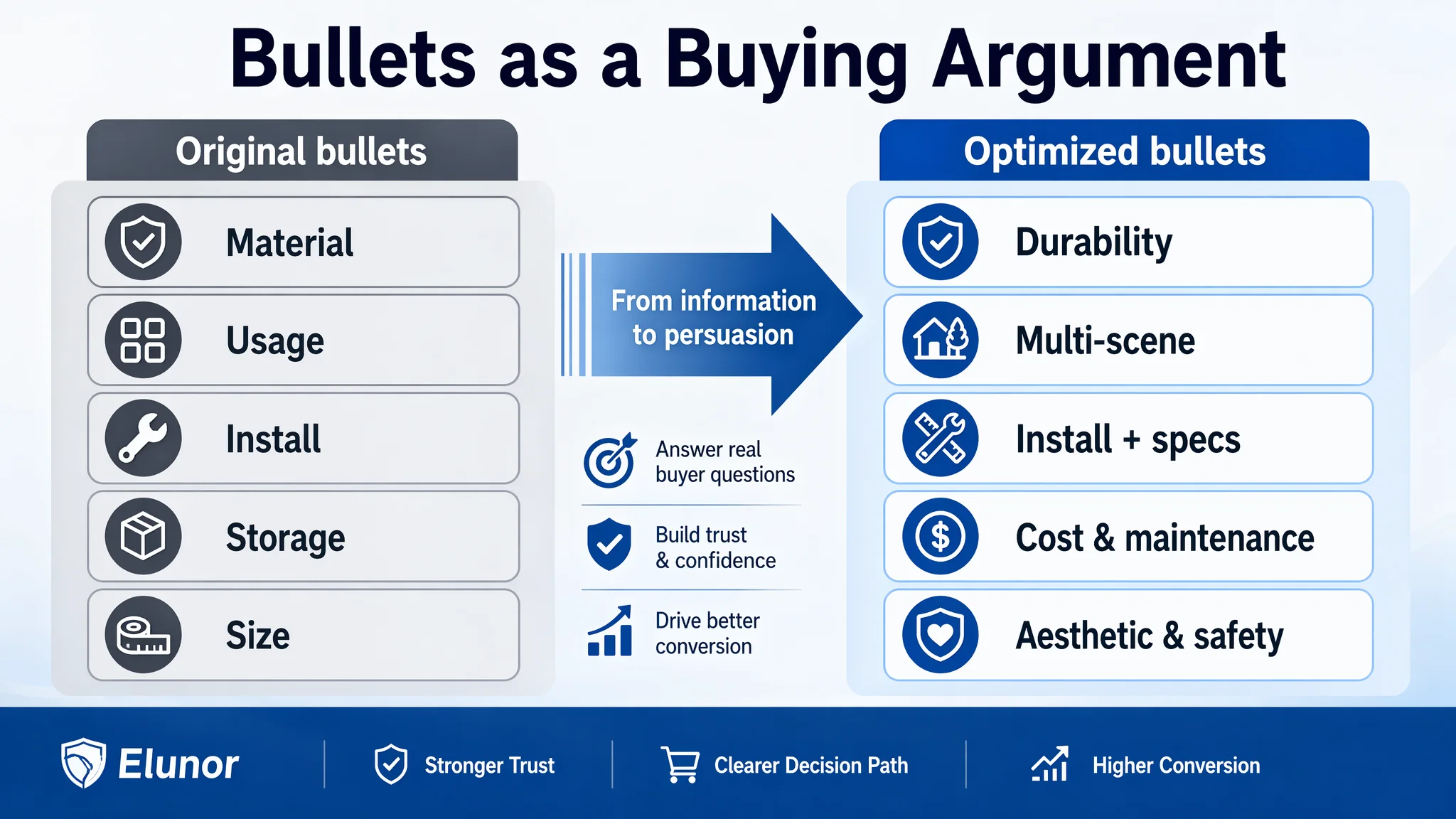
3. Bullets Listed Facts, but Did Not Build a Buying Logic
Comparing bullet-point structure:
- Benchmark structure:
- Start with durability & technical advantage.
- Then multi-scene usage.
- Clear installation specs.
- Cost-effectiveness & environmental angle.
- End with aesthetic appeal & quality feel.
- Target structure:
- Material and durability.
- Multi-purpose usage.
- Ease of installation.
- Storage and transport.
- Size options.
On paper this doesn’t look bad, but the logic is shallower:
- It does not connect durability to cost savings or long-term protection.
- It does not escalate from functional specs to emotional reassurance (garden looks good, pets are safe).
- The last bullet is just “size options,” not a higher-level benefit.
In other words, the bullets were “informational,” not “persuasive.” When a shopper scrolls, there is no strong narrative path from concern → solution → reassurance.
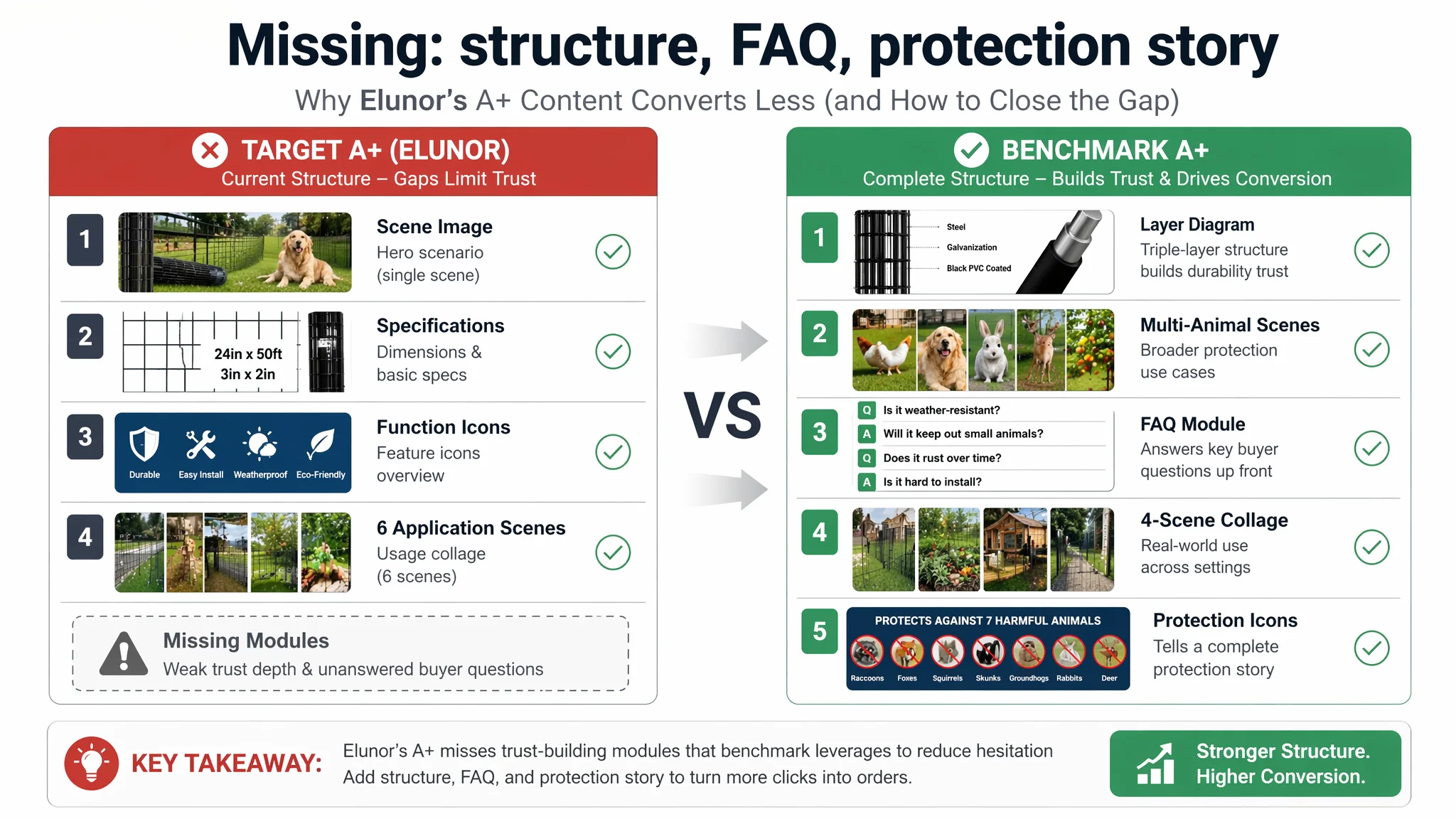
4. Detail / A+ Content Missed Key Conversion Modules
On the A+ level:
- The seller used:
- Scene hero image.
- Spec/parameter image.
- Functional icon image.
- A 6-scene usage collage.
- The benchmark added:
- Double-coating structure diagrams with labeled layers (“Steel / Galvanization / Black Vinyl Coated”).
- Multi-animal protection scenes (chickens, dogs, rabbits, deer, fruit trees).
- A clear FAQ module handling durability, installation, small-animal defense.
- A “protection” narrative: from simple fencing to asset-protection solution (e.g., icons of 7 harmful animals crossed out).
The difference is critical:
“Advertising does not only amplify advantages. It can also amplify a page’s existing defects.”
The target A+ content did not:
- Turn invisible quality (“16 gauge galvanized”) into a visible, intuitive story.
- Systematically remove buyer objections (Will it rust? Will it hold up in snow? Will it really keep raccoons out?).
- Elevate the product from “tool” to “guardian” of pets, plants, and property.
With these gaps, ad-driven sessions had nowhere to go but out.
5. Review System Was Almost Non-Existent
- Target Listing: 5.0 stars, 1 review.
- Benchmark Listing: 4.3 stars, 236 reviews, 7 reviews on first page.
Even though the target had a higher star rating, it lacked volume and depth. One review cannot:
- Prove consistency.
- Reflect real-world use diversity.
- Show honest pros and cons that build trust.
The benchmark’s 14% visible negative-review rate actually increased credibility; shoppers could see transparent feedback and still feel comfortable buying.
No amount of ad tweaking can out-muscle a 1 vs. 236 review gap. With such thin social proof, the page fundamentally lacked the trust base to support aggressive spend.
How DeepBI Reframed the Problem: Listing Conversion as the Primary Constraint
From DeepBI’s perspective, the single, central bottleneck was:
The Listing lacked enough conversion capacity to justify more traffic.
Everything else—high ACOS, perceived ad inefficiency—was a symptom of that one constraint.
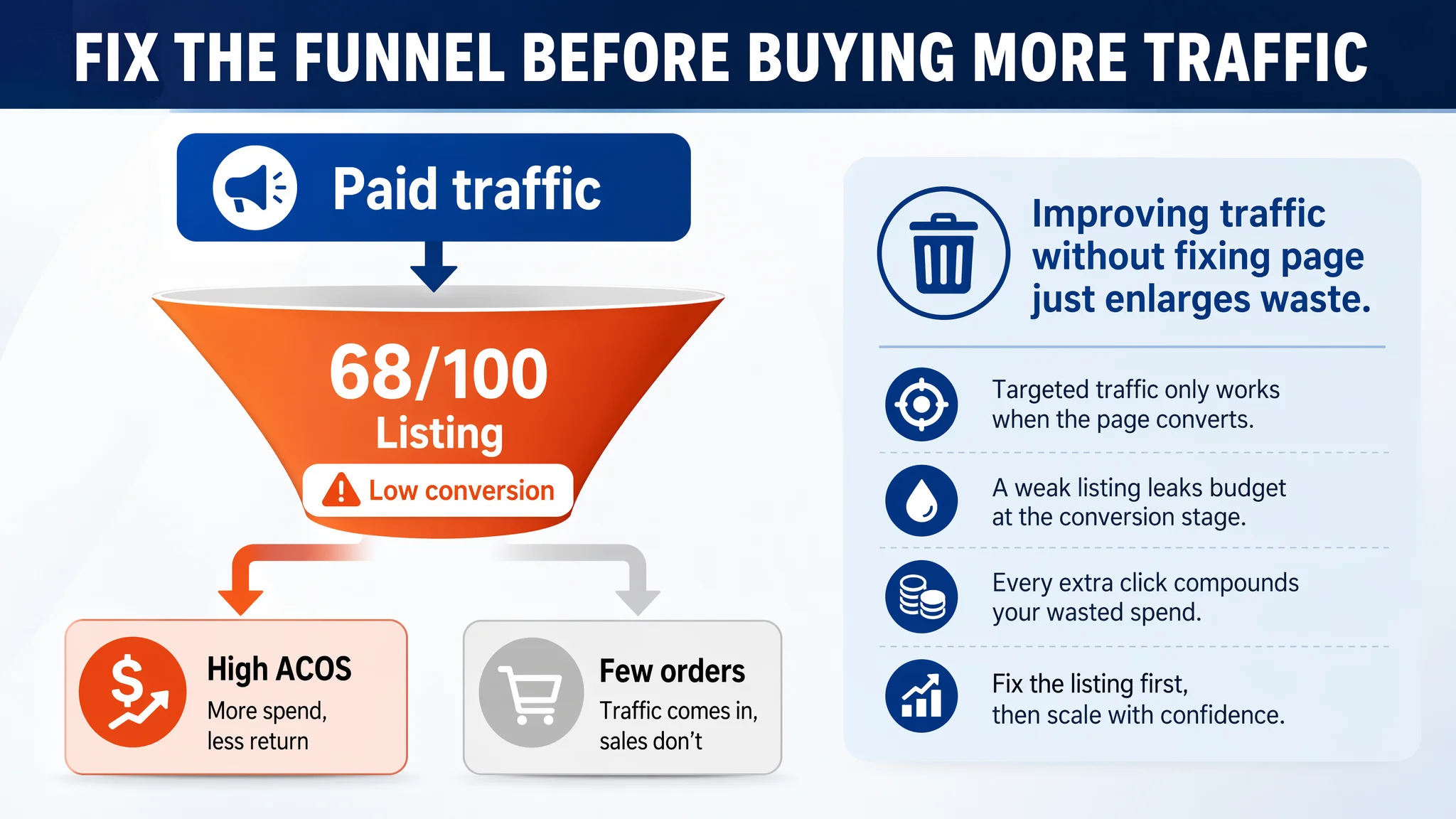
Why Listing Conversion Had to Be Fixed Before Scaling Ads
1. Each additional click was low-yield. Sending more traffic to a 68/100 page versus an 85/100 benchmark only increases the cost of the same underlying weaknesses.
2. The biggest measurable gap was in trust (reviews) and detail-page persuasion, not in raw traffic availability.
3. The product’s real strengths (vinyl-coated, heavy-duty, multi-scene protection) were not visualized with enough authority, so buyers defaulted to more “professional-looking” competitors.
4. Amazon’s own ranking and ad ecosystem rewards effective conversion. A Listing that converts better:
- Supports stronger organic ranking.
- Allows lower CPCs and lower ACOS over time.
- Reduces dependence on high ad intensity to sustain sales.
Given this, continuing to prioritize ad tweaks first would have been the riskiest business decision. Instead, DeepBI focused on rebuilding the page so that every paid session had a higher chance of turning into a sale.
The New Direction: Rebuilding the Page as a Professional Protection Solution
Instead of another round of “ad optimization,” the work shifted to reconstructing the Listing’s decision logic across title, main images, bullets, and A+.
1. Title: From Generic Wire Fence to High-Intent “Vinyl Coated Dog Fence”
Suggested title direction:
Vinyl Coated Dog Fence, 24" x 50' Black PVC Coated Welded Wire Fence Roll, 2" x 3" Mesh Size, Garden Fencing for Yard, Chicken Wire for Vegetable Plant Protection & Poultry Netting
Core changes in logic:
- Front-load the most valuable core keyword: “Vinyl Coated Dog Fence” instead of a mid-title “Wire Fence”.
- Explicitly describe product form and specs:
- “24" x 50'”
- “Black PVC Coated Welded Wire Fence Roll”
- “2" x 3" Mesh Size”
- Add high-intent use cases that map to search terms:
- “Garden Fencing for Yard”
- “Chicken Wire for Vegetable Plant Protection & Poultry Netting”
This puts the Listing into the same search-logic lane as the benchmark while also carving out more specific intent clusters (dog fence, vegetable plant protection, poultry netting) that match how buyers actually search.
2. Bullets: From Disconnected Info to a Persuasive Path
The bullets were restructured to follow a “pain → solution → reassurance” pattern.
Bullet 1: Durability as the Anchor
【Ultimate Durability & Weatherproof】 Constructed from heavy-duty welded steel with a premium black vinyl (PVC) coating, our wire fence offers double protection against rust, corrosion, and environmental elements. Designed to withstand extreme rain, snow, and sun, it ensures a longer lifespan and stable structure for long-term outdoor use.
Here, durability is:
- Named explicitly.
- Linked to double-protection structure.
- Connected to real conditions (rain, snow, sun) that buyers actually worry about.
Bullet 2: Real Multi-Scene Versatility
【Versatile Multi-Purpose Applications】 This multi-functional mesh serves as poultry cages, rabbit pens, dog enclosures, and garden borders. It’s also perfect as a soil sieve, tree trunk protector, or window guard, providing a clean and tidy environment while keeping deer, cats, and other small animals away from your plants.
Now the Listing:
- Covers a wide range of use cases, mirroring and extending the benchmark.
- Adds differentiated scenarios like soil sieves and window guards to tap extra search demand.
Bullet 3: Installation + Specs (Not Either/Or)
【Easy to Install & Customize】 Unlike complex chain-link fencing, our flexible welded wire mesh (Mesh size 2"x3") allows for fast DIY installation with T-posts or wooden frames. It can be easily cut with simple wire cutters to fit your exact project needs, making it ideal for both temporary and permanent fencing.
Specs (mesh size) become part of the ease-of-use story, not an isolated datum.
Bullet 4: Cost-Effectiveness and Low Maintenance
【Cost-Effective & Low Maintenance】 The smooth black vinyl coating not only prevents rust but also makes the surface easy to clean and maintain. Lightweight and economical, it can be easily rolled up for transport or storage. Our eco-friendly design ensures maximum protection for your garden without harming animals.
Now durability is clearly connected to:
- Less maintenance.
- Easier cleaning.
- Animal-safe protection.
Bullet 5: Aesthetic & Safety, Not Just Size
【Aesthetic Appeal & Safety Design】 Featuring a sleek, modern appearance, our fence panels complement any architectural style. Engineered with no jagged edges, twisted wires, or sharp corners, it provides a safe and professional finish that protects your pets and children while enhancing your landscape’s visual appeal.
This mirrors the benchmark’s “aesthetic” bullet, but tailored:
- Solves a hidden objection: sharp edges and pet/child safety.
- Adds emotional value: the garden still looks good after installation.
Together, these bullets turn the listing from a technical description into a coherent buying argument.
3. Main Images: From “Asset Stack” to Professional Outdoor/Industrial Story
The main-image strategy moved from “show many things” to “lead buyers through a clear visual decision chain”.
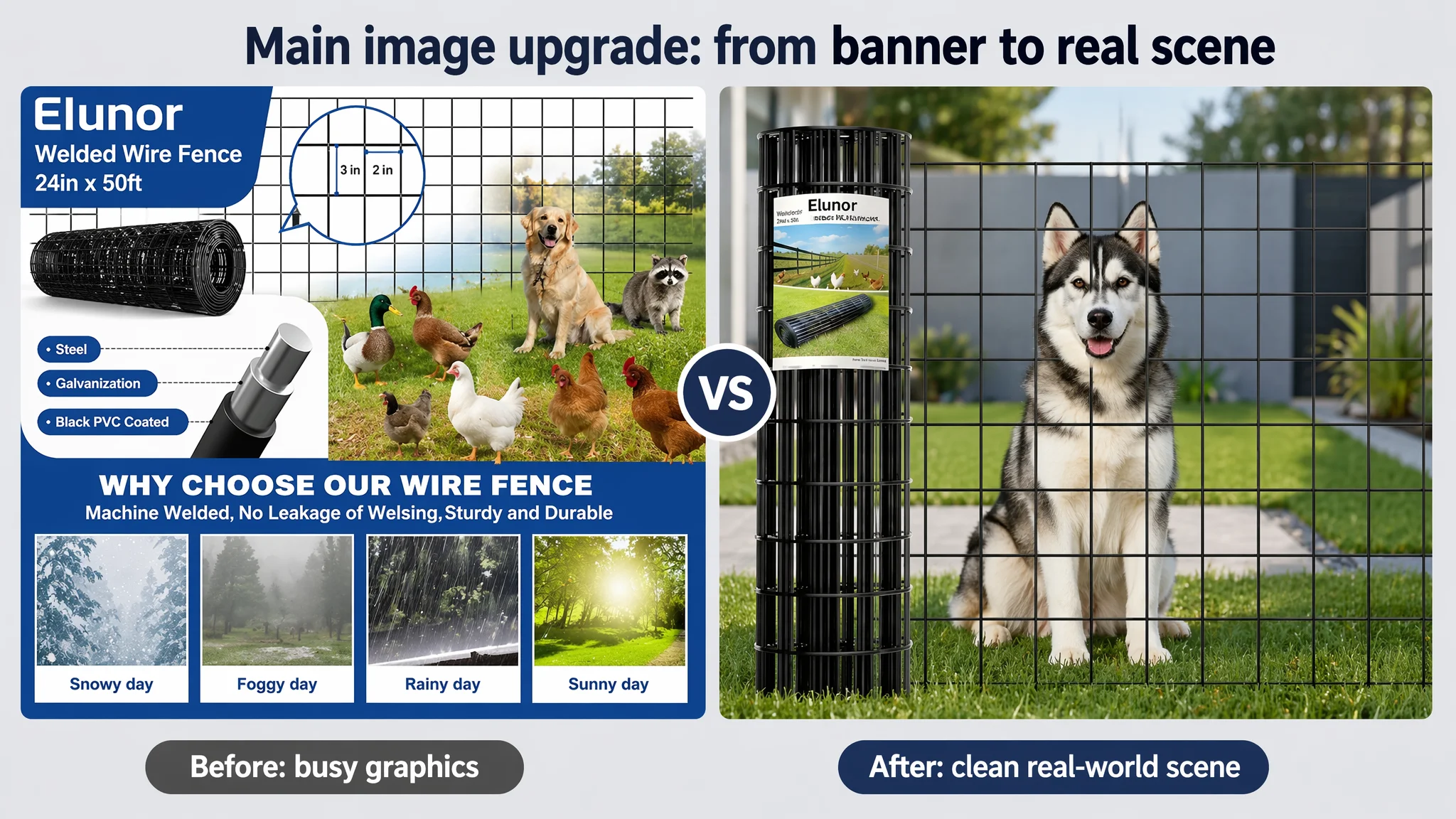
Key shifts:
- Hero image:
- Wire fence roll on left (~30% width), expanded mesh on right (~70%).
- A single dog (e.g., husky) behind the fence, natural modern yard in the background.
- Clean, high-contrast composition: black fence vs. green yard.
- No extra animals or clutter.
- Technical function image:
- Roll centered left; three square tiles on right showing installation, cutting, and mesh detail.
- Clear lighting, neutral grey background, simple overlay of length and mesh size.
- Structure/“triple layer” visualization:
- Partial mesh on the left.
- On the right, a stepped visual of 3 layers: steel core, galvanization, black vinyl coat.
- Strong directional lighting and clear labels: “Steel,” “Galvanization,” “Black Vinyl Coated.”
- Weather resistance image:
- Fence shown under four conditions: sun, rain, snow, fog.
- Outdoor setting that looks real, not a lab graphic.
- VS comparison image:
- Left: this product under rain, clean and intact.
- Right: generic rusty wire fence.
- “VS” marker emphasizing corrosion resistance and long-term value.
This is not “prettier design” for its own sake; it corrects the 1-point main-image gap by:
- Making the product look like a professional outdoor solution, not a hobby project.
- Showing what durable, coated steel actually means in real life.
- Giving ad-clickers immediate visual reasons to stay.
4. A+ / Detail Page: Turning Invisible Quality and Protection into a Narrative
The detail page recommendations focused on turning technical value and use cases into a modular visual system:
- Scene hero module:
- Real chicken-yard shot with the fence roll clearly visible.
- Overlaid icons for corrosion resistance, toughness, aesthetics, and multi-use.
- Strong, natural lighting to make the product feel grounded and trustworthy.
- Material structure module:
- Macro cross-section of a single wire with 3 distinct layers.
- Clear labeling (“Steel,” “Galvanization,” “Black Vinyl Coated”).
- Clean, clinical style to emphasize technical credibility.
- “Harmful animal” defense module:
- Realistic forest-edge scene with the fence and a deer.
- Icons of raccoons, foxes, squirrels, etc., each with a red “X.”
- Explicit framing of the product as a protection system for plants and property.
- Garden and orchard protection modules:
- Scenes showing:
- Lavender protected behind the black mesh.
- Apple trees framed by the fence, with strong red-green-blue color contrast.
- The fence is clearly visible but visually “blends” with the garden to reassure on aesthetics.
- Six-scene “widely used” collage:
- Yard fence, wooden fence reinforcement, tree-trunk guard, woodland perimeter, pet zone, large-scale farm use.
- Unified natural-light style to keep the story cohesive.
- FAQ module:
- Clean Q&A layout covering:
- Weather resistance.
- Suitability for small animals.
- Anti-rust ability.
- Installation difficulty.
- Flexibility and cutting.
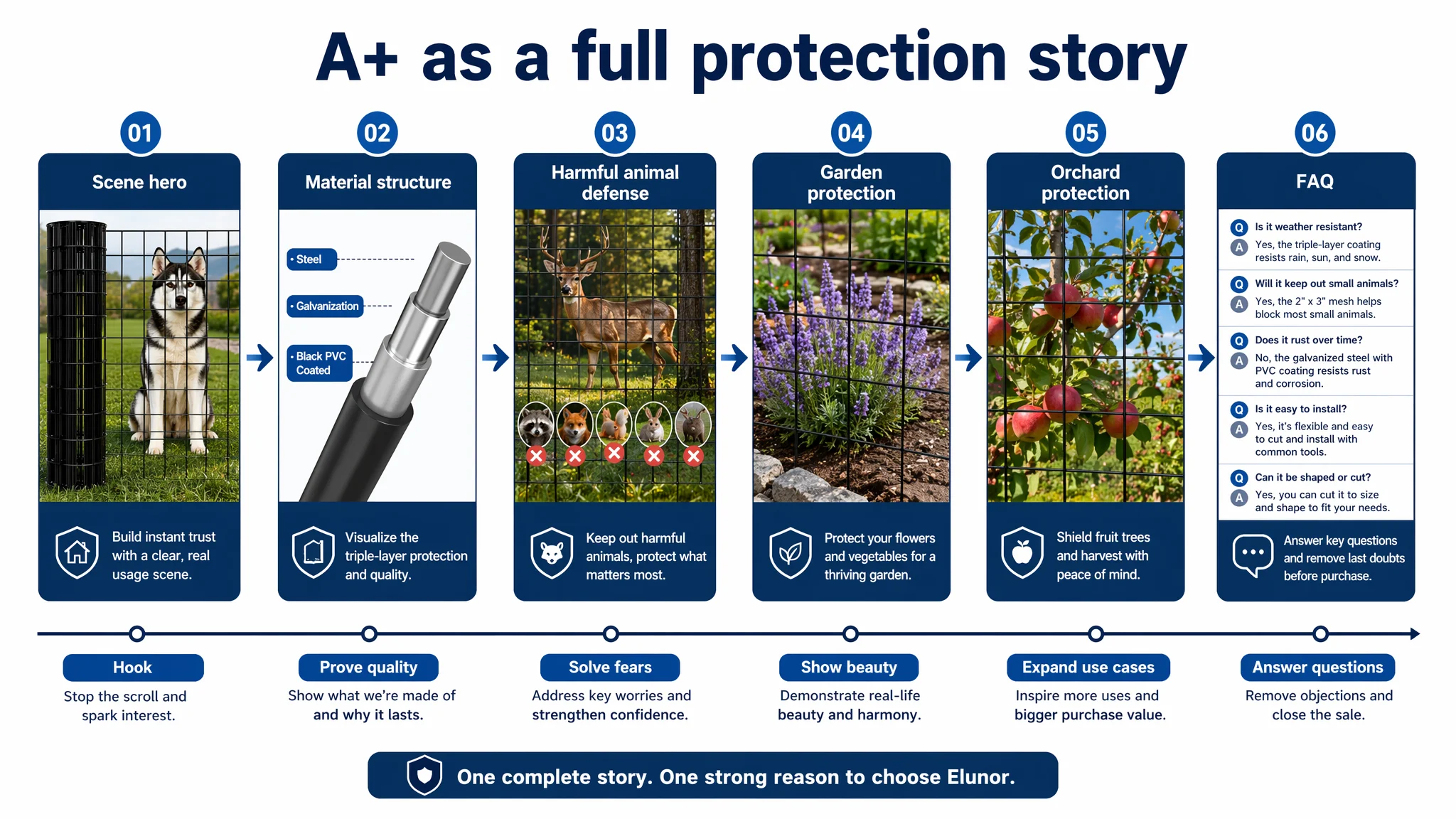
This structure directly patched the 4-point A+ gap by:
- Visualizing quality that had previously been trapped in text.
- Answering the exact questions that stall conversion.
- Elevating the product from “fence” to “reliable outdoor protection infrastructure”.
Why Ads Could Work Again Only After the Page Was Fixed
DeepBI’s judgment was clear:
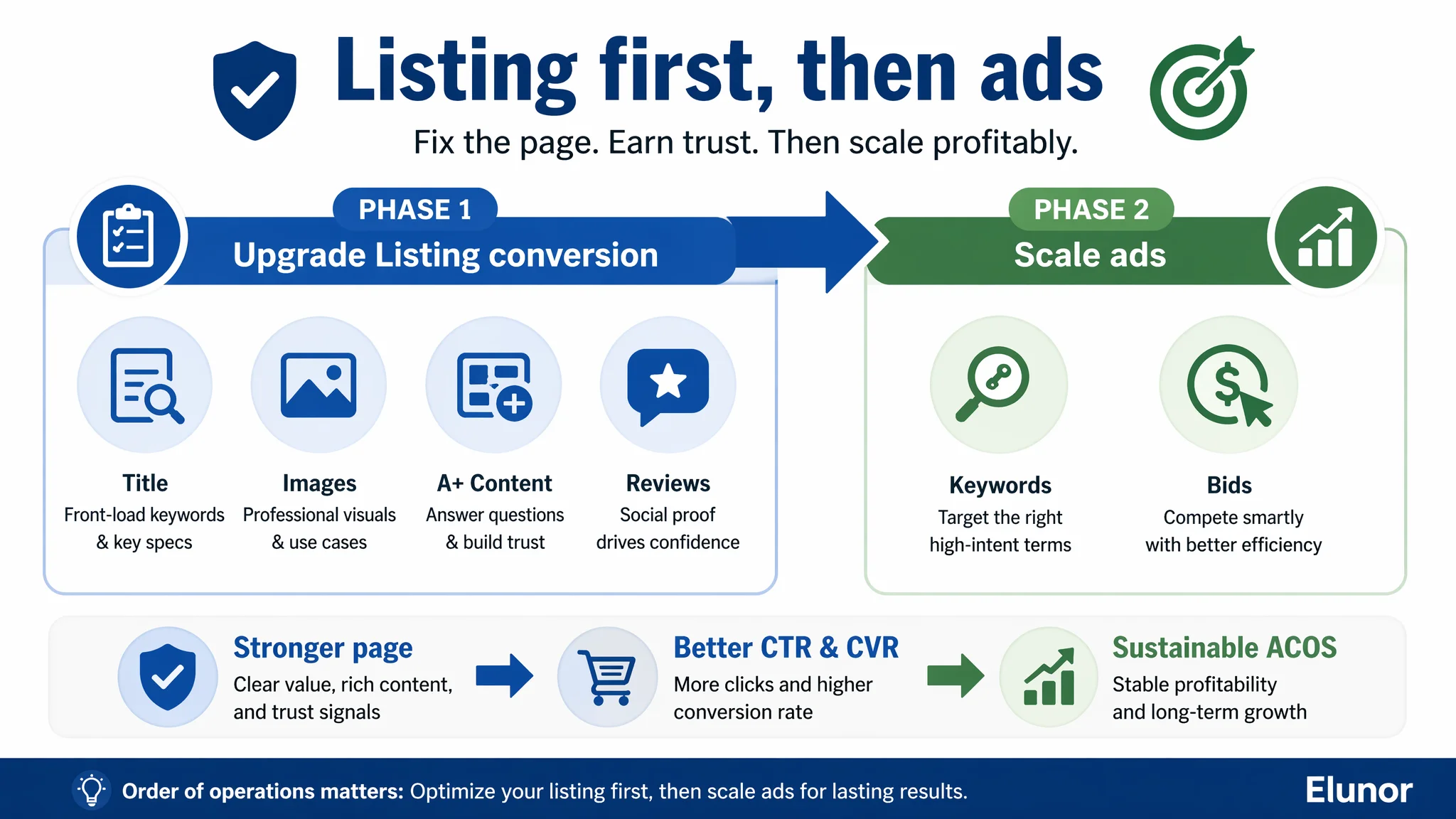
1. Do not keep pouring budget into a 68-point page while your main competitor operates at 85+ points.
2. Repair the Listing’s conversion capacity first, so that each paid click has materially better odds of converting.
3. Then revisit ad scaling and keyword expansion, using a stronger Listing as the foundation.
In practice, this meant:
- Rebuilding the Listing to meet or exceed the benchmark on:
- Keyword structure and title clarity.
- Main-image professionalism and scene realism.
- Bullet-point decision logic.
- A+ depth and trust modules (structure diagrams, FAQs, multi-scene usage).
- Accepting that reviews were a strategic, medium-term project, not something ads alone could fix:
- Focus first on raising the conversion performance for the traffic that does arrive.
- Then let improved conversion and better customer experience feed back into review growth over time.
Once these page-level issues were addressed, several things became possible:
- Ad traffic stopped feeling like “waste” and started behaving like a predictable input.
- The gap with the category benchmark narrowed, reducing the “penalty” the Listing was paying in both organic ranking and paid performance.
- The seller gained a clear operational principle: “No scaling of traffic before the page deserves that traffic.”
What Changed in the Seller’s Understanding
By the end of this process, the seller no longer saw Amazon ads as the primary battlefield.
Their revised understanding looked more like this:
- Amazon ads do not fix Listing conversion problems. They expose them faster.
- Listing quality is the real base of advertising efficiency.
- A stronger main image and A+ story improve both CTR and CVR.
- Better conversion lets you afford more competitive bids and broader coverage without ACOS spinning out of control.
- Title, main image, bullets, and A+ must work together as one decision engine.
- Title captures the right search intent.
- Main image earns the click and sets expectations.
- Bullets answer functional and emotional concerns.
- A+ and reviews build depth of trust.
- Before increasing budgets, always ask: “Is my page at least as strong as the listings I’m competing with?”
For other Amazon sellers—especially in functional categories like garden fencing, hardware, and outdoor protection—the lesson is direct:
If your ACOS is stubborn and your first instinct is to keep turning ad knobs, it may be time to stop and score the Listing instead. When the page is underbuilt versus its benchmark, every extra click is just more proof that the real work still needs to be done on the product page.