

This case comes from an Amazon seller in the car air‑purifier category. On the surface, their challenge looked familiar: ads were getting more expensive, and orders were not keeping up. The team’s instinct was to push harder on Amazon ads and tweak bids and keywords. But when we put their Listing against a truly comparable benchmark, the data told a different story: the real leak was not in the ad console, it was on the product page.
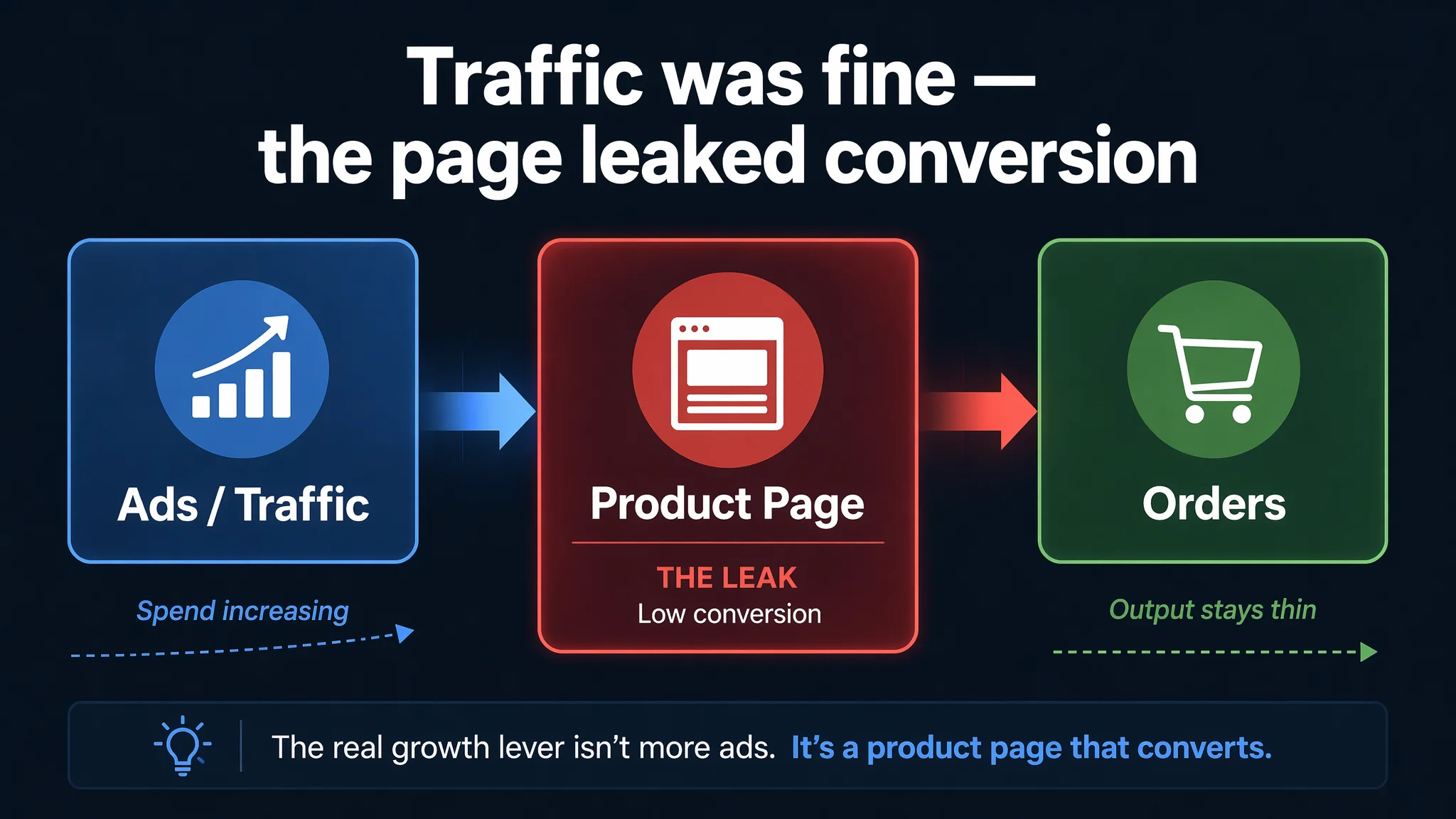
The Listing had traffic potential but almost no conversion capacity. The title didn’t speak to odor problems, the main images didn’t show any “before–after” effect, the bullet points read like a product manual, and the A+ content barely built any trust. Against a benchmark Amazon car air purifier, their Listing scored 53/100 versus 84/100, with the largest gaps in A+ detail content and overall sales story. Ads were essentially sending paid traffic into a page that could not answer basic “why this product” questions.
DeepBI’s judgment was clear: unless the Amazon Listing was rebuilt around odor elimination, real driving scenarios, and visible economic advantages (filter‑free, low maintenance), more traffic would only magnify the waste. The optimization therefore focused first on re‑framing the title, main images, bullet structure, and A+ narrative into a coherent “problem → solution → proof → long‑term value” path. For other Amazon sellers, this case is a reminder: when ACOS feels “stuck,” you have to ask whether you’re buying more clicks for a page that has never been given a fair chance to convert.
The Core Conflict: Traffic Was Not the Bottleneck—Conversion Was
The product is a USB‑powered car air purifier, physically designed to sit in a cup holder. The seller believed the main challenge was getting enough exposure in a competitive subcategory and assumed the fix was to:
- Raise bids, open more keywords around “car air purifier”
- Expand match types and placements
- Expect that more search visibility would eventually drive orders
However, once we ran the Listing through a structured Amazon Listing diagnosis and benchmarked it against a category‑leading car air purifier, one fact stood out:
The Listing’s conversion engine was weak at every content layer. Ads were not failing; the page was consuming the traffic.
Total Listing score:
- Target Listing: 53 / 100
- Benchmark competitor: 84 / 100
- Gap: –31 points
Across core dimensions:
- Title: Target: 10, Benchmark: 16, Max: 20, Gap: -6
- Main Images: Target: 21, Benchmark: 26, Max: 30, Gap: -5
- Bullet Points: Target: 3, Benchmark: 8, Max: 10, Gap: -5
- A+ / Detail Page: Target: 14, Benchmark: 24, Max: 25, Gap: -10
- Reviews: Target: 5, Benchmark: 10, Max: 15, Gap: -5
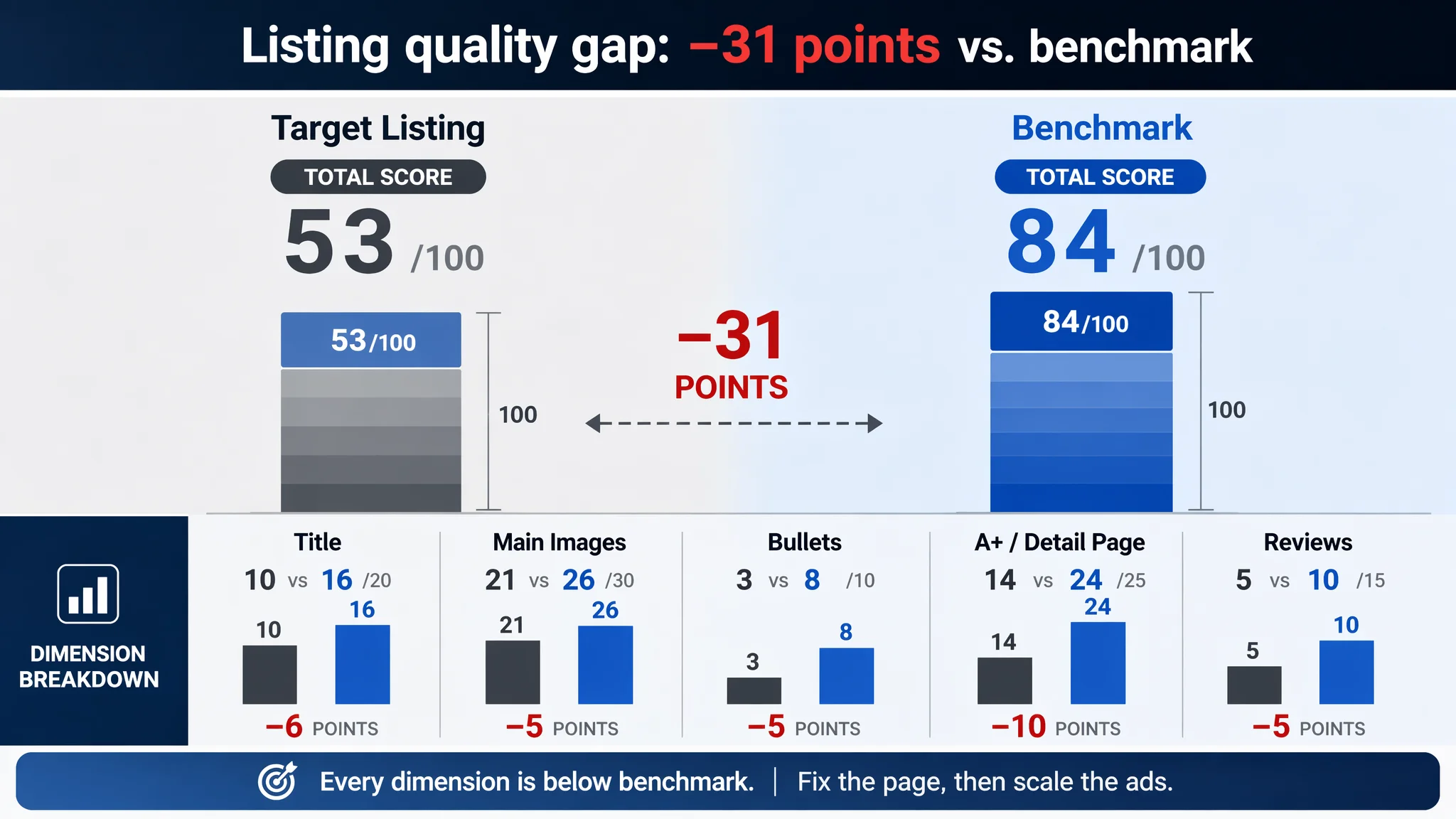
The largest absolute gap was in the detail/A+ content, but every layer—from title to bullet points—contributed to a weak conversion narrative. Running more ads into this structure would only push TACOS higher without giving the customer a more convincing reason to buy.
What the Seller Originally Misread
From the seller’s perspective, several signals suggested that the product itself was “fine”:
- The product had a 5.0‑star rating, albeit from a single review.
- Physically, the design was clean and compact, with a cup‑holder form factor.
- The page had basic images, specifications, and a functioning A+ section.
The team therefore anchored on a classic assumption:
“Our product and Listing are okay. We just need more traffic and better bids.”
This led to repeated cycles of ad‑side tinkering:
- Adjusting bids and budgets
- Trying new keyword sets for “car air freshener,” “car air purifier,” “smoke remover”
- Watching ACOS stay high relative to the actual order volume
What they did not see clearly was that the Amazon product page failed to meet the basic expectations that their category’s high‑converting Listings had already standardized.
How the Benchmark Exposed the Real Constraint
Once we locked a truly comparable benchmark car air purifier on Amazon US, the structural differences became obvious.
1. The title didn’t promise an outcome
The benchmark title opened with the word “Compact” and then stacked clear outcome and use‑case language:
- “for Odor”
- “for Smoke/Pet Odors/VOCs”
- “Easy Install”
- “Filter Free”
- “Silent Operation”
- “Universal Vent Clip”
This approach:
- Immediately positions the product around smell problems (the user’s actual pain)
- Surfaces search‑friendly, high‑intent attributes (smoke, pet odors, VOCs)
- Signals ease, low upkeep, and quiet use—all conversion‑oriented ideas
The target Listing’s original title focused on physical attributes (shape, power method, color) and underplayed what users actually buy in this category: removal of smoke and odors, comfort in a closed car, and low lifetime cost.
DeepBI’s proposed direction rebuilt the title around:
“Car Air Purifier – USB Powered Odor Eliminator for Smoke, Pet Odors and Dust – Silent Operation, 7‑inch Cylindrical Design for Car Interior, Silver”
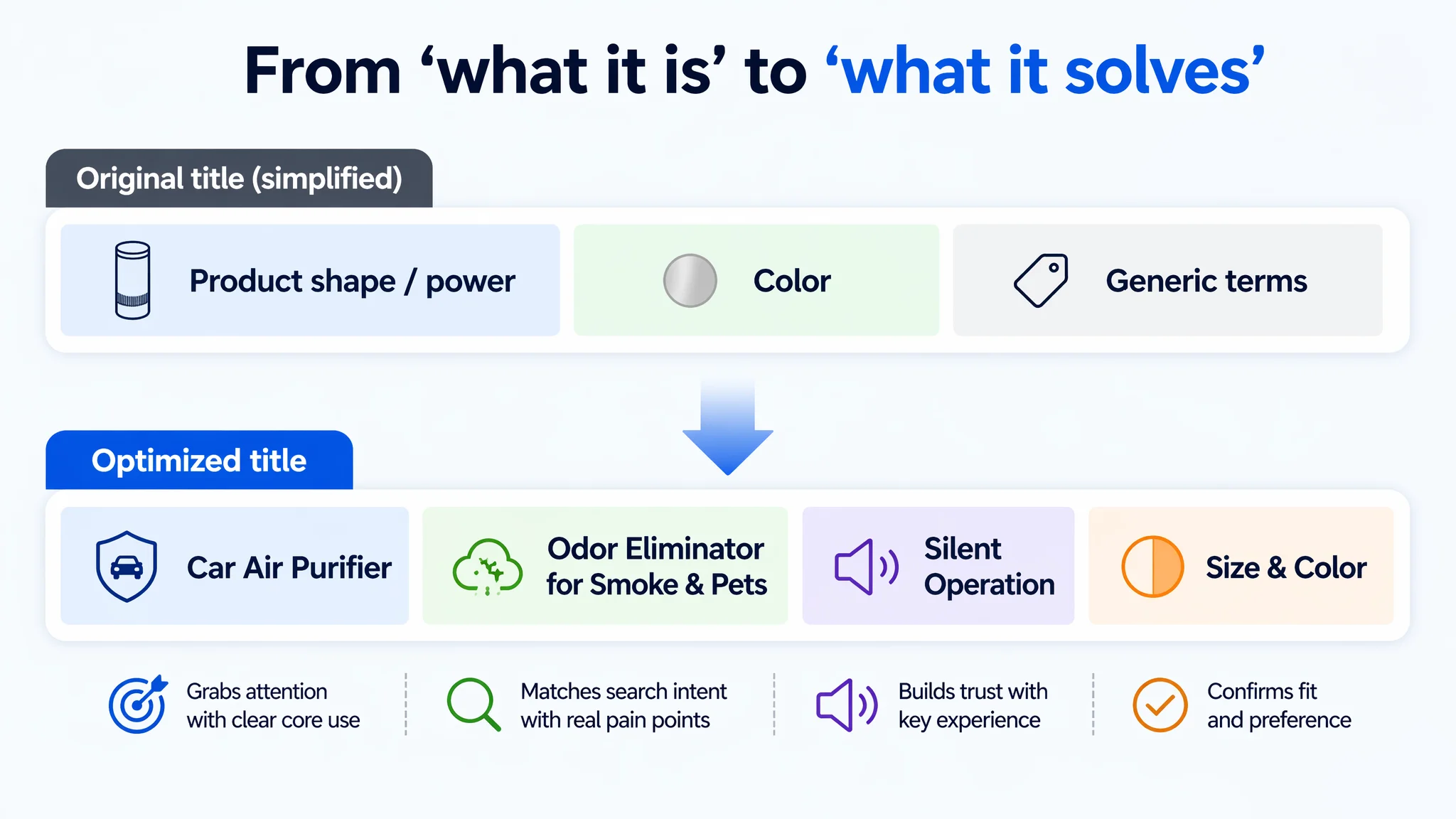
This shift is not cosmetic; it re‑anchors search and click decisions around “odor eliminator” and specific odor sources, rather than “a silver cylinder that uses USB.”
2. Main images showed the product, not the problem being solved
On Amazon, the main image set must do two jobs:
- On the search results page: earn the click
- On the detail page: build fast, visual trust
The benchmark’s image sequence was constructed as a narrative:
- Problem → solution contrast (dirty particles vs. clean air, sleeping passengers)
- Clear role of the device in real car interiors
- Installation clarity and compatibility
- “Filter‑free” economic benefit
- Trust markers and data overlays
The target Listing’s images, in contrast:
- Focused on static product shots with limited emotional or functional context
- Concentrated too much information in a few images without a clear sequence
- Lacked visual proof of “no filter,” “quiet,” or “real odor removal”
DeepBI’s diagnosis: there was no “first glance proof” that this was a professional odor‑removal solution, only a device.
That led to a specific image‑system direction:
- Image 1 (hero):
Product centered, ~70% of frame, strong directional light, deep gray background, subtle reflection, and soft blue airflow ribbons—modern industrial feel that signals “professional air treatment,” not just a gadget.
- Image 2 (dimensions):
45° top‑down view on white background, clean black dashed lines and labels for 7" height and 2.6" diameter, aligning with category norms for credible dimensional diagrams.
- Image 3 (in‑car scene):
Device in a cup holder, seen from rear seat, natural sunlight, surrounding car interior softly blurred, with subtle blue glow/particles from the device—proof that it fits where it’s meant to be used.
- Image 4 (structure/operation):
Product plus filter area, simple arrow and “Rotate counterclockwise to open” text—turning a vague structure shot into a guided operation visual.
- Image 5 (indicator & detection):
Top‑view close‑up with three LED states (green/blue/red) plus semi‑transparent “air detection waves”—making the otherwise abstract “air detection / status” function visually intelligible.
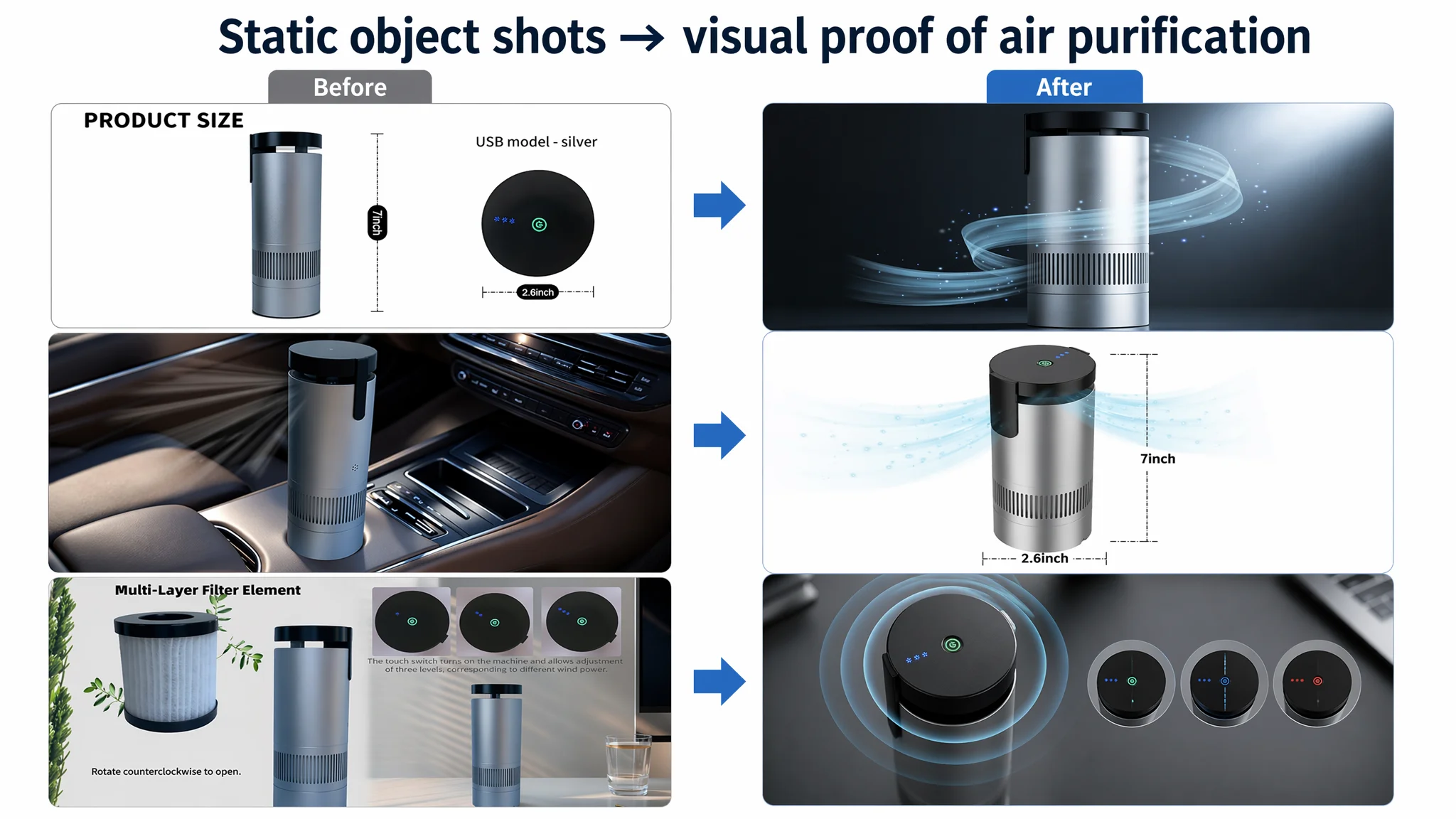
“The real problem was not that ads failed to bring traffic. It was that the page could not visually explain what the product actually did better than a generic freshener.”
3. Bullet points read like a spec sheet, not a buying path
The bullet section is often the first place serious buyers look once they land on the page. The benchmark used its bullets to build a value loop:
- Start with a powerful promise: removes 99.97% of odors and smoke
- Explain “filter‑free” and maintenance‑free economics
- Contrast with conventional air fresheners that only mask odors
- Cover design, convenience, durability, and installation
By comparison, the target Listing:
- Opened with design and appearance, not odor removal
- Listed supply method, control method, and size without tying them to benefits
- Lacked any explicit comparison to “just masking smells”
- Did not explain the technical basis for odor removal in a way that creates trust
DeepBI re‑framed the bullets to follow a “pain → solution → context → proof” logic. Key examples:
- BP #1 – lead with the core problem
POWERFUL SMOKE & ODOR ELIMINATION: Effectively removes strong odors, smoke, and pollutants from your vehicle’s interior. Unlike conventional fresheners that mask smells, this purifier neutralizes airborne particles at the source for fresh, clean air.
- BP #2 – specify fit and space saving
COMPACT CUP HOLDER DESIGN: Specifically engineered with a 2.6‑inch diameter base to fit perfectly in standard car cup holders. The sleek, vertical 7‑inch construction saves space while providing powerful air purification in enclosed environments.
- BP #3 – translate technology to benefit
ADVANCED FILTRATION TECHNOLOGY: Targets and neutralizes pet dander and common allergens, offering a comfortable, odor‑free environment that is highly beneficial for passengers sensitive to air quality during long road trips or daily commutes.
- BP #4 – broaden usage scenarios, not just specs
USB POWERED CONVENIENCE: Features a universal USB connection for hassle‑free operation. Easily connects to car outlets, laptops, or portable power banks, ensuring continuous air cleaning wherever a USB power source is available.
- BP #5 – make operation feel easy and controlled
SMART ONE‑TOUCH CONTROLS: Equipped with an intuitive LED indicator light and a simple one‑touch interface for effortless operation. The visual light feedback ensures you know exactly when the device is actively purifying your space.
- BP #6–9 – round out value and risk removal
- Versatility (car, home, office)
- Durability and long‑term performance
- Tool‑free, immediate installation
- Exact size specifications and compatibility reassurance
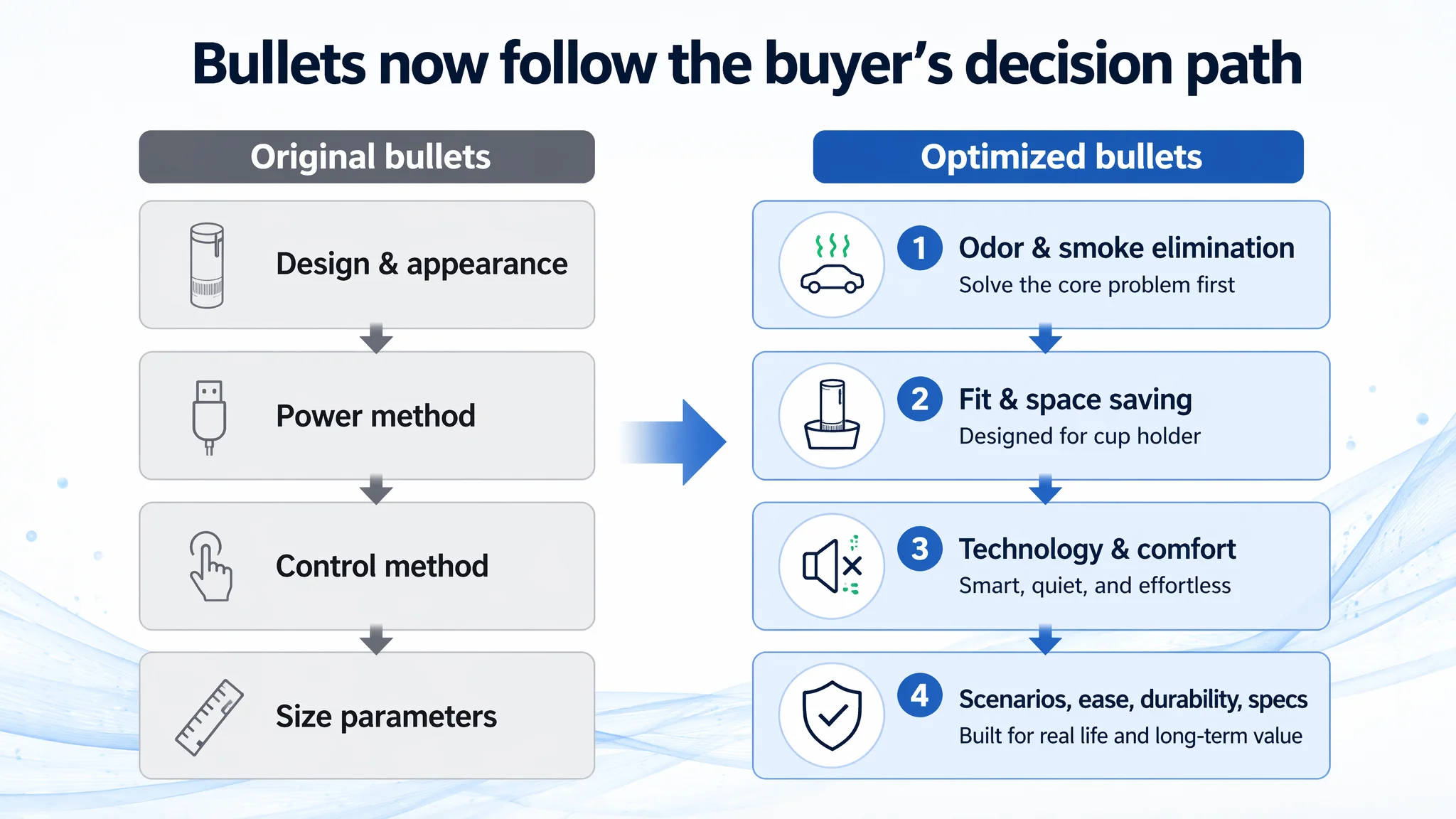
Instead of nine loosely connected specs, the bullets now guide a buyer through: “Does it fix my odor problem?” → “Does it fit my car and lifestyle?” → “Is it easy and economical to own?”
4. A+ content did not build a full trust story
On A+ (detail page) content, the gap was stark:
- Target Listing: basic structure and product images only
- Benchmark: full storyline including:
- Core benefits lead‑in
- Multiple high‑res, real‑world use cases (new car, smoking, pets)
- Technical principle visualizations
- Filter‑free economic argument
- Silent operation illustrated by sleep scenarios
- Compatibility diagrams
- Extended scenarios (office, home)
- Certifications and comparison tables as trust anchors
DeepBI identified that for this product type, buyers can’t see clean air, so they must be convinced via:
- Visualized VOCs, smoke, and particles
- before/after effects
- clear data points
- and recognisable daily scenarios
The proposed A+ re‑architecture:
1. Core intro module (where is it installed & what does it do)
- Full‑car interior shot with the purifier in place
- Right‑side icons: “99.7% removal,” “Compact size,” “Quiet operation,” “Auto on/off”
2. Pain‑point module – new car VOCs
- Green spheres representing VOCs being neutralized by blue ion/air flow from the purifier
- Copy focused on “reduce new‑car formaldehyde and odors”
3. Technology module – ionization principle
- Left: polluted air with smoke, dust, bacteria icons
- Middle: ion structures
- Right: clean air with green leaf icons
- Highlighted metric like “releases XX million positive and negative ions” (within honest bounds of the product spec)
4. Economic module – filter‑free vs. filter‑based
- Left: large HEPA filter with a red “ban” symbol
- Right: compact purifier labeled “FREE – No Filter Replacement”
- Explicit “zero lifetime filter cost” message
5. Silent operation / sleep module
- Passenger (adult or child) sleeping in the car, soft lighting, faint blue device indicator
- Headline: “Quiet Operation for a Distraction‑Free Drive”
6. Compatibility module
- Grid of different vent or interior layouts where the product fits securely
- Plus visually marked “wrong” installation with red crosses
- Reduces “will this work in my car?” anxiety and potential returns
7. Multi‑scenario extension
- Vertically split scenes: car, home fan, office desk
- Tagging each zone: “Vehicle / Room / Office”
- Elevates perceived value beyond “only for car”
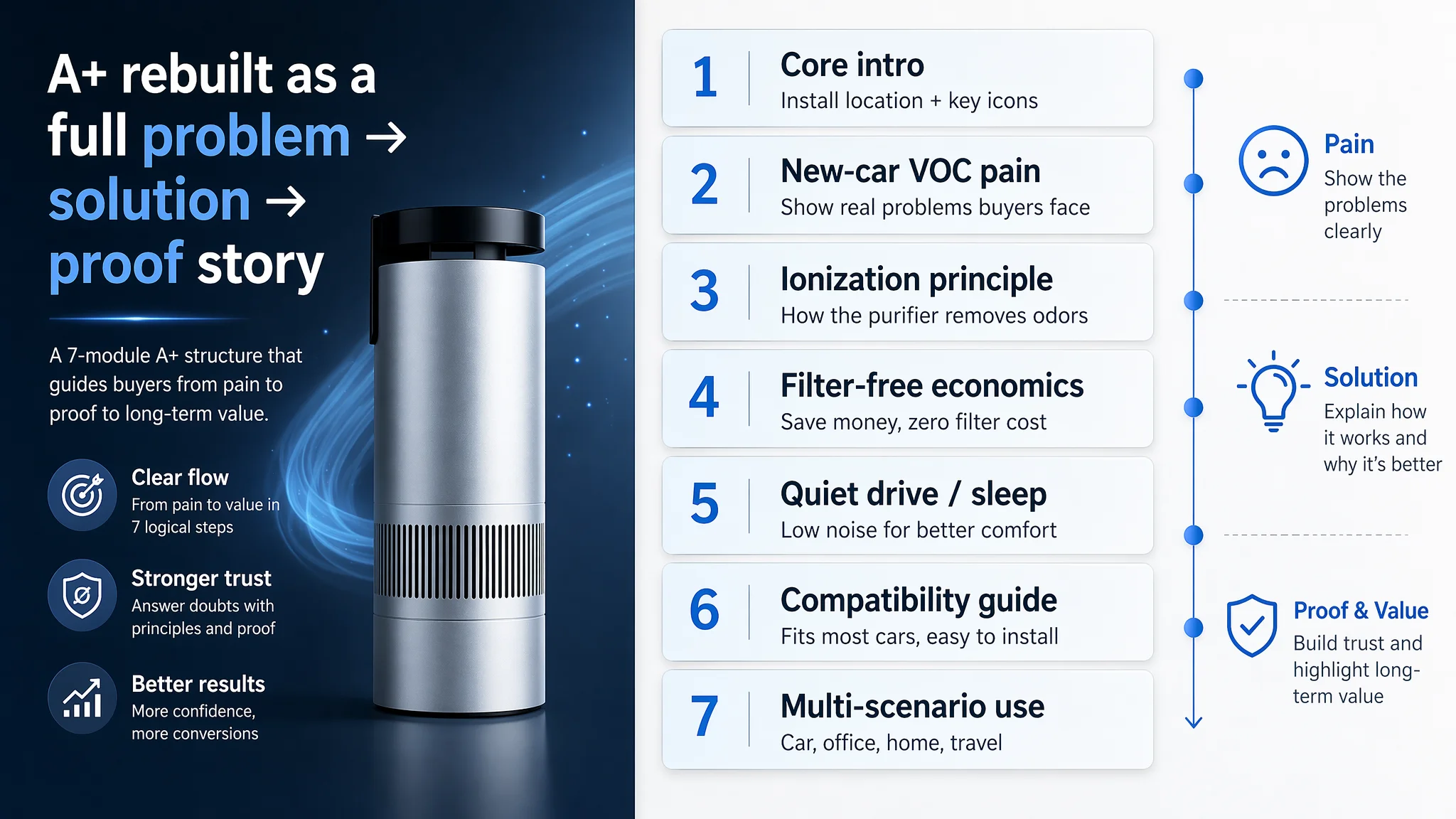
“Advertising does not only amplify advantages. It can also amplify a page’s existing defects. Here, ads were amplifying a Listing that never fully showed why it deserved to win against cheaper, simpler solutions like a hanging freshener.”
Why DeepBI Prioritized Listing Conversion Before More Ad Changes
Given the scoring results and structural gaps, continuing to treat this as an “ad optimization” problem would have been commercially risky:
- High ACOS risk: Each additional dollar would send more users into a page that still:
- Didn’t clearly state “odor elimination for smoke/pets/VOCs”
- Didn’t show clear in‑car usage and compatibility
- Didn’t explain filter‑free economics visually
- Didn’t build enough trust through scenarios and quasi‑technical proof
- Organic performance ceiling: Weak Listing quality also limits the page’s ability to convert existing organic traffic, capping organic rank and forcing heavier ad dependency.
DeepBI’s judgment path was:
1. Root cause: Listing conversion capacity is the primary constraint, not insufficient traffic.
2. Risk: Scaling ads now would mainly scale waste, not profitable orders.
3. Priority: Rebuild the Listing’s sales logic—title, images, bullets, A+—to at least match benchmark conversion potential.
4. Then: Use Amazon ads to amplify a page that can actually convert, not to “patch” a page that fails to persuade.
Only after the Listing is structurally competitive does it make sense to seriously test higher budgets and broader keyword coverage.
How the Page’s Sales Logic Started to Recover
Once the content approach changed from “describe the product” to “resolve the buyer’s decision path,” several shifts occurred in how the Listing would behave in the funnel:
- On the search results page:
- The revised title and enhanced hero image increase the chance that “smoke,” “pet odor,” and “VOCs” queries actually see a relevant, outcome‑driven option.
- Stronger thumbnail visual (industrial feel, airflow, clear object identity) supports higher CTR potential.
- On the product page above the fold:
- The bullet section immediately answers: “Will this really clear my smoke/pet smell?” and “Will it fit my car, power setup, and lifestyle?”
- Visual dimension and in‑car images reduce doubts before they turn into bounce.
- In the A+ section:
- Buyers see explicit pain‑point coverage (new car VOCs, smoke, pets), technology visuals, filter‑free economic logic, quiet‑operation reassurance, and fit guidance.
- Time on page and scroll depth become meaningful—buyers are not just skimming, they are being led through a structured case to purchase.
- For reviews and social proof:
- Although the Listing only had one review, the stronger conversion story and more credible visual system give early reviewers more context to reference in feedback.
- Over time, as more units sell through, the review base can develop enough volume to rival the benchmark, whose 41 reviews included a significant share of negative feedback.
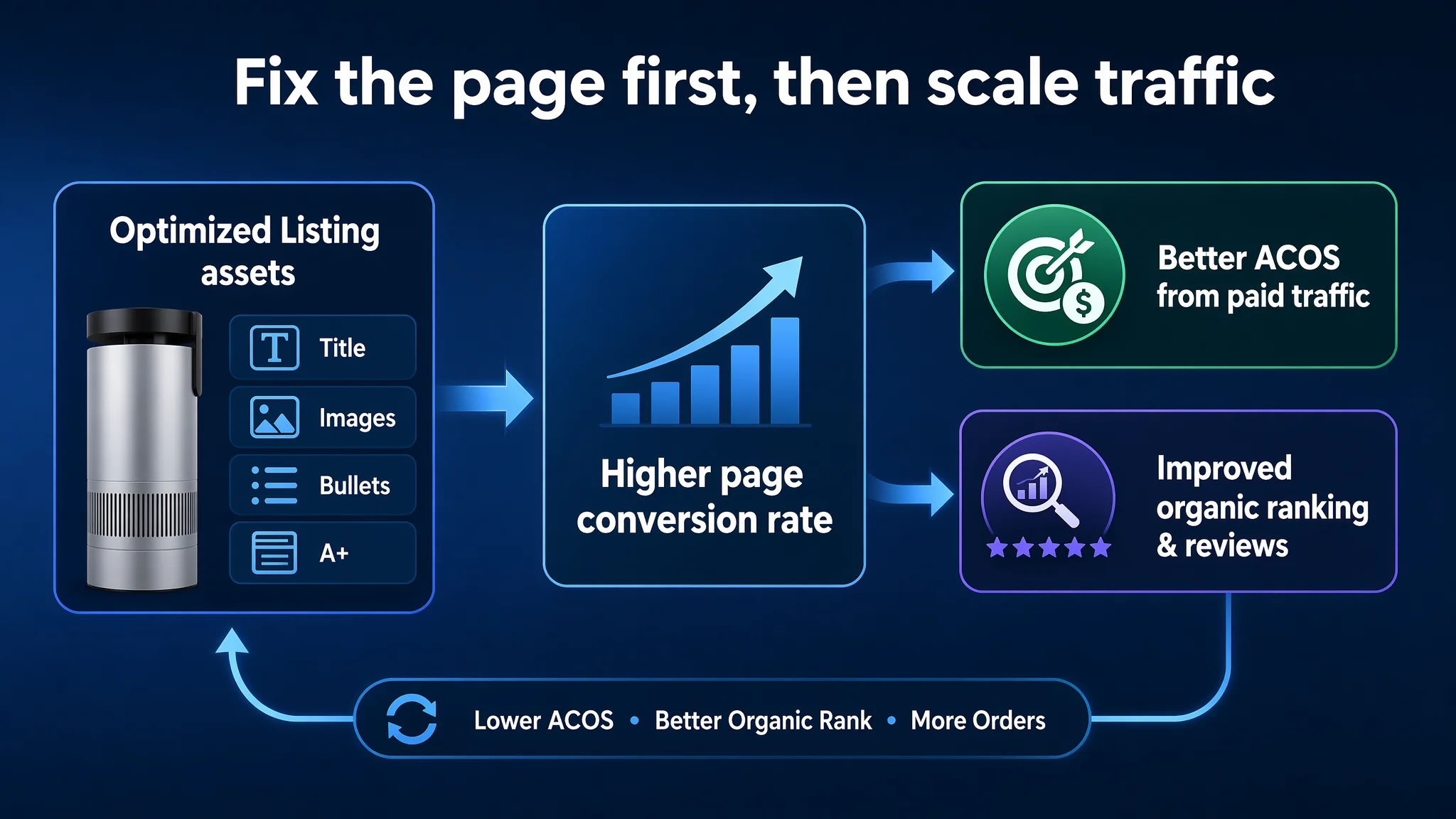
The immediate change is not a miracle spike, but a change in operating state:
- Paid traffic is no longer “burned” by a page that fails to sell.
- Each click has a higher probability of turning into an order.
- Over time, better conversion can:
- Lower ACOS
- Improve relevance and organic rank for core terms
- Reduce dependence on constant bid escalation
What This Case Changes in the Seller’s Understanding
For the seller team, this project altered several core beliefs about Amazon operations:
1. “High ACOS = ad problem” is not always true
Here, the real bottleneck was a weak Listing against the category’s visual and narrative standard.
2. Listing quality is the foundation of ad efficiency
Without a compelling Amazon product page—title, hero image, bullet logic, and A+—even perfectly structured campaigns cannot deliver sustainable results.
3. Product‑page trust is built through a sequence, not one module
- Title surfaces the right pains and outcomes.
- Main images show real context and capability.
- Bullets transform features into reasons to buy.
- A+ content removes the last doubts and highlights long‑term value.
4. Advertising should amplify proven strengths, not hide weaknesses
Running more traffic into a page that doesn’t explain filter‑free economics, quiet use, and actual odor elimination simply pays to confirm that doubt.
Takeaways for Other Amazon Sellers
This car air‑purifier case is not unique to its category. The real lesson generalizes across Amazon:
- If you see rising ACOS and flat orders, do not assume keywords, bids, or budgets are the only levers.
- Benchmark your Amazon Listing against a truly comparable top performer and ask:
- Does my title lead with outcomes and use cases, or just product attributes?
- Does my main image set show problem → solution and real scenes, or just the object?
- Do my bullets form a convincing buying logic, or a list of specs?
- Does my A+ content walk buyers through pains, principle, proof, and value?
DeepBI’s role in this case was not to “beautify” the page, but to reframe the business problem: the store did not suffer from a lack of traffic; it suffered from a lack of conversion power. Once that judgment was made, every optimization step—title, images, bullets, A+—was aligned around one simple question:
“If we pay for one more click, has this page finally earned the right to convert it?”