

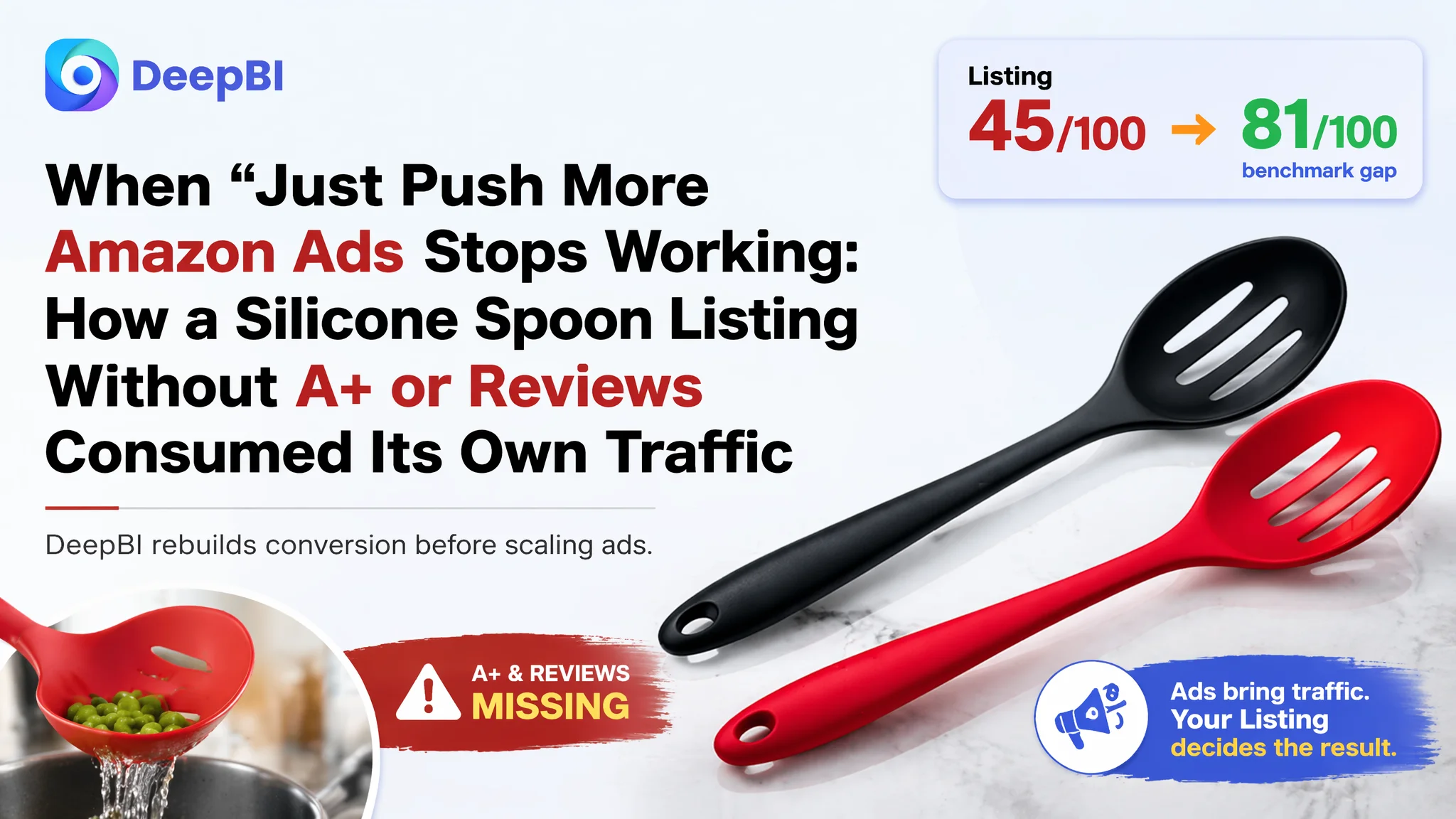
This Amazon seller in the kitchenware category thought they had a straightforward problem: a new silicone slotted spoon set on Amazon UK was not taking off, and the team’s first instinct was to push harder on ads and tweak bids. On paper, the product itself was competitive – food‑grade silicone, high heat resistance, non‑scratch for nonstick cookware – yet the Listing score came in at 45/100 against a benchmark competitor at 81/100, and advertising could not be scaled profitably.
The team initially assumed it was an advertising or keyword issue. But once DeepBI put the Listing into a structured Amazon Listing comparison, a different picture emerged: title and main image were not the fatal flaws; the real gap was that the Amazon product page had no A+ at all and zero reviews, competing directly against a mature competitor with full A+ storytelling and 570 reviews at 4.6 stars. In other words, ads were sending paid traffic into a page that had almost no conversion infrastructure.
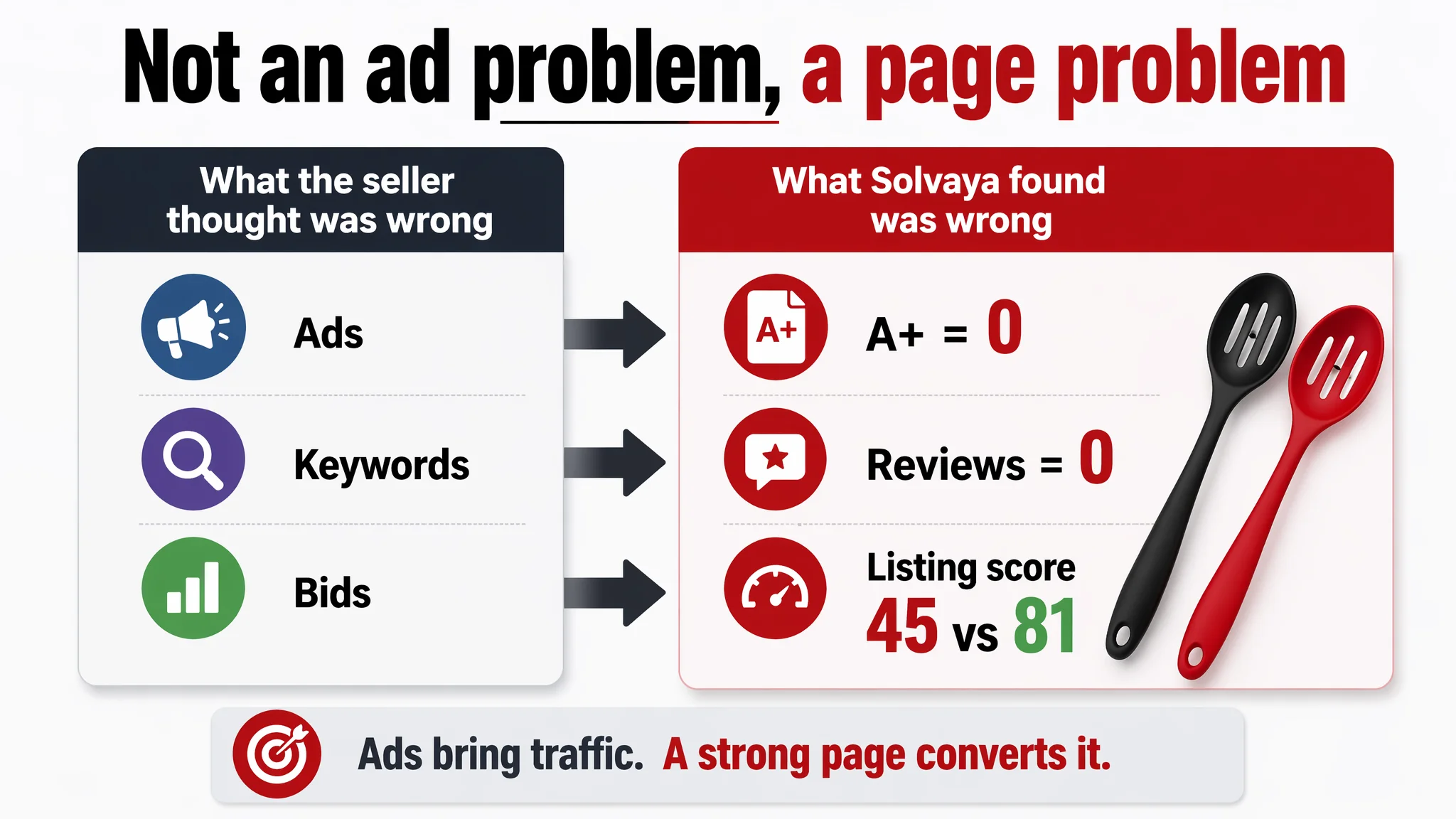
The optimization therefore did not start from “more precise ads”. It started from rebuilding the page’s basic conversion capacity: restructuring the title around the real search logic, tightening the main image set to win the thumbnail click, upgrading bullet points into a clear “problem–solution” logic, and designing a complete A+ visual story around cookware protection, heat resistance, easy cleaning, and multi‑scene usage. Only after the page could reasonably convert did paid traffic have a chance to work.
For other Amazon sellers, this case is a reminder that high ACOS or weak launch data is not always an ad problem. When Listing conversion is fundamentally underbuilt – especially when A+ and reviews are missing – every additional ad click becomes more waste. The key question is not “how do I buy more traffic?”, but “does this Amazon Listing currently deserve more traffic?”
The Real Constraint Was Not Traffic. It Was a 45/100 Listing Competing Against an 81/100 Benchmark.
From DeepBI’s Listing scoring, the situation was clear in one screen:
- Target Listing total score: 45 / 100
- Benchmark Listing total score: 81 / 100
- Score gap: –36 points
Broken down by Amazon Listing dimensions:
- Title: Target: 14, Benchmark: 17, Full Score: 20, Gap: -3
- Main image set: Target: 24, Benchmark: 25, Full Score: 30, Gap: -1
- Bullet points: Target: 7, Benchmark: 5, Full Score: 10, Gap: +2
- A+ / Detail: Target: 0, Benchmark: 21, Full Score: 25, Gap: -21
- Reviews: Target: 0, Benchmark: 13, Full Score: 15, Gap: -13
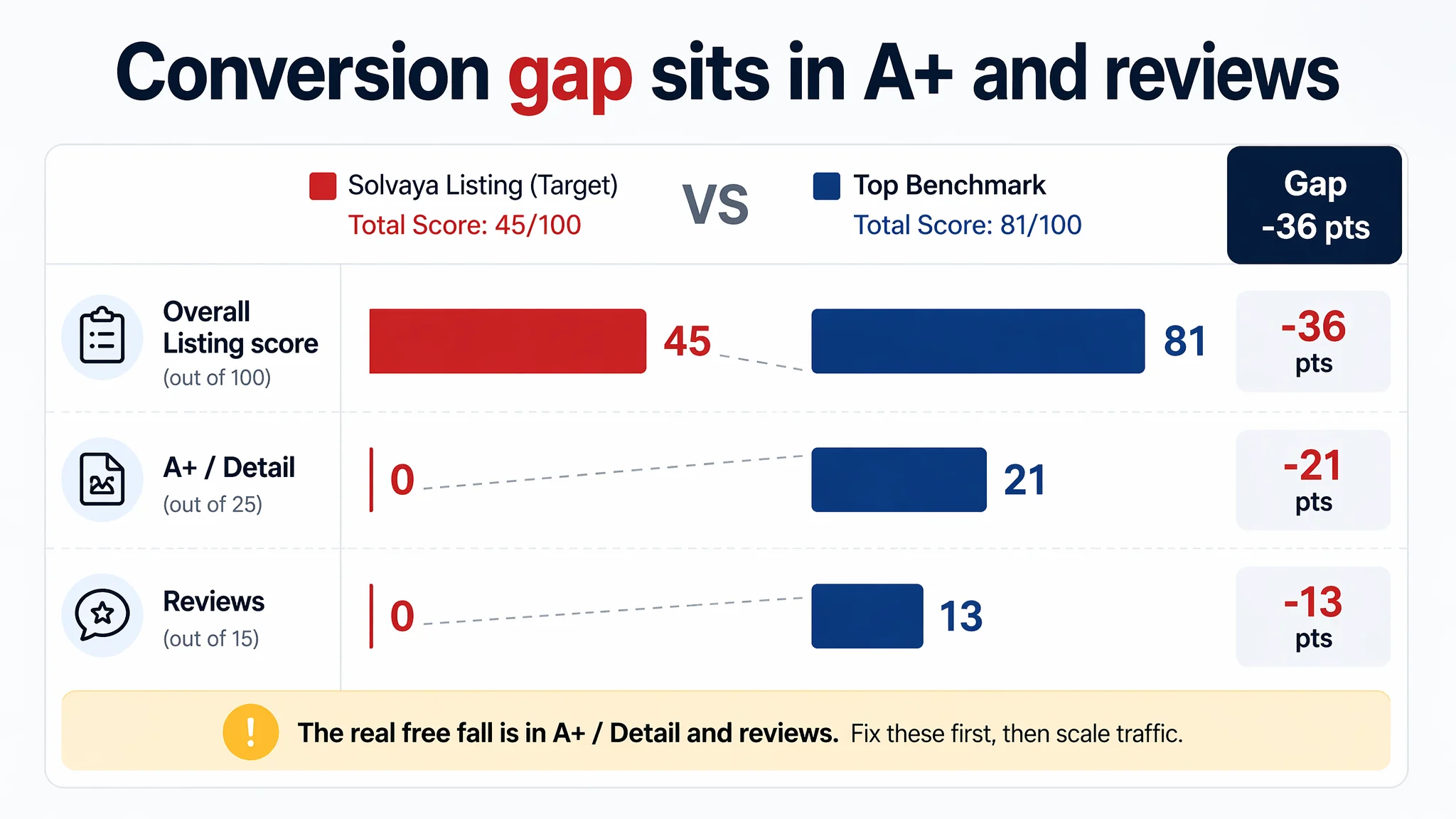
Two things stand out immediately:
1. Title and main images were not dramatically worse than the competitor. There were optimizable issues, but not “catastrophic”.
2. The real free fall was in A+ and reviews: 0 vs 21 in detail, 0 vs 13 in reviews.
“The real problem was not that ads failed to bring traffic. It was that the page could not convert the traffic.”
If the team had kept treating this as a pure advertising problem, they would have continued to pour budget into a page that, by construction, could not compete in trust or storytelling.
How the Seller Originally Misread the Problem
From the seller’s internal view, the logic looked like this:
- Product is competitively priced and functionally strong.
- Title contains core keywords like silicone, slotted, spoon, cooking.
- Images are compliant and show the product clearly.
- Ads are live, but orders are not ramping → something must be wrong with:
- Keyword selection
- Bids and match types
- Daily budgets
In other words, the team assumed “ad precision” was the main lever. That’s a common pattern:
- High ACOS is equated to “poor ad optimization”.
- Time is spent on bid changes, negative keywords, and campaign structure.
- The assumption is: if traffic is low and expensive, the answer is to tune the ads.
What was missing from that view:
- This Listing was brand new in terms of social proof:
- 0 reviews
- No star rating on the page or in search results
- The competitor the Listing was actually competing against:
- 4.6 stars
- 570+ reviews
- 10 high‑quality reviews visible on the first page
- Full A+ content with multiple modules and lifestyle shots
On any Amazon search results page, a user comparing:
- A new spoon set with no reviews and no A+
vs.
- A similar spoon set with 4.6 stars, 570 reviews, and a rich A+ story
will almost always click, stay and buy from the latter – even if your product is technically better.
Advertising in that state does not “fix” anything. It amplifies the disadvantage.
Why Traditional Amazon Ad Optimization Could Not Move the Needle
From a funnel perspective:
1. Impressions can be purchased by ads.
2. Clicks (CTR) are heavily influenced by:
- Main image thumbnail
- Title clarity and relevance
- Visible star rating and review count
3. Conversion (CVR) is strongly driven by:
- A+ / detail page content
- Review quality and quantity
- Perceived trust and usage clarity
In this case:
- Main image set: slightly behind the benchmark, but not fundamentally broken.
- Title: structurally weaker, but still recognizably relevant.
- Visible stars: none. New Listing, no rating.
- Detail content (A+):
- Target Listing: no A+ at all.
- Competitor: multiple high‑quality modules with lifestyle, dimensions, material close‑ups, and trust‑building scenes.
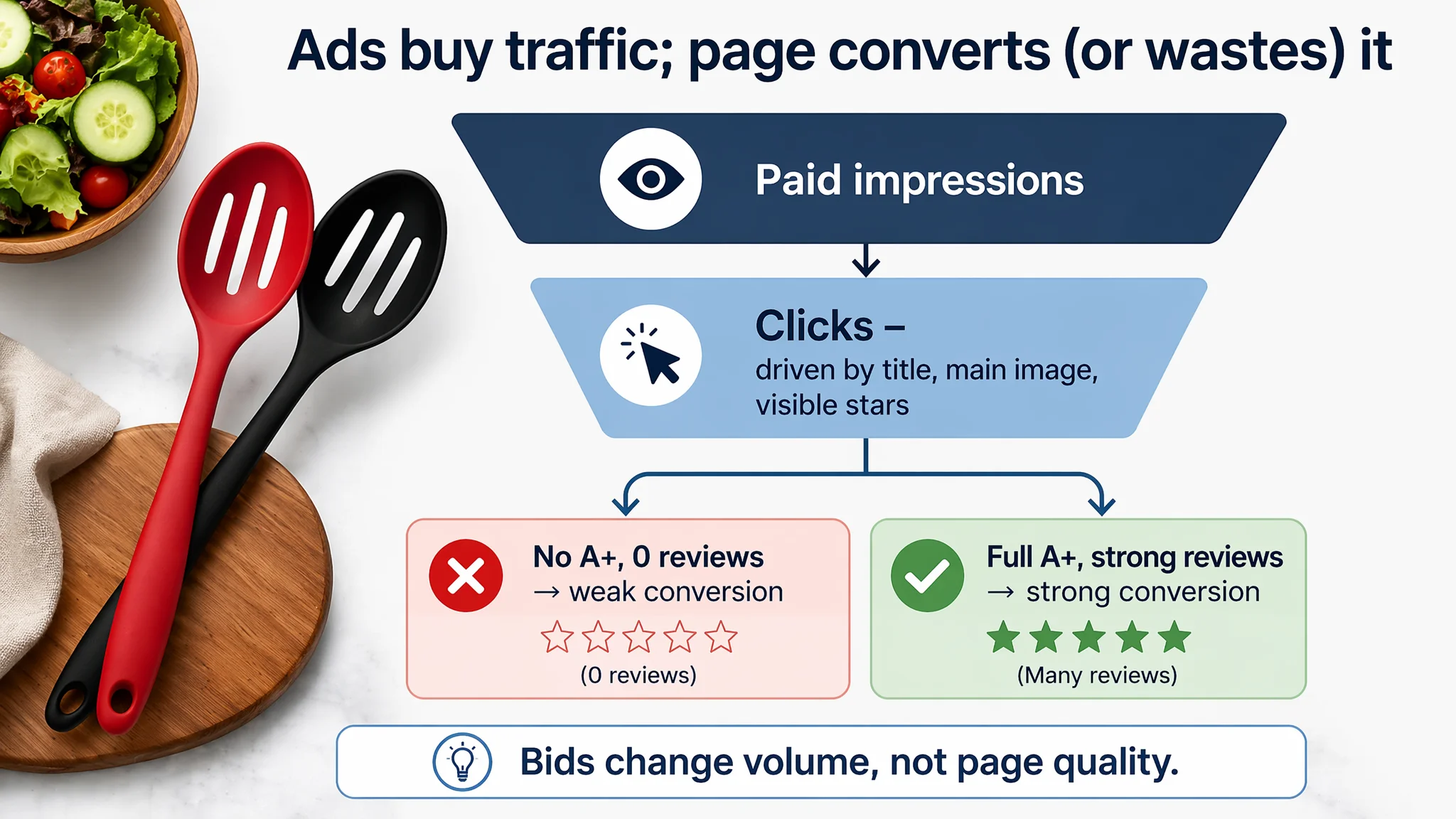
If ACOS was high or traffic was not converting, tuning bids could only affect how much money was burned, not why users were not buying.
Until the page could answer basic questions like:
- “Will this scratch my nonstick pan?”
- “Is it truly heat resistant?”
- “How big is the spoon? Will it work with my pots?”
- “Is it easy to clean and store?”
every click would carry unnecessary friction.
What the Listing Data Actually Said: A Conversion Infrastructure Gap
DeepBI’s Listing breakdown made the gap explicit.
Title: Functional but Mis‑ordered
The existing title:
- Led with “Silicone Slotted Cooking Spoons” instead of the more powerful “Slotted Silicone Spoon Set / 2‑Pack Slotted Silicone Spoon Set”.
- Pushed secondary attributes (“Brown”) into already tight title real estate.
- Under‑utilized strong differentiators like “BPA‑Free” and “Non‑Scratch”, and did not prioritize them early enough.
- Described usage scenarios more weakly than the competitor, which explicitly stated “for Stirring, Scooping and Mixing”.
The benchmark title did a better job of:
- Bringing the product shape and set (“2 Pcs Silicone Nonstick Kitchen Spoon Set”) to the front.
- Anchoring use cases (“for Stirring Scooping and Mixing”).
- Making the search intent match obvious at a glance.
DeepBI’s recommendation reframed the title to:
2-Pack Slotted Silicone Spoon Set, Heat Resistant 480°F BPA-Free Non-Scratch Cooking Spoons for Nonstick Cookware, Stirring and Draining Kitchen Spoons, Dishwasher Safe, Brown
Key logic:
- Front‑load the core search term: “Slotted Silicone Spoon Set”.
- Bake in high‑value attributes (480°F, BPA‑Free, Non‑Scratch, Nonstick Cookware).
- Add scenario verbs (Stirring, Draining).
- Keep nonessential attributes last.
This is not “cosmetic” work; it directly affects visibility and click intent on Amazon search results.
Main Images: Not Terrible, But Not Memorable – and Not Fully Strategic
Score gap: only –1 vs competitor, but the qualitative issues mattered:
- First three images lacked a strong “first‑glance” hook in the search thumbnail:
- Shadows looked hard and composited.
- Product arrangement felt casual rather than deliberate.
- No clear visual trigger for “slotted / draining functionality”.
- Trust elements were weak:
- No visual reinforcement of heat resistance.
- No visual cue for “food‑safe”, “non‑scratch”, or real kitchen context.
- No explicit “problem–solution” visuals:
- No “metal spoon scratching pan vs silicone spoon protecting pan”.
- No visualized time‑saving / ease‑of‑use concept like the competitor’s “clock + tape measure” composition.
By contrast, the benchmark used:
- A clean, uniform aesthetic (matte black + symmetric composition).
- Clear scenes and props that imply:
- Safe with food
- Fits modern kitchen décor
- Easy and pleasant to use
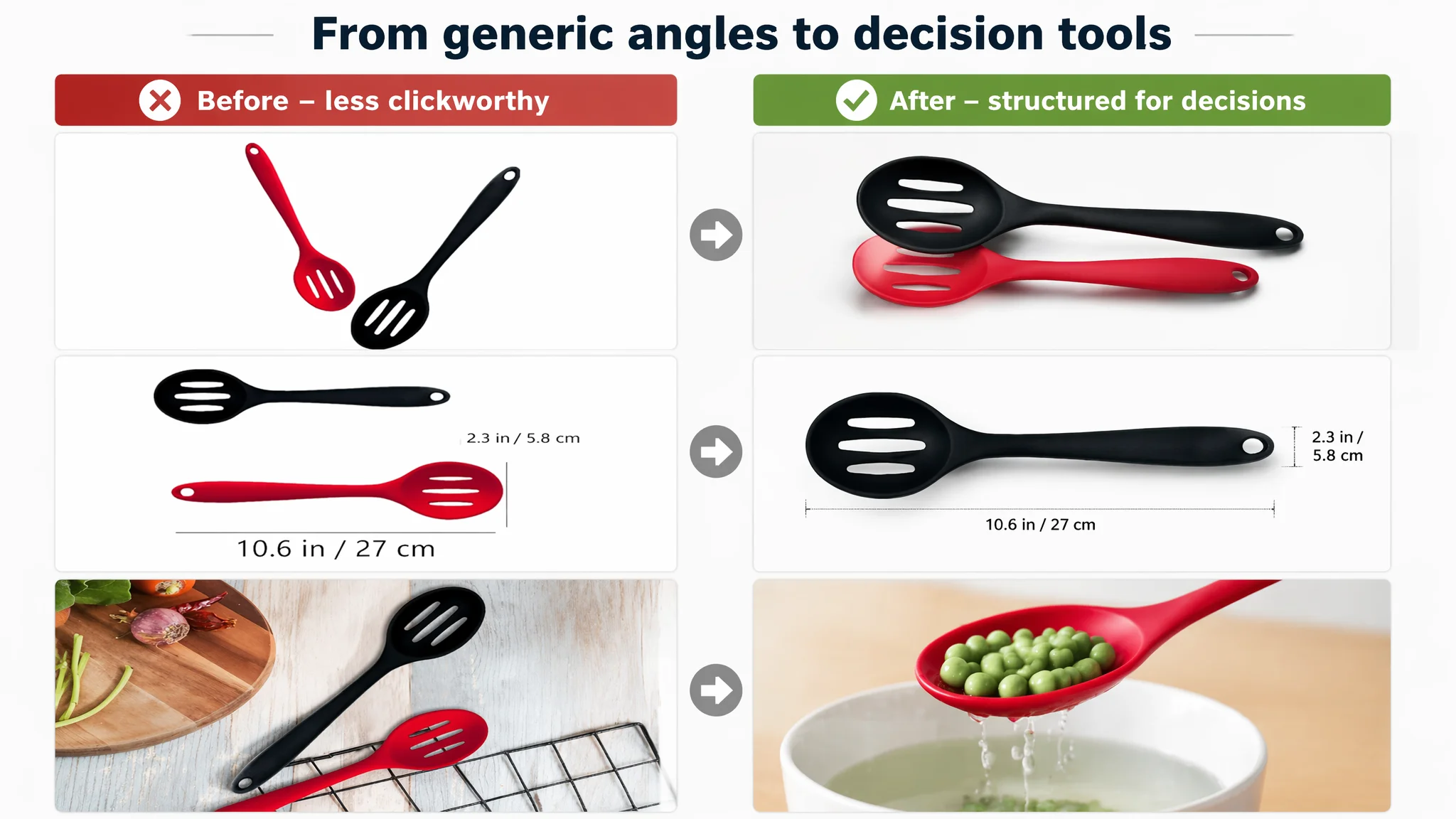
DeepBI’s image‑level recommendations focused on turning each image into a specific decision‑stage tool, not just an angle variation:
1. Hero image: Two spoons crossed centrally, 45° overhead, 75% of frame, crisp contour light, strong color contrast to stand out in thumbnails.
2. Set identity: Single spoon at a diagonal across a gradient background, with clear “2‑pack” textual tag – reinforcing value and set nature.
3. Professional dimensions shot: Top‑down, white background, thin measurement lines, clean typography for length and width.
4. Lifestyle kitchen scene: Spoon on marble counter with salad bowl and linen napkin – conveying real usage and aesthetic fit.
5. Functionality visualization: Red spoon lifting green peas with clear water droplets draining through slots – finally “showing” what “slotted” means.
The intent was simple: make the thumbnail clickable and the gallery self‑explanatory, so ads are not fighting the images.
Bullet Points: Logic Was Good, But Under‑Leveraged
Ironically, the target Listing’s bullet points were structurally stronger than the competitor’s:
- Clear progression:
Core performance → Core function → Structural advantage → Ease of use → Overall value
- Specific data: 250°C / 480°F heat rating.
- Competitive contrast: reduced seams vs multi‑part designs, avoiding wood cracking issues.
Where they fell short was in naming and framing the value in a more Amazon‑native, benefit‑first style, and fully connecting feature → benefit → scenario.
DeepBI’s re‑framed bullets did three things:
1. Pack the benefit into the bullet title:
- “PREMIUM HEAT-RESISTANT MATERIAL”
- “NON-STICK PAN PROTECTION”
- “ERGONOMIC HANDLE & EASY STORAGE”
- “SEAMLESS ONE-PIECE CONSTRUCTION”
- “VERSATILE 2-PIECE SET FOR WIDE USES”
2. Tie features to concrete use cases:
- Stirring sauces, soups, frying.
- Protecting ceramic, stainless, cast‑iron pans.
- Hanging on hooks to keep the kitchen organized.
- Avoiding wood cracking and bacterial buildup.
- Use in home kitchens, restaurants, catering.
3. Maintain the precise technical edge (480°F, food‑grade silicone), but integrate it into pain‑point resolution (no warping, no melting, no scratching).
“The bullet points had information, but not a buying logic. After reframing, each line started as a reason to buy, not as a raw specification.”
Detail Page / A+ Content: The 21‑Point Free Fall
This was the real red flag:
- Target Listing: no A+ content.
- Benchmark Listing: full A+ with:
- Brand module
- Use‑case scenes
- Dimension diagrams
- Material close‑ups
- Multi‑angle product layouts
- Kitchen storage scenes
DeepBI’s diagnosis:
- With no A+, the page:
- Could not build trust visually.
- Could not stage a usage journey from pain point to solution.
- Offered no structured content to increase time on page, a soft signal for Amazon that a page is useful.
- The benchmark’s A+:
- Used “problem–solution” module logic:
- “Protect your nonstick pans” + image of gentle spoon–pan contact.
- “Easy to clean” + dishwasher iconography.
- Combined emotional and rational persuasion:
- Smiling user in a bright kitchen.
- Professional measurement illustrations.
- Mix of ingredients and cooking scenes.
In deep competition terms, this seller’s page was entering the fight with no armor at all.
Why DeepBI Did Not Recommend “Keep Tuning the Ads First”
From a business‑risk perspective, continuing to optimize ads first would have:
- Increased spend on every click.
- Driven more traffic to a page that:
- Had 0 trust signals (no reviews, no A+).
- Had less click‑worthy search presence (weaker title and thumbnail).
- Potentially led the seller to the wrong conclusion:
- “This product doesn’t work.”
- “The category is too competitive.”
- “Silicone spoons can’t be profitable.”
The more rational decision path:
1. Stabilize Listing conversion first:
- Fix the title logic.
- Rebuild the main image set to win clicks and communicate function.
- Build a full A+ that makes the product explorable and credible.
2. Then re‑evaluate ad performance under a page that is actually capable of converting.
“Advertising does not only amplify advantages. It can also amplify a page’s existing defects.”
With DeepBI’s scoring, the sequence of work became defensible:
- A+ and reviews: catastrophic gap (0 vs 21, 0 vs 13) → must fix first.
- Title/main images: moderate but important gap (–3, –1) → optimize in parallel.
- Bullets: structurally okay but under‑leveraged → tighten for clarity and persuasion.
- Ads: only scale after page‑level conversion bottlenecks are addressed.
Rebuilding the Page: From “Bare Product” to a Complete Cooking Story
On the A+ side, DeepBI’s optimization plan was essentially a storyboard for a complete Amazon detail page.
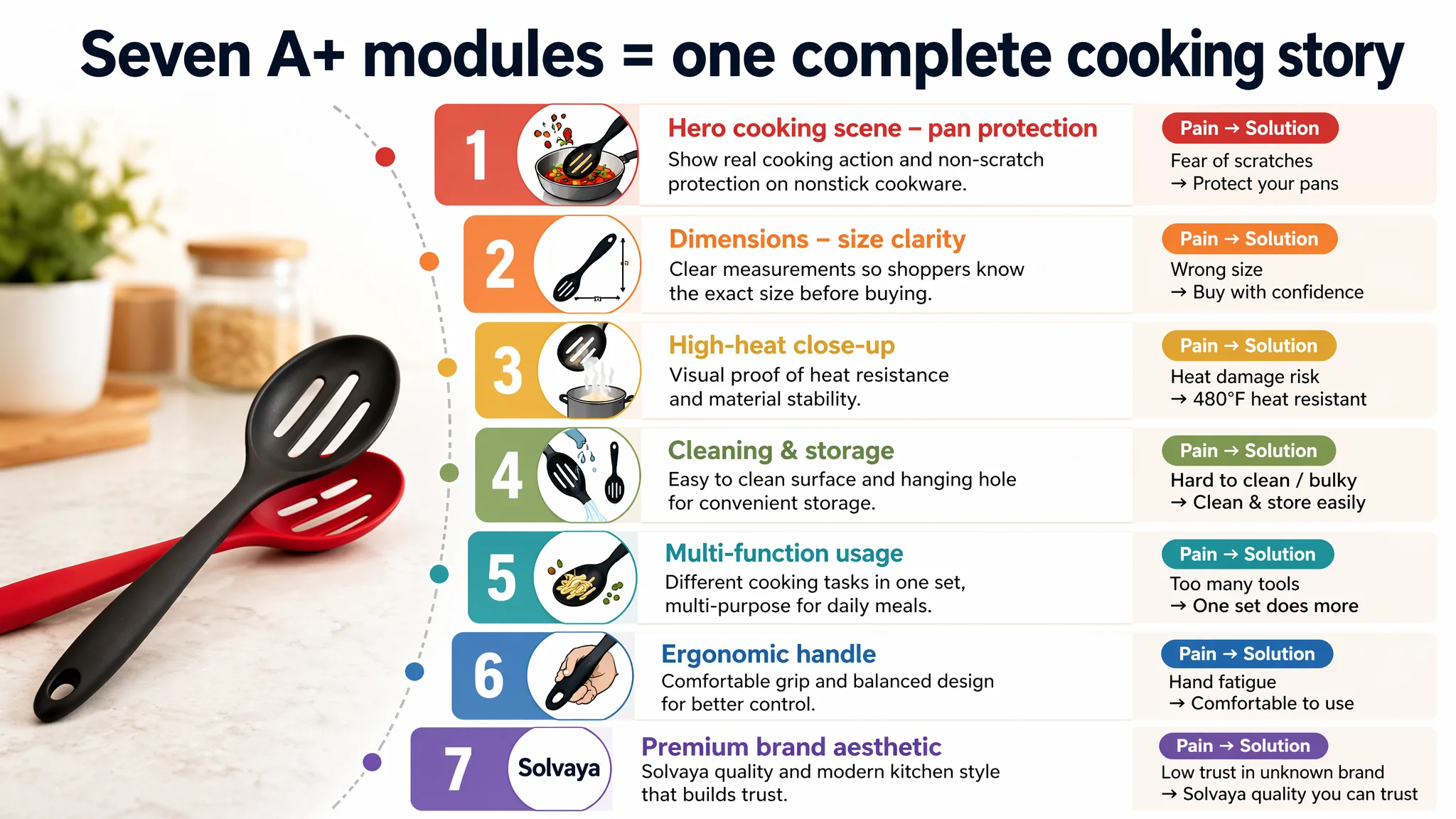
1. Hero Cooking Scene: “This Is How You Actually Use It”
- Bright, modern kitchen.
- A family member holding the black silicone spoon while stirring colorful vegetables in a stainless pan.
- Slightly blurred background, clear focus on:
- Spoon–pan contact (emphasizing “non‑scratch”).
- Fresh, vivid ingredients.
- Natural window‑like light, around neutral daylight color temperature.
- Message: “This belongs in your kitchen, and it will not damage your pans.”
2. Clean, Minimal Dimensions Visual
- Pure white background.
- Single spoon vertically centered.
- Thin lines marking:
- Overall length: 27.5 cm.
- Spoon head width: 5.8 cm.
- No decorative elements; only product + precise text.
Purpose:
- Pre‑empt “size doesn’t match my pot” friction.
- Reduce returns and negative reviews tied to expectation mismatch.
3. High‑Heat Protection Close‑Up
- 30° angled close‑up.
- Spoon immersed in boiling soup, with visible steam.
- Warm lighting emphasizing contrast between black spoon and rich orange/red broth.
- Slightly blurred stove and pot edges behind.
Purpose:
- Visually prove heat resistance and material stability.
- Connect the 480°F spec to a clear mental image.
4. Cleaning & Storage Split Scene
- Left: spoon under running water, water beads sliding off the surface.
- Right: two spoons hanging neatly on metal hooks.
- Light, clean bathroom‑like or kitchen wall background.
Purpose:
- Solve two anxieties at once:
“Is this hard to clean?” and “Will it clutter my kitchen?”
5. Multi‑Function Ingredient Usage
- 45° overhead shot of spoon scooping flour or oats from a glass jar.
- Warm wooden countertop, jars slightly blurred in the background.
Purpose:
- Expand perception from “soup spoon” to multi‑purpose cooking and baking tool.
- Strengthen sense of value and versatility.
6. Ergonomic Grip Detail
- Close‑up of a hand holding the handle.
- Clear view of:
- Contact points of thumb and index finger.
- Handle curvature.
- Hanging hole at the end.
Purpose:
- Visualize comfort and control, especially for longer cooking sessions.
7. Premium Brand Aesthetic Shot
- Two spoons crossed on a marble surface.
- Sprigs of basil and cherry tomatoes as accents.
- Soft, diffused lighting.
Purpose:
- Add a lifestyle and brand layer beyond pure utility.
- Signal that this is not a cheap, anonymous utensil – it belongs in a modern, thoughtfully designed kitchen.
Each module answered a different conversion question. Together, they turned a bare product page into a coherent narrative:
- This spoon protects your pans.
- It handles high heat confidently.
- It is easy to clean and store.
- It supports multiple cooking and baking tasks.
- It is comfortable to use and looks good in your kitchen.
What Changes Once the Page Can Actually Convert
Even without fabricating post‑optimization numbers, some shifts in operating state are expected and observable when a Listing moves from:
- 45/100 score, no A+, no reviews
to something much closer to:
- A titled and imaged Listing aligned with search intent.
- A+ that systematically addresses risk and value.
- A plan to accumulate first social proof.
The main changes:
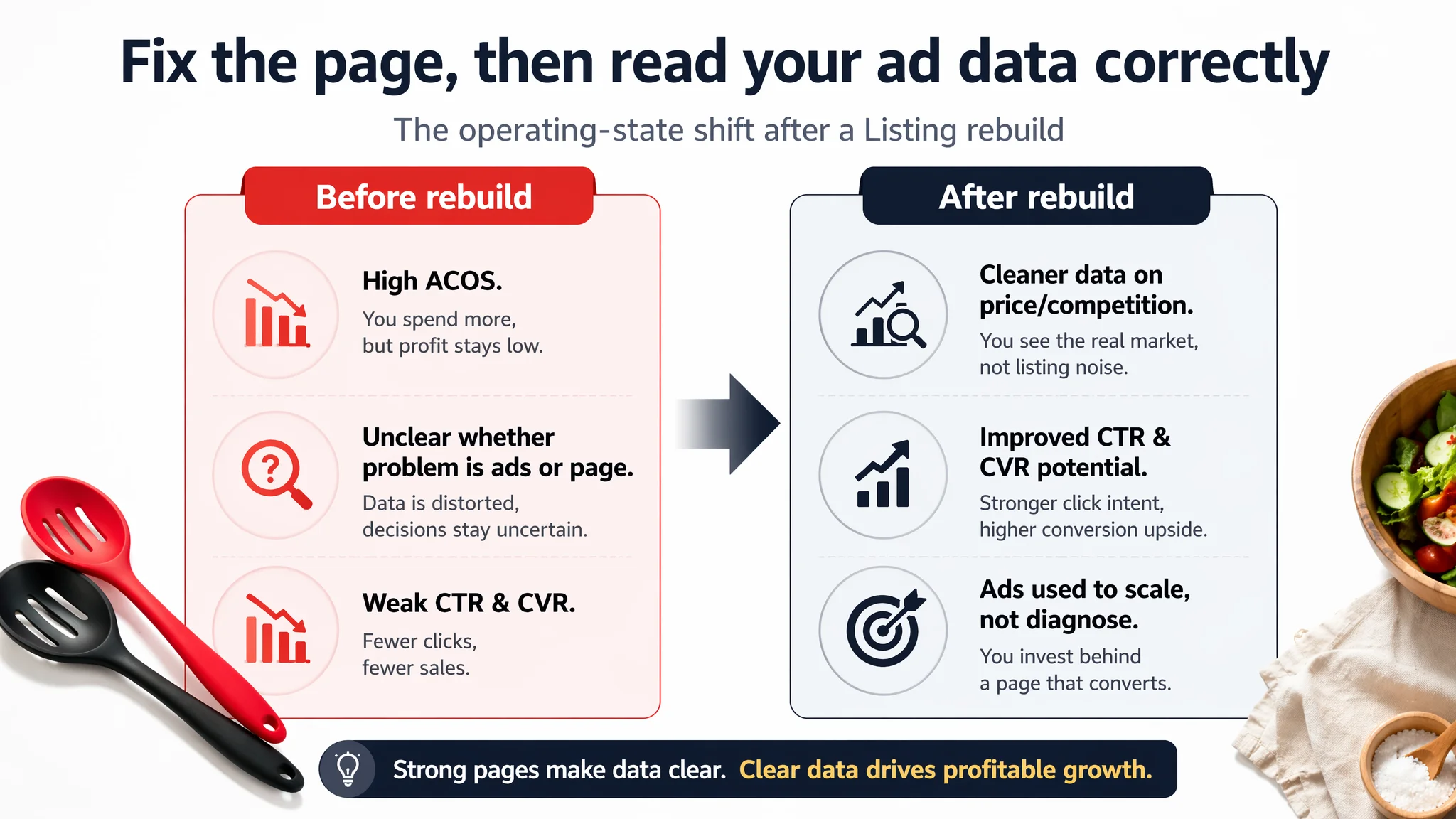
1. Ads Stop Being Purely “Exploratory Spend”
With a rebuilt Listing:
- Click‑through rate (CTR) has a real chance to move, because:
- The title works better with the target queries.
- The main image stands out more and communicates core functionality.
- Conversion rate (CVR) can start to normalize, because:
- Users finally see a clear explanation of benefits.
- Visual evidence reduces fear about damaging cookware or buying the wrong size.
That does not guarantee instant profitability, especially with 0 reviews, but it allows data to be read correctly:
- If ACOS stays very high after these fixes, the problem might genuinely lie in:
- Price position.
- Category competitiveness.
- Product‑market fit.
- Without these fixes, you can’t tell whether the problem was ads, page, or product.
2. Organic Traffic Becomes Worth Protecting
As A+ and images improve:
- Amazon’s algorithm sees better engagement:
- More time on page.
- Fewer bounces back to search.
- Over time, this favors:
- More stable organic rankings for key search terms.
- Less dependence on paid clicks for every single order.
The Listing begins to build its own conversion “muscle”, rather than relying solely on ad injections.
3. The Seller’s Mental Model Changes
Perhaps the most important shift is cognitive:
- From:
“If ads are not working, we need a better ad manager or more sophisticated structure.”
- To:
“Before scaling ads, we must ensure that the Amazon Listing – title, main photos, bullets, and A+ – is structurally capable of converting paid traffic.”
The team realizes:
- A new Listing with 0 reviews and 0 A+ is not a fair fight against a benchmark with 570+ reviews and full A+.
- Ads cannot substitute for trust and clarity that are missing on the page.
- Listing score is not a vanity metric; it reflects where your real bottleneck sits in relation to the category’s best.
What Other Amazon Sellers Can Take Away
This silicone spoon case is not about cookware specifically; it’s about how many Amazon sellers misallocate effort.
Key takeaways:
- If your Listing has no A+ and no reviews, your primary problem is almost never “bid strategy”.
- A small gap in title or main image can be masked by a massive gap in trust and storytelling.
- Strong bullet‑point logic is not enough if:
- The title does not win the click.
- The images and A+ do not visually answer core risks.
- Advertising should not be used to “test the product” on a structurally weak page. It should be used to scale what the page can already convert.
Before you decide that:
- “This product doesn’t work,” or
- “This category is impossible now,”
check, with data, where you stand against your real Amazon benchmark:
- Do you have A+ at all?
- How does your image set compare by role (hero, dimensions, function, lifestyle)?
- Does your title surface the right search logic in the first 80–120 characters?
- Are bullets tightly framed around pain point → solution → scenario?
Only when those answers are solid does it make sense to ask the next question: “Now, how much traffic can we profitably buy?”