

An automotive Amazon seller in the brake pad category came to DeepBI with a familiar complaint: ad spend was getting harder to control, yet the product page did not seem to “deserve” these costs in return. On paper, the product itself was solid, and the team believed the main bottleneck was lack of reviews and minor copy tweaks. They kept tuning ads and refreshing text, but ACOS remained stubborn and conversion felt fragile.
Once we put this Listing next to a true benchmark competitor on Amazon, a different picture emerged. The problem was not traffic volume or a “bad product.” The real constraint was that the Amazon product page lacked a complete, trustworthy decision path—especially in the A+ section—while the benchmark Listing was quietly doing the heavy lifting with a full-page story, clear fitment logic, and strong professional cues.
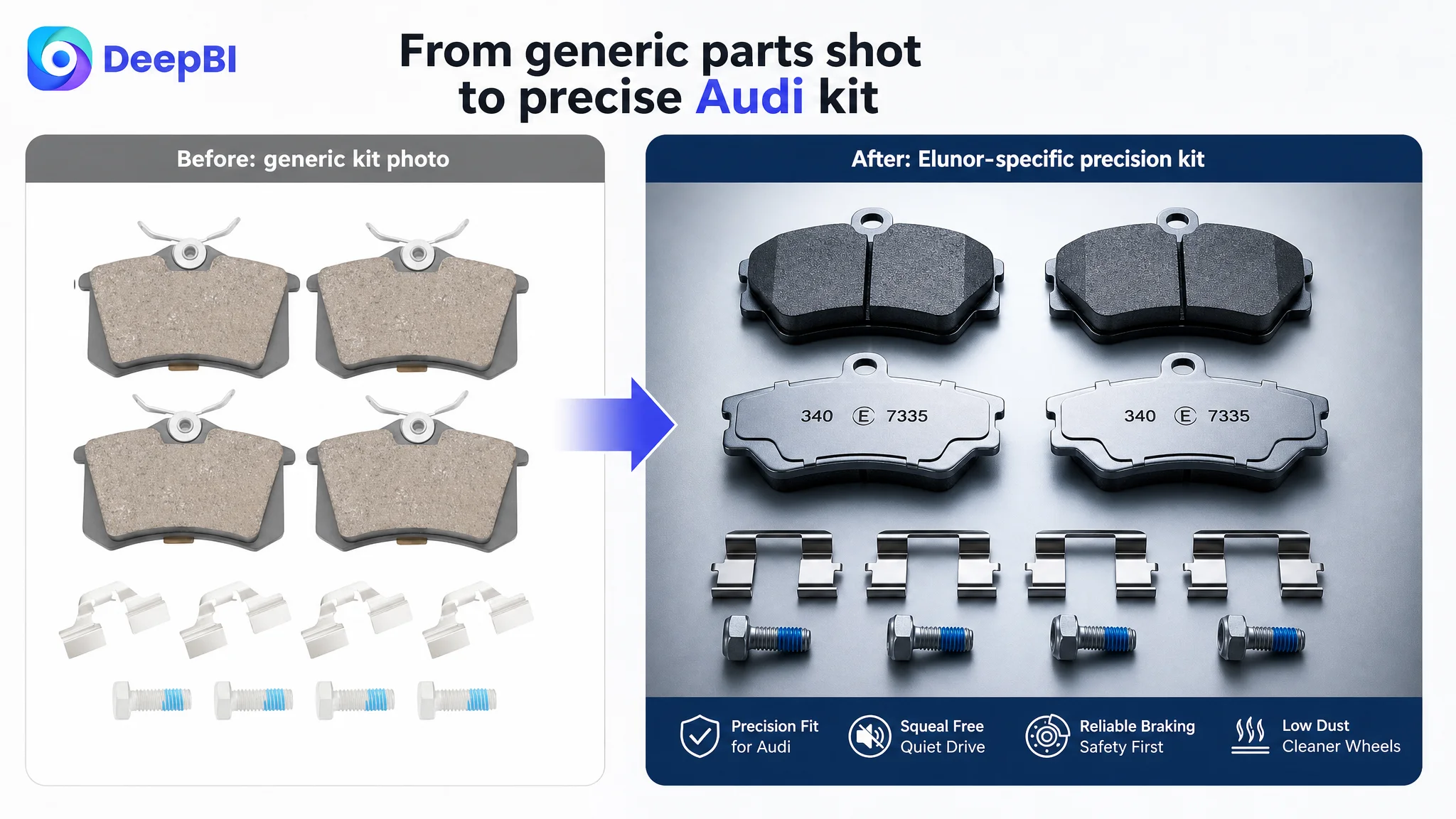
The later optimization did not start by squeezing bids or expanding keywords. It focused on rebuilding the page’s sales logic: reordering the title around “Audi rear brake pads,” restructuring bullets by compatibility blocks and safety benefits, and designing a full A+ content flow with fitment tables, technical structure visuals, and real-world driving scenarios. For many Amazon automotive sellers, this case is a reminder: if the page cannot convert and reassure, ads will only magnify that weakness.
The Core Conflict: A Listing That Looked “OK” but Could Not Compete
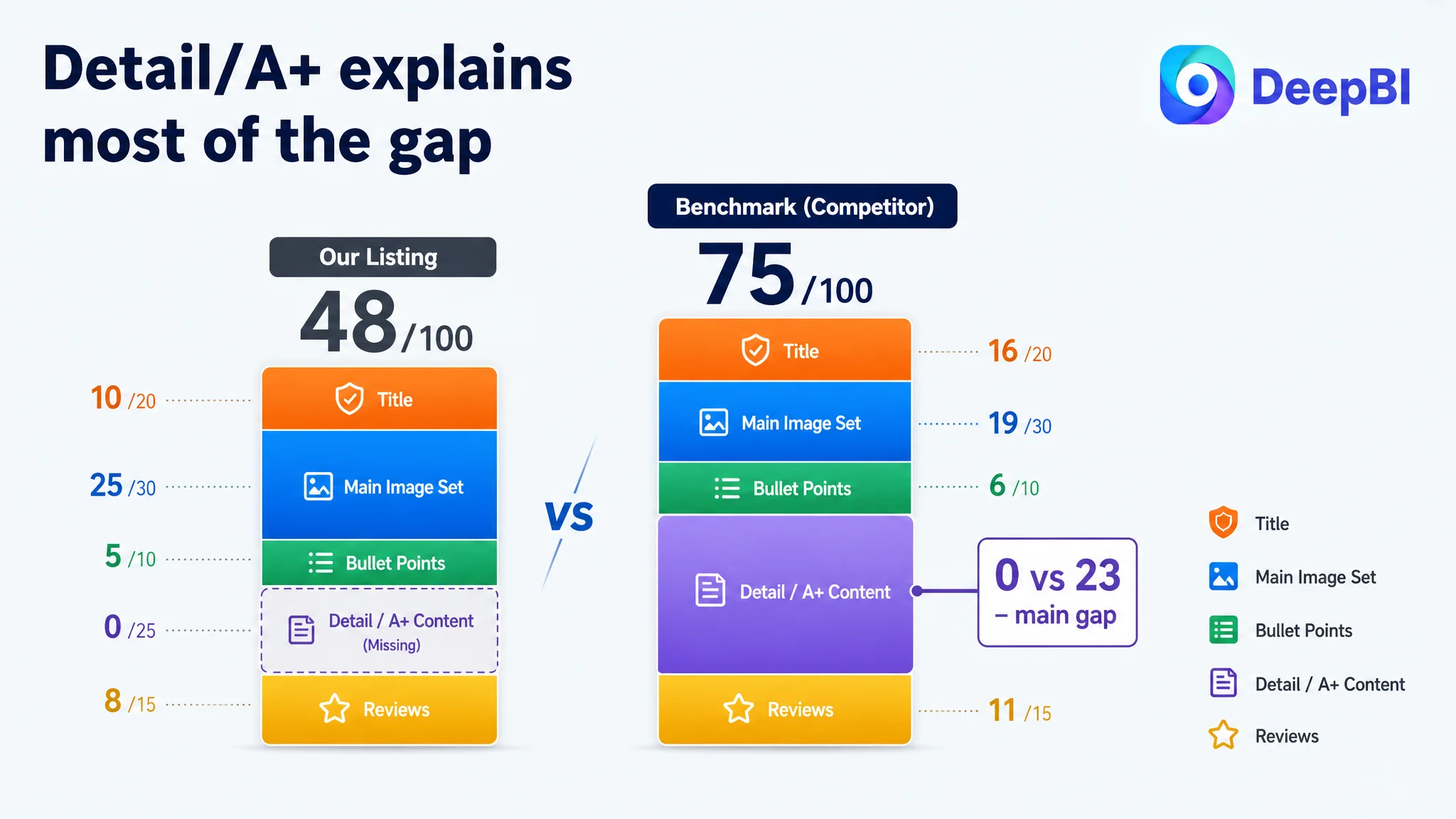
DeepBI’s Listing scoring put the brake pad Listing at 48/100, versus 75/100 for a benchmark competitor in the same Amazon US subcategory.
- Title: 10 vs 16
- Main image set: 25 vs 19
- Bullet points: 5 vs 6
- Detail/A+ content: 0 vs 23
- Reviews: 8 vs 11
On the surface, the seller felt the page was “good enough”: complete kit photos, some scene images, bullet points, and a modest base of reviews (4.3 stars, 15 reviews). They attributed weak performance to:
- Not enough reviews compared with the category leader
- “Maybe the images are not pretty enough”
- “We just need stronger ads to push ranking first”
But the score gap told a different story. The largest single deficit—23 points—came from the detail/A+ content dimension. In a high-safety, high-liability automotive category, this is not a cosmetic issue; it is the backbone of trust and conversion.
“The real problem was not that ads failed to bring traffic. It was that the page could not convert the traffic.”
What the Seller Was Optimizing — and Why It Was Not Moving the Needle
From the customer’s perspective:
- CTR was not dramatically worse than peers once ads were tuned
- Star rating (4.3) looked “acceptable”
- Main images showed the whole kit and some structure diagrams
- Complaints were mostly about scale: fewer reviews, less visibility
So they kept:
- Tweaking ad bids and keyword coverage
- Hoping that more impressions and more reviews would fix conversion
- Treating the page as basically complete, only needing “polish”
This is a classic misdiagnosis:
- Symptom they saw: high ACOS and slow order growth
- Assumed cause: insufficient traffic and social proof
- Real cause: incomplete purchase logic and trust building on the Amazon product page
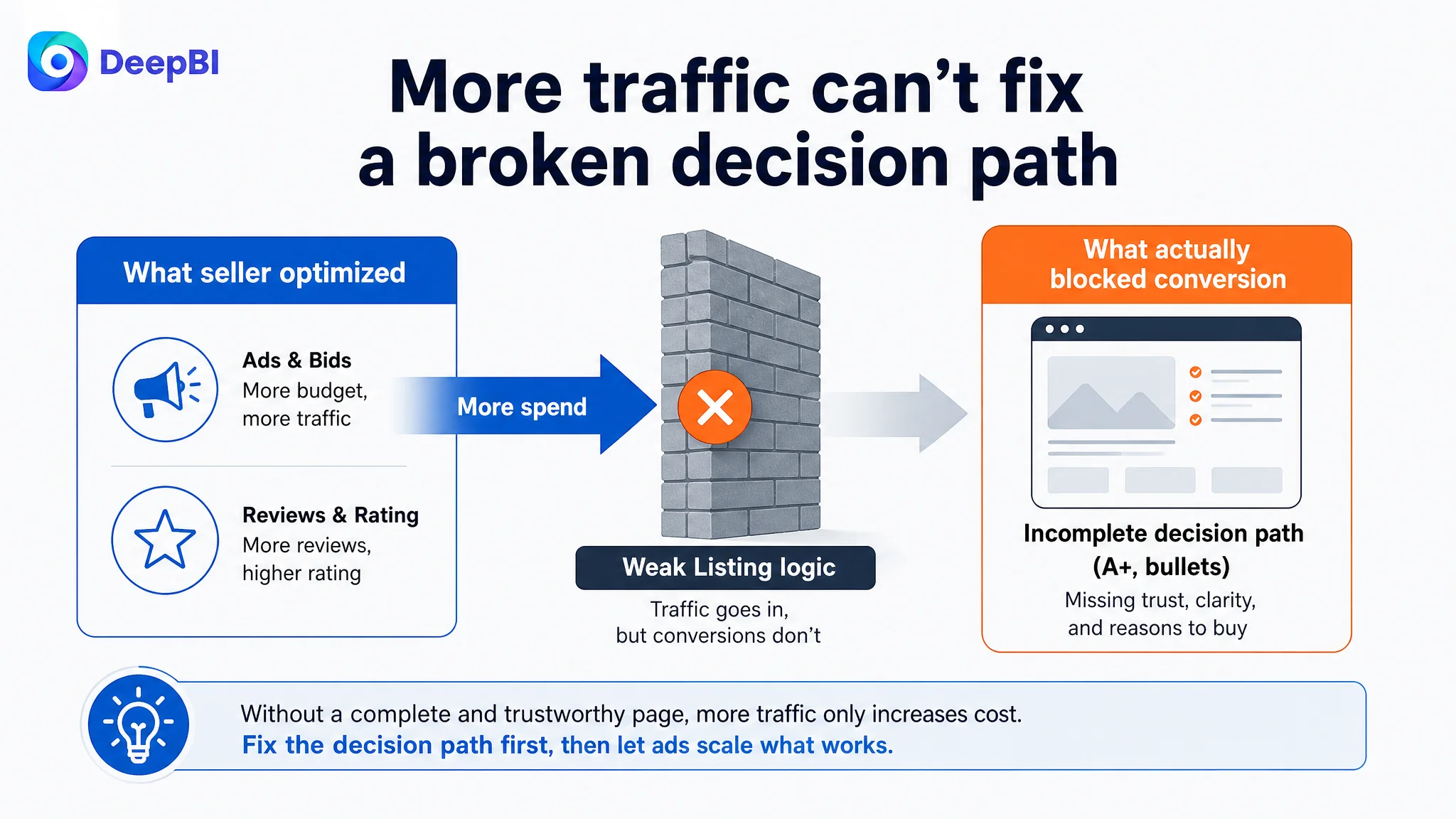
When ad pressure rises, many teams instinctively increase targeting sophistication and budget. But if the page is structurally weaker than the benchmark, every additional click is just more expensive proof that the Listing cannot keep up.
What DeepBI Saw in the Listing Data
A Title That Worked for the Seller, Not for Amazon Shoppers
DeepBI’s comparison between the target Listing and the benchmark highlighted several structural title problems:
- Model code first, product second
The original title led with an internal model code (HZ340) instead of “Audi rear brake pads”. The competitor led with “Brake Pads” and clearly named the product type, aligning with how buyers actually search and how Amazon allocates keyword weight.
- Overloaded compatibility, underdeveloped benefits
The title used “Fit Compatible with” plus a long, ungrouped model list. Information was there, but logic was not: hard to scan, slow to understand, low conversion efficiency. The benchmark followed a clearer pattern: product + brand + core selling point + core fitment + extended fitment.
- No clear material or pack-size signal
In automotive, “ceramic” and “4pcs” are fast, high-value cues. The benchmark title stated them. The target title stayed at generic compatibility and codes, missing a fast hook.
DeepBI’s recommended title direction reframed priorities:
“HZ340 Audi Rear Brake Pads, Compatible with EHT340H D340-7335, for Audi A3 2010-2012, A4 1997-2008, A4 Quattro 2002-2006, A6 1998-2004, A6 Quattro 1998-2004”
- “Audi Rear Brake Pads” comes first to capture core intent
- The HZ340 model and cross-reference codes (EHT340H, D340-7335) are preserved for professional searches
- Fitment is grouped by core Audi families, instead of a raw year-model dump
This is not “SEO magic”; it is aligning the title with how real buyers search and read on Amazon.
The Surprising Finding: Images Were Not the Weakest Link
From scoring, the main image dimension (25 vs 19) actually showed the target Listing slightly ahead of the benchmark:
- A complete kit shot showing pads, clips, bolts
- Scene images and functional diagrams forming a basic “narrative chain”
- Dimension and structure information useful to B2B and repair-shop buyers
The competitor, by contrast, relied heavily on repeated static product angles, with only 2 proper information graphics.
So the usual suspicion—“our images must be weaker”—did not hold. The issue was not that there were no good images; it was that:
- Visual logic was not clearly tied to buyer pain points (noise, safety, fitment certainty, extreme conditions)
- The Amazon A+ section, where technical depth and brand professionalism should be anchored, was completely missing
“Advertising does not only amplify advantages. It can also amplify a page’s existing defects.”
DeepBI’s diagnosis: click potential was not the primary bottleneck; trust and decision support after the click were.
Where the Page Truly Failed: Detail / A+ Content at Zero
In the detail/A+ dimension, the target Listing scored 0/25. The benchmark scored 23/25 with:
- A strong main banner with full-width product imagery
- Visual icon rows summarizing core selling points
- A multi-page fitment table covering Audi, VW, and related models by year
- Technical structure diagrams and exploded views
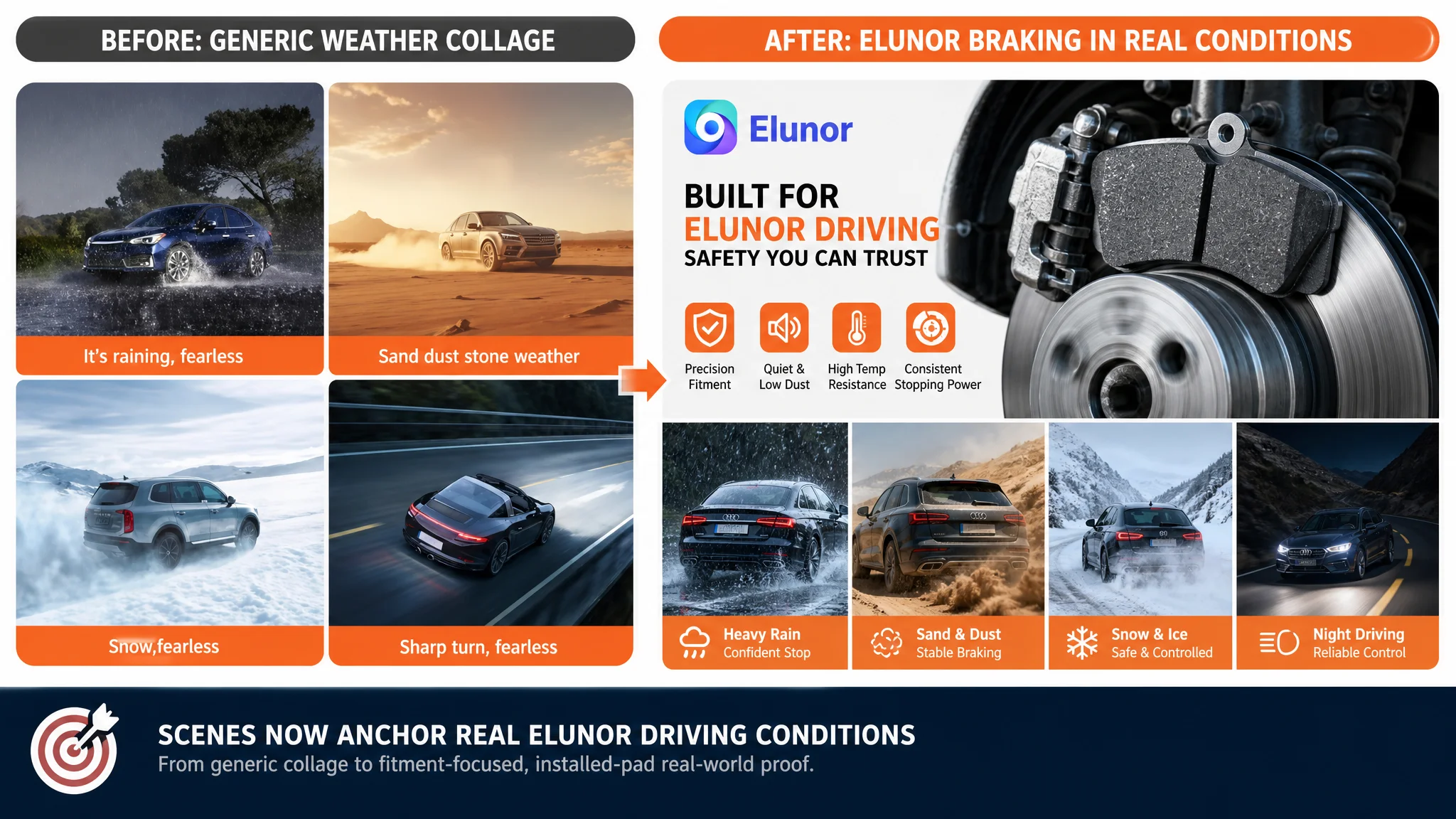
- Real driving scenes across rain, snow, dust, and mountain roads
- Installation and safety modules with a technician visual and “Attention” notes
For a safety-critical product like brake pads, this creates a complete decision path:
1. “This is the right type of pad” (banner and icons)
2. “It definitely fits my car” (detailed fitment tables)
3. “The internals and materials look professional” (technical diagrams)
4. “It performs in my real driving conditions” (weather/terrain scenes)
5. “It is installed and endorsed by professionals” (technician scene, safety notes)
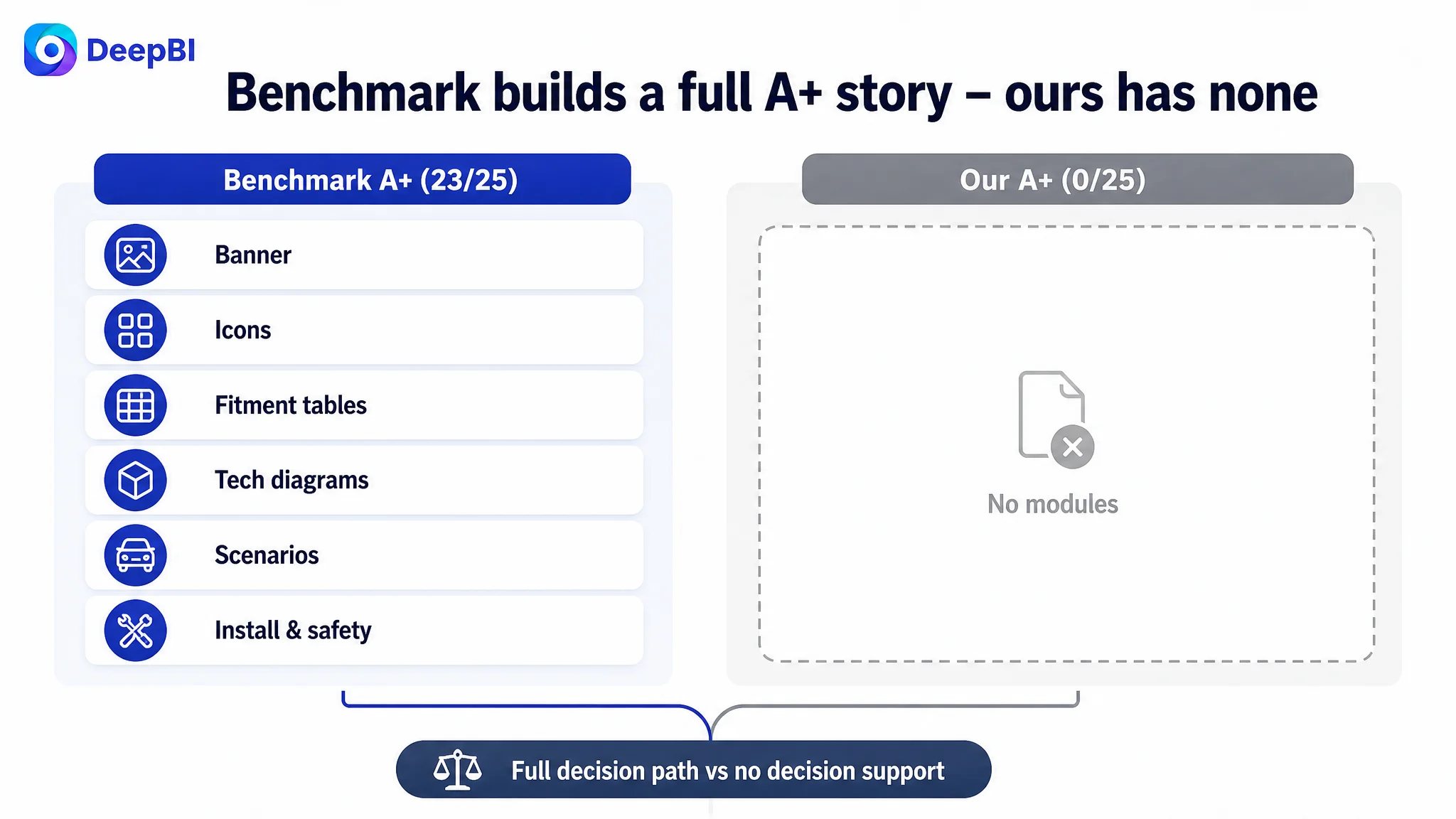
The target Listing, with no A+ content, had:
- No expanded fitment reassurance beyond basic text
- No visual proof of internal structure or material logic beyond a simple layer image
- No real-world scenario validation
- No professional installation or safety narrative
In numbers, this alone explained almost the entire 27-point gap (0 vs 23 in A+ plus smaller gaps elsewhere). But more importantly, it explained the business experience: paid traffic flowed in, but buyers bailed out before completing the decision.
Why DeepBI Did Not Recommend “Optimizing Ads First”
At this stage, the temptation is to:
- Push more traffic via Amazon ads
- Expand keyword coverage to reach more Audi/VW/Peugeot owners
- Add budgets on “Brake Pads” and specific model keywords
DeepBI’s judgment was that this would be commercially reckless before fixing the Listing:
- The page lacked the full trust stack the benchmark offered
- Review volume was much lower (15 vs 126), with a higher share of visible negatives (25% vs 11% on page one)
- A+ content was zero, so there was no structured story to offset weaker social proof
In other words, every additional click would land on a page that:
- Could not prove fitment as clearly
- Could not visualize technical superiority as convincingly
- Could not reassure about performance in extreme conditions
- Could not leverage professional installation cues
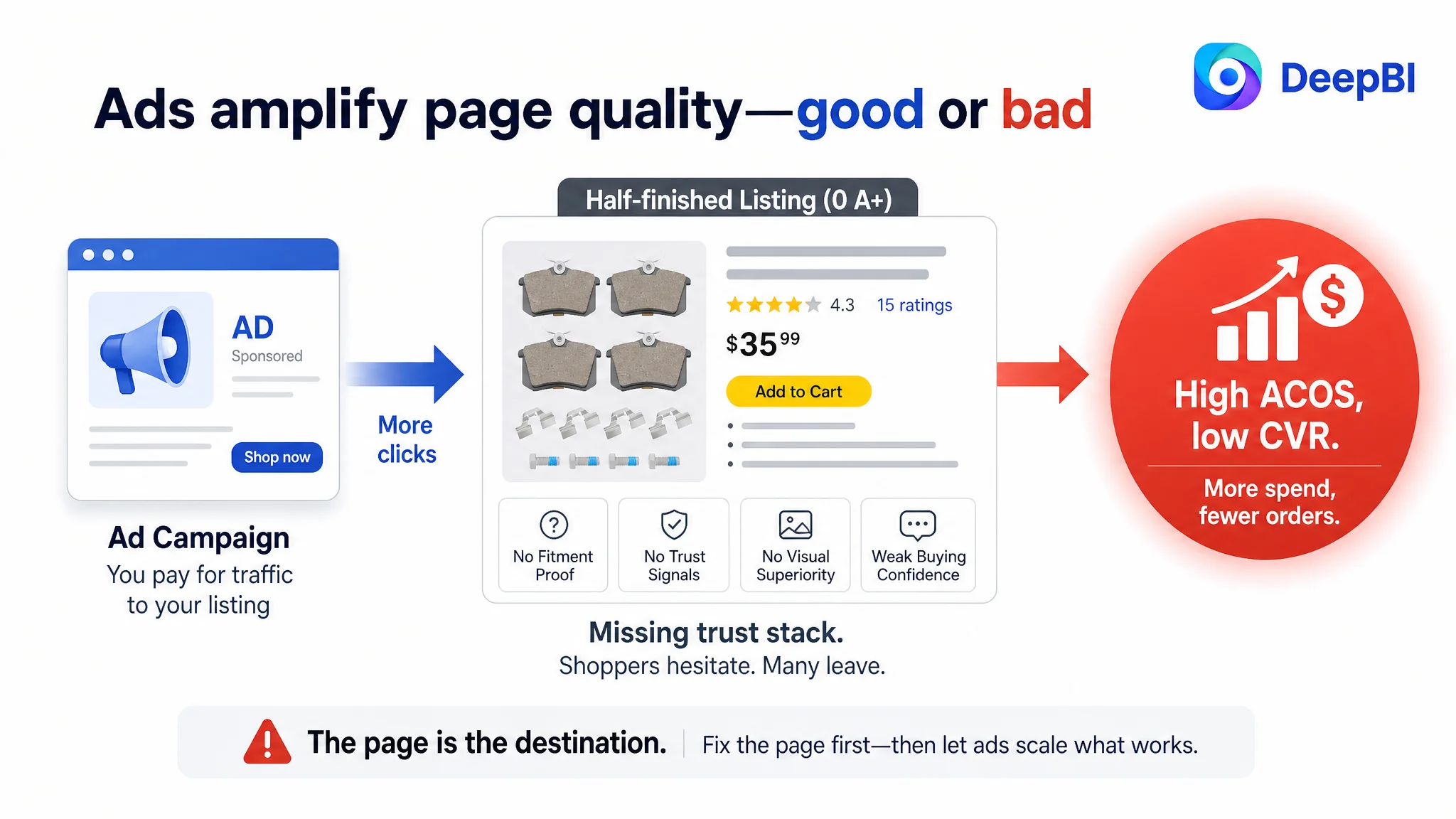
The biggest current risk was not insufficient impressions; it was amplifying a half-finished product page with expensive ads.
Rebuilding the Sales Logic: From Compatibility Dump to Buying Path
DeepBI’s optimization direction was not “make it prettier.” It was “rebuild the way a buyer decides on this Amazon Listing.”
1. Bullets: From Raw Lists to Structured Decision Blocks
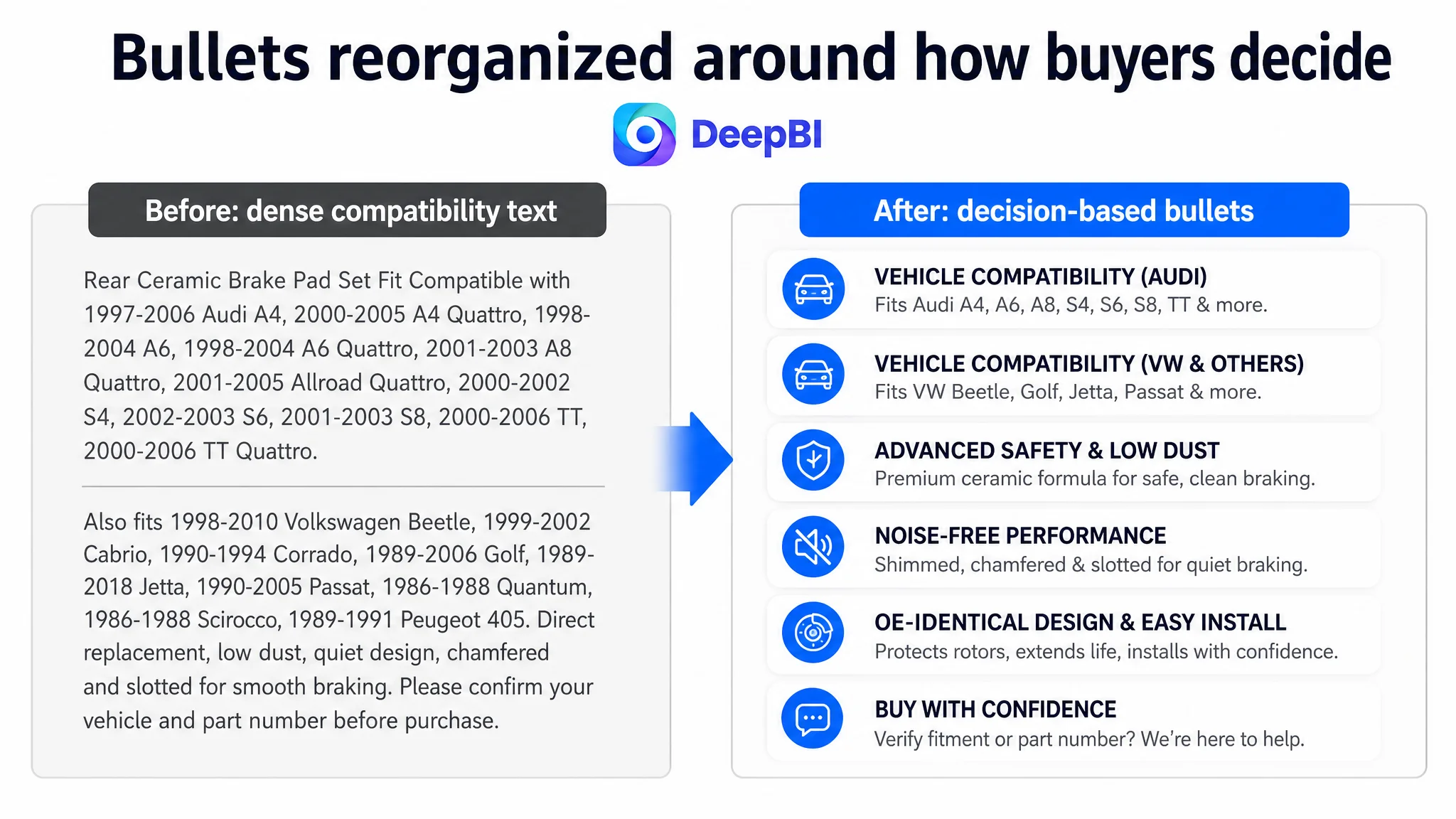
Original bullets heavily stacked compatibility information in long, dense paragraphs, mixing models and years without strong hierarchy. The benchmark did better by:
- Splitting fitment into clear Audi and VW/Peugeot blocks
- Using capitalized subheadings like “FITMENT”, “SAFETY”, “No Noise”, “BUYER NOTICE”
- Moving from technical description to clearly framed benefits
DeepBI’s restructuring logic:
- BP #1 & #2 — Compatibility as two clean modules
- “VEHICLE COMPATIBILITY (AUDI)” and “VEHICLE COMPATIBILITY (VW & OTHERS)”
- Each bullet covers a clear brand group and core models/years
- Easier for buyers to scan and confirm fit, while also improving keyword coverage
- BP #3 — Safety & low dust as a named promise
- “ADVANCED SAFETY & LOW DUST”
- Explicitly linking ceramic material, dust reduction, and corrosion protection
- BP #4 — Noise as a direct pain-point solution
- “NOISE-FREE PERFORMANCE”
- Calling out shimmed, chamfered, and slotted design to address squeal and vibration
- BP #5 — OE-standard fit and rotor protection
- “OE-IDENTICAL DESIGN”
- Emphasizing direct bolt-on fit and rotor-friendly chamfers for longer life
- BP #6 — Buyer notice & support
- “BUYER NOTICE & SUPPORT”
- Clear guidance to use Amazon fitment checker or contact support before purchase
The shift is subtle but decisive: from dumping information to guiding the decision.
2. Main Image Set: Organizing Visuals Around How Buyers Judge
Even though the target Listing already outscored the benchmark on the main-image dimension, there was room to align visuals more tightly with buyer logic:
- Primary kit image:
- Move from semi-random layout to a clean, centered 2×2 matrix of pads
- Align clips and bolts in a neat row to signal “OEM-level kit completeness”
- Use high-contrast lighting to highlight metal and friction surface textures
- Hero product + vehicle context image:
- Show a single pad at 45° angle, with a blurred Audi wheel in the background
- Include four compact orange icons for “Low Dust,” “No Noise,” “Fast Response,” “Efficient Heat Dissipation”
- All-weather capability image:
- Use split-screen: installed pad visual + four small real-world scenes (rain, dust, snow, mountain curves)
- Label as “All-weather protection”
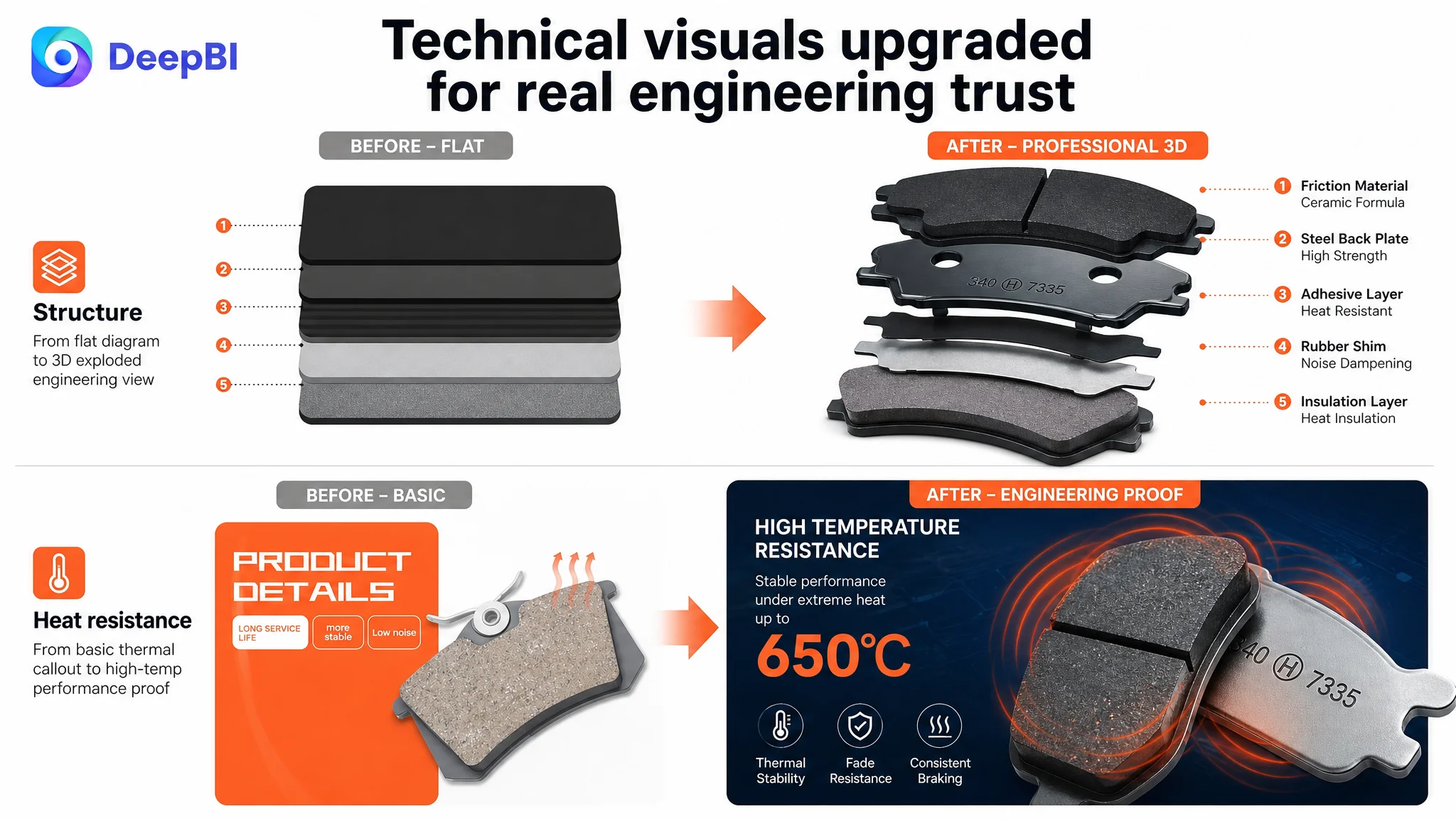
- High-temperature stability image:
- 45° pad on deep-blue tech background with subtle heat-wave effect
- Clearly labeled high-temperature resistance (based on real specs, not invented)
- Layered structure image:
- Upgrade from flat stack to vertical layered composition with clear labels for each layer (shim, backing plate, adhesive, insulator, friction compound)
The key is that each image now answers a concrete question:
- What exactly do I get?
- Will it fit my type of driving?
- Can it handle heat and conditions?
- Is this really a ceramic, multi-layer pad or just generic metal?
3. A+ Content: Building the Missing Professional Story
The biggest structural change DeepBI pushed for was building A+ content from zero:
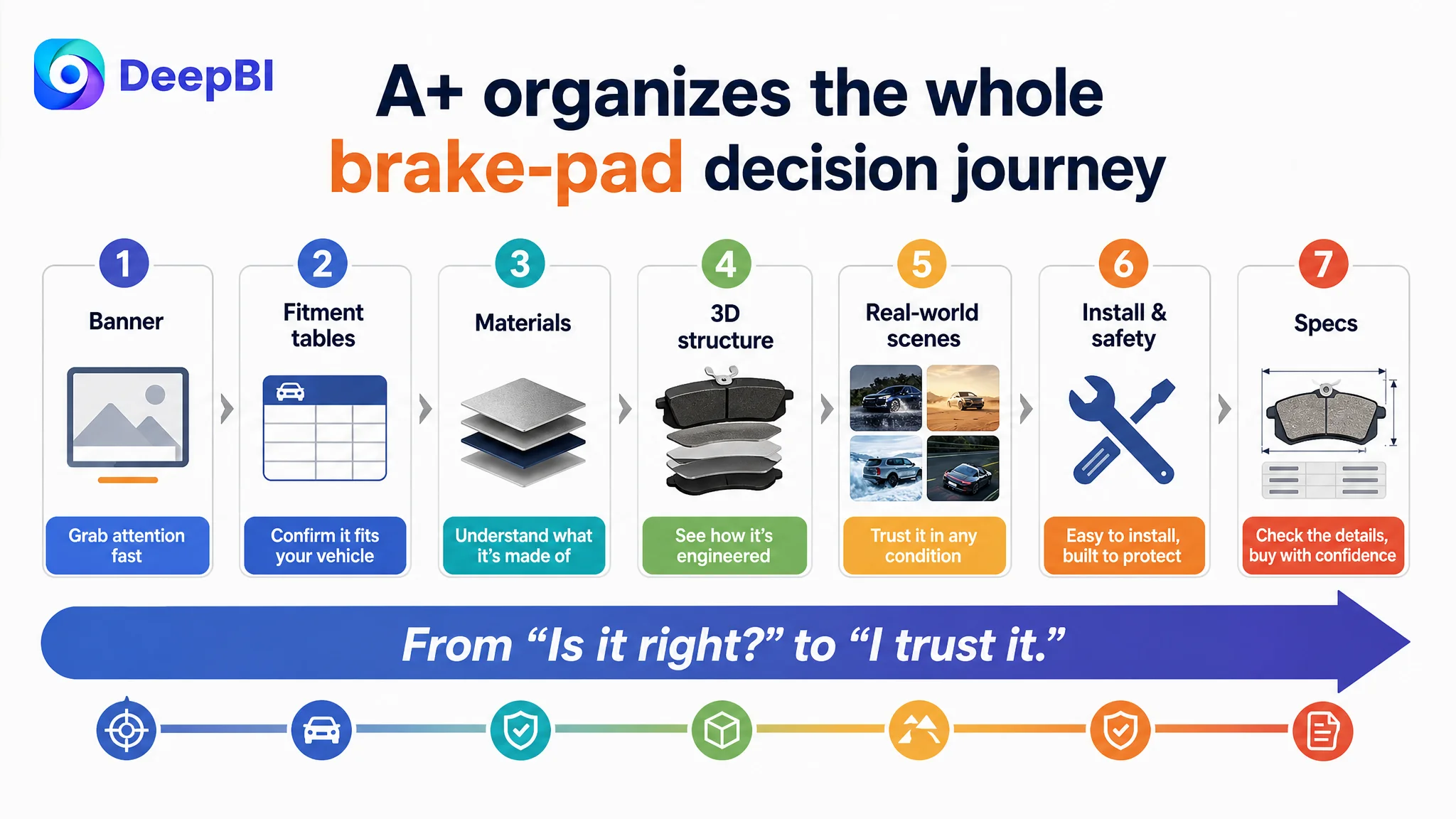
1. Opening banner
- Correct the spelling error (“BPAKNG”) that undercut professionalism
- Show the pads with an Audi/VW-compatible vehicle in motion
- Use a clear, correctly spelled technology promise line (“INNOVATIVE TECHNOLOGY LEADING IN BRAKING”)
2. Fitment tables
- A dedicated module listing Audi and VW models, years, engine variants in a clean, grid-based layout
- Clear “Fit For Vehicle Models” headline
3. Core construction and material module
- Close-up pad image with callouts for “THERMAL SCORCHED,” “DUAL LAYER RUBBER SHIM,” and “CERAMIC COMPOUND”
4. 3D exploded structure view
- Diagonal exploded layers (shim, backing plate, adhesive, insulator, friction material) with labeled lines
- Emphasizes engineering depth and build quality
5. Real-world scenario module
- 2×2 grid of driving scenes: rain, dust, snow, night cornering
- Each scene labeled to link to performance in harsh conditions
6. Professional installation & safety
- A technician in a workshop actively installing the pads
- Overlay text on OE-level quick install and safety reminders
7. Dimensions & spec sheet
- White-background technical drawing with clear length/width/height and key specs
- Clean, engineering-style layout
In automotive, this is not “over-design.” It is the visual equivalent of a mechanic walking a customer through why this pad is safe, fits, and will last.
How This Changes the Role of Ads
With this Listing rebuilt around a complete conversion story:
- Title and bullets speak the language of fitment, safety, and noise reduction instead of only technical jargon
- Images and A+ modules show structure, conditions, and installation in a way that is easy to trust
- Fitment certainty is higher, reducing returns and pre-purchase doubt
- Professional cues (technician, safety notes, precise dimensions) compensate for lower review volume
At that point, ad traffic becomes useful again:
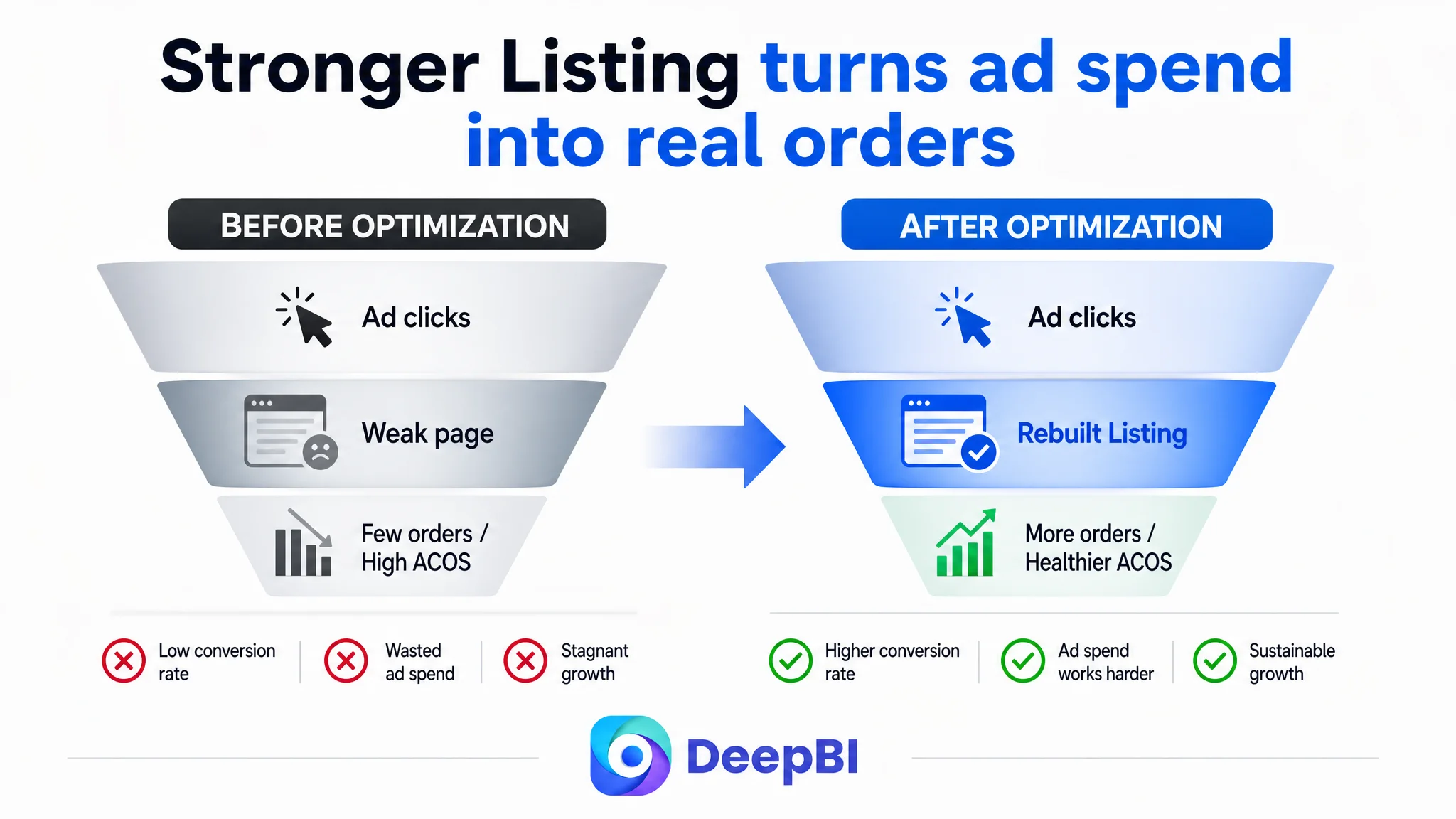
- Each click lands on a page that can justify the purchase
- ACOS has a realistic chance to improve because CVR is no longer capped by a missing A+ story
- The page starts to accumulate more organic conversions, improving ranking and reducing long-term advertising dependence
The seller’s understanding also shifts:
- Amazon ads are not a universal fix; they magnify the current state of the Listing
- A half-finished product page will turn ads into a cost center, not a growth engine
- In a safety-sensitive category, A+ content is a conversion necessity, not a “nice-to-have”
What Other Amazon Automotive Sellers Can Take Away
This brake pad case is not unique to brake pads. Many automotive and hard-parts sellers are in the same pattern:
- They run increasingly sophisticated Amazon ads
- They blame weak results on reviews or “image quality”
- They underestimate how much the A+ and bullet logic influence CVR and long-term ad efficiency
Three practical judgments emerge:
1. If A+ content is at zero while a benchmark is full, you are competing with a handicap.
2. If compatibility is buried in dense text, you are making fitment confirmation harder than it needs to be.
3. If your Listing cannot walk a buyer from “Is this the right part?” to “Can I trust it?” in clear visual steps, ads will only expose that weakness faster.
DeepBI’s value in this case was not about generating nicer images. It was about reordering the seller’s decisions: fix the Amazon product-page conversion logic first, then let ads scale what works—instead of paying to prove what doesn’t.