

The customer in this case is an Amazon seller in the photography accessories category, focusing on a portable RGB video light for cameras and content creation. What they saw on the surface was simple and worrying: ad costs were hard to control, the product page was not converting, and a key benchmark competitor was clearly winning the category. Their first reaction was to look at ads, keywords, and bids.
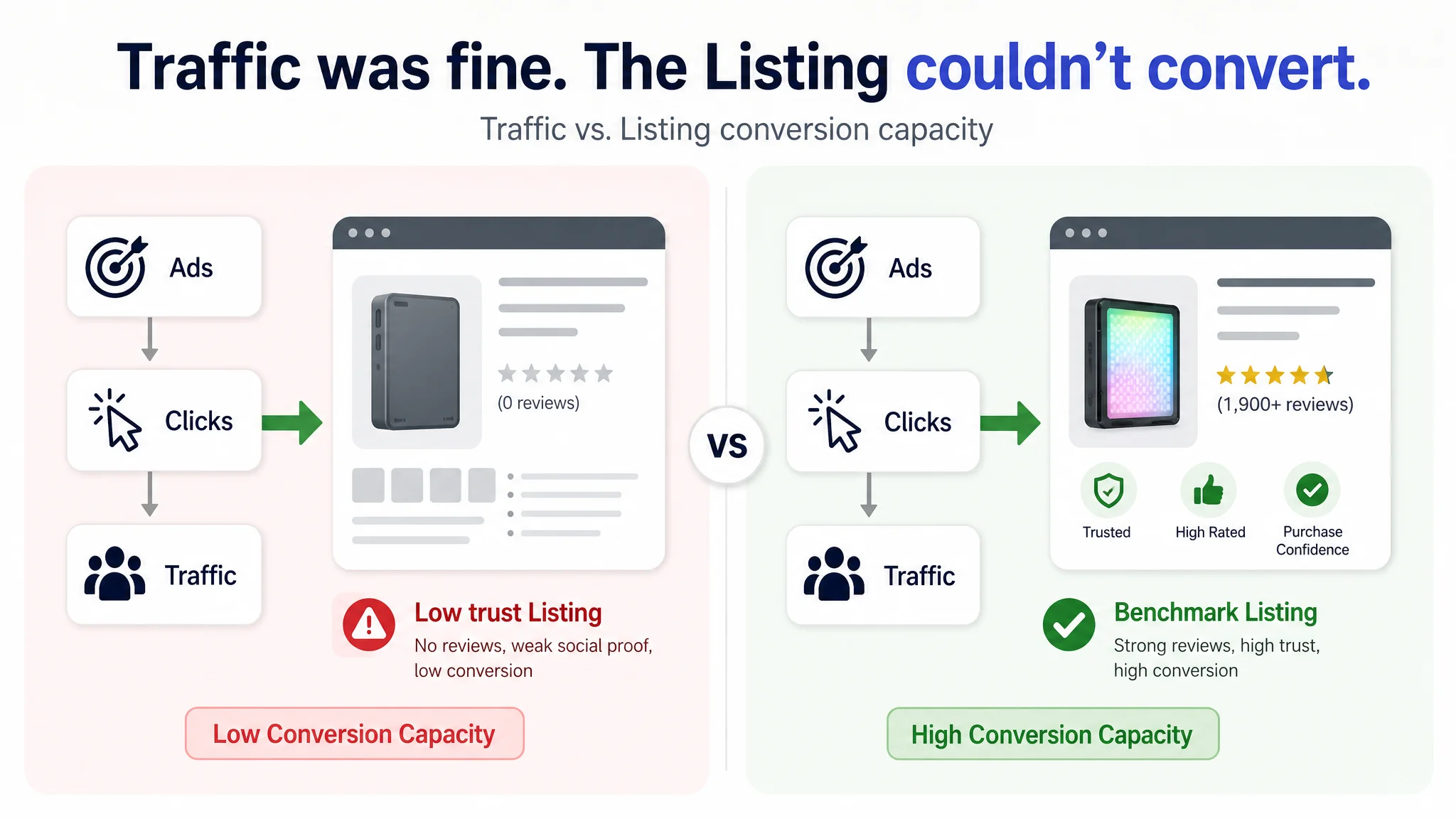
DeepBI’s diagnosis showed a different picture. The core blockage did not sit in Amazon ads structure; it sat on the Amazon product page itself. Against a mature competitor listing, this RGB video light listing had weaker overall Listing quality and, more critically, zero reviews. Ads were sending traffic into a page that looked less trusted and less professionally framed for creators, so paid clicks were being consumed without turning into orders.
The later optimization therefore did not start with more granular bid tuning. It started with restructuring the title, strengthening visual and A+ storytelling toward “professional portable tool for creators,” and building a trust path that could eventually support a review system. For other Amazon sellers, the lesson is clear: if the page cannot convert or build trust, advertising will only magnify the problem. Listing conversion capacity must be judged and repaired before trying to scale traffic.
Amazon Ads Were Not Failing. The Page Was Consuming the Traffic.
At the time of diagnosis, the seller was under typical Amazon pressure:
- Ad spend was not translating into expected order volume.
- A direct benchmark listing in the same RGB video light niche had strong ranking and social proof.
- Internally, the team suspected that “we probably just haven’t tuned our ads enough.”
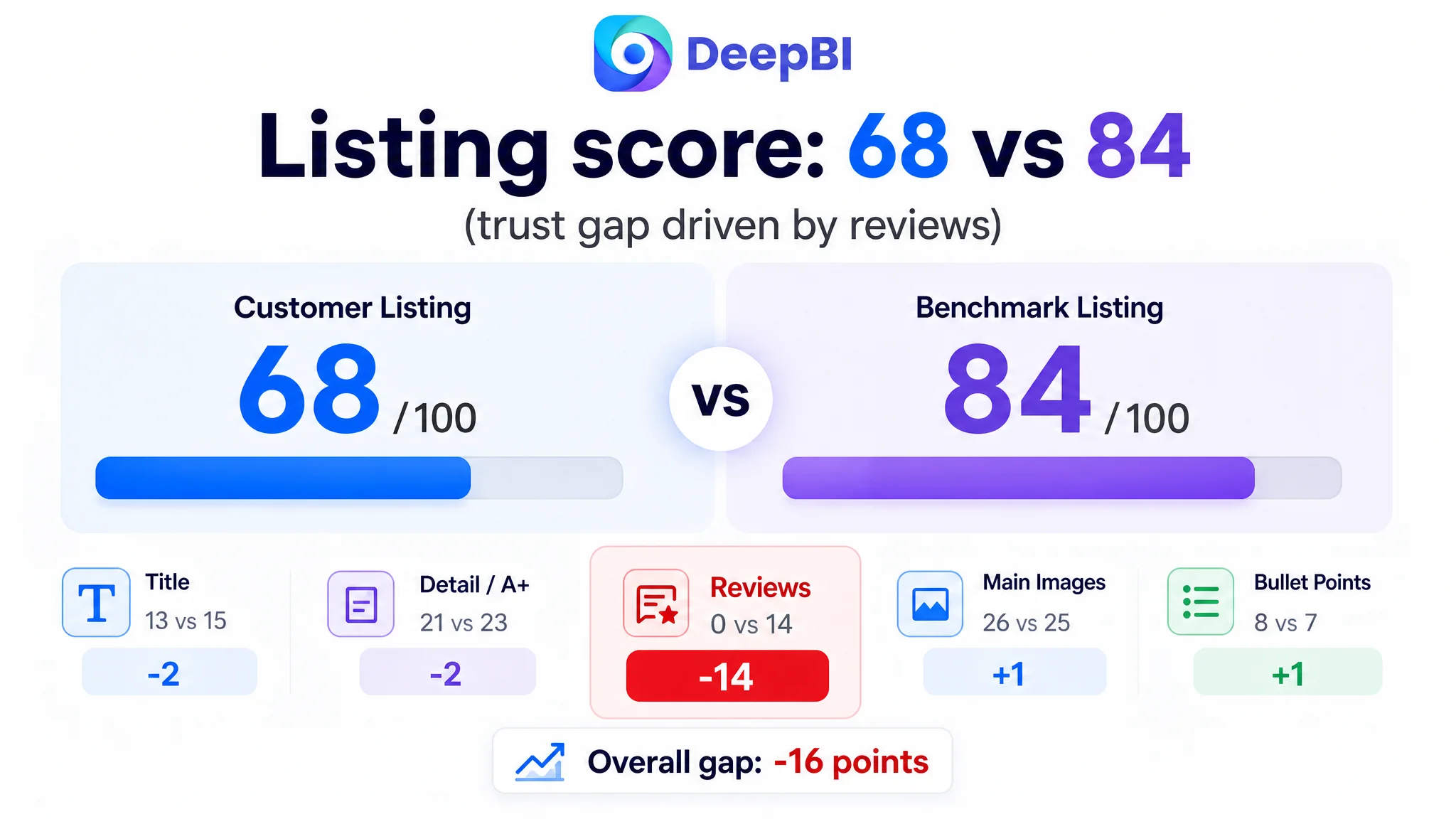
When DeepBI scored the listing, the gap became visible in one glance:
- The customer’s Listing: 68/100
- The benchmark Listing: 84/100
- Gap: -16 points
Breaking this down:
- Title: 13 vs. 15
- Main images: 26 vs. 25 (not the main issue)
- Bullet points: 8 vs. 7 (actually slightly better structured)
- Detail / A+: 21 vs. 23
- Reviews: 0 vs. 14 (out of 15)
The visual and textual modules were not fundamentally broken; the seller had a reasonably structured page. The decisive difference was that the benchmark Listing had 4.5 stars and ~1900 reviews, while the customer Listing had no rating, no reviews, no trust layer at all.
“The real problem was not that ads failed to bring traffic. It was that the page could not convert the traffic.”
In this state, any ad optimization was operating against a conversion wall:
- Visitors were comparing a no-review listing with a high-review benchmark in the same category.
- The page emphasized functional descriptions but did not fully anchor the product as a “trusted professional tool” for vloggers, photographers, or video creators.
- Ads were effectively paying to send users into a comparison that was nearly impossible to win.
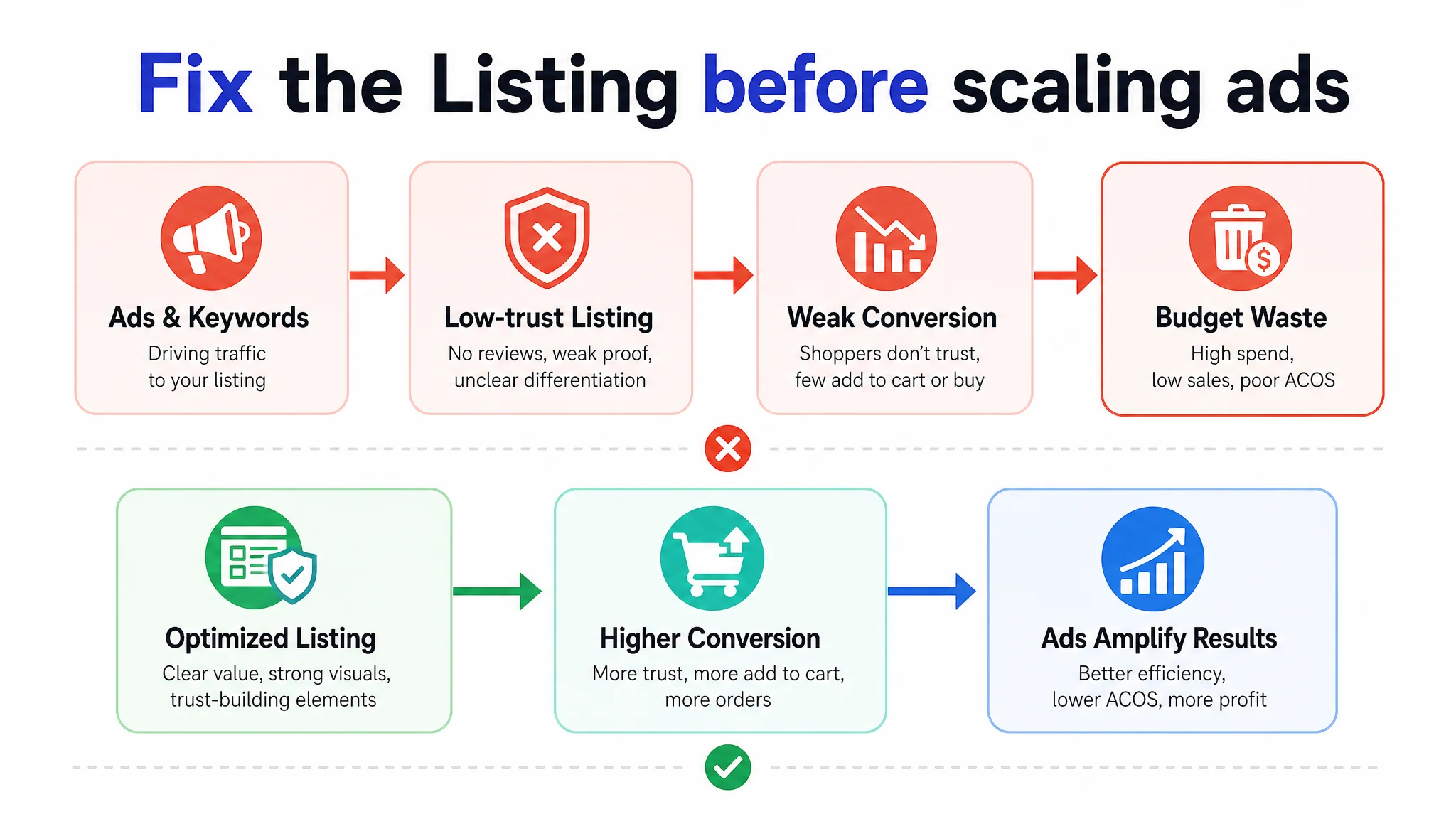
DeepBI’s judgment was that Listing conversion capacity, especially trust construction, had to be addressed before trying to squeeze more efficiency out of ads.
The Real Constraint Was Listing Conversion Capacity
DeepBI’s scoring logic treats Listing quality as a multi-dimensional system, not just “nice images” or “keyword-rich text.” In this case, there was one clear core bottleneck:
Core problem: The Amazon Listing lacked trust and conversion capacity compared to a category-leading competitor, especially in reviews and scene-based storytelling.
Traditional ad adjustments—bids, keywords, placements—were not failing because they were technically wrong. They were failing because they were trying to force a low-trust page to behave like a high-trust page.
Several points made this visible:
1. Reviews: A Missing Trust System
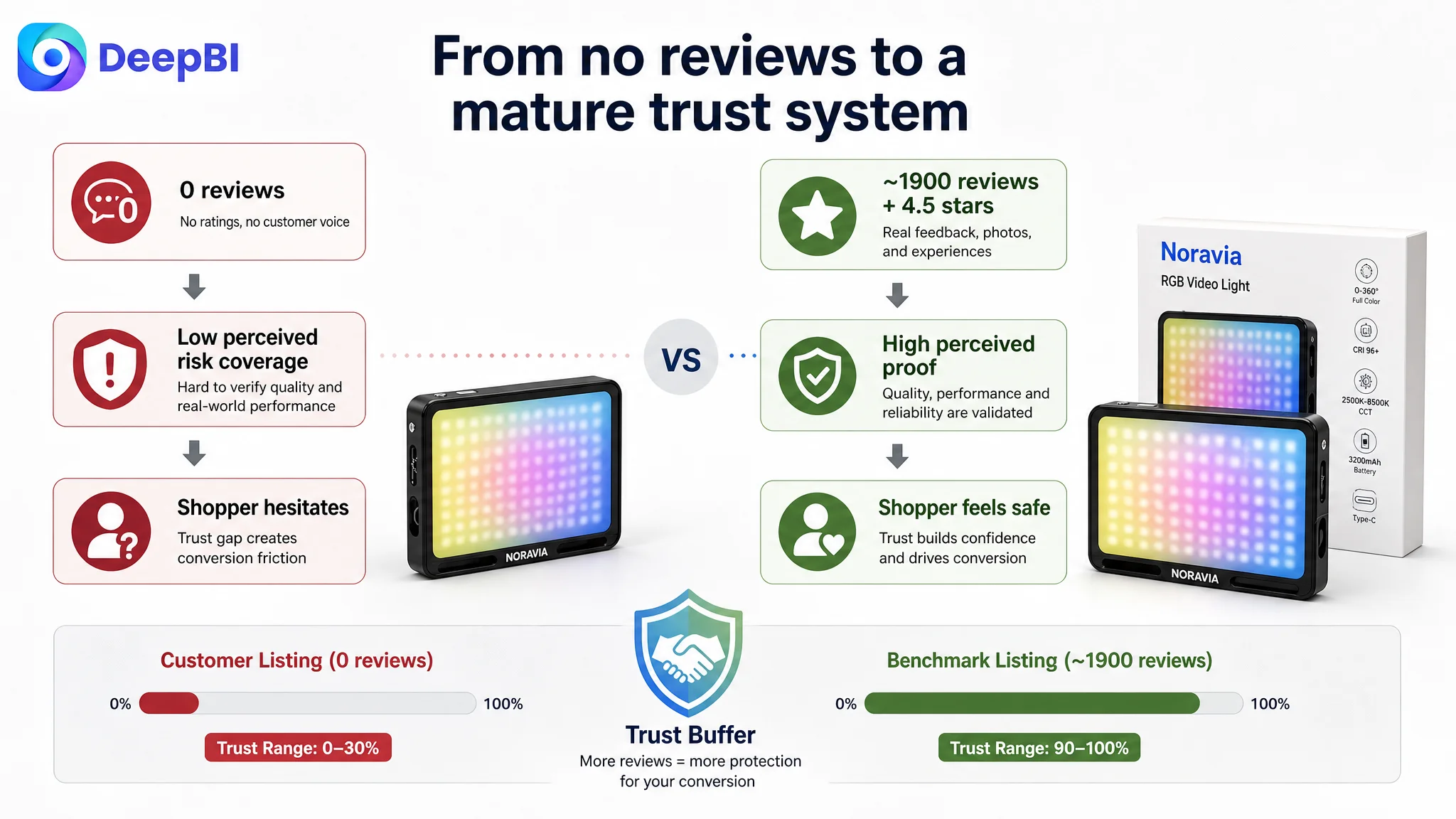
- Customer Listing: 0 ratings, 0 reviews, no visible customer voice.
- Benchmark Listing: 4.5 stars, ~1900 reviews, rich front-page reviews including detailed photo reviews.
For a technical product like an RGB video light, creators rely heavily on peer validation:
- Does it actually deliver the promised color quality?
- How does battery life hold up in real shoots?
- Does it feel like a serious tool or a cheap gadget?
With no reviews, the Listing sat in the 0–30% trust range, while the benchmark sat in the 90–100% range. This was not a minor gap. It meant the Listing had no conversion buffer: shoppers had to trust the brand purely on manufacturer claims, without social proof.
2. Title: Functional, but Not Fully Weaponized
The competitor’s title was optimized around Amazon’s common “brand + product + quantified attributes + scenarios” pattern:
- Brand front-loaded
- Clear product phrase: “Portable LED Camera Light Panel”
- Quantified, punchy attributes: “0-360 Full Color,” “3100mAh Rechargeable”
- Scenario tags aligned with creators: “Vlogging, Photography, Video Conference”
The customer’s original title:
- Used “Portable LED Video Light, Aluminum Alloy Body On-Camera Light”
- Carried more descriptive wording, less tight outcome-oriented phrasing
- Under-leveraged the product’s differential advantages like CRI 96+ and aluminum alloy body
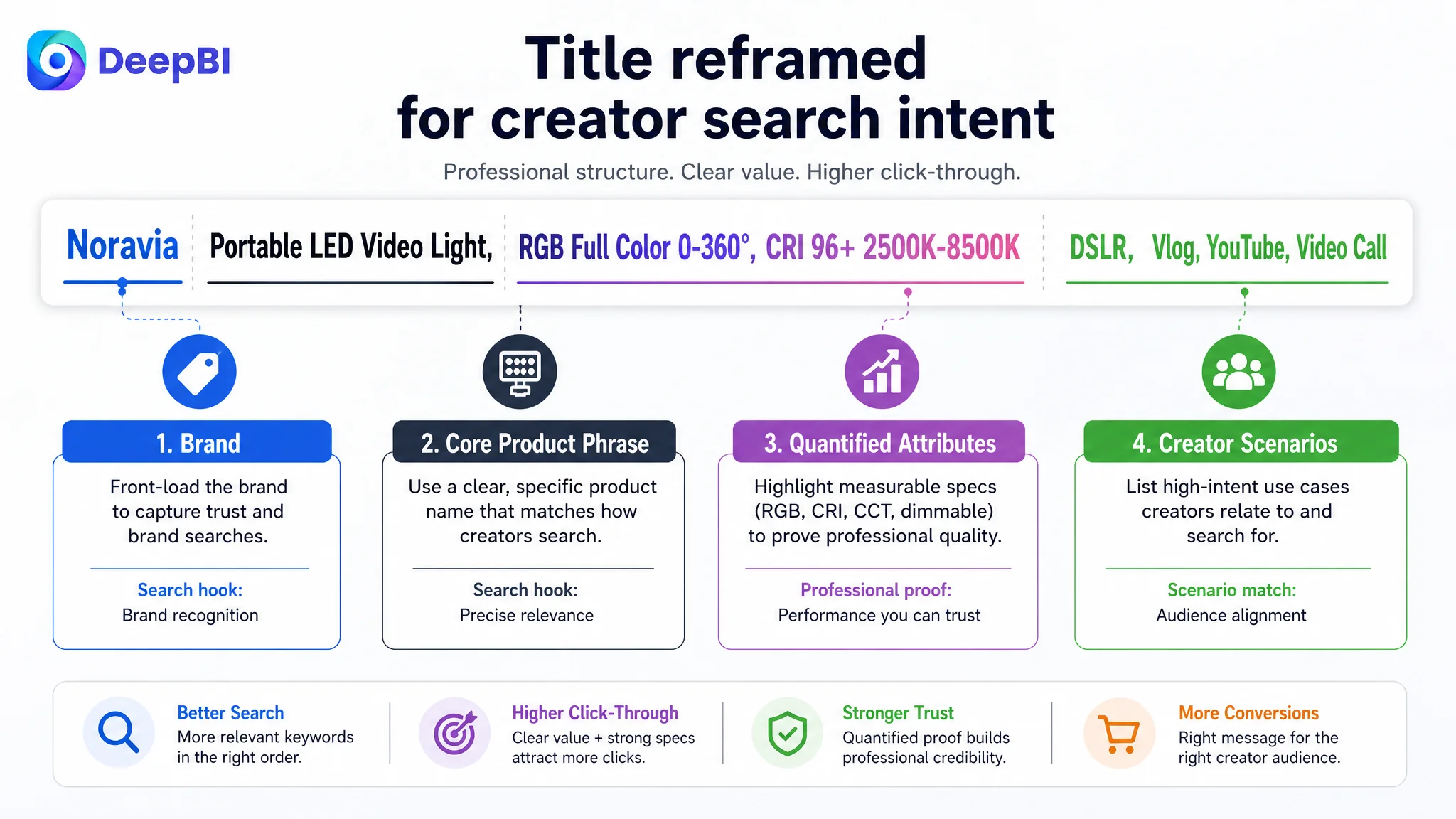
DeepBI’s recommendation re-centered the title into a more competitive structure:
Proposed title Moman Portable LED Video Light, RGB Full Color 0-360° Camera Light Panel, CRI 96+ 2500K-8500K Dimmable Photography Fill Light, Aluminum Alloy Body, Built-in Battery for DSLR, Vlog, YouTube, Video Call
The logic:
- Move “RGB Full Color 0-360°” close to the product phrase for better search and click relevance.
- Emphasize CRI 96+ versus competitor’s CRI 95+—a professional signal.
- Expand application scenarios (DSLR, Vlog, YouTube, Video Call) to match how buyers search and imagine usage.
This wasn’t keyword stuffing. It was a decision to speak the “professional creator” language more directly on the Amazon search results page.
3. Bullet Points: Good Logic, Underused Advantage
DeepBI’s comparison of bullet points showed an interesting pattern:
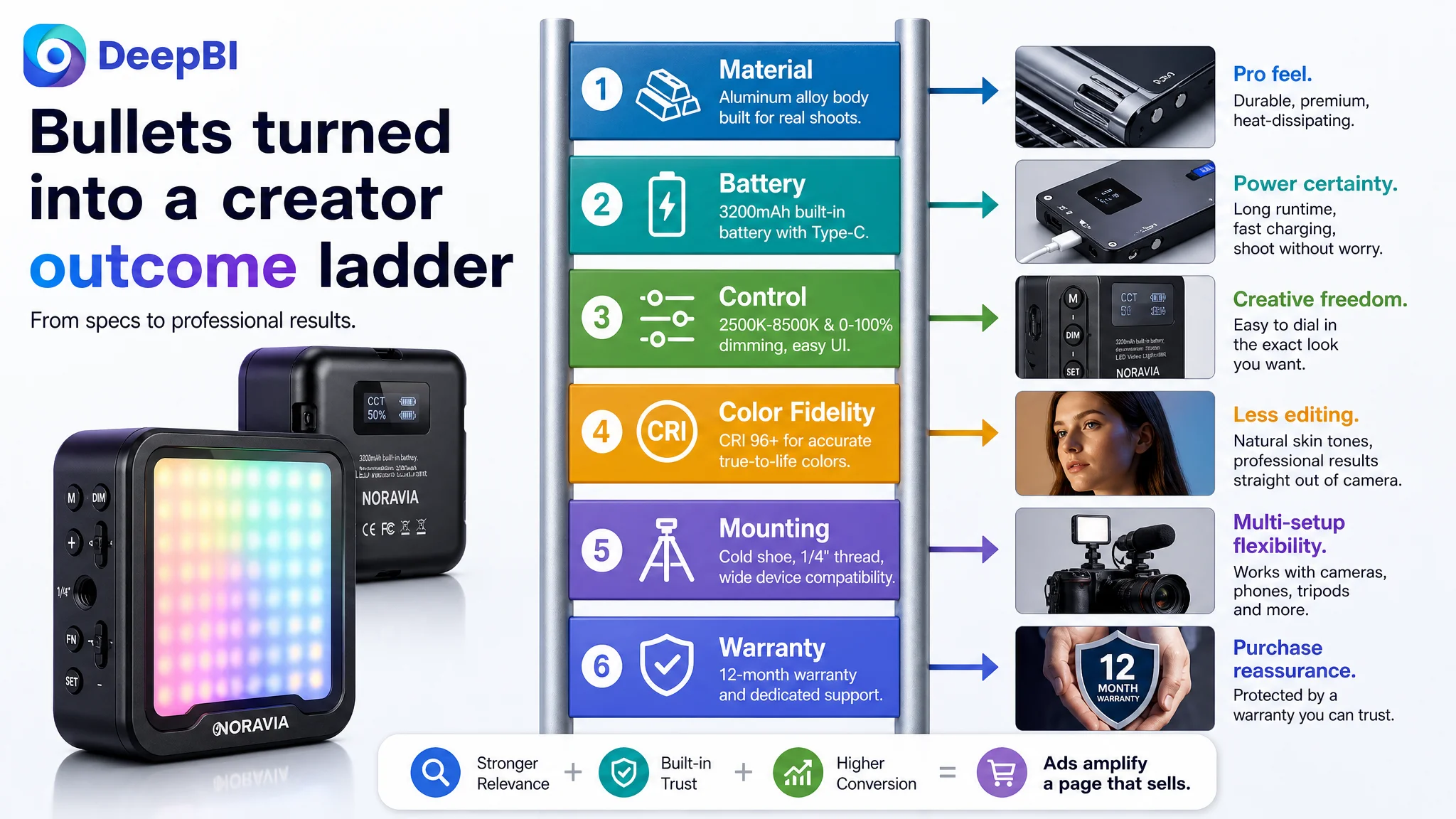
- The customer’s bullet points already had clear logic and a solution-oriented structure: from material and portability, to battery, to color control, to pro-grade color accuracy, to mounting flexibility, plus warranty.
- The competitor leaned more on feature lists and modes, and added a separate after-sales bullet.
In other words, the customer was not weak in structure. The weakness was in how strongly those bullets surfaced key differentiators and trust signals.
DeepBI’s optimization kept the structural advantage but sharpened each bullet around conversion levers:
1. Material & Portability
【PREMIUM ALUMINUM ALLOY & ULTRA-SLIM】 Crafted from high-grade aluminum alloy… pocket-sized, lightweight… perfect portable lighting tool for vloggers and professional content creators.
Decision: Push the aluminum alloy message hard as a quality anchor versus plastic competitors.
2. Battery & Charging
【RECHARGEABLE BATTERY & TYPE-C FAST CHARGING】 …high-capacity built-in rechargeable battery… supports working while charging…
Decision: Explicitly address battery anxiety—long shoots, charging flexibility, “never miss a shot.”
3. Color Control
【ADJUSTABLE BI-COLOR & DIMMABLE BRIGHTNESS】 2500K–8500K, 0–100% brightness… from Zoom calls to portrait photography.
Decision: Position as “professional fill light” rather than just an effect toy.
4. Color Accuracy
【PRO-GRADE COLOR ACCURACY (CRI 96+ & TLCI 98+)】 …reduces post-production editing time and workload.
Decision: Translate numbers (CRI/TLCI) into outcomes (less editing, reliable skin tones and product colors).
5. Mounting Flexibility
【DUAL 1/4" THREADS & UNIVERSAL COMPATIBILITY】 …horizontal or vertical mounting… DSLR, mirrorless, tripods, mobile setups.
Decision: Turn a hardware detail (dual threads) into a usability advantage for multiple shooting styles.
6. Warranty & Pack Contents
【12-MONTH WARRANTY & RELIABLE SUPPORT】 …what’s in the box… response within 24 hours.
Decision: Add a formal trust layer comparable to the competitor’s after-sales bullet.
The business judgment here: text structure wasn’t the main problem; missing emphasis on professional outcomes and concrete reassurance was.
This Product Page Did Not Lack Features. It Lacked Trust and Creator-Centric Storytelling.
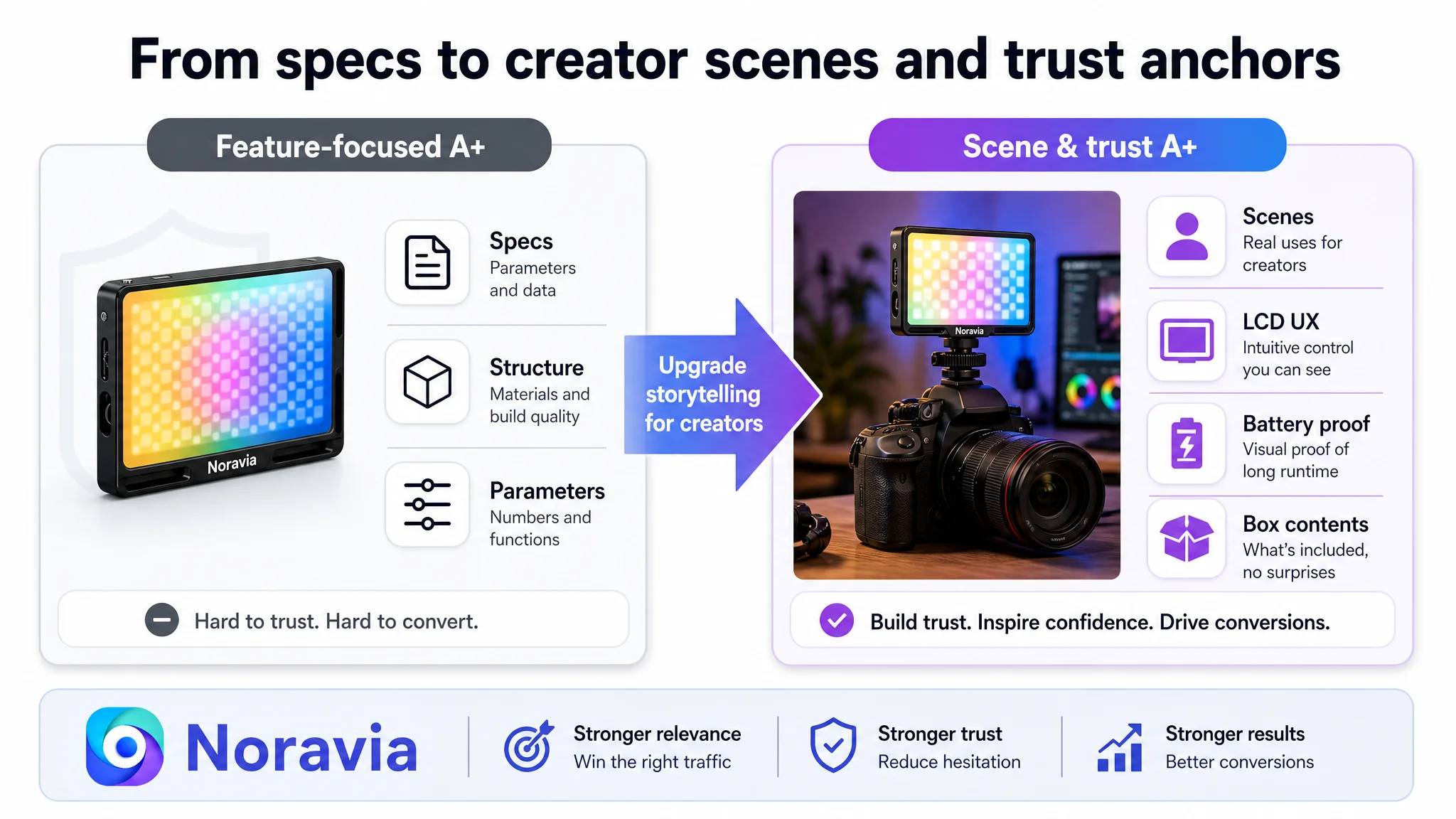
DeepBI’s A+ comparison went beyond images as “nice visuals” and treated them as conversion modules with specific jobs.
Benchmark: A Scene Matrix That Binds to User Identity
The competitor’s A+ layout:
- Clear brand statement and main visual
- Core parameter icons and color wheel
- Multiple real usage scenes (party, makeup, YouTube, portrait, video shooting)
- LCD screen close-ups, battery visualizations, box contents
- Five real shooting scenes illustrating different use cases
Effect on conversion:
- Binds the product to specific roles: YouTuber, portrait photographer, party host, makeup artist.
- Makes abstract parameters “battery, modes, RGB” look like real-world outcomes.
- Gives buyers a visual walkthrough of what they actually get and how it performs.
Customer A+: Technically Informative, Emotionally Thin
The customer’s A+:
- Main scene visuals
- Parameter icons and color wheel demonstrations
- Product structure and material
- Energy design and size comparison
- Charging interface and mounting modes
Technically:
- It does show key attributes—shape, materials, RGB logic.
- It stays focused on features and data.
But from a decision logic standpoint:
- User identity and usage motivation are underplayed. Creators don’t just buy LEDs; they buy stable skin tones, flexible setups, and mood creation.
- Trust chain is incomplete. LCD UX, battery endurance, box contents, and warranty are not individually highlighted as reassurance modules.
- Scene coverage is narrower. There is less explicit visual proof that the light fits multiple creator use cases.
DeepBI’s conclusion:
“This page did not lack information. It lacked a path from ‘specs and features’ to ‘I can see myself using this in my own shoots, and I trust it to perform.’”
Why DeepBI Did Not Recommend “Fix Ads First”
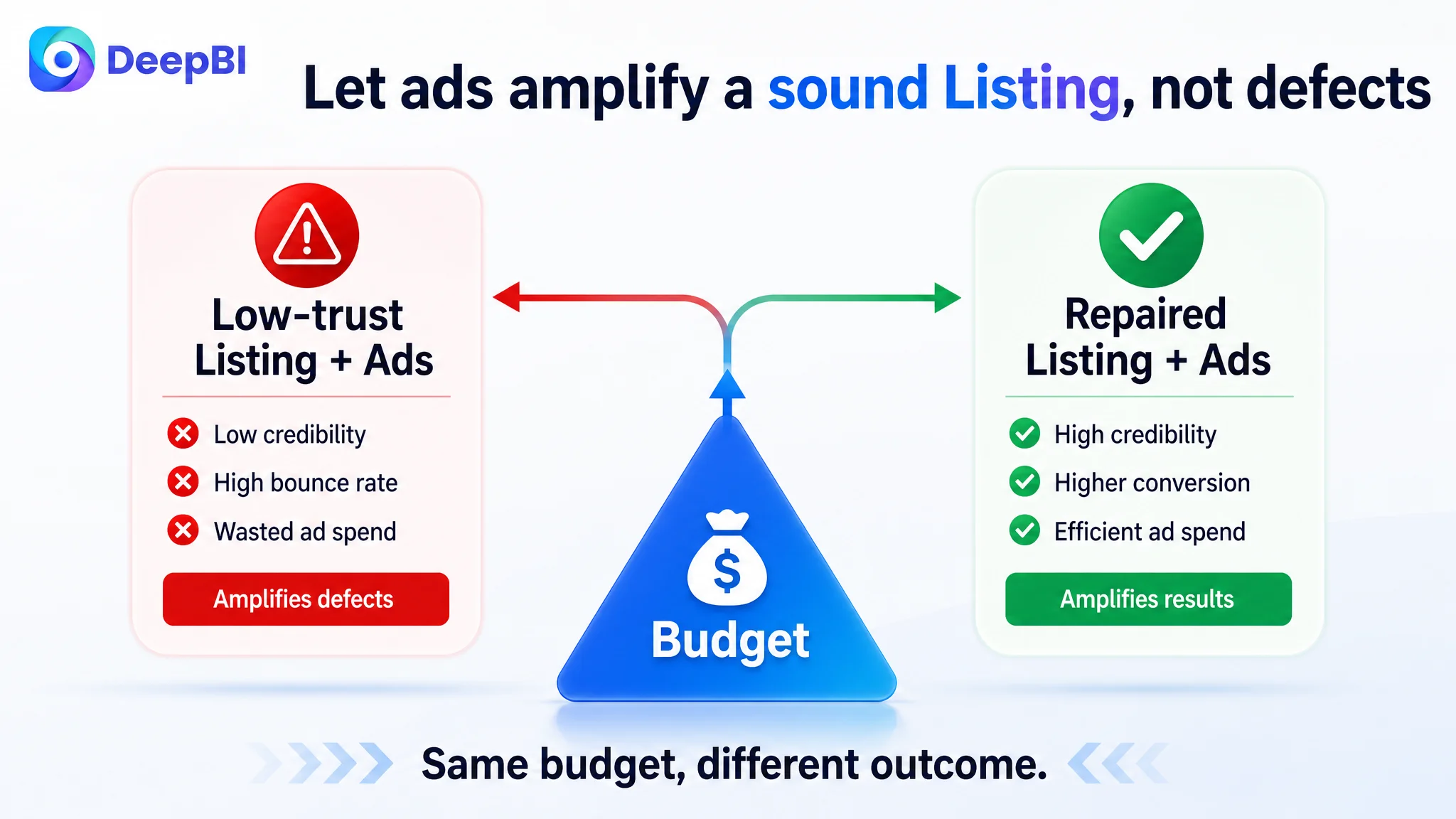
From an Amazon operations standpoint, the biggest risk in this situation was:
- Continuing to push paid traffic into a Listing that structurally underperformed against a strong, review-rich competitor.
If ads were tuned first:
- TACOS and ACOS would stay volatile because clicks were being converted inefficiently.
- The lack of reviews and limited scene storytelling would keep CVR suppressed.
- The seller could wrongly conclude “this product can’t win,” when in reality the Listing conversion logic had not been fully built.
DeepBI’s judgment was:
1. Amazon Listing conversion had to be repaired before scaling ads.
2. Visual and textual trust elements had to move closer to benchmark quality.
3. The page needed to be repositioned as a professional creator tool, not just a generic RGB accessory.
This decision path protects budget:
- It avoids using ads to amplify a low-conversion, low-trust page.
- It gives the Listing a chance to convert both organic and paid traffic more reliably once improved.
- It sets the foundation for reviews to be earned and leveraged later.
How the Page’s Sales Logic Started to Recover
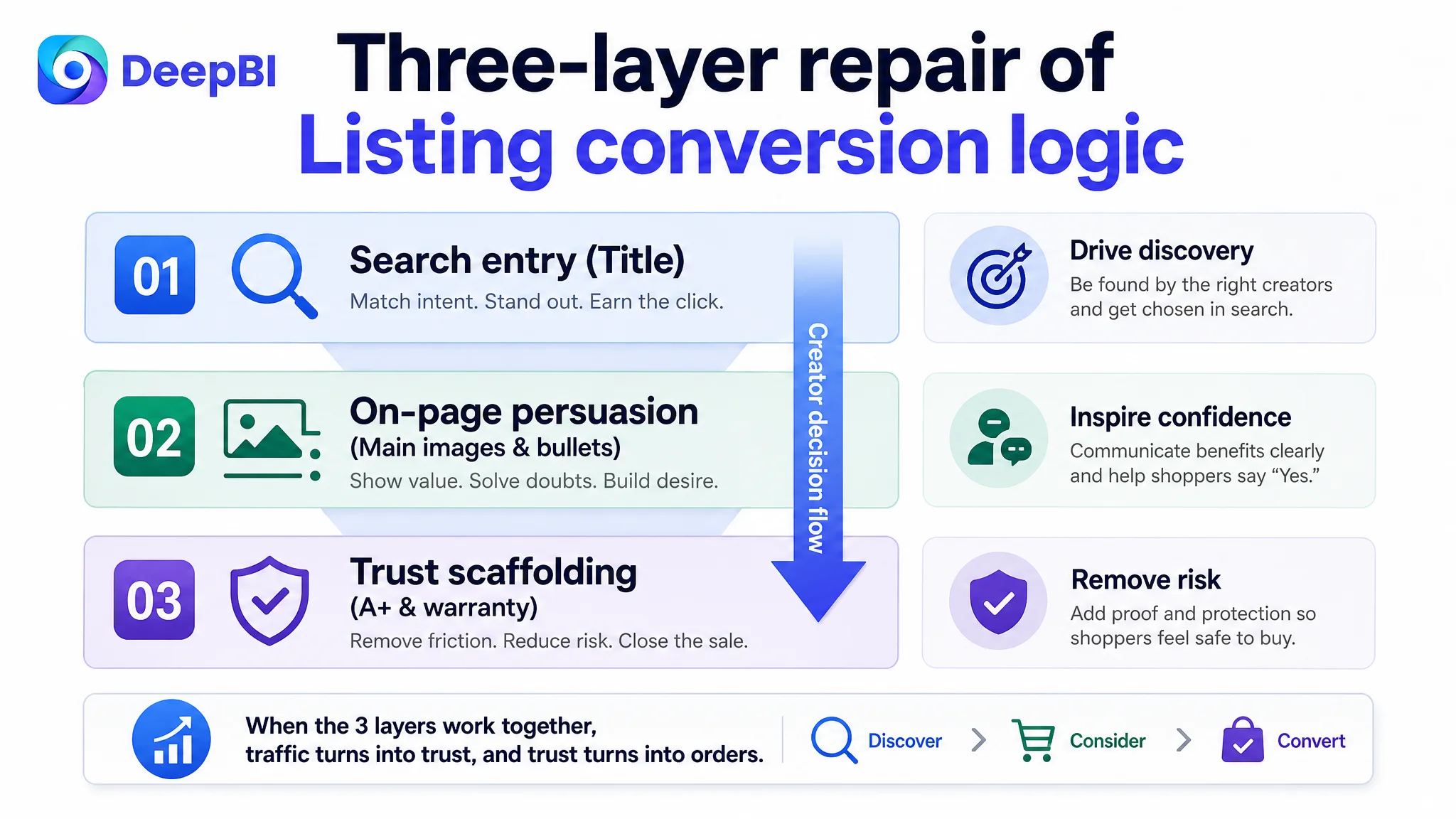
DeepBI’s optimization path focused on three main layers: search entry (title), on-page persuasion (images and bullets), and trust scaffolding (A+ and warranty).
1. Title: Competing for the Right Clicks
By restructuring the title around “brand + portable video light + RGB 0–360° + CRI 96+ + 2500–8500K + creator scenarios,” the Listing:
- Signals “professional fill light” directly in search results.
- Surfaces its technical edge (CRI 96+, aluminum body) at the point of click decision.
- Aligns with how serious creators filter options (CRI, color range, portability, DSLR/vlog compatibility).
Resulting operating change:
- Ad traffic and organic impressions begin landing on a page whose title better matches creator intent.
- Clicks, while not artificially promised to increase, become more qualified, reducing pure curiosity clicks and increasing “serious buyer” traffic.
2. Bullet Points: From Features to Professional Outcomes
The reworked bullets form a coherent persuasion path:
1. Quality and feel (aluminum alloy)
2. Endurance and charging certainty (battery + Type-C + work while charging)
3. Control range (bi-color + dimming)
4. Color fidelity (CRI 96+, TLCI 98+)
5. Mounting flexibility (dual threads + compatibility list)
6. Assurance (warranty + pack list)
Operating impact:
- Visitors no longer see only specs; they see how those specs solve creator pain points: heat, durability, power anxiety, color correction workload.
- The product is reframed from “RGB light that can do many things” to “a professional tool that removes friction from real shoots.”
3. Main Images: Giving the Light a Professional Identity
DeepBI’s image-level recommendations followed a structured logic:
Main image set
- Core product angle: 45-degree main product occupying ~60% of frame, showing front and back (including OLED display), clean tech background, RGB ambient glow.
- Human portrait comparison: Warm vs cool color temperature on a model (2500K–8500K), demonstrating skin tone control.
- Portability: The light sliding into a back pocket, with clear size and weight annotations.
- Battery communication: Type-C connected, OLED showing 100% battery, bold text blocks for “3200mAh,” “140 Mins Work,” “Type-C Fast Charging.”
- Professional use: Installed on a camera hot shoe in a studio setup, highlighting LED density and “Dimmable / 150 LED Beads / High CRI.”
Business logic:
- Every image is assigned a role: click hook, color control proof, portability proof, battery reassurance, professional identity.
- The set works as a conversion funnel, not a gallery.
A+ detail modules
DeepBI recommended a move from “single-product showcase” to “scene + data visualization”:
- Intro module: Hand-held product, showing phone-like slimness and dual-side design (“Slim as Phone”), plus LCD parameters visible.
- RGB color module: Color wheel plus stone bust in different RGB hues, highlighting light’s ability to sculpt shadows and form.
- CCT module: 2500K–8500K comparison with a model across warm, natural, and cool presets.
- Material trust: CNC aluminum body at a dramatic angle, with hard-side light showing edges and “Rapid Heat Dissipation.”
- Battery visualization: Circular clock graphic around the Type-C port, showing working times at different brightness levels.
- Scene matrix: Six real shooting scenarios—live streaming, product photography, outdoor portrait, party ambience, video recording, makeup lighting.
- Box contents: Flat lay of light, diffuser, Type-C cable, cold shoe adapter, manual under “What’s in the Box.”
“Advertising does not only amplify advantages. It can also amplify a page’s existing defects.”
Here, DeepBI deliberately rewired the page so that if ads were later scaled, they would be amplifying:
- Portable, professional identity
- Clear scene coverage
- Trust anchors in material, battery, and warranty
rather than amplifying a generic, feature-only presentation.
How Ad Traffic Became Useful Again
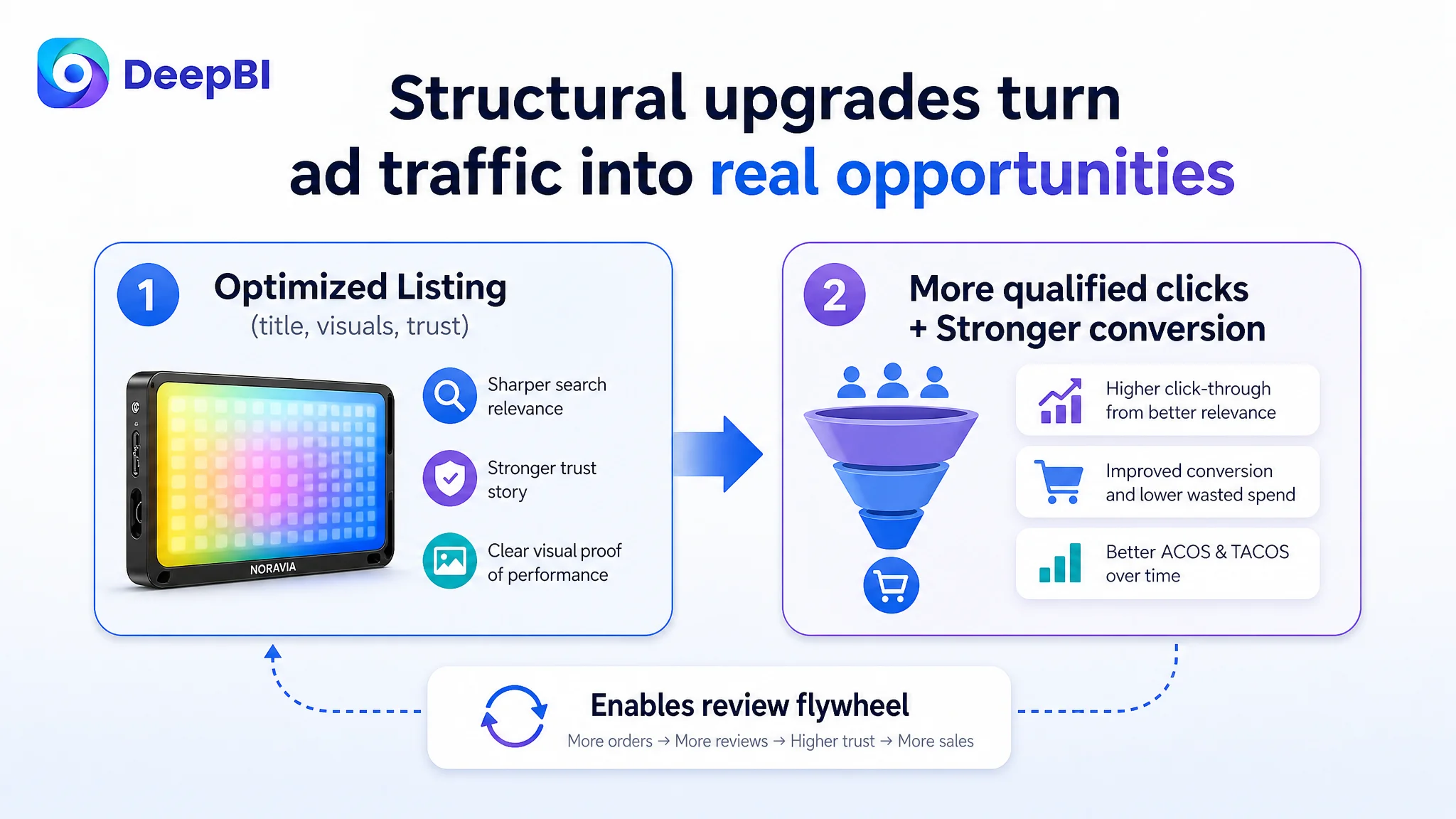
There is no invented numeric result here—the case does not provide post-optimization metrics. But the operating state changed in meaningful ways:
- The Listing’s overall structural score moved closer to benchmark logic, especially in title clarity, bullet outcome emphasis, and A+ scene depth.
- The page began to look and read like a serious tool for creators, not just an RGB gadget; this matters deeply for conversion when reviews are still in early stages.
- Ad traffic, once reintroduced or scaled, now lands on a page with:
- Sharper search relevance
- Stronger trust story
- Clearer visual proof of performance
This reduces wasted paid clicks and improves the Listing’s ability to build its first wave of real reviews.
Business risk reduction
- Overdependence on ads is mitigated by giving the page better organic conversion potential.
- The Listing’s vulnerability in head-to-head comparison with a high-review competitor is reduced by stronger professional framing and reassurance.
- The seller’s decisions move from “keep changing campaigns and hoping” to “judge whether the page deserves more traffic, then let ads amplify a sound listing.”
What Changed in the Seller’s Understanding
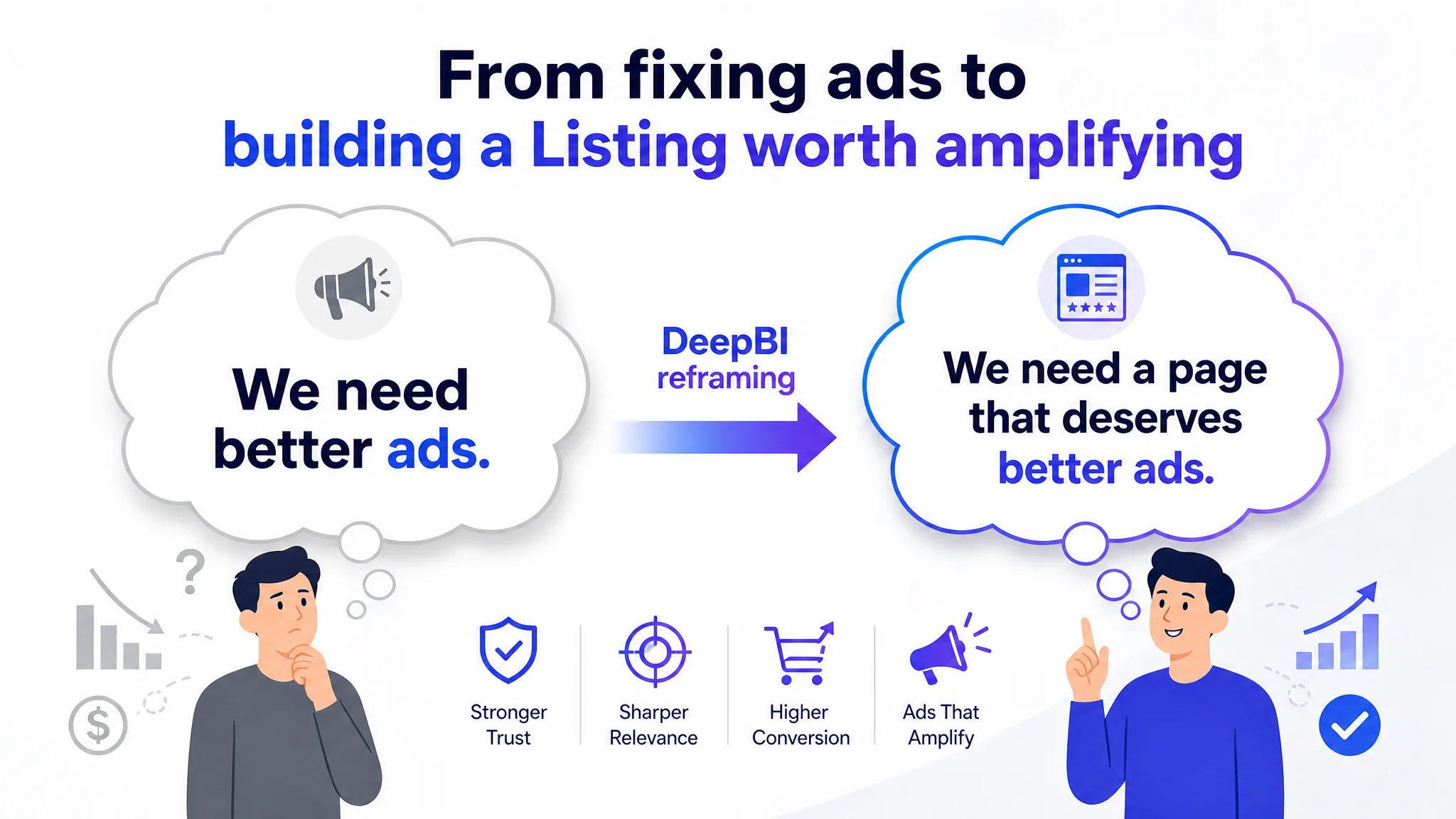
The deepest shift was not in imagery or wording. It was in how the seller thought about Amazon growth:
- Ads cannot fix every conversion problem. If the page looks less trustworthy than a competitor’s, traffic will leak.
- Listing quality is a prerequisite for efficient advertising. Title, main image, bullets, A+, and reviews must cooperate to build a persuasive chain.
- Conversion capacity is a business asset, not a cosmetic layer. Professional storytelling, trust elements, and scene coverage all directly influence ACOS and TACOS over time.
For other Amazon sellers, especially in technical categories like lights, audio, or camera gear, this case is a reminder:
- Before pushing more budget into Amazon ads, ask:
- Does our Listing look like a professional tool for our core user, or just a feature list?
- Are we building a clear trust path—material, battery, accuracy, warranty, scenes, reviews?
- Are we letting ads amplify a page that can genuinely convert?
DeepBI’s strength in this case was not in “having features” but in helping the seller reframe the problem: from “we need better ads” to “we need a page that deserves better ads.” Once that judgment changed, the path forward became far more controllable.