

An Amazon seller in the cigar accessories category came to DeepBI with rising pressure on their Amazon ads. Clicks were not turning into stable orders, ACOS was hard to control, and the team’s first reaction was familiar: “Our bids and keywords still aren’t tuned enough.” In their view, this was an advertising optimization problem.
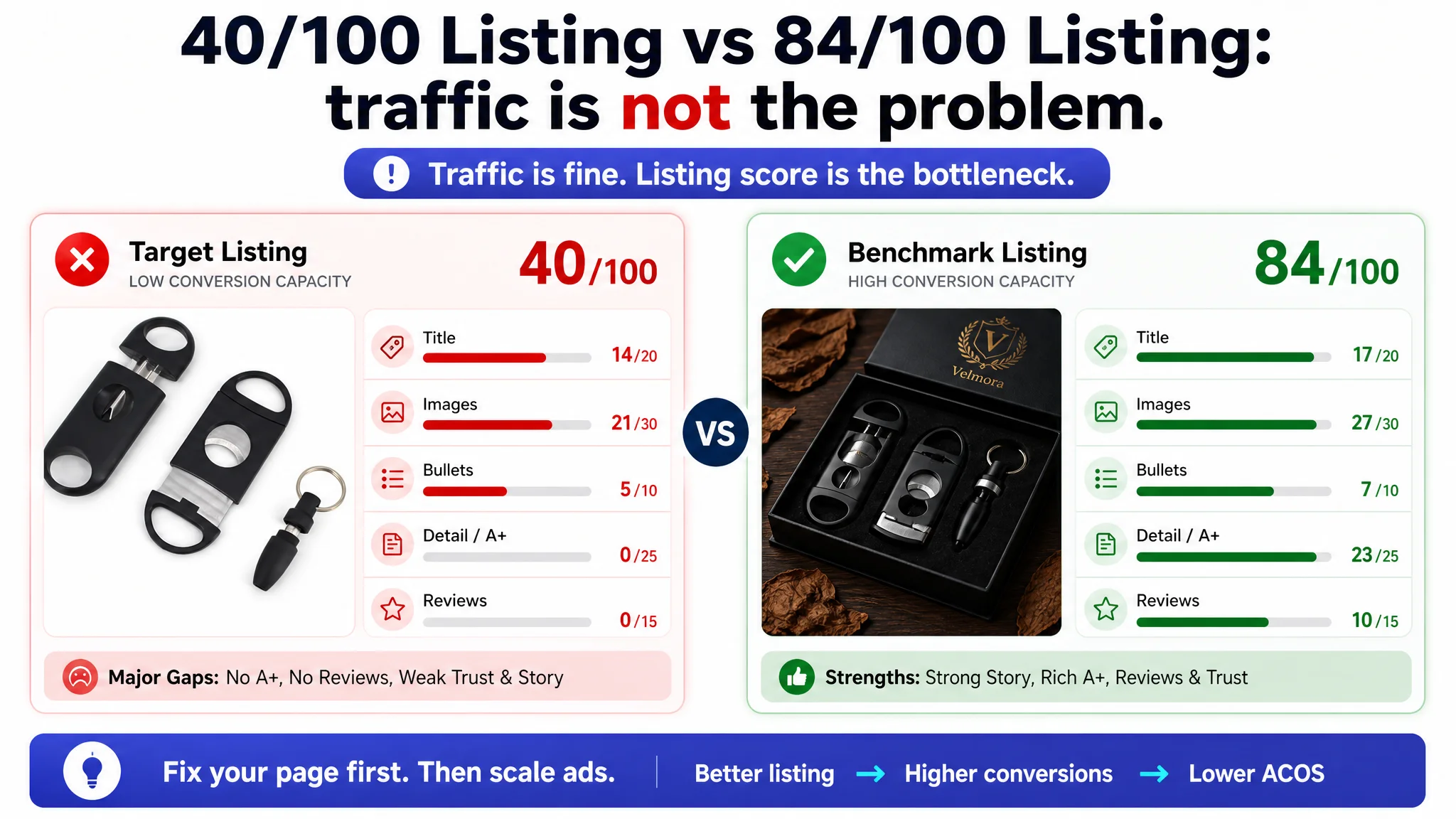
Once we put their Amazon Listing and a category-leading cigar cutter set side by side, a different picture emerged. The product page scored only 40/100 against a benchmark at 84/100. The seller had almost no A+ content, no reviews, and a purely “tool manual” style of communication, while the benchmark was selling a lifestyle and a gift. Ads were not failing; they were sending paid traffic into a page that could not convert or build trust.
The optimization direction had to flip. Instead of pushing harder on Amazon ads, we focused on rebuilding the Listing’s core sales logic: title structure, main image system, bullet-point narrative, and a complete visual A+ story targeted at “gift set for men” and social cigar scenes. The goal was to turn a functional tool kit into a credible, aspirational cigar gift set that actually deserved traffic.
For other Amazon sellers, this case is a reminder: when ACOS feels out of control and ad tweaks stop working, the real bottleneck may be a low-conversion Listing. If the page cannot convey value, trust, and context, every extra click is just more paid traffic leaking out of the funnel.
Amazon Ads Were Not Failing. The Page Was Consuming the Traffic.
From the seller’s perspective, the problem looked straightforward:
- Sponsored ads were driving exposure, but orders were unstable.
- Keyword and bid adjustments weren’t producing meaningful improvement.
- The natural instinct was to “optimize ads harder” and search for better traffic.
However, when we mapped the Listing against a strong Amazon competitor in the same cigar cutter segment, the numbers told a different story:
- Overall Listing score:
- Target Listing: 40/100
- Benchmark Listing: 84/100
- Gap: –44 points
Breaking that down:
- Title: 14 vs. 17 (–3)
- Main images: 21 vs. 27 (–6)
- Bullet points: 5 vs. 7 (–2)
- Detail / A+ content: 0 vs. 23 (–23)
- Reviews: 0 vs. 10 (–10)
Two red flags jump out:
1. Detail/A+ at 0 vs. 23 – the target Listing had no A+ at all.
2. Reviews at 0 vs. 10 – zero rating and zero social proof.
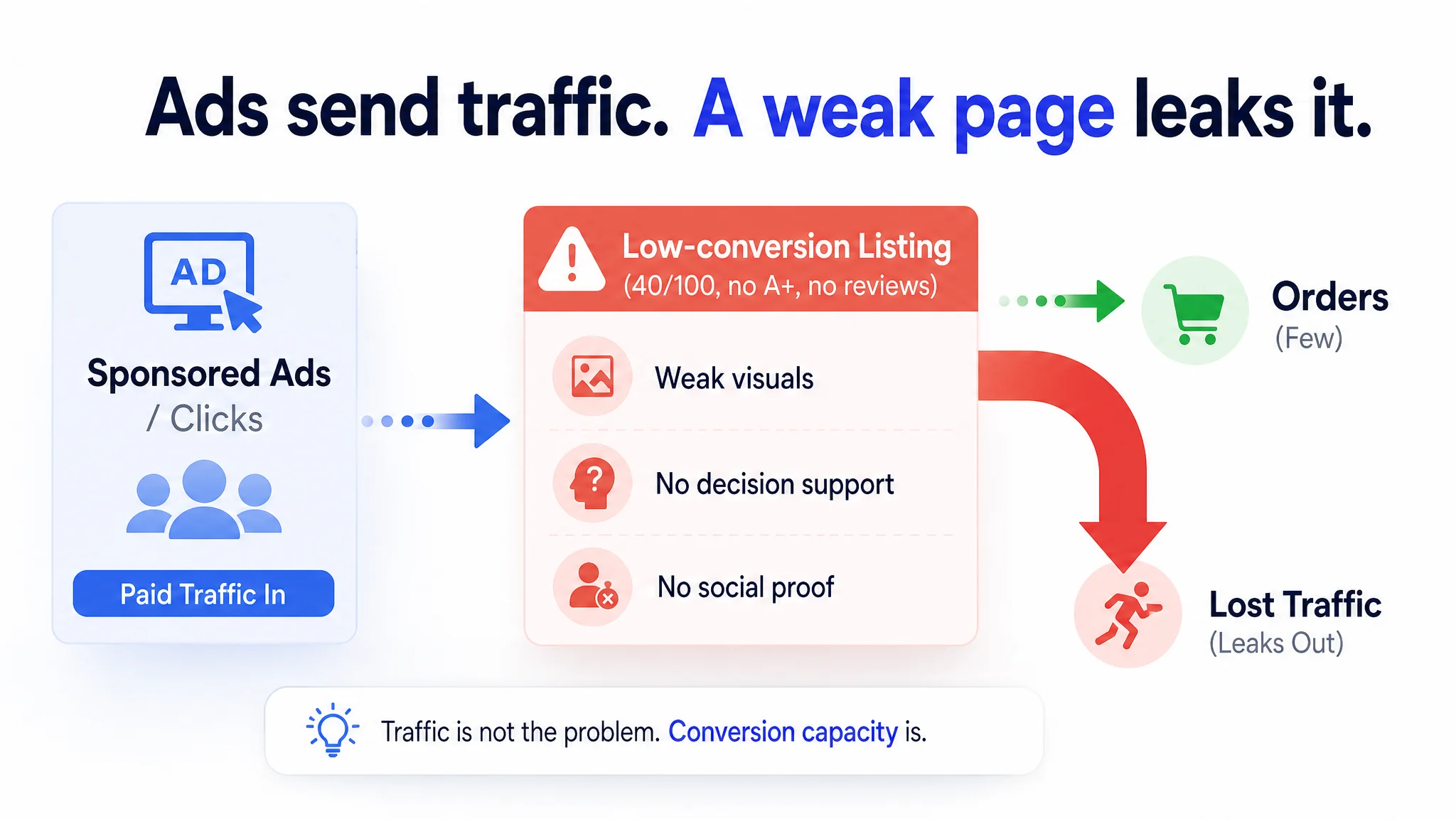
In other words, ad traffic was hitting:
- A page with minimal visual storytelling,
- No structured decision support, and
- No review-based trust.
Expecting stable ad efficiency under those conditions was unrealistic.
“The real problem was not that ads failed to bring traffic. It was that the page could not convert the traffic.”
The Original Misdiagnosis: “Our Tools Are Clear. We Just Need More Traffic.”
The seller did not ignore their Listing. They had:
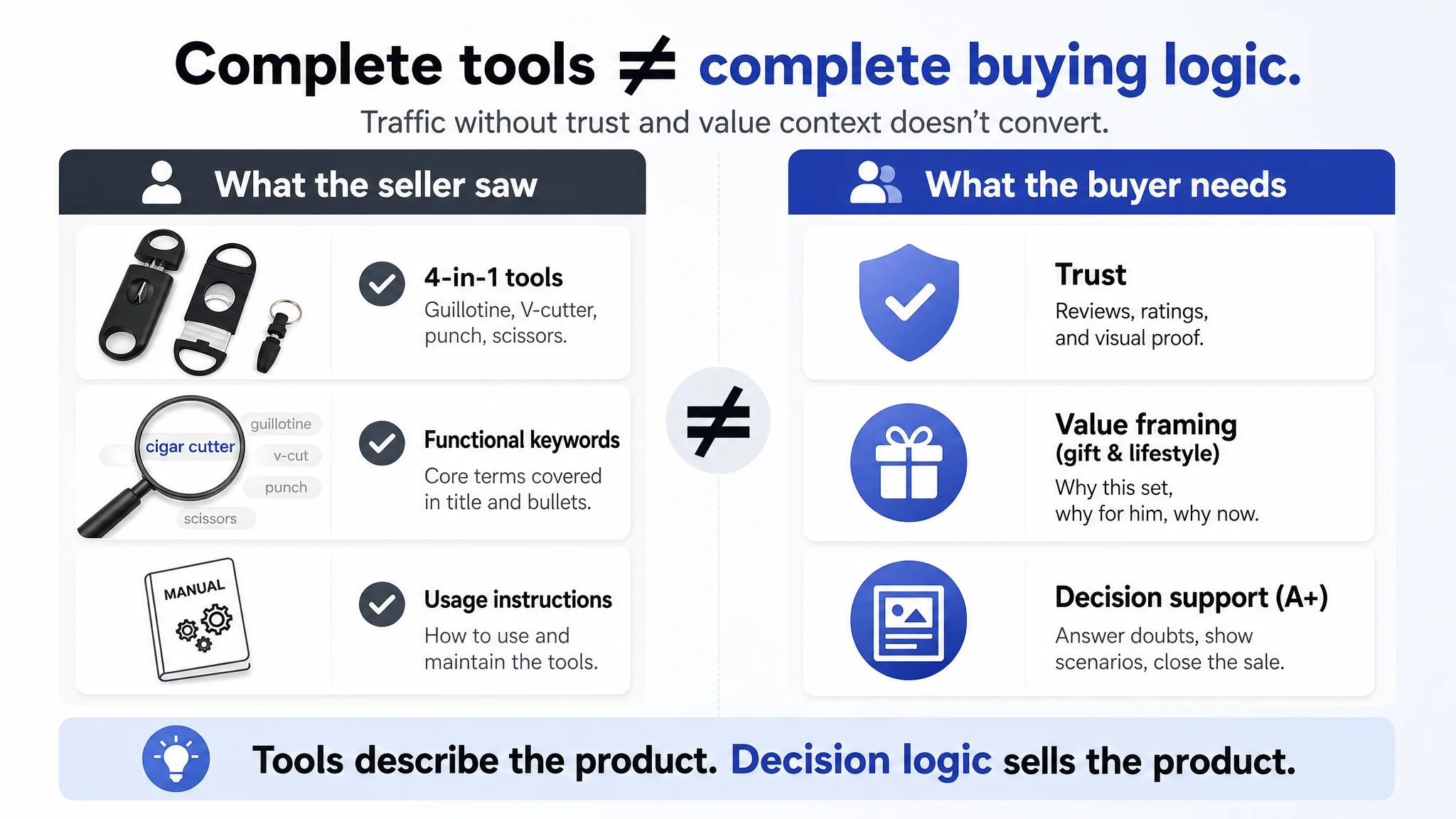
- A complete tool set: guillotine cutter, V-cutter, punch, scissors
- Titles that covered most functional keywords
- Bullet points explaining how to use and maintain the tools
- Several product images
This created a false sense of completeness. The internal narrative was:
- “The SKU configuration is strong; we’re a 4-in-1 set.”
- “We clearly explain how the tools work.”
- “If conversions are low, the traffic must be poor. Ads need improvement.”
The misdiagnosis sat in one blind spot: they treated the Listing like a technical spec sheet for a tool, not as a decision engine for a buyer.
While they were discussing match types and bids, two foundational issues went untouched:
1. Trust deficit:
- No reviews, no rating, no A+ visuals.
- Nothing on the page compensated for the lack of social proof.
2. Value framing deficit:
- The page spoke in “tool language”: usage tips, safety, maintenance.
- The category winner spoke in “gift and lifestyle language”: social gatherings, ideal gift for men, bar/office/lounge scenes.
This is why traditional ad optimization failed: the ads were configured on top of a page that could not justify the click.
Listing Data Made the Real Constraint Impossible to Ignore
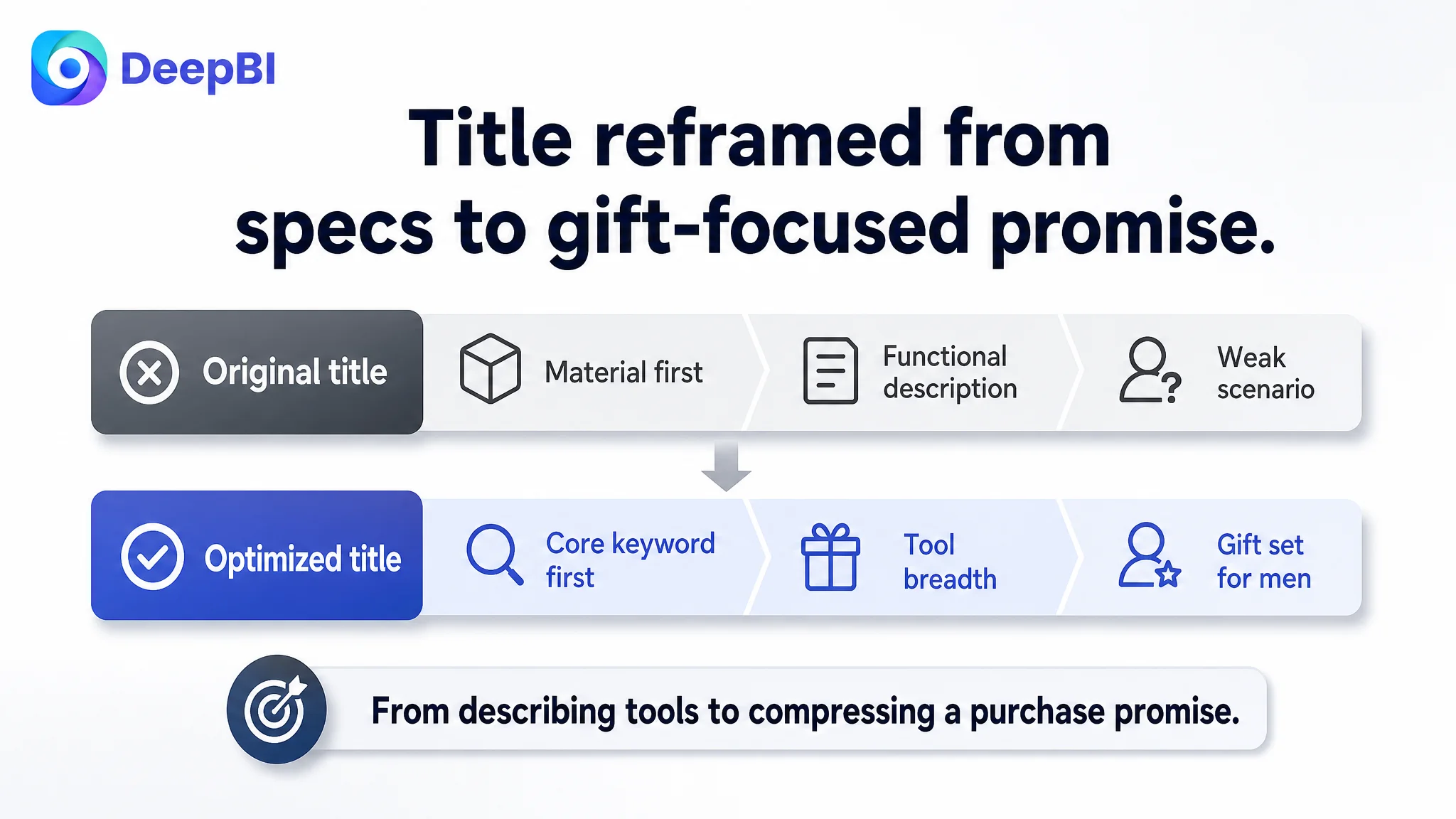
DeepBI’s Listing audit quantified what the seller felt only as “ads pressure.”
1. Title: Complete Keywords, Weak Commercial Story
The target title covered functionality but missed the decision logic:
- Opened with material, not the core product keyword.
- Focused on a descriptive structure.
- Lacked strong scenario cues and gift positioning.
The benchmark did three things better:
- Keyword front-loading: Started directly from “Cigar Cutter Guillotine,” locking the main intent early.
- Quantified combination: “3 in 1,” “Set of 2” – compressing complexity into simple numerical concepts.
- Scene & audience targeting: Ended with “Gift Set for Men,” clearly pointing to the gifting and social use case.
Even though the target title had “cigar cutter”–related terms, it didn’t signal quickly and clearly:
- What is this set?
- For whom?
- In what scenario?
DeepBI’s recommendation reframed the title into:
“Stainless Steel Cigar Cutter Set: Precision Double Blade Guillotine and V-Cut Cigar Scissors with Punch Tool, Portable Cigar Accessories Gift Set for Men, Black/Silver”
Logic behind this:
- Lead with material + core keyword (“Stainless Steel Cigar Cutter Set”).
- Immediately clarify tool breadth (guillotine, V-cut, scissors, punch).
- Lock in gift and accessories wording early enough for Amazon search and for scanning buyers.
This turns the title from a functional description into a compressed promise: premium material + full tool coverage + gift positioning.
2. Main Images: From “Laid-Out Tools” to “Cigar Ritual”
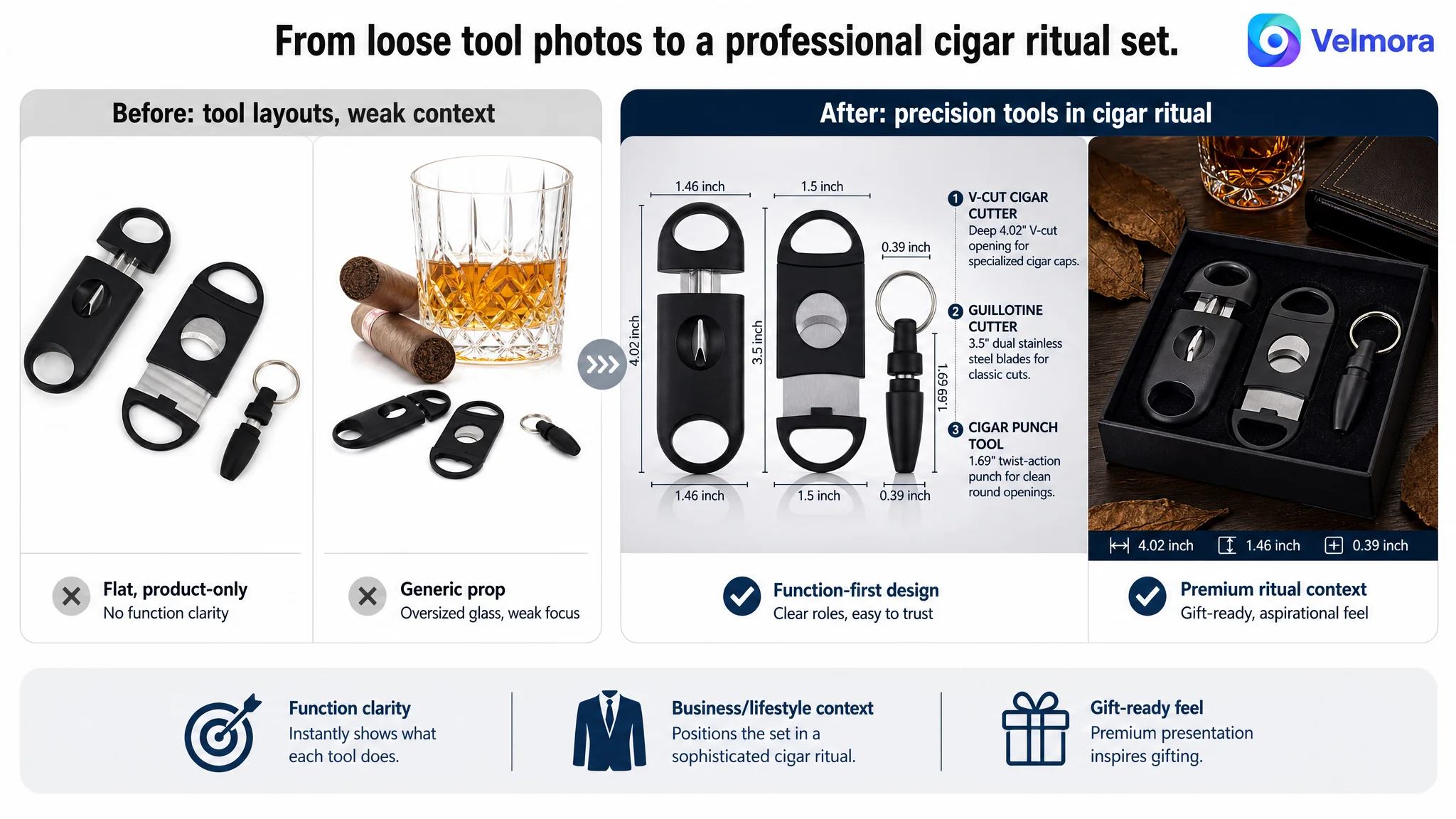
The image score gap, 21 vs. 27, was not just about aesthetics. It reflected three missing roles in the target Listing:
- A hook image that immediately shows “multi-tool cigar set” with visual clarity.
- A size/portability reference that anchors “pocketable, business-ready.”
- A social/lifestyle scene that lets buyers imagine using or gifting it.
The benchmark’s image strategy:
- Hero shot: double products with a cigar, cut section, and ash – instant context and emotional pull.
- Technical visuals: close-ups with cut diameters and ring gauge compatibility.
- Lifestyle: a glass of whiskey, leather, bar/office scenes, a mature gentleman’s ritual.
The target Listing:
- Flat white-background product layouts.
- Warm wood backgrounds that felt more “generic props” than premium.
- A whiskey glass so dominant in one image that it visually competed with the product.
DeepBI’s image directions were not about “make it prettier,” but about role-based images:
- Main image:
- Product group centered, ~70% of the frame.
- 45° angle to show dimensionality.
- Cold, industrial lighting to emphasize stainless-steel quality.
- Clean labeling of the 3–4 cutting functions so even a 1-second glance on the search results page communicates “all-in-one cigar tool set.”
- Size/portability image:
- Product beside a suit pocket or leather wallet.
- Dimensions labeled around the product.
- The buyer instantly sees: this fits your pocket and business life.
- Detail/credibility images:
- Macro of punch tool, blades highlighted under focused light.
- V-cutter open on a dark wood or leather surface with ring gauge compatibility labeled.
- “Precise punch,” “Compatible with 52 ring gauge” – technical assurance.
- Scene images:
- Product placed next to whiskey and a cigar box in a subtly lit home bar or cigar lounge.
- The product is clearly the hero; background cues emotional value instead of stealing attention.
“Advertising does not only amplify advantages. It can also amplify a page’s existing defects.”
In this case, ads were amplifying lack of context and lack of trust.
3. Bullet Points: From Manual Instructions to Buying Logic
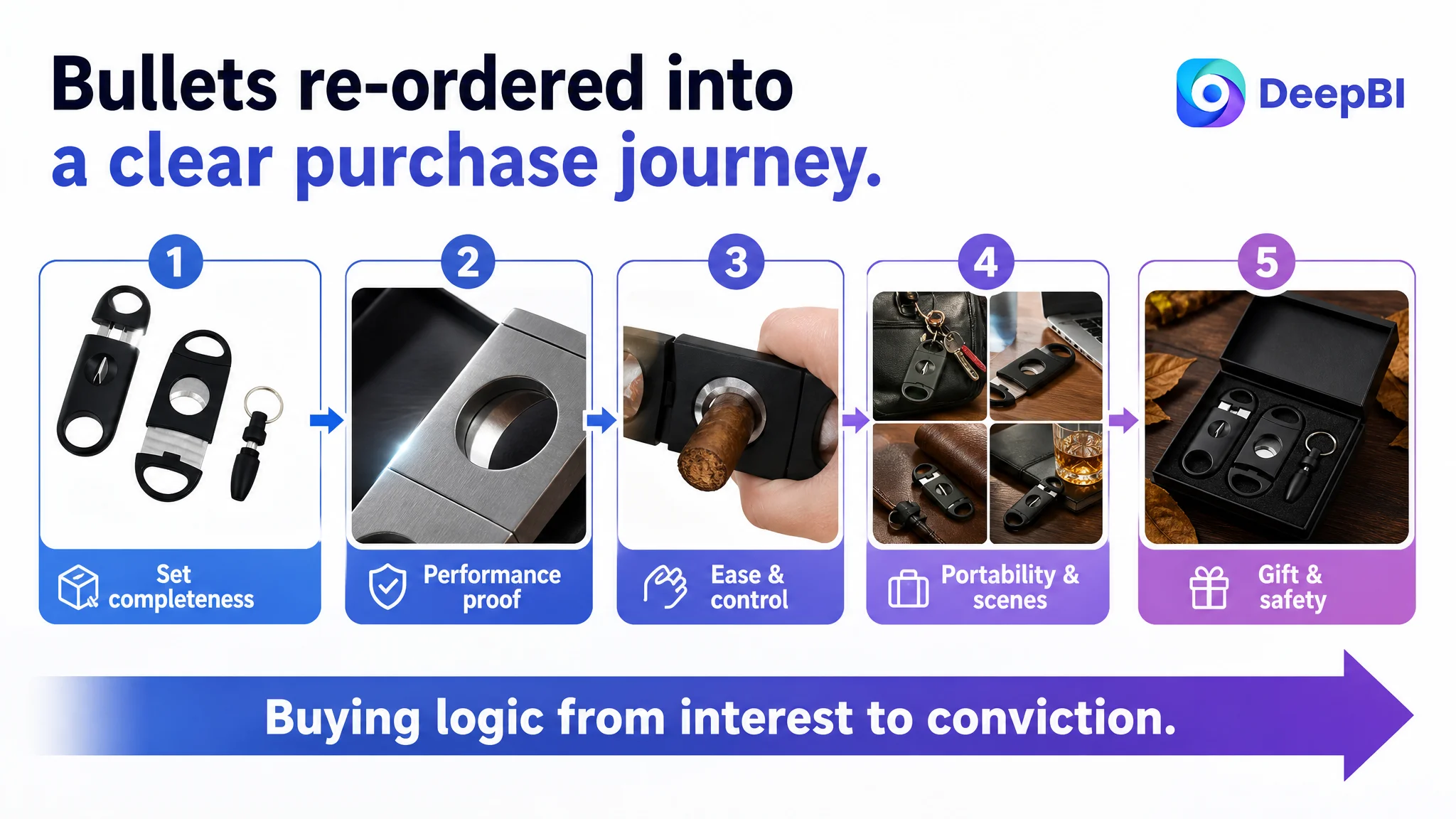
The bullet-point gap (5 vs. 7) seems small numerically, but the qualitative difference was decisive.
- Target Listing:
- Focus on tool functions, usage tips, maintenance, and safety.
- Read like a manual written for someone who already decided to buy.
- Benchmark Listing:
- Leads with multifunctionality and social scenes.
- Backs up performance with specific data (diameters, ring gauge).
- Frames the product as an ideal gift, not just a cutter.
DeepBI’s optimization re-ordered and reworded the bullets to create a purchase path, not just a description:
1. Lead with set completeness
- “COMPREHENSIVE 4-IN-1 CIGAR CUTTER SET…”
- Names all four tools, positions them as essential for every aficionado.
- This immediately justifies why this set is more complete than a simple cutter.
2. Then prove performance
- “ULTRA-SHARP STAINLESS STEEL BLADES…”
- References compatibility up to 60 ring gauge to anchor professional use.
- Connects blade quality to a smoother smoking experience.
3. Make usage feel controlled and accessible
- “ERGONOMIC DESIGN & PRECISION CONTROL…”
- Emphasizes non-slip grip and preventing over-cutting:
- Reduces anxiety for less experienced users.
- signals thought-through design for seasoned smokers.
4. Anchor portability and real-world scenes
- “PORTABLE & TRAVEL-FRIENDLY…”
- Maps usage to cigar lounges, business trips, golf outings, outdoor social gatherings.
- Each scenario helps the buyer visualize when they will actually use the set.
5. Close on gift logic plus a minimal safety note
- “IDEAL GIFT FOR CIGAR LOVERS…”
- Targets fathers, husbands, friends; mentions birthdays, anniversaries, Father’s Day.
- Reinforces durability and adds a clear safety reminder about sharp blades.
The shift is subtle but fundamental: from “what the tools are” to “why this set is worth buying and gifting.”
4. Detail Page / A+: The Biggest Hole in the Funnel
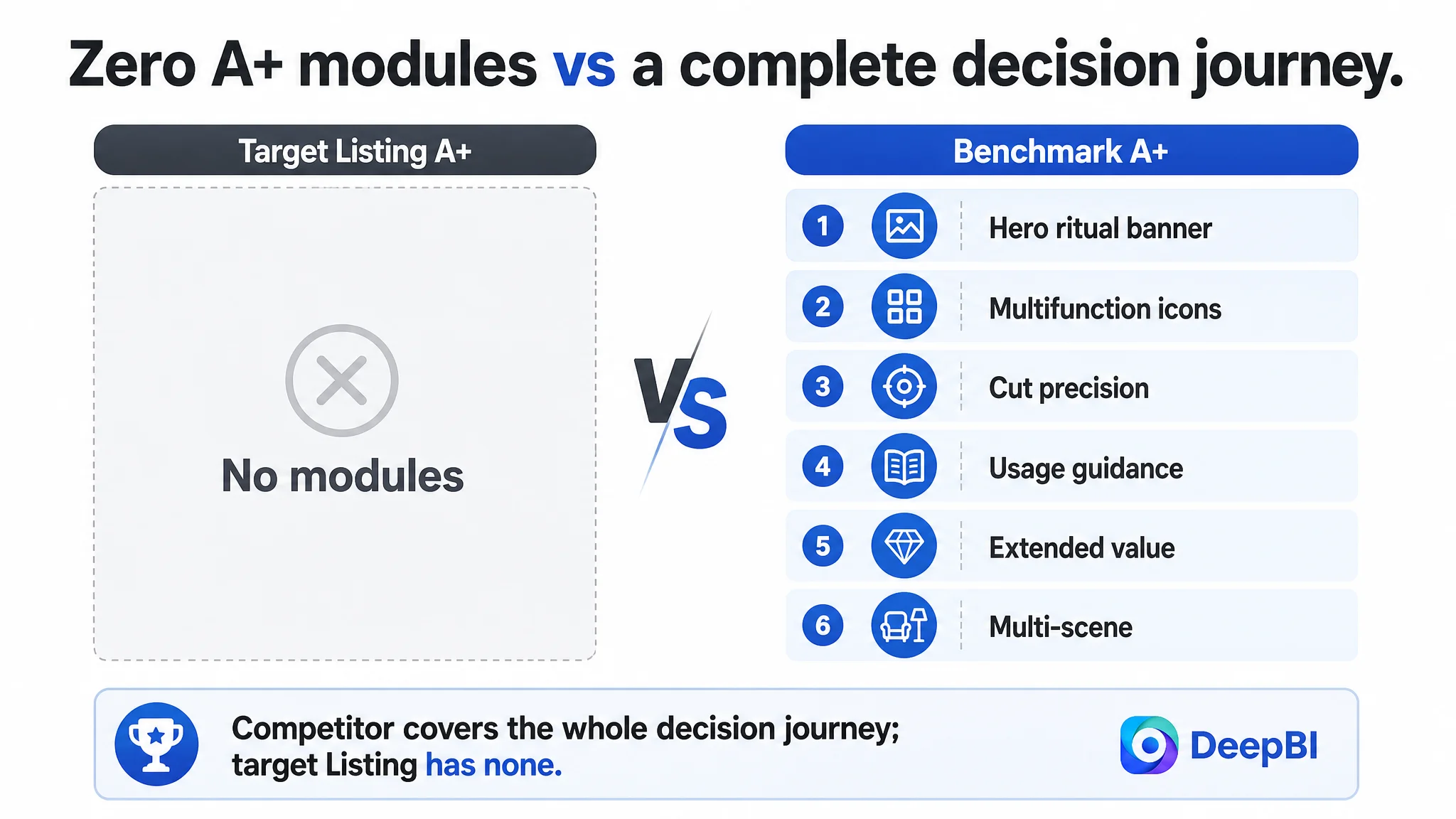
The largest numeric gap was in the detail/A+ dimension:
- Target Listing: 0/25
- Benchmark Listing: 23/25
The competitor’s A+:
- Strong hero banner in a bar-like setting, with the cutter integrated into a luxurious cigar ritual.
- Modules that break down:
- Multifunctionality (3-in-1) with clear icons.
- Blade material and precision (stainless steel, cut diameters).
- Step-by-step usage guidance.
- Extended value: bottle opener usage.
- Multi-scene use (bar, office, lounge, living room).
The target Listing had no A+ at all, meaning:
- No visual explanation of the 4-in-1 structure.
- No guided decision journey.
- No way to compensate for the total lack of reviews.
DeepBI’s A+ concept was structured around restoring the conversion path:
1. Hero banner: “Cigar ritual, not just tools”
- Product in both open and closed states at 45°.
- Background: dim private bar, whiskey, burning cigar in soft focus.
- Icons for Multifunction, Comfortable Grip, Sharp Blade, Pocket Size.
- This image tells buyers: this is a compact, premium cigar tool set for serious social use.
2. Technical credibility: cut precision module
- Split-screen showing V-cut and straight-cut cigar cross-sections.
- Specific cut-diameter labels like 0.82 in and 0.94 in.
- Short explanation of how this suits different cigar sizes and preferences.
- This answers the classic buyer question: “Will this work with my cigars?”
3. Function extension: bottle opener usage
- Product opening a beer bottle, condensation visible.
- Secondary scene opening a can.
- Clear demonstration that this is a social gathering tool, not just a cutter.
4. Portability & detail module
- Top-down shot on a carbon-fiber-style surface, one tool open, one closed.
- “COMPACT PROFESSIONAL CIGAR CUTTER” text.
- Visual proof that the set is compact, sleek, and professional.
5. Multi-scene grid
- Four equal panels: bar counter, modern office, cigar lounge, home living room.
- Product naturally integrated into each environment with labels “Bar,” “Office,” “Cigar Lounge,” “Living Room.”
- This module quietly expands the product from a niche tool to an all-scenario companion.
6. Material & durability close-up
- Macro shot of fully extended blades on a pure-black background.
- Hard, narrow sidelight creating a sharp highlight on the cutting edge.
- Text: “STAINLESS STEEL SHARP BLADES.”
- This is where trust in longevity and cutting performance gets visually anchored.
7. Gift & packaging module
- The set laid in a black velvet-lined gift box on a dark wood table.
- Dry tobacco leaves as subtle decoration.
- The scene signals: this is suitable for Father’s Day, birthdays, and business gifts.
Without A+, the original Listing gave buyers no guided journey from curiosity to confidence. With a full A+ structure, the page can finally carry the weight that ads are paying to deliver.
Why DeepBI Did Not Recommend “Keep Tuning Ads First”
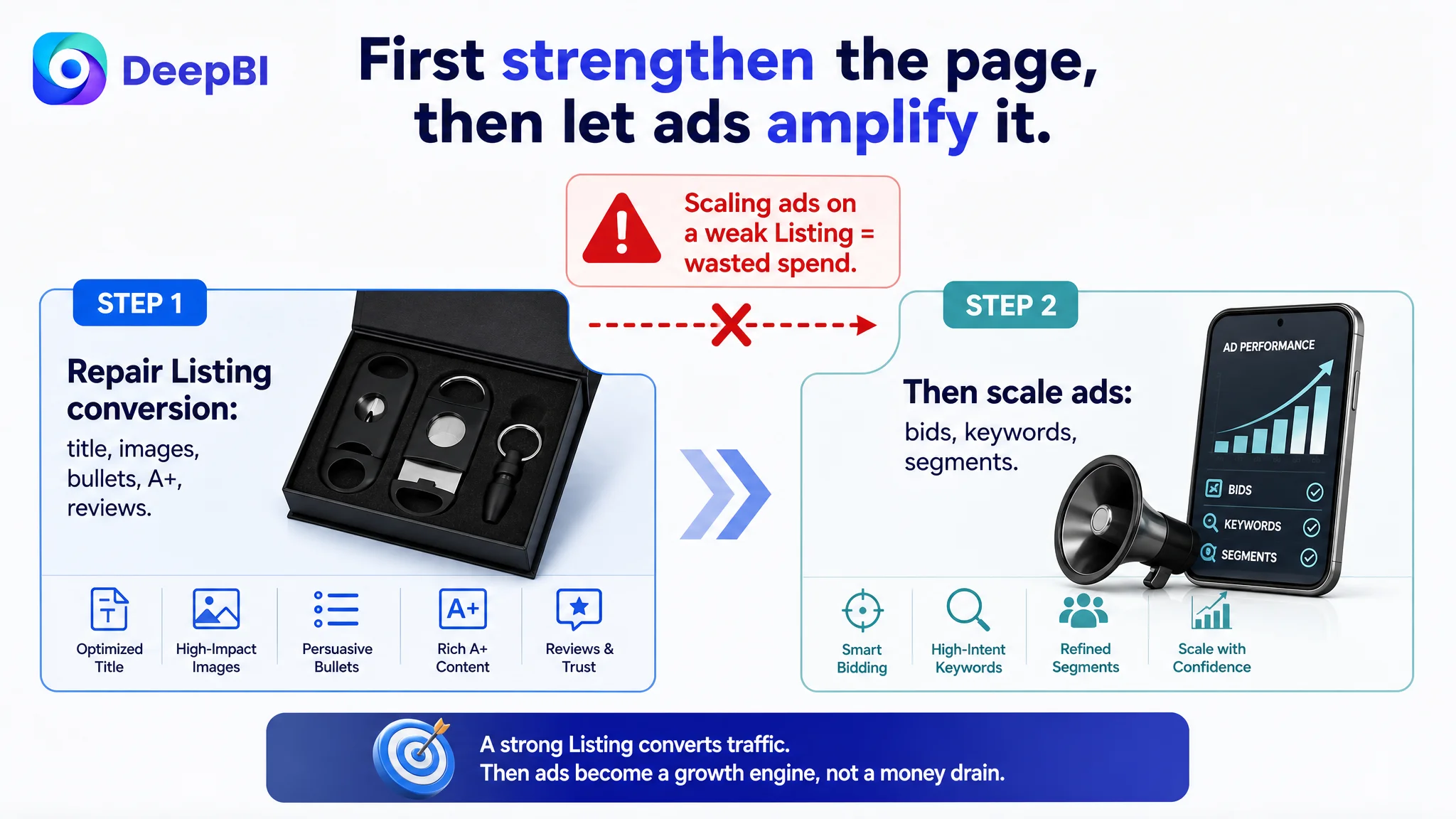
From a pure advertising standpoint, the seller could have:
- Continued adjusting bids.
- Re-grouped keywords.
- Tested more audience segments.
But with:
- No reviews,
- No A+ content, and
- A 40/100 Listing score versus an 84/100 benchmark,
every additional dollar on ads would face the same structural constraints:
1. Low trust ceiling – zero reviews and no visual proof on A+.
2. Weak first impression – main image and title not clearly expressing superiority or gift value.
3. Incomplete buying logic – bullet points and images not guiding buyers from feature to benefit to scenario to gift.
The biggest business risk was straightforward:
- Ads were amplifying a weak Listing.
So the decision path had to be:
1. Stabilize the Listing’s conversion capacity first:
- Improve title, images, bullets, and A+.
- Start building early review volume.
2. Only then revisit ad scaling, when:
- The page can convert at a healthier baseline CVR.
- Each extra click has a better chance of becoming an order.
This is where DeepBI’s perspective diverged from the seller’s initial instinct. Ads are not the lever of last resort; they are the lever you pull after the product page can carry the load.
How the Page’s Sales Logic Started to Recover
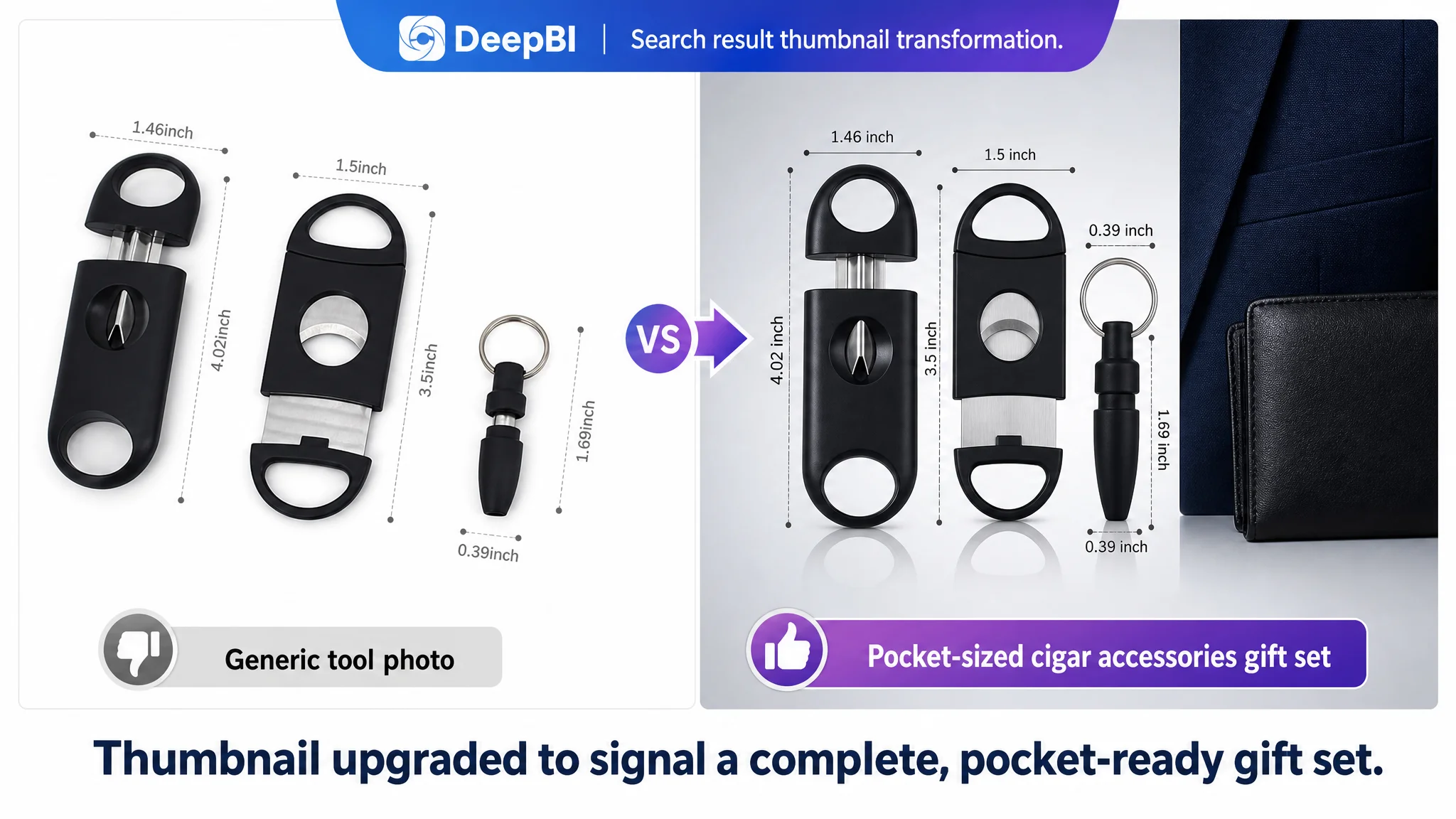
After reframing the Listing as the core bottleneck, the priority sequence became clear.
1. Title and Thumbnail: Earn the Click First
- Rewriting the title to foreground “cigar cutter set,” stainless steel, and gift set for men helped:
- Clarify relevance on search results.
- Position the product as a premium, multi-tool gift, not just another cutter.
- Rebuilding the primary image around clear multi-function visuals and industrial lighting made it more likely to:
- Stand out in a grid of similar thumbnails.
- Signal seriousness and “worth investigating.”
Resulting change in state (even without invented numbers):
- The Listing shifted from “another generic tool photo” to “complete cigar accessories gift set” on the search page.
- Ad clicks were no longer landing on a page that visually undersold the promise made in the title.
2. Bullet Points and A+: Protect the Click and Build Trust
As the message architecture matured:
- Bullet points now connected features → performance → scenarios → gifting.
- A+ visuals addressed:
- Precision (cut diameters, blade sharpness)
- Portability (compact form factors)
- Multi-functionality (cigar + bottle opener)
- Social positioning (bar, office, lounge)
- Gifting (luxury packaging)
This allowed the page to:
- Compensate partially for the lack of reviews by showing, not just telling.
- Create an internal logic where the price and assortment feel justified.
3. Ads Became Useful Again, Not Wasteful
Once the Listing could:
- Present a compelling hero value,
- Visually answer compatibility concerns, and
- Anchor itself as a gift option,
ad traffic was no longer walking into a trust vacuum.
The operating state shifted from:
- “Ads are expensive and do not pay back,” to
- “Ads feed a page that can convert; now it makes sense to re-test bids and keywords.”
Even without specific CVR or ACOS numbers, one business shift is clear:
- The seller moved from fighting symptoms at the ad layer to repairing the cause at the Listing layer.
What This Case Changes in the Seller’s Understanding
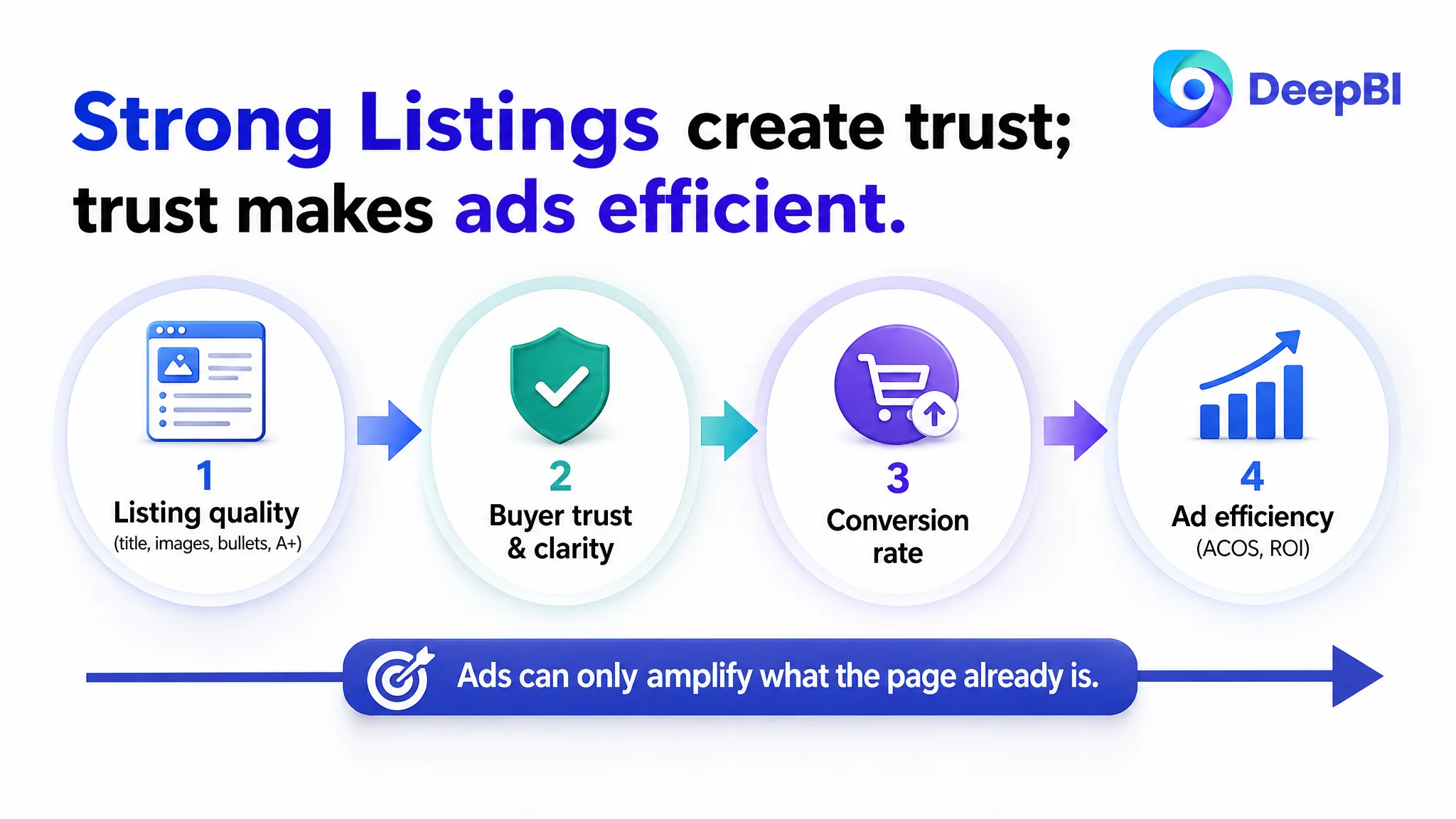
By the end of the diagnosis and repositioning, the seller’s internal logic changed in several key ways:
1. Amazon ads cannot fix a trust-free page.
- If reviews are zero and A+ is empty, buyers will hesitate regardless of bidding strategy.
2. Listing quality is the foundation of advertising efficiency.
- Title, main image, bullets, and A+ must work together to tell a coherent story:
- Why this product,
- Why now,
- Why at this price.
3. In categories with gift and lifestyle attributes, “tool language” is not enough.
- Cigar accessories are not only about cutting; they’re about social rituals and identity.
- Ignoring lifestyle and gifting language means losing to competitors who tap into those drivers.
4. Before scaling ads, ask: “Does this page deserve more traffic?”
- Are the main image and title strong enough to earn the click?
- Does A+ close doubts that the bullets introduce?
- Does the page compensate for current review volume?
For Amazon sellers reading this, the takeaway is direct:
If your Amazon ads feel like they are “not working,” look at your Listing as aggressively as you look at your campaigns. A 40/100 page competing against an 84/100 benchmark is not an ads issue; it is a conversion capacity issue. Only after that is repaired can ad traffic truly become an asset instead of an ongoing expense.