

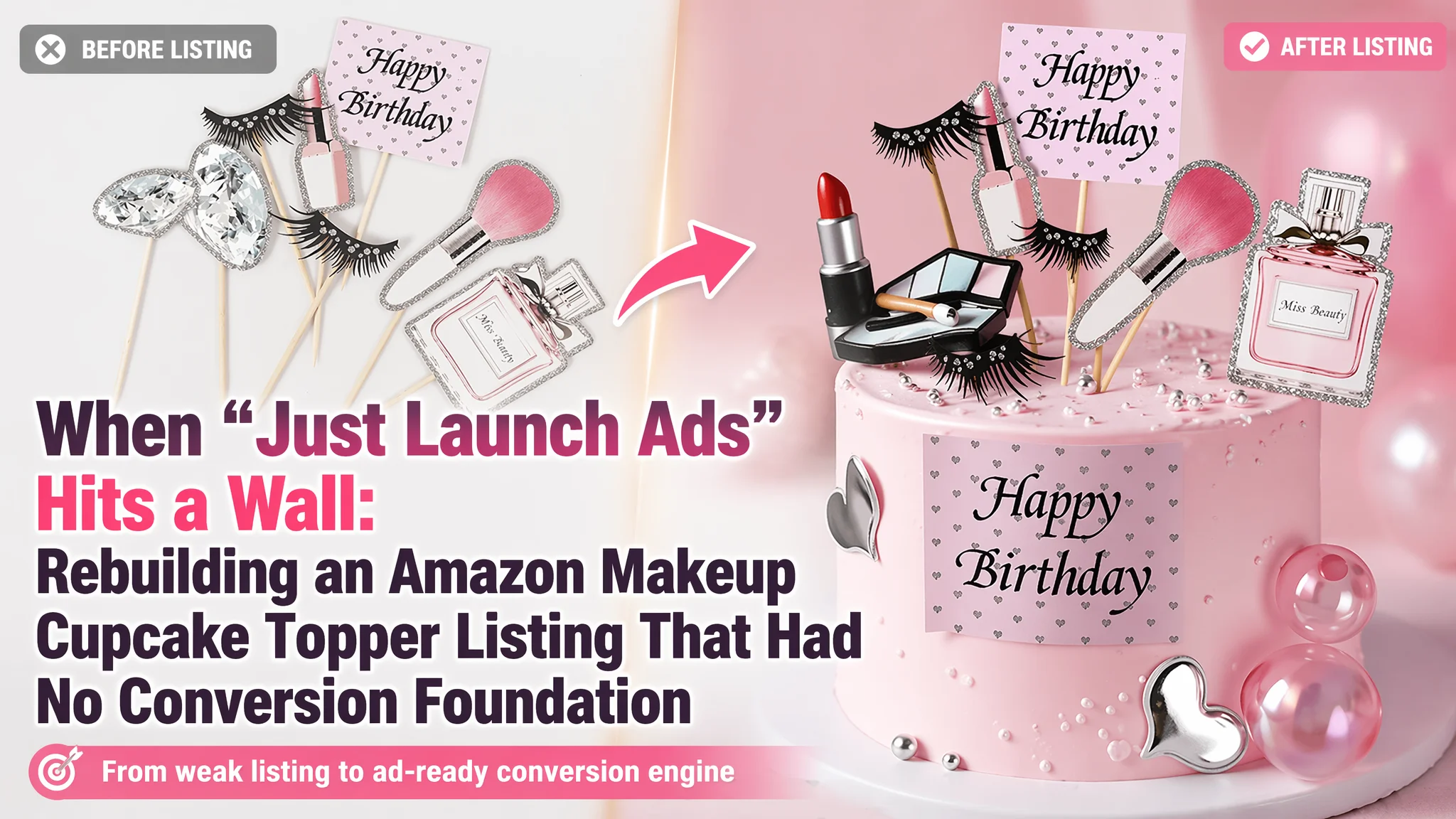
An Amazon seller in the party-supplies category came to DeepBI with a familiar pressure: they wanted to push a new makeup-themed cupcake topper set with Amazon ads, but the numbers were already signaling trouble. Before serious advertising even started, the Listing’s competitive score was just 38/100 against a key benchmark at 83/100, and the page had zero reviews, no A+ content, and weak title and bullet structure. The seller’s internal diagnosis was straightforward but misleading: “We just need more traffic and some reviews—ads will take care of it.”
DeepBI’s analysis showed a different picture. This was not an advertising problem waiting to be solved; it was a product-page conversion problem waiting to be exposed. The benchmark Listing had built a full Amazon product-page story—optimized title, strong main-image set, emotionally framed bullet points, rich A+ visuals, and an initial review base—while the customer page relied on basic catalog-style images and technical descriptions. Pushing more ads onto this foundation would not fix ACOS; it would amplify the Listing’s weaknesses.
The optimization therefore did not start with campaign restructuring. It started with the Amazon Listing itself: reframing the title around quantity and scenario, rearchitecting bullet points from “what it is” to “what it delivers,” and designing a new main-image and A+ visual system that could actually convert party-planning traffic. Other Amazon sellers can read this case as a caution: if the Listing cannot build trust or show real usage scenarios, scaling ads is not just inefficient—it’s risky.
Amazon Ads Were Not Failing. The Page Was Consuming the Traffic.
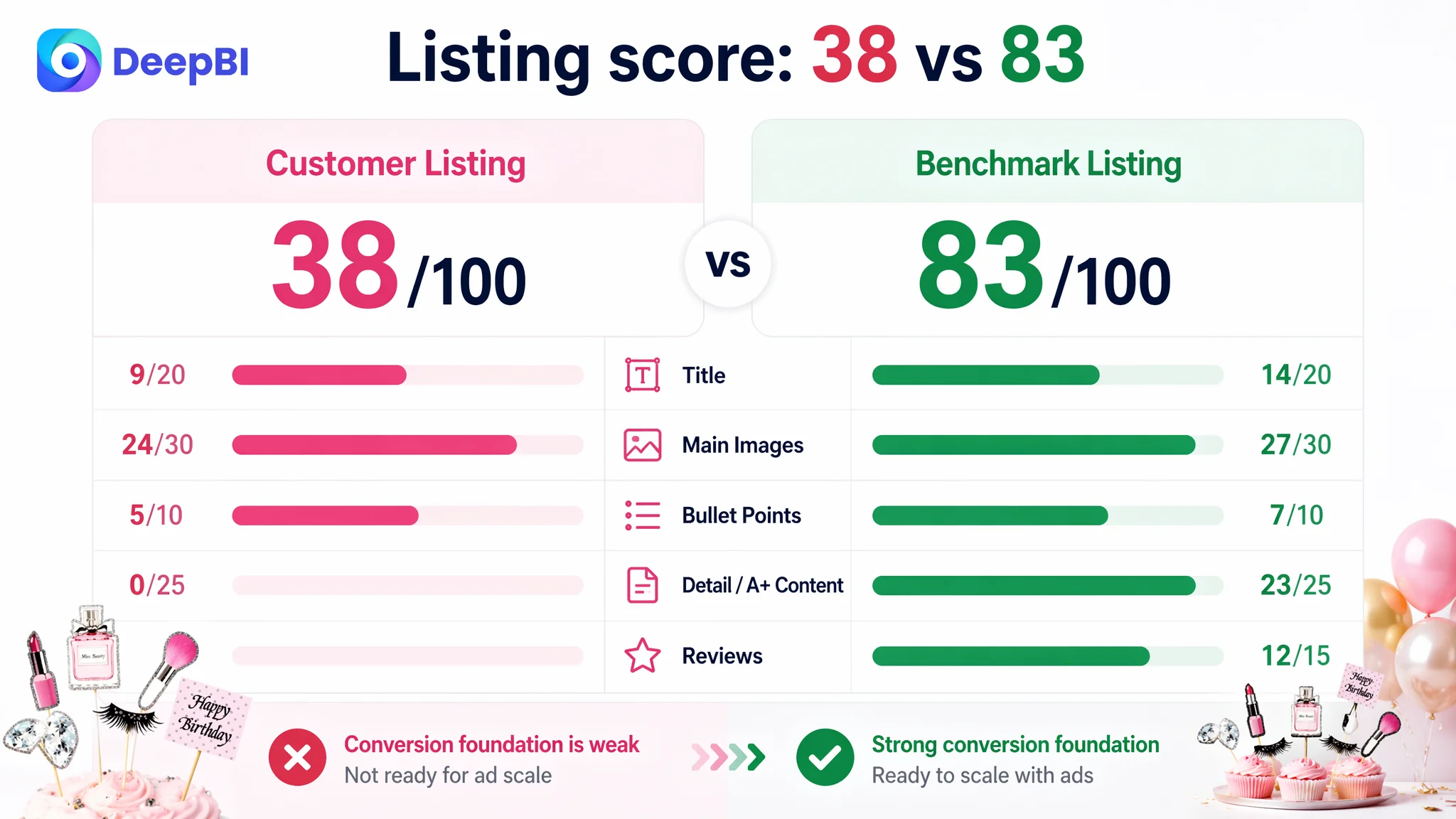
The product is a 24-piece makeup-themed cupcake topper set aimed at girls’ birthday parties, bridal showers, hen parties, spa days, and similar events on Amazon US. Before any meaningful ad scale, DeepBI’s Listing score already placed the product at a structural disadvantage:
- Customer Listing: 38/100
- Benchmark Listing: 83/100
- Gap: -45 points
Broken down by dimension:
- Title: 9 vs. 14 (out of 20)
- Main images: 24 vs. 27 (out of 30)
- Bullet points: 5 vs. 7 (out of 10)
- Detail/A+ content: 0 vs. 23 (out of 25)
- Reviews: 0 vs. 12 (out of 15)
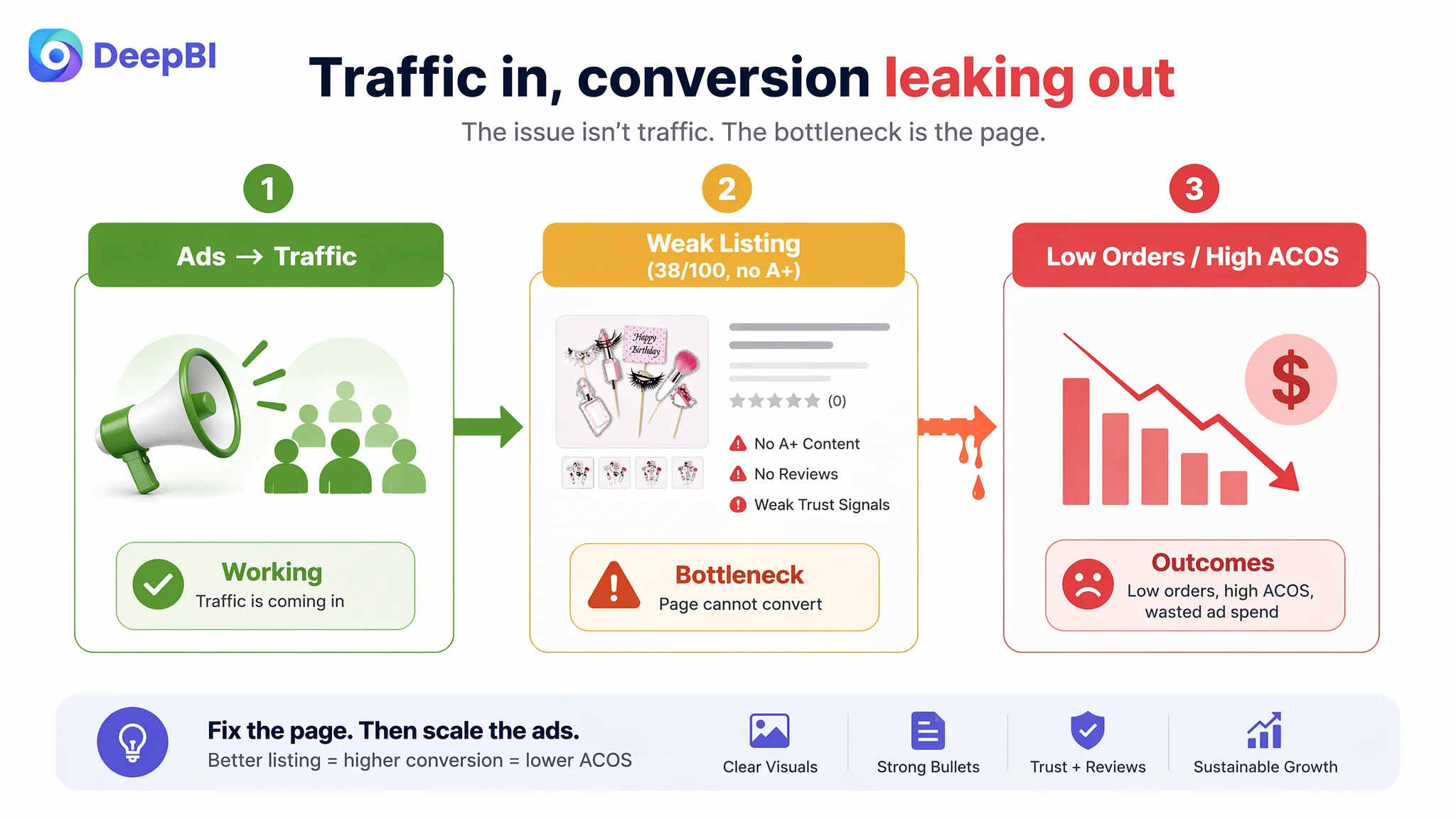
The seller’s operating mindset was understandable: “We’re a new Listing, we don’t have reviews yet, so let’s run ads, drive more exposure, and build our base.” What was missing from that judgment was the relationship between traffic and page quality. In this category, buyers are not only searching “makeup cupcake toppers”; they are visually validating:
- Does this look like the kind of party I want to host?
- Is the quantity and set composition clear?
- Is it safe, sturdy, and easy to use?
- Will this feel special enough for the occasion?
On the benchmark Listing, all of those questions were answered visually and textually. On the customer’s Listing, almost none of them were.
“The real problem was not that ads failed to bring traffic. It was that the page could not convert the traffic.”
If ads had been aggressively scaled at this stage, they would have pushed more buyers into a page that lacked a credible story and trust signals. ACOS would climb, CTR and CVR would stagnate, and the seller would likely blame keywords and bids instead of the underlying Listing conversion capacity.
The Real Constraint Was Listing Conversion Capacity
DeepBI’s scoring made the constraint very clear: the Listing did not yet have the ability to carry traffic through the purchase decision. The gap wasn’t in one cosmetic detail; it was structural.
Title: No Clear Reason to Click or Understand Value
The benchmark uses a typical Amazon party-supplies structure:
- Quantity at the front: “24PCS Makeup Cupcake Toppers”
- Core keyword repeated and anchored: “Makeup Cupcake Toppers”
- Scenario and use: birthday party decorations, bridal shower, cosmetics party
This does three things at the search-results level:
- Quantifies value immediately (“24PCS” signals a full set).
- Reassures relevance for the buyer’s query (“makeup cupcake toppers” is front-loaded).
- Broadens coverage to multiple events without diluting the core theme.
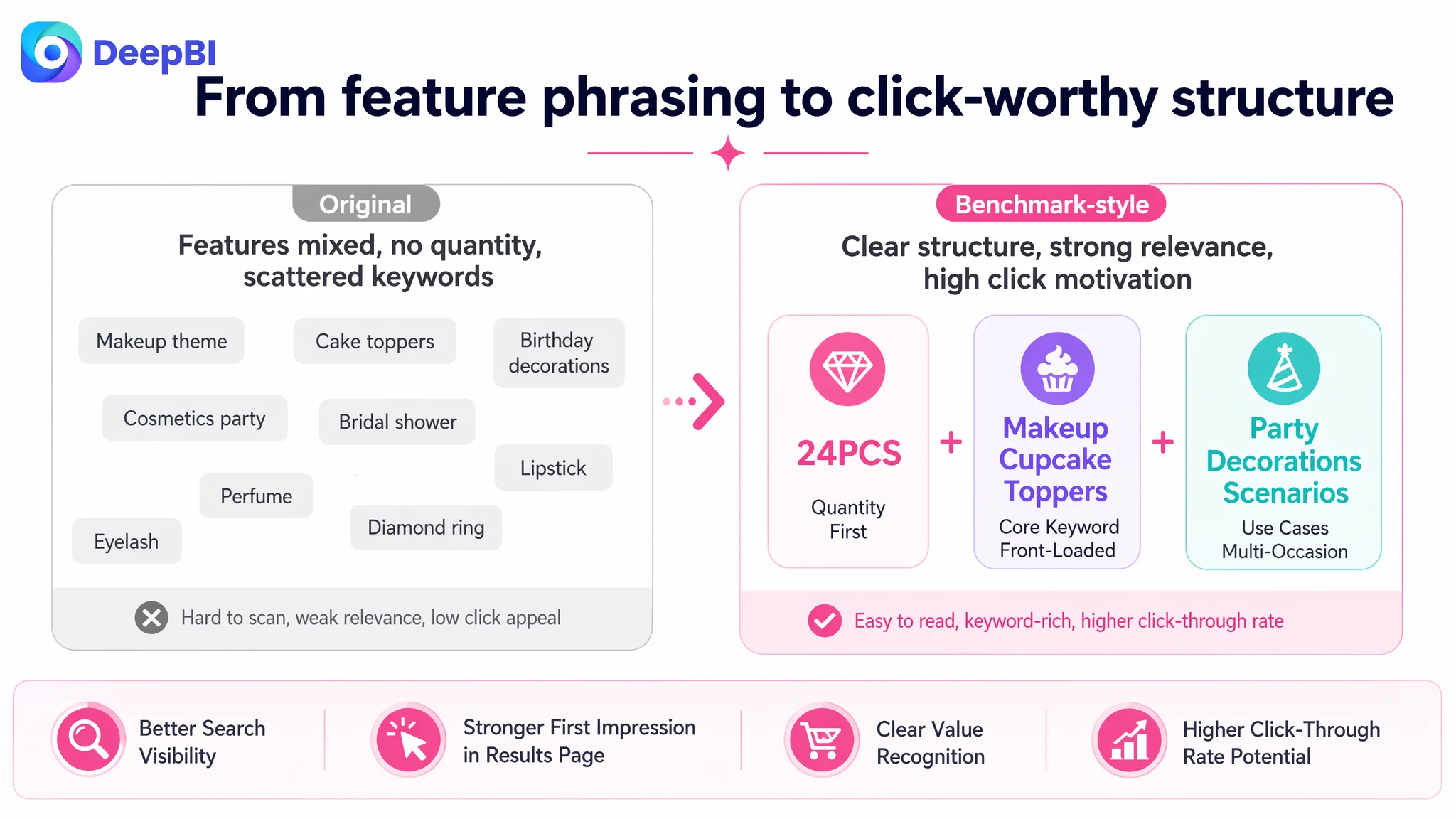
The customer’s original title was more of a natural descriptive phrase about product features. Keywords were scattered, quantity was not emphasized, and scenarios were not structured as strong search or decision hooks. The result: weaker search weight and less click appeal, especially when shown next to a benchmark that telegraphs “24PCS” and “party decorations” at first glance.
Main Images: Catalog Presentation vs. Party Decision Logic
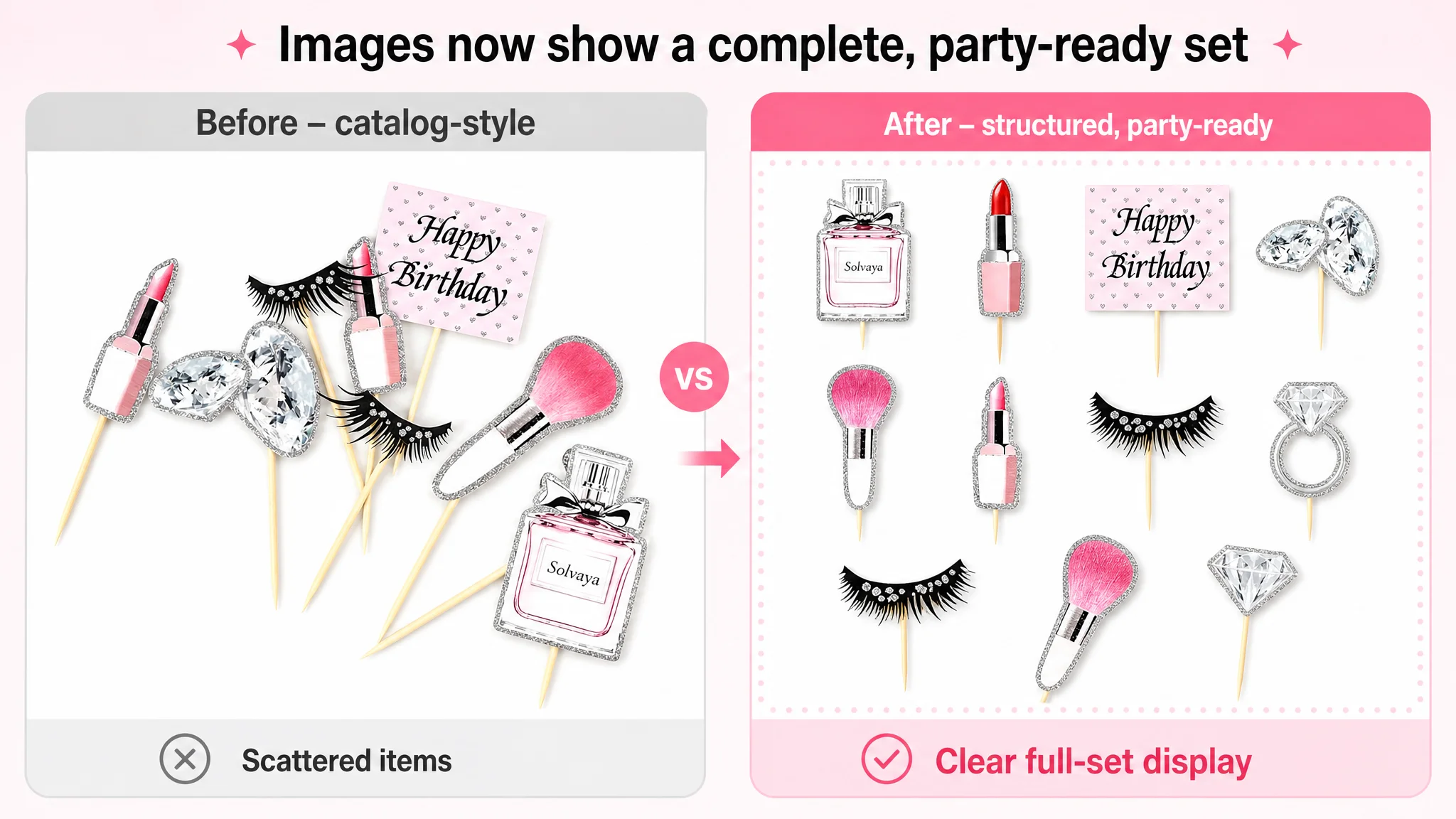
On the image set, the deep gap was not that the customer had “bad pictures”; they had passable catalog-style photos. The problem was that the benchmark Listing used images as an orchestrated decision funnel, while the customer Listing stayed at static product shots.
Benchmark behavior:
- Multiple real-party scenes: children interacting, decorated dessert tables, bridal or spa settings.
- A dedicated specification image showing quantity per design (e.g., “X2PCS” per icon), with clear size markers.
- High-quality lighting, soft backgrounds, and coordinated color palette (“pink + gold”) to signal a “refined party” feel.
Customer behavior:
- Images that look more like a product catalog: items laid out, some size indication, but no narrative of “this is how your party will look.”
- No systematic visualization of all SKUs and quantity logic in one clear frame.
- Some attractive shots, but with crowded composition and diffused focus, diluting perceived “premium” and clarity.
From an Amazon buyer’s perspective, the benchmark immediately answers:
- “Yes, this is plug-and-play decor.”
- “I see the quantity and size; I know it fits my cake/cupcakes.”
- “My party will look like this.”
The customer’s page never fully gets there. The Listing asks the buyer to imagine the outcome by themselves rather than showing it.
Bullet Points: Information Without a Buying Logic
DeepBI’s comparison of bullet points revealed another structural gap: the customer bullets described the product; the benchmark bullets sold the event.
Benchmark bullets (summarized):
- Start with packing list and quantity, making value explicit.
- Emphasize premium food-grade materials and safety.
- Map multiple occasions with emotional language (“fill you with fun and joy”).
- Highlight ease of use and time saving.
- Close with service and reliability commitments.
Customer bullets (before optimization):
- List contents.
- Describe appearance.
- Enumerate usage scenarios.
- Explain usage method.
- Provide safety warnings.
The difference is not in how many words are used; it’s in the logic:
- Benchmark: “sell the event outcome” → “reassure safety and ease” → “guarantee support”
- Customer: “tell what the product is and how to use it” → “warn about safety”
In a category where the buyer is under time pressure (events are date-bound, decorations are time-sensitive), the absence of clear value and reassurance words like “premium,” “safe,” “time-saving,” and “photo-ready” materially weakens conversion.
Detail/A+ Content: A Complete Trust Gap
The A+ dimension is where the Listing was effectively non-existent:
- Customer page: no A+ content, no extended visuals, no storytelling modules → score 0
- Benchmark page: multiple high-quality A+ images with scenes, close-ups, multi-occasion layouts → score 23
The benchmark’s A+ visual chain:
1. Dessert table with full decoration: core atmosphere.
2. Product close-ups: design and sparkle details.
3. Children’s interaction: social proof and joy.
4. Multi-angle displays: full set and composition clarity.
5. Extended adult scenarios: bridal, spa, and other higher-end events.
The customer page offered none of this. The trust and imagination layer was missing entirely; the conversion funnel broke at the first scroll. DeepBI’s judgment was straightforward: advertising into a page that has zero A+ storytelling in a visual category is a conversion risk, not an opportunity.
Reviews: No Social Proof at All
On reviews:
- Customer: 0 reviews, 0 stars, no front-page comments.
- Benchmark: 4.9 stars, 21 total reviews, 4 detailed top reviews visible.
No review base means:
- Ads have to carry 100% of the trust burden.
- Any page-level weakness (visuals, bullets, missing A+) is magnified.
- Buyers comparing two similar products will default to the Listing with proof of satisfaction.
In this context, the absence of review content turns Listing quality into the primary—and only—trust mechanism. That mechanism was not yet built.
Why DeepBI Did Not Keep Tuning the Ads First
With this scoring landscape, DeepBI’s core judgment was that there was one immediate bottleneck: the Listing’s conversion capacity. Ads were not yet the right lever.
The risk profile:
- High probability that ad spend would drive clicks into a page with no A+ content, no reviews, and weaker title/image/bullet logic.
- Likely outcome: low CVR, rising ACOS, and misattribution of failure to ad tactics rather than Listing structure.
- Operational impact: pressure to “fix” keywords, bids, or match-type settings without addressing the page’s ability to turn traffic into orders.
DeepBI’s decision path:
1. Freeze the assumption that ads are the main solution.
At this stage, the Listing has not earned the right to scale traffic. The foundation is too weak.
2. Prioritize Listing reconstruction.
- Rebuild title for search weight and click logic.
- Redesign main-image set to show quantity, specification, and real-party scenes.
- Reframe bullet points into value, safety, scenario, and ease-of-use arcs.
- Construct an A+ visual chain that mimics the benchmark’s “party story” without copying design.
3. Delay aggressive ad optimization until after page repair.
Ads should be used to validate a stronger Listing, not to test a page that cannot yet convert.
“Advertising does not only amplify advantages. It can also amplify a page’s existing defects.”
This is the core learning: when the Listing is structurally weak against a validated benchmark, improving ads first is often the wrong order of operations.
This Product Page Did Not Lack Traffic. It Lacked Trust.
Rebuilding the Listing started with one assumption: for party-decoration products on Amazon, the buyer is buying a future moment, not a cardstock cutout. The page has to deliver that future moment visually and verbally.
Reframing the Title Around Quantity, Theme, and Scenario
DeepBI’s proposed title direction:
24PCS Makeup Cupcake Toppers, Sparkly Cosmetic Cake Toppers with Lipstick, Perfume Bottle, Eyelash and Diamond-Style Ring, Party Supplies for Birthday, Bridal Shower, Hen Party
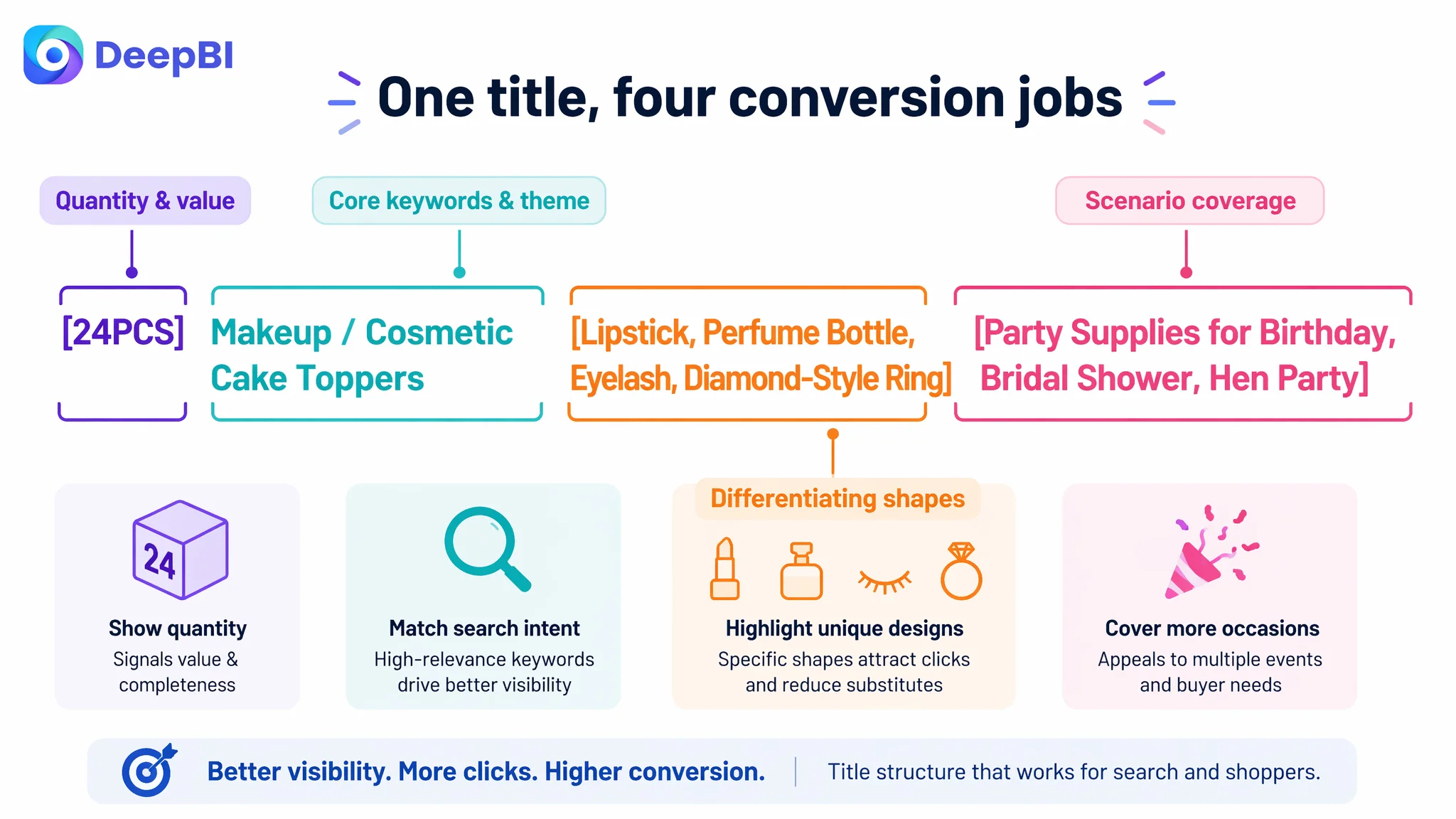
This change is not “just wording.” It reorders the commercial logic:
- “24PCS”: leads with quantity and value.
- “Makeup Cupcake Toppers / Cosmetic Cake Toppers”: locks core keywords and theme.
- “Lipstick, Perfume Bottle, Eyelash, Diamond-Style Ring”: uses specific shapes as long-tail differentiators.
- “Party Supplies for Birthday, Bridal Shower, Hen Party”: anchors broad scenarios in party language.
Resulting advantages:
- Stronger coverage of high-intent search queries.
- More immediate communication of “set size + theme.”
- Clear event relevance at the title level, even before images.
Turning Bullet Points Into a “Event Outcome” Narrative
DeepBI’s bullet restructuring moved from neutral description to structured selling logic.
Bullet 1 – Theme and Design Value
From “set contents” to:
Elegant Makeup Theme Designs: Features 4 iconic hand-picked designs—lipstick, perfume bottle, eyelash, and diamond-style ring. Each topper is crafted to bring a sophisticated salon and spa aesthetic to your dessert table, making your cupcakes stand out with a professional touch.
Judgment:
- The goal is no longer to say “what designs exist,” but to frame the aesthetic outcome (“sophisticated salon and spa”) and position cupcakes as a centerpiece.
Bullet 2 – Material Quality and Visual Sparkle
Premium Quality & Sparkling Detail: Finished with gem and sequin-style detailing, these toppers are made from sturdy, high-quality materials to ensure durability. They combine a glamorous look with reliable construction, perfect for adding a touch of luxury to your spa or salon-themed party displays.
Judgment:
- Combines appearance (sparkle) and structural reliability; addresses both “will it look good?” and “will it hold up?”
Bullet 3 – Scenario Coverage
Versatile for All Celebrations: These makeup cupcake toppers are ideal for girls' birthday parties, bridal showers, bachelorette events, spa days, and salon-themed celebrations. A must-have decoration to fill your special event with charm and joy.
Judgment:
- Compresses multiple occasions into a clear, high-relevance list, with emotional language (“charm and joy”) to frame outcomes.
Bullet 4 – Ease of Use and Time Saving
Effortless Setup & Time Saving: Pre-assembled with picks for immediate use; simply insert them into cupcakes or celebration cakes after icing. This user-friendly design allows you to decorate in seconds, saving you valuable time while ensuring your dessert table is photo-ready.
Judgment:
- Directly hits a core party organizer pain point: time and hassle. It also subtly introduces “photo-ready”, connecting decor to social media and memory-making.
Bullet 5 – Safety and Assurance
Safe & Reliable Decoration: Intended for decorative use only (non-edible). Please remove before serving and keep away from heat sources. We are committed to providing high-quality party supplies to ensure your celebration is both beautiful and safe for all guests.
Judgment:
- Upgrades a technical warning into a protection and trust statement. Safety is acknowledged with clarity; commitment to quality is made explicit.
Overall, bullets now form a clear conversion path:
Design appeal → quality and sparkle → scenario versatility → ease and time-saving → safety and assurance.
The Main Image Was Not Just a Visual Issue. It Failed to Create a Reason to Click.
DeepBI’s main-image optimization goals were simple: make the first impression about volume, clarity, and real-party relevance.
Key directions included:
1. Matrix-style full set display
- Centered 9-grid layout.
- Top-down angle, consistent spacing.
- Pure white background, high saturation for pink and silver.
- Goal: instantly communicate “many pieces, unified theme.”
2. Atmospheric birthday scene
- 45° view of toppers inserted into a decorated cake.
- Soft warm lighting, pastel balloon hints, pearl details.
- Goal: show how the product transforms a dessert table.
3. Specification and quantity image
- Straight-on layout with clearly marked width/height.
- Text overlay: “24-piece set.”
- Goal: remove size and quantity doubt in one glance.
4. Children’s party scene
- Cupcakes with toppers in the foreground; laughing kids and party ribbons blurred in the background.
- Goal: provide social proof and scale of use.
5. Professional dessert-stand scene
- Multi-level ceramic stand with cupcakes, bright light emphasizing metallic edges.
- Goal: elevate perceived professionalism and “event-ready” status.
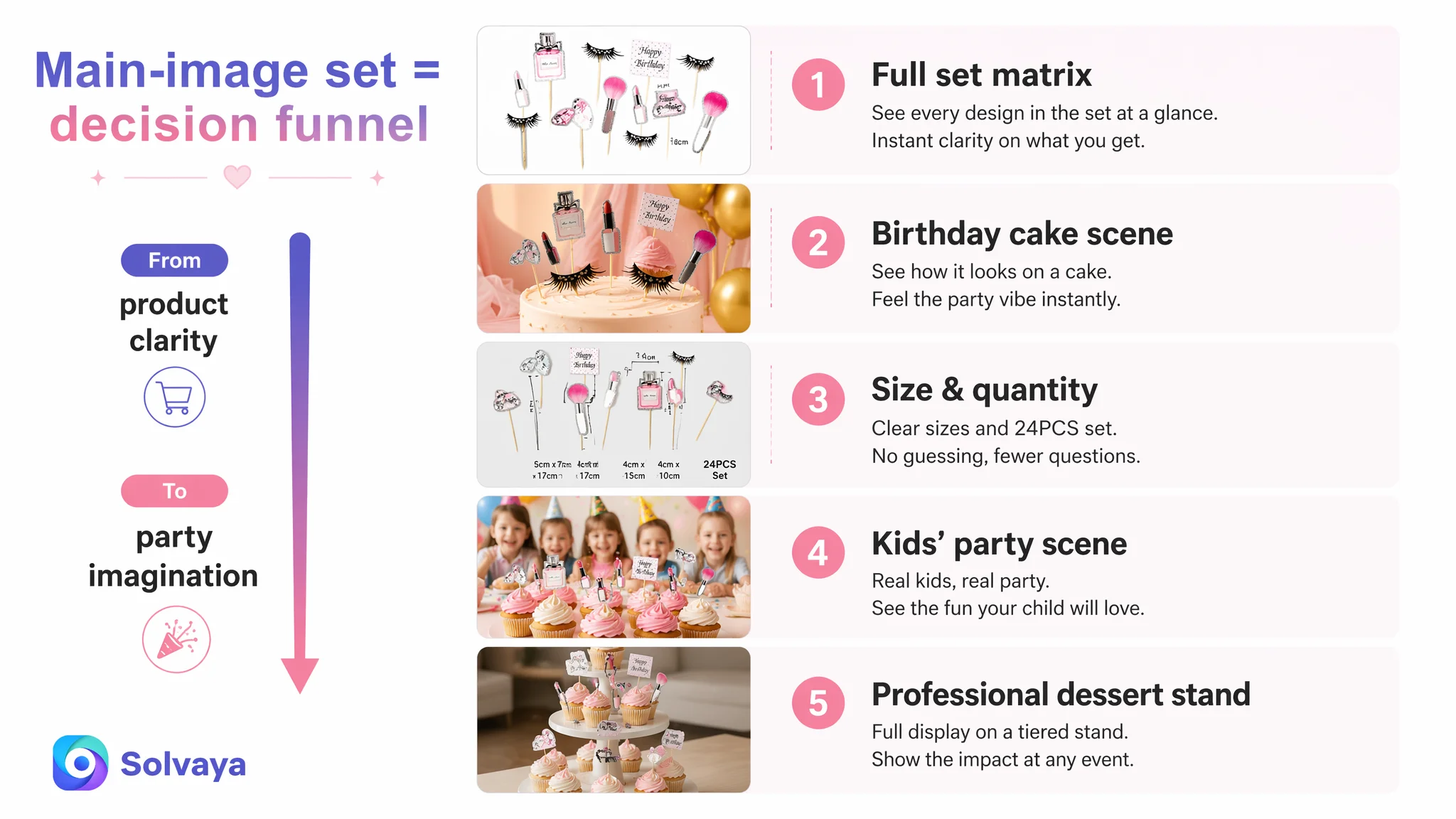
These are not aesthetic experiments; they are conversion hypotheses: each image must reduce a specific type of buyer hesitation (quantity, size, theme fit, atmosphere, professionalism).
Missing A+ Content Removed the Final Layer of Persuasion
For this category, the A+ is where the “mini catalog” of scenarios lives. DeepBI’s A+ design logic followed a simple sequence:
1. Core atmosphere
- A top image showing the 24-piece set arranged on cupcakes over a marble table, warm light, scattered macarons.
- Role: set the thematic bar—this is a refined, coordinated makeup party.
2. Design diversity and detail clarity
- A front-facing array of all icon types (lipstick, perfume bottle, eyelash, ring).
- Role: eliminate worries about repetition or undesired icons; increase perceived value by showcasing diversity.
3. Children’s birthday scenario
- 3–4 girls with birthday hats around the decorated table on a lawn.
- Role: confirm relevance to kids, show joy, and validate scale in a natural environment.
4. Adult/bridal/spa scenario
- Lace tablecloth, fine white porcelain tea set, cupcakes with toppers in an afternoon-tea context.
- Role: extend usage into higher-value events, breaking the “just for kids” perception.
5. Material and size close-up
- Side-view close-up of a single topper, showing thickness, clean edge, and pick connection, with right-side area reserved for size text.
- Role: directly address size and sturdiness concerns.
6. Large-scale display (multi-tier stand)
- Full view of a three-tier stand loaded with topped cupcakes, soft indoor-event background.
- Role: show impact at event scale and emphasize the 24-piece capacity.
7. Assembly/usage clarity
- Two toppers, front and back, showing adhesive or pre-assembled state.
- Role: reduce fear of fiddly assembly and potential product failure during party preparation.
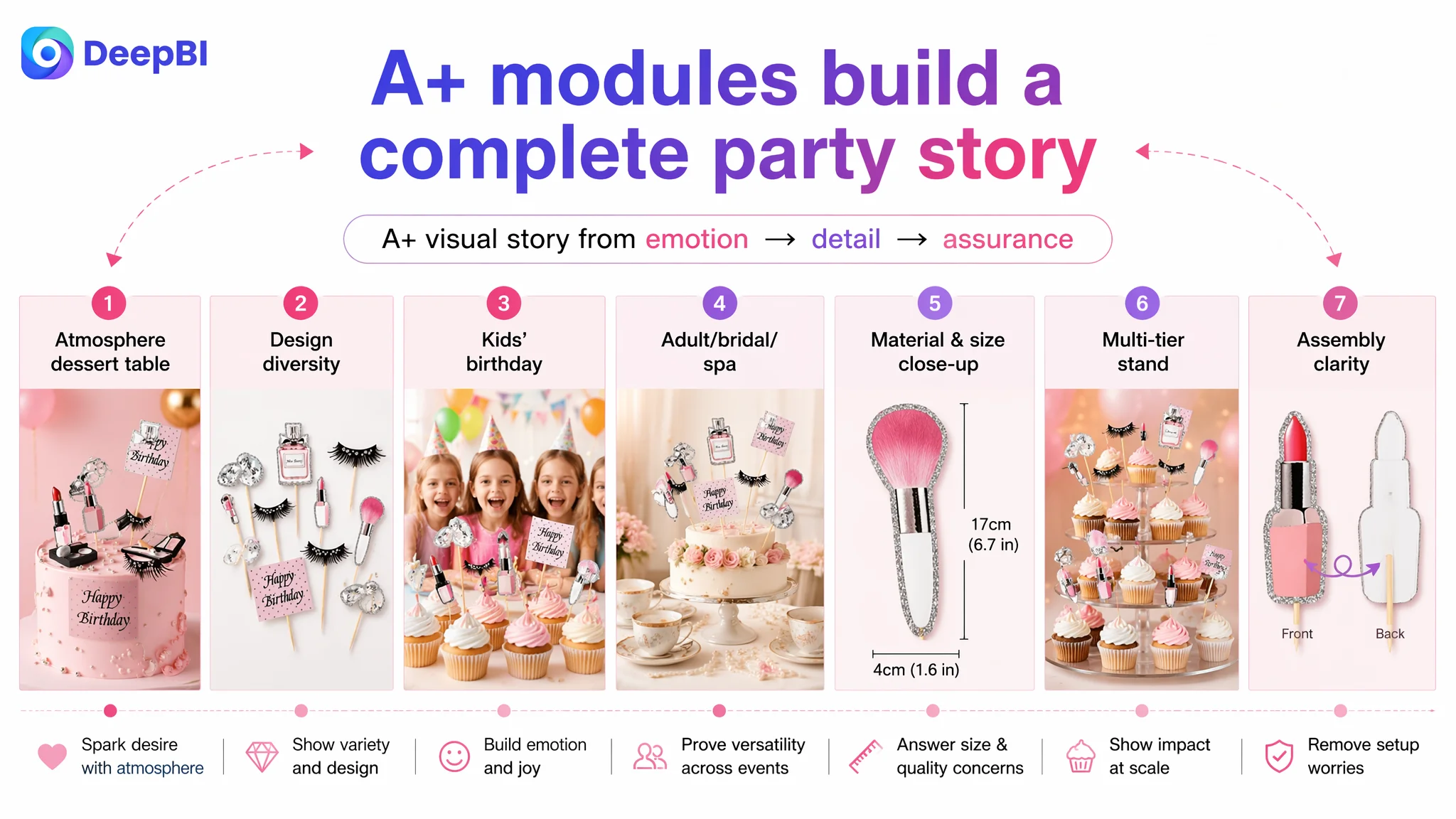
Each module exists to close a gap identified in the benchmark comparison:
- No visual proof of real parties → add scenes with people.
- Fear of wrong size or flimsy material → add detailed close-ups and specifications.
- Uncertainty about event versatility → add separate adult and children scenarios.
- Doubt about set capacity → show “full-load” displays.
Before Ads Could Work Again, the Page Had to Convert
Once the Listing’s logic was rebuilt—title, bullets, main images, and A+ content—the conditions for ads changed. Traffic would now land on a page that:
- Quantifies volume and theme in the title.
- Shows the full set and party outcome in the main images.
- Speaks to event outcomes, safety, and time-saving in the bullets.
- Visually narrates use across multiple scenarios in the A+.
- Is structurally comparable to a category-leading benchmark, even if review volume still needs time to catch up.
For the seller, this shifted understanding in several ways:
- Ads are not a universal fix. If the Listing cannot answer basic decision questions, more traffic only exposes the weakness faster.
- Listing conversion is the foundation of ad efficiency. CTR and CVR are downstream of how well title, images, bullets, and A+ work together.
- Trust cannot be delegated solely to reviews. Page content must build trust, especially for new Listings that have not yet accumulated social proof.
- Before scaling ads, judge whether the page deserves more traffic. If a benchmark is at 83/100 and you are at 38/100, ads are a leverage risk until that gap is addressed.
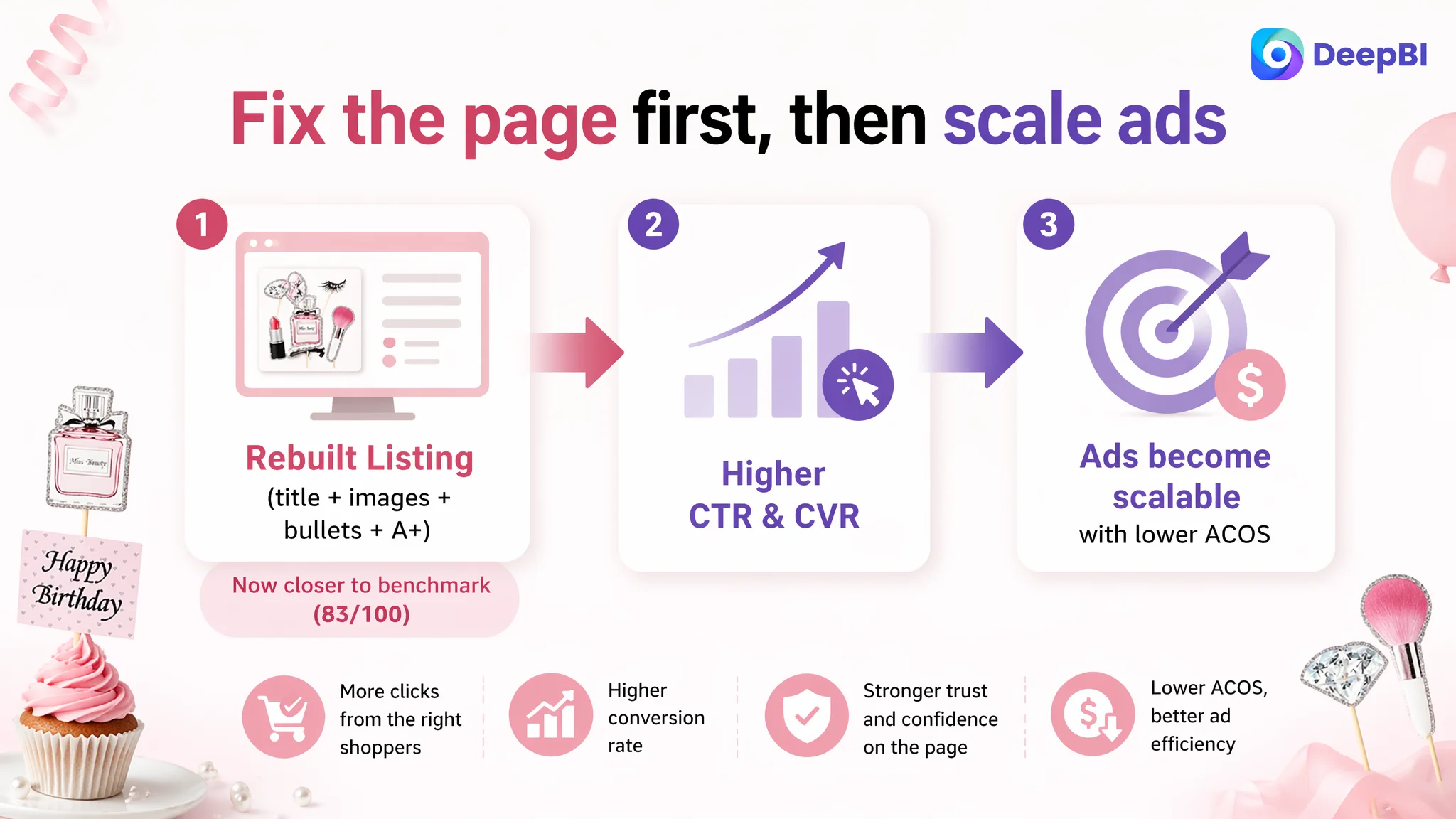
The seller did not just receive a set of cosmetic edits; they received a reframed judgment about their Amazon business: before asking why ads are expensive, ask whether the Listing can convert the traffic you already have.
For other Amazon sellers—particularly in visual, occasion-driven categories—the lesson is direct. When traffic exists but orders do not follow, it is often not an ad-optimization problem. It is a Listing conversion problem. Repair the page’s decision logic first; then let ads do what they are actually good at: scaling a solid foundation, not compensating for a missing one.