

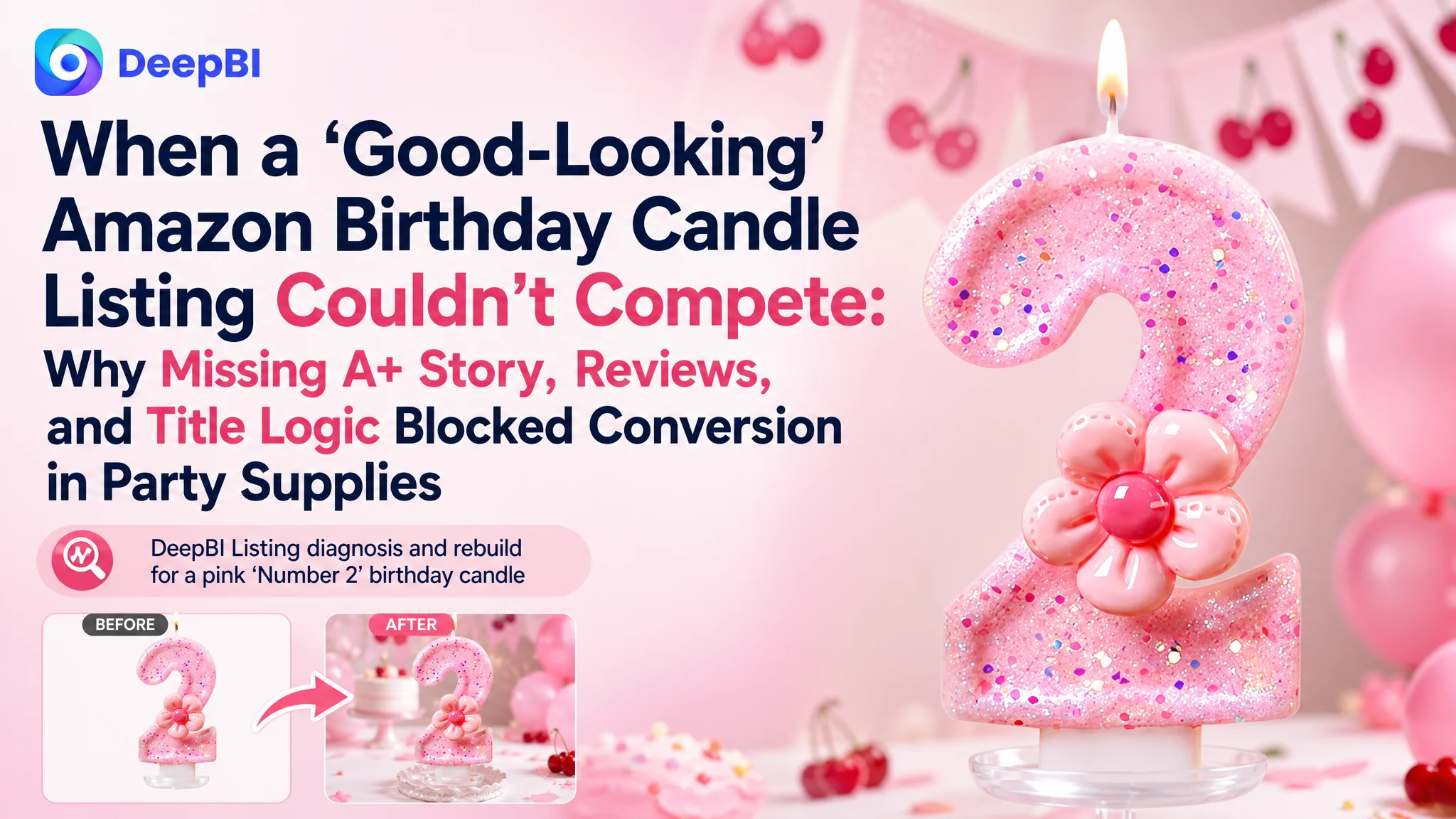
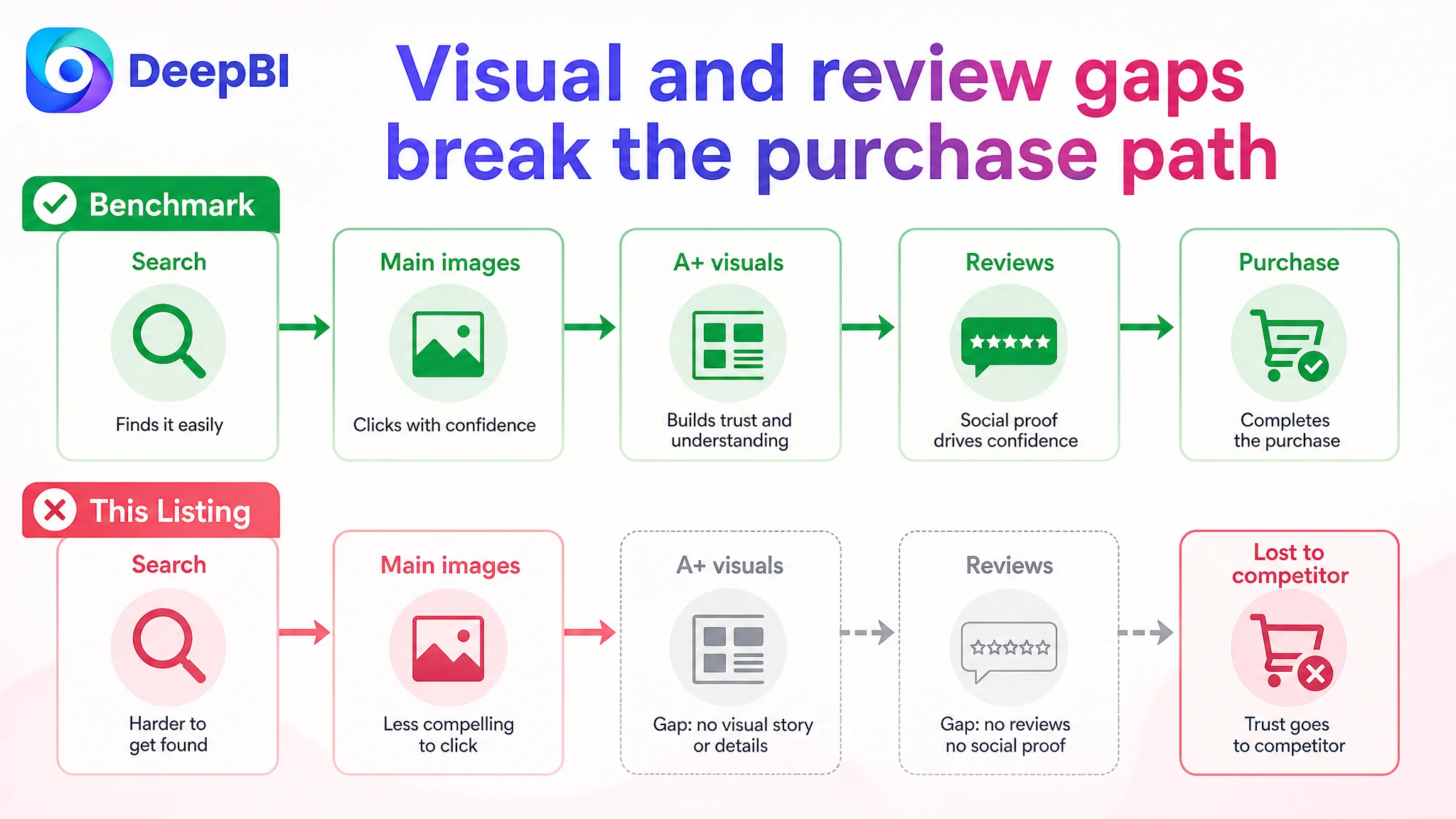
For this Amazon UK seller in the party-supplies category (number-shaped birthday candles for cakes), the early assumption was simple: “Our listing looks fine; we just need more traffic.” The team believed the product page was already strong on benefits and design, and that the main gap was advertising scale. But once DeepBI scored the Listing against a leading benchmark candle on Amazon, a different picture emerged: the page wasn’t ready to convert the traffic it already had.
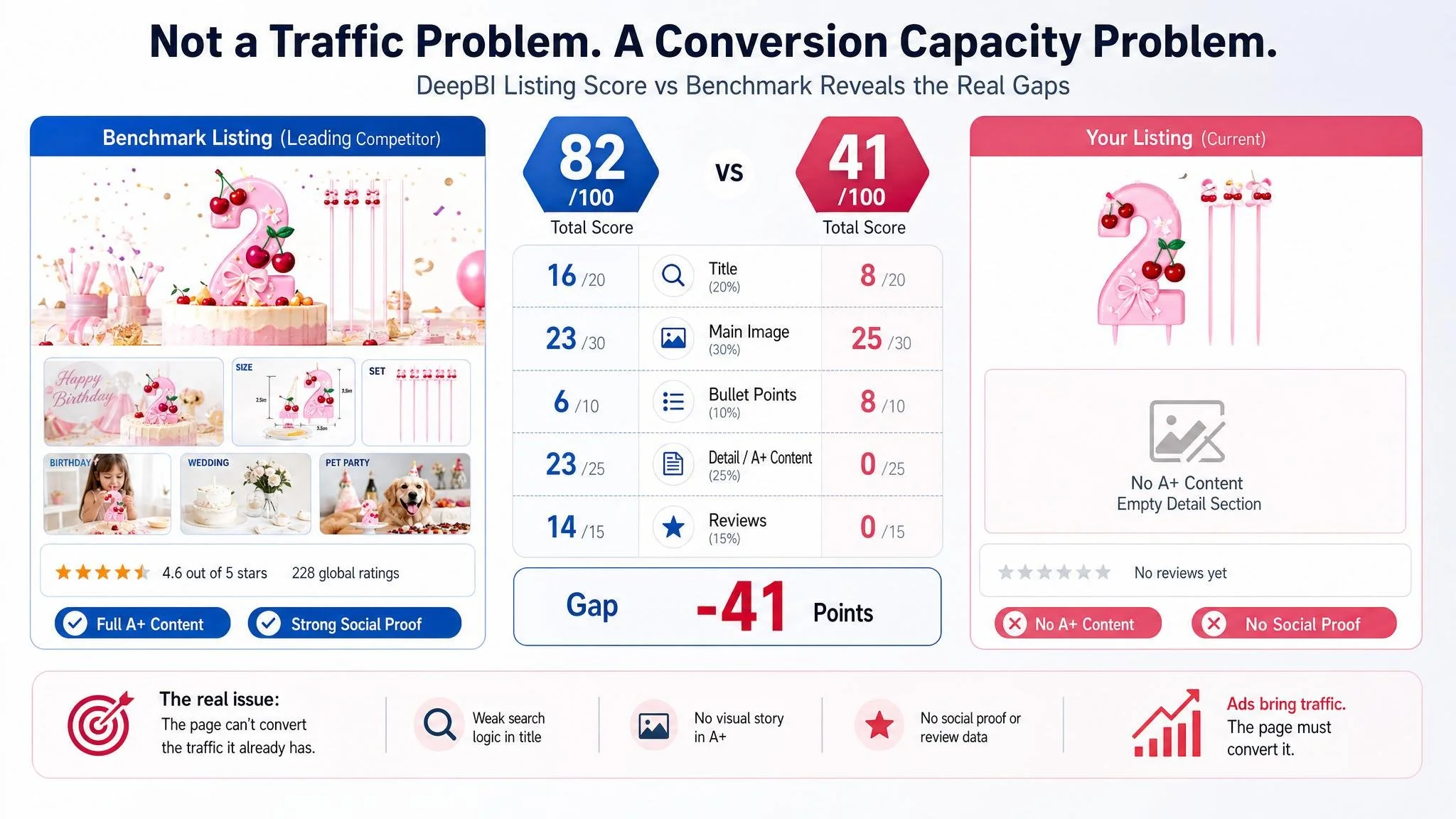
The benchmark Listing for a similar pink “number 2” birthday candle scored 82/100. This customer’s Listing scored 41/100. The main image and bullet points were not the real bottleneck; the critical missing pieces were a search-aligned title, a completely empty A+/detail section, and zero review data. Ads could bring visitors, but the Amazon product page lacked the trust, story, and clarity to turn visitors into orders.
 DeepBI reframed the problem as a Listing-conversion issue, not an advertising or “creative taste” issue. The later optimization focused on rebuilding the title around Amazon search logic, constructing an A+ visual story that matches how party buyers actually decide, and preparing the page to support future review accumulation. Many Amazon sellers in similar categories can recognize this pattern: a visually “nice” page that still loses to a benchmark because it fails to organize decision logic, trust signals, and usage scenarios in a way that Amazon buyers can act on.
The Core Constraint Was Not Traffic — It Was Listing Conversion Capacity
When the birthday candle seller looked at their Amazon UK Listing, they saw a product with clear benefits:
- Distinctive cherry and bow decorations
- Glittery visual design
- Bullet points written around user value (safety, beauty, ease of use, scenes)
From the seller’s perspective, the key problem was exposure. They were inclined to think in terms of ads, positioning, and perhaps “making the images prettier,” assuming that if clicks increased, orders would follow.
DeepBI’s Listing score forced a different judgment:
- Seller’s Listing total: 41/100
- Benchmark Listing total: 82/100
- Gap: -41 points
The score breakdown showed that the seller’s page was not suffering from a single cosmetic flaw. It had a structural conversion problem:
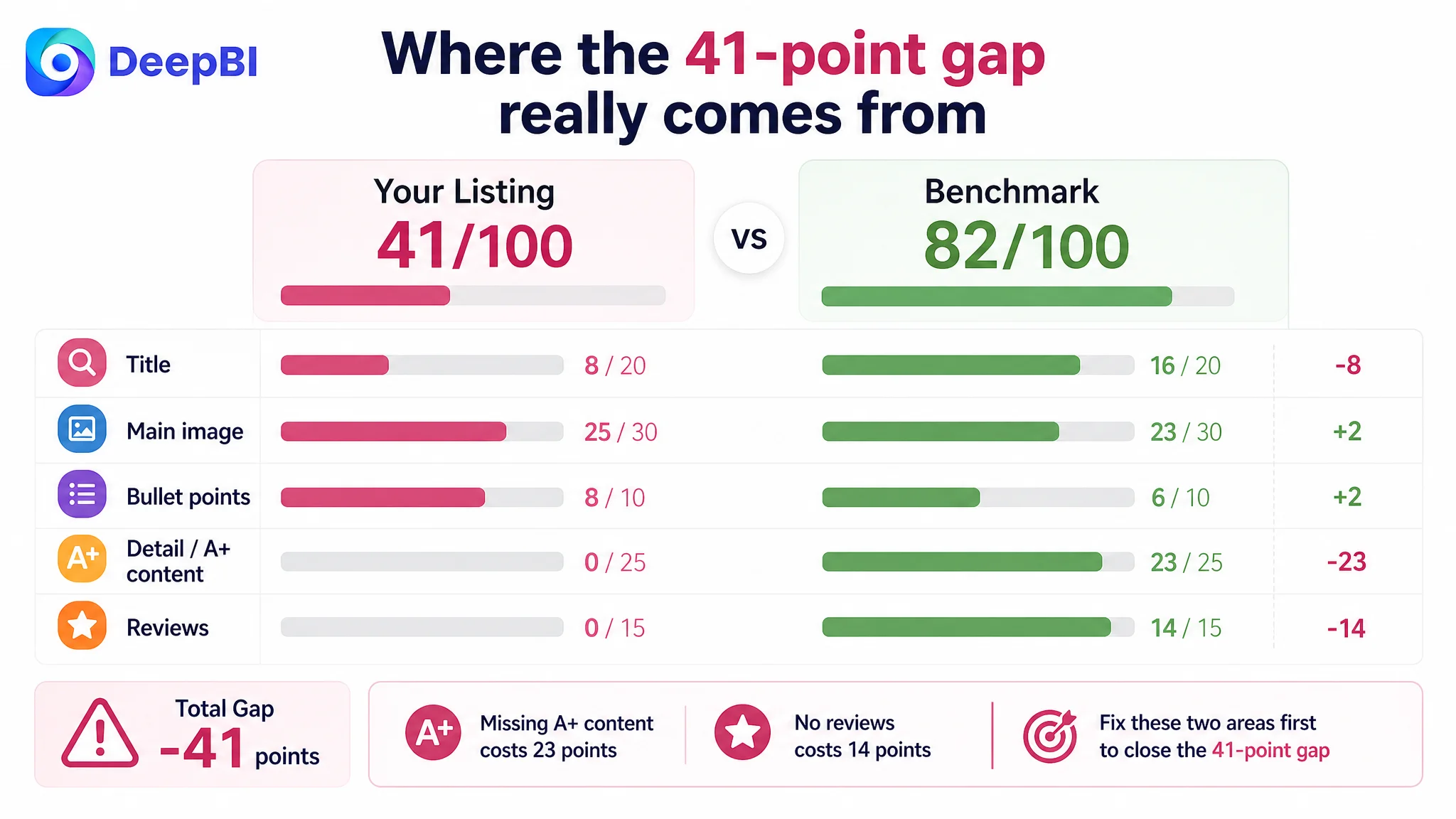 Title: 8 vs 16 (out of 20) – weak search alignment and scenario logic
- Main image: 25 vs 23 (out of 30) – not the main weakness; roughly competitive
- Bullet points: 8 vs 6 (out of 10) – relatively strong logic orientation
- Detail/A+ content: 0 vs 23 (out of 25) – complete absence of visual story and modules
- Reviews: 0 vs 14 (out of 15) – no rating, no social proof, vs 4.6 stars and 228 reviews
“The real problem was not that ads failed to bring traffic. It was that the page could not convert the traffic.”
In party-supplies categories, where buyers are often organizing emotionally charged events (children’s birthdays, baby showers, anniversaries), the product page needs to deliver:
- Clear search relevance (title and keywords)
- Trust and safety (material, smokeless, food-grade, non-drip)
- Emotional fit (color, theme, age, audience)
- Visual proof in multiple scenes (cakes, kids, pets, parties)
- Social verification (ratings, reviews)
This Listing was trying to do part of that in text, but it was missing most of it in visuals and evidence.
Where the Seller Misdiagnosed the Problem
The customer team had focused on what they could see and control quickly:
- They believed bullet points were a strong differentiator, emphasizing user benefits, promises, and scenarios.
- They saw their main images as “good enough,” with product visibility and decorative elements.
- They valued the cherry-theme positioning as a unique angle in a crowded candle market.
From that vantage point, it was tempting to think:
- “Our page looks decent; maybe we just need better ads or more keywords.”
- “The benchmark is doing similar things visually; our problem is traffic volume.”
Two blind spots drove this misdiagnosis:
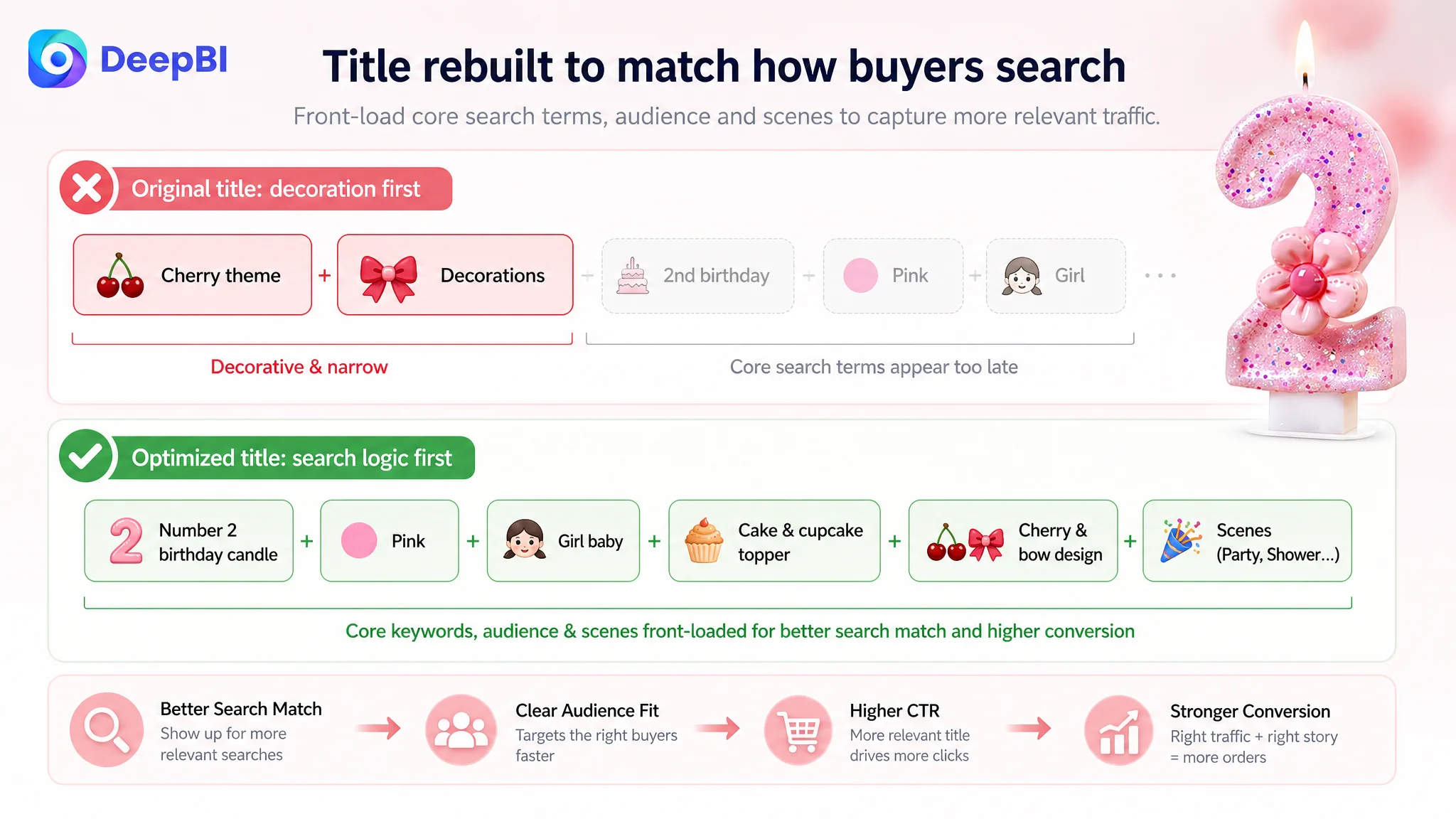
1. Title structure and search logic were off.
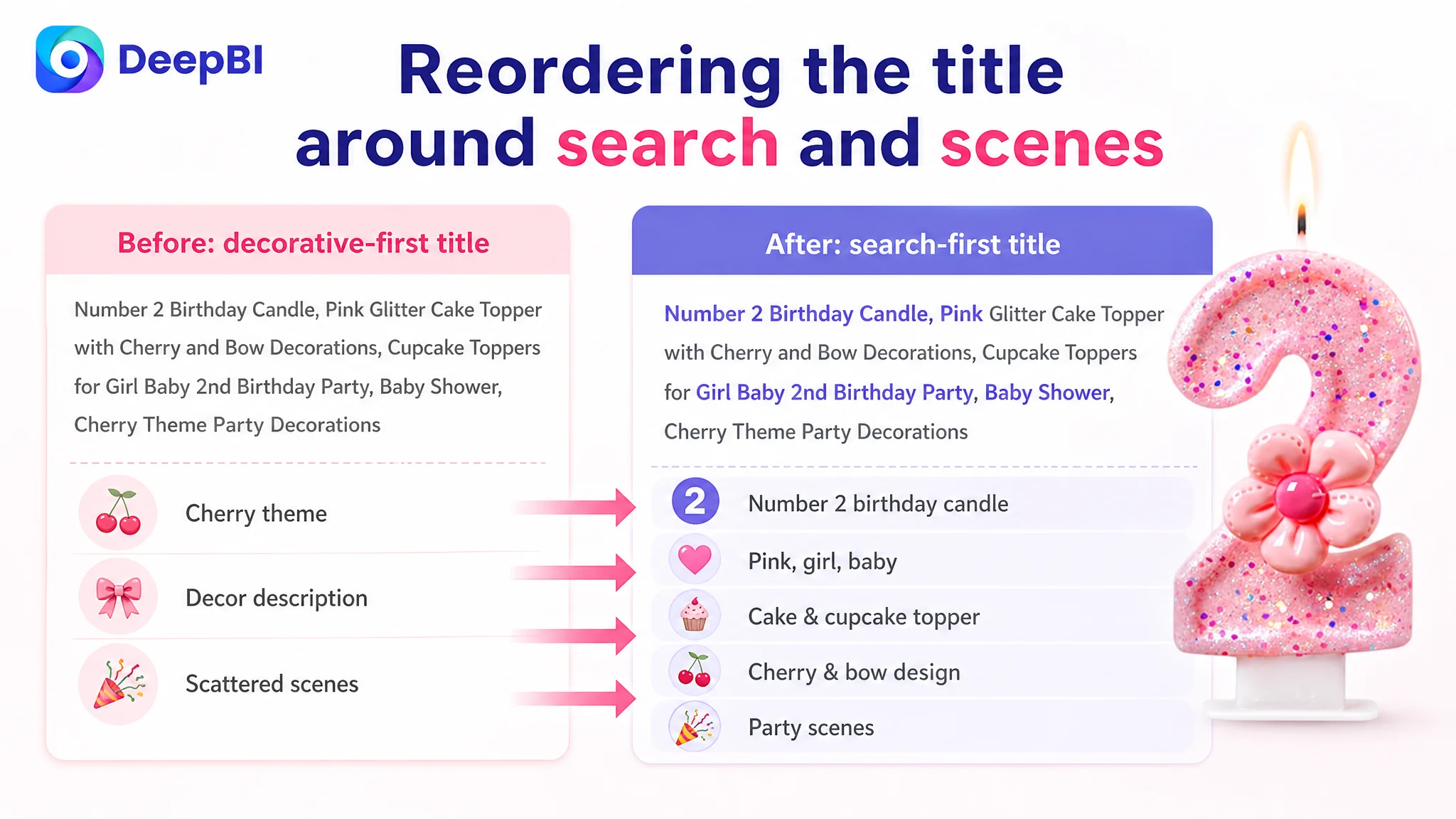
The seller’s original title led with decorative description and a narrow cherry theme, pushing core search drivers (“2nd birthday,” “pink,” “girl,” “candle”) to secondary positions or diluting them with overly specific scene wording.
The benchmark title followed a different pattern: “Happy 2nd Birthday Pink Long Stick Number 2 Candles for Cake, Cupcake Toppers for Girl Baby Birthday Party & Wedding Anniversary Decorations”
It front-loaded:
- Age and core scene (“2nd Birthday”)
- Color (“Pink”)
- Product form (“Long Stick Number 2 Candle”)
- Audience and scenes (“Girl Baby Birthday Party & Wedding Anniversary Decorations”)
The seller’s title made the decorative theme the main storyline, limiting how Amazon’s search system and buyers could match the product to broader high-conversion traffic.
 2. Complete absence of A+ content and visual detail modules.
On the seller’s page, the detail section had no images and no A+ modules. The benchmark Listing used:
- A strong banner with cake + numeric candles + confetti
- Close-ups for size and material
- Combination views (number candle + long stick set)
- Multi-scene mosaics (birthday, wedding, pet party)
- Emotional shots (babies, smiling children, party ambience)
The seller’s assumption that “bullet points tell the story” ignored how Amazon buyers actually behave on party products: they rely heavily on visual immersion and trust cues in A+ to finalize decisions.
Amazon Ads Were Not Failing. The Page Was Consuming the Traffic.
From DeepBI’s perspective, this Listing showed a classic pattern:
- The main image wasn’t disastrous. Score 25 vs 23; in some subimages the seller even had decent product framing.
- The bullet points were relatively strong, built around user value and structured as problem–solution–result.
- The detail section and reviews were effectively non-existent. A+ score 0, review score 0, vs benchmark’s 23 and 14 respectively.
If the seller had pushed ads aggressively at this stage, three risks would have materialized:
1. Paid traffic landing on a trust-deficient page.
Without A+ visuals and reviews, the page would feel “thin” compared to the benchmark. Buyers arriving from ads would still switch to the competitor that shows real usage scenes, children interacting with cakes, and clear social proof.
2. Ads amplifying the wrong outcome.
Advertising does not only amplify advantages. It can also amplify a page’s existing defects. In this case, ads would amplify:
- Lack of clear material/safety storytelling (e.g., smokeless, lead-free wick)
- Absence of multi-scene proof (pets, cupcakes, different party formats)
- Zero rating, which stands out more when visitors are actively comparing options
3. Wasted spend on misaligned search entry.
A title that over-emphasizes “Cherry Theme Party” and under-emphasizes “2nd birthday”, “girl baby”, and “pink number 2 candle” will attract narrower traffic and miss broader intent. Even well-structured ad campaigns would fight against an inefficient organic-search foundation.
DeepBI’s judgment was clear: this Listing did not lack traffic potential; it lacked trust, story, and search logic. Fixing ads first would only increase cost without fixing conversion.
How Listing Data Revealed the Real Bottleneck
DeepBI’s scoring process pits a Listing against a benchmark in the same Amazon category and usage scenario. Here, the data abnormality was concentrated in two dimensions:
- Detail/A+ content: 0 vs 23
- Reviews: 0 vs 14
On the visual side:
- Seller: no banner, no detail images, no A+ modules
- Benchmark: full-funnel visual narrative:
- Banner scene (cake + number candles + confetti)
- Size and material close-ups
- “Set” visualization (numeric candle + long sticks)
- Multi-scene usage (birthday, wedding, pet party)
- Emotional imagery (baby tasting cake, smiling girl)
On the social-proof side:
- Seller:
- No star rating
- No review count
- No front-page comments
- Benchmark:
- 4.6 stars
- 228 total reviews
- 10 front-page reviews
- Majority detailed, positive, specific feedback
These gaps matter because in party supplies, buyers:
- Compare several Listings in a short window
- Use visuals to evaluate “theme fit” and “overall atmosphere”
- Use reviews to de-risk quality and safety concerns
Without visuals that answer “How will my party look?” and reviews that answer “Can I trust this?” the seller’s Listing is operating at a structural disadvantage, regardless of ad copies or bids.
 This Product Page Did Not Lack Information. It Lacked a Visual Trust Path.
The bullet points on the seller’s Listing were not the weak link. In fact, DeepBI’s analysis noted that:
- The seller’s bullet points were user-value-centric, focusing on safety, beauty, convenience, and scenarios.
- Each point followed a solution + result promise logic, like “ensures…” and “makes celebrations safe.”
- The structure formed a commercial persuasion chain: product → quality → design → usage convenience → scenes.
The benchmark’s bullet points were more parameter-focused and less sophisticated in persuasion.
However, in Amazon practice, bullet points rarely carry conversion alone. They must be supported by:
- A title that matches search and scene intent
- Main images that create a reason to click and a quick trust impression
- Detail/A+ images that show size, material, scenes, and emotional moments
- Reviews that anchor perceived quality
On this Listing, the persuasion chain broke at the visual and evidence layers:
- No size visualization, even though size is critical for cakes.
- No material close-ups or burn-state proof, even though safety and drip-free performance are key concerns.
- No scene diversity (baby parties, cakes of different sizes, pets, garden parties) to show versatility.
- No emotional imagery to make the buyer imagine their own celebration.
- No reviews to confirm that others have already had good experiences.
The result: a text-strong but visually-empty Listing that cannot “carry” paid or organic traffic through the decision funnel.
Why DeepBI Prioritized Listing Repair Before Any Ad Scaling
Given the score and qualitative differences, DeepBI’s reasoning was:
1. Title must first align with Amazon’s search and decision logic.
The proposed title shifts from decorative narrative to search-fronted structure:
Number 2 Birthday Candle, Pink Glitter Cake Topper with Cherry and Bow Decorations, Cupcake Toppers for Girl Baby 2nd Birthday Party, Baby Shower, Cherry Theme Party Decorations
Key changes:
- “Number 2 Birthday Candle” moved to the front, matching core search behavior.
- “Girl” and “Baby” added to unlock high-conversion audience tags.
- Product form “Cake Topper” and “Cupcake Toppers” clearly stated.
- Original “Cherry and Bow” differentiation retained, but no longer blocking broader traffic.
- Multiple scene words (2nd birthday, baby shower, party decorations) balance niche and broad intent.
This ensures that when ads bring traffic, the organic signal and title itself support relevance and discoverability.
 2. Build an A+ visual story that mirrors how party buyers decide.
DeepBI’s optimization guidance did not stop at “add A+ images.” It specified how images should work, referencing the benchmark’s conversion path:
- Banner image: full cake scene with numeric candle and coordinating long-stick candles, confetti, and pink gradient background to instantly communicate “celebration,” “set completeness,” and “theme consistency.”
- Size/appearance module: clean white background, clear dimension lines around the candle and holder, showing true height and width, plus the plastic tray/spike structure for stability.
- Set usage module: ten long-stick candles arranged, all lit, on a cake, demonstrating burn stability and atmosphere, reassuring buyers that the product works in real party conditions.
- Scene modules:
- Baby birthday with candle and smiling infant
- Multiple cupcake colors with different number candles (showing color compatibility)
- Pet birthday scene with dog and cake
- Burn-stability module: macro shot of the candle’s flame, explicitly showing no smoke, no dripping wax, and a stable flame.
This structure matches “function → scene → emotion” and covers core party concerns: will it fit, will it look good, is it safe, and can it support different party formats?
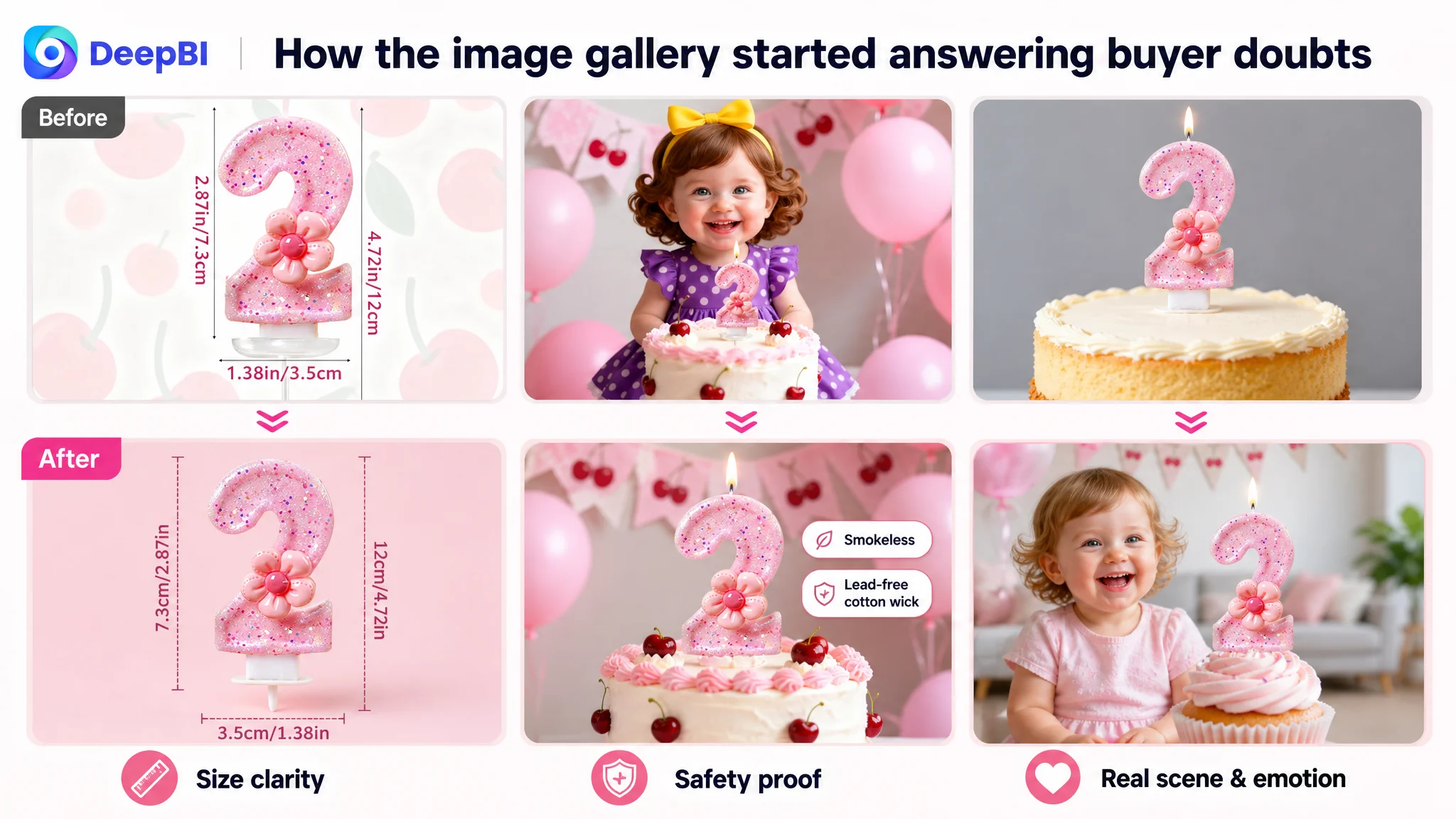
3. Make the main images support click and pre-filter doubts.
For search-page behavior, main images and gallery thumbnails must do part of the job before buyers scroll to A+. DeepBI’s guidance restructured the seller’s images to:
- Improve background purity and color consistency (soft pink gradients, warm tones)
- Clarify product size through on-image annotations (cm/inch)
- Visualize safety claims via in-image labels (“Smokeless,” “Lead-free cotton wick”)
- Show the candle in actual cake usage, with subtle party elements in the background
- Create emotional association with a smiling child in a natural home setting
The goal: increase CTR by giving buyers enough cues at thumbnail level to feel that this Listing is professional, safe, and emotionally fitting.
 4. Prepare the Listing to support review accumulation.
With a completely new Listing, reviews will not appear overnight. But DeepBI’s judgment was that the page must look high-trust and high-clarity from day one, so that early buyers are more likely to purchase and then leave positive feedback.
Without that, review building is slow and expensive; with it, each ad click has a higher chance of turning into both an order and a future trust asset.
“Before ads could work again, the page had to convert.”
How the Page’s Sales Logic Started to Recover
After refocusing the optimization around Listing quality rather than ads, several structural changes became possible:
1. Title now speaks Amazon’s language and buyer intent.
The revised title re-centers the product in the “2nd birthday + pink + girl baby + cake topper” space, while preserving decorative differentiation. This supports both organic search and advertising keyword logic.
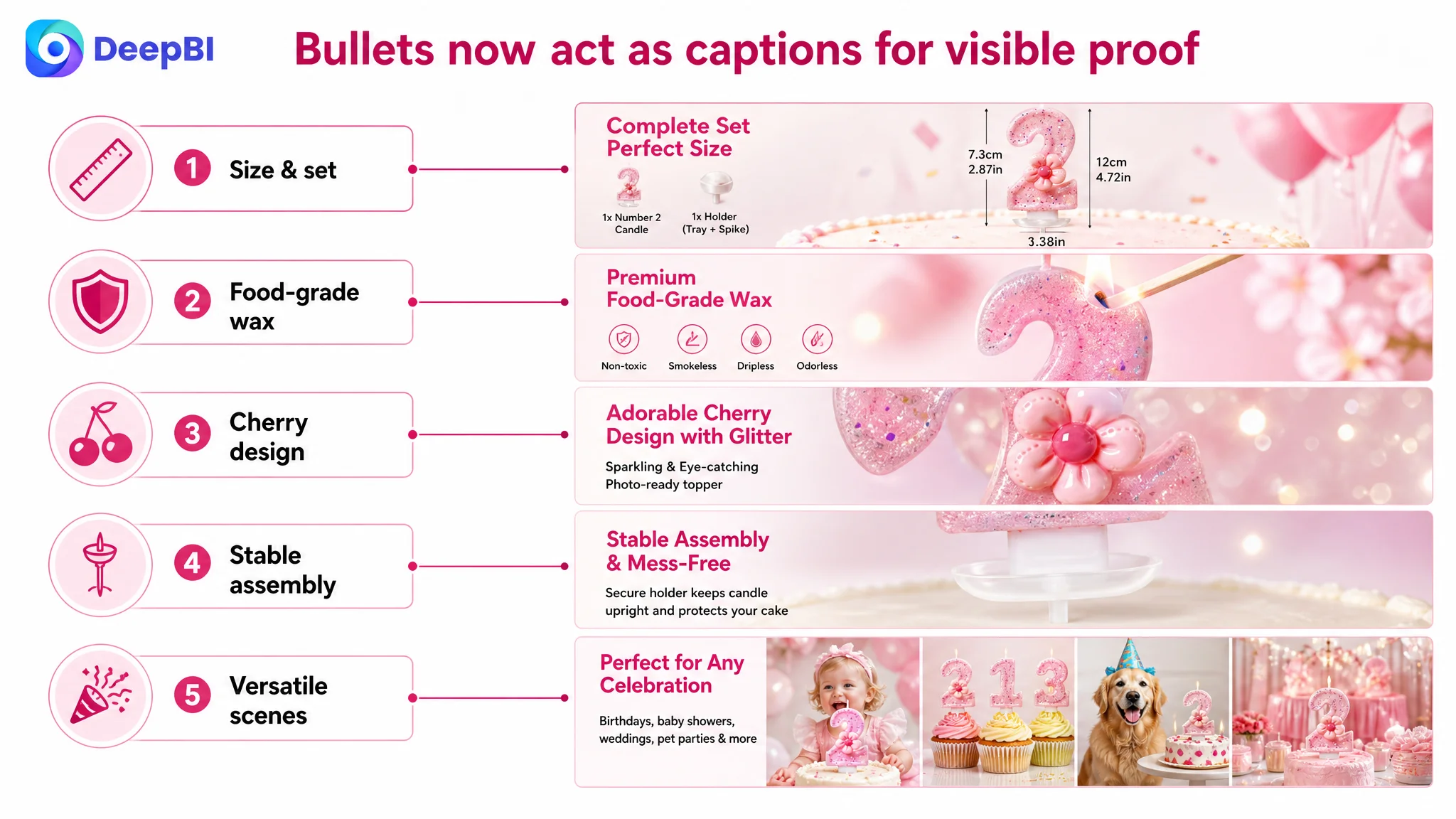
2. Bullet points move from being isolated text to part of a full funnel.
DeepBI’s suggested bullet revisions tie into visual modules:
- Complete set & perfect size – matches the size and set banner.
- Premium food-grade wax – echoes the burn-stability and smokeless visuals.
- Adorable cherry design with glitter finish – reinforced by macro design images.
- Stable assembly & mess-free – clarified by holder close-ups and cake scenes.
- Versatile for multiple occasions – supported by baby, pet, and garden-party scenes.
Bullet points stop being abstract promises and become captions to visible proof.
 3. A+ content transforms an empty space into a conversion engine.
The new A+ structure walks buyers through:
- Immediate atmosphere and set completeness
- Exact physical understanding of the candle
- Performance in real party scenarios
- Emotional connection with children and pets
- Versatility across different dessert and party types
- Safety and burn stability
This makes the product page capable of answering most questions without requiring extra ad copy or manual customer support.
4. Ad traffic becomes usable again.
Once the Listing can hold buyers and guide them through a clear visual story, ads are no longer feeding a thin page. Each click has a higher probability of:
- Staying on the page longer
- Checking A+ modules
- Converting from interest to purchase
- Contributing to the first wave of reviews
ACOS can start to move down, not because bids changed, but because conversion started to recover.
What Other Amazon Sellers Can Take Away
This case, centered on a pink “number 2” birthday candle in Amazon UK’s party-supplies category, is not unique. Many sellers face similar hidden constraints:
- The page looks acceptable, but benchmarks reveal severe gaps in A+ content and reviews.
- Bullet points are well written, but there is no visual story to support them.
- Ads are blamed for poor sales, but the Listing itself cannot convert traffic at benchmark levels.
Key learnings:
1. High ACOS is often a Listing problem before it is an advertising problem.
If detail/A+ score is near zero and review score is near zero, ads are attempting to push traffic into a page that lacks basic trust structures.
2. Title structure must align with Amazon search and buyer scenes.
Leading with narrow decorative themes while hiding core age, color, and audience terms reduces both organic reach and ad effectiveness.
3. Bullet points are not enough; A+ is where trust and emotion are built.
In categories like party supplies, failure to visualize scenes, size, and safety features will push buyers toward competitors with fuller stories.
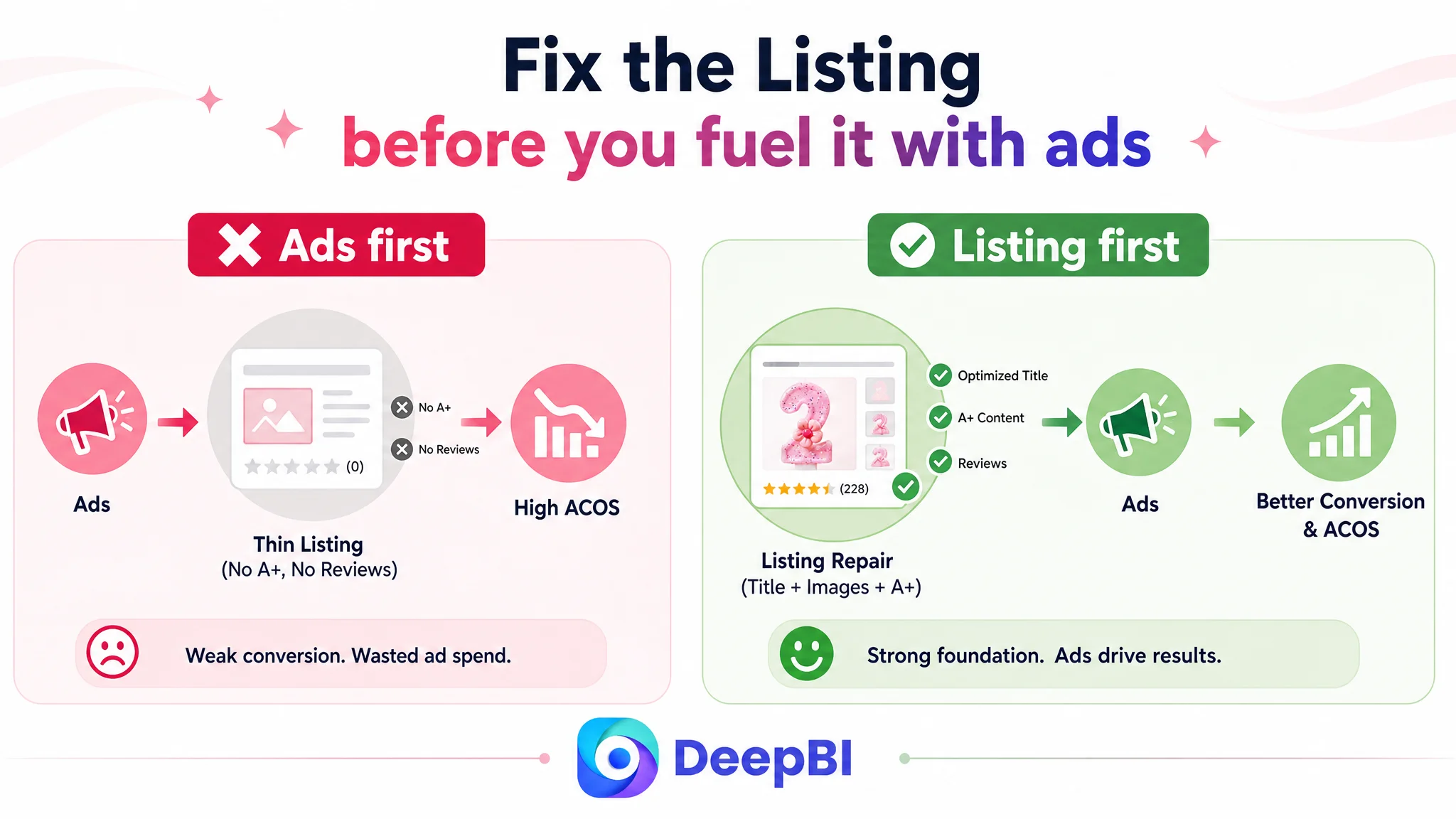 4. Advertising amplifies whatever your Listing already is.
If the page is thin and trust-poor, ads amplify that thinness. If the page is rich in proof and clarity, ads amplify its conversion ability.
5. DeepBI’s strength is judgment, not just production.
What changed the trajectory in this case was not only image or text generation, but the decision to fix Listing conversion capacity first and only then consider ads as a scalable lever.
For Amazon sellers, the practical takeaway is straightforward: before spending more to bring in traffic, ask if your Amazon product page—title, main image, bullet points, A+ content, and reviews—actually deserves that traffic. If the answer is “not yet,” the priority is Listing repair, not bid adjustment.