


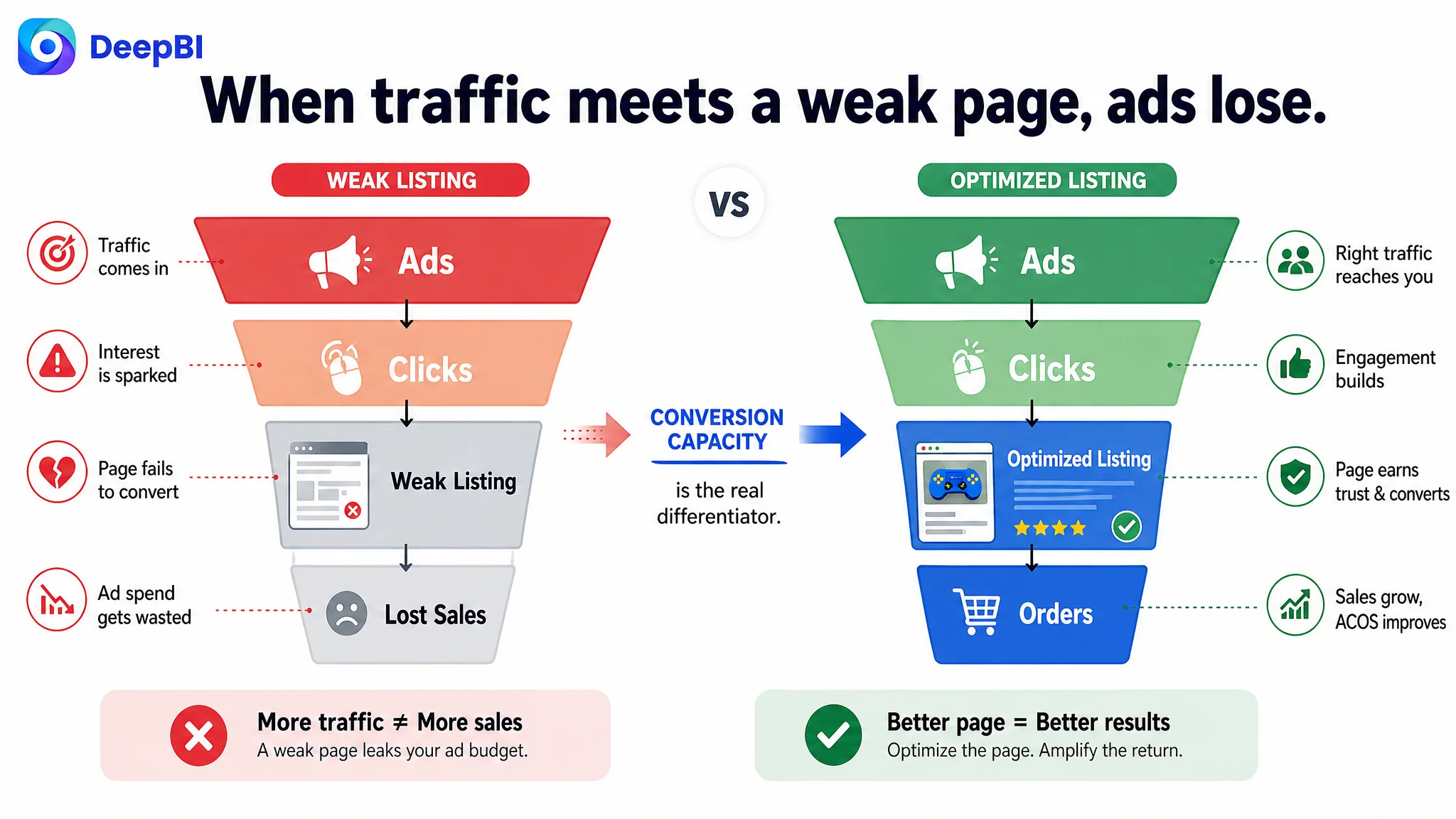
 Many Amazon sellers in electronics and toys will recognize this story. A US marketplace seller of a retro handheld game console saw Amazon ad costs getting harder to control and assumed the issue lay in bidding and keyword structure. But when DeepBI looked at the Listing head‑to‑head against a top competing Amazon Listing, the evidence pointed somewhere else: the product page itself could not carry the traffic it was already getting.
On the surface the page did not look “terrible” — the main image was decent, copy was emotional, A+ content existed. Yet compared to a benchmark competitor, the Listing scored 68 vs 80, and the biggest gaps were not where the seller expected: review trust, title positioning, and A+ content’s handling of parents’ real buying concerns. Ads were being asked to do a job the page was structurally unable to finish.
DeepBI’s diagnosis shifted the focus away from squeezing ad efficiency out of a weak page and toward rebuilding the Amazon product-page conversion logic: repositioning the title around the right audience, rebuilding images and A+ modules to answer parents’ safety and durability concerns, visually proving “300+ games” instead of only stating it, and reducing the trust gap created by low rating and few reviews. The lesson for other Amazon sellers is blunt: when CTR and ACOS stall, it is often not “bad ads” — it is a Listing that doesn’t deserve more traffic yet.
Amazon Ads Were Not Failing. The Page Was Consuming the Traffic.
 From the seller’s perspective, the pressure came from a familiar place: Amazon advertising. Sponsored Products were getting more expensive, ACOS was stubborn, and every small tweak in bids or match types seemed to deliver diminishing returns.
Internally, the working assumption was clear: “Our niche is competitive, so we must optimize ads harder.” The team was prepared to adjust keywords, segment campaigns, and push more budget into “top of search” to chase volume.
What they were not prepared for was the possibility that ads were already doing their job, and that each additional click was simply being poured into a leaky bucket.
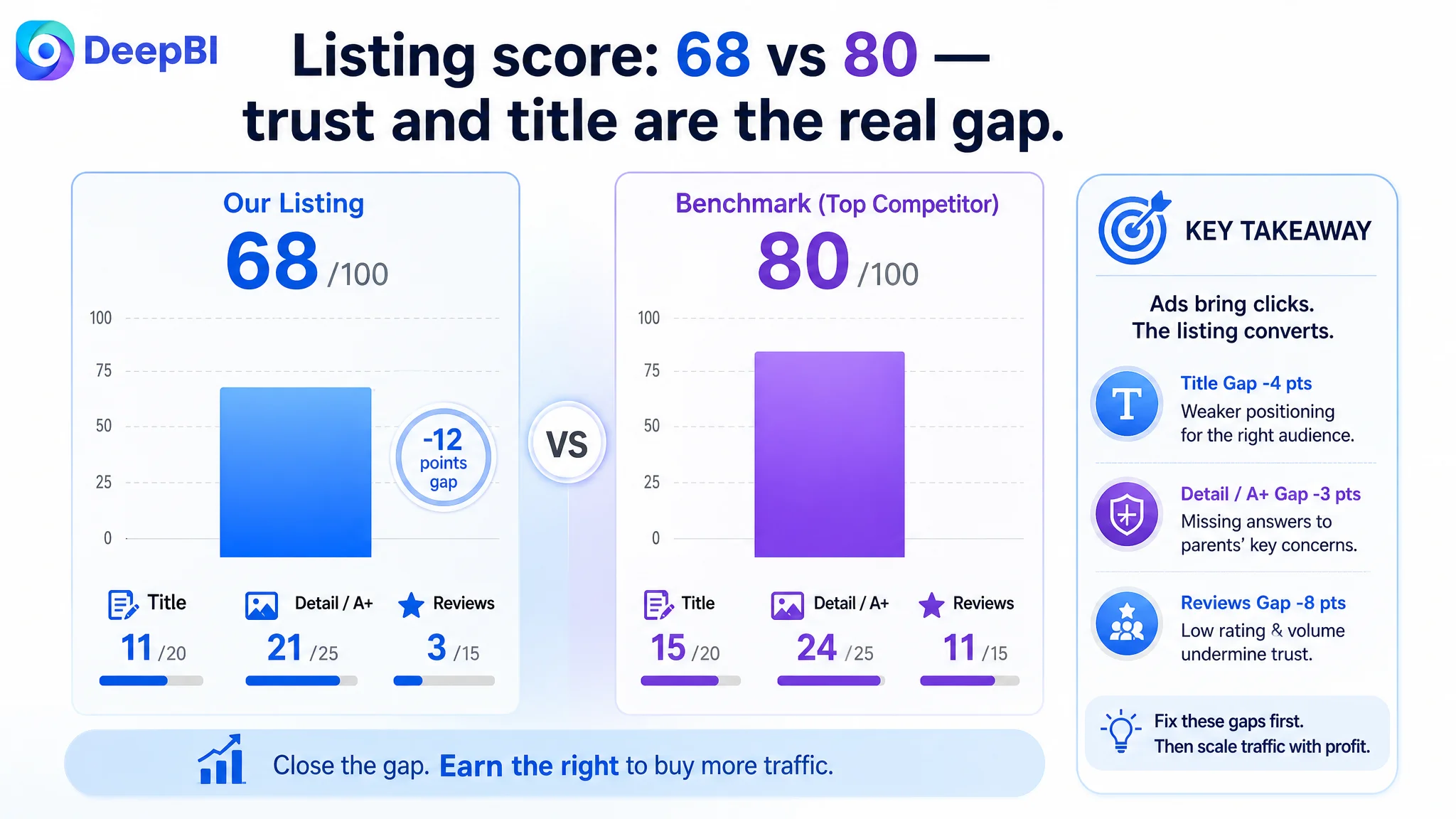
DeepBI’s listing score comparison against a category‑leading handheld game console told a different story:
- Overall score: 68 vs 80
- Title: 11 vs 15 (out of 20)
- A+ / detail: 21 vs 24 (out of 25)
- Reviews: 3 vs 11 (out of 15)
The main image and bullets were not the weakest links. The real constraints sat in how the product was positioned in the title, how the A+ content handled decision‑critical concerns, and how fragile the review profile was. Amazon ads were not the primary enemy; they were amplifying a fragile page.
“The real problem was not that ads failed to bring traffic. It was that the page could not convert the traffic.”
The Seller’s Original Misdiagnosis: “We Need Better Ads, Not a New Story”
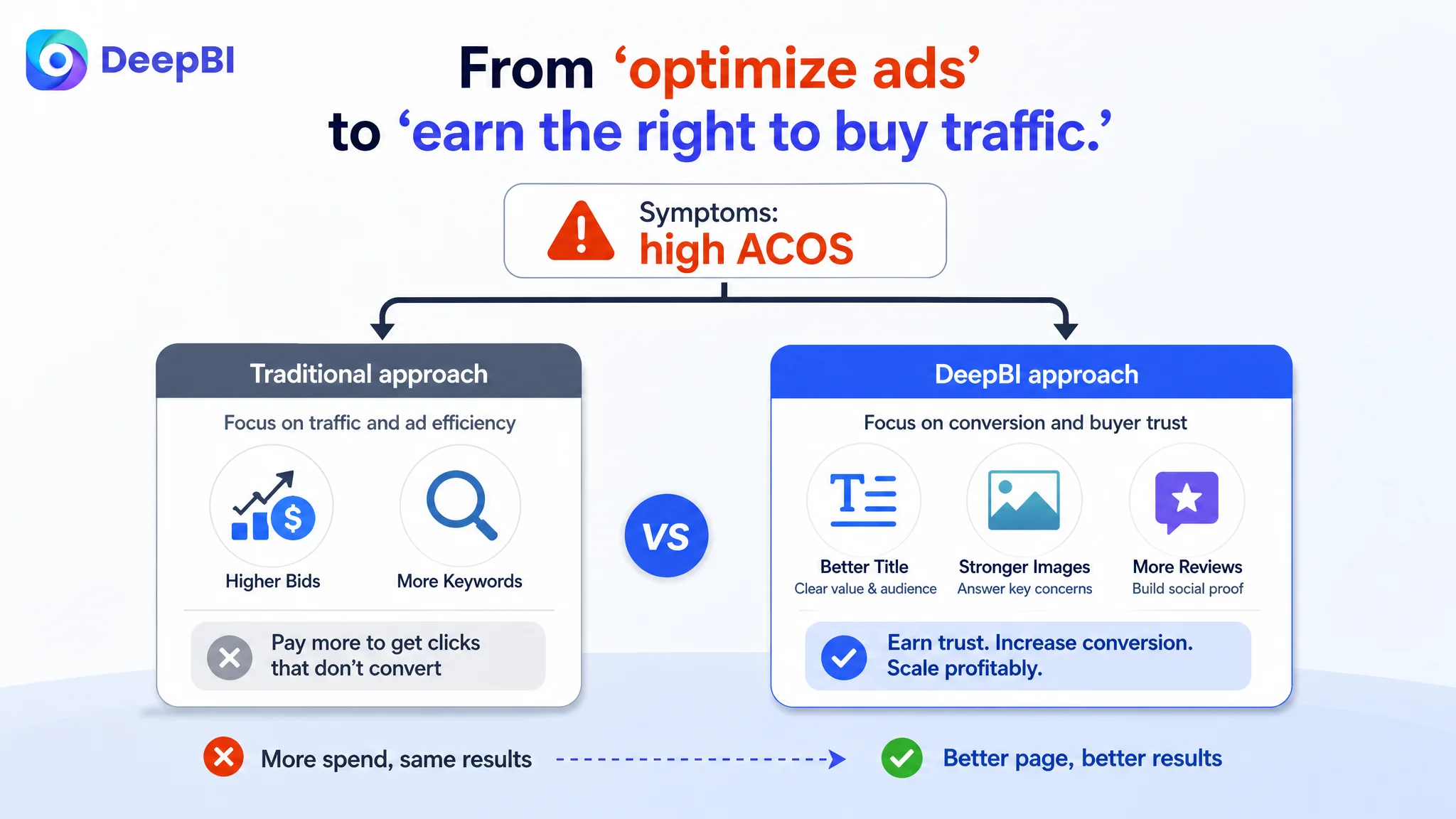 Before bringing DeepBI in, the seller’s thinking followed a pattern many Amazon teams will recognize:
- Symptom: Rising ACOS, inconsistent ROAS.
- Assumption: “We have to fix advertising — better keywords, sharper bids, smarter campaign structure.”
- Implicit belief: The Listing is ‘good enough’; the market is just expensive.
Under that assumption, the operating plan was to:
- Refine keyword lists and negative keywords
- Increase budgets on converting terms
- Test different placements (top of search vs rest of search)
What this approach never questioned was whether the product page itself clearly told Amazon — and the buyer — what the product really was, who it was for, and why it solved the buyer’s actual problem better than a competing Listing.
DeepBI’s analysis flipped the question from “How do we buy cheaper traffic?” to “Does this page earn the right to buy more traffic at all?”
The Real Constraint Was Listing Conversion Capacity
When DeepBI set the target Listing against a benchmark competitor in the same Amazon category, several structural gaps emerged.
1. Title: No Clear Owner of the Product
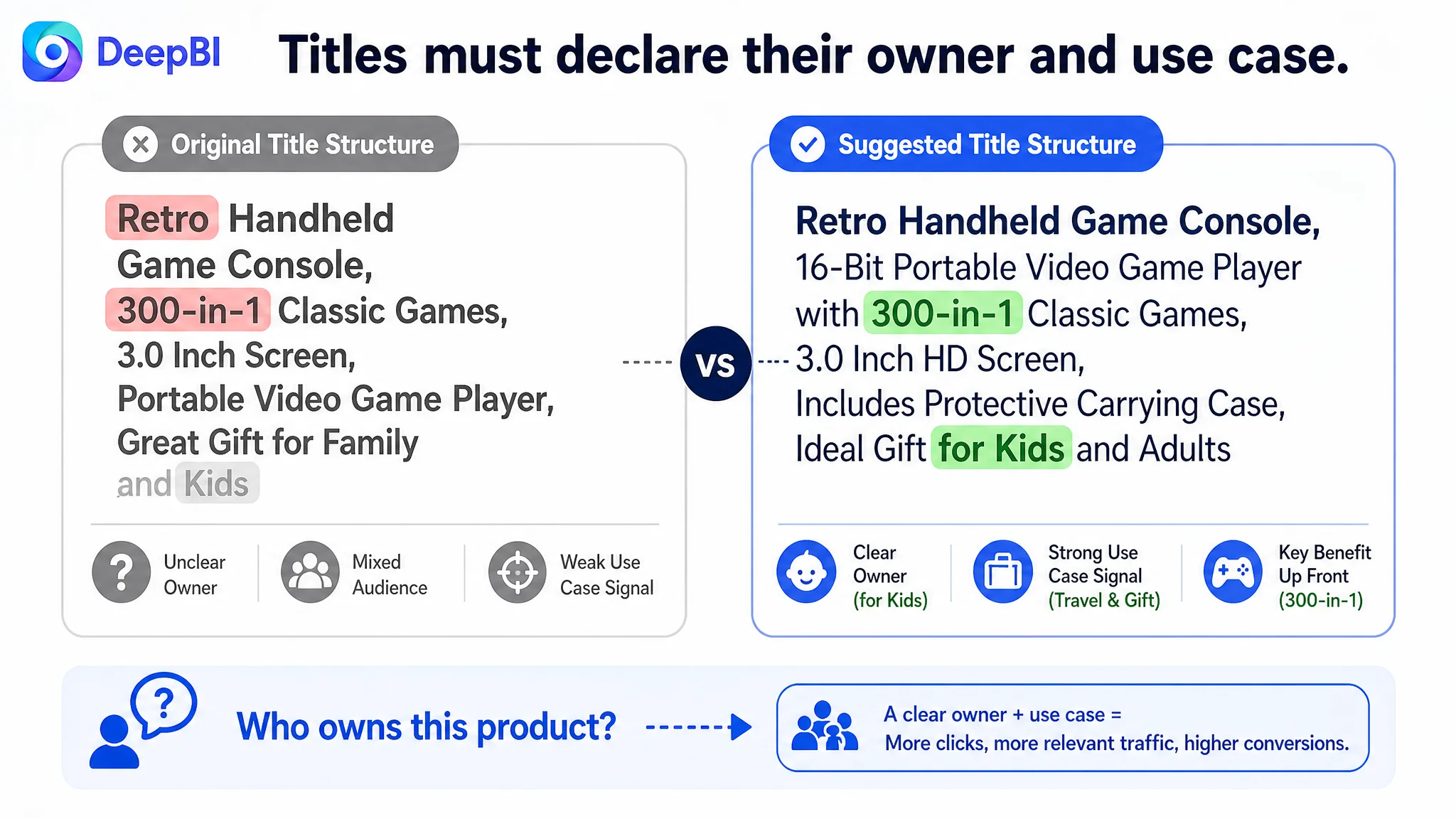 The competitor’s title did something simple but fundamental: it named its owner and use case early.
- Explicit “for Kids”
- Age bands like “Ages 4–8–12”
- Scene words like “Travel Electronics Toys”
The target Listing’s title leaned heavily into “Retro” and “300‑in‑1”, and blended kids and adult nostalgia without a clear priority. To Amazon’s algorithm and to a scrolling parent, the product looked like a generic retro handheld console, not an obviously child‑focused road‑trip solution.
DeepBI’s scoring reflected this: 11/20 vs 15/20 in the title dimension. That four‑point gap was not about vocabulary; it was about who the Listing told Amazon to show the product to.
2. Detail Page: Emotion Without Enough Risk Removal
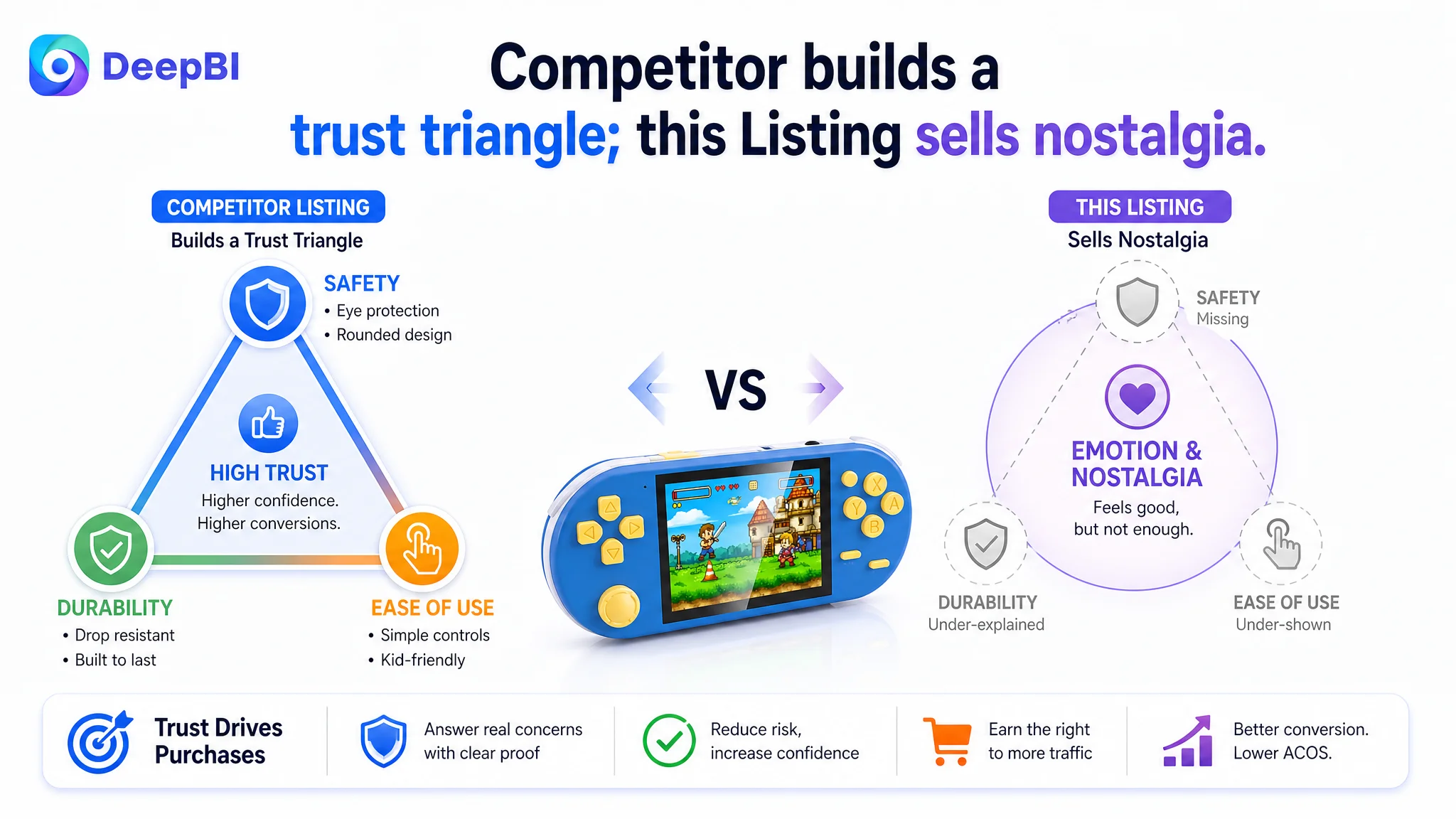 On the A+ / detail section, the surface looked fine: scenes, emotional storytelling, nostalgia, family usage. But side‑by‑side with the benchmark, the gaps were sharp:
- The competitor built a “trust triangle”:
- Safety: eye protection, rounded corners
- Durability: visual proof of impact resistance
- Ease of use: icon‑based feature explanations
- The target Listing leaned on:
- Nostalgia and “retro fun”
- General family scenes
- A text‑only claim of “durable”
DeepBI’s judgment: the page spoke to emotion, while the competitor spoke to the parent’s concrete fears — screen safety, device breakage, offline usage, content purity, and boredom on the road.
The score gap (21 vs 24) looks small, but in a category where parents are making a risk‑weighted decision, those three points represent missing answers to the questions that actually decide whether “Add to Cart” is clicked.
3. Reviews: A Trust Gap That Ads Cannot Cover
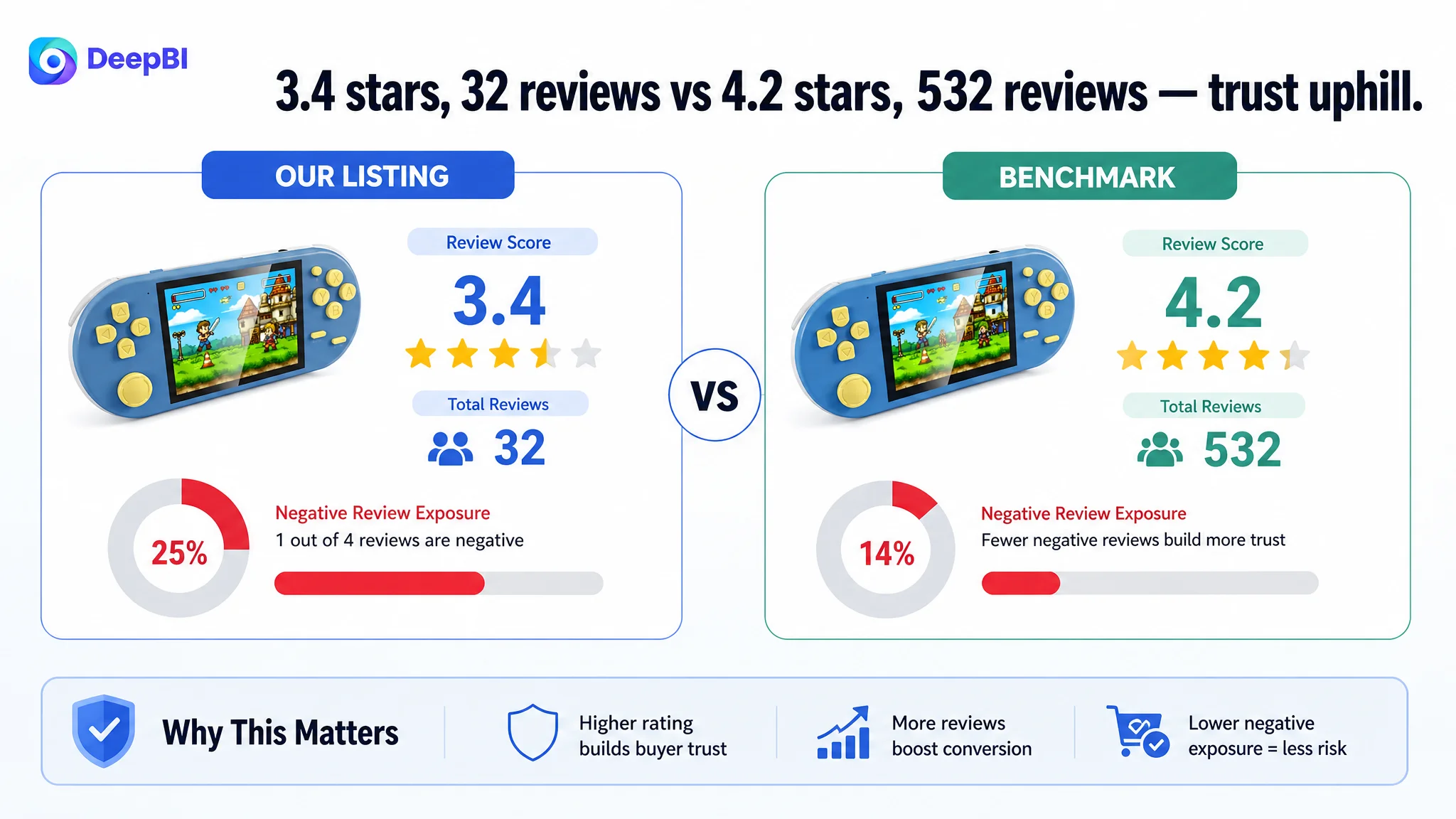 The review data made the conversion risk explicit:
- Rating: 3.4 vs 4.2
- Review count: 32 vs 532 (about 1:16.6 scale)
- Homepage negative‑review exposure: 25% vs 14%
With that profile, every extra click the seller bought on Amazon was being asked to push uphill against a fragile trust base, while the competitor rode on a large, healthy rating buffer.
In DeepBI’s view, this meant:
- The Listing had low resilience to new negative reviews
- The product page looked risky next to a strong competitor, especially for a children‑oriented device
- Ads were being forced to compensate for a position of structural weakness
Under these conditions, treating ACOS as “purely an advertising problem” ignored the weight of basic page‑level trust.
Why Traditional Amazon Ad Optimization Kept Failing
Once DeepBI tied the scorecard to the commercial context, the pattern became clear.
- Traffic was not the bottleneck. The category had demand, and ads were capable of securing impressions and clicks.
- The Listing did not anchor a clear buying logic. Parents couldn’t quickly answer: “Is this safe, durable, age‑appropriate, and easy to use for my child?”
- The competitor minimized risk; this Listing framed nostalgia. In a children’s electronics purchase, risk tends to win over emotion.
So every round of “better ads” had the same effect:
1. Bring more traffic to a page that:
- did not signal “kid‑first” clearly in the title
- did not visibly prove “300+ games” variety
- did not visually prove durability and safety
2. Send parents into the reviews, where:
- a 3.4 rating and small review base amplified doubt
3. Watch a large portion of those clicks either:
- bounce back to search and choose the benchmark Listing
- or not convert at all
In other words, ads were amplifying the Listing’s existing weaknesses.
“Advertising does not only amplify advantages. It can also amplify a page’s existing defects.”
How DeepBI Read the Listing Data Differently
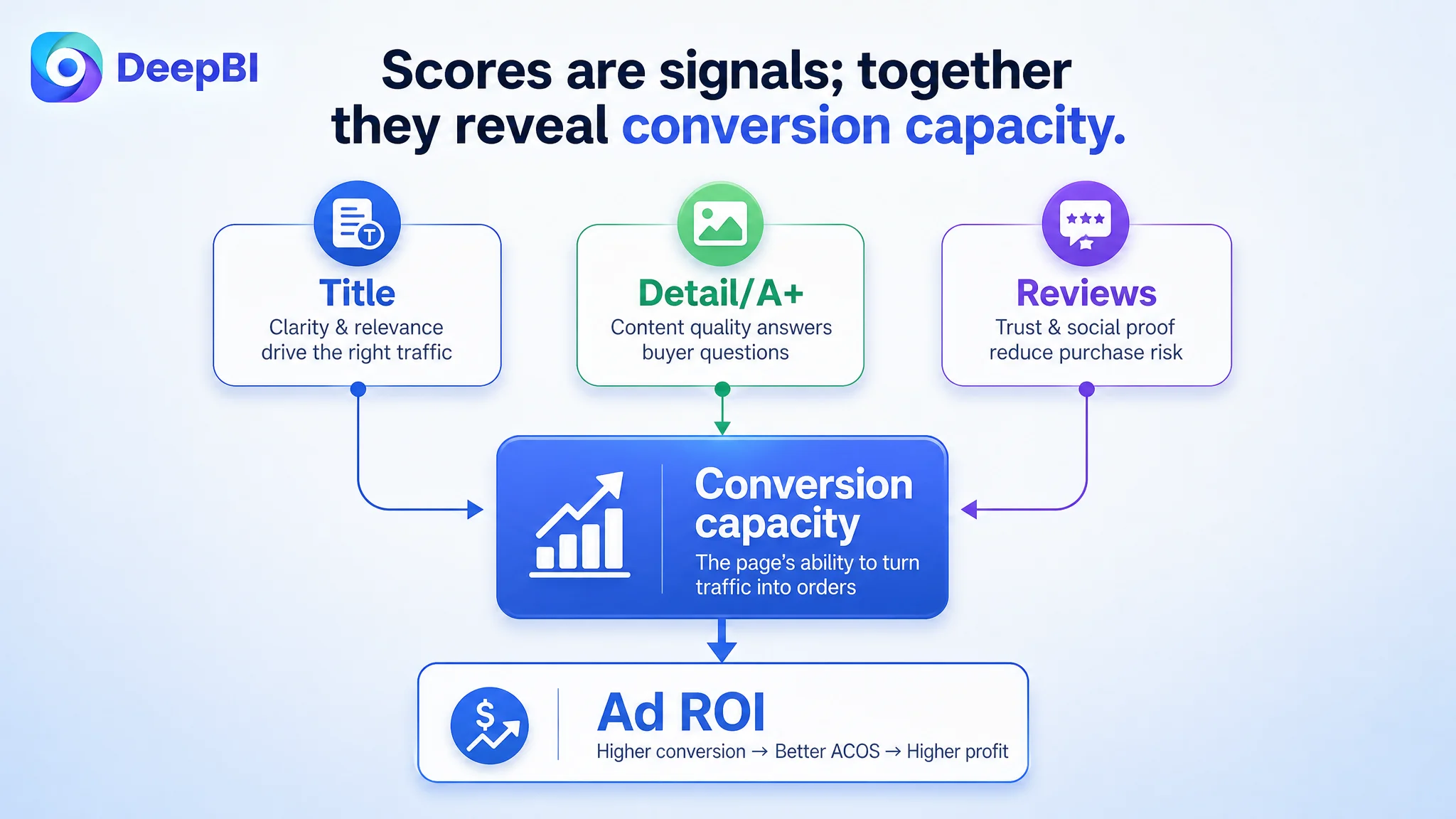 DeepBI’s Listing scoring is not an abstract grade; it’s designed to explain where a page is blocking conversion and how that interacts with traffic. In this case, the critical signals were:
- Title score lagging despite acceptable keyword presence → indicates misaligned positioning (unclear audience and scenario), not just missing terms.
- Detail/A+ slightly behind but structurally different → emphasis on emotion and nostalgia over safety, durability, and scenario breadth.
- Review score drastically behind → structural trust deficit; ads will be forced to overpay for each sale.
Taken together, this led to a clear judgment:
- Core problem: Weak Listing conversion capacity vs direct benchmark, especially for the parent‑buyer’s risk calculus.
- Immediate risk: Each incremental advertising dollar has declining marginal return because the page cannot translate visits into orders at a competitive rate.
- Priority: Fix conversion logic on the Listing first; treat ads as a lever only after the page earns that leverage.
This is why DeepBI did not start the engagement by rewriting campaign structures or suggesting new bidding patterns.
Why the Listing Had to Be Rebuilt Before Ads Could Work Again
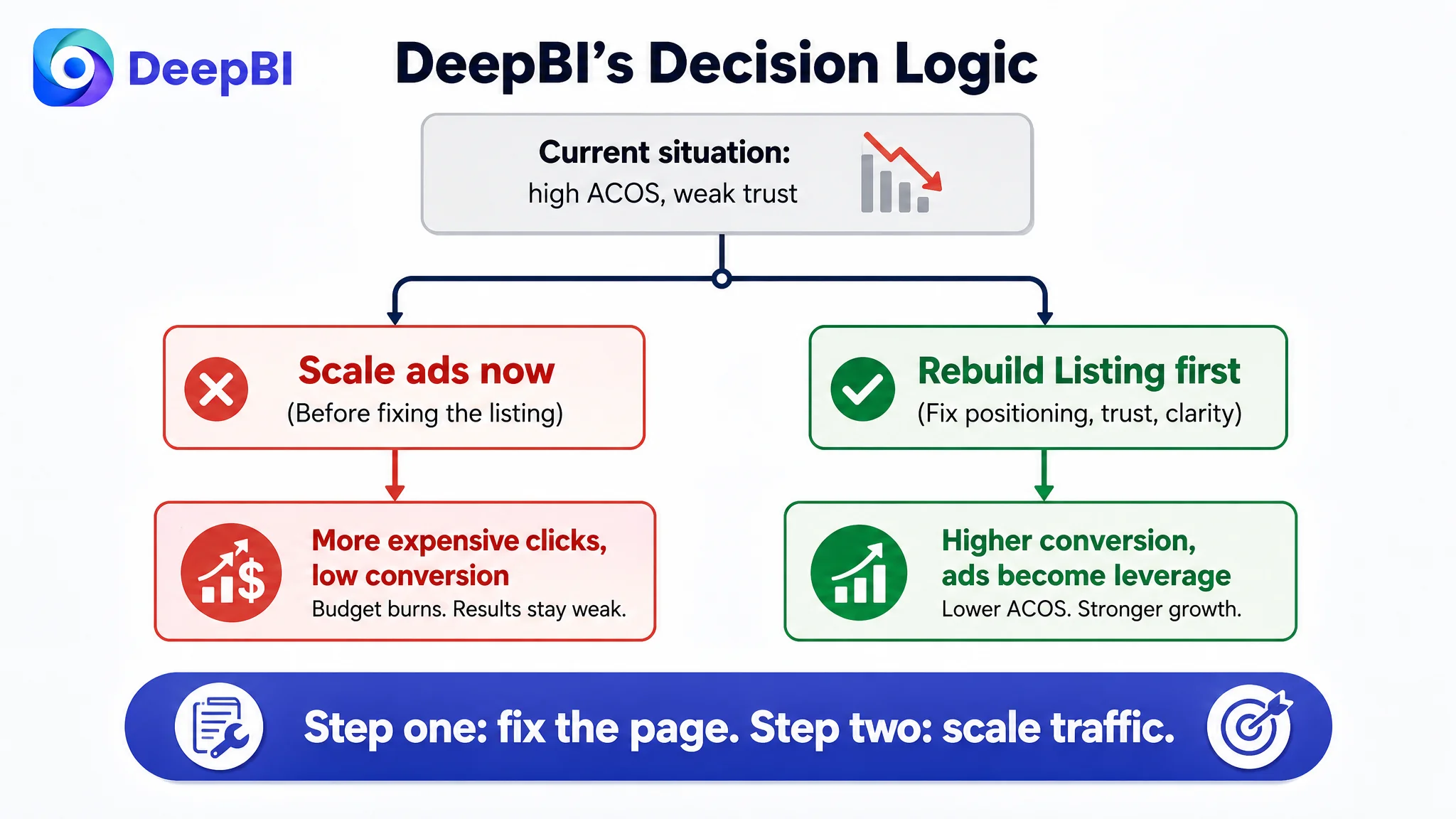 From a business decision standpoint, DeepBI framed the situation in three questions:
1. If we double traffic tomorrow, does the current page have the trust and clarity to convert it?
For this Listing, the answer was no — the trust and safety narrative was weaker than a direct competitor with a much stronger review base.
2. Is the core audience and buying scenario clearly “owned” on the page?
The competitor owned “kids’ travel electronics and educational play.” The target Listing tried to be both a kids’ gift and an adult nostalgia device, diluting message clarity.
3. Are we visually solving the parent’s decision pain points?
The competitor visually solved screen safety, offline play, durability, and game variety. The target Listing relied on text and emotion.
Given those answers, DeepBI’s decision logic was:
- Ads should not be scaled until:
- The title clearly signals “Retro handheld game console for kids” as a primary use case
- The imagery and A+ content visually de‑risk durability and eye safety
- The game count and variety are made concrete (not just numeric)
- Review risk is at least partially mitigated through better expectation‑setting and more accurate positioning
Otherwise, any attempt to “optimize ACOS” would be trying to force performance out of a structurally disadvantaged product page.
This Product Page Did Not Lacked Traffic. It Lacked Trust and Clarity.
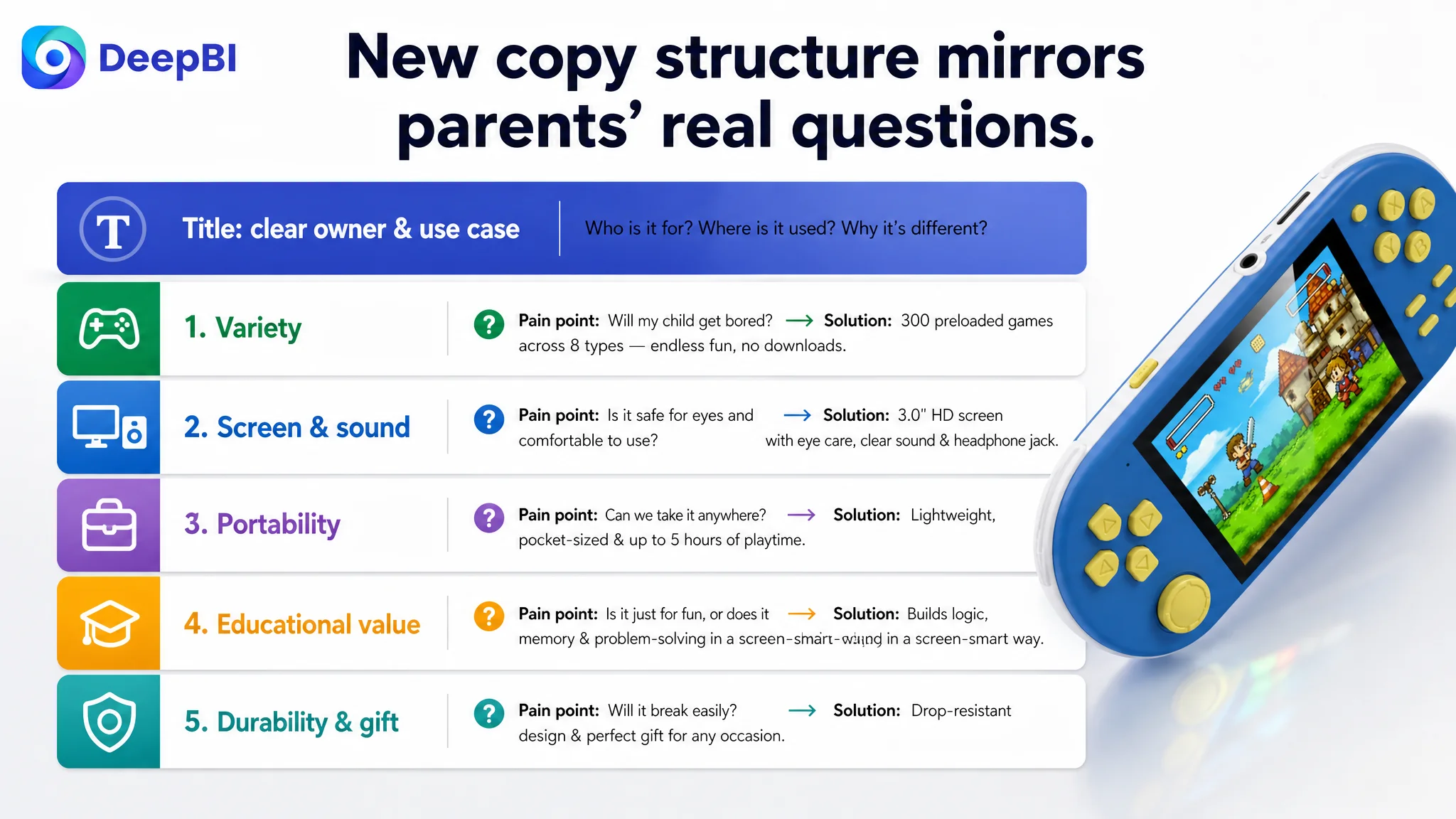 DeepBI’s optimization direction centered on rebuilding the conversion story, not just polishing the visuals.
1. Reframing the Title Around a Clear Use Case
DeepBI’s suggested title structure:
Retro Handheld Game Console, 16-Bit Portable Video Game Player with 300-in-1 Classic Games, 3.0 Inch HD Screen, Includes Protective Carrying Case, Ideal Gift for Kids and Adults (Blue)
Key shifts in logic:
- Lead with the core identity: “Retro Handheld Game Console” up front to align with Amazon search semantics.
- Surface the main numerical hook early: “300‑in‑1 Classic Games” within the first half of the title.
- Reinforce gift positioning: “Ideal Gift for Kids and Adults” to catch both primary and secondary audiences.
This is not about adding more keywords; it is about telling Amazon and the buyer, in the first 100 characters, who the product is for and why it matters.
2. Bullet Points: From Emotion‑Only to “Pain Point → Solution” Logic
The original bullets leaned strongly into nostalgia and entertainment. DeepBI pushed them into a more structured buying logic that mirrors how a parent actually evaluates:
- Game variety and non‑violent content → “300‑in‑1 Classic Retro Games” with categories like Sports, Logic, Memory, Adventure, and emphasis on non‑violent, offline play.
- Screen and sound experience → “HD Display & Audio Experience” with eye protection, headphone jack, and adjustable speakers for quiet family environments.
- Portability and real‑world usage → “Portable & Long Battery Life” explicitly tied to flights, commute, and camping.
- Developmental value and shared play → “Educational & Interactive Fun” highlighting hand‑eye coordination and parent‑child bonding.
- Durability and age fit → “Durable Material & Ideal Gift” specifying high‑strength plastic, shatter‑resistant shell, and explicit age range.
This moves the bullets from “here are features” to “here are the exact concerns you have as a parent, and how this console answers them.”
Main Image and Gallery: Turning Claims Into Visible Proof
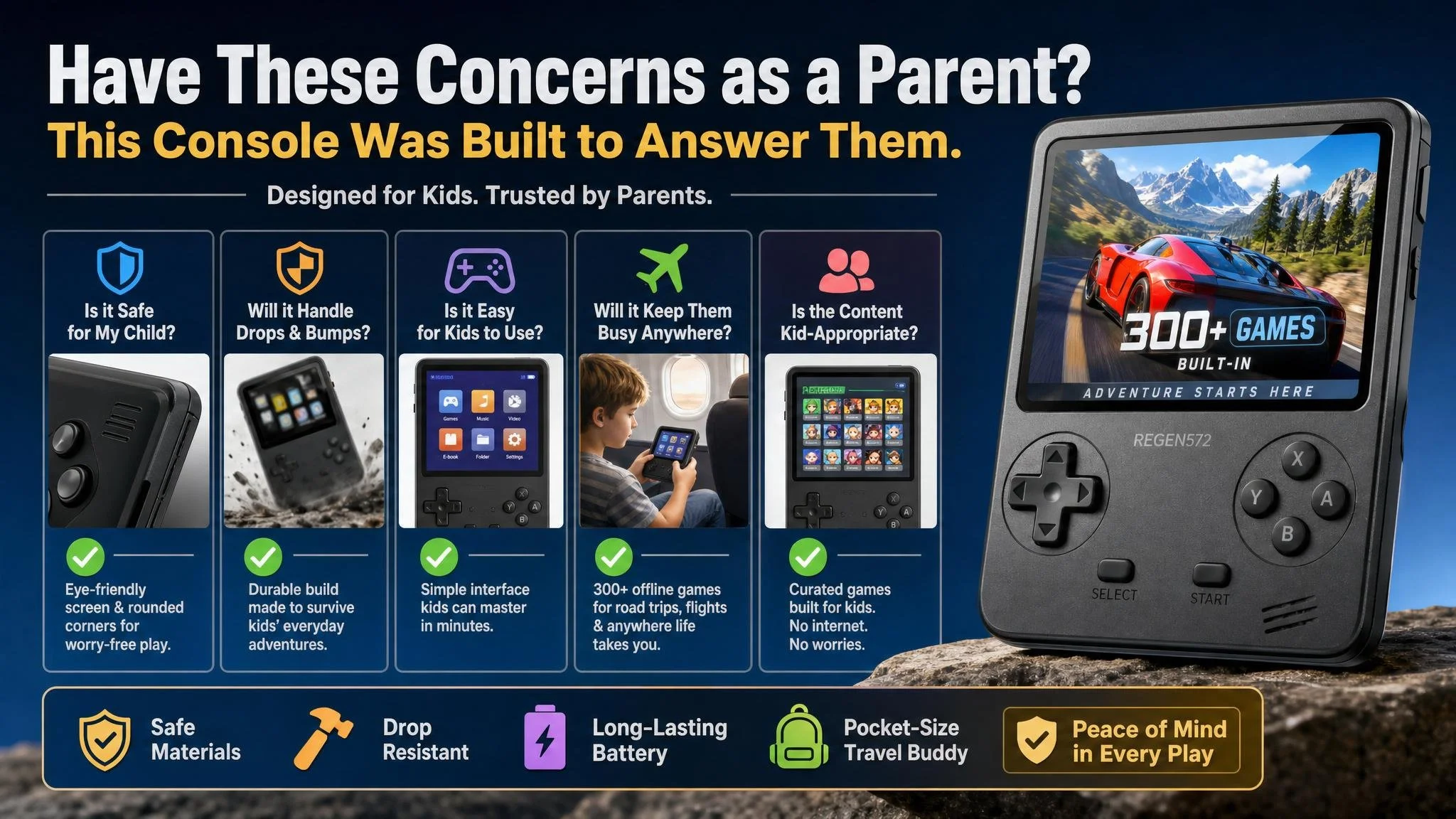 On the image side, DeepBI’s analysis was not “make it prettier.” It was: how do we make the core sales logic visible at thumbnail and gallery level?
The main image had one job: earn the click
The guidance focused on:
- A clean, high‑end digital look with:
- Product centered, ~70% of frame
- 45° angle, bright white background, controlled reflection under the device
- Vivid in‑screen gameplay (e.g., a racing game) to hint at fun and variety
- Strong color contrast emphasizing the blue shell and yellow buttons
This is the click‑earning asset; it needs to signal quality and clarity in a crowded search result.
Secondary images: each one answering a specific doubt
DeepBI’s prompts effectively turned each image slot into a conversion step:
- Game variety image: Device in hand against a blurred matrix of 20+ retro game screenshots, with “300+ Classic Games” as a clear overlay — visually solving “Will my kid get bored?”
- Battery and charging image: Device plugged in, with icons and clear “4–6 Hours Playtime” to reduce anxiety about travel usage.
- Game categories image: Device with six colored icons (“Sports”, “Puzzle”, “Adventure”, etc.) to let buyers map the console to their child’s preferences instantly.
- Real travel usage image: Child in a car’s back seat playing, natural sunlight through the window, “Perfect Road Trip Companion” text — making the “boredom killer” promise concrete.
Each image is no longer just a different angle; each is a visual answer to a decision question.
A+ Content: From Festive Nostalgia to Year‑Round Decision Engine
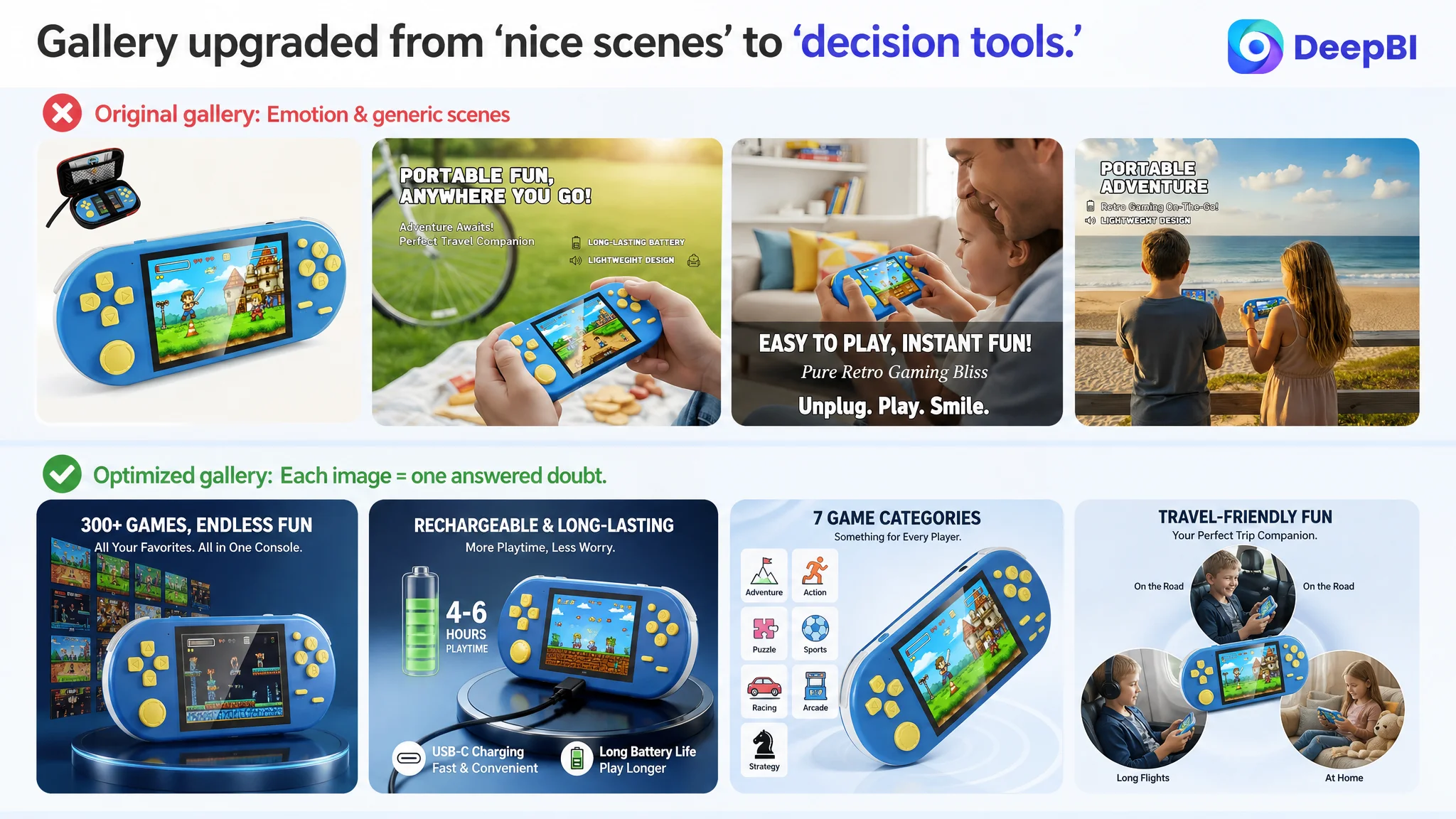 On the A+ / detail side, DeepBI’s logic was to move from a mostly Christmas‑focused, mood‑driven layout to a year‑round, pain‑point‑driven structure.
Key structural shifts:
- Open with a multi‑occasion gift scene, not just Christmas, to support birthdays, holidays, and general “gift for boys & girls” search.
- Add a parameter hub: an icon‑based module summarizing “3.0'' HD Screen,” “300+ Games,” “Stereo Sound,” “Offline Play” for quick spec capture.
- Visualize the game library: a background grid of game thumbnails behind the console — turning “300+” from an abstract number into a visible promise.
- Show durability: a low‑angle visual with the console above cracked stone or hard floor texturized background, anchoring the “Durable Design” claim visually.
- Cover multi‑scenario portability: car, airplane, and home scenes in one combined module so parents can instantly imagine usage across travel and home.
- Address safety directly: a close‑up of a child’s face and the screen in a warm home setting, with overlays like “Eye Care” and “Safe & Offline” to frame the decision as responsible, not risky.
- End with color variety and universal gifting: a clean lineup of all color variants, framed as “Perfect Gift for Every Child.”
This transforms the A+ from “nice extra pictures” into a structured argument: gift‑worthy, safe, durable, varied, portable, and suitable for the child’s age and environment.
How Ad Traffic Becomes Useful Again
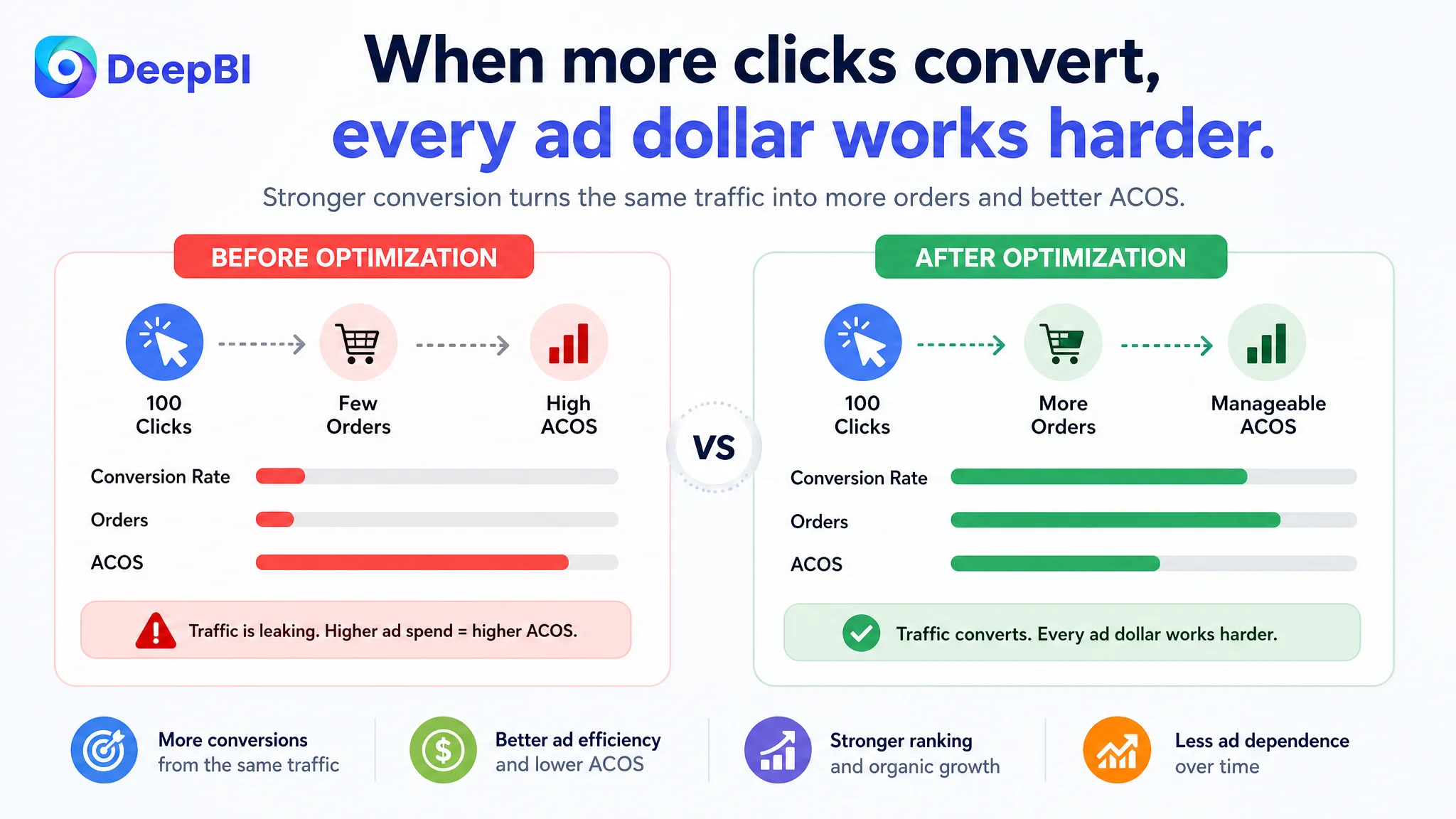 Because DeepBI’s work centered on decision logic, not just aesthetics, the expectation after implementing these changes is not a vague “better results.” The operating logic is:
- Conversion rate should start to recover because:
- Parents see clearer signals that the product is suitable for kids
- Safety, durability, and offline play are visually and textually answered
- Game variety is proven, not just claimed
- ACOS should gradually become manageable, not because bids are magically lower, but because each click has a higher chance of converting.
- Organic traffic has a better chance to stick, as the improved Listing helps Amazon’s algorithm see stronger engagement and conversion, reinforcing rank.
- Advertising dependence can decrease over time, since the page regains its ability to convert both paid and organic visits more efficiently.
Even without inventing specific numbers, DeepBI’s goal is clear: return the Listing to a state where buying more traffic makes economic sense.
What Changed in the Seller’s Understanding
 After going through this case, the seller’s view of their Amazon business shifted in several important ways:
- Ads are not a universal fix. When the page is mispositioned and under‑trusted, more ad spend mostly buys more bounced visitors.
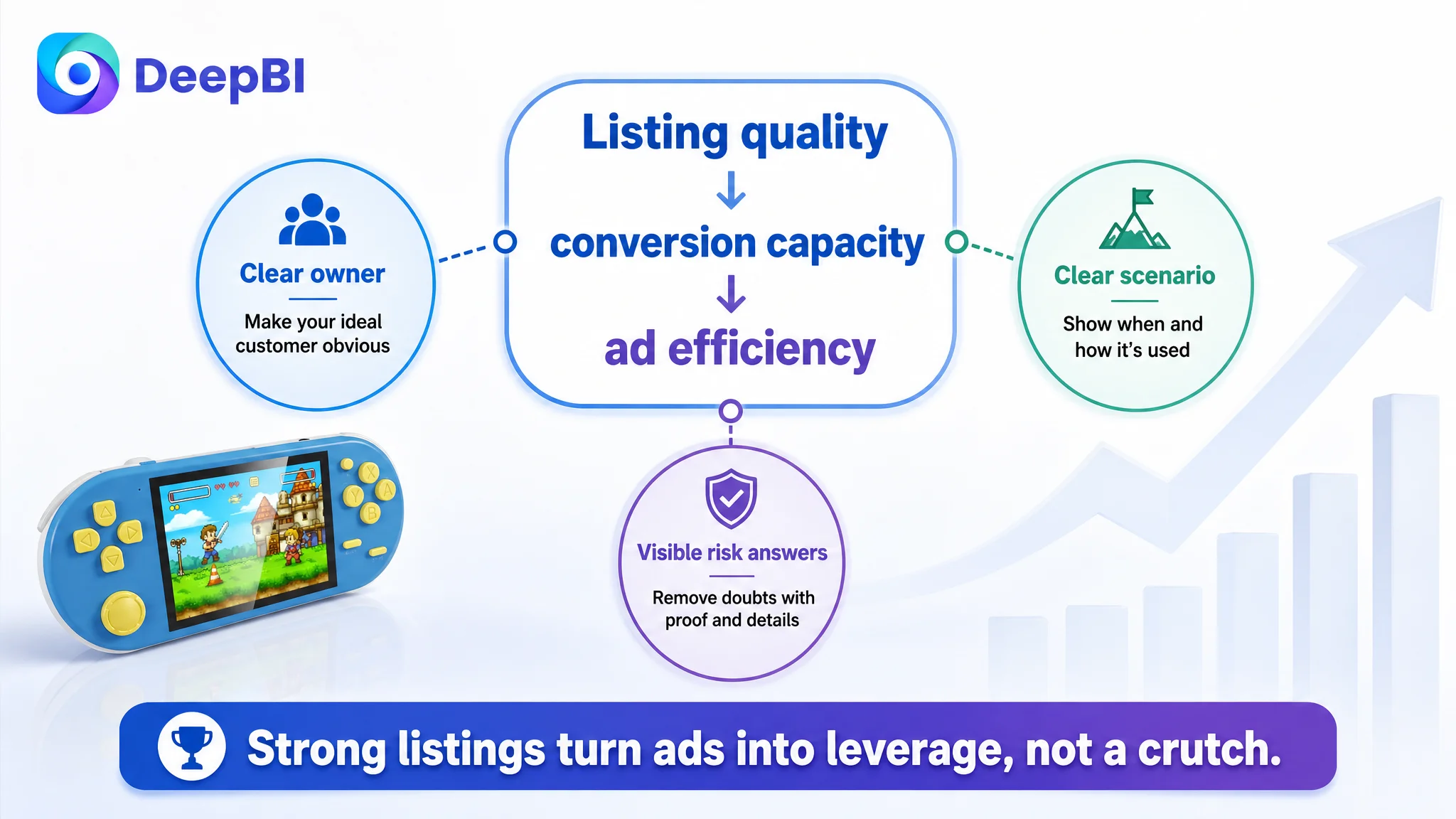
- Listing quality is not “cosmetic”; it is the base of ad efficiency. Title, main image, bullets, and A+ must work together to give ads something to convert into.
- The real competition is not only the bid auction; it is the benchmark Listing. If a competitor resolves parents’ fears better, they will win even at the same price and traffic level.
- Visual storytelling is a decision tool, not decoration. Each image must answer a specific buying question: What is it? Is it safe? Will it last? Will my kid enjoy it?
For other Amazon sellers, the takeaway is straightforward:
- When ACOS feels stubborn and you’re tempted to blame “bad traffic” or “expensive ads,” first ask whether your Amazon Listing has a clear owner, a clear scenario, and visible answers to your customer’s real risks.
- If the page cannot convert the traffic it already has, DeepBI’s experience suggests the priority is not “more ads” — it is rebuilding the Listing so that ads have something solid to amplify.