

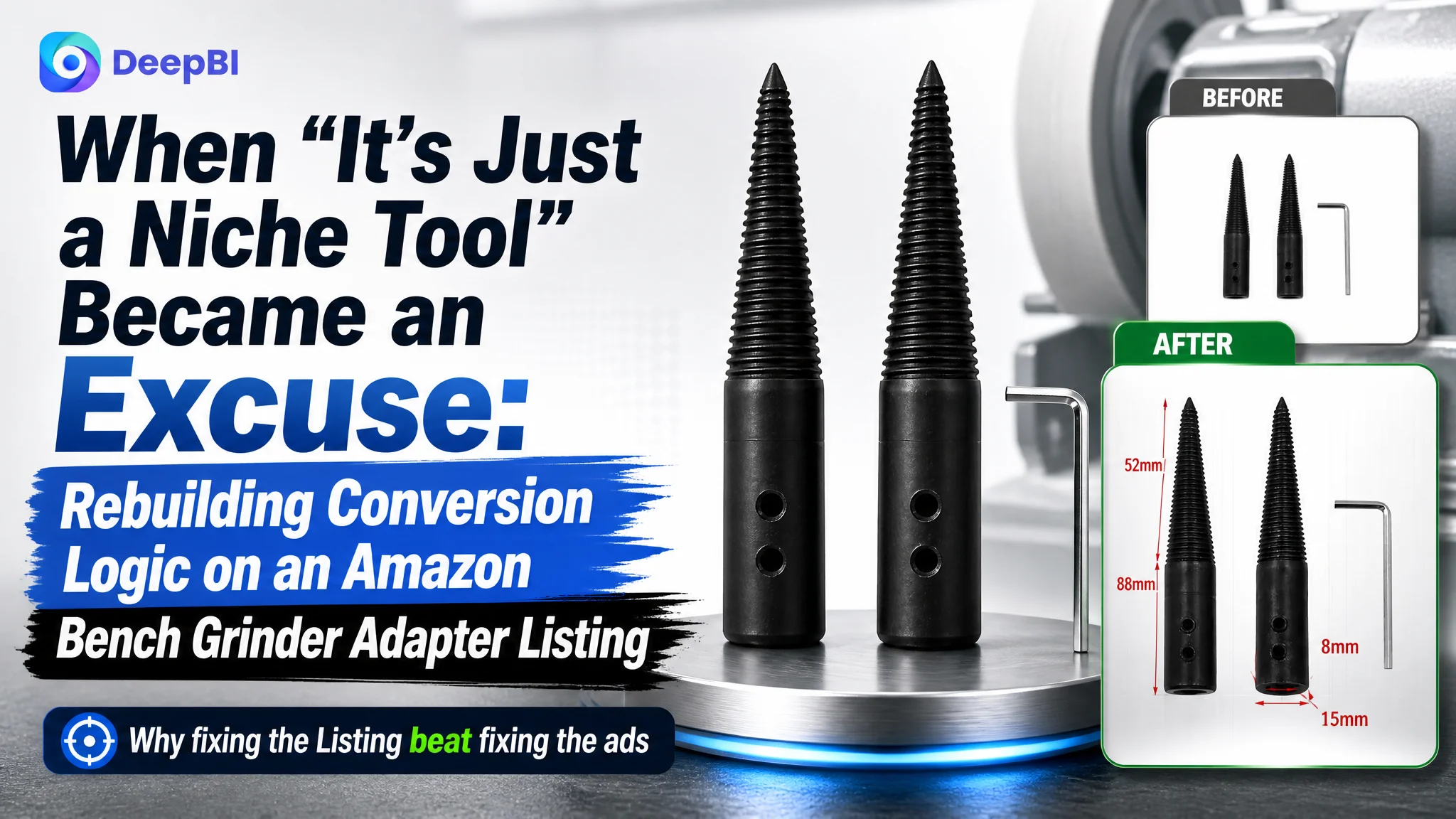
This case comes from an Amazon seller in the tools & hardware category, selling a spindle adapter set for bench grinders on the US marketplace. The team believed their poor performance was mainly because the product was niche and ads were not delivering enough traffic, so they tried to “wait for reviews” and occasionally tweak bids. What they did not see was that, even when traffic arrived, the Amazon Listing itself had almost no ability to convert.
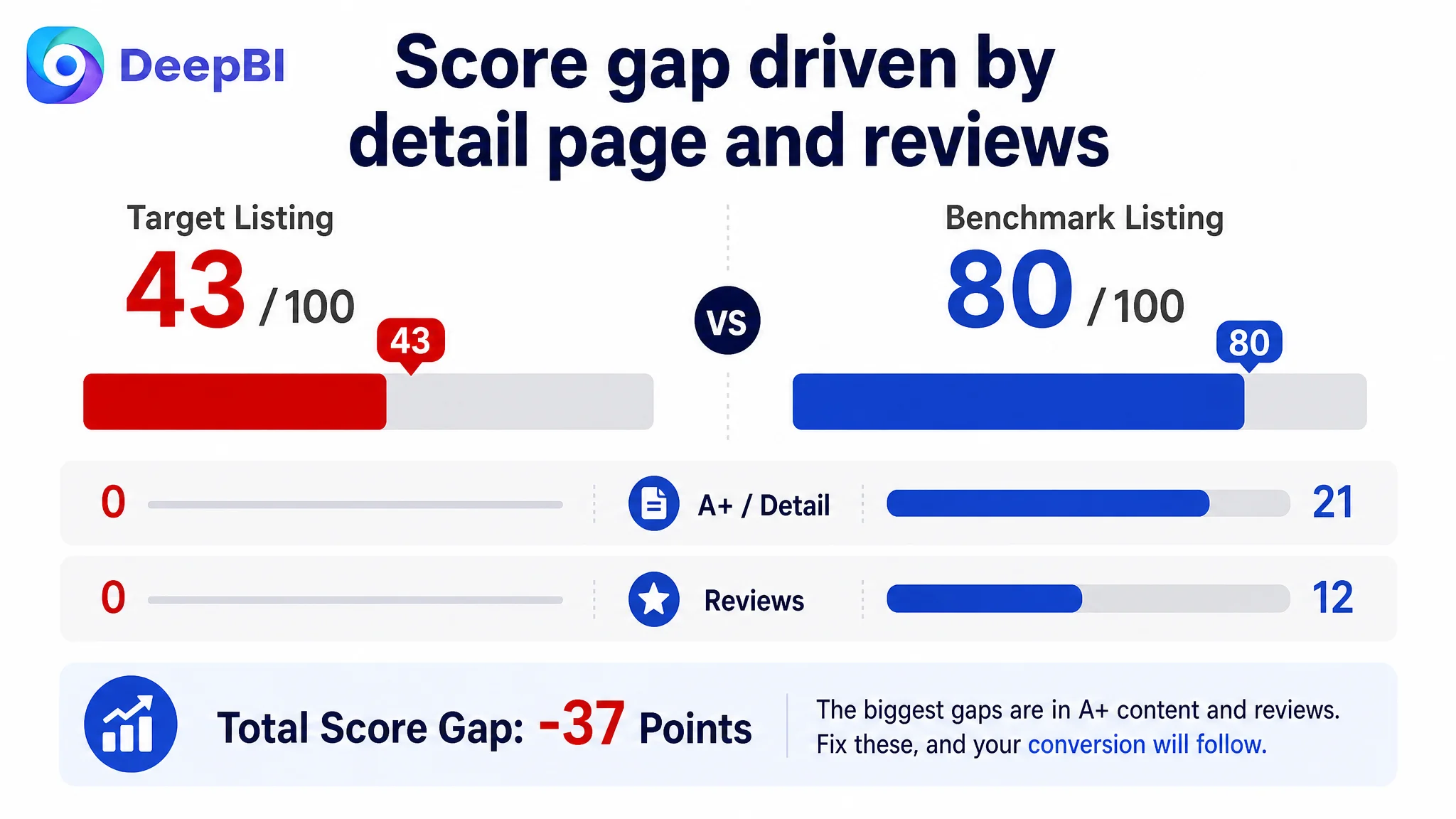
DeepBI’s diagnosis, built on direct comparison with a leading Amazon competitor in the same sub-category, showed a very different story: the target Listing scored only 43/100 versus the competitor’s 80/100, with the real gap not in title or main image, but in the complete absence of A+ content and reviews. In other words, this was not an Amazon ads problem; it was a product-page conversion and trust problem.
Once the seller accepted that the core bottleneck was Listing conversion capacity, not “insufficient ads,” the optimization direction flipped. Instead of endlessly tuning campaigns, the work focused on clarifying compatibility in the title and bullets, rebuilding the main-image set around industrial clarity and use scenarios, and constructing an A+ detail page that actually walked grinder owners through fit, safety, and use outcomes. Only after the page could explain and de-risk the product did ad traffic start to have a chance of converting.
For other Amazon sellers, especially in technical or hardware categories, this case is a reminder: when ACOS feels uncontrollable or orders stagnate, it is dangerous to assume the problem is “just ads” or “not enough reviews yet.” If your Amazon product page lacks a coherent story, clear compatibility logic, and visual proof of use, ads simply pay to expose that weakness faster.
 Amazon Ads Were Not Failing. The Page Was Consuming the Traffic.
The seller operates an Amazon US Listing for a bench grinder buffing wheel adapter set: left and right tapered threaded arbors that convert an 8mm shaft grinder into a buffer.
From their perspective, the situation looked like this:
- Clicks were limited and inconsistent.
- Orders were sporadic.
- There were zero reviews.
- The team assumed the category was “slow” and that “it will get better once reviews accumulate.”
Because of this judgment, the main actions were:
- Light ad testing and bid changes.
- Leaving the Listing structure mostly untouched.
- Hoping time and traffic would eventually build feedback.
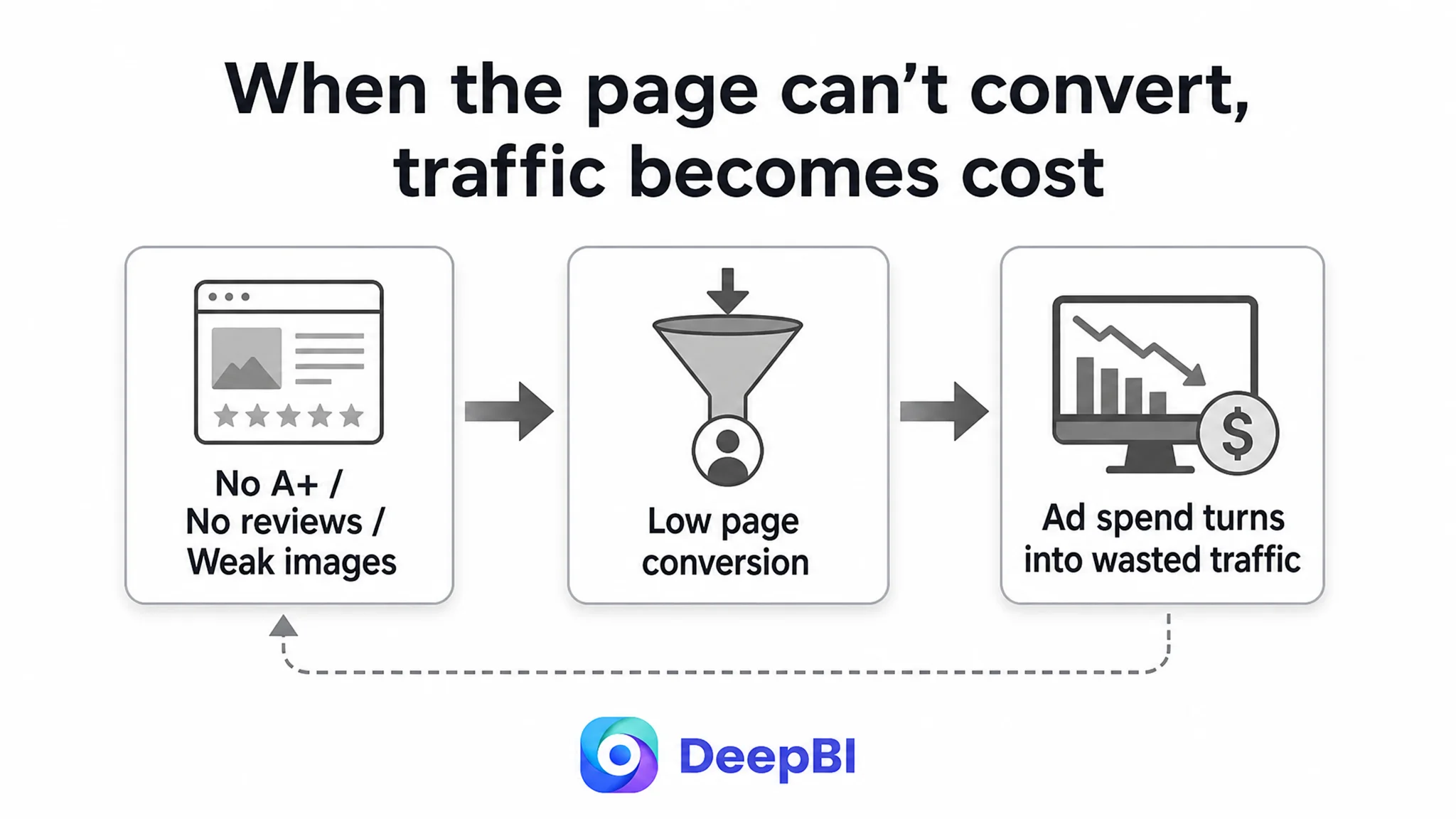
What they didn’t connect was the simple chain: a page with no social proof, no A+ content, and incomplete compatibility communication will not convert, even if you somehow win traffic.
DeepBI’s Listing scoring and competitor benchmark made that painfully clear: the Listing was not in a state that justified heavy traffic input.
“The real problem was not that ads failed to bring traffic. It was that the page could not convert the traffic.”
The Real Constraint Was Listing Conversion Capacity
When DeepBI compared the target Listing against the strongest comparable Amazon competitor in the same spindle adapter niche, the numbers were not subtle:
- Total Listing score
- Target Listing: 43/100
- Benchmark Listing: 80/100
- Gap: –37 points
At a glance, title and main image did not look catastrophic:
- Title: 15 vs 17 (out of 20) — only –2 points
- Main image: 24 vs 25 (out of 30) — only –1 point
- Bullet points: 4 vs 5 (out of 10) — only –1 point
The real collapse was here:
- Detail (A+ / product page richness):
- Target: 0/25
- Benchmark: 21/25
- Gap: –21 points
- Reviews and rating:
- Target: 0/15 (0 reviews, no rating)
- Benchmark: 12/15 (318 reviews, 4.4 average rating, high 4–5 star share)
On Amazon, this means:
- The target Listing had no A+ content at all — no visual explanation, no scenarios, no sizing diagrams, no comparison, no safety emphasis.
- The benchmark Listing had built a full A+ funnel:
main visual + material explanation + advantages + application scenes + detailed size specs + accessory close-ups + explicit “1 pair for both sides” reassurance.
From a conversion perspective, the core constraint was no longer debatable:
- This Listing did not lack traffic. It lacked a page that could carry any serious buying decision.
 Why Traditional Ad Tuning Couldn’t Help
Before the diagnosis, the seller viewed ACOS and low order volume mainly as an Amazon ads challenge: “keywords not precise enough,” “bids not optimized,” “limited clicks.”
Yet the structural reality was:
- Zero social proof: no rating, no reviews.
- Zero A+: no explanation of fit, safety, or use.
- Incomplete compatibility communication: unclear which grinder shafts and wheel arbor sizes were actually supported.
- Weak visual trust: mainly cut-out images with dated graphic overlays, almost no compelling workshop scenes or clear installation sequences.
In that environment:
- Increasing bids would only pay more to send users to a page that looked incomplete and risky.
- Even perfect keyword matching would not fix the missing trust ladder.
- The A9 algorithm would likely read the Listing as weakly optimized and less relevant versus a benchmark with rich content and strong reviews.
In other words, ads were amplifying a low-conversion substrate. Without repairing the page, there was no sustainable way to make ACOS controllable.
This Product Page Did Not Lack Traffic. It Lacked Trust.
For a technical accessory like a spindle adapter, Amazon buyers are not just looking at price; they are asking:
- Will this fit my specific grinder shaft?
- Will my buffing wheels stay on at speed?
- Is the material strong and corrosion-resistant enough for workshop use?
- Can I run two wheels at once, left and right, safely?
DeepBI’s comparison showed that the benchmark Listing had systematically answered these questions, while the target Listing largely left them to the buyer’s imagination.
Title: Information Present, Decision Logic Missing
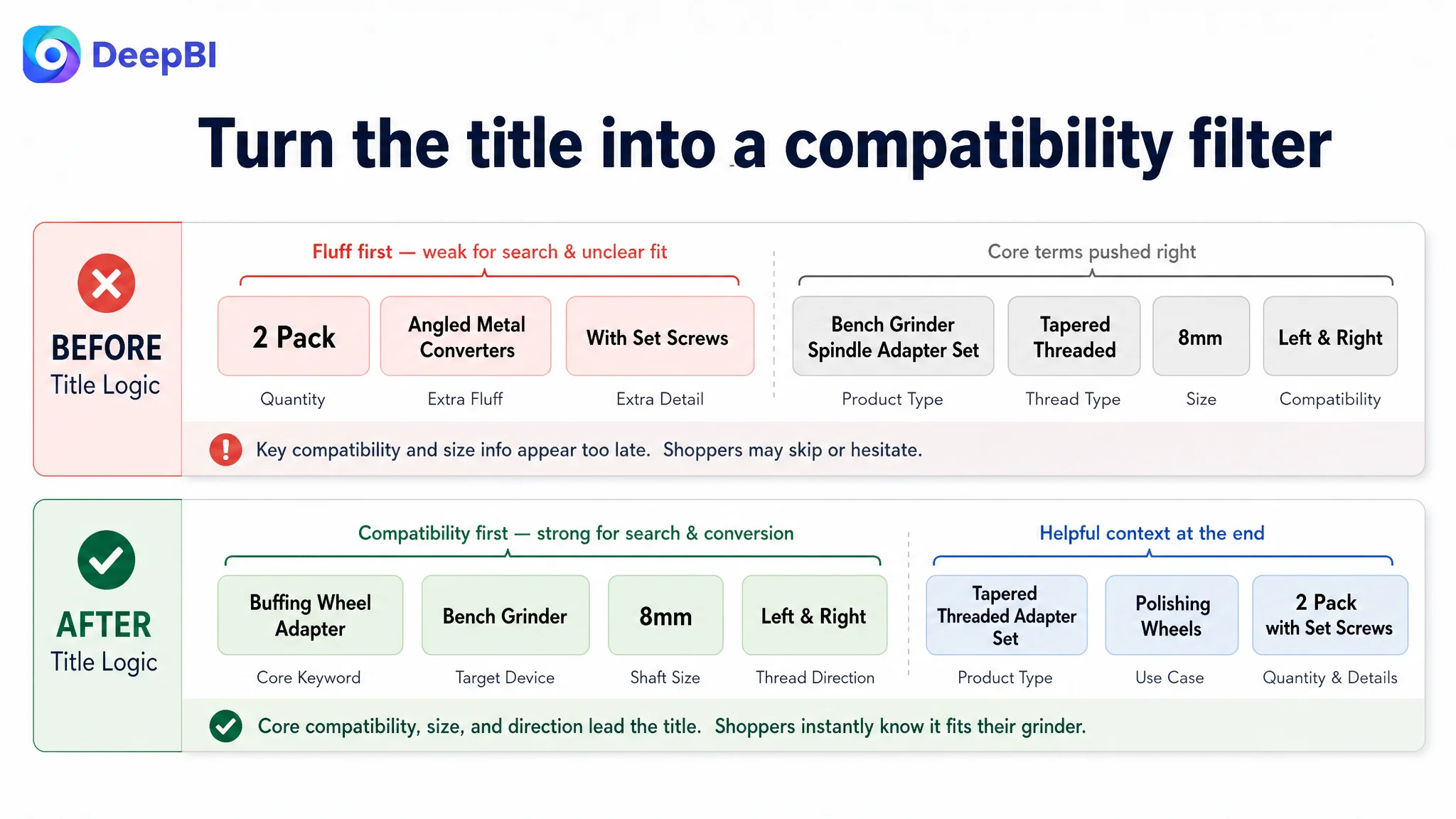
The original title led with “2 Pack,” then “Bench Grinder Spindle Adapter Set,” and included wording like “Angled Metal Converters with Set Screws.” Technically, information was there, but the buying logic was off:
- Core search terms not prioritized correctly:
“2 Pack” was front-loaded; “Buffing Wheel Adapter” and “Bench Grinder” came later.
- Compatibility not explicit:
The competitor clearly stated compatibility like “Suitable for 3/16"-10/16" arbor hole.” The target title did not spell out the specific shaft or arbor range.
- Overloaded wording:
Phrases such as “Angled Metal Converters with Set Screws” increased length without improving search relevance or decision clarity.
DeepBI’s revised direction:
- Open with “Buffing Wheel Adapter” and “Bench Grinder” to align with how users actually search.
- Explicitly mark shaft size (e.g., 8mm) and left & right pair to reduce fit anxiety and returns.
- Remove low-value, low-search phrases; keep the structure tight and outcome-focused.
The takeaway: title is not just keywords; it is the first compatibility filter.
 Main Images: From “Cut-Outs” to Industrial Decision Aids
Scoring showed only a small raw gap vs the competitor in the main image dimension, but visually, the difference in decision power was large.
Common issues in the target image set:
- Flat, straight-on angles without depth, making the adapters look generic and small.
- Overlaid circles and heavy arrows that cheapened the industrial feel and partially blocked the product.
- Busy, inconsistent backgrounds in operation shots, diluting focus.
- Weak emphasis on “sold as a pair” and “professional workshop use.”
The benchmark, by contrast:
- Used 45° industrial angles, clean gradients, and precise line annotations.
- Showed the adapters installed on an actual grinder with buffing wheels, in crisp, controlled scenes.
- Emphasized pairing and double-sided use visually, not just in text.
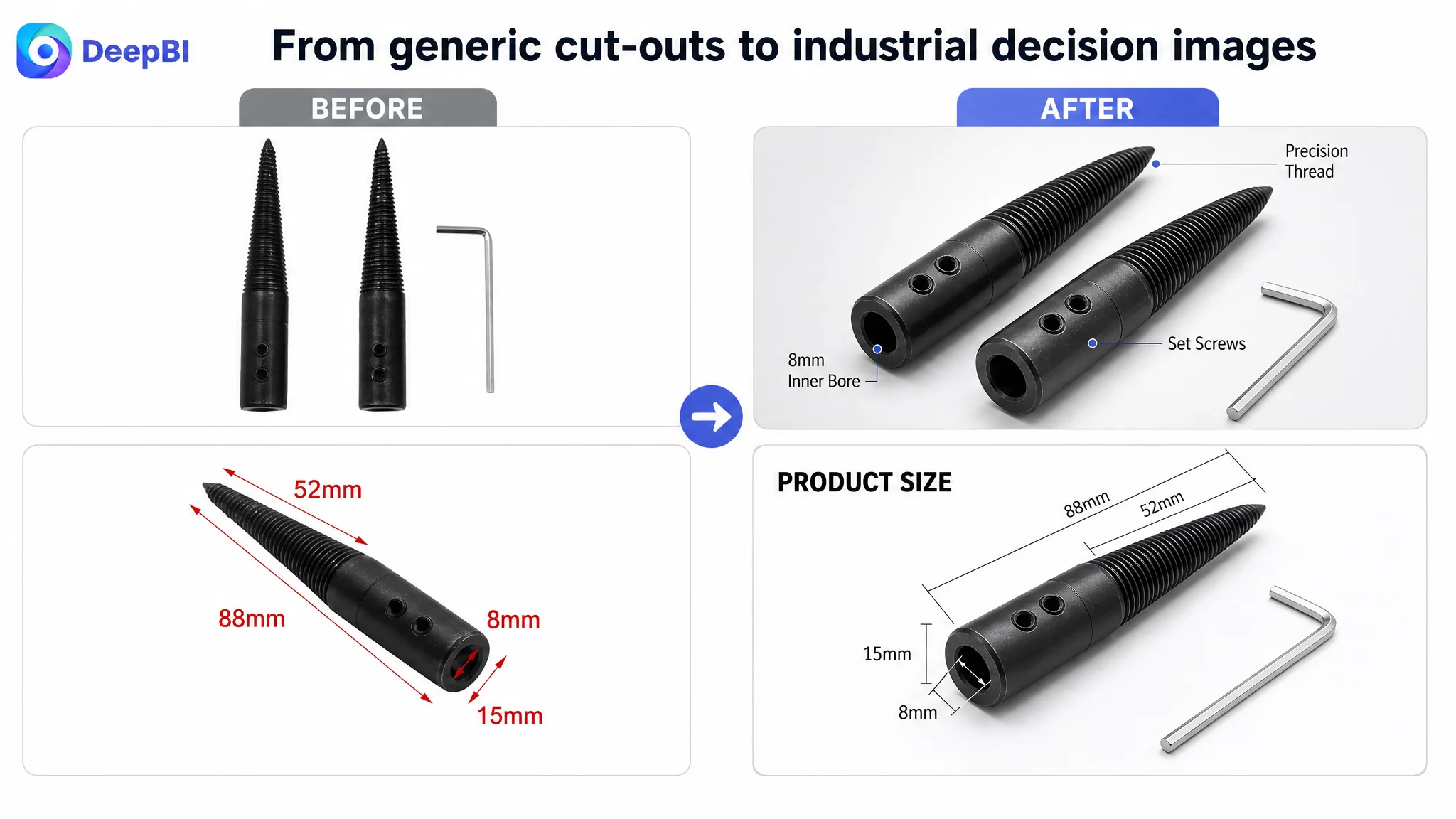
DeepBI’s optimization logic pushed the Listing toward “industrial minimalism”:
- Hero image: two adapters at 45° parallel, ~70% of frame, with hex key on the side, cool grey gradient background, professional side lighting.
- Size image: one adapter at ~30° angle, white background, clean black dimension lines, “PRODUCT SIZE” label, no cartoonish arrows.
- Thread close-up: macro diagonal shot, high-contrast side light to highlight thread precision, “Precision Thread” as a small caption.
- Installation: adapters mounted on a grinder shaft with a buffing wheel, shallow depth-of-field workshop background, “EASY ASSEMBLE” caption.
- Pair / configuration image: left and right sides both installed, clearly signaling “1 pair for both sides.”
“Advertising does not only amplify advantages. It can also amplify a page’s existing defects.”
Until the images could visually answer “what is this?” and “how does it sit on my grinder?”, spending more on ads was high-risk.
 The Bullet Points Had Information, but Not a Buying Logic
The original bullet points were heavily parameter-driven:
- Thread directions
- Taper design description
- Packaging and weight details
- Material mention mixed with minor attributes
What they lacked was a clear user journey:
1. What does this adapter actually do for my grinder?
2. How do I mount it and keep it from flying off?
3. Will it fit my buffing wheels?
4. Does it give me more working space and speed up accessory changes?
5. Is it built to survive workshop abuse?
DeepBI’s comparison with the benchmark highlighted a structural gap:
- The competitor organized bullets around function → use → fit → durability.
- The target Listing organized around specs → thread theory → design explanation → mixed uses.
The restructuring focused each bullet on one stage of the decision path:
1. Wide Compatibility
- Anchor on bench grinders with an 8mm shaft.
- Spell out that these adapters convert the grinder into a professional buffer, not just “another accessory.”
2. Left & Right Thread Pair (Safety Logic)
- Explain why left/right thread matters.
- Turn “thread direction” into the outcome: automatically tightens under rotation, won’t loosen or drop off.
3. Precision Tapered Design (Fit & Vibration)
- Link taper shape to self-centering and balanced rotation for different wheel arbor sizes.
- Translate engineering into user benefit: smooth, low-vibration polishing.
4. Quick Conversion & Clearance (Workflow)
- Show that adapters extend the spindle, providing extra working clearance for larger workpieces.
- Emphasize fast accessory changes, not just thread design.
5. Durable Metal Construction (Longevity)
- Focus on heavy-duty metal, coating, and workshop-grade durability.
- Tie the pair (left and right) to professional use and repeat tasks.
This turned the bullets from a scattered spec list into a compact narrative that mirrored how a buyer evaluates risk and utility.
A+ Was Missing, So the Funnel Broke at the Entrance
The most severe structural issue was Absolute Zero A+ content.
On Amazon, especially in hardware:
- A+ is where technical doubts are resolved visually.
- It is where compatibility, installation, and safety can be made obvious in a few seconds.
- It is often the only place to fully show dimension logic and model variations.
The competitor’s A+ layout, which the scoring exposed in detail, covered:
- Intro / hero module: product clearly installed on a grinder, strong contrast, title and core function headline.
- Material module: steel + zinc plating, rust resistance, durability claims.
- Advantage module: “tapered threaded” explanation, easy assembly, “no dropping” safety promise.
- Application scenes: bench grinder vs angle grinder, different buffing wheel types.
- Dimensions module: full precision diagram with OD, ID, length, and thread sections.
- Pairing & accessories: “1 pair for both sides,” multiple angles showing both adapters and tools.
- Close-ups: wheel hub fit, thread engagement, set-screw locking points.
The target Listing had none of this. For a buyer asking “does it fit my 1/2" shaft,” the Listing essentially said: scroll back to the generic text and guess.
DeepBI’s A+ direction mirrored the benchmark’s logical path, but rooted in the target product’s real attributes:
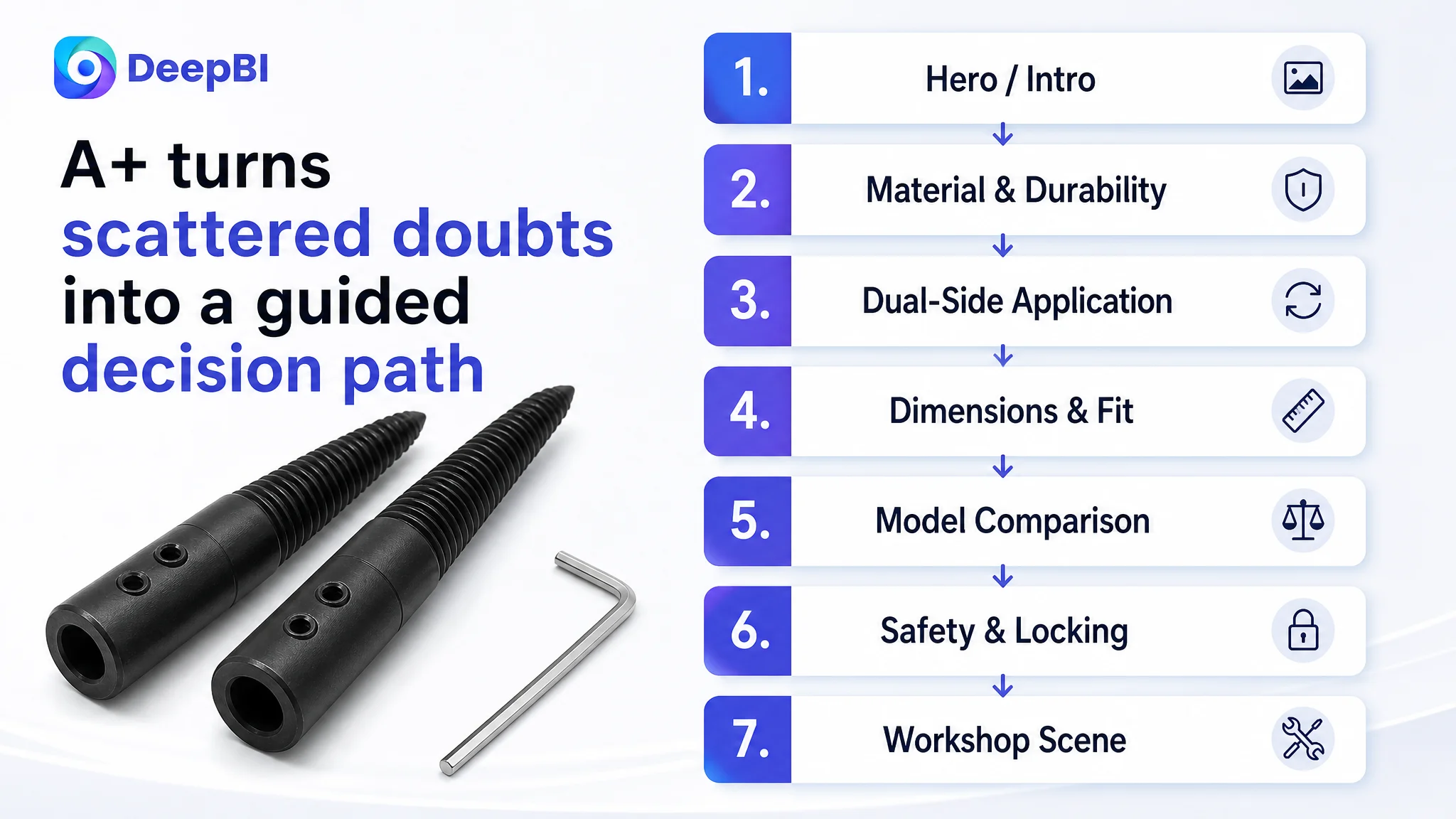
1. Hero / Intro Module
- Adapter visibly mounted on a red bench grinder.
- Bold “1/2" Tapered Spindle Adapter” headline.
- “For Left and Right Sides” subline to reinforce the pair logic.
2. Material & Durability Module
- Two adapters, 45° angle on white.
- Simple “Steel with Zinc Plated” and “Sturdy & Durable” callouts.
- Emphasis on anti-rust, workshop-ready perception.
3. Application / Dual-Side Use Module
- Grinder with a white cotton buff on one side, yellow fiber wheel on the other.
- “1 pair provided” and “Double Side Use” captions, visualizing the workflow advantage.
4. Dimension & Fit Module
- Clean dimension graphic with key measures (length, thread length, ID).
- Industrial layout to reduce “will this fit?” friction.
5. Model Comparison Module
- 1/2" vs 5/8" styles in a simple table: “Style / Fit / Number.”
- White background with light blue row accents for quick scanning.
6. Safety & Locking Module
- Macro of inner hex screws with L-wrench inserted.
- “Internal Hex Screw Locking” and “No Dropping” captions targeted at high-speed safety fears.
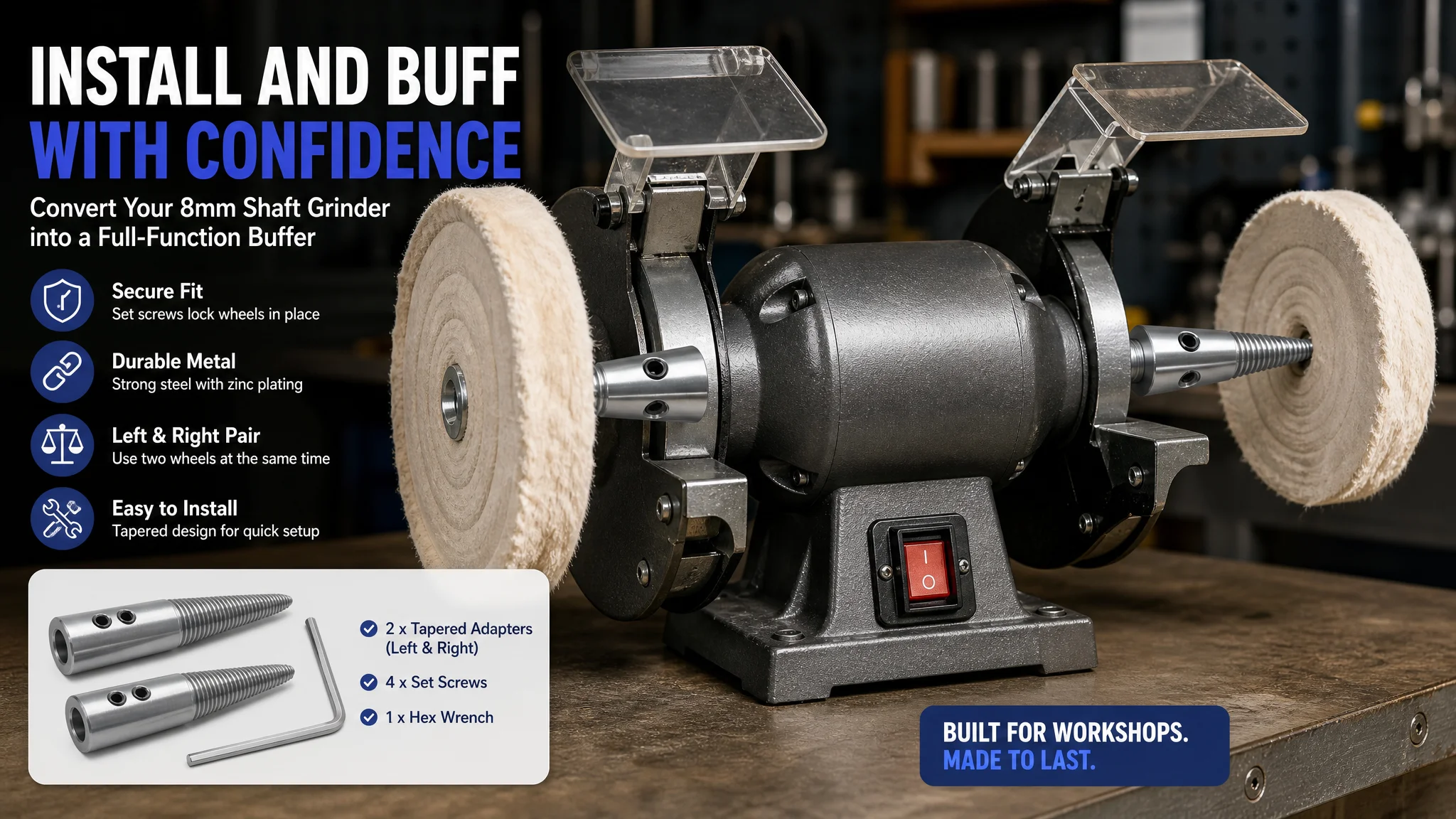
7. Workshop Scene Module
- Real bench with the grinder and adapters in context, tools in the background, warm interior lighting.
- Lifestyle but still industrial, not decorative.
For this Listing, A+ was not a “nice-to-have” aesthetic layer; it was the missing backbone of the conversion story.
 Why DeepBI Did Not Recommend “Fix Ads First”
From a pure ads-operations mindset, a common checklist would be:
- Add more keywords.
- Refine match types.
- Adjust bids.
- Try different CPC ceilings.
- Split campaigns by device or time.
DeepBI’s scoring and structural analysis argued the opposite sequence:
1. Listing conversion capacity was structurally broken:
- 0/25 on A+.
- 0/15 on reviews.
- Incomplete decision logic in title, bullets, and images.
2. Ads would be paying to expose that weakness:
With no trust and inadequate explanation, each click had a low probability of converting, whatever the bid.
3. The biggest business risk was scaling a non-converting page:
- Wasted ad spend.
- Potential negative learnings about the product due to frustrated buyers and misfits.
- Slow or no review accumulation, keeping the trust issue frozen.
Therefore, the decision path was:
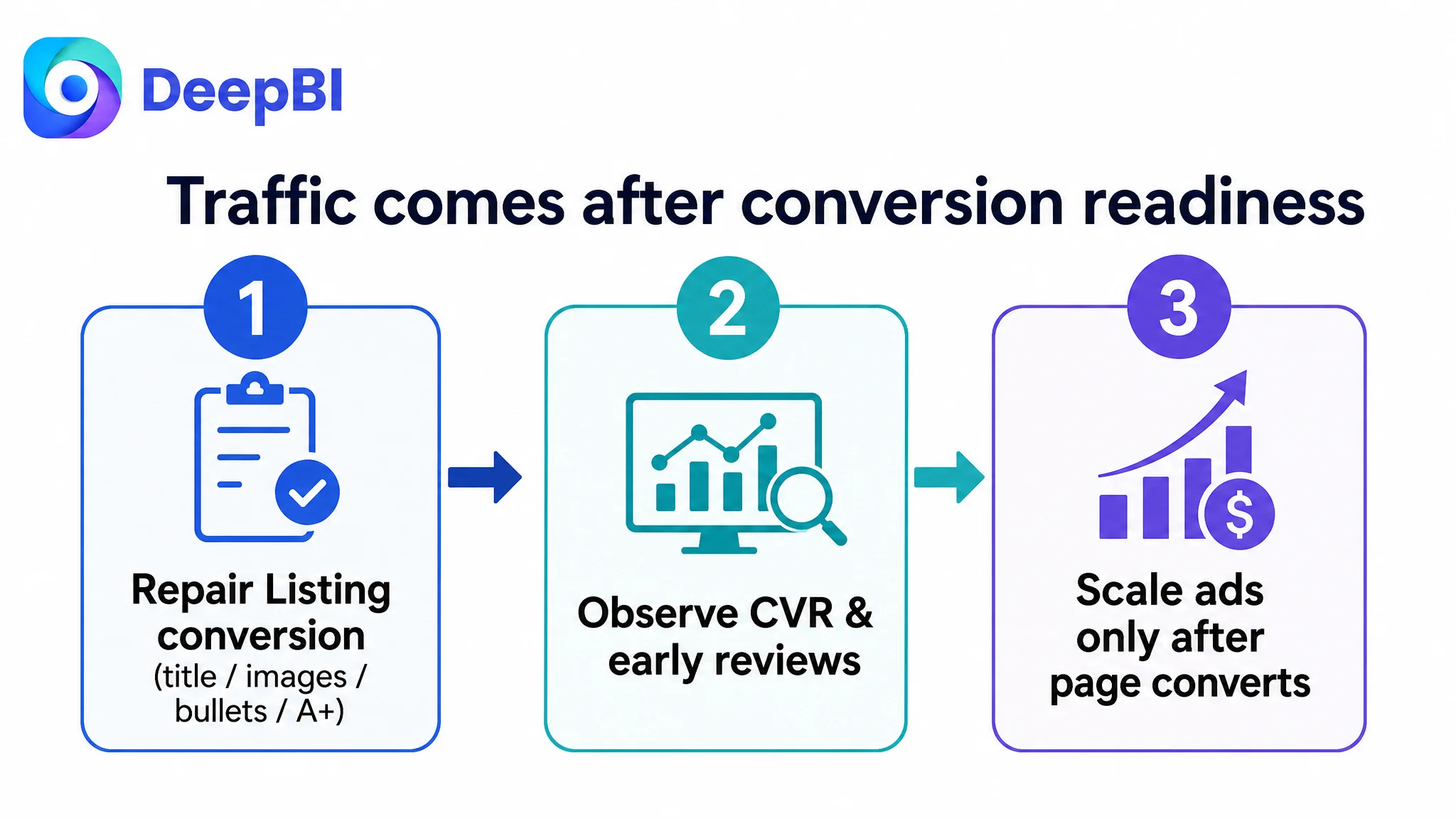
- First: Repair Listing conversion—title logic, visual set, bullet narrative, and especially A+.
- Then: Reassess whether the page’s conversion starts to move (CVR, early review quality, organic order signals).
- Only after that: Consider structured ad scaling, when each paid click lands on a confident, convincing page.
This is the core of DeepBI’s business judgment: traffic is a lever, not a cure. A weak page turns that lever into a cost multiplier.
 How the Page’s Sales Logic Started to Recover
While no exact post-optimization numbers are disclosed, the nature of the changes shifts the Listing into a more controllable state:
- Clarity at the search stage
- Improved title structure makes it obvious what the product is and what shaft it serves.
- Better alignment with real search terms increases the odds that each impression is relevant.
- Stronger click motivation
- Industrial, coherent main images look more like professional hardware, less like low-effort imports.
- Clearer visualization of “pair for both sides” and real installed scenes give buyers a reason to click.
- Reduced friction on the product page
- Bullets that map to real buyer questions reduce the need for users to leave the page or scroll endlessly.
- A+ modules walk through fit, safety, and dual-side usage visually, answering doubts before they become exits.
- Improved trust potential
- As early orders convert more confidently, opportunities for positive reviews and photo feedback improve.
- Over time, this can start to narrow the trust gap vs a 318-review benchmark.
In business terms:
- The Listing begins to regain intrinsic conversion ability, so that both organic and paid traffic have a fair chance to turn into orders.
- Advertising can eventually become a volume amplifier of a working model, not a bandage over a broken one.
 What Changed in the Seller’s Understanding
By the end of the diagnosis and optimization planning, the seller’s view of their Amazon problem had shifted:
- From:
“This is a niche bench grinder accessory with slow demand; ads and reviews are the main issue.”
- To:
“Our Amazon Listing could not clearly explain fit, safety, or benefits, and lacked any A+ or review trust. Ads were not the starting point; the page itself was the bottleneck.”
Key learnings they carried forward:
- Amazon ads cannot solve every conversion problem. When the page is structurally weak, more traffic is more waste.
- Listing quality is the foundation of advertising efficiency. CTR and CVR are functions of how well the product page aligns with real buyer decision logic.
- Title, main image, bullets, and A+ must work together as one story. Compatibility, safety, usage, and durability need to be laid out in a clear, cumulative path.
- Before scaling ads, ask: does this page deserve more traffic? If your A+ is empty, reviews are zero, and buyers must guess fit, the answer is almost always no.
For other Amazon sellers in tools, hardware, or any technical category, this case is a caution: when performance stalls, do not stop at “ads are expensive” or “we need more reviews.” Step back and ask whether your Amazon product page, as it stands today, would persuade you to install this part on your own equipment at 3,000 RPM.
If the answer is “I’m not sure,” the real work is on the Listing, not in the bid console.