

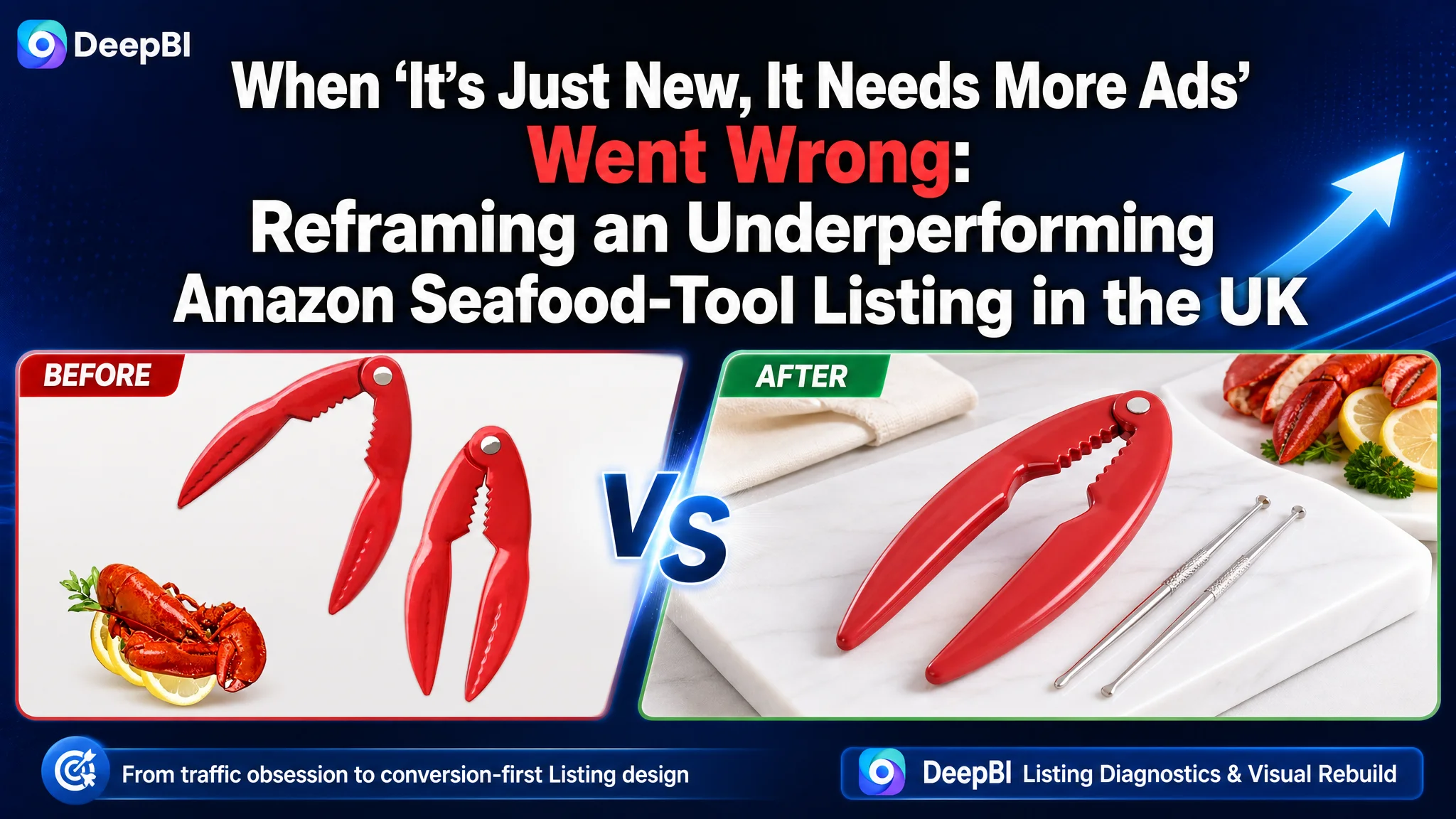
This case comes from an Amazon seller in the UK home & kitchen / seafood-tools category. They launched a crab and lobster cracker set and, seeing no reviews and weak sales, assumed the problem was simply “too new, not enough traffic.” The initial plan was to push harder on Amazon ads and wait for reviews to accumulate, treating it as a pure advertising and review-velocity issue.
Once we put the Listing into DeepBI’s scoring and benchmarking workflow, the picture changed. Against a comparable Amazon seafood-tool set, the page scored 41/100 versus the competitor’s 75/100. The real gap was not in traffic volume but in the Listing’s ability to convert that traffic: no A+ content at all, almost no persuasive bullet logic, a title that undersold the set value, and imagery that showed “results” but not credible “operation.”
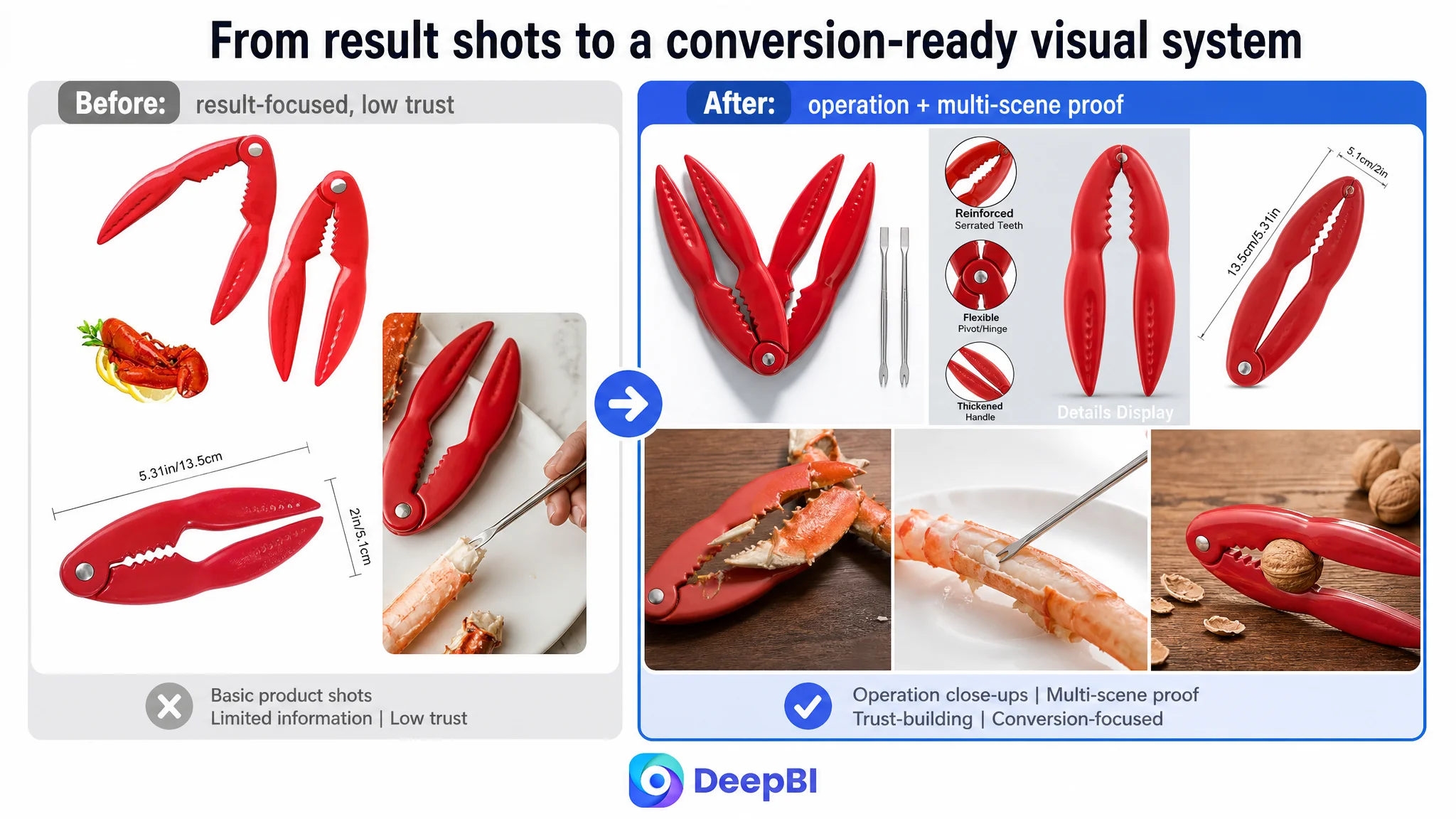 The later optimization did not start from bids or campaign structure. It focused on rebuilding the Amazon product page: retuning the title around value and durability, rewriting bullets around use-cases and pain points, and designing a full A+ sequence and main-image system that mimicked the best logic in the benchmark without copying it. For other Amazon sellers, the lesson is straightforward: when a page has no trust, no story, and no clear value structure, more ad spend only magnifies the leak.
Amazon Ads Were Not Failing. The Page Was Consuming the Traffic.
From the seller’s perspective, the situation looked familiar: a fresh Amazon UK Listing for a crab/lobster shell cracker set with very low order volume and zero reviews.
Internally, the team’s diagnosis was simple:
- The product was new.
- There was no social proof yet.
- With more Amazon ads and time, the product would “naturally” pick up reviews and then convert.
Under this assumption, their energy went into classic levers: increasing exposure, iterating keywords, and trying to drive enough clicks to get the first few orders.
But when we ran the Listing through DeepBI’s scoring and benchmark comparison against a direct category competitor, the core constraint became obvious:
The real problem was not that ads failed to bring traffic. It was that the page could not convert the traffic.
With a 41/100 Listing score versus the competitor’s 75/100, almost every conversion-related dimension was structurally weaker:
- Title: 12 vs 15 (out of 20)
- Main image: 24 vs 25 (out of 30)
- Bullet points: 5 vs 7 (out of 10)
- Detail / A+ content: 0 vs 21 (out of 25)
- Reviews: 0 vs 7 (out of 15)
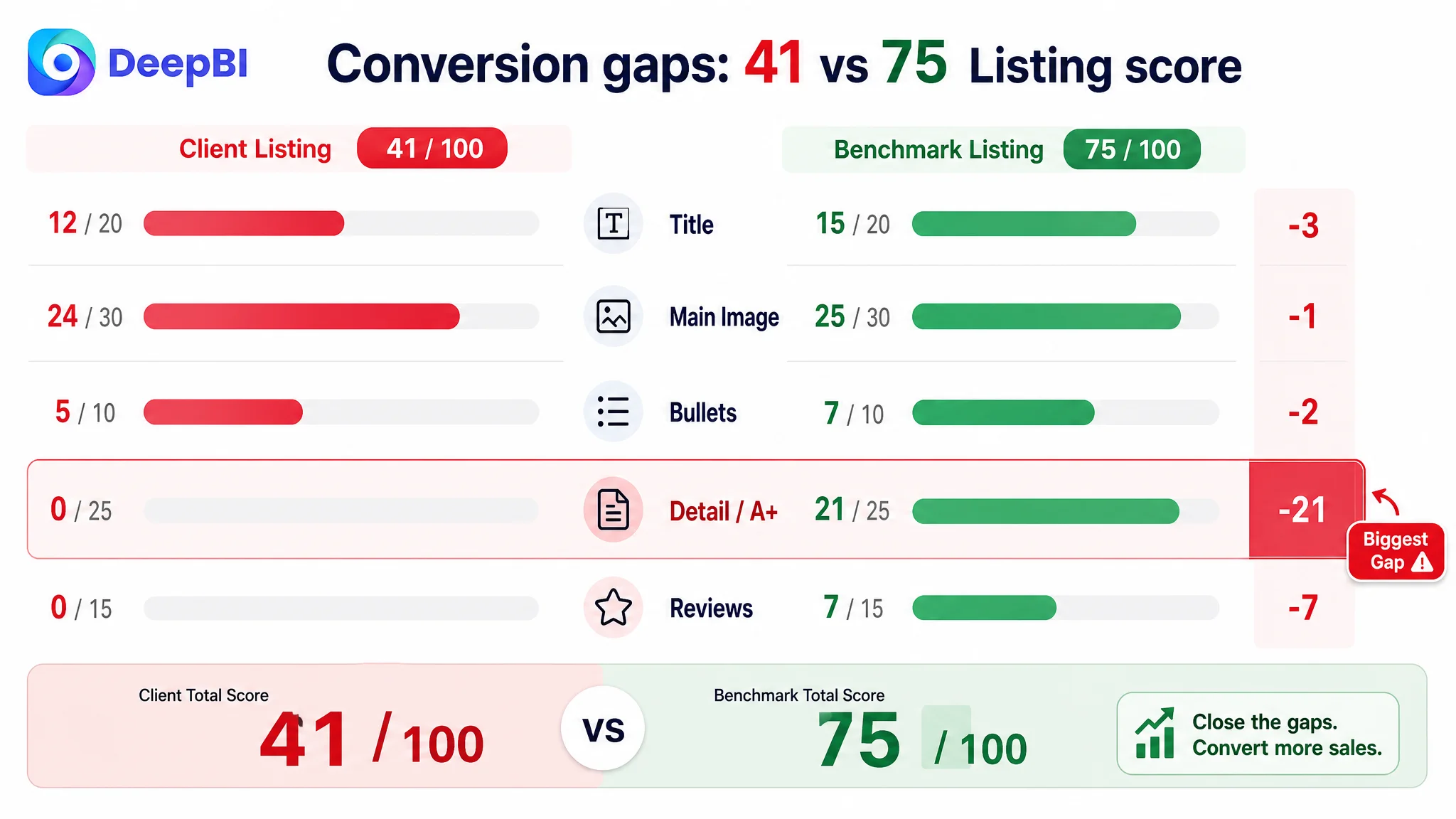 On an Amazon Listing that has literally zero rating, zero reviews, and zero A+ content, asking ads to “solve” conversion was commercially unsafe. The funnel was broken after the click.
The Real Constraint Was Listing Conversion Capacity
Looking at the benchmark seafood-tool set on Amazon UK, we were not just comparing “better pictures.” We were comparing full decision logic.
The competitor’s 75/100 score came from a page that:
- Clearly defined the set value and count in the title (“13 PCS” set, “Including 3 Lobster Cracker and 10 Forks”).
- Anchored durability up front with “Heavy Duty.”
- Used a consistent visual story across main and secondary images: engineering-style callouts, multi-scene usage (seafood + nuts), and explicit cleaning/dishwasher validation.
- Filled the A+ section with a problem–solution narrative: break hard crab claws, pick out meat cleanly, easy dishwashing, multiple scenes.
Our customer’s Listing, by contrast, was:
- Underscoring the offer: leading with “2 Pack” and generic “Crab Claw Seafood Crackers,” so the value-per-order felt smaller and less complete than the benchmark’s “13 PCS” set.
- Over-focusing on specs: size, color, and ergonomics were described, but not tied to a clear outcome (“elegant, effortless seafood experience”).
- A+ absent: detail-page score 0 vs competitor 21; there was no Amazon A+ content at all, so the entire mid- and lower-funnel trust layer was missing.
- Emotionally flat: no social scene, no seafood party narrative, no dishwasher scene to reduce perceived hassle.
With that structure, the page’s conversion capacity was fundamentally lower than the benchmark’s, regardless of traffic source. Any additional Amazon ad spend would simply feed a page that was not yet capable of closing the sale.
Why Traditional Amazon Ad Optimization Kept Failing
The seller’s first instinct was standard:
- Increase bids on “crab cracker,” “seafood tools,” and related keywords.
- Expand match types to capture more impressions.
- Expect that a few weeks of spend would generate enough orders and reviews to “unstick” the Listing.
The problem is that ad optimization assumes the page can already convert at a reasonable baseline. Here, two structural issues made that assumption invalid:
1. Zero review trust vs. competitor baseline
- Competitor: 4.1 stars from 10 reviews, plus several visible front-page reviews.
- Customer: 0 rating, 0 reviews.
When a shopper compares the two, even a small review base is dramatically safer than none—especially for metal tools where durability and comfort are uncertain.
2. A+ and mid-funnel content vacuum
- Competitor A+ walked the shopper through: what’s in the set → how it cracks shells → how pick tools extract meat → dishwasher scene → multiple use cases (seafood and nuts).
- Customer: no A+, no modules, no extended explanation.
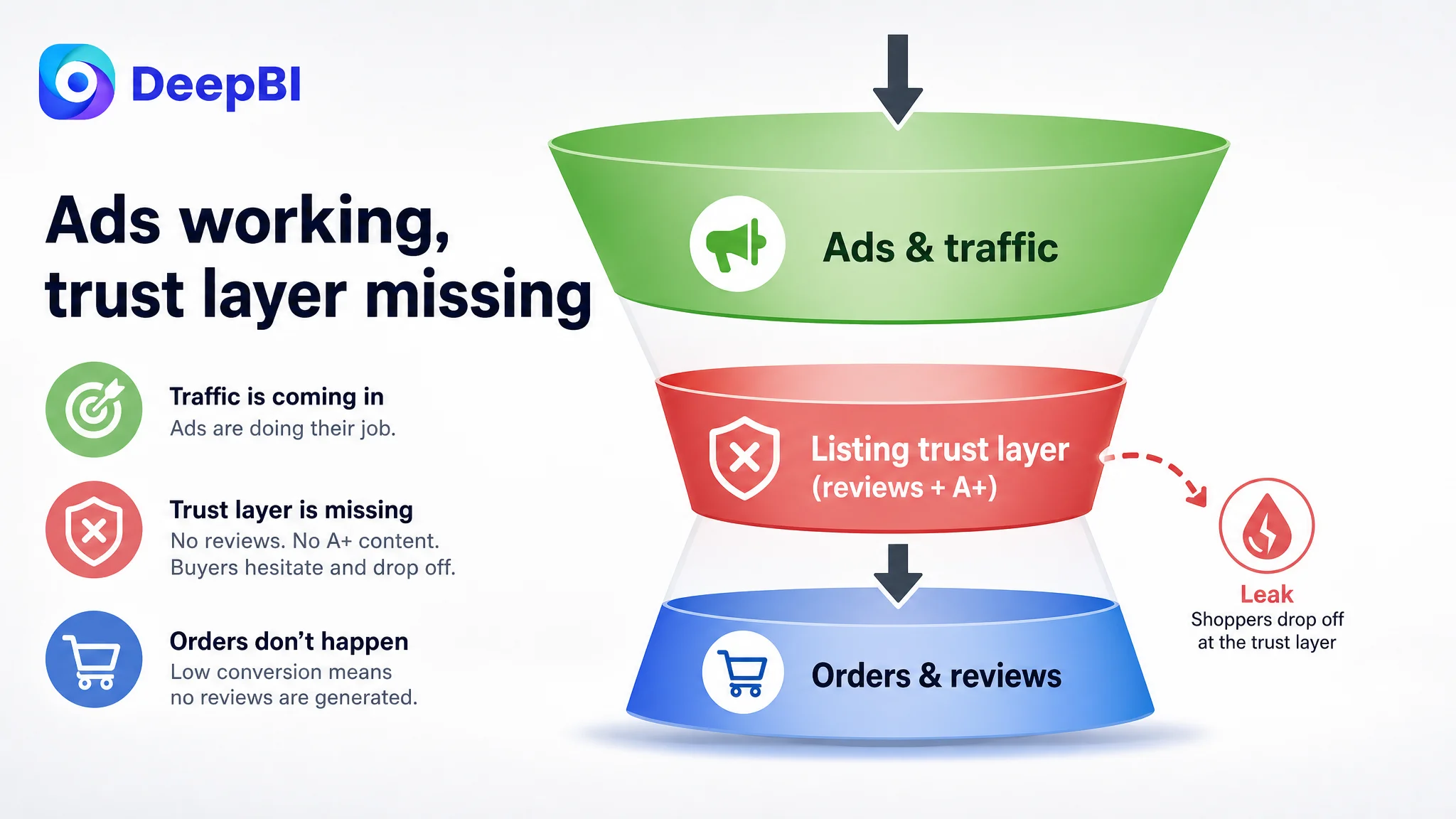 In this state, ads generate one of two outcomes:
- Clicks but low add-to-cart, because the page cannot answer “Is it solid?” “Is it complete enough for a party?” “Is it easy to clean?”
- Higher ACOS, because every incremental click is more likely to bounce off than to convert.
From an operating-risk perspective, pouring more budget into this funnel would not “fix” the absence of trust and story. It would amplify the cost of that absence.
This Product Page Did Not Lack Traffic. It Lacked Trust.
When we broke the Listing down by components, the same theme repeated: the page did not build enough instant trust at each stage of the shopper’s decision.
Title: Underselling Value and Outcome
The benchmark title starts with:
“13 PCS Lobster Crackers and Picks Set, Crab Leg Cracker Tools, Including 3 Lobster Cracker and 10 Forks, Heavy Duty Shellfish Nut Cracker Set…”
Key roles it plays:
- Set completeness: “13 PCS… Including 3… and 10…”
- Use-case clarity: “Lobster Crackers and Picks Set,” “Crab Leg Cracker Tools.”
- Durability anchor: “Heavy Duty.”
The customer’s original title led with “2 Pack” and generic “Crab Claw Seafood Crackers.” That came across as:
- Less generous (two pieces versus a named multi-piece set).
- Less focused (broader “Seafood Crackers” vs clear “Lobster Crackers and Picks Set”).
- Missing a strong durability promise.
The proposed direction moved it to:
“2 Pack Crab Cracker and Seafood Tools, Heavy Duty Zinc Alloy Shellfish Nut Crackers with Curved Handle, 13.5cm Red Lobster Cracker for King Crab Legs, Walnuts and Almonds”
That reframing does three important things for Amazon search and conversion:
- Pulls “Crab Cracker” forward as a core search term.
- Injects “Heavy Duty” and “Zinc Alloy” for durability.
- Spreads use-cases across king crab legs and nuts, widening relevant query coverage while staying honest.
Main Images: Showing Results Without Proving Capability
The original imagery leaned heavily on “after” shots—crab meat extracted, cracked shells, etc. That created an impression of outcome, but not evidence of how the tool achieves it.
The benchmark, by contrast, did three things well:
- Material credibility: clear metal texture, high-contrast product presence.
- Engineering-style callouts: “Snap Fit Design,” “Smooth Handle” with structural diagrams.
- Multi-scene demonstration: cracking seafood, cracking nuts, including a bottle-opener integration.
DeepBI’s diagnosis was:
“Your images focus on ‘using result’, but lack ‘operation credibility’ such as grip stability and clamping force validation, which creates uncertainty about actual performance.”
Hence the recommended image directions:
- A dominant V-shaped composition of the two crackers, with metal needles arranged clearly to signal a professional “set.”
- Macro detail views of serrated jaws, hinge, and thickened handle, with clean technical labels.
- Proper scale visualization with precise length and jaw width measurements, removing guesswork about size.
- Realistic action shots: the cracker visibly breaking a crab claw, and another image cracking a walnut, tying into the multi-use story.
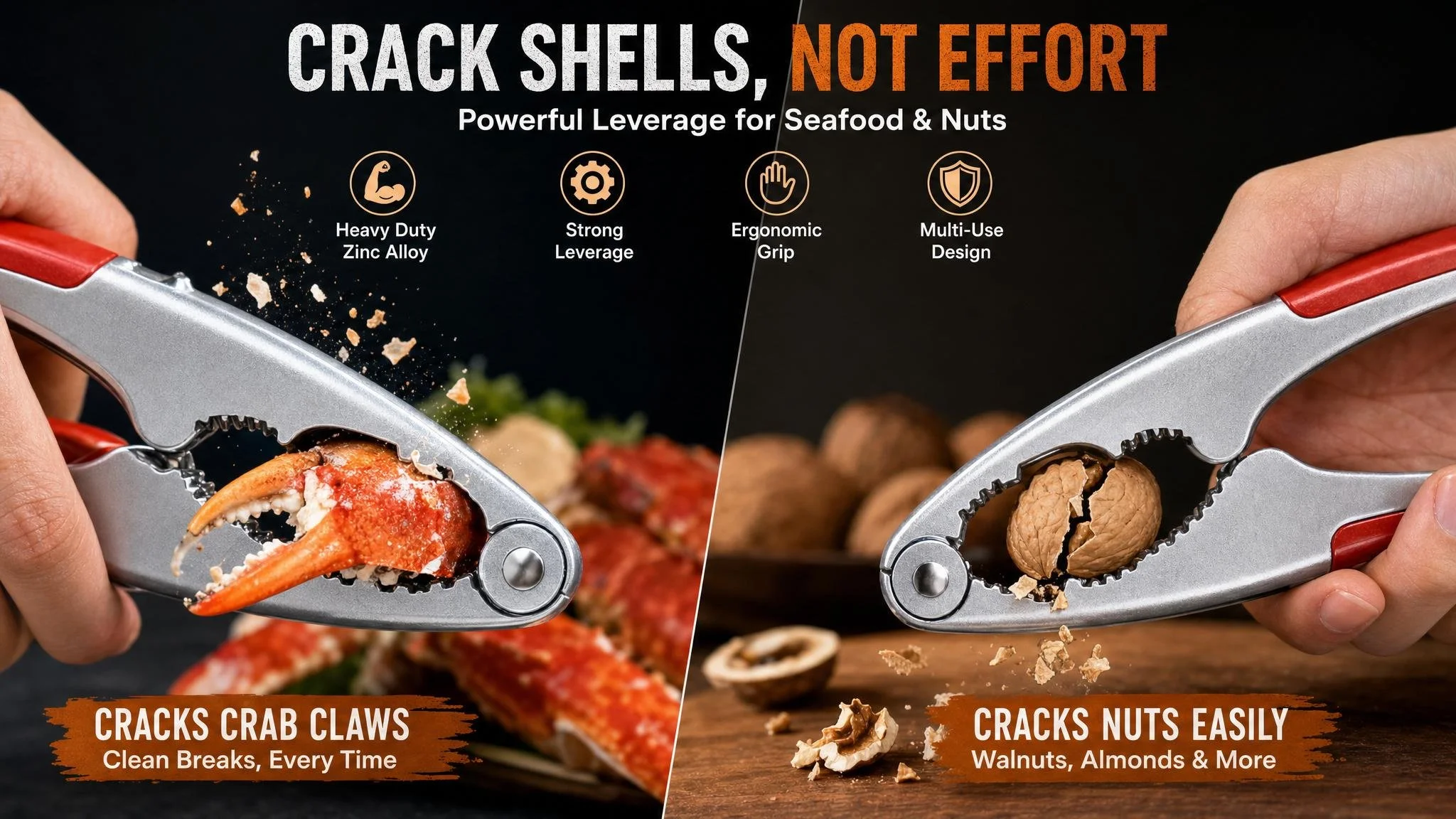 These shifts are not “aesthetic upgrades”; they are conversion enablers. Each image is repositioned to answer a doubt: “Is it strong?”, “Can I control the pressure?”, “Can it handle nuts too?”
The Bullet Points Had Information, but Not a Buying Logic
Textually, the original bullets over-invested in specs and ergonomics and under-invested in the emotional and functional logic that made the competitor’s page work.
Comparative structure:
- Customer bullets:
1. Size and dimensions
2. Material description
3. Ergonomic design principle
4. Multi-function scenarios
5. Usage and maintenance guide
- Benchmark bullets:
1. Package & occasions – “good helper for holding seafood parties”
2. Durability & corrosion resistance – “used for a long time”
3. Hands substitute – eat seafood “elegantly and simply”
4. Dishwasher-safe – don’t worry about cleaning
5. Wide application – multiple seafood and nut types
In other words, the competitor starts from occasion and benefit, then backs into details. The customer starts from technicalities, with weak emotional hooks.
The optimized bullets reversed the logic:
- BP #1 – Value & scenario
“Value Pack for Seafood Lovers… essential for hosting seafood parties or family dinners.” This connects set-size and completeness directly to hosting and social use.
- BP #2 – Durability
“Sturdy Zinc Alloy Construction… heavy-duty… anti-corrosion and anti-rust.” This translates material choice into clear longevity and reliability.
- BP #3 – Ergonomics as experience
“Ergonomic Design & Elegant Experience… comfortable, non-slip grip… handle crab legs and lobster shells elegantly…” Ergonomics is reframed as less hand strain and more graceful eating, mirroring competitor messaging but grounded in the product’s real design.
- BP #4 – Versatile multi-use
Explicitly enumerating crab legs, lobster tails, scallops, oysters, walnuts, almonds, pecans. This moves beyond vague “multi-use” to keyword-rich, concrete variety.
- BP #5 – Cleaning simplicity
“Easy to Clean and Maintain… simply rinse or wash with mild detergent… reduce residue buildup.” This strips away technical maintenance talk and focuses on the low-friction cleanup sellers know is critical for kitchen tools.
Collectively, the bullets shift from “what it is” to “why it matters in use,” which is exactly where the original Listing underperformed.
A Missing A+ Story Turned a High-Intent Visitor into a Bounce
The single largest scoring gap was the detail/A+ content:
- Customer: 0 / 25
- Benchmark: 21 / 25
On Amazon, A+ is where you close the loop: you justify price, prove robustness, and visually walk the shopper through use. The competitor used A+ to cover the entire value chain:
1. Core set overview – clearly showing all tools in the box, on a premium stone or marble surface with fresh seafood.
2. Material & cleaning – metal quality plus a real dishwasher action scene.
3. Core function close-up – macro shot of cracking shells.
4. Picking-extraction detail – showing how the small tools cleanly extract meat.
5. Nut functionality – cracking nuts in a different, more rustic context.
6. Component checklist – clear, clean overview of included pieces.
7. Lifestyle/party scene – family table, seafood feast, tools placed at each setting.
Our customer had none of this. For a buyer comparing two tools at similar price points, one page shows a complete narrative of “from unboxing to party cleanup”; the other effectively says, “Here is a tool; trust us.”
DeepBI’s recommendation was to rebuild A+ along a precise logic flow:
1. Core set panoramic shot
- Full set of seafood tools arranged on a marble-like background with king crab legs and lemon slices.
- Purpose: answer “Is this set complete enough?” and build premium feel in one glance.
2. Material & dishwasher scene
- Split-screen: close-up of the tool against a dark textural backdrop vs. a real kitchen scene with someone placing the cracker into a dishwasher.
- Purpose: lock in durability + low cleaning effort.
3. Function strength demo
- Macro shot of the cracker crushing a crab claw, visible cracks, clear handle texture.
- Purpose: quantify “cracking power” in a way text alone cannot.
4. Pick-tool precision
- Close-up of a pick tool extracting shrimp meat from a leg on a white plate.
- Purpose: show the “minor” accessory as a high-precision helper, not an afterthought.
5. Nut-use module
- Cracking a walnut on wood, with shells scattered around.
- Purpose: expand perceived usage beyond seafood seasons, strengthening year-round relevance.
6. Component checklist
- Flat lay of all tools on white, with quantities clearly noted.
- Purpose: de-risk price comparison, emphasize value per set.
7. Family/party scene
- Full table with lobster, crab, glasses, and the tools laid out at each place setting.
- Purpose: connect the product to celebration and social moments, not just utility.
“Advertising does not only amplify advantages. It can also amplify a page’s existing defects.”
Before investing more in Amazon ads, this missing story had to be built, or every extra click would simply pass through an empty mid-funnel.
Why DeepBI Did Not Recommend “Tune the Ads First”
When we aggregated all the scoring evidence, the decision sequence was clear:
- Title: structurally weaker, under-communicating value and durability.
- Main image: acceptable baseline, but lacking proof-of-operation and professional detail.
- Bullets: logically misaligned with how buyers choose seafood tools.
- A+: non-existent.
- Reviews: zero.
At this stage, the biggest business risk was not “insufficient traffic.” It was paying to send traffic into a page that hadn’t earned the right to be scaled.
DeepBI’s judgment was:
1. Fix conversion capacity first
- Because any ad investment atop a 0/25 A+ score and 0/15 review score is structurally fragile.
- Because even organic visitors will not convert robustly without trust and story, which in turn slows review accumulation and organic ranking.
2. Use the benchmark as a ceiling, not a template
- Extract the logic: set completeness, durability, elegance of use, cleaning ease, multi-use, social scenes.
- Rebuild those ideas using the customer’s real product attributes and visual DNA, not copying competitor specifics.
3. Only then re-evaluate Amazon ads
- Once the page can convincingly present value, usage, and trust, ad clicks become testable rather than simply expensive.
This is the opposite of the initial seller instinct, which is often: “If we just push more traffic, the rest will sort itself out.”
How the Page’s Sales Logic Started to Recover
After the Listing was reframed around conversion fundamentals rather than traffic volume, several structural improvements became available—even before any new data rolled in:
- The title now aligned high-intent queries (“crab cracker,” “seafood tools”) with explicit durability and multi-use signals (“Heavy Duty Zinc Alloy… King Crab Legs, Walnuts and Almonds”).
- Main and secondary images were mapped to specific doubts: “Is it strong?”, “How big is it?”, “Can I use it for nuts?”, “Is it actually comfortable to grip?”
- Bullets shifted from spec-heavy to outcome-led: social occasions, elegance, hand comfort, easy cleaning, and clear multi-use.
- A+ modules were designed to walk a shopper from “what’s in the box” to “this fits my kitchen, my sink, and my table,” matching the best-performing competitor’s narrative structure.
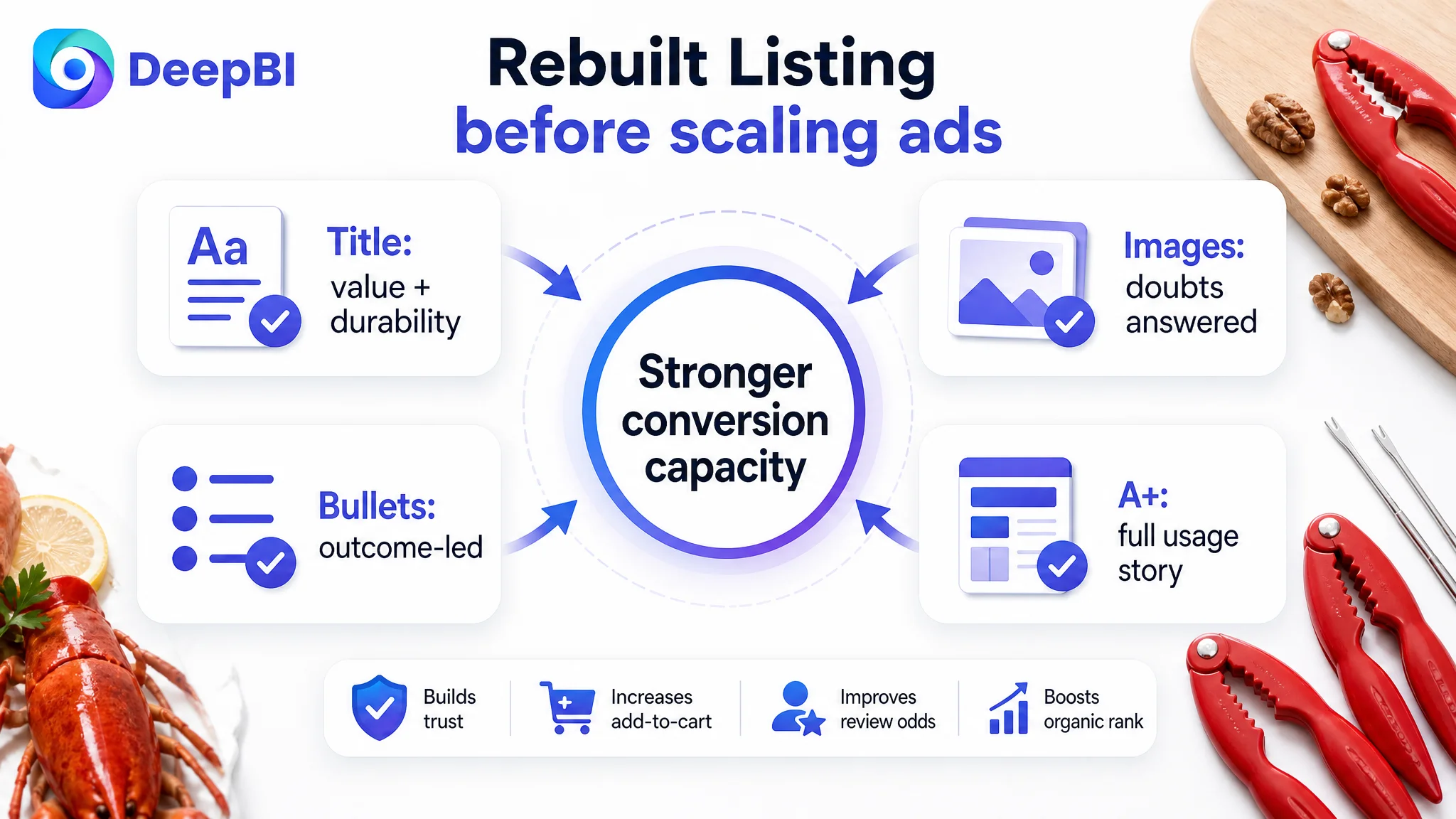 Even without fabricating performance metrics, these changes increase the Listing’s inherent conversion potential. When ad traffic resumes or scales:
- Every click has a higher probability of turning into a cart add or purchase.
- Early buyers are more likely to feel their expectations were met (or exceeded), which improves the odds of genuine positive reviews.
- Over time, organic ranking can stabilize because the page stops “wasting” impressions.
What This Changed in the Seller’s Understanding
This case left the customer team with a different mental model of Amazon operations:
1. High ACOS is not always an ad problem.
In this category, the lack of A+ content and zero-review state meant conversion was structurally handicapped, independent of keyword targeting.
2. Listing quality is the foundation of ad efficiency.
Without a coherent title, visual proof, bullets that mirror buyer logic, and A+ that builds trust, ads are just a faster way to burn money.
3. Title, main image, bullets, and A+ must tell one story.
Here, that story shifted from “two red tools, some specs” to “a durable, multi-use, party-ready seafood and nut set that is easy to clean and pleasant to use.”
4. Before scaling ads, ask: does this page deserve more traffic?
In DeepBI’s scoring, a 41 vs 75 gap against a close benchmark was a red flag that the page did not yet deserve aggressive paid traffic.
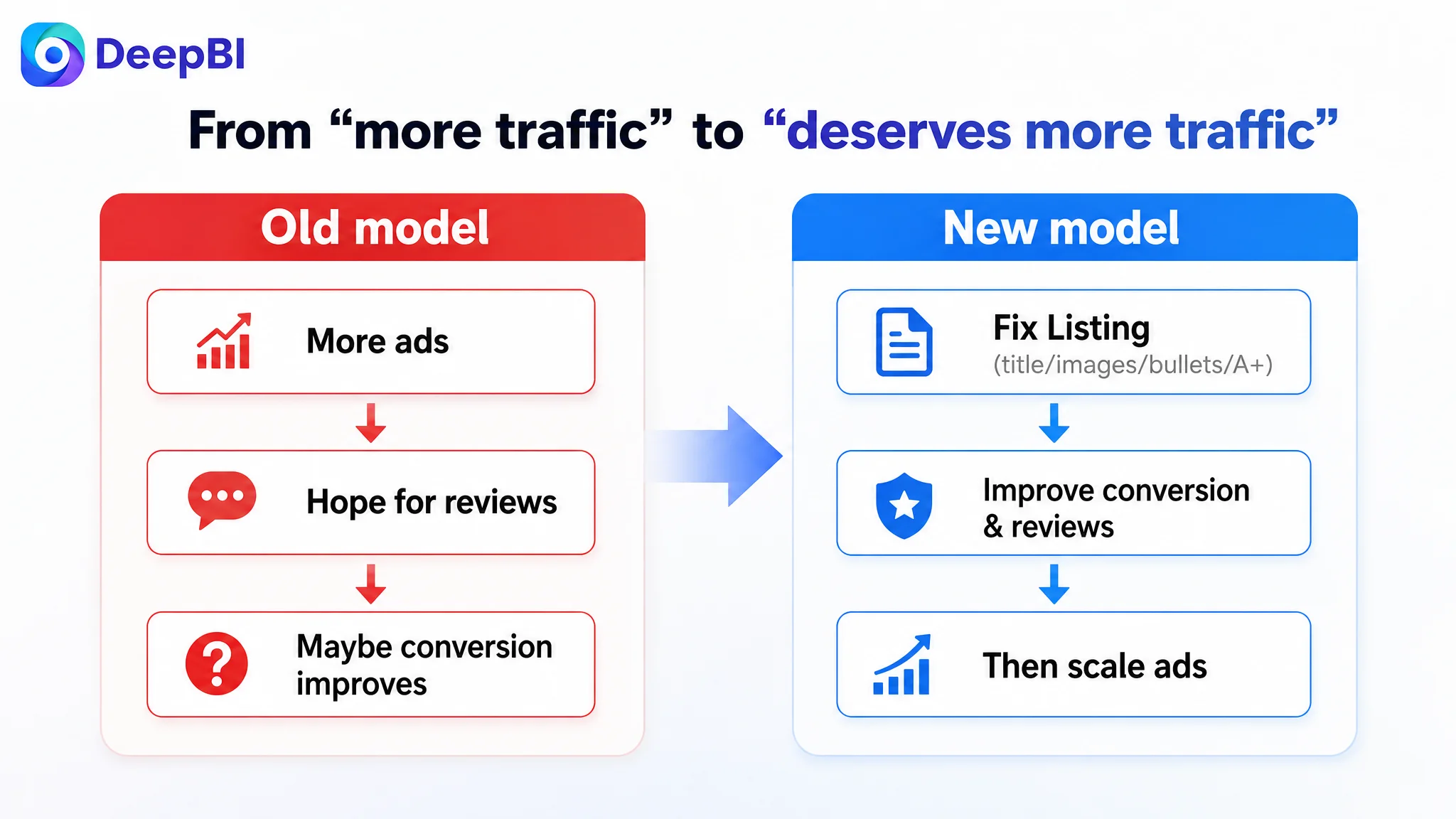 For other Amazon sellers—whether in kitchen tools, craft supplies, or automotive accessories—the lesson is consistent: when traffic exists but orders do not follow, look hard at the Amazon product page before touching the bids. Conversion leaks on the Listing side are often where ad “problems” truly begin.