

This Amazon seller came to DeepBI with a familiar headache: ads for a suction shower head holder in the US marketplace were driving traffic, but orders stayed weak and ACOS was hard to bring down. Internally, the team’s judgment was clear—this was an Amazon ads problem. They tried to adjust bids, tweak keywords, and restructure campaigns, expecting lower CPC and better return to fix the issue.
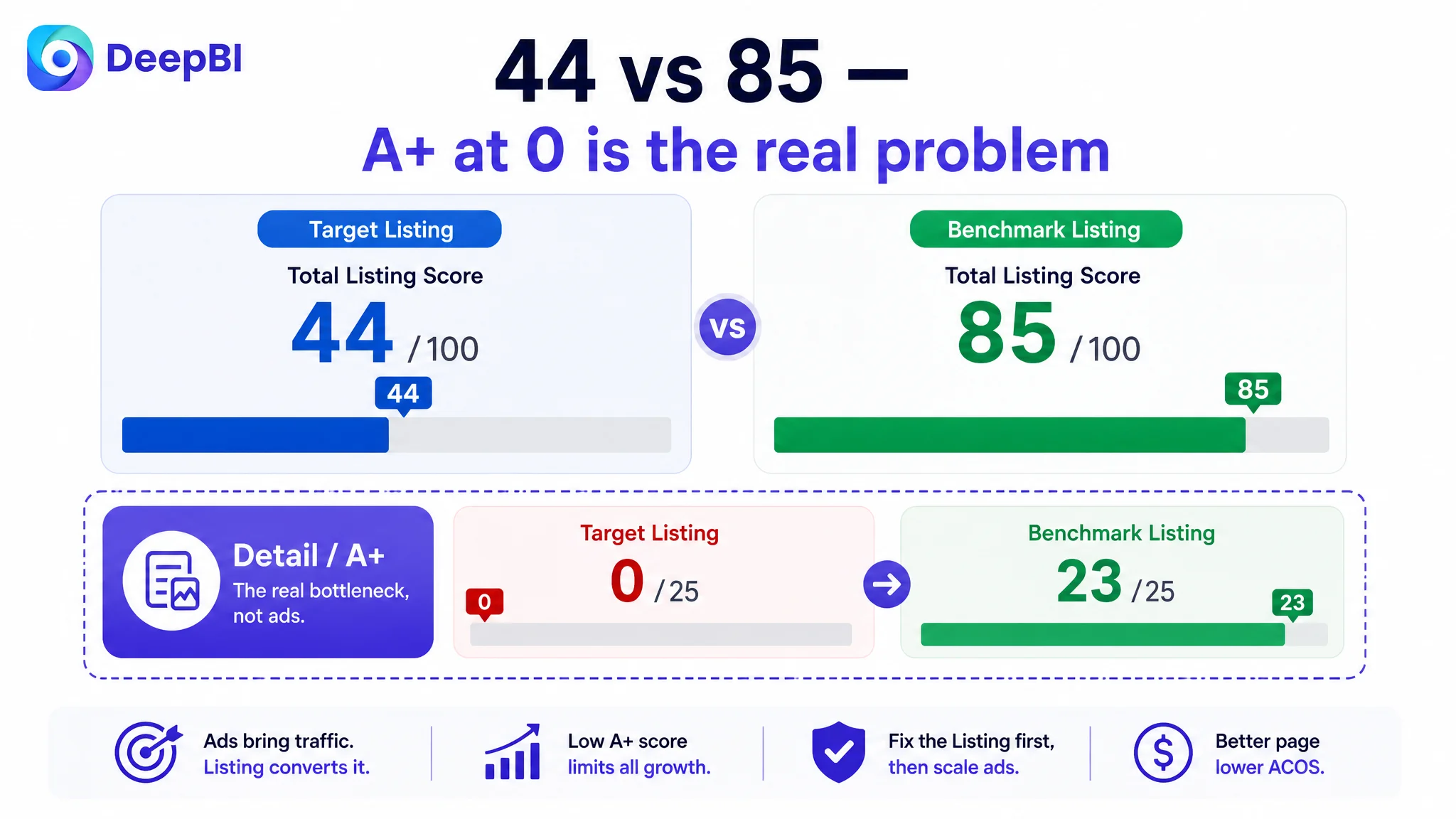
Once we put the product page under DeepBI’s Listing diagnosis, a very different picture emerged. The Amazon Listing itself had a total score of 44/100 versus a benchmark competitor at 85/100. Title, images, bullets, A+ content, and reviews all lagged—especially the detail page, which scored 0/25. In other words, ads weren’t failing; the product page was consuming the traffic.
The later optimization work therefore did not start from more ad tuning. It started from rebuilding the Listing’s conversion capacity: tightening the Amazon title around high-intent queries, reconstructing the image set to show compatibility, waterproofness, and load-bearing, and designing a full A+ structure that clarified surfaces, sizes, and use cases (children, elderly, pets). Once the page could actually persuade, ad traffic had somewhere to land.
For other Amazon sellers, this case is a warning: when ACOS gets stuck, it is easy to over-focus on advertising levers. But if your Amazon product page scores like this one did—44 vs 85; 0 in A+; weak trust signals—no amount of bid optimization will save you. Listing conversion is not a cosmetic issue; it is the foundation of every ad dollar you spend.
The Core Conflict: Ads Were Paying for Traffic a Weak Listing Couldn’t Convert
DeepBI’s Listing scoring put numbers on what the seller only felt loosely from ad reports.
- Target Listing total score: 44/100
- Benchmark Listing total score: 85/100
- Gap: –41 points
By dimension:
- Title: Target: 11, Benchmark: 16, Max: 20, Gap: -5
- Main Images: Target: 23, Benchmark: 27, Max: 30, Gap: -4
- Bullets: Target: 5, Benchmark: 8, Max: 10, Gap: -3
- Detail / A+: Target: 0, Benchmark: 23, Max: 25, Gap: -23
- Reviews: Target: 5, Benchmark: 11, Max: 15, Gap: -6
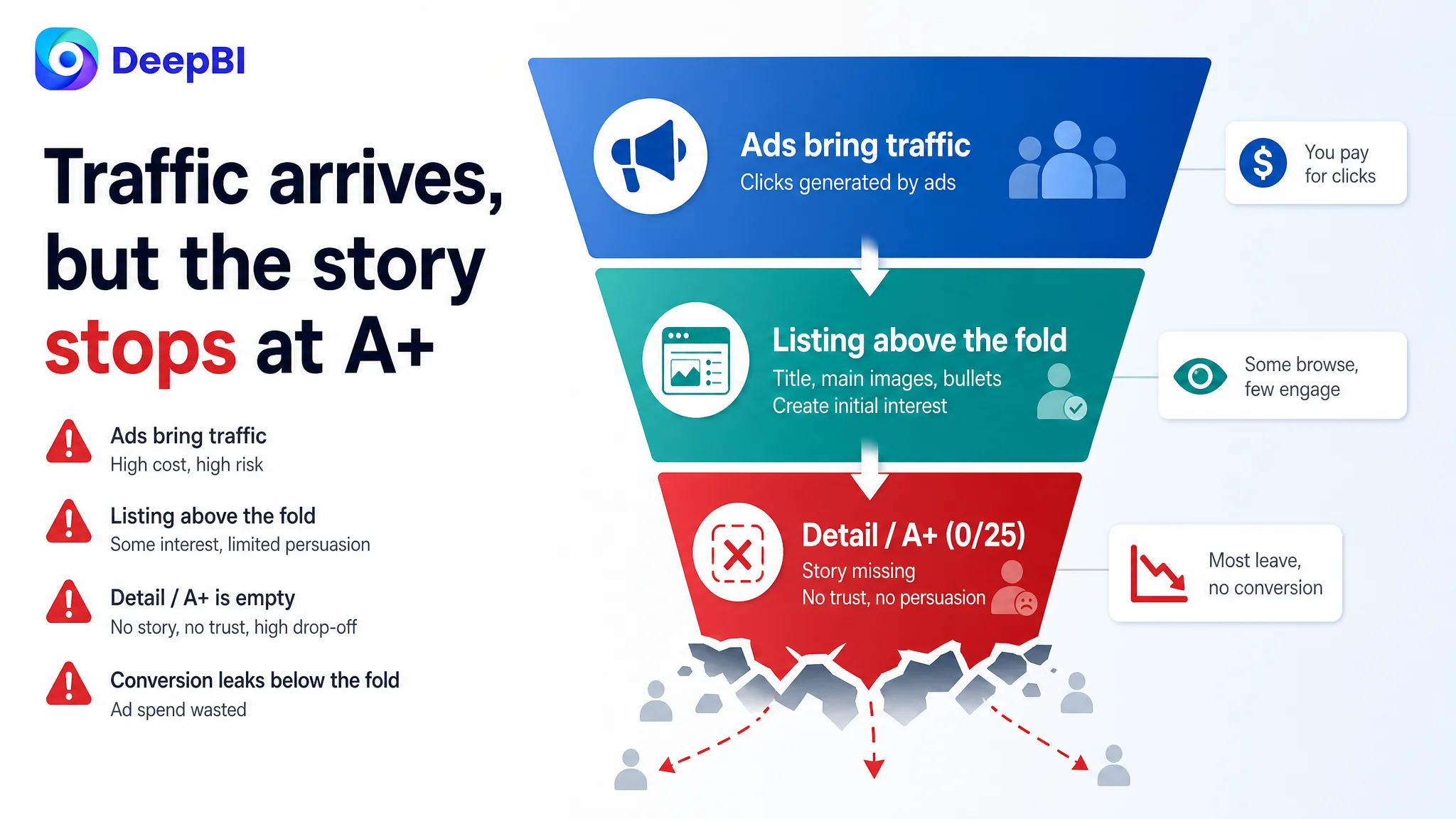
The number that matters most here is not the total score; it is the 0 in detail/A+ against 23 for the competitor. That 0 means: no structured story below the fold, no trust-building modules, no explanation of surfaces, sizes, or installation risks. Yet the brand was actively buying traffic through Amazon ads.
“The real problem was not that ads failed to bring traffic. It was that the page could not convert the traffic.”
From a business perspective, this is the worst combination: rising ad expenditure, weak Listing conversion, and a direct competitor that has already built a full persuasive A+ funnel. Every extra click purchased with ads simply increases the cost of exposing your weakest area.
What the Seller Originally Misdiagnosed
From the seller’s perspective, the situation looked like a classic advertising efficiency problem:
- ACOS uncomfortably high.
- Traffic volume from Amazon ads reasonable.
- Orders not scaling with spend.
- CPC in some keywords pushed up by category competition.
The natural conclusion: “Bids and keywords must not be tuned enough. We should refine match types, negate more search terms, and re-allocate budget.”
So the team:
- Reworked campaigns and ad groups.
- Adjusted bids by placement.
- Shifted budget towards higher-CTR targets.
What did not change:
- The core Amazon product title structure.
- The main-image set.
- The absence of any A+ content.
- The weak review base and what it signaled to shoppers.
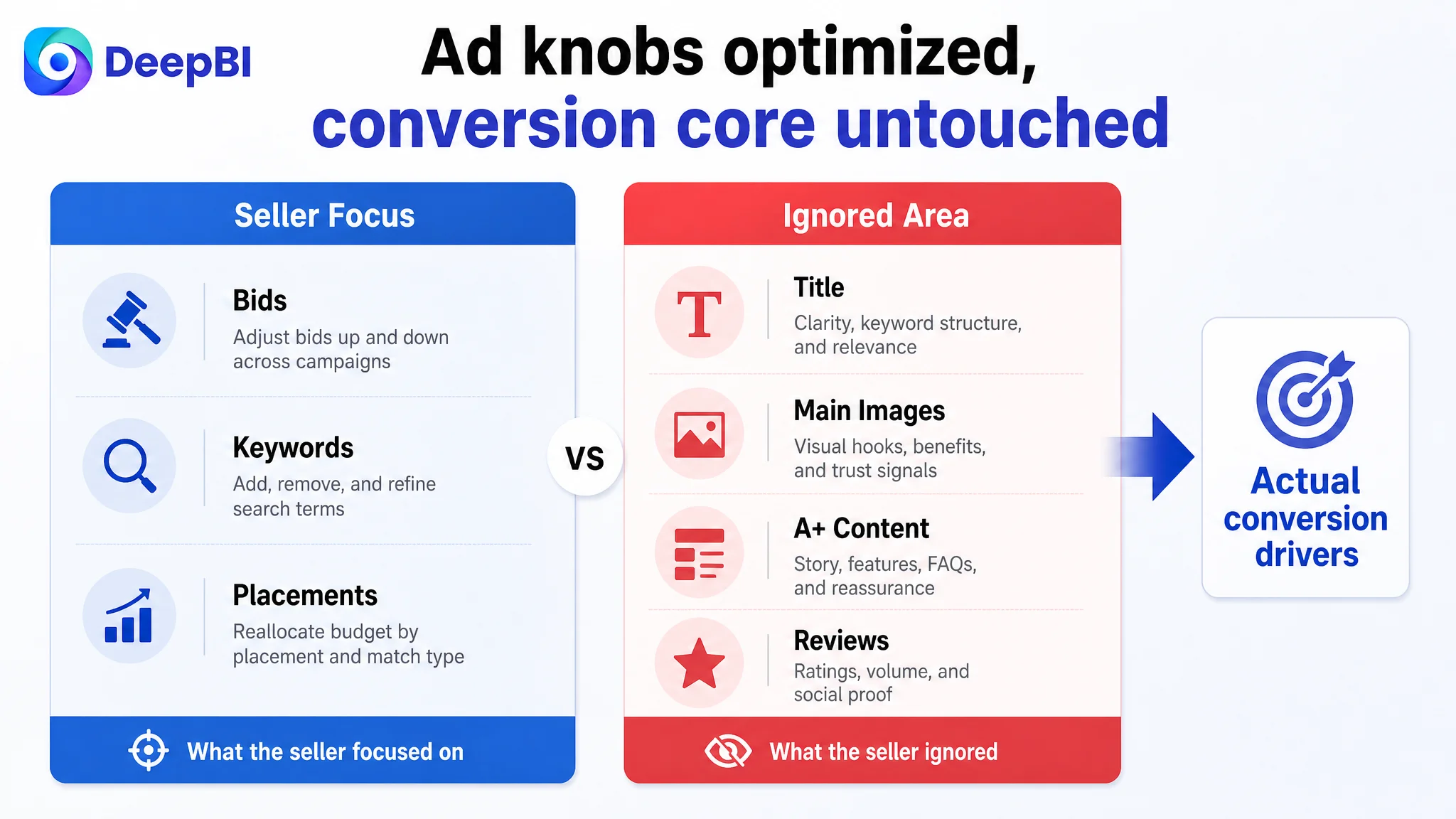
This is how many Amazon operations teams get trapped: they keep iterating on the part of the system they own daily (ads), and leave the part that actually decides conversion (the Listing) relatively untouched because it feels “good enough.”
Why Traditional Amazon Ad Optimization Couldn’t Work Here
DeepBI’s logic is simple: if a page cannot convert, more precise ads just buy more non-converting sessions.
Several structural problems made traditional ad optimization ineffective in this category:
1. Listing conversion capacity was objectively low
The 44 vs 85 score wasn’t about taste; it captured specific commercial gaps:
- No A+ modules at all (0/25).
- Significantly weaker review footprint (3.8 stars, 9 reviews vs 4.2 stars, 353 reviews).
- Less focused title and image information about surfaces, compatibility, and installation speed.
Even if ads drove highly relevant search terms (e.g., “suction shower head holder no drilling”), users landed on a page that did not answer the main decision risks.
2. The competitor’s page had already “standardized” the decision logic
The benchmark Listing had:
- Brand-forward title and structured attribute sequence.
- A+ content explaining:
- “No waiting installation” vs “24 hours wait” for glue/adhesive.
- Surface compatibility.
- Size fit.
- Use/Reuse guide.
- Multi-scenario use (baby, pet, elderly).
On Amazon, once one or two strong competitors define a clear decision framework, shoppers subconsciously expect that standard. A page that doesn’t follow it feels incomplete.
3. The risk was being paid for twice
- First, through low CTR on a visually weaker main-image set.
- Second, through low CVR caused by missing A+ and weak reviews.
Every ad dollar simultaneously exposed both weaknesses.
Listing Data Abnormalities DeepBI Flagged
1. Title: Keywords Present, Decision Logic Weak
The competitor’s Amazon title:
- Starts with brand (platform-consistent structure).
- Quickly concentrates critical attributes:
- Adjustable height & angle
- Wall mounted
- Waterproof
- Adds specific attributes (color, material, shape).
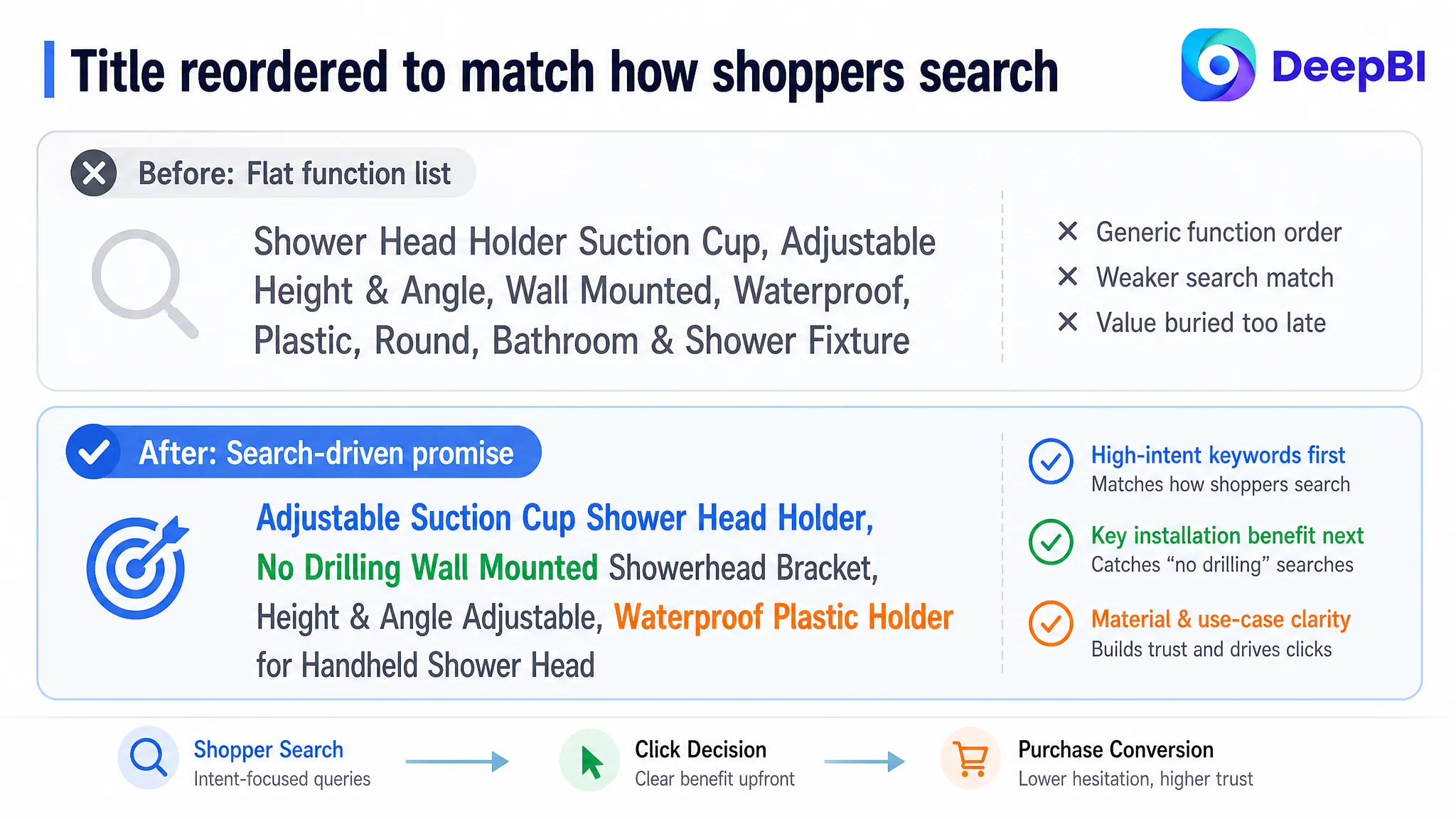
The customer’s title:
- Covered core keywords.
- But read like a flat function list instead of a decision path.
- Lacked clear front-loaded promise around adjustability and no-drill, and did not maximize attribute coverage for search and clarity.
DeepBI’s suggestion re-ordered the logic:
“Adjustable Suction Cup Shower Head Holder, No Drilling Wall Mounted Showerhead Bracket, Height & Angle Adjustable, Waterproof Plastic Holder for Handheld Shower Head”
The change is not cosmetic. It does three things:
- Puts “Suction Cup Shower Head Holder” and “Adjustable” at the front.
- Integrates “No Drilling”, “Wall Mounted”, “Waterproof” together.
- Removes redundant terms and keeps the string clean for both Amazon search and human scanning.
2. Main Images: No Real Hook in Search Results
The benchmark Listing used its image slots strategically:
- Scene images that speak to pet owners and families with children.
- A 6-step installation guide with do/don’t examples and temperature tips.
- A high-contrast “1s installation” visual hook.
The customer’s main images:
- Standard white-background product shot as #1.
- Limited installation and usage info.
- No strong visual statements about waterproofness, load-bearing, or compatibility.
As a result:
- CTR drag: No truly distinctive visual to win the click on crowded Amazon search pages.
- Trust drag: Once clicked, users didn’t quickly see proof of “won’t fall”, “fits my shower head”, “works on my wall”.
3. Bullets: Information Present, but Not Purchase Logic
Structurally:
- Benchmark bullets start with:
- Precise size & compatibility (down to hose diameters).
- Clear list of suitable and unsuitable surfaces.
- “1-second installation”, “no drilling”, “no marks”.
- Specific user groups: children, elderly, disabled, pets.
- Installation troubleshooting tips.
- The target Listing bullets:
- Open with generic material description.
- Talk about function and advantages in broad strokes.
- Mention installation, scenes, and craftsmanship.
- No closing loop on after-sales or problem solving.
DeepBI’s bullets reframe the structure from “describing” to “screening + de-risking + scenarios”:
- Bullet 1: Compatibility & precise fit (diameter range, measure before purchase).
- Bullet 2: Optimal surface guide (what works, what doesn’t).
- Bullet 3: 1-second, tool-free installation & wall protection.
- Bullet 4: Engineering-grade ABS with durability in wet conditions.
- Bullet 5: 360° adjustable & multi-user design (children, elderly, pets).
- Bullet 6: Installation tips & troubleshooting.
This transforms bullets into a decision-flow:
“Can I use it?” → “Will it stay?” → “Is it easy?” → “Will it last?” → “Is it right for my household?” → “What if installation fails first time?”
4. Detail Page / A+: A Complete Void vs a Full Story
The most severe abnormality was the detail page:
- Target Listing: No A+ content at all.
- Benchmark Listing A+ covered:
- Brand value proposition.
- Iconized core benefits.
- Scene-based installation demos.
- Multi-angle function breakdown.
- Load-bearing and durability test visuals.
- Size and compatibility charts.
- Competitive comparison (“no wait” vs “24h wait”).
- Surface applicability.
- Multi-scenario usage.
Without A+, the target Listing:
- Could not answer “Will it fall off my wall?” with quantified evidence.
- Could not show real-life use for children or pets.
- Could not educate users on where not to install it.
- Had no visual trust anchor to balance its weaker review base.
“Advertising does not only amplify advantages. It can also amplify a page’s existing defects.”
5. Reviews: Trust Deficit
- Target: 3.8 stars, 9 reviews, with 40% of homepage reviews ≤ 3 stars.
- Benchmark: 4.2 stars, 353 reviews, only 27% of homepage reviews ≤ 3 stars.
The target Listing’s review system:
- Is still in its early stage.
- Has a visible trust gap on first glance.
- Has insufficient positive volume to “wash out” early defects.
With such a thin and fragile review layer, the responsibility to build trust shifts even more heavily onto Listing content and A+. But here, A+ was absent.
How DeepBI Reframed the Problem: The Real Constraint Was Listing Conversion
Putting these observations together, DeepBI’s judgment was:
- This is not primarily an Amazon ads problem.
- The binding constraint is the Listing’s conversion capacity, particularly:
- No A+.
- Weak structured bullets for risk management.
- Under-leveraged main-image slots.
- Trust deficit vs a benchmark that has standardized the category’s persuasion model.
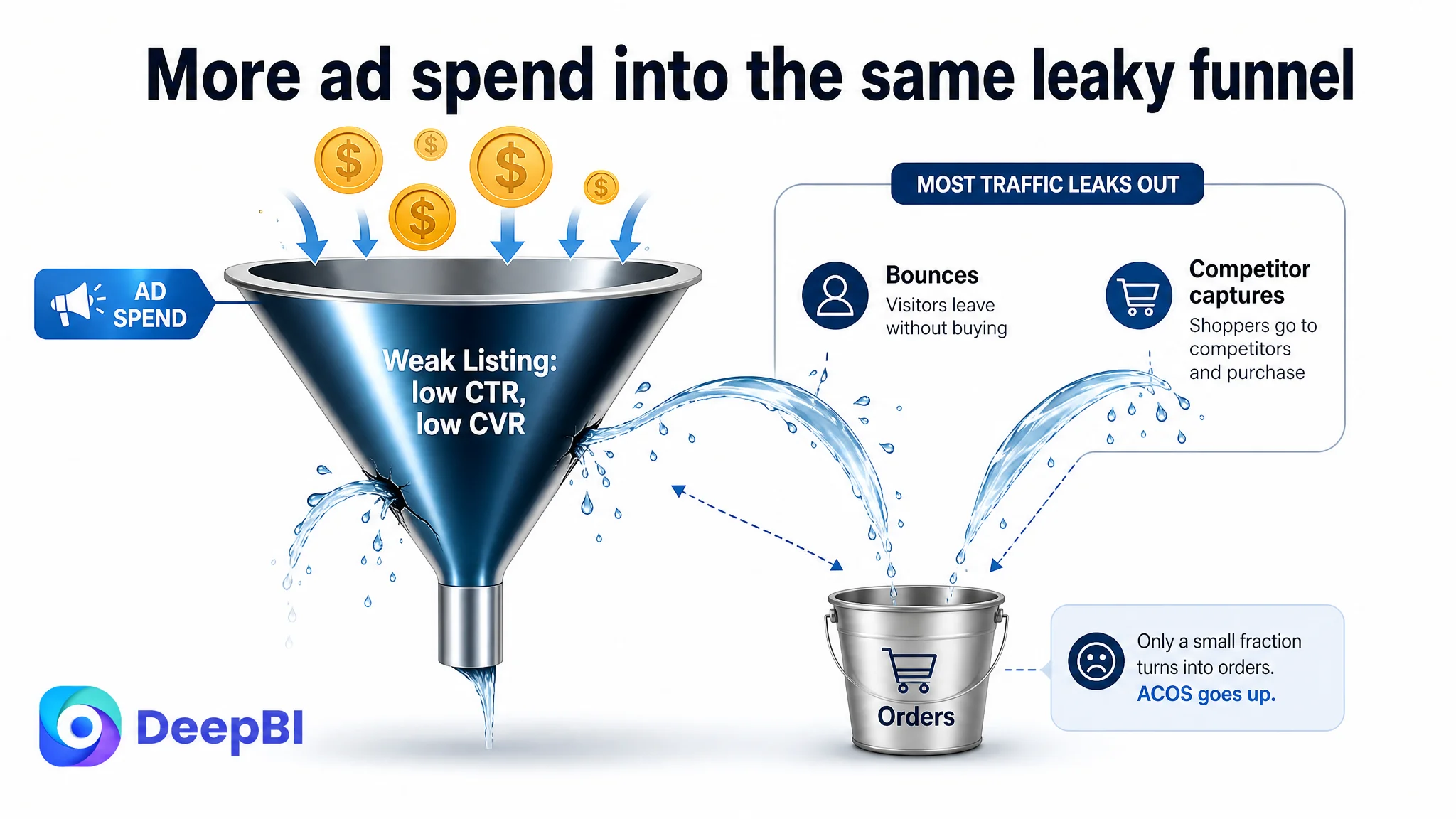
The key business risk:
- Every additional ad dollar thrown in would go through the same leaky funnel:
- Lower CTR because of weak visual hooks.
- Lower CVR due to missing answers on compatibility and surfaces.
- Strong competitor pages that capture users who bounce.
In that state, optimizing bids and keywords first would optimize the wrong object. It would only help the seller pay slightly more or less for each wasted or half-converted visit.
Why Listing Conversion Had to Be Fixed Before More Ad Tuning
The decision order DeepBI recommended:
1. Rebuild the Listing so it deserves traffic.
2. Then relaunch and refine ads on top of a page that can actually convert.
The logic:
- If CTR is dragged down by weak main-image hooks, you pay more impressions for each click.
- If CVR is dragged down by lack of A+ and risk explanation, you pay more clicks for each order.
- Ads cannot “argue” on your behalf; your Amazon product page must.
Fixing the Listing first addresses three compounding problems simultaneously:
1. Reduces wasted ad spend.
A more convincing page recaptures value from the traffic you already pay for.
2. Improves organic conversion and ranking.
Better conversion improves relevance signals, which supports organic keyword positions, reducing overdependence on ads.
3. Stabilizes traffic structure.
Once the page can convert both paid and organic traffic, the business isn’t forced to keep “buying” every unit of volume with ads.
How the Page’s Sales Logic Was Reconstructed
DeepBI’s recommendations focused on rebuilding the decision journey inside the Amazon Listing.
Title: From Feature List to Search-Driven Promise
- Clarified the main product phrase and front-loaded it.
- Integrated adjustability, no-drill, waterproof, wall-mounted into one clean, readable sequence.
- Removed redundancy like double “holder/mount” while preserving semantic richness for Amazon SEO.
Resulting direction: a title that matches user intent and aligns with how the top competitor already educates searchers on Amazon.
Main Images: Creating Click and Trust Hooks
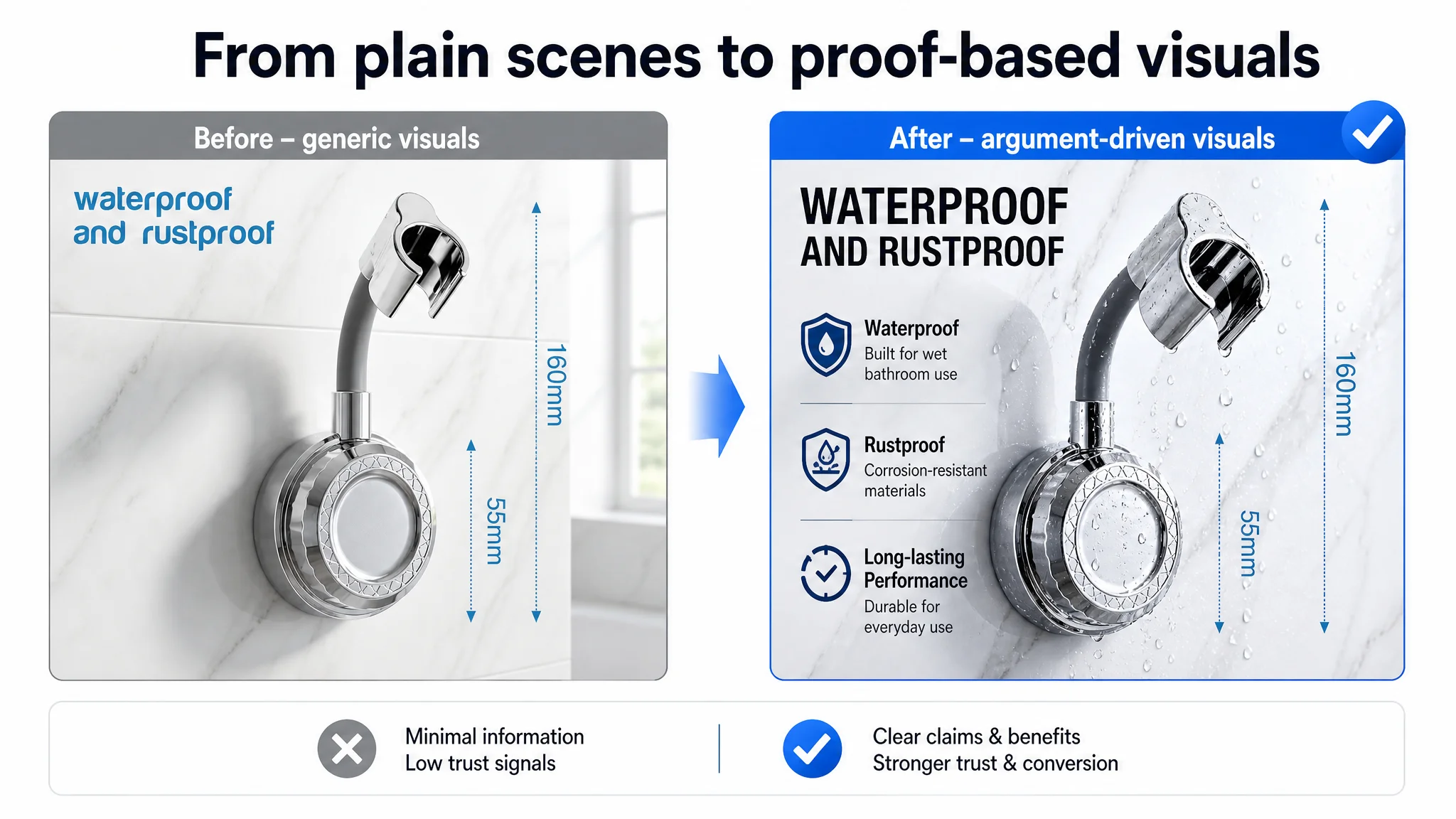
The rebuilt image plan was anchored in a “modern clean industrial” look, cold-toned lighting, and professional studio feel, but every suggestion had a conversion purpose.
Key roles:
- Hero image:
- Product centered, about 75% of frame.
- Clear 45° angle, clean white background, strong side lighting, sharp shadow.
- Goal: stand out on the search results row and signal quality.
- Dimensional and compatibility image:
- Front-on neutral lighting.
- Explicit internal diameter and height annotations next to the holder.
- Goal: eliminate “Will my hose fit?” anxiety.
- Waterproof/durability image:
- 45° upward angle, water droplets and flow, marble wall background.
- Bold text callout “Waterproof and Rustproof”.
- Goal: show, not claim, long-term use in wet bathrooms.
- Load-bearing proof image:
- Low-angle shot emphasizing strength.
- Professional plate marked “10KG” hanging from the hook.
- “Stable Load-bearing” caption.
- Goal: visually answer “Will it fall?” with quantified evidence, improving conversion and reducing returns.
- Adjustability image:
- Overlay of multiple positions (up, horizontal, down) with clear arrows.
- Goal: make height & angle adjustable obvious without reading bullets.
These are not “pretty pictures.” They are visual responses to the core friction points identified from the competitor and from reviews.
Bullets: Turning Text Into a Conversion Funnel
DeepBI’s bullet suggestions aligned closely with how the benchmark already guided buyers, but tailored to the customer’s product:
1. Universal Compatibility & Precise Fit
- Shows targeted diameter range and urges measurement before purchase.
- Reduces returns and negative reviews from misfit.
2. Optimal Surface Guide
- Lists acceptable surfaces (tiles, glass, mirror, polished metal, plastic).
- Clearly calls out unsuitable ones (lime walls, wallpaper, textured wood).
- Screens out wrong-use scenarios before purchase.
3. 1-Second Tool-Free Installation
- Takes the benchmark’s “1 second installation” concept but grounds it in simple steps: clean, press, twist.
- Connects directly to the no-drill, no-marks value for renters and homeowners.
4. Engineering-Grade ABS Material
- Upgrades the material vocabulary to something buyers recognize as professional and durable in wet environments.
5. 360° Adjustable & Multi-User Design
- Explicitly mentions children, elderly, and pets.
- Binds functional adjustability to real usage scenarios.
6. Maintenance & Installation Tips
- Provides self-help troubleshooting if suction fails initially.
- Reduces support load and protects ratings by turning some “problem experiences” into “success with guidance.”
A+ Detail Page: From 0 to a Structured Persuasion Engine
The biggest structural fix was building an A+ ecosystem where none existed.
The proposed A+ modules followed a clear flow:
1. Brand/Intro Module – Real bathroom scene, no-drill suction strongly highlighted on glossy tiles.
- Establishes first trust: “This is how it looks in a real shower environment.”
2. Core Value / Load-Bearing Module – Close-up of holder with a labeled 5 kg or 11 lbs water bottle load test.
- Quantifies performance against the primary fear: “It will drop.”
3. Multi-Angle Adjustment Module
- Single clean composition showing multiple tilt positions using overlay shadows and arrows.
- Shows adaptability for different heights and use modes.
4. Competitive Comparison Module – “OURS” vs “OTHERS” split.
- Left: 1-second suction, full color, bright.
- Right: 24-hour wait, drilling damage, grayscale.
- Makes the “no-wait, no-damage” advantage explicit and emotionally felt.
5. Compatibility Assurance Module
- Holder close-up plus multiple shower head types shown fitting.
- Size annotations visible.
- Closes the “Will my shower head work?” loop visually.
6. Scenario Application Module
- Three panels: pet bathing (low), bathtub soaking (side), toddler bathing (mid).
- Turns the product from a “hook” into a solution to specific life situations, expanding purchase triggers.
7. Surface Guide Module
- Clean grid with green ticks for suitable surfaces, red crosses for unsuitable ones.
- Connects A+ back to Bullets #2 and #6, standardizing expectations and reducing post-purchase conflict.
Together, these modules rebuild the middle and bottom of the conversion funnel that simply did not exist before. They also reduce operational risk: fewer support tickets about falling holders, fewer returns due to surface mismatch, and fewer low-star reviews caused by mis-use.
How Ad Traffic Became Useful Again
Once this kind of Listing overhaul is in place, the economics of ads change:
- CTR can improve because main images and titles now match how top competitors frame the category and visibly communicate adjustability, no-drill, waterproof, and load-bearing.
- CVR can recover because:
- Size and surface compatibility are clearly explained.
- Load-bearing and waterproofness are visually proven.
- Multi-user scenarios widen perceived value.
- Installation troubleshooting reduces dissatisfaction.
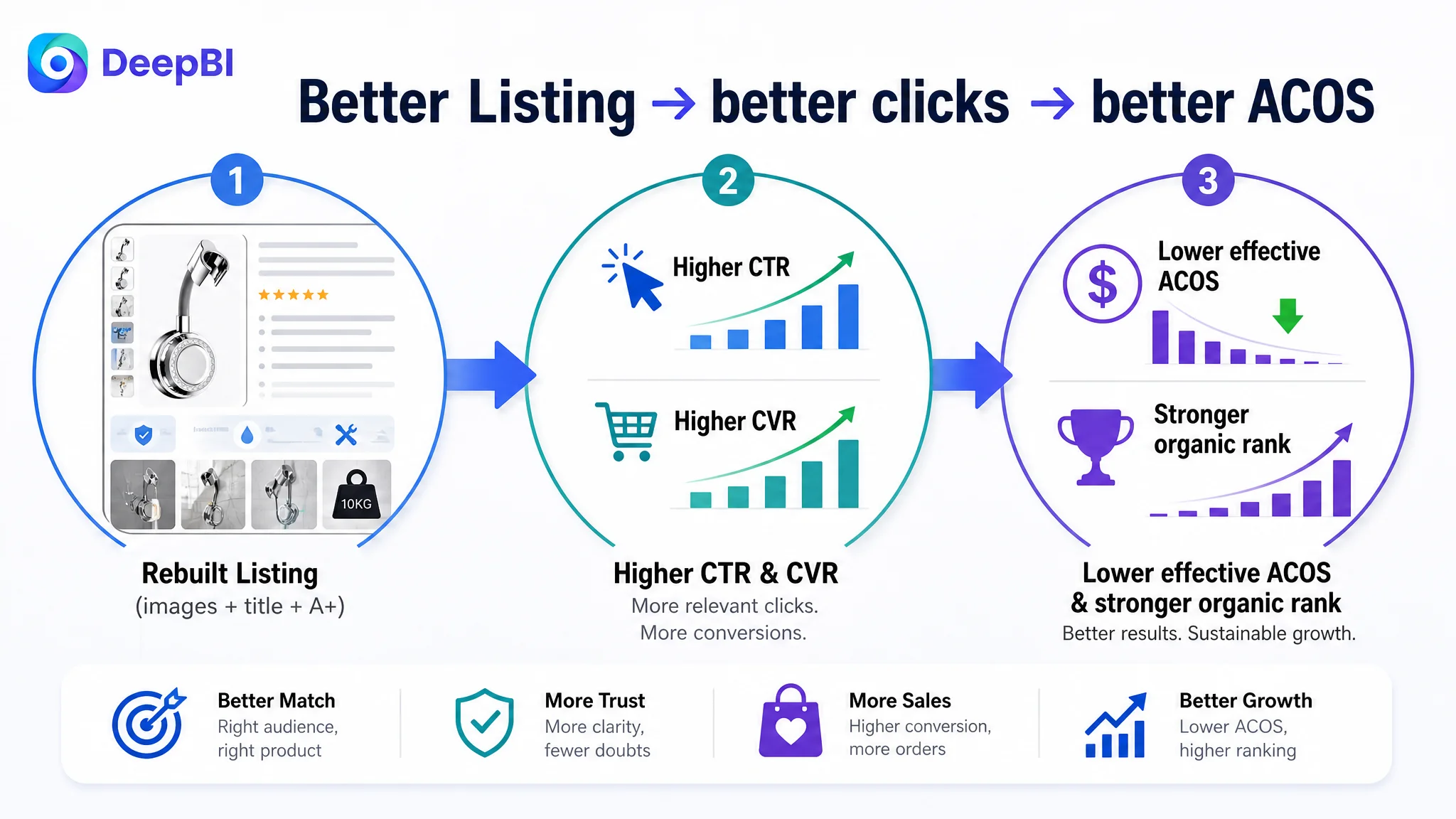
At that point, going back to Amazon ads optimization—bids, search term mining, placement scaling—actually makes sense:
- Each additional click is more likely to convert.
- ACOS has room to move down because both click efficiency and conversion efficiency improve.
- Organic ranking gains from better CVR reduce the paid-share pressure over time.
The seller’s business risk profile shifts from:
- “We are paying to send shoppers into a blind alley”
to:
- “We are paying to send shoppers into a page that now competes on equal or better footing with the category standard.”
What Changed in the Seller’s Understanding
The most important outcome of this case was not just a better page; it was a different mental model of how Amazon growth works.
Key shifts:
- From “ads first” to “Listing first”
The team realized that on Amazon, Listing conversion quality is the ceiling of ad efficiency. Without a solid product page, campaigns become an expensive diagnostic tool instead of a growth lever.
- From “images as aesthetics” to “images as arguments”
Main images, bullets, and A+ are not decoration. They are how you:
- Pre-qualify buyers.
- Eliminate fears.
- Prove performance.
- Expand use cases.
- From “reviews will fix everything later” to “we must carry more of the trust load now”
With a small and imperfect review base, the Listing itself has to do more work. Hiding behind “we just need more reviews” is risky when direct competitors are already in a trust-mature phase.
- From “optimize parameters” to “optimize decision logic”
DeepBI’s scoring and recommendations shifted the conversation away from isolated tweaks and into the structure of how a shopper moves from search term → click → conviction → purchase.
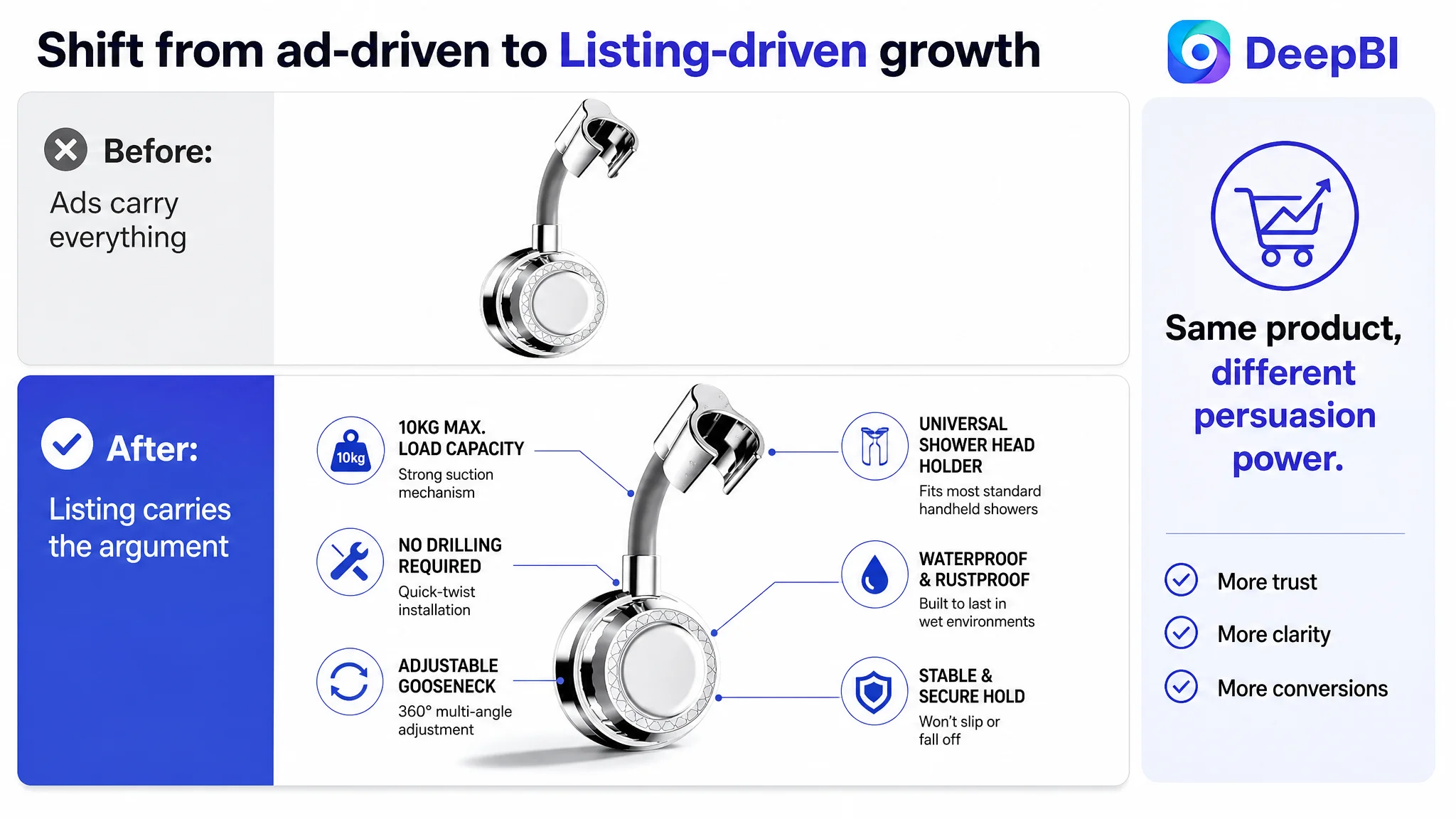
For other Amazon sellers, this case draws a clear lesson:
- If your Amazon ad metrics show stress—rising ACOS, stubborn CVR—and your Listing resembles this one (no A+, weak structured bullets, limited visual proof), do not keep turning ad knobs first.
- Diagnose the Listing conversion capacity head-on.
- Fix title, main-image hooks, bullet decision flow, and A+ trust story before scaling your spend.
Only when your Amazon product page can carry the argument, will your ads stop feeling like a cost center and start behaving like a growth engine.