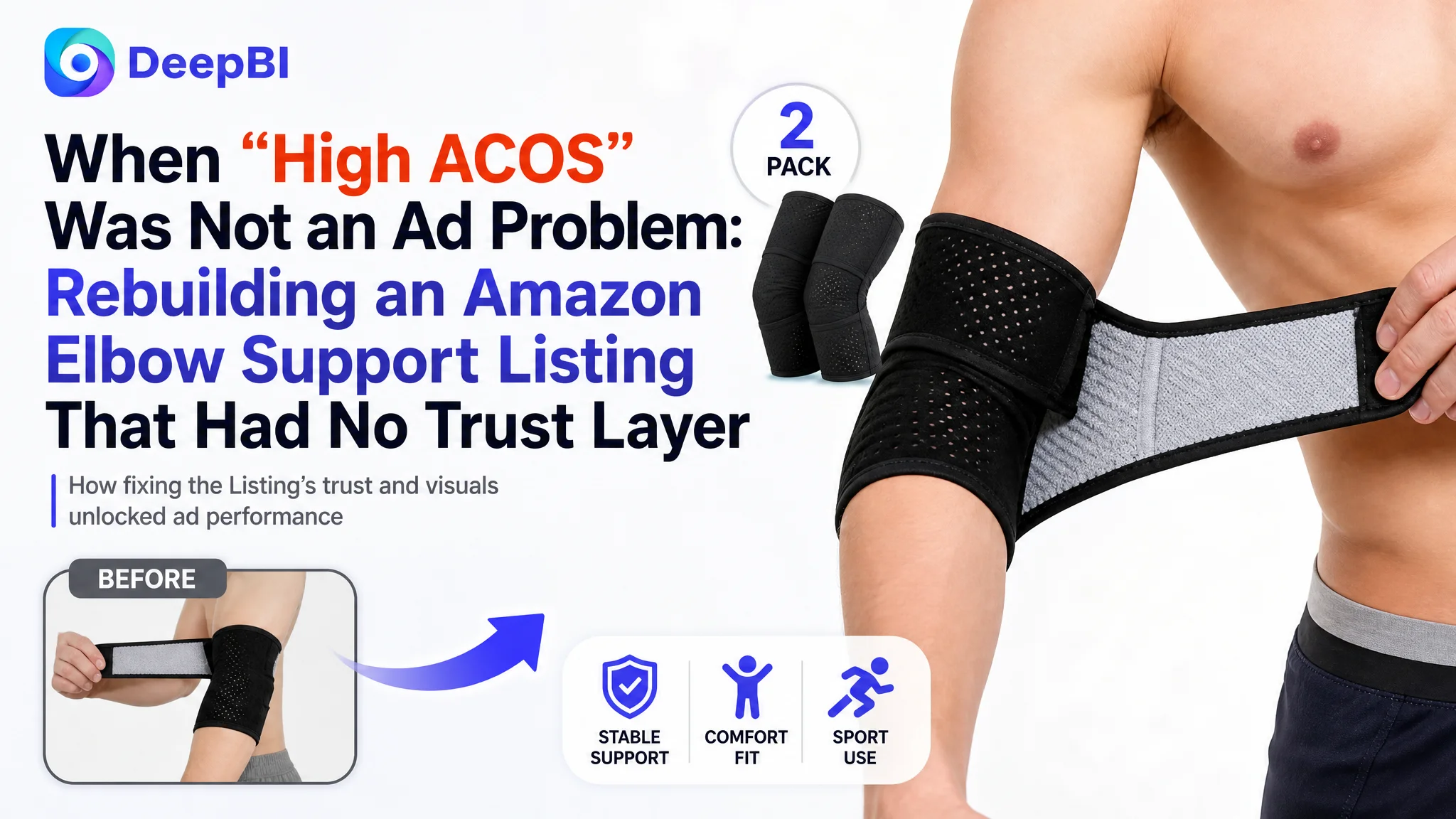
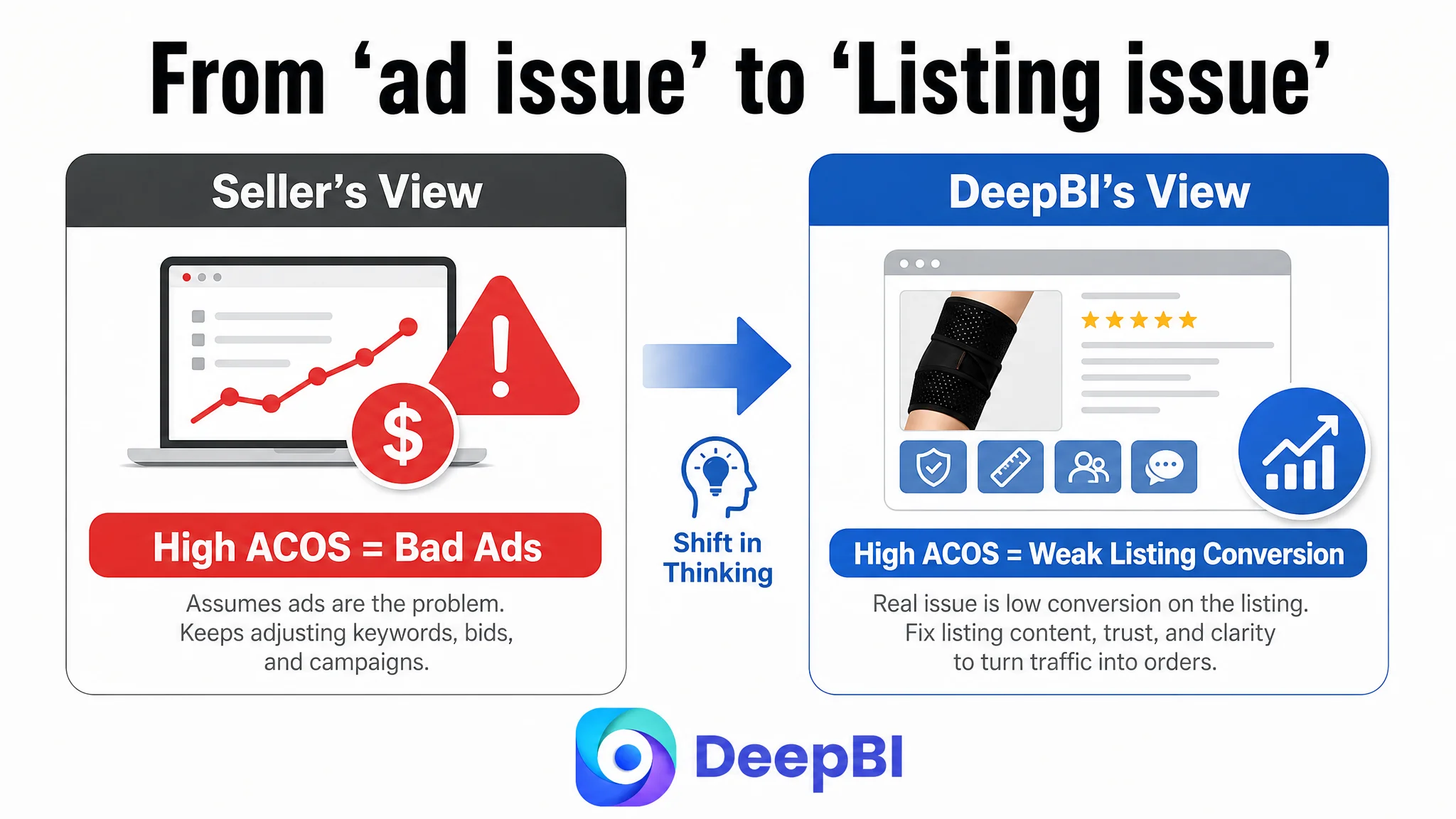
This Amazon seller in the sports and health accessories category came to DeepBI with a familiar pressure: Amazon ads were getting expensive, clicks were limited, and the product page for an elbow support brace was not turning traffic into orders. The team’s instinct was to keep tuning keywords and bids, assuming the issue was purely an advertising problem.
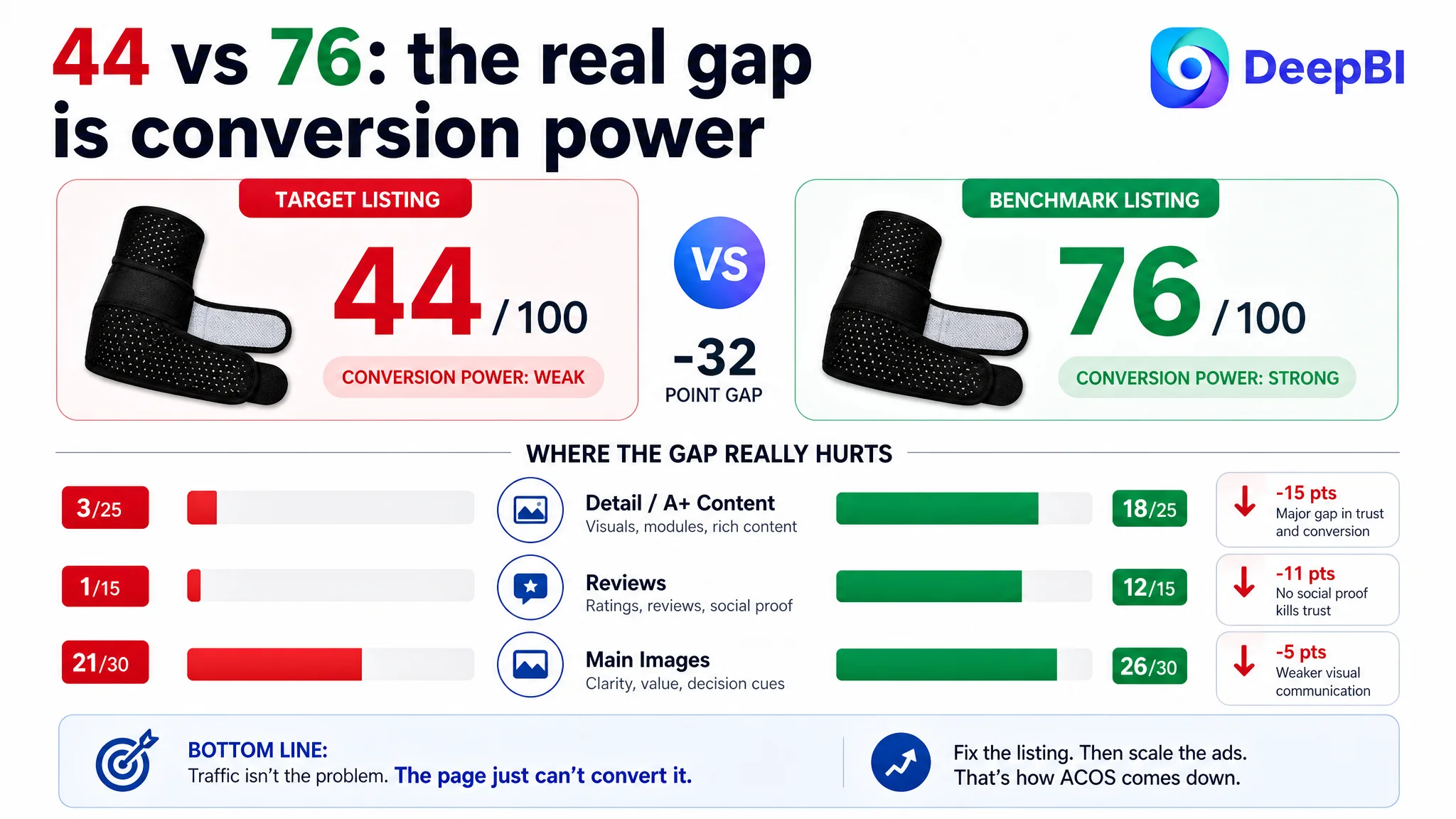
DeepBI’s Listing scoring and competitor benchmark told a very different story. Against a leading Amazon arm & elbow compression sleeve, the target Listing scored only 44/100 versus 76/100. The real gap was not in traffic volume, but in the page’s ability to convert: no A+ images, no reviews, weak visual logic, and a main image set that failed to confirm basic things like “2-pack included” or “Will this fit my arm?”.
Once the problem was reframed as a Listing conversion bottleneck instead of an ad-optimization issue, the optimization path changed completely. The priority shifted to rebuilding the Amazon product page—title, bullet points, main images, and A+—around clear value (2-pack), adjustable support logic, sizing clarity, and trust. Only after that did it make sense to send more ad traffic.
For other Amazon sellers, this case is a reminder: when ACOS is high and ads “don’t work”, the real leak is often that the Listing has no conversion engine. Ads are not failing; they are amplifying a page that cannot persuade.
The Core Conflict: Traffic Was There, Conversion Capacity Was Not
From the seller’s perspective, the first visible symptom was simple:
- Ads were running, but orders stayed low.
- Any attempt to increase spend pushed ACOS into an unacceptable range.
The intuitive judgment inside the team:
- “Our keywords are not accurate enough.”
- “We might need to adjust bids, structure, and targeting again.”
- “Maybe we just need more traffic and more time.”
But once DeepBI ran the Listing scoring and benchmark analysis against a strong Amazon competitor in arm & elbow compression sleeves, a harsher reality surfaced:
- Total Listing score:
- Target Listing: 44/100
- Benchmark Listing: 76/100
- Gap: -32 points
- Dimension breakdown (Target vs Benchmark):
- Title: 14 vs 12 (comparable)
- Main Image: 21 vs 26 (-5)
- Bullet Points: 5 vs 8 (-3)
- Detail / A+ Content: 3 vs 18 (-15)
- Reviews: 1 vs 12 (-11)
Title was not the main problem. The real constraint was clear: the page could not build trust or guide a purchase at all.
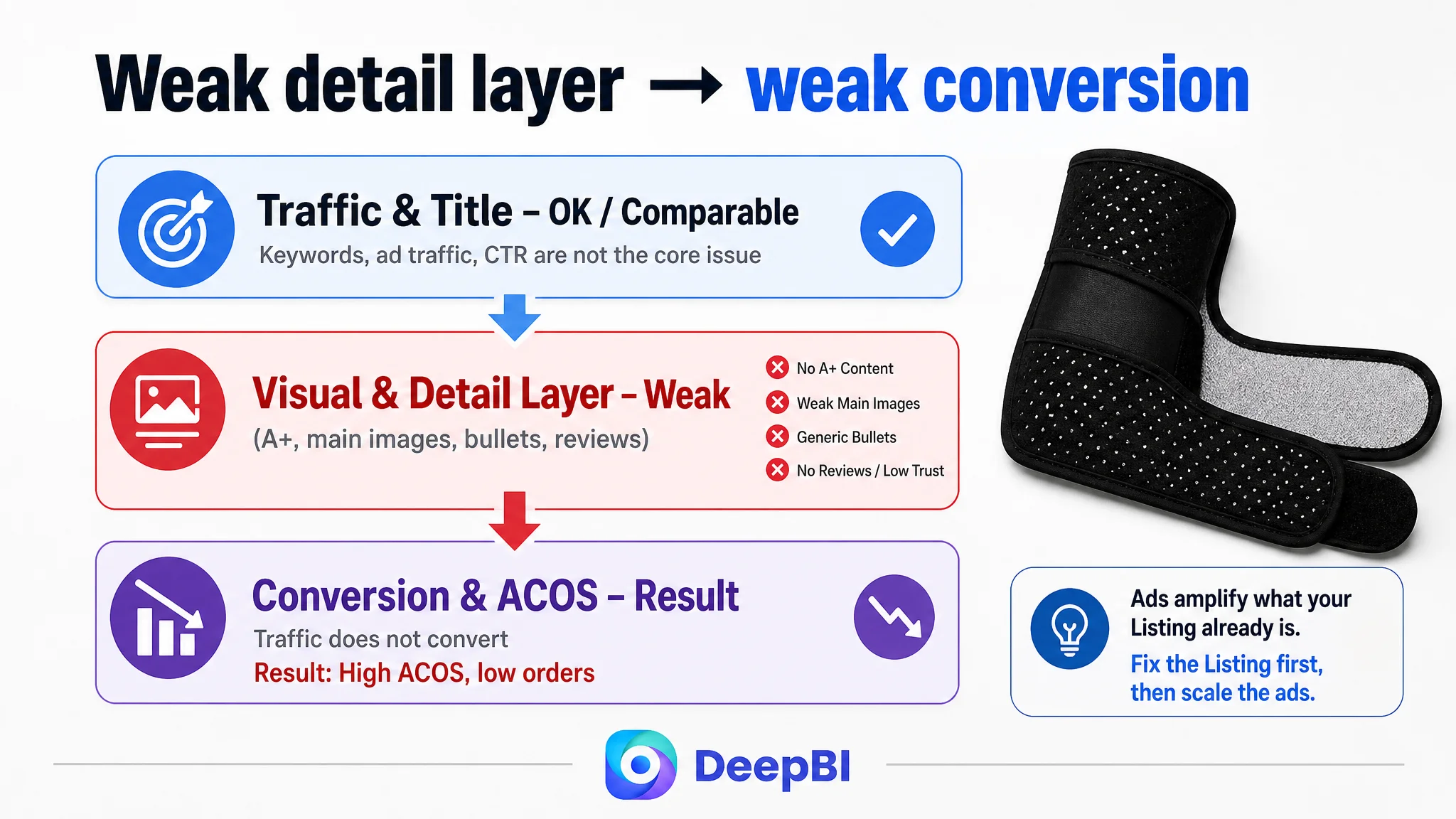
“The real problem was not that ads failed to bring traffic. It was that the page could not convert the traffic.”
With no reviews, no A+ visuals, and no clear visual decision path, every click from Amazon ads landed on a page that had almost no chance of turning into an order—no matter how precisely the traffic was targeted.
How the Seller Originally Misdiagnosed the Problem
What they believed
Internally, the seller’s thinking was typical of many Amazon teams:
- High ACOS → “Our ads are inefficient.”
- Low order volume → “We need more exposure and better keyword coverage.”
- Weak sales → “Maybe pricing or category competition are the core issues.”
Because the title already contained many keywords (“elbow support”, “compression”, multiple sports and injury terms), the team assumed:
- “Our Listing is good enough; the problem must be the campaigns.”
This led to a loop of:
- Repeated keyword reshuffling
- Bid adjustments
- Campaign restructuring
But none of these could change one hard fact: The Listing had 0 reviews, 0 A+ visual content, and a weak main-image logic.
Why traditional ad optimization kept failing
From DeepBI’s perspective, the business logic was broken:
- Ads drove traffic into a page with no social proof (0 reviews vs competitor’s 4.4 stars and 4,560 reviews).
- There was no sizing clarity on images or A+ to remove the “Will this fit me?” risk.
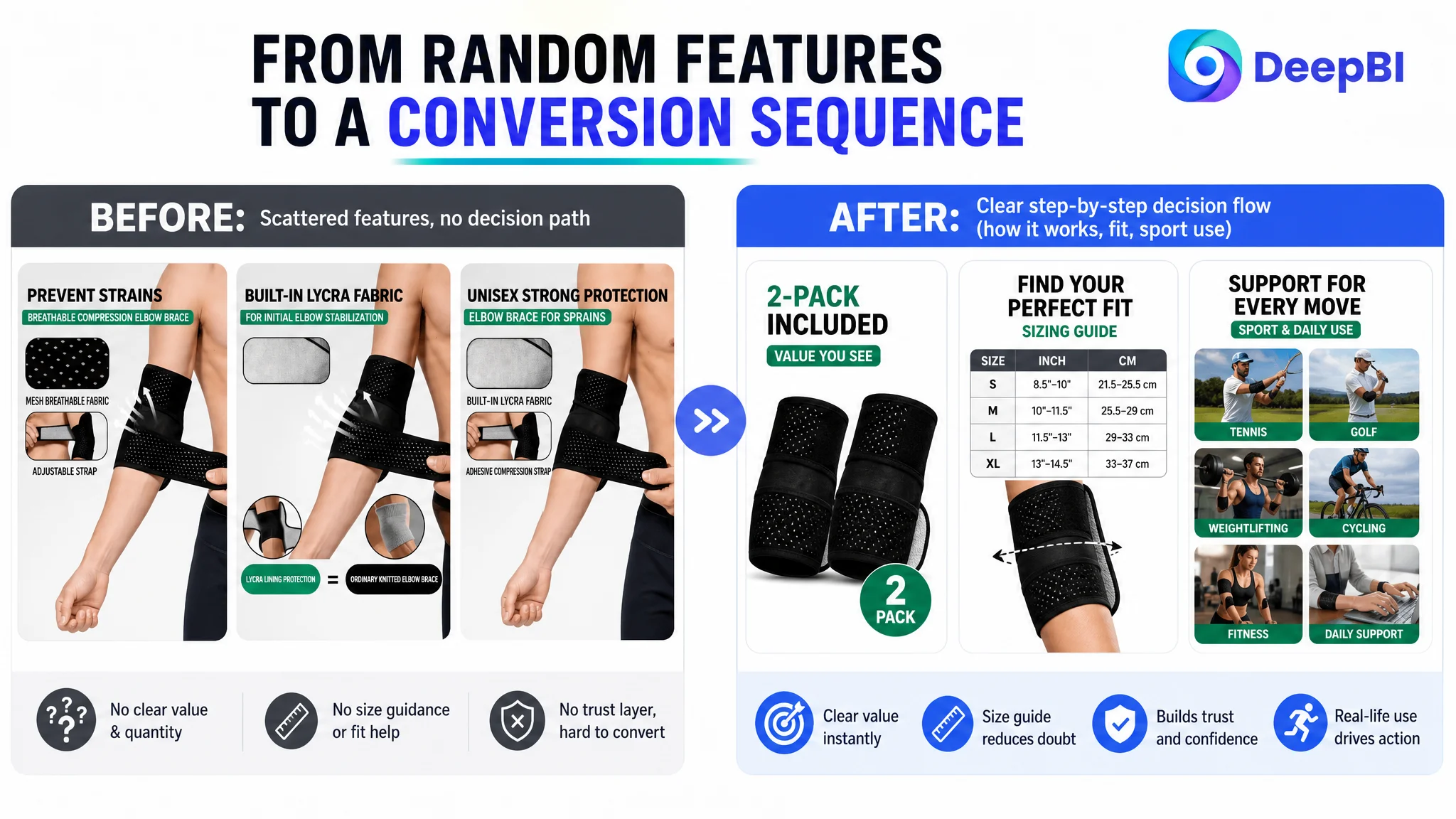
- The main image set did not visually confirm the 2-pack offer shown in the title.
- The bullet points contained generic functional statements, not a real pain-point-to-solution path.
Under these conditions, every attempt to “optimize ads” was just:
- Sending more expensive traffic
- Into a page that lacked basic trust and clarity
- And watching ACOS stay high
Advertising was not the lever to pull at this stage. Listing conversion capacity was.
Listing Data Abnormalities DeepBI Uncovered
The scoring and benchmark analysis highlighted specific structural weaknesses.
1. Reviews: A Total Trust Void
- Target Listing:
- 0 reviews, 0 rating
- Benchmark Listing:
- 4.4 stars, 4560+ reviews, rich text feedback, images, and “Helpful” interactions
This meant:
- A shopper comparing both pages would see one with strong social proof and one that looked untested.
- Even if the product itself was solid, the Amazon product page communicated zero real-world validation.
Business implication: Until some form of trust signal existed (content, visuals, perceived professionalism), ad traffic would keep bouncing.
2. Detail / A+ Content: Almost Nonexistent
- Target: 3/25 points
- No A+ images
- Only repeated text, unstructured, no visual story
- Benchmark: 18/25 points
- Multiple high-resolution product photos
- Consistent style, clear view of material, design, and multi-color options
This gap was not cosmetic; it was commercial:
- Without A+ images, the seller could not:
- Show real wearing scenarios
- Explain adjustable support visually
- Clarify sizing and fitting
- Map sports/injury scenarios to product benefits
Shoppers had to “imagine” everything—and many simply left.
3. Main Images: Information But No Decision Logic
The target Listing’s image set had content, but not a conversion pathway:
- No clear 2-pack confirmation in the first image
- Early focus on secondary benefits (Lycra comfort) before explaining the core adjustable strap function
- Repetitive focus on breathable mesh without progressing the buying logic
- No dedicated sizing guide image
- No clear sports scenario validation (e.g., someone actually playing golf or tennis with the brace on)
By contrast, the benchmark Listing used images to:
- Confirm what you get
- Show how it fits
- Connect to sports usage
- Reduce risk (“Will it fit?”, “Is it comfortable?”, “Is it stable in motion?”)
“Advertising does not only amplify advantages. It can also amplify a page’s existing defects.”
Here, ads were amplifying a missing trust structure.
The Real Constraint: Listing Conversion Capacity, Not Ads
Based on the scoring and benchmark, DeepBI’s core judgment was:
- The bottleneck is not traffic volume or bid strategy.
- The bottleneck is that the Listing cannot earn trust or guide a decision.
In numbers:
- Title: Roughly competitive (14 vs 12). Not the main lever.
- Main Image, A+, Reviews: Deep deficits that directly affect CVR.
From a business-decision standpoint, this forced a reframing:
- Wrong question: “How do we lower ACOS through better ads?”
- Right question: “Is this Amazon product page ready to receive more traffic at all?”
The answer at that moment was no.
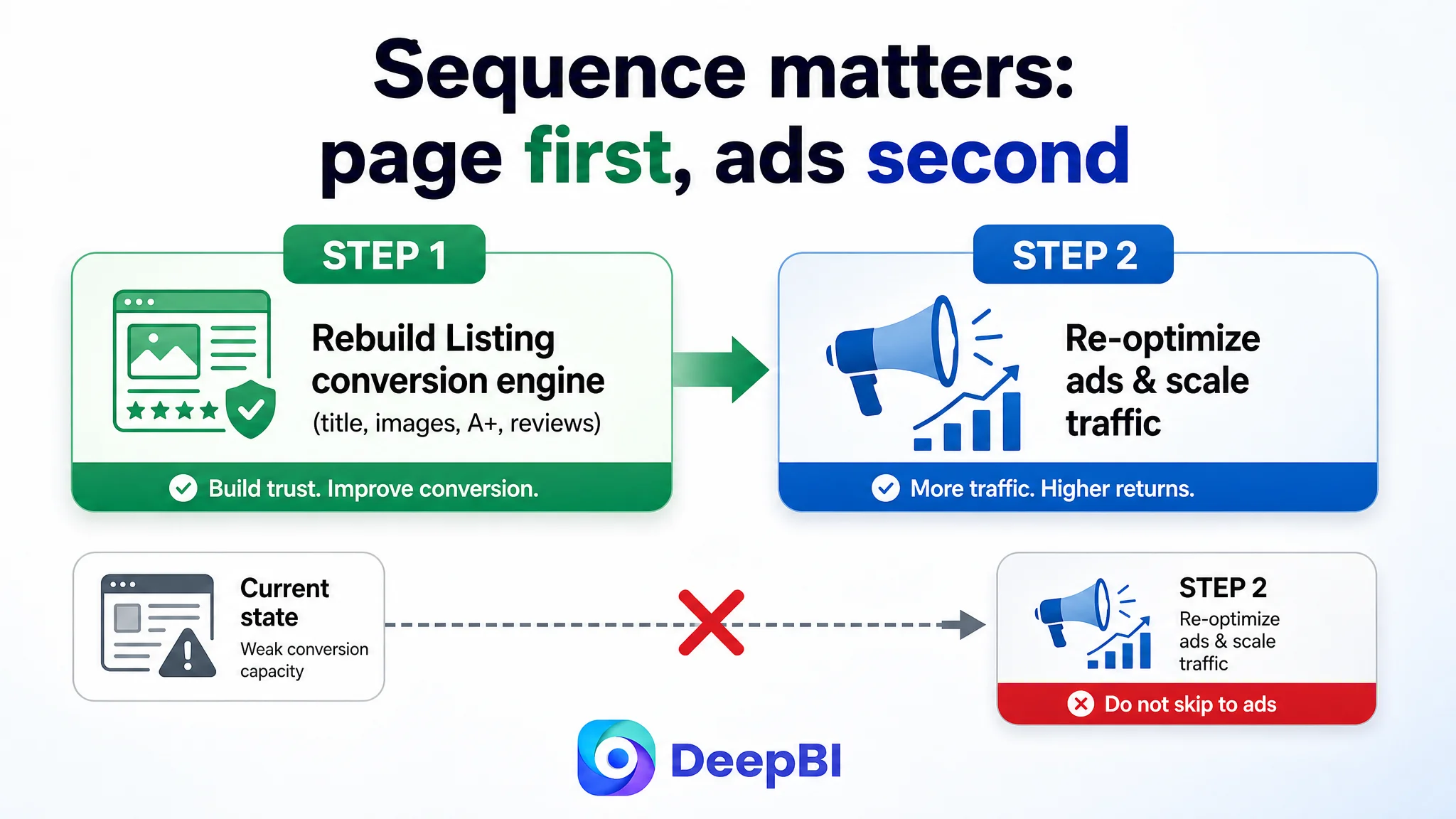
So the priority sequence changed:
1. Fix the product-page conversion engine first.
2. Then, let ads re-test performance on a stronger Listing.
Why DeepBI Did Not Keep Tuning Ads First
Continuing to optimize ads before repairing the Listing would have meant:
- More tests at the campaign level with no structural change in CVR.
- Ongoing spend to “prove” again and again that a zero-review, A+-empty page does not convert well.
- Increased dependence on deep discounts or aggressive pricing to compensate, further eroding margins.
From a risk perspective:
- Each extra dollar in ad spend was being deployed into a page that could not reciprocate.
- The brand was training itself to believe “this product doesn’t work on Amazon,” when in reality the page was never allowed to work.
DeepBI’s judgment was:
- Fix the page’s sales logic first:
- Confirm what you get
- Show how it works
- Prove it fits
- Connect to clear pain relief
- Build perceived professionalism and value
Only after that would ad optimization have a real chance of lowering ACOS and stabilizing TACOS.
How the Page’s Sales Logic Was Rebuilt
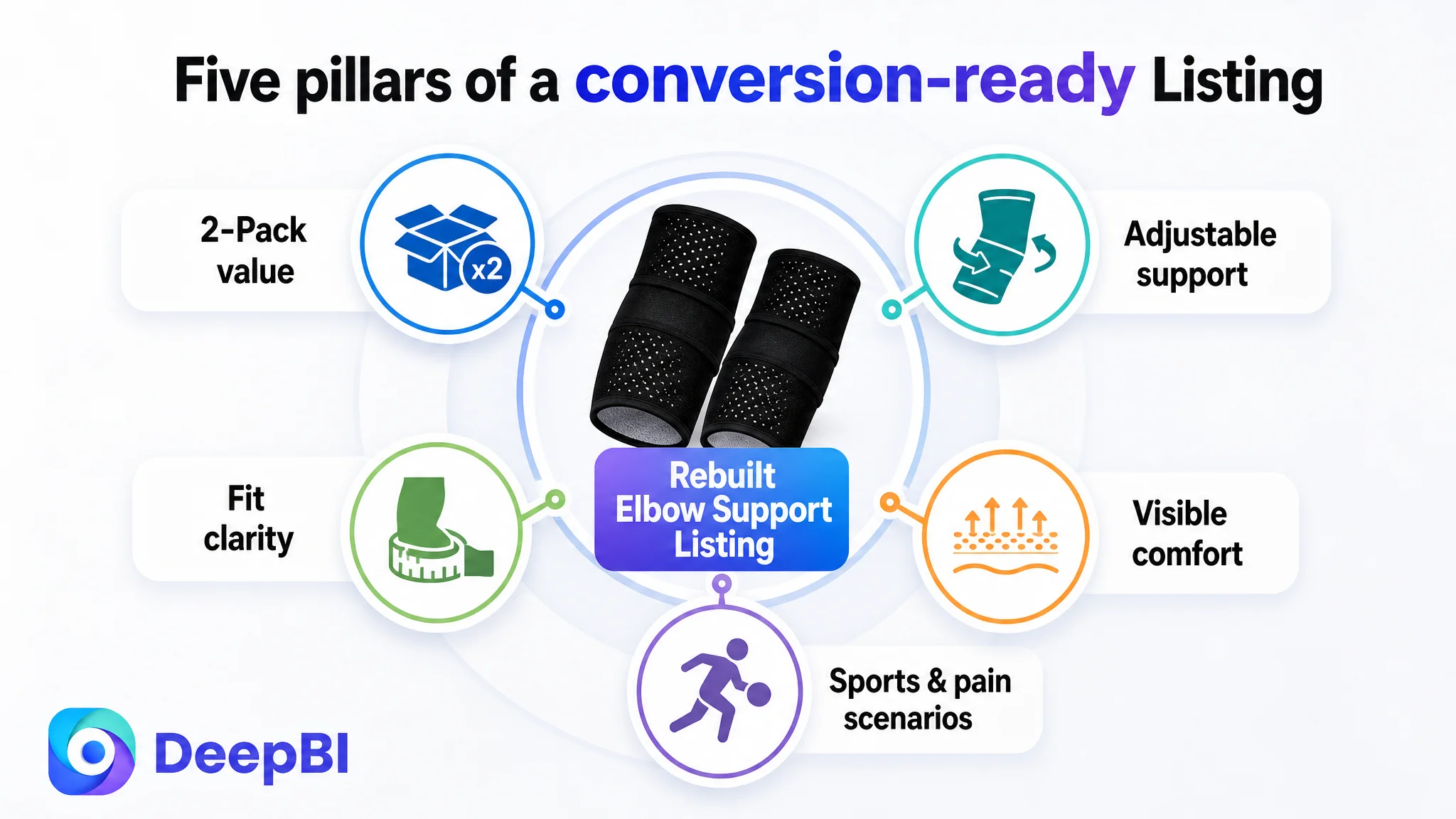
DeepBI’s optimization focused on aligning every visible element—title, bullets, images, and A+—around a few non-negotiable pillars:
- Confirm the 2-pack value up front
- Explain adjustable, custom support as the main differentiator
- Reduce fit risk with sizing clarity
- Translate “breathable material” into comfort you can picture
- Map to specific pain points and sports scenarios
1. Title: From Keyword Pile to Structured Promise
Original title issues:
- Core keyword “Elbow Support” appeared early but was wrapped in a near-keyword-stuffing structure.
- Listed 7+ sports and injuries in one messy string, weakening readability.
- Repeated words like “fitness,” lowering keyword efficiency.
- Missed clear, high-intent signals like “2-Pack” and “Unisex”.
Recommended title direction:
Adjustable Elbow Support Compression Sleeve 2-Pack for Tendonitis, Tennis & Golfer’s Elbow Relief, Unisex Arm Braces for Weightlifting, Fitness, Pain Relief & Injury Recovery, Black
Key shifts:
- Core search terms (“Adjustable Elbow Support”, “Compression Sleeve”) moved into a strong front position.
- “2-Pack” explicitly added, aligning title promise with later visual confirmation.
- Unisex added to broaden appeal without new SKUs.
- Symptom keywords (“Tendonitis”, “Tennis Elbow”, “Golfer’s Elbow”) used as high-conversion long-tail anchors, not random filler.
This did not suddenly fix CVR alone, but it aligned search intent, product promise, and page content.
2. Bullet Points: From Flat Features to Pain–Solution Logic
Original bullets were mainly:
- Generic function statements (“support and protection”, “breathable material”)
- Weak emotional and risk framing
- Little sense of a user journey from pain to relief to confident purchase
Benchmark bullets, in contrast, used:
- Emotion (“Best gift”)
- Specific pain language (tennis elbow, tendonitis)
- Technical reassurance (pressure balance, no-risk return)
DeepBI rebuilt the bullets as a conversion path:
1. Lead with pain relief, not generic protection
- “Effective elbow pain relief”
- Explicitly naming tennis elbow, tendonitis, golfer’s elbow, joint inflammation
- Framing the brace as both protection and recovery support
2. Convert material into comfort logic
- “Breathable mesh & optimal compression”
- Explaining that perforated mesh = cool and dry, not just “breathable”
- Stressing balanced compression: stable but not circulation-blocking
3. Highlight adjustability as the differentiating mechanic
- “Adjustable custom fit”
- Emphasizing the binding strap as the answer to imperfect fit issues common in fixed sleeves
- Guaranteeing it stays in place without restricting motion
4. Anchor to real-life scenarios
- “Versatile for sports & work”
- Covering tennis, golf, baseball, weightlifting, plus long computer work
- Showing that this is not a niche brace, but a daily-use helper
5. Make the 2-pack feel like a decision advantage
- “2-pack value & universal design”
- Bilateral support or one-as-backup logic
- Left-right universal fit and gift framing for active friends/family
Result: The bullet section stops being a pile of features and becomes a compressed sales conversation.
3. Main Image Set: From Disconnected Pictures to a Decision Flow
DeepBI redefined roles for the main images instead of treating them as five isolated assets.
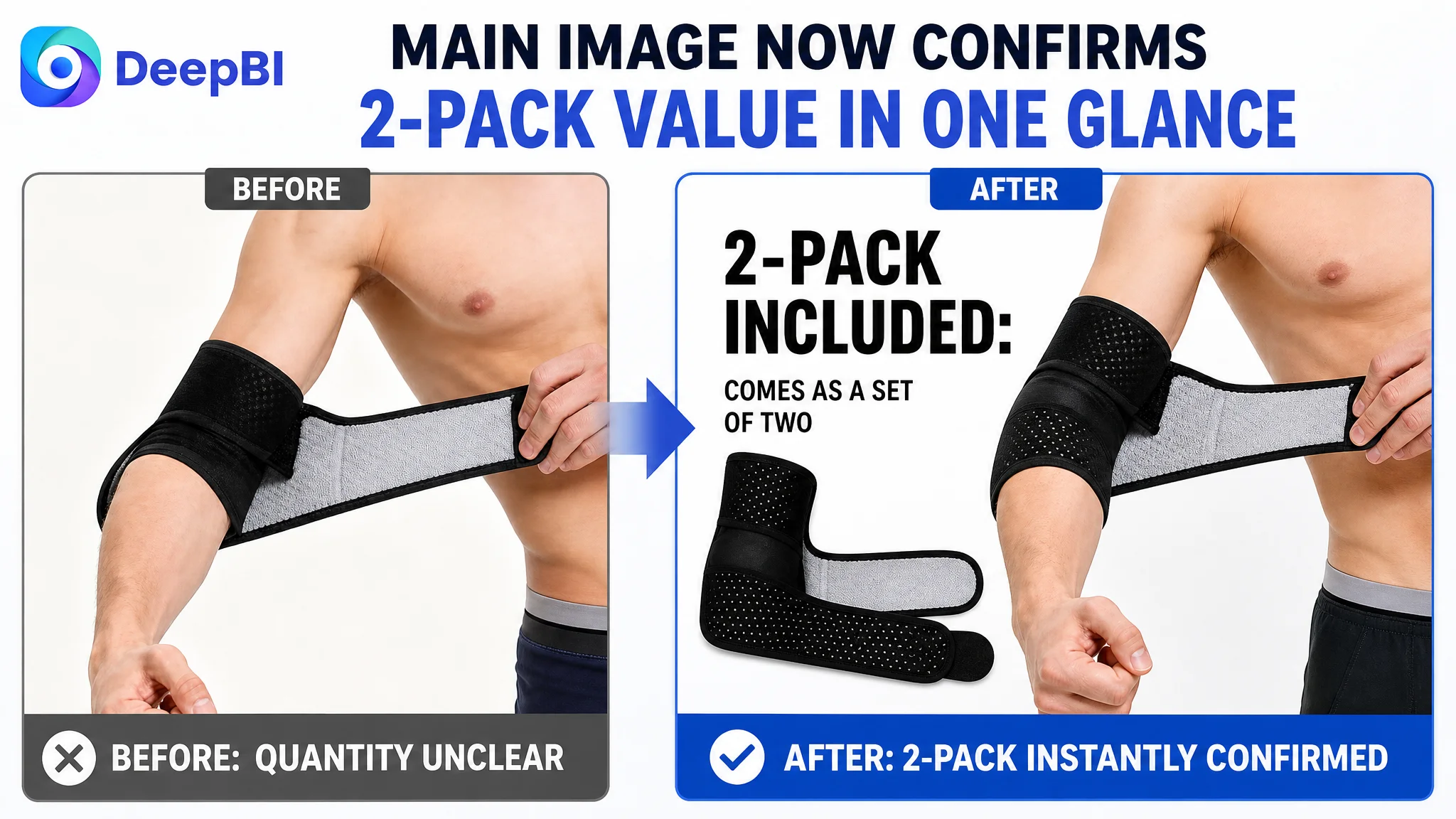
Image 1: “What am I buying?” — 2-Pack Confirmation & First Trust Point
- Show two braces together clearly (not just implied by text).
- Keep one brace worn on a model arm; place the second in a clean product layout nearby.
- Add minimal, clear overlay text confirming “2-Pack Included”.
Impact: They see quantity and feel immediate value; no ambiguity between single vs pair.
Image 2: “How does this actually work?” — Core Feature Deep Dive
- Split view:
- Phase 1: Arm with sleeve only
- Phase 2: Same arm with adjustable strap fully engaged
- Arrows and labels explaining:
- “Adjustable binding strap”
- “Targeted pressure on elbow/forearm”
- “Customizable support”
Impact: The adjustable strap stops being a decorative band and becomes the main reason to choose this product.
Image 3: “Will it fit me?” — Sizing Risk Reduction
- Replace redundant fabric/mesh image.
- Add a clear sizing guide:
- Model arm in measurement pose
- Arrow pointing to the correct measuring point (elbow circumference)
- Chart with S–XL, in both inch and cm
Impact: A major purchase blocker—fit anxiety—is addressed before the shopper scrolls, lowering returns and abandonment.
Image 4: “Can I really use this in my sport?” — Scenario Validation
- Use the slot for sports immersion, not abstract graphics:
- For example, a model holding a golf club, brace visible
- Show natural movement and range of motion
- Tie directly to title claims like “Golfer’s Elbow”.
Impact: This turns “suitable for golf” from a text claim into a visual proof, anchoring sports usage in the shopper’s mind.
Image 5: “Will it be comfortable all day?” — Comfort & Versatility
- Highlight:
- Perforated mesh close-up
- Adjustable strap detail
- Add small icons for key scenarios: running, cycling, fitness, office.
- Short overlays around “Breathable for all-day wear”, “Stable support during daily activities”.
Impact: Completes the decision chain: from what it is, to how it works, to whether it fits, to how it behaves in real life.
Rebuilding the A+ Detail Page Into a Conversion Engine
At the start, the target Listing had no A+ images at all—only repeated text.
DeepBI’s view: in a competitive Amazon environment, this is equivalent to operating without a second half of the sales page.
The A+ was redesigned as a sequence of seven modules, each solving a specific doubt.
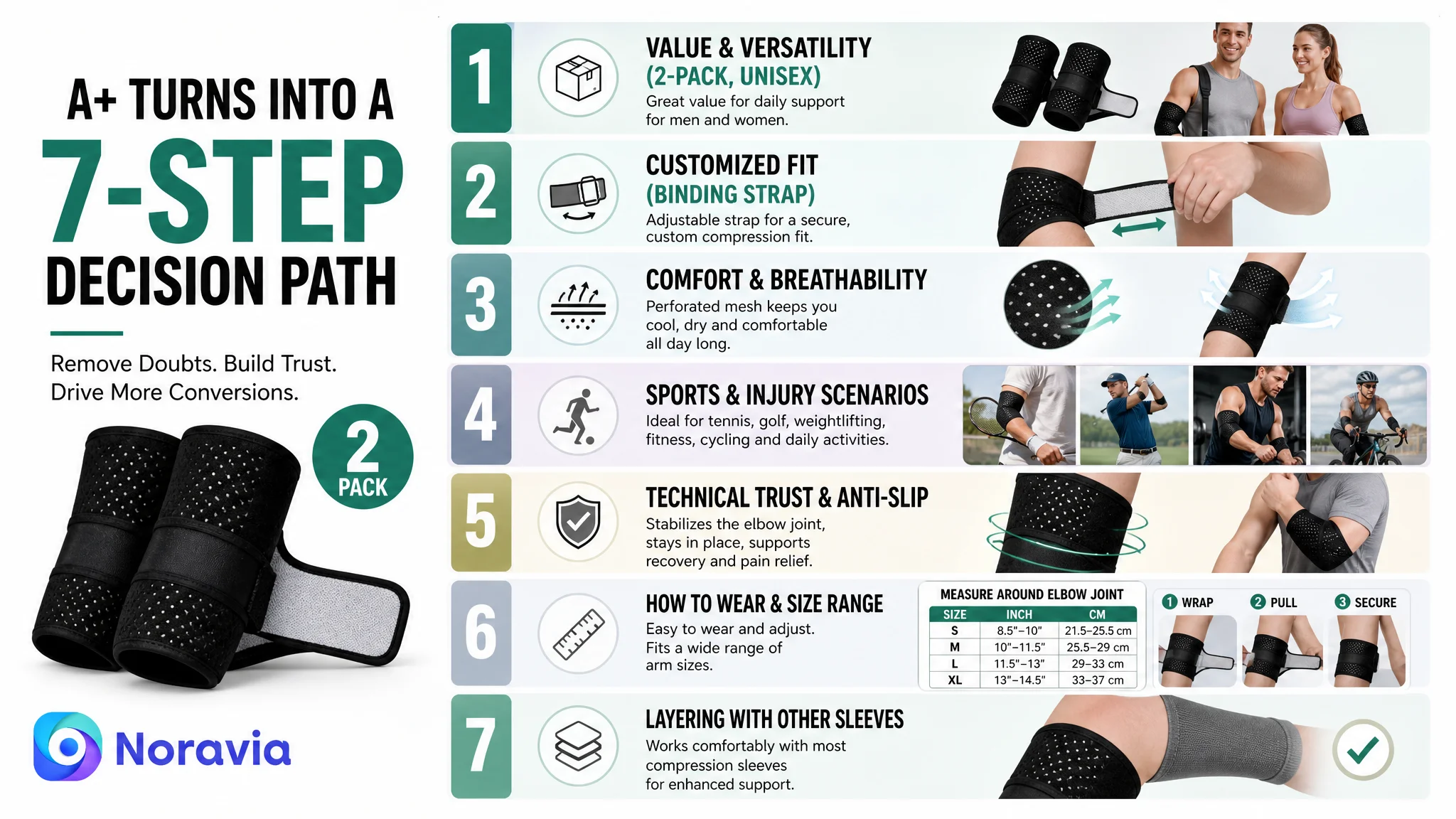
Module 1: Value & Versatility Entry
- Show the 2-pack visually as the opening statement.
- Reinforce:
- “2-Pack Included”
- Unisex design
- Left/right arm compatibility
Role: Instantly anchors value and flexibility before going into technical details.
Module 2: Customized Fit as the Core Mechanism
- Focus on the adjustable binding strap.
- Explain that many fixed sleeves fail due to imperfect fit.
- Position this product as the answer to “one-size doesn’t fit me”.
Module 3: Comfort & Breathability Decision Node
- Dedicated module around perforated mesh material.
- Visualize airflow and moisture management.
- Tie back to common worries: “Will it be hot? Will it itch?”
Module 4: Deep Applicability & Injury Prevention
- Map sports and daily activities (golf, tennis, running, fitness, cycling) to:
- Pain relief for tendinitis, arthritis, sprains, and strains
- Injury prevention logic for repetitive movements
Role: Expands the product from niche to multi-scenario helper.
Module 5: Technical Trust & Anti-Slip Verification
- Close-ups of:
- Strap construction
- Stitching
- Material durability
- Copy confirms:
- Stabilization
- Pain-relief support
- Anti-slip behavior during motion
Module 6: Usage & Size Clarity
- Step-by-step illustrations of:
- How to wear the sleeve
- How to wrap and adjust the strap
- Reinforce that it fits a wide size range because of adjustability.
Module 7: Differentiation via Layering Compatibility
- Confirm it’s compatible with most compression sleeves.
- Position it as both:
- A standalone brace
- A stackable layer for those already using other sleeves and needing targeted extra support
Overall effect: The A+ stops being an empty area and becomes a structured argument for why this brace is worth buying and keeping.
What Changed Once Conversion Was Addressed First
The case does not rely on fabricated numbers. Instead, the focus is on how the operating state and business risk changed once the Listing was rebuilt before scaling ads.
Data & Funnel Changes (Qualitative)
- The page gained:
- Clear 2-pack validation
- A defined pain-relief narrative
- Sizing clarity
- Credible visuals for sports and daily use
This means:
- CVR had a realistic path to improve, instead of being capped by structural page defects.
- ACOS had room to move down, because each ad click now landed on a page with:
- Better clarity on what is sold
- Lower perceived risk
- Stronger perceived value
Traffic Structure & Risk
Before:
- Overdependence on ads just to test whether the product could sell.
- No organic conversion foundation; even if organic clicks came, the page had no trust infrastructure to capture them.
- Every new dollar of ad budget faced the same low-conversion environment.
After:
- A more balanced funnel, where both organic and paid traffic can be converted by the same stronger Listing.
- Reduced risk that ads are amplifying a broken page.
- A foundation where reviews, once accumulated, can compound the effect of the improved visuals and copy.
Understanding Inside the Seller Team
The most important shift was not graphical; it was conceptual:
- Ads were no longer seen as the universal solution to weak sales.
- The team understood that:
- Amazon ads cannot fix a trustless page.
- Listing quality is the base layer of ACOS and TACOS control.
- Title, main images, bullets, and A+ content must work as a single logic chain.
Before launching or scaling campaigns, the new internal question became:
“Does this Amazon product page deserve more traffic yet?”
That is the real leverage Amazon sellers can draw from this case.
What Other Amazon Sellers Can Take Away
This elbow support case is not unique to sports accessories. The pattern appears across categories:
- High ACOS blamed on “bad ads”
- Continuous campaign tweaking that ignores page-level conversion leaks
- Listings with:
- Thin or missing A+
- Weak main-image logic
- Zero or low reviews
- Generic, non-pain-based bullets
From DeepBI’s perspective, the key lessons are:
1. Score the Listing before blaming the ads.
If title is acceptable but A+, images, and reviews are far behind competitors, ads are not your first battlefield.
2. Treat images as a decision sequence, not decoration.
Each slot (main image, secondary images, A+ modules) needs a job: confirm value, explain function, reduce risk, validate scenarios, build trust.
3. Translate material and features into felt outcomes.
“Breathable mesh” is just a property; “cool and dry during long matches” is a buying reason.
4. Fix conversion capacity before scaling spend.
Ads will magnify whatever your page already is—whether that is trust or doubt.
5. Make “Is this Listing ready for more traffic?” a standard checkpoint.
Only when the answer is “Yes” should you let Amazon ads carry your next round of growth.
In this case, the real breakthrough did not come from discovering new keywords. It came from admitting that the Amazon product page itself was the bottleneck—and then rebuilding it to finally deserve the traffic it was already getting.